SECTION 3: CASE STUDIES
The Vermont Oxford Network: Evidence-Based Quality Improvement for
Neonatology
Jeffrey D. Horbar, MD
ABSTRACT. The Vermont Oxford Network is a volun-tary collaborative group of health professionals commit-ted to improving the effectiveness and efficiency of med-ical care for newborn infants and their families through a coordinated program of research, education, and qual-ity-improvement projects. In support of these activities, the Network maintains a clinical database of information about very low birth weight infants that now has more than 300 participating neonatal intensive care units (NICUs). We anticipate that these NICUs will submit data for 25 000 infants with birth weights of 401 to 1500 g born in 1998.
The research program of the Network includes out-comes research and randomized clinical trials. The goal of Network outcomes research is to identify and explain the variations in clinical practice and patient outcomes that are apparent among NICUs. Network trials are de-signed to answer practical questions of importance to practitioners and families using pragmatic designs that can be integrated into the daily practice of neonatology. Quality improvement is a major focus of the Network. Members receive confidential quarterly and annual re-ports based on the Network database that document their performance and compare practices and outcomes at their unit with those at other units within the Network. These reports are intended to assist the members in identifying opportunities for improvement and to help them monitor the success of their improvement efforts.
Although information is necessary for improvement to occur, it is not sufficient to foster lasting improvement by itself. Information must be translated into action. The Network is sponsoring an ongoing program of quality initiatives designed to provide members with the knowl-edge, skills, tools, and resources needed to foster action for improvement.
The Network’s first formal quality-improvement project, the NIC/Q Project, brought together 10 NICUs to apply the methods of collaborative improvement and benchmarking to neonatal intensive care. Building on the lessons learned in that initial project, the Network now is conducting the Vermont Oxford Network Evidence-Based Quality Improvement Collaborative for Neonatol-ogy, known as NIC/Q 2000. This 2-year collaborative will assist multidisciplinary teams from the 34 participating
NICUs to develop four key habits for improvement: the habit for change, the habit for practice as a process, the habit for collaborative learning, and the habit for evi-dence-based practice. During the collaborative, partici-pants will contribute to a knowledge bank of clinical, organizational, and operational change ideas for improv-ing neonatal care.
The coordinated program of research, education, and quality improvement described in this article is only possible because of the voluntary efforts of the members. The Network will continue to support these efforts by developing and providing improved tools and resources for the practice of evidence-based neonatology. Pediatrics 1999;103:350 –359; neonatology, very low birth weight, database, network, quality improvement, evi-dence-based medicine, randomization, trials, outcomes, mortality, length of stay.
ABBREVIATIONS. NICU, neonatal intensive care unit; NICHD, National Institute of Child Health and Development; LOS, length of stay; OR, odds ratio; CI, confidence interval; SMR, standardized mortality ratio; NIC/Q, Neonatal Intensive Care Collaborative Quality (Project); PDSA, Plan-Do-Study-Act; CAT, critically ap-praised topic.
T
he Vermont Oxford Network was establishedin 1989 with the goal of improving the effec-tiveness and efficiency of medical care for newborn infants and their families through a coor-dinated program of research, education, and quality-improvement projects. This article will describe the Network and its activities, with a particular focus on the Vermont Oxford Network Evidence-based Qual-ity Improvement Collaborative for Neonatology.
The Vermont Oxford Network is a nonprofit cor-poration supported by membership fees, grants, and contracts. The basic philosophy of the Network is to integrate research into daily practice by designing simple, pragmatic studies that are compatible with the demands of busy health professionals and rele-vant to the questions that arise in daily practice.1Our
philosophy is based on the concepts developed by Ian Chalmers, Adrian Grant, and co-workers at the National Perinatal Epidemiology Unit in Oxford, En-gland. The Network has adopted these ideas and, in so doing, gained the cooperation and allegiance of neonatologists, neonatal nurses, and other profes-sionals who volunteer their time and effort to partic-ipate in the Network. They are motivated both by a desire to contribute to new knowledge regarding newborn medicine and to have access to comparative From the Department of Pediatrics, University of Vermont College of
Med-icine, Burlington, Vermont, and the Vermont Oxford Network, Burlington, Vermont.
Dr Horbar is the Executive Director of the Vermont Oxford Network. Received for publication Sep 9, 1998; accepted Sep 9, 1998.
Address correspondence to Jeffrey D. Horbar, MD, Professor of Pediatrics, Department of Pediatrics, University of Vermont College of Medicine, Medical Alumni Building, Burlington, VT 05401.
Network data that allows them to evaluate their own performance and that of their NICU.
VERMONT OXFORD NETWORK DATABASE
The Vermont Oxford Network maintains a data-base including information for all infants with birth weights of 401 to 1500 g born at member institutions or admitted to them within 28 days of birth (before 1996, only infants weighing 501 to 1500 g were in-cluded).2,3The database provides information for use
in outcomes and epidemiologic research, serves as the core data source for Network trials, and is used to provide comprehensive individualized reports to participating hospitals that serve as the foundation for local quality-improvement projects and peer re-view. The database is a unique source of information regarding clinical practices and patient outcomes for high-risk infants and is successfully supporting the mission of the Network. It has generated numerous scientific presentations, reports, and publica-tions.1,2,4 –16
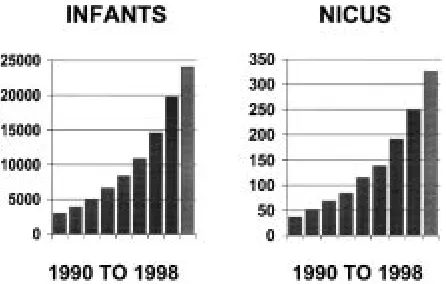
The database has grown dramatically during the past 9 years (Fig 1). In 1990, the first full year of database operations, 36 hospitals submitted data for
;3000 very low birth weight infants. The Network now has more than 300 member NICUs. In 1998, we anticipate collecting data for close to 25 000 very low birth weight infants. This will include .50% of all very low birth weight infants born in the United States in that year. The Network currently is per-forming a pilot project designed to evaluate the fea-sibility of data collection for all NICU admissions, regardless of birth weight. We anticipate introducing this expanded database to our members over the next 2 years.
RANDOMIZED CLINICAL TRIALS
An important component of the Vermont Oxford Network’s mission is to generate new knowledge and evidence for practice by performing randomized controlled trials. The Network clinical trials program is directed by Roger F. Soll, MD. Network trials are supervised by steering committees composed of Net-work members and are monitored by appointed data safety committees. Investigators from member
insti-tutions volunteer their time and effort to perform the trials.
The first Network multicenter trial compared two surfactants for the treatment of neonatal respiratory distress syndrome.7,17This trial enrolled.1200 very
low birth weight infants at 38 Network sites. It achieved results comparable to those of a smaller trial of similar design performed by the National Institute of Child Health and Development (NICHD) Neonatal Research Network, a grant-supported net-work of academic research centers.18 The surfactant
trial was an excellent choice for the first Vermont Oxford Network trial, because it did not involve an experimental therapy. Both of the surfactants studied were available commercially at the time the trial was performed, allowing the investigators to focus on the mechanics of trial participation including identifying eligible subjects, obtaining informed consent, ran-domizing assignment of treatments, and collecting trial data. The successful completion of the surfactant trial demonstrated the willingness and capability of volunteer Network investigators to perform large, high-quality randomized trials at a low cost.
The Network currently is completing a random-ized trial to determine whether corticosteroid treat-ment within 12 hours of birth decreases mortality and chronic lung injury for infants weighing,1000 g at birth. The trial, with a planned sample size of 800 infants at more than 40 centers, is a major milestone for the Network, because it requires the pharmacies at participating sites to prepare coded vials of med-ication and to dispense them according to a locally maintained randomization lists. The pharmacists at these institutions are volunteering their time and effort and receive no financial support from the Net-work. The participation of pharmacists at each site will allow the Network to perform a wide range of masked drug trials. It provides additional evidence of the commitment and ability of member hospitals to integrate research into the daily practice of neona-tal intensive care.
The Network now is preparing to begin a trial of skin care for the prevention of nosocomial infection in extremely low birth weight infants (William H. Edwards, MD, Principal Investigator; Jeannette Con-nor, MS, MN, ARNP, Co-investigator, Dartmouth Hitchcock Medical Center). The primary goal of the study is to evaluate the impact of Aquaphor Original emollient ointment treatment during the first 2 weeks of life on the incidence of mortality and/or nosocomial bacterial sepsis for infants with birth weights of 501 to 1000 g. The premise of this trial is that skin breakdown and the resulting loss of integ-rity of the skin barrier lead to an increased risk of nosocomial infection. Data from one small trial sug-gest that this may be the case.19 The Network trial
will enroll 800 infants and have sufficient power to detect a 10% absolute risk reduction (from 40% to 30%) in the combined rate of nosocomial infection or death in the target population.
Network trials are part of a coordinated strategy of research and quality improvement. Both the early corticosteroid trial and the skin care trial have direct
links to Network quality-improvement projects de-scribed below in this article.
OUTCOMES RESEARCH
Dramatic variations in clinical practice and patient outcomes have been observed in a wide variety of medical settings.20 Practices and outcomes vary
among different physicians, geographic regions, and health care institutions. The goal of outcomes re-search is to identify and explain these variations. The Vermont Oxford Network Database demonstrates the presence of substantial variation among individ-ual NICUs with respect to mortality, morbidity, and length of stay (LOS) for very low birth weight in-fants. Analyzing this variation, both over time and among different NICUs, has served as a focus for outcomes research in the Network.
The database has been used to evaluate the effect of antenatal steroid treatment on patient out-comes5,6,9; to identify trends in morbidity, mortality,
and clinical practices during the 1990s21; and to
de-termine patient and hospital characteristics associ-ated with the mortality risk.8Studies are in progress
concerning delivery room resuscitation practices,22
the effects of intrauterine growth retardation on mor-bidity and mortality for premature infants, and the association of different levels of NICU care with outcomes.
Network studies of antenatal corticosteroid treat-ment provide a good example of the how the data-base can be used for outcomes research and how the results of this research can be applied. In February 1994, the National Institutes of Health convened the Consensus Development Conference on the Effect of Corticosteroids for Fetal Maturation on Perinatal Outcomes.23,24The Consensus Development Panel, in
preparation for this conference, invited several orga-nizations with neonatal databases to provide data for presentation. The organizations (Burroughs Well-come, the NICHD Neonatal Research Network, Ross Laboratories, and the Vermont Oxford Network) worked together to develop a common analytic plan and format for presentation.6
During 1991 and 1992, 73 centers participated in the Network database. These centers submitted data for 8908 infants with birth weights of 501 to 1500 g. After excluding infants with missing data (n 5 32) and those who died in the delivery room (n 5127), the final sample for analysis included 8749 infants.5
Seventy-four percent of these infants were not ex-posed to any antenatal corticosteroid treatment, 7.5% were exposed to partial treatment (delivery ,24 hours or .1 week after the last dose of maternal steroid treatment), and 18.5% were exposed to a complete course of treatment (delivery between 24 hours and 1 week of the last dose of maternal steroid treatment). A logistic regression analysis showed that any corticosteroid treatment (partial or com-plete) was associated with reductions in the risks of death within 28 days of birth (odds ratio [OR]50.55; 95% confidence interval [CI]: 0.45 to 0.64), respira-tory distress syndrome (OR5 0.62; 95% CI: 0.56 to 0.70), intraventricular hemorrhage (OR 5 0.71; 95% CI: 0.59 to 0.76), and severe intraventricular
hemor-rhage (OR 5 0.60; 95% CI: 0.45 to 0.69). Antenatal corticosteroid exposure was associated with an in-creased risk of necrotizing enterocolitis (OR5 1.32; 95% CI: 1.08 to 1.60). There was no statistically sig-nificant association with the risk of sepsis (OR 5 1.10; 95% CI: 0.93 to 1.20). The results of this analysis were consistent with those of the other organizations presenting data to the Consensus Development Panel.6
Broad recommendations regarding the use of an-tenatal corticosteroids for women at risk for preterm delivery are justified by the evidence from random-ized trials alone.25However, because neonatal
inten-sive care practices have changed dramatically since the trials were conducted and because additional further trials are unlikely to be performed, the obser-vational data provided by the Vermont Oxford Net-work and the other participating organizations added supplementary evidence of value for the panel to use in its deliberations.
Additional Network research has shown that an-tenatal corticosteroid use has increased steadily since 1990. The overall percentage of infants weighing 501 to 1500 g in the Network Database exposed to any antenatal corticosteroid therapy increased from 19% in 1990 to 34% in 1993.9During that period,
increas-ing year of birth, prenatal care, inborn location of birth, and multiple birth were associated with a higher likelihood of antenatal corticosteroid expo-sure, whereas black race and small size for gesta-tional age were associated with a lower likelihood of exposure.
Antenatal corticosteroid treatment has continued to increase in subsequent years. In 1996, the median rate of antenatal corticosteroid treatment for infants weighing 501 to 1500 g at 191 Network hospitals was 66%.16 However, there was substantial variation in
these rates among hospitals. The one quarter of the hospitals with the highest rates had rates .76%, whereas the one quarter with the lowest rates had rates of#56%. It is likely that hospitals in the upper quartile for antenatal corticosteroid treatment rates are now providing treatment to most eligible women, whereas those in the lowest quartile still could increase their treatment rates.
Preliminary analyses of the database presented in abstract form indicate that mortality rates for infants weighing 501 to 1500 g have decreased steadily since 1991 in association with the increased use of antena-tal corticosteroids.21 There have been a number of
other changes in obstetric and neonatal practice, as well as changes in the expectations of physicians and parents during that period that could account for this observation. However, the evidence suggests that the increase in antenatal corticosteroid treatment for women at risk for preterm delivery is one important contributing factor. If that is the case, then it may be that as treatment rates increase to the point that all or most eligible women are receiving antenatal cortico-steroid treatment, the observed decline in mortality will slow or level off.
useful reports for the members. These reports are intended to help the members identify areas in which they have opportunities for improvement. To do this, the reports must compare “apples to apples,” ac-counting for differences among NICUs in case mix. Examples of areas in which Network research has led to better reporting are mortality and LOS.
Figure 2 shows the standardized mortality ratio (SMR) for 191 NICUs in the Network database in 1996. The SMR is the ratio of the number of observed deaths at an NICU to the number of deaths predicted based on the characteristics of the patients treated at the NICU. Values.1 indicate that there were more deaths than would have been predicted based on the characteristics of the patients, whereas values ,1 indicate that there were fewer deaths than would have been predicted.
The number of predicted deaths for each NICU is calculated using a multivariate logistic regression model that accounts for differences among NICUs in the types of patients they treat. The predictor vari-ables are gestational age (weeks); gestational age squared (weeks2); major birth defect (yes, no); size
for gestational age (,10% percentile, $10% percen-tile); multiple birth (yes, no); 1-minute Apgar score (1 to 10); gender; race/ethnicity (black, Hispanic, white, other); location of birth (inborn, outborn); and deliv-ery by cesarean section (yes, no). All these variables are based on factors occurring before or immediately after birth and are not influenced by treatments re-ceived in the NICU. The model performs and fits the data well (area under the ROC curve 0.88; Hosmer– Lemeshow goodness of fit statistic with 8 degrees of freedom, 4.70; P50.79).
Two features of the data in Figure 2 are worthy of note. First, after accounting for differences in case mix, some units have significantly fewer deaths than expected, whereas others have significantly more
deaths than expected. Previous analyses of Network data using similar models have shown that there is more variation in mortality rates among units than can be explained by differences in case mix or chance.8 Of course, it is possible that some of the
unexplained variation could be attributable to risk factors for which we have not adjusted. Second, as indicated by the wide CIs, the estimates of the SMR for individual NICUs are relatively imprecise. This is because the number of very low birth weight infants treated at an individual NICU in a given year is small. The median number of infants weighing 501 to 1500 g treated at Network centers is approximately 80 per year. Estimates of the SMR based on samples of that size will always be relatively imprecise.
Figure 3 shows the risk adjusted total LOS for survivors at the 177 North American NICUs in the Network in 1996. The risk adjusted total LOS is the geometric mean of the total LOS before discharge home (including stays at hospitals to which infants were transferred before going home) calculated us-ing analysis of covariance. This measure can be in-terpreted as estimating what the mean total LOS would have been had the individual NICU treated a group of infants with risk factors similar to those for the Network population as a whole.
The predictor variables used to estimate total LOS are birth weight (grams); assisted ventilation (IMV or high frequency: yes, no); respiratory distress syn-drome (yes, no); bacterial sepsis on or before day 3 (yes, no); major surgery (yes, no); 1-minute Apgar score (1 to 10); size for gestational age (,10th per-centile, $10% percentile); transfer status (not trans-ferred, transferred for surgery, transferred other); delivery by cesarean section (yes, no); location of birth (inborn, outborn); gender; race/ethnicity
Fig 2. The SMR at 191 NICUs participating in the Vermont Ox-ford Network in 1996. The SMR is the ratio of the number of predicted deaths to the number of observed deaths for infants weighing 501 to 1500 g. The number of predicted deaths is calcu-lated for each NICU using a logistic regression model that in-cludes terms for gestational age (weeks); gestational age squared (weeks2); major birth defects (yes, no); size for gestational age
(,10th percentile, $10 percentile); multiple birth (yes, no); 1-minute Apgar score (1 to 10); gender; race/ethnicity (black, Hispanic, white, other); location of birth (inborn, outborn); and cesarean section (yes, no). The 95% CI for the estimated SMR is shown as a vertical bar. (Reprinted with the permission of the Vermont Oxford Network.)
(black, Hispanic, white, other); and major birth de-fect (yes, no). The analysis including hospital as a covariate had an R2of 0.73.
Similar to the mortality data, the LOS data also demonstrate dramatic variation among NICUs after adjusting for differences in case mix. The adjusted total stays range from,40 days to.75 days. We do not understand why this tremendous variation ex-ists, but we intend that by reporting these data to the NICUs, they will begin to identify opportunities for reducing LOS where appropriate. As with the SMR data, it is possible that some of the unexplained variation in LOS is attributable to risk factors that we have not measured.
The data for mortality and LOS are examples of the widespread variations in practice and outcomes that are observed at Network NICUs. Similar variation can be seen for most of the outcomes and practices that we monitor. This suggests that there are sub-stantial opportunities for improvement yet to be achieved.
QUALITY IMPROVEMENT
The database forms the cornerstone of the Net-work’s continuous quality-improvement efforts. The first step in using the Network database for this purpose is transforming the data into useful infor-mation. The database includes several million indi-vidual data items. These must be analyzed and the results synthesized and reported in a way that mem-bers can use to understand and assess their perfor-mance easily. Network reports are designed with these principles in mind.
Participating hospitals receive confidential quar-terly and annual reports using the database to doc-ument their performance, identify trends over time, and compare performance to the Network as a whole. Reports include data on birth weight-specific incidence rates, as well as risk adjusted mortality, morbidity, and LOS. Birth weight strata provide ho-mogeneous risk categories for reporting on morbid-ity and practice interventions. Network reports to members include figures similar to those for mortal-ity and LOS shown above, which allow them to identify their own individual NICU. Of course, they cannot identify any of the other NICUs. This enables units to compare their risk-adjusted mortality and LOS with those in the rest of the Network.
A new reporting feature will be added to the Net-work reports in 1998. In addition to comparing units with the Network as a whole, we also will compare them with subgroups of NICUs providing a level of medical and surgical services similar to their own. Development of the system for classifying NICUs into these subgroups is the subject of ongoing re-search in the Network. This is an example of applied outcomes research at work and demonstrates further the relationship between research and quality-im-provement activities in the Network.
Feedback of comparative, risk-adjusted practice and outcome information is crucial to supporting continuous quality-improvement efforts. However, although information is necessary, by itself it is not sufficient to foster lasting improvement. The
infor-mation must be interpreted; opportunities for im-provement identified; and appropriate change con-cepts developed, implemented, monitored, and maintained. In other words, information must be transformed into action. This requires knowledge, tools, skills, and resources for improvement. The Vermont Oxford Network is sponsoring an ongoing program of quality-improvement initiatives to help members achieve the necessary knowledge and skills and to develop the relevant tools. These initiatives include the Neonatal Intensive Care Collaborative Quality (NIC/Q) Project, and the Vermont Oxford Network Evidence-based Quality Improvement Col-laborative for Neonatology, otherwise known as NIC/Q 2000.
THE NIC/Q PROJECT
During the past 3 years, we have applied a team approach to health care improvement with the goal of improving the effectiveness and efficiency of neo-natal intensive care. The NIC/Q Project uses a col-laborative model of quality improvement and bench-marking that was developed originally by industry and is now being applied successfully to health care.26 –30
The major components of the project are 1) multi-disciplinary collaboration within and among hospi-tals; 2) feedback of information from the Network database regarding clinical practices and patient out-comes; 3) training in quality-improvement methods; 4) site visits to project NICUs; 5) benchmarking visits to superior performers within the Network; 6) iden-tification and implementation of “potentially better practices”; and 7) evaluation of the results. The project, involving 10 Network NICUs, has been funded by grants from the Center for the Future of Children of the David and Lucile Packard Founda-tion, and has been performed in collaboration with the Rand Corporation. The participating institutions in the NIC/Q Project are listed in Appendix I.
Since January 1995, teams from these hospitals have worked together in cross-institutional improve-ment groups and participated in an intensive series of large group meetings, site visits, and conference calls. They have chosen quality indicators, formed subgroups related to specific indicators, performed detailed process analyses and literature reviews, and participated in site visits to each other as well as to superior performers identified using the Network database. Based on these activities, the subgroups have developed a series of “potentially better prac-tices,” which now are being implemented. The data-base is being used to monitor their impact.
The initial improvement goals chosen by the NIC/Q Project sites were a reduction in nosocomial bacterial infection for infants weighing 501 to 1500 g and reduction in chronic lung disease or death for infants weighing 501 to 1000 g. Chronic lung disease is defined as oxygen supplementation at 36 weeks’ postconceptional age. Six NICUs focused on reduc-ing nosocomial infection; four units focused on re-ducing chronic lung disease.
the year before the beginning of the project, and 1996, the year after implementation of the “potential-ly better practices” had begun.31 The overall rate of
nosocomial infection at the six NICUs in the infection subgroup declined from 26.3% in 1994 to 20.9% in 1996 (P 5 0.007). The rate of supplemental oxygen administration at 36 weeks for infants weighing 501 to 1000 g decreased from 43.5% in 1994 to 31.5% in 1996 (P50.03) at the four NICUs in the chronic lung disease subgroup. There was significant variation among NICUs with respect to the whether improve-ment occurred and the magnitude of improveimprove-ment achieved within both subgroups. The improvements observed at the NICUs in these subgroups as a whole were significantly larger than were the changes ob-served at the 66 other Vermont Oxford Network centers in North America that participated in the Network, but not in the NIC/Q Project, from 1994 to 1996. A full report of the NIC/Q Project results is in preparation.
We are now building on the results of the original NIC/Q Project to create “The Vermont Oxford Net-work Evidence-based Quality Improvement Collab-orative for Neonatology.” This project will run for a 2-year period, ending in the year 2000. It will be called NIC/Q 2000 to acknowledge its roots in the approaches developed during the first NIC/Q Project.
NIC/Q 2000
Our goal in the NIC/Q 2000 project is to create and evaluate an Evidence-based Quality Improvement Collaborative for Neonatology. The specific aims of the collaborative are:
1. to make measurable improvements in the quality and cost of neonatal intensive care,
2. to develop new knowledge, tools, and resources for quality improvement in neonatology, and 3. to disseminate the knowledge, tools and resources
to the professional community.
The ideas and materials developed during NIC/Q 2000 will contribute to an evolving knowledge bank maintained by the Vermont Oxford Network (Fig 4). This knowledge bank will include clinical informa-tion; a new archive of clinical, organizational, and operational “better practices” and change concepts; a set of tools for improvement studies; and simple data collection instruments useful in the quality-improve-ment process. Our goal is to make this resource widely available to all interested in improving the quality of medical care for newborn infants.
The collaborative will assist multidisciplinary teams from 34 participating Network hospitals de-velop four key habits for clinical improvement: the habit for change, the habit for clinical practice as a process, the habit for collaborative learning, and the habit for evidence-based practice.32The four key
hab-its were conceptualized by Paul Plsek, a recognized leader in the field of quality improvement in health care, who served as the facilitator and consultant to the original NIC/Q Project and will serve a similar role in NIC/Q 2000. Multidisciplinary teams from
participating hospitals will apply the four key habits to the continuous improvement of neonatal intensive care.
THE HABIT FOR CHANGE
The habit for change does not come naturally to individuals or organizations, yet it is the critical foundation on which improvement efforts must be built. The habit for change includes several compo-nents: identifying local leaders and champions for change; preparing the organization for change and fostering the specific skills, tools, and methods nec-essary to develop change ideas; and to test and im-plement them successfully.
There must be a sense of urgency for change.33
Individuals must understand why change is neces-sary. This requires strong internal champions for change who have a vision of what improvement can achieve and the skills to communicate that vision to everyone involved. Without leadership, change that results in significant improvement will not occur. In the NIC/Q 2000 collaborative, each organization will form a core leadership team consisting of two to four key individuals in the NICU who will have the over-all responsibility for preparing their organization for change. The collaborative will assist the members of the leadership teams in developing the necessary skills.
The collaborative will use a new organizational assessment survey as a way of helping teams to understand their organization’s unique culture and to prepare for change. This survey tool, specific to the NICU environment, is being developed and tested in conjunction with Ross Baker, PhD, an ex-pert in organizational assessment and quality im-provement in health care. The results of the organi-zation survey will be shared with the members of the collaborative so that they can understand how their organization compares with others in the collabora-tive from the perspeccollabora-tive of organizational develop-ment. Throughout the collaborative, participants will work together to identify organizational and
gerial “better practices” that create an organizational environment receptive to change and contribute to accelerated improvement.
The final component of the habit for change in-volves using a simple but proven model for acceler-ated improvement. The model, originally developed by Langley and colleagues, uses a “trial and learn-ing” approach to improvement.34 Teams first must
answer three simple questions:
1. What are we trying to accomplish?
2. How will we know that a change is an improve-ment?
3. What changes can we make that will result in an improvement?
A series of Plan-Do-Study-Act (PDSA) cycles then are used to test and implement the changes. In each individual cycle, specific plans are developed (Plan), the plans are conducted (Do), the results are evalu-ated (Study), and actions are taken based on what has been learned (Act).
As simple as these steps seem, organizations need training and assistance to integrate them into their routine behavior. The Breakthrough Series of the Institute for Health Care Improvement, under the leadership of Donald Berwick, has applied this model successfully in a variety of health care set-tings.35,36 The NIC/Q 2000 collaborative will apply
the model to neonatal intensive care.
THE HABIT FOR CLINICAL PRACTICE AS PROCESS
Productive work is accomplished through process-es.37,38 Yet it is a relatively recent development for
physicians and other health care providers to view medical care as a process. In the past, physicians saw patient care strictly in terms of their own responsi-bility for history-taking, examination, diagnosis, and treatment. Other providers, including nurses, had similarly restricted views. A major advance attribut-able to the introduction of the concepts of continuous quality improvement into health care is the realiza-tion that patient care involves a complex system of interacting components and processes.37–39 Real
im-provement in quality requires an understanding of the total system and how its component parts are interrelated.
There is no doubt that the NICU is a complex system. The care of critically ill, very low birth weight infants requires a large multidisciplinary team and the application and coordination of a broad array of constantly changing technologies. NICU care must be integrated into the complex environ-ment of a modern health care organization with all the competing demands for staffing, scheduling, fi-nancing, and other resources. A major goal of the proposed collaborative is to assist participants in understanding the processes involved in the NICU system. This will be accomplished in a number of ways.
Teams will be taught to describe and think about work in the NICU in process-oriented terms when appropriate: customers, suppliers, hand-offs, bottle-necks, sequence, flow, rework, and so forth. They
will learn to be explicit about the care process through the use of flowcharts, care maps, and other standard documentation tools. Systems thinking will be stressed in a series of large and small group exercises and teaching sessions, using specific exam-ples from participating NICUs. Team members will be helped to realize that processes within a system are interconnected and that when one is changed, others also may be influenced in a chain of intended and unintended consequences.
The crucial importance of measurement, to moni-tor process performance in an ongoing way, will be taught and supported. The database will be the basis for many of the measurements. Additional, simple measurement tools also will be needed, especially with regards to variations in the process of care. The group will receive instruction in the efficient collec-tion, presentacollec-tion, and interpretation of measure-ment data. The data will be used to identify areas of significant practice and outcomes variation. These will include clinical practices and outcomes; organi-zational factors such as leadership, communication, and unit culture; and operational issues related to the efficiency of the care process. Teams will be assisted in distinguishing appropriate variation from
inap-propriate, wasteful, or unintended variation.
Throughout the collaborative, we will foster the habit for clinical practice as process through educa-tion, discussion, and the analysis of real-world NICU examples.
THE HABIT FOR COLLABORATIVE LEARNING
Collaborative learning is another critical skill that requires training and practice. The NIC/Q 2000 project will assist individuals and organizations to develop this key habit. Collaboration will mean cre-ating close working relationships both among the disciplines within an institution as well as among the teams from different institutions. Physicians, nurses, administrators, and allied health personnel all must learn that individuals from other disciplines have knowledge and skills to contribute. The old auto-cratic model in which the physician gives “orders” and others follow will not work. New attitudes and behaviors are required. The working relationships among team members clearly changed over the course of the first NIC/Q Project as new patterns of interaction emerged and individuals developed new roles in the group. The NIC/Q 2000 project will foster this same type of multidisciplinary collabora-tion.
Cross-institutional collaboration has been used successfully in a number of different health care settings.26 –30The Northern New England
Cardiovas-cular Disease Study Group has shown that collabo-ration and site-visiting can be important components of the improvement effort. O’Connor has reported that postsurgical mortality for coronary artery by-pass graft procedures was reduced at a group of Northern New England hospitals that participated in a program involving performance feedback, quality-improvement training, and site-visiting.29A key
the different hospitals. During site visits, the teams were able to observe the routines of daily care in extreme detail. The lessons learned from these site visits lead to substantive changes in the processes and organization of care that were temporally asso-ciated with the decrease in mortality.
Benchmarking has been defined as the search for best practices that lead to superior performance.40
This type of benchmarking, coupled with in-depth process analysis and literature review, was used in the first NIC/Q Project to identify “potentially bet-ter” clinical practices. Multidisciplinary teams in the NIC/Q 2000 collaborative also will participate in benchmarking visits to Network hospitals, not nec-essarily in the collaborative, that have been identified using the database to achieve superior performance with respect to selected indicators. Questions remain about how to translate observations made in bench-marking visits into changes in clinical practice, par-ticularly in cases where scientific evidence is lacking or weak. The knowledge gained during the NIC/Q 2000 collaborative will help answer these questions. A theoretic perspective on benchmarking may be gained by considering the analogy with the role of recombination in biologic evolution. Just as recom-bination is an effective strategy for genetic evolution on rugged fitness landscapes, it also may represent an effective search strategy for other complex adap-tive systems such as evolving medical technologies.41
A critical element of successful cross-institutional collaboration is the open sharing of information about the processes and outcomes of care. There often is reluctance to share such information out of fear that the results could become public or be mis-used by others to gain a competitive advantage. The institutions participating in the NIC/Q Project adopted detailed guidelines regarding sharing of in-formation, confidentiality, and publications. Similar guidelines will be developed for the proposed col-laborative. Agreement with the principle of informa-tion-sharing within the collaborative subject to ap-propriate guarantees of confidentiality will be a prerequisite for participation in the project.
THE HABIT FOR EVIDENCE-BASED PRACTICE
Evidence-based medicine has been defined as “the conscientious, explicit and judicious use of current best evidence in making decisions about the care of individual patients.”42 The practice of
evidence-based medicine requires self-directed learning and the acquisition and application of specific skills. Ev-ery patient encounter creates the need for informa-tion about diagnosis, prognosis, and therapy that then must be applied to make specific decisions that take into account the beliefs and values of the patient and family. In their recent book Evidence-Based
Med-icine, How to Practice and Teach EBM David Sackett
and colleagues have outlined five steps involved in the practice of evidence-based medicine.42These are:
1. form clinical questions so that they can be an-swered,
2. search for the best external evidence,
3. critically appraise the evidence for its validity and importance,
4. actually apply the evidence in clinical practice, and
5. evaluate your performance as a practitioner of EBM.
We plan to incorporate teaching of these steps into the mission of the collaborative as we focus on as-sisting participants in developing the habit for evi-dence-based practice. This will be accomplished in several ways.
Each meeting of the collaborative will include for-mal teaching in the principles of evidence-based medicine using relevant examples from neonatology. The book by Sackett and colleagues will serve as an informal text. Sauve and associates have described the critically appraised topic (CAT), a formal, one-page summary in standard format that records the results of a critical appraisal of the literature.43,44
Re-sources related to the creation of CATs are available from the Center for Evidence-Based Medicine on the World Wide Web (http://cebm.jr2.ox.ac.uk/).
We plan to teach participants in the collaborative how to prepare CATs and encourage each team to submit CATs on a regular basis. These CATs then can be cataloged, indexed, and made available to participants in printed or electronic form. This will encourage evidence-based thinking in daily practice, avoid duplication of effort among teams as they search for and evaluate the evidence, and focus at-tention on areas where formal overviews or random-ized trials are needed.
The collaborative will reinforce the critical ap-praisal of the strength of health care recommenda-tions and the quality of evidence on which the rec-ommendations are based. “Better practice” concepts will be evaluated in relation to the published evi-dence. Participants in NIC/Q 2000 will use formal assessment tools to evaluate the evidence as they develop the habit for evidence-based practice.
Several approaches to grading the quality of evi-dence and the strength of the recommendations have been proposed. The original classification system was developed by the Canadian Task Force on the Periodic Health Examination and later adapted by the US Preventive Services Task Force.45 This rating
system was used by the National Institutes of Health Consensus Panel in formulating and presenting its recommendations for antenatal corticosteroid thera-py.24Participants in the NIC/Q Project used a
mod-ification of this system for assessing the evidence supporting their “potentially better practices.”
Guyatt and colleagues, for the Evidence-based Medicine Working Group, have gone further. They have developed a rating system for health care rec-ommendations based on systematic overviews that integrates three elements: the strength of the evi-dence in the overview; the threshold or magnitude of effect at which the benefit exceeds the risk of the therapy; and the relationships between magnitude of effect, the precision of the estimate of that effect, and the threshold.47
Systematic overviews of neonatal therapies are available in printed and electronic formats.48,49 The
Neonatal Review Group of the Cochrane Collabora-tion is building a growing archive of systematic re-views in neonatal medicine. These can be accessed on the World Wide Web at a site maintained by the NICHD (http://silk.nih.gov/silk/cochrane). Unfor-tunately, there is currently insufficient data concern-ing most clinical practices to support systematic overviews. Participants in the NIC/Q 2000 collabo-rative therefore will often have to rely on less con-clusive evidence.
A major challenge for participants in the collabo-rative will be to identify “potentially better prac-tices” when little high-quality evidence is available in the literature. This situation will occur frequently. Observations made on benchmarking visits must be tempered by the availability of scientific evidence. The NIC/Q centers confronted this problem in the case of nosocomial infection. The benchmarking vis-its to two superior performing sites with low infec-tion rates suggested that early use of central venous lines to avoid skin punctures for blood drawing and intravenous infusions might be responsible for the low rates of infections observed at these sites. These observations led to the hypothesis that improved skin care and increased skin integrity might lead to reduced infection rates. In response, the Network has designed a randomized trial of skin care practices to address this issue and gather the necessary evidence. The chronic lung disease group of the NIC/Q Project confronted a similar issue regarding early therapy with corticosteroids. A literature review and meta-analysis suggested that early steroid therapy reduced the risk of chronic lung disease in very low birth weight infants.50 However, the evidence was
judged insufficient to support routine introduction of this therapy. The group, therefore, recommended participation in the Network randomized trial of early steroids, rather than of implementation of a particular practice. A secondary gain of the collabo-rative will be the identification of questions requiring scientific study and the initiation of the appropriate randomized trials and outcomes studies. The habit for evidence-based practice is a cornerstone of this approach.
PROJECT TIMELINE
Thirty-four institutions currently are planning to participate in the NIC/Q 2000 collaborative. Before the first face-to-face meeting of the collaborative in September 1998, these institutions will form their local project teams, communicate the goals of the project widely within their organizations, administer
the new organizational assessment survey, create an inventory of local measurement and improvement resources, identify areas of excellence and opportu-nity, and experiment with one PDSA cycle of rapid improvement. After the initial meeting, the teams will work together closely for 2 years to identify, test, and implement changes intended to improve the quality of neonatal intensive care. By applying the four key habits for clinical improvement and contrib-uting their improvement knowledge to the continu-ously evolving Network Knowledge Bank, partici-pants in the NIC/Q 2000 collaborative will create a valuable improvement resource that can be dissem-inated to other Network members and the wider professional community.
CONCLUSION
The Vermont Oxford Network is committed to improving the quality and efficiency of neonatal in-tensive care through a coordinated program of re-search, education, and quality improvement. The Network provides the infrastructure for this pro-gram, but it is only through the voluntary efforts of health professionals at the member institutions that its goals can be realized. The Network will continue to support these efforts by providing improved tools and new knowledge for the practice of evidence-based neonatology and the continuous improvement of neonatal intensive care.
APPENDIX I. Participants in the NIC/Q Project Children’s Hospital Medical Center of Akron, Akron, OH Dartmouth–Hitchcock Medical Center, Lebanon, NH Emanuel Children’s Hospital, Portland, OR Fletcher Allen Health Care, Burlington, VT Miami Valley Hospital, Dayton, OH
Milton S. Hershey Medical Center, Hershey, PA
Minneapolis Children’s Medical Center, Minneapolis, MN Parkview Memorial Hospital, Fort Wayne, IN
St. Francis Medical Center, Peoria, IL Wesley Medical Center, Wichita, KS
APPENDIX II. Vermont Oxford Network Staff Gary Badger, MS, Statistician
Paula Beales, Data Processor Joan Briggs, Data Editor
Joseph H. Carpenter, MS, Network Statistician Susan Dyer, Administrative Secretary Gail Ewell, Data Clerk
Jean Fitts, Data Processor
Jeffrey D. Horbar, MD, Executive Director, Database Director Michael Kenney, MS, Statistician
Kathy Leahy, RN, NNP, NIC/Q Projects Coordinator Jerold F. Lucey, MD, President
Nancy Morse, Database Manager David Mortenson, Programmer Ellen Wilhite, Data Editor Ollie Rutherfurd, Programmer
Roger F. Soll, MD, Clinical Trials Director A. Lynn Stillman, Network Administrator
ACKNOWLEDGMENT
I thank Joseph H. Carpenter, MS, for performing the statistical analyses for Figures 2 and 3; Michael Kenney, MS, for creating these two figures; and the Vermont Oxford Network Staff for their dedication to accuracy, timeliness, and quality.
REFERENCES
2. The Vermont–Oxford Trials Network Database Project. The Vermont Oxford Network Database Manual of Operations. Release 3.3. Vermont Oxford Network. Burlington, VT: Vermont Oxford Network; 1997 3. Horbar JD, Leahy KA for the investigators of the Vermont–Oxford
Trials Network. An assessment of data quality in the Vermont–Oxford Trials Network Database. Control Clin Trials. 1995;16:51– 61
4. Horbar JD for the Investigators of the Vermont–Oxford Neonatal Net-work. Antenatal corticosteroid treatment and neonatal outcomes for infants 501 to 1500 grams in the Vermont–Oxford Neonatal Network. Am J Obstet Gynecol. 1995;173:275–281
5. Wright LL, Horbar JD, et al. Evidence from Multicenter Networks on the current use of antenatal corticosteroids in very low birthweight infants. Am J Obstet Gynecol. 1995;173:263–269
6. The Vermont–Oxford Neonatal Network. A multicenter, randomized trial comparing synthetic surfactant with modified bovine surfactant extract in the treatment of neonatal respiratory distress syndrome. Pediatrics. 1996;97:1– 6
7. Horbar JD, Badger GJ, Lewit EM, Rogowski J, Shiono P for the Vermont Oxford Network. Hospital and patient characteristics associated with variation in 28-day mortality rates for very low birth weight infants. Pediatrics. 1997;99:149
8. Horbar JD for the Vermont Oxford Network. Increasing use of antenatal corticosteroid therapy between 1990 and 1993 in the Vermont Oxford Network. J Perinatol. 1997;17:309 –313
9. Vermont Oxford Database Project 1990 Annual Report. Burlington, VT: Vermont Oxford Network; July 1991
10. Vermont Oxford Database Project 1991 Annual Report. Burlington, VT: Vermont Oxford Network; July 1992
11. Vermont Oxford Database Project 1992 Annual Report. Burlington, VT: Vermont Oxford Network; July 1993
12. Vermont Oxford Trials Network 1993 Annual Report. Burlington, VT: Vermont Oxford Network; July 1994
13. Vermont Oxford Neonatal Network 1994 Annual Report. Burlington, VT: Vermont Oxford Network; July 1995
14. Vermont Oxford Network 1995 Database Summary. Burlington, VT: Vermont Oxford Network; August 1996
15. Vermont Oxford Network 1996 Annual Database Summary. Burlington, VT: Vermont Oxford Network; 1997
16. Avorn J. Practice based outcomes research: Crucial, feasible and ne-glected. Pediatrics. 1996;97:113–114
17. Horbar JD, Wright LL, Soll RF, et al. A multicenter randomized trial comparing two surfactants for the treatment of neonatal respiratory distress syndrome. J Pediatr. 1993;123:757–766
18. Nopper AJ, Horii KA, Sookdeo-Drost S, et al. Topical ointment therapy benefits premature infants. J Pediatr. 1996;128:660 – 669
19. Blumenthal D. The variation phenomenon in 1994. N Engl J Med. 1994; 331:1017–1018
20. Horbar JD, Badger G for the Vermont Oxford Network. Decreasing mortality and other trends for infants 501 to 1500 gms (1991–1995). Pediatr Res. 1997; 41:199A. Abstract
21. Finer NN, Horbar JD for the Vermont Oxford Network. Delivery room CPR in premature infants: the Vermont Oxford Network experience. Pediatr Res. 1998;43:173A. Abstract
22. National Institutes of Health. Report of the Consensus Development Con-ference on the Effect of Corticosteroids for Fetal Maturation on Perinatal Outcomes. Bethesda, MD: National Institutes of Health, National Insti-tute of Child Health and Human Development; 1994 (NIH Publication No. 95-3784)
23. NIH Consensus Development Panel on the Effect of Corticosteroids for Fetal Maturation on Perinatal Outcomes. Effect of Corticosteroids for Fetal Maturation on Perinatal Outcomes. JAMA. 1995;273:413– 418
24. Crowley P. Promoting pulmonary maturity. In: Chalmers I, Enkin M,
Keirse MJNC, eds. Effective Care in Pregnancy and Childbirth. Oxford, UK: Oxford University Press; 1989:746 – 64
25. O’Rourke LM. Healthcare Organizations Adapt Benchmarking Tech-niques from Industry to Make Quality Gains. Qual Lett. 1992;4:2–10 26. Plsek PE. Collaborating across organizational boundaries to improve
the quality of care. Am J Infect Control. 1997;25:85–95
27. Patrick M, Alba T. Healthcare benchmarking: a team approach. Qual Manage Health Care. 1994;2:38 – 47
28. O’Connor GT, Plume SK, Olmstead EM, et al. Results of a regional prospective study to improve the in-hospital mortality associated with coronary artery bypass grafting. JAMA. 1996;275:841– 846
29. Mohr JJ, Mahoney CC, Nelson EC, Bataldan PB, Plume SK. Improving health care. III. Clinical benchmarking for best patient care. J Qual Improve. 1996;22:599 – 616
30. Horbar JD, Rogowski J, Plsek PE, et al, for the Vermont Oxford Network NIC/Q Project. Collaborative quality improvement for neonatal inten-sive care. Pediatr Res. 1998;43:177A. Abstract
31. Plsek PE. Quality improvement methods in medicine. Pediatrics. 1999; 103:203–214
32. Kotter JP. Leading change. Why transformation efforts fail. Harvard Business Rev. March–April 1995;59 – 67
33. Langley G, Nolan K, Nolan T, et al. The improvement guide: a practical approach to enhancing organizational performance. San Francisco, CA: Jossey-Bass; 1996.
34. Kilo CM. Improving care through collaboration. Pediatrics. 1999;103: 384 –393
35. Nolan T, Schall MW. Breakthrough Series Guide. Guide to Reducing Delays and Waiting Times. Boston, MA: Institute for Healthcare Improvement; 1996
36. Berwick DM, Godfrey AB, Roessner J. Curing Health Care: New Strategies for Quality Improvement. San Francisco, CA: Jossey-Bass; 1991 37. Deming WE. The New Economics for Industry, Government, Education.
Cambridge, MA: Massachusetts Institute of Technology Center for Ad-vanced Educational Services; 1994
38. Berwick DM. Continuous improvement as an ideal in health care. N Engl J Med. 1989;320:53–56
39. Camp RC. Benchmarking. The Search for Industry Best Practices That Lead to Superior Performance. Milwaukee, WI: ASQC Quality Press; 1989 40. Kauffman SA. The Origins of Order. Self Organization and Selection in
Evolution. Oxford, UK: University Press; 1993:114 –117
41. Sackett DL, Richardson WS, Rosenberg W, Haynes RB. Evidence-Based Medicine. How to Practice and Teach EBM. New York, NY: Churchill Livingstone; 1997
42. Sauve S, Lee HN, et al. The critically appraised topic: a practical ap-proach to learning critical appraisal. Annales CRMCC. 1995;28:396 –398 43. Soll RF, Andruscavage L. Evidence-based quality improvement in
neo-natal and perineo-natal medicine. Pediatrics. 1999;103:215-224
44. US Preventive Task Force. Guide to Clinical Preventive Services. 2nd ed. Alexandria, VA: International Medical Publishing; 1996:861– 862 45. National Health and Medical Research Council. Clinical Practice
Guide-lines. Care Around Preterm Birth. Canberra, Australia: Australian Gov-ernment Publishing Service; 1996:xvii
46. Guyatt HG, Sackett DL, Sinclair JC, et al. User’s guide to the medical literature. IX. A method for grading health care recommendations. JAMA. 1995;274:1800 –1804
47. Sinclair JC, Bracken MB, eds. Effective Care of the Newborn Infant. Oxford, UK: Oxford University Press; 1992
48. Sinclair JC, Bracken MB, Horbar JD, Soll RF. Introduction to neonatal systematic reviews. Pediatrics. 1997;100:892– 892
1999;103;350
Pediatrics
Jeffrey D. Horbar
Neonatology
The Vermont Oxford Network: Evidence-Based Quality Improvement for
Services
Updated Information &
http://pediatrics.aappublications.org/content/103/Supplement_E1/350
including high resolution figures, can be found at:
References
#BIBL
http://pediatrics.aappublications.org/content/103/Supplement_E1/350
This article cites 28 articles, 7 of which you can access for free at:
Subspecialty Collections
http://www.aappublications.org/cgi/collection/neonatology_sub Neonatology
sub
http://www.aappublications.org/cgi/collection/fetus:newborn_infant_ Fetus/Newborn Infant
ne_sub
http://www.aappublications.org/cgi/collection/evidence-based_medici Evidence-Based Medicine
sub
http://www.aappublications.org/cgi/collection/quality_improvement_ Quality Improvement
following collection(s):
This article, along with others on similar topics, appears in the
Permissions & Licensing
http://www.aappublications.org/site/misc/Permissions.xhtml
in its entirety can be found online at:
Information about reproducing this article in parts (figures, tables) or
Reprints
http://www.aappublications.org/site/misc/reprints.xhtml
1999;103;350
Pediatrics
Jeffrey D. Horbar
Neonatology
The Vermont Oxford Network: Evidence-Based Quality Improvement for
http://pediatrics.aappublications.org/content/103/Supplement_E1/350
located on the World Wide Web at:
The online version of this article, along with updated information and services, is
by the American Academy of Pediatrics. All rights reserved. Print ISSN: 1073-0397.