ECO-FRIENDLY CONCRETE
Asst.Prof. Jayalakshmi Dheiveekan
Assistant Professor, Department of Civil Engineering, GSMCOE Balewadi Pune, (India)
ABSTRACT
The Rapid Construction activities has increased in the demand for concrete, which leads to overuse of natural
resource in the manufacture of cement. Hence, conservation of natural resources is necessary. Due to rapid
growth in industrialization large amount of wastes are been generated and the disposal of such waste has been
a problem.To establish the acceptability of various eco-friendly concrete, an experimental study is investigated
on the optimum content of replacing cement and aggregates with biodegradable and environmental friendly
material for the attainment of maximum strength of concrete blocks that contributes to the control of pollution
on the earth. To produce a well-planned concrete construction which can have many sustainable benefits,
various waste materials were used in an innovative manner with the help of IS codes such as IS 10262:2009, IS
383:1970, IS9103:1999 and IS 516:1959 in the present work. In this investigation concrete tested to minimize
the maximum demand for cement and to reduce the cost of construction by replacing the fine aggregate with
saw dust, by using thermocol balls in the place of course aggregate for the making of light weight concrete and
by replacing cement with paper sludge.
I. INTRODUCTION
Energy plays a crucial role in growth of developing countries like India. In the context of low availability of
non-renewable energy resources coupled with the requirements of large quantities of energy for building
materials like cement, the importance of using industrial waste cannot be underestimated and it possess the vital
importance. During the manufacturing process of 1 tons of Ordinary Portland Cement (OPC) we need about 1⅓
t of earth resources like limestone, etc. Further during manufacturing of 1 t of Ordinary Portland Cement an
equal amount of carbon di-oxide is released into the atmosphere. In this Backdrop, the search for cheaper
substitute to OPC is a needful one. Using waste materials for new products is a global trend undergoing rapid
development. This situation has led to the search for new application for these wastes. Their use in concrete is
an interesting alternative.
Accumulating the unmanaged wastes especially in developing countries has resulted to an increasing
environmental concern. The increase in the popularity of using environmental friendly, lightweight construction
materials in building industry has brought about the need to investigate how this can be achieved by benefiting
the environment as well as to maintain the requirements as per the standards. Since a large demand has been
placed on building material industry especially in the last decade owing to the increasing population that causes
a chronic shortage of building materials, the civil engineers have been challenged to convert the wastes to useful
construction materials.
without a large amount of bark has proved to be satisfactory. This does not introduce a high content of organic material that may upset the reactions of hydration
Lightweight concrete can be produced by partially replacing the normal weight coarse aggregate particles with expanded polystyrene granules. The incorporation of thermocol (polystyrene granules) in concrete may provide a satisfactory solution to the problems faced in concrete production.
Paper sludge is a major economic and environmental problem for the paper and board industry. The material is a by-product of the de-inking and re-pulping of paper. In functional terms, paper sludge consists of cellulose fibres, fillers such as calcium carbonate, china clay and residual chemicals bound up with water. The moisture content is typically up to 40%. The material is viscous, sticky, hard to dry, can vary in viscosity and lumpiness.
Most wastes used in this research are currently dumped in the open areas which creates environmental disposal
problem. Disposal of this product waste is again a major problem which we can overcome by utilizing it in an
optimum manner in making concrete.
II
PROPERTIES OF CONCRETE
2.1SAWDUST CONCRETE:
Fig 2.1: Saw dust
Sawdust is a highly variable material with differing particle size, chemical composition, density and colour. It is principally composed of cellulose, hemicelluloses, lignin and extractives.
2.1.1 Workability:
Workability of the concrete decreased as the percentages of saw dust replacement increased. This is due to water absorption of sawdust.
2.1.2 Bleeding:
Conventional concrete shows bleeding. But addition of sawdust in concrete reduces the rate of bleeding due to absorption of water by sawdust. The control of internal bleeding plays an important part in determining the strength of the transition zone between aggregates and the cement paste
2.1.3Compressive strength:
The compressive strength of cubes of the concrete for all mix increases with age of curing and decreases as the saw dust content increases. The optimum replacement level in fine aggregate with saw dust is 3% with river sand.
2.2 THERMOCOL CONCRETE:
Fig 2.2: Thermocol balls 2.2.1Workability:
The workability characteristics of the polystyrene concretes were very different from normal concrete. Compaction by rodding or vibration was not effective owing to the lightweight nature of the mixes and the compressibility of the polystyrene beads. When rodded, the mix was simply displaced from where the tamping rod was inserted, and failed to fill in the hole left by the rod when it was withdrawn. Thus, from this point of view, the mix could be described as „stiff‟ mix. The mixes were also very sticky or cohesive, the cement slurry coating the polystyrene beads was very effective in holding the mix together. Owing to the light weight nature of the mix, it was very easy to displace the mix and move it around, and the mix stuck to anything that it came into contact with – the hand or the mould. The slump test was not carried out as the mixes would not have been properly compacted in the slump cone, and when the cone was lifted, most of the mix would have lifted up with the cone. However, because of the lightweight, cohesive nature of the mixes, they had the ability to stand under their own weight without slumping. The mix shows very less workability without the addition of admixtures. On the addition of admixtures (Rheofit1163 and Micro air) the mix was workable enough to cast the cubes.
2.2.2 Bleeding:
The addition of fly ash reduces the rate of bleeding. Since the fly ash particles are finer than cement particles, they modify the minute space in wet concrete and block the flow of water in the channels and thus reduces the bleeding.
2.2.3 Compressive strength:
The compressive strength of cubes of the concrete for all mix increases with age of curing and also with the increase in density of concrete.
2.3 PAPERSLUDGE CONCRETE
Fig.2.3: Paper Sludge 2.3.1Workability:
Workability of the concrete decreased as the percentages of paper sludge replacement increased. This is due to water absorption quality of paper sludge.
2.3.2Bleeding:
to absorption of water by paper sludge. 2.3.3 Compressive Strength:
The compressive strength of cubes of the concrete for all mix increases with age of curing and decreases as the paper sludge content increases. The optimum replacement level in cement with paper sludge is 10%.
III INVESTIGATION METHODOLOGY:
An experiment investigation was carried out to evaluate the compressive strength of concrete cured at normal curing condition for 3 days, 7 days and 28 days. Sawdust concrete made with 3%, 5%, 7%, 8%,10% replacement with fine aggregate. Thermocol concrete made by replacing coarse aggregates with thermocol balls. Paper sludge concrete made by replacing cement in conventional concrete by 10%, 15%, 20%, 25%, 30%.
LITERATURE
STUDY
MATERIAL
TESTING
MIX
DESIGN
CUBE TESTING
(3,7,28 DAYS)
RESULT
ANALYSIS
COST
ANALYSIS
Water cementitious material ratio was 0.45. The compressive strength of the above ecofriendly mix is tested, their performance is evaluated and compared to find the optimum mix of making ecofriendly concrete.
IV. RESULTS AND DISCUSSIONS:
The compressive strength and the cost for the various trial mixes are analysed and compared with the conventional mix and the optimum mix is suggested.
4.1ANALYSIS OF SAWDUST CONCRETE:
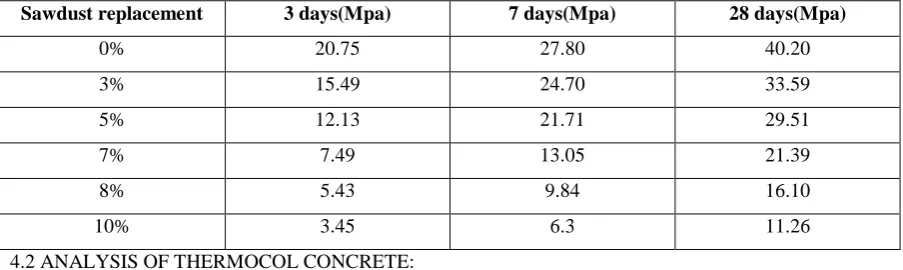
TABLE 4.1. Compressive strength for sawdust concrete
Sawdust replacement 3 days(Mpa) 7 days(Mpa) 28 days(Mpa)
0% 20.75 27.80 40.20
3% 15.49 24.70 33.59
5% 12.13 21.71 29.51
7% 7.49 13.05 21.39
8% 5.43 9.84 16.10
10% 3.45 6.3 11.26
4.2 ANALYSIS OF THERMOCOL CONCRETE:
TABLE 4.2. Compressive strength for thermocol concrete
Concrete
Density(kg/m3)
3 days(Mpa) 7 days(Mpa) 28 days(Mpa)
1250 0.82 1.8 2.42
1410 1.06 1.85 2.84
1650 1.41 3.34 6.45
4.3 ANALYSIS OF PAPER SLUDGE CONCRETE:
TABLE 4.3. Compressive strength for paper sludge concrete
Paper sludge
replacement
3 days(Mpa) 7 days(Mpa) 28 days(Mpa)
0% 20.75 27.80 40.20
10% 6.52 11.67 19.16
15% 4.53 8.52 13.91
20% 2.88 5.17 8.56
25% 1.66 3.59 6.12
30% 1.18 2.4 4.24
For sawdust concrete the optimum mix is by replacing 7% fine aggregate which can achieve compressive strength around 20Mpa. For paper concrete the optimum mix is by replacing 10% of cement which can achieve compressive strength around 20Mpa.
V. CONCLUSION
As per the cost analysis, sawdust concrete remains almost closer to the cost of conventional concrete but the
Beyond 10% replacement, saw dust does not show any increase in strength. Saw dust concrete gives better
result with river sand than crushed sand. Saw dust concrete is recommended for non- structural application like road kerbs, noise barrier, wall panels, floor panels, formwork, partition, filling, nailing purposes. To block the pores a layer of zycosil can be applied.
Strength of thermocol concrete increases with the increase in its density. This concrete is applied in
cladding panels, curtain walls, composite flooring systems, load bearing concrete blocks, floating marine structures, sub base material for pavement.
Replacement of paper sludge beyond 15% shows very poor strength. Water absorption property of paper
sludge depends on amount of organic content present in it. So its organic content can be reduced for better strength. This concrete is applied like noise barrier, wall panel, floor panel, etc.,
REFERENCES
[1.] F.A. Olutoge, Department of civil engineering, University of Ibadan, Ibadan, Nigeria, “Investigations on sawdust and palm kernel shells as aggregate replacement”, vol. 5, no. 4, April 2010 ISSN 1819-6608 Arpn journal of engineering and applied sciences
[2.] Anil Kumar, Akshatha Shetty, Assistant Professor Department of Civil Engineering, NMAMIT, Nitte, Karkala, Karnataka, India, “Strength Characteristics of Concrete Using Paper Sludge Ash and Foundry Sand”, Volume 2, Issue 3, 2016, PP 33-39 ISSN 2454-8693, International Journal of Constructive Research
in Civil Engineering (IJCRCE)
[3.] Zaher kuhail, Samir Shihada, Department of civil engineering, Islamic University, Gaza, Palestine, “Mechanical properties of polystyrene lightweight concrete”, vol.11, No 2,P93-P114,2003,Journal of
Islamic University of Gaza
[4.] Horace K. MooYoung, Thomas F Zimmie, Member ASC , “Geotechnical properties of paper millsludges for use in land fill covers”, Vol122, Issue 9, Sep 1996, Journal of Geotechnical engineering
[5.] Gabriele Fava,Maria Letizia Ruello and Valeria corinaldesi, “Paper mill sludge ash as supplementary cementitious material”, Vol 23, Issue 6, June 2011,Journal of material in civil engineering.
[6.] Daniel Yaw Osei, Emmanuel Nana Jackson, “Compressive Strength of Concrete Using Sawdust as Aggregate”, Volume 7, Issue 4, April-2016 ISSN 2229-5518, International Journal of Scientific &
Engineering Research.
[7.] Paki Turgut Department of Civil Engineering, Harran University, Osmanbey Campus, Sanliurfa, Turkey, “Cement composites with limestone dust and different grades of wood sawdust”, Received 2 October 2006;
received in revised form 27 October 2006; accepted 8 November 2006
[8.] Giedrius vaickelionis, Rrita vaickelioniene Faculty of chemical technology, Kaunas university of technology radvilenu str. 19, 50254 kaunas, Lithuania, “Cement hydration in the presence of wood extractives and pozzolan mineral additives”, Submitted February 4, 2005; accepted March 30, 2006