POSITRON IMPACT IONIZATION PROCESSES IN GASES
A thesis submitted to the University o f London for the degree o f Doctor o f Philosopy
Geraint Owain Jones
ProQuest Number: 10611133
All rights reserved INFORMATION TO ALL USERS
The qu ality of this repro d u ctio n is d e p e n d e n t upon the q u ality of the copy subm itted. In the unlikely e v e n t that the a u th o r did not send a c o m p le te m anuscript and there are missing pages, these will be note d . Also, if m aterial had to be rem oved,
a n o te will in d ica te the deletion.
uest
ProQuest 10611133
Published by ProQuest LLC(2017). C op yrig ht of the Dissertation is held by the Author.
All rights reserved.
This work is protected against unauthorized copying under Title 17, United States C o d e M icroform Edition © ProQuest LLC.
ProQuest LLC.
789 East Eisenhower Parkway P.O. Box 1346
ABSTRACT
The two experiments that are discussed in this work are both studies o f ionization phenom ena in gases.
The m ain body o f the work involved the developm ent o f an experiment to measure the positron impact ionization cross-section o f atomic hydrogen. This experiment utilizes the crossed-beam m ethod wherein a magnetically guided positron beam crosses a diverging jet o f highly dissociated hydrogen gas. The suitability of this system to measure relative ionization cross-sections with both positrons and electrons has b een demonstrated by measuring the impact ionization cross-sections of m olecular hydrogen. Results obtained agree with previously published data to within experim ental error.
Preliminary studies have also been made with the atomic hydrogen source in operation and these revealed that high fluxes o f photons, protons and electrons are em itted from the gas discharge and detected. T hese would make it impossible to detect ions at the considerably lower count-rates that are anticipated and their effects have had to be circumvented. This has been done successfully and it is concluded that th e m easurement o f the positron impact ionization cross-section o f atomic hydrogen seem s possible with this apparatus.
TABLE OF CONTENTS
Abstract 2
Table o f Contents 3
Figure Captions 5
Table Captions 13
Acknowledgements 14
CHAPTER 1 INTRODUCTION
1.1 Historical Background 16
1.2 Basic Properties o f the Positron and Positronium 18 1.3 The Development o f Slow Positron Beams 22 1.4 The Measurement o f Slow Positron Scattering
Cross-Sections 33
1.5 The Measurement o f Positron Impact Ionization
Cross-Sections 46
1.5.1 Scattering Cell Experiments 48 1.5.2 Crossed-Beam Experiments 56
1.6 Motivation for this Work 65
CHAPTER 2 THE THEORETICAL CALCULATION OF THE TOTAL POSITRON IMPACT IONIZATION CROSS-SECTION OF ATOMIC HYDROGEN
2.1 Introduction 67
2.2 Classical Calculations 67
2.3 Quantum Mechanical Calculations 74 2.3.1 High Energy Approximations 76 2.3.1.1 The Bom Approximation 76 2.3.2.2 The Glauber Approximation 81 2.3.2 Distorted Wave Calculations 85
2.4 Summary 93
CHAPTER 3 THE DETERMINATION OF THE TOTAL POSITRON IMPACT IONIZATION CROSS-SECTION OF ATOMIC HYDROGEN - EXPERIMENT
3.1 General Layout and Principles o f Operation 94 3.2 Slow Positron Production and Transport 95
3.3 The Atomic Hydrogen Source 101
CHAPTER 4 POSITRON AND ELECTRON IMPACT IONIZATION OF ATOMIC AND MOLECULAR HYDROGEN
4.1 Preliminary Remarks 118
4.2 Results for Molecular Hydrogen 118 4.2.1 Positron Impact Ionization 119 4.2.2 Electron Impact Ionization 129 4.3 Preliminary Studies with Atomic Hydrogen 129 4.3.1 Positron Impact Ionization 131 4.3.2 Electron Impact Ionization 135
4.4 Summary 136
CHAPTER 5 ELECTRON CA PTU R E TO THE C O N T IN U U M IN POSITRON-ARGON COLLISIONS
5.1 Introduction 136
5.2 Electron Capture to the Continuum in Positron
Impact Ionization 141
5.2.1 Quantum Mechanical Theory 141
5.2.2 Classical Theory 142
5.2.3 Experimental Studies o f Capture to the
Continuum after Positron Impact 144 5.3 An Experiment to Study the Times o f Flight of
Electrons Ejected Following Positron Impact
Ionization o f Argon 145
5.3.1 The Primary Positron Beam 147 5.3.2 The Interaction Region and Timing System 150
5.3.3 Experimental Procedure 156
5.3.4 Results and Discussion 156
CHAPTER 6 CONCLUSION 162
FIGURE CAPTIONS
The Feynman diagrams for annihilation into one, two, three and four photons and for radiationless annihilation.
The potential energy encountered by a positron at the surface of a metal.
Slow positron yield as a function of the positron work function for Cu (Murray and Mills, 1980).
Source-moderator geometries: (a) Backscattering; (b) Vanes; (c) Mesh; (d) Cup; (e) Transmission
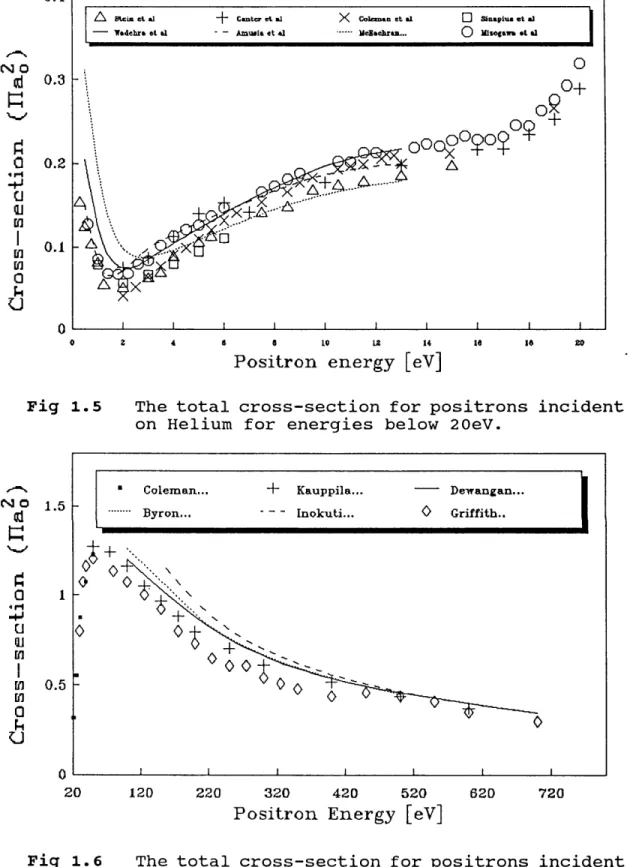
The total cross-section for positrons incident on Helium for energies below 20eV.
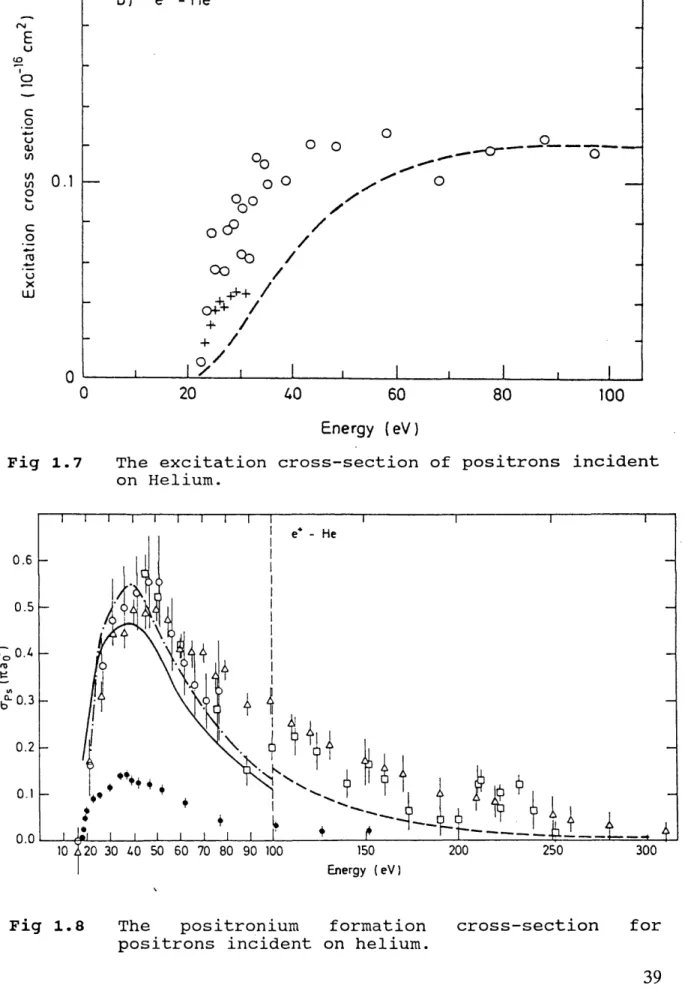
The total cross-section for positrons incident on Helium for energies above 20eV.
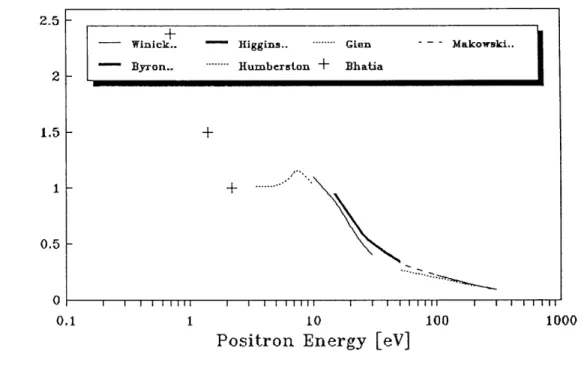
The excitation cross-section of positrons incident on Helium.
The positronium formation cross-section for positrons incident on helium.
The total cross-section excluding ionization for positrons incident on helium showing contributions from individual channels (Campeanu et al, 1987).
1.11
1.12
1.13
1.14
1.15
1.16
1.17
1.18
1.19
1.20
The positronium formation cross-section of positrons 44 incident on atomic hydrogen (a) up to 14eV, (b) at
higher energies.
The cross-sections for excitation o f atomic hydrogen by 45 positron impact from its ground state into (a) the 2S
level and (b) the 2P level.
Calculated total, elastic, excitation and positronium 47 formation cross-sections for e +-H scattering. Also shown
is the sum o f the individual cross-sections for these channels.
The positron impact ionization cross-section of atomic 47 hydrogen determined from partitioning the total cross-
section. Directly calculated and measured results are shown for comparison.
The positron impact ionization cross-section of He. 50
The positron impact ionization cross-section of Ne. 50
The positron impact ionization cross-section of Ar. 51
The RP-TOF apparatus used by Sueoka and Mori (1984) 52 to measure the positron impact ionization cross-sections
o f He, N e and Ar.
The apparatus used by D iana et al (1985) to measure the 52 positron impact ionization cross-section of He.
The apparatus used by Fromme et al (1986, 1988) to measure the positron impact ionization cross-sections o f H e and H 2.
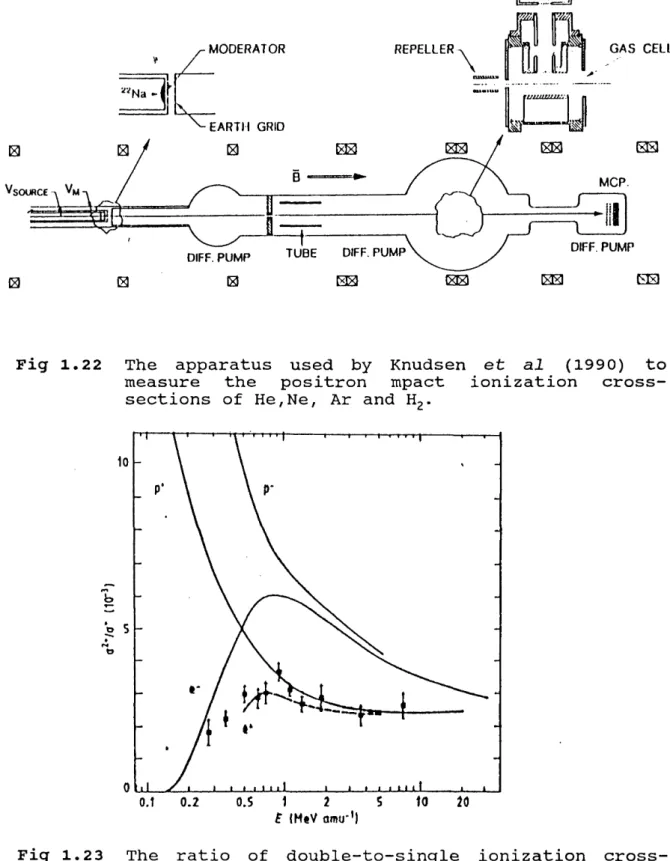
The apparatus used by Knudsen et al (1990) to measure the positron mpact ionization cross-sections o f H e,N e, Ar and H 2.
The ratio of double-to-single ionization cross-sections of H e for e', e +, p and p (from the data o f Charlton et al, 1988, 1989 and Andersen et al, 1987).
A block diagram o f a typical crossed-beam experiment to measure the ionization cross-sections o f gases showing the quantities in equations (1.16) and (1.17).
A schematic diagram o f the apparatus used by Fite and Brackmann (1958) to measure the electron impact ionization cross-section o f atomic hydrogen.
The measured electron impact ionization cross-sections o f atomic hydrogen.
A schematic diagram o f the apparatus used by Shah et al (1987) to measure the electron impact ionization
cross-section of atomic hydrogen.
A diagram o f the apparatus used by Spicher et al (1990) to measure the positron impact ionization cross-section.
The measured ionization cross-sections o f Spicher et al (1990) for (a)
Electron impact ionization cross-sections o f atomic hydrogen calculated using the Binary Encounter Approximation.
2.3 Positron impact ionization cross-sections of atomic 72 hydrogen calculated using the Classical Trajectory Monte
Carlo (CTMC) method.
2.4 The notation used in the present discussion o f quantum 76 mechanical systems for (a) the pre- and (b) post-collision
systems.
2.5 Electron impact ionization cross-sections calculated using 80 the first Born approximation which are suitable for
consideration in positron scattering (see text).
2.6 The electron impact ionization cross-section o f atomic 84 hydrogen calculated using the Glauber approximation
but allowing for the possibility o f exchange.
2.7 The positron impact ionization cross-section calculated 88 using the indicated models (see text) by Ghosh et al
(1985).
2.8 The positron impact ionization cross-section o f atomic 88 hydrogen calculated using different m odels (for details
see text) by Mukherjee et al (1987).
2.9 The results o f distorted wave calculations o f the positron 91 impact ionization cross-section o f atomic hydrogen using
different forms of the polarization potential V POL, see text for details.
2.10 The positron impact ionization cross-section o f atomic 91 hydrogen calculated using different models incorporating
final state correlation by Campeanu (1990).
3.1 A cut-away diagram of the source/m oderator holder 96 showing the brass plug on which the source is held and
the W moderator meshes.
The acceptance angle (see text for definition) of the positron beam transport system over a range o f positron energies.
A schematic diagram of the microchannel plates used for positron detection in this experiment.
(a) A schematic diagram o f the Pd-Ag hydrogen gas leak valve.
(b) A graph showing the variation of hydrogen pressure in the gas handling system with current passing through the Pd-Ag leak valve.
A schematic diagram o f the radio-frequency discharge tube used in this experiment.
A diagram o f the resonator cavity cut away to show the helical inner conductor.
A schematic diagram o f the electrostatic ion extraction system used in this experiment, the nozzle o f the R F discharge tube is located centrally betw een the ion extraction plates.
A diagram o f the trajectories o f H + ions after extraction from different parts o f the interaction region, showing the spatial focusing properties o f the extraction optics. A block diagram o f the timing electronics.
4.2 The measured ion yield as a function o f gas pressure at 121 different positron energies (a) below 150eV, (b) above
200eV.
4.3 A plot o f the measured ion yield against positron energy, 123 having normalized all points to the data o f Knudsen et
al (1990) at lOOeV which is shown sm oothed (—).
4.4 The ion yield shown as a function o f extra delay 123 added to the onset time of the extraction pulse.
4.5 The H2 ion yield shown at diiferent energies as a 126 function o f the potential applied to the positron
extraction tube.
4.6 The H2 ion yield plotted over a range o f energies 126 having normalized it to the data o f Knudsen et al (1990)
at lOOeV, this being shown smoothed (--- ).
4.7 The H2 ion yield plotted against electron beam intensity 127 for an electron energy of 300eV.
4.8 Ion yields measured over a range o f energies with an 128 electron beam, the data has been normalized to the
corrected data of Rapp and Englander-Golden (see text) which is shown sm oothed (--- ).
4.9 A coincidence spectrum taken with the discharge on and 132 a lOOeV positron beam showing the peaks due to H +
ions and, at longer time, H ^.
4.10 The H + ion yield plotted as a function o f the magnitude 134 of the dc offset potential applied to the ion extraction
plates.
5.1 The calculated doubly differential cross-section for 137 electron emission o f Macek (1970) for 300 keV protons
The reduced cross-section o c for capture to a continuum state of Rodbro and Andersen (1979) compared with reduced cross-sections for capture to bound states derived from literature.
The energy distribution o f electrons em itted at 0° in positron impact ionization o f H at lOOeV as calculated by Mandal et al (1986).
The energy distribution o f electrons em itted at 0° in the ionization o f H atoms by IkeV positrons, as calculated by Brauner and Briggs (1986).
The energy distribution o f electrons em itted in the ionization of H by lOOeV positrons, calculated at various angles by Schultz and Reinhold (1990). Also shown are the scaled 0° results o f Mandal et al (1986).
The emitted electron count versus retarding potential reported by Coleman (1986) for positron impact ionization of Helium.
Electron count versus retarding potential for positron impact ionization o f neon reported by Charlton et al (1987) ( • ) shown with the integrated results o f Brauner and Briggs’ (1986) (□).
A cut-away diagram o f the source region
A schematic diagram o f the experimental apparatus showing the primary positron beam transport and electron collection and detection systems.
A schematic diagram of the interaction region.
A schematic diagram o f the timing electronics.
The time-of-flight spectra o f electrons detected after the ionization o f Argon atoms by lOOeV positrons in magnetic fields o f (a) 15 Gauss and (b) 25 Gauss
(a) A plot o f the observed positions o f the peaks in the electron energy distributions against those values o f electron energy expected from theory at 15 Gauss. (b) A plot o f the observed positions o f the peaks in the electron energy distributions against those electron energies expected from theory at 25 Gauss.
Table
TABLE CAPTIONS
Page
1.1 Developments in slow positron moderators. 24
1.2 A table showing the possible reactions in e+-H scattering 65 which give rise to ions and the notation that is used for
the cross-section o f each.
ACKNOWLEDGEMENTS
I would like to express my gratitude to those who have supported, encouraged and helped me over the course of my postgraduate work.
For their supervision and tuition I would like to thank Drs Mike Charlton and N ella Laricchia and Prof Ceiri Griffith.
For their invaluable technical assistance I must thank Ivan Rangue, Ted Oldfield, Brian Humm, Bill Lenihan and Niall Murphy.
I should also acknowledge the advice given on particular aspects o f the work by Prof J A Slevin, Drs A C H Smith, D L Moores and A Kover.
Neither can I overlook the contributions o f the following to my general welfare over the last few years: Z oe, Bing, Dave, Flowel, Nevs, Dave, Annette, Jon, Mogens, Jeremy, Iain, Nazrene (especially for joggling my thesis so expertly) and Sfle.
CHAPTER 1
INTRODUCTION
1.1 H istorical Background
The existence of antimatter was first predicted by Dirac (1930a) when proposing a physical interpretation of solutions to his relativistic wave equation requiring electrons to have negative total energies. Dirac formulated his m odel by considering Einstein’s relation betw een the energy E of a particle of rest mass mQ and its mom entum p, with c being the speed o f light in vacuo
E2- m y + p 2c2 ( l . «
One can then assume that all energy states below -m0c2 (-m0c2>E>-°o) are filled with electrons. The Pauli exclusion principle then forbids the transition o f free electrons from the positive states to the occupied negative states. However, if an electron in the negative levels gains enough energy it can go to a positive level leaving a hole in the negative "sea of electrons". This hole will behave as a positive particle. Dirac’s reluctance to propose the existence of a new particle led to his suggestion that these holes corresponded to protons but Weyl (1931) showed that the new particle had to have the same mass as an electron. The particle becam e known as the positron, e +.
Experimental confirmation o f its existence was subsequently obtained by Anderson (1932) in cloud chamber studies of cosmic ray showers. His results were subsequently corroborated in an experiment by Blackett and Occhialini (1933).
antiparticles the ready availability o f positrons from radio-isotopes has ensured their rapid developm ent as probes of atomic interactions in gases and of the bulk and surface properties of condensed matter. The complementarity of these investigations to those employing electrons is a consequence o f the different charge signs but equal masses of the particles. This leads to the distinguishability o f projectile positrons from target atom electrons unlike the electron case where exchange effects must be taken into account.
Another difference is the possibility o f annihilation with one o f the electrons in the target with the emission of y-rays. Observation o f this phenom enon in swarm experiments involving positrons allows the determination o f the momentum distributions of electrons in solids and the study of the interaction mechanisms of positrons with gas atoms. Reviews o f such experimental work for gases can be found in Griffith and Heyland (1978) and Charlton (1985) and for solids in Schultz and Lynn (1988).
O f great importance is the attractive nature o f the positron-electron Coulomb interaction. This can lead to a high degree of correlation betw een the particles if they are free with the possible outcome o f forming a quasi-stable bound state-positronium, Ps. Its existence was predicted by Mohorovicic (1934) and confirmed experimentally by Deutsch (1951). The simplicity and purely leptonic nature o f this system has led to extensive theoretical treatments with a view to testing the accuracy of the bound state aspects of Quantum Electrodynamics (Q E D ) (e.g. W heeler, 1946 and Fulton and Martin, 1954).
and antimatter and is integral to gauge field theories. Current experimental efforts to produce antihydrogen are discussed in detail by Charlton (1989) and Poth (1989).
The study of positron scattering processes developed significantly in the late 1960s with the advent of slow positron beams. On the implantation of fast (3+ particles certain solids were found to emit positrons with energies o f a few eV . Their subsequent acceleration and collimation allows the energy dependence o f individual atomic scattering processes to be ascertained. The main body o f this work will detail such a study.
1.2 Basic Properties o f the Positron and Positronium
The mutual annihilation of positrons and electrons is likely to result in the em ission of a number of y-ray photons. If both are at rest their total energy will be the sum of their rest mass energies, 1.022MeV. Conservation of charge parity, Pc determines the number of photons, ny that are emitted. Since a single photon has Pc =-1, a system of ny photons will have
/>c- ( - l ) nt (1-1)
Using symmetry arguments Yang (1950) has showed that, in positron-electron annihilation
P c- ( - l ) L+s ( x-3)
where L is the total angular momentum and S is the total spin o f the system. The detection of annihilation radiation therefore yields information on the relative states of the annihilating pair.
annihilation into zero, one, two, three and four photons. The probability of an interaction occurring is given approximately by a m where a is the fine structure constant ( a « l/1 3 7 ) and m is the number of vertices on the Feynman diagram i.e. the number o f points where photons interact with other particles. Both cases (a) and (c) in Fig. 1.1, for annihilation into one and three photons respectively have m = 3 but the required presence of a third body in case (a) to conserve mom entum makes case (a) less likely to occur by a factor a 3. O f cases (a) to (c) case (b) is therefore the most likely, followed by case (c). Case (d)-annihilation into four photons-with four vertices is less likely still but, nevertheless, has been observed recently (Adachi et al, 1990). Radiationless annihilation, depicted in case (e), was first proposed by Brunings (1934). H ere a positron annihilates with a bound electron and the energy liberated releases another electron from the atom. Its branching ratio was subsequently calculated more accurately by Massey and Burhop (1938) and their conclusion was that, although rare compared to the other annihilation modes, it should still be observable. It is clear from these considerations that annihilation into two y-rays is the most probable, in fact Ore and Powell (1949) have calculated that the ratio of the cross-section for annihilation into two y-rays to that into three y-rays is 1:372 for free positrons.
Dirac (1930b) derived the following expression for the cross-section for the annihilation into two y-rays of a non-relativistic positron with a free electron, a 2y
C
T
(1-4)
2Y
o o
X^-Tzrlcri'
(1.5)
In a gas o f number density, p this can be written
A.2T- * r 02cZ„/v)p (1-6)
where Z eff is the effective number o f electrons per atom seen by a positron of velocity v. It differs from the atomic number, Z because o f the polarization of the atom by the approaching positron. As this is only significant at low positron energies Z eff approaches Z at energies commonly encountered in positron beam experiments. A t these energies it has been shown that a 2y is ~ 1 0 _26cm'2 so the likelihood of positron annihilation is negligible compared to that of the other scattering channels that are investigated in beam experiments.
An alternative reaction to annihilation in which the positron can participate is the formation of Ps given by the reaction
e '+ X -P s+ X *
where X is any atom or m olecule. The threshold energy for this reaction, EPs is given by
EPs-(E r 6. S)eV (1*7)
(a) (b)
Y
e
(c)
Y
»+
e e'
(d)
Atom /Ion
(e)
Fig 1.1 The Feynman diagrams for annihilation into one,
being the most likely. This gives it a longer lifetim e than the singlet state (L + S = 0) para-positronium (p-Ps) which is most likely to emit two colinear photons. Calculations have borne this out with Harris and Brown (1957) finding the self- annihilation rate of p-Ps to be 0A.p_ps =7.9852ns'1 compared to Caswell and Lepage’s (1979) result for o-Ps of 0^o.ps = (7.0386 ± 0.0002)jus"1. The short lifetim e o f p-Ps makes the experimental determination of its decay rate difficult but G idley et al (1982) employed the Zeem an effect to mix it with the m = 0 substate o f o-Ps in a magnetic field and obtained a result in accordance with theory. The most accurate measurement to date for o-Ps is however (7.0482± 0.0016)m s_1 by N ico et al ( 1991) which is significantly different to theory*,, the authors cannot ascribe this discrepancy to systematic effects but suggest that the calculation may be inadequate and suggested the need for higher order corrections.
1.3 The Development o f Slow Positron Beams
In this section the developm ent over the last forty years o f increasingly efficient sources of slow positrons shall be reviewed. The milestones in this field are summarized for convenience in Table 1.1.
calculated to be ~ 10"3 for their experiment in which samples of various materials were irradiated by a 64Cu source. Positron detection was to be by means of y-ray detectors observing the annihilation of positrons on an A l plate 80 cm away from the moderator sample in an axial magnetic field. They obtained a null result for each sample which is now thought to be due to the poor resolution of the experiment and the quality of the samples although at the time it was claimed that it was due to Ps formation and e + trapping in bulk defects and at the surface-two phenom ena that are now known to be of great significance.
The first observation of slow positron production in this manner was from a Cr covered mica surface by Cherry (1958). In this experiment the positrons were extracted electrostatically and the moderation efficiency, e was measured to be 3x10' 8. The significance of this work was not realized until Madey (1969) performed a similar experiment with a polyethylene sample and Groce et al (1968) used gold.
Moderator Experimental Arrangement Efficiency e AE [eV] Reference
Pt, K, Ga Transmission 0 - Madanski & Rasetti (1950) Cr/Mica Transmission 3xl0"8 - Cherry (1958)
Au/M ica Transmission I
-*
oI •v
j
2 Costello et al (1972) MgO coated Au Backscattering
/Vanes
3xl0'5 2.3 Canter et al (1972)
B Self-moderator 10'7 0.15 Stein et al (1974) Al(100) Backscattering 3xl0'5 0.1 Mills et al (1978) C u (lll) + S Backscattering 9xl0‘4 0.3 Mills (1979) W Backscattering
/Vanes
7xl0'4 1.3 Dale et al (1980)
W(110) Backscattering 3xl0"3 0.7 Vehanen et al (1983) W(100) Transmission, High
vacuum
6xl0"4 3 Lynn et al (1985)
Ne Transmission 7xl0'3 0.58
Mills &
Gullikson (1986) W(100)
Transmission, High vacuum
5.9xl0‘4
- Gramsch et al (1987)
Ni(100) 6.6xl0'4
Mo 7.5xl0'5
W(100) Transmission, Low vacuum annealing
8.8xl0’4 1.7
Zafar (1990)
Ni(100) 6.5xl0'4 0.3
Mo Transmission/ Low vacuum annealing
4xl0’4 0.8 Andrikoupoulos, Avdi & Laricchia (1991)
Diamond Field assisted/
Backscattering 7xl0’3
Brandes et al (1991)
A far more efficient positron moderator was discovered by Canter et al (1972). An efficiency of 3xl0"5 was achieved using MgO coated gold vanes-this then prompted the increasing use of positron beams to measure total cross-sections (see section 1.4). The model of Tong (1972) could not however explain the effectiveness o f this moderator. It was suggested that slow positron production from this moderator was an indirect process in which a positron formed excited positronium, Ps* which subsequently broke up. Field ionization in a charge layer at the non-conducting surface due to liberated electrons was proposed as the mechanism for Ps break-up (Griffith et al, 1978). Jacobs (1951) had previously postulated that such a charge layer was responsible for an observed enhancement in secondary electron emission from oxide layers upon electron bombardment-a concept which was supported by later experimental results. There have been subsequent studies of other non-conducting moderators, most notably solid rare gases by Gullikson and Mills (1986). These moderators have yielded results which are not in accordance with this model and are discussed fully below.
A new developm ent in moderator technology came in 1974 when Stein et al used a self-moderating source. Here, a boron target was bombarded with 4.75 M eV protons from a Van de Graaf generator to produce n C by the reaction
6L c“ 15l f J + e * + v s
The fast positrons produced here are moderated in the bulk o f the B and are emitted
# n
with a very low energy spread (~ 0 .1 e V ) and an efficiency of 10 . By virtue o f this Kauppila et al (1976) observed a Ramsauer-Townsend minimum in the e +-Ar total cross-section using this source-moderator arrangement.
were still under investigation. Pendyala et al (1976) studied the emission properties of various polycrystalline samples and achieved their maximum efficiency with Cu. But this work did not add greatly to the understanding of moderators and the m oderation process because the structure and purity of the samples were not known. This situation was rectified by Mills et al (1978) who investigated the moderating properties of various pure well-characterized samples. These included Al(100), Cr and Si(100), where the numbers denote the orientation o f the crystal face. Efficiencies of 3 xl0'5 were achieved. Following this study, the authors deduced the mechanism of slow positron emission from metals, a brief discussion o f which now follows.
On implantation in the bulk of the moderator material a fast p + particle loses energy to electrons in the solid. It loses energy via processes such as plasmon emission and electron-hole pair creation. Whilst thermalizing, a fast positron can diffuse towards the surface of the moderator but for stopping distances that are typical for high energy p + particles most thermalize before reaching the surface. Therefore those which do diffuse to the surface before annihilating will arrive there thermalized. Thermal positrons at the surface of a solid can undergo one of four processes: Ps formation, trapping in a surface state, reflection or ejection into the vacuum. The latter process which is that of slow positron em ission from solids requires the material to have a negative positron work function. The work function of any material is defined as the minimum energy necessary to remove a particle from a point just inside to one just outside the surface. For electrons it was defined by Lang and Kohn (1971) as the difference between the surface dipole barrier, <5 and the bulk chemical potential, /x_
Tong (1972) analogously expressed the positron work function as
<
j>
+--6-[i+
(1.8)
where fi + is the bulk chemical potential for a positron. The potentials that a positron encounters at the surface of a solid are shown in Figure 1.2. Tong (1972) represented the contribution of ion cores in the bulk to the potential a particle experiences at the surface with "jellium": an uniform positive background which is calculated as the m ean potential a particle feels at an interstitial site in the lattice from the ion cores. The bulk chemical potential, /x ± is the sum of this and the potential o f the uniform electron gas in the bulk. The electron gas "spills out" into the vacuum at the surface and gives rise to a negative charge just outside the interface. This forms a dipole with the positive charge inside whose electrostatic interaction with a particle is expressed as S as shown in Figure 1.2. This helps bind electrons to the solid but because of their opposite charge sign it tends to eject positrons from the material as it can cancel out m+ in equation (1.8) and even make 0 + negative. In adiabatic conditions the maximum energy an emitted positron can then have is <p + . In practice the thermal motion of surface atoms gives rise to a small energy spread around in the emitted positron energy distribution. Murray and Mills (1980) have investigated the dependence of moderation efficiency on <p+. They did this for Cu and Al samples by changing the crystal orientation, changing the amount of surface coverage by sulphur and heating the sample. Their results are shown in Figure 1.3 and show a clear increase as 0 + is made more negative thus lending support to the above model of slow positron emission from metals.
(P+= - G -
M+
J e l l i u m
V a c u u m L e v e l
T o t a l P o t e n t i a l
C o n d u c t i o n
E l e c t r o n s
m e t a l
\
v a c u u m
Fig 1.2 The potential energy encountered by a positron at
the surface of a metal.
0.6
1.2 0.8
0 0.4
Fig 1.3 Slow positron yield as a function of the positron
further investigation it transpired that the annealing process was a far more significant process in increasing the yield than the removal of surface contaminants by chemical etching. This was because, on heating, the lattice structure of the W relaxed and then recrystallized as it cooled. D efects in the crystalline structure are thus removed and there being fewer sites for diffusing positrons to b e trapped, the diffusion length, and hence the moderator efficiency, is increased.
It was also discovered in the study of D ale et al (1980) that the annealing of W removes all adsorbed O from its surface. During subsequent exposure to air the extent o f adsorption will not exceed about two monolayers o f O - it was concluded that this inertness made W a very useful positron moderator especially when working in non-U H V conditions. Using a single crystal sample instead o f the polycrystalline W used above Vehanen et al (1983) obtained an efficiency of 3xl0"3, close to the maximum expected efficiency for W of 4 x l0 '3 calculated by V ehanen and Makinen (1985).
The extraction of slow positrons from the source-moderator arrangement is clearly highly dependent on its geometry. All the systems described thus far have employed backscattering or vane geometries for the moderator, these are depicted in Figure 1.4 (a) and (b) respectively. Another widely used arrangement is the mesh moderator - this is shown in Figure 1.4 (c). In cases (b) and (c) the dimensions o f the source are unimportant but in case (a) this is not so because the source obscures part of the moderator and therefore intercepts some of the re-emitted positrons. The size of the source must therefore be kept to a minimum when using the backscattering geometry so radioactive isotopes with a high specific activity (activity per unit mass) such as 58Co must be used to maintain a high flux of (3+ particles. W hen this is not a consideration 22N a with a lower specific activity but a conveniently long half-life of 2.6 years (more than 13 times that of 58Co) is normally used.
(a)
( c)
(e)
( d )
Fig 1.4 Source-moderator geometries: (a) Backscattering;
condensed the rare gases Ne, Ar, Kr and X e to make the first solid rare gas moderators. The maximum efficiency achieved was (7 .0 ± 0 .2 )x l0 with a layer of solid N e deposited on the cup. This was the most efficient slow positron moderator then produced. The authors explain their results in terms of the "hot positron" model which assumes that the positrons are not thermalized prior to emission. They postulate that implanted positrons will lose energy by making inelastic collisions involving electronic transitions until their energy falls below the threshold for these processes. Subsequent energy loss will be via phonon em ission but since the maximum phonon energy is small (e.g. 8.3m eV for Ar) positrons diffuse a long distance before thermalizing (~ 5 0 0 0 A in Ar) and som e are likely to reach the surface and be emitted if their energies are greater than the positron work function 0 + (0+ > 0 for rare gas solids). On measuring the slow positron yield over a range of implantation energies the authors deduced the variation o f yield with positron implantation depth. Extrapolation of this yield to zero implantation depth revealed that slow positron emission was considerably more probable than the formation of Ps at the surface-this contradicts the field-ionization m odel o f Griffith et al (1978).
Figure 1.4 (e) shows the transmission geometry as first used by Chen et al (1985). This has the advantage over the other geometries o f a smaller energy spread for the emitted positrons as with the backscattering case but without the associated problem of source shadowing. In the study o f Chen et al (1985) single crystal W (100) films of varying thicknesses were grown epitaxially on a M gO /M o substrate which was subsequently removed by chemical etching. These films were then annealed in situ to remove defects and surface contaminants. The FW HM o f the emitted positron energy distribution was found to be less than half an eV. In a later study Lynn et al (1985) report an efficiency of 4x l0 '4 for a W (100) film prepared in this manner.
to be potentially useful moderators include W, Ni and Mo. Specific references and results are cited in Table 1.1 but it is of interest to note the recent work of Andrikoupolos, Avdi and Laricchia (1991) with single crystal Mo in which it was ascertained that half of the observed energy spread of ~8 0 0 m eV arises from the wide angular distribution of emitted positrons. This complements the study of Gullikson et al (1985) which revealed a similar effect for W (110) and N i(100) except that in the U H V conditions used and accordingly less surface contamination the observed energy spread was almost entirely the result o f the angular distribution of positrons. These experiments therefore support the theory that positron em ission from metals is an elastic process which, in adiabatic conditions, would produce mono- energetic positrons with energy <p +.
Although these developments are leading to more well-defined positron beams their spatial spreads are still too broad for many applications e.g. som e surface studies such as low energy positron diffraction. Focussing on its own cannot overcom e these difficulties since, as pointed out by Mills (1980), Liouville’s theorem states that in a conservative field the volume occupied by a swarm o f particles in phase space remains constant. This implies the constancy of the quantity d2Esin20 for a beam of particles of energy E which has a minimum diameter d and angular divergence 0. If the beam is o f intensity I one can define the brightness per unit energy as
£ (£ )- - .
L
(1.10)
d 2Esin2Q
Focussing would therefore improve one or more o f d,0 or E at the expense of worsening others. Mills (1980) went on to suggest that the non-conservative process
^ ry
brightness enhancement, was by Frieze et al (1985) but a more recent experiment by Brandes et al (1988) increases B (E) by a factor of 500. Such work aids the developm ent of positrons as probes of surfaces and bulk media, a purpose for which they are potentially valuable sources of information.
1.4 The Measurement o f Slow Positron Scattering Cross-Sections
The first positron scattering cross-section to be measured was the total cross-section o f H e by Costello et al (1972b) but this data is now known to be inaccurate. As sources of slow positrons became more efficient several other groups measured total cross-sections for various gases. Experiments to measure the total cross-section for scattering processes in gases generally involve observing the attenuation o f a beam o f particles through an extended region in which the gas is confined. In these circumstances the total cross-section ctt can be defined
/ - / 0exp (- p/a r) (1.9)
where I0 is the intensity of a beam entering a gas column of length 1 and number density p and I is the intensity of the beam leaving the scattering region. The gas density, n can be related to the measurable quantities pressure and temperature by simple relations deriving from kinetic theory. In total cross-section measurements with positrons the attenuation was either observed directly or inferred from time-of- flight spectra with and without gas present.
the measurement of crT at energies as low as 0.5eV allowing therefore the first observation of a Ramsauer-Townsend minimum in the e +-H e total cross-section. This was subsequently confirmed in the very low energy measurements (l-6 eV ) of Wilson (1978) and Mizogawa et al (1985). The Ramsauer-Townsend minimum is familiar in low energy electron scattering but arises in a slightly different fashion for positrons. The static interaction with an atom is repulsive for positrons but the polarization interaction is attractive as for electrons, at low energy where the polarization interaction is strong there will be a point at which the interactions cancel out, there will then be a minimum in the total cross-section.
A ll experimental measurements shown in Figure 1.5 are in reasonable agreement above the Ramsauer-Townsend minimum but differ around the minimum itself. Figure 1.5 also show the theoretical calculations of the elastic scattering cross-section below the threshold for inelastic processes. These are as follows: the Kohn variational calculations of Humberston (1979) for s-wave scattering, Humberston and Campeanu (1980) for p-wave, Drachman (1966) for d-wave and the Born approximation result of O ’Malley et al (1961) for higher order phase shifts all summed by Wadehra (1981); the many-body calculation of Amusia et al (1976) and the polarized orbital method of McEachran et al (1977) which followed the work of Temkin and Lamkin (1961). It can be seen that all calculations apart from those of McEachran et al (1977) are slightly higher than the measured values around the Ramsauer-Townsend minimum but subsequently are in agreement up to the Ps formation threshold (17.8eV). Those of McEachran et al (1977) do not reproduce the shape of the cross-section very well at low energies.
are the available theoretical calculations at these energies. As expected these perturbative calculations agree better with experimental data towards higher energies. The calculations are the eikonal-Born series calculation of Byron (1978), the distorted wave second Born approximation (see section 2.2.1) calculation of Dewangan and Walters (1977) and the Bethe-Born calculation of Inokuti and M cDowell (1974).
There have, o f course, been many experiments to measure a T for positrons incident on other atoms and m olecules and these have provided many an insight into the behaviour of positrons and, on comparison of corresponding data, electrons in collisions. Further details of these measurements and comparisons are given in the review papers of Griffith and Heyland (1978), Charlton (1985) and Kauppila and Stein (1990).
0 . 4
Btcin e t *1 Canter e t al X Colem an e t al □ S inapiua e t e l --- e t el ■ — Am ueie < t e l ... U c E a d iru t...
0
+
Q 0.2
CJ U m
0 . 1 - A U1
[fl Q U U
0
0 2 4 8 8 10 IZ 14 18 18 8 0
P o s i t r o n e n e r g y [eV]
Fig 1.5 The total cross-section for positrons incident
on Helium for energies below 20eV.
"4“ K auppila...
In o k u ti...
C olem an... D eiran gan ...
0 G riffith ..
M O <rt G
B yron...
a
a aj
0 0
in
0.5m Q u a
20 1 2 0 220 320 420 520 620 720
P o s i t r o n E n e r g y [eV]
Fig 1.6 The total cross-section for positrons incident
The other apparatus that has been used to measure positron excitation cross-sections is the Retarding Potential-Time of Flight (RP-TOF) system of Sueoka (1982) that is shown in Figure 1.18 and discussed below. To observe excitation it was modified to account for positrons which had scattered more than once and consequently had times-of-flight indistinguishable from those which had lost energy on excitation (Sueoka, 1989). Results have been reported for the lowest transition in H e up to 120eV. Comparison is made with the summed theoretical result of Parcell et al (1983, 1987) whose calculations used a distorted wave approximation and reasonable agreement is obtained although the experimental results are generally higher.
Considerable interest has also been shown in positronium formation as this reaction occurs exclusively for positrons and can therefore yield information on positron scattering mechanisms. Initially, the positronium formation cross-section crPs was determined below the excitation threshold by assuming the shape of the elastic cross- section and subtracting it from the total cross-section. Clearly though this procedure was unsatisfactory and direct measurements of crPs were required. The first measurements for H e were made by Charlton et al (1980) but only up to 12eV above threshold; they were subsequently extended to 150eV by Charlton et al (1983) and results are shown in Figure 1.8. The other sets of measurements o f a Ps for H e have been made by Fornari et al (1983) using a time-of-flight technique at low energies; D iana et al (1985a) with the same apparatus but a different technique and Fromme
et al (1986). All these measurements were made on systems with which
measurements of the total ionization cross-section, <?i were made and the experiments are discussed in detail in section 1.4.
preferentially formed in the forward direction in their experiment. The latter point has gained credence following the study of Laricchia et al (1987) of Ps formation in positron scattering from H e and Ar which revealed that up to 4% of Ps formed was emitted in a 6 ° cone in the forward direction. On comparison with theory the other experimental data for crPs in H e is seen to agree reasonably at low energies with the distorted wave calculations available (Khan and Ghosh, 1983, Khan et a l, 1985 and Mandal et al, 1979) but this is not the case at higher energies.
Apart from general information about the nature o f the interaction the only new knowledge that can be gleaned from total cross-sections concerns the relative significance of their contributory components. If the possibility o f annihilation is neglected, which - as was explained earlier - is quite valid at the energies under discussion, one can write for the total cross-section for positron scattering, a T
co
o T- o el+^2 o(nLS)+o t+o Ps (1*9)
n - 2
c o
nj u x UJ
e+ - He
0 . 1
Co
0
0 20 40 60 80 100
Fig 1.7
Energy ( e V )
The excitation cross-section of positrons incident on Helium.
e* - He
0.5
0.3
0.0
250
200 300
150 Energy ( e V )
Fig 1.8 The positronium formation
positrons incident on helium.
° T ~ ° r ° ps~ ° ei+Y l °(n L S )-o n-2
(1.10)
where crno ion is the total cross-section for those channels in which an ion is not produced. Since measurements of crT, cq and crps were available, the sum o f a el and a(nLS) could be deduced. Values of cr(nLS) had been calculated by Parcell et al (1983, 1987) up to n = 2 so crel could be calculated from these enabling the authors to study its behaviour near the threshold for inelastic processes - one o f their stated aims. The resulting data is shown in Figure 1.9, the selected cross-sections having been measured previously by Stein et al (1978) and Fromme et al (1986).
A cusp in o no ion at the threshold can be seen - this could only be due to structure in a el as it is the only contributing cross-section at this point. The existence o f such a cusp in crel had previously been predicted by Brown and Humberston (1985). For electrons, a cusp in crcj at the threshold for inelastic processes is predicted as a result of flux conservation (Mott and Massey, 1965): since the inelastic channel will have infinite slope at the threshold, the elastic channel would correspondingly decrease sharply immediately above threshold thus giving rise to a cusp structure. In positron impact the first inelastic channel is that for positronium formation, crPs rises sharply from threshold and it has been proposed that a cusp in a cl could result.
no ion
0 a. IAP0I
Oe| I0WSBI
CL
5 0 0 100
50 200 1000
10 20
Energy, E(eV)
Fig 1.9 The total cross-section excluding ionization and Ps
formation for positrons incident on helium showing contributions from individual channels (Campeanu et
a l, 1 9 8 7 ) .
A tom ic hydrogen is one of the most interesting atoms to consider theoretically because of its simplicity but, to date, experimental data is very limited. A detailed discussion of calculations of a f o r atomic hydrogen is given in Chapter 2 as these are relevant to the experimental work that will subsequently be described. There now follows a brief overview of theoretical results for the other cross-sections for positrons scattering off atomic hydrogen.
the Unitarized Eikonal-Born Series; Makowski et al (1986) with an iterative method for representing scattering matrices and a second-order optical potential; G ien (1977) using a modified Glauber method (discussed in Chapter 2); Winick and Reinhardt (1978) using the moment T-matrix approach; Humberston (1984) using the Kohn variational method and, most recently, Higgins et al (1990) with an R-matrix calculation. All these calculations are shown in Figure 1.10 which displays the good level o f agreement betw een the different methods. A great deal of theoretical attention has been given to Ps formation in e +-H collisions again because this is the simplest rearrangement collision in which a positron can participate. Figures 1.11 (a) and (b) show the low and high energy behaviour o f the calculated values o f a Ps. The low energy calculations shown have been made by Brown and Humberston (1985): Kohn variational; Mandal and Guha (1979): first Born approximation including exchange, denoted FOEA; Drachman et al (1976): a second Born approximation using a coupled static approximation for L<1 and Born terms for greater L; Mandal et al (1979): a distorted wave calculation and finally, an R-matrix calculation by Higgins and Burke (1991). The variational calculation o f Brown and Humberston agrees quite well with Drachman et a/’s results suggesting the accuracy o f the latter calculation over a broad energy range. The higher energy results o f Drachman et al
(1976) have been plotted in Figure 1.11 (b), this diagram shows the intermediate energy region where the above calculations of Mandal and Guha (1979) and Mandal
et al (1979) are expected to be more accurate, and indeed good agreement with other
2 . 5
GLen H ig g in s ..
H u m b e r s to n H” B h a tia B y r o n ..
1 .5
0 .5
0.1 1 10 100 1000
P ositron. E n ergy [eV]
Fig 1.10 The calculated elastic cross-section of positrons incident on atomic hydrogen.
Apart from ionization the remaining inelastic channel, excitation, has also received som e theoretical attention. Calculated cross-sections for excitations from the ground state to the 2s and 2p levels are shown in Figure 1.12 (a) and (b) respectively. The calculations shown are those of Morgan (1982), Bransden et al (1985), Byron et al (1985), Srivastava et a/ (1987) and Walters (1988). On both diagrams there is good agreement between the results of Morgan, Walters and Bransden et al, this is to be expected as each calculation employed a six-state close coupling approximation although the latter two attempt to account for other states via the second Born approximation and polarization respectively. The concurrence of the final results shows the minor role played by the other states in this interaction.
( a )
6
D rach m an..
H iggins and Burke
5
4
3
2
1
0
1 3 1 4
6 7 8 0 10 11 12
P o s itr o n E n erg y [eV]
(b)
100
B a s u .. (SB A ) T r ip a t h i .. D r a c h m a n ..
1 0 M a n d a l (FOEA)
1 0 . 1
0 . 0 1
1 . 0 0 0 E - 0 3
Q 1 . 0 0 0 E - 0 4
1 . 0 0 0 E - 0 5
0 1 0 0 2 0 0 3 0 0 4 0 0 5 0 0 6 0 0
P o s i t r o n E n e r g y [eV]
C r o s s s e c t i o n . ( I T a .0 ) C r o s s — sec tio n (I T a . (a) 0.4
B r a n s d e n .. S r iv a s ta v a .. M organ
Walters Byron.. 0.3 0.2 1000 10 100
P o s itr o n E n ergy [eV]
Ob) Morgan W altera Srivastava.. 1.5 0.5 1000 10 100
P o s itr o n E n erg y [eV]
Fig 1.12 The cross-sections for excitation of atomic
cross-section, this will be discussed in detail in Chapter 2. However, one can estimate it by considering all the other cross-sections as follows. For each of the above cross- sections, the sets of calculated values which are believed to be most accurate and appear to be consistent over different energy ranges are combined. These are plotted in Figure 1.13; the calculations used were those o f Bhatia et al (1971, 1974), Brown and Humberston (1985), Higgins et al (1990) and Makowski et al (1986) for G cl; Drachman et al (1976) and Basu and Ghosh (1988) for GPs and the 2s and 2p excitation cross-sections of Morgan (1982), Walters (1988), Srivastava (1988) and Byron (1981). By summing these cross-sections a cross-section for all channels bar ionization is obtained, this is labelled Gt.jon in Figure 1.13. Also shown in Figure 1.13 is the total cross-section those authors who calculated the elastic cross-section evaluated from their elastic phase-shifts using the optical theorem. If one then subtracts G t.ion from this calculated total cross-section the total ionization cross-section can be estimated. This can be seen clearly by rearranging equation (1.9). A comparison of the ionization cross-section determined in this way with experimental measurements and with the best direct calculation of G ion to date (Campeanu, 1990 - see section 2.2.2) gives an indication of the accuracy o f the various calculations o f inelastic cross-sections. Such a comparison is made in Figure 1.14 and the accuracy of these calculations is clearly called into questin at intermediate energies.
1.5 The M easurement of Impact Ionization Cross-Sections
N 0 id E £ 0 3 a u in 1 n n 0 U u
E la s tic E x c ita tio n P o s it r o n iu m T o ta l ( c a lc )
™™ T o ta l—Ion 6 4 2 0 0.1 Fig
N 0 id
E
£ 0 ■•H +1 (j 41 m 1 n m Q U U Fig1 10 100
P o sitr o n e n e r g y [eV]
1000
1.13 Calculated elastic, excitation and positronium
formation cross-sections for e+-H scattering and their sum (denoted Total-Ion) Also shown is the calculated total cross-section.
2 .5
“ S p ic h e r e t a l (1 9 9 0 ) Io n iz a tio n c .s . C a m p e a n u (1 9 9 0 )
2
1.5
1
0 .5
0
0 20 4 0 6 0 8 0 100 120 140 160
E nergy [eV]
1.14 The positron impact ionization cross-section
of atomic hydrogen determined from
with positrons which will be reviewed in this section.
The reaction which will be discussed here can be written e * + X -e * + k e ~ + X k*
where X is the target atom or molecule, k denotes the degree of ionization of X: single or double. The cross-section for this reaction can then be calculated from
I (E )
- L y - . p i ^ k o t m - p i o ^ E )
( l . i D
where Ii(E) is the ion current; Ip(E) is the projectile current, in this case, positrons; p is the number density of the target gas and 1 is the path length of the positrons through the gas. The total ionization cross-section aj is here expressed as the sum of the individual cross-sections for ionization of n electrons, a k.
Broadly speaking, experimental work on this reaction can be divided into two groups- those which have employed gas scattering cells and those o f the crossed-beam type. These will now be discussed in detail.
1.5.1 Scattering Cell Experiments