Sex Differences in the Secular Changes in Pubertal Maturation
Anastasios Papadimitriou, MD
ABSTRACT. Objective. It is a common experience
among pediatricians in the industrialized countries that many girls— but many fewer boys—present with second-ary sex characteristics at a younger age than normal. This study examines whether there are sex differences in the secular changes toward earlier pubertal maturation.
Methods. The author collected the growth data from various studies performed in Greece in the 20th century (from 1928 to 1995) and estimated the age at peak annual height increment in each study by calculating mean in-crease in height in each successive year.
Results. In all studies, boys presented peak mean annual height increment at 13 to 14 years of age. Girls did not present a discernible peak height increment until the late 1960s; however, thereafter they presented a peak height increment at 11 to 12 years of age.
Conclusions. The data suggest sex differences in the secular changes in pubertal maturation, girls being af-fected more intensely than boys.Pediatrics 2001;108(4). URL: http://www.pediatrics.org/cgi/content/full/108/4/
e65;sex differences, puberty, pubertal maturation, secular trend.
ABBREVIATION. AHI, annual height increment.
T
he rapid socioeconomic changes that took place in the 20th century resulted in a secular trend toward greater height and earlier puber-tal maturation of children.1The latter is basedpri-marily on studies of menarcheal age or breast devel-opment of girls.2 However, the data on the sexual
maturation of boys are scarce, mainly as a result of the difficulties of examining the male genitalia in adolescence.
An indirect method of estimating the secular trend in pubertal maturation is by comparing the age at peak height velocity, or, in other words, the peak mean annual height increment (AHI), in the various studies performed through the years. If there is a substantial secular change (positive or negative) in the sexual maturation of the population under study, then a shift of the age at peak mean AHI would be anticipated accordingly.
In this study, the age at peak mean AHI of Greek children in the 20th century was examined. The au-thor provides evidence, although indirect, for the existence of sex differences in the secular changes of
pubertal maturation and speculates on possible mechanisms that might be responsible for this.
METHODS
The data were taken from growth studies the author was able to find in the Greek literature, that were performed in the 20th century.3–10Each study had to include at least 100 children in each
age group for each sex. All studies were cross-sectional and spanned the period between 1928 and 1995. The studies referred mainly to schoolchildren who lived in Athens. In all studies, most of the chil-dren were attending public schools (state owned), where students usually belong to the middle social class. The age at peak mean AHI of the various populations by calculating mean increase in height in each successive year was estimated. Two of the studies, 1 from 1931 and 1 from 1963, were excluded from additional analysis. The study performed in 1931 was excluded because many of the children ex-amined also were reported in the study of 1928, so the results were similar.4 The study performed in 1963 was excluded because of
obvious inaccuracy of measurements, eg, there was a 1-cm increment in the height of 10- to 11-year-old boys.6
RESULTS
Tables 1 and 2 show the mean height of Greek schoolboys and -girls, respectively, as well as the number of children measured in growth studies per-formed in the 20th century. The mean AHI for boys and girls at various ages is shown in Tables 3 and 4, respectively.
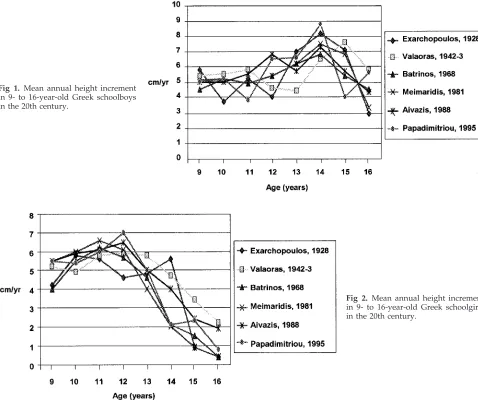
Boys present peak mean AHI consistently at 13 to 14 years of age in all studies (Fig 1), except for the one performed in 1942, in which peak mean AHI occurred 1 year later, manifesting the adverse effect World War II on children’s growth and develop-ment. Peak AHI ranged from 6.8 to 8.8 cm/year. In girls, there is no discernible peak AHI in the studies performed in the first half of 20th century, with a plateau at 10 to 14 years of age. Peak AHI ranged from 4.6 to 5.9 cm. On the contrary, the studies performed in the late 1960s and afterward all show a clear peak growth at 10 to 11 years of age or at 11 to 12 years of age (Fig 2). Peak AHI ranged from 6.6 to 7.0 cm/yr.
DISCUSSION
The observation that Greek boys present a consis-tent age at peak AHI suggests that in the last 70 years, they did not experience a significant secular trend toward earlier maturation. As far as girls are concerned, the blunted peak AHI in the studies per-formed in the first part of the 20th century suggests great variability in the timing of pubertal events during that period; many girls entered puberty late, therefore diminishing the average height increment. The observation that a clear peak mean AHI took place in all of the studies performed after the late 1960s suggests that the average Greek girl in the last From the First Department of Pediatrics, Penteli Children’s Hospital,
Ath-ens, Greece.
Received for publication Feb 5, 2001; accepted Jun 5, 2001.
Reprint requests to (A.P.) First Department of Pediatrics, Penteli Children’s Hospital, Athens, Greece. E-mail: [email protected]
30 years matures earlier than before. The latter is supported by the significant decrease in menarcheal age from older than 13 years11in 1935 to a median of
12.1 years12in 1998.
The positive secular changes in somatic
develop-ment generally are attributed to improved hygienic and environmental conditions.1,2However, these
fac-tors affect both sexes equally; therefore, one would expect a similar degree of secular trend for boys and girls.
TABLE 1. Mean Height (in Centimeters) of Greek Boys at Various Ages in the 20th Century Age
(Year)
Exarchopoulos Athens, 1928
(n⫽1883)
Valaoras Attica-Corinth, 1942–1943 (n⫽9461)
Batrinos Athens, 1968 (n⫽4826)
Meimaridis National,
1981
Aivazis Thessaloniki, 1988 (n⫽4046)
Papadimitriou Athens, 1995 (n⫽2562)
5 106.5 115.0
6 111.7 117.0 118.0 118.0
7 117.1 115.4 122.6 122.0 123.9
8 121.3 118.8 129.4 128.1 126.5 130.0
9 127.1 124.2 133.9 133.2 131.5 135.0
10 130.8 129.7 139.1 138.3 136.5 140.2
11 136.0 135.5 144.0 143.3 142.0 144.0
12 141.0 140.1 149.4 148.7 148.8 150.5
13 148.0 144.5 155.6 155.5 154.5 157.1
14 156.2 151.0 162.4 163.0 161.8 165.9
15 163.3 158.6 167.8 169.8 167.5 169.9
16 166.2 164.4 171.5 173.1 171.8 175.5
17 165.0 168.1 172.7 174.2 176.7
18 167.8 170.4 171.9
TABLE 2. Mean Height (in Centimeters) of Greek Girls at Various Ages in the 20th Century Age
(Year)
Exarchopoulos Athens, 1928
(n⫽1638)
Valaoras Attica-Corinth, 1942–1943 (n⫽4972)
Batrinos Athens, 1968 (n⫽4340)
Meimaridis National,
1981
Aivazis Thessaloniki, 1988 (n⫽3880)
Papadimitriou Athens, 1995 (n⫽2437)
5 100.5 110.3
6 111.5 118.2 117.0 116.7
7 115.0 115.1 123.3 121.0 122.8
8 122.0 118.5 129.2 128.7 126.0 129.2
9 126.2 123.7 133.2 134.2 131.5 134.7
10 132.0 128.6 138.7 140.2 137.4 140.1
11 137.6 134.4 144.9 146.8 143.5 146.1
12 142.2 140.3 150.6 152.9 150.0 153.1
13 147.0 146.1 155.2 156.9 155.0 158.1
14 152.6 150.8 157.3 158.9 159.0 160.2
15 153.5 154.2 158.8 159.8 161.4 162.5
16 153.9 156.4 159.2 160.2 162.3 163.3
17 155.7 158.3 158.9 160.3 162.6
18 155.7 158.7 158.8 160.4
TABLE 3. Mean Annual Height Increment (Centimeters/Year) in 9- to 16-Year-Old Greek Schoolboys Age (Year) Exarchopoulos, 1928 Valaoras, 1942–1943 Batrinos, 1968 Meimaridis, 1981 Aivazis, 1988 Papadimitriou, 1995
9 5.8 5.4 4.5 5.1 5.0 5.0
10 3.7 5.5 5.2 5.2 5.0 5.2
11 5.2 5.8 4.9 4.9 5.5 3.8
12 4.0 4.6 5.4 5.4 6.8 6.5
13 7.0 4.4 6.2 6.2 5.7 6.6
14 8.2 6.5 6.8 7.5 7.3 8.8
15 7.1 7.6 5.4 6.8 5.7 4.0
16 2.9 5.8 4.5 3.3 4.3 5.6
TABLE 4. Mean Annual Height Increment (Centimeters/Year) in 9- to 16-Year-Old Greek Schoolgirls Age (Year) Exarchopoulos, 1928 Valaoras, 1942–1943 Batrinos, 1968 Meimaridis, 1981 Aivazis, 1988 Papadimitriou, 1995
9 4.2 5.2 4.0 5.5 5.5 5.5
10 5.8 4.9 5.5 6.0 5.9 5.4
11 5.6 5.8 6.2 6.6 6.1 6.0
12 4.6 5.9 5.7 6.1 6.5 7.0
13 4.8 5.8 4.6 4.0 5.0 5.0
14 5.6 4.7 2.1 2.0 4.0 2.1
15 0.9 3.4 1.5 0.9 2.4 2.3
16 0.4 2.2 0.4 0.4 1.9 0.8
It is a common experience among clinicians, at least in the industrialized countries, that many girls— but much fewer boys—present with second-ary sex characteristics at a younger age than normal. This has led to the study of secondary sex character-istics in a large number of US girls.13 It was found
that a significant proportion of US girls enter puberty much earlier than the age of 8 years that was consid-ered as normal. These observations led the Drug and Therapeutics and Executive committees of the Law-son Wilkins Pediatric Endocrine Society to reexam-ine the age limits for definition of precocious puberty in girls in the United States.14 The new guidelines
suggested that sexual maturation is considered pre-cocious when it occurs before the age of 7 years in white and 6 years in black girls. For boys, however, there were no data to suggest a change in the existing recommendations. In fact, 2 recent studies15,16on the
sexual maturation of US boys did not show a notable trend toward earlier maturation.
It is widely known that girls mature earlier than boys. Furthermore, the incidence of precocious pu-berty is much higher in girls and usually is idio-pathic, whereas precocious puberty in boys is rare and often is pathologic. The reason(s) for the earlier
activation of the hypothalamic-pituitary-gonadal axis in girls is largely unknown.
Besides improvements in nutrition and hygiene, other conditions that have been regarded as possible factors responsible for earlier somatic maturation of children include products and foods that contain estrogens17 and also exposure to certain chemicals
that mimic estrogens.18 An association between in
utero and postnatal exposure to polybrominated bi-phenyls and early age at menarche was reported recently.19 Furthermore, significant levels of
phtha-late esters have been identified in Puerto Rican girls with premature breast development but not in con-trol subjects.20
Another factor that needs to be considered is the possible effect of psychosexual stimuli on pubertal maturation. This was addressed in 1935 by Malaspina,11who studied the relation between
men-archeal age and psychosexual stimuli in girls living in Athens. She found that 35% of the girls who were exposed to such stimuli, eg, read romance stories and went to the theater, had menarche before their 13th birthday, whereas only 26% of the girls who lived a more restricted life had menarche before that age. For the most part of the 20th century, Greek society
Fig 1. Mean annual height increment in 9- to 16-year-old Greek schoolboys in the 20th century.
was very puritanical, especially for girls, regarding the relations with the opposite sex. The moderniza-tion of Greek society that started taking place after the late 1960s certainly had a more intense effect on girls.
Childhood obesity became a major health problem in the second half of the 20th century in the indus-trialized countries. Its incidence is increasing, so in some countries it is considered as an epidemic.21
Although it affects both males and females, the effect that overweight exerts on the pubertal maturation of boys and girls is different. There are reports suggest-ing that overweight girls enter puberty earlier than girls of normal weight, whereas there is no difference in the timing of puberty between overweight and normal weight boys.22However, this is an issue that
needs further research.
CONCLUSION
The data of this study and those of the literature that was reviewed in this article suggest sexual dif-ferences in the secular trend toward earlier pubertal maturation, girls being affected more intensely than boys. Various factors seem to have a role in this; however, the contribution of each one is difficult to determine.
REFERENCES
1. Garn SM. The secular trend in size and maturational timing and its implications for nutritional assessment.J Nutr. 1987;117:817– 823 2. Rees M. Menarche when and why?Lancet. 1993;342:1375–1376 3. Exarchopoulos N.Somatology of the Child. Athens, Greece: Rougas; 1931
(in Greek)
4. Gedeon, S. Pedometric Studies in Greece. Athens, Greece: Dimitrakos; 1931 (in Greek)
5. Valaoras V, Papaioannou S. The height and weight of Greek pupils during the period of war.Proc Acad Athens. 1944;19:293–299 (in Greek) 6. Bezos D. A comparative study on the stature of children during Nazi
occupation (1942– 44) and today (1963).Arch Hellenic Paediatr Soc.1964; 27:363–370 (in Greek)
7. Batrinos M, Panayotou P. Height curves of 4826 boys and 4340 girls, aged 8 –18 years, living in the area of Athens.Proc Acad Athens. 1968; 43:436 – 451 (in Greek)
8. Mantzagrioti-Meimaridi M.Anthropometric Study of Child and Adolescent Population, 1981. Athens, Greece: Institute of Child Health; 1985 (in Greek)
9. Aivazis V.The Normal Child. Thessaloniki, Greece: Aris; 1990 (in Greek) 10. Papadimitriou A. Growth and development of Greek children in the twentieth century. In: Bodzsar BE, Susanne C, eds.Secular Growth Changes in Europe. Budapest: Eotvos University Press; 1998:161–173 11. Malaspina E. The commencement of menstruation in Greek girls.Proc
Acad Athens. 1935;10:70 – 81 (in Greek)
12. Papadimitriou A, Gousia E, Pitaouli E, Tapaki G, Philippidis P. Age at menarche of Greek girls.Ann Hum Biol. 1999;26:175–177
13. Herman-Giddens ME, Slora EJ, Wassermann RC, et al. Secondary sex-ual characteristics and menses in young girls seen in office practice: a study from the pediatric research in office settings network.Pediatrics. 1997;99:505–512
14. Kaplowitz PB, Oberfield SE, and the Drug and Therapeutics and Exec-utive Committees of the Lawson Wilkins Pediatric Endocrine Society. Reexamination of the age limit for defining when puberty is precocious in girls in the United States: implications for evaluation and treatment.
Pediatrics. 1999;104:936 –941
15. Roche AF, Wellens R, Attie KM, Siervogel RM. The timing of sexual maturation in a group of US white youths.J Pediatr Endocrinol Metab. 1995;8:11–18
16. Biro FM, Lucky AW, Huster GA, Morrison JA. Pubertal staging in boys.
J Pediatr. 1995;127:100 –102
17. Saenz de Rodriguez CA, Bongiovanni AM, Conde de Borrego L. An epidemic of precocious development in Puerto Rican children.J Pediatr. 1985;107:393–396
18. McKinney JD, Waletr CL. Polychlorinated biphenyls as hormonally active structural analogues.Environ Health Perspect. 1994;102:290 –297 19. Blanck HM, Marcus M, Tolbert PE, et al. Age at menarche and Tanner
stage in girls exposed in utero and postnatally to polybrominated biphenyl.Epidemiology. 2000;11:641– 647
20. Colon I, Caro D, Bourdony CJ, Rosario O. Identification of phthalate esters in the serum of young Puerto Rican girls with premature breast development.Environ Health Perspect. 2000;108:895–900
21. Maffeis C. Aetiology of overweight and obesity in children and adoles-cents.Eur J Pediatr. 2000;159(suppl 1):S35–S44
22. Buckler JMH. Growth at adolescence. In: Kelnar CJH, Savage MO, Stirling HF, Saenger P, eds.Growth Disorders: Pathophysiology and Treat-ment. London: Chapman and Hall Medical; 1998:179 –193
DOI: 10.1542/peds.108.4.e65
2001;108;e65
Pediatrics
Anastasios Papadimitriou
Sex Differences in the Secular Changes in Pubertal Maturation
Services
Updated Information &
http://pediatrics.aappublications.org/content/108/4/e65
including high resolution figures, can be found at:
References
http://pediatrics.aappublications.org/content/108/4/e65#BIBL
This article cites 12 articles, 3 of which you can access for free at:
Subspecialty Collections
icine_sub
http://www.aappublications.org/cgi/collection/adolescent_health:med
Adolescent Health/Medicine
following collection(s):
This article, along with others on similar topics, appears in the
Permissions & Licensing
http://www.aappublications.org/site/misc/Permissions.xhtml
in its entirety can be found online at:
Information about reproducing this article in parts (figures, tables) or
Reprints
http://www.aappublications.org/site/misc/reprints.xhtml
DOI: 10.1542/peds.108.4.e65
2001;108;e65
Pediatrics
Anastasios Papadimitriou
Sex Differences in the Secular Changes in Pubertal Maturation
http://pediatrics.aappublications.org/content/108/4/e65
located on the World Wide Web at:
The online version of this article, along with updated information and services, is
by the American Academy of Pediatrics. All rights reserved. Print ISSN: 1073-0397.
the American Academy of Pediatrics, 345 Park Avenue, Itasca, Illinois, 60143. Copyright © 2001 has been published continuously since 1948. Pediatrics is owned, published, and trademarked by Pediatrics is the official journal of the American Academy of Pediatrics. A monthly publication, it
at Viet Nam:AAP Sponsored on August 30, 2020
www.aappublications.org/news