R E V I E W
Open Access
Load balancing in cloud computing
–
A
hierarchical taxonomical classification
Shahbaz Afzal
*and G. Kavitha
Abstract
Load unbalancing problem is a multi-variant, multi-constraint problem that degrades performance and efficiency of computing resources. Load balancing techniques cater the solution for load unbalancing situation for two
undesirable facets- overloading and under-loading. In contempt of the importance of load balancing techniques to the best of our knowledge, there is no comprehensive, extensive, systematic and hierarchical classification about the existing load balancing techniques. Further, the factors that cause load unbalancing problem are neither studied nor considered in the literature. This paper presents a detailed encyclopedic review about the load balancing techniques. The advantages and limitations of existing methods are highlighted with crucial challenges being addressed so as to develop efficient load balancing algorithms in future. The paper also suggests new insights towards load balancing in cloud computing.
Keywords:Cloud computing, Taxonomy, Classification, Cloud service consumer, Cloud service provider, Quality of
service, Load unbalancing, Load balancing
Introduction
Cloud Computing is an internet based network technol-ogy that shared a rapid growth in the advances of commu-nication technology by providing service to customers of various requirements with the aid of online computing re-sources. It has provisions of both hardware and software applications along with software development platforms and testing tools as resources [1,2]. Such a resource deliv-ery is accomplished with the help of services. While as the former comes under category of Infrastructure as a service (IaaS) cloud, the latter two comes under headings of Soft-ware as a service (SaaS) cloud and platform as a service
(PaaS) cloud respectively [3]. The cloud computing is an
on-demand network enabled computing model that share resources as services billed on pay-as-you-go (PAYG) plan
[4]. Some of the giant players in given technology are
Amazon, Microsoft, Google, SAP, Oracle, VMware, Sales
force, IBM and others [1,2]. Majority of these cloud
pro-viders are high- tech IT organizations. The cloud comput-ing model is viewed under two different headcomput-ings. The first one is the service delivery model, which defines the type of the service offered by a typical cloud provider.
Based on this aspect, there are popularly following three
important service models SaaS, PaaS and IaaS [5, 6]. The
other aspect of cloud computing model is viewed on its scale of use, affiliation, ownership, size and access. The
official ‘National Institute of Standards and Technology’
(NIST) definition for cloud computing outlines four cloud deployment models namely private, public, community and hybrid clouds [7].
A cloud computing model is efficient if its resources are utilized in best possible way and such an efficient utilization can be achieved by employing and maintain-ing proper management of cloud resources. Resource management is achieved by adopting robust resource scheduling, allocation and powerful resource scalability techniques. These resources are provided to customers in the form of Virtual Machines (VM) through a process known as virtualization that makes use of an entity
(soft-ware, hardware or both) known as hypervisor [8]. The
greatest advantage of cloud computing is that a single user physical machine is transformed into a multiuser
virtual machines [9, 10]. The Cloud Service Provider
(CSP) plays a crucial role in service delivery to users and is a complex task with given available virtual resources. While serving user requests, some VMs will get a heavy traffic of user tasks and some will get a lesser traffic. As
© The Author(s). 2019Open AccessThis article is distributed under the terms of the Creative Commons Attribution 4.0 International License (http://creativecommons.org/licenses/by/4.0/), which permits unrestricted use, distribution, and reproduction in any medium, provided you give appropriate credit to the original author(s) and the source, provide a link to the Creative Commons license, and indicate if changes were made.
a result, the Cloud Service Provider (CSP) is left with unbalanced machines which have a huge gradient of user tasks and resource utilization [11].
The problem of load unbalancing is an undesirable event in the CSP side that degrades the performance and efficacy of the computing resources along with guaranteed Quality of Service (QoS) on agreed Service Level Agree-ment (SLA) between consumer and provider. Under these circumstances there arises need for load balancing (LB) and is a peculiar topic of research interest among re-searchers. The load balancing in cloud computing can be
done at physical machine level or VM level [2].
A task utilize resources of a VM and when a bunch of tasks arrive at a VM, the resources gets exhausted which means no resource is now available to handle the additional task requests. When such situation arises the VM is said to have entered into an overloaded state. At this point of time, tasks will either suffer from starvation or end up in deadlock with no hope of accomplishing them. Consequently there is necessity to migrate tasks to another resource on other VM. The workload migration process includes three basic steps: load balancing which checks the current load on machine resource, resource discovery which finds another suitable re-source and workload migration which moves extra tasks to available resources. These operations are performed by three different units commonly known as load balancer, resource discovery and task migration units respectively.
Load balancing is the process of redistribution of work-load in a distributed system like cloud computing ensuring no computing machine is overloaded, under-loaded or idle
[12, 13]. Load balancing tries to speed up different
con-strained parameters like response time, execution time, system stability etc. thereby improving performance of
cloud [14, 15]. It is an optimization technique in which
task scheduling is an NP hard problem. There are a large number of load balancing approaches proposed by re-searchers where most of focus has been concerned on task scheduling, task allocation, resource scheduling, resource allocation, and resource management. To the best of our knowledge, we could not find an in-depth and comprehen-sive literature concerned with factors that cause load unbalancing situation. The survey papers based on load balancing could not provide a proper systematic classifica-tion of methods and techniques. The main aim of the paper is to review the existing work along with the advan-tages and pitfalls in them. A comparison is also made among different existing load balancing techniques and the challenges faced in cloud load balancing. The survey also outlines factors responsible for load unbalancing problem and also suggests methods that can be used in future work. The contributions of this paper are summarized as follows:
I. Explore the factors that cause load unbalancing problem in cloud computing.
II. Provide a systematic overview of the existing approaches in the load balancing process and the way in which these approaches have been used in the cloud technology.
III. Provide the in-depth classification of different load bal-ancing techniques, methods, strategies and algorithms. IV. Analyze the challenges faced by researchers in
developing an efficient load balancing algorithm.
The remaining paper is structured as follows. Section
“Load balancing model background” features a brief de-scription about load balancing model in cloud computing.
Section “Research methodology” highlights some related
works. The research methodology is discussed in section
“Research methodology”. Section “Proposed classification
of load balancing algorithms” proposes taxonomy based
classification. The results are evaluated in section“Results and discussion” while section“Discussion on open issues
on load balancing in cloud computing” discusses upon
open issues in cloud load balancing. Finally section“
Con-clusion and future work” concludes our work and points
out some future directions.
Load balancing model background
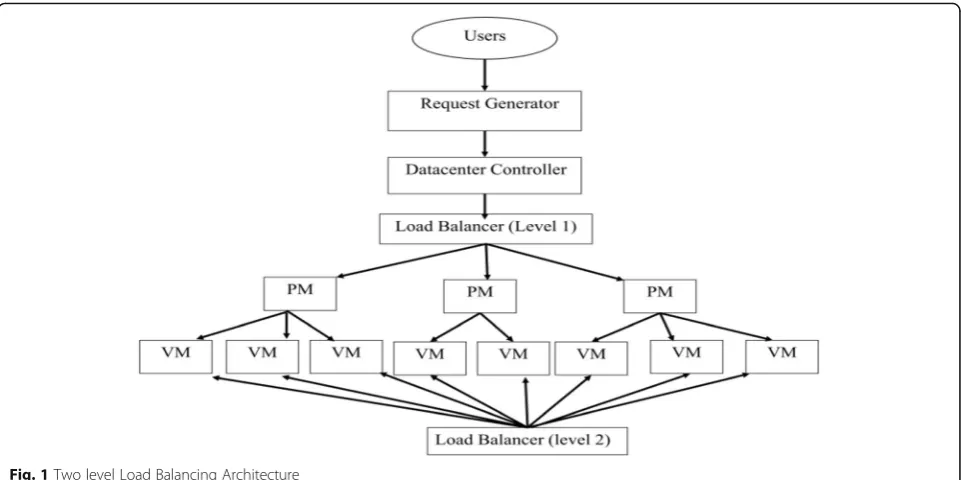
In this section a two level load balancing architecture model is presented in imbalanced clouds for achieving
best load shedding as shown in Fig. 1 which is a
modi-fied architecture given by Gupta et al. [16]. The virtual
machine manager and virtual machine monitor are ab-stracted in this model. The first level load balancing is performed at the Physical Machine (PM) level and the second level is performed at the VM level. Based on this, there are two task migration sets;
1. Intra VM task migration 2. Inter VM task migration
The request generator generates user requests which are user tasks that need computing resources for their execution. Data center controller is in-charge of task management. The load balancer checks which VM to assign for a given user task. The first level load balancer balances the given workload on individual Physical Ma-chines by distributing the workload among its respective associated Virtual Machines. The second level load bal-ancer balances the workload across different Virtual Ma-chines of different Physical MaMa-chines.
Activities involved in load balancing
Identification of user task requirements
This phase identifies the resource requirement of the user tasks to be scheduled for execution on a VM.
Identification of resource details of a VM
This checks the status of resource details of a VM. It gives the current resource utilization of VM and the unallocated resources. Based on this phase, the status of VM can be determined as balanced, overloaded or under-loaded with respect to a threshold.
Task scheduling
Once resource details of a VM are identified the tasks are scheduled to appropriate resources on appropriate VMs by a scheduling algorithm.
Resource allocation
The resources are allocated to scheduled tasks for execu-tion. A resource allocation policy is being employed to ac-complish this. A large number of scheduling and allocation policies are proposed in literature. While, scheduling is required for speeding up the execution, allocation policy is used for proper resource management and improving re-source performance. The strength of the load balancing al-gorithm is determined by the efficacy of the scheduling algorithm and the allocation policy [17–19].
Migration
Migration is an important phase in load balancing process in cloud and latter is incomplete without the former. Mi-gration is of two kinds in cloud based on entity taken into
consideration- VM migration and task migration. VM mi-gration is the movement of a VM from one physical host to another to get rid of the overloading problem and is categorized into types as live VM migration and non live migration. Likewise task migration is the movement of tasks across VMs and is of two types: intra VM task mi-gration and inter VM task mimi-gration. A large number of migration approaches has been proposed in literature. An efficient migration technique leads to an efficient load bal-ancing. From the extensive survey it has been concluded that task migration process is more time and cost effective than VM migration and the trend has shifted from VM to task migration [20–24].
Related work
In general a lot of work have been done in the field of cloud computing particularly in scheduling (tasks, VMs and Compute), resource provisioning, resource manage-ment, energy management and load balancing etc.
How-ever, load balancing has been an eagle’s eye among
researchers because of its essence in cloud computing
between the stakeholders’i.e. Cloud Service Provider and
Cloud Service Consumer. Based on analysis of existing re-view literature one of the reasons presented is absence of proper classification among different approaches. A thor-ough review about the existing work in literature has been presented in this section.
Ghomi et al. [25] proposed a survey on load balancing
hadoop- map reduce load balancing, agent based load balancing, natural phenomena based load balancing, ap-plication oriented load balancing, general load balancing, network aware load balancing and workflow specific load balancing which in literature fall under two domains based on system state and who initialized the process. From each category, the different algorithms are grouped together and their advantages and limitations
are listed. Meanwhile, Milani et al. [26] reviewed existing
load balancing techniques, established on the survey; authors grouped existing algorithms into three broad do-mains as static, dynamic and hybrid. The authors for-malized relevant questions towards load balancing and addressed key concern about importance, expectation level of metrics, role and challenges faced in load balan-cing. A proper search operation was followed in search query to retrieve most relevant content from different publishing sources assisted by Boolean operations in search strings and selection criteria phase was executed with Quality Assessment Checklist (QAC). However the two surveys examined limited QoS metrics in their work that are Response time, Makespan, Scalability, Resource utilization, Migration Time, Throughput and Energy saving leaving behind a gap to consider other important QoS metrics like migration cost, service level violations, degree of balance, task rejection ratio etc. This gap in metric selection for analysis is overcome in this survey.
Kalra and Singh [27] conducted a comparative study of
various scheduling algorithms for cloud and grid computing considering five fundamental meta-heuristic methods namely Ant Colony Optimization (ACO), Genetic Algorithm (GA), Particle Swarm Optimization (PSO), League Championship Algorithm (LCA) and BAT algorithm. Besides this a thor-ough comparison is made among the techniques; however their work is limited to scheduling algorithms for meta-heuristic techniques only. Also the survey concentrates on evolutionary algorithms only and lacks broad classification.
Mesbahi and Rahmani [28] classified load balancing
al-gorithms into three categories: general algorithm based, architectural based and artificial intelligence based, stud-ied the basic requirements and essentials in designing and implementing a desired load balancer for cloud pro-vider. Like other previous studies, this paper considers static and dynamic categorization as broad classification. However, authors suggested key challenges in designing load balancing algorithms. Further, authors made a judg-ment on the basis of study on algorithms that have prop-erties of being dynamic, distributive and non-cooperative are best.
Kanakala et al. [29] proposed a classification paper on
existing load balancing algorithms which are grouped into static and dynamic algorithms like ones discussed in previous studies. They also identified challenges in finding solution for problem of load balancing. Among
the challenges are geographical distribution of nodes, migration time, system performance, energy management and security which are long ago listed in the literature. In-fact the authors compared existing load balancing algo-rithms on the basis of certain QoS metrics like throughput, speed, response time, migration time etc. The paper con-cluded that there is tradeoff among metrics. The limitation of paper is that only eight load balancing algorithms are compared from a vast set of algorithms.
Shah et al. [30] discusses a comprehensive overview
with respect to the load balancing algorithms. The dif-ferent load balancing methods were classified as static and dynamic based on the state of the system, homoge-neous and heterogehomoge-neous based on VM type uniformity. Performance metrics were also used to classify the load balancing methods. Further, the advantages and disad-vantages of each algorithm were discussed. The paper does not address the literature in a systematic manner.
Neghabi et al. [31] presented a well defined, systematic
and potential review about load balancing techniques in software defined networks and broadly classified them into deterministic and non-deterministic approaches along with associated metrics being investigated into depth. The study poses some important questions and tries to answer them along dimensions of their significance, metric analysis, role and challenges being faced in load balancing of software defined networks. The study carried out by the authors pre-sents the detailed advantages and limitations of existing literature in communication networks. Further the paper holds a strong foundation and solid correlation among load balancing metrics, despite the fact that it does not go specific to cloud computing domain. Also, the study is based on single level classification rather than hierarchical classification.
From above listed survey papers, it is concluded that already existing survey papers are lacking from a good classification system. A criterion is fixed for classification purpose, but no generalization and specialization charac-teristics are drawn, which eventually lead to inadequate and insufficient conclusions. Further, existing review ar-ticles does not examine some important parameters like algorithmic complexity of load balancing algorithms and also the percentage of occurrence of load balancing metrics in literature. The existing survey papers lacks full description of QoS metric set, most likely new met-rics (as migration cost, service level violations, degree of balance, task rejection ratio) should have been intro-duced in survey. A taxonomy based classification is pro-posed in this paper to prove its effectiveness over the existing literature. Also, the classification of QoS metrics is proposed in this survey as performance metrics and
economic metrics [32]. So, to guide future researchers in
insights into future work, a taxonomy based classifica-tion system is introduced in this paper. The proposed methodology of classification is based on various character-istics of load balancing algorithms- ‘nature of algorithm’,
‘state of the algorithm’,‘trait used for load balancing’,‘mode of execution’,‘type’, ‘functionality’, and‘technique used by algorithm’.
Research methodology
To go deep into roots of load balancing process as to what causes load unbalancing problem a proper research meth-odology was followed. The literature survey was conducted in accordance with general research strategy that outlines the way in which load unbalancing problem is undertaken and identifies the methods, theories, algorithms, approaches and paradigms used in it. The load unbalancing problem was studied in accordance with constructive generic
frame-work (CGF) methodology [33] where it is broken down into
sub- processes i.e. the factors, variables and parameters that are associated with load balancing. Further the literature study was enhanced by following the research guideline for Systematic Literature Review (SLR) as contemplated by Kitchenham with a special focus on research related to load
balancing mechanism in cloud [26, 34]. An SLR is a
peated research method that can be replicated by other re-searchers to explore more knowledge.
In order to feature the importance of load balancing in cloud computing, a set of questions were framed to ad-dress the key issues and challenges in load unbalancing.
Question identification
A set of questions were identified from literature survey that need to be answered before going into the load balan-cing process. Some of the questions have been answered in literature while others are not. The questions are given as follows:
RQ1: What causes the load unbalancing problem? This question tries to answer why load unbalancing problem happens. This involves identification of factors
responsible for cause of load unbalancing. The question cannot be answered until each individual factor is considered and studied with full detail. The load balancing process is incomplete unless knowledge about variables leading to unbalancing is not clear. This is of prime importance and till date no study
considered this question. So, this paper presents answer of this question.
RQ2: Why load balancing is the need of hour in cloud computing? This question tries to answer the issues and challenges faced by cloud service providers. RQ3: Does load balancing consider the evaluation of single objective (single attribute) or multi-objective (multi-attribute) function(s)? This question classifies
the existing load balancing algorithms into single objective and multi-objective approaches.
RQ4: What is the time complexity of load balancing algorithm? This question answers the amount of time taken by load balancing algorithm to complete the load balancing process. Algorithm complexity is not taken as a standard for classifying the LB algorithms in the existing literature. The algorithm should run with real time algorithm complexity to be of practical use.
This section explores the causes for load unbalancing problem in IaaS clouds and tries to answers RQ1. The following factors are the causes for load unbalancing problem in IaaS clouds.
The dynamic nature of user tasks.
The unpredictable and probabilistic traffic flow to a cloud provider.
Lack of robust, accurate and efficient mapper and generator function to map the tasks to the appropriate resources.
The scheduling process itself is an NP hard problem. The heterogeneous nature of user tasks demanding
varying resource requirements.
The uneven and non- uniform distribution of tasks across computing resources along with their dependencies also contributes to load unbalancing situation.
Load balancing is a promising solution to load unbalancing problem that arise due to circumstances discussed in this section. This section answers RQ2 with the importance of load balancing in cloud computing. The load balancing algorithm has to enhance response time, cost of execution, execution time, throughput, fault toler-ance, migration time, degree of baltoler-ance, makespan, re-source utilization and scalability. At the same time to reduce the resource wastage, migration cost, power con-sumption, energy concon-sumption, carbon emission and SLA violations. The degradation of values of these factors leads to poor Quality of Service (QOS) to CSC and drop in economy in the form of profit to CSP. So keeping in view QOS and economy, it has become a big challenge for CSPs to provide QOS according to guaranteed SLA. How-ever, to improve performance and economic metrics in one go is still a milestone for researchers to conclude the load balancing as NP hard problem like scheduling. This is because as we try to improve one specific metric the as-sociated metrics begin to diminish and bottleneck persists, thus declaring load unbalancing as a multi- constrained multi-objective problem.
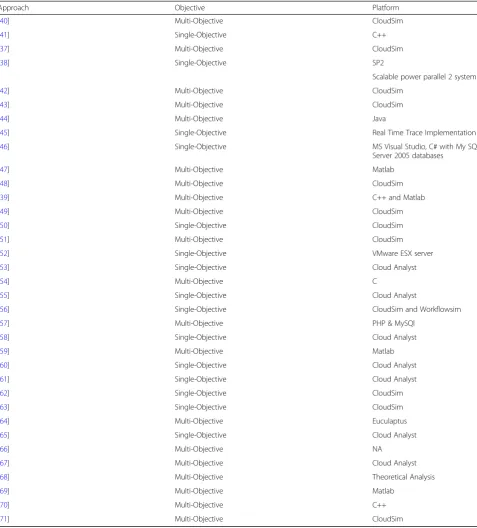
particular algorithm and tries to answer RQ3. RQ3 is also an elucidation of the RQ2 to consider load unbalancing as a multi-objective problem. Till date there exists no perfect load balancing algorithm in literature that takes into ac-counts all of the metrics in a single algorithm. Different researchers propose single objective algorithm to speed up a single metric while others tried to improve more than one metric at a time. The limitation of single objective ap-proaches is that introduction of these in load balancing process altogether would result in huge complexity of architectural design and may become impractical for use. So prime attention is shifted from single objective to
multi-objective approaches. Table 3 reviews different
existing approaches based on single objective or multi-objective function(s) solved by a particular approach.
The RQ4 tries to answer time complexity of the algo-rithm being used in load balancing process and should be considered as a benchmark to determine performance of a load balancing algorithm. However, as a matter of concern we could not find enough literature determining the algo-rithmic complexity of an approach being used in the process. Out of top 35 studies conducted in this research only 7 studies considers the algorithmic complexity in their work which accounts to only 20% and the figure may drop as we increase the search space.
Milani et al. [26] identified the three main primary
questions in the existing literature and justified them in their work. The questions were formalized as follows;
1. What is the consequence on load balancing with the growth of cloud users? The authors pointed out that from 2010 to 2015 there is a momentous rise in research papers on the scope of load balancing that follows a positive exponential curve and in our work find it more increasing in 2016, 2017 and 2018. This shows the importance of load balancing in the cloud computing with increasing number of users.
2. What is the capability of present load balancing approaches to meet the primary load balancing metrics? The question was answered and validated through the argument that dynamic load balancing algorithms are more practical, robust, efficient and fault tolerant than static ones.
3. What are the problems, issues, challenges and solutions identified in load balancing for future trends? The limitations and advantages of the existing approaches were listed and based on that challenges faced by researchers were discussed.
Data collection search process
The data collection search process includes papers gathered from reputed sources, journals and publications from five
most authentic and potential databases that are scientific-ally and technicscientific-ally peer- reviewed: IEEE Xplore Digital Library, Science Direct, ACM Digital Library, Springer and Elsevier. The search was organized in June 2018 with data collected from 2010 to June 2018. The data source consist of review and survey papers, journal papers and conference papers excluding book chapters. A well organized search process was adopted to retrieve relevant data started with fundamental terms to advanced ones. The search strings were framed for source databases with inclusion and
exclu-sion criteria similar to the one used by [26]. Search
key-words were formed along with their synonyms to increase the search space. Initially, the basic terms and keywords
were used in search query processing like“Load Balancing
in Cloud Computing”, “Workload Distribution in Cloud
Computing”, “Resource Distribution in Cloud”, “Task
scheduling”, “Migration process in Cloud Computing”,
“Resource utilization in Cloud”, “Resource allocation
policies in Cloud”, “Load scheduling in Cloud” and much
more. Later on the advanced terms were used following by integration of basic keywords in query operation assisted by
Boolean operations as “Boolean OR” and “Boolean AND”
[26,35] to narrow down the search space for relevant data. As an illustration the following keywords were integrated
“Resource allocation AND Task scheduling”,“Task
Migra-tion” “Task scheduling”and“Resource utilization”. Later on the advanced search operation was equipped to collect most reliable papers for data collection, like the use of Inspec controlled and non- controlled keywords were applied followed by advanced filters. As an example the fol-lowing advanced search operation was applied in the IEEE
Xplore. “Advanced keyword/phrase” option which include
two sub options“metadata only” and“full text and
meta-data” each using three Boolean operations “AND”, “OR”
“NOT”. Similarly, command search and citation search
op-tions were also used.
Proposed classification of load balancing algorithms
In this section load balancing algorithms are classified based on various criteria. A top down approach is pro-posed and followed in classification process. The limitation of existing review papers is that there is no proper and sig-nificant hierarchical taxonomical classification of load bal-ancing algorithms which makes it quite difficult to identify where a particular algorithm holds its place in taxonomy. The various criteria used for classification purpose include
we placed in taxonomy and which till date have not been shown in any of the literature studies. Based on state of system, the LB algorithms are static, dynamic or hybrid. On the basis of trait used in load balancing, LB algorithms are classified as scheduling and allocation algorithms. On the basis of type of LB algorithms they are grouped as VM LB algorithms, CPU LB algorithms, Task LB algorithms, Server LB algorithms, Network LB algorithms and Normal Cloud Load balancing algorithms. On the basis of func-tionality, the load balancing methods are grouped as hard-ware load balancing; elastic load balancing and latter is further grouped into network load balancing, application load balancing and classic load balancing. Based on the technique, Load balancing algorithms are classified as; Machine learning, Evolutionary, Nature Inspired, mathem-atical derived algorithms, and swarm based techniques.
Nature of the algorithm
The first categorization of load balancing algorithms in this work has been done on the basis of nature of algo-rithm. On the basis of this classification, LB algorithms are classified as proactive based approaches and reactive based approaches. However in other fields of technology particularly in the communication and networking for mobile adhoc networks (MANETS), the nature of the communication routing protocols has been extensively
studied under these two variants [36].
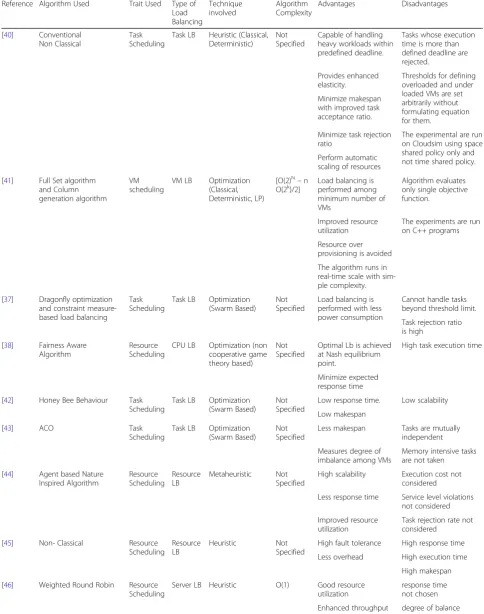
A proactive based LB algorithmic technique is an ap-proach to algorithmic design which takes into consider-ation action by causing change and not only reacting to that change when it happens. It is intended to yield a good outcome to avoid a problem in advance rather than waiting until there is a problem. Proactive behavior aims at identification and exploitation of opportunities and in taking preemptory action against potential problems and threats. The limitation of existing approaches is that a limited number of proactive approaches have been used and that too in a traditional manner with no novel
con-cepts. Table 1 depicts proactive approaches in existing
LB approaches. Polepally et al. [37] proposed dragonfly
optimization and constraint measure-based LB approach in cloud computing by distributing uniform load across
VMs with minimal power consumption. Xiao, et al. [38]
proposed game theory based fairness-aware LB algo-rithm to minimize expected response time while main-tain fairness. The Nash equilibrium point of the game corresponds to load balancing at optimal level.
The reactive based approaches act in response to a situ-ation rather than controlling it. In reactive based approach of load balancing the problem of load unbalancing is solved as it arises and after which the consequences are visible. Most of load balancing algorithms fall under this category. The main flaw that has been analyzed from literature of existing works on load balancing is that load unbalancing
problem is left to happen and then researchers propose some approaches to tackle that problem by optimizing
some load balancing parameter(s) [32] as given in Fig. 2.
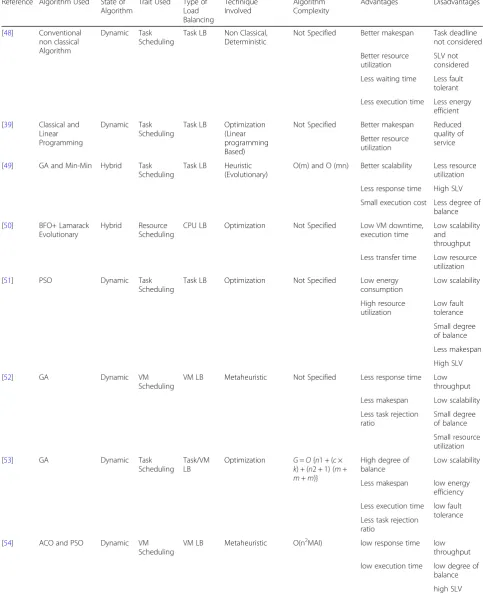
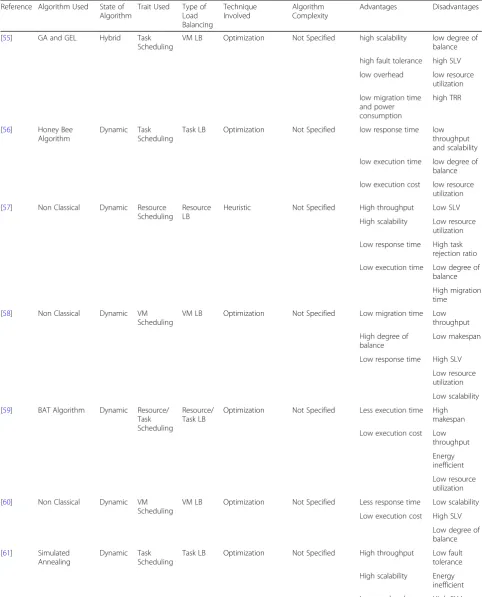
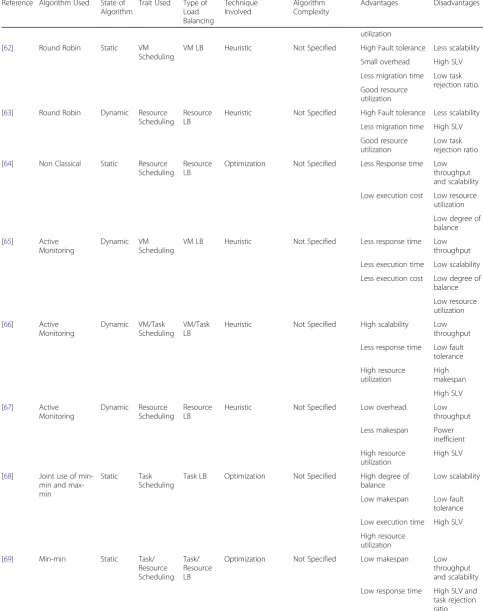
Table2 discusses the reactive approaches in the
exist-ing LB approaches e.g. Adhikari et al. [39] proposed a
heuristic-based scheduling and load balancing algo-rithm for IaaS cloud to minimize task completion time, makespan, waiting time, and increase resource utilization. Proactive approaches are more effective than reactive approaches as the former tries to avoid the problem in advance while in latter the solution is provided after the problem occurs.
State of the algorithm
On the basis of state information of system that an algo-rithm relies on, LB algoalgo-rithms are widely classified as static, dynamic and hybrid. From existing literature survey, it is evident that this is most widely used classifi-cation system for LB algorithms. Majority of work on comparative studies on load balancing begin the algo-rithmic taxonomy by placing this category on top of tax-onomy. In static load balancing, traffic load is segregated uniformly across the servers. This is done by algorithm having the prior knowledge about system resources and task requirements. The static LB algorithm schedules tasks to VM for execution at compile time. The advan-tage of static algorithm is their less complexity but they suffer from a fatal bottleneck of being unable to move tasks during execution in progress to another machine for load balancing. Static algorithms do not consider current state of system and requires advance knowledge about machines and tasks like task resource require-ments, communication time, processing power of nodes, memory, storage, bandwidth capacity and so on. The main drawback of static LB algorithm is that migration process is not possible during execution of tasks and hence is not suitable approach for distributed system like cloud where system state changes dynamically.
Further on the basis of mode of execution of tasks, dy-namic algorithms are grouped as offline mode also called as batch mode and online mode or live mode as shown in
Fig. 3. In batch mode, the task is allocated only at some
Table 1Proactive approaches of Cloud load balancing in existing literature
Reference Algorithm Used Trait Used Type of Load Balancing Technique involved Algorithm Complexity Advantages Disadvantages [40] Conventional Non Classical Task Scheduling
Task LB Heuristic (Classical, Deterministic)
Not Specified
Capable of handling heavy workloads within predefined deadline.
Tasks whose execution time is more than defined deadline are rejected.
Provides enhanced elasticity.
Thresholds for defining overloaded and under loaded VMs are set arbitrarily without formulating equation for them.
Minimize makespan with improved task acceptance ratio.
Minimize task rejection ratio
The experimental are run on Cloudsim using space shared policy only and not time shared policy. Perform automatic
scaling of resources
[41] Full Set algorithm and Column generation algorithm
VM scheduling
VM LB Optimization (Classical, Deterministic, LP)
[O(2)N–n
O(2k)/2] Load balancing isperformed among minimum number of VMs
Algorithm evaluates only single objective function.
Improved resource utilization
The experiments are run on C++ programs
Resource over provisioning is avoided
The algorithm runs in real-time scale with sim-ple comsim-plexity.
[37] Dragonfly optimization and constraint measure-based load balancing
Task Scheduling
Task LB Optimization (Swarm Based)
Not Specified
Load balancing is performed with less power consumption
Cannot handle tasks beyond threshold limit.
Task rejection ratio is high
[38] Fairness Aware Algorithm
Resource Scheduling
CPU LB Optimization (non cooperative game theory based)
Not Specified
Optimal Lb is achieved at Nash equilibrium point.
High task execution time
Minimize expected response time
[42] Honey Bee Behaviour Task Scheduling
Task LB Optimization (Swarm Based)
Not Specified
Low response time. Low scalability
Low makespan
[43] ACO Task
Scheduling
Task LB Optimization (Swarm Based)
Not Specified
Less makespan Tasks are mutually independent
Measures degree of imbalance among VMs
Memory intensive tasks are not taken
[44] Agent based Nature Inspired Algorithm Resource Scheduling Resource LB Metaheuristic Not Specified
High scalability Execution cost not considered
Less response time Service level violations not considered
Improved resource utilization
Task rejection rate not considered
[45] Non- Classical Resource Scheduling
Resource LB
Heuristic Not Specified
High fault tolerance High response time
Less overhead High execution time
High makespan
[46] Weighted Round Robin Resource Scheduling
Server LB Heuristic O(1) Good resource utilization
response time not chosen
nature and much complicated to design compared to static LB algorithms.
However dynamic LB algorithms are much efficient in terms of performance, accuracy and functionality. Static load balancing algorithms work smoothly if nodes have small load variations but could not
oper-ate in varying load environments. Figure 3 shows the
load balancing taxonomy on the basis of nature and state of algorithm.
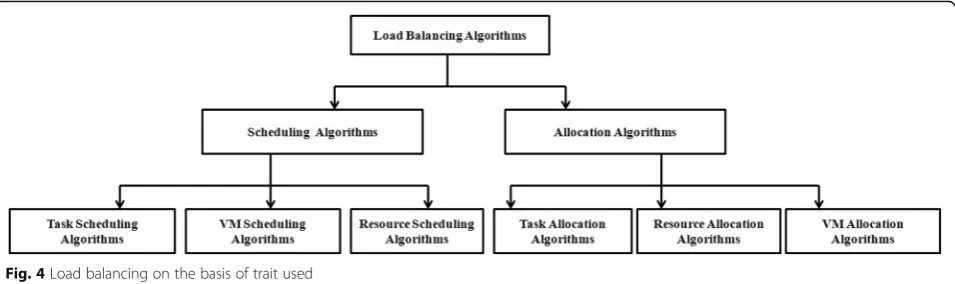
Trait used for load balancing
The algorithms in this category are classified as scheduling and allocation algorithms. The allocation and scheduling al-gorithms in cloud are classified based upon current state of
Table 1Proactive approaches of Cloud load balancing in existing literature(Continued) Reference Algorithm Used Trait Used Type of
Load Balancing
Technique involved
Algorithm Complexity
Advantages Disadvantages
Less overhead energy efficiency not chosen High fault tolerance
[47] Nature Inspired GA Task and Resource Scheduling
Task LB Optimization O(1) Efficient resource utilization
Priority based
Less resource wastage Less scalability
Small energy consumption
Less fault tolerance
Less SLV
Improved degree of balance
Table 2Reactive approaches of cloud load balancing in existing literature
Reference Algorithm Used State of Algorithm
Trait Used Type of Load Balancing
Technique Involved
Algorithm Complexity
Advantages Disadvantages
[48] Conventional non classical Algorithm
Dynamic Task Scheduling
Task LB Non Classical, Deterministic
Not Specified Better makespan Task deadline not considered
Better resource utilization
SLV not considered
Less waiting time Less fault tolerant
Less execution time Less energy efficient
[39] Classical and Linear Programming
Dynamic Task Scheduling
Task LB Optimization (Linear programming Based)
Not Specified Better makespan Reduced quality of service Better resource
utilization
[49] GA and Min-Min Hybrid Task Scheduling
Task LB Heuristic (Evolutionary)
O(m) and O (mn) Better scalability Less resource utilization
Less response time High SLV
Small execution cost Less degree of balance
[50] BFO+ Lamarack Evolutionary
Hybrid Resource Scheduling
CPU LB Optimization Not Specified Low VM downtime, execution time
Low scalability and
throughput
Less transfer time Low resource utilization
[51] PSO Dynamic Task
Scheduling
Task LB Optimization Not Specified Low energy consumption
Low scalability
High resource utilization
Low fault tolerance
Small degree of balance
Less makespan
High SLV
[52] GA Dynamic VM
Scheduling
VM LB Metaheuristic Not Specified Less response time Low throughput
Less makespan Low scalability
Less task rejection ratio
Small degree of balance
Small resource utilization
[53] GA Dynamic Task
Scheduling
Task/VM LB
Optimization G=O{n1 + (c×
k) + (n2 + 1) (m+
m+m)}
High degree of balance
Low scalability
Less makespan low energy efficiency
Less execution time low fault tolerance Less task rejection
ratio
[54] ACO and PSO Dynamic VM Scheduling
VM LB Metaheuristic O(n2MAI) low response time low throughput
low execution time low degree of balance
high SLV
Table 2Reactive approaches of cloud load balancing in existing literature(Continued) Reference Algorithm Used State of
Algorithm
Trait Used Type of Load Balancing
Technique Involved
Algorithm Complexity
Advantages Disadvantages
[55] GA and GEL Hybrid Task Scheduling
VM LB Optimization Not Specified high scalability low degree of balance
high fault tolerance high SLV
low overhead low resource utilization
low migration time and power consumption
high TRR
[56] Honey Bee Algorithm
Dynamic Task Scheduling
Task LB Optimization Not Specified low response time low throughput and scalability
low execution time low degree of balance
low execution cost low resource utilization
[57] Non Classical Dynamic Resource Scheduling
Resource LB
Heuristic Not Specified High throughput Low SLV
High scalability Low resource utilization
Low response time High task rejection ratio
Low execution time Low degree of balance
High migration time
[58] Non Classical Dynamic VM Scheduling
VM LB Optimization Not Specified Low migration time Low throughput
High degree of balance
Low makespan
Low response time High SLV
Low resource utilization
Low scalability
[59] BAT Algorithm Dynamic Resource/ Task Scheduling
Resource/ Task LB
Optimization Not Specified Less execution time High makespan
Low execution cost Low throughput
Energy inefficient
Low resource utilization
[60] Non Classical Dynamic VM Scheduling
VM LB Optimization Not Specified Less response time Low scalability
Low execution cost High SLV
Low degree of balance
[61] Simulated Annealing
Dynamic Task Scheduling
Task LB Optimization Not Specified High throughput Low fault tolerance
High scalability Energy inefficient
Low overhead High SLV
Less makespan
Table 2Reactive approaches of cloud load balancing in existing literature(Continued) Reference Algorithm Used State of
Algorithm
Trait Used Type of Load Balancing
Technique Involved
Algorithm Complexity
Advantages Disadvantages
utilization
[62] Round Robin Static VM Scheduling
VM LB Heuristic Not Specified High Fault tolerance Less scalability
Small overhead High SLV
Less migration time Low task rejection ratio. Good resource
utilization
[63] Round Robin Dynamic Resource Scheduling
Resource LB
Heuristic Not Specified High Fault tolerance Less scalability
Less migration time High SLV
Good resource utilization
Low task rejection ratio
[64] Non Classical Static Resource Scheduling
Resource LB
Optimization Not Specified Less Response time Low throughput and scalability
Low execution cost Low resource utilization
Low degree of balance
[65] Active Monitoring
Dynamic VM Scheduling
VM LB Heuristic Not Specified Less response time Low throughput
Less execution time Low scalability
Less execution cost Low degree of balance
Low resource utilization
[66] Active Monitoring
Dynamic VM/Task Scheduling
VM/Task LB
Heuristic Not Specified High scalability Low throughput
Less response time Low fault tolerance
High resource utilization
High makespan
High SLV
[67] Active Monitoring
Dynamic Resource Scheduling
Resource LB
Heuristic Not Specified Low overhead Low throughput
Less makespan Power inefficient
High resource utilization
High SLV
[68] Joint use of min-min and max-min
Static Task Scheduling
Task LB Optimization Not Specified High degree of balance
Low scalability
Low makespan Low fault tolerance
Low execution time High SLV
High resource utilization
[69] Min-min Static Task/ Resource Scheduling
Task/ Resource LB
Optimization Not Specified Low makespan Low throughput and scalability
Low response time High SLV and task rejection ratio
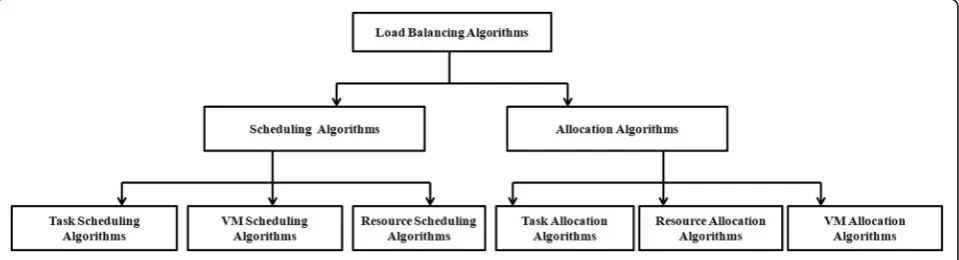
VM and accordingly can be static or dynamic. The alloca-tion and scheduling policies play a vital role in resource management and performance monitoring of cloud, which in turn has a good impact on QoS delivery to user. The scheduling policies are decomposed into three subsequent activities task scheduling, resource scheduling and VM scheduling; likewise the allocation policies are decomposed as task allocation, resource allocation and VM allocation respectively.
Task scheduling is the method of assigning user tasks to relevant computing resources for execution while resource scheduling is the process of planning, managing and monitoring computing resources for task execution. VM scheduling is the process of creating, destroying and man-aging VMs within a physical host apart from manman-aging the VMs during migration process across the hosts. The task allocation is the act of allocating task to a resource on which it is supposed to execute. Resource allocation is the act of allocating a resource to a task for its completion. Task allocation and resource allocation are inversion of each other. VM allocation is the allocation of virtual
machine to a user or a set of users. Figure 4 shows the
load balancing algorithms on the basis of trait being used.
Functionality
On the basis of functionality, load balancers are classified as hardware load balancer and elastic load balancer as
depicted in Fig.5. Hardware load balancers are concerned
with the distribution of workload at hardware level i.e. memory, storage and CPU. Elastic Load Balancing auto-matically distributes incoming application traffic across multiple targets, such as Amazon EC2 instances, con-tainers, and IP addresses. It can handle varying load of user application traffic in a single availability zone or across multiple availability zones. Elastic Load Balancing offers three types of load balancers that all feature high availability, automatic scaling, and robust security neces-sary to make user applications fault tolerant. Application Load Balancer operates at the request level (layer 7) rout-ing traffic to targets - EC2 instances, containers and IP ad-dresses based on the content of the request. Ideal for advanced load balancing of HTTP and HTTPS traffic,
Table 2Reactive approaches of cloud load balancing in existing literature(Continued) Reference Algorithm Used State of
Algorithm
Trait Used Type of Load Balancing
Technique Involved
Algorithm Complexity
Advantages Disadvantages
utilization inefficient
[70] Max-Min Static Task Scheduling
Task LB Optimization O (mn)2 High throughput and scalability
Low resource utilization
Low fault tolerance Low degree of balance
Low overhead High makespan
[71] Round Robin Dynamic Task Scheduling
Task LB Heuristic Not Specified Low makespan Low fault tolerance
Low power consumption
Low degree of balance
Low SLV Low resource utilization
Application Load Balancer provides advanced request routing targeted at delivery of modern application archi-tectures, including micro-services and container-based ap-plications. Application Load Balancer simplifies and improves the security of your application, by ensuring that the latest SSL/TLS ciphers and protocols are used at all times. Network load balancers are implemented at the transport layer of the OSI model. It has ability to handle millions of requests per second. The network load balan-cing is popularly used by Microsoft azure and AWS in de-ployment model. The network load balancing feature allows traffic distribution among servers using the TCP/IP internet protocol. Classic Load Balancer provides basic load balancing across multiple Amazon EC2 instances and operates at both the request level and connection level. Classic Load Balancer is intended for applications that were built within the EC2-Classic network.
Type of load balancing
On the basis of type, LB algorithms are classified as VM LB, CPU LB, task LB, server LB, network LB and normal
cloud LB as shown in Fig. 5. VM load balancing is the
process of redistribution of VMs from overloaded nodes to
under loaded nodes and was first introduced as a new inbox feature in windows server 2016 that allows optimize node utilization in a failure cluster. VM load balancing identifies over committed nodes and redistributes VMs from those nodes to under committed nodes. VMs are live migrated from a node exceeding threshold to a newly added node in failure cluster. VM load balancing is achieved through VM migration process. CPU load balan-cing is the process of limiting the load on a CPU within its threshold limit. Task Load balancing is the act of distribu-tion of tasks across the VMs from overloaded machines to under loaded machines. Server LB is proper distribution of total incoming load in a datacenter or a server farm across the servers. Network LB is concerned with management of incoming traffic without use of complex protocols.
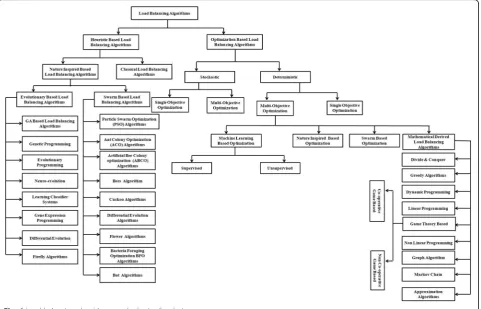
Technique used in load balancing
On the basis of the technique used, load balancing algo-rithms are classified as heuristics and meta-heuristics techniques, and optimization techniques.
A heuristic approach is an approach to problem solving accounting a practical method or methodology guaranteed Fig. 4Load balancing on the basis of trait used
not be optimal, perfect, logical or rationale but sufficient to reach an immediate goal. Finding an optimal solution may be impossible or impractical particularly to load balancing which is a NP hard problem and heuristics play an import-ant role to gear up the process of finding a decent solution. Heuristic methods are designed following strategies derived from previous experience with similar problem sets. Heu-ristics play a crucial role in load balancing process to sort up various issues faced by CSPs. A lot of research work has been carried out with heuristic and meta-heuristic ap-proaches in cloud load balancing and as such we have clas-sified the heuristic and meta-heuristic methods into nature inspired algorithms and classical algorithms. The nature in-spired algorithms are sub divided into evolutionary based algorithms and swarm based algorithms.
Optimization techniques are used to find optimal solu-tions of a problem. Optimization techniques in cloud load balancing are broadly classified as classical and non classical optimization techniques. These algorithms can be either stochastic or deterministic. A further classification classifies the optimization techniques into constrained based and non constrained based algorithms and these can further be either a single objective or multi-criteria optimization. The multi- criteria optimization is further classified as attribute and objective optimization. The
multi-objective algorithms may be either machine learning based, nature inspired based, swarm based or mathematical derived
based load balancing algorithms. Figure 6 shows the load
balancing algorithms on the basis of technique used.
Table1and Table2respectively list the different
char-acteristics of proactive and reactive approaches in related literature along various dimensions. The strength and
weakness of each approach is also reflected in Table 1
and Table 2. Table 3 depicts the different approaches
under investigation as single objective and multi-objective. Table 3 also highlights the implementation platform, tool and simulating environment under which a particular
approach was studied and investigated. Finally Table4
pre-sents the essential load balancing metrics analyzed in the existing approaches.
Results and discussion
This section outlines the results achieved from compara-tive analysis of different load balancing approaches in
cloud computing. Figure 7(a) shows the percentage of
contribute 9.09%. From Fig.7(b) it is evident that most of the reactive approaches in existing literature have been studied under task scheduling which amount to 51.85%, followed by VM scheduling which contribute to 25.93% and resource scheduling which contribute to
22.22% respectively. Figure8describes the percentage of
research articles on cloud load balancing defining the
algorithmic complexity. It is calculated that 80% of re-search articles did not considered algorithmic complex-ity in their work while only 20% define it in their work.
It is analyzed from Fig. 9(a) that proactive approaches
are always dynamic in nature while Fig.9(b)depicts that
most of the reactive approaches fall under dynamic state of algorithm which contribute to 68%, followed by static Table 3Number of objective function (s) and implementation platform used in existing literature
Approach Objective Platform
[40] Multi-Objective CloudSim
[41] Single-Objective C++
[37] Multi-Objective CloudSim
[38] Single-Objective SP2
Scalable power parallel 2 system
[42] Multi-Objective CloudSim
[43] Multi-Objective CloudSim
[44] Multi-Objective Java
[45] Single-Objective Real Time Trace Implementation
[46] Single-Objective MS Visual Studio, C# with My SQl
Server 2005 databases
[47] Multi-Objective Matlab
[48] Multi-Objective CloudSim
[39] Multi-Objective C++ and Matlab
[49] Multi-Objective CloudSim
[50] Single-Objective CloudSim
[51] Multi-Objective CloudSim
[52] Single-Objective VMware ESX server
[53] Single-Objective Cloud Analyst
[54] Multi-Objective C
[55] Single-Objective Cloud Analyst
[56] Single-Objective CloudSim and Workflowsim
[57] Multi-Objective PHP & MySQl
[58] Single-Objective Cloud Analyst
[59] Multi-Objective Matlab
[60] Single-Objective Cloud Analyst
[61] Single-Objective Cloud Analyst
[62] Single-Objective CloudSim
[63] Single-Objective CloudSim
[64] Multi-Objective Euculaptus
[65] Single-Objective Cloud Analyst
[66] Multi-Objective NA
[67] Multi-Objective Cloud Analyst
[68] Multi-Objective Theoretical Analysis
[69] Multi-Objective Matlab
[70] Multi-Objective C++
Table 4 Load balancing me trics in existing literature Refere nce Throu ghpu t Scal ability Fault Tolerance Overhead Migrat ion Time
Degree of Balance
Make span Resp onse Time Exec ution Time Exec ution Cost Power Consu mptio n Service Lev el Viol ation Resou rce Utili zation Migrat ion Cost
Task Rejection Ratio
Table
4
Load
balancing
me
trics
in
existing
literature
(Co
ntinued)
Refere
nce
Throu
ghpu
t
Scal
ability
Fault Tolerance
Overhead
Migrat
ion
Time
Degree of Balance
Make
span
Resp
onse
Time
Exec
ution
Time
Exec
ution
Cost
Power Consu
mptio
n
Service Lev
el
Viol
ation
Resou
rce
Utili
zation
Migrat
ion
Cost
Task Rejection Ratio
Wai
ting
Time
[
67
]*
*
*
[
68
]*
*
*
*
*
[
69
]*
*
*
*
[
70
]*
*
*
*
[
71
]*
*
*
*
*
*
[
47
]*
*
algorithm which contribute 20% and hybrid algorithm
which represent 12%. It is evident from Fig. 10(a) that
60% of proactive approaches are multi-objective while 40% are single objective approaches. Likewise 56% of re-active approaches are multi-objective while 44% are
sin-gle objective approaches as depicted in Fig. 10(b).
Figure 11 displays the testing environment on which a
particular approach was run to evaluate the performance metrics. It is clear that CloudSim simulator is extensively used for conducting simulation experiment constituting 33.33% of experimental implementation followed by Cloud Analyst simulator with 19.44% of experimental implementation. C and C++, Matlab implementation of load balancing approaches amount to 11.11% each re-spectively while others constitute 19.44%. The real time
implementation of cloud load balancing approaches is
very less and constitutes only 5.56%. Figure12depicts the
percentage of LB metrics in the existing approaches where response time, execution time, resource utilization, make-span, scalability and execution cost are most widely dis-cussed each with 13.39%, 11.81%, 11.02%, 9.45%, 9.45% and 8.66% respectively.
Discussion on open issues on load balancing in cloud computing
The review presented in this article addresses some import-ant issues that had not been taken with good consideration in existing survey literature neither in technical literature and which the cloud load balancing demands rigorously. Thus, we discuss some open research in this section. Fig. 7Percentage based on scheduling trait (task scheduling, VM scheduling, and resource scheduling) in proactive and reactive approaches
Complexity of an algorithm is a pivotal element in determining the performance of any load balancing algo-rithm. Out of 35 potential technical articles considered in this study, it is found that only 7 articles define the corresponding algorithmic complexity which amounts to 20% and also 28 articles does not define the algorithmic complexity which amounts to 80%. Therefore, it is ob-served that majority of the works does not include algo-rithmic complexity and hence for future researchers it is suggested that algorithm complexity should be made a benchmark for developing a new load balancing ap-proach with improved practicality.
A reactive approach of load balancing always features migration in particular task migration. Migration of tasks always incurs some cost that is called as migra-tion cost. From the study it is evident that less litera-ture in cloud load balancing focuses on migration
cost apart from Service Level Violations, Task Rejec-tion ratio and power consumpRejec-tion. This can be con-sidered as important direction for future researchers in development of reactive approaches with minimum migration cost.
Further, from the study carried out in this work, it is investigated that majority of the works primarily focus on certain metrics and avoids other main metrics. Out of 16 different metrics collected in this study it is revealed that most of existing works on cloud load balancing features 6 metrics as key parameters for evaluation that are response time (13.39%), execution time (11.81%), resource utilization (11.02%), makespan (9.45%), Scalability (9.45%) and execution cost (8.66%)
respectively as depicted in Fig. 12. while the remaining
10 metrics account to only 36.22% and they are Throughput (7.87%), Overhead (7.09%), Fault Tolerance Fig. 9Percentage based on state of algorithm in proactive (dynamic and static)and reactive (dynamic, static, and hybrid) approaches
(4.72%), Degree of balance (4.72%), Migration Time (3.93%), Power consumption (3.14%), Waiting time (2.36%), Task Rejection Ratio (1.50%), and Service Level Violation (0.78%). considering these metrics in future works is also one of the insights for future researchers.
Conclusion and future work
The work presents a comparative study on load balan-cing approaches in reviewed articles. The problem of load unbalancing in cloud computing was discussed along with driving factors that lead to this problem. An Fig. 11Experimental platforms for cloud load balancing approaches
abstracted load balancing model was briefly discussed to-gether with activities involved in load balancing process. A proper research methodology was followed in which the problem was studied in guidelines with Constructive Gen-eric Framework (CGF) further reinforced by Systematic Literature Review (SLR) methodology. We framed a set of problem related questions and discussed them in the work. The data collected for this study had been gathered from five reputed potential databases that include IEEE Xplore digital library, Science Direct, ACM digital Library, Springer and Elsevier. The data search process was assisted by different tools and advanced filter options. The data was collected for the period from 2010 to June 2018. A multilevel taxonomy based classification was proposed in this work where the classification process is done on five criteria. The most important criteria used in this work is“Nature of Algorithm”. Based on this criteria we classi-fied 35 articles into two broad categories- 10 of them are proactive and 25 of them are reactive in nature. The statis-tics showed that proactive approaches are 100% dynamic while reactive approaches need not be dynamic. We also generalized that all proactive approaches are dynamic but all dynamic approaches may not be proactive Also the study revealed that task scheduling had been given much importance both in proactive and reactive approaches contributing 45% and 51.85% respectively.
The challenges of the load balancing algorithms are explored in this work in order to suggest more efficient load balancing methods in future. Majority of the reviewed articles had not considered significant and fun-damental QoS metrics for investigation. Some of the es-sential QoS metrics are not discussed in reviewed articles in full depth e.g. migration time, migration cost, power consumption, service level violation, task rejection ratio and degree of balance. Further our study revealed that al-gorithm complexity is not given much attention in deter-mining the performance of load balancing algorithm and as such 80% of the works does not consider it for evalu-ation of performance. Also majority of existing load balan-cing approaches have been implemented on simulator platforms which overall constitute 94.44%. Real time im-plementation of load balancing is very less (5.56) and should be encouraged in future works.
From the review conducted during this research process, it is concluded that there are a lot of issues still open in load balancing process which can be bridged in future by applying an efficient and sophisticated load balancing algorithm most importantly along dimensions of additional QoS metrics and algorithm complexity evaluation. The survey also presents some algorithms in taxonomy which can guide the future researchers to deal with load unbalancing problem effectively like nature in-spired algorithms, machine learning and mathematical derived algorithms (Markov chain, game theory based).
Abbreviations
IaaS:Infrastructure as a service; SaaS: Software as a service; PaaS: Platform as a service; PAYG: Pay-as-you-go; NIST: National Institute of Standards and Technology; VM: Virtual Machine; CSP: Cloud Service Provider; CSC: Cloud Service Consumer; QoS: Quality of Service; SLA: Service Level Agreement; ALO: Ant Lion optimizer; CGF: Constructive generic framework;
SLR: Systematic literature review; LB: Load Balancing; PM: Physical Machine; MANETS: Mobile adhoc networks; VPC: Virtual Private Cloud
Acknowledgements
The authors are grateful to the editor and anonymous referees for their valuable comments and suggestions. Only the authors are responsible for the views expressed and mistakes made.
Authors’contributions
Design the study: SA. Collected the data from different sources: SA and GK. Analysis and interpretation of data: SA. Drafting of Manuscript: GK. All authors read and approved the final manuscript.
Funding NA
Availability of data and materials
The data has been gathered from research papers and articles that are mentioned in Table1, Table2, Table3and Table4.
Competing interests
The authors declare that there is no competing interest.
Received: 21 January 2019 Accepted: 25 November 2019
References
1. Pradhan P, Behera PK, Ray BNB (2016) Modified round Robin algorithm for resource allocation in cloud computing. Proced Comp Sci 85:878–890 2. Mishra SK, Sahoo B, Parida PP (2018) Load balancing in cloud computing: a
big picture. J King Saud Univ Comp Infor Sci:1–32
3. Reddy VK, Rao BT, Reddy LSS (2011) Research issues in cloud computing. Glob J Comp Sci Technol 11(11):70–76
4. Bohn RB, Messina J, Liu F, Tong J, Mao J (2011) NIST cloud computing reference architecture. In: Proceedings of IEEE 7th world congress on services (SERVICES’11), Washington, DC, USA, Jul. 2011, pp 594–596 5. Bokhari MU, Shallal QM, Tamandani YK (2016, March) Cloud computing
service models: a comparative study. In: 3rd international conference on computing for sustainable global development (INDIACom), 16–18, March 2016, pp 890–895
6. Mahmood Z (2011, August) Cloud computing: characteristics and deployment approaches. In: 2011 IEEE 11th international conference on Computer and Information Technology (CIT), pp 121–126
7. Buyya R, Vecchiola C, Selvi ST (2013) Mastering cloud computing: foundations and applications programming. Morgan Kaufmann, USA, 2013 8. Jain N, Choudhary S (2016, March) Overview of virtualization in cloud
computing. In: Symposium on colossal data analysis and networking (CDAN), pp 1–4
9. Alouane M, El Bakkali H (2016, May) Virtualization in cloud computing: no hype vs HyperWall new approach. In: 2016 International Conference on Electrical and Information Technologies (ICEIT), pp 49–54
10. Rimal BP, Choi E, Lumb I (2009, August) A taxonomy and survey of cloud computing systems. In: Fifth international joint conference on INC, IMS and IDC, 2009. NCM’09, pp 44–51
11. Afzal S, Kavitha G (2018, December) Optimization of task migration cost in infrastructure cloud computing using IMDLB algorithm. In: 2018 International Conference on Circuits and Systems in Digital Enterprise Technology (ICCSDET), pp 1–6
12. Achar R, Thilagam PS, Soans N, Vikyath PV, Rao S, Vijeth AM (2013, December) Load balancing in cloud based on live migration of virtual machines. In: 2013 annual IEEE India Conference (INDICON), pp 1–5 13. Magalhães D, Calheiros RN, Buyya R, Gomes DG (2015) Workload modeling
![Fig. 2 Load Balancing Metrics [32]](https://thumb-us.123doks.com/thumbv2/123dok_us/846883.1582376/9.595.55.545.98.256/fig-load-balancing-metrics.webp)