R E S E A R C H
Open Access
Design and implementation of a social
networking platform for cloud deployment
specialists
Kostas Magoutis
1,2*, Christos Papoulas
1,3, Antonis Papaioannou
1,3, Flora Karniavoura
1,3,
Dimitrios-Georgios Akestoridis
2, Nikos Parotsidis
2, Maria Korozi
1,3, Asterios Leonidis
1,3, Stavroula Ntoa
1and Constantine Stephanidis
1,3Abstract
A new discipline at the intersection of the development and operation of software systems known asDevOpshas seen significant growth recently. Among the wide range of tasks of DevOps professionals, we focus on that of selecting appropriate cloud deployments for distributed applications. Despite the advent of automated software deployment and management frameworks, reasoning about good deployments still requires interaction with experts, often through discussions on online technical forums and social networks.
Current social networking technologies offer basic ways to communicate. Within theDevOpscommunity, communication on application structure and cloud deployment tradeoffs could become more effective by using knowledge present in global community-sourced information repositories. In this paper we argue for the benefits of tapping into such knowledge and for seamlessly feeding it back into the social networking platform.
The social networking platform presented in this paper integrates social networking with automated deployment of applications on multi-clouds and with knowledge drawn from community-sourced information repositories. The implementation leverages two such repositories, the PaaSage repository and Chef Supermarket. Our user evaluation experiments demonstrate the value created forDevOpsprofessionals.
1 Introduction
In an information technology (IT) world that requires shorter development cycles, excellent software reliabil-ity and delivery, and a service-oriented perspective on all aspects of software, the fields of software develop-ment and IT operations are drawn closer together in a new field called DevOps [1] (short for “development and operations”). DevOps encompasses a rapidly growing class of IT professionals whose interests span the fields of software development and deployment, infrastructure management, system administration, cloud computing operations, and IT optimization.
*Correspondence: [email protected]
1Institute of Computer Science (ICS), Foundation for Research and Technology – Hellas (FORTH), GR-70013 Heraklion, Greece
2Department of Computer Science and Engineering, University of Ioannina, GR-45100 Ioannina, Greece
Full list of author information is available at the end of the article
In recent years there have been several efforts to provide DevOps professionals with the tools that they need to address challenges in developing, deploying, and managing large-scale applications. To bridge across different development and deployment environments, especially in the cloud computing space, configuration management systems such as Chef [2] and Puppet [3] have emerged as solutions to codifying and executing manage-ment procedures (installation, deploymanage-ment, etc.) around software components. DevOps tools aiming to simplify application management increasingly express application structure, requirements, and application deployments in a cross-platform manner using models1. TOSCA [4] and CloudML [5] are two such frameworks with associated runtimes [6, 7].
Increased adoption of these frameworks by DevOps professionals has spawned active communities of users
with an interest in exchanging know-how and in better understanding the DevOps field. A recent trend in DevOps communities is the creation of repositories of informationwhere users can jointly contribute knowledge
–via crowdsourcing [8]– creating shared value. These
include repositories of software, such as GitHub [9], Sourceforge [10], GoogleCode [11], CodePlex [12], and repositories of software component descriptions and associated configuration and management procedures, such as Chef Supermarket [13].
Among the range of possible DevOps tasks, in this paper we focus on selecting the most appropriate deploy-ment configuration for an application. This task is espe-cially challenging in a multi-cloud setting due to the large diversity of deployment possibilities and tradeoffs. It is of particular interest to cloud deployment special-ists, DevOps engineers whose main role is to perform distributed software deployment to various testing and production environments. Since DevOps engineers usu-ally form well-integrated teams, we believe that the theme of this paper is more broadly relevant to the entire DevOps community.
Currently DevOps engineers work with a small set of well-understood deployment options, missing opportuni-ties for improving performance, reliability and/or lower cost. Investigating new options involves time-consuming testing over new infrastructures. Discussing with the com-munity in online social or technical forums may provide insight over deployment options; however the answer to a hard question often needs to be backed by experimental data that is not readily available.
In this paper we argue that the state of things can be improved by providing DevOps engineers with analyses of execution data from a large set of cloud applications over a variety of cloud infrastructures. To store such execution data, we use a new repository of information developed by the PaaSage EU project [14] based on the CAMEL modeling language. In CAMEL, application models are associated with execution historiescollected from appli-cation deployments over different cloud infrastructures. Analysis of data (collected in a crowdsourced manner) can reveal important knowledge about application deploy-ments, such as performance and availability tradeoffs, cost-effectiveness, etc. [15].
In line with the DevOps principles of rapid and con-tinuous deployment, we require that CAMEL applica-tion models be automatically deployable. We achieve this by drawing Chef management procedures for each soft-ware component of the CAMEL application model from Chef Supermarket and orchestrating them to achieve full application deployment. The use of Chef Super-market adds important new value: through analysis of information mined from Chef Supermarket on compo-nents and their interrelationships, we can aid DevOps
engineers in understanding and adapting the structure of their applications and in answering questions such as “which relational databases are alternatives and can
replace MySQL?” or “what other components MySQL
depends on?”.
Motivated by the fact that information sources such as the CAMEL repository and Chef Supermarket con-tain important knowledge that can aid DevOps engi-neers but is currently unexploited, we embarked on a project to bring this knowledge closer to them. Cur-rent general-purpose forums, message boards, or generic social networks however support only basic social inter-action between professionals. We thus decided to design and prototype a social networking platform that leverages these information repositories.
The social networking platform (developed in the con-text of the PaaSage project and named after it) enriches user interactions with structured references to applica-tions and their components, and mined information from execution data of real deployments. Mined knowledge is combined with user activity and profiles to provide personalized suggestions and hints. The main research question addressed in this paper is whether DevOps professionals perceive value in a social networking plat-form designed to leverage the aforementioned inplat-forma- informa-tion repositories and thus whether they have incentives to use it. We address this question through three user evaluation studies.
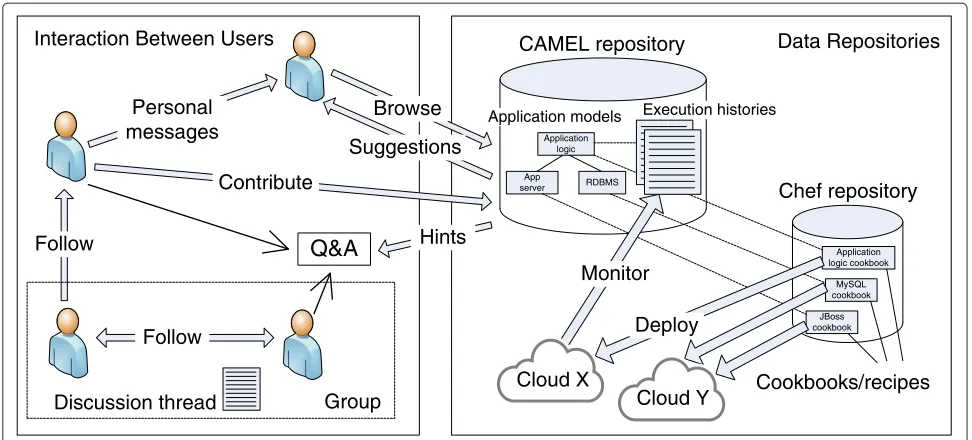
The architecture of the PaaSage social networking platform is shown in Fig. 1, highlighting the integration of a collaborative social platform (left) with the reposi-tories of information (right). It shares certain principles with standard question-and-answer (Q&A) sites where users can create sub-communities relative to specific top-ics of interest (groups) and use features such as following other users or news feeds, facilitating stronger interaction between users.
The PaaSage social networking platform advances the state of the art in several ways. First, it encompasses the ability to represent applications and infrastructure
as models, and to use them in automating deployment
Interaction Between Users CAMEL repository Data Repositories
Chef repository
Application logic
App
server RDBMS
Application models Execution histories
Application logic cookbook
JBoss cookbook
MySQL cookbook
Browse
Monitor
Cookbooks/recipes Deploy
Contribute
Q&A
Cloud Y Cloud X
Suggestions Personal
messages
Hints Follow
Discussion thread Follow
Group
Fig. 1Integration of a collaborative social platform with repositories of information
Our contributions in this paper are:
• The design and implementation of the PaaSage social networking platform (user interface and back-end infrastructure) for the DevOps community, integrated with two information repositories. • Use of advanced features such as pointers to
structured descriptions of applications, components, executions, etc., and mined knowledge (statistics, cost-benefit analyses) to improve the level of technical discussion between DevOps users
• Three user evaluation studies and a demonstration of offering users with cost-benefit analyses of
application deployments on multi-cloud setups.
The paper is structured as follows. In Section 2 we describe related work split into two major areas: professional (social) networks and systems automating configuration management and deployment. In Section 3 we provide background on modeling distributed appli-cations and the Chef configuration management frame-work. In Section 4 we describe the requirements and design principles of the social networking platform and in Section 5 we describe our implementation. In Section 6 we describe our user evaluations and experience with our prototype (accessible online) and in Section 7 we present our conclusions.
2 Related work
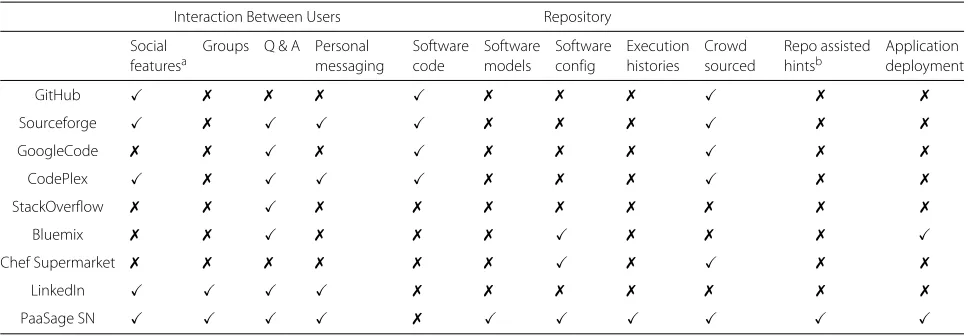
In the following subsection we review related work on professional social networks. In Table 1 we summarize and categorize the characteristics of the most impor-tant related approaches along the following dimensions
(depicted as columns of Table 1): (1) which of the follow-ing key social features are supported by the platform: fol-low users; news feeds; groups; Q&A; personal messages; (2) does the platform rely on one or more repositories to store the following type of information: software code, software models, configuration information, execution histories; and whether these repositories are community-sourced; (3) does the social networking platform leverage the repositories to provide users with specific suggestions and hints; (4) does it support application deployment? In Table 1 we compare related approaches to ours along these dimensions and provide further details in the following section.
2.1 Professional networks
During the last few years social networking has evolved into a fundamental daily activity for many individu-als and a new frontier for business marketing. Besides “traditional” social networking, a recent trend is profes-sional and domain-specific networking services focused on interactions and relationships of a business nature around a specific target domain. These online communi-ties have the potential to become a platform for collec-tive intelligence and open innovation [16], a medium for knowledge-centered collaboration [17], and a trustworthy decision-support tool [18].
Table 1Feature comparison
Interaction Between Users Repository
Social Groups Q & A Personal Software Software Software Execution Crowd Repo assisted Application featuresa messaging code models config histories sourced hintsb deployment
GitHub ✗ ✗ ✗ ✗ ✗ ✗ ✗ ✗
Sourceforge ✗ ✗ ✗ ✗ ✗ ✗
GoogleCode ✗ ✗ ✗ ✗ ✗ ✗ ✗ ✗
CodePlex ✗ ✗ ✗ ✗ ✗ ✗
StackOverflow ✗ ✗ ✗ ✗ ✗ ✗ ✗ ✗ ✗ ✗
Bluemix ✗ ✗ ✗ ✗ ✗ ✗ ✗ ✗
Chef Supermarket ✗ ✗ ✗ ✗ ✗ ✗ ✗ ✗ ✗
LinkedIn ✗ ✗ ✗ ✗ ✗ ✗ ✗
PaaSage SN ✗
aFeatures: follow and news feed
bUser assistance based on data analysis of the repository
a collaborative revision control platform for developers launched in April 2008, and arguably the largest code-hosting site in the world. GitHub provides social net-working functionality such as feeds, followers, wikis and a social network graph that captures how developers work on their versions (“forks”) of a repository, which version is newest, etc. Gitter [20] is a related service that facilitates discussions between members of GitHub communities by providing a long-term chat integrated with code and issues. Neither GitHub nor Gitter collect, analyze, or use information from executions of application deployments to improve the level of technical discussion between users. Sourceforge [10] was the first code-hosting platform offered to open-source projects. It was launched in 1999 and offered IT professionals the ability to develop, down-load, review, and publish open-source software. Source-forge is similar to GitHub in its support for social features. In 2006 Google offered publicly their own host-ing platform, Google Code [11], which is planned to shut down by January 2016 as “the service simply isn’t needed anymore” [21]. In June 2006 Microsoft officially released their own open source project hosting website, Code-Plex [12]. Similar to GitHub it allows shared development of open source projects. CodePlex features include wiki pages, source control systems (such as git, mercurial, etc.), discussion forums, issue tracking, project tagging, RSS support, statistics, and releases. Microsoft is cur-rently moving many of its premier projects from CodePlex to GitHub [22]. None of these platforms abstract code structure through modeling or enhance user interactions through the use of analytics over application execution histories.
StackOverflow [23] advances on earlier Q&A sites in which users ask and answer questions. Users can vote up or down questions and answers and earn reputation pointsandbadgesin return for their active participation.
Although StackOverflow and GitHub address different aspects of software development (StackOverflow is not a code-hosting platform) there is a synergy and correlation between the two [24]. Our system extends StackOverflow through the use of social networking features that enable users interested in reasoning about application deploy-ments to use and share knowledge drawn from analyses of information repositories.
IBM’s Bluemix [25, 26] is a development and sup-port platform for communities of DevOps users wishing to compose distributed applications out of components drawn from libraries and deploy them at IBM-provided and supported cloud infrastructure. Bluemix is a key com-ponent of IBM’s DevOps best practices [27] for achieving rapid prototyping, automated deployment, and continu-ous testing of software. Bluemix relies on StackOverflow to support community discussions. It uses the StackOver-flow API [28] to search and retrieve Q&A threads and display them within the Bluemix platform [26]. Our sys-tem differs from Bluemix in its support for expressing applications as models (CloudML, CAMEL), its use of two information repositories, the PaaSage repository of mod-els and execution histories and Chef supermarket, and the use of analytics over past executions to enable users to reason about application deployments. A common fea-ture between our system and Bluemix (shared by no other related system in Table 1) is support for deployment of distributed applications, although we use a different deployment mechanism (Section 5.2). This is a key feature required by DevOps users [27] and thus included it in our professional networking platform.
LinkedIn provides no specific support for software engi-neering activities and thus more closely resembles tradi-tional social networking platforms such as Facebook.
The above systems can be further classified based on whether they use a repository to store software-related information (code, models, configuration, or execution histories) and whether this information is shared and raised through crowdsourcing [8]. As seen from Table 1, GitHub, GoogleCode, CodePlex, SourceForge, Bluemix, Chef Supermarket (a community site and repository described in Section 3.2), and our platform store at least one type of software-related information and all systems but Bluemix are raising shared content in their software-related repositories via crowdsourcing. Our professional network is the only solution that analyzes information in its software-related repositories to assist users with suggestions and hints.
On the other hand, an important concern when designing an online community portal is to stimulate regular contributions and effective collaborations. The willingness to share knowledge with community mem-bers is influenced by social interaction ties, trust, norm of reciprocity, identification, shared vision and shared lan-guage [30]. In addition, the willingness of professional community members to continue being engaged with the network was found to be affected by social interaction ties and by their satisfaction in relation to their pre-usage expectations [31]. Following the above principles, as well as literature reported usability and sociability fac-tors to reading, contributing, collaborating and leading in an online community [32] the PaaSage professional net-work aims to provide high quality services to software engineers, actively engaging them in collaborative and community-building activities.
Next we review related work in the areas of configura-tion management and applicaconfigura-tion deployment.
2.2 Configuration management and deployment
A key component in a portfolio of DevOps tools is configu-ration management(CM) [33], the process of maintaining a detailed recording of software and hardware compo-nents in an infrastructure. An effective CM process pro-vides significant benefits including reduced complexity through abstraction, greater flexibility, faster machine deployment, faster disaster recovery, etc. There are numerous configuration management tools from which a system administrator can choose, however the most widely known are: Bcfg2 [34], CFEngine [35], Chef [2], and Puppet [3]. Each of these tools has its strengths and weaknesses [36, 37]. In a DevOps environment, a CM solution is often combined with provisioning and deploy-ment tooling [27]. In this work, we use Chef as a CM and deployment automation tool to support professional network users.
A recent trend in DevOps software development is
continuous integration (CI) [38] and automated code
deployment and testing off of online code repositories. Travis [39] is a CI tool that automatically detects when a commit has been made and pushed to a GitHub repos-itory, subsequently tries to build the project, deploy and run tests, and notify the user of the status. Another pop-ular CI tool is Jenkins [40], an open-source software tool for testing and reporting on isolated code changes in real time. Similar to Travis, Jenkins, enables developers to find and solve defects in their code rapidly and automates the testing of their builds. Although the PaaSage social networking platform does not provide a complete CI solution, it automates the deployment of complex applica-tions through a model-driven process (C2C) described in Section 5.2.
Previous research on automatically finding optimal deployments of distributed applications on multi-clouds has explored mathematical optimization techniques with main objectives being performance and cost [41–43]. QoS-aware deployment and management of applications on cloud infrastructures using workload characterization and system modeling techniques offer another approach to this problem [44]. While such tools are useful in reducing the range of deployment choices, their simpli-fying assumptions and inability to capture the full set of user requirements means that they usually provide only approximate solutions to deployment problems. Our work is complementary in that it helps DevOps engi-neers browse over and analyze results of past deploy-ment executions and communicate and exchange ideas to better understand tradeoffs in the space of deployment solutions.
3 Background
In the following subsections we briefly describe the mod-eling concepts used in our social networking platform as well as the key concepts behind the Chef configuration management framework. Additionally, we describe the characteristics of the community of users that contribute to the Chef Supermarket repository.
3.1 Application modeling
Fig. 2DSLs comprising CAMEL
the core of application modeling CAMEL (and thus in our professional network) it is worthwhile describing its key modeling concepts:
• Internal component: a reusable type of application component, whereas aninternal component instance represents an instance of an application component. The description of an application component stays at a generic level while the specification of its respective instances involves particular configuration
information.
• Communication, Communication Instance: a relationship between two application components or component instances respectively. This concept is used to describe communication or containment relationship between components.
• Cloud : a collection of virtual machines (VMs) offered by a cloud provider.
• VM type, VM instance: a VM type refers to a generic description of a VM, while an instance of a VM type maps to a specific instantiation of a VM including specific configuration information.
We have implemented a CAMEL information reposi-tory using the Eclipse Connected Data Objects (CDO)
[45–47] technology. The repository is currently being populated with a wealth of information from multi-cloud deployments of various distributed applications [15]. We are also in the process of building an analytics engine and knowledge base over the CAMEL repository to extract knowledge about deployments characteristics that work best for certain applications and use it in the context of the professional network. While we refer to this knowledge base in the context of our description of the professional network, its implementation is beyond the scope of this paper and subject of future work.
3.2 The Chef configuration management framework The Chef CM framework automates complex configura-tion management tasks through aninfrastructure-as-code approach. Packages, services, and other pieces of a sys-tem are represented asresources. Configuration files that describe resources and their desired state, calledrecipes, provide operations such as package installment, software configuration, and application deployment. Recipes are stored in cookbooks, which also contain other related components including templates, file distributions, and metadata.
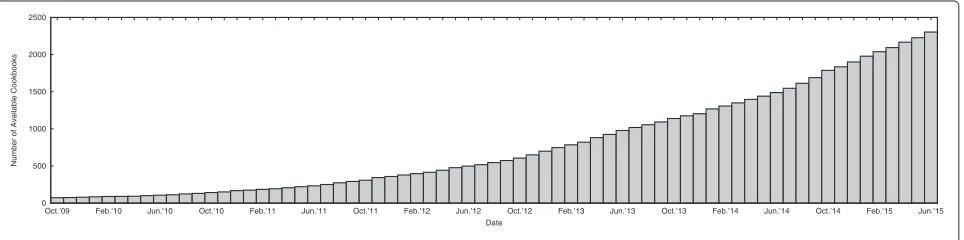
One of the key strengths of Chef is its community. The Opscode Community site (or Chef Supermarket) [13] is a site where people from a wide range of backgrounds can contribute and share a plethora of cookbooks that are available to the community. This community seems to evolve and grow over time. As seen from our anal-ysis of contributions to Chef ’s public repository (Fig. 3) its contents started from an initial state of 72 cookbooks (October 2009) and grew slowly over its first year of operation. After two years, the rate of new cookbooks started to increase. In particular, each month in 2014 about 58 new cookbooks were shared in the Opscode community site. As of June 2015, there are 2303 cook-books in Chef ’s public repository and their number is growing at an even higher rate. This highlights Chef ’s popularity and its emergence as a de-facto standard for systems management and application deployment tasks.
0 500 1000 1500 2000 2500
Oct.’09 Feb.’10 Jun.’10 Oct.’10 Feb.’11 Jun.’11 Oct.’11 Feb.’12 Jun.’12 Oct.’12 Feb.’13 Jun.’13 Oct.’13 Feb.’14 Jun.’14 Oct.’14 Feb.’15 Jun.’15
Number of Available Cookbooks
Date
4 The PaaSage social networking platform
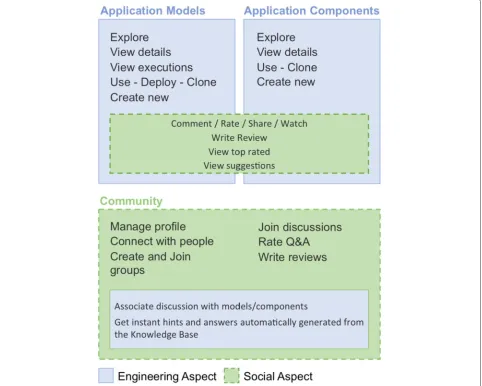
A key design objective of the professional social networking platform is to create a strong bond between (i) software engineering services for managing and deploying cloud-targeted application models; and (ii) community-oriented facilities for communication and collaboration between users. The interconnections between the two in the design of the user inter-face are depicted in Fig. 4 and further explained in Section 4.3.
The architecture of the professional networking plat-form and the supporting infrastructure (including the two information repositories and facilities for applica-tion modeling and deployment on multi-cloud infras-tructures) are shown in Fig. 1. The requirements that drove the design of the overall platform are sum-marized in the last row of Table 1 and details on the implementation are provided in Section 5. The
prototype implementation is publicly accessible online at http://socialnetwork.paasage.eu.
Users of the professional network are expected to be familiar with basic principles of software modeling and distributed cloud-based application design and deployment. Their roles will range from DevOps engi-neers and cloud deployment specialists to IT architects, cloud developers, software engineers, application design-ers, and system administrators. Section 4.1 provides an overview of support around application modeling. Section 4.2 focuses on community-building aspects. Section 4.3 analyzes the process and practices applied to the design of the user interface.
4.1 Application modeling
The PaaSage professional networking platform aims to support users that wish to explore, deploy, and optimize application models and components.
4.1.1 Model exploration
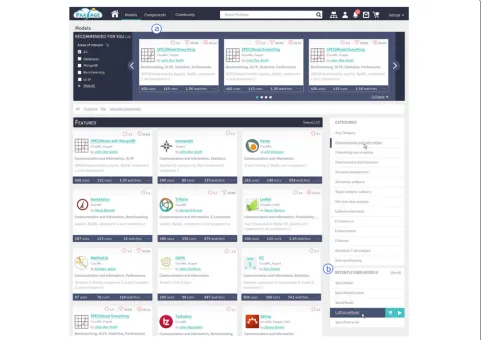
The platform offers personalized and universal explo-ration facilities to accelerate model discovery. Themodels pagedepicted in Fig. 5 concentrates information on appli-cation models available in the network. The level of per-sonalization on the displayed content is known to strongly influence overall user experience [48]. Based on this prin-ciple, our platform delivers (i) personalized recommenda-tions based on each user’s areas of interest (Fig. 5a) and (ii) context-sensitive lists of recently-viewed models and components for quicker reference (Fig. 5b).
Among universal features, the most commonly used yet highly efficient one is content classification based on explicit categories. Previous studies have shown it to simplify browsing [49] for almost 50 % of targeted users [50, 51]. Content organization is further enhanced with tag annotationsthat can be set in a category-independent manner, motivating a classification-by-usebasis [52]. To leverage the collective experience of professional net-work members, we facilitate the discovery of new and noteworthy content by promoting featured, popular and trending application models based on their community impact [53].
To assist users that prefer searching over browsing [50, 51] we provide an advanced filtering mechanism and a faceted-search facility to enable that type of tent discovery. Filters are differentiated based on con-text. Filters on the initial models’ category page include model categories and recently-used models. When view-ing models under a specific category, filters narrow down results based on: model status, deployment platform, modeling framework, model cost, minimum uptime, max-imum response time, minmax-imum throughput, geographi-cal distribution of the model’s executions, and specific tags related to the model. When viewing the page of an application model, filters narrow down the displayed executions based on execution start and end date, cost, uptime, response time, throughput, geographical distri-bution, cloud provider, and execution owner (user, user’s network, all users).
4.1.2 Focusing on a model
An application model is a discrete entity with a wealth of heterogenous information that must be delivered in a well-structured manner. Combining this requirement with the fact that the popularity of a model is based on
efficient broadcasting of its strong features, the PaaSage professional networking platform employs the concept of Pages typically used to promote organizations/businesses in social networks (e.g., Facebook fan Pages, Google+ Pages, LinkedIn Company Pages, etc.) [54].
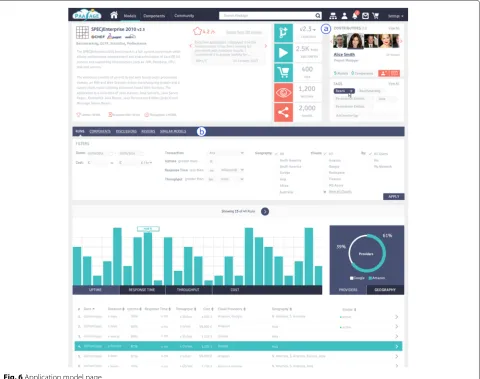
At the top of an application model Page (Fig. 6a) a user can find essential information regarding that model, including its identity and impact in the community. Apart from the basic description and contributors, a mix of social information (e.g., rating, top review, number of watches and shares) and engineering information (e.g., version, number of deployments and uses) allows the user to form a clear picture about the model’s capabilities. Interactive controls permit rapid action from an engineer-ing (e.g., clonengineer-ing, deployengineer-ing, use) and social perspective (e.g., watching or sharing a model).
Besides the model overview, a secondary menu (Fig. 6b) allows users to get additional information through sep-arate screens that present: the hierarchical structure of its components; any related discussions and reviews;
similar models; and lists with extended execution statis-tics (runs). The past-executions list stored in the CAMEL information repository offers the ability to compare exe-cution statistics and identify the most successful config-urations (i.e., identify best practices). Due to the large amount of information, we use a rich filtering mecha-nism to narrow down the displayed data, while graphi-cal visualizations facilitate quicker analysis (e.g., uptime, response time, throughput, cost, etc.). The same design approach was used oncomponent Pages; the only excep-tion is the fact that the execuexcep-tion statistics screen is missing as such data are not available for individual components.
Although the PaaSage professional network does not provide an integrated model editor, it does provide some support towards creation of application models. Mem-bers can import new models or reuse (clone and modify) existing models to benefit from the design principle of service composability. We have applied theshopping cart metaphor(Fig. 7) so that users, while browsing, can save
Fig. 7Models and components list
application and/or component models of interest for later use.
Among cart features, the most advanced is the abil-ity to collect entire categories of components (e.g., Web Servers). The PaaSage professional network relies on proven external model editors for creating or modify-ing models. The cart can deliver components to such an editor, in which model composition and further editing would take place, prior to importing the new model back into the platform.
To further support engineers, new models are initially marked asdraftsand their visibility limited to the model owner and any contributors explicitly invited. At any time the owner is able topublisha model to the community by marking it aspublished. From that point on the model becomes public and every user can use, clone, or deploy it. Prior to publishing, the owner is also able to determine whether the model is a self-contained element that can be deployed as-is (i.e., application model) or it is a composite component that must be embedded in other application models.
4.1.3 User’s personal area
An important component of the network is the user’s personal area, which reflects the user’s activity towards building and deploying models and components. It is also an information retrieval point on community activities related to the user’s models. The PaaSage professional network introduces various tools in a user’s personal area to facilitate management of model-based distributed applications. Users get live statistics of their active execu-tions and can easily control them (e.g., stop, undeploy one or more instances) (Fig. 8). They can modify the details of individual configuration schemes (e.g., VM properties, resource allocation, distribution, etc.) on a model-by-model basis. For convenience, context-sensitive actions and aggregated statistics regarding engineering and social performance (e.g., number of uses, rating, average execu-tion time, etc.) are visualized adjacently.
4.2 Community
Apart from social features that facilitate distribution and promotion of application models and components
(e.g., share, rate, review, watch), the professional network encourages the creation of an active organized community that supports collaboration (Fig. 9).
People with similar interests can connect and follow each others’ updates. The formation of groups promotes a team spirit, exchange of opinions, and knowledge cre-ation through the accumulcre-ation of experiences. Members are encouraged to participate in discussions by posting their questions and answers on topics of interest and rate or review the answers of others. To further contextualize discussions, the system offers the ability to associate posts with references to models and components (sim-ilar to attaching a file in an e-mail), while instant and automatically-generated hints are provided when possible by the network’s knowledge base. Figure 10 depicts an example where two hints are automatically generated via simple queries (constructed based on the keywords “Amazon” and “SpecJEnterprise” found in the question body) to the CAMEL repository. They are meant to inform the user about the quantity of information that is possibly relevant to their question. We envision a scheme where a question is associated with higher-level knowledge drawn from the knowledge base, this is how-ever subject of ongoing research and out of scope of this paper.
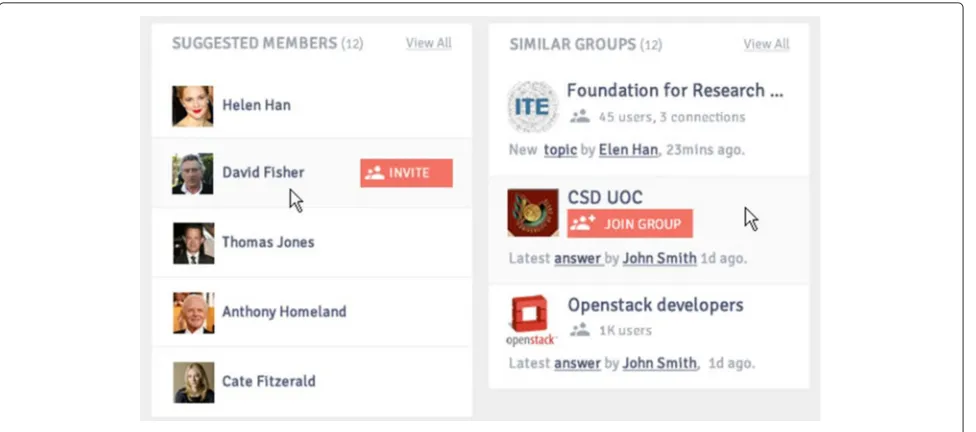
Community growth is stimulated by intelligent sug-gestions on connections or groups that may interest a user. Besides invitations to connect with other members or to join new groups, sugggestions may also encourage individuals to endorse their connections for skills or even invite members to groups to strengthen commu-nity bonds. An adaptive approach has been employed to deliver and present the ideas: prompts are either displayed
on dedicated areas (e.g., sidebars) or embedded in the main content area, mixed with existing notifications (e.g., updates in models in watchlist, new answers on topics that the user currently follows, etc.). To support new members, the system integrates advanced help facilities, including FAQ and Q&A sections, with intelligent mech-anisms that discover and suggest similar questions or relevant answers.
4.3 User interface design process and practices
The user-facing interface of the professional network was designed following an iterative approach[55, 56], alter-nating design with expert-based evaluation involving both usability and domain experts. The main benefit of this approach is that problems are identified early in the development lifecycle and can be corrected before the implementation, even in cases where the agile program-ming method is applied [57], ensuring high quality of user experience [58]. Discussion of user requirements and evaluation of the designed mockups were carried out in focus groups involving users of social and professional networks, software engineers, cloud computing experts and usability experts.
The focus groups involved seven participants with the following characteristics: two cloud computing experts with limited experience in social and professional net-works, three software engineers –all of which were regular users of social networks and one was also experienced in using professional networks– and two usability experts, one of whom had some experience in cloud computing platforms and DevOps environments. During the iterative design process the same group of experts and users was engaged in discussions regarding requirements elicitation
Fig. 10Automatic provision of context-sensitive assistance when available
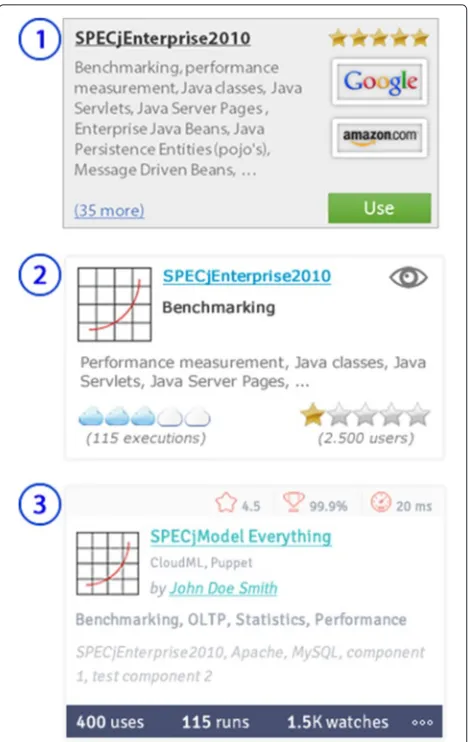
and evaluation of the mockups. Given the extent of the design (100 mockups were produced) the process required 13 sessions to evaluate the mockups. The discussions car-ried out within the focus group led to thorough redesign-ing and usability fixes for several parts of the professional network. An example of how the design of a system com-ponent (the Application Model Overview Panel) evolved over time using our approach is illustrated in Fig. 11.
Fig. 11Evolutionary design of the application model overview panel
Overall, the design of the PaaSage professional network had five objectives:
4.3.1 Strong bond between software engineering and community-oriented activities
The design ensures that pages oriented towards software engineering information include details and prompts for community-building and vice versa in order to exploit the generational experience [59] and enable new ways for soft-ware developers to work together [60] and build stronger bonds [61]. For instance, in the Application Model page (Fig. 6) users can view information about the model and also: (i) information on model contributors, enhanced with direct options for sending them a message or ask-ing them to be connected; (ii) the most popular tags that describe the model, with facilities for adding tags; (iii) overall rating of the model and most popular reviews. Similarly, in a user’s Profile page, his/her top model and component contributions are displayed at a prominent area, along with ready-to-use options for using or running these models. The two types of user actions are seamlessly interweaved; being distinct perspectives however, they can be easily distinguished through design cues, such as different colors used consistently throughout to indicate different action types:blue (turquoise)for model-related and red (terra cotta) for community-related activities. Figure 4 summarizes these concepts.
4.3.2 Prioritization of personalized information
Fig. 12Main navigation menu
material, including his own model and component designs and deployments, profile, notifications, messages, cart and settings. Thus, the design promotes three modali-ties of interaction:browsing,searching for, andpersonally contributing content.
4.3.3 Rich home page
An important concern during the design of any website is its home page functionality and layout. The home page is the flagship of every site [65] and should be designed accordingly, displaying vital information both to first-time and regular users. Such information may include [66]: site identity and mission, site hierarchy, search, content and feature promotion, timely content, and shortcuts. Along these guidelines, the home page of the PaaSage professional network was designed to act as an informa-tion point for activity related to the user’s models and components and to community activity that might be of interest.
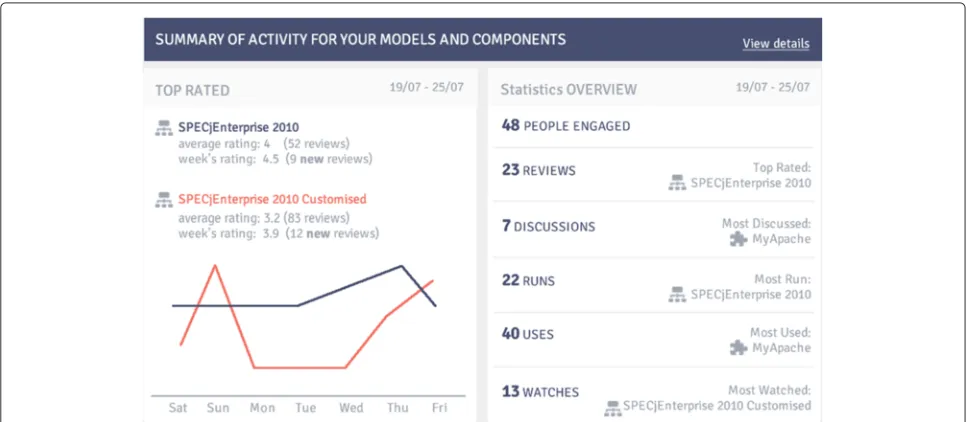
The home page of a signed-in user includes: (1) Statisti-cal information and graphics regarding the user’s models and components (e.g., top rated and most-run models, number of reviews, discussions, runs, uses and watches of his models and components, etc.) as shown in Fig. 13; (2) Live feed including model- and component-related information (e.g., new models or components made pub-lic, updated configurations of models, badges received
and new reviews for a model or component, etc.) and community-related facts (e.g., who has an updated profile or was endorsed for a skill, who has made new con-nections, who posted questions and answers regarding a specific topic, etc.); (3) Information on the user’s profile, such as profile completeness, skills and areas of interest. (4) Suggested content according to the user’s profile and recent activity, including potentially interesting models, groups and connections.
4.3.4 Nurture an active and sustainable community A vital consideration for any online community is how actively its members are involved in it, which can be determined by the quality of the content itself [67] and by the design of its user interface [68, 69], which should support and facilitate communication, collaboration, and content contribution. To nurture an active and sustainable community our design applies the following practices: First, it makes content contributions (models, compo-nents, questions, answers, ratings and reviews) visible to the community. Second, it cultivates a sense of belong-ing by presentbelong-ing activities and contributions of familiar people which may be relevant to the current context. Third, it supports both major contributions (e.g., mod-els or components) as well as smaller contributions (e.g., ratings, reviews, or question-asking). Fourth, it recog-nizes high quality contributions (e.g., top rated models,
mostly up-voted answers) as well as high quantity contri-butions: the more a user contributes, the more expertise points he gains (top contributors receive special badges as an indication of expertise). Fifth, it enhances the feel-ing of safety and trust, by makfeel-ing links to the terms of services and privacy policy easily accessible through any network page. Furthermore, users can define privacy set-tings regarding who can see their data, send requests to them, or look them up [64]. Finally, any user can report members or groups to network administrators if they feel that they violate intellectual rights or exhibit abusive behavior.
DevOps professional communities have indeed shown interest in supporting and using such platforms. For example, the community that has formed around Chef Supermarket is an active and sustainable one as shown from an analysis of cookbook popularity figures (Table 2). While Opscode, Inc. is the single largest cookbook main-tainer in the repository, about 96 % of the cookbooks in the site are maintained by other developers, students, organizations, etc. Most of the shared cookbooks seem to be maintained by independent developers rather than companies, if we take contributor e-mail domain as an indication (gmail.com is by far more popular (507 users) than opscode.com (121 users) or getchef.io (68 users)). Finally, a majority (about 62 %) of cookbook maintainers have shared only a single cookbook. We expect that the Chef Supermarket community will share characteristics with the community to be formed around our professional network.
4.3.5 Motivate active and regular participation
Following recent trends in HCI design and with the aim to motivate active and regular participation in the PaaSage professional network, the design employs gami-fication features, namely use of video game elements to improve user experience and user engagement in non-game services and applications [70]. One gamification
feature in our current design is the reward system for active community members. As users contribute con-tent (models, components, ratings, reviews, questions, or answers) they receive experience points leading to spe-cial badges visible to all community members. Other features are the Profile completeness bar with sugges-tions on how to increase it, and a skills’ endorsement system: a user can be endorsed by others for specific skills. Such endorsements are visible to all his friends’ live feeds, increasing his popularity in the community. Finally, the concept of Model badges awarded to application and component models in case of excelling performance. Badges can serve among others as goal-setting devices, status symbols, and indications of reputation assessment procedures [71].
We next describe the implementation of our current professional network prototype.
5 Implementation
The social networking platform is implemented over the Elgg extensible social network framework [72]. Elgg is open-source software written in PHP, uses MySQL for data persistence and supports jQuery for client-side scripting. The Elgg framework is structured around the following key concepts:
• Entities, classes capturing concepts such as users, communities, application models, etc.
• Metadata describing and extending entities (e.g., a response to a question, a review of an application model, etc.).
• Relationships connecting two entities (e.g., user A is a friend of user B, user C is a contributor to an
application model, etc.).
Elgg comprises a core system that can be extended through plugins. The core comes with a few basic enti-ties (Object, User, Group, Site, Session, Cache) as well as
Table 2Popularity of Chef cookbooks (as of June 30, 2015)
Rank Total downloads Followers Versions
1 mysql(108,162,744) mysql(561) mysql(115)
2 java(64,872,884) nginx(541) newrelic(71)
3 apache2(64,149,630) apache2(448) docker(59)
4 docker(64,114,027) java(301) apache2(57)
5 newrelic(61,039,635) apt(266) chef-client(56)
6 bacon(60,405,762) chef-client(253) java(56)
7 nginx(54,673,163) git(238) bacon(55)
8 windows(54,263,225) postgresql(226) windows(54)
9 chef-client(54,073,080) build-essential(194) nginx(48)
other classes necessary for the operation of the engine. All Elgg objects inherit from Entity, which provides the gen-eral attributes of an object. Plugins add new functionality, can customize aspects of the Elgg engine, or change the representation of pages (examples are the Cart system or the handling of Application Models). A plugin can create new objects characterized (through inheritance of Entity) by a numeric globally unique identifier (GUID), owner GUID, and Access ID. Access ID encodes per-missions ensuring that a user touches only data it has permissions on.
Figure 14 shows the model, view, and control parts of Elgg’s architecture. In a typical scenario, a web client requests an HTML page (e.g., the description of an application model, Fig. 6). The request arrives at the Controller, which confirms that the application exists and instructsModel to increase the view counter on the application model object. The controller dis-patches the request to the appropriate handler (e.g., application model, component handler, community han-dler) which then turns the request to the view sys-tem. View pulls the information about the application model and creates the HTML page returned to the web client.
All plugins share a common structure of folders and php files. Folderactionsincludes the actions applied on appli-cation models (delete, save, or search). Theviewsfolder contains thephpforms applied on application models and riverevents (live feeds).Pagesoverrides elements of core Elgg pages. Thejsandlibfolder provides javascript and phplibrary functions. Finally, thevendorsfolders include third-party frameworks such as Twitter’s bootstrap front-end [73] , which lfront-ends its responsiveness, look and feel, and portability across Web browsers to the PaaSage pro-fessional network..
Social network relationships (friendship, group, own-ership, etc.) are persisted in the Elgg back-end database. The execution history of deployments of application mod-els and the description of those modmod-els is stored in the CAMEL information repository, which is implemented as an Eclipse CDO server. The exchange of information
between the Elgg and CDO servers is implemented over network sockets.
5.1 Components and categories
In the implemented prototype, application component categories as well as individual components have been imported from Chef Supermarket (and periodically re-freshed as the master copy of this content remains with Chef Supermarket). Figure 15 depicts those component categories. Each category contains all imported compo-nents and associated cookbooks. The distribution of Chef cookbooks over the existing categories and their abso-lute numbers are depicted in Fig. 16. The total number of cookbooks available on Chef Supermarket on June 30, 2015 was 2303. Our analysis is based on a full down-load using theknife cookbook sitecommand [74]. We have mined additional information on the popularity of cookbooks (most downloaded, followed, and updated) shown in Table 2. We believe that this information is of interest to users (since application deployment relies on execution of cookbooks) and plan to make it available to them.
It is worthwhile mentioning that over time we observed a shift in the way cookbooks are categorized: Initially it was customary for cookbooks in the repository to be asso-ciated with more than one categories; however later this changed to just a single category per cookbook. More recently, several cookbooks have been left unclassified or re-categorized in the generic category “Other”, including
mysql(previously in “Databases”),apache2(previously
in “Web Servers”), andgit(previously in “Utilities”). On May 2014 about 8 % of the cookbooks were categorized as “Other”, while on June 2015 this increased to about 29.5 %. We believe that this shift away from user-provided cook-book categorization is due in part to (a) the users’ lack of belief in the usefulness of such a scheme, as reported by the creators of the community site [75, 76]; and (b) the difficulty with coming up with a consistent and widely-accepted software categorization scheme in Chef Super-market. We believe that even if users saw the benefits in achieving a universal cookbook categorization (e.g., as a
Fig. 15Application components. Component categories and components imported from Chef Supermarket
enabler of advanced functionality, such as coming up with suggestions for alternative implementations to a specific software component as part of a “what-if ” analysis), the only way to achieve it would be through a community-moderated categorization scheme (e.g., majority voting on category proposals) for software components. To be successful, such a scheme would require strong inte-gration between technical and community aspects. Our professional network is uniquely positioned to support such as scheme.
5.2 Application deployment
A key aspect of the PaaSage professional network is its support for deployment of applications. CAMEL (through CloudML) is able to express deployable models of applications that specify the infrastructure upon which middleware and application logic will be deployed and run on.
An important feature of our system is its support for the creation of CAMEL applications through composi-tion of components imported from Chef Supermarket (Fig. 15). We orchestrate the deployment of all application components starting from a CloudML/CAMEL model of the application using the Chef configuration management tool. In what follows we briefly describe our methodology (calledCAMEL-to-Chef or C2C for short). The reader is referred to [77] for a complete exposition.
C2C comprises three major modules: i) A model parser that analyzes an application model and extracts a list of application components and the nodes (VMs) that the components will be deployed on; ii) the VM man-ager module responsible for the provisioning of the VMs (using third-party libraries such as JClouds [78] or provider-specific APIs such as Azure SDK [79]) and installs the Chef client in each one; and iii) the Chef instructor, a wrapper around the Chef runtime
system. C2C identifies the corresponding cookbooks (Section 3.2) to each application component and deploys them on the appropriate VMs. We assume that cook-books are imported from Chef Supermarket. It derives the order in which the components should be installed by analyzing the application structure and the depen-dencies among its components as described in CAMEL model.
Note that there are additional component dependen-cies (besides CAMEL component dependendependen-cies) that are at play here. Each Chef cookbook may define a num-ber of Chef dependencies on other cookbooks describing software that must be installed, configured, and started first. The wealth of information available at Chef Super-market gives us the opportunity to study those depen-dencies thoroughly on a large collection of cookbooks. This is interesting to the user of the social networking platform since it provides insight as to how many and which cookbooks arefoundational(many others depend on them) and therefore their reliability history and other dependability aspects are important. Section 5.3 presents the results of our dependency analysis.
5.3 Chef cookbook dependency analysis
We analyzed information on dependencies between Chef cookbooks in Chef Supermarket as follows. We crafted
adependency graphin which each vertexvcorresponds
to a cookbook and each edge e = (v,w) represents a dependency from cookbookvto cookbook w. For each cookbook (software component) we calculate the number of cookbooks that it supports, i.e. the number of cook-books that depend on this cookbook, and the number of cookbooks that it depends on. To obtain their indi-rect dependencies we performed a depth-first search from each vertex v in the cookbook dependency graph and added an edgee=(v,w)in another graph for each unique vertexwthat we visited.
In Fig. 17 we observe that both direct and indirect cook-book dependencies follow power-law distributions. We found 1468 of the 2303 cookbooks to depend on at least one other cookbook. This prevalence of dependencies highlights the value of automated deployment frame-works such as Chef. Table 3 lists the top 10 cookbooks
with the highest in-degree and out-degree from direct and indirect dependencies.
Our prototype is being extended to include this infor-mation (marking components as“foundational”, “compo-nents with many dependencies”, etc.) in the context of the components page.
6 Evaluation
In this section we describe the user evaluation of the PaaSage professional network, as well as the design and deployment of an application model using the platform. During the iterative process of designing the user inter-face several expert-based evaluations were carried out in group sessions (Section 4). To obtain additional feedback from non-experts, three additional user-based evalua-tion experiments were designed and carried out involving potential users. This research work does not involve iden-tifiable human material or data and user privacy is ensured in all cases.
6.1 Preliminary evaluation of mockups
The first experiment aimed at assessing the overall look and feel of the network, the navigation mechanisms, as well as the design of fundamental functionality (e.g., home page, model categories, component categories, and model details). Six non-interactive mockups along with a doc-umentation of the design rationale were presented to 10 experienced cloud-computing engineers, in the con-text of a specific use case scenario. Users were asked to view the mockups and the related rationale and pro-vide their feedback so as to shape the requirements from an end-user perspective. The evaluation resulted in 25 distinct questions that came across from partici-pants on more than one occasions (see Fig. 18). All the issues that were identified focused mainly in (a) func-tionality that was not showcased through the provided mockups, and (b) general questions regarding the modus operandi of the professional networking platform (e.g., Question 1: As a user who is writing code how do I publish either Models or Components?, Question 9: Is it possible and encouraged to make direct contact with a user who has had a similar experience to my planned model?). In summary, the raised issues reflected users’
Table 3Ranking of Chef cookbook dependencies (as of June 30, 2015)
Rank Directly supports Indirectly supports Directly depends Indirectly depends
1 apt(404) yum(708) nodestack(31) magentostack(90)
2 build-essential(236) build-essential(645) magentostack(29) nodestack(87)
3 yum(199) apt(629) stack_commons(28) pythonstack(82)
4 java(172) chef_handler(551) platformstack(24) phpstack(80)
5 git(141) yum-epel(528) elkstack(18) stack_commons(76)
6 apache2(133) windows(518) gitlab(18) jenkinsstack(50)
7 runit(111) chef-sugar(259) phpstack(17) rackops_rolebook(41)
8 windows(107) packagecloud(230) pythonstack(17) noosfero(40)
9 mysql(106) runit(225) noosfero(16) platformstack(40)
10 yum-epel(99) dmg(223) ut_workstation(16) boilerplate_php(37)
concerns regarding the final design and functionality of the professional network and did not focus on usability problems of the specific mockups that were evaluated. As a result, a detailed design of the professional net-work was created through 100 non-interactive mockups, taking into account all the issues raised in the first eval-uation. These mockups were the basis for developing an interactive working prototype of the PaaSage professional network platform, featuring the final interface design and exposing an extensive set of the most important functionality.
6.2 Evaluation of interactive prototype through free exploration
The second evaluation experiment aimed to collect subjective results rather than performance metrics. It involved a different set of 12 users who, after a brief intro-duction to the available facilities, were asked to use the
interactive prototype [80, 81] using the free exploration method of the Thinking Aloud protocol [82] and fill-in a questionnaire fill-in order to rate and comment their experience. Users were recruited through the PaaSage EU project [14] consortium, based on the expertise cri-teria that all participants should be software develop-ers with at least some expertise in social networking or cloud computing. The interactive prototype to be evalu-ated included all the necessary functionality for browsing through models and components, viewing detailed model information, and engaging in social activities, such as fol-lowing and messaging a user, joining a group and posting questions to the group.
The questionnaire comprised four sections: (a) back-ground information (sex, age, expertise), (b) overall sys-tem usability according to the Syssys-tem Usability Scale (SUS) questionnaire [83], (c) assessment of specific system features (registration, finding a model, model information,
community features) rated on a five point Likert-scale and (d) additional information, where participants were asked to identify the three features that they liked most, the three features that they disliked most, and provide additional comments. Statistics regarding the participants’ gender, age, social network expertise, cloud computing expertise, and IT expertise are provided in Table 4.
As shown in Fig. 19, the overall SUS score for the profes-sional network prototype (section B of the questionnaire) was 68.5 (a SUS score above 68 can be considered above average), while the SUS score from expert users was 77.8 and the SUS score from users with medium expertise was 55.5 (below average).
Rating of the individual network features (section C of the questionnaire), as shown in Fig. 20, indicated that users encountered difficulties in finding specific models and viewing their information. As explained by additional comments provided by some of the users, an important shortcoming was that only a small num-ber of models were included in the prototype and only one model included rich information for users to view.
Analysis of users’ responses in section D of the ques-tionnaire (most liked and most disliked features) revealed that users most commonly favored the user interface of the network, the potential to share models and compo-nents with experts in the field and the ability to discuss
Table 4Demographic information of participants of the second evaluation experiment. Social network, cloud computing and software development expertise was provided by the participants through rating their own level of exposure (scale of 1 to 5)
Gender Social network expertise
Male 8 66.7 % Very high 2 16.6 %
Female 4 33.3 % High 6 50.0 %
TOTAL 12 100.0 % Medium 2 16.6 %
Low 0 0.0 %
Very low 2 16.6 %
Age TOTAL 12 100 %
<30 7 58.3 % 30 - 40 5 41.7 %
TOTAL 12 100.0 %
Cloud computing expertise Software development expertise
Very high 3 25.0 % Very high 1 8.3 %
High 4 33.3 % High 6 50.0 %
Medium 5 41.7 % Medium 5 41.7 %
Low 0 0.0 % Low 0 0.0 %
Very low 0 0.0 % Very low 0 0.0 %
TOTAL 12 100.0 % TOTAL 12 100.0 %
with others and participate in groups of users with similar interests. On the other hand, users’ responses regarding the features they disliked most indicated that medium expertise users would prefer an introductory video, a user guide, or tooltips in order to help them understand how the site works. Furthermore, most users commented on functionality that was missing or partially implemented, such as editing user profile, searching for friends, reset-ting password, and filtering model runs. Finally, users pointed out the lack of content as a problem that neg-atively affected their experience with the prototype. In summary, evaluation of the interactive prototype indi-cated that users liked the user interface as simple and professional and that they highly appreciated the facili-ties provided by the social network allowing model shar-ing, discussions and networking with users of similar interests.
Most of the negative comments and ratings are a result of the small size of the current content and evolving imple-mentation. This was due to the nature of the experiment: aiming to receive as many comments and suggestions as possible for functionality that users desire to see included, they were asked to freely use the prototype, vocalize their thoughts and fill-in the evaluation questionnaire, rather than been taken through specific scenarios in an observa-tion experiment.
6.3 Evaluation of prototypes through scenarios and interviews
6.3.1 Methodology
The third evaluation experiment involved 15 participants who were guided through the interactive prototype of the PaaSage social network using specific scenarios. They were interviewed on their requirements and feedback following a semi-structured interview approach [84] that included both open-ended and close-ended questions. The evaluation session was carried out via Skype [85]. Par-ticipants were recruited through European companies and organizations associated with the PaaSage EU project [14]. They were either developers or operations staff, thus within the target user groups of the PaaSage social net-work. Participants were not users of the PaaSage platform; some however were familiar with the project’s goals and objectives. Before the experiment, each participant was requested to fill-in a background information form and was sent an informed consent form, explaining all the recording and anonymity-ensuring procedures. A more detailed analysis of the participants’ profile is presented in Table 5.
Fig. 19SUS scores
networking sites; (iv) use of the PaaSage social net-work through given scenarios;(v)feedback regarding the PaaSage social network; and (vi)debriefing. Upon com-pleting these sections, the interviewer read his/her notes to the participants and asked them (if needed) to clar-ify notes or add more comments prior to ending the session. All sessions were audio recorded. To ensure anonymity and data safety, each user received an ID with which he/she was referred to, while all documents and recordings of the participant were password protected.
6.3.2 User requirements
Questions regarding users’ requirements from DevOps and social networking environments aimed at receiving information about which specific DevOps and social net-working platforms each participant uses, how frequently they use them, features that they like or dislike in these environments, and features that are missing. When a participant was not a DevOps or social network user, they were asked why they were reluctant to use them. In all cases, the participants’ willingness to try a new
Table 5Demographic information of participants of the third evaluation experiment. Professional expertise was provided by participants through an open-ended question. Several participants indicated more than one domains of expertise
Gender Age
Male 12 80 % <30 6 40 %
Female 3 20 % 30–40 9 53.3 %
TOTAL 15 100 % Undeclared 1 6.7 %
TOTAL 15 100.0 %
DevOps expertise Social networking expertise
0–1 years 3 20 % 0–1 years 1 6.7 %
1–2 years 1 6.7 % 1–2 years 0 0.0 %
>2 years 11 73.3 % >2 years 14 93.3 %
TOTAL 15 100.00 % TOTAL 15 100.00 %
Professional expertise* Familiarity with PaaSage objectives
Software Engineer 13 86.7 % Limited 5 33.3 %
Researcher 6 40 % Medium 4 26.7 %
Solutions Architect 2 13.3 % High 6 40.0 %
Other 1 6.7 % TOTAL 15 100.0 %
environment was explored both in general and in particu-lar for an environment that would combine both DevOps and social networking features.
In relation to DevOps platforms, most of the par-ticipants were GitHub (80 %), GoogleCode (33.3 %), StackOverflow (33.3 %), or BitBucket (26.7 %) users. Users reported that the features they liked most about the DevOps environments they use were: (1) related to developer activities: issue and activity tracking, bug reporting, viewing project statistics and following spe-cific projects; and (2) relevant to community activi-ties around the projects: user collaboration, ranking and rating, commenting. Features missing from these plat-forms include instant messaging, project management facilities, personalization characteristics (e.g., suggestion of possibly interesting projects according to each user’s profile).
In relation to the social networking platforms, most of the participants were Facebook (80 %), LinkedIn (73.3 %) and Twitter (60 %) users. The majority of users reported that they use those platforms for personal and pro-fessional activities. Propro-fessional activities include infor-mation retrieval, connection with other professionals, seeking job opportunities, and promotion of oneself by making visible one’s work. Features that users favored include communication with other people, fast informa-tion retrieval, linking with other individuals with similar interests and joining a large community of users. A major concern reported by nearly all participants is data privacy
and security. Furthermore, some users reported that they were annoyed by e-mail pushing regarding activities car-ried out in the network.
Participants were asked if they would be willing to use a new platform that combines some DevOps features with social features, as well as what requirements they would have for such a platform in order to use it and prefer it in comparison to the other platforms that they use. All participants except one (who was not a developer) were positive to the idea of using such an environment. Several highlighted the fact that currently they have to use several different social networks to communicate with experts in their field. Features that the platform would have to deliver include privacy control, source code sharing and man-agement options, good search and filtering mechanisms, user collaboration and communication facilities, as well as personalization features (such as the suggestion of poten-tially interesting people or projects according to the user’s interests and current content that he is viewing).
6.3.3 Exploration through scenarios
profile page of a specific model contributor, add him to the users he/she follows and view other models that this net-work user has contributed. Finally, each participant was asked to find a specific group in the PaaSage social net-work community, become a member, and post a question to the group.
During this process, participants were instructed to share their screen through Skype so that the interviewer could guide them through the scenarios and also observe their interaction with the system. The analysis of users’ interaction with the system resulted in the identifica-tion of specific problems, which in most cases were also confirmed by the participants during their feedback elic-itation process. For instance, issues that were identified included the visibility of certain UI elements, incomplete implementation of specific platform features (e.g., search), lack of integrated model editor, use of inappropriate labels in some cases, and lack of instructions or help for the more complicated pages.
6.3.4 User feedback
After going through the scenario, participants were inter-viewed regarding their opinion for the PaaSage social network. They were asked to rate on a scale of 1–10 how easy it was to find a specific model and if the model infor-mation was satisfying for them. For rates lower than 8, they were asked to identify what posed difficulties in their interaction and what they did not like about the specific network features. Model-finding received an average rate of 9 (standard error of the mean: 0.31), while model infor-mation was rated 8.4 on average (standard error of the mean: 0.34), as shown in Fig. 21.
The lack of a fully implemented search facility was reported as the feature that prevented users from eas-ily locating a specific model, since six of the users tried to locate the model through search and not through
navigation on the available content. Additional informa-tion requested for the model page was: specific instruc-tions on how to deploy a model, a graphical representation of the model, and to what percentage each contributor participates in the development of a model. Furthermore, some users found that due to the amount of informa-tion on the model page they needed addiinforma-tional time and instructions to view and fully understand it.
Next, users were asked to identify DevOps or social networking features that they would like to have seen in the network. DevOps features that were requested (Fig. 22) included code sharing, software project management facilities (e.g., activity tracking, versioning, milestones’ management), instructions and scripts for model deployment, application binaries, and direct model execution. The few social networking fea-tures that were suggested were: messages with multiple recipients and attachments, chat facility, flagging of dis-cussions as interesting to follow.
Users were asked to identify up to three most-liked and three most-disliked features. Most-liked features included (Fig. 23): the employment of social features in a develop-ment environdevelop-ment; the use of charts and statistical infor-mation to represent data; the detailed model inforinfor-mation that could be retrieved and the model execution histories; the automatically-generated hints provided by the net-work as replies in discussion topics; the concept of sharing one’s models; the overall UI design; the direct connection between projects and users, and the user profile tags that allowed them to find users that would be interesting to connect with.
Most-disliked social networking platform characteris-tics included aesthecharacteris-tics issues (e.g., fonts, appearance of error messages, responsiveness); low visibility for certain components (e.g., model filters, suggested groups); extensive information in the model page; the lack of