STUDY AND VALIDATION OF BODY
POSTURES OF WORKERS WORKING
IN SMALL SCALE INDUSTRY
THROUGH RULA
D. N. AGRAWAL
Bapurao Desmukh College of Engineering, Nagpur University Sevagram (Wardha), Maharashtra, India- 442001
T. A. MADANKAR
Shri Ramdeobaba Kamla Nehru Engineering College Nagpur, Maharashtra, India
M. S. JIBHAKATE
Bapurao Desmukh College of Engineering, Nagpur University Sevagram (Wardha), Maharashtra, India- 442001
Abstract:
Ergonomics is an important aspect in order to improve workers performance at work, develop an autonomous rhythm at work which will synchronize physical, physiological and psychological aspects that is responsible for human behavior and efficiency at work and stands as a key factor deciding workers effectiveness. This paper focuses the attention on the ergonomics consideration required to be governed in the small scale industries, a specific case of tractor trolley manufacturing unit is considered, which is deviating from all these aspects. Particularly, an important & bulky component ‘turn table’ is considered for analyzing the ergonomic manufacturing methods. The gap between ergonomic considerations and actual practices at the workplace gives the perspective to design the workstation. The data of musculoskeletal disorder of worker working at workplace of tractor trolley manufacturing unit is collected, analyzed and validated by using RULA.
Keywords: Ergonomic, musculoskeletal disorders, tractor trolley, RULA etc.
1. Introduction
In the present market scenario, cost reduction technique is playing significant role to meet the competition in the market. Weight reduction, simplicity in design and application of industrial engineering etc. are the source of the techniques which are used. Various components or products used in rural areas are mostly manufactured in small scale industries such as farming machinery, thrashers, tractor trolleys etc. It has been observed that these rural products are not properly designed. These products are by and large manufactured as per need, by trial and error methods of manufacturing. These products are getting improved by means of feedback of failure as and when it occurs. Big industrial sectors have not yet entered in manufacturing of these products; hence no significant development in design of rural product has been done so far. Thus most of rural products are manufactured without availability of design. Tractor trolleys are manufactured in small to moderate scale industries. Though tractor trolleys are manufactured of various capacities by various industries, still there is a large variation in manufacturing methods, component designs etc.
work, improvement in the quality of product and services, incorporation of safety, establishing a healthy work culture, etc. It has been observed that while manufacturing the products rural industries do not take into account the ergonomic methods of manufacturing it.
Awachat Industries Ltd. MIDC Wardha is one of the leading manufacturers of Tractor Trailer and tractor driven agricultural implements in the central India. The manufacturing operation consists of cutting and joining various steel sections by welding process at different workstations. The existing plant layout is the combination of various process, product and fixed layout governed for different phases of manufacturing of tractor trailer. Welding is the main process which contributes a major part of total manufacturing of the product. Welding workstation at fixed layout are observed and noted and found that there is scope of improvement as regard the ergonomics and industrial engineering aspects are concerned for welding.
Welding in the industry is done on kneeling posture as the fixture used for welding is placed on the ground. Continuously worker has to sit on that posture and has to perform welding of turn table. It is observed and found that due to continuous kneeling posture worker get fatigued frequently and musculoskeletal problems are identified in them which is then validated by using RULA.
For finding the musculoskeletal disorders among workers, the body regions of workers are divided into 10 sites of pain where mostly pain can occur. Subjects with working tenure of 1 year or less have reported less problems relating to pain in the body. Subjects with working tenure relating 1 to 5 yrs have maximum pain at site 5 (20%), site 6 (20%) and site 9 (20%) of the total of all the sites of pain for this tenure. Subjects with working tenure relating 6 to 10 yrs have maximum pain at site 2, site 4, site 5, site 6, site 7 and site 8 as 15% of the total of all the sites of pain for that tenure. The workers are doing work mainly in kneeling and forward bending postures they are found out with the more problems of MSDs as compared to those who are doing the same work in standing posture. During standing posture they find less back and ankle to knee pain. The data is analyzed as per the occupational exposure of the workers. The number of sites of musculoskeletal pain has increased with the increase in length of exposure. [1]
It is found that with the increase in length of exposure of work that is with the increase in years of working the site of pain is increasing and it can be reduced by evaluation of existing posture and with the change of suitable posture. The problems in the standing postures are less as compared to the existing postures which they are following currently in the industry. Due to heavy weight of welding gun and continuous holding of welding gun severe problem of shoulder may occur and because of it worker might not work properly for long years and will might not lift weight in future.
2. Literature Review
Rongo L. M. B. states that the workers in Small Scale Industry (SSI) are reported ergonomics related injuries and illnesses ranging from eye strain and headaches, musculoskeletal ailments such as chronic backache, neck and shoulder pain. No ergonomics guidelines are known for SSI. Awareness of ergonomics principles among workers in welding, spray painting, woodwork and carpentry and metal works are needed. The level of awareness of ergonomics principles are low among workers in SSI compared to office workers. So, immediate measures are needed for the awareness of ergonomics principles in SSI. [2]
Kadefors Roland, Ph. D Professor describes in terms of physical load, welding rated number 8, of all occupations reporting exposure to daily lifting of heavy materials weighing 15 kg or more (39%). Flexed or twisted postures were reported by 49% of the welders (rated 9th of all occupations), whereas 40% of them reported work with the hands at or above shoulder level (rated 7th). This very particular strain on the musculoskeletal system comes from awkward postures and the static character of welding work. Musculoskeletal complaints and disorders in welders give rise to the following points: a) musculoskeletal symptoms are prevalent in welders; b) welding work entails an increased risk of shoulder pain due to inflammatory reactions in the rotator cuff. It is static nature of work that causes elevated risk for chronic pain in the shoulder and neck. Static work is considered ergonomically unsound and has firm physiological basis. It concludes that welders run a high risk to acquire occupational diseases in the musculoskeletal system. [3] Kumru Mesut and Kilicogullari Pinar discusses that it is common in industry that after knowing the extremity of problems caused due to negligence of ergonomics than also industries insist the workers to do the job in the same condition and to increase the productivity and profit. The attitude is not of course tolerated by the workers and this makes to investigate the present working conditions, look for alternative ways and design new production tools and equipments if there is possibility of improvement. Ergonomic improvements provide the basis to increase the efficiency of the production units as well as the work life quality of the employees. During the ergonomic design study conducted for welding process improvement several suggestions are derived as to design of tools and equipments. [4]
Questionnaire enables to find the severity, the duration, the treatment and the disability but does not include items related to fingers numbness and finger blanching for hand arm vibration. [5]
Alzuheri Atiya et.al, discussed in their paper that Work Related Musculoskeletal Disorders (WRMDs) occurred mainly due to improper design of workstation and negligence of ergonomics measures. Proper ergonomically design of workstation guarantees to fulfill the objectives of industry with the context that considers productivity, integration, workers comfort, worker variety and safety. If these ergonomics measures are neglected in designing and analyzing of manual assembly systems than can expose workers to the major risk of WRMDs. In industry mainly the work includes lifting, carrying, pushing, pulling of materials and quality control and due to high load in these operations, it may cause injuries during neck flexion, shoulder flexion, forearm muscle exertion, extreme wrist postures. Product quality depends on technical factors and it is influenced by work area, job design, equipment design, and workstation design and work environment. Various software and methods are available for the study of evaluation of working postures and physical workloads to avoid WRMDs such as NOISH, OWAS, energy expenditure, MTM and RULA. These measures generate data on the postures adopted and physical load experienced during manual work. [6]
Tirthankar Ghosh et. al., and Antonio Lorusso et. al, discussed in their paper about MSDs which are reported in different occupations due to improper body posture and work load. Poor designs of workstation are causes of improper postures such as twisting, bending and over reaching. These posture increases the discomfort and pain at different parts of the body such as back, neck and shoulders. By providing proper work desk the work condition can be improved. [7] & [8]
Alireza Choobineh et. al., states that Nordic musculoskeletal questionnaire and RULA are used to find out the WRMDs and it is found that there is very high score of RULA (action level 3 & 4). RULA score can be reduced by designing ergonomic workstation and it may reduce the WRMDs among the workers. RULA shows that the awkward working postures and static work are found to be the major risk factors that the workers encountered. Improper design and ill arrangement of workstation are the causes of postural problems and can be cured by redesigning workstations based on ergonomics principles and will reduce the RULA Grand Score. [9]
Vaemazyar Sakineh et. al., described in their paper that since last some years the researchers are paying more attention towards the study of MSDs in the workplaces. Using different software and methods they are evaluating the workplaces to find out the occurrence of the problem. Company haven’t scored 1-2 RULA score which shows the postures are acceptable, the scores are from 3-7 which emphasize on poor workstation design and more research and changes are needed. After applying RULA other methods can be used to find the validity of it but RULA is simple and give results to recommend changes. [10]
3. RULA
RULA is a quick survey method for use in ergonomic investigations of workplaces where MSD’s are reported. It is a screening tool that assesses biomechanical and postural loading on the body. It focuses on the neck, trunk and upper limbs, and is ideal for sedentary workers e.g. computer workplaces. It has been validated on groups of computer users and sewing machine operators. It is quick and easy to complete. RULA scores indicate the level of intervention required to reduce MSD risks. It compliments other ergonomic methods.
Table 1 Analysis of RULA
SCORE ACTION LEVEL
DESCRIPTION
1-2 1 Posture is acceptable if it is not maintained or repeated for long periods 3-4 2 Further investigation is needed and changes may be required
5-6 3 Investigation and changes are required soon 7 4 Investigation and changes are required immediately
3.1 Interpretation of RULA
RULA gives a total job assessment that suggests directions for modifying body positions to reduce the possibility of hazards. It does not provide exact Engineering controls or work activity changes. RULA is a simple diagnostic tool that allows you to survey various tasks involving the upper limbs at work. It focuses on use of arms, wrists, position of the head, and the posture of the upper body.
3.2 Procedure
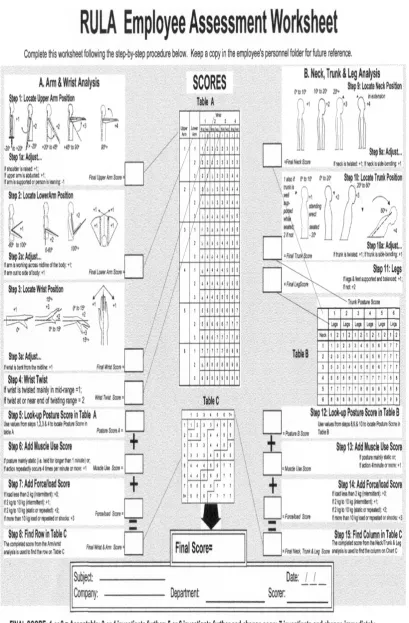
is modified according to the use of the limbs. Then the final A and B scores are calculated and using the final scores a Grand Score, using table C, is determined.
1. Posture, muscle use and force ratings
Select the observed posture range number for the upper and lower arms, wrist and wrist twist and record them in the boxes labeled A in the score sheet. Then score the “muscle use” (repetitive or static) and “forces or loads” involved in the adjacent boxes leaving the “posture score” A column blank. Similarly, score the neck, trunk and leg postures, muscle use and forces involved and enter the scores in the B boxes.
2. Scoring
A. Using the posture scores for the upper and lower arm, wrist and wrist twist, look up the upper limb posture score in Table A and enter it into the “Posture Score” A column.
B. Similarly use the posture scores for the neck, trunk and legs to look up Posture Score B in Table B and enter it into Posture Score B column.
3. Posture Score A + Muscle Use Score A + Force/Load Score A = Final Score A Posture Score B + Muscle Use Score B + Force/Load Score B = Final Score B
4. Grand Score
Using Final Score A and Final Score B, look up the grand Posture Score in Table C. 5. Investigation
For a Grand Score of:
1 or 2 the posture is acceptable if it not maintained or repeated for long periods (Class 1)
3 or 4 further investigation is needed (Class 2)
5 or 6 further investigations and changes are required soon (Class 3) More than 6 investigate and change now (Class 4) [11]
4. Application of RULA for the validation of work
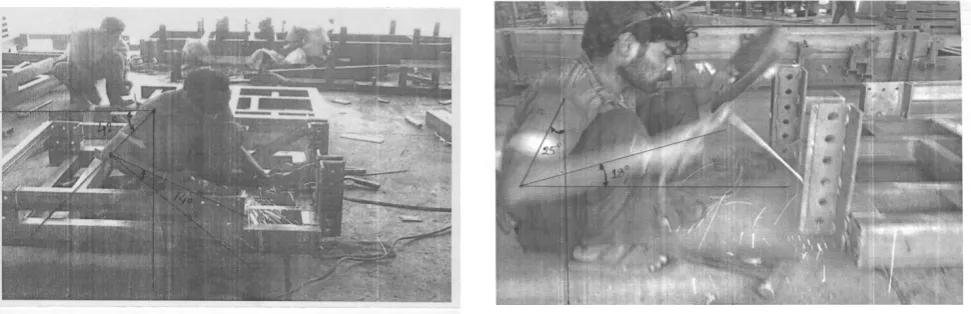
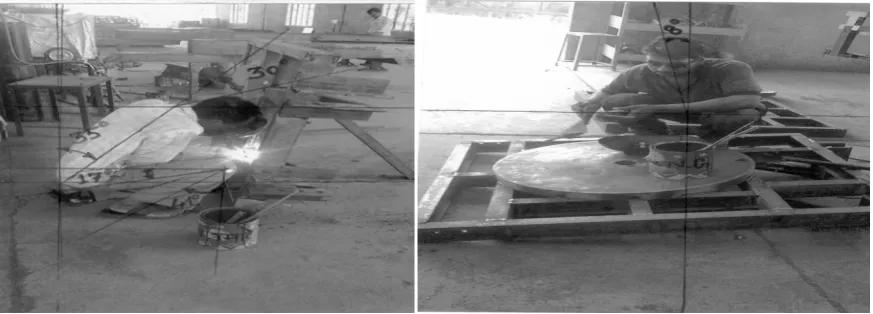
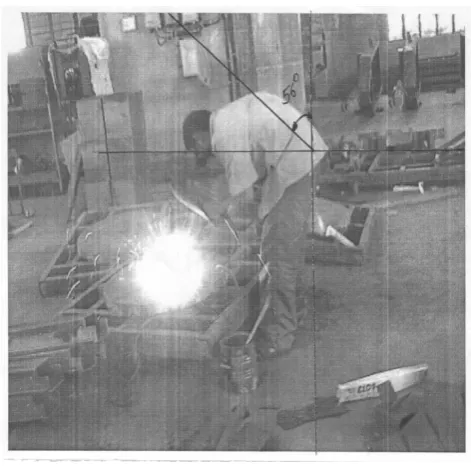
After investigating the MSD’s through the questionnaire in the industry, it has been observed that there is need of investigation. So with the help of RULA the postures are evaluated for finding the severity of the problem. Below figure shows the pictures of workers use angles are evaluated by graphical method and which are evaluated through RULA, it consists of two areas for assessment of whole body which is divided into Posture A & Posture B. This method investigates body parts as upper arm, lower arm, wrist, wrist twist, neck, trunk and limb.
The working postures of the workers and the angle at which they are working are recorded by taking photographs. Graphs are made on the photograph to find the angle of posture so that it can be evaluated through RULA.
Figure 1 Upper and Lower Arm Angle Figure 2 Upper and Lower Arm Abduction Angle
while working worker has to move the arm out to the side of the body, it gives score of ‘1’ individually and it will get added to the previous score. So the grand score of the lower arm is ‘4’.
Figure 3 Side Bending and Wrist Position
From the fig.3, position of wrist has been observed and by selecting the related position of the wrist from the worksheet we get the score of ‘2’. While working the wrist bent from the midline which gives the score of ‘1’ and this is added to the previous score and the final score of wrist position is ‘3’. Welding can be any type, here it is of continuous type so for this type of welding some of the time wrist has to be bend so the wrist twist position score is ‘2’.
After getting these four scores, to find score of posture A, table A has to be used in that the upper arm score ‘4’ and in that lower arm score ‘4’ wrist position score ‘3’ and in that wrist position score of ‘2’ has to be observed this will give the score ‘5’ for posture A which will be further get added to muscle and force/load score for final score of Posture A. Muscle score of ‘2’ has been found as the posture there is mainly static and the welding action is repetitive. And the load of welding gun is of around 2 kg and is again static and repetitive so it gives the score of ‘2’.After this score of posture A ‘5’ is added to muscle score and load score and the grand score of Posture A is ‘9’.
Figure 4 Forward Bending Angle and Neck Angle Figure 5 Side Trunk Bending Angle
From above figure 4 & 5, we can observe the neck angle of the posture of the worker and related to that the mannequin from worksheet is selected and it gives the score ‘3’. Now the neck twist that is any movement of neck on either side of the body, in continuous welding operation neck has to twist till the end of the welding length so it gives score of ‘1’ which will get added to previous score of neck. Figure 5 shows that the worker is bending on his side while working, so the neck side bend gives score of ‘1’ which will be added to the previous score of neck and the final score of neck is ‘5’.
Figure 6 Forward Trunk Bending Angle
From figure 6, it can be observed that the angle of posture of worker and related to that the mannequin is selected and it gives the score of ‘3’. The score of ‘1’ individually for trunk twist and trunk side bend is added to the previous score of trunk and it gives the final score for trunk as ‘5’. The worker works on both of their legs so it gives score for limb as ‘1’. So by using table B for neck, trunk and leg as for Posture A we find the score of Posture B and it is ‘6’. This score is than will be added to the muscle and force/load score to get grand score for Posture B. The muscle score is ‘2’ as work is mainly static and it is repetitive and the force/load score is ‘0’ as the worker is not having any load on his back. So the grand score for the Posture B by adding ‘6’ to ‘2’ and ‘0’ is ‘8’. Figure 7 shows the worksheet of employee assessment with RULA which can be used to assess directly the RULA score and severity of the problem.
5. Results
6. Conclusion
Unawareness about ergonomics is observed in industry in which work is undertaken. Musculoskeletal disorders are there in the welding process where workers are working in kneeling posture and it shows that there is need to change the body postures. Mainly in some of the sites of the body region the extremity of pain is more and it can cause severe problem to worker in the future which they are not understanding and feeling now. It is validated through RULA which gives score of ‘7’ which lies in class IV. Evaluation of postures by RULA shows that there is need of investigation and immediate changes are needed in the workstation.
7. References
[1] Metgud D.C, Khatri Subhash, et.al., “An ergonomic study of women workers in a woolen textile factory for identification of health –
Related problems”, Indian Journal of Occupational and Environmental medicine-April 2008-volume 12-issue 1.
[2] Rongo L.M.B., Tanzaniya, “Are worker in small industries in Dar es Salaam aware of occupational ergonomics principle?” Afr
Newslent on Occupational Health and safety, 2005; 15:14-16.
[3] Kadefor Roland, Ph.D., Professor Industry and Human Resource National Institute of Working Life Box 8850 SE-40272 Goteborg
Sweden
[4] Kumru Mesut, Kilicogullari Pinar, “Process improvement through Ergonomic Design in welding in shop of an Automotive Factory”.
[5] KAEWBOONCHOO1 Orawan, et.al., “The Standardized Nordic Questionnaire Applied to Workers Exposed to Hand arm Vibration”,J
health 1998; 40:218-222.
[6] Alzuheri1 Atiya, et.al., “Ergonomics Design Measures in Manual Assembly Work”.
[7] Ghosh1.3 Tirthankar,et.al.,“Work-related Musculoskeletal Disorder of the Goldsmiths in India”, Indian Journal of community
Medicine/vol 35/issue 2/April 2010.
[8] Lorusso*, Antonio et.al., “Musculoskeletal complaints among Italian X-ray technology students: a cross-sectional questionnaire
survey”, Lorusso et al. BMC research Notes 2010,3:114,http://www.biomedcentral.com/1756-0500/3/114.
[9] Choobineh Alireza, et.al., “Musculoskeletal problems among workers of an Iranian communication company”, Indian Journal of
Occupational and Environmental medicine-April 2007-volume 11-issue 7.
[10] Varmazyar Sakineh,et.al., “Evaluation Working posture and Musculoskeletal Disorders Prevalence in Pharmacy packaging Workers”,
European Journal of Scientific research ISSN 1450-216X vol.29 No. 1(2009),pp82-88.
[11] http://ezinearticles.com/? What –is – a RULA Assesment? ---An Ergonomists – Answer&id-1794097
About Author