https://doi.org/10.5194/esurf-7-549-2019 © Author(s) 2019. This work is distributed under the Creative Commons Attribution 4.0 License.
A versatile, linear complexity algorithm for flow routing
in topographies with depressions
Guillaume Cordonnier1,2, Benoît Bovy3, and Jean Braun3,4
1Univ. Grenoble Alpes, 1251 Avenue Centrale Domaine Universitaire, Saint-Martin-d’Hères, France 2Inria Grenoble Rhône-Alpes, 655 Avenue de l’Europe, Montbonnot-Saint-Martin, France 3GFZ German Research Centre for Geosciences, Telegrafenberg 14473, Potsdam, Germany
4University of Potsdam, Am Neuen Palais 10, Potsdam, Germany
Correspondence:Guillaume Cordonnier ([email protected])
Received: 8 November 2018 – Discussion started: 10 December 2018 Revised: 27 March 2019 – Accepted: 12 May 2019 – Published: 19 June 2019
Abstract. We present a new algorithm for solving the common problem of flow trapped in closed depressions within digital elevation models, as encountered in many applications relying on flow routing. Unlike other ap-proaches (e.g., the Priority-Flood depression filling algorithm), this solution is based on the explicit computation of the flow paths both within and across the depressions through the construction of a graph connecting together all adjacent drainage basins. Although this represents many operations, a linear time complexity can be reached for the whole computation, making it very efficient. Compared to the most optimized solutions proposed so far, we show that this algorithm of flow path enforcement yields the best performance when used in landscape evo-lution models. In addition to its efficiency, our proposed method also has the advantage of letting the user choose among different strategies of flow path enforcement within the depressions (i.e., filling vs. carving). Furthermore, the computed graph of basins is a generic structure that has the potential to be reused for solving other problems as well, such as the simulation of erosion. This sequential algorithm may be helpful for those who need to, e.g., process digital elevation models of moderate size on single computers or run batches of simulations as part of an inference study.
1 Introduction
Finding flow paths on a topographic surface represented as a digital elevation model (DEM) is a very common task that is required by many applications in domains such as hydrol-ogy, geomorphometry, soil erosion, and landscape evolution modeling, and for which various algorithms have been pro-posed for either gridded DEMs (e.g., O’Callaghan and Mark, 1984; Jenson and Domingue, 1988; Quinn et al., 1991; Tar-boton, 1997) or unstructured meshes (e.g., Jones et al., 1990; Banninger, 2007).
Closed depressions may arise in DEMs because they are real topographic features or result from interpolation error during DEM generation or its lack of resolution. These spu-rious local minima need to be resolved because they disrupt flow routing, produce hydrologically unrealistic results, or introduce artificial singularities that may result from a
sud-den, unrealistic jump in computing discharge. Flow routing is often corrected by filling depressions (e.g., Jenson and Domingue, 1988), carving channels through artificial sills (Rieger, 1998), or by using hybrid breaching-filling tech-niques (Lindsay, 2016).
Although not having a linear time complexity, the most recent algorithms of depression removal – e.g., the Priority-Flood algorithm and its variants (Barnes et al., 2014a; Zhou et al., 2016; Wei et al., 2018) – have been optimized so that they can be used efficiently on large datasets. To increase per-formance for very large datasets, further optimization efforts have been focused primarily on rather complex, parallel vari-ants of these algorithms (Barnes, 2016; Zhou et al., 2017).
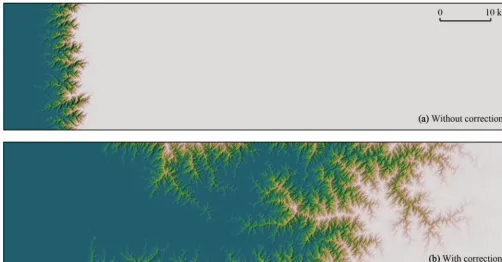
evolving topography (see Tucker and Hancock, 2010, for a review) and that rely on flow routing to compute erosion rates. To produce realistic results, flow path enforcement is often applied many times, i.e., at each simulation time step (Fig. 1), even when this eventually becomes irrelevant as the modeled erosional processes usually tend to remove depres-sions rather than deepen or add new ones (Braun and Willett, 2013). Furthermore, LEMs are also used as forward models in sensitivity analyses and/or inferences on the parameters that control erosional processes, which often require running a large number of models to adequately explore the param-eter space. Parallel flow routing and hydrological correction algorithms do not help much here, as grid-search and/or sam-pling methods (e.g., Sambridge, 1999) are generally easier to implement and more effective to execute in parallel. Highly optimized, sequential algorithms are still needed in this case. We have developed a new method of flow enforcement that is based on the explicit building of a graph of drainage basins (possibly encompassing depressions) and the computation of the flow paths both within and across those basins. This idea was first introduced in aComputer Graphicsimplementation of the stream power law (Cordonnier et al., 2016), but with a sub-optimal complexity. Although this approach may ap-pear naive at first glance, we have improved it by using fast algorithms of linear complexity at each step of the proce-dure, which now makes the whole computation very efficient. Not only does this method enable the use of a wide range of techniques of flow enforcement within the closed depres-sions (e.g., depression filling, channel carving, or more ad-vanced techniques), but it also provides generic data struc-tures that could potentially be reused for solving other prob-lems like modeling the behavior of erosion–deposition pro-cesses within those depressions.
After a detailed presentation of the different steps of the method, we will show in the sections below through some results how our algorithm behaves and performs compared to existing solutions of flow path enforcement. We will finally discuss the assets and limitations of our method, with some focus on landscape evolution modeling applications.
2 Algorithm
The input of the algorithm is a topography T =(N,E), whereN is a set of nodes andE is a set of edges that link pairs of neighbor nodes. A nodenis given a horizontal po-sitionpn and a vertical elevationzn. A topography may for
example result from a triangulation or correspond to a regu-lar grid of four-connectivity (i.e, four neighbors per nodes) or eight-connectivity (i.e., also including diagonal neighbors). We follow the conventions of Braun and Willett (2013) to define flow paths on the topography: each nodenis given (1) a single flow receiver, rcv(n), which corresponds to that of its (strictly) downslope neighbors having the steepest slope, and (2) a set of flow donors, Donors(n), which is a subset
of the neighbors of n and is defined as Donors(n)= {k∈
Nb(n), s.t.rcv(k)=n}. We set rcv(n)=∅whennis a sin-gular node: it corresponds to either a user-definedboundary node (e.g., a node on the domain boundary) or alocal mini-mumin the topography, i.e., a node inside the domain where all of its neighbors have a higher elevation, and correspond to either apitor aflat-bottomed depressionin Lindsay (2016) terminology.
We propose an algorithm that updates the receivers of a subset ofN such that the flow is never trapped in local ima. This algorithm primarily aims at resolving local min-ima in the context of flow routing and thus leaves the eleva-tion of the nodes unchanged. Hence it breaks the previously introduced definition of a flow receiver: the new receivers assigned by the algorithm generally produce some localized “upslope flow”. While this seems unnatural and may not be wanted, the data structures used by the algorithm provide enough information to efficiently address this issue later de-pending on the application, which is beyond the scope of this work. Still, the algorithm ensures that the updated flow rout-ing stays consistent across the whole topography by respect-ing the followrespect-ing properties for each nodenof the topogra-phy.
1. There exists a single boundary nodeb(not a local min-imum), and a unique flow path fromntob. The flow path is defined as the set of nodes P =(n, rcv(n), rcv(rcv(n)), . . ., b).
2. This flow path does not contain any cycle; i.e., each node appears only once inP.
3. The receivers definingP are chosen such that it satisfies properties 1 and 2, and minimizes the energyE, defined as
E=X
i∈P
Ei. (1)
As a first approximation, we setEi=zi (the altitude of the
node). We will discuss later the special case of nodes under water level.
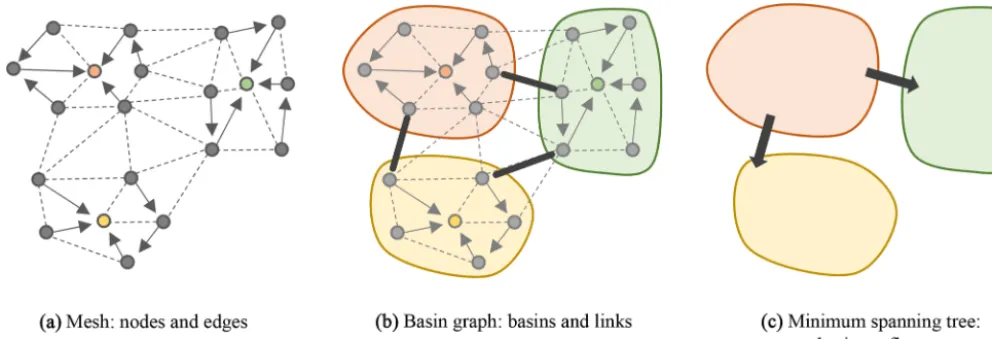
Our method is essentially based on the computation of a graph connecting adjacent drainage basins. We define abasin as the set of all nodes that flow toward the same singular node (Fig. 2b). A basin is either a boundary basin or an inner basin depending on whether the singular node is a boundary node or a local minimum.
To better explain the problem that we want to solve, we consider a filled topography as the result of an ideal physi-cal process where a perfectly fluid material has been poured onto an impermeable ground and stabilized at steady state. For a node n, we define aswater level (wn) the elevation
of the fluid surface, and as a spill any node s such that
Figure 1.Simulation of the evolution of an escarpment over 70 time steps of 1000 years each and on a 1024×256 regular grid, using the FastScape model (Braun and Willett, 2013, see also Sect. 3 below). The grid nodes of the leftmost column (boundary nodes) have a fixed elevation while the initial elevation of the other nodes corresponds to a 500 m high flat surface with small random perturbations. Using the same set of model parameters, simulation results are shown(a)without and(b)with correction of flow routing in local depressions at each time step. As illustrated, flow path disruptions in(a)cause a much slower migration of the escarpment, while the topography predicted in (b)is usually considered more realistic, especially under temperate or humid climates.
flow routing observing the aforementioned properties, the water level can be computed as wn=max(wrcv(n), zn). We
also use the termdepressionfrom Lindsay (2016) terminol-ogy, and we define it with respect to a basinB as a subset of nodes ofBunder water level, characterized bywn=wrcv(n). Note that the water level of a boundary basin corresponds to the elevation of its associated boundary node so that it con-tains no depression. In the case of nested depressions, the water level of a basin may be higher than the elevations of all its nodes, which means that the spill does not always be-long toB.
The energy of the nodes should be changed toEi =wi, but
as described later, one may choose various routing strategies inside the depressions depending on the application. There-fore, we allow any path within depressions by settingEi to
zero inside them, and keepingEi=zielsewhere.
One may break the problem of flow path enforcement down to three smaller problems: find the spill of each de-pression, force the flow within the depressions to be routed toward their respective spill, and ensure that the flow through the spills is properly routed into adjacent basins. The pro-posed algorithm addresses this problem in an explicit manner and can be divided into three main stages.
1. Compute the basins and link all pairs of adjacent basins (Fig. 2b).
2. Select only some of the basin links computed at the pre-vious stage and orient them such that the flow is routed consistently across adjacent basins, from inner basins toward the boundary basins (Fig. 2c). This operation is not trivial: an optimal selection needs a global knowl-edge of the whole basin graph. To do so, we use an algorithmic structure: aminimum spanning treeof the basin graph. We propose here two algorithms, a sim-ple one withO(nlogn) complexity, and a more complex one withO(n) complexity.
3. Update the flow receivers. Using the links selected at the previous stage, we update (only some of) the receivers to enforce the flow both within and across inner basins so that it is ensured to finally reach the boundary basins and their associated boundary nodes. We propose three different methods (one may choose a method over an-other depending on the specific problem to solve).
Figure 2.Illustration of the inputs and the first steps of the proposed flow routing algorithm.(a)The input topography is defined on top of a mesh by a set of nodes and edges. A single edge is selected for each node, it connects the node to its flow receiver, i.e., its neighbor with the steepest slope. Nodes with no receiver are local minima (colored in the figure).(b)All the nodes that flow to a same local minimum belong to the same basin. A graph of basins is created by connecting together adjacent basins withlinks, which are materialized on the mesh by edges representing the passes, i.e., the crossings of lowest elevation that connect each pair of basins (black thick arrows).(c)Some of the links are selected by computing a minimum spanning tree and the corresponding passes are oriented in the direction of the flow across the basins (unidirectional arrows). This structure is then used to update the flow receivers so that the flow reaches the domain boundaries without being interrupted.
2.1 Basin computation and linkage
This first stage consists in first assigning a basin identifier, basin_id(n), to each nodenof the topography. The identifiers are added sequentially by starting at singular nodes and pars-ing the nodes uspars-ing a depth-first traversal in the direction of the donors (see Appendix A1). The case of flat-bottomed de-pressions does not require any particular treatment: all nodes within flat areas are singular nodes and therefore are each assigned a unique basin identifier.
Then, thelinksconnecting all pairs of adjacent basins are retrieved. To each link also corresponds an edge of the to-pography, here called a pass, which represents the crossing of lowest elevation between the two basins. For example, the link L=(B1, B2) connects the basins B1 and B2 and has the corresponding Pass(L)=(n1, n2), wheren1∈B1and n2∈B2and where the chosen (n1, n2) minimizeszpass(L)= max(zn1, zn2). We define a single procedure to retrieve both the links and their pass (see Appendix A2). This procedure parses each edge of the topography: if the two nodes of the current edge each have different basin identifiers, then (1) it adds a new link if no link has been already set for these two basins, and (2) it sets or maybe updates the pass of that link with the current edge.
The sets of basinsBand the set of retrieved linksLboth define a basin graph. It is worth noting that, at this stage, the links and passes are not oriented and that only one link and pass are stored for two adjacent basins. The procedure described above runs sequentially and will not add the link (B2, B1) if it already added the link (B1, B2).
2.2 Flow routing across adjacent basins
This second stage tackles the problem of selecting the right subset of links so that we obtain consistent flow paths on the basin graph. To illustrate the proposed solution, let us start from an inner basin. If it is filled with water, the water level will rise until it finds a pass where water eventually pours into another, adjacent basin. The associated link is then called theoutflowof the basin. Hence, routing the flow across the basins consists in connecting all outflows such that the re-sulting flow paths, from inner basins to the boundary basins, have the same properties as stated above; i.e., those paths are unique, contain no cycle, and minimize the energy needed to reach the boundary basins.
If we add to the basin graph a virtual basin (let us call it ex-ternal basin) to which we link all the boundary basins (i.e., the external basin may be viewed as a bucket collecting all the flow that leaves the domain), then we can represent the connected outflows using a specific algorithmic structure: a tree. More specifically, abasin treeis a tree that satisfies the properties above: it actually corresponds to a minimum span-ning tree of the basin graph, i.e., a subset of the basin graph resulting from a selection of the links so that the following energy is minimized:
Etree=
X
L
∈Ozpass(L), (2)
whereOis the set of selected links (or the set of outflows) andzpass(L)is the elevation of their respective passes.
simple with a log-linear complexity. We also propose a sec-ond algorithm, which leverages the planar nature of the basin graph to reach a linear complexity.
2.2.1 Kruskal’s algorithm
Kruskal’s algorithm (Kruskal, 1956) is one of the most clas-sical algorithms used for computing minimum spanning trees and is known to have a O(mlogm) complexity, where m is the number of links. The number of links being always bounded by a linear function of the numbernof nodes in the grid (Euler formula), using this algorithm induces a global upper bound of O(nlogn) on the complexity of our solu-tion. This algorithm uses a union–find structure to store and merge equivalence classes of objects (see Algorithm 1). The idea here is to parse all linksL∈Lsorted by increasing ele-vationzpass(L), progressively grouping each pair of basins as
a larger, virtual one (equivalence class). All subsequent paths between basins within this equivalence class are discarded to prevent loops. The union–find data structure has three opera-tions:
MakeSet Create an equivalence class containing a single el-ement.
Union Merge two equivalence classes.
Find Get the equivalence class of an object.
The optimal implementation of the union–find structure provides aO(α(N)) complexity for these operations, where N is the number of elements in the structure (i.e., here the number of basins) andαis the inverse Ackermann function whose complexity is lower thanO(logN). This however re-quires first sorting the links by increasing weight (i.e., by the elevation of their respective passes), which finally yields a O(mlogm) complexity for the whole computation.
2.2.2 Planar graphs
The problem of finding the minimum spanning tree is known to have aO(N) complexity when the graph isplanar(Mareš, 2002). A planar graph is a graph which can be embedded in a plane such that none of its edges cross another one. The basin graph described in Sect. 2.1 is an example of a planar graph.
The key intuition behind the algorithm proposed in Mareš (2002) is that at least half of the vertices of a planar graph have at most eight neighbors. The algorithm is then an adap-tation of another classical algorithm, named Boruvka’s algo-rithm (Boruvka, 1926); see Algoalgo-rithm 2 for more details. The O(N) complexity comes from the fact that at each step of the outer loop, we parse and remove at least half of the nodes of the graph, andP
N+N/2+ · · · +1<2N. As the num-ber of grid nodes n > N, the complexity of this algorithm is bounded byO(n). As demonstrated by Mareš (2002), the limit of eight neighbors for the selection of a basin in the in-ner loop is critical in halving the number of edges at each iteration of the outer loop and thus in obtaining a linear time complexity.
A special case may arise when the basin graph is computed from a grid of eight-connectivity. In this case, the edges of the graph may cross each other due to the diagonal connec-tivity, possibly making the basin graph not perfectly planar. This is, however, rather unlikely as it implies that two passes connecting different basins are found on the two diagonals connecting four adjacent nodes of the grid. Furthermore, this issue does not impact the correctness of the algorithm. Only the linear complexity is not formally proven. Because it is not planar, the case of an eight-connectivity grid would fall in the second category mentioned by Mareš (2002) of graphs closed on graph minor. We have validated this experimentally by randomly computing minors of differently sized eight-connected graphs. We found an edge density of 4, imply-ing that half of the basins in the basin graph are linked to at most 16 adjacent basins (and not eight as for planar graphs) at any step of the algorithm. Therefore, we have demonstrated the linear complexity for eight-connected graphs experimen-tally, although future work is needed to prove this in a formal framework.
2.3 Updating flow receivers
the two nodes of each pass, one asnin(incoming flow) and the other one asnout(outgoing flow). Depending on their el-evation, eitherninornoutis the spill node of the correspond-ing basin.
The last stage then consists in updating the flow receivers so that any flow entering an inner basin is ensured to leave the basin throughnout. The most straightforward solution would be to only update the receiver of each local minimump so that rcv(p)=nout. Note that ifninhas a higher elevation than nout, then two receivers must be updated: rcv(nin)=noutand rcv(n)=nin. This very simple solution ensures topological continuity of the flow but does not preserve its spatial conti-nuity. We therefore propose two other, more realistic meth-ods: one similar todepression fillingand another similar to depression carving. Note that we use carving and filling as metaphors as our algorithm only changes the flow graph con-nectivity without altering elevation values. For each of the variants, the donors and stack structures need to be updated to reflect the changes in the receivers.
2.3.1 Depression carving
The idea here is to mimic the effect of a river carving a nar-row trench between the bottom of the depression and the spill: a new, single path is computed from the local mini-mum to the pass. In fact, the most direct path is already de-fined by the flow receivers that were computed initially, but it is in the reverse order, i.e., from the pass to the local mini-mum. Hence, it is trivial to follow this path and progressively revert the receivers until the local minimum is reached (see Algorithm 3).
2.3.2 Depression filling
Unlike the previous method, we update here the receivers as if the depressions were completely filled by some material. We define a procedure that starts at a pass and then progres-sively parses all neighbor nodes in a breadth-first order as long as these are below water level, at the same time updating the receiver of the current parsed node as being one among its neighbors that has already been parsed (see Algorithm 4). We repeat this procedure for all depressions by traversing the basin tree from the boundary basins to the most inner ones so that accurate water level values can be computed during the procedure. Receivers are chosen according to a cost func-tion that we define here as the minimal Euclidean distance
between a node andnout. This function does not yield the perfect path patterns that one would obtain by including ob-stacles in the computation of the Euclidean distance on a reg-ular grid, but it is simple and efficient while being accurate enough. We prefer this method over a simple breadth-first search, which depends on the order in which neighbors are visited and which leads to more pronounced straight lines af-ter erosion, due to the four- or eight-connectivity.
3 Results
Our algorithm is run under different settings to illustrate its behavior and compare it with some other state-of-the-art methods. Most of the examples below are shown within the context of landscape evolution modeling, using a sim-ple model of block uplift vs. channel erosion by the stream power law. This model simulates the evolution of the topo-graphic surfacez, which can be written as follows:
∂z
∂t =U−K A
m(∇z)n, (3)
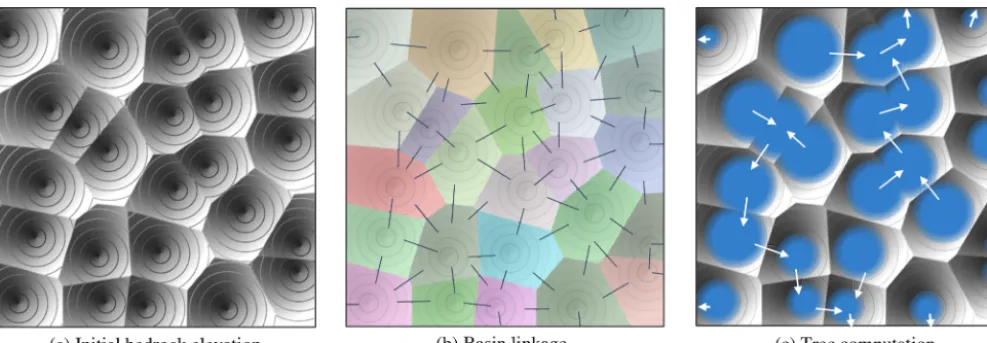
Figure 3.Our algorithm of flow enforcement run on a synthetic case.(a)Hillshade and contour plot of the input topography with apparent depressions.(b)Basins (areas of unique, random colors) and all passes connecting adjacent basins (thin black lines).(c)Flow directions across the basins (white arrows), as resulting from the computation of a minimum spanning tree from the basin graph, and water level (blue areas) after some erosion is applied to the input topography.
3.1 Illustration of the algorithm
The behavior of our algorithm of flow path enforcement is best illustrated using a simple synthetic topography as in-put. A set of 25 local minima is sampled on a regular grid of 500×500 nodes and the elevation of the topographic sur-face is locally computed as a fixed proportion of the distance to the nearest local minimum (Fig. 3a). The first step of the algorithm delineates the basin of each local minimum and finds all possible connections (links) between the basins, lo-cated at the lowest pass between each pair of adjacent basins (Fig. 3b). Then, a minimum spanning tree is computed from the graph of these links to find the path of minimum energy that would allow the water to leave the basins (white arrows in Fig. 3c). The flow receivers can then be updated by using the edges of this basin tree. The updated receivers are in turn used by the FastScape algorithm to slightly erode the basin boundaries during one time step of 100 years. The result is shown as well as the final water level in Fig. 3c.
3.2 Effect of flow path enforcement strategies on eroded topographies
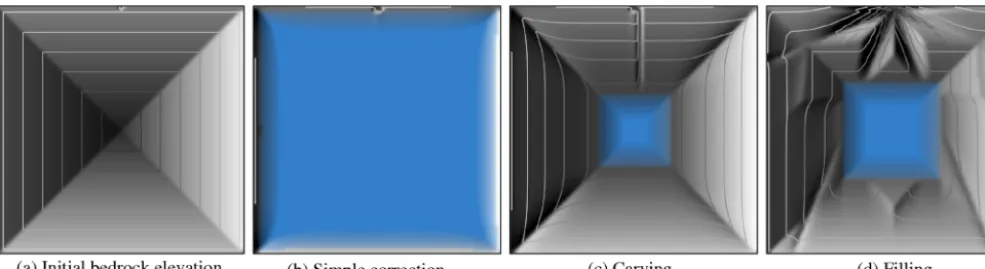
Figure 1 already shows the effect of flow path enforcement vs. no enforcement on the evolution of an escarpment under active erosion processes. A second set of experiments, shown in Fig. 4, illustrates the impact that the different strategies of flow receiver updating have on the evolution of the to-pographic surface under the action of channel erosion. The input synthetic topography is defined on a 100×100 regu-lar grid and looks like an inverted pyramid with 45◦regular slopes, forming a single, big depression (Fig. 4a). The node at the middle of the top boundary is the only node that is not part of the depression: it has the same elevation as the node at the center of the grid and it is defined as a boundary node.
A single time step of 5000 years of erosion only (no uplift) is performed using each of the strategies described in Sect. 2.3.
Simple correction. In this specific case, the algorithm up-dates the receivers of only three nodes: (1) one of the neighbors of the boundary node, which here corre-sponds to the spill of the closed depression, (2) one of the neighbors of the spill that, together with the spill, forms the pass connecting the depression to the bound-ary node, and (3) the local minimum at the bottom of the depression. The new assigned receivers are for (1) the boundary node itself, (2) the spill, and (3) the other node of the pass. We can see in Fig. 4b that this strat-egy does not allow channel erosion to propagate much from the boundary node into the closed depression. In fact, drainage area values close to the boundary node are high enough to trigger erosion but the low values of drainage area in the vicinity (within the depression) prevent further propagation of the erosion wave.
Depression carving. Unlike the former strategy and as ex-pected, Fig. 4c shows that the depression carving strat-egy allows erosion to propagate toward the local mini-mum along a narrow and deep trench.
Depression filling. Using the depression filling strategy, flow receivers are updated over a large area of the de-pression as if the water surface was replaced by a very gentle slope toward the spill. As a result, erosion affects a great part of the modeled domain, with the emergence of a star-like pattern centered at the spill (Fig. 4d). The number and disposition of the branches of the star are due to the grid eight-connectivity used here.
strat-Figure 4.Demonstration of the effect of flow path enforcement on erosion, using different strategies of flow receivers “correction” within inner basins.(a)Hillshade and contour plot of the initial topography.(b),(c)and(d)Hillshade and contour plot of the topography obtained after running a single time step of 5000 years with channel erosion only (no uplift), with flow receivers updated using each of the different strategies described in Sect. 2.3. Water level is shown in blue, and is computed by propagating the spill elevation while parsing the nodes in the upstream order (based on updated donors).
egy may be acceptable if one assumes that no erosion could happen in depressions below the water level. However, in-terrupted drainage area patterns within the depressions may be problematic when used with erosion algorithms like the FastScape model, which uses an implicit time scheme for solving the stream power law but still treats drainage area explicitly, resulting in too slow opening of the closed depres-sions by erosion. The depression carving or depression fill-ing strategies generally yield better results in the latter case. These two strategies have, however, contrasting behaviors and choosing one or the other will depend on several criteria such as the size (i.e., depth vs. volume) of the depressions.
3.3 Performances
To assess the performance of our algorithm, we have run multiple benchmarks under various settings. Although these benchmarks mostly take place in the framework of landscape evolution modeling, they provide results that may be useful in other applications too. Note that for better readability, we present here only the results from benchmarks applied to a fixed grid of 16 384×16 384 nodes. We obtain consistent re-sults for other grid sizes.
We have run benchmarks for our algorithm – including the two variants for computing the minimum spanning tree but considering only the depression filling strategy – as well as for three other state-of-the-art algorithms of local minima resolution, respectively proposed by Barnes et al. (2014a), Zhou et al. (2016), and Wei et al. (2018). All three of those algorithms fill the depressions using improved variants of the Priority-Flood algorithm that reduce the number of nodes processed by a priority queue. The Barnes et al. (2014a) vari-ant used here, i.e., Priority-Flood+, is only slightly opti-mized but has the advantage of filling the depressions with a nearly flat surface so that flow directions can be determined. Interestingly, the simplicity of this first version makes it the
most efficient when the number of local minima is large (see Sect. 4). While being the most optimized sequential variant that has been proposed so far, the Wei et al. (2018) variant fills the depressions with perfectly flat surfaces and thus has to be combined with a flat resolution algorithm – we use here an optimalO(n) algorithm proposed by Barnes et al. (2014b). We apply the same treatment to the Zhou et al. (2016) variant. All variants fill the depressions by directly updating the elevation values on the grid. To ensure proper comparison with our algorithm, we thus need to run them on a temporary copy of the elevation values before computing the flow receiver for each node of the grid. With our algo-rithm being optimized for a sequential usage, we chose not to compare it to the parallel versions of Barnes (2016) and Zhou et al. (2017). Both the algorithms and the benchmarks are implemented using the C++ language. For the state-of-the-art algorithms, we reuse the implementations available in the RichDEM library v2.2.9 (Barnes, 2018). The bench-marks where computed on an Intel Xeon Silver 4110 CPU (2.1 GHz, 32.0 Go RAM). We used Microsoft Visual Studio compiler with fast optimization options. Note that because of the differences in the design/implementation used in Rich-DEM vs. our code, the benchmarks presented here should be seen as an illustration of the theoretical complexities of the algorithm variants rather than a strict comparison of their ac-tual performances.
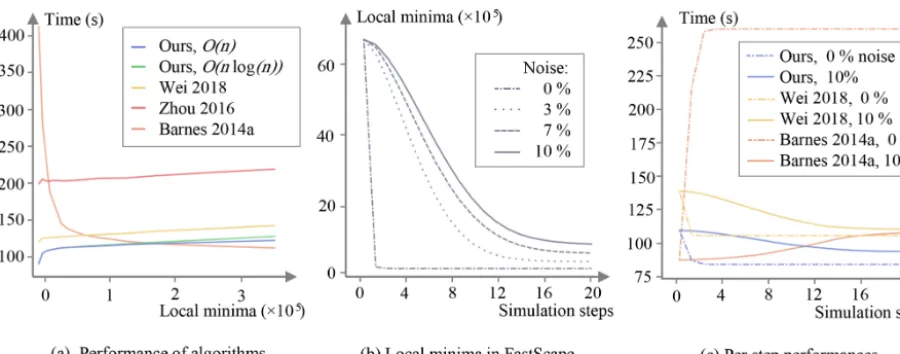
cumu-Figure 5.Results from benchmarks assessing the performance of our algorithm for local minima resolution – including bothO(nlogn) Kruskal’s andO(n) Mareš’ variants for computing the minimum spanning tree, compared to three other solutions based on variants of the Priority-Flood depression filling algorithm proposed by Barnes et al. (2014a), Zhou et al. (2016), and Wei et al. (2018). See text for more details about the setup of these benchmarks.(a)Execution time measured for local minima resolution applied once to a synthetic input topography vs. total number of local minima generated in the input topography. (b)Evolution of the number of local minima detected in the topography obtained at each of the first 20 time steps of a FastScape model run. Each curve corresponds to a given magnitude of random perturbations added to produce spatially variable uplift rates (magnitude values are relative to a fixed uplift rate of 5×10⁻³m yr−1). (c)Execution time measured for local minima resolution at each time step, with either spatially uniform or variable uplift rates (i.e., a relative noise magnitude of either 0 % or 20 %). The blue curves refer to our algorithm using theO(n) variant for computing the minimum spanning tree.
lative size of the depressions. Figure 5a shows the execution times of our algorithm vs. state-of-the-art algorithms for an increasing number of local minima. We can see that in these settings our algorithm (both variants for the computation of the minimum spanning tree) globally outperforms the state-of-the-art solution of Wei et al. (2018) combined with flat resolution. Note that without combining it with a flat reso-lution algorithm, the Wei et al. (2018) algorithm shows an equivalent performance to our approach, provided that the depressions remain evenly distributed. In that case, the main difference between the two approaches is that ours provides data structures (flow paths, basin graph) that might be reused elsewhere. By contrast, the Barnes et al. (2014a) Priority-Flood variant shows an inverse trend: it performs much worse in the absence of depression but the execution time rapidly decreases when increasing the total number of local minima, eventually achieving better performance than our algorithm. This is explained by the very simple implementation of this variant, in which all the nodes are processed by a priority queue in the absence of depression (not optimal) while a plain queue is used for most of the nodes if the topography is largely covered by depressions, making this variant near optimal in that specific case. Note that for high numbers of local minima we also start to discern in Fig. 5a the difference in performance of the variants used to compute the minimum spanning tree, here explained by their log-linear vs. linear complexity.
In a second set of benchmarks, we analyze the perfor-mances of the algorithms for local minima resolution through full simulations of landscape evolution. We run the FastScape model over 20 time steps of 10 000 years each, starting from a flat topography with small random perturbations (thus taining many local minima) and using fixed boundary con-ditions, i.e., boundary nodes all along the grid boundaries. The simulations are all based on a uniform uplift rate of 5×10⁻³m yr−1but each differ by the magnitude of the ran-dom field (created on a coarser, 1500×1500 grid) added to produce spatially variable uplift rates. This magnitude ranges from 0 % to 20 % of the uniform uplift rate. As shown in Fig. 5b, a greater magnitude of perturbation of uplift rates reduces the rate at which the local minima disappear un-der the action of channel erosion as the simulation proceeds. With no perturbation, all local minima are removed after the first time step. This has important implications for the over-all time spent on resolving local minima during a simula-tion. Figure 5c shows that, with uniform uplift, our algorithm greatly optimizes this overall time compared to the Priority-Flood variant of Barnes et al. (2014a). Even with variable uplift rates, our algorithm performs better after only a few time steps.
4 Analysis
state-of-the-art algorithms, as reported in the section above. Barnes et al. (2014a) propose progressively flooding the topography from exterior to interior, keeping in a priority queue all the parsed nodes except for the ones in depressions, which are processed using a plain queue. The operations used in this algorithm can be split in two main categories: one handling thendnodes in depression areas, withnd< nthe total num-ber of nodes, and another one handling the other “regular” nodes, nr=n−nd, using the priority queue. As a depres-sion encloses at least one node (a local minimum) and zero or more nodes in the immediate vicinity, the total number of nodes in depression areas is always greater than or equal to the total number of local minimanl, that is,n−nd≤n−nl. Therefore, the complexity of Barnes et al. (2014a) Priority-Flood variant is bounded byk0+k1n+k2(n−nl) log(n−nl), wherek0,k1, andk2are constants. Due to the very simple formulation of this algorithm,k1is very small. The improved variants of Priority-Flood proposed by Zhou et al. (2016) and Wei et al. (2018) further reduce the number of nodes that are processed by the priority queue by carefully selecting spill candidates among the regular nodes. In those variants, the to-tal number of nodes processed by the priority queue becomes nearly proportional to the number of local minima, inverting the formulation of the complexity that is here bounded by k3+k4n+k5nllognl. Because those variants are more com-plex,k4has higher values.
We also derive the complexity of our algorithm taking its stages separately. The first and last stages, i.e., the compu-tation of the basin graph and the update of flow receivers, are both bounded by k6+k7n, with a relatively high value for thek6andk7constants. The second stage, i.e., the com-putation of the minimum spanning tree, is bounded by ei-therk8nllognlwhen using the Kruskal’s algorithm ork9nl when using the algorithm proposed by Mareš (2002), with k8< k9. Both expressions above are valid considering that nl∼Nvalues (the number of basins) forNlarge.
The complexities of the algorithms that we have derived here are all consistent with the benchmark results shown in Fig. 5a. The difference between the two minimum span-ning tree algorithms is visible only for a large number of local minima, as predicted by their respective asymptotic complexity, while being unnoticeable for lownl where the other stages of the processing prevail. Similar expressions obtained for the complexity of our algorithm vs. the solution based on Wei et al. (2018) are also well illustrated by sub-parallel curves in the figure. The inverse trend observed for the Barnes et al. (2014a) solution is explained by its complex-ity, where the term (n−nl) log(n−nl) tends towards zero asnl increases.
For all the algorithms compared here, the memory con-sumption grows linearly with the DEM size. Barnes et al. (2014a), Zhou et al. (2016), and Wei et al. (2018) Priority-Flood variants only use a supplementary queue to unload the priority queue, making it very memory-efficient. By con-trast, our algorithm stores more information like the
struc-tures used for representing flow paths (receivers, donors, and stack), the basin graph, and possibly some additional data structures like those needed by the algorithm of Mareš (2002). Some of these data might be required for further pro-cessing, e.g., the flow paths in landscape evolution modeling applications. Other data related to the basin graph increase the memory consumption, although in practice the number of local depressions – and thus the size of the graph – is small enough with respect to the size of the grid, resulting in only a small memory overhead compared to the Priority-Flood vari-ants.
5 Conclusions
We have presented here a new algorithm for flow path en-forcement in topographies with depressions. We have de-signed this algorithm within the framework of landscape evo-lution modeling and we have demonstrated through bench-marks that, in this scope, it may greatly improve performance compared to other state-of-the-art solutions. The potential of this algorithm is, however, not limited to landscape evo-lution models. On a broader scope, the basin graph and its minimum spanning tree are generic structures that other ap-plications may leverage, possibly through derived quantities such as the water level of each depression. We propose here optimal methods to compute those structures and quantities. Despite the fact that our algorithm is rather complex and re-quires some work to be properly implemented, it is designed in a composable way such that it is easy to reuse one or sev-eral of its components. Adding new features like alternative strategies of flow path enforcement within the depressions would require only little effort, too.
While being versatile, this new algorithm does not pro-vide a universal solution to the problem of flow routing both within and across closed depressions. Perhaps its main limitation is the assumption of single- direction flow, i.e., each node has one unique flow receiver. Adding full support for multiple-direction flow (MDF) without losing in perfor-mance is rather difficult and would require a fair amount of redesign work at each of the three stages of the algorithm:
– Basin computation should take into account divergent flow (basin labels are not unique for grid nodes located on drainage divides).
– It should be theoretically possible to route the outflow from an inner basin into more than one of its adjacent basins (this is currently not possible using a minimum spanning tree computed from the basin graph).
– Alternative, MDF-compliant methods should be imple-mented to update the flow receivers within the depres-sions.
pre-vent us from applying MDF flow routing methods on the modified topography.
Appendix A: Algorithms
A1 Basin computation
Algorithm 5 finds which basin each node of the grid belongs to by assigning them a label. One unique label is defined (here by an integer) for each basin.
A2 Basin linkage
Code availability. The code used for the implementation of the algorithm, examples, and benchmarks presented in this paper is available here: https://github.com/fastscape-lem/ flow-routing-depressions (last access: 13 May 2019; Cordonnier et al., 2019). Note that this read-only repository contains a snapshot version of the fastscapelib library that has been extracted for reproducibility purposes. Further maintenance and new de-velopments will happen in the fastscapelib’s main repository: https://github.com/fastscape-lem/fastscapelib (last access: 12 March 2019; Bovy and Braun, 2019).
Author contributions. GC designed the algorithm and imple-mented it including the examples/benchmarks presented in this pa-per; BB also worked on the implementation. GC and BB worked on the redaction of the paper with contributions by JB, and all authors contributed to fruitful discussions throughout this study, especially JB, who provided many test conditions and use cases.
Competing interests. The authors declare that they have no con-flict of interest.
Acknowledgements. We thank the reviewers for their helpful comments that greatly improved this article.
Review statement. This paper was edited by Greg Hancock and reviewed by two anonymous referees.
References
Banninger, D.: Technical Note: Water flow routing on ir-regular meshes, Hydrol. Earth Syst. Sci., 11, 1243–1247, https://doi.org/10.5194/hess-11-1243-2007, 2007.
Barnes, R.: Parallel Priority-Flood depression filling for trillion cell digital elevation models on desktops or clusters, Comput. Geosci., 96, 56–68, https://doi.org/10.1016/j.cageo.2016.07.001, 2016.
Barnes, R.: RichDEM: Terrain Analysis Software, available at: http: //github.com/r-barnes/richdem (last access: 6 November 2018), 2018.
Barnes, R., Lehman, C., and Mulla, D.: Priority-flood: An optimal depression-filling and watershed-labeling algorithm for digital elevation models, Comput. Geosci., 62, 117–127, https://doi.org/10.1016/j.cageo.2013.04.024, 2014a.
Barnes, R., Lehman, C., and Mulla, D.: An efficient as-signment of drainage direction over flat surfaces in raster digital elevation models, Comput. Geosci., 62, 128–135, https://doi.org/10.1016/j.cageo.2013.01.009, 2014b.
Boruvka, O.: O jistém problému minimálním, Pràce Moravské p˘rìrodov˘edecké spole˘cnosti, 3, 37–58, 1926.
Bovy, B. and Braun, J.: Fastscapelib, available at: https://github. com/fastscape-lem/fastscapelib, last access: 12 March 2019. Braun, J. and Willett, S. D.: A very efficient O (n), implicit and
par-allel method to solve the stream power equation governing fluvial
incision and landscape evolution, Geomorphology, 180, 170– 179, https://doi.org/10.1016/j.geomorph.2012.10.008, 2013. Campforts, B. and Govers, G.: Keeping the edge: A
numeri-cal method that avoids knickpoint smearing when solving the stream power law, J. Geophys. Res.-Earth Surf., 120, 1189–1205, https://doi.org/10.1002/2014JF003376, 2015.
Cordonnier, G., Braun, J., Cani, M.-P., Benes, B., Galin, E., Pey-tavie, A., and Guérin, E.: Large scale terrain generation from tectonic uplift and fluvial erosion, Comput. Graph. Forum, 35, 165–175, https://doi.org/10.1111/cgf.12820, 2016.
Cordonnier, G., Bovy, B., and Braun, J.: A versatile, linear com-plexity algorithm for flow routing in topographies with de-pressions (code), available at: https://github.com/fastscape-lem/ flow-routing-depressions, last access: 13 May 2019.
Jenson, S. and Domingue, J.: Extracting topographic structure from digital elevation data for geographic information system analysis, Photogram. Eng. Remote Sens., 54, 1593–1600, 1988.
Jones, N., Wright, S., and Maidment, D.: Watershed de-lineation with triangle-based terrain models, J. Hydraul. Eng., 116, 1232–1251, https://doi.org/10.1061/(ASCE)0733-9429(1990)116:10(1232), 1990.
Kruskal, J. B.: On the shortest spanning subtree of a graph and the traveling salesman problem, P. Am. Mathem. Soc., 7, 48–50, 1956.
Lindsay, J. B.: Efficient hybrid breaching-filling sink removal meth-ods for flow path enforcement in digital elevation models, Hy-drol. Process., 30, 846–857, https://doi.org/10.1002/hyp.10648, 2016.
Mareš, M.: Two linear time algorithms for MST on minor closed graph classes, ETHZ, Institute for Mathematical Research, 2002. O’Callaghan, J. and Mark, D.: The extraction of drainage networks from digital elevation data, Comput. Vis. Graph. Image Proc., 28, 323–344, https://doi.org/10.1016/S0734-189X(84)80011-0, 1984.
Quinn, P., Beven, K., Chevallier, P., and Planchon, O.: The pre-diction of hillslope flowpaths for distributed hydrological mod-eling using digital terrain models, Hydrol. Process., 5, 59–80, https://doi.org/10.1002/hyp.3360050106, 1991.
Rieger, W.: A phenomenon-based approach to upslope con-tributing area and depressions in DEMs, Hydrol. Pro-cess., 12, 857–872, https://doi.org/10.1002/(SICI)1099-1085(199805)12:6<857::AID-HYP659>3.0.CO;2-B, 1998. Sambridge, M.: Geophysical inversion with a neighbourhood
algorithm-I. Searching a parameter space, Geophys. J. Int., 138, 479–494, https://doi.org/10.1046/j.1365-246X.1999.00876.x, 1999.
Tarboton, D.: A new method for the determination of flow directions and upslope areas in grid digital elevation models, Water Resour. Res., 33, 309–319, https://doi.org/10.1029/96WR03137, 1997. Tucker, G. E. and Hancock, G.: Modelling landscape
evolution, Earth Surf. Process. Landf., 35, 28–50, https://doi.org/10.1002/esp.1952, 2010.
Wei, H., Zhou, G., and Fu, S.: Efficient Priority-Flood depression filling in raster digital elevation models, Int. J. Dig. Earth, 0, 1– 13, https://doi.org/10.1080/17538947.2018.1429503, 2018. Zhou, G., Sun, Z., and Fu, S.: An efficient variant of the