Fingerprint Image Compression
Ms.Mansi Kambli 1* ,Ms.Shalini Bhatia2 *
Student 1*, Professor 2*
Thadomal Shahani Engineering College *1,2
Abstract
Modified Set Partitioning in Hierarchical Tree with Run Length Encoding is a new framework proposed for fingerprint image compression. The Proposed method is better because more number of images related to the fingerprint image are retrieved. Experiments on an image database of grayscale bitmap images show that the proposed technique performs well in compression and decompression. We use Peak Signal to noise ratio [3] and Mean Square Error [3] to compute the picture quality of fingerprint images.
Keywords
SPIHT, Discrete wavelet transform, lossy
1. Introduction
In this era of technology the most important factor is storage space. The transmission of images consumes a lot of space. Image compression is one of key techniques in solving this problem. Image compression exploits redundancy to achieve reduction in the actual amount of data with or without quality information loss according to certain rules through transform and combination. Many image compression algorithms have been in practice, such as DPCM, JPEG, SPIHT and JPEG2000, etc. Even though there are many applications for image compression little work has been done in the progressive retrieval of images. The algorithm should concentrate on this aspect, while at the same time, minimizing the loss of information. The algorithm should provide efficient and progressive compression and decompression for gray-scale and color bitmap (.bmp) images. Most importantly, this algorithm should provide improvements over the original SPIHT, favorably for all sorts of bitmap images. The application provides efficient and flexible image compression for bitmap (.bmp) images with variable compression ratios. The application finds use in transmission of images, storage of images as well as image mining. It is a lossy technique.
Large volumes of fingerprints are collected and stored every day in a wide range of applications, including forensics, access control etc., and are evident from the database of Federal Bureau of Investigation (FBI) which contains more than 70 million fingerprints. An automatic recognition of people based on fingerprints requires that the input fingerprint be matched with candidates within a large number of fingerprints. Since large volume of data in a database consumes more amount of memory, the information contained in fingerprints must, therefore, be compressed by extracting only visible elements. The proposed algorithm, focuses mainly on the new fingerprint compression using Modified Set Partitioning in Hierarchical trees (SPIHT) which is applied to get better quality, i.e., high peak signal to noise ratio (PSNR)[2].
Fingerprint images exhibit characteristic high energy in certain high frequency bands resulting from the ridge-valley pattern and other structures. To account for this property, the Wavelet standard for lossy fingerprint compression has been proposed in this paper[4].
2. The Discrete Wavelet Transform
Image compression schemes use transforms in order to find a representation of the image in which the maximum energy (or information) is present in a small number of coefficients. DWT of an image leads to its representation in different scales in the form of spatial orientation trees (SOT). After the transform, the lowest frequency coefficients concentrate most of the energy of the transformed image [1].
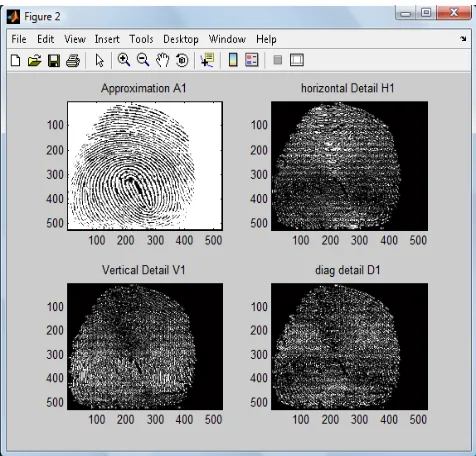
Figure 2.1: Fingerprint Image
The first image in Figure 2.1 is the original non-transformed fingerprint image. The input image is a fingerprint image of 512 x512 in bmp format. The discrete wavelet transform has to be applied on it. DWT splits the image into four sub-bands – LL,LH,HL,HH .This splitting can be done repeatedly upto n times but as the level increases the compression though increases but the information loss also increases above tolerable levels. Wavelet transform at level 2 is manageable but at level 1 is quite good.
Figure 2.2: Single Level Decomposed Fingerprint Image
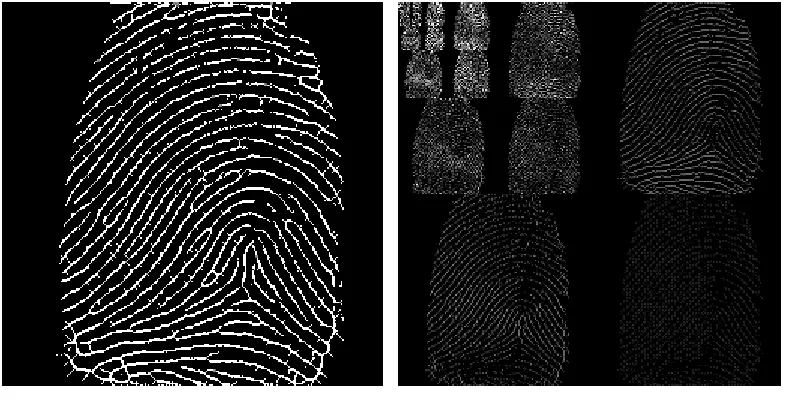
Figure 2.3: Two Level Decomposed Fingerprint Image
A two level decomposed Fingerprint image in Figure 2.3 is obtained after performing discrete wavelet transform on the single level decomposed fingerprint image. The coefficient matrices of the level-two approximation (A2) and horizontal, vertical and diagonal details (H2V2,D2 )respectively are obtained. The coefficients of all the components of second-level decomposition (that is, the second-level approximation and the first two levels of detail) are returned.
3. Basic SPIHT Algorithm
The SPIHT algorithm operates on a wavelet-transformed image with equal length and width of an integer power of 2. It encodes the wavelet coefficients in a way that uses a hierarchical organization of the coefficients. This encoding sends high-order bits of coefficients before low-order bits. The SPIHT algorithm only requires anywhere from 1 to log2N steps of the wavelet transform. Energy is concentrated in the coarser approximations (that is, those coefficients tend to have a larger magnitude) and there is a spatial self-similarity between the parent and child pixels that suggests that an encoding scheme that moves from the parent to the child will exhibit decreasing coefficient magnitudes. current magnitude threshold. It is a very fast coding/decoding (nearly symmetric) algorithm [5].
3.1. Important Terms
SPIHT maintains three lists List of Significant Pixels (LSP) List of Insignificant Pixels (LIP) List of Insignificant Sets (LIS) Type A entry: D(i,j) Type B entry: L(i,j) What is significant?
3.2. The SPIHT Algorithm
1. Initialization 2. Sorting Pass 3. Refinement Pass 4. Quantization-step update
Figure 3.1: SPIHT algorithm
In Figure 3.1 the term significant pixel is used to indicate that the magnitude of a pixel exceeds or equals the current threshold. An insignificant pixel is a pixel whose magnitude is less than the current threshold. An insignificant set can be one of two types of sets. The set H contains all the pixels in the last level of the wavelet transform that was performed, including the coarse and detail coefficients.
O (i,j): set of coordinates of all offspring of node (i,j). D (i,j): set of coordinates of all descendants of node (i,j). H (i,j): set of all tree roots (nodes in the highest pyramid level). L (i,j): D (i,j) – O(i,j) (all descendents except the offspring[5]. 3.2.1. Initialization
It initializes the value of n for testing significance of pixels and constructing significance map. The LSP is set as an empty list. The LIS is initialized to maintain all pixels in the low pass sub band that have descendents and hence act as roots of spatial trees. All these pixels are assigned to be of type A. LIP is initializing to contain all pixels in low pass pixels.
2. LIP = All elements in H 3. LSP = Empty
4. LIS = D’s of Roots 3.2.2. Sorting Pass
The purpose of the sorting pass is to manipulate the three lists so that they are correct with respect to the current value of the magnitude threshold N. In this pass, elements of the LIP may be moved to the LSP. Elements of the LIS are decomposed as necessary: a set in the LIS may be broken into type A or type B subsets and its roots may be moved into the LIP or LSP as appropriate. Each entry of the LIP is tested for significance with respect to n. if significant, a 1 is transmitted, a sign bit representing sign of that pixel is transmitted and pixel coordinates are moved to LSP. If not, then 0 is transmitted.
1. Process LIP.
a) For each coefficient (i,j) in LIP, Sn (i,j) is output where Sn (i,j) =1 when max |c(i,j)| >= 2n or Sn (i,j) = 0 for other. b) If Sn (i,j)=1 ,sign of coefficient (i,j): 0/1 is output and (i,j) is moved to the LSP.
2.Process LIS.
a) For each entry (i,j) in LIS and if the entry is of type D then output Sn(D(i,j)). i) If Sn(D(i,j)) = 1 then for each (k,l) O(i,j) output Sn(k,l).
ii) If Sn(k,l) = 1, then add (k,l) to the LSP and output sign of coefficient: 0/1 . iii) If Sn(k,l)=0, then add (k,l) to the end of the LIP.
b) If type L then output Sn(L(i,j)).
i) If Sn(L(i,j)) =1 then add each (k,l) O(i,j) to the end of the LIS as an entry of type D and remove (i,j) from the LIS
3.2.3. Refinement pass
The nth MSB of the magnitude of each entry of the LSP, except those added in current sorting pass is transmitted. Note that at the end of 1st sorting pass no bits would be transmitted as a part of the refinement pass because the LSP contained no pixels prior to current sorting pass. Refinement pass is to be added keeping in mind the decoding or reconstruction. The refinement pass follows the sorting pass and outputs the bit corresponding to the current magnitude threshold for each of pixels in the LSP, which were not added in the immediately previous sorting pass. 1. Process LSP.
2. For each element (i,j) in LSP except those just added above in the sorting pass the nth most significant bit of coefficient is output.
3.2.4. Quantization Step Update
The quantization-step updates simply decrements N. That is, the magnitude threshold is decreased. The algorithm then returns to the sorting pass and continues. We can halt the algorithm at any time we wish, such as if the compressed data stream has reached the size we desire..N is decremented by 1 and the procedure is repeated from step 2 onwards.
1. Decrement n by 1.
An additional task done by decoder is to update the reconstructed image. For the value of n when a coordinate is moved to the LSP, it is known that
1
,
2
2
nj i n
C
So, the decoder uses that information, plus the sign bit that is input just after the insertion in the LSP, to set Ci, j
1
.
5
*
2nSimilarly, during the refinement pass the decoder adds or subtracts 2n - 1 to
C
i, j when it inputs the bits of the binary representation ofC
i,j .4. Modified SPIHT Algorithm
The redundancy of original SPIHT is removed. The frequency coefficients obtained after transform are taken as input and the Modified SPIHT eliminate the correlation in same level sub bands[1].
Compression
1. Apply DWT on the original fingerprint image. 2. Make all the coefficients of this DWT positive.
3. Apply SPIHT on the DWT obtained after step 2 ignoring the sign bit and compressed bit stream is obtained.
Decompression
1. Apply inverse SPIHT on the bit stream recovered after step 2, again ignoring the sign bit since it has not been encoded.
2. Change the sign of all those pixels whose sign had been reversed during compression. 3. Apply IDWT on this transform to get back the original image.
5.SPIHT with Run Length Encoding
RLE (Run Length Encoding) has to be applied to the resulting bit stream after SPIHT is applied to the DWT. It will help to reduce the size of the bit stream already generated. At the receiving end, the original bit stream can be easily recovered by applying inverse RLE.
6.Objective Quality Measures
Let x (m, n) denotes the samples of original image, and x’(m, n) denotes the samples of compressed image. M and N are number of pixels in row and column directions respectively[3].
Mean Square Error is given by:
MSE = ∑m=1∑n=1 (x(m, n)- x'(m, n))2 /MN Peak Signal To Noise Ratio is given as: PSNR = 10log10 (255)2/MSE
1) The discrete wavelet transform was applied on the fingerprint image ie: single step decomposition and two level decomposition was performed on the fingerprint image. The DWT when applied on an image concentrated the maximum information content of that image towards the left top corner. After the transform the frequency coefficients are obtained.
2) Then basic SPIHT was applied on the decomposed fingerprint image and compressed bit stream was obtained. SPIHT exploits the hierarchical tree structure produced by the DWT. It codes the individual bits of the image wavelet transform coefficients following a bit plane sequence. It compresses the pixels with the maximum information content first and then progressively proceeds towards the less important pixels.
3) The redundancy of original SPIHT was removed by using Modified SPIHT. The frequency coefficients obtained after transform are taken as input and the Modified SPIHT eliminates the correlation in same level sub bands. 4) Then reconstruction was done by applying inverse SPIHT on the compressed bit stream.
5) Then inverse discrete wavelet transform was applied to recover the original fingerprint image.
6) The output was compared based on a set of quality measures like Peak Signal to Noise Ratio (PSNR) and Mean Square Error (MSE).
8. Experimental Results
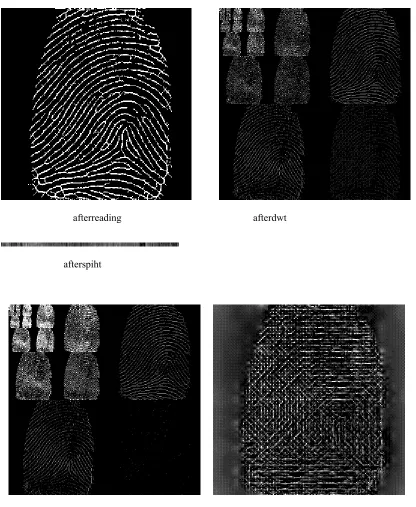
For evaluating the performance of the algorithms, we used an experimental database which consists of 50 images of 512 x512 in bmp format. Results are shown on one of the fingerprint image using matlab platform, coded with Basic SPIHT and Modified SPIHT. The following result images are created in the ‘work’ folder of MATLAB.
afterreading: This is the image which has been read by the algorithm. afterdwt: This is the image of the DWT of the original image.
afterspiht: This is the image of the resulting bit pattern after SPIHT has been applied on the DWT of the original
image.
afterrle: This is the image of the compressed bit stream after applying RLE on the SPIHT output.
afterirle: This is the image of the DWT original bit stream reconstructed after applying inverse RLE on the received
bit stream.
afterreading afterdwt
afterspiht
afterispiht afteridwt
after reading afterdwt
afterspiht
afterrle afterirle
afterispiht afteridwt
Figure 7.2: Modified SPIHT with RLE ( 1bpp)
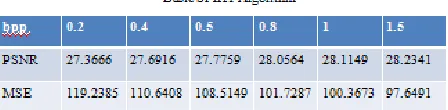
Table I: Performance Results
9. Conclusion
From the experimental results, it is seen that Proposed method (Modified SPIHT with Run Length Encoding) gives better PSNR as compared to Basic SPIHT Algorithm. Comparison of Modified SPIHT and Basic SPIHT using PSNR and MSE as image quality measure shows that Modified SPIHT achieves higher picture quality than SPIHT for all compression ratios and test images.
10. References
[1] Anilkumar V. Nandi, Dr.R.M.Banakar, ”Hardware modeling and implementation of Industrial and Information systems,2007,ICIIS 2007,
pp.329-334.
[2] R. Sudhakar, R. Karthiga, S. Jayaraman,”Fingerprint Compression Using Contourlet Transform with Modified SPIHT Algorithm”. Journal of Electrical and Computer Engineering, Vol. 5, No. 1, Dec 2006, pp 74-84.
[3] Bhawna1 Rani, R K Bansal , Dr Savina Bansal,” Comparison of JPEG and SPIHT Image Compression Algorithms using Objective Quality
Measures”, Multimedia, Signal Processing and Communication Technologies, 2009. IMPACT '09. International Publication, pp.90-93.
[4] Brahimi,T.Melit, A.KHelifi,”Improvements to SPIHT for Lossless Image Coding”,3rd International Conference on Information and
communication Technologies,2006,ICTTA 2006, pp 90-93.
[5] A. Said, W. A. Pearlman, “A New, Fast, and Efficient Image Codec Based on Set Partitioning in Hierarchical Trees”, IEEE Transactions