Healthy UNH
HealtHy UNH
aNNUal RepoRt
Program Year 5
January - december 2014
Institute for Health Policy and Practice
durham, new Hampshire
you walked
today?
If you walked here from...
Building # of Steps* # of
Minutes*# of Miles* Dimond Library 3168 29 1.5
Field House 2302 21 1.1 Health Services 3358 30 1.6 Hewitt Hall 2956 26 1.4 Institute on
Disability-West Edge 1837 17 .9 Kingsbury Hall 2956 27 1.4 MUB/Holloway 3168 29 1.5 Parsons Library 3104 31 1.6 Philbrook Dining Hall 3294 30 1.6 Stillings Dining Hall 2977 27 1.4
Thompson
School-Cole Hall 1647 15 .8 Thompson Hall 2893 26 1.4 Whittemore Center 2534 23 1.2 *This is an approximation; number of steps,
minutes, and miles differ due to strides and routes taken.
CDC recommends that adults get 10,000 steps per day.1
1Source: Center for Disease Control and Prevention www.unh.edu/healthyunh
Healthy UNH Co-Chairs
Mike Ferrara, Dean, College of Health & Human Services
Kathy Neils, Associate Vice President, Chief Human Resources Officer
Healthy UNH Partners in Prevention, 2014:
Campus Planning Campus Police Campus Recreation Counseling Center
Department of Kinesiology Dining Services
Health Services Human Resources
Office of Environmental Health and Safety Residential Life
Healthy UNH Program Staff
Ned Helms, Director, Institute for Health Policy & Practice Jo Porter, Deputy Director, Institute for Health Policy & Practice
Stacey Gabriel, Research Associate, Institute for Health Policy & Practice Kimberly Persson, Project Director, Institute for Health Policy & Practice
Lyin Schramm, Program Support Assistant, Institute for Health Policy & Practice
EXECUTIVE SUMMARY
January 2014-December 2014 was the fifth full program year for the Healthy UNH Initiative, a collaborative effort to become the healthiest campus community in the country by the year 2020. In its effort to improve the health of the population and its underlying healthcare costs, Healthy UNH takes a broader scope than is customary in traditional worksite wellness programs. It goes beyond basic health promotion to consider the issues of appropriate use of healthcare services, to promote transparency in healthcare treatment costs and options, and to foster a culture of
healthy eating, mental wellness, and active living. The fifth program year continued to build on the solid foundation of capacities, awareness, and measurement developed in the previous programming years.
Healthy UNH has executed on its intended plan of activities. These have included:
Contracting with Raka, a local communication firm, to help us organize and synthesize our health messages to campus and create more effective communications;
Conducting a communications assessment of Healthy UNH, and implemented a well-rounded communication approach, to best reach all audiences and topic areas;
Joining the Partnership for a Healthier America, Healthier Campus Initiative. UNH is one of 19 other schools across the country to adopt and implement guidelines around food and nutrition, physical activity, and programming;
Assisting in proposal development and submission for the USNH/Community College System of New Hampshire (CCSNH) Tobacco-Free Campus Initiative; and, since its funding, providing staffing infrastructure for the initiative, as well as supporting UNH-specific efforts as part of a larger campus workgroup;
Continually updating and improving the centralized website;
Maintaining the Wellness Resource Guide, an online guide for health and wellness resources and program information, as well as the calendars of events;
Updating the UNH Walking Guide to allow users to track their walking distances throughout the day and encourage safe and healthy walking habits;
Developing a campus-wide poster campaign to promote walking on campus (to launch in 2015);
Updating the online health measurement tool, including the addition of a fourth year of data and a visual data component to see trends;
Continuing to partner with the UNH Employee Clinic to assist Health Services in marketing availability of the clinic to USNH employees;
Continuing to partner with the Department of Kinesiology to support a pilot program to expand hours of operation and allow adjunct employees to utilize the Employee Fitness Program;
2 Continuing to collaborate with Health Services and Campus Recreation to bring Student
Health 101, an online wellness magazine, to campus, which includes specific content
related to Healthy UNH messages and programs;
Expanding and adding more than 65 “I am Healthy UNH” profiles for the Healthy UNH website, which tell stories of healthy living among the campus community;
Promoting Healthy Returns and MyPath2Wellness, including creating a raffle (on the Durham and Manchester campuses) to incentivize participation;
In partnership with Campus Recreation Outdoor Adventures, creating summer series of outdoor fitness events for employees, offering paddle boarding and kayaking;
Continuing to collaborate with UNH Dining Services to develop and market The Wildcat Plate, a portion plate used in all UNH dining halls, which helps guide patrons in making healthy food selections and choosing appropriate portion sizes; also continuing to work with UNH Innovation and a local distribution company to commercially sell The Wildcat Plate.
Selected to represent UNH and USNH at the World Congress Conference as a leader in integrating employee wellness and healthcare;
Highlighted in Fosters Daily Democrat about Healthy UNH’s new collaboration with the Partnership for a Healthier America;
Widespread local media coverage about the USNH/CCSNH Tobacco Cessation grant; Article in Food Service Director magazine, regarding the use of The Wildcat Plate in UNH
dining halls;
Campus coverage through the Campus Journal about Bike to Work Day in May;
National coverage on the University of New Hampshire being a part of the first cohort for the Partnership for a Healthier America’s, Healthier College Initiative.
Cultivating new and continuing to build existing relationships with campus partners and leveraging their health-related expertise;
Reviewing key measures of the health of the population to identify areas of greatest need and potential impact to guide programming decisions;
More fully leveraging social media tools (Facebook, Twitter, Google +, Pinterest, YouTube, Instagram, LinkedIn, Blackboard, Wildcat Link, and student blogs) to improve awareness of issues and improve participation in programs;
Developing and publishing tools to assist the campus community in making more effective healthcare choices;
Increasing Healthy UNH’s visibility on campus through health and wellness promotions and interactive displays; and
Working with departments across campus to implement the Partnership for Healthier America’s Healthier Campus Initiative guidelines.
3
2014 WORK PLAN
Communications
Historically, Healthy UNH has worked to communicate about a multitude of health topic areas to a breadth of campus sub-populations. The lack of a coordinated communication approach has resulted in difficulty reaching all facets of the UNH population with core messages. In January 2014, Healthy UNH began working with Raka, a local communications firm, which assisted in distilling and solidifying Healthy UNH’s mission, goals, and focus areas to improve messaging capabilities overall.
As Healthy UNH has progressed over the years, work focus areas have shifted to include four different areas of work, which have been identified as most pressing through analysis of claims and health risk assessment data. These areas include Nutrition, Physical Activity, Mental
Wellness, and Healthcare Consumerism. Raka helped to fine-tune language to better define these work areas and to develop messaging strategies for each. Over the course of nine months, Raka and Healthy UNH, with extensive input from the UNH Partners in Prevention, developed a comprehensive communications strategy to more effectively reach the majority of campus populations. Messaging includes:
Nutrition:
Healthy eating is key to an overall healthy life. Healthy UNH helps individuals find resources to build healthy lives through sound nutritional choices, with the goal of fostering more mindful eating habits at both the individual and community levels.
Healthy eating can positively affect overall health. Nutrition is directly connected to many chronic health issues.
About 20% of employees and 5% of students have a body mass index (BMI) that
categorizes them as obese, according to the CDC. Making healthy nutritional choices is an important part of a healthy weight.
Healthy UNH can help connect individuals with nutrition resources, whether individuals are looking for specific ways to address nutrition needs, or if they need to completely rethink the way they eat. Existing resources include the Wildcat Plate, talking with UNH dietitians, the Healthy UNH Eating Guide, Guiding Stars, Healthy Returns, and Health Services.
Physical Activity:
Physical activity helps improve overall wellness. We connect individuals with many options for physical activity on the UNH campus and beyond, with the goal of empowering community members to take ownership of their health.
Physical activity is for everyone, and has a range of positive mental and physical effects. Even though there are many options for physical activity each day, only 30%-40% of the
4 (CDC) recommended 30 minutes of physical activity or more at least five days a week. Healthy UNH can help connect individuals to a multitude of activities. Whether you are just starting out, or you're trying to shave a few minutes off a marathon time, UNH has something for you.
Existing resources and incentives for physical activity include the Harvard Pilgrim Wellness Connection, the Hamel Recreation Center, the Employee Fitness Program, the Healthy UNH Fitness Map, miles of campus, walking paths, College Woods, Walk NH, outdoor equipment rentals, and more.
Mental Wellness:
Mental wellness is an important component of overall health. Healthy UNH helps our campus community members access education, programs, and resources for improving mental wellness with the goal of assisting individuals at all levels of need.
Mental wellness is a key part of overall health. Healthy UNH identifies resources to help individuals understand how stress, emotions, and mental illness impact overall health. Nobody is alone in addressing mental wellness concerns. In our campus community, more
than 30% of faculty and staff and more than 20% of students report symptoms of depression.
The University of New Hampshire has the expertise and experience to help individuals address their mental wellness concerns. Healthy UNH can help connect individuals to these resources, which include the Employee Assistance Program, the UNH Counseling Center, Health Services, and coverage of medical services through employee benefits.
Healthcare Consumerism:
By helping individuals become informed healthcare consumers, we empower the campus community to be engaged in their health, which includes how healthcare dollars are spent. We advocate for individuals by providing education on the many healthcare Individuals have choices in the way healthcare is received. Taking an active role in
decision-making helps individuals get the right healthcare. It can also help make the most of individuals’ healthcare dollars.
UNH spends about $50 million for the 6,000 members it covers and employees contribute another $10 million on healthcare benefits. (According to 2013 data.)
5 Through research, both campus-specific and nationally, Raka developed population profiles for major groups on campus, and described the health priority areas and most effective
communication channels for each group. It was determined that by targeting its messaging to four main types of people in various ways, Healthy UNH would be more effective in cross-campus communications. These groups were defined as Sarah Student, Fred Faculty, Admin Annie, and Steve Staff. All personas can be viewed in Appendix B.
Once language, audience, and methods of communication were defined, Raka made specific recommendations regarding changes to the Healthy UNH website to increase functionality and improve search engine optimization. Raka also revamped Healthy UNH’s use of social media, expanding presence beyond Facebook and Twitter. A full listing of these recommendations can be found in Appendix A.
Healthy UNH has implemented many of these recommendations, which include:
Reformatting the design and functionality of the Healthy UNH website;
Augmenting a social media presence beyond Facebook and Twitter to include Google+, Instagram, LinkedIn, YouTube, and Pinterest;
Increasing the frequency of social media posts; Altering blog schedules to improve readership;
Restructuring use of social media meta data to improve search engine optimization; Developing a monthly online newsletter; and
Dedicating more staff time to focus on these efforts.
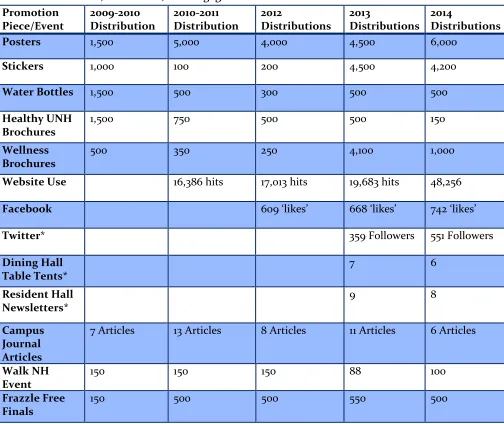
These changes have led to a larger network of social media “friends,” allowing Healthy UNH to reach a larger population online. Appendix B, Table 1 provides the numbers of Healthy UNH followers for major social media outlets.
However, Raka has been clear in indicating that not all members of the UNH population can be reached online. Included in the group that is harder to reach online are employees working under the umbrella of Facilities, as they are often working outside of a typical office setting. To reach these employees, we have continued with departmental mailings, maintaining a presence at campus events, and working directly with Human Resources partners to attain face time during departmental meetings.
This comprehensive strategy was fully launched in January 2015.
Partnership for a Healthier America’s Healthier Campus Initiative
6 administered through the Partnership for a Healthier America (PHA), known as the Healthier Campus Initiative (HCI).
HCI is modeled after Let’s Move, a national campaign stemming from the Office of the First Lady at the White House, targeting childhood obesity in schools. Partner colleges and universities are required to accomplish 23 of 39 tasks over a period of 2 ½ years, with an intention of reducing obesity on college campuses. Tasks are related to Food and Nutrition, Physical Activity and Movement, and Campus-wide Programming. As Healthy UNH has significant experience with campus wellness programming, PHA looked to Healthy UNH for guidance in developing its Memorandum of Understanding (MOU) for partnering institutions. Over a period of four months, Healthy UNH reviewed drafts of the document and held multiple conference calls to provide feedback pertaining to setting realistic expectations for campuses and also offering insight regarding the operations of college campuses.
In July 2014, once the final MOU was released, UNH Administration asked Healthy UNH to review the document to assess UNH’s level of readiness to participate in the initiative. Project staff reviewed the tasks listed in the MOU, and using content from the Healthy UNH Wellness Resource Guide, was able to narrow the focus of UNH’s potential action items based on existing programming on campus. This initial set of items was selected because staff was confident that infrastructure was already in place or because the level of complexity to construct the
infrastructure was low.
Project staff then began conducting meetings with essential campus partners, to introduce the initiative, gain buy-in, and to specifically discuss the items tentatively selected by Healthy UNH staff. Campus partners were given an opportunity to express concern for less desirable tasks, and to request substitutions when possible. When the final tasks were selected, the final draft of the document was shared with the campus partners. It was then signed and submitted to PHA in October 2014.
HCI was announced at the American Public Health Association’s Annual Meeting in November 2014. The University of New Hampshire is part of the first cohort of the Healthier Campus
Initiative, which consists of 20 colleges and universities in eighteen states, which will impact more than 500,000 students and 126,000 faculty and staff.
UNH has three opportunities to verify that criteria for task items have been met. Verification reports can be submitted in June 2015, June 2016, and June 2017. For every task item being reported on in June, work must have been completed by April 1 of that year. Healthy UNH staff will lead all reporting work, collaborating with campus partners to collect necessary
7 UNH has selected the following tasks, and has estimated a level of complexity related to cost, campus politics, and need for policy change. Items perceived as easier to accomplish are slated for earlier verification:
Task Summary Category Level of
Complexity
Offer on the menu a minimum of one (1) wellness meal
at each breakfast, lunch, and dinner meal (if served). Food and Nutrition Medium
Offer a minimum of five (5) types of fruit, five (5) types of vegetables, and two (2) 100% whole grain products at both lunch and dinner (if served).
Food and Nutrition Medium
Offer only a total number of fried foods that does not exceed the total number of platforms available at both lunch and dinner (if served) across all venues.
Food and Nutrition High
Offer and identify as healthier at point of presentation at least three (3) desserts at both lunch and dinner that have no more than 150 calories as served.
Food and Nutrition Medium
Designate healthier food and beverage options using a
healthy icon at the point of presentation. Food and Nutrition Medium
Offer a plant-based food option at every platform
serving meat. Food and Nutrition Medium
Offer tray-less dining as the default system in at least
seventy-five percent (75%) of dining venues. Food and Nutrition High
Offer a healthier catering menu that only includes foods and beverages that meet healthier food and nutrition guidelines.
Food and Nutrition Medium
Make free water available in all dining, recreational
and educational facilities. Food and Nutrition
Low to None
Make available Registered Dietitian Nutritionists (RDNs) for personal nutrition assessments and counseling to all students.
Food and Nutrition Low to None
Provide marked walking routes on campus, one of which must be at least two (2) miles in length and have distance markers at regular intervals. A route map is made available to individuals on campus.
Physical
8 Provide at least one (1) bicycle parking space on
campus for every fifteen (15) individuals on campus.
Physical Activity\Movement
Low to None
Offer a bicycle share/rental program and/or subsidized bicycle purchase program for all individuals on
campus.
Physical Activity/Movement
Low to None
Implement a campus-wide program/policy that incentivizes the use of public or campus provided transportation.
Physical Activity/Movement
Low to None
Provide, without a user fee, sixteen (16) hour per day access to at least one (1) fitness or recreation center for all students.
Physical Activity/Movement
Low to None
Offer a minimum of twenty (20) diverse recreation, physical activity/movement or competitive sports opportunities during each academic year.
Physical Activity/Movement
Low to None
Offer without a user fee, a minimum of one (1) monthly "how to" physical activity/movement class that
introduces students to new activities.
Physical Activity/Movement
Low to None
Provide at least one running/walking track that is open and available for use to individuals on campus and the community for at least three hours per day.
Physical Activity/Movement
Low to None
Offer a rental outdoor recreation equipment program for students.
Physical Activity/Movement
Low to None
Make available certified personal trainers for all students.
Physical Activity/Movement
9 Implement an integrated, comprehensive wellness
program for individuals on campus that is provided annually. The program will include all of the following components:
- A coordinating committee that includes student, faculty, administrative and staff representatives and meets at least quarterly;
- Health and wellness education and activities for all individuals on campus;
- Activities that incorporate provisions for individuals with disabilities;
- A promotional plan to market the wellness program through at least one online venue and three physical venues on campus;
- Provision of annual physical activity/movement and nutrition training for all resident assistants (RA’s) to help inform students about campus resources available for wellness.
Programming Medium
Implement a mandatory health and wellness education online module to be completed by all incoming first year or transfer students, upon registering with the college or university.
Programming High
Offer a rewards-on-benefits structured program that gives insurance premium discounts and/or rebates to individuals on campus who participate in a wellness program designed by the health insurer on campus.
Programming Medium
Wildcat Workout Project
In conjunction with the UNH Athletics Department, Healthy UNH created the Wildcat Workout Project, a free boot camp-style fitness class offered to employees 5 days a week on the Durham campus. The program was piloted in the summer of 2014, and has continued through the 2014-2015 academic year. Over 115 unique individuals have participated in the Wildcat Workout Project.
Tobacco
10
Data Measurement
With measured achievement of the end goal in mind, Healthy UNH established a measurement subcommittee to identify the metrics by which it will measure its progress early in the
development process. Ongoing measurement of the program will consider the health of the population, as reflected in several existing surveys of the faculty, staff, and student populations; use of healthcare services, as reflected in healthcare claims data for preventive, emergency room, and generic drugs; as well as other measures of the health of the campus.
The measures were first published in early 2012 with the Health Measurement Tool, which is part of the Healthy UNH website. It provides transparent, on-going tracking of the initiative’s
progress. The fourth year of data was added to the Health Measurement Tool in December 2014, along with a visual indicator to show trends. Specific program activity measures are included in Appendix B.
Image: Visual indicator showing data trend
CONTINUING WORK ITEMS:
11
Task Summary
Status Activity to Date
Healthy UNH Program Operations, Communication, and Participation
Initiate an iterative, detailed project plan with tasks, owners, and timeframes
Ongoing activity of planning and tracking. Core Healthy UNH team meets twice monthly. Executive team meets monthly. The Healthy UNH Partners group was also convened semi-annually, and plans for quarterly in 2015.
Research grant opportunities for health improvement, research, and engagement
Actively and continuously research grant opportunities. Assisted with the application to the NH Department of Health and Human Services to assist in Tobacco Cessation Program and Policy work at UNH (which was funded).
Submit for grant opportunities and research and practice implementation
Continue to seek grant funding opportunities. Healthy UNH continues to converse with the National Prevention Council and Office of the Surgeon General about how to help implement the NPS more broadly. UNH will also work with PHA leadership to identify opportunities that might arise from the Healthier Campus initiative.
Aggregate existing wellness programs and promote through a central brand
Participated in the University Open House; University Day; Student, Parent, and Employee Orientations; National Public Health Week; Frazzle Free Finals; National Nutrition Month; Walk NH; National Bike to Work Day; Great American Smokeout; Quit Butts Day; and Healthy Returns. With Raka, created a
comprehensive plan to strategically market all Healthy UNH events.
Publish work of Healthy UNH in academic publications;
Worked with the National Prevention Council and Office of the Surgeon General on
communicating the UNH approach to implement the NPS.
Establish department level goals and incentives
12 Identify barriers to participating
in programs and improving health
Healthy UNH continues to review the Health Risk Assessment, Campus Recreation student survey, other surveys, and feedback collected by email and in events to Healthy UNH to identify existing tools that gauge issues related to barriers. In 2014, Healthy UNH increased, and targeted communications to increase knowledge of health resources on campus.
Provide short term incentives for engagement in new services
Initiated a number of new campus activities and provided prizes and recognition for
participation, including the Healthy Returns and MyPath2Wellness programs and
pedometers provided at walking events. Augment benefits offered to
adjunct employees and retirees (i.e. access to EAP, Healthy Returns, free use of indoor pool, use of Employee Fitness Center, free pedometers)
Continue to support (financially) and promote the expanded use of the Employee Fitness Center and the Wildcat Workout Project to all employees. In 2015 Healthy UNH will continue this work.
Build Health Coaching into curriculum and use students as peer coaches
Healthy UNH collaborated with a professor in the Nutrition Department to develop an
internship for students to develop and publish a series of blogs and assist with Healthy UNH events
Healthy UNH Focus: Healthcare Decision-Making
Add health finance course work in Health Management and Policy and Business Curriculums
Developed and published an online curriculum for the Healthy UNH website to provide students education about healthcare costs, health insurance, finance, consumerism, and decision making.
Implement a program to encourage appropriate emergency room use
Included information about appropriate use of emergency rooms (ER) in its video, newsletters, blogs and spoke to the highest volume provider to understand why ER use is high and what can be done about it. Continued focus in this area is likely next year.
Develop a Provider Report Card Tool to assist consumers in choosing high quality, cost effective medical practitioners with a focus on preventive care.
After review, the Provider Report Card Tool was best suited for the Cost Containment initiative, and the work is completed through the Tandem contract.
Implement a program to improve rate of generic drug use
Promote generic drug use via the Healthy UNH promotional video, and assisting in content for newsletters and Campus Journal, and other media outlets.
13 Continue biometric data capture
Continue to work with Health Risk Assessment and Healthy Returns and MyPath2Wellness efforts to capture biometric data for faculty and staff. Worked with the College Health and Nutrition Assessment Survey (CHANAS), which collects data from students as part of a course in the Nutrition Department to collect data on students.
Continue to track indicators that measure the success of the programs
Data continually populates the Healthy UNH Measurement Tool. In 2014, Healthy UNH added a visual indicator, to signal positive or negative health changes in health on campus.
Disseminate national, local, and UNH-specific health cost, quality, and status data to campus population.
Release information regularly through Campus Journal articles, on the UNH website home page, and the UNH Today. Integrated into new employee orientation, a presence at new student and parent orientations, and additional social media outlets established in 2014.
Obtain better Health Risk, Biometric, and Exercise data for employees and students
The Measurement Subcommittee identified which metrics are key to measuring the progress of Healthy UNH, with comparators to Healthy People 2020 and UNH specific targets. Healthy UNH continually seeks robust sources of data to measure its progress.
Track indicators that measure program effectiveness
Launched an online health measurement tool, updated yearly, to help track progress. Worked with Research Computing and Instrumentation to create a visual indicator to show health progress over time, on health measurement website.
National Prevention Strategy Priority Area: Active Living
Develop new layers to the Healthy UNH Fitness Map to include schedules of on-campus athletic facilities and walking distances of campus paths
Contracted with UNH’s Research Computing Center to build a fitness new map to include walking distances. In early 2015, Healthy UNH will launch a campus-wide campaign to promote safe and healthy walking habits.
Expand the hours of the Employee Fitness Center
In November 2012, partnered with the
14 Help facilitate more resources for
staffing and space constraints at Campus Recreation facilities
The issue of staffing and space constraints for Campus Recreation is being addressed by another campus committee and new
construction is moving forward. Healthy UNH will become involved as needed.
Help promote exercise-related programs and services that are available to employees, such as the outdoor pool, indoor pool, and employee fitness center
Highlighted the availability of on-campus fitness facilities through the Healthy UNH Wellness Resource Guide, and also works to promote it through the website, blogs, and use of social media. Healthy UNH also partnered with
Campus Recreation Outdoor Adventures to offer a series of winter and summer outdoor activities for employees, to promote fitness opportunities on campus.
Help promote Health Services’ Pedometer Program for students
Partnered with Health Services to highlight the student pedometer program as a physical activity in the Healthy UNH Wellness Resource Guide, and also works to promote it through the website, blogs, and use of social media. This activity will continue in 2015.
Help recruit employees to participate in the Employee Fitness Program
Include Employee Fitness Center in the Healthy UNH Wellness Resource Guide, and also works to promote it through the website, blogs, and use of social media. Additionally, Healthy UNH advertises other fitness resources to employees, including the fitness club and health education wellness benefits, and opportunities through Campus Recreation.
Integrate Cooperative Extension work with current faculty research around children and fitness
Will meet with Cooperative Extension to discuss how to leverage their reach and resources to support the UNH population; this will be reconsidered in 2015.
Pilot incentive of extended lunch hours to provide option to exercise
Continue to consider ways to support flex-time arrangements that promote better health.
Implement free workout program for employees
In conjunction with the UNH Athletics Department, created the Wildcat Workout Program, a free boot camp-style fitness class offered to employees 5 days a week on the Durham campus. The program was piloted in the summer of 2014, and has continued through the 2014-2015 academic year.
15 Collaborate with Dining Services
to promote healthy eating, including promoting their wellness plan to include eliminating trans fats from all recipes, reducing sodium in all recipes, increasing the number of recipes receiving Guiding Stars, and providing more information about portion sizing
Healthy UNH partnered with Dining Services to develop the Wildcat Plate, a portion plate to assist diners in selecting healthy food options and choosing appropriate portion sizes.
Continue to meet with UNH Dining to consider other priority initiatives.
Evaluate and implement healthy food options in vending
machines
Healthy UNH implemented snack and beverage vending studies. The conversation for having healthy items is complete across the Durham campus in 2014
Evaluate food-based initiatives
The Healthy Dining Guide was maintained in 2014, and the Wildcat Plate was promoted at many events. In 2015, the Healthy Dining Guide will be updated with new locations and
information. Extend nutritional education to
faculty and staff, who have meal plans, through consultation by Dining Services' Registered Dietitian
Worked with Dining Services to implement nutrition education with employees who have purchased a meal plan.
Promote Food Pro website as a way to educate the campus population about nutritional components in dining hall offerings
The Healthy Dining Guide was maintained in 2014. In 2015, the Healthy Dining Guide will be updated with new locations and information.
National Prevention Strategy Priority Area: Injury and Violence Free Living
Add safety component to all annual performance evaluations
Brokered conversations between Human Resources, the USNH Director of Healthcare Cost Containment, and the Office of
Environmental Health and Safety (OEHS). This issue will be addressed by the newly formed Workers Compensation Committee.
Educate students about
transportation safety policies on campus
The brochure was updated in 2014with the Office of Campus Planning to promote
transportation and safety on campus. Materials were distributed during the summer and fall of 2014 as well as on the Healthy UNH website. Implement additional safety
protocol to establish specific walking paths on campus that are safe to walk at night
16 Promote the "Guaranteed Ride
Home" program (for people who rely on public transportation and need to get home quickly due to an emergency) to encourage use of public transportation to campus
The brochure was updated in 2014with the Office of Campus Planning to promote
transportation and safety on campus. Materials were distributed during the summer and fall of 2014 as well as on the Healthy UNH website.
Work more collaboratively with Residence Halls to educate about trains and railway safety
The brochure was updated in 2014with the Office of Campus Planning to promote
transportation and safety on campus. Materials were distributed during the summer and fall of 2014 as well as on the Healthy UNH website.
National Prevention Strategy Priority Area: Mental and Emotional Well-Being
Implement training program for faculty and staff members to help identify, refer, and treat
colleagues and students who are struggling emotionally
Worked with the UNH Counseling Center to help promote Kognito, the online training modules which identify and help students at risk.
Expand type of resources and services offered by EAP to adjunct employees
Partnered with Human Resources to begin conversations to review the USNH EAP contract to evaluate how to better link people with the type of resources they need. HR decided to expand EAP services to all employees starting in 2015.
National Prevention Strategy Priority Area: Tobacco Free Living
Augment website offerings to develop tobacco cessation resources to be used by
employees and their dependents
Begin to promote Quitline and other resources as part of an educational campaign relating to smoking cessation. Added tobacco as a specific health topic to search by on the Wellness Resource webpage. Created educational campaign with Health Services to promote all cessation resources available to students and employees. Used campaign at the employees Benefits Fair, and the Great American Smokeout in November.
Explore the possibility of making UNH a tobacco free campus
17 Promote Quitline
Begin to promote Quitline as part of an educational campaign relating to smoking cessation. Created educational campaign with Health Services to promote all cessation resources available to students and employees. Used campaign at the employees Benefits Fair, and the Great American Smokeout in
November. Reduce the cost of
pharmaceuticals that help with smoking cessation
Explore this issue as part of its research on the possibility of a tobacco-free campus. This will be further explored in 2015.
In its first programming year, Healthy UNH identified overall goals to track over time. Progress towards the goals set forward for Healthy UNH is below and in Appendix C.
REPORTING YEAR
Goal 2010 2011 2012 2013 2014
Improve rate of generic drug use by 5%* Approx. 63% (CY 2009) Approx. 67% (CY 2010) Approx. 70% (CY 2011) Approx. 77% (CY 2012) Approx. 81% (CY 2013)
Improve rate of participation in Healthy Returns & MyPath2Wellness by 10% Spring- 544 Fall- 668 Total: 1,212 (CY 2010) Spring- 506 Fall - 596 Total: 1,102 (CY 2011)
Spring-536 Fall - 571 Total: 1,107 (CY 2012)
Spring- 573 Fall - 696 Total: 1,296 (CY 2013)
Spring- 571 Fall*- 1,562
Improve rate of increase in total healthcare spend to 7%** 4% Increase (CY 2009) 14% Increase (CY 2010)
5 % Increase (CY 2011) 2.5 % Increase (CY 2012) 1% Increase (CY 2013)
*Fall 2014 first year of MyPath2Wellness, all following years will only have one MyPath2Wellness event in the fall semester.
18
CONCLUSION
Although it has been a central issue for both public and private employers for the better part of the last century, healthcare has become an increasingly prevalent topic in America’s public discourse. Individuals, employers, and public officials have been actively engaged in many independent activities to achieve the goals of reduced healthcare costs, improved quality, and increased access.
Healthy UNH, a President-sponsored, multi-departmental initiative was developed in a collaborative and centralized fashion to achieve a number of healthcare and budget-related organizational objectives. In addition to supporting UNH’s strategic imperative to curb the unsustainable annual increases of healthcare expenditures, Healthy UNH also aims to improve the appropriate use of healthcare services, promote transparency in healthcare options and costs, and imbue into its community a lifestyle of wellness, in a way that is personalized and easily understood.
2014 was a successful year for Healthy UNH. The planning process in 2012, guided by a national framework, and implemented in 2013, allowed for a thorough review of current activity and opportunities for improvement. Healthy UNH continues to address campus needs identified through this process. In 2014, Healthy UNH also focused attention on partnering with the Partnership for Healthier America’s Healthy Campus Initiative and better defined its
communications strategy. All of this work has provided Healthy UNH with a seat on a national stage and offers an opportunity for achieving a higher profile for its success over the years. Healthy UNH made great progress towards its goals by generating awareness through internal press and promotion, local and national media coverage, executing on its strategic objectives, and defining the data and sources required to evaluate the program’s progress.
19
APPENDIX A:
HEALTHY UNH COMMUNCATION GUIDE
Raka Recommendations for Healthy UNH
The Game Plan
Goal #1. Establish an Implement a Unifying Theme for Existing Messages
Implement Department-Wide Use of Messaging Document
Goal #2. Define and Grow Healthy UNH as a Brand
Create Online Brand Guidelines
Be More Vocal About Healthy UNH’s Initiatives & Partnerships
Goal #3. Develop and Implement a Social Media and Online Marketing Plan
Update Twitter, Facebook & Instagram Profiles
Create LinkedIn Page
Identify Content Curation Sources
Optimize Use of HootSuite for Social Management
Establish YouTube and/or Vimeo Channels
Establish Google+ Company Page and Authorship
Creating an Email Marketing Template
Goal #4. Create Positive Organic Search Engine Results
Optimize All Pages of Existing Website
Write Blog Posts to Solve Problems, Entertain, Enlighten and Inspire
Set Open Graph Tags
Include Images in All Blog Posts
Share all Original Content Multiple Times via Social Media
Mix up Social Sharing Language and Times
Goal #5. Create an Inbound Marketing Infrastructure
Incorporate Calls to Action
Update Email Marketing System
Establish Measurement Tools
Maintain Publishing Schedule
20
Key Performance Indicators
Website Traffic
Follower Volume
Social Engagement
Monthly Reach
Brand Awareness
Content and Post Strategy
Proposed Schedule and Channel Content
After updating branding and text for all online channels, Healthy UNH should employ the following schedule of posts as a general starting point. Effectiveness of this type of content schedule should be measured and adjusted as needed.
Editorial Calendar
Healthy UNH should set an editorial calendar for each quarter with adjustments for each month and week. The editorial calendar should rotate topics and categories. For example, content topics should target a specific audience each week.
Weekly: At least one blog post geared toward students. At least one blog post geared toward faculty/staff.
Weekly: At least one Instagram image using established hashtags. Interacting with other campus entities will help develop exposure, as will featuring students and including their Instagram handle in posts.
Daily: Five to 12 tweets. Tweets should target students, other campus partners, and related national organizations. Content should include Healthy UNH’s original posts and content and links to industry news and insight. Be sure to include established hashtags.
Daily: One to three Facebook updates. Facebook should target Sarah Student, Annie Admin and, potentially, Fred Faculty personas. When featuring students (for content like “I am Healthy UNH,”) tag the student (or encourage her to do so) in the update or photo to enhance exposure.
21
APPENDIX B: PERSONAS
SARAH STUDENT
Background
Undergrad or graduate student at UNH. Unmarried. Lives on or near Campus. Works 10-15 hours at a part Time job.
Identifiers
Very tech savvy. Fills free moments browsing on smartphone. Young, healthy, and feels invincible. Health Insurance is not a current concern.
Health Goals
• To feel good about physical Appearance/maintain weight • To manage stress appropriately & Maintain energy levels
Challenges
• School and social commitments often override commitments to healthy living • Campus culture often makes healthy choices difficult
• Peer pressure to drink/eat poorly
• Doesn’t know/care about healthcare options when she is off parents’ insurance
Common Objections
• Doesn’t need to worry about healthcare because she’s on parents’ insurance • With school and part-time work, she doesn’t have the time or energy to work out • With so many options, it’s hard to make healthy choices at the dining hall
How Healthy UNH Helps Her
•Provide free resources to Help students make healthy living choices
• offer information to help students become informed healthcare consumers
Marketing Message
22
FRED FACULTY
Background
Professor or faculty member at UNH. married with children. Likely has doctorate degree.
Identifiers
Highly educated & generally cultured. Not very tech savvy. Frequently feels busy & stressed. Eligible for Benefits, Healthy Returns & Tandem Care.
Health Goals
To regain control over physical and mental wellness To manage stress appropriately
To make the best healthcare choices for the whole family To maximize health benefits and reduce personal costs.
Challenges
Feels intimidated by gym & not sure how to use machines
Time constraints make it difficult to work out and/or prepare healthy meals Not sure where to exercise
Doesn’t understand Tandem Benefits or know who to use it
Common Objections
Doesn’t want to make a fool of himself at the gym
Researching lowest costs for benefits is one more thing he doesn’t have time for He doesn’t know where to work out on campus or how to get started
How Healthy UNH Helps Him
A healthy lifestyle can safe him money on healthcare costs
We partner with several departments to help develop a fitness program & training Help save them money through healthcare consumerism
Educate him on how individual choices affect UNH’s total costs
Marketing Message
23
ANNIE ADMIN
Background
Administrative position at UNH: office, extension educators, etc. Married/ partnered w/ children.
Identifiers
Enjoys job—especially benefits. Moderately tech-savvy. Frequently feels stressed or overwhelmed. Cost of healthcare is a concern. Eligible for benefits, Healthy Returns, & Tandem Care.
Health Goals
To be healthy without drastically changing daily life To manage stress appropriately
To make the best healthcare choices for the whole family To spend less on healthcare
Challenges
Family commitments make working out and preparing healthy meals difficult Intimidated by gym & may not have time to work out after commute
Feels confused by healthcare system overall and unempowered to take health into her own hands
Healthy food is too expensive
Doesn’t know show to maximize FSA to address individual healthcare costs
Common Objections
Doesn’t have time to go to the gym
Kids don’t like the healthy options she’s prepared in the past
She feels like she’s at the mercy of the healthcare system no matter what, so she’s given up trying to control it
How Healthy UNH Helps Her
We partner with several departments to help develop a fitness program & training We connect her with on campus resources
Help save her money through healthcare consumerism
Educate her on how individual choices affect UNH’s total costs
Marketing Message
24
STEVE STAFF
Background
Staff position at UNH: dining, maintenance, etc. Married/ partnered w/ children. Works on & around campus.
Identifiers
Not technically savvy. Poor diet & smoking contribute to health issues. Cost of healthcare is a concern. Eligible for benefits, Healthy Returns, & Tandem Care.
Health Goals
To spend less on healthcare
To lose weight and/or quit smoking per doctor’s orders
Challenges
Doesn’t know how to prepare healthy meals on a budget
Large appetite & decades of oversized portions make healthy eating seem difficult Thinks he gets all the physical activity he needs from work
Thinks of “healthy eating” as plain salads & dieting Doesn’t understand value of Healthy Returns program
Doesn't know that some programs are available for him to take advantage of while he is "on the clock" and that he may not have to use earned time for things like Healthy Returns
Common Objections
Doesn’t have time to go to the gym
Healthcare in this country is so messy, he’s given up Healthy food is expensive and doesn’t satisfy his hunger
How Healthy UNH Helps Him
Show him how to save money on healthcare costs
We provide resources to educate him to be an informed healthcare consumer We show him easy lifestyle tweaks he can make today
We tell him how to get a $50 gift card by participating in Healthy Returns and other incentive programs
Marketing Message
25
APPENDIX C:
SPECIFIC PROGRAM MEASUREMENT RESULTS
Table 1: Promotion, Awareness, and Engagement Promotion
Piece/Event
2009-2010 Distribution
2010-2011 Distribution
2012
Distributions
2013
Distributions 2014
Distributions
Posters 1,500 5,000 4,000 4,500 6,000
Stickers 1,000 100 200 4,500 4,200
Water Bottles 1,500 500 300 500 500
Healthy UNH Brochures
1,500 750 500 500 150
Wellness Brochures
500 350 250 4,100 1,000
Website Use 16,386 hits 17,013 hits 19,683 hits 48,256
Facebook 609 ‘likes’ 668 ‘likes’ 742 ‘likes’
Twitter* 359 Followers 551 Followers
Dining Hall Table Tents*
7 6
Resident Hall Newsletters*
9 8
Campus Journal Articles
7 Articles 13 Articles 8 Articles 11 Articles 6 Articles
Walk NH Event
150 150 150 88 100
Frazzle Free Finals
150 500 500 550 500
26
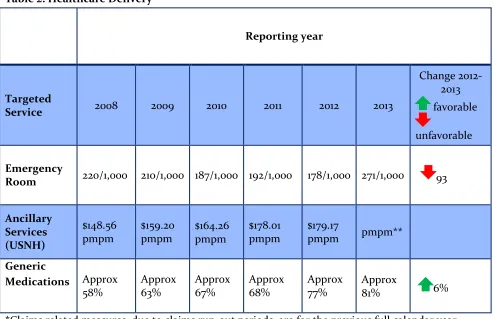
Table 2: Healthcare Delivery
Reporting year
Targeted
Service 2008 2009 2010 2011 2012 2013
Change 2012-2013 favorable
unfavorable
Emergency
Room 220/1,000 210/1,000 187/1,000 192/1,000 178/1,000 271/1,000 93
Ancillary Services (USNH)
$148.56 pmpm
$159.20 pmpm
$164.26 pmpm
$178.01 pmpm
$179.17
pmpm pmpm**
Generic
Medications Approx
58%
Approx 63%
Approx 67%
Approx 68%
Approx 77%
Approx
81% 6%
27
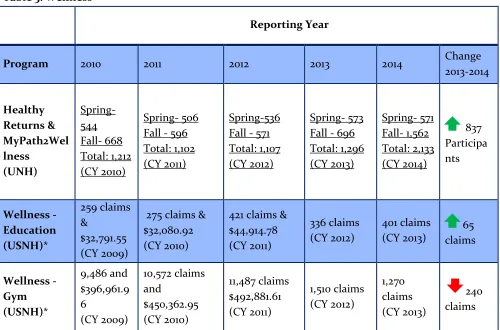
Table 3: Wellness1
Reporting Year
Program 2010 2011 2012 2013 2014 Change
2013-2014 Healthy Returns & MyPath2Wel lness (UNH) Spring- 544 Fall- 668 Total: 1,212 (CY 2010) Spring- 506 Fall - 596 Total: 1,102 (CY 2011)
Spring-536 Fall - 571 Total: 1,107 (CY 2012)
Spring- 573 Fall - 696 Total: 1,296 (CY 2013) Spring- 571 Fall- 1,562 Total: 2,133 (CY 2014) 837 Participa nts Wellness - Education (USNH)* 259 claims & $32,791.55 (CY 2009)
275 claims & $32,080.92 (CY 2010)
421 claims & $44,914.78 (CY 2011) 336 claims (CY 2012) 401 claims (CY 2013) 65 claims Wellness - Gym (USNH)* 9,486 and $396,961.9 6 (CY 2009) 10,572 claims and $450,362.95 (CY 2010) 11,487 claims $492,881.61 (CY 2011) 1,510 claims (CY 2o12) 1,270 claims (CY 2013) 240 claims
*Claims related measures, due to claims run-out periods, are for the previous full calendar year.
1
As this is includes times before the first full program year, changes in the Wellness metrics cannot be fully attributed to the
28
APPENDIX D:
CAMPUSES PARTICIPATING IN TOBACCO GRANT
Table 1: Community College System of NH Campus PopulationsCommunity College System of New Hampshire (CCSNH) Location
Number of Students (FTE for Fall, 2013)
Number of Employees
CCSNH Office of the Chancellor 26 College Drive
Concord, NH 03301
N/A 59
White Mountains Community College 2020 Riverside Drive
Berlin, NH 03570-3717
575 206
NHTI, Concord’s Community College 31 College Drive
Concord, NH 03301
3591 835
River Valley Community College One College Place
Claremont, NH 03743-9707
705 254
Lakes Region Community College 379 Belmont Road
Laconia, NH 03246-1364
949 266
Manchester Community College 1066 Front Street
Manchester, NH 03012-8528
2085 525
Nashua Community College 505 Amherst Street
Nashua, NH 03063-1026
1718 539
Great Bay Community College 320 Corporate Drive
Portsmouth, NH 03801-2879
1527 345
Total 11,150 3,029
Table 2: University System of New Hampshire Campus Populations
University System of New Hampshire
location
Number of Students
(FTE, Fall 2013)
Number of
Employees
USNH Office of the Chancellor, Concord n/a 82
Granite State College
Concord, Littleton, Lebanon, Claremont, Conway, Manchester, Nashua, Rochester, Portsmouth
2,058 245
Keene State College Keene
4,923 934
Plymouth State University Plymouth
5,237 840
University of New Hampshire
Concord (UNH School of Law) 513 110
Durham 15,902 4,420
Manchester 956 150