University of New Hampshire
University of New Hampshire Scholars' Repository
Doctoral Dissertations
Student Scholarship
Spring 2019
ATRC PROCESSES AND ARCHITECTURES
AS TOOLS FOR ADVANCING THE
COMPLEXITY OF SINGLE-CHAIN
POLYMERIC NANOPARTICLES
Elizabeth Bright
University of New Hampshire, Durham
Follow this and additional works at:
https://scholars.unh.edu/dissertation
This Dissertation is brought to you for free and open access by the Student Scholarship at University of New Hampshire Scholars' Repository. It has been accepted for inclusion in Doctoral Dissertations by an authorized administrator of University of New Hampshire Scholars' Repository. For more information, please [email protected].
Recommended Citation
Bright, Elizabeth, "ATRC PROCESSES AND ARCHITECTURES AS TOOLS FOR ADVANCING THE COMPLEXITY OF SINGLE-CHAIN POLYMERIC NANOPARTICLES" (2019).Doctoral Dissertations. 2438.
ATRC PROCESSES AND ARCHITECTURES AS TOOLS FOR ADVANCING THE COMPLEXITY OF SINGLE-CHAIN POLYMERIC NANOPARTICLES
BY
ELIZABETH R. BRIGHT
B.S., University of New Mexico, 2014
DISSERTATION
Submitted to the University of New Hampshire in Partial Fulfillment of
the Requirements for the Degree of
Doctor of Philosophy in
Chemistry
ii
This dissertation has been examined and approved in partial fulfillment of the requirements for the degree of Doctor of Philosophy in Chemistry by:
Dissertation Director, Erik Berda, Professor of Chemistry
Christine Caputo, Associate Professor of Chemistry
Margaret Greenslade, Professor of Chemistry
John Tsavalas, Professor of Chemistry
Corinne Lipscomb, 3M Company
On April 11, 2019
iii
DEDICATION
iv
ACKNOWLEDGEMENTS
Berda – You gave me every opportunity I asked for and let me wrestle with the consequences in a supportive environment. I grew tremendously because of this and I am emphatically grateful.
Committee – Each of you regularly and meaningfully invested in my education. You challenged me when I was afraid to challenge myself. Thank you.
Berda Group Family and Cohort – You know about disappearing small stir bars, the noisy v.s. not noisy downstairs coffeemaker, and double cookie day at lunch talk. You know about something called an air handler being down. Some of you have trophy dinosaurs. You’re a remarkably vivid, caring, and generous group; thanks for sharing this experience with me.
Students – Teaching and mentoring are the most gratifying things I have ever done. Thank you.
Cindi, Laura, Pat – I am not sure how you are possibly so helpful, but I hope to learn from the example.
Family and friends – I’m not sappy. You’re sappy!
v
TABLE OF CONTENTS
DEDICATION ... iii
ACKNOWLEDGEMENTS ... iv
LIST OF SCHEMES ... ix
LIST OF FIGURES ... x
LIST OF TABLES ... xv
ABSTRACT ... xvi
Chapter I: Introduction ... xviii
Motivation to Develop Complex Synthetic Macromolecules ... xviii
The Role of Controlled Radical Polymerizations ... xviii
Sequence Control ... xx
Intramolecular Cross-linking ... xxi
Evaluating SCNP Morphology ... xxii
Orthogonal Folding Approach ... xxvi
Intrachain Polymerization Approach ... xxvii
Early Examples of Complex SCNP Designs ... xxvii
Chapter II. Understanding and Promoting Intramolecular ATRC ... 29
Introduction ... 29
ATRC as a Versatile Handle for Post-Polymerization Modifications ... 29
Intramolecular ATRC: Role of Reducing Agent ... 31
vi
Research Objective ... 33
Results and Discussion ... 33
Experimental Design ... 33
NMR Methods for Monitoring Extent of Incorporation and Disproportionation ... 34
ATRC of PA ... 42
ATRC of PB, p(MMA-co-PhBrema) ... 49
ATRC of terpolymer PAB ... 55
Conclusions ... 58
Chapter III. Sequencing ATRP and ATRC to form advanced SCNP architectures ... 60
Introduction ... 60
Research Objective ... 62
Results and Discussion ... 63
Comparing ATRC in the presence of MMA or MeBrema ... 63
Kinetics of and Livingness of ATRP/C ... 66
Comonomer Graft System ... 67
Coupled Brush System ... 68
Kinetics of ATRP/C ... 69
Conclusions ... 72
Chapter IV. Experimental ... 73
General Experimental Section ... 73
vii
Reagents ... 73
Reactions ... 74
Flash Chromatography ... 75
Instrumentation ... 75
Detailed Experimental Section ... 80
Syntheses in Chapter II ... 80
Monomer Synthesis ... 80
Monomer 1 (MeBrema)71 ... 80
General Procedure for RAFT ... 82
General Procedure for Intramolecular ATRC ... 82
Cu(0)-free Control for Intramolecular ATRC ... 83
ATRC of a Terpolymer to Examine the Persistent Radical Effect ... 84
Syntheses in Chapter III ... 1
Preparation of Brushes and Hypergrafts ... 1
LIST OF REFERENCES ... 2
Appendices ... 20
Appendix A: Characterization ... 20
Polymer Samples ... 20
ATRC Products ... 29
Reaction Progress of NPA-2 ... 35
viii
Series B: Variations in L, Continuous Addition ... 45
Hyperbranched and Brush Architectures ... 53
Appendix B: Additional Reactions Not Described in this Dissertation ... 68
Dimerization by ATRC ... 68
ix
LIST OF SCHEMES
Scheme 1. Systematic investigation of intramolecular ATRC. ... 34
Scheme 2. Parent Polymer Synthesis ... 37
Scheme 3. Formation of SCNP with and without Cu0 reductant. ... 38
Scheme 4. ATRC of PB. ... 49
Scheme 5. Synthesis of terpolymer PAB using RAFT.fMeBrema = 33.1 mol% fPhBrema = 38.1 mol%, Mw = 15 kDa. ... 55
Scheme 6 Reimagining p(MMA-co-MeBrema) as both an ATRP macroinitiator and SCNP precursor. ... 60
Scheme 7. Formation of p(MMA-co-MeBrema-g-MeBrema) hypergrafted SCNP. ... 63
Scheme 8. Reaction of PA under combined ATRP/C conditions in the presence of MMA and MeBrema to form NPA-MMA-MeBrema. ... 68
Scheme 9. The preparation of furan-incorporated Diels-Alder active via RAFT. ... 71
x
LIST OF FIGURES
Figure 1. Strategy for building star block copolymers using a core-first approach and ATRP. Reprinted with permission from Ref. 13. Copyright 2016 American Chemical Society. . xix Figure 2. Bottle brush polymers have a wide variety of uses. Amphiphilicity or other self-assembly
mechanisms may be incorporated. Reproduced from Ref. 14 with permission from The Royal Society of Chemistry. ... xix Figure 3. Photoswitchable foldamer design by Wooley and coworkers. Adapted from reference
19; Copyright 2000 National Academy of Sciences. ... xx Figure 4. ATRA/C method for preparing periodic vinyl copolymers. Reproduced from Ref. 24 with
permission from The Royal Society of Chemistry. ... xxi Figure 5. Generic representation of the collapse of a parent polymer to a single-chain
nanoparticle. ... xxi Figure 6. GPC evidence of a decrease in hydrodynamic radius after intramolecular cross-linking. ... xxiii Figure 7. GPC-MALS trace of externally cross-linked Diels-Alder system. A maximum degree of
collapse was observed when the maleimides were in a 9:1 ratio with furan groups on the polymer. Reproduced from Ref. 34 with permission from The Royal Society of Chemistry. ... xxiv Figure 8. SCNP tend to have elongated structures with local cross-links (left) rather than the
compact and globular morphology which would be expected if coupling between pendants was entirely random (right). ... xxv Figure 9. GPC MALS trace of a copolymer capable of multiple orthogonal folding mechanisms. It
becomes denser after each transformation. Reproduced from Ref. 40 with permission from
xi
Figure 10. Combination of sequence-controlled polymerizations and intramolecular “click” chemistry was used to sequentially control folding. Adapted with permission from Ref. 48.
Copyright 2014 American Chemical Society. ... xxviii
Figure 11. Single-chain nanoparticle design with a chiral internal structure and hydrophilic grafts. Reproduced from Ref. 53 with permission from The Royal Society of Chemistry. ... xxviii
Figure 12. Products of intramolecular cross-linking. ... 30
Figure 13. Mechanistic relationship between ATRP and ATRC. ... 31
Figure 14. Symmetrical block copolymer synthesis by ATRC. ... 31
Figure 15. Modular monomer design. ... 34
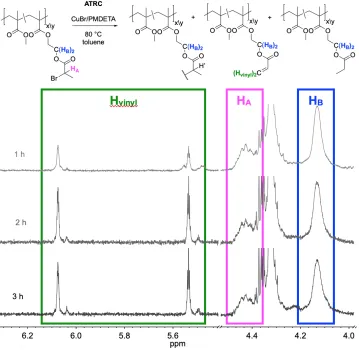
Figure 16. 1H NMR can be conveniently used to track the desired ATRC product as well as alkyl and vinyl byproducts caused by competition of disproportionation. To do so, the integration of the signals representing HA, HA’, and Hv can be compared with that of the inert ethylene spacer, HB. ... 36
Figure 17.74 k ATRP values measured by Matyjaszewski et al. under the following reaction conditions: EtBriB/Cu(I)Br/MeCN/22 °C. ... 37
Figure 18. NMR spectra comparing ATRC with (left) and without (right) a Cu(0) reductant. The integration of resonances HV, HA, and HB is used to calculate the extent of coupling and disproportionation. ... 39
Figure 19. The formation of an organometallic species may promote disproportionation. ... 40
Figure 20. Multi-detection GPC comparing parent polymers PA-1 and PA with their respective SCNP. NPA-1: Cu(I)Br/PMDETA, xc’ = 2%; NPA-2: Cu(I)Br/PMDETA/Cu(0), xc’ = 10%. ... 41
Figure 21. Tracking coupling and disproportionation of ATRC by 1H NMR. ... 42
xii
Figure 23. Vinyl region of the 1H NMR spectra of series A. Top to bottom: NPA-4 (L = TPMA), PA,
NPA-3 (L = TPEN), NPA-2 (L = PMDETA). ... 45
Figure 24. Series A GPC traces and M-H-S plots comparing the morphologies of SCNP products using PMDETA, TPEN, and TPMA catalyst systems. The activity of the ligand, approximated by kATRP, was positively correlated with increased coupling efficiency, leading to more compact structures. ... 47
Figure 25. Bayesian projection of DOSY plots for Series A. The x-axis is normalized such that the diffusion coefficient of THF is 0.0. Molecular volume decreases from left to right. Top to bottom: NPA-3, NPA-2, NPA-1, PA. ... 48
Figure 26. The GPC-MALS traces of PB (solid line), and NPB-3 before (small dashed line) and after (long dashed line) rigorous purification to remove low molecular weight species. . 50
Figure 27 GPC-MALS Traces of Series B (standard procedure at 0.25 mg/mL). ... 50
Figure 28. 1H NMR array comparing SCNP created in ATRC of PB prepared using a continuous addition procedure. Cu(I)Br/L/Cu(0)/1 mg mL-1/1:1 MeCN:THF/55 °C; L = PMDETA, TPEN, and TPMA for NPB-2, NPB-3, and NPB-4, respectively. ... 51
Figure 29. GPC-MALS trace of CA-NPB-2, 3 and 4 (continuous addition procedure). ... 52
Figure 30. M-H-S plot of Series B (standard procedure). ... 53
Figure 31. 1H NMR of terpolymer PAB 15. The broad signal in this case is due to a highly concentrated sample. ... 56
Figure 32. 1H NMR of SCNP made from terpolymer PAB. ... 57
Figure 33. GPC-MALS traces of PAB and NPAB. ... 58
Figure 34. Preparation of a diverse set of architectures from a common substrate under a unified set of reaction conditions by sequencing ATRC with ATRP. ... 61
Figure 35. SCNP with low DP “hyperbranched” cross-links. ... 62
Figure 36. Preparation of brush polymers or “knit” SCNP using MMA or inimer. ... 64
xiii
Figure 38. 1H NMR of Hypergrafted SCNP NPA-MeBrema10 (10 eq. inimer). ... 65
Figure 39. The fit of the intrinsic viscosity to the MALS trace for PA (blue) and NPA-MeBrema10 (red). ... 66 Figure 40. Extending the arms of hyperbranched chains was used to test for the presence of “live”
halogenated chain ends. ... 66 Figure 41. Kinetic plot of ATRP/C showing reasonable fidelity to the pseudo first order kinetics
usually observed in ATRP. ... 67 Figure 42. Coupled brush SCNP. ... 68 Figure 43. GPC-MALS of coupled brush SCNP. ... 69 Figure 44. DOSY Calibration Curve prepared for narrowly disperse PS standards in THF-d6. . 76 Figure 45. DOSY Calibration Curve prepared for narrowly disperse PS standards in DMF-d7. 77 Figure 46. Determination of dn/dc of a PMMA research sample using the multiple injection
volumes method. ... 79 Figure 47. An illustration of the substantial physical difference between freely diffusing functional
groups (left) and those tethered to a polymer backbone (right). When external cross-linkers are used for systems like that on the right, they should be used in a 2 to 3 fold excess to adjust their stoichiometry to account for the local concentration. ... 69 Figure 48. Key variables in the design of SCNP via thermal Diels-Alder reactions. ... 70 Figure 49. FMA incorporation of the parent chains was calculated by comparing the integrations
of the 1H NMR signals for peak E representing methyl protons in the MMA moieties and A
representing a furfuryl proton in the FMA moieties. ... 73 Figure 50. A focused comparison of the effects of varying cross-linker for polymer B. ... 74 Figure 51. Array of GPC-MALS traces showing the collapse to form SCNP using rigid or flexible
di- or tri- functional cross-linkers with 10–40 mol% furfuryl methacrylic parents. ... 75 Figure 52. 1H NMR of furan-functionalized methacrylate parent polymers. Clockwise from top left:
xiv
Figure 53. A syringe pump is used to slowly add concentrated polymer solution. ... 77 Figure 54. Polymer concentrations can be increased ten-fold using the continuous addition
xv
LIST OF TABLES
Table 1. The efficiency and selectivity of the intramolecular ATRC of PA to form SCNP. ... 39
Table 2. Progression of coupling and disproportionation in a typical ATRC of PA. ... 43
Table 3. Series A Polymer Properties ... 46
Table 4. Series B-CA DOSY ... 54
Table 5. Series B Polymer Properties ... 54
Table 6. Characterization of PAB and NPAB. ... 58
Table 7. Comparison of GPC characterization data for higher molecular weight brushes. ... 69
Table 8. Summary of Properties of Polymers and Brushes or SCNP products of ATRP/C. ... 71
Table 9. Diffusion coefficients used to DOSY calibration curve, above. ... 76
xvi
ABSTRACT
ATRC PROCESSES AND ARCHITECTURES AS TOOLS FOR ADVANCING THE COMPLEXITY OF SINGLE-CHAIN POLYMERIC NANOPARTICLES
by
Elizabeth R. Bright
Atom transfer radical coupling (ATRC) is gaining recognition for its utility in building complex polymeric architectures because it features efficiency, a wide range of compatible substrates, and a lack of byproducts. These qualities are especially desirable in applications requiring intramolecular cross-linking as in the synthesis single-chain nanoparticles (SCNP).
This dissertation aims to (I) provide motivation and context for developing ATRC technology for intramolecular cross-linking, (II) provide guidance into the impact of catalyst selection and substrate on reaction efficiency and morphology, and (III) demonstrate the possibility to sequence intrachain ATRC with ATRP to create advanced SCNP architectures.
Chapter II describes the preparation of SCNP from parent polymers containing alkyl or benzyl bromide ester pendants using ATRC catalyzed by copper halides complexes. Tri- or tetradentate alkyl or pyridyl amines (PMDETA, TPEN, and TPMA), which tune the redox potential of the Cu(I)/Cu(II) system, were directly compared. Coupling efficiency was positively correlated with the kATRP of the respective catalyst systems. However, PMDETA complexes afforded greater
control as evidenced by lower polydispersity. In the case of alkyl halide pendants, selectivity for coupling over disproportionation systematically decreased under conditions designed to increase the concentration of CuI/L. Polymers with benzyl bromide pendants, which cannot
xvii
Chapter III describes the preparation of SCNP from parent polymers capable of initiating intra-chain polymerization by ATRP under conditions favoring termination by coupling. Because of the wide variety of compatible monomers that have been well-established for ATRP systems, the ATRP/C framework both simplifies reaction procedures (one pot polymerization and coupling strategies are feasible) and imparts handles with which to control both architecture and functionality. To demonstrate this potential, model simple brushes and hyperbranched examples were prepared. SCNP with the hyperbranched motif were remarkably dense, a result which demonstrates the potential to facilitate more globular SCNP structures using modifications of intrachain polymerizations. Methacrylic brush arms, which are not non-ATRC active, could be induced to couple by adding 5 equivalents of styrene under the shared ATRP/C conditions. In addition, it was determined that hyperbranched SCNP retain “living” ω-ends which may be initiated to perform post-collapse polymerizations. A model styrene example is presented; despite occurring in an ultradilute solution, the polymerization maintains fidelity to pseudo-first order kinetics.
xviii
Chapter I: Introduction
Motivation to Develop Complex Synthetic Macromolecules
In nature, the ability of a polymer to perform a task depends on a combination of its chemical composition and morphology. Together, these tightly controlled structural features create remarkably specific chemical associations. This specificity is key because, unlike the isolated models of chemistry built in laboratory reactors, biological macromolecules operate in complex systems. Further, conditions such as solvent, temperature, and pH are controlled at a systems level rather than optimized for individual reactions. Despite this, biomacromolecules regularly and often dramatically outperform synthetic analogues in providing structural integrity, energy storage, or catalytic activity.1–4
Given the breadth of these capabilities, it is unsurprising that so much research is dedicated to understanding structure-function relationships in biopolymer chemistry. For their part, chemists and materials scientists have been developing increasingly sophisticated synthetic polymer architectures with the goals of understanding the fundamental principles governing biopolymer processes (e.g. protein folding) and advancing these understandings to an application stage (e.g. as catalysts, drug delivery systems, or nanoreactors).
The Role of Controlled Radical Polymerizations
The development of versatile controlled radical polymerization techniques, especially atom transfer radical polymerization (ATRP) and reversible addition/fragmentation chain transfer polymerization (RAFT), has been one of the most impactful achievements to this end.56,78 The
xix
structures tend to have special and unexpected properties, some of which are technologically useful.9–12 For example, bottle brush drug delivery systems tend to outperform their linear
counterparts. The “living” nature of controlled radical polymerizations makes combinations of structural control and block copolymer technology possible, as in the star block13 or brush block14
architectures shown in Figure 1 and Figure 2.
Figure 1. Strategy for building star block copolymers using a core-first approach and ATRP. Reprinted with
permission from Ref. 13. Copyright 2016 American Chemical Society.
Figure 2. Bottle brush polymers have a wide variety of uses. Amphiphilicity or other self-assembly mechanisms may
be incorporated. Reproduced from Ref. 14 with permission from The Royal Society of Chemistry.
Because these polymerizations are compatible with a wide range of monomers and functional groups, it is possible to use chemically distinct monomers for the blocks. This property is most often exploited to make frustrated systems or amphiphiles with self-assembly behavior, as seen in block copolymer micelles.15,16 However, the possibilities do not end at
hydrophobic/hydrophilic functionalities. For example, monomers can be designed to form predictable motifs on the basis of bulk, hydrogen bonding, or chirality.17 These so-called foldamer
designs are analogous to the secondary structure of proteins.18 Dynamic chemistries can be used
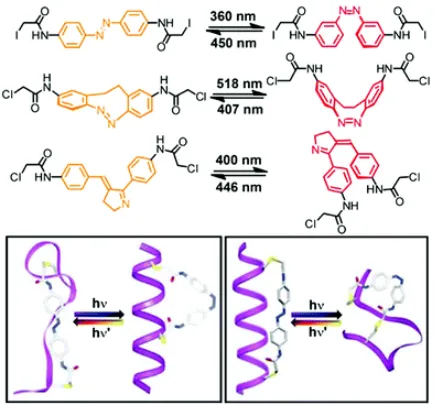
to create switchable morphologies. A particularly illuminating example of this is the peptide-based photoswitchable loop designed by Wooley and coworkers (Figure 3).19 When triggered by visible
xx
coil transition (Figure 3). Facile access to amphiphilic or otherwise asymmetric and self-assembling or dynamic motifs represents an important step to mimicking natural processes.
Figure 3. Photoswitchable foldamer design by Wooley and coworkers. Adapted from reference 19; Copyright 2000
National Academy of Sciences.
Sequence Control
While self-assembly processes are important, other methods of controlling solution architecture are necessary to form robust structures. True architectural control relies on the development of efficient sequence-controlled polymerization strategies, which is a significant challenge. The majority of attempts at sequence control come from traditional step-growth polymerizations such as polycondensations, however, the development of more functionally tolerant approaches is necessary. This work often takes the form of ring-opening,20 ayclic diene
metathesis,21 or “click” reactions22 to create periodic copolymers. Radical step growth
xxi
ATRA, creating a biradical AB block which combines through ATRC to form repeating ABBA repeats (Figure 4).
Figure 4. ATRA/C method for preparing periodic vinyl copolymers. Reproduced from Ref. 24with permission from
The Royal Society of Chemistry.
Intramolecular Cross-linking
The capability to efficiently and precisely select multiple functional group placements on a chain promises to be revolutionary for both architectural and functional control. Architectural control will come from a system of intramolecular cross-linking between functional monomer units. Regardless of cross-linking chemistry, these reactions come with a unique set of challenges. These may be studied in isolation using the single-chain nanoparticle motif, which generally consists of a copolymer chain with cross-links between pendants (Figure 5). Although the concept was first reported in the 1960’s by Kuhn and Balmer, SCNP chemistry did not garner significant research interest until controlled radical polymerizations dramatically opened the design space.25
xxii
As these intramolecular cross-links form, the hydrodynamic radius of the macromolecule decreases. This collapse is analogous in form and, ideally, function to the coil-to-globular transition seen in protein folding that results in molecules capable of advanced processes like molecular recognition or catalysis. The parent polymers are often prepared using controlled radical polymerizations because their control over chain length and compatibility with a wide range of functional monomers offer significant advantages. First, control over the radius and size distribution of the final nanostructures is primarily controlled by manipulating the length of the parent chain. Second, broad chemical compatibility maximizes the range of possible post-polymerization modifications, creating a large design space for architectural modifications such as grafting or cross-linking and installations of functional pendants such as catalytic centers or fluorophores.
While, in theory, any cross-linkable comonomer system may be used, practical considerations govern the choice of folding mechanism. Regardless of the backbone chemistry, the synthesis of SCNP is typically conducted in ultra-dilute solutions to prevent interchain cross-linking. Therefore, the cross-linking chemistry must be efficient. Also, purification can be challenging and typically depends on either precipitation or dialysis. In this regard, byproduct-free reactions have a significant advantage. Within these parameters, SCNP have been prepared using a wide variety of covalent,26 non-covalent,27 and coordination motifs.28 These have been
recently summarized by our group and others.29,30
Evaluating SCNP Morphology
GPC
xxiii
intramolecular cross-linking decreases the hydrodynamic volume of the chain, SCNP products elute from GPC columns at longer retention times than do their parents (Figure 6). Therefore, SCNP products have lower relative molecular weights than those of their respective parent polymers. The ability to sort based on size is especially powerful when coupled with other instrumentation to perform techniques like multi-angle light scattering (MALS), UV detectors, and viscometers, which would otherwise result in an average value rather than a distribution.
Figure 6. GPC evidence of a decrease in hydrodynamic radius after intramolecular cross-linking.
Light Scattering
Light scattering is very useful in SCNP characterization because it gives insight into molecular weight, form factor, and polydispersity in solution. Molecular weight data from light scattering depends on the intensity of scattered light and the refractive index increment dn/dc of a given polymer solution.3132 Therefore, it contributes an absolute molecular weight which may be
meaningfully compared to the apparent molecular weight generated using GPC.33 The effect of
xxiv
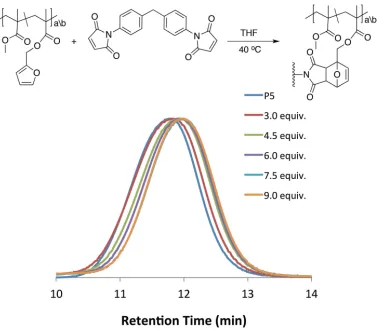
Figure 7. GPC-MALS trace of externally cross-linked Diels-Alder system. A maximum degree of collapse was
observed when the maleimides were in a 9:1 ratio with furan groups on the polymer. Reproduced from Ref. 34with
permission from The Royal Society of Chemistry.
Knowledge of these properties for a given system is important beyond evaluating the degree of collapse. Deeper morphological insight, such as density and form factor, can be studied by examining how molecular weight scales with size for a given sample or exploiting angular dependence in multi-angle light scattering (MALS) to determine the radius of gyration (Rg).
However, most single-chain nanoparticles are in the sub 10-nm size regime. For this reason, accurate determination of Rg requires the small angles only available in x-ray or neutron scattering
(SAXS or SANS) techniques. Although SANS and SAXS are powerful methods for studying particles with radii below 10 nm, the required instrumentation is not widely available.
Viscometery
Fortunately, evidence of this scaling behavior can also be observed using GPC with an online viscometer and multi-angle light scattering (MALS) detector. Intrinsic viscosity, the contribution of the solute to the solvent’s viscosity (Equation 2), can be used directly to calculate hydrodynamic radius, Rη. The intrinsic viscosity and molecular weight are related by the Mark-Houwink Equation (Equation 3).
𝜂" = (𝜂 − 𝜂') 𝜂
'
)
xxv
[𝜂] = 𝑙𝑖𝑚
/→12
𝜂" 𝑐4
Equation 2. Intrinsic viscosity, where η is the sample viscosity and c is concentration.
[𝜂] = 𝐾6𝑀8
Equation 3. Mark-Houwink Equation. The Mark-Houwink parameters, K and a, vary based on solvent quality and the
polymer architecture; [𝜼] is intrinsic viscosity and M is molecular weight.
𝑅𝜂 = ;3𝑀[𝑛] 10𝜋𝑁B
C
Equation 4. Einstein–Simha Relation, where NA is Avogadro’s number and Rη is the hydrodynamic radius.
The scaling exponent, a, varies with the quality of the solvent and the polymer architecture. Its value is 0.5 for linear chains in a theta solvent. More extended chains have larger a-values, up to 2 in the case of a rigid rod conformation, while more globular morphologies lead to a-values in the range of 0.3. This is true for other dense morphologies, for example, a can be 0.3–0.5 for hyperbranched polymers with long spacers. Though it varies by chemistry, generally speaking, parent polymers used in SCNP work have values in the range of 0.8 to 1.12,35
Trends in intrinsic viscosity can be used to assess the collapse efficiency and final morphology in SCNP. Upon intramolecular cross-linking, the intrinsic viscosity tends to decrease with the corresponding increase in density as it becomes more like a uniform sphere. In this limiting case, it reaches a value of 5/2 divided by density.
Figure 8. SCNP tend to have elongated structures with local cross-links (left) rather than the compact and globular
xxvi
The relationship between molecular weight, cross-link density, and hydrodynamic size of various SCNP chemistries have been investigated extensively by Pomposo and coworkers. Scaling behavior has been studied by compiling SANS and SAXS data.35 They have also
systematically compared trends in the intrinsic viscosities of synthetic SCNP with those uncovered by molecular dynamics simulations. Both approaches have generated evidence that typical single-chain nanoparticles (those prepared by the intramolecular cross-linking of statistical copolymers) do not take a compact, globular shape. Rather, the trends in their morphology and density are more closely comparable to those seen in intrinsically disordered proteins: local globules distributed within a generally open chain (Figure 8).36–38 This relative lack of density is
one of the key architectural challenges in SCNP. Using highly efficient cross-linking chemistries at finely tuned incorporations is insufficient to create dense structures. The most impactful approaches must modify chain mobility or segmental length between cross-linkable units, the primary drivers behind the statistics of cross-linking.
Orthogonal Folding Approach
Systems designed with multiple orthogonal covalent cross-linking chemistries have been more compact than those designed using only one comparable cross-linker type, even at identical overall functional incorporations.39,40 For example, Chao and coworkers designed a system with
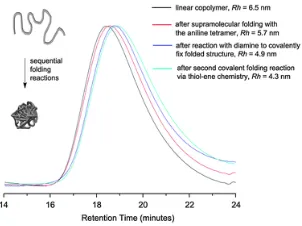
three distinct cross-linking capabilities: supramolecular, anhydride-amine, and thiol-ene click chemistry. These were triggered sequentially, and hydrodynamic volume decreased at each step (Figure 9).40 Each step in a sequential folding method effectively brings the next cross-linkable
xxvii
Figure 9. GPC MALS trace of a copolymer capable of multiple orthogonal folding mechanisms. It becomes denser
after each transformation. Reproduced from Ref. 40 with permission from The Royal Society of Chemistry.
Intrachain Polymerization Approach
By nature, intrachain polymerizations also modify segmental mobility and chain length and can therefore become a route to globular structures. A diverse set of SCNP prepared through intrachain polymerization is available in the literature.41–47 This strategy is particularly useful in
overcoming restricted motion when using parent polymers with relatively rigid primary backbones. In theory, with the proper monomer choice, intrachain polymerization could also become a versatile way to functionalize cross-links.
Early Examples of Complex SCNP Designs
The confluence of these developments has created the opportunity and demand to attempt more complex designs. For example, Lutz and Roy used a combination of sequence-controlled polymerization and orthogonal “click” chemistries to prepare asymmetric SCNP (Figure 10).48 Their parent polymer system consisted of an inert styrene backbone with a
xxviii
Figure 10. Combination of sequence-controlled polymerizations and intramolecular “click” chemistry was used to
sequentially control folding. Adapted with permission from Ref. 48. Copyright 2014 American Chemical Society.
Foldamer chemistry has also been instructive to the creation of single-chain nanoparticles with secondary structural characteristics.29,49,50 This potential is well-illustrated by a system
designed by the Meijer group (Figure 11) which uses a chiral motif (3,3′-bis(acylamino)-2,2′-bipyridine-substituted benzene-1,3,5-tricarboxamide) in conjunction with hydrophilic polymer grafts.51,52 Examples of grafted SCNP are relatively rare. In this case, the hydrophilic grafts shown
here are used to introduce finer morphological features – in poor solvent, the structure of these SCNP are reminiscent of globular proteins with a hydrophobic pocket.53 The chiral motif makes it
possible to study these changes using circular dichroism.
Figure 11. Single-chain nanoparticle design with a chiral internal structure and hydrophilic grafts.Reproduced from
29
Chapter II. Understanding and Promoting Intramolecular ATRC
Introduction
ATRC as a Versatile Handle for Post-Polymerization Modifications
Progress toward truly structurally defined soft nanomaterials is fueled by rapid advancement in controlled polymerizations and an increasingly sophisticated toolbox of compatible organic transformations. Many current examples are designed for applications in medicine and biotechnology such as targeted drug delivery or sensing. Post-polymerization modifications, especially “click” reactions and similarly efficient chemistries, are at the heart of the advancement of these technologies because they are used heavily to both install functional groups and control architecture. They can also be used to prepare diverse species from a common precursor and minimize functional incompatibility.
30
however, the scope of these reactions has rapidly expanded in the past decade with the development of macrocycles and SCNP, which are prepared using end-to-end and pendant-to-pendant coupling, respectively (Figure 12).54,55 A range of covalent, dynamic-covalent, and
non-covalent cross-linking strategies is well-documented in the recent literature.
Figure 12. Products of intramolecular cross-linking.
31
Figure 13. Mechanistic relationship between ATRP and ATRC.
Because it can be used to directly couple the halogenated ω-ends of ATRP products, ATRC is particularly adaptable for the preparation of telechelic, functionally diverse,56–58 and/or
symmetrical block copolymers (Figure 14).59–61 The first report of its synthetic utility and surprising
efficiency came from Fukuda and coworkers in 2002.62 Using ATRC, 90% of bromo-terminated
polystyrene chains could be coupled, thereby doubling their molecular weight in a controlled fashion, in a ten minute reaction. Soon thereafter, Yagci demonstrated its utility in forming aldehyde, alcohol, carboxylic acid, or amine-functionalized telechelic chains.63 More recently, its
broad compatibility with copper-mediated polymerizations (CMP) and atom transfer radical addition (ATRA) conditions have been exploited in higher-order sequential polymerization-coupling strategies.23,64 Because it is also efficient and byproduct-free, it is a good candidate for
intramolecular cross-linking in applications like the synthesis of well-defined macrocycles and single-chain nanoparticles.54,65–67
Figure 14. Symmetrical block copolymer synthesis by ATRC.
Intramolecular ATRC: Role of Reducing Agent
In ATRP, the lower valent metal species (CuII/L) serves an important role in limiting the
number of radicals produced at a given time, thereby controlling the polymerization. As a
R + R CuII-X
2/L
X CuIX/L
kact
kdeact
+ kp
activator deactivator
kATRP = kact / kdeact
reductant
kt
32
consequence, high concentrations of this deactivating species (in relation to the corresponding activator, CuI/L) suppress termination by ATRC. Although “classical” ATRP conditions have been
used to couple low molecular weight (~1 kDa) polystyrenes in the absence of monomer, these procedures are not popular. More typically, a secondary reducing agent is added to regenerate the activating CuI complex and thereby increase the concentration of radicals. Due to the
persistent radical effect, most applications practically require a reducing agent to undergo efficient ATRC.5,68
In analogy to activators regenerated by electron transfer, or ARGET, ATRP,69,70 the
reducing agent may be organic or inorganic, most often abscorbic acid or zero-valent metals, respectively. Cu0 is a popular choice because it is remarkably user-friendly: copper nanoparticles
and wires are readily available, effective, and easy to separate from the reaction mixture. Relative to organic reducing agents, copper is less likely to participate in side reactions with monomers, initiators, or other adjuncts. It comproportionates with the deactivator to generate two CuI
complexes (as in ATRP, the ligand is added in substantial excess, usually 5 times the molar concentration of the metal salt). It may also provide a convenient handle for controlling ATRC because copper wire can be wrapped around a magnet (such as a stir bar) which may be removed from solution without exposing the flask reaction to oxygen. Switchable procedures of this type could be used to streamline sequential polymerization and coupling strategies.
Intramolecular ATRC: Interaction of Substrate, Ligand, and Process Conditions
As in ATRP, ATRC is highly sensitive to the properties of the substrate (radical stability and propensity to chain transfer or disproportionation) as well as the catalyst system (kATRP varies
33
increasing the necessary equivalents of the metal salt and ligand. Both effects are consistent with other findings in SCNP literature, as described in Chapter I. In analogy to externally cross-linked systems, the increased catalyst requirement can be attributed to the considerable difference in halide concentration within the pervaded volume of the polymer chain and that of the overall solution. The results of the present study provide guidance in the selection of catalyst and reaction parameters for performing ATRC under such conditions.
Research Objective
Although ATRC is most often an undesirable side reaction, it can be used advantageously as a post-polymerization modification to create more complex architectures (e.g. telechelic blocks, macrocycles, SCNP). Further, its innate compatibility with ATRP systems could greatly promote the development of facile sequential polymerization and coupling strategies. While the interaction between Cu-mediated ATRP components (including ligands, imitators, monomers, and substrates) is well-studied, relatively little is known about the ATRC process. This is especially true under conditions favoring SCNP formation, including ultra-dilute solutions or semi-batch procedures. The goal of this study is to understand the effect of catalyst and substrate on ATRC chemistry under these conditions and relate these to morphologies. We also aim to examine the possibility of the formation of an organometallic species as alternative mechanism for disproportionation under high concentrations of Cu(I)/L complex.
Results and Discussion
Experimental Design
34
Scheme 1. Systematic investigation of intramolecular ATRC.
NMR Methods for Monitoring Extent of Incorporation and Disproportionation
The ATRC-active comonomer, shown in Figure 15, is modular by design. It consists of a methacrylic backbone coupled to a pendant ethylene spacer and terminated by a methyl or phenyl bromopropionate. The ester, which activates the carbon toward heterolytic cleavage, is readily synthesized using nucleophilic substitution or Steglich esterification; appropriate syntheses, including those used here, are well-documented in the literature.71 In analogy to comparable
ATRP initiating systems, the ability of the R-substituent to stabilize the radical is important to its reactivity.
Figure 15. Modular monomer design.
O O
O
C O
Br R
methacrylic backbone common, broad compatibility
ethylene spacer
may be modified to tune form, function
alkyl bromide
CH3 vs. Ph: reactivity and structural impact
easy detection by 1H NMR
=
35
While a more highly substituted carbon would be expected to be more active, secondary alkanes (where R = Me or Ph in MeBrema or PhBrema, respectively) were selected for this study to facilitate tracking by 1H NMR (Figure 15). In both cases, the chemical shift of the proton
neighboring the halide shifts markedly upfield upon coupling (Figure 16). The coupled fraction, xc,
was calculated by taking a proportion of the integration of the unreacted alpha proton signals (HA)
normalized against that of a resonance from the inert ethylene spacer, HB (Equation 5). In the
case of p(MMA-co-MeBrema), where ATRC faces competition from disproportionation, the degree of side product formation (xdis) was calculated using the relative integrations of vinyl
resonances (Equation 6).
𝑥/ = 1 − E 2 ∫ 𝐻B ∫ 𝐻B+ J∫ 𝐻K) L2
M
Equation 5. Extent of coupling, xc.
𝑥N"'= 1 − O∫ 𝐻∫ 𝐻P
P+ ∫ 𝐻KQ
36
Figure 16. 1H NMR can be conveniently used to track the desired ATRC product as well as alkyl and vinyl byproducts
caused by competition of disproportionation. To do so, the integration of the signals representing HA, HA’, and Hv can be compared with that of the inert ethylene spacer, HB.
This methodology allowed us to correlate coupling efficiency to morphological insights from multi-detection GPC to glean insight into the impact of substrate and catalyst combinations. The rich body of knowledge regarding ATRP is highly instructive for ATRC given their shared mechanism. Although metal and metal-free catalysts are available, CuIBr/L systems, where L is
a polyamine or pyridine chelator, are versatile, popular, and well-studied by Matyjaszewski and others.70,72–77 In these systems, the effect of ligand structure on ATRP kinetics is pronounced.
Three of the most common ATRP ligands, PMDETA, TPEN, and TPMA were selected to sample this structural diversity and corresponding range of activity, which spans 3 orders of magnitude (Figure 17).
O OO O C(HB)2 O x\y O Br HA PA O O (HB)2
O O HA’ O O
(HB)2 O O
O O (HB)2
O O O O
x \ ydis 1 \ ydis 2 \ yc NPA
HV HV’ ATRC
O OO O C(HB)2 O x\y O Ph Br HA ATRC
O OO O C(HB)2 O x\y
O
Ph HA’ NPB
37
Figure 17.74kATRP values measured by Matyjaszewski et al. under the following reaction conditions:
EtBriB/Cu(I)Br/MeCN/22 °C.
Examples of each backbone chemistry were tested with each ligand in a 50:50 MeCN:THF solvent mixture. These results were directly compared to those obtained using the most prevalent ATRC conditions, CuIIBr/PMDETA/Cu0 in toluene.
Scheme 2. Parent Polymer Synthesis
Statistical copolymers with molecular weights in the range of 30-50 kDa were prepared using reversible addition−fragmentation chain-transfer (RAFT) polymerization (Scheme 2) to target the 5–10 nm size regime. RAFT provides a controlled polymerization orthogonal to ATRP. The proportion of the functional comonomer (f) was limited 35 mol% to maximize the controlled collapse in radius from parent polymer to SCNP according to literature precedent.
O O O O
O
O OO O
O x\y +
O
Br R
O
R Br R = CH3 (PA) or Ph (PB)
RAFT
38
Effect of Cu0 Reductant on ATRC and Byproduct Formation
Scheme 3. Formation of SCNP with and without Cu0 reductant.
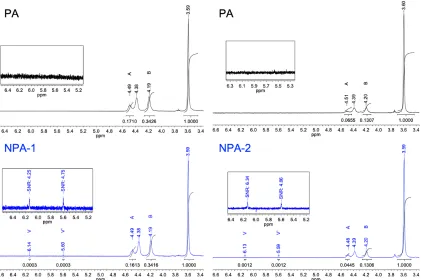
With this utility in mind, ATRC of PA was performed under both standard and reducing conditions (Scheme 3). The 1H NMR spectra of the nanoparticle products, which are shown in
Figure 18, were used to determine xc and xdis using the procedure described above. Because the
usual calculation of xc assumes no side reactions at the radical site, it is more accurately
considered an apparent coupling efficiency. Given the observed tendency of PA to
disproportionate, an effective coupling constant, xc’, was calculated by subtracting xdis from xc. As
expected, the extents of coupling and disproportionation were both higher when Cu0 wire was
included as a reductant (NPA-2) than when standard ATRC conditions were used (NPA-1). Indeed, negligible evidence of coupling was observed in the spectrum of NPA-1 (xc’ = 2.8%). The
extent of coupling of NPA-2 was higher but incomplete (xc’ = 10.0%). Disproportionation was the
minor product in both cases: xdis =0.1% and 8.9% for NPA-1 and NPA-2, respectively. These
results are summarized in Table 1.
O OO O
C(HB)2
O x\y O Br HA PA O O (HB)2
O O HA’
O O (HB)2
O O O O
(HB)2
O O O O
x \ ydis 1 \ ydis 2 \ yc NPA-1
ATRC
HV
HV’ NPA-1
CuBr/PMDETA toluene, 80 °C
NPA-2
CuBr/PMDETA/Cu0
39
Figure 18. NMR spectra comparing ATRC with (left) and without (right) a Cu(0) reductant. The integration of
resonances HV, HA, and HB is used to calculate the extent of coupling and disproportionation.
Table 1. The efficiency and selectivity of the intramolecular ATRC of PA to form SCNP.
PA-1 NPA-1 PA NPA-2
f 0.339 0.339 0164 0.164
xdis - 0.001 - 0.089
xc’ - 0.028 - 0.100
xc’/ xdis - 28.0 - 1.12
Despite their shared starting material, the ratio of disproportionation to coupling products did not scale proportionally; xc’/xdis decreased from 28.0 to 1.12 when Cu0 was present. The
implication of this result is that the abstraction of an alkyl proton is favored over radical recombination when the concentration of the activating CuI complex is relatively high. Given the
40
question of whether a reasonable alternative pathway to disproportionation products could be proposed. One possible explanation is that the high activator concentration generated from comproportionation of the copper and deactivator species leads to a formation of an organometallic CuI species which could undergo β-elimination, thereby producing a catalytic
disproportionation pathway which may proceed alongside radical abstraction (Figure 19). This existence of similar organometallic species is not without precedent; they have been isolated using radical traps for certain ARGET ATRP systems.78,79 However, direct comparisons must be
made cautiously given the large number of variables at play, including the substrate, catalyst system, reaction conditions, and/or adjuncts.
Figure 19. The formation of an organometallic species may promote disproportionation.
Morphological Implications of Inefficient Coupling
Because the primary motivation to develop intramolecular ATRC chemistry is architectural control, multi-detection GPC and diffusion NMR (DOSY) were used to relate the coupling efficiency and disproportionation with their morphological implications.80 The outcomes of these
competing reaction pathways are conveniently detected and distinguished using GPC with inline light scattering and viscometry capabilities. (1) Disproportionation does not noticeably impact the hydrodynamic radius or molecular weight; (2) cross-linking between pendants reduces the hydrodynamic radius without substantially increasing molecular weight; and (3) intermolecular cross-linking dramatically increases both. Therefore, the SCNP products of an efficient intramolecular “collapse” are distinguished because they elute before their respective parents, effectively decreasing their apparent molecular weights. However, their absolute molecular weights are impacted only by the coupling chemistry (e.g. loss of bromide in the case of ATRC).
ka
kd P-Cu
II/L
CuI/L + P P=CH2 + P-H + CuI/L
41
Figure 20. Multi-detection GPC comparing parent polymers PA-1 and PA with their respective SCNP. NPA-1:
Cu(I)Br/PMDETA, xc’ = 2%; NPA-2: Cu(I)Br/PMDETA/Cu(0), xc’ = 10%.
The traces of NPA-1 and NPA-2, along with those of their respective parent polymers, are shown in Figure 20. A very low degree of coupling (e.g. 2.0%, as in NPA-1) is likely to broaden the size distribution of the sample due to a large population of chains without cross-links. This effect is pronounced in the broad and bimodal multi-angle light scattering (MALS) trace of NPA-1. As the extent of coupling increases, its polydispersity should decrease to its lower limit, which is that of the parent polymer sample. Practically, that degree of size control is possible for all but the least efficient cross-linking systems. For example, both the MALS and RI traces of NPA-2 (xc’
42
ATRC of PA
Reaction Progress and Byproduct Formation
Figure 21. Tracking coupling and disproportionation of ATRC by 1H NMR.
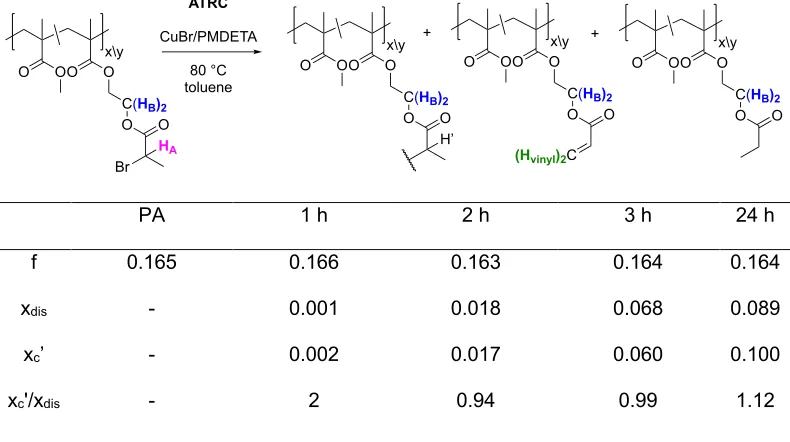
The progression of the competing coupling and disproportionation processes was tracked during the ATRC of PA to form NPA-2 (Figure 21). Samples were removed at t = 0, 1, 2, 3, and 24 h by 1H NMR using an air-tight syringe. The results of this study are summarized in Table 2.
The extent of coupling, xc’, reached a maximum of 10.0% after 24 h. This system displayed unique
competitive behavior. Early in the reaction (< 1 h), the desired coupled product was favored (xc’/xdis
= 2). While both xc’ and xdis increased with reaction time as expected, xc’/xdis decreased to
43
time required to build the concentration of the activator species. Each halide transfer early in the reaction generates a deactivator species, and in the absence of a reducing agent, this species would remain deactivated. However, if Cu0 is available, the comproprotionation product with CuII
produces two equivalents of CuI/L, eventually surpassing the original population. In other words,
this behavior is consistent with the theory that high CuI/L concentrations promote
disproportionation through some mechanism, possibly formation of an organometallic species followed by and beta elimination as described above.
Table 2. Progression of coupling and disproportionation in a typical ATRC of PA.
PA 1 h 2 h 3 h 24 h
f 0.165 0.166 0.163 0.164 0.164
xdis - 0.001 0.018 0.068 0.089
xc’ - 0.002 0.017 0.060 0.100
xc'/xdis - 2 0.94 0.99 1.12
Effect of Ligand System
Because the nature of the ligand so heavily modifies the reducing potential of the copper complex, it is expected to impact the progression of ATRC. There are many reasons for tuning the efficiency of halogen extraction, including the possibility to facilitate more efficient coupling or adapt the system for sequential ATRA/C or ATRP/C procedures. Further, variations in reduction
O OO O
C(HB)2
O x\y
O
O OO O
C(HB)2
O x\y
O
Br
HA H’
ATRC
CuBr/PMDETA
80 °C toluene
O OO O
C(HB)2
O x\y
O
(Hvinyl)2C
+
O OO O
C(HB)2
O x\y
44
potential or steric effects from ligand bulk could be expected to impact the formation of an organometallic species, thereby providing indirect evidence of such a pathway.
Extent of Coupling
*H20 in CDCl3; Cu(I)Br/L/Cu(0)/1 mg mL-1/toluene/80 °C
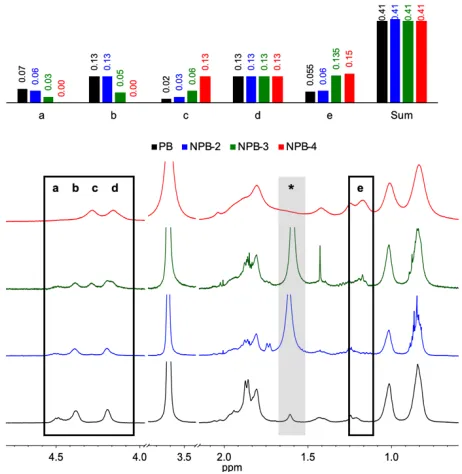
Figure 22.1H NMR array comparing SCNP created in ATRC of PA (bottom, black); L = PMDETA, TPEN, and TPMA
for NPA-2 (blue), NPA-3 (green), and NPA-4 (top, red).
Differences between the samples prepared using each catalyst were evident in their respective 1H NMR spectra (Figure 22). Full spectra are available in Appendix A. The extent of
coupling, xc, positively correlated with the kATRP of the catalyst complexes, following the order
NPA-4 > NPA-3 > NPA-2. At first glance, this is unintuitive because higher kATRP ligands should promote a rapid buildup of the Cu(II)/L species, thereby suppressing ATRC through the persistent radical effect. However, these results indicate that the Cu0 reduction pathway is sufficiently
45
samples prepared using TPEN and TPMA. No evidence of the alpha proton is visible above the noise in the spectrum of NPA-4, the sample produced using TPMA as a ligand. While this is largely attributed to differences in reactivity, it could also be due to the significant broadening of neighboring signals. Because f, the incorporation of functional monomer, remains unchanged through this process, its value was used to determine xc for this system.
Figure 23. Vinyl region of the 1H NMR spectra of series A. Top to bottom: NPA-4 (L = TPMA), PA, NPA-3 (L =
TPEN), NPA-2 (L = PMDETA).
Unfortunately, signal broadening also precluded the calculation of xdis for this system.
Signals for the disproportionation product are visible, but the signal to noise ratio was not sufficient for integration in the case of NPA-4 (Figure 23). Qualitatively, however, higher kATRP ligands
seemed to result in a decrease in the proportion of disproportionation products formed. Because higher kATRP ligands promote the generation of the Cu(II)/L species, they would be expected to
suppress the formation of an organometallic species and thereby limit the ratio of disproportionation to coupling to that of the direct interaction between pendants.
Size and Conformation
DOSY NMR and GPC-MALS were used to determine the radius of each species in THF. Additionally, morphological considerations were evaluated by determining the Mark-Houwink
a-5.8 5.9 6.0 6.1 6.2 6.3 6.4 6.5
46
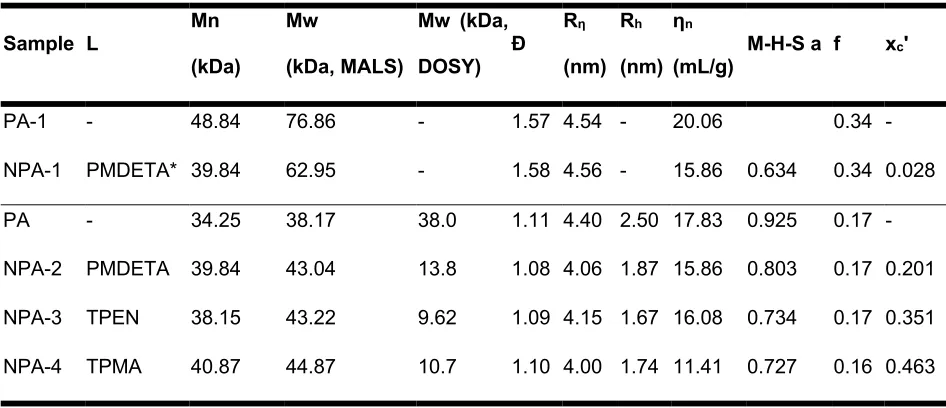
parameter of each sample. The trends in these data corroborate the trends in xc noted above,
and the relevant data are tabulated in Table 3.
Table 3. Series A Polymer Properties
Sample L Mn (kDa)
Mw
(kDa, MALS)
Mw (kDa,
DOSY) Ð Rη
(nm) Rh
(nm) ηn
(mL/g) M-H-S a f xc'
PA-1 - 48.84 76.86 - 1.57 4.54 - 20.06 0.34 -
NPA-1 PMDETA* 39.84 62.95 - 1.58 4.56 - 15.86 0.634 0.34 0.028
PA - 34.25 38.17 38.0 1.11 4.40 2.50 17.83 0.925 0.17 -
NPA-2 PMDETA 39.84 43.04 13.8 1.08 4.06 1.87 15.86 0.803 0.17 0.201
NPA-3 TPEN 38.15 43.22 9.62 1.09 4.15 1.67 16.08 0.734 0.17 0.351
NPA-4 TPMA 40.87 44.87 10.7 1.10 4.00 1.74 11.41 0.727 0.16 0.463
*no Cu0 reductant
GPC
GPC traces for Series A from the MALS and RI detector are shown in Figure 24. The height of the traces are normalized to the intensity of the highest signal to facilitate the comparison of retention time and dispersity. The maximum intensities of the MALS and RI traces were scaled to 1 and 0.5, respectively, to facilitate comparison while avoiding overlapping signals. As expected, each of the SCNP products (NPA2–NPA4) elutes at a longer retention time than that of the parent polymer, providing evidence for intramolecular cross-linking and corresponding decrease in hydrodynamic radius. The polydispersity remained low in each case. The trend in shifts to longer retention times roughly follows the order of xc, however, NPA-3 and NPA-4 had
47
and diffusion NMR were used to further probe this result and create a more complete picture of the resultant morphologies.
Figure 24. Series A GPC traces and M-H-S plots comparing the morphologies of SCNP products using PMDETA,
TPEN, and TPMA catalyst systems. The activity of the ligand, approximated by kATRP, was positively correlated with increased coupling efficiency, leading to more compact structures.
Mark-Houwink-Sakurada a-parameter
Trends in the Mark-Houwink a-parameter were examined to compare the change in solution morphology induced by ATRC using each ligand. The Mark-Houwink-Sakurada plots in Figure 24 were created using differential pressure trace of the gel permeation chromatogram (a detailed procedure is available in the Supplementary Material). As described above, a value of approximately a = 0.8 is considered typical for a methacrylic copolymer in a good solvent such as THF. The a-value of the p(MMA-co-MeBrema) parent is 0.92, which is in line with those expectations. In accordance with expectations from other SCNP systems, the observed a-values for the SCNP after ATRC were smaller (Table 3). The observed trend modestly correlates with ligand activity, obeying the order NPA-2 > NPA-3 > NPA-4.
DOSY NMR
48
below in accordance with well-established methods.80–82 For a series of SCNP prepared from a
common parent polymer, the apparent molecular weight should be inversely correlated with xc.
The Mw calculated for the parent polymer was in good agreement with the molecular weight data gathered from GPC (Mw, MALS = 38.17 kDa; Mw, DOSY = 38.0 kDa). As predicted, the apparent molecular weights were lower for NPA-2–4 than for PA.
The Stokes radius, like the viscometeric radius, is a hydrodynamic radius which can be determined absolutely. Further, the sample was dissolved in THF for both GPC and DOSY experiments. Therefore, the two are expected to be in good agreement for non-interacting materials. Interestingly, the calculated Stokes radius of each sample was smaller than the corresponding viscometric radius. The mechanism behind this behavior is unclear. In order to further investigate, the Bayesian projections of the DOSY spectra were compared (Figure 25).
Figure 25. Bayesian projection of DOSY plots for Series A. The x-axis is normalized such that the diffusion coefficient
of THF is 0.0. Molecular volume decreases from left to right. Top to bottom: NPA-3, NPA-2, NPA-1, PA.
Although quantitative integration of the Bayesian projections requires low sample concentrations (and correspondingly high magnet strengths and long instrument times), the distribution of signals in the SCNP spectra was instructive. The shift to smaller volumes was apparent, however, the signals display an abnormal peak shape. Given that the GPC trace did
-0.10 -0.07 -0.04 -0.01 0.02 0.05 0.08 0.11 0.14 0.17 0.20 0.23 0.26 0.29 0.32 0.35 0.38
Normalized Diffusion Units
NPA-4_projection_f2
NPA-3_projection_f2
NPA-2_projection_f2
49
not show this behavior, this observation is most probably an effect of low resolution. Repetition using an extended number of scans time may be instructive to this end, however, very long acquisitions demand that the instrument maintain stable gradients for an extended period, which proved prohibitively challenging.
ATRC of PB, p(MMA-co-PhBrema)
Scheme 4. ATRC of PB.
As in the previous section, ATRC was performed using three ligands (PMDETA, TPEN, and TPMA) with a common parent polymer. To facilitate comparison between the results, the same molecular weight and incorporation were targeted. However, the SCNP prepared from PB proved notoriously difficult to isolate due to solubility issues. Operating on the assumption that this was due to the highly stable radical generated in halide abstraction, which may react to form multi-chain aggregates upon concentration of the crude product, the reaction was attempted at lower concentrations, first at 0.5 and then at 0.25 mg/mL. While samples prepared at 0.25 mg/mL showed some improvement in solubility, these attempts did not satisfactorily resolve the issue. The polymer seemed to interact with the GPC column and contain some low molecular weight species. This was attributed to excess catalyst trapped within the pervaded volume of the chain, and rigorous purification methods were applied (filtration through neutral alumina followed by dialysis over 72 h and reprecipitation). Acids could not be used for fear of degrading the
O OO O
O x\y O O O O O x\y
O OO O
50
methacrylic backbone. The results of this procedure are shown in Figure 26, the GPC-MALS trace of NPB-3. This purification procedure was adapted to examine the remainder of the series.
Figure 26. The GPC-MALS traces of PB (solid line), and NPB-3 before (small dashed line) and after (long dashed
line) rigorous purification to remove low molecular weight species.
Effect of Ligand System and Unexpected Molecular Weight Profiles
Figure 27 GPC-MALS Traces of Series B (standard procedure at 0.25 mg/mL).
51
low sample concentrations in NPB-2 and NPB-3. Given the shared structure of these samples with PB and the evidence of aggregation, this is attributed to sample lost during pre-injection filtration with a 0.45 micron syringe filter.
Modified “Continuous Addition” Process Conditions
Therefore, an alternative procedure was attempted to circumvent aggregation. In an adaptation of a “continuous addition” procedure first reported by Harth and coworkers, the parent polymer solution (10 mg/mL, 100 mg polymer) was added by syringe pump over 4 h to a Schlenck flask with the other components (15 mL total solvent, final polymer concentration 2.5 mg/mL).83
With the exception of CANP-3, examples prepared in this manner did not show signs of aggregation, instead shifting to longer retention times. Further, they were soluble enough for analysis by solution NMR.
Extent of Coupling
Figure 28.1H NMR array comparing SCNP created in ATRC of PB prepared using a continuous addition procedure.
Cu(I)Br/L/Cu(0)/1 mg mL-1/1:1 MeCN:THF/55 °C; L = PMDETA, TPEN, and TPMA for NPB-2, NPB-3, and NPB-4,
respectively.
52
α-proton signals (e) and ethylene spacers (f or g) in the 1H NMR (Figure 28). As predicted, the
α-proton resonances shifted upfield significantly upon abstraction of the halide in ATRC (e’). The resonances from the phenyl ring, a, b, and c, shifted downfield. Signal broadening was observed in CA-PB-3 and CA-PB-4. As noted above, this is not an unusual finding for intramolecularly cross-linked systems.
Size and Conformation
Figure 29. GPC-MALS trace of CA-NPB-2, 3 and 4 (continuous addition procedure).
However, the dispersity increased from that of the parent polymer in each case, as evidenced by broader GPC traces and higher proportions of Mw to Mn (Ð) (Figure 29). The inconsistency of results obtained using ATRC of PB regardless of ligand obscure any trends that might otherwise be observed. Although the coupling behavior observed by 1H NMR is similar to
that observed for PA, the GPC data raises the question of whether this result is generalizable. Notably, the products of intramolecular and intermolecular ATRC cannot be discerned using 1H
53 Mark-Houwink-Sakurada a-parameter
Figure 30. M-H-S plot of Series B (standard procedure).
The observed trend in the Mark-Houwink a-parameter is the reverse of that seen in Series
A (aNP-2 < aNP-3 < aNP-4). However, the phenomenon can be similarly attributed to the relatively high
coupling efficiency of CuI/L complexes with TPEN and TPMA. Together, the relatively high
M-H-S a-values, increases in polydispersity, and shifts to longer retention times point some combination of two behaviors: a combination of coupling between near neighbors (resulting in a more rigid and cylindrical morphology) and the continued formation of a small concentration of multi-chain aggregates.
DOSY NMR
54
samples from this series were prepared in DMF-d7. The apparent molecular weight of the parent polymer and sample prepared using PMDETA (CA-NPB-2) were of sufficient quality for analysis while the signals for CA-NPB-3 and CA-NPB-4 were weak due to low solubility. The MW and Rh values for PB are in agreement with those obtained using GPC. The apparent molecular weight and Rh of CA-NPB-2 are smaller, providing evidence that the desired intra-chain cross-linking desired to form SCNP occurred.
Table 4. Series B-CA DOSY
Sample D (m2/s) MW (kDa) Rh (Stokes)
PB 6.13 x 10⁻¹¹ 51.5 4.44
CA-NPB-2 6.67 x 10⁻¹¹ 41.71 4.08
CA-NPB-3
(weak signal) 2.11x 10
-11 747.98 12.90
CA-NPB-4
(weak signal) 2.39 x 10
-11 1.70 1.14
Table 5. Series B Polymer Properties
Sample L Mn (kDa)
Mw
(kDa) Ð
Rh(v)
(nm) ηn
(mL/g) M-H-S
a f xc Notes
PB - 50.81 55.407 1.09 5.07 17.740 0.850 0.174 -
NPB-2 PMDETA - 200.12 - - - - 0.172 0.024
aggregation,
low solubility
CA-NPB-2* PMDETA 50.56 64.10 1.15 8.51 11.91 1.200 0.174 0.031
NPB-3 TPEN 288.13 330.00 1.15 8.60 14.731 - - - aggregation
CA-NPB-3* TPEN 55.13 143.30 2.60 6.14 17.710 1.369 - -
55
CA-NPB-4 TPMA 49.90 55.60 1.11 4.99 8.450 1.542 - - broadening
ATRC of terpolymer PAB
The unique behavior of PB, especially its tendency to form multi-chain aggregates under unfavorable conditions, is presumably due to the stabilization of the radical from the benzyl and ester moieties. If this is the case, it is effectively forming a persistent radical under ATRC conditions. This raised the question of whether this behavior could be used adventitiously to drive the formation of ATRC over disproportionation (a problem exclusive to MeBrema) and prevent aggregation (a problem exclusive to PhBrema) if the two substrates were concurrently present. To test the feasibility of this application of the persistent radical effect, a model p(MMA-co-MeBrema-co-PhBrema) terpolymer was made (Scheme 5) and reacted under ATRC conditions to form NPAB (Figure 32).
Scheme 5. Synthesis of terpolymer PAB using RAFT.fMeBrema = 33.1 mol% fPhBrema = 38.1 mol%, Mw = 15 kDa.