Iran J Public Health, Vol. 46, No.10, Oct 2017, pp.1374-1378
Original Article
Research Misconduct: A Report from a Developing Country
Majid KHADEM-REZAIYAN, *Maliheh DADGARMOGHADDAM
Dept. of Community Medicine and Public Health, Mashhad University of Medical Sciences, Mashhad, Iran
*Corresponding Author: Email: [email protected]
(Received 18 Sep 2016; accepted 10 Jan 2017)
Introduction
Cheating is a worldwide phenomenon that in-volves educational systems (1-3). Cheating rate is rising and engages newer methods. Medical science is not excluded from this issue and re-ports of research misconduct by medical practi-tioners go back for at least a century (4). Scientif-ic fraud can distract the search for truth, and it contaminates the record of scientific literature (5). Research misconduct has a great burden both in economic and human terms (6). In 2000, the US Office of Research Integrity provided a con-cise definition of research misconduct as "fabri-cation, falsification or plagiarism in proposing, performing or reviewing research or in reporting research" (7). The Medical Research Council of United Kingdom defines misconduct as „fabrica-tion, falsifica„fabrica-tion, plagiarism, or deception in
proposing, carrying out or reporting results of research and deliberate, dangerous, or negligent deviations from accepted practice in carrying out research" (8).
Fabrication is defined as the invention of data or information, falsification is defined as the altera-tion of the observed result of a scientific experi-ment and plagiarism is defined as taking someone else‟s work without attributing the source and claiming it to be one‟s own (9).
Although there is a convincing amount of re-search on scientific fraud around the world, few reports have come from developing ones like Iran (10). In one of these unpublished research projects, 50% of students declared that they had committed fabrication and falsification in their thesis (11). In another one, some real cases of
Abstract
Background: Cheating rate is rising and engages newer methods. This study performed to estimate the rate of
re-search misconduct in the thesis of undergraduate and postgraduate medical students in 2015.
Methods: In this cross sectional study, all undergraduate and postgraduate medical students graduated during the study period in 2015, from the School of Medicine, Mashhad University of Medical Sciences, Mashhad, Iran were asked to fill a small checklist anonymously. It consisted of two demographic questions and two other ones for estima-tion of research misconduct. All three major types of research misconduct were explained in the checklist. We used the Randomized Response Technique for sensitive question in this survey. We asked the respondent to choose one question randomly and answer to it. The probability of selection of each question was equal.
Results: There were 149 filled questionnaires out of which 44 (31%) were graduated for General Practitioner, 63 (44%) for Residency, 31(21%) for Master Degree and 6 (4%) for Ph.D. Fifty-two percent (75) were male. More than half of participants were graduated between 2011 and 2012. The majority of participants were native (104, 81%). Un-dergraduate students had an estimation of 19% research misconduct in performing the thesis while this was 26% of postgraduate students. Males were nearly two times comparing to females in this issue (30% vs. 16%).
Conclusion: This high estimation must be considered in future policy making about observing strictly on researches.
misconduct happened in one of the main medical universities of Iran have been discussed (12). Fa-brication and falsification were estimated to be 37% and 40% of thesis, respectively. Plagiarism was also estimated to be 25%-50% (13).
A report has shown that Iran (6.60), India (5.68), Turkey (5.38), South Korea (3.59), and China (2.00) had higher ratios of „„publication miscon-duct‟‟ to „„distrust data or interpretations‟‟ than other countries. Because plagiarism is a major component of the publication misconduct cate-gory, the English language barrier may be at least partially responsible for the high ratios of Iran, Turkey, South Korea and China (6).
One of the main causes of this underreporting is that researchers and their institutions often react with denial, and may be anger when faced with an accusation of research misconduct(4).
The promulgation of codes of ethical research practice and the provision of training in research ethics and especially promoting innate moral val-ues of the individuals can reduce this ugly beha-vior (4). However, for proper education, basic information is needed. Therefore, this study was performed to cover this gap about proper estima-tion of research misconduct in thesis of under-graduate and postunder-graduate medical students.
Methods
This cross sectional study was performed in 2015. All undergraduate and postgraduate medi-cal students from the School of Medicine, Mash-had University of Medical Sciences, MashMash-had, Iran graduated during the study period were asked to fill a small checklist anonymously. It consisted of two demographic questions and two other ones for estimation of research duct. All three major types of research miscon-duct were explained in the checklist.
We used the Randomized Response Technique for sensitive question in this survey. Warner pro-posed the randomized response method as a technique that reduces potential bias of nonres-ponse and social desirability when asking ques-tions about sensitive behaviors and beliefs (14).
The method asks respondents to use a randomiz-ing selection whose outcome is not obvious for the researcher. In this method, the respondents may be more inclined to answer truthfully. Two assumptions should be met in this method: (A) the randomization distribution is known to re-searchers, and (B) respondents comply with the instructions and answer the sensitive question truthfully when prompted. In the unrelated ques-tion design, randomizaques-tion determines whether a respondent should answer a sensitive question or an unrelated, non-sensitive question (15). Unlike the other designs of random response, the unre-lated question design introduces an unreunre-lated question to increase respondents‟ compliance with survey instruction (16).
We asked the respondent to chose one question randomly and answer to it. The probability of selection of each question was equal. The sensi-tive question was: “Have you committed a re-search misconduct )Fabrication, falsification or plagiarism( for your thesis?” The unrelated ques-tion was “Did you born in summer?” and there was a determined probability for this question. This checklist was filled in the final step before completing the official process of graduation. This research was approved by Deputy Research of Mashhad University of medical sciences (931603).
Results
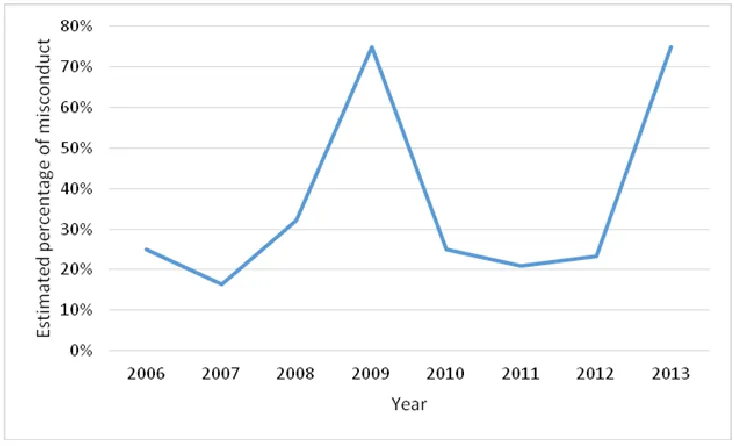
Fig. 1:Estimated percentage of research misconduct in performing thesis based on the acceptance year in the medi-cal university
Research misconduct was nearly twice in students accepted as guest in this university comparing to native ones (50% vs 26%). However, the least estimated misconduct belonged to transferred students (13%).
Discussion
According to the main results of this study, un-dergraduate students had an estimation of 19% research misconduct in performing the thesis while this was 26% of postgraduate students. Males were nearly two times comparing to fe-males in this issue (30% vs. 16%).
In a systematic review and meta-analysis study that was published in 2009, a pooled weighted average of 1.97% (N=7, 95%CI: 0.86–4.45) of scientists accepted to have fabricated, falsified or modified data or results at least once. In surveys about the behavior of colleagues, admission rates were 14.12% (N = 12, 95% CI: 9.91–19.72) for falsification and up to 72% for other questiona-ble research practices (17). Asking about others behaviors is an indirect method and is recom-mended for asking sensitive questions. This esti-mation was much closer to our estiesti-mation.
The true estimation of fraud in medical research is difficult for many reasons. Direct estimation via a survey of investigators, those who commit fraud are not likely to be forthcoming about hav-ing done. The underreport lead to iceberg phe-nomenon (18).
“When conducting medical research, one must abide by the ethical and moral obligations as out-lined by the Nuremberg code in 1947(19) and the subsequent Declaration of Helsinki 1964 (and later revised in 2002) (20, 21), which explain the responsibilities of scientists and physicians when conducting medical research on humans.” How-ever, despite these guides, there is a long history of fraud in medical researches (22-24).
study, undergraduate students had an estimation of 19% research misconduct in performing the thesis while this was 26% of postgraduate stu-dents. It may due to more statistical knowledge in postgraduate student that enable them to do data making the other reason maybe the restricted time and overloaded work in residency program. Few reasons were suggested for this phenomenon, but the most important underlying factors are to be successful in science and also a fear of failure (27).
Academic pressure, personal desire for fame, “sloppy” science, financial gain, and inability to determine right from wrong are a number of rea-sons why research misconduct takes place. Ethi-cal standards need to be made clear and there needs to be an alleviation of pressure on re-searchers, as well as greater control on medical researchers.
“It is time to consider what aspects of the re-search environment are most salient to rere-search integrity, which aspects are most amenable to change, and what changes are likely to be most fruitful in ensuring integrity in science”(26).
Conclusion
Undergraduate students had an estimation of 19% research misconduct in performing the the-sis while this was 26% of postgraduate students. This high estimation must be considered in fu-ture policy making about observing strictly on researches.
Ethical considerations
Ethical issues (Including plagiarism, informed consent, misconduct, data fabrication and/or fal-sification, double publication and/or submission, redundancy, etc.) have been completely observed by the authors.
Acknowledgements
This project was supported by Deputy Research of Mashhad University of Medical sciences.
Conflict of Interests
The authors declare that there is no conflict of interests.
References
1. Murdock TB, Beauchamp AS, Hinton A (2008). Predictors of cheating and cheating attribu-tions: Does classroom context influence cheating and blame for cheating? Eur J Psychol Educ, 23(4): 477-492.
2. Lin CHS, Wen LYM (2007). Academic disho-nesty in higher education: A nationwide study in Taiwan. J High Educ, 54(1): 85-97.
3. Murdock TB, Anderman EM (2006). Motiva-tional perspectives on student cheating: to-ward an integrated model of academic disho-nesty. Educ Psychol, 41(3): 129-145.
4. Breen KJ (2003). Misconduct in medical re-search: whose responsibility? Intern Med J, 33(4):186-91.
5. Sox HC, Rennie D (2006). Research misconduct, retraction, and cleansing the medical litera-ture: lessons from the Poehlman case. Ann In-tern Med, 144(8):609-13.
6. Zhang M, Grieneisen ML (2013). The impact of misconduct on the published medical and non-medical literature, and the news media.
Scientometrics, 96(2):573-587.
7. Pascal CB (2000). Scientific misconduct and re-search integrity for the bench scientist. Proc Soc Exp Biol Med, 224(4): 220-30.
8. Evans I (1998). Dealing with research miscon-duct in the United King-dom. Conduct
unbecoming--the MRC's approach. BMJ, 316(7146):1728-9. 9. Gilbert FJ, Denison AR (2003). Research
Mis-conduct. Clin Radiol, 58(7):499-504.
10. Khamesan A, Amiri MA (2011). The study of academic cheating among male and female students. Ethics in Science & Technology, 6(1):53-61. (In Persian)
11. Nikpour H. Investigation of medical students' opinions on research fraud in thesis and its frequency [MD thesis]. School of Medicine, Kerman University of Medical Sciences, Iran; 2004.
According to Committee on Publication Eth-ics (COPE). Iran J Basic Med Sci, 15(5):1003-7. 13. Nakhaei N, Nikpour H (2005). Investigation of
medical students' opinions on research fraud in thesis and its frequency. Strides Dev Med Educ, 2(1):10-17.
14. Warner SL (1965). Randomized Response: A Survey Technique for Eliminating Evasive Answer Bias. J Am Stat Assoc, 60(309):63-6. 15. Greenberg B G, Abul-Ela ALA, Horvitz DG
(1969). The Unrelated Question Randomized Response Model: Theoretical Framework. J Am Stat Assoc, 64(326):520-539.
16. Greenberg BG, Kuebler Jr RR, Abernathy JR, Horvitz DG (1971). Application of the Ran-domized Response Technique in Obtaining Quantitative Data. J Am Stat Assoc, 66(334): 243-250.
17. Fanelli D (2009). How Many Scientists Fabricate and Falsify Research? A Systematic Review and Meta-Analysis of Survey Data. PLoS One, 4(5):e5738.
18. George SL (1997). Perspectives on scientific misconduct and fraud in clinical trials. Chance, 10(4):3-5.
19. Shuster E (1997). Fifty years later: The signific-ance of the Nuremberg Code. NEngl J Med,
337(20):1436-40.
20. Ankier SI (2002). Dishonesty, misconduct and fraud in clinical research: An international problem. J Int Med Res, 30(4):357-65.
21. Christie B (2000). Doctors revise declaration of Helsinki. BMJ, 321(7266): 913.
22. Hamblin TJ (1981). Fake. Br Med J (Clin Res Ed), 283(6307): 1671-1674.
23. Franzen M, Rödder S, Weingart P (2007). Fraud: Causes and culprits as perceived by science and the media. Institutional changes, rather than individual motivations, encourage mis-conduct. EMBO Rep, 8(1): 3-7.
24. Westfall RS (1973). Newton and the fudge factor.
Science, 179(4075):751-8.
25. Ranstam J, Buyse M, George S et al (2000). Fraud in medical research: An international survey of biostatisticians. Control Clin Trials,
21(5):415-27.
26. Martinson B, Anderson M, De Vries R (2005). Scientists behaving badly. Nature,
435(7043):737-8.