USING DECOMPOSED THEORY OF
PLANNED BEHAVIOUR TO PREDICT
CUSTOMERS INTENTION TO ADOPT
ISLAMIC HOME FINANCING
AMINAT TITILAYOAJETUNMOBI
Faculty of Economics and Muamalat (FEM) Universiti Sains Islam Malaysia (USIM)
Bandar Baru Nilai, 71800 Nilai Negeri Sembilan Malaysia
NORHAZLINA IBRAHIM
Faculty of Economics and Muamalat (FEM)Universiti Sains Islam Malaysia (USIM) Bandar Baru Nilai, 71800 Nilai
Negeri Sembilan Malaysia
SUHAILA ABDUL HAMID
Faculty of Economics and Muamalat (FEM)Universiti Sains Islam Malaysia (USIM) Bandar Baru Nilai, 71800 Nilai
Negeri Sembilan Malaysia
Abstract
The perceptions of customers towards Islamic banking and its products is not a new area of research in Islamic finance. However, the previous studies mainly used the theory of reasoned action (TRA) and theory of planned behaviour (TPB). This study deems it necessary to decompose the factors that can influence human behaviour into the relevant variables in Islamic finance. Due to it is comprehensiveness and influence on perception, the study used the decomposed theory of planned behaviour (DTPB) to examine the factors that can influence homebuyers’ intention to adopt Islamic home financing. A survey was conducted among 518 potential homebuyers in Nigeria, and the data were subjected to structural equation modelling. The study results revealed that attitude, subjective norms and perceived behavioural control influence the customer's intention to adopt Islamic home financing in Nigeria, while knowledge of Islamic finance and cost-benefit influence their attitude towards the intention. The DTPB can be used to
understand customers’ intention to adopt Islamic financing products. This study offers bankers insight into important factors to market their products, and help lawmakers understand why they should promote Islamic finance.
Keywords: Adoption, Decomposed Theory of Planned Behaviour, Intention, Islamic Home Financing.
I.INTRODUCTION
societal development or benefit. Activities that involve interest (riba), gambling (my sir) and speculative trading (gharar) are prohibited. The principles of Islamic financing different from conventional financing. The fundamental principles of the Islamic financial system are developed based on partnership (mutual risk and profit sharing) (Ahmad, 2000; Chapra, 2000). Through these principles, Islamic banks operate different deposits, financing and other commercial transactions and services for the retail and corporate customers. Due to the prohibition of riba, they replace loans with financing by using a profit and loss sharing system based on Islamic principles of Mudharabah, Murabaha, Musharakah, and Ijarah instead of loaning money for money.
The ultimate goal and target of the conventional financing is profit. It does not really seek to help the borrowers who require financial assistance. They make their profits by charging interest which is added to the principal of the transaction. Thisis not Shariah-compliant and has made it difficult for many people to buy a house (Aminat & Norhazlina, 2016).However, Islamic finance uses sales and partnership for financing which is riba free and equitable. In equity financing, banks get their rewards and due shares in the form of profit in a pre-determined and mutually agreed ratio (Ahmad, 2000). Interest-free financing on the basis of mutual ownership is the best way out of this conventional financing predicament (Aminat & Norhazlina, 2016). Therefore, adopting Islamic home financing will ease people’s burden to acquire a house.
This study examines factors that can influence the homebuyers’ intention to adopt Islamic home financing. Attitude, subjective norms, and perceived behavioural control have been used by previous studies to examine the customers’ intention to adopt Islamic home financing (Amin et
at., 2012; Razak & Abdul, 2012). The present study seeks to overcome some of the limitations in previous studies by decomposing attitude into relevant variables that can measure customer attitude towards the adoption of Islamic home financing. Taylor& Todd (1995) suggested that researchers should consider using DTPB if they are looking for a more comprehensive perception of intention. This study employs DTPB because it is looking for an in-depth understanding of customers’ behaviour in the area of home financing.
Literature Review
Factors Influencing Customer Perceptions of Islamic Home Financing
Naser et al. (1999) added a bank’s reputation and perceived level of confidentiality to the criteria set by Haron et al. (1994). They also perceived a high level of ignorance regarding certain Islamic products and confirmed that religion is very important in selecting an Islamic bank. Likewise, Gerrard & Cunningham (1997) found no difference between Muslim and non-Muslim customers on bank selection criteria and noted that religion is the main basis for choosing an Islamic bank. In contrast to Metawa & Almossawi (1998), the most important factor in selecting an Islamic bank is the Shari’ah based principles that govern these financial institutions. Another study by Echchabi & Olaniyi (2012) on patronisation behaviour of Islamic bank customers in Malaysia used the theory of reasoned action to show that attitude and subjective norms have a positive effect on the intention to adopt Islamic banking services. They further stressed that reputation of the banks is critical in determining customer attitude towards the bank.
Concerning Islamic home financing, the major variables that have been found to be relevant to the perceptions of customers are knowledge and awareness, religion, bank reputation, etc. (Ismail et al., 2014; Siswantoro 2012; Alam et al., 2012). Others have used the theory of planned behaviour to measure customers’ perceptions of Islamic home financing and found the relationship between attitude, subjective norms and perceived behavioural control and the intention to adopt Islamic home financing (Razak & Abdul, 2012; Jamshidi, et al., 2014; Amin, et al., 2012).This study supports the theory of planned behaviour and in order to contribute to the body of knowledge and extends the theory to various relevant variables.
The Decomposed Theory of Planned Behaviour (DTPB)
In an attempt to understand people’s intention to adopt Islamic home financing, the decomposed theory of planned behaviour (DTPB) was chosen as a theoretical model for this research. DTPB is the extended TPB proposed by Taylor & Todd (1995) to overcome the limitations of TPB. The TPB is a further development of the Theory of Reasoned Action (TRA) to address the limitations identified in the original model in dealing with behaviour over which people have incomplete volitional controls (Ajzen, 1991).These theories suggested that attitude could explain human actions (Ajzen & Fishbeing, 1980).
The TPB focuses on the direct measures of attitude, subjective norms, and perceived behavioural control to predict one’s behaviour (Ajzen, 1991). However, itis not without criticism (Taylor & Todd, 1995). Among the limitations, as stated by Ajzen (1991) are that the theory does not account for other variables that factor into behavioural intention and motivation such as fear, threat, mood or experience and does not take into account environmental or economic factors that may influence a person’s intention to perform a particular behaviour. Therefore, Taylor & Todd (1995) proposed the extended theory of planned behaviour.
the relationship between belief and the antecedents of intention should become clearer and more readily understood. Second, decomposition can provide a stable set of beliefs, which can be applied across a variety of settings. Third, by focusing on specific beliefs, DTPB is more managerially relevant. Hence, this study employs DTB because of the larger number of factors that may influence the adoption of Islamic home financing.
In this study, DTPB explores attitudes, subjective norms, and perceived behavioural control by decomposing them into belief-based indirect measures. For instance, knowledge, religious obligation, bank reputation, accessibility, and cost-benefit explain attitudes: injunctive and descriptive explain subjective norms; and facilitative condition and self-efficacy explain perceived behavioural control. Taylor & Todd (1995) suggested that DTPB provides increased explanatory power and a more precise understanding of behaviour. In addition, it facilitates a more focused examination of the relationship among factors and their effects on the adoption and use of Islamic home financing products.
DTPB is widely used and validated for predicting behaviour intentions from attitude, subjective norms, and perceived behavioural control in both information technology and education studies (Taylor & Todd, 1995). As a result, the model provides a way to broadly understand how an individual’s attitudes, subjective norms and perceived behavioural control can influence his or her intention to adopt Islamic home financing. Many studies on Islamic finance (Jamshidi et al., 2014; Amin et al., 2014; Alam. et al., 2012) have shown the predictive power of TPB, due to the multidimensional of its components. Taylor and Todd suggested that researchers should consider using DTPB if they are looking for a more
comprehensive perception of intention. Consequently, this study selected this theoretical model to explore the perceptions of intentions of people to use Islamic home financing. Figure 1 show details of conceptual framework of this study. Methodology
In designing this research, it is of the utmost importance that appropriate choices of methods and procedures were made to enhance the validity of the study result. In response to this, a survey was conducted in Nigeria between August and October 2016.The sample was chosen using a stratified method by grouping the prospective home buyers in Nigeria based on geographical location. A total of 600 potential homebuyers from five cities within Nigeria were randomly selected. The five most populated cities were chosen to facilitate an effective response. The questionnaires were self-administered, with a total of 600 questionnaires distributed to the respondents in which 518 were completed and useful. The data were analysed using structural equation modelling (SEM, AMOS).
List of Hypotheses
H1: Attitude of customers towards the adoption of Islamic home financing positively affects their behavioural intentions.
H1a: Customer knowledge positively affects attitude to adopt Islamic home financing.
H1b: Religious obligation positively affects attitude to adopt Islamic home financing.
H1c: Accessibility positively affects attitude to adopt Islamic home financing.
H1d: Cost benefits positively affects attitude to adopt Islamic home financing.
H1e: Reputation positively affects attitude to adopt Islamic home financing.
H3: The perceived behavioural control of customers to adopt Islamic home financing positively affects behavioural intention.
H4: Customer behavioural intention to adopt Islamic home financing positively affects behaviour.
Confirmatory Factor Analysis (CFA)
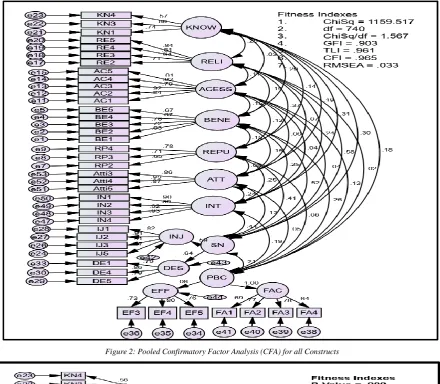
The 11 different measurement models (first-order latent variables) were evaluated for construct validity and uni-dimensionality. The main measurement item purification was conducted with multiple iterations of CFA through maximum likelihood estimation (MLE). The reason for this purification of items was to search for model specifications (Hair et al., 2006). Several indicators such as modification indexes squared multiple correlations and standard residuals covariance was examined to verify whether the modification was needed. As recommended by Hair et al. (2006) and Min & Mentzer (2004), before final deletion of any measurement item, qualitative review or theoretical assessment was made. In this purification process, a total of 13 items were removed from further analysis. We used the pooled CFA for all the constructs in the model as illustrated in Figure 2.
Based on the population discrepancy, and non-centrality parameter, the indicator represents per degree of freedom measured in terms of the population is GFI and RMSEA. These indicators were used as a reference in the analysis. GFI values for this model shows a good fit. The closer the GFI is to 1.00, the better the fit of the model to the data. The GFI value in this present model was 0.903. A GFI greater than 0.9 is considered good (Hair et al., 2010). Furthermore, the RMSEA value was within the recommended range of0.03. The cutoff points as suggested by Hair et al. (2010) and Hu & Bentler (1999) are in the range from 0.03 and 0.1.
Apart from RMSEA and GFI, other indices were used in this measurement model fit.
They all show a good fit which indicates that the model can be considered a good fit. It has been argued that the CFI values are the most important index since it accounts for sample size – a common bias in index calculations (Bentler, 1990). These models show excellent fit within the range of 0.965. The same applies to other indicators – AGFI and TLI, which all loaded well and aligned with the model fit suggested by Hair et al. (2010). This indicates that the model under consideration has a good fit. The details of fitness index are presented in Table 1.
Structural Model – Path Analysis
Figure 3 illustrates the relationship between the constructs in the study. In this context, the structural model was specified by the results obtained from the measurement models. From here, the relationship between the independent and dependents variables were built based on the proposed conceptual model. This structural model was formedto test the hypotheses of the study. The hypotheses were between the independent variables (knowledge, religious, accessibility, cost-benefit and bank reputation) and the dependent variable (attitude) and also, between independent variables (attitude, subjective norm and perceived behavioural control) and dependent variable (intention). Furthermore, the hypotheses have also taken into account the test of intention as a predictor of adoption. The structural model was then assessed for the validity of the relationship.
As demonstrated in Figure 3, the score for
often reported test statistics. The model fit indices results indicate that the model have an acceptable model fit (X2 = 1639.567; df = 807; X2/df = 2.032;
P= 0.000; TLI = 0.928; CFI = 0.932; RMSEA = 0.045). The result from the structural model is fit and can be used for hypotheses testing.
II.FINDINGS
Based on the structural model analysis, Table 3 shows the results of hypotheses testing for the respective paths in the model. Among all the constructs in the model, the strongest predictor of intention to use Islamic home financing is subjective norm with (β = 0.622, p-value = 0.000), followed by attitude (β = 0.378, p-value = 0.000), and the least predictor in the model is perceived behavioural control with (β = 0.143, p-value = 0.005) as illustrated in the table3.
Based on the findings from the SEM analysis, subjective norms emerged as the main predictor of intention to adopt Islamic home financing. This finding is consistent with the previous study of Islamic home financing by Razak & Abduh (2012) which found that customer intention is more influenced by subjective norm than other factors. Furthermore, these findings show that subjective norm is statistically significant at the level of 0.000 in relation to the intention to adopt Islamic home financing. This indicates that the greater the subjective norm, the higher the intention to adopt Islamic home financing in Nigeria. Thus, it can be suggested that the subjective norm significantly affects the intention to adopt Islamic home financing positively. The findings support the hypothesis: Subjective norm positively affects the intention to use Islamic home financing. Therefore, hypothesis 2 is supported.
The findings also indicated that perceived behavioural control is the least predictor in the model. However, being the least predictor does not mean it is not significant; it estimates 0.143beta of
the path, and significant at 0.005. The finding indicates that perceived behavioural control has positive effects on the intention to adopt Islamic home financing. This finding is consistent with the former study on the adoption of Islamic banking products and services by Ayedh et al. (2014) which reveals that the Yemeni customers are willing to adopt Islamic banking services while the main factors that influence this decision are the environmental factors and decision-making control. Therefore, the more the customer controls their decisions, the higher their intention to adopt Islamic home financing in Nigeria. Hence, it can be suggested that perceived behavioural control significantly affects the intention to adopt Islamic home financing positively. Thus, the findings support the hypothesis: Perceived behavioural control positively affects the intention to use Islamic home financing. Therefore, hypothesis 3 is supported.
adopt Islamic home financing. Thus, the hypothesis 1 is supported.
This study also decomposed attitude into relevant variables. As suggested by Ajzen (1991), the TPB can include other external variables if it captures a significant proportion of the variance in intention or behaviour. For this reason, this study decomposed the construct into relevant variables. Attitude comprised five variables; knowledge, religious, accessibility, reputation and cost-benefit. Although the result from SEM analysis indicates a positive path coefficient on these constructs in relation to attitude, only knowledge, religious obligation and cost-benefit were statistically significant. Others are not statistically significant. Therefore, hypothesis 1a: Customer knowledge positively affect attitude to adopt Islamic home financing; 1b: Religious obligation positively affects attitude to adopt Islamic home financing and 1d: Cost-benefit positively affects attitude to adopt Islamic home financing are supported. In contrast, accessibility and reputation are not statistically significant but have positive path coefficients.
This is consistent with the previous study by Rashid et al. (2009) which found cost-benefit as one of the factors that affect attitude towards Islamic banks. Furthermore, Ahmad & Haron (2002) and Khattak (2011) found that the level of knowledge of customer on Islamic bank is a factor affecting their perception. Tara et al. (2014) also find religious obligation as important factor influencing customer perception in adopting Islamic banking. Therefore, hypotheses 1a, 1b and 1d are supported. Overall, the intention of customers positively affects the adoption of Islamic home financing and is significant at (p-value = 0.000). Therefore, hypothesis 4: Customer behavioural intention has a significant effect on behaviour is supported. This result is consistent
with Ajzen (1991) which suggested that behavioural intention is the most important factor in predicting the decision to take a specific action. Given the close relationship between the intention and behaviour, previous studies have used behavioural intention to predict specific behaviour (Ayedh et al., 2014; Amin et al., 2012; Elchachabi & Aziz, 2012). Thus, in accordance with the rule of this model, the more positive the attitude and subjective norms are towards Islamic home financing, the greater the perceived control, and the stronger the individual’s intention to adopt Islamic home financing.
III.CONCLUSION
This study decomposed the TPB into the factors relevant for Islamic finance to examine the effects of attitude, subjective norms and perceived behavioural control on the intention to adopt Islamic home financing. The result indicated that subjective norm is the strongest factor that influenced the customer intention. In other words, Nigerians’ intention to adopt Islamic home financing is influenced most by subjective norms compared to attitude and perceived behavioural control. This shows that customers care mostly about what others are doing or whether they approve what they are doing or not. Hence, Nigerians do not just go for any product unless they get approval from their relatives. Relatives and friends influence Nigerians’ buying behaviour (Omar, 2007). Therefore, the two variables that measure subjective norms (injunctive and descriptive) are vital.
influence customers’ attitude. While accessibility and bank reputation have no significant effect on customers’ attitude. Therefore, it can be suggested that knowledge, religious obligation and cost-benefit have great impacts on a customer’s attitude in adopting Islamic home financing in Nigeria. Although, two factors have no significant effect on attitude, yet attitude is the second prominent factor to influence customer intention to adopt Islamic home financing in Nigeria. This indicates that the higher the positive attitude of the customer towards the Islamic home financing, the stronger their intention to adopt.
The last factor which influences the intention of the customer is perceived behavioural control. In the case of this study, perceived behavioural control was measured by two sub-constructs which are self-efficacy and facilitative condition. This study shows that self-efficacy and facilitative conditions have been the most important factor in measuring perceived behavioural control. This indicates that Islamic banks need some facilitators to market their products. Self-efficacy is
the control individuals have on the condition that may act as a barrier to their intention. Therefore, this study suggests that Islamic banks should consider facilitative condition and self-efficacy of customers in order to compete with conventional banking. In general, the effect of these factors on house acquisition is positive. Therefore, it can be suggested that the higher the customers’ intention of Islamic home financing, the higher the adoption of Islamic home financing. Finally, this study suggests that a positive attitude, support from subjective norms and perceived behaviour control are important factors for positive behaviour intention towards Islamic home financing adoption. The present study examined three geographical areas (North, East and West) in Nigeria which include the three recognised religions (Muslim, Christian and Traditional).Therefore, the result can be generalised to Nigeria as a whole. However, future research could engage in a cross-country study concerning the adoption of Islamic home financing by including Muslim minority states.
Figure 1: Conceptual framework for people’s perception of Islamic home financing, based on the Decomposed Theory of Planned
Behaviour
Figure 2: Pooled Confirmatory Factor Analysis (CFA) for all Constructs
Figure 3: Standardised Regression Weight for every path in the model
Table 1: Fitness Index for the Measurement Model
Name of Category Name of Index Index Value Comments
1. Absolute fit RMSEA 0.033 The required level is achieved GFI 0.903 The required level is achieved 2. Incremental fit
TLI 0.961 The required level is achieved CFI 0.965 The required level is achieved 3. Parsimonious fit Chisq/df 1.567 The required level is achieved
Source: Primary data of the study
Table 2: CFA Results for the Measurement Model after Item Deletion
Construct
Cronbach Alpha (Above 0.7)
Composite Reliability (Above 0.6)
Average Variance Extracted (Above 0.5)
Intention 0.950 0.951 0.828
Attitude 0.860 0.920 0.923
Knowledge 0.737 0.750 0.504
Religious Obligation 0.838 0.841 0.573
Access 0.921 0.921 0.701
Cost-Benefit 0.817 0.820 0.500
Bank Reputation 0.759 0.761 0.516
Injunctive Norm 0.929 0.931 0.603
Descriptive Norm 0.855 0.858 0.668
Subjective Norm 0.860 0.549 0.379
Perceived Behavioural
Control 0.700 0.709 0.558
Self-Efficacy 0.801 0.804 0.579
Facilitative Condition 0.808 0.813 0.522
Source: Primary data of the study
Table 3: Standardised Estimates for Every Path in the Model
Estimate S.E. C.R. P-Value Result Attitude <--- Knowledge 0.103 0.061 2.007 0.045 Significant Attitude <--- Religious 0.099 0.059 2.005 0.045 Significant Attitude <--- Accessibility 0.049 0.040 1.053 0.292 Not Significant Attitude <--- Benefit 0.103 0.066 2.061 0.039 Significant Attitude <--- Reputation 0.074 0.065 1.457 0.145 Not Significant Intention <--- SN 0.622 0.265 4.322 *** Significant Intention <--- Attitude 0.378 0.164 4.754 *** Significant Intention <--- PBC 0.143 0.073 2.800 0.005 Significant Adoption <--- Intention 0.742 0.038 22.162 *** Significant
Note: *** indicates item is significant at <0.001
Source: Primary data of the study
IV.REFERENCES
1) Abdul Razak, D., & Abduh, M. (2012). Customers Attitude towards Diminishing Partnership Home Financing in Islamic Bank. American Journal of Applied Sciences, 9(4), 593–599.
2) Ahmed, S. A. (2000). Global Need for a New Economic Concept: Islamic Economics. International Journal of Islamic Financial Services.1(4).
3) Ahmad, N., & Haron, S. (2002). Perceptions of Malaysian corporate customers towards Islamic banking products and services. International Journal of Islamic Financial Services, 3(4), 13–29.
4) Ajzen, I. (1991). The theory of planned behavior. Organizational Behavior and Human Decision Processes, Dec(50), 179–211. 5) Ajzen, I. (2006). Constructing a TpB