Developing Scientific Citizenship Identity Using Mobile Learning and Authentic Practice
Duane E. Wallace Lehigh University, USA
Alec M. Bodzin Lehigh University
Abstract
This quasi-experimental study examined how the approach of mobile learning and authentic practice (MobiLAP) may foster scientific citizenship among ninth grade students. It was hypothesized that students that form identities as citizen scientists may have more favorable attitudes to contribute to citizen science, have greater interest in science and technology and may be more interested in pursuing education and careers in science, technology, engineering and math (STEM). The treatment group participated in an authentic citizen science project where they studied climate change, spent time in nature and used mobile devices to observe and report phenological data. The control group had a “business as usual” classroom experience studying climate change. The Scientific Citizenship, STEM Interest and Mobile Learning Survey (SCI-ML) instrument was developed to understand students’ citizen science identity formation and was administered to both groups pre and post intervention. The instrument was found to be highly reliable for both the entire scale and each of the four subscales. Findings revealed that the MobiLAP approach had a significant impact on participant attitudes toward citizen science identity and careers in STEM areas, but no significant improvement in attitudes toward mobile learning or learning science and technology.
Key words: authentic practice, citizen science, climate change, identity, mobile learning, STEM, technology, science
Please address all correspondence to: Duane Wallace, Lehigh University, A109 Iacocca Hall, Bethlehem PA - [email protected]
Introduction
found to increase public knowledge in science and the scientific process (Bonney, Phillips, Ballard, & Enck, 2016).
While citizen science may seem to be a new trend in ecology and the environmental sciences, its roots can be traced back to the early stages of modern science and demonstrate humankind’s innate curiosity about the world. Individuals such as Benjamin Franklin and Charles Darwin were not professional scientists, but rather regular citizens who systematically observed and experimented within their respective scientific interests (Silvertown, 2009). In the United States, the origins of citizen science may coincide with the work of Wells W. Cooke’s bird migration program (Cooke & Merriam, 1888) which began in 1881 and eventually developed into the North American Bird Phenology Program (U.S. Geological Survey, 2016). Cooke’s program began with his migratory bird observations in the Mississippi Valley and led him to solicit observations from ornithologists and eventually from common citizens such as farmers and lighthouse keepers.
The information age has exponentially increased citizen science projects and contributions with amateur scientists utilizing smart phones and the internet to observe and record data for real-world studies. Citizen science now spans continental and global scales with hundreds of thousands of observations recorded (Havens & Henderson, 2013). One of the primary foci of modern citizen science is examining how climate change affects life on our planet.
Understanding climate change is important because it affects nearly all systems on our planet. As more human actions disrupt climate, there is a greater the risk of severe, global and irreparable consequences (Pachauri et al., 2014). According to NASA's analysis of global surface temperatures and Arctic sea ice, 2016 was predicted to become the hottest year ever recorded since record-keeping began in 1880 (Lynch, 2016). This continues the trend of increasingly warmer global temperatures with the 10 warmest years on record taking place after 1998 (NASA’s Jet Propulsion Laboratory, 2016). Climate change may continue to harm the planet by contributing to rising sea levels, natural disasters, desertification, spread of death and disease, extinction of species, ocean acidification and a decline in plant and animal life (Pachauri & Reisinger, 2007).
Climate change caused by warming temperatures also impacts the timing of observable changes in life cycle events in plants and animals (Fitchett, Grab, & Thompson, 2015). These phenophases control migration patterns, breeding, metamorphosis, hibernation and stages of growth. Warming temperatures are directly related to earlier spring and later autumn phenology that artificially extend the growing season (Ibáñez et al., 2010). If nature’s timing is altered, the impact can be significant in terms of desynchronizing phenologies for countless interdependent species (Gilman, Fabina, Abbott, & Rafferty, 2012). This asynchrony may lead to the extinction of numerous mutualistic populations (Memmott, Craze, Waser, & Price, 2007). Advancing the flowering phase may impact the relationship between plants and pollinators, which affects the plant-herbivore dynamic and can have consequences for the entire food chain in an ecosystem.
of climate change research, it seems, has not correlated with public perception (Etkin & Ho, 2007). Educating society in this area may be particularly difficult as this subject may challenge a person’s worldview (Priest, 2013) and despite a myriad of evidence and scientific research, there still exists a widely contested debate on the matter by the general public (Douglas & Sutton, 2015). There are factions of the U.S. population that reject the very existence of anthropogenic climate change (Dunlap & Jacques, 2013). This denial is often a deeply-rooted belief that is closely aligned to an individual’s political affiliation (Dickinson, Crain, Yalowitz, & Cherry, 2013) and one’s sense of self (McCright & Dunlap, 2011). It is apparent that this vital topic is vastly misunderstood and steps must be taken to educate those who may not recognize its impact. In addition, it is important that citizens understand how they contribute to anthropogenic climate change and understand that there are actions that can be taken to mitigate human-induced causes of climate change.
Citizen science participation offers learners a way to contribute to climate change research and creates real and meaningful opportunities for individuals to enact change in their communities and their identities (Meyer et al., 2014). This study aims to understand how students may develop scientific citizenship using a learning approach with mobile learning and authentic practice (MobiLAP) when taking part in a citizen science project. It is hypothesized that this approach will create the potential for scientific citizenship identity formation. If students develop identities as citizen scientists, they may be more likely to participate in future scientific citizenship programs, seek additional science, technology, engineering and math (STEM) education (Price & Lee, 2013), pursue STEM careers (Hiller & Kitsantas, 2014) and may be more inclined to take part in pro-environmental thinking and decision-making (Johnson et al., 2014).
Literature Review
Research suggests that the state of STEM learning in the United States is not adequately preparing students for the demands of today’s economy and the economy of the future (National Research Council, 2011; National Science Board, 2007). Engaging in citizen science practices may be a way to address this issue. Studies have shown that citizen science participation can increase scientific literacy (Jordan, Gray, Howe, Brooks, & Ehrenfeld, 2011), positive attitudes toward science (Price & Lee, 2013), personal engagement in science (Crall, et al., 2013), knowledge of the scientific process (Garbarino & Mason, 2016), conservation efforts (Toomey & Domroese, 2013) and student motivation toward pursuing STEM careers (Hiller & Kitsantas, 2014). A study by Price and Lee (2013) revealed that while attitudes toward science and citizen science increased after intervention, participants’ self-evaluation of scientific knowledge significantly decreased. Interviewees had an appreciation for knowledge yet to be learned.
Citizen science has often gone uncredited in terms of its contributions to science. In a study of 173 original research papers on the effects of climate change on migratory birds, Cooper, Shirk and Zuckerberg (2014) found that nearly fifty percent of the studies relied on contributions from citizen scientists. This indicates both the need for and credibility of citizen science in terms of contributing to global change research. The data gleaned from scientific citizenship have even been used to provide policymakers with the insight needed to make environmental decisions (Cohn, 2008).
promise in creating transformational learning opportunities in high school students in which an individual’s educational and career path may be altered (Walker & Molnar, 2014) and can even lead to a shift in identity (Farnsworth, 2010).
Luehmann (2009) defined identity as an individual’s “recognition as a certain kind of person” (p. 52). This recognition stems from one’s engagement in everyday, contextual experiences. Authentic learning enables students to take part in realistic tasks using real-world tools and resources while thinking and acting like professionals in order to address legitimate problems (Herrington, Parker, & Boase-Jelinek, 2014). It is important to note that being engaged in activity is vital to identity formation in addition to the interpretation or recognition of engaging in said activities (Gee, 2005). As learners take part in authentic scientific practice and have the opportunity to reflect on these actions, changes to their perceptions and attitudes about science may take place (Toomey & Domroese, 2013).
A change in one’s identity may not be an individual endeavor. Wenger’s (1998) social theory of learning points to the impact of social participation and recognition as key components of identity development. Likewise, the context in which authentic learning experiences takes place plays a major role in terms of identity formation. Learners develop identities during school (Rubin, 2007), in after-school programs (Luehmann, 2009), in informal settings (Cole, 2012) and even virtually (Gaydos & Squire, 2012). A study conducted by Hughes, Nzekwe, and Molyneaux (2013) revealed significant positive changes in STEM identities in students that took part in authentic STEM activities.
The identification as a certain kind of person can have lifelong effects on an individual (Flum & Kaplan, 2012). Most adults can quickly recall their favorite subject during their high school years. That particular subject or content area may have had a significant impact on the adult’s life and career choices. Learning about a particular subject in school can help shape student identities and may be a contributing factor to a student’s world view (Lave & Wenger, 1991). Identity theory (Burke & Stets, 2009; Stryker, 1980) contends that each individual in today’s society has multiple identity roles that correspond to the varying roles they play in society. Learners may identify a certain way while in a group, such as a classroom setting or team, but may identify in different ways in other social situations. For example, a sophomore in high school may identify as an “Environmental Science Club” member on Thursdays during a weekly meeting, but may not identify as such in other instances. Identity is a fluid process that shifts according to context. In order to form a lasting identity, learners should have a truly transformative experience that changes perceptions, frames of reference and habits of mind.
Mobile Learning
Many of the tasks required in citizen science projects can be completed by using mobile technologies (Devisch & Veestraeten, 2013). For instance, a smartphone may be used to record the latitude, longitude and altitude of a species in addition to collecting other information such as specimen photos and phenophase. The use of mobile devices seems to go “hand in hand” with many citizen science activities as students attain authentic experiences when they attempt to solve real-world issues and contribute to research by learning, collaborating, observing, collecting, reflecting and submitting relevant data (Oberhauser & LeBuhn, 2012).
Using mobile technologies as part of an authentic practice can act as an important bridge between the formal classroom and real-life contexts (Liljeström, Enkenberg, & Pöllänen, 2013) and may extend learning beyond a classroom-based activity. Students may continue to use mobile devices to explore and learn while outside of a formal learning environment (Baloch, Abdulrhaman, & Ihad, 2012; Clough, 2010; Mills, Knezek, & Khaddage, 2014). Thus, mobile technologies have much potential to expand on requisite classroom learning to a learners’ self interest. If students become interested in a topic, they may continue learning on their own time which may further stimulate identity development.
Gaydos and Squire (2012) conducted a study that examined student identity as citizen scientists after playing a video game entitled “Citizen Science”. Throughout the game, students solved problems related to the pollution of a virtual lake system. The goal was to foster student identity as a citizen scientist, which would ultimately lead students to care more for the lakes in their own respective communities. The results, although limited by a brief four-day intervention, found that students had increased their interest, knowledge, skills, and values toward becoming a citizen scientist. Although the activity was not completely authentic, one could argue that since the learning simulation did have an authentic, real-life context, the student learning activity could be considered to involve authentic science practices. In a study by Ruiz-Mallén et al. (2016), secondary school students took part in a long-term citizen science project which caused participants to reframe their attitudes and perceptions of science and lead them toward generating ideas of self as legitimate, empowered, competent and informed actors. Thus, it appears that citizen science can create transformative learning experiences with participants.
The Mobile Learning and Authentic Practice (MobiLAP) Approach
MobiLAP is one promising approach that integrates citizen science, mobile learning and authentic practice. The efficacy of this type of approach was evident in a study by Liljeström et al. (2013). Participants in this study used mobile phones, digital cameras and GPS devises to capture observations, take field notes and transfer data during out-of-school activities. Mobile learning technologies propelled the learning and practices toward more expert-like practices. This study demonstrated how classroom instruction, mobile learning and authentic scientific inquiry enhanced scientific learning in participants’ learning practices. Moreover, Herrington and Parker (2013) cite the potential for knowledge scaffolding, collaboration and the use of emerging technologies as cognitive tools when learners pair mobile learning with authentic tasks.
leveraging their access and ability with the devices seems a promising approach toward citizen science contribution. The MobiLAP approach also holds promise for contributing to citizen science identity formation. The ubiquity of mobile devices and their prevalence as tools in citizen science creates a combination that may stimulate citizen science identities in participants. We hypothesized that students who take part in the MobiLAP approach will have an increased interest in science and technology, increased interest in STEM careers and education, and increased attitudes and perceptions toward their respective identities as citizen scientists.
Research Questions
The importance of creating lifelong educational and career interest in science and technology related fields may be directly tied to the formation of citizen science identity. Based on this premise, this study addresses the following research questions:
How does high school student interest in science and technology change after taking part in the MobiLAP approach?
How does the MobiLAP approach impact high school students in terms of college and career interest?
How do high school students perceive their identity in regard to scientific citizenship after taking part in the MobiLAP approach?
Method Section
Participants
A convenience sample of 78 ninth grade students (31 males and 47 females) ages 14-15 years was selected from six biology classes at a high school in the eastern United States. The six classes ranged from six students to 30 students for a total of 120 students. Forty-two students were not able to participate due to non-submission of permission forms, health forms, field trip forms or because of absence. The demographic distribution for the students was 40% White, 15% Black or African American, 15% Asian, 3% American Indian and Alaska Native, 3% Native Hawaiian and Other Pacific Islander and 24% identifying as “Some Other Race”. High school students were selected as the target population because at this age, identities may be developed through learning and career decisions may not yet be finalized. In addition, individuals at this grade level are likely to have experience with technology, such as Web browsers, smartphones, apps, etc. and it is highly likely that they may own smartphones themselves.
Three intact classes were randomly assigned to the control group while the other three classes were assigned to the intervention group. The purpose of assigning classes in this manner was to create an efficient way of conducting the intervention with students by class. Logistically, it would not be feasible to separate the participants via other sampling methods such as random sample. One group of three intact classes (n=39) took part in the experiment, while the remaining three classes (n=39) acted as the control group and had a “business as usual” classroom experience.
Design
Instruments
The Scientific Citizenship, STEM Interest and Mobile Learning (SCI-ML) Survey (see Appendix A) is a 41 item quantitative scale developed to measure how mobile learning and the authentic practice of participating in a citizen science project may impact citizen science identity formation, perceptions of mobile learning and interest in STEM related fields. The instrument consists of four subsections. The first subsection includes ten items related to science and technology learning; select items include I plan to take more science classes in high school, More time in the school day should be devoted to science and I enjoy using technology to learn science. The second subscale has eight items related to science and technology careers; select items include Working in technology would be interesting, I would NOT enjoy a job in technology and I will probably choose a job that involves using technology. The third subsection includes thirteen items related to citizen science identity; select items for this subsection include Contributing data/information to Citizen Science is important for the planet, I want to be a Citizen Scientist and I feel like a Citizen Scientist. The final of the four subsections has ten items related to mobile learning; select items for this subsection include Using mobile technologies helps me learn, I use mobile technologies for schoolwork and Mobile technologies make learning fun. Participants responded to each item with responses based on a Likert-type scale of 1 (strongly disagree) to 5 (strongly agree). The possible scores for the entire SCI-ML survey range from 41-205. Participants in the intervention group responded to six additional open-ended questions following the intervention (see Appendix B).
We developed the SCI-ML survey by reviewing existing instruments in the literature related to student interest in STEM, mobile learning and citizen science identity. Two subscales from the SCI-ML instrument were derived from the Student Interest in Technology and Science (SITS) Survey (Romine, Sadler, Presley, & Klosterman, 2014). The SITS instrument has three subscales; however, only two of the original subscales were modified for use in the SCI-ML instrument: Ideas about learning and Ideas about careers. The Cronbach's alpha for both of these subscales was .80 for the original SITS study.
To validate the SCI-ML instrument, two independent experts in the fields of environmental science and education reviewed the SCI-ML instrument and offered feedback for several items. In addition, a student in the target population age took part in pilot testing the survey and reviewed the language used for each question. A few minor wording and formatting changes were made to increase the validity of the instrument.
Table 2
Pearson correlations for main study variables
Ideas about science and technology
Ideas about careers Ideas about citizen science
Ideas about science and technology 1 .539** .534**
Ideas about careers .539** 1 .544**
Ideas about citizen science .534** .544** 1
**Correlation is significant at the 0.01 level (2-tailed).
Procedures
In order to have a successful citizen science project, there must be a certain level of resources available and training provided to participants (Cox et al., 2015). The literature recognizes, however, that there may be a challenge in providing training to these amateur scientists in order to get the most out of their participation (Roy, Baxter, Saunders, & Pocock, 2016; Starr et al., 2014). Geographic location, subject matter knowledge and technological proficiency are all areas that may impact an individual’s training and subsequent contributions. Training via in-person or video training methods are essential for participants to collect and contribute data to citizen science projects (Starr et al., 2014; Vermeiren, Muno, Zimmer, & Sheaves, 2016).
Participants in both the control group and intervention groups completed The Scientific Citizenship, STEM Interest and Mobile Learning Survey (SCI-ML) at two time points - pre-intervention and post-intervention over the course of a four-day period in October, 2015. Each survey was identical with the exception of a six-item open-ended questionnaire (Appendix B) that was given only to the intervention group after the intervention. The purpose of the open-ended questions was to gain further insight about student interest in STEM careers and education, citizen science identity, and mobile learning.
The control group completed a “business as usual” classroom experience in which they were presented with a lesson on global warming and climate change from the classroom biology teacher. Following the lesson, participants were arranged in teams of three and began working together on a group presentation about climate change and its effect on plant and animal species. Students were given time in class to work on this assignment and continued the project for homework over the next three days. After
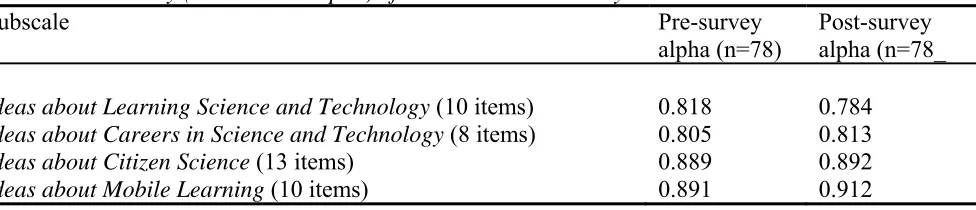
Table 1
Internal consistency (Cronbach’s alpha) of SCI-ML instrument by subscale
Subscale Pre-survey
alpha (n=78)
Post-survey alpha (n=78_
Ideas about Learning Science and Technology (10 items) 0.818 0.784 Ideas about Careers in Science and Technology (8 items) 0.805 0.813
Ideas about Citizen Science (13 items) 0.889 0.892
completing the assignment, participants presented their findings to their peers and instructor in the form of a group presentation. Following the presentations, participants again completed the SCI-ML survey.
The intervention group was presented with the same lesson on global warming and climate change from the classroom biology teacher. Following the lesson, this group did not complete a group presentation on climate change. Instead, they were introduced to a national citizen science research project, Project Budburst (Chicago Botanical Garden, 2015). In this large-scale citizen science project, amateur scientists around the country collect plant and tree data in an effort to better understand the effects of climate change on plant species. The study examines phenophase data to determine if the trend of increasingly warmer temperatures affects phenological events and thus impacts micro and macroclimates. The duration of the intervention group learning activities and control group activities were the same.
Collecting data for Project BudBurst required the use of several mobile technologies. Using a bring your own device (BYOD) approach, students used their own smartphones to gather data in the project. In order to accurately identify tree species, participants were given instruction on the use of the Leafsnap app
(Columbia University, 2011). This app uses a smartphone’s built-in camera along with an algorithm to identify plant and tree species by taking and uploading photos of the leaf that is being investigated. The location of each species sampled was determined by using the Where Am I At app (Admapps, 2015) that
displays the latitude, longitude and altitude of the targeted site. The majority of students in the intervention group (n = 31) owned iPhones and were able to download the apps for free. Participants that did not own an iPhone were paired with those who did. Students were familiarized with the Project Budburst observation report, a form where they would record information on tree sample data such as species, phenophase (leaves blooming, flowering, changing color or falling), date, time, and location.
Participants in the intervention group took part in a field trip to a nearby natural area with a large assortment of tree species in order to collect data for Project Budburst. Working in teams of two or three, participants gathered data for Project Budburst. Students walked along hiking trails and used the Leafsnap
app to identify tree species, the Where Am I At app to capture sample locations and the Project Budburst
observation report to record all of the data. In addition, participants utilized camera apps to take photos of the local environment and collected leaves as physical evidence to examine further later in the classroom.
Once back in the classroom, participants in the intervention group, confirmed the identity of each collected leaf sample by cross-referencing physical evidence with classroom resources. Once tree species were validated, each student submitted their data to Project Budburst via the online submission form located at the project Web site. After completing the project, participants again completed the SCI-ML instrument and the six open-ended questions. The intent of the open ended questions was to gain additional insight into student perceptions about the citizen science project.
Data Collection and Analysis
the intervention group (129.15). A t-test was conducted to compare the two pre-test means. The two pretest means were found to be not statistically significantly different (p >.05).
Results
The SCI-ML instrument was used to address the study’s three research questions that examined student interest in science and technology, interest in STEM education and careers and citizen science identity. Each research question corresponded with a subscale in the instrument. These subscales were Ideas about learning (research question 1), Ideas about careers (research question 2) and Ideas about citizen science (research question 3).
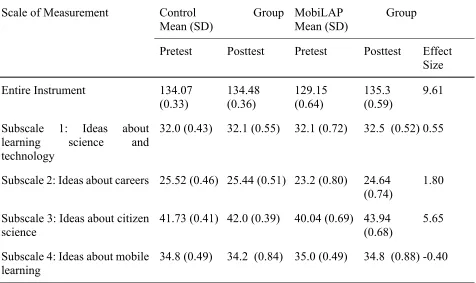
The MobiLAP group means for the entire SCI-ML instrument were 129.15 (pre) and 135.30 (post) with standard deviations of 0.64 and 0.59 respectively. The control group means were 134.07 (pre) and 134.48 (post) with standard deviations of 0.33 and 0.36. The means and standard deviations for each subscale of the instrument are listed in Table 3.
Table 3
Means and Standard Deviations of the pre and posttest scores for the entire SCI-ML instrument and its subscales by the type of intervention.
Scale of Measurement Control Group
Mean (SD)
MobiLAP Group
Mean (SD)
Pretest Posttest Pretest Posttest Effect
Size
Entire Instrument 134.07
(0.33)
134.48 (0.36)
129.15 (0.64)
135.3 (0.59)
9.61
Subscale 1: Ideas about
learning science and
technology
32.0 (0.43) 32.1 (0.55) 32.1 (0.72) 32.5 (0.52) 0.55
Subscale 2: Ideas about careers 25.52 (0.46) 25.44 (0.51) 23.2 (0.80) 24.64 (0.74)
1.80
Subscale 3: Ideas about citizen science
41.73 (0.41) 42.0 (0.39) 40.04 (0.69) 43.94 (0.68)
5.65
Subscale 4: Ideas about mobile learning
34.8 (0.49) 34.2 (0.84) 35.0 (0.49) 34.8 (0.88) -0.40
= 0.003]. However, there was a significant interaction between the different time periods and the type of intervention that was used [F(1, 76) = 4.86, p = 0.030, partial eta2 = 0.060]. Further analysis using pairwise t-tests revealed that the post-survey scores on the entire SCI-ML instrument significantly increased compared to the pre-survey scores for the intervention group (t(38) = 2.38, p = 0.023) but not for control group (t(38) = -0.80, p = 0.431).
To further understand the intervention’s impact, each of the instrument’s four subscales was analyzed individually using a two-way mixed ANOVA design at a level of significance of 0.05. Results indicating significant interactions were further analyzed with pairwise t-tests. The Ideas about Careers subscale showed a main effect of time [F(1,76) = 4.42, p = 0.039, partial eta2 = 0.055] but there was no main effect of the type of intervention [F(1,76) = 1.97, p = 0.165, partial eta2 = 0.025]. There was a significant interaction with this subscale between the effect of time and the type of intervention used [F(1,76) = 5.094, p =0.027, partial eta2 = 0.063]. There was a significant main effect of time [F(1,76) = 16.98, p < 0.001, partial eta2 = 0.181] but there was no main effect of the type of intervention [F(1,76) = 0.005, p = 0.941, partial eta2 < 0.001] for the Ideas about Citizen Science subscale. This subscale showed a significant interaction between the time it was completed and the type of intervention [F(1,76) = 13.33, p < 0.001, partial eta2 = 0.150]. Further analysis using pairwise t-tests showed that the post-survey scores on this subscale were significantly greater compared to the pre-survey scores for the intervention group (t(38) = 3.93, p < 0.001) but not for control group (t(38) = 3.91, p = < 0.001). There were no significant interactions found with the Ideas about Learning Science and Technology subscale nor the Ideas about Mobile Learning subscale.
Participants in the intervention group (n = 39) were presented with six additional open-ended questions after the intervention designed to further understand attitudes toward and perceptions of taking part in a citizen science project. The majority of students did not respond to every open-ended item. Twenty five percent (n=10) responded to all six questions while 28% (n=11) did not respond to any of the open-ended questions. Thirteen students (33% of the intervention group participants) recorded a favorable opinion with regards to taking part in the citizen science project.
Several students noted that the project made science and citizen science “seem more real” and enjoyed playing an active role in an authentic scientific study. Four students indicated the importance of citizen science, in terms of environmental awareness and taking care of the planet. When asked what they enjoyed most about the citizen science project, the majority of student respondents (n=20) cited that the activity took place in nature and outside of the regular classroom experience. Participants said that they most enjoyed “exploring nature and helping science”, “helping the environment” and “finding leaves”.
Eleven participants found at least one aspect that they did not like about the project. Nearly half of these non-favorable responses dealt with the physical nature of being outside and/or hiking. It may be of interest to note that two of the students had a negative opinion because they wanted more time and freedom to find different leaves for the project, specifically mentioning “not being able to walk off trail and find leaves”.
In summary, research question one addressed how high school student interest in science and technology changed after taking part in the MobiLAP approach. Findings revealed that interest in science and technology significantly increased with students who used the MobiLAP approach. Research question two addressed the impact of the MobiLAP approach on high school students’ college and career interest. Findings revealed that students that took part in the MobiLAP group had a significantly increased interest in STEM careers and education. Finally, research question three considered the impact of the MobiLAP project on citizen science identity in participants. Findings revealed that students who used the MobiLAP had significantly increased attitudes and perceptions of self as citizen scientists.
Discussion
The aim of this study was to understand how implementing a mobile learning and authentic practice approach within a citizen science context fosters citizen science identities. This research also hoped to identify the ways in which mobile learning and interest in STEM education and careers are impacted after taking part in the MobiLAP approach. Considering a brief four-day intervention, the results revealed that introducing the MobiLAP approach has potential to help form citizen science identity and increasing interest in STEM with ninth grade high school students.
The MobiLAP study supports the findings from Price and Lee’s (2013) research in that participant attitudes toward citizen science significantly improved after intervention. Likewise, participant identity as citizen scientists increased as was the case in the study by Gaydos and Squire (2012). This approach also proved to significantly improve interest in STEM related careers and education which coincides with the research findings of Hiller and Kitsantas (2014).
This study employed a BYOD approach in which participants had familiarity with using their own mobile devices. The majority of participants owned iPhones that allowed them to download the Leafsnap app and Where Am I At app at no cost. After the intervention, six participants used these mobile technologies on their own time, thus illustrating the ubiquity of mobile learning and the potential for intrinsic learning outside of the school environment.
An important component of this study is the development of the SCI-ML instrument. To our knowledge, there is no currently existing tool to measure citizen science identity that takes into account mobile learning. We believe that the development SCI-ML instrument makes an important contribution to the literature and will hopefully serve as a valuable resource to the science education community, especially those who are interested in citizen science projects. Understanding how citizen science identities are formed may further promote the important work of amateur scientists and help the public understand important issues such as climate change.
how this approach may foster changes in citizen science identity. Given the brief intervention, this study may have merely “scratched the surface” in terms of understanding how the MobiLAP approach may foster citizen science identity. A more prolonged study with multiple observations over the course of one or more phenological cycles may prove to be more optimal to understand the development of citizen science identity, mobile learning and STEM interest. Further studies may wish to separate out citizen science activity with and without a mobile learning component.
The qualitative data demonstrated that participants espouse several key aspects of developing scientific citizenship. The majority of participants in the intervention group (56%) had positive things to say about the experience, with many reporting that being in nature was the best thing about the project. Similarly, several participants noted that the experience created positive feelings as a result of “helping the environment” and made science/citizen science seem “more real”. Furthermore, a few participants acknowledged their own learning through the use of technology and that taking part in the project may have contributed to thinking about their career paths.
It is clear that this intervention has impacted many participants’ attitudes and perceptions of STEM careers and citizen science in a positive manner. As one participant noted: “Taking part in the citizen science project can change how I feel about citizen science because you are contributing rather than just viewing data”. One of the salient points of this study seems to be that students in the intervention group were able to make the connections between the authentic practice of taking part in a legitimate citizen science project and the association of identifying oneself as a citizen scientist. Participants also linked their experiences with an increased interest in STEM careers noting science, technology, engineering and agriculture specifically. This study improved attitudes toward STEM education and careers similar to other studies that used authentic learning experiences with technology (Hayden, Ouyang, Scinski, Olszewski, & Bielefeldt, 2011) and the environment (Wheland et al., 2013).
Since this study relied on convenience sampling, there are apparent limitations in terms of the generalizability of our findings to the target population. The results should be generalized with caution to a population with similar key characteristics. Future studies may benefit from sampling methods that would be more representative of the target population. In addition, this study experienced some challenges during its implementation. The timing of this study was a challenge since the intervention began during the fall season. This time period typically coincides with many tree species entering the Full Color (fall) phenophase in which leaves start to change color and fall from trees. Obtaining various permission forms from the participants to make observations before the leaves fell off trees was an additional challenge with the sample population. As such, the initial sample population of 120 students resulted with only 39 participants in the control group and 39 in the intervention group.
Implications for Teaching
(Jordan et al., 2011). Implementing citizen science in the classroom benefits students by instilling environmental awareness, critical thinking, the practical application of knowledge, and problem solving skills (Shah & Martinez, 2016).
The Next Generation Science Standards also includes investigation into global climate change. This concept, however, may seem like an abstract idea to high school students (Chang & Pascua, 2015). One of the benefits of many citizen science projects is that they afford individuals an up-close look at climate change in their own geographical area (Yoho & Vanmali, 2016). Observing climate change impacts in an individual’s community may be more impactful than learning about climate change with traditional classroom-based laboratory experiences. As students explore nature, collect data on climate change and participate in scientific citizenship, they are at some level making connections about humankind’s impact on the environment. The more frequently they participate in these practices, the more likely they are to form strong opinions, beliefs and even identities. Individuals who develop identities as community members are more likely to contribute to the community in which they identify (Handley, Sturdy, Fincham & Clark, 2006).
The majority of students that took part in the MobiLAP project expressed positive feelings toward being outside the normal classroom and in nature. Since much learning takes place in informal settings (McGivney, 2006), this extension of the classroom is one of the great strengths of pairing mobile learning with the authentic practice of a citizen science project. With the dramatic increase of technology available via smartphones, the field of citizen science has the potential and capability of contributing sophisticated data to legitimate and important scientific studies (Starr et al., 2014). Since many citizen science programs use mobile technologies to record and enter data, familiarity with smartphone technologies is paramount to the success of these programs. According to the 2015 Pew Research Center’s Teens Relationships Survey (Lenhart, 2015), 73% of teens have access to a smartphone and 91% of teens access the Internet on a mobile device. The ubiquitous, personalized and social nature of mobile learning affords individuals the ability to turn almost any location into a learning environment.
While studying the use of mobile learning to increase environmental awareness, Uzunboylu, Cavus, & Ercag, (2009) observed significant improvements in participants’ attitudes toward maintaining clean environments and preventing pollution. This study also noted teachers’ and students’ positive attitudes on the use of mobile technologies in the teaching and learning process. Furthermore, Chang, Chen, & Hsu, (2011) contended that mobile learning combined with authentic practice in outdoor instruction can improve students’ motivation to learn, increase participation and enrich the learning performance.
References
Admapps. (2015). Where Am I At. Retrieved from http://admapps.com/where-am-i-at/.
Baloch, H. Z., Abdulrhaman, A., & Ihad, N. A. (2012). Mobile collaborative informal learning design: Study of collaborative effectiveness using activity theory. International Journal of Interactive Mobile Technologies, 6(3) 34-41.
Baya'a, N. F., & Daher, W. M. (2009). Learning mathematics in an authentic mobile environment: The perceptions of students. International Journal of Interactive Mobile Technologies,3(1), 6-14. Bodzin, A. M., Anastasio, D., Sahagian, D., Peffer, T., Dempsey, C., & Steelman, R. (2014). Investigating
climate change understandings of urban middle-level students. Journal of Geoscience Education, 62(3), 417-430.
Bonney, R., Phillips, T. B., Ballard, H. L., & Enck, J. W. (2016). Can citizen science enhance public understanding of science? Public Understanding of Science, 25(1), 2–
16.
Brewer, C. (2006). Translating data into meaning: Education in conservation biology. Conservation Biology, 20(3), 689-691.
Burke, P., & Stets, J. (2009). Identity theory. New York: Oxford University Press.
Casanovas, P., Lynch, H. J., & Fagan, W. F. (2014). Using citizen science to estimate lichen diversity. Biological Conservation, 171, 1-8. doi:10.1016/j.biocon.2013.12.020
Chang, C. S., Chen, T. S., & Hsu, W. H. (2011). The study on integrating WebQuest with mobile learning for environmental education. Computers & Education, 57(1), 1228-1239.
Chang, C. H., & Pascua, L. (2015). 'The hole in the sky causes global warming': A case study of secondary school students' climate change alternative conceptions. Review of International Geographical Education Online (RIGEO), 5(3), 316-331.
Chicago Botanical Garden (2015). Project Budburst. Retrieved from http://budburst.org/. Clough, G. (2010). Geolearners: Location-based informal learning with mobile and social
technologies. IEEE Transactions on Learning Technologies, 3(1), 33-44.
Cohn, J. P. (2008). Citizen science: Can volunteers do real research? BioScience, 58(3), 192-197.
Cole, S. (2012). The development of science identity: An evaluation of youth development programs at the
museum of science and industry. Retrieved from
http://ecommons.luc.edu/cgi/viewcontent.cgi?article=1338&context=luc_diss Columbia University. (2011). Leafsnap. Retrieved from http://leafsnap.com/.
Cooke, W. W., & Merriam, C. H. (1888). Report on bird migration in the Mississippi Valley in the years 1884 and 1885. Washington, DC : U.S. Dept. of Agriculture, Division of Economic Ornithology.
Cooper, C. B., Shirk, J., & Zuckerberg, B. (2014). The invisible prevalence of citizen science in global research: Migratory birds and climate change. PloS one, 9(9). Retrieved from
http://journals.plos.org/plosone/article?id=10.1371/journal.pone.0106508
Cordero, E., Todd, A. M., & Abellerra, D. (2008). Climate change education and the ecological footprint. Bulletin of American Meteorological Society, 89(6).
Cox, J., Oh, E. Y., Simmons, B., Lintott, C., Masters, K., Greenhill, A., ... Holmes, K. (2015). Defining and measuring success in online citizen science: A case study of Zooniverse projects. Computing in Science & Engineering, 17(4), 28-41.
Crall, A. W., Jordan, R., Holfelder, K., Newman, G. J., Graham, J., & Waller, D. M. (2013). The impacts of an invasive species citizen science training program on participant attitudes, behavior, and science literacy. Public Understanding of Science, 22(6), 745-764.
Cronbach, L. J. (1951). Coefficient alpha and the internal structure of tests. Psychometrika, 16(3),
De Pietro, O. (2013). Authentic and situated learning with the use of an adaptive search engine and a QR-code in mobile mode. International Journal of Digital Literacy and Digital Competence (IJDLDC), 4(3), 19-30.
Devisch, O., & Veestraeten, D. (2013). From sharing to experimenting: How mobile technologies are helping ordinary citizens regain their positions as scientists. Journal of Urban Technology, 20(2),
63-76.
Dickinson, J. L., Crain, R., Yalowitz, S., & Cherry, T. M. (2013). How framing climate change influences citizen scientists’ intentions to do something about it. The Journal of Environmental Education, 44(3), 145-158.
Dickinson, J. L., Shirk, J., Bonter, D., Bonney, R., Crain, R. L., Martin, J., ... Purcell, K. (2012). The current state of citizen science as a tool for ecological research and public engagement. Frontiers in Ecology and the Environment, 10(6), 291-297.
Douglas, K. M., & Sutton, R. M. (2015). Climate change: Why the conspiracy theories are dangerous. Bulletin of the Atomic Scientists, 71(2), 98-106.
Dunlap, R. E., & Jacques, P. J. (2013). Climate change denial books and conservative think tanks: Exploring the connection. American Behavioral Scientist, 57(6) 699–731
Etkin, D., & Ho, E. (2007). Climate change: Perceptions and discourses of risk. Journal of Risk Research, 10(5), 623-641.
Farnsworth, V. (2010). Conceptualizing identity, learning and social justice in community-based learning.
Teaching and Teacher Education, 26(7), 1481-1489
Fitchett, J. M., Grab, S. W., & Thompson, D. I. (2015). Plant phenology and climate change: Progress in methodological approaches and application. Progress in Physical Geography, 39(4), 460-482. Flum, H., & Kaplan, A. (2012). Identity formation in educational settings: A contextualized view of theory
and research in practice. Contemporary Educational Psychology, 37(3), 240-245.
Garbarino, J., & Mason, C. E. (2016). The power of engaging citizen scientists for scientific progress.
Journal of Microbiology & Biology Education, 17(1), 7.
Gaydos, M. J., & Squire, K. D. (2012). Role playing games for scientific citizenship. Cultural Studies of Science Education, 7(4), 821-844.
Gee, J. P. (2005). An introduction to discourse analysis: Theory and method (2nd ed.). New York: Routledge.
Gilman, R. T., Fabina, N. S., Abbott, K. C., & Rafferty, N. E. (2012). Evolution of plant–pollinator mutualisms in response to climate change. Evolutionary Applications, 5(1), 2-16.
Givot, R., O'Connell, K., Hadley, A. S., & Betts, M. G. (2015). Hummingbird citizen science. The Science Teacher, 82(8), 25.
Gonsamo, A., Chen, J. M., & Wu, C. (2013). Citizen science: Linking the recent rapid advances of plant flowering in Canada with climate variability. Scientific Reports, 3, 1-5. doi:10.1038/srep02239 Hayden, K., Ouyang, Y., Scinski, L., Olszewski, B., & Bielefeldt, T. (2011). Increasing student interest
and attitudes in STEM: Professional development and activities to engage and inspire learners. Contemporary Issues in Technology and Teacher Education, 11(1), 47-69.
Havens, K., & Henderson, S. (2013). Citizen science takes root. American Scientist, 101(5), 378.
Handley, K., Sturdy, A., Fincham, R., & Clark, T. (2006). Within and beyond communities of practice: Making sense of learning through participation, identity and practice. Journal of Management Studies, 43(3), 641-653.
Herrington, J., Parker, J., & Boase-Jelinek, D. (2014). Connected authentic learning: Reflection and intentional learning. Australian Journal of Education, 58(1), 23-35.
Hiller, S. E., & Kitsantas, A. (2014). The effect of a horseshoe crab citizen science program on middle school student science performance and STEM career motivation. School Science and Mathematics, 114(6), 302-311.
Hsu, Y. C., & Ching, Y. H. (2012). Mobile microblogging: Using Twitter and mobile devices in an online course to promote learning in authentic contexts. The International Review of Research in Open and Distributed Learning, 13(4), 211-227.
Huang, C. S., Yang, S. J., Chiang, T. H., & Su, A. Y. (2016). Effects of situated mobile learning approach on learning motivation and performance of EFL students. Journal of Educational Technology & Society, 19(1), 263-276.
Hughes, R. M., Nzekwe, B., & Molyneaux, K. J. (2013). The single sex debate for girls in science: A comparison between two informal science programs on middle school students’ STEM identity formation. Research in Science Education, 43(5), 1979-2007.
Hurlbert, A. H., & Liang, Z. (2012). Spatiotemporal variation in avian migration phenology: Citizen science reveals effects of climate change. PLoS One, 7(2). Retrieved from http://journals.plos.org/plosone/article?id=10.1371/journal.pone.0031662
Ibáñez, I., Primack, R. B., Miller-Rushing, A. J., Ellwood, E., Higuchi, H., Lee, S. D., ... Silander, J. A. (2010). Forecasting phenology under global warming. Philosophical Transactions of the Royal Society of London B: Biological Sciences, 365(1555), 3247-3260.
Illeris, K. (2004). Transformative learning in the perspective of a comprehensive learning theory. Journal of Transformative Learning, 2(2), 79–89.
Illeris, K. (2007). How we learn: Learning and non-learning in school and beyond. London, England: Routledge.
Illeris, K. (2013). Transformative learning and identity. London, England: Routledge.
Johnson, M. F., Hannah, C., Acton, L., Popovici, R., Karanth, K. K., & Weinthal, E. (2014). Network environmentalism: Citizen scientists as agents for environmental advocacy. Global Environmental Change, 29, 235-245. doi:10.1016/j.gloenvcha.2014.10.006
Jordan, R. C., Gray, S. A., Howe, D. V., Brooks, W. R., & Ehrenfeld, J. G. (2011). Knowledge
gain and behavioral change in citizen‐science programs. Conservation Biology, 25(6), 1148-1154. Khaddage, F., Müller, W., & Flintoff, K. (2016). Advancing mobile learning in formal and informal settings via mobile app technology: Where to from here, and how? Journal of Educational Technology & Society, 19(3), 16-26.
Kridelbaugh, D. M. (2016). The use of online citizen-science projects to provide experiential learning opportunities for nonmajor science students. Journal of Microbiology & Biology Education, 17(1), 105.
Lave, J. & Wenger, E. (1991) Situated learning: Legitimate peripheral participation. New York: Cambridge University Press.
Lenhart, A. (2015). Teens, social media & technology overview 2015. Retrieved from
http://www.pewinternet.org/2015/04/09/teens-social-media-technology-2015/pi_2015-04-09_teensandtech_06/
Liljeström, A., Enkenberg, J., & Pöllänen, S. (2013). Making learning whole: An instructional approach for mediating the practices of authentic science inquiries. Cultural Studies of Science Education, 8(1), 51-86.
Lynch, P. (2016). 2016 climate trends continue to break records. Retrieved from https://www.nasa.gov/feature/goddard/2016/climate-trends-continue-to-break-records
McCright, A. M., & Dunlap, R. E. (2011). Cool dudes: The denial of climate change among conservative white males in the United States. Global Environmental Change, 21(4), 1163-1172.
McGivney, V. (2006). Informal learning: The Challenge for research. In R. Edwards, J. Gallacher & S. Whittaker (Eds.), Learning outside the academy: International research perspectives on lifelong learning (pp. 11-23). New York, NY: Routledge.
Memmott, J., Craze, P. G., Waser, N. M., & Price, M. V. (2007). Global warming and the disruption of plant–pollinator interactions. Ecology Letters, 10(8), 710-717.
Metz, S. (2015). Citizen science. The Science Teacher, 82(8), 6.
Meyer, N. J., Scott, S., Strauss, A. L., Nippolt, P. L., Oberhauser, K. S., & Blair, R. B. (2014). Citizen science as a REAL environment for authentic scientific inquiry. Journal of Extension, 52(4), 1-6. Mezirow, J. (1978). Perspective transformation. Adult Education Quarterly, 28(2), 100-
110.
Mills, L. A., Knezek, G., & Khaddage, F. (2014). Information seeking, information sharing, and going mobile: Three bridges to informal learning. Computers in Human Behavior, 32(1), 324-334.
NASA’s Jet Propulsion Laboratory (2016). Global temperature. Retrieved from
http://climate.nasa.gov/vital-signs/global-temperature/.
National Research Council. (2011). Successful K-12 STEM education: Identifying effective approaches in science, technology, engineering, and mathematics. Committee on Highly Successful Science Programs for K-12 Science Education, Board on Science Education and Board on Testing and Assessment, Division of Behavioral and Social Sciences Education. Washington, DC: The National Academies Press.
National Science Board (US). (2007). A national action plan for addressing the critical needs of
the U.S. science, technology, engineering, and mathematics education system. Washington, DC: National Science Foundation.
NGSS Lead States. (2013). Next generation science standards: For states, by States. Washington, DC: The National Academies Press.
Oberhauser, K., & LeBuhn, G. (2012). Insects and plants: Engaging undergraduates in authentic research through citizen science. Frontiers in Ecology and the Environment, 10(6), 318-320.
Pachauri, R. K., Allen, M. R., Barros, V. R., Broome, J., Cramer, W., Christ, R., ... & Dubash, N. K. (2014). Climate change 2014: Synthesis report. Contribution of working groups I, II and III to the fifth assessment report of the intergovernmental panel on climate change. IPCC, Geneva,
Switzerland, 151 pp.
Pachauri, R. K., & Reisinger, A. (2007). Contribution of working groups I, II and III to the fourth assessment report of the intergovernmental panel on climate change. IPCC, Geneva, Switzerland. Price, C. A., & Lee, H. S. (2013). Changes in participants' scientific attitudes and epistemological beliefs during an astronomical citizen science project. Journal of Research in Science Teaching, 50(7),
773-801.
Priest, S. (2013). Critical science literacy what citizens and journalists need to know to make sense of science. Bulletin of Science, Technology & Society, 33(5-6), 138-145.
Ranieri, M., & Pachler, N. (2014). Inventing and re-inventing identity: Exploring the potential of mobile learning in adult education. Prospects, 44(1), 61-79.
Roy, H. E., Baxter, E., Saunders, A., & Pocock, M. J. (2016). Focal plant observations as a standardised method for pollinator monitoring: Opportunities and limitations for mass participation citizen
science. PloS one, 11(3). Retrieved from
http://journals.plos.org/plosone/article?id=10.1371/journal.pone.0150794
Rubin, B. C. (2007). Learner identity amid figured worlds: Constructing (in)competence at an urban high school. The Urban Review, 39(2), 217-249.
Ruiz-Mallén, I., Riboli-Sasco, L., Ribrault, C., Heras, M., Laguna, D., & Perié, L. (2016). Citizen science toward transformative learning. Science Communication, 38(4), 523-534.
Science for Citizens LLC. (2016) SciStarter. Retrieved from https://scistarter.com/.
Shah, H. R., & Martinez, L. R. (2016). Current approaches in implementing citizen science in the classroom. Journal of Microbiology & Biology Education, 17(1), 17.
Shepardson, D. P., Niyogi, D., Roychoudhury, A., & Hirsch, A. (2012). Conceptualizing climate change in the context of a climate system: Implications for climate and environmental education.
Environmental Education Research, 18(3), 323-352.
Shin, W. S., & Kang, M. (2015). The use of a mobile learning management system at an online university and its effect on learning satisfaction and achievement. The International Review of Research in Open and Distributed Learning, 16(3), 110-130.
Silvertown, J. (2009). A new dawn for citizen science. Trends in Ecology & Evolution, 24(9), 467-471. Starr, J., Schweik, C. M., Bush, N., Fletcher, L., Finn, J., Fish, J., & Bargeron, C. T. (2014). Lights,
camera… citizen science: Assessing the effectiveness of smartphone-based video training in invasive plant identification. PloS one, 9(11). Retrieved from
http://journals.plos.org/plosone/article?id=10.1371/journal.pone.0111433
Stryker, S. (1980). Symbolic interactionism: A social structural view. Menlo Park CA:
Benjamin/Cummings.
Tippins, D. J., & Jensen, L. J. (2012). Citizen science in digital worlds: The seduction of a temporary escape or a lifelong pursuit? Cultural Studies of Science Education, 7(4), 851-856.
Toomey, A. H., & Domroese, M. C. (2013). Can citizen science lead to positive conservation attitudes and behaviors? Human Ecology Review, 20(1), 50-67.
U.S. Geological Survey (2016). North American Bird Phenology Program. Retrieved from http://www.pwrc.usgs.gov/bpp/AboutBPP2.cfm
Uzunboylu, H., Cavus, N., & Ercag, E. (2009). Using mobile learning to increase environmental awareness. Computers & Education, 52(2), 381-389.
Vermeiren, P., Munoz, C., Zimmer, M., & Sheaves, M. (2016). Hierarchical toolbox: Ensuring scientific accuracy of citizen science for tropical coastal ecosystems. Ecological Indicators, 66, 242-250.
Versprille, A. N., & Towns, M. H. (2014). General chemistry students’ understanding of climate change and the chemistry related to climate change. Journal of Chemical Education, 92(4), 603-609 Walker, T., & Molnar, T. (2014). Can experiences of authentic scientific inquiry result in transformational
learning? Journal of Transformative Education, 11(4), 229-245.
Wallace, R. (2011). Empowered learner identity through m-learning: Representations of disenfranchised students’ perspectives. International Journal of Mobile and Blended Learning, 3(1), 53-63.
Weber, E. U., & Stern, P. C. (2011). Public understanding of climate change in the United States.
American Psychologist, 66(4), 315.
Wenger, E. (1998). Communities of practice: Learning, meaning, and identity. New York: Cambridge
Wheland, E. R., Donovan, W. J., Dukes, J. T., Qammar, H. K., Smith, G. A., & Williams, B. L. (2013). Green action through education: A model for fostering positive attitudes about STEM. Journal of College Science Teaching, 42(3), 46-51.
Wilson, J. F., Baker, D., Cook, M., Davis, G., Freestone, R., Gardner, D., ... & Young, H. (2015). Climate association with fluctuation in annual abundance of fifty widely distributed moths in England and Wales: A citizen-science study. Journal of Insect Conservation, 19(5), 935-946.
Appendix A
The Scientific Citizenship, STEM Interest and Mobile Learning Survey (SCI-ML)
In this survey, you will be asked to share your ideas about science, technology, citizen science and mobile learning. For the purpose of this survey, we use these terms in the following ways.
Science represents fields of study that focus on exploring the natural world. Science includes disciplines like biology, chemistry and physics as well as applied fields like engineering.
Technology represents any electronic or computer-based device. Examples might include computers, handheld devices, probes or the Internet.
Citizen Science represents the collection and analysis of data relating to the natural world by members of the general public (often collaborating with professional scientists and contributing to research).
Mobile Learning represents the use of mobile technologies (such as smartphones, apps, iPads, etc.) to increase learning.
For each of the items on the following pages, you will be asked to indicate the extent to which you agree or disagree with a statement.
Section I: Ideas about learning. Items in this section present ideas related to learning and your experiences in school. Indicate the extent to which you agree or disagree with the following statements. Please read each sentence and MARK THE CIRCLE that best describes your opinion for EACH item.
Indicate how you feel about each statement.
Strongly
Agree Agree
No
Opinion Disagree
Strongly Disagree
1. I enjoy learning science.
2. School science has improved my decision-making.
3. I enjoy using technology to solve science problems.
4. I plan to take more science classes in high school.
5. Technology does NOT help me learn science.
Indicate how you feel about each statement.
Strongly
Agree Agree No Opinion Disagree Strongly Disagree
7. Computers make learning science more interesting.
8. Learning science is NOT interesting.
9. I enjoy using technology to learn science.
10. More time in science classes should involve the use of technology.
Section II: Ideas about careers. Items in this section present ideas related to careers in science and technology. Indicate the extent to which you agree or disagree with the following statements. Please read each sentence and MARK THE CIRCLE that best describes your opinion for EACH item.
Indicate how you feel about each statement.
Strongly
Agree Agree
No
Opinion Disagree
Strongly Disagree
11. I would be more likely to take a job if I knew it involved working with technology.
12. Working in technology would be interesting.
13. I would like to become a scientist.
14. I would like to get a job in technology.
15. I would NOT enjoy a job in technology.
16. I will probably choose a job that involves using technology.
Indicate how you feel about each statement.
Strongly
Agree Agree No Opinion Disagree Strongly Disagree
18. I would like to contribute additional data to scientific research.
Section III: Ideas about Citizen Science. Items in this section present ideas related to citizen science. Indicate the extent to which you agree or disagree with the following statements. Please read each sentence and MARK THE CIRCLE that best describes your opinion for EACH item. An example of citizen science may include fishermen concerned about the population of a certain species of fish. In this example, they may submit data when they catch this type of fish (such as size weight, gender, condition, season, etc.) to scientists that will use the information in a global study. This information may be used to understand and protect fish populations.
Indicate how you feel about each statement.
Strongly
Agree Agree No Opinion Disagree Strongly Disagree
19. Citizen Science helps me better understand the world I live in.
20. More people should take part in Citizen Science.
21. Contributing data/information to Citizen Science is important for the planet.
22. Taking part in Citizen Science does NOT help the environment.
23. Anyone can be a Citizen Scientist.
24. I want to be a Citizen Scientist.
Indicate how you feel about each statement.
Strongly
Agree Agree No Opinion Disagree Strongly Disagree
26. Citizen Scientists are smart.
27. I feel like a Citizen Scientist.
28. Citizen Science is fun.
29. I can help my local environment by taking part in Citizen Science.
30. Citizen Science does NOT make me more interested in science.
31. Citizen Science makes science seem more real.
Section IV: Ideas about Mobile Learning. Items in this section present ideas related to mobile learning. Indicate the extent to which you agree or disagree with the following statements. Please read each sentence and MARK THE CIRCLE that best describes your opinion for EACH item.
Indicate how you feel about each statement.
Strongly
Agree Agree No Opinion Disagree Strongly Disagree
32. Using mobile technologies helps me learn.
33. Mobile technology makes it easier to communicate with classmates and teachers.
34. I use mobile technologies for schoolwork.
35. I use mobile technologies for schoolwork while I’m outside of the normal classroom.
36. I do NOT feel connected because of mobile technology.
Strongly
Agree Agree
No
Opinion Disagree
Strongly Disagree
37. Mobile technologies make learning easier.
38. Mobile technologies make learning fun.
39. Mobile technologies help to organize schoolwork.
40. I can use mobile technology for important projects.
Appendix B Open-ended Questionnaire
1. How might taking part in the citizen science project change how you feel about citizen science?
2. What did you like most about taking part in the citizen science project?
3. What did you like least about taking part in the citizen science project?
4. Did you use your mobile device to continue exploring phenology while outside of school? Why or why not?
5. In what ways have your feelings about learning with technology changed after taking part in the project?