Optimal Node Placement of Industrial Wireless
Sensor Networks Based on Adaptive Mutation
Probability Binary Particle Swarm Optimization
Algorithm
Ling Wang1,2, Wei Ye1, Haikuan Wang1, Xiping Fu1, Minrui Fei1, and
Muhammad Ilyas Menhas1
1.Shanghai Key Laboratory of Power Station Automation Technology,
School of Mechatronics Engineering and Automation, Shanghai University, 200072 Shanghai, China
{wangling, yeweiysh, hkwang, fuxp, mrfei, Ilyasmenhas}@shu.edu.cn
2 Center for Applied Optimization, Department of Industrial and Systems
Engineering, University of Florida, 32611 Florida, USA
Abstract. Industrial Wireless Sensor Networks (IWSNs), a novel technique in industry control, can greatly reduce the cost of measurement and control and improve productive efficiency. Different from Wireless Sensor Networks (WSNs) in non-industrial applications, the communication reliability of IWSNs has to be guaranteed as the real-time field data need to be transmitted to the control system through IWSNs. Obviously, the network architecture has a significant influence on the performance of IWSNs, and therefore this paper investigates the optimal node placement problem of IWSNs to ensure the network reliability and reduce the cost. To solve this problem, a node placement model of IWSNs is developed and formulized in which the reliability, the setup cost, the maintenance cost and the scalability of the system are taken into account. Then an improved adaptive mutation probability binary particle swarm optimization algorithm (AMPBPSO) is proposed for searching out the best placement scheme. After the verification of the model and optimization algorithm on the benchmark problem, the presented AMPBPSO and the optimization model are used to solve various large-scale optimal sensor placement problems. The experimental results show that AMPBPSO is effective to tackle IWSNs node placement problems and outperforms discrete binary Particle Swarm Optimization (DBPSO) and standard Genetic Algorithm (GA) in terms of search accuracy and the convergence speed with the guaranteed network reliability.
1.
Introduction
In harsh industrial environments, a large number of hazards ranging from strong mechanical vibrations, high temperatures, fragile surfaces, noisy electrical effects and even explosive gases may occur. Although wired industrial communication systems, such as fieldbus systems and wired Highway Addressable Remote Transducer (HART), have been used successfully in the field of factory automation and process automation [1], [2] , on one hand, it is still difficult to install the wiring in these harsh industrial environments. On the other hand, the installation and maintenance of cables and sensors are much more expensive than sensors themselves for the traditional wired control systems. In recent years, wireless sensor networks (WSNs) have been applied in numerous fields, such as space exploration and border protection. By deploying wireless sensors to operate unattended in harsh industrial environments, it would be possible to avoid the risks to human lives and decrease the cost of the applications [3]. Thus, the industrial wireless communication technology has drawn increasing attention and been applied to factory automation and industrial process control [4], [5], [6], [7]. With Industrial Wireless Sensor Networks (IWSNs), engineers can collect information from where it previously has been economically or technologically infeasible, and therefore the process would be enhanced with respect to quality and quantity further. Now, IWSNs have been applied in food industry, beverages industry, pharmaceuticals industry, oil industry, gas industry, chemical industry, mining industry, refining industry, power plants, pulp industry, etc. The industrial applications of IWSNs demonstrate that wireless installation typically costs as much as 50 percent less than the wired alternative. Meanwhile, IWSNs can improve efficiency and be applied to the fields where the wired system cannot be installed.
However, there are still obstacles for the large-scale applications of IWSNs, among which the reliability of networks is the absolute requirement for most industrial systems. Thus this paper develops an optimal node placement model for the cluster-based IWSNs in which the reliability, cost and scalability of the network are taken into account. To obtain the best performance, a novel adaptive mutation probability binary Particle Swarm Optimization algorithm (AMPBPSO) is proposed to solve the optimal node placement problem of large-scale IWSNs with the model.
Mutation Probability Binary Particle Swarm Optimization Algorithm
2.
Related Work
Nowadays, Industrial Wireless Sensor Networks (IWSNs) have become a new research hotspot in industrial control technologies. To improve the performance of IWSNs and meet requirements in industrial applications, researchers developed various strategies to enhance and extend IWSNs. Heo et al. [8] proposed a new energy aware routing protocol for IWSNs in which real-time and reliable delivery as well as energy saving were considered. Park et al. [9] presented an adaptive protocol for IWSNs, called Breath, which ensured a desired packet delivery and delay probabilities while minimizing the energy consumption of network where the reliability of the packet were treated as the constraint. Bertocco et al. [10] developed a suitable testbed enlisting IEEE 802.14.5 wireless sensor nodes for studying the interference to optimize the network setup. Considering the high bit error rate characteristics of wireless channel due to harsh conditions like attenuation, noise and channel fading, Balasubramanian et al. [11] offered a novel real-time Medium Access Control (MAC) protocol that was specifically tailored to the requirement of the industrial environments. Villaverde et al. [12] introduced a route selection algorithm, named InRout, where local information was shared among neighboring nodes of IWSNs to enable efficient route selection. In their work, route selection is described as a multi-armed bandit task and Q-learning techniques are adopted to gain the best solution with low overhead, and thus it can improve the reliability and typical quality of service. Chen et al. [13] depicted a new distributed estimation and collaborative control scheme for wireless sensor and actuator networks to make up for the problems caused by the unreliable wireless and multi-hop communication among sensors and actuators in IWSNs. Yu et al. [14] discussed the use of forward error correction (FEC) codes in IWSNs to improve the link reliability and reduce the number of retransmissions in harsh industrial environments. They proposed a FEC scheme suitable for MAC level protection in which the packet was divided into groups and encoded using systematic FEC codes. Xing et al. [15] optimized the MAC protocol and presented a modified multi-channel one for IWSNs which could achieve more reliable communication in an energy and bandwidth efficient way.
widely used evolutionary algorithm, Genetic Algorithms (GAs) have been successfully used to design the node placement of WSNs. Ferentinos and Tsiligiridis [18] used a GA to design WSNs to fulfill the existent connectivity constraints and incorporate energy-conservation to guarantee maximum life span of the network. Jia et al. [19] investigated the coverage control scheme based on a multi-objective GA in which the minimum number of sensors was selected in a densely deployed environment while preserving full coverage of networks. Hu et al. [20] developed a hybrid approach of combining a genetic algorithm with schedule transition operation to maximizing the lifetime of sensor networks. To achieve better results, various meta-heuristic algorithms, such as Particle Swarm Optimization (PSO) [21], [22], Differential Evolution (DE) [23], Harmony Search [24] and Ant Colony Optimization (ACO) [25], [26] have been applied to the optimal design of WSNs. However, the previous works mainly focus on optimizing node placement for maximizing the lifetime of networks due to the characteristics of WSN applications. Different from general WSNs in the non-industrial applications [27], the demand of energy saving in IWSNs is alleviated as the network is maintained and the battery of nodes can be replaced. But IWSNs have stringent requirement of the communication reliability because the real-time field data are transmitted to the control system through IWSNs. Therefore, the network reliability should be especially concerned in the node placement of IWSNs, and the node placement strategies for the WSNs mentioned above are unsuitable for IWSNs. Now only few attempts have been made on optimizing the node deployment in IWSNs to satisfy the network reliability needs. And as far as we know, no one has addressed this problem utilizing intelligent optimization algorithms.
3.
Node Placement of IWSNs
3.1. Communication model of cluster-based IWSNs
Mutation Probability Binary Particle Swarm Optimization Algorithm
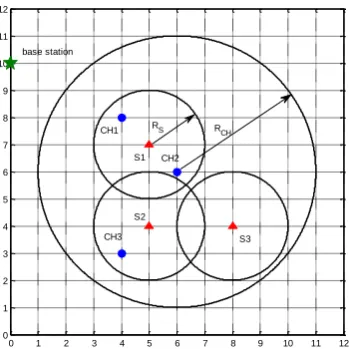
between the sensor node S1 and the cluster-head node CH1 or CH2 is below RS, that is, CH1 and CH2 are covered by the communication circle of S1, and thus the monitored data of S1 can be reliably transmitted to CH1 or CH2. However, the data transmitted from S2 will not be received by CH2 as the location of CH2 is beyond the maximum communication range of S2. In case of CH1 running out of its energy and the data of any sensor cannot be transmitted to the base station, which will make the whole network break down and cause the shutdown of the industry system or even hazard. Thus the extra nodes have to be deployed for redundancy to guarantee the essential reliability and robustness of IWSNs. Besides, the additional cluster-head nodes can improve the balance of load and extend the lifetime of batteries, which reduces the maintenance work of IWSNs. In summary, two questions, i.e. how many cluster-head nodes are needed at least and how to place them, should be considered carefully to satisfy the design goals of IWSNs.
0 1 2 3 4 5 6 7 8 9 10 11 12
0 1 2 3 4 5 6 7 8 9 10 11 12
S2 CH3
CH2
S3 CH1
S1 base station
RS RCH
Fig. 1. A sample on the communication model of sensor nodes (▲) and cluster-head nodes (●)
3.2. Optimal node placement model of IWSNs
.
CL
f C SD (1)
2 .
1
. 2 .
S CH SN CH C CN j H MIN LCH L
s t MI M N L CL
(2)
where C is the setup cost of IWSNs; SDCL is the standard deviation of
cluster-head communication load which indicates the maintenance cost of IWSNs; and are the weighting factors with 1. S
CH
MIN is the minimum communicating cluster-head number of all the sensors, and CH
CH
MIN is the least communicating cluster-head number of all the cluster-head nodes. LSN,
LCN and MCL represent the sensor node reliability constraint, the cluster-head
node reliability constraint and the maximum load constraint, respectively. LCHj is the load number of the j-th cluster-head.
Reliability Constraint. To ensure the communication reliability of IWSNs, each node must have at least one redundant cluster-head node; that is, the cluster-head number for each node in IWSNs should be more than two as (3)
2 2 S CH SN CH CH CN MIN L MIN L
. (3)
where LSN and LCN are the pre-defined least numbers of cluster-heads for
sensor nodes and cluster-head nodes, respectively.
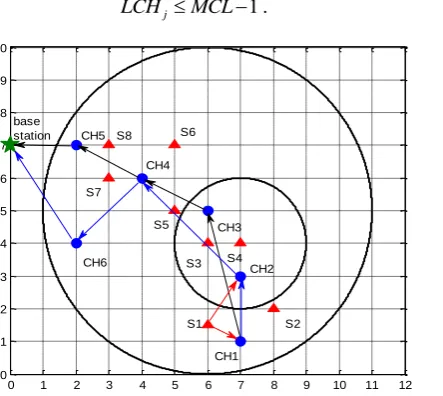
As seen in Fig. 2, the sensor node S1 and the cluster-head node CH4 have one redundant cluster-head node, i.e. CH2 and CH6, respectively. When CH1 or CH5 fails, the data of S1 still can be transmitted to the base station successfully due to the assigned redundant cluster-head nodes, and therefore the reliability of IWSNs is improved and guaranteed.
Suppose that there are Ns sensor nodes and Nch cluster-head nodes placed
in the industry field and Ni (i = 1, 2,…, Ns) and Mj (j = 1, 2,…, Nch) are the
cluster-head node numbers of the i-th sensor node and the j-th cluster-head, respectively, S
CH
MIN and CH
CH
MIN can be calculated as (4)-(5).
min{ ,| 1, 2,..., } .
S
CH i S
MIN N i N (4)
min{ ,| 1, 2,..., } .
CH
CH j ch
MIN M j N (5)
However, a node need not transmit its data to every cluster-head node in its communication range. Thus, in this work every sensor node or cluster-head node only communicates with the nearest LSN or LCN cluster-head
Mutation Probability Binary Particle Swarm Optimization Algorithm Maximum Load. Although the energy and communication capacity of cluster-head nodes are more powerful than those of sensor nodes, their load-driven capacity is still limited owing to the finite computation ability. Thus, the total load of cluster-head nodes should not be beyond the maximum communication load MCL. Furthermore, at least one configuration point should be reserved for the upgrading or maintenance of the system. Therefore, the maximum number of load nodes for each cluster-head node is defined as (6).
1 .
j
LCH MCL (6)
0 1 2 3 4 5 6 7 8 9 10 11 12
0 1 2 3 4 5 6 7 8 9 10
CH2 CH5
S2 S4 S6 S8
CH3 S5
CH4
S7
S3
CH1 S1 base
station
CH6
Fig. 2. An instance of the reliable IWSNs (the symbol ▲ represents the sensor node and the symbol ●represents the cluster-head node)
Setup Cost. When constructing IWSNs, the setup cost should be reduced without decreasing the performances of the system, especially in the very large-scale applications. For the node placement in IWSNs, the change of the cost mainly lies in the investment of cluster-head nodes as the sensor nodes are already determined by the requirements of monitoring. Thus, the setup cost can be defined as (7)
.
ch ch
CP N (7)
where Nch is the number of the cluster-head nodes used and Pch is the weight
of the cluster-head node number .
energy totally runs out. Thus, the unbalanced load uniformity will bring the frequent maintenance of IWSNs, which should be avoided. Therefore, the load uniformity of IWSNs is considered as the main metric of the maintenance cost to be optimized in this paper, which can be indicated by the standard deviation of the cluster-head load (SDCL) as (8)-(9),
2
1
( )
. 1
Nch
j CH
j CL
LCH ML SD
Nch
(8)1 . Nch
j j CH
LCH
ML
Nch
(9)where MLCH is the mean load of all the cluster-head nodes.
4.
Adaptive Mutation Probability Binary Particle Swarm
Optimization
Particle Swarm Optimization (PSO) algorithm was first proposed by Kennedy and Eberhart in 1995 [28], which has been studied and applied to solve numerous science and engineering problems successfully. It works with a group of particles. Each particle can be considered as a candidate solution and represented by a position vectorxi
xi1, ,xij, ,xiD
in a D dimensionalsearch space, which keeps on moving toward new points in the search space with the addition of a velocity vectorvi
vi1, ,vij, ,viD
to facilitate thesearch procedure. During the search process all particles move toward the areas of potential solutions by utilizing the cognitive and social learning components. The process is repeated until any prescribed stopping criterion is reached. After any iteration, each particle updates its position and velocity to achieve a better fitness value according to (10)-(11)
1
1 1 ( ) 2 2 ( ) .
G G G G G G
ij ij ij ij j ij
v w v c r P x c r Pg x (10)
1 1
.
G G G
ij ij ij
x v x (11)
where G ij
v represents the velocity of the j-th element of the i-th individual at iteration G; w is the inertia weight; c1 and c2 are called as the acceleration
factors, usually valued as 2.0; r1 and r2 are the uniform random numbers
between 0 and 1; G ij
x represents the position of the j-th decision variable of
the i-th individual at iteration G; G i
P and G
Mutation Probability Binary Particle Swarm Optimization Algorithm
the i-th individual and the global best position of the group until iteration G, respectively.
However, the standard PSO and majority of its variants are developed for optimization problems in continuous space, which cannot be used to solve discrete binary optimization problems directly. To extend its application fields, Kennedy and Eberhart proposed a discrete binary PSO (DBPSO) algorithm in 1997 [29]. DBPSO reserves the velocity updating formula (10), but the velocity vector is transformed into the probability of being “1” of each bit through the sigmoid limiting function as (12). Finally, the binary solution is generated based on this probability as (13)
1
1 1
( ) .
1 iG
G
ij v
sigmoid v
e
(12)
1 1 1, () ( )
. 0,
G ij G
ij
if rand sigmoid v x
else
(13)
whererand()is a random number uniformly distributed in [0,1].
However, DBPSO is easy to be trapped in the local optima. To make up for it, a probability binary Particle Swarm Optimization (PBPSO) algorithm was presented in our previous work, which has been proven to be efficient and effective for solving various optimization problems [30], [31], [32]. Considering that the optimal node placement of large-scale IWSNs is a high-dimensional constrained multi-objective NP-hard problem and its fitness evaluation is very time-consuming, a novel adaptive mutation PBPSO (AMPBPSO) is proposed in this paper into which an adaptive mutation operator is introduced to improve the search ability and convergence speed of the algorithm.
4.1. Initialization
AMPBPSO adopts the binary encoding. Assume the population size of AMPBPSO and the dimension of solutions are N and D, respectively. The i-th individual, i.e. a candidate solution, is denoted asbxi
bxi1, ,bxij, ,bxiD
, wherei1, 2, ,N; j1, 2, ,D;bxij{0,1}.The local best position of the i-th individual and the global best position of the group are denoted asbPi
bPi1, ,bPij, ,bPiD
andbPg
bPg1, ,bPgj, ,bPgD
, respectively. In thebxij, vij and xijof AMPBPSO is initialized as (14)-(16),
0 1, if () 0.5 .
0, otherwise ij
rand
bx
(14)
0
max min min
( ) () .
ij
v v v rand v (15)
0
max min min
( ) () .
ij
x x x rand x (16)
where
rand
()
is a random number uniformly distributed in [0,1];v
min andmax
v
are the lower and upper velocity bound;x
min andx
max are the pre-defined lower and upper pseudo-probability bound, respectively.4.2. Population Updating
Like PSO, the velocity vi and the pseudo-probability xi of AMPBPSO is
dynamically updated according to (17)-(18),
1
1 1 ( ) 2 2 ( ) .
G G G G G G
ij ij ij ij j ij
v w v c r bP bx c r bPg bx (17)
1 1
.
G G G
ij ij ij
x v x (18)
Note that the binary solution
bx
ijG,bP
ijGandbPg
Gj are used here instead ofG ij
x
,P
ijGandPg
Gj in the standard PSO. Ifx
ijG1
x
maxorx
ijG1
x
min, we fix 1
G ij
x
to xmax or xmin , respectively. After the updating of the pseudo-probability, the real probability prij is calculated and adopted to generate anew binary solution through the probability estimation operator as (19)-(20).
1 1
min max min
( ) / ( ) .
G G
ij ij
pr x x x x (19)
1 1 1, ()
. 0,
G ij G
ij
if rand pr bx
otherwise
(20)
4.3. Adaptive Mutation
Mutation Probability Binary Particle Swarm Optimization Algorithm
1, 0
() , .
0, 1
G ij G
m ij G
ij
if bx
if rand p bx
if bx
(21)
max
1 1.45 (0.05 ) .
m
p G
D G
(22)
where pm is the mutation rate of each bit. In AMPBPSO, pm adaptively varies
based on the solution dimension D and the iteration number G; that is, pm
linearly increases from0.05
D to
1.5
D in the search process. The introduction of
the dimension D is to enhance the scalability of the algorithm, and the linear increment of pm can retain the diversity of the population. The final value of
pm, i.e. 1.5
D , is adopted to ensure the accuracy of local search.
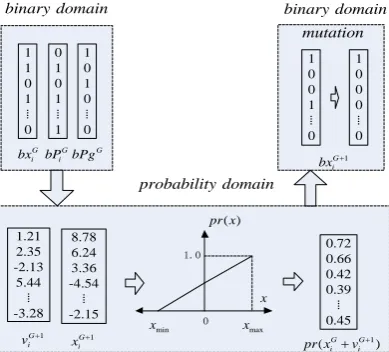
The evolutionary mechanism of AMPBPSO can be described as Fig. 3. Unlike DBPSO discarding the position updating formula and using the velocity as the probability to generate solutions, AMPBPSO reserves the original position of PSO by re-defining it as the pseudo-probability and therefore the entire updating mechanism of PSO is inherited. All the binary individuals of AMPBPSO have the pseudo-probability states as well as velocity states, which are updated following the framework of PSO and adopted to yield new candidate solutions using the probability estimation operator. For one thing, as the pseudo-probability of each individual is updated from generation to generation according to the information from its historical and global best individuals, AMPBPSO has the strong global exploration ability. For another, AMPBPSO adopts the pseudo-probability vector to create the new solution, thus it can maintain population diversity effectively. Moreover, the adaptive mutation operator enhances further the capability of local search as well as escaping from the local optima. Therefore, AMPBPSO can achieve an appropriate balance between exploration and exploitation.
5.
Implementation of AMPBPSO for the Node Placement
in IWSNS
5.1. Solution Representation
For industrial applications, the sensor nodes are deployed for monitoring and their locations are already determined. Thus, the variables included in the optimal node placement of IWSNs are the number and positions of the cluster-head nodes used. Each individual of AMPBPSO specifies the number and positions of cluster-head nodes encoded as a binary vector, where a bit “1” indicates that a cluster-head node is placed at the corresponding grid conjunction while a bit “0” denotes the opposite. Fig. 5 displays an example individual, which represents a grid with four rows and four columns. The grid junctions are encoded row by row into the binary vector, and therefore a 16-bits binary solution can be used to delineate a corresponding candidate deployment scheme. 1 0 1 0 ⁞ 0 0.72 0.66 0.42 0.39 ⁞ 0.45 1 0 0 0 ⁞ 0 1
( G G )
i i
pr x v
G
bPg G1
i bx 1.21 2.35 -2.13 5.44 ⁞ -3.28 1 G i v 0 1 0 1 ⁞ 1 1 1 0 1 ⁞ 0 G i bx G i bP 1.0 0 min
x xmax
x ( ) pr x 1 0 0 1 ⁞ 0 binary domain probability domain 8.78 6.24 3.36 -4.54 ⁞ -2.15 1 G i x mutation binary domain
Fig. 3. Evolutionary mechanism of AMPBPSO
5.2. Fitness Function
Mutation Probability Binary Particle Swarm Optimization Algorithm
1 2 3
.
p
f
f
p
p
p
(23)1 1
1
max{0,
(
)} .
Ns
SN i i
p
c
L
N
(24)2 1
1
max{0, ( )} . CH
N
CN j j
p c L M
(25)3 2
1
max{0,
(
1
)} .
CH
N
j j
p
c
LCH
MCL
(26)where fp is the final fitness value; p1, p2 and p3 are the penalty items of the
sensor node reliability constraint, the cluster-head node reliability constraint and the maximum load number constraint, respectively. c1 is the penalty
coefficient of the reliability constraints, and c2 is the penalty coefficient for
violating the limitation of the communication load.
5.3. Optimal node placement of IWSNs based on AMPBPSO
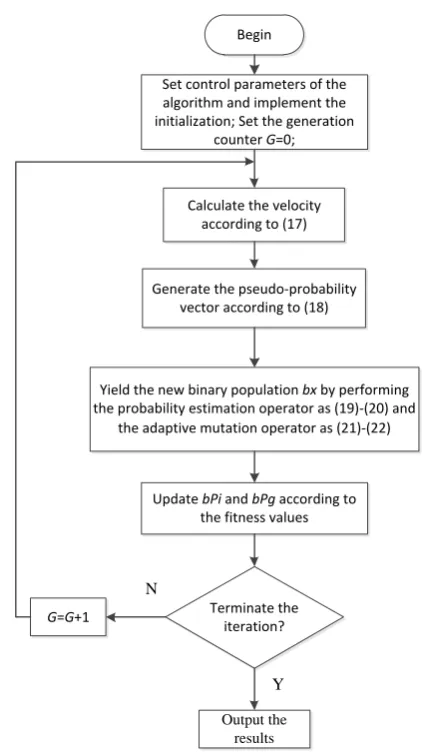
Based on the pre-defined fitness function, AMPBPSO iteratively generates new candidate solutions to search the optimal node placement scheme of IWSNs. The whole procedure of designing the optimal node placement with AMPBPSO can be described as follows:
Step 1: Set the model parameters of IWSNs, such as RS, RCH and MCL.
Step 2: Initialize AMPBPSO including weight factor w, learning factors c1 and
c2, the maximum velocity vmax , the binary population bx, the local best
individual bPi, the global best individual bPg, the velocity v, the
pseudo-probability x and its lower/upper bound xmin /xmax.
Step 3: Update the velocity vector and pseudo-probability vector of each individual according to (17)-(18).
Step 4: Generate offspring individuals, i.e. new binary solutions, by performing the probability estimation operator as (19)-(20) and the adaptive mutation operator as (21)-(22).
Step 5: Calculate the fitness value of each individual according to (23)-(26). Step 6: Update the local best individual bPi and the global best individual
bPg.
Begin
Set control parameters of the algorithm and implement the initialization; Set the generation
counter G=0;
Calculate the velocity according to (17)
Generate the pseudo-probability vector according to (18)
Yield the new binary population bx by performing the probability estimation operator as (19)-(20) and
the adaptive mutation operator as (21)-(22)
Update bPi and bPg according to the fitness values
Terminate the iteration?
Y N
Output the results G=G+1
Fig. 4. The flowchart of AMPBPSO
[1010110101100010]
i
x
0 1 2 3
0 1 2 3
Mutation Probability Binary Particle Swarm Optimization Algorithm
6.
Experiments and Analysis
6.1. Node Placement Benchmark Problem of IWSNs
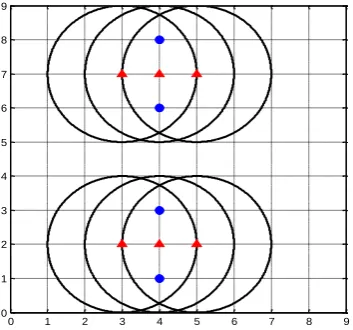
To test the effectiveness of the developed node placement model for IWSNs, a small-scale node deployment benchmark problem is designed as Fig. 6. The gird of this problem is 10×10 and the positions of the sensor nodes are pre-placed and represented as the triangles in the figure. The communication radii of the sensor node and the cluster-head node are set as RS=2 and
RCH=5, respectively. The reliability constraints are LSN=2 and LCN=2.
Therefore, the optimal solution of this benchmark is unique, and the corresponding positions of the deployed cluster-heads are marked as the circles. AMPBPSO, DBPSO [29] and GA [18] with the recommended parameters in Table 1 were adopted to tackle the benchmark problem. The population size and the maximum generation of each algorithm were set as N=200 and Gmax=100, respectively.
0 1 2 3 4 5 6 7 8 9
0 1 2 3 4 5 6 7 8 9
Fig. 6. The optimal placement scheme of the standard benchmark problem (▲ represents the sensor node, ● represents the cluster-head node, the circles are the communication ranges of the sensor nodes)
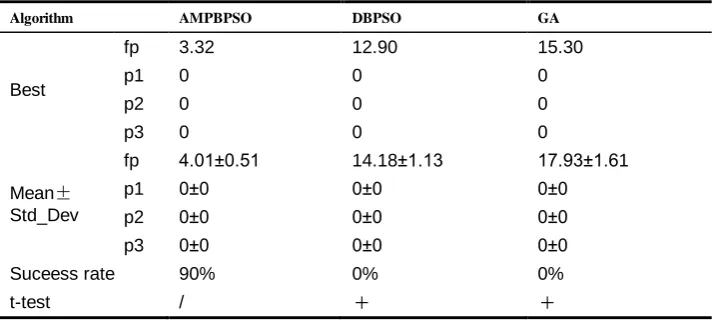
problem was found out successfully. However, AMPBPSO did not find the best solution with 100% success rate while DBPSO and GA totally failed to reach the global best solution, which illustrates that the optimal sensor placement problem is very complicated. The t-test results show that AMPBPSO is significantly superior to GA and DBPSO on this benchmark which demonstrates that AMPBPSO has the better global search ability and the adaptive mutation operator effectively enhances the performance of the algorithm.
Table 1. Parameters of AMPBPSO, DBPSO AND GA
Algorithms Parameters
AMPBPSO w0.8,c1c2 2.0,vmax6.0, xmin 20,xmax20,
max
1 1.45 (0.05 )
m
p G
D G
DBPSO [29]
1 2 max
0.8, 2.0, 6.0
w c c v
GA [18] ps1.0,pc 0.8,pm0.005
Table 2. Results of AMPBPSO, DBPSO and GA on the node placement benchmark problem
Algorithm AMPBPSO DBPSO GA
Best
fp 3.32 12.90 15.30
p1 0 0 0
p2 0 0 0
p3 0 0 0
Mean± Std_Dev
fp 4.01±0.51 14.18±1.13 17.93±1.61
p1 0±0 0±0 0±0
p2 0±0 0±0 0±0
p3 0±0 0±0 0±0
Suceess rate 90% 0% 0%
t-test /
6.2. Large-scale Node Placement of IWSNs
Mutation Probability Binary Particle Swarm Optimization Algorithm
yielded and adopted as the benchmarks. The communication radii of the sensor node and the cluster-head node were set as RS=50m and RCH=100m,
respectively. The reliability constraints were LSN=2 and LCN=2. The required
accuracy of the node location information is application-dependent. On the one hand, the communication reliability is extremely important for industrial applications and the radius of wireless sensors is not exact due to various kinds of interferences in the industry environment. Thus, the high accurate location of cluster-head nodes for IWSNs is unnecessary. On the other hand, with the improvement on the accuracy of the grid onto which the industrial field is mapped, the search space of the node placement problem will increase exponentially. Based on the above factors, the grid cell was set as 10m in this paper.
Table 3. Results of AMPBPSO, DBPSO and GA on the 200m×200m node placement
problems
Density 0.2 0.5
Algorithm AMPBPSO DBPSO GA AMPBPSO DBPSO GA
Best
fp 16.15 72.06 78.48 27.27 36.91 40.96
p1 0 0 0 0 0 0
p2 0 0 0 0 0 0
p3 0 0 0 0 0 0
Mean± Std_Dev
fp 18.18 ±1.77 74.55 ±2.36 85.13 ±2.77 27.26 ±0 39.09 ±2.16 46.44 ±2.39
p1 0±0 0±0 0±0 0±0 0±0 0±0
p2 0±0 0±0 0±0 0±0 0±0 0±0
p3 0±0 0±0 0±0 0±0 0±0 0±0
t-test /
/
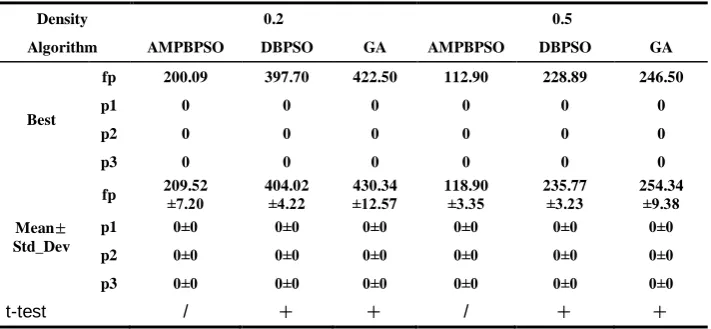
Table 4. Results of AMPBPSO, DBPSO and GA on the 400m×400m node placement
problems
Density 0.2 0.5
Algorithm AMPBPSO DBPSO GA AMPBPSO DBPSO GA
Best
fp 200.09 397.70 422.50 112.90 228.89 246.50
p1 0 0 0 0 0 0
p2 0 0 0 0 0 0
p3 0 0 0 0 0 0
Mean±
Std_Dev
fp 209.52 ±7.20 404.02 ±4.22 430.34 ±12.57 118.90 ±3.35 235.77 ±3.23 254.34 ±9.38
p1 0±0 0±0 0±0 0±0 0±0 0±0
p2 0±0 0±0 0±0 0±0 0±0 0±0
p3 0±0 0±0 0±0 0±0 0±0 0±0
AMPBPSO, DBPSO and GA with the recommended parameters were used to solve the large-scale node placement problems for a fair comparison. All the algorithms were repeated 10 times on each problem independently. Tables 3-5 list the experimental results which show that AMPBPBO surpasses DBPSO and GA on all the problems and the average results of AMPBPSO are even better than the best ones of DBPSO and GA. The t-test results also demonstrate that AMPBPSO is significantly superior to GA and DBPSO.
Table 5. Results of AMPBPSO, DBPSO and GA on the 600m×600m node placement
problems
Density 0.2 0.5
Algorithm AMPBPSO DBPSO GA AMPBPSO DBPSO GA
Best
fp 662.47 969.70 1009.70 359.28 580.90 600.10
p1 0 0 0 0 0 0
p2 0 0 0 0 0 0
p3 0 0 0 0 0 0
Mean±
Std_Dev
fp ±13.28 671.83 986.10 ±5.36 1026.74 ±13.04 366.59 ±6.62 591.14 ±4.11 611.94 ±8.18
p1 0±0 0±0 0±0 0±0 0±0 0±0
p2 0±0 0±0 0±0 0±0 0±0 0±0
p3 0±0 0±0 0±0 0±0 0±0 0±0
t-test /
/
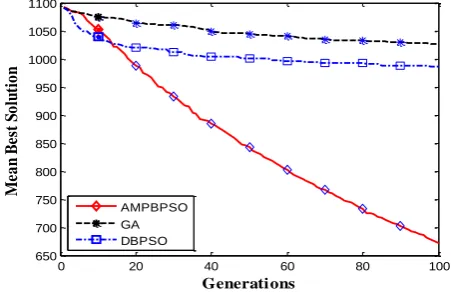
The average convergence curves of each algorithm on the six problems are drawn in Fig. 7-12. From Fig. 7-12, we can clearly observe that AMPBPSO has the best search ability and outperforms DBPSO and GA in terms of solution quality and the convergence speed for the optimal node placement of IWSNs.
7.
Conclusions and Future Work
Mutation Probability Binary Particle Swarm Optimization Algorithm
as enhance local search. The presented algorithm and model were firstly verified on the small-scale node placement benchmark problem. The results of the benchmark demonstrate the effectiveness and efficiency of the model and algorithm. Finally, the proposed model and AMPBPSO were used to tackle the large-scale node placement problems of IWSNs. DBPSO and GA were also applied to all the problems for a comparison. The simulation results indicate that AMPBPSO can effectively solve the optimal node placement problems with the guarantee of the reliability and outperforms DBPSO and GA in terms of search accuracy and the convergence speed.
0 20 40 60 80 100
0 20 40 60 80 100 120
Generations
M
ea
n
B
es
t
S
o
lu
ti
o
n
AMPBPSO GA DBPSO
Fig. 7. Convergence curves of the 200m×200m node placement problem with 0.2
0 20 40 60 80 100
25 30 35 40 45 50 55 60 65 70
Generations
M
ea
n
B
es
t
So
lu
ti
on
AMPBPSO GA DBPSO
0 20 40 60 80 100 200
250 300 350 400 450 500
Generations
M
ea
n
B
es
t
S
o
lu
ti
o
n
AMPBPSO GA DBPSO
Fig. 9. Convergence curves of the 400m×400m node placement problem with 0.2
0 20 40 60 80 100
100 150 200 250 300
Generations
M
ea
n
B
es
t
S
o
lu
ti
o
n
AMPBPSO GA DBPSO
Fig. 10. Convergence curves of the 400m×400m node placement problem with
0.5
0 20 40 60 80 100
650 700 750 800 850 900 950 1000 1050 1100
Generations
M
ea
n
B
es
t
S
o
lu
ti
o
n
AMPBPSO GA DBPSO
Fig. 11. Convergence curves of the 600m×600m node placement problem with
0.2
Mutation Probability Binary Particle Swarm Optimization Algorithm
0 20 40 60 80 100
350 400 450 500 550 600 650 700
Generations
M
ea
n
B
es
t
S
o
lu
ti
o
n
AMPBPSO GA DBPSO
Fig. 12. Convergence curves of the 600m×600m node placement problem with
0.5
The optimal node placement of IWSNs is a multi-objective optimization problem, and the setting of weighting factors of each optimization goal is a challenge for real applications. Thus, the Pareto-based approach has the advantage, which is a direction for the future research. Another direction of the future research is to improve the optimization model to meet the more requirements of industrial applications.
Acknowledgments. This work is supported by research funds for the Doctoral Program of Higher Education of China (20103108120008), the Projects of Shanghai Science and Technology Community (10ZR1411800 & 10JC1405000), National Natural Science Foundation of China (Grant No. 60834002 & 61074032), Shanghai University “11th Five-Year Plan” 211 Construction Project and the Mechatronics Engineering Innovation Group project from Shanghai Education Commission.
References
1. Zhuang, L. Q., Goh, K. M., Zhang, J. B.: The wireless sensor networks for factory automation: Issues and challenges. IEEE Conference on Emerging Technologies and Factory Automation, 141-148. (2007)
2. Lee, J. H., Kwon, T., Song, J. H.: Group Connectivity Model for Industrial Wireless Sensor Networks. IEEE Transactions on Industrial Electronics, Vol. 57, 1835-1844. (2010)
3. Senel, F., Younis, M. F., Akkaya, K.: Bio-inspired Relay Node Placement Heuristics for Repairing Damaged Wireless Sensor Networks. IEEE Transactions on Vehicular Technology, Vol. 60, 1835-1848. (2011)
4. Gungor, V. C., Hancke, G. P.: Industrial Wireless Sensor Networks: Challenges, Design Principles, and Technical Approaches. IEEE Transactions on Industrial Electronics, Vol. 56, 4258-4265. (2009)
6. Flammini, A., Ferrari, P., Marioli, D., Sisinni, E., Taroni, A.: Sensor networks for industrial applications. The 2nd International Workshop on Advances in Sensors and Interface, 1-15. (2007)
7. Flammini, A., Ferrari, P., Marioli, D., Sisinni, E.: Wired and wireless sensor networks for industrial applications. Microelectronics Journal, Vol. 40, 1322-1336. (2009)
8. Heo, J., Hong, J., Cho, Y.: EARQ: Energy aware routing for real-time and reliable communication in wireless industrial sensor networks. IEEE Transactions on Industrial Informatics, Vol. 5, 3-11. (2009)
9. Park, P., Fischione, C., Bonivento, A., Johansson, K. H., SangiovanniVincent, A.: Breath: an adaptive protocol for industrial control applications using wireless sensor networks. IEEE Transactions on Mobile Computing, Vol. 10, 821-838. (2011)
10. Bertocco, M., Gamba, G., Sona, A., Vitturi, S.: Experimental characterization of wireless sensor networks for industrial applications. IEEE Transactions on Instrumentation and Measurement, Vol. 57, 1537-1546. (2008)
11. Balasubramanian, K., Anil Kumar, G. S., Manimaran, G., Wang, Z.: A novel real-time MAC protocol exploiting spatial and temporal channel diversity in wireless industrial networks. Lecture Notes in Computer Science, Vol. 4297, 534-546. (2006)
12. Villaverde, B. C., Rea, S., Pesch, D.: InRout–A QoS aware route selection algorithm for industrial wireless sensor networks. Ad Hoc Networks, Vol. 10, 458-478. (2011)
13. Chen, J., Cao, X., Cheng, P., Xiao, Y., Sun, Y.: Distributed collaborative control for industrial automation with wireless sensor and actuator networks. IEEE Transactions on Industrial Electronics, Vol. 57, 4219-4230. (2010)
14. Yu, K., Gidlund, M., Akerberg, J., Bjorkman, M.: Reliable and Low Latency Transmission in Industrial Wireless Sensor Networks. Procedia Computer Science, Vol. 5, 866-873. ( 2011)
15. Xing, Z., Zeng, P., Wang, H.: Reliability, Capacity, and Energy Efficiency: A Comprehensively Optimized MAC Protocol for Industrial Wireless Sensor Networks. Advances in Communication Systems and Electrical Engineering, Vol. 4, 139-154. (2008)
16. Ke, W. C., Liu, B. H., Tsai, M. J.: Constructing a Wireless Sensor Network to Fully Cover Critical Grids by Deploying Minimum Sensors on Grid Points Is NP-Complete. IEEE Transactions on Computers, Vol. 56, pp. 710-715. (2007) 17. Wu, Q., Rao, N. S. V., Du, X., lyengar, S. S.: On efficient deployment of sensors
on planar grid. Computer Communications, Vol. 30, 2721-2734. (2007)
18. Ferentinos, K. P., Tsiligiridis, T. A.: Adaptive design optimization of wireless sensor networks using genetic algorithms. Computer Networks, Vol. 51, 1031-1051. (2007)
19. Jia, J., Chen, J., Chang, G., Tan, Z.: Energy efficient coverage control in wireless sensor networks based on multi-objective genetic algorithm. Computers & Mathematics with Applications, Vol. 57, 1756-1766. (2009)
20. Hu, X. M., Zhang, J., Yu, Y., Chung, H. S. H., Li, Y. L., Shi, Y. H., Luo, X. N.: Hybrid genetic algorithm using a forward encoding scheme for lifetime maximization of wireless sensor networks. IEEE Transactions on Evolutionary Computation, Vol. 14, 766-781. (2010)
Mutation Probability Binary Particle Swarm Optimization Algorithm 22. Aziz, N. A. B. A., Mohemmed, A. W., Alias, M. Y.: A wireless sensor network coverage optimization algorithm based on particle swarm optimization and Voronoi diagram. International Conference on Networking, Sensing and Control, 602-607. (2009)
23. Hojjatoleslami, S., Aghazarian, V., Aliabadi, A.: DE Based Node Placement Optimization for Wireless Sensor Networks. The 3rd International Workshop on Intelligent Systems and Applications, 1-4. (2011)
24. Nezhad, S. E., Kamali, H. J., Moghaddam, M. E.: Solving K-Coverage Problem in Wireless Sensor Networks Using Improved Harmony Search. 2010 International Conference on Broadband, Wireless Computing, Communication and Applications, 49-55. (2010)
25. Nematy, F., Rahmani, A. M., Teshnelab, M., Rahmani, N.: Ant Colony Based Node Deployment and Search in Wireless Sensor Networks. 2010 International Conference on Computational Intelligence and Communication Networks, 363-366. (2010)
26. Li, D., Liu, W., Cui, L.: EasiDesign: an Improved Ant Colony Algorithm for Sensor Deployment in Real Sensor Network System. 2010 IEEE Global Telecommunications Conference, 1-5. (2010)
27. Mainwaring, A., Culler, D., Polastre, J., Szewczyk, R., Anderson, J.: Wireless Sensor Networks for Habitat Monitoring. Proceedings of the 1st ACM international workshop on Wireless sensor networks and applications, 88-97. (2002)
28. Kennedy, J., Eberhart, R.: Particle swarm optimization. The Proceedings of the 1995 IEEE International Conference on Neural Networks, Vol. 4, 1942-1948. (1995)
29. Kennedy, J., Eberhart, R. C.: A Discrete Binary Version of the Particle Swarm Algorithm. The Proceedings of IEEE International Conference on Computation, Cybernetics and Simulation, System, Man and Cybernetics, Vol. 5, 4104-4108. (1997)
30. Wang, L., Wang, X., Fu, J., Zhen, L.: A novel probability binary particle swarm optimization algorithm and its application. Journal of software, Vol. 3, 28-35. (2008)
31. Zhen, L. L., Wang, L., Wang, X.T., Huang, Z.: A Novel PSO-Inspired Probability-based Binary Optimization Algorithm. International Symposium on Information Science and Engineering, 248-251. (2008)
32. Menhas, M. I., Wang, L., Fei, M.R., Pan, H.: Comparative performance analysis of various binary coded PSO algorithms in multivariable PID controller design. Expert Systems with Applications, Vol. 39, 4390-4401. (2011)
Wei Ye is a postgraduate student major in Control Science and Engineering at Shanghai University. He received B.Sc. degree in Measurement and Control Technology from Shanghai University in 2010. His research interests include industrial wireless sensor networks and evolutionary computation.
Haikuan Wang is a post doctor in Control Theory and Control Engineering at Shanghai University. He received Ph.D. degree in control theory and control engineering from Shanghai University in 2011. His research interests include wireless sensor networks and industrial engineering.
Xiping Fu received his B.Sc. and Master degree in Automation from Shanghai University in 2008 and 2011, respectively. His research interests include particle swarm optimization algorithm, differential evolution algorithm and industrial wireless sensor networks.
Minrui Fei received his Ph.D. degree in Control Theory and Control Engineering from Shanghai University in 1997. Since 1998, he has been a professor and doctorial supervisor in Shanghai University. His current research interests are in the areas of intelligent control, networked learning control systems, wireless sensor networks, etc. He is a vice-chairman of Chinese Association for System Simulation, a standing director of China Instrument & Control Society, and a director of Chinese Artificial Intelligence Association.
Muhammad Ilyas Menhas recieved his B.Sc in electrical engineering from University of Azad Jammu and Kashmir in 2002. He has been an assistant engineer with Azad Jammu and Kashmir Electricity Department. Currently he is doctoral student at Shanghai University. His research interests include intelligent optimization algorithms, automation and control.