Available online on 10.01.2019 at http://jddtonline.info
Journal of Drug Delivery and Therapeutics
Open Access to Pharmaceutical and Medical Research© 2011-18, publisher and licensee JDDT, This is an Open Access article which permits unrestricted non-commercial use, provided the original work is properly cited
Open Access
Review ArticleReview on Lozenges
Surbhi Choursiya*, Deepti Andheriya
Dept of Pharmaceutics, Ujjain Institute of Pharmaceutical Science, Ujjain, M.P., India
ABSTRACT
Lozenges are one of the very popular and better innovative dosage form and oral confectionary products. Lozenges have been in use since 20th century and are still in commercial production. Lozenges have bright future as a novel method of delivering drugs for local action and systemic effect in the oral cavity. The “lozenges are solid medicated, flavored and sweetened base dosage forms intended to be sucked and hold in the mouth/ pharynx”. The benefits of the medicated lozenges is they increase the retention time of the dosage form in oral cavity which increases bioavailability, reduces gastric irritation and bypasses first pass metabolism. The acceptance for lozenges as a dosage form is high by adults and also more by children. Different types of lozenges available in market are compressed lozenges, hard lozenges & soft lozenges and their methods of preparation along with ingredients used in their preparation are discussed. The present review covers more or less all aspects associated with lozenges and also throws light on the applications of lozenges. It includes various researches performed till date, formulation and evaluation parameters, packaging and applications of lozenges.
Keywords: Lozenge, Troches, Pastilles, Molding
Article Info:Received 18 Sep 2018; Review Completed 30 Nov 2018; Accepted 01 Dec 2018; Available online 10 Jan 2019
Cite this article as:
Choursiya S, Andheriya D, Review on Lozenges, Journal of Drug Delivery and Therapeutics. 2018; 8(6-A):124-128
*Address for Correspondence:
Surbhi Choursiya, Dept of Pharmaceutics, Ujjain Institute of Pharmaceutical Science, Ujjain, M.P., India
INTRODUCTION
The development cost of a new chemical entity is very high; the pharmaceutical companies are now focusing on the development of new drug delivery systems for existing drug with an improved efficacy and bioavailability together with reduced dosing frequency to minimize side Effects. There are many drugs dosage forms like lozenges, tablets, mouthwash, and topical gel, are in markets for the treatment of the oral infections. New drug design to this area always benefit for the patient, physician and drug industry is lozenges.
The word "Lozenge" is derived from French word "Losenge" which means a diamond shaped geometry having four equal sides. Lozenges and pastilles have been developed since 20th century in pharmacy and is still under commercial production. Lozenges are solid preparations that are intended to dissolve in mouth or pharynx. They may contain one or more medicaments in a flavored and sweetened base and are intended to treat local irritation, infection of mouth or pharynx and may also be used for systemic drug absorption. They can deliver drug multi directionally into the oral cavity or to the mucosal surface. Lozenges are better innovative dosage form placed in oral cavity. Lozenges historically have been used for the relief of minor sore throat pain and irritation and have been used extensively to deliver topical anesthetics and antibacterial. Today lozenges contain different category of medicament as follows: analgesics,
anesthetics, antimicrobials, antiseptics, antitussives,
astringents, decongestants, demulcents and other classes and combinations of drugs.
Depending on the type of lozenge they may be prepared by molding (Pastilles) and Compression tablets (Troches).
Advantages1, 2, 3, 4
It can be given to those patients who have difficulty in
swallowing.
Easy to administer to geriatric and pediatric population.
It extends the time of drug in the oral cavity to elicit a
specific effect.
Easy to prepare, with minimum amount of equipment
and time.
Do not require water intake form administration.
Systemic absorption of drugs can be possible through
buccal cavity.
Taste of the drugs can be masked by sweeteners and
flavors used in the formulation.
Technique is non invasive, as is the case with parenterals.
It can Increase in bioavailability
It can reduce gastric irritation.
It can improve onset of action.
It can bypass of first pass metabolism.
Improved patient compliance.
Disadvantages1, 2, 3, 4
Some drugs may not be suitable with aldehyde candy
bases eg; benzocaine.
Children having above 6 years of age can use lozenges
safely.
The non ubiquitous distribution of drug within saliva for
local therapy.
Possible draining of drug from oral cavity to stomach
along with saliva.
The lozenge dosage form is that it mistakenly could be
used as candy by children.
A hard candy lozenge is the high temperature required
for their preparation.
Hard lozenges become grainy.
Classification of lozenges1, 2, 3, 4
According to the site of action
(a) Local effect Ex. Antiseptics, Decongestants. (b) Systemic effect Ex. Vitamins, Nicotine.
According to texture and composition-
(a) Chewy or caramel based medicated lozenges (b) Compressed tablet lozenges
(c) Soft lozenges (d) Hard candy lozenges
(a) Chewy or caramel based medicated lozenges 5, 6
These are the dosage form in which medicament is incorporated into a caramel base which is chewed instead of being dissolved in mouth. These lozenges are often highly fruit flavored and may have a slightly acidic taste to cover the acrid taste of the glycerin. These lozenges are especially used for pediatric patients and are a very effective means of administering medications for gastrointestinal absorption and systemic use. One of the more popular lozenges for pediatric use is the chewable lozenge, or “gummy-type” candy lozenge. These gelatin-based pastilles were prepared by pouring the melt into molds or out onto a sheet of uniform thickness.
(b) Compressed tablet Lozenges 7
When the active ingredient is heat sensitive, it may be prepared by compression. The granulation method is similar to that used for any compressed tablet. These tablets differ from conventional tablets in terms of
Organoleptic property,
Non disintegrating characteristics and
Slower dissolution profiles.
The lozenge is made using heavy compression equipment to give a tablet that is harder than usual, as it is desirable for the troche to dissolve slowly in mouth. Commercially, the preparation of lozenges by tablet compression is less important.
(c) Soft Lozenges 2
Soft lozenges have become popular because of the ease of extemporaneous preparation and applicability to a wide variety of drugs. The bases usually consist of a mixture of various polyethylene glycols, acacia or similar materials. One form of these soft lozenges is the pastille, which is defined as a soft variety of lozenge, usually transparent, consisting of a medication in a gelatin, glycerogelatin or acacia: sucrose base.Soft lozenges are similar to a historical form of medication that is making a comeback the “confection”. Confections are defined as heavily saccharinated, soft masses containing medicinal agents. The improvement in their current use is largely due to the use of polymers (polyethylene glycols) as the matrix for the dosage form. They are easy to use, convenient to carry, easy to store (room temperature), and are generally pleasant tasting. Polyethylene glycol-based lozenges may have a tendency to be hygroscopic and may soften if exposed to high temperatures.
(d) Hard Candy Lozenges
Hard candy lozenges are mixtures of sugar and other carbohydrates in an amorphous (noncrystalline) or glassy state. They can also be regarded as solid syrups of sugars. The moisture content and weight of hard candy lozenge should be between, 0.5 to 1.5 % and 1.5 - 4.5 g respectively. These should undergo a slow and uniform dissolution or erosion over 5 - 10 min., and should not disintegrate. The temperature requirements for their preparation is usually high hence heat labile materials cannot be incorporated in them. These pastilles were prepared by Heating and congealing method.
Figure 1: Types of lozenges
Formulation of medicated lozenges 1, 2, 3, 4
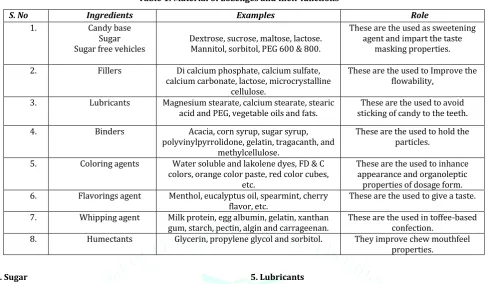
The raw materials used in medicated lozenges contain sugar, corn syrup, acidulant, colorant, flavor, and the medicament.
Table 1: Material of Lozenges and their functions 1
S. No Ingredients Examples Role
1. Candy base
Sugar
Sugar free vehicles Dextrose, sucrose, maltose, lactose. Mannitol, sorbitol, PEG 600 & 800.
These are the used as sweetening agent and impart the taste
masking properties.
2. Fillers Di calcium phosphate, calcium sulfate,
calcium carbonate, lactose, microcrystalline cellulose.
These are the used to Improve the flowability,
3. Lubricants Magnesium stearate, calcium stearate, stearic
acid and PEG, vegetable oils and fats. sticking of candy to the teeth. These are the used to avoid
4. Binders Acacia, corn syrup, sugar syrup,
polyvinylpyrrolidone, gelatin, tragacanth, and methylcellulose.
These are the used to hold the particles.
5. Coloring agents Water soluble and lakolene dyes, FD & C
colors, orange color paste, red color cubes, etc.
These are the used to inhance appearance and organoleptic properties of dosage form.
6. Flavorings agent Menthol, eucalyptus oil, spearmint, cherry
flavor, etc. These are the used to give a taste.
7. Whipping agent Milk protein, egg albumin, gelatin, xanthan
gum, starch, pectin, algin and carrageenan. These are the used in toffee-based confection.
8. Humectants Glycerin, propylene glycol and sorbitol. They improve chew mouthfeel
properties.
1. Sugar
Sucrose, a disaccharide of glucose and fructose, is obtained from sugarcane or beet. The choice of beet or cane sugar is based on availability and geographical considerations. Sucrose and sucrose products are used in medicated lozenges because of their value as neutral sweeteners, their ready solubility, and their function as a ‘‘drier’’ to reduce the weight of the confection through crystallization.
2. Corn syrup
Corn syrup is used in almost every type of confection to control sucrose and dextrose crystallization, which may lead to crumbling.Corn syrup in appropriate proportion with sucrose and dextrose allows the formation of an amorphous glass and produces a candy with the desirable appearance. The following physical properties of corn syrup are extremely important in the preparation of medicated candies: density, dextrose equivalent , hygroscopicity, sugar crystallization, viscosity, freezing point depression, and osmotic pressure. 3. Sugar bases
The sugar bases frequently associated with lozenge tablets are sucrose or compressible sugar, dextrose, mannitol, and sorbitol, which are available in special tableting grades from a variety of excipient manufacturers. Generally intended for direct compaction applications, they may also be utilized with the above binders in wet-granulation systems.
A nonnutritive sweetener is a synthetic or natural sugar substitute whose sweetness is higher than or comparable to sucrose. Examples of nonnutritive sweeteners like xylitol, mannitol, sorbitol, invertsugar etc.
4. Binders
These are generally intended for compressed tablet that are used to hold the particles of mass as discrete granules and include acacia, corn syrup, sugar syrup, gelatin, polyvinyl-pyrrolidone, tragacanthand methylcellulose.
5. Lubricants
These are used to avoid sticking of candy to the teeth and improve flow of final troche mixture and include magnesium stearate, calcium stearate, stearic acid and PEG.
6. Colorants
Colorants are incorporated into medicated lozenges for appearance, product identification, and masking of physical degradation.Dyes and other organic colorants may degrade by heat or light via oxidation, hydrolysis, photo oxidation, etc and their compatibility with drug, excipients, and process conditions should be studied before selection. Suppliers of colors are excellent sources of information on current regulatory status of colorants.
7. Acidulants
Acidulants are generally added to medicated lozenges to fortify and strengthen their flavor profile. Organic acids such as citric, malic, fumaric, and tartaric acids are most commonly used. Citric acid alone or in combination with tartaric acid is the most common. Another use of acids in medicated lozenges is to alter the pH to maintain the integrity of the drug.
8. Preservatives
These are solid dosage forms, there usually is no need to incorporate preservatives. However, since hard candy lozenges are hygroscopic, the water content may increase and bacterial growth may occur if they are not packaged properly. Since the water that is present would dissolve some sucrose, the resulting highly concentrated sucrose solution is bacteriostatic in nature and would not support bacterial growth. A few comments are in order concerning the flavors and effects of preservatives.
9. Flavors
medicaments and that degrade by heat and light. Aldehydes, ketones, and esters may react with drugs. A classic example of flavor–drug interaction is that of a primary amine drug
(benzocaine, phenylpropanolamine) with aldehyde
containing flavor components like cherry, banana, etc., resulting in the formation of a Schiff base, drug decomposition, and loss of efficacy. Adjustment of lozenge base pH to accentuate certain flavors (e.g., citrus) may also result in incompatibility with some medicaments (e.g. benzocaine).
Methods of preparation
Candy Based Lozenges
(a) Heating and Congealing Technique 8
Syrupy base was prepared in a beaker by dissolving the required amounts of sugar in water and kept for heating on a hot plate. Temperature was maintained at 105-110 °C till it
became thick. The drug and other excipients (except
plasticizer) were added manually and mixed thoroughly after
30 min withcontinue process of heating. The prepared mass
was further heated for 45 min and thenplasticizer was added
into it. Then above syrupy base was poured into pre-cooled
and prelubricatedmold and the mold was kept aside for
10-15 min. Lozenges were removed frommold and were kept for
air drying. In the case of batches without plasticizer, a step of plasticizer addition was omitted from procedure.
(b) Melting and Mold Technique 9, 10
PEG was melted on water bath and mixed with the other ingredients to form a homogeneous mixture. Subsequently, the mixture was poured into the desired shape & size stainless steel mold to forming a candy.
Compressed Tablet lozenges2, 9
(a) Direct compression technique
Ingredients can be thoroughly mixed and directly compressed.
(b) Wet granulation technique
sucrose is pulverized by mechanical combinations to a fine powder then add binder solution and mass is formed and pass through # sieve no.16 granules formed & dried then add Lubricant, flavor prior to the compression.
Evaluation of Medicated Lozenges11, 12, 13
The prepared lozenges were evaluated for parameters like drug content uniformity, hardness, thickness and diameter, weight variation, friability and in vitro dissolution test, drug content, moisture content analysis and stability studies by pharmaceutical standard methods.
Diameter The thickness and diameter of lozenges were
determined using vernier callipers. Three lozenges from each batch were used and average values were calculated. The extent to which the diameter of the lozenges deviated from ± 5 % of the standard value.
Weight variation: The weight variation was conducted by
weighing 20 lozenges individually and calculating the average weight and comparing the individual lozenges weight to the average value.
Weight Variation = Average Weight- Initial Weight/ Average Weight
Hardness: The hardness of the lozenges was determined by
using Monsanto Hardness tester, where the force required to break the lozenges was noted. The hardness was measured in
terms of (kg/cm2).
Friability: The friability of the lozenges was determined
using Roche Friabilator. Weighed lozenges were placed in the friabilator and operated for 4 min at 25 rpm. The tablets were then made free from dust and reweighed. The percentage friability was calculated.
Moisture content analysis: Moisture content in the final
candy is determined by using Helium moisture balance apparatus. The sample was weighed and crushed in a mortar from this one gram of the sample was weighed and the moisture content is determined by the moisture balance apparatus.
Mouth dissolving time test: The time taken by the candy to
dissolve completely was determined by the USP Disintegration apparatus, where hard boiled candy lozenges were placed in each tube of the apparatus and time taken for the lozenges to dissolve completely was noted by using
phosphate buffer of pH 6.8 at 37 ◦C.
In-vitrodrug dissolution studies: The rate of dissolution
possibly is related to the efficacy of the tablet lozenge. Dissolution study was carried out in 800 ml of phosphate buffer of pH 6.8 by USP II paddle method at 150 rpm. Samples were withdrawn at 5 min interval and replaced immediately with an equal volume of fresh buffer and were analyzed UV spectrophotometer.
Drug content: Appropriate number of lollipop are crushed
and dissolved in an appropriate solvent and the absorbance of the solution is measured spectrophotometrically.
Stability studies: The stability studies were performed to
assess physical as well as the chemical stability of the drug, which may possibly affect the organoleptic properties of the lozenges. Accelerated stability study was conducted as per ICH guidelines (zone IV) at 45°C and 75% relative humidity over a period of seven weeks. Sufficient number of optimized formulations were packed in amber coloured screw capped bottles and kept in incubator maintained at 37°C. Samples were taken at intervals of 15 days to estimate the drug content and to evaluate organoleptic properties.
Storage:
These preparations should be stored away from heat and out of the reach of children. They should be protected from extremes of humidity. Depending on the storage requirement of both the drug and base, either room temperature or refrigerated temperature is usually indicated.
Packaging:
Hard candies are hygroscopic and usually prone to absorption of atmospheric moisture. Considerations must include the hygroscopic nature of the candy base, storage conditions of the lozenges, length of time they are stored and the potential for drug interactions. These products should be stored in tight containers to prevent drying. This is especially true of the chewable lozenges that may dry out excessively and become difficult to chew. If a disposable mold with a cardboard sleeve is used, it is best to slip this unit into a properly labelled, sealable plastic bag.
DISCUSSION 1, 2, 3, 4
innovative dosage form. Lozenges enjoy an important position in pharmacy and will continue to remain at the same in future.
CONCLUSION
Lozenges are medicated confections that have been developed about 20th century ago and are still under commercial production. Most of the preparations are available over the canter products and are very economic dosage forms. They are designed for local as well as systemic therapy. A wide range of actives can be incorporated within their structure. Lozenges enjoy an important position in pharmacy and will continue to remain so in future.
REFERENCES
1) Maheshwari R., Jain V., Ansari R., Mahajan S.C., joshi G. A Review on lozenges. British Biomedical Bulletin. 2013; 1(1): 35-43. 2) Shinde G., Kadam V., Kapse G.R., Jadhav S.B., Zameeruddin Md.,
Bharkad B.A:Review on lozenges. “Indo American Journal of Pharmaceutical Research. 2014; 4(1):566-571.
3) Pothu R., Rao Y. Lozenges Formulation and Evaluation. International Journal of Advances in Pharmaceutics. Research. 2014; 5(5):290 – 298.
4) Kaur R., Kaur S. Role of polymers in drug delivery. Journal of Drug Delivery and Therapeutics, 2014; 4(3):32-36. https://doi.org/10.22270/jddt.v4i3.826
5) Loyd. V. Ansel Pharmaceutical Dosage forms & Drug delivery System. Chewable Lozenge. 8thedition. New Delhi (India) Pvt. Ltd. 2007; 246.
6) Aulton E. M. Aulton pharmaceutics. Compressed lozenges. 3rdedition.Elsevier. 2007; 457.
7) Pothu R., Rao Y. Development and In-Vitro Evaluation of Nicotine Troches for Smoking Cessation. Asian Journal Pharmaceutical and Clinical Research. 2014; 7(2):68-75. 8) Modyala D., Srinivas P. Formulation, Evaluation and
Characterization of Itraconazole Lozenges. International Science and Research Journal of Pharmceutical, Bioscience. 2014; 9(3):86-94.
9) Phaechamud T and Tuntarawongsa S. Clotrimazole Soft Lozenges Fabricated with Melting and Mold Technique. Research Journal of Pharmceutical, Bioscience. & Chemical. Science. 2010; 1(4):579- 587.
10) Patel M. Dasharath, Patel J. Rahul, Shah R.M., Patel N. Chhagan. Formulation and Evaluation of Diphenhydramine hydrochloride Lozenges for Treatment of Cough. World. Journal of Pharmaceutical Science. 2014; 3(5):822-835.
11) Kini R., Rathnanand M., Kamath D. Investigating the Suitability of Isomalt and liquid glucose as sugar substitute in the formulation of Salbutamol Sulfate hard candy lozenges. Journal of Chemical and Pharmaceutical Research. 2011; 3(4):69-75. 12) Nagoba S.N. Studies on candy Ketoconazole based Paedriatic
tablet lozenges. International Journal of Research in Ayurveda & pharmaceutics. 2011; 2(1):239-243.