A Novel Method for Data Conflict Resolution using
Multiple Rules
Zhang Yong-Xin1, Li Qing-Zhong2, and Peng Zhao-Hui2
1
School of Mathematical Sciences, Shandong Normal University, Jinan 250358, China
School of Computer Science and Technology, Shandong University, Jinan 250101, China
{lqz; pzh}@sdu.edu.cn
Abstract. In data integration, data conflict resolution is the crucial issue which is closely correlated with the quality of integrated data. Current research focuses on resolving data conflict on single attribute, which does not consider not only the conflict degree of different attributes but also the interrelationship of data conflict resolution on different attributes, and it can reduce the accuracy of resolution results. This paper proposes a novel two-stage data conflict resolution based on Markov Logic Networks. Our approach can divide attributes according to their conflict degree, then resolves data conflicts in the following two steps: (1)For the week conflicting attributes, we exploit a few common rules to resolve data conflicts, such rules as voting and mutual implication between facts. (2)Then, we resolve the strong conflicting attributes based on results from the first step. In this step, additional rules are added in rules set, such rules as inter-dependency between sources and facts, mutual dependency between sources and the influence of week conflicting attributes to strong conflicting attributes. Experimental results using a large number of real-world data collected from two domains show that the proposed approach can significantly improve the accuracy of data conflict resolution.
Keywords: Data integration, Data conflict resolution, Markov Logic Networks.
1.
Introduction
called data conflict resolution and has recently received increasing attention in data integration field [1, 2, 3].
The current major works to resolve data conflicts are based on relational algebra and define some conflict resolution strategies and functions [4]. By relational operations expansion or user-defined-functions, user or domain expert can assign conflict resolution functions to different data conflicts according to their requirements or domain knowledge [5]. Though these methods can resolve data conflict to some extent, they fall short in the following aspects.
When new data and data sources are integrated into system, the previous assignment may be refined. Even a new conflict resolution function will be assigned or defined. So these methods can hardly adapt the situation where data integration is dynamic.
Among all conflict resolution strategies, “Trust your friends” and “Cry with wolves” [4] are widely used. Their principles are taking the value of a preferred source and taking the most frequent value. However, it is a challenge for data integration how to choose the most trustworthy data source. And it is arbitrary to only trust a certain source. In addition, especially on Web, with the ease of publishing and spreading information, the false information becomes universal. The voting strategy that prefers the most often frequent is not sufficiently reasonable. So the current methods can hardly guarantee the accuracy of data conflict resolution.
Current research focuses on resolving data conflict on single attribute, which does not consider not only the conflict degree of different attributes but also the interrelationship of data conflict resolution on different attributes, and it can reduce the accuracy of resolution results.
Recently, there has been a few interesting techniques developed that aim to identify the true values from false ones [6, 7, 8]. They can be called truth discovery or others. These approaches treat data conflict resolution as an inferring problem, and incorporate more semantic features and sophisticated human knowledge to determine which value is true. In the process of handling data conflicts, any helpful confidences and rules can be considered. However, as the uncertainty of the knowledge, it is a hot potato how to combine these evidences to infer the true values.
To adapt to dynamic data integration and incorporate uncertain knowledge to better resolve data conflict, a two-stage data conflict resolution based on Markov Logic Networks (MLNs) [9] is proposed. In Summary, we make the following three contributions:
We propose a two-stage data conflict resolution based on Markov Logic Networks. Our approach can divide attributes according to their conflict degree and separately handle conflicts on them in two stages. Because we consider the influence of week conflicting attributes to strong conflicting ones, this approach can improve the accuracy effectively.
Experimental results using a large number of real-world data collected from two domains show that the proposed approach can effectively combine these features and rules and significantly improve the accuracy of data conflict resolution.
This paper is organized as follows. We briefly review some related research efforts in Section 2, and describe the problem in Section 3. The overview of the proposed approach is introduced in Section 4, and the model details are described in Section 5. Experimental evaluations are reported in Section 6, and in the last section we draw conclusions and point out some future directions.
2.
Related Work
The current major works to resolve data conflict on query time are based on relational algebra. The most representative work is conducted by Felix Naumann et al. Naumann et al. summarize current conflict resolution strategies and functions, and propose two research prototypes: HumMer [10] and FeSum [11]. They also extend and implement some relational operators such as minimum union [12].
Besides resolving data conflicts by relation expansion, there are some researches which focus on identifying true value from conflicting data. Minji
Wu et al. [6] propose aggregating query results from general search engineer
by considering importance and similarity of the sources. The importance of the sources can be measured by their ranks and popularity [13]. However, the rank of web pages according to authority based on hyperlinks does not reflect accuracy of information exactly. In addition, the method has certain limitation because it can only focus on queries whose answers are numerical values.
For discovering the true fact from conflict information provided by multiple data sources, Xiaoxin Yin et al. [7] propose an iterative algorithm -
TruthFinder, which considers trustworthy of sources, accuracy of facts and
interrelationship of two aspects. Nevertheless, this method does not consider dependence between sources in truth discovery. With the ease of publishing and spreading false information on the Web, a false value can be spread through copying and that makes truth discovery extremely tricky.
Xin Dong et al. [8] propose a novel approach that considers dependence between data sources in truth discovery. And they apply Bayesian analysis to decide dependence between sources [14] and design an algorithm that iteratively detects dependence and discovers truth from conflicting information. However, Bayesian model will be re-trained when some new inference rules join. So the approach is not adaptive enough.
Markov logic networks [9] is a simple approach to combining first-order logic and probabilistic graphical models in a single representation. As a general probabilistic model for modeling relational data, MLNs have been applied to joint inference under different domains, such as entity resolution [15] and information extraction [16, 17]. We will give a more detailed introduction to MLNs in Section 5.
3.
Problem Definition
To make a clear presentation and facilitate the following discussions, we first explain some concepts in this paper in this section.
Data Source.The source which provides conflict information, such as databases, web sites, etc. A set of data sources can be represented as
1 2 , n
S s s, , s , where si
1 i n
is the ith
data source.
Entity.An entity is a real world thing which is recognized as being capable of an independent existence and which can be uniquely identified, such as a book, a movie, etc.
Entity Attribute.Obviously, an entity attribute represents a particular aspect of a real world entity, such as an author of a book, a director of a movie. A set of entity attributes can be expressed as A
a a1, 2, ,am
, where ai
1 i m
is the ith
entity attribute.
Fact.For an entity attribute, the value provided by a data source can be called fact. For example, for an entity attribute a(the author of book ‘Flash CS3: The Missing Manual’), the data source s(the online book store ‘ABC Books’) provides a fact f (‘Chris Grover, E. A. Vander Veer’).
Data Conflict.When some data sources provide different facts for the same entity attribute, data conflict will be appeared.
True Value.In the conflicting facts, the fact which describes the real world is the true value.
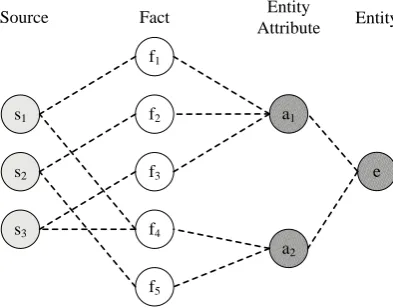
Different data sources can provide different facts for some entity attributes. Among facts provided for an entity attribute, one correctly describes the real world and is the true value, and the rest are false. Fig. 1 depicts the sources, facts, entities, entity attributes and the relationships between them.
Definition 1. To input data source set S , entity set E, entity attribute set EA, fact set F and the relationships of them. For an entity attribute eaEA,
1, 2, , FF f f f denotes the facts provided by S on ea and data conflict
s1
s2
s3
f5
f1
f2
f3
f4
a1
a2
Source Fact Entity
Attribute
e Entity
Fig. 1. Sources, facts, entities, entity attributes and the relationships
4.
Approach Overview
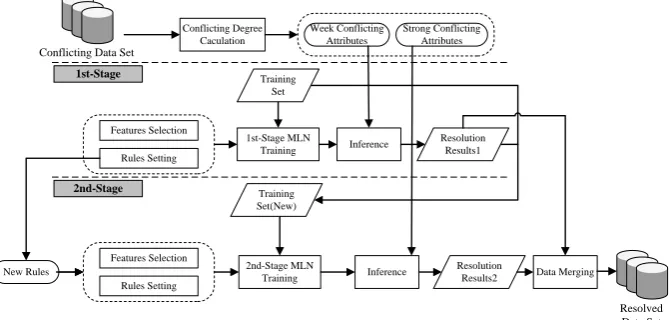
In this paper, we propose a two-stage data conflict resolution based on Markov Logic Networks and the flowchart of our approach is illustrated in Fig. 2.
(1)First, data conflicting degree will be calculated on different attributes. According to conflicting degree, attributes can be divided into two sets: week conflicting attributes and strong conflicting ones.
(2)Then, data conflicts on week conflicting attributes will be resolved in the first stage. For resolving conflicts on these attribute, we use some rules such as voting and mutual implication between facts to train our MLN model with training set and infer the true values. Since the conflicting degree is low, resolution results will be highly accurate only through these simple rules.
(3)In the second stage, the results from the first stage can be added to the previous training set and our MLN model can be trained again with the new training set and inference can be carried out for the strong conflicting attributes. As the conflicting degree is high, more powerful rules will be added such as inter-dependency between sources and facts, mutual dependency between sources and the influence of week conflicting attributes to strong conflicting attributes. These rules can contribute to utilizing the resolution results from the first stage and improving the accuracy of data conflict resolution.
1st-Stage
2nd-Stage
Features Selection
Rules Setting
1st-Stage MLN
Training Inference
Features Selection
Rules Setting
2nd-Stage MLN
Training Inference Conflicting Degree
Caculation Conflicting Data Set
Training Set
Training Set(New)
Resolution Results1
Resolution Results2
Resolved Data Set Week Conflicting
Attributes
Strong Conflicting Attributes
Data Merging New Rules
Fig. 2. The flowchart to the proposed approach.
The input of data conflict resolution is the data set with duplicates from different data sources, where the duplicates have been detected. And, the output is the data set in which the data conflicts have been resolved. The whole algorithm of data conflict resolution is showed below:
Algorithm 1.
Input: Integrated data set with duplicates DC which contains attribute set A and entity set E. The training set is DTrain and the test set is DTest. T is the threshold of data conflict resolution.
Output: The data set DR whose data conflicts have been resolved.
: , :
L H
A A ; //AL, AH denote separately week
conflicting attribute set and strong one. :=
R
D ; //resolved data set
for aiA do
if Conflict a
i T thenAL:AL
aielse
AH:AH
ai ;Define predictors and formulas, train our MLN model
on DTrain. Infer the true values for AL on DTest, then get
the result set D1;
DTrain:DTrain D1;
Add new formulas and re-train our MLN model on DTrain.
Infer the true values for AH on DTest, then get the
for eiE do
for ajA do
Select true values according to D1 and D2, and
constitute a record ri;
DR:=DR
ri ;return DR.
5.
Model Detail
5.1. Conflicting Degree Measure
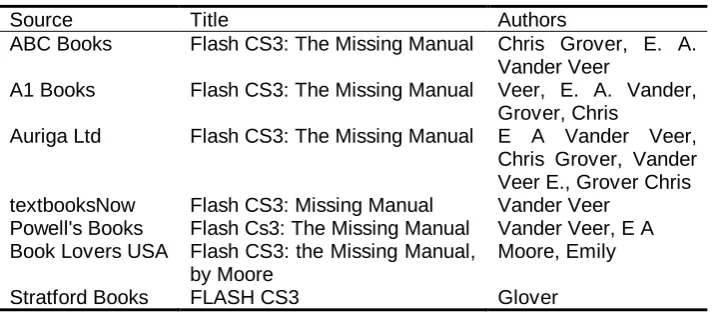
In integrated data set, different attributes have different conflicting degree. As described in Table 1, we collect information about the book “Flash CS3: The Missing Manual” (ISBN: 0596510446), which contains information about three attribute: Source, Title and Authors. We can see clearly that the titles of the book from different sources are accord with each other and the conflicting degree is low. However, the authors information is vary more widely and the conflicting degree is high. Obviously, if data sources provide more different facts, the entity attribute is more uncertain and the conflicting degree of it is higher. So we give the definition of conflicting degree of an entity attribute using information entropy.
Definition 2. For an entity attribute eaEA, let F
f f1, 2, ,fL
be the fact set provided by different sources and fi denotes the frequency of the fact fi
1 i L
, and then the conflicting degree of the entity attribute ea can be defined as follow:
1
log L
i i
i
EAConflict ea p f p f
(1)where p f
i is the probability of the fact fi, and
1 i
i L
j j
f p f
f
.Definition 3. For an attribute aA , let EA
ea1、ea2、 eak
be the corresponding entity attribute set, and then the conflicting degree of the attribute a can be defined as follow:
1
k
i i
EAConflict ea Conflict a
k
Table 1. Conflicting information of a book
Source Title Authors
ABC Books Flash CS3: The Missing Manual Chris Grover, E. A. Vander Veer
A1 Books Flash CS3: The Missing Manual Veer, E. A. Vander, Grover, Chris
Auriga Ltd Flash CS3: The Missing Manual E A Vander Veer, Chris Grover, Vander Veer E., Grover Chris textbooksNow Flash CS3: Missing Manual Vander Veer
Powell's Books Flash Cs3: The Missing Manual Vander Veer, E A Book Lovers USA Flash CS3: the Missing Manual,
by Moore
Moore, Emily
Stratford Books FLASH CS3 Glover
5.2. Markov Logic Networks
Markov Logic Networks (MLNs) [9] is a simple approach to combining first-order logic [18] and probabilistic graphical models in a single representation, and is a probabilistic extension of a first-order logic for modeling relation data. In MLNs, each formula has an associated weight to show how strong a constraint is: the higher the weight is, the greater the difference in log probability between a world that satisfies the formula and one that does not, vice versa. In this sense, MLNs soften the constraints of a first order logic. That is, when a world violates one formula it is less probable, but not impossible. Thus, for the problem of data conflict resolution, MLNs is a sounder model since the real world is full of uncertainty, noise imperfect and contradictory knowledge.
Definition 4. A Markov logic network L is a set of pairs
1
, m
i i i
F w , where
i
F is a formula in first logic and the real number wi is the weight of the formula. Together with a MLN L and a finite set of constants
1, 2, , | |CC C C C , it constructs a Markov Random Field [19] ML C, as follows:
(1)ML C, contains one binary node for each possible grounding of each predicate appearing in L. The value of the node is 1 if the ground atom is true and 0 otherwise.
(2)ML C, contains one feature for each possible grounding of each formula
i
F in L. The value of this feature is 1 if the ground formula is true and 0 otherwise. The weight of the feature is the wi associated with Fi in L.
{ }1 1
exp i i i i n xi
i i
P X x w n x x
Z Z
(3)where Z is a normalization factor employed for scaling values of P X
x
to [0,1] interval, n xi
is the number of true groundings of Fi in x, x{ }i is the state of the atoms appearing in Fi, and
{ } wii xi e
, wi is the weight of the
ith formula.
Eq. 3 defines a generative MLN model, that is, it defines the joint probability of all the predicates. In our application of data conflict resolution, we know the evidence predicates and the query predicates a prior. Thus, we turn to the discriminative MLN. Discriminative models have the great advantage of incorporating arbitrary useful features and have shown great promise as compared to generative models [9,20]. We partition the predicates into two sets - the evidence predicates X and the query predicates Q. Given an instance x, the discriminative MLN defines a conditional distribution as follows:
1
| exp ,
Q i
i j i F j G x
P q x w g q x
Z w
(4)where Zx
w is the normalization factor, FQ is the set of formulas with atleast one grounding involving a query predicate, and Gi is the set of ground formulas of the ith first-order formula. gj
q x, is a binary function and equals to 1 if the jth ground formula is true and 0 otherwise.The problem of data conflict resolution introduced in this paper is to examine the correctness of conflicting facts and identify the true value corresponding to the real world. Thus, in our MLN model, we only need to define one query predictor as IsAccurate fact
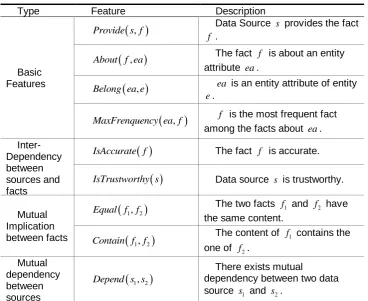
, which describe the accuracy of a fact. The confidence predictors can be the feature of conflicting facts. In a discriminative MLN model as defined in Eq. 4, the evidence x can be arbitrary useful features. With the predefined features, we define some rules or the formulas in MLNs. With these rules, MLN can learn the weight of the roles and infer the accuracy of facts.5.3. Features
Basic Features
The basic features show source, entities, entity attributes, facts and the relationship between them. For example, a data source s provide a fact f , this evidence can be presented as Provide s f
,
. Also, to present the evidence that fact is a fact f about an entity attribute ea, we define a predictor About f ea
,
. In addition, for introducing the following voting rule, we introduce another evidence predictor MaxFrequence ea f
,
, which show that f is the most frequent fact about entity attribute ea.Inter-dependency between Sources and Facts
Intuitively, there exists the “trustworthy” data source that frequently provides more accurate facts than other sources. This can be validated in the table I, which the data sources ABC Books and A1 Books are more trustworthy. And then, a fact is likely to be true if it is provided by trustworthy sources (especially if by many of them). Moreover, a data source is trustworthy if most facts it provides are true. Thus, we represent the trustworthy of a source and the accuracy of a fact as IsTrustworthy s
, IsAccurate f
respectively.Mutual Implication between Facts
Different facts about the same entity attribute may be conflicting. However, sometimes facts may be supportive to each other although they are slightly different. For example, for the book “Flash CS3: The Missing Manual”, one data source claims the author to be “Chris Grover, E. A. Vander Veer” and another one claims “Veer, E. A. Vander, Grover, Chris”. Though the expressions are different, two facts are equal. For another example, if two sources provide two facts: “E. A. Vander Veer” and “Vander Veer”, then the content of the first fact contain the second one and the last one actually supports the last one. In order to represent such relationships, we represent them as Equal f f
1, 2
and Contain f f
1, 2
.Mutual Dependency between Sources
1, 2
InterDepend s s . To describe the relationship more formally, we give the definition of the mutual dependency between sources.
Definition 5. For two data sources s1, s2 , if they satisfy the equation
1 2
1 2
| |
| |
F F
EA EA , then there exists a dependency between the two data sources. Where F1 and F2 represent the set of facts provided by s1 ,s2 respectively, EA1 and EA2 represent the set of entity attributes for which
1
s ,s2 provide the facts, and the threshold [0,1]. Sepcially, we regard two facts as equal only if they provide the equal value for the same entity attribute.
Table 2. The proposed features
Type Feature Description
Basic Features
,
Provide s f Data Source s provides the fact
f .
,
About f ea The fact f is about an entity
attribute ea.
,
Belong ea e ea is an entity attribute of entity
e.
,
MaxFrenquency ea f f is the most frequent fact
among the facts about ea.
Inter-Dependency between sources and facts
IsAccurate f The fact f is accurate.
IsTrustworthy s Data source s is trustworthy.
Mutual Implication between facts
1, 2
Equal f f The two facts f1 and f2 have
the same content.
1, 2
Contain f f The content of f1 contains the
one of f2. Mutual
dependency between sources
1, 2
Depend s s
There exists mutual
dependency between two data source s1 and s2.
5.4. Rules
are represented as predictor formulas in MLN. Because of the powerful and flexible knowledge representation, when new rules join, we can conveniently define new formulas to describe the rules and learn weights of the formulas to infer. Therefore, it makes our approach more adaptive. In addition, a majority of rules introduced in this paper are uncertain, and MLNs can handle uncertainty. Thus, any rules which are useful to resolve data conflict can be introduced to our approach even if the rules are imperfect and contradictory.
Rules in 1st Stage
In the first stage of data conflict resolution on week conflicting attributes, since the conflicting degree is low, we can get very high accuracy only through some simple rules. We will introduce voting rule and the rule of mutual implication between facts as follow.
Rule1: Voting
For the problem of identifying the true value from conflicting facts, voting is a naïve rule. Usually, the most frequent fact for an entity attribute is accurate.
,
MaxFrequence ea f IsAccurate f (5)
Rule2: Mutual Implication between Facts
If two facts have the same content for an entity attribute ea, they have the same accuracy. As a rule the detailed information is better than the simple one. Thus, if the content of a fact f1 contains the one of another fact f2 and
2
f is accurate, then f1 is also accurate.
1, 2
1
2
Equal f f IsAccurate f IsAccurate f (6)
1 2 1 2
2 1
, ^ , ^ , ^
About f ea About f ea Contain f f
IsAccurate f IsAccurate f (7)
Rules in 2nd Stage
Rule3: Inter-dependency between Sources and Facts
Base on analysis in the previous section, often the data source which provides accurate facts is trustworthy and the fact provided by trustworthy data sources is accurate. Therefore, we introduce the following formulas:
^
,
IsAccurate f Provide s f IsTrustworthy s (8)
^
,
IsTrustworthy s Provide s f IsAccurate f (9)
Rule4: Mutual Dependency between Sources
If two data sources provide many same facts for many entity attributes, there exists mutual dependency between the two sources. Therefore, the facts provided by them for other entity attributes likely have the same accuracy.
1 2 1 2
1 1 2 2
1 2
, ^ , ^ , ^
, ^ ,
InterDepend s s About f ea About f ea
Provide s f Provide s f
IsAccurate f IsAccurate f
(10)
Rule5: Influence of Week Conflicting Attributes to Strong Ones
For an entity, if a data source provides true facts for many entity attributes, the facts provided by it for other entity attributes are probably accurate.
1 1 1 1
2 2 2 2
1 2
, ^ , ^ , ^
, ^ , ^ , ^
Provide s f About f ea Belong ea e
Provide s f About f ea Belong ea e
IsAccurate f IsAccurate f
(11)
5.5. MLN Weight Training and Inference
In addition to the features and formulas, a MLN must also include the relative weights of each of these clauses. However, in our case we do not know the relative strength of all of the above formulas beforehand. Therefore, we must train the model to automatically learn the weights of each formula.
The state-of-the-art discriminative weight learning algorithm for MLNs is
the voted perceptron algorithm [21, 22]. The voted perceptron is a gradient
descent algorithm that will first set all the weights to zero. It will iterate through the training data and update the weights of each of the formulas based on whether the predicted value of the training set matches the true value. Finally, to prevent over-fitting, we will use the average weights of each iteration rather than the final weights. In order to train the data using the voted perceptron algorithm, we must know the expected number of true groundings of each clause. This problem is generally intractable, and therefore, the MC-SAT [23] algorithm is used for approximation.
inference in probabilistic models, and satisfiability algorithms have been used for pure logical systems. Since a MLN contains both probabilistic and deterministic dependencies, neither will give good results. In our experiments, the MC-SAT algorithm will be used to determine the values of query predicates. The MC-SAT is an algorithm that combines MCMC and satisfiability techniques, and therefore performs well in MLN inferences.
Finally, according to the true value of each entity attribute, we merge all record referring to an entity to a single record. So we can get the result set.
6.
Experiments Evaluation
We perform experiments on two real data sets to examine the accuracy of our approach. Our MLN model will be developed using the Alchemy system [25], which is an open source software package developed at the University of Washington that provides interfaces and algorithms for modeling Markov Logic Networks. In order to examine the effectiveness of our model, we perform experiments in the following aspects: (1) The accuracy of data conflict resolution; (2) The effects of changing the size of the training sample; (3) The effectiveness of two-stage data conflict resolution; (4) The effects of rules and their combination.
6.1. Datasets
Books
First, we extract book information from O'Reilly web site (http://oreilly.com/), including the book title, the authors, the publication date and ISBN. The data set contains 1,258 books and we regard it as ground truth (Our data set does not contain information from O'Reilly). Then, for each book, we use its ISBN to search on www.abebooks.com, which returns the online bookstores that sell the book and the book information from each store. We develop a program to crawl and extract the book information and get 26,891 listings from 881 bookstores. Since the ISBNs do not conflict each other, we perform our method to resolve the data conflicts about the book title, the authors and the publication date. In addition, we do a pre-cleaning of authors’ names in order to remove some noise information.
Movies
book title and the authors. To validate the ability of our method for resolving various type data conflict, we collect data about movies and examine the method for numerical data such as movie runtime. First, we extract top 250 movie information from IMDB.com, including the movie name, the directors and the movie runtime. Because of the authority of IMDB, we consider the information it provides as the standard facts (Also, information from IMDB.com is excluded from our data set). Then, according to the name of movies, we collect information of each movie using Google as described in [7]. The movies data set contains 7,119 movie listings from 952 data sources.
6.2. Experimental Results
Accuracy of Data Conflict Resolution
We measure the performance of data conflict resolution via accuracy, which can be defined as the percentage of the entity attributes whose true values are identified correctly over all entity attributes. We compare the accuracy of our approach against voting and TruthFinder [7] in the above two data sets. Our approach is represented as 2-Stage MLN. Specially, TruthFinder will give the incomplete facts partial scores. However, in our method, the incomplete facts can be considered as false. In addition, if two facts are equal, then the representation of them can be ignored. For example, for authors of a book, if the number of authors and each author’s information are correct, then the authors’ fact is correct, without considering the sequence of authors.
70 75 80 85 90 95 100
Books Movies
A
cc
ur
ac
y(
%
)
Voting TruthFinder 2-Stage MLN
Fig. 3. Accuracy comparation among Voting, TruthFinder and our approach.
Fig.3 shows that our approach gets higher accuracy over other two approaches across the two data sets. In the books data set, our approach has an obvious advantage (the accuracy is 92.9%), it is because there exists plenty of incomplete or incorrect information for the book authors. It also validates the ability of our approach for resolving data conflict to some extent. But, our approach only gets a little higher accuracy than TruthFinder
in the second data set. It is because that the movie runtime referring to a movie are not such variable as the book authors. And Voting also can get a high accuracy (87%). The experiments prove that our approach improve effectively the precision by 2-Stage data conflict resolution and utilizing multi-dimensional features.
Effects of Changing the Training Size
To check the effect factors of our approach, we test the effectiveness of the size of training samples. In the books data set, we randomly select records referring to 300, 600, 900, 1200 entities as training samples and resolve data conflict utilizing our approach. Otherwise, in the movies data set, records referring to 60, 120, 180, 240 entities are selected.
80 82 84 86 88 90 92 94 96
300 600 900 1200
Accur
acy
(%
)
Size of training sample(number of entities)
Fig. 4. Effects of changing the training size (The books data set)
90 91 92 93 94 95 96 97
60 120 180 240
A
cc
u
ra
cy
(%
)
Size of training sample(number of entities)
Fig. 5. Effects of changing training size (The movies data set)
Effectiveness of Two-Stage Data Conflict Resolution
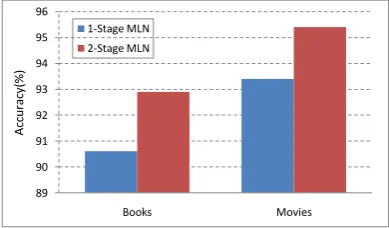
One of the most important characteristics of our approach is to divide attributes into two sets according to conflicting degree and resolve data conflicts in two stages based on MLN. To validate the effectiveness of two-stage data conflict resolution, we conduct experiments as follows. First, we equally treat all attributes and resolve data conflicts in one stage, we call this approach as one stage data conflict resolution with MLN and denote it as 1-Stage MLN. As the rule of influence of week conflicting attributes to strong ones cannot be considered, we only use the first four rules in this approach. Then we resolve data conflict using our approach proposed in this paper and denoted it as 2-Stage MLN. We compare the accuracy of the two approaches.
conflicting attributes to strong ones and re-train the more precise MLN model to infer true values. Thus, the accuracy of resolution is improved effectively.
89 90 91 92 93 94 95 96
Books Movies
A
cc
u
ra
cy(
%
)
1-Stage MLN 2-Stage MLN
Fig. 6. Effectiveness of two-stage data conflict resolution.
Effects of Rules and Their Combination
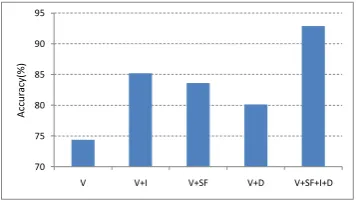
To validate the rules proposed in this paper, the performance of our approach utilizing various rules and their combination is reported. The fifth rule needs to resolve data conflict on week conflicting attribute in advance and can be used only in the second stage, and the effectiveness of it has been validated in the third experiment. So we only test our four rules: Voting (denoted as V), Mutual implication between facts (denoted as I), Inter-dependency between sources and facts (denoted as SF), Mutual dependency between sources (denoted as D). We regard Voting as a basic rule, and then add one of the other three rules to the basic rule; finally we combine all the four rules. Thus, we get five rules and their combination. We test the accuracy of our approach utilizing the five respectively.
This experiment is executed in the books data set, and the other setting is the same as the first experiment. In Fig.7, it shows the accuracy using various rules and their combination. Obviously, each rule can improve the accuracy to some degree and it can validate the effectiveness of our rules. Among all rules, I and SF have a more obvious effect than D. On the one hand, it validates the existence of “trustworthy” data sources and the effect for identifying the true values from conflicting facts. On the other hand, conflicting information is often represented as incomplete or inconsistent, and it is one of the main troubles for resolving data conflict. In addition, we do not consider the dependency direction of D; it causes D not show enough significance.
conflict types, and then MLN weight training and inference are conducted. It also demonstrates the adaptability of our approach.
70 75 80 85 90 95
V V+I V+SF V+D V+SF+I+D
Acc
ur
ac
y(
%
)
Fig. 7. Effects of rules and their combination.
7.
Conclusion
In this paper we have presented an approach for two-stage resolving data conflict based on Markov Logic Networks. Our approach can divide attributes according to their conflict degree and separately handle conflicts on them in two stages. With multi-angle features and rules, our approach can effectively improve the accuracy of data conflict resolution. Based on the flexibility of knowledge representation as well as the ability to handle uncertainty of MLN, our approach can combine the imperfect and contradictory knowledge and is more adaptive. However, the training process of our model is something time-consuming when the training set is very large scale. So how to improve the efficiency of our approach is one of our future works.
Acknowledgment. This work was supported in part by the National Natural Science Foundation of China under Grant No. 90818001 and the Natural Science Foundation of Shandong Province of China under Grant No. 2009ZRB019YT and No. 2009ZRB019RW.
References
1. Dong, X., Naumann, F.: Data fusion – Resolving data conflicts for integration. In Proceedings of the 35th International Conference on Very Large Databases, Lyon, France, 1654-1655. (2009)
3. Gatterbauer, W., Suciu, D.: Data conflict resolution using trust mappings. In Proceedings. of ACM SIGMOD International Conference on Management of Data, Indianapolis, Indiana, USA, 219-230. (2010)
4. Bleiholder, J., Naumann, F.: Conflict handling strategies in an integrated information system. In Proceedings of the International Workshop on Information Integration on the Web, Edinburgh, UK. (2006)
5. Bleiholder, J., Naumann, F.: Data fusion. ACM Computing Surveys. Vol. 41, No. 1, 1-41. (2008)
6. Wu, M-J., Marian, A.: Corroborating answers from multiple web sources. In Proceedings of the 10th International Workshop on the Web and Databases. Beijing, China. (2007)
7. Yin, X-X., Han, J-W., Yu, P. S.: Truth discovery with multiple conflicting information providers on the Web. In Proceedings of the 13th ACM SIGKDD International Conference on Knowledge Discovery and Data Mining. San Jose, California, USA, 1048-1052. (2007)
8. Dong, X., Berti-Equille, L., Srivastava, D.: Integrating conflicting data: the role of source dependence. In Proceedings of the 35th International Conference on Very Large Databases. Lyon, France, 550-561. (2009)
9. Richardson, M., Domingos, P.: Markov logic networks. Machine Learning. Vol. 62, No. 1-2, 107-136. (2006)
10. Bilke, A., Bleiholder, J., Bohm, C., Draba, K., Naumann, F., Andweis, M.: Automatic data fusion with HumMer. In Proceedings of the 31st International Conference on Very Large Databases. Trondheim, Norway, 1251-1254. (2005) 11. Bleiholder, J., Draba, K., Naumann, F.: FuSem – Exploring different semantics of
data fusion. In Proceedings of the 33rd International Conference on Very Large Databases. Vienna, Austria, 1350-1353. (2007)
12. Bleiholder, J., Szott, S., Herschel, M., Kaufer, F., Naumann, F.: Subsumption and complementation as data fusion operators. In Proceedings of 13th International Conference on Extending Database Technology. Lausanne, Switzerland, 513-524. (2010)
13. Page, L., Brin, S., Motwani, R., Winograd, T.: The PageRank citation ranking: bringing order to the web. Technical report, Stanford Digital Library Technologies Project. (1998)
14. Berti-Equille, L., Sarma, A. D., Dong, X., Marian, A., Srivastava, D.: Sailing the information ocean with awareness of currents: Discovery and application of source dependence. In Proceedings of the 4th Biennial Conference on Innovative Data Systems Research. Asilomar, CA, USA. (2009)
15. Singla, P., Domingos, P.: Entity resolution with Markov logic. In Proceedings of the 6th Industrial Conference on Data Mining. Hong Kong, China, 572-582. (2006) 16. Yang, J-M., Cai, Y., Wang, Y., Zhu, J., Zhang, L., Ma, W-Y.: Incorporating
site-level knowledge to extract structured data from web forums. In Proceedings of the 18th International Conference on World Wide Web. Madrid, Spain, 181-190. (2009)
17. Zhu, J., Nie, Z., Liu, X., Zhang, B., Wen, J-R.: Statsnowball: a statistical approach to extracting entity relationships. In Proceedings of the 18th International Conference on World Wide Web, Madrid, Spain, 101-110. (2009) 18. Genesereth, M. R., Nilsson, N. J.: Logical Foundations of Artificial Intelligence.
Morgan Kaufmann, San Mateo, CA. (1987)
19. Poon H., Domingos, P.: Joint inference in information extraction. In Proceedings of 22nd AAAI Conference on Artificial Intelligence. Vancouver, Canada, 913-918. (2007)
21. Lowd, D., Domingos, P.: Efficient Weight Learning for Markov Logic Networks. In Proceedings of 11th European Conference on Principles and Practice of Knowledge Discovery in Databases. Warsaw, Poland, 200-211. (2007)
22. Collins, M.: Discriminative training methods for hidden Markov models: Theory and experiments with perceptron algorithms. In Proceedings of EMNLP, Philadelphia, PA. (2002)
23. Poon, H., Domingos, P.: Sound and efficient Inference with Probabilistic and Deterministic Dependencies. In Proceedings of the 21st National Conference on Artificial Intelligence. Boston, Massachusetts, USA, 458-463. (2006)
24. Gilks, W. R., Richardson, S., Spiegelhalter, D. J.: Markov Chain Monte Carlo in Practice. Chapman and Hall. London, UK. (1996)
25. Kok, S., Singla, P., Richardson, M., Domingos, P.: The Alchemy system for statistical relational AI. Technical report, Department of Computer Science and Engineering, University of Washington, Seattle, WA. (2005). http://www.cs.-washington.edu/ai/alchemy.
ZHANG Yong-Xin, born in 1978, received the Ph. D. degree from School of Computer Science and Technology, Shandong University, Jinan, China, in 2012. Now, he is working at School of Mathematical Sciences, Shandong Normal University. His research interests include web data integration and web data fusion.
LI Qing-Zhong is a professor in School of Computer Science and Technology, Shandong University, China. His research interests include data integration and Software as a Service (SaaS).
PENG Zhao-Hui, born in 1978, Ph. D., associate professor. His research interests include keyword search in database and web data management.