© IJEDR 2018 | Volume 6, Issue 4 | ISSN: 2321-9939
IJEDR1804035
International Journal of Engineering Development and Research (
www.ijedr.org
)
184
Identification And Improvement Of Expanded Flow
At Various Step Heights
1Katturoju Ashokachary, 2Rajarao.V, 3K.Narendrareddy 1Assistant professor, 2 Assistant professor, 3 Assistant professor
1Department of Mechanical Engineering, 1Vidya Jyothi Institute of Technology, Hyderabad, India.
_____________________________________________________________________________________________________
Abstract - When the fluid passes through the constant area geometry, it results in the reduction of pressure because of presence of friction between the material and wall. But if the geometry increases suddenly, it undergo loss of pressure and it produces strong re-circulating flow. This re-circulated flow is not at all desirable for sudden expansion flows. Present work aims at the re-circulated region and uses the control technique namely; suction to break the undesirable re-circulated zone. In the present study, flow over sudden expansion geometries with and without suction scenario is studied for different Lmax/Lmin models of 3, 4 and 5. For Lmax/Lmin = 5, it is found that the re-circulation and loss zones are more. Further, the configuration of Lmax/Lmin = 5 is subjected to suction. With suction, flow scenario is completely changed and attachment point is observed at the base of the model itself. Results, thus identify the improved flow structure that can be useful to different applications.
Index Terms - Sudden expansion geometries, flow structure, flow pattern, suction, re-circulated zone and vortex. _____________________________________________________________________________________________________
INTRODUCTION Fluid flow over obstacles like steps with increasing and decreasing dimension is an interesting problem with wide range of applications. As we can find them in many engineering applications like an automobile, the front side of the car is like decreasing cross sectional area, whereas, the rear side of the car is like increasing cross sectional area. The present study aims at understanding the flow structure for suddenly increasing cross sectional area, problems encountered, formation of loss zones with this sudden change in geometry and also discusses about control techniques to reduce the loss zones. The loss zones (vortex) are created because of presence of low pressure at the corners of the suddenly expanded geometries. These vortices are responsible for reducing the vehicle movement. The more is the size of vortex, more will be the reduction in the mileage of the vehicle. The size of the vortex depends on the step height of the geometry. Present work aim to understand the variation of vortex size with step height and control of vortex with suction. Vortices are formed because of low pressure at the corner, but, the theme of providing suction at the corner is to further reducing the pressure in the expansion region, which creates strong low pressure region at the corner. That enables to suck the fluid from the top; thereby it creates a flow free from vortices, and diminishes the primary re-circulating region. With the effect of suction, the fluid particles at the beginning of the sudden expansion itself, are sucked towards the corner of the geometry, because of strong low pressure region. There by, the fluid particles move as the geometry changes.
Figure 1. Experimental section.
EARLIER WORKS
IJEDR1804035
International Journal of Engineering Development and Research (
www.ijedr.org
)
185
characteristics of flow of sudden expansion with expansion ratio of 2.5 and found swirl intensity increment with increase of Reynolds number. Uruba et al. [4] investigated on the control of narrow channel flow behind backward facing step by blowing and suction. Preliminary results indicated that both blowing and suction could reduce the length of separation zone to one third of its value without control. Hussan et al. [5] studied the symmetry of breaking flow bifurcation phenomenon and its control of flow through symmetric sudden expansion channel by applied magnetic field in the transverse direction. Zong Yuan Guo et al. [6] studied the symmetric sudden expansion flows with heating effect in the corner recirculation zone (CRZ). The heat addition to such flows will lead to the reduction of recirculation of CRZ length and it even disappears if the heating intensity is sufficiently large. Bender et al. [7,8] studied sudden expansion flows with and without solid particles moderately at high Reynolds numbers and found that flow with solid particles had less vortex compared to flow without solid particles. Tihon et al. [9] experimentally and numerically studied the backward facing step flow at moderate Reynolds numbers for different expansion ratios. As the channel expansion ratio is increased, the recirculation pattern becomes more complex in the laminar flow regime. According to Nejad et al. [10], improving swirl to the inlet flow resulted in a considerable reduction of corner recirculation length. Das et al. [11] studied pressure characteristics in the configuration of sudden expansion with central restriction and suction with 2% to 10% of inlet mass flow. Chakrabarti et al. [12] studied performance of vortex controlled diffuser at low Reynolds number regime and revealed that when the bleed is incorporated, the VCD behaves in a completely different manner from that of sudden expansion.FLOW DEVELOPMENT OVER A MODEL OF STEP HEIGHT (H) = 20 MM LMAX/LMIN = 5
WITHOUT SUCTION
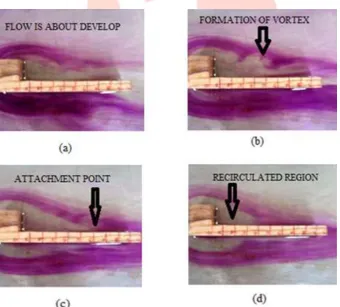
Figure 2 represents the flow visualization study of Lmax/Lmin = 5 at without suction. Flow is initially detached from the wall as shown in the fig. This is called detachment point, this occur where the crosss section of the object abruptly changed. This flow is attached to wall far away from the vertical wall with spiraling effect known as vortex. This is called attachment point, which occurs at a distance of 3 (ration of attachment point to step height) from the vertical wall. After the flow gets attached to the wall, comes back towards the vertical wall because of the presence of low pressure at the corner. This creates the pockets of eddies, results in recirculating region. This region is called primary recirculation zone. If the length of the Lmax is large enough, then the free stream flow, which crosses the primary recirculation region gets dettached from the wall. Again, attaches afterwards, which is called re-attachment point. In between the detachment and re-attachment points, flow circulates and this is called secondary recirculation region. But, the present study aims only at understanding and control of primary recirculation region.
FIGURE.2. FLOW DEVELOPMENT OVER A MODEL OF LMAX/LMIN = 5 AT WITHOUT SUCTION
LMAX/LMIN = 5 WITH SUCTION
IJEDR1804035
International Journal of Engineering Development and Research (
www.ijedr.org
)
186
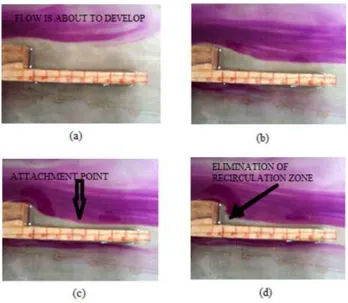
automobiles. In order to avoid or to minimize these zones, suction is introduced. The effect of suction is to create further strong low pressure rigion at the corner of the model. This strong low pressure region at the corner enables to hold the particles, which are at the beginning of the expansion region so that these traveldirectly to the corner of the model, which will minimize the recirculation flow and vortex as shown in Fig.3. Initially, the flow attaches the wall at a distance of 1 (ration of attachment point to step height) from the vertical wall. As the time passes the attachment point shifts towards the vertical wall resulting in diminished recirculated region. With suction, it follows the physical structure of the model. Then the flow doen not find detachment point. Hence, the flow through sudden expansion geometry with suction is like potential flow through sudden expansion.Figure3.Flow Development Over A Model Of Lmax/Lmin = 5 With Suction.
FLOW DEVELOPMENT OVER A MODEL OF STEP HEIGHT (H) = 30 MM
LMAX/LMIN = 3 AT WITHOUT SUCTION
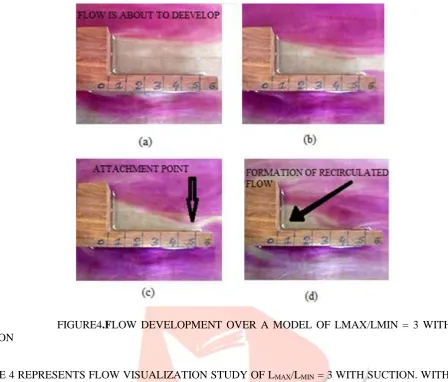
Figure 4 represents the flow visualization study of Lmax/Lmin = 3 without suction at a step height of 30 mm. As the step height increases, the flow pattern changes a lot as shown. Flow does not directly separate from the vertical wall as in the case with step height 20 mm, but it follows the vertical wall in the verically down ward direction then separates from the wall at a distance 3 mm from top (where the actual separation would occur). After that, this detached flow moves gradually over Lmax and gets attached at a distance of 1.83 from the vertical wall. Then turns back and forms the typical recirculated flow.
IJEDR1804035
International Journal of Engineering Development and Research (
www.ijedr.org
)
187
FIGURE4.FLOW DEVELOPMENT OVER A MODEL OF LMAX/LMIN = 3 WITHOUT
SUCTION
IJEDR1804035
International Journal of Engineering Development and Research (
www.ijedr.org
)
188
FIGURE5.FLOW DEVELOPMENT OVER A MODEL OF LMAX/LMIN = 3 WITH
SUCTION
CONCLUSIONS
FLOW STRUCTURE OVER SUDDEN EXPANSION GEOMETRY IS EXPERIMENTALLY STUDIED FOR
DIFFERENT CONFIGURATIONS INVOLVING VARIED LMAX/LMIN
VALUES. THE VORTEX SIZE AND
RE-CIRCULATION ZONES INCREASE AS THE STEP HEIGHT INCREASED. FOR STEP HEIGHT OF 20
MM, THE ATTACHMENT POINT OCCURS FAR AWAY FROM THE VERTICAL WALL THAN WITH A
STEP HEIGHT OF 30 MM. BUT, FOR STEP HEIGHT OF 30 MM, THE VORTEX SIZE IS MORE IN
VERTICAL DIRECTION. WITH SUCTION, THESE ISSUES ARE SOLVED AND REDUCE THE VORTEX
AND RECIRCULATION REGIONS, WHICH ARE VERY MUCH DESIRABLE FOR SUDDEN EXPANDED
FLOWS. HENCE, IT IS CLEAR THAT THE FLOW THROUGH SUDDEN EXPANSION WITH SUCTION
APPROACHES POTENTIAL FLOW. SUCH IMPROVED FLOW STRUCTURE WILL BE HELPFUL FOR
MANY ENGINEERING APPLICATIONS.
REFERENCE[1]. Numerical investigation of liquid metal flows in rectangular sudden expansions C. Mistrangelo, L. Bühler Fusion Engineering and Design Volume 82, Issues 15–24, October 2007, Pages 2176–2182
[2]. Experimental investigation of cavitation in a sudden expansion pipe Jian-min ZHANG, Qing YANG, Yu-rong WANG, Wei-lin XU and Jian-gang CHEN Journal of Hydrodynamics, Ser. B Volume 23, Issue 3, June 2011, Pages 348-352
[3].Near field characteristics of swirling flow past a sudden expansion H. Mak, S. Balabani, Chemical Engineering Science Volume 62, Issue 23, December 2007, Pages 6726–6746
[4]. Control of a channel-flow behind a backward-facing step by suction/blowing Václav Uruba, ,Pavel Jonáš, Oton Mazur International Journal of Heat and Fluid Flow Volume 28, Issue 4, August 2007, Pages 665–672
[5]. Control of asymmetric flows by applied magnetic field in a symmetric sudden expanded channel Dr. Hussam Ali Khalafv Al-Qadisiyah Journal For Engineering Sciences, Vol. 9……No. 4….2016 585
[6]. Thermal effect on the recirculation zone in sudden-expansion gas flows, Zeng-Yuan Guo.De-Yu Li.Xin-Gang Liang International Journal of Heat and Mass Transfer Volume 39, Issue 13, September 1996, Pages 2619-2624
[7]. Fluid flow in an axisymmetric, Sudden-Expansion Geometry, C.F. Bender, P.F. Buerger, M.L. Mittal, T.J. Rozmajzl ParallelComputational Fluid Dynamics 1995 Implementations and Results Using Parallel Computers 1996, Pages 363–370 [8]. Fluid flow in an axisymmetric, Sudden-Expansion Geometry, C.F. Bender, P.F. Buerger, M.L. Mittal, T.J. Rozmajzl
IJEDR1804035
International Journal of Engineering Development and Research (
www.ijedr.org
)
189
[10]. Flow field characteristics of an axisymmetric sudden-expansion pipe flow with different initial swirl distribution A.S. Nejad.S.A. Ahmed. International Journal of Heat and Fluid Flow 13(4):314-321· December 1992[11]. Pressure characteristics study for the configuration of sudden expansion with central restriction and suction, Tridibesh das1*, Somnath chakrabarti2 journal of fluid dynamics, 6, 30-41