362
Restaurant Management System Over Private
Network
Amanat Dhillon, Shreya Tuli
Abstract: Restaurant Management System over Private Network is an automated business environment which allows restaurants to reduce operational costs, increase efficiency of business, improve customer satisfaction, cut down labour costs, decrease order processing time and provide better Quality-of-Service(Q-S). This system manages a digital menu allowing the customers to place orders easily. Authentication fields for employees enable better administration of the restaurant. The whole restaurant is integrated into one private network thereby improving security and eliminating the need for a constant internet connection.
Index Terms: Automated Business, Digital menu, Localhost, Private network, QOS, Restaurant, WIFI.
————————————————————
1
I
NTRODUCTIONThe first large scale production of personal computers was initiated by IBM in 1975. In the last four decades technology has grown by leaps and bounds. The 21st century saw rapid digitalization, and now wireless technology has become an indispensible part of our lives. Efforts now are being made to incorporate these concepts in the hospitality industry. In today’s competitive world customer satisfaction, better quality of experience, adoption of efficient and accurate time saving methods, reduction of human errors, lesser human-human interaction has become vital. This research deals with developing a whole-some restaurant business environment including menu management system, authentication system for customers and staff, delivery management system for home delivery of food, provision of an administrator field for the overall management and well being of the restaurant. This project underwent two stages of development- requirement specification, and implementation and design. The requirement specifications were decided after conducting a survey to understand the user’s preferences and to deduce the need and demand for the product in the market. During the product deployment stage statistical analysis showed the superiority of the project over existing systems available in terms of lesser manpower requirement and profit margins for the restaurant despite installation of new digital devices. Therefore it was deduced that the introduction of an automated system reduced ordering time, relay time between kitchen and service area and resulted in better quality of experience for the customers.
2
R
EQUIREMENTS
PECIFICATIONSA survey was conducted to understand the requirements for the project. Various aspects of the system were finalized based on the results of the survey.
Question 1:
Figure 1. Question 1
The first question is to determine the the age group of people answering the survey. 53.8 % of the response was from the age group of 18-30. Hence a fair assumption can be made that restaurants are most frequently visited by the same age group and the product must be developed keeping this in mind.
Question 2:
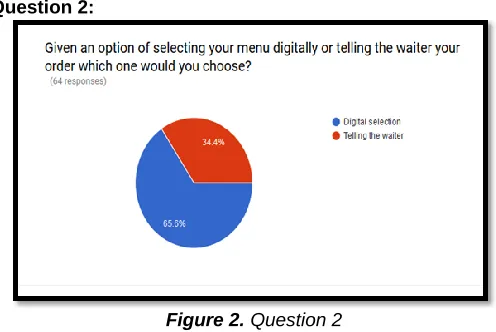
Figure 2. Question 2
The second question illustrates the user willingness to adopt digital menu selection over manual menu selection. 65.6% people are willing to switch to digital methods of order selection as opposed to just 34.4% who prefer the manual method.
Question 3:
This question illustrates the need for an option where the user can change his choice after placing the order. The statistics show that 55.4 % of the people rarely change their order after placing it, whereas only 20% of the people often change their order. Keeping this in mind the need for a reorder option was removed. The user is provided with an option to choose from the menu but once the order is placed, it cannot be cancelled without contacting the manager.
Question 4:
Figure 4. Question 4
The fourth question illustrates the amount of time it takes for the waiter to bring the cheque at the end of the meal. The highest response said it was between 5-10 minutes(41.5%). While some customers do not mind waiting for that time, yet others may have a problem. This question highlights the need for automatic bill display for those customers who do not prefer to wait.
Question 5:
The last part of the survey was a subjective question where the users were asked about the kind of questions they generally ask the waiters to assess the importance of the waiter being present while the customer places the order. Out of 65 people who took the survey 47 answered the question Their answers included questions like:
How long would it take for the order to arrive? What was the dish of the day?
Personal recommendations about the restaurant’s best dish. What was the chef’s special for the day?
Based on the user response it is fair to assume that while the customers prefer to ask questions, yet the presence of the waiter at all times is unnecessary and unwanted. Any queries about the menu items or food could be clarified easily by calling on the waiter as and when required while still continuing with the digital form of menu based ordering. The user survey conducted provided an insight into the minds of the customers. Their likes and dislikes and help assess the demographic for the product.
3.
M
ODULED
ESCRIPTION3.1 Main Management System
This module includes running the entire application as localhost. It includes the main database system which acts as the backend for the entire system. It includes the login pages
for all the employees as well as for the customers. The entire application is supported on this one server and is accessed by other devices that run on the restaurant’s connection. It acts as the backbone for the entire organization.
3.2 Ordering System
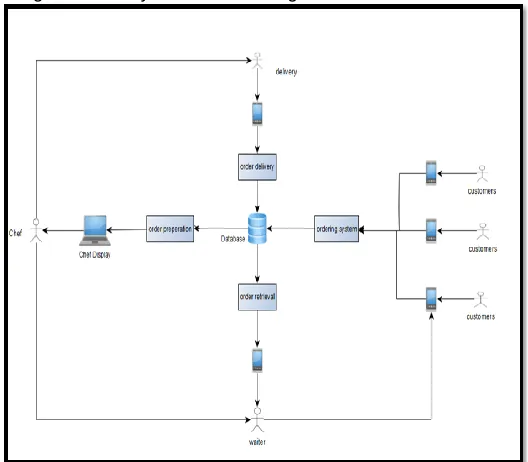
The customers in the restaurant access the application on their own devices and place their respective orders. The application is running on the main workstation but can be accessed by every individual device after connecting to the restaurant’s wifi connection. In case the customer is unable to place an order on his own he/she can then call the waiter who can proceed to take the order on his own smart phone device. This connection works without the use of the internet. Also the customers who want their food to be Home delivered access the application through the internet following the same procedure.
3.3 Order Preparation System
The order preparation system includes the chef’s display device on which he can read the orders placed and can erase all the orders at the end of service once they have been delivered. It also includes calling the waiter whenever the order is ready to take the order to the respective table. The order preparation module also deals with supplying the order to the delivery personnel whenever a customer orders it online.
3.4 Order Retrieval System
The order is obtained by the waiters from the kitchen as and when it is ready. The waiter can also use his/her own smart phone device to take a customer’s order in some cases.
3.5 Order Delivery System
The system includes the delivery personnel logging into their password protected accounts to view the orders to be placed. The delivery personnel then receives the orders from the kitchen and deliver it to the required address. The same procedure is followed even when someone wants food delivered to the bus station. The five main modules are integrated closely to work as a single efficient unit.
364
4.
W
ORKINGM
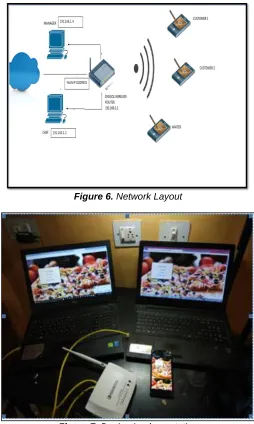
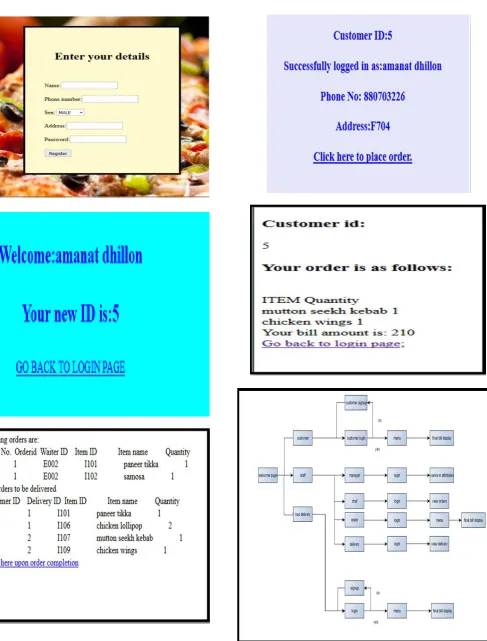
ECHANISMThe model includes one DIGISOL DG BG 4100NU wireless router, RJ 45 cables to establish Ethernet LAN connections, two laptops connected in an Ethernet LAN connection and multiple wireless devices all accessing the wireless network. The wired LAN connections between the two computers and the router form a private network with the static IP configurations of 192.168.1.2, 192.168.1.4 and 192.168.1.1. The dynamic address allocation is turned off to reduce ambiguity due to network change. The two computers in the network configuration belong to the manager and the chef respectively with the web application running on server with IP address 192.168.1.3. Various other devices(smart phones) are introduced into the system which simulate the customers visiting the restaurants. Each customer can access the application running on the main server by logging into the router network and typing in the IP address 192.168.1.4 in the browser search window. Therefore any incoming user well within the range of the restaurant premises can place an order after proper authentication without the need to connect to the internet, or call the waiter. The customer accesses the digital menu and selects the desired quantity and type of food required. The bill is automatically displayed and additional orders are appended to the same bill. New customers can signup with the links provided. The two main computers connected by Ethernet connection act as the manager server and the chef server. Both can be setup in different rooms and will run the same application. The manager server hosts the entire application using WAMP server with inbuilt PhpMyadmin, Mysql and Apache files. The application backend works on Mysql DBMS, the front end programming has been done in Html with integration by php. Thus only one server is required to run the entire web application and the IP address of the server which hosts the application is supplied to every device connected to the network either through a wired connection or wirelessly. This reduces the need to host the restaurant website, to have constant internet connectivity, enhances security because only the devices connected to the router’s network can connect to the web application. In case a device from some other device tries to connect it is not granted access. To allow people from other networks to access the application NAT protocol is implemented with the LAN and WAN IP address of the manager server acting as a conduit between the private restaurant network and the rest of the internet. The application includes password protected login fields for the customers and the staff. Any new customer can also become a part of the existing restaurant by filling out a simple form. Similar login field are provided for the manager, waiter and the chef. The manager can oversee the working of the entire restaurant through his device which is hosts the web application. In case the customer is not comfortable with using this technology he/she can ask for a waiter who then after authentication can take their order. The chef after authentication can see all the orders on his screen and can proceed to preparing them. Once the orders are ready the waiters are asked to deliver the food to the required tables. For online delivery the customers access the application enables through NAT protocol and place their order. The delivery services are enabled and the food is delivered to the desired address. The system also provides a bus delivery option wherein the customers can select a particular station for the food to be delivered during a certain time frame.
Figure 6. Network Layout
Figure 7. Design Implementation
366
6.
A
CKNOWLEDGMENTThe author wishes to thank faculty Prof. Srimann Iyengar of Vellore Institute of Technology.
7.
R
EFERENCES[1] V. Swapna, M. Firdouse Ali Khan “Design And Implementation Of Ordering System For Restaurants,” International Journal of Engineering Research and Technology,Volume 1, Issue 10, December 2012 .
[2] Maxat Pernebayev Shymkent, Tanvi Singh, Karthick Sundararajan Palladam, “Design, Implementation, and Evaluation of a Menu Management System for Restaurants,” University of Zurich.
[3] Varsha Chavan, Priya Jadhav, Snehal Korade, Priyanka Teli, “Implementing Customizabke Online Food Ordering System Using Web Application, ” International Journal of Innovative Science, Engineering & Technology, Volume 2 Issue 4, April 2014.