University of Pennsylvania
ScholarlyCommons
Publicly Accessible Penn Dissertations
2019
Bayesian Approaches For Modeling Variation
Gemma Elyse Moran
University of Pennsylvania, [email protected]
Follow this and additional works at:
https://repository.upenn.edu/edissertations
Part of the
Statistics and Probability Commons
This paper is posted at ScholarlyCommons.https://repository.upenn.edu/edissertations/3350 For more information, please [email protected].
Recommended Citation
Bayesian Approaches For Modeling Variation
Abstract
A core focus of statistics is determining how much of the variation in data may be attributed to the signal of interest, and how much to noise. When the sources of variation are many and complex, a Bayesian approach to data analysis offers a number of advantages. In this thesis, we propose and implement new Bayesian methods for modeling variation in two general settings. The first setting is high-dimensional linear regression where the unknown error variance is also of interest. Here, we show that a commonly used class of conjugate shrinkage priors can lead to underestimation of the error variance. We then extend the Spike-and-Slab Lasso (SSL, Rockova and George, 2018) to the unknown variance case, using an alternative, independent prior
framework. This extended procedure outperforms both the fixed variance approach and alternative penalized likelihood methods on both simulated and real data.
For the second setting, we move from univariate response data where the predictors are known, to
multivariate response data in which potential predictors are unobserved. In this setting, we first consider the problem of biclustering, where a motivating example is to find subsets of genes which have similar expression in a subset of patients. For this task, we propose a new biclustering method called Spike-and-Slab Lasso Biclustering (SSLB). SSLB utilizes the SSL prior to find a doubly-sparse factorization of the data matrix via a fast EM algorithm. Applied to both a microarray dataset and a single-cell RNA-sequencing dataset, SSLB recovers biologically meaningful signal in the data.
The second problem we consider in this setting is nonlinear factor analysis. The goal here is to find low-dimensional, unobserved ``factors'' which drive the variation in the high-dimensional observed data in a potentially nonlinear fashion. For this purpose, we develop factor analysis BART (faBART), an MCMC algorithm which alternates sampling from the posterior of (a) the factors and (b) a functional approximation to the mapping from the factors to the data. The latter step utilizes Bayesian Additive Regression Trees (BART, Chipman et al., 2010). On a variety of simulation settings, we demonstrate that with only the observed data as the input, faBART is able to recover both the unobserved factors and the nonlinear mapping.
Degree Type
Dissertation
Degree Name
Doctor of Philosophy (PhD)
Graduate Group
Statistics
First Advisor
Edward I. George
Subject Categories
BAYESIAN APPROACHES FOR MODELING VARIATION
Gemma E. Moran
A DISSERTATION
in
Statistics
For the Graduate Group in Managerial Science and Applied Economics
Presented to the Faculties of the University of Pennsylvania
in
Partial Fulfillment of the Requirements for the
Degree of Doctor of Philosophy
2019
Supervisor of Dissertation
Edward I. George, Universal Furniture Professor, Professor of Statistics
Graduate Group Chairperson
Catherine M. Schrand, Celia Z. Moh Professor, Professor of Accounting
Dissertation Committee
Veronika Roˇckov´a, Assistant Professor of Econometrics and Statistics, Chicago Booth
Nancy R. Zhang, Professor of Statistics
BAYESIAN APPROACHES FOR MODELING VARIATION
c
COPYRIGHT
2019
Gemma Elyse Moran
This work is licensed under the
Creative Commons Attribution
NonCommercial-ShareAlike 3.0
License
To view a copy of this license, visit
Dedicated to my grandparents:
ACKNOWLEDGEMENT
First and foremost, I would like to thank my advisor, Ed George. Your incredible insight and
statistical intuition have been instrumental in shaping both this thesis and my development
as a statistician. Moreover, your boundless enthusiasm and encouragement always led me
to come away from meetings with a renewed positive outlook and energy, especially when I
was at my most stressed.
Thank you to my committee members: Veronika Roˇckov´a, Shane Jensen and Nancy Zhang.
Veronika - your tremendous work ethic and intellect have been an inspiration and I have
learnt so much from working with you over the course of my PhD. Shane - thank you
for being a fantastic teacher, for your wealth of knowledge of all things Bayesian and for
all your encouragement. Nancy - thank you for fostering my interest in both genomics
and dimensionality reduction - many of my current research interests were inspired from
attending your reading group.
Next, an enormous thank you to the Wharton Statistics Department. On my prospective
PhD visit from Australia five years ago, I was struck by the warmth and collegiality of the
department, a feature which has remained constant over my five years here. To the faculty
that I have been fortunate enough to have as teachers, thank you for your dedication and
helping me grow as a researcher and statistician. To the staff - thank you for all you do
to keep the department running smoothly, and for all your generous help, from reserving
classrooms for TA sessions, to navigating PhD forms and for always being there with kind
words and/or a donut.
To our PhD cohort - Raiden Hasegawa, Bikram Karmakar, Justin Khim and Linjun Zhang
- it has been a privilege to call you my classmates. I will always have fond memories of the
first year office where we would alternate doing our probability homework with playing putt
putt golf. To the Bayesian gang - Cecilia Balocchi and Sameer Deshpande - our reading
forward to future collaborations in the years to come! To the Statistics PhD students,
both present and graduated - thank you for all the laughs and great conversations, both
statistical and otherwise, over our daily lunches in the department, board game nights,
drinks at Cav’s and barbecues.
I feel so lucky to have so many amazing friends from all over the world. To my Philadelphia
friends - you have made my five years here enriching personally as well as intellectually.
Thank you especially to Lesley Meng, Cecilia Balocchi, Elica Dhundia McCarthy, Sameer
Deshpande, Kathy Li and Daniela Schmitt for always being there for me, from the stressful
times to the celebratory times, and everything in between. Finding balance during the PhD
was so important - thanks to the erstwhile running club: Justin Khim, Kathy Li, Lesley
Meng, Min Xu; the bowling crew: Justin Chiu, Colman Humphrey, Matt Olson; the bridge
club: Eric Baxter, Ashley Baker, Ling Lin; and the vegan food gang: Edward Chang and
Lesley Meng. To my Australian friends: true friendship is when it feels like just yesterday
since you’ve last seen each other, even if it has been a year - thank you.
To Eric Baxter - thank you for always being able to make me laugh, supporting me, being
there for me in tough times, and for all of our adventures, even when I forget to read contour
maps and plan a hike up an (almost) vertical mountain slope.
Finally, thank you to my family. As the quote goes - you have given me roots and wings.
Roots, to ground me and give me a sense of belonging and identity, and wings, to give me
the courage to go out in the wider world. Thank you especially to my parents: Gabrielle
and Paul, and Greg and Trish: even though I am on the other side of the world, it gives
me such strength knowing you are always there for me, just a call away. Nick - thank you
for being the best big brother. Margaret - thank you for being my “Philly Mum” - it has
been so wonderful to have had the opportunity to connect here and I am so grateful for all
your care, encouragement, and showing me this great city. Your equanimity, generosity and
In the week before submitting this thesis, my uncle Simon tragically passed away. Si
-thank you for being such a great uncle, from introducing me to my favorite sci-fi and
fantasy novels as a kid, to always having a witty response or joke for every situation, and
ABSTRACT
BAYESIAN APPROACHES FOR MODELING VARIATION
Gemma E. Moran
Edward I. George
A core focus of statistics is determining how much of the variation in data may be attributed
to the signal of interest, and how much to noise. When the sources of variation are many
and complex, a Bayesian approach to data analysis offers a number of advantages. In this
thesis, we propose and implement new Bayesian methods for modeling variation in two
general settings. The first setting is high-dimensional linear regression where the unknown
error variance is also of interest. Here, we show that a commonly used class of conjugate
shrinkage priors can lead to underestimation of the error variance. We then extend the
Spike-and-Slab Lasso (SSL, Roˇckov´a and George, 2018) to the unknown variance case,
using an alternative, independent prior framework. This extended procedure outperforms
both the fixed variance approach and alternative penalized likelihood methods on both
simulated and real data.
For the second setting, we move from univariate response data where the predictors are
known, to multivariate response data in which potential predictors are unobserved. In this
setting, we first consider the problem of biclustering, where a motivating example is to find
subsets of genes which have similar expression in a subset of patients. For this task, we
propose a new biclustering method called Spike-and-Slab Lasso Biclustering (SSLB). SSLB
utilizes the SSL prior to find a doubly-sparse factorization of the data matrix via a fast EM
algorithm. Applied to both a microarray dataset and a single-cell RNA-sequencing dataset,
SSLB recovers biologically meaningful signal in the data.
The second problem we consider in this setting is nonlinear factor analysis. The goal here
high-dimensional observed data in a potentially nonlinear fashion. For this purpose, we develop
factor analysis BART (faBART), an MCMC algorithm which alternates sampling from the
posterior of (a) the factors and (b) a functional approximation to the mapping from the
factors to the data. The latter step utilizes Bayesian Additive Regression Trees (BART,
Chipman et al., 2010). On a variety of simulation settings, we demonstrate that with only
the observed data as the input, faBART is able to recover both the unobserved factors and
TABLE OF CONTENTS
ACKNOWLEDGEMENT . . . iv
ABSTRACT . . . vii
LIST OF TABLES . . . xi
LIST OF ILLUSTRATIONS . . . xii
CHAPTER 1 : Introduction . . . 1
CHAPTER 2 : Variance Priors . . . 5
2.1 Introduction . . . 5
2.2 Invariance Criteria . . . 9
2.3 Bayesian Regression . . . 12
2.4 Connections with Penalized Likelihood Methods . . . 20
2.5 Global-Local Shrinkage . . . 22
2.6 Spike-and-Slab Lasso with Unknown Variance . . . 26
2.7 Protein Activity Data . . . 39
2.8 Conclusion . . . 42
2.9 Appendix . . . 43
CHAPTER 3 : Spike-and-Slab Lasso Biclustering . . . 47
3.1 Introduction . . . 47
3.2 Model . . . 54
3.3 Simulation Studies . . . 61
3.4 Breast Cancer Microarray Dataset . . . 65
3.5 Mouse Cortex and Hippocampus scRNA-seq Dataset . . . 70
3.7 Appendix . . . 77
CHAPTER 4 : Nonlinear Factor Analysis via BART . . . 91
4.1 Introduction . . . 91
4.2 Review of BART . . . 93
4.3 Related Work . . . 97
4.4 Nonlinear Factor Analysis via BART . . . 100
4.5 Identifiability . . . 105
4.6 Parametric Examples . . . 107
4.7 Visualization Examples . . . 111
4.8 Conclusion . . . 118
4.9 Appendix . . . 118
LIST OF TABLES
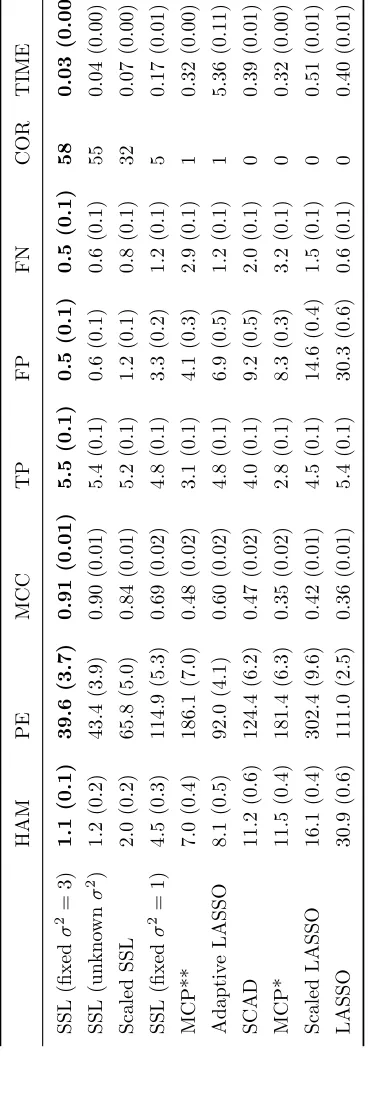
TABLE 1 : Comparison of penalized likelihood methods . . . 38
TABLE 2 : Estimates for number of biclusters . . . 64
LIST OF ILLUSTRATIONS
FIGURE 1 : Comparison of variance priors for ridge regression . . . 17
FIGURE 2 : SSL variance estimates . . . 39
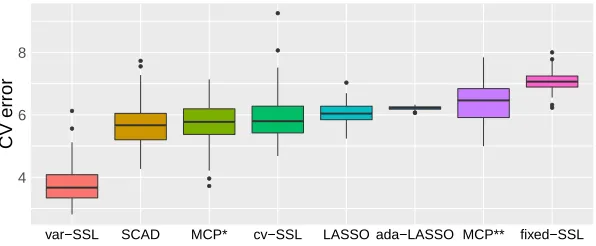
FIGURE 3 : Cross-validation error on the protein dataset . . . 41
FIGURE 4 : Illustration of rank-1 biclusters . . . 49
FIGURE 5 : Consensus, relevance and recovery scores . . . 63
FIGURE 6 : Breast cancer dataset: SSLB results . . . 66
FIGURE 7 : Breast cancer dataset: FABIA results . . . 70
FIGURE 8 : Zeisel dataset: SSLB results . . . 72
FIGURE 9 : Zeisel dataset: BicMix results . . . 76
FIGURE 10 : Breast cancer dataset: comparison of raw and normalized data . . 83
FIGURE 11 : Breast cancer dataset: SSLB complete results . . . 84
FIGURE 12 : Breast cancer dataset: enrichment maps for SSLB genes . . . 85
FIGURE 13 : Zeisel dataset: SSLB complete results . . . 88
FIGURE 14 : Zeisel dataset: enrichment maps for genes in SSLB biclusters 1 & 2 89 FIGURE 15 : Zeisel dataset: enrichment maps for genes in SSLB bicluster 44 . . 90
FIGURE 16 : Illustrations for BART . . . 94
FIGURE 17 : Parametric Example 1: faBART results . . . 108
FIGURE 18 : Parametric Example 2: faBART and VAE results . . . 110
FIGURE 19 : Parametric Example 3: faBART and VAE results . . . 112
FIGURE 20 : Embeddings of Swiss-roll data . . . 115
FIGURE 21 : Example MNIST images . . . 117
FIGURE 22 : Embeddings of MNIST data . . . 117
CHAPTER 1 : Introduction
Statistics has been said to be the science of variation. A core problem of any statistical
analysis is determining how much of the observed variation in the data can be attributed to
the signal of interest, and how much to noise. Understanding and modeling these sources of
variation is crucial for both inferring the size and significance of the signal, and predicting
future realizations of the data.
In this thesis, we first consider the problem of high-dimensional linear regression where the
unknown noise variance is also of interest. We then move from this univariate response
setting where the predictors are known, to the multivariate response setting in which
po-tential predictors are unobserved. Although this lack of predictors presents an even greater
challenge, this multivariate setting also presents a tremendous opportunity to learn about
the covariation of the responses. In this setting, the covariation itself is often a signal of
interest; in gene expression data, for example, finding sets of responses which exhibit similar
behavior (that is, covary) can be an indication that these responses are driven by the same
underlying biological process.
To tackle the challenge of modeling variation in these settings, we adopt a Bayesian
perspec-tive. A Bayesian approach to modeling begins with specifying a data generating process, or
model. Within this model, the Bayesian paradigm allows for the coherent inclusion of
mul-tiple sources of variation which give rise to the observed data. In treating the parameters
of this model as themselves random, a Bayesian approach confers a number of advantages.
Firstly, it provides uncertainty quantification for the parameters via their posterior
distri-bution. Secondly, by treating the parameters as random instead of fixed, the parameters
are able to adapt to the data at hand. Finally, Bayesian analyses allow for the “borrowing
of strength” across multiple observations to ultimately yield parameter estimates which are
less susceptible to noise.
both the univariate linear regression setting, and the multiple response setting where no
predictors are observed.
In Chapter 2, we consider the problem of simultaneously estimating the regression
co-efficients and error variance in the high-dimensional Gaussian linear model. A common
Bayesian approach to modeling the error variance is to use a conjugate shrinkage prior
framework. Here, however, we show that these commonly used conjugate shrinkage
pri-ors can actually have detrimental consequences for error variance estimation. Such pripri-ors
are often motivated by the invariance argument of Jeffreys (1961). Revisiting this work,
however, we highlight a caveat that Jeffreys himself noticed; namely that biased estimators
can result from inducing dependence between parameters a priori. In a similar way, we
show that conjugate priors for linear regression, which induce prior dependence, can lead
to such underestimation in the Bayesian high-dimensional regression setting. Following
Jef-freys, we recommend as a remedy to treat regression coefficients and the error variance as
independent a priori.
In the latter half of Chapter 2, we then extend the Spike-and-Slab Lasso of Roˇckov´a and
George (2018) to the unknown variance case, using an independent prior framework. This
extended procedure outperforms both the fixed variance approach and alternative
penal-ized likelihood methods on simulated data. On the protein activity dataset of Clyde and
Parmigiani (1998), the Spike-and-Slab Lasso with unknown variance achieves lower
cross-validation error than alternative penalized likelihood methods, demonstrating the gains in
predictive accuracy afforded by simultaneous error variance estimation.
In the next part of this thesis, we move to the multivariate setting, where for each individual,
we observe many responses, or features. Unlike Chapter 2, however, we now do not observe
any potential predictors for these responses.
In Chapter 3, we consider the problem of finding small sets of individuals which covary
referred to as biclusters. In this way, biclustering methods differ from traditional clustering
methods, which find groups of individuals that are similar over their entire set of features.
Motivating applications for biclustering include genomics data, where the goal is to cluster
patients or samples by their gene expression profiles; and recommender systems, which seek
to group customers based on their product preferences. More precisely, biclusters of interest
are often assumed to manifest as rank-1 submatrices of the data matrix. This submatrix
detection problem can be viewed as a factor analysis problem in which both the factors and
loadings are sparse.
We propose a new biclustering method called Spike-and-Slab Lasso Biclustering (SSLB).
SSLB utilizes the Spike-and-Slab Lasso of Roˇckov´a and George (2018) to find a
doubly-sparse factorization of the data matrix. SSLB also incorporates an Indian Buffet Process
prior to automatically choose the number of biclusters. Many biclustering methods make
assumptions about the size of the latent biclusters, either assuming that the biclusters are
all of the same size, or that the biclusters are either very large or very small. In contrast,
SSLB can adapt to find biclusters which have a continuum of sizes. SSLB is implemented
via a fast Expectation-Maximization (EM) algorithm with a variational step. In a variety of
simulation settings, SSLB outperforms other biclustering methods. We apply SSLB to both
a microarray dataset and a single-cell RNA-sequencing dataset and highlight that SSLB
can recover biologically meaningful signal in the data.
In Chapter 4, we again consider the unsupervised multivariate response setting with the
goal of finding low-dimensional “factors” which drive the variation in the observed data.
Unlike in Chapter 3, however, we now relax the assumption that the observed data is
linearly related to the unobserved factors. This adds an additional layer of complexity to
the problem: we need to both estimate the unobserved factors, and the mapping between
the factors and observed data. To accomplish this task, we develop a Markov Chain Monte
Carlo (MCMC) algorithm which alternates between sampling from the posterior of the
Additive Regression Trees (BART), introduced by Chipman et al. (2010). We refer to
our method as Factor Analysis BART (faBART). On a variety of simulation settings, we
demonstrate that with only the observed data as the input, faBART is able to recover both
the unobserved factors and the nonlinear mapping. We then develop tempered faBART, a
modification of faBART which includes a tempering step to allow the algorithm to more
easily detect structure for data visualization. On two canonical datasets for visualization,
CHAPTER 2 : Variance Priors
2.1. Introduction
Consider the classical linear regression model
Y =Xβ+ε, ε∼Nn(0, σ2In) (2.1)
where Y ∈ Rn is a vector of responses, X = [X
1, . . . ,Xp] ∈ Rn×p is a fixed regression
matrix ofp potential predictors, β= (β1, . . . , βp)T ∈Rp is a vector of unknown regression
coefficients andε∈Rn is the noise vector of independent normal random variables withσ2
as their unknown common variance.
Whenβis sparse so that most of its elements are zero or negligible, finding the non-negligible
elements ofβ, the so-called variable selection problem, is of particular importance. Whilst
this problem has been studied extensively from both frequentist and Bayesian perspectives,
much less attention has been given to the simultaneous estimation of the error varianceσ2.
Accurate estimates of σ2 are important to discourage fitting the noise beyond the signal,
thereby helping to mitigate overfitting of the data. Variance estimation is also essential in
uncertainty quantification for inference and prediction.
In the frequentist literature, the question of estimating the error variance in our setting
has begun to be addressed with papers including the scaled Lasso (Sun and Zhang, 2012)
and the square-root Lasso (Belloni et al., 2014). Contrastingly, in the Bayesian literature,
the error variance has been fairly straightforwardly estimated by including σ2 in prior
specifications. Despite this conceptual simplicity, the majority of theoretical guarantees for
Bayesian procedures restrict attention to the case of known σ2, as there is not a generally
agreed upon prior specification whenσ2 is unknown. More specifically, priors onβ and σ2
Adapted from a research article:
Moran, G. E., Roˇckov´a, V. and George, E. I. (2019) “Variance Prior Forms for High-Dimensional Bayesian
are typically introduced in one of two ways: either via a conjugate prior framework or via
an independence prior framework.
Conjugate priors have played a major role in regression analyses. The conjugate prior
framework for (2.1) begins with specifying a prior onβ that depends onσ2 as follows:
β|σ2 ∼N(0, σ2V), (2.2)
where V may be fixed or random. This prior (2.2) results in a Gaussian posterior for β
and as such is conjugate. To complete the framework, σ2 is assigned an inverse-gamma
(or equivalently scaled-inverse-χ2) prior. A common choice in this regard is the right-Haar
prior for the location-scale group (Berger et al., 1998):
π(σ)∝1/σ. (2.3)
Whilst the right-Haar prior is improper, it can be viewed as the limit of an inverse-gamma
density. When combined with (2.2), the prior (2.3) results in an inverse-gamma posterior
for σ2 and as such it behaves as a conjugate prior. Prominent examples that utilize the
above conjugate prior framework include:
• Bayesian ridge regression priors, withV=τ2I;
• Zellner’s g-prior, withV=g(XTX)−1; and
• Gaussian global-local shrinkage priors, with V=τ2Λ,for Λ = diag{λ
j}pj=1.
We note that the conjugate prior framework refers only to the prior characterization of β
and σ2, and allows for any prior specification on subsequent hyper-parameters such as g
and τ2 which do not appear in the likelihood.
A main reason for the popularity of the conjugate prior framework is that it often allows for
updates of posterior model probabilities. This allowed for analyses of the model selection
consistency (Bayarri et al., 2012) as well as more computationally efficient MCMC
algo-rithms (George and McCulloch, 1997). Despite these advantages, however, the conjugate
prior framework is not innocuous for variance estimation, as we will show in this work.
Alternatively to the conjugate prior framework, one might treat β and σ2 as independent
a priori. The formulation corresponding to (2.2) for this independence prior framework is:
β∼N(0,V), (2.4)
π(σ)∝1/σ.
Note that the prior characterization (2.4) does not yield a normal inverse-gamma posterior
distribution on (β, σ2) and as such is not conjugate.
In addition to the above prior frameworks, Bayesian methods for variable selection can
be further categorized by the way they treat negligible predictors. Discrete component
Bayesian methods for variable selection exclude negligible predictors from consideration,
adaptively reducing the dimension of β. Examples of such discrete component methods
include spike-and-slab priors where the “spike” distribution is a point-mass at zero (Mitchell
and Beauchamp, 1988). In contrast, continuous Bayesian methods for variable selection
shrink, rather than exclude, negligible predictors and as such β remains p-dimensional
(George and McCulloch, 1993; Polson and Scott, 2010; Roˇckov´a and George, 2014).
In this chapter, we show that for continuous Bayesian variable selection methods, the
con-jugate prior framework can result in underestimation of the error variance when: (i) the
regression coefficientsβare sparse; and (ii)pis of the same order as, or larger thann.
Intu-itively, conjugate priors implicitly add p “pseudo-observations” to the posterior which can
distort inference for the error variance when the true number of non-zeroβis much smaller
than p. This is not the case for discrete component methods which adaptively reduce the
the use of independent priors onβandσ2. Further, we extend the Spike-and-Slab Lasso of
Roˇckov´a and George (2018) to the unknown variance case with an independent prior
formu-lation, and highlight the performance gains over the known variance case via a simulation
study. On the protein activity dataset of Clyde and Parmigiani (1998), we demonstrate the
benefit of simultaneous variance estimation for both variable selection and prediction.
It is important to note the difference in the scope of this work with previous work on
variance priors, including Gelman (2004); Bayarri et al. (2012); Liang et al. (2008). Here,
we are focused on the estimation of the error variance,σ2. In contrast, the aforementioned
works are concerned with the choice of priors for hyper-parameters which do not appear in
the likelihood, i.e. theg in theg-prior, and τ2 and λ2j for global-local priors. We recognize
the importance of the choice of these priors for Bayesian variable selection; however, the
focus of this chapter is the prior choice for the error variance in conjunction with variable
selection.
We also note that our discussion considers only Gaussian related prior forms for the
regres-sion coefficients. Despite this seemingly limited scope, we note that the majority of priors
used in Bayesian variable selection can be cast as a scale-mixture of Gaussians (Polson and
Scott, 2010), and that popular frequentist procedures such as the Lasso and variants thereof
also fall under this framework.
The chapter is structured as follows. In Section 2, we discuss invariance arguments for
conjugate priors and draw connections with Jeffreys priors. We then highlight situations
where we ought to depart from Jeffreys priors; namely, in multivariate situations. In
Sec-tion 3, we take Bayesian ridge regression as an example to highlight why conjugate priors
can be a poor choice. In Section 4, we draw connections between Bayesian regression and
concurrent developments with variance estimation in the penalized likelihood literature. In
Section 5, we examine the mechanisms of the Gaussian global-local shrinkage framework
and illustrate why they can be incompatible with the conjugate prior structure. In
how the conjugate prior yields poor estimates of the error variance. We then extend the
procedure to include the unknown variance case using an independent prior structure and
demonstrate via simulation studies how this leads to performance gains over not only the
known variance case, but a variety of other variable selection procedures. In Section 7, we
apply the Spike-and-Slab Lasso with unknown variance to the protein activity dataset of
Clyde and Parmigiani (1998), highlighting the improved predictive performance afforded by
simultaneous variance estimation. We conclude with a discussion in Section 8.
2.2. Invariance Criteria
A common argument used in favor of the conjugate prior for Bayesian linear regression is
that it is invariant to scale transformations of the response (Bayarri et al., 2012). That is,
the regression coefficients depend a priori on σ2 in a “scale-free way” through
π(β|σ2) = 1
σph(β/σ), (2.5)
for some proper density functionh(x). This means that the units of measurement used for
the response do not affect the resultant estimates; for example, ifY is scaled by a factor of
c, one would expect that the estimates for the regression coefficients,β, and error variance,
σ2, should also be scaled byc.
A more general principle of invariance was proposed by Jeffreys (1961) in his seminal work,
The Theory of Probability, a reference which is also sometimes given for the conjugate prior.
In this section, we examine the original invariance argument of Jeffreys (1961) and highlight
a caveat with this principle that the author himself noted; namely that it should be avoided
in multivariate situations. We then draw connections between this suboptimal multivariate
behavior and the conjugate prior framework, ultimately arguing similarly to Jeffreys that
2.2.1. Jeffreys Priors
For a parameterα, the Jeffreys prior is
π(α)∝ |I(α)|1/2, (2.6)
whereI(α) is the Fisher information matrix. The main motivation given by Jeffreys (1961)
for these priors was that they are invariant for all nonsingular transformations of the
param-eters. This property appeals to intuition regarding objectivity; ideally, the prior information
we decide to include should not depend upon the choice of the parameterization, which itself
is arbitrary.
Despite this intuitively appealing property, the following problem with this principle was
spotted in the original work of Jeffreys (1961) and later re-emphasized by Robert et al.
(2009) in their revisit of the work. Consider the normal means model
Yi ∼N(µi, σ2), i= 1, . . . , n
where the n-dimensional mean is denoted by µ= (µ1, . . . , µn). If we treat the parameters
µ and σ independently, the Jeffreys prior is π(µ, σ) ∝ 1/σ. However, if the parameters
are considered jointly, the Jeffreys prior is π(µ, σ) ∝ 1/σn+1. In effect, by considering
the parameters jointly as opposed to independently, we are implicitly including additional
“pseudo-observations” ofσ2and consequently distorting our estimates of the error variance.
This “pseudo-observation” interpretation can be seen explicitly in the conjugate form of
the Jeffreys prior for a Gaussian likelihood. The joint Jeffreys priorπ(µ, σ)∝1/σn+1 is an
improper inverse-gamma prior with shape parameter, n/2, and scale parameter zero. As
the prior is conjugate, the posterior distribution for the variance is also inverse-gamma:
π(σ2|Y,µ)∼IG
n
2 +
n
2, 0 +
Pn
i=1(Yi−µi)2
2
where the first term of both the shape and scale parameters in (2.7) are the prior
hyper-parameters. Thus, the dependent Jeffreys prior can be thought of as encoding knowledge
of σ2 from a previous experiment where there were nobservations which yielded a sample
variance of zero. This results in the prior concentrating around zero for large n and will
severely distort posterior estimates ofσ2. As we shall see later, thisdependent Jeffreys prior
for the parameters is in some cases akin to the conjugate prior framework in (2.2).
This prior dependence between the parameters is explicitly repudiated by Jeffreys (1961)
who states (with notation changed to match ours): “in the usual situation in an estimation
problem,µandσ2 are each capable of any value over a considerable range, and neither gives
any appreciable information about the other. We should then take: π(µ, σ) =π(µ)π(σ).”
That is, Jeffreys’ remedy is to treat the parameters independentlya priori, a
recommenda-tion which we also adopt. In addirecommenda-tion, Jeffreys points out that a key problem with the joint
Jeffreys prior is that it does not have the same reduction of degrees of freedom required
by the introduction of additional nuisance parameters. We shall examine this phenomenon
in more detail in Section 2.3 where we will discuss the consequences of using dependent
Jefferys priors and other conjugate formulations in Bayesian linear regression.
We note a possible exception to this independence argument which is found later in The
Theory of Probability where Jeffreys argues that for simple normal testing, the prior on
µ under the alternative hypothesis should depend on σ2. However, it is important to
note that this recommendation is for the situation where µ is one-dimensional and so the
underestimation phenomenon observed in (2.7) is not a problem. Given Jeffreys’ earlier
concerns regarding multivariate situations, it is unlikely he intended this dependence to
2.3. Bayesian Regression
2.3.1. Prior Considerations
Consider again the classical linear regression model in (2.1). For a non-informative prior,
it is common to use π(β, σ2)∝1/σ2 (see, for example, Gelman et al., 2014). Similarly to
our earlier discussion, this prior choice corresponds to multiplying the independent, Jeffreys
priors forβ and σ2. In contrast, the joint Jeffreys prior would be π(β, σ2)∝1/σp+2. Let
us now examine the estimates resulting from the former, independent Jeffreys prior. In this
case, we have the following marginal posterior mean estimate for the error variance:
E[σ2|Y] = kY−X b
βk2
n−p−2 (2.8)
whereβb= (XTX)−1XTYis the usual least squares estimator. We observe that the degrees
of freedom adjustment, n−p−2, naturally appears in the denominator.1 This degrees of
freedom adjustment does not occur with the joint Jeffreys prior where the marginal posterior
mean is given by:
E[σ2|Y] = kY−X b
βk2
n−2 . (2.9)
For large p, this estimator will severely underestimate the error variance. Avoiding this, it
is commonly accepted that the independent Jeffreys prior π(β, σ2) ∝ 1/σ2 should be the
default non-informative prior in this setting.
There is no such clarity, however, in the use of conjugate priors for Bayesian linear regression.
To add to this discourse, we show that these conjugate priors can suffer the same problem
as the dependent Jeffreys priors and recommend, similarly to Jeffreys, that independent
priors should be used instead. We make this point with the following example. A common
1Note that had we treatedβ
1 as an intercept and integrated it out with respect to a uniform prior, this
conjugate prior choice for Bayesian linear regression is
β|σ2, τ2∼Np(0, σ2τ2I). (2.10)
For simplicity of exposition, in this section we consider the parameterτ2 to be fixed, which
corresponds to Bayesian ridge regression. In later sections we will consider the global-local
shrinkage framework whereτ2 is assigned a prior.
With an additional non-informative priorπ(σ2)∝1/σ2, we then have the joint prior
π(β|σ2)π(σ2) =π(β, σ2)∝ 1
σp+2exp
− 1
2σ2τ2kβk
2
. (2.11)
Note again theσp+2 in the denominator, similarly to the joint Jeffreys prior.
Instead of considering how β depends on σ2 a priori as in (2.10), it is illuminating to
consider the reverse: how this prior induces dependence of σ2 on β. From (2.11), the
implicit conditional prior onσ2 is given by
σ2|β∼IG
p
2,
kβk2
2τ2
. (2.12)
The mean of this inverse-gamma prior is approximately 1pkβk2/τ2. Heuristically, this term
is of order O(q/p), where q is the number of non-zero β. When β is sparse and bounded
with q p, (2.12) will then transmit downward biasing information from β to σ2. This
intuition is formalized in Proposition 1, which shows that the implicit conditional prior on
σ2 concentrates around zero in regions where β is sparse.
Proposition 1. Suppose kβk0 = q and maxjβj2 =K for some constant K ∈ R. Denote
the true variance as σ02. Then
P σ2/σ20 ≥ε |β
≤ q
p−2
K
τ2
1
εσ02. (2.13)
Proposition 1 implies that we can choose 0< ε <1 such that as q/p→0, the prior places
decreasing mass on values of σ2 greater than εσ02. Thus, in regions of bounded sparse
regression coefficients, the conjugate Gaussian prior can result in poor estimation of the
true variance.
Further, from a more philosophical perspective, it is troubling that the error variance
de-pends on the regression coefficientsa priori, given that the noise is generally assumed to be
independent of the signal and in particular the regression coefficients.
In the next section, we conduct a simulation study for the simple case of Bayesian ridge
regression and show empirically how this implicit prior on σ2 can distort estimates of the
error variance.
2.3.2. The Failure of a Conjugate Prior
As an illustrative example, we taken= 100 andp= 90 and compare the least squares
esti-mates ofβandσ2 to Bayesian ridge regression estimates with (i) the conjugate formulation
with (2.10) and (ii) the independent prior formulation with
π(β)∼Np(0, τ2I). (2.14)
For both Bayesian ridge regression procedures we use the non-informative error variance
prior: π(σ2)∝1/σ2. The predictorsX
i,i= 1, . . . , pare generated as independent standard
normal random variables. The true β0 is set to be sparse with only six non-zero elements;
the non-zero coefficients are set to {−2.5,−2,−1.5,1.5,2,2.5}. The response Y is
gener-ated according to (2.1) with the true variance being σ2 = 3. We take τ = 10 as known
and highlight that this weakly informative choice leads to poor variance estimates in the
conjugate prior framework. Whilst an empirical or fully Bayes approach for estimating τ2
may be preferable for high-dimensional regression, it is troubling that the conjugate prior
yields poor results for a simple example where n > p and in which least squares and the
The conjugate prior formulation allows for the exact expressions for the marginal posterior
means of β andσ2:
E[β|Y] = [XTX+τ−2I]−1XTY (2.15)
E[σ2|Y] = Y
T[I−H
τ]Y
n−2 (2.16)
where Hτ =X[XTX+τ−2I]−1XT. Similarly to (2.9), the above marginal posterior mean
forσ2does not incorporate a degrees of freedom adjustment and so we expect this estimator
to underestimate the true error variance.
It is illuminating to observe the underestimation problem when considering the conditional
posterior mean ofσ2, instead of the marginal:
E[σ2|Y,β] =
kY−Xβk2+kβk2/τ2
n+p−2 . (2.17)
The additional p in the denominator here leads to severe underestimation of σ2 when β
is sparse and bounded as in Proposition 1 and p is of the same order as, or larger than,
n, as discussed in the previous section. We note in passing that a value of τ2 close to
kβk2/pσ2, which may be obtainable with an empirical or fully Bayes approach, would avoid
this variance underestimation problem, as can be seen from (2.17).
This is in contrast to the conditional posterior mean for σ2 using the independent prior
formulation (2.4), which we also consider. This estimator is given by:
E[σ2|Y,β] =
kY−Xβk2
n−2 . (2.18)
Here we do not observe a degrees of freedom adjustment because (2.18) is the conditional
posterior mean, not the marginal. Earlier in (2.8) we considered the marginal posterior
mean for the independent Jeffreys’ prior which led to then−p−2 in the denominator. For
closed form expressions. To compute these, we use a Gibbs sampler, the details of which
may be found in Section 2.9.1 of the Appendix.
When τ2 is large, the estimate ofβ for both the conjugate and independent formulations
are almost exactly the least-squares estimate, βb = [XTX]−1XTY. However, the estimates
of the variance σ2 differ substantially.
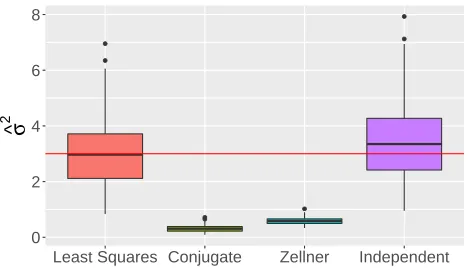
In Figure 1, we display a boxplot of the estimates ofσ2 for (i) Least Squares, (ii) Conjugate
Bayesian ridge regression, (iii) Zellner’s prior:
β|σ2∼N(0, σ2τ2[XTX]−1), (2.19)
and (iv) Independent Bayesian ridge regression over 100 replications. Here, the estimates
from least squares and the independent ridge are reasonably distributed around the truth.
In sharp contrast, the estimates from the conjugate ridge and Zellner’s prior consistently
underestimate the error variance with medians of bσ2 = 0.27 and 0.55, respectively. This
poor performance is a result of the bias induced by adding p “pseudo-observations” of σ2
as discussed in Section 2.3.1, which also occurs for the Zellner prior.
In the above simulation study, we considered the posterior mean of σ2 over many
repli-cations of the data. This allowed us to assess the variability of these point estimates in
a frequentist sense. For a Bayesian perspective, we can also consider the entire marginal
posterior distribution forσ2. For the conjugate prior formulation, this posterior is given by:
σ2|Y∼IG
n
2,
YT[I−Hτ]Y
2
. (2.20)
The above distribution (2.20) is tightly concentrated about the posterior mode, given by
YT[I−Hτ]Y/(n+ 2), which suffers from the same underestimation phenomenon as the
posterior mean (2.16). Thus, consideration of the posterior distribution of σ2 will yield
● ●
● ●
●
● ●
0 2 4 6 8
Least Squares Conjugate Zellner Independent
σ
^
2
Figure 1: Estimatedσb2 for each procedure over 100 repetitions. The trueσ2= 3 is the red
horizontal line.
This phenomenon of underestimating σ2 can also be seen in EMVS (Roˇckov´a and George,
2014), which can be viewed as iterative Bayesian ridge regression with an adaptive penalty
term for each regression coefficient βj instead of the same τ2 above. EMVS also uses a
conjugate prior formulation in which β depends on σ2 a priori similarly to (2.10). As in
the above ridge regression example, with this prior EMVS yields good estimates forβ, but
severely underestimates σ2. This occurs in the Section 4 example of Roˇckov´a and George
(2014) with n= 100 and p = 1000. There, conditionally on the modal estimate of β, the
associated modal estimate ofσ2is 0.0014, a severe underestimate of the true varianceσ2 = 3.
Fortunately, EMVS can be easily modified to use the independent prior specification, as
now has been done in the publicly available EMVS R package (Roˇckov´a and Moran, 2018).
It is interesting to note that the SSVS procedure of George and McCulloch (1993) used the
nonconjugate independence prior formulation in lieu of the conjugate prior formulation for
the continuous spike-and-slab setup.
A natural question to ask is: how does the poor estimate of the variance in the conjugate
case affect the estimated regression coefficients? Insight is obtained by comparing (2.15) to
the conditional posterior mean of β in the independent case, given by:
E[β|σ2,Y] =
XTX+σ
2
τ2I
−1
In (2.15), the Gaussian prior structure allows forσ2to be factorized out so that the estimate
ofβdoes not depend on the variance. This lack of dependence on the variance is troubling,
however, as we want to select fewer variables when the error variance is large making the
signal-to-noise ratio low. This is in contrast to (2.21) where when σ2 is large relative to
τ2, the signal-to-noise ratio is low and so the posterior estimate for βwill be close to zero,
correctly reflecting the relative lack of information. This does not occur for the posterior
mean ofβ in the conjugate case.
Although the posterior mean of β in the conjugate prior formulation does not depend on
σ2, the posterior variance ofβdoes depend on the error variance. Specifically, the posterior
variance of β is given by:
E[β|Y, σ2] =σ2[XTX+τ−2I]−1. (2.22)
Consequently, underestimation of σ2 will result in too narrow credible intervals forβ.
Fur-ther, underestimation of the error variance σ2 will also result in too narrow prediction
intervals for future responses.
2.3.3. What About a Prior Degrees of Freedom Adjustment?
At this point, one may wonder: if the problem seems to be the extraσp in the denominator,
why not use the prior π(σ2) ∝ σp−4 instead of the right-Haar prior π(σ2) ∝ σ−2 that is
commonly used? This “p-sigma” prior then results in the joint prior:
π(β|σ2)π(σ2)∝ 1
(σ2)2exp
− 1
2σ2τ2kβk
2
, (2.23)
which yields the implicit conditional prior onσ2:
σ2|β∼IG
1,kβk
2
2τ2
For the simulation setup in Section 2.3.2, this alternative conjugate prior would in fact
remedy the variance estimates of the conjugate formulation (2.10). However, the p-sigma
prior can actually lead to overestimation of the error variance, as opposed to the
under-estimation observed in Section 2.3.1. Heuristically, the mean of the prior (2.24) is now of
order O(q), where q is the number of non-zeroβ. As many posterior concentration results
require q → ∞, albeit at a much slower rate thanp (see, for example, van der Pas et al.,
2016), this is particularly troublesome.
This overestimation can be further seen from the concentration of the prior captured in
Proposition 2 below. As we will discuss in Section 2.4, a similar phenomenon also occurs
for a penalized likelihood procedure that implicitly uses a p-sigma prior.
Proposition 2. Supposekβk0 =qandminj,βj6=0β
2
j =K for some constantK∈R. Denote
the true variance as σ02. Then
P(σ2 ≥δσ02 |β)≥1−exp
− qK
2δσ2
0τ2
. (2.25)
Proof. We have:
P(σ2 ≥δσ02 |β) =
Z ∞
δσ2
0
kβk2
2τ2
1
u2 exp
−kβk
2
2τ2
1 u
du
≥1−exp
− qK
2δσ2
0τ2
.
Proposition 2 implies that we can choose arbitrary δ >1 such that asq → ∞, thep-sigma
prior places increasing mass on values of σ2 greater than δσ02. Another concern regarding
thep-sigma prior is more philosophical. As p gets larger, thep-sigma prior puts increasing
mass on larger and larger values ofσ2, which does not seem justifiable.
For these reasons, we prefer the independent prior forms for the regression coefficients and
error variance. We are also of the opinion that the simplicity of the independent prior is in
2.4. Connections with Penalized Likelihood Methods
Here we pause briefly to examine connections between Bayesian methods and developments
in estimating the error variance in the penalized regression literature. Such connections can
be drawn as penalized likelihood methods are implicitly Bayesian; the penalty functions
can be interpreted as priors on the regression coefficients so these procedures also in effect
yield MAP estimates.
One of the first papers to consider the unknown error variance case for the Lasso was St¨adler
et al. (2010), who suggested the following penalized loss function for introducing unknown
variance into the frequentist Lasso framework:
Lpen(β, σ2) =
kY−Xβk2
2σ2 +
λ
σkβk1+nlogσ. (2.26)
Optimizing this objective function is in fact equivalent to MAP estimation for the following
Bayesian model with the p-sigma prior discussed in Section 2.3.2:
Y∼N(Xβ, σ2I) (2.27)
π(β|σ2)∝ 1
σp
p
Y
j=1
e−λ|βj|/σ
π(σ2)∝σp.
Interestingly, Sun and Zhang (2010) proved that the resulting estimator for the error
vari-ance overestimates the noise level unless λkβ∗k1/σ∗ =o(1), where β∗ and σ∗ are the true
values of the regression coefficients and error variance, respectively. However, this condition
requires q, the true number of non-zero β, to be of the following order (details in Section
2.9.2 of the Appendix).
q =opn/logp. (2.28)
posterior contraction and result in consistent estimates for the error variance. Note also
the connection to Proposition 2: there, the prior mass on σ2 will concentrate on values
greater than the true variance unlesskβk2/τ2 =o(1).
To resolve this issue of overestimating the error variance, Sun and Zhang (2012) proposed
as an alternative the “scaled Lasso”, an algorithm which minimizes the following penalized
joint loss function via coordinate descent:
Lλ(β, σ) =
kY−Xβk2
2σ +
nσ
2 +λ
p
X
j=1
|βj|. (2.29)
This loss function is a penalized version of Huber’s concomitant loss function, and so may
be viewed as performing robust high-dimensional regression. It is also equivalent to the
“square-root Lasso” of Belloni et al. (2014). Minimization of the loss function (2.29) can
be viewed as MAP estimation for the Bayesian model (with a slight modification):
Y∼N(Xβ, σI) (2.30)
π(β)∝
p
Y
j=1 λ
2e
−λ|βj|
σ∼Gamma(n+ 1, n/2).
Note that to interpret the scaled Lasso as a Bayesian procedure, σ, rather than σ2, plays
the role of the variance in (2.30). Sun and Zhang (2012) essentially then re-interpret σ
as the standard deviation again after optimization of (2.29). This re-interpretation can be
thought of as an “unbiasing” step for the error variance. It is a little worrisome, however,
that the implicit prior on the error variance is very informative: as n → ∞, this Gamma
prior concentrates around σ= 2.
Sun and Zhang (2012) proved that the scaled Lasso estimate bσ(X,Y) is consistent for the
“oracle” estimator
σ∗= kY−Xβ
∗k
√
where β∗ are the true regression coefficients, for the value of λ0 ∝
p
(2/n) logp. This
estimator (2.31) is called the oracle because it treats the true regression coefficients as if
they were known. The termkY−Xβ∗k2is then simply the sum of normal random variables,
of which we calculate the variance asPn
i=1ε2i/n.
2.5. Global-Local Shrinkage
In this section, we examine how the use of a conjugate prior affects the machinery of the
Gaussian global-local shrinkage paradigm. The general structure for this class of priors is
given by:
βj ∼N(0, τ2λ2j), λ2j ∼π(λ2j), j= 1, . . . , p (2.32)
τ2 ∼π(τ2)
whereτ2 is the “global” variance andλ2j is the “local” variance. Note that taking τ2 to be
the same as the error variance σ2 would result in a conjugate prior in this setting. This
is exactly what was done in the original formulation of the Bayesian lasso by Park and
Casella (2008), which can be recast in the Gaussian global-local shrinkage framework as
follows (notation changed slightly for consistency):
Y|β, σ2∼Nn(Xβ, σ2In) (2.33)
βj|σ2, λ2j ∼N(0, σ2λ2j), π(λ2j) =
u2
2 e
−u2λ2
j/2, j= 1, . . . , p
π(σ2)∝σ−2.
In the conjugate formulation (2.33),σ2 plays the dual role of representing the error variance
as well as acting as the global shrinkage parameter. This is problematic in light of the
mechanics of global-local shrinkage priors. Specifically, Polson and Scott (2010) recommend
the following requirements for the global and local variances in (2.32): π(τ2) should have
are negligible; and π(λ2
j) should have heavy tails so that it can be quite large, allowing for
a few large coefficients to “escape” the heavy shrinkage of the global variance.
This heuristic is formalized in much of the shrinkage estimation theory. For the normal
means problem where X = In and β ∈ Rn, van der Pas et al. (2016) prove that the
following conditions result in the posterior recovering nonzero means with the optimal rate:
(i) π(λ2j) should be a uniformly regular varying function which does not depend on n; and
(ii)τ2 = q
nlog(n/q), whereq is number of non-zeroβj.
The uniformly regular varying property in (i) intuitively preserves the “flatness” of the prior
even under transformations of the parameters, unlike traditional “non-informative” priors
(Bhadra et al., 2016). In preserving these heavy tails, such priors for λ2j allow for a few
large coefficients to be estimated. The condition (ii) encourages τ2 to tend to zero which
would be a concerning property if it were also the error variance. These results suggest
we cannot identify the error variance with the global variance parameter on the regression
coefficients as in (2.33): it cannot simultaneously both shrink all the regression coefficients
and be a good estimate of the residual variance. Finally, we note that Hans (2009) also
considered the independent case for the Bayesian lasso in which the error variance is not
identified with the global variance.
An alternative conjugate formulation for Gaussian global-local shrinkage priors is to instead
include three variance terms in the prior forβj: the error variance,σ2, the global variance,
τ2, and the local variance,λ2j. For example, Carvalho et al. (2010) give the conjugate form
of the horseshoe prior:
βj|σ2, τ2, λ2j ∼N(0, σ2τ2λ2j), λ2j ∼π(λ2j), j= 1, . . . , p (2.34)
τ2 ∼π(τ2),
π(σ2)∝σ−2.
separates the roles of the error variance and global variance. However, this prior structure
can still be problematic for error variance estimation.
Consider the conditional posterior mean ofσ2 for the model (2.34):
E[σ2|Y,β, τ2, λ2j] =
kY−Xβk2+Pp
j=1βj2/λ2jτ2
n+p−2 . (2.35)
Proposition 3 highlights that, given the true regression coefficients, the conditional posterior
mean ofσ2 underestimates the oracle variance (2.31) whenβ is sparse.
Proposition 3. Consider the global-local prior formulation given in (2.34). Denote the
true vector of regression coefficients by β∗ where kβ∗k0 = q. Suppose maxjβj∗2 =M1 for
some constantM1 ∈R. Denote the oracle estimator forσgiven in (2.31)byσ∗ and suppose
σ∗ =O(1). Suppose also that for j ∈ {1, . . . , p} with β
j 6= 0, we have τ2λ2j > M2 for some
M2 ∈R. Then
E[σ2|Y,β∗, τ2, λ2j]≤
nσ∗2
n+p−2 +
q
n+p−2
M1
M2
. (2.36)
In particular, as p/n→ ∞ and q/p→0, we have
E[σ2|Y,β∗, τ2, λ2j] =o(1). (2.37)
Given the mechanics of global-local shrinkage priors, the assumption in Proposition 3 that
the termτ2λ2j is bounded from below for non-zeroβj is not unreasonable. This is because for
largeβj, the local varianceλ2j must be large enough to counter the extreme shrinkage effect
ofτ2. Indeed, the prior forλ2j must have “heavy enough” tails to enable this phenomenon.
We should note that Proposition 3 illustrates the poor performance of the posterior mean
(2.35) given the true regression coefficients β∗, whereas the horseshoe procedure does not
actually threshold the negligibleβjto zero in the posterior mean ofβ. For these smallβj, the
termτ2λ2
However, it is still troubling to use an estimator for the error variance that does not behave
as the oracle estimator when the true regression coefficients are known. This is in contrast
to the independent prior formulation where the conditional posterior mean ofσ2 is simply:
E[σ2|Y,β] =
kY−Xβk2
n−2 . (2.38)
Note also that the problem of underestimation of σ2 is exacerbated for modal estimation
under the prior (2.34). This is because modal estimators often threshold small coefficients
to zero and so the term Pp
j=1βj2/λ2jτ2 becomes negligible as in Proposition 3. As MAP
estimation using global-local shrinkage priors is becoming more common (see, for example,
Bhadra et al., 2017), we caution against the use of these conjugate prior forms.
A different argument for using conjugate priors with the horseshoe is given by Piironen and
Vehtari (2017). They advocate for the model (2.34), arguing that it leads to a prior on the
effective number of non-zero coefficients which does not depend onσ2 andn. However, this
quantity is derived from the posterior ofβand so does not take into account the uncertainty
inherent in the variable selection process. As a thought experiment: suppose that we know
the error variance, σ2, and number of observations, n. If the error variance is too large
and the number of observations are too few, we would not expect to be able to say much
about β at all, and this intuition should be reflected in the effective number of non-zero
coefficients. This point is similar to our discussion at the end of Section 2.3.2 regarding
estimation of β.
As before, we recommend independent priors on both the error variance and regression
coefficients to both prevent distortion of the global-local shrinkage mechanism and to obtain
2.6. Spike-and-Slab Lasso with Unknown Variance
2.6.1. Spike-and-Slab Lasso
We now turn to the Spike-and-Slab Lasso (SSL, Roˇckov´a and George, 2018) and consider
how to incorporate the unknown variance case. The SSL places a mixture prior on the
regression coefficients β, where each βj is assumed a priori to be drawn from either a
Laplacian “spike” concentrated around zero (and hence be considered negligible), or a diffuse
Laplacian “slab” (and hence may be large). Thus the hierarchical prior overβand the latent
indicator variablesγ= (γ1, . . . , γp) is given by
π(β|γ)∼
p
Y
j=1
[γjψ1(βj) + (1−γj)ψ0(βj)], (2.39)
π(γ|θ) =
p
Y
j=1
θγj(1−θ)1−γj and θ∼Beta(a, b),
where ψ1(β) = λ1
2 e
−|β|λ1 is the slab distribution and ψ0(β) = λ0
2 e
−|β|λ0 is the spike (λ1
λ0), and we have used the common exchangeable beta-binomial prior for the latent
indica-tors.
Roˇckov´a and George (2018) recast this hierarchical model into a penalized likelihood
frame-work, allowing for the use of existing efficient algorithms for modal estimation while
retain-ing the adaptivity inherent in the Bayesian formulation. The regression coefficients β are
then estimated by
b
β= arg max
β∈Rp
−1
2kY−Xβk
2+pen(β)
(2.40)
where
pen(β) = log
π(β)
π(0p)
, π(β) =
Z 1
0 p
Y
j=1
Roˇckov´a and George (2018) note a number of advantages in using a mixture of Laplace
densities in (2.39), instead of the usual mixture of Gaussians as has been standard in the
Bayesian variable selection literature. First, the Laplacian spike serves to automatically
threshold modal estimates of βj to zero when βj is small, much like the Lasso. However,
unlike the Lasso, the slab distribution in the prior serves to stabilize the larger coefficients
so they are not downward biased. Additionally, the heavier Laplacian tails of the slab
distribution yields optimal posterior concentration rates (Roˇckov´a, 2018).
Although the use of the spike-and-slab prior is typically associated with “two-group” Bayesian
variable selection methods, the Spike-and-Slab Lasso can also be interpreted as a
“one-group” global-local shrinkage method as the spike density is continuous. As such, the use
of a conjugate prior for the error variance here will result in underestimation, similarly to
the results for global-local shrinkage priors in Section 2.5. This is especially the case as
the SSL procedure finds the modes of the posterior, automatically thresholding negligible
regression coefficients to zero. In the next section, we provide further details on why this
underestimation phenomenon occurs for the SSL with a conjugate prior formulation.
Af-terwards, we introduce the SSL with unknown variance which avoids this underestimation
problem by instead utilizing an independent prior framework.
2.6.2. The Failure of a Conjugate Prior
This conjugate prior formulation for the Spike-and-Slab Lasso is given by:
π(β|γ, σ2)∼
p
Y
j=1
γj
λ1
2σe
−|βj|λ1/σ+ (1−γ
j)
λ0
2σe
−|βj|λ0/σ
(2.42)
γ|θ∼
p
Y
j=1
θγj(1−θ)1−γj, θ∼Beta(a, b) (2.43)
p(σ2)∝σ−2. (2.44)
can be found in Section 2.9.3 of the Appendix. At the (k+ 1)th iteration, the EM update
for the error variance is:
σ(k+1)= Q+
q
Q2+ 4(kY−Xβ(k)k2)(n+p+ 2)
2(n+p+ 2) (2.45)
with
Q=
p
X
i=1
|βj(k)|λ∗(βj(k)/σ(k);θ(k)), (2.46)
λ∗(β;θ) =λ1p∗(β;θ) +λ0(1−p∗(β;θ)), (2.47)
p∗(β;θ) =
1 +λ0
λ1
1−θ
θ
exp{−|β|(λ0−λ1)}
−1
, (2.48)
whereβ(k), σ(k), θ(k) are the parameter values after the kth iteration.
Let us take a closer look at the update (2.45). Following the line of reasoning in Sun and
Zhang (2010), an expert with oracle knowledge of the true regression coefficientsβ∗ would
estimate the noise level by the oracle estimator:
σ∗2= kY−Xβ
∗k
n . (2.49)
However, the maximuma posteriori estimate ofσ at the true values ofβ∗,γ∗ is given by
b
σM AP =τ+
s
τ2+ (σ∗)2
1 +p/n+ 2/n (2.50)
where τ = λ1kβ∗k1/[2(n+p+ 2)]. Here we see that if n → ∞ with p fixed, we have
b
σM AP → σ∗. If, however, we have p/n → ∞ and q/p → 0, where the underlying sparsity
is q = kβ∗k0, we have bσM AP → 0. Thus, similarly to our previous examples in Sections
2.3 and 2.5, we will severely underestimate the error variance. As in these examples, the
2.6.3. Spike-and-Slab Lasso with Unknown Variance
We now introduce the Spike-and-Slab Lasso with unknown variance, which considers the
regression coefficients and error variance to bea prioriindependent. The hierarchical model
is
π(β|γ)∼
p
Y
j=1
[γjψ1(βj) + (1−γj)ψ0(βj)] (2.51)
γ|θ∼
p
Y
j=1
θγj(1−θ)1−γj, θ∼Beta(a, b) (2.52)
π(σ2)∝σ−2. (2.53)
The log posterior, up to an additive constant, is given by
L(β, σ2) =− 1
2σ2kY−Xβk
2−(n+ 2) logσ+
p
X
j=1
pen(βj|θj) (2.54)
where, for j= 1, . . . , p,
pen(βj|θj) =−λ1|βj|+ log[p∗(0;θj)/p∗(βj;θj)], (2.55)
with p∗(β;θ) = θψ1(β)
θψ1(β) + (1−θ)ψ0(β) and θj =E[θ|β\j]. (2.56)
For large p, Roˇckov´a and George (2018) note that the conditional expectation E[θ|β\j] is
very similar to E[θ|β] and so for practical purposes we treat them as equal and denote
θβ =E[θ|β].
To find the modes of (2.54), we pursue a similar coordinate ascent strategy to Roˇckov´a
and George (2018), cycling through updates for each βj and σ2 while updating the
however, Roˇckov´a and George (2018) note that it can be approximated by
θβ ≈
a+kβk0
a+b+p. (2.57)
We now outline the estimation strategy for β. As noted in Lemma 3.1 of Roˇckov´a and
George (2018), there is a simple expression for the derivative of the SSL penalty:
∂pen(βj|θβ)
∂|βj| ≡ −λ
∗(β
j;θβ) (2.58)
where
λ∗(βj;θβ) =λ1p∗(βj;θβ) +λ0[1−p∗(βj;θβ)]. (2.59)
Using the above expression, the Karush-Kuhn-Tucker (KKT) conditions yield the following
necessary condition for the global mode β:b
b
βj =
1 n
h
|zj| −σ2λ∗(βbj;θβ) i
+sign(zj), j= 1, . . . , p (2.60)
wherezj =XTj(Y−
Pp
k6=jβbk·Xk) and we assume that the design matrixXhas been centered
and standardized to have norm √n. The condition (2.60) is very close to the familiar
soft-thresholding operator for the Lasso, except that the penalty term λ∗(βj;θ) differs for
each coordinate. Similarly to other non-convex methods, this enables selective shrinkage
of the coefficients, mitigating the bias issues associated with the Lasso. As a non-convex
method, however, (2.60) is not a sufficient condition for the global mode. This is particularly
problematic when the posterior landscape is highly multimodal, a consequence of p n
and large λ0. To eliminate many of these suboptimal local modes from consideration,
Roˇckov´a and George (2018) develop a more refined characterization of the global mode.
This characterization follows the arguments of Zhang and Zhang (2012) and can easily be
Proposition 4. The global mode βb satisfies
b
βj =
0 when |zj| ≤∆
1
n[|zj| −σ2λ∗(βjb;θβ)]+sign(zj) when |zj|>∆
(2.61)
where
∆≡inf
t>0[nt/2−σ
2pen(t|θ
β)/t]. (2.62)
Unfortunately, computing (2.62) can be difficult. Instead, we seek an approximation to the
threshold ∆. A useful upper bound is ∆≤σ2λ∗(0;θβ) (Zhang and Zhang, 2012). However,
when λ0 gets large, this bound is too loose and can be improved. The improved bounds
are given in Proposition 5, the analogue of Proposition 3.2 of Roˇckov´a and George (2018)
for the unknown variance case. Before stating the result, the following function is useful to
simplify exposition:
g(x;θ) = [λ∗(x;θ)−λ1]2+
2n
σ2 log[p
∗(x;θ)]. (2.63)
Proposition 5. When σ(λ0−λ1)>2√nand g(0;θβ)>0 the threshold∆ is bounded by
∆L<∆<∆U,
where
∆L=
q
2nσ2log[1/p∗(0;θ
β)]−σ4dj+σ2λ1, (2.64)
∆U =q2nσ2log[1/p∗(0;θ
β)] +σ2λ1 (2.65)
and
0< dj <
2n
σ2 −
n
σ2(λ
0−λ1)
− √
2n σ
!2
.

![Figure 1:Figure 4: Mean of a data matrix with two biclusters: Factorization of the mean of the data matrix into two biclusters: E[Y] = x1β E1T[ Y+] = x2 xβ21T� .1](https://thumb-us.123doks.com/thumbv2/123dok_us/9219623.1457478/63.612.118.537.74.195/figure-figure-mean-matrix-biclusters-factorization-matrix-biclusters.webp)