Licensed under Creative Common Page 1
http://ijecm.co.uk/
ISSN 2348 0386
STUDENTS PERSPECTIVE ON THE COMPETENCY BASED
TRAINING PROGRAMME IN TAMALE POLYTECHNIC, GHANA
Aboko A.
Department of Secretaryship and Management Studies, Tamale Polytechnic, Tamale, Ghana [email protected]
Obeng F. K.
Department of Agricultural Extension, Rural Development and Gender Studies University for Development Studies, Tamale, Ghana
Abstract
This study employed descriptive survey to ascertain the perceptions of students on the
effectiveness of the Competency-Based Training programme in imparting Industry desired
competencies. A simple random sampling technique was employed to select 73 students out of
the 90 who participated in the industrial attachment in 2014. Data on their personal
characteristics and their competencies before and after industrial attachment were collected
using structured questionnaire and analysed using frequency counts and percentages,
correlation and paired t-test statistics. The results indicated that, competence level among
students changed from not competent to competent in 17 out of the 19 desired competencies
investigated. The paired t-test computed at p <0.05 indicated a significant difference in their
competence levels before (2.38) and after (3.28) the industrial attachment. Correlational
statistics determined at p<0.05 showed positive significant relationship between students’
socio-demographic characteristics and their acquisition of desired competencies. Constraints were
investigated and ranked using Kendall’s co-efficient of concordance where it was revealed that,
the programme is bedeviled with constraints of lack of workshops for practicals, limited places
for industrial attachment and inadequate budgetary support among others. To this end, the
study recommends the establishment of a demonstration farm, simulation centre,
well-resourced workshop for the agricultural engineering department, and the effective involvement
of lecturers in the supervision of students.
Licensed under Creative Common Page 2 INTRODUCTION
Students‟ participate in academic endeavors because it will assist them acquire skills,
knowledge and ultimately lead to changes in their behaviour that will enable them fit into the world of work. Hence, any course of study is defined by a specific period and progression that depends on passing prescribed exams. However, at any given time during the study, the teacher is expected to be at a specific point in the course content. While not every student may progress at the same pace, the system naturally requires everyone to move at the same pace as the trainer. Tests are administered occasionally to ensure students understand the theories and principles. Test scores are often compared to determine the grades of the students.
Unfortunately, when a student does not do well on a test, there is often little time for individual assistance as the lecturer must move on in order to adhere to the established time schedule. While the traditional time-based approach to education has met with different levels of success over the years, it may be less effective if the objective is to train students to execute specific, job-related tasks. A more appropriate approach for specific job related training is Competency-based training (CBT). With the traditional time-based approach, the unit of progression is time and it is teacher-centered. However, with the CBT approach, the unit of progression is the mastery of specific skills and is learner-centered.
Competency-based Training
Competency-based training (CBT) is an approach that allows students to earn qualifications through demonstration of skills and knowledge in a required subject area using a series of carefully designed assessments. Under this, students take tests, write papers, complete assignment and undertake industrial attachment. With this model, instead of focusing on credit hours, qualifications are awarded through tangible evidence of learning. Outcomes and assessments are the bookends of CBT (Marguerite 2014). This is in contrast to the traditional form which places emphasises on theoretical aspects of skills training. It is expected to enhance individual industry specific needs rather than the group (Albanese et al., 2008; Anane, 2013). CBT provides training to meet industry specific needs rather than individuals‟ achievement relative to others in the group. The approach has emerged as a useful tool that could be used to address shortfalls in contemporary approaches to training. Ansah and Enerst (2013) reported that, many countries now employ CBT which could respond to the needs of new entrants into the world of work. It is also suitable for other learners desirous of upgrading their technical skills for existing jobs.
Licensed under Creative Common Page 3 assessment and learning materials are designed and developed(Marguerite, 2014). This approach ensures that all learners gain the requisite knowledge, skills and attitudes or values to be successful at work. Under the approach, each learner is assessed to find the gap between the skills they need as described in the training module and the skills they already have. The difference between the two is the skills gap. A training programme is then developed to help the learner acquire the missing skills. Following this, standards are defined to determine expected occupational roles to be performed in the world of work. These standards could be grouped into units to form the basis of certification or awards for individuals who have successfully undertaken the programme. Credit values are assigned to units and this could be based on the content and notional time needed to complete the process. For trainees to be assessed competent, they need to demonstrate their ability to perform tasks to the standard expected in employment.
Competency-based training in Ghana
In Ghana, there has been a notable wide-ranging gap in skills acquisition from the polytechnics and industry needed skills. The skills improvement as well as hands-on training has the capacity to enhance industrial growth and development. The absence of training in practical and entrepreneurial skills remains a recurrent point of criticism in formal employer feedback from Ghana Employers Association (GEA, 2006). To this end, students are attached to industries for three months as the first step towards inculcating practical knowledge and skills in their area of discipline. This is aimed at addressing the notable deficiencies in the theoretical method of training which became evident especially among the agricultural engineering students.
Again, the requisite skills required by industries and those assumed to be acquired from the polytechnics appears to be sub-standards when viewed against the competencies required for performance on-the-job (Obeng et al., 2013). A tracer study conducted by Boahin et al (2010) reported that, 28% of polytechnic graduates undertake professional formal training after completing their programmes. Also, 33% of the graduates from the business programmes undertake further formal training after finishing their study programme, while for those from the engineering and applied arts, and science and technology programmes 25% and 19% respectively were involved in further training.
It was envisioned that, the development of agriculture as a business will involve an increase in demand for skills to operate and maintain the technical infrastructure that is needed with regards to irrigation, mechanisation, food storage and processing and transport and that has reinforced government‟s commitment to establish two agricultural marketing centres in the
Licensed under Creative Common Page 4 is driven based on skills-gap identification and design of models to assist improve skills and knowledge of the would-be graduates of agricultural engineering.
Although several Government policy initiatives have been implemented, there is still the need to increase the skills level of the workforce in order to support industries to increase productivity (GoG, 2013). This according to Ayariga (2013), would help address unemployment challenges bedeviling the country. It was also reported that, inadequate level of skilled labour is making it impossible for manufacturers to be competitive (GoG, 2010). Hence, it is the expectation of all stakeholders that, the CBT would help address the skills gap in the agricultural engineering graduates from the polytechnics.
Polytechnic Education in Ghana
In the last few decades, the polytechnic educational system in Ghana has undergone transformation aimed at bridging the skills gap. The technical training provided at this level was to enable students acquire theoretical knowledge with little or no hands-on practicals. With this development, industries were left with no options than to use quality time to re-train new employees through the provision of on-the-job training. The passage of “The Act of Parliament, 321” in 1992 for the establishment of Polytechnics, and the subsequent enactment of Act 745 in
2007, placed emphasis on Technical and Vocational Educational Training (TVET). Both Acts mandated the polytechnics to train graduates for industry, commerce, business and administration with industry demand driven skills to help stem the tide of unemployment in the country. According to Akyeampong (2010), TVET was modeled to provide apprenticeship training for the unemployed using the vocational and technical institutions. The changes were aimed at improving the educational system to produce the right competencies for polytechnic graduates for national development.
Licensed under Creative Common Page 5 NUFFIC Project
The Netherlands Foundation for International Cooperation (NUFFIC) selected some Polytechnics to pilot a project on competency-based training. The project titled Strengthening Agricultural Engineering Education and Training at Polytechnics for Rural Development and Poverty Reduction (SAEET) had the main objective of strengthening the Agricultural Engineering programme for the enhancement of education and training in order to achieve rural development, food security and poverty reduction in Ghana(NUFFIC, 2005). The specific objectives of the project were to:
design, implement student-centred competency-based teaching methodology and
curriculum for the agricultural engineering courses. This was hoped to be in line with labour market demands, incorporating issues of socio-economic relevance as well as promoting forms of creative, problem solving approach;
offer training opportunities for students and staff for the development of skills and
knowledge in the relevant areas.
Tamale Polytechnic was one of the pioneer institutions selected in northern Ghana for the CBT programme focusing on agricultural engineering programme. The programme was intended to enhance rural development and poverty reduction in cooperation with, and for the benefit of, Tamale Polytechnic. In the last five years, the agricultural engineering department has been graduating students who have undergone „hands-on‟ CBT programme.
Problem Statement
Licensed under Creative Common Page 6 Objectives of the Study
The study sought to:
describe the demographic characteristics of the participating students in the agricultural
engineering department of Tamale Polytechnic;
determine students‟ competency levels before and after industrial attachment training as
assessed by students;
determine the relationship between students demographic characteristics and their
competency levels as assessed by students
ascertain constraints that hinder the effectiveness of the CBT programme as assessed
by students
METHODOLOGY
This study used descriptive survey to describe the effect of CBT on Agricultural Engineering students‟ acquisition of competencies needed for the world of work. The survey design was
used because it is flexible, efficient and the results are generalisable (McMillan, 2004).The population for the study was made up of all students in the agricultural engineering department of Tamale Polytechnic who participated in the industrial attachment session from July to September 2014. The study used simple random sampling to select73 out of the 90 students. The research instruments employed for the study were combination of questionnaires, interviews and extant document analyses because of time constraints and the need to collect a significant amount of information.
A set of questions on demographic characteristics of students and competencies were developed by the researcher. The instruments for data collection were developed with the support of lecturers from the agricultural engineering department of Tamale Polytechnic and supervisors at the industry level. Competency was measured by asking students to indicate their levels of competence from a list of competencies that students acquired from the Polytechnic courses. The questionnaires was validated with the help of experts and pre-tested to ensure reliability before it was administered.
Data was collected on participating student‟s sex, age, occupation of parents, and parent‟s educational background and industry desired competencies. Competencies were measured using a four-point Likert-type rating scale as; 4 - very competent, 3- competent, 2 – fairly competent, and 1 – not competent. Each student was tasked to complete a questionnaire
Licensed under Creative Common Page 7 the Statistical Package for Social Sciences (SPSS) version 20.0. Descriptive statistics in the form of frequency counts and percentages were used to analyse the demographic data of respondents, correlational statistics was used to determine the relationship between students‟
demographic characteristics and their acquired competencies, paired t-test was used to determine students‟ competency levels before and after the industrial attachment training, while
Kendall co-efficient of concordance was used to rank the constraints examined.
EMPIRICAL RESULTS & DISCUSSION
Demographic Characteristics of Students
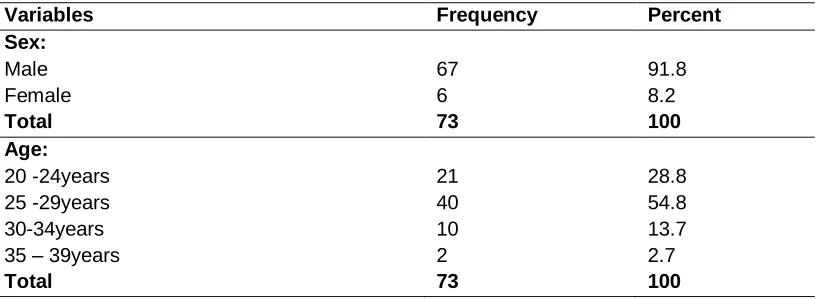
From the findings, an overwhelming 91.8% of the students were male, whiles only 8.2% were female. The male dominance was noted by UNESCO (2012) which affirmed that, gender disparity still exist among students despite the efforts made to bridge the gap between boys and girls access to science related programmes at higher levels of education. The study also revealed that, students in the age bracket of 25 – 29 years constituted the majority of the study population representing 54.8% while those in the age bracket of 35 – 39 years are the least representing 2.7%.The findings indicated that, farming is the main occupation of most of the parents (47.8) of students surveyed. The findings confirm the study of Okeke (1996) who reported that, majority of children were willing to take after their parents occupations. From the study, over 80% of the parents of students who are on the CBT programme have had some form of education with majority attaining basic level education. Although only 5% of their parents have had education up to the tertiary level, the findings demonstrates the students‟
determination to achieve what their parents could not do. This is quiet refreshing as the study area has high illiteracy level due to deliberate policy of building a crop labour force in the north as migrant farmers to the south by colonial masters (de Lang, 2007).
Table 1: Demographic characteristics of students
Variables Frequency Percent
Sex: Male Female Total
67 6 73
91.8 8.2 100 Age:
20 -24years 25 -29years 30-34years 35 – 39years Total
21 40 10 2 73
Licensed under Creative Common Page 8 Occupation of Parents:
Farmer Trade Salary Earner Contractor Total 35 32 4 2 73 47.9 43.8 5.5 2.7 100 Educational background of parents:
Tertiary Senior High Basic Level No Education Others Total 5 18 36 12 2 73 6.8 24.7 49.3 16.4 2.7 100
Competencies ‘before’ and ‘after’ industrial attachment training as assessed by students
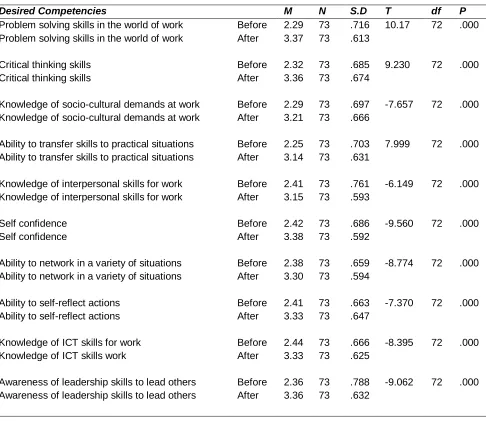
Students competence were ascertained by asking them to state their levels of competence in 19 competency items that are needed to function effectively in the world of work. A survey was conducted at the beginning and end of the industrial attachment training programme. The results of paired t-test presents an assessment before and after practical training among students in terms of competencies acquired. The findings indicate that, significant differences were found among all industry desired competencies for all the 19 competency items examined. Students recorded higher total competence mean of 3.28 after the practical training than the mean score of 2.38 before the training. It can therefore be concluded that, the training has significantly increased the competence levels of students in the areas assessed which had a mean difference of 0.9.
This confirms the findings of Mohd et al. (2009) that, engineering students perception after Industrial Training Placement in Malaysia had beneficial effect on them since it significantly improved their „personal attitude‟, „communication‟, and „work attitude‟. The training provided
has given them wealth of experience and this creates an opportunity for superior future employment prospects. Equally, Oloruntoba (2008) reported that students‟ farm practical year programme at the University of Agriculture, Abeokuta, Nigeria, provided students with „hands-on‟ experience and opportunity to apply theory learnt in the classroom to real work situation
where they adapted and provided solutions to problems on the field. Students also felt strongly that, the farm practicals would contribute to their professional career and employability on graduation.
Licensed under Creative Common Page 9 students of Botswana College of Agriculture. This underscores the expectations that practical training received at the industry level strengthens the theory from the class and as a result support in preparing prospective graduates to fit into the employment world. The findings also corroborates the studies of Boahin (2013), Oseiet al, (2005) and Madebwe and Madebwe 2005) on similar practical training programmes in Ghana and Zimbabwe respectively.
The study also indicate that, students were competent before undertaking the practical training programme in “theoretical agricultural knowledge” and “practical agricultural knowledge”
out of the 19 competency items. This is an indication that, the practical training programme was not solely responsible for the changes in their competency levels. These changes could possibly be attributed to the practical training received at school or at home by parents who might have demonstrated such competencies to their children on their farms.
Table 2: Competencies of students „before‟ and „after‟ industrial attachment
Desired Competencies M N S.D T df P
Problem solving skills in the world of work Before 2.29 73 .716 10.17 72 .000 Problem solving skills in the world of work After 3.37 73 .613
Critical thinking skills Before 2.32 73 .685 9.230 72 .000 Critical thinking skills After 3.36 73 .674
Knowledge of socio-cultural demands at work Before 2.29 73 .697 -7.657 72 .000 Knowledge of socio-cultural demands at work After 3.21 73 .666
Ability to transfer skills to practical situations Before 2.25 73 .703 7.999 72 .000 Ability to transfer skills to practical situations After 3.14 73 .631
Knowledge of interpersonal skills for work Before 2.41 73 .761 -6.149 72 .000 Knowledge of interpersonal skills for work After 3.15 73 .593
Self confidence Before 2.42 73 .686 -9.560 72 .000
Self confidence After 3.38 73 .592
Ability to network in a variety of situations Before 2.38 73 .659 -8.774 72 .000 Ability to network in a variety of situations After 3.30 73 .594
Ability to self-reflect actions Before 2.41 73 .663 -7.370 72 .000 Ability to self-reflect actions After 3.33 73 .647
Knowledge of ICT skills for work Before 2.44 73 .666 -8.395 72 .000 Knowledge of ICT skills work After 3.33 73 .625
Licensed under Creative Common Page 10 Group decision making through consensus Before 2.26 73 .834 -8.848 72 .000 Group decision making through consensus After 3.33 73 .554
Organise and express ideas clearly Before 2.36 73 .806 -8.449 72 .000 Organise and express ideas clearly After 3.30 73 .594
Ability to know and handle different issues Before 2.30 73 .758 -8.465 72 .000 Ability to know and handle different issues After 3.16 73 .601
Ability to work methodically Before 2.41 73 .663 -6.363 72 .000 Ability to work methodically After 3.11 73 .636
Capacity to deal with changes Before 2.40 73 .702 -9.097 72 .000 Capacity to deal with changes After 3.32 73 .598
Possesses theoretical agricultural knowledge Before 2.55 73 .688 -7.654 72 .000 Possesses theoretical agricultural knowledge After 3.34 73 .650
Possesses practical agricultural knowledge Before 2.54 73 .687 -8.818 72 .000 Possesses practical agricultural knowledge After 3.37 73 .565
Skills to work in diverse cultures Before 2.42 73 .725 -6.851 72 .000 Skills to work in diverse cultures After 3.18 73 .631
Able to perform different activities at work Before 2.40 73 .702 -7.914 72 .000 Able to perform different activities at work After 3.22 73 .583
Significant at P<0.05 Scale: 4-very competent, 3-competent, 2-fairly competent, and 1-not competent
Relationship between demographic characteristics of students and their acquisition of industry desired competencies
Correlation coefficients of students‟ demographic characteristics and their acquisition of industry
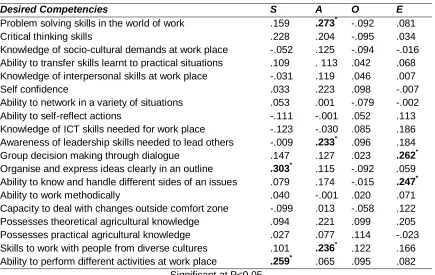
desired competencies are presented in the table below using Pearson Product Moment Correlation (PPMC) computed at (p<0.05). The findings revealed that, with an r value of .273, „problem solving skills in the world of work‟ showed positive significant relationship with age.
The implication is that, the ages of students determine their ability to acquire and apply problems solving skills in the world of work. This confirms the findings of Van et al (2006) that, matured students achieve better academic grades and are more well prepared to deal with work related problems than their younger counterparts.
Licensed under Creative Common Page 11 others and what can be done to motivate followers in other to maximise output in the working environment.
Also, the findings also indicated a significant positive relationship between educational background of parents and students‟ acquisition of skills in group decision making through
dialogue which has an r value of .262.This affirms the assertion of Azhar, et al (2013) that, educated parents understand the educational and attitudinal needs of their children and are able to prepare them to work with diverse groups in the world of work better than the uneducated.
The results also showed a positive significant relationship between educational background of parents and students ability to know and handle different sides of issues in the working environment which has an r value of .247. This means that, students whose parents are well educated stand the chance of understanding different sides of issues which will enable them craft suitable measures to address them.
The findings also indicated positive significant relationship between age and students‟
acquisition of skills to work with people from diverse cultures whose r value is .236.This supports the findings of Sheard (2009) that, matured students achieved greater academic success, as measured by final degree GPA, and have the capacity to work with colleagues from different backgrounds compared to younger ones.
Finally, with r value of .303, the results revealed a positive significant relationship between sex of students and their ability to perform different activities at work place. The implication is that, students‟ sex have profound impact on their acquisition of skill needed to perform different activities at the work place. In line with this, Rajagopal and Bojin‟s (2003)
reported that, there were performance differences among male and female college and university students. To this end Baker, (1994) reported that, female students are noted to be generally more motivated towards learning and to readily engage with academic goals and activities.
Licensed under Creative Common Page 12 Table 3: Relationship between students‟ demographic characteristics and
their competency levels
Desired Competencies S A O E
Problem solving skills in the world of work .159 .273* -.092 .081 Critical thinking skills .228 .204 -.095 .034 Knowledge of socio-cultural demands at work place -.052 .125 -.094 -.016 Ability to transfer skills learnt to practical situations .109 . 113 .042 .068 Knowledge of interpersonal skills at work place -.031 .119 .046 .007
Self confidence .033 .223 .098 -.007
Ability to network in a variety of situations .053 .001 -.079 -.002 Ability to self-reflect actions -.111 -.001 .052 .113 Knowledge of ICT skills needed for work place -.123 -.030 .085 .186 Awareness of leadership skills needed to lead others -.009 .233* .096 .184 Group decision making through dialogue .147 .127 .023 .262* Organise and express ideas clearly in an outline .303* .115 -.092 .059 Ability to know and handle different sides of an issues .079 .174 -.015 .247* Ability to work methodically .040 -.001 .020 .071 Capacity to deal with changes outside comfort zone -.099 .013 -.058 .122 Possesses theoretical agricultural knowledge .094 .221 .099 .205 Possesses practical agricultural knowledge .027 .077 .114 -.023 Skills to work with people from diverse cultures .101 .236* .122 .166 Ability to perform different activities at work place .259* .065 .095 .082
Significant at P<0.05
Legend: S = Sex, A = Age, O = Occupation of parents, E = Educational background of parents
Constraints of the CBT programme as assessed by students.
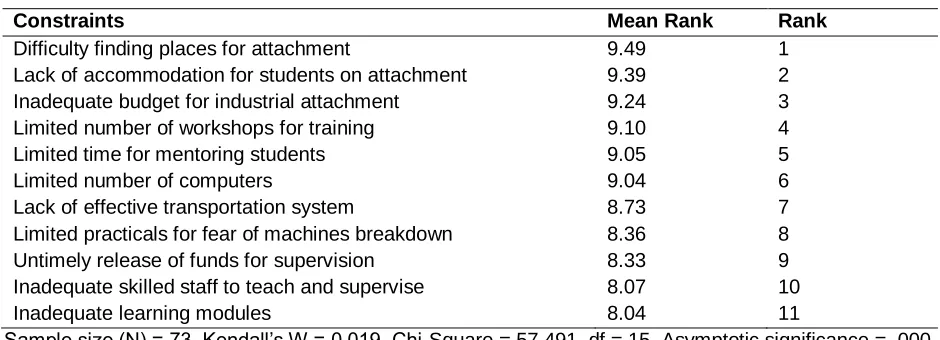
The constraints working against the smooth running of the competency based training programme in Tamale Polytechnic as assessed by students were ranked using Coefficient of concordance (W) statistics as shown in the table below. The findings ranked difficulties students encounter in trying to find places for attachment as the top most constraint with a mean of 9.49. The Polytechnic is located in the regional capital, Tamale, where limited opportunities exist for these students to undertake this practical training exercise. This finds expression in the Ministry of Education (MOESS, 2008) that, pre-employment institution-based training finds it hard to connect with industry, to arrange staff and trainees for industrial placements and to get industry representation on institution boards. Equally, Bekunda et al., (2007) posited that, there is little or minimum interface with organisations to expose students to practical realities of the learning programme. As a result of the absence of effective collaboration between the polytechnic on one hand and the private sector on the other hand, mechanisms have to be put in place to lessen these challenges that bedevil the programme.
Licensed under Creative Common Page 13 that are not financially sound, thus, are unable to undertake this practical training in areas where land lords charge bloody prices. The period for the training is three months and owners of accommodation do not see it attractive enough to rent properties to students when so many fully employed people within the same area could be looking for it. It is therefore not surprising that accommodation was rated second as an impediment to the effective implementation of the CBT programme.
The programme also suffers from inadequate budgetary allocation from the polytechnic. Funds for practical training supervision are paid by students which from all indications is inadequate and that could be responsible for its mean score of 9.24. Lecturers are not provided with transportation to undertake these exercises and the GH 50 given to them for accommodation and transportation is not sufficient to fuel their own cars. Government does not contribute anything as far as the supervision of students is concerned. It is therefore not surprising that, incomes generated can only enable lecturers supervise students only once throughout the practical training period which last for three months. Though a fraction of what students pay is expected to take care of students and lecturers insurance, this rarely happen and some organisations even reject students for practical training who do not have insurance cover. This development confirms the assertion of Dauda (2006) that, practical training programmes suffer from inadequate placement opportunities, lack of insurance for both trainees and supervisors, and other financial incentives such as night allowances. Thus, for CBT to be responsive to the needs of industry, a financing framework need to be modelled taking into consideration all the relevant issues that would make it effective. Currently, it is only the students who bear the cost and if other stakeholders such as the industry, non-governmental organisations and government could be brought into the picture, the programme stands the chance of succeeding.
Licensed under Creative Common Page 14 In the same vein, Kirkpatrick and Kirkpatrick (2006) asserted that, lack of suitable training facilities could affect trainees‟ motivation to learn. Places that have the potential for distractions,
inappropriate temperature as well as venues that would require long distance travels should not be considered (Bimptos and Petridou, 2012). Storr and Hurst (2001) also indicated that, the right facilities and resources, learning space, classrooms, and other learning resources that are required for good training should be functional and comfortable. According to Brown and McCracken (2009), perceived absence of opportunity to learn and physical logistical constraints could impact negatively on learning. However, the current constrains could soon become a thing of the past since there is on-going project meant to house the whole of school of engineering which includes the agricultural engineering department.
Another constraint that has the potential of working against the effective implementation of CBT is the use of unqualified staff to train students. Currently, most of the teaching staff in the department have undergone training in CBT either within the Polytechnic, or in the Netherland (NUFFIC 2008). The department has 16 teaching staff and except one, the rest have minimum of second degree which is the required entry qualification (Polytechnic Strategic Plan, 2013). This explains why “Inadequate skilled staff to teach and supervise students” is seen as one of
the least constrains to CBT effectiveness with a mean rank of 8.07. The availability of qualified staff could probably be responsible for students being assessed competent in most competency items since they play a pivotal role in CBT both within and outside the Polytechnic. This is in line with the assertion of Kirkpatrick (2006) that, the trainers‟ qualities should include sound
knowledge in the training area, a good listener, a desire to train, good com
munication skills, and excellent talent to motivate trainees to participate in the training process. Also, Massey (2003) added that, training standards requires that, trainers should have the ability to know how they can transfer skills and knowledge to the trainee. According to Lawson (2006), the trainer‟s physical presence in terms of appearance, teaching, his ability to communicate could affect trainees‟ perceptions of the training, and this could inspire them to
Licensed under Creative Common Page 15 Table 4: Constraints of the CBT program as ranked by students
Constraints Mean Rank Rank
Difficulty finding places for attachment 9.49 1 Lack of accommodation for students on attachment 9.39 2 Inadequate budget for industrial attachment 9.24 3 Limited number of workshops for training 9.10 4 Limited time for mentoring students 9.05 5
Limited number of computers 9.04 6
Lack of effective transportation system 8.73 7 Limited practicals for fear of machines breakdown 8.36 8 Untimely release of funds for supervision 8.33 9 Inadequate skilled staff to teach and supervise 8.07 10
Inadequate learning modules 8.04 11
Sample size (N) = 73, Kendall‟s W = 0.019, Chi-Square = 57,491, df = 15, Asymptotic significance = .000, Rank 1 = Highest Constraints, Rank 14 = Least constraint.
CONCLUSION AND RECOMMENDATION
The results of this survey indicates that, students in the agricultural engineering department of Tamale Polytechnic perceive the competency based training programme to be largely capable of equipping them with the desired industry competencies. The students perceived themselves to be competent in most of the industry desired competencies they have acquired at the Tamale Polytechnic. Though students were competent in both “theoretical agricultural knowledge before
undertaking the practical training, their levels of competencies improved after the programme. This is an indication that, the CBT has contributed to the overall changes in their competency levels. To this end, the following recommendations are put forward for the improvement of CBT:
There is the need for all tertiary education institutions in the country to engage in
some self- introspection relative to the effectiveness of the CBT programme in equiping students with the desired competencies.
Effective collaboration between the Polytechnic and industry should be
encouraged
Demonstration farm should be established in the Polytechnic
Well-resourced workshop and simulation centre should be established to help
students acquire hands-on experience.
Insurance covers should be provided for both all students on industrial
attachment.
Lecturers also need industrial attachment to enable them teach and assess
Licensed under Creative Common Page 16 LIMITATIONS OF THE STUDY AND SCOPE FOR FURTHER RESEARCH
The study was limited in academic scope to all Agricultural Engineering graduates of Tamale Polytechnic who are on the competency-based training programme. Also, the instrument used for the study was also limited by the lack of psychometric data available, thereby limiting the ability to quantify the exactness of the measurement. In view of this, another opportunity for future research in this area will include the use of an instrument that has psychometric data available. Although the research findings and conclusions may not be widely representative, it may serve as baseline upon which future training programmes of this nature could be based, hence in Ghanaian Polytechnics.
REFERENCES
Akyeampong, K. (2010). Educational Expansion and Access in Ghana: A Review of 50 Years of Challenge and Progress: Centre for International Education University of Sussex, UK.
Albanese, A., Mejicano, G., Mullan, P., Kokotailo, P., & Gruppen, L. (2008). Defining characteristics of educational competencies. Med Educ 42(3):248–355.
Allen, K. E., & Cowdery, G. E. (2009). The exceptional child: Inclusion in early childhood education (6th edition). Clifton Park, NY: Thompson Delmar Learning.
Amankwah, E. (2011). Relevance of Competency Based Training in Polytechnic Education for National Development, Journal of Education and Practice, ISSN 2222-1735, Vol 2. .
Anane, C., A. (2013). Competency based training: Quality delivery for technical and vocational education and training (tvet) institutions, educational research international issn-l: 2307-3713, issn: 2307-3721 vol. 2 no. 2.
Ansah, S., K, , & Ernest, K. (2013). Technical and Vocational Education and Training in Ghana: A Tool for Skill Acquisition and Industrial Development
Avolio, B. J., Waldman, D. A., & McDaniel, M. A. (1990). Age and work performance in nonmanagerial jobs: The effects of experience and occupational type. Academy of Management Journal, 33:407–422. Ayariga, M. (2013). Public Universities must restructure programs: Ghana News Agency, Accra. .
Azhar, M., Nadeem, S., Naz, F., Perveen, F., & Sameen, A. (2013). Impact of parental education and socio-economic status on academic achievements of university students. International Journal of Academic Research and Reflection Vol. 1 No. 3, 2013.
Baker, T. L. (1994). ,Doing Social Research (2nd edition). New York: McGraw-Hill Inc.
Bimpitsos, C., & Petridou, E. (2012). A Trans disciplinary approach to training: preliminary research findings based on a case analysis. European Journal of Training and Development, 36 (9), 911 – 929. Boahin, P. (2013). Competency-Based Training (CBT) in higher education Towards an implementation in Ghanaian polytechnics; Print: Ipskamp Drukkers BV – Enschede, The Netherlands ISBN: 978-90-367-6866-5978-90-367-6867-2 (electronic version) NUR: 841
Brown, T. C., & McCracken, M. (2009). Building a bridge of understanding; how barriers to training participation become barriers to training transfer. Journal of European Industrial Training, 33(6), 492-512. Bryman, A. (2004). Social research methods (2nd ed.). Oxford, Oxford: University Press.
Licensed under Creative Common Page 17 de Lang, A. (2007). Deprived Children and Education in Ghana. International Research on Working Children (IREWOC), Plan Netherlands.
Duodu, A. (2006). TVET in Ghana: A Case Study, Ministry of Education and Sports Report (Ghana Education Service, Technical and Vocational Education Division), Accra.
Ehrenberg, R. G., & Smith, R. S. (2000). Modern labor economics: Theory and public policy. Reading, MA: Addison Wesley.
Eisenkopf, G., Hessami, Z., Fischbacher, U., & Ursprung, H., U. (2013). Academic Performance and Single-Sex Schooling: Evidence from a Natural Experiment in Switzerland. JEL classification: I21, J16. Flecknoe, M. (2002). “How can ICT help us to improve education”? Innovations in Education & Teaching International, Vol. 39, No. 4, Pp; 271-280.
Gasper, O. A. (2005). Competency Based Science, Technology and Engineering Curriculum for Human Capital Development in Nigeria. Proceedings of the Commonwealth Association of Polytechnics in Africa (CAPA) Seminar on the Role of Technical Education in Africa in the Post Secondary Millennium Era)‟ Qualitype Limited, Accra. .
Gay, L. R., & Airasian, P. (2000). Educational Research: Competencies for Analysis and application, (61h edition). Ohio: Prentice Hall.
GEA. (2006). Ghana Employers Association: Annual Report. ( p.24). .
Gentry, R. (2013). Collaboration skills pre-service teachers acquire in a responsive preparation program Jackson State University: Journal of Instructional Pedagogies Collaboration Skills, Page 1
GoG. (2010). Private Sector Development Strategy 2010-2015. Ministry of Trade and Industry, Government of Ghana, Accra, Ghana. Unpublished. .
GoG. (2013). The budget statement and economic policy of the Government of Ghana for the 2014 financial year presented to Parliament on Tuesday, 19th November 2014 by SetheTerkper, Minister for Finance. .
Igbinedion, v., i. (2011). Perception of factors that influence students‟ vocational choice of secretarial studies in tertiary institutions in edo state of nigeria. European journal of Educational Studies 3(2), Ozean Publication.
Kirkpatrick, D., & Kirkpatrick, J. D. (2006). Evaluating Training Programs. San Francisco, USA: Berrett-Koehler.
Kolb, A. Y., & Kolb, D. A. (2005). Learning styles and learning spaces: Enhancing experiential learning in higher education. Academy of Management Learning and Education, 4(2), 193–212. .
Kozma, R. (2005). 'National Policies That Connect ICT-Based Education Reform To Economic And Social Development', Human Technology Vol.1, No. (2), Pp; 117-156.
Kulik, J. (2003). “Effects of using instructional technology in elementary and secondary schools: What controlled evaluation studies say (Final Report No. P10446.001)”. Arlington, VA: SRI International. Madebwe, C., & Madebwe, V. (2005). Undergraduate work related-learning impact study. Uniswa res. J. Agric. Sci. And tech. 8(1): 57-63.
Marguerite J, D. (2014). Competency-based degrees – The quiet revolution? The New College Guide:
http://www.universityworldnews.com/article.php?story=20140212124833226.
McMillan, J. H. (2004). Educational research: Fundamentals for the consumer (4th ed.). Boston: Allyn and Bacon.
Licensed under Creative Common Page 18 NUFFIC. (2004). CBT workshops on Curriculum design, development and implementation. Bolgatanga, Ho, Tamale and Wa Polytechnics.
NUFFIC. (2006). CBT workshops on Curriculum design, development and implementation. Bolgatanga, Ho, Tamale and Wa Polytechnics. .
NUFFIC. (2007). CBT workshops on Curriculum design, development and implementation. Bolgatanga, Ho, Tamale and Wa Polytechnics.
NUFFIC. (2008). CBT workshops on Curriculum design, development and implementation. Bolgatanga, Ho, Tamale and Wa Polytechnics.
NUFFIC. ((2005-2008). ). CBT workshops on Curriculum design, development and implementation. Bolgatanga, Ho, Tamale and Wa Polytechnics. .
Nwana, S. (2010). Effect of gender on student-teachers‟ vtr technique acquisition for mastering verbal communication skill in microteaching. The nigerian journal of research and Production Volume 17 No 1. Obeng, G. Y., Adjaloo, M. K., & Amrago, D. K. (2013). Analysis of Skills and Training Needs of Metalwork Engineering Enterprises in Ghana The International Journal Of Engineering And Science (IJES), Volume 2. .
Okeke, A. C. (1996). Women and Girls Participation in Science, Technology and Maths: Educators As Facilitators”. A lead paper presented at the 8th Conference of Nigerian Academy of Education. Enugu 19-21 November.
Oladele, O., I, , Subair, S., K,, & Thobega, M. (2011). Effectiveness of field practical training for competence acquisition among students of Botswana College of Agriculture: African Journal of Agricultural Research Vol. 6(4), pp. 923-930, .
Oliver, R. (2002). The role of ICT in higher education for the 21st century: ICT as a change agent for education. Edith Cowan University, Perth, Western Australia.
Oloruntoba, A. (2008). Agricultural Students‟ Perceptions of Farm Practical Year Programme at University of Abeokuta, Nigeria. Agricultural Conspectus Scientificus, 73(4): 245-252.
Osei, C., K,,, Berchie, J., N.,, , Ansah, I., O.,O.,, , Gyasi-Boakye, S., Asante, S., N.,, , & Adjekum, A., A.,. (2005). (,2005). MoFA-Root and Tuber improvement programme: Accounting for Training Results: An Evaluation of the Training Activities of the Root and Tuber Improvement Programme
Quiñones, M. A., Ford, J. K., & Teachout, M. S. (1995). The relationship between work experience and job performance: A conceptual and meta-analytic review. Personnel Psychology, 48: 887–910.
Smith, T. E. C., Gartin, B., & Murdick, N. L. (2012). Including adolescents with disabilities in general education classrooms. Boston, MA: Pearson.
Sturman, M. C. (2003). Searching for the inverted u-shaped relationship between time and performance: Meta-analyses of the experience/performance, tenure/performance, and age/performance relationships. [Electronic version]. Retrieved [25-10-2014], from Cornell University, SHA School site:
http://scholarship.sha.cornell.edu/articles/119.
Thobega, M., K. , Subair, S., K, , , & Oladele, O., I. (2011). Supervisors‟ Perceptions of Student Competencies After a Field Practical Training Class.
UNESCO. (2012). Youth and Skills: Putting Education to Work.10th Edition of Education for All Global Monitoring Report. UNESCO Publishing. Second Edition.
Verhaeghen, P., & Salthouse, T. A. (1997). Meta-analyses of age-cognitive relations in adulthood: Estimates of linear and nonlinear age effects and structural models. Psychological Bulletin, 122:231–249. Wagner, A. D. (2001). “IT and Education for the Poorest of the Poor: Constraints, Possibilities, and Principles”. TechKnowLogia, July/August, Pp; 48-50.
Licensed under Creative Common Page 19 Wiggins, G. (1990). The case for authentic assessment: ERIC digest. Retrieved from
http://eric.ed.gov/ERICWebPortal/contentdelivery/servlet/ERICServlet?accno=ED32861.