6136
Implementation of the Trait Treatment Interaction
(TTI) Learning Model by using the Lecture Maker
Media Application
Prima Aswirna, Intanziah Rahmadani
Abstract — This research is motivated by educators giving equal treatment to all students in the learning process even though students have different abilities. Students are grouped into high-ability students, students with moderate abilities and low-ability students. This research purpose is to know that learned using the TTI (Trait Treatment Interaction) model using Lecture Maker media. This research is a quasi experiment with control group only design. This research population is all the VII grade students in MTsN 6 Padang in the 2017/2018 academic year, amounting to 195 people. Data analysis method used for statistical analysis and test requirements analysis. The research showed that (1) the learning outcomes of students who took lessons with learning the Trait Treatment Interaction (TTI) model using the learning model were as follows: conventional learning models is included in the medium category, (3) there are significant differences between students who are learning to follow the learning TTI (Trait Treatment Interaction) models using media Lecture Maker with students who are learning to follow the conventional learning models (t -counted> t-table). The TTI (Trait Treatment Interaction) students who learn to use learning using Lecture Maker showed better learning outcomes than students who learn to follow the learning using conventional learning models.
Index Terms — Trait Treatment Interaction, Lecture Maker
1 INTRODUCTION
ducation is one of the main pillars in the development of science and technology that is increasingly rapid today. Education is a very influential central point to improve a country's progress. Education is a very important thing to develop, so that the development of human resources in the field of education is the main capital in nation building. Education requires people to be able to improve their quality, develop their competencies, think smartly, creatively and innovator. Renewal in the field of education is an effort to improve the quality of education. A significant factor in improving the quality of education is the role of educators. Educators are desirable to teach in different ways in an effort to deal with the demands of this change [1], [2]. Educators must pay attention to the environment and knowledge possessed by students because both affect the learning system [3]. Learning requires a variety of ways to deliver lessons to students, so learning outcomes can be achieved. One way is to use a learning model. Learning has a very big role, one of which is to make it easier for students to understand learning, foster students' interests and aspirations in learning [4], [5]. Students' scientific knowledge can be improved by applying effective learning models [2].
Observations conducted by researchers in the field at one of the junior high schools in Padang showed that educators gave the same treatment to all students. Educators do not seem to give more treatment to students who do not understand the material being taught. Class conditions prove that students have different abilities to absorb material. Students' abilities are grouped into students who have high ability, moderate ability, and low ability. This difference in ability results in learning outcomes obtained by students also vary.
Based on these problems, it is known that the factors that influence student learning outcomes include learning models used, learning media, and the environment. The active learning model is a learning model that invites students to learn actively. When students learn actively, it means that they dominate learning activities. With active learning, students are invited to take part in learning, not only mentally but also physically. In this way students will usually feel a more pleasant atmosphere so that learning outcomes can be maximized.
One learning model that makes students become more active and participate in learning activities is Trait Treatment Interaction (TTI). The Berliner and Cahen study [6] about Trait Treatment Interaction and Leraning shows that the TTI approach is a good paradigm for research on teaching. Likewise, the research conducted by Aswirna [7] on the Application of Trait Treatment Interaction to Improve Learning of Chemistry shows that Trait Treatment Interaction can improve the ability of students in the academic performance of Chemistry.
Trait Treatment Interaction (TTI) is a learning model that takes into account individual differences possessed by students. The Trait Treatment Interaction learning model is a learning model that accommodates each group of individuals to get a particular treatment tailored to their potential or ability. The Trait Treatment Interaction learning model emphasizes the differences in abilities possessed by individuals [7].
The use of the term Aptitude Treatment Interaction (ATI) learning with Trait Treatment Interaction (TTI) for some experts both have similarities. As stated by Berliner and Cahen 1973 states [6] "We call this area of research on instruction Trait-Treatment Interaction," TTI. " The term, as
used by Hills (1971), conveys the same meaning as Aptitude-Treatment Interaction (ATI), which has been used by Bar-Yam (1969), Bracht (1970), Cahen (1969), Cronbach (1967) , Cronbach and Snow (1969), DiVesta, Peters, Sanders, Schultz, and Weener (1970a, 1970b), DiVesta, Sanders, Schultz, and Weener (1971a, 1971b), and Kropp, Nelson, and King (1967). This means that the Trait Treatment Interaction (TTI) has the same meaning as Aptitude Treatment Interaction (ATI). Lalley [8] states that certain decades of differences give the impression of using the term Aptitude Treatment Interaction (ATI), while in another decade the term Trait Treatment Interaction (TTI) was used. The fundamental eesence of the ATI and TTI models are both the same, namely implementing learning by prioritizing the awareness that each individual is different from one another.
The ATI learning model only limits the ability or potential of students based on the intelligence possessed by students. The TTI model of potential or ability possessed by students is not only studied based on intelligence, but can be traced through the character / temperament possessed or personality possessed by each student (open personality or closed personality). Thus the use of the TTI learning model has a broader dimension of understanding compared to the ATI learning model [8]. The TTI learning model emphasizes individual differences possessed by students. Students will be given treatment according to their potential or ability. Hunt [9] states that students who are fast-capable are given structured learning, while students who are capable of getting regular learning (regular teaching).
while students with slow abilities (slow leaner) are given regular learning with additional learning (regular teaching + tutorial). TTI is based on the theory of individual differences that can be used as a theoretical foundation for adaptive learning systems. This is as revealed by Lee [10]:
"The individual difference theories can be said to be the theoretical basis for adaptive learning systems. In other words, an adaptive learning system is possibly the realization of the individual difference theories. Therefore, this study will deal with the basis for adaptive learning systems and related theories. In addition, this study will illustrate learning styles that were utilized to develop this adaptive learning system. "
The advantages of the TTI model include: (1) allowing students to progress according to their respective abilities in full and precise; (2) foster pleasant personal relationships between teachers and students; (3) using the TTI learning model teachers can use diverse learning techniques in providing treatment to each group; (4) low-ability students, can take part in learning well because they are given additional learning.
The disadvantages of the TTI model are: (1) the teacher must be able to divide his time well to provide treatment to each ability; (2) the teacher must be able to show that there is no difference in learning; (3) allows students to feel differentiated in treatment.
The TTI model illustrates the importance of giving different treatments according to the ability of students to improve learning outcomes. As stated by Joyce and Weil [11] that
TTI has a major influence on the learning process. The effectiveness of learning using TTI can be increased by adding learning media.
Learning media also occupy a fairly important position as one component of the learning system. Some studies show that there are interactions between the use of learning media and student learning characteristics in determining student learning outcomes. The learning atmosphere can be fun and meaningful by using interactive media. In accordance with the research conducted by Di Vesta [12] about Trait - Treatment Interactions, Cognitive Process and Research on Communicative shows that Trait Treatment Interaction (TTI) -based media have a considerable and promising impact on the process of communication and understanding of human behavior. This shows that the use of media in learning is quite effective.
Media has uses and benefits. One approach that can involve the media is media presentations. Learning media can be audio (sound, music), animation, video, text, graphics and images (visual). Learning media using images (visual) can used by teachers in learning. The use of media can make students more active in learning, especially regulating, choosing, and integrating verbal and visual information [13], [14], [15].
Interactive learning media in the form of online and offline can use Lecture Maker software. Interactive learning media Lecture Maker is an alternative media that can be used by both teachers and students. Lecture Maker software is equipped with an audio video creation program, so it is possible to create interactive learning media. In this media there are simulations that can help students in the learning process and evaluation to measure student learning outcomes. Elvisa [16] has developed Lecture Maker media in the form of learning media with 91% media validation results with very valid categories. On average the practical results of physics learning media produced are 78.5% with very practical categories. The results of the analysis of effectiveness obtained were 78% in the very effective category.
Based on the description of the learning model and the problems described previously, in this experimental study we wanted to find out whether the application of the Trait Treatment Interaction model using Lecture Maker media was better than the conventional learning model on science learning outcomes of class VII students at 6 MTsN Padang?
2 METHODS
he research method used quasi experiment with randomized control group only design. This study used two classes, namely the experimental class group was treated by applying the Trait Treatment Interaction model using Lecture Maker media and the control class using a conventional model. After students are given treatment then post-test is done to measure student learning outcomes.
6138
The population in this study were all class VII MTsN 6 Padang Academic Year 2017/2018 which consisted of 5 classes with 195 students. The sampling technique used is Cluster Random Sampling. Class VII4 was obtained as the experimental class and class VII5 as the control class. The experimental class applied the Trait Treatment Interaction model using Lecture Maker media with 30 students. The control class uses a conventional model of 40 students.
Data from the results of this study are student learning outcomes in science subjects. Learning outcomes measured in this study are limited only to students' cognitive abilities. The instrument used in this study was an essay test of 10 items. Before the test instrument was used a trial was carried out carried out on class VII7 students of MTsN 6 Padang. Data obtained from test trials in the field, then analyzed for knowing the validity of the items, the reliability of the item, the power difference, and the index of the difficulty of the items. The presentation of the results of the instrument trials is explained as follows:
Design of Learning Plans (RPP)
Draft Learning Plan (RPP) is a plan of learning activities created and will be carried out in the learning process. Before the RPP was implemented in class, the lesson plan was validated in advance by three people consisting of content and pedagogic experts.
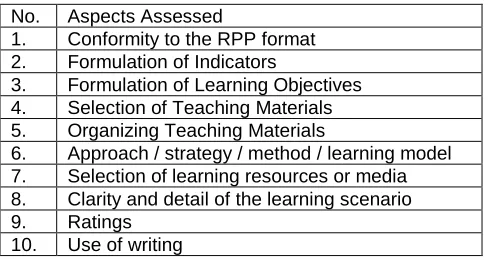
RPP assessment is categorized as invalid if the percentage is ≤ 60%, valid if the percentage is 61-75% and is very valid if the percentage is 76-100%. RPP assessments are related to various aspects shown in Table 1.
Table 1. Description of aspects in RPP
No. Aspects Assessed
1. Conformity to the RPP format
2. Formulation of Indicators
3. Formulation of Learning Objectives
4. Selection of Teaching Materials
5. Organizing Teaching Materials
6. Approach / strategy / method / learning model
7. Selection of learning resources or media
8. Clarity and detail of the learning scenario
9. Ratings
10. Use of writing
The results of the RPP assessment by the three content and pedagogic expert judges show that the lesson plan includes a very valid category with an average score of 80%. The question grid is the format of the description of the questions that will be tested and used for making questions. Before the problem is used in research, the grid and the questions must be tested for validity, reliability, difficulty index and distinguishing power first. Grid of questions and questions validated by three judgment people. The validity of the test questions is in the valid category if the percentage ranges from 61-75% while the very valid category ranges from 76-100%. The form of the problem indicator is shown in Table 2.
Table 2. Validity of Trial Questions
No Question Indicator
1. Explain the characteristics of the constituent layer of the earth.
2. Describe the characteristics of the atmosphere.
3. Explain the characteristics of the lithosphere
4. Describe earthquake characteristics and reduce
the risk of hazards.
5. Explain the characteristics of volcanoes and
reduce the risk of their hazards.
6. Explain the characteristics of the hydrosphere and
risk reduction
The results of the question validation based on the indicators found in Table 2, the trial questions are in the percentage of 90% included in the very valid category. The reliability of the test questions which was followed by 30 students in the form of the essay test obtained r11 = 0.9363865 and rt = 0.361. Because r11> rt, the test results that were tested were reliable with very high categories. The difficulty index of the test questions is at 0.31-0.79 in the medium category. The test problem has different powers ranging from 0.33 to 0.68 included in the sufficient and good category. Based on the results of the analysis of the validity, reliability, level of difficulty and differentiation test, 10 essay questions tested can be used for research. Analysis of research data was carried out by descriptive statistical analysis and analysis prerequisite test (t-test). Descriptive statistical analysis techniques present mean (mean), median, mode and standard deviation. This descriptive analysis is used to determine the high and low level of student science learning outcomes which are converted into ideal mean criteria and ideal standard deviations. The inferential statistical analysis technique used is to test the hypothesis (t-test). Before carrying out the t-test, the data must be tested for normality and homogeneity. Data normality test is intended to find out that the data obtained is normally distributed. The variance homogeneity test is intended to find out that the variance between the experimental class and the control class is homogeneous.
3 Result and Discussion
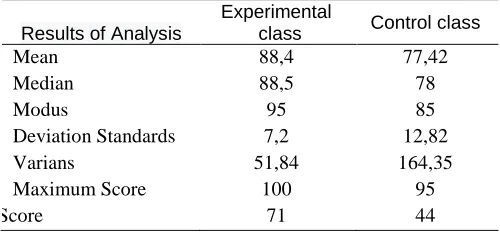
ata on science learning outcomes of students in the experimental class and control class in this study were obtained during the learning process and after learning in the form of the results of the assessment of understanding scientific concepts (cognitive domain). The results of the experimental class applying the Trait Treatment Interaction model using Lecture Maker showed that 27 students scored above KKM with the highest score of 100 and the lowest score of 71. The average student learning outcomes were 88.4 with the percentage of students completing 90 % or as many as 27 students and 3 students (10%) below the minimum completeness criteria. The results of this study are in accordance with Putra, et al. [17] showed that the average post-test in the class taught by the ATI (Aptitude Treatment Interaction) learning model assisted by concept maps was greater than the average post-test of students in the class taught by conventional
learning models. Student learning outcomes in the control class showed the highest score of 95 and the lowest score of 44. The average value of student learning outcomes was 77.42 with a percentage of completeness of 58% or as many as 23 students and 17 students (42%) below the minimum completeness criteria. Students in the control class more often do not complete learning. Students in the control class listen more to the explanation from the teacher and then record and do the exercises given. One of the causes of the low learning outcomes of control class students compared to the experimental class is the use of different learning models. This difference in learning models makes the learning class of the control class lower than the experimental class. This result is the same as the research conducted by Dongoran [18] about the effects of the ATI (Aptitude Treatment Interaction) learning model on students' activity and generic physics science. The results obtained showed that the generic science skills of conventional class students were lower than the generic science skills of students in the ATI class. The results of student science learning in both classes have actually shown better than before. But the difference in class learning outcomes using conventional TTI models is clear. Sample class normality test data can be seen in Table 3.
Table 3. Sample Class Normality Test Data
Results of Analysis
Experimental
class Control class
Mean 88,4 77,42 Median 88,5 78
Modus 95 85
Deviation Standards 7,2 12,82 Varians 51,84 164,35 Maximum Score 100 95 Minimum Score 71 44
The average posttest score of the class using the TTI model assisted by Lecture Maker media was higher than the average posttest score of the class taught by conventional learning models. This proves that the TTI model is better used in learning according to Berliner and Cahen's research [6] about Trait-Treatment Interaction and Leraning. The results of the study indicate that the TTI approach is a good paradigm for research on teaching. Data distribution normality test was carried out by Lilifors test at a significance level of 5%. The calculation results in the experimental class show that L-counted = 0.1147, n = 30 with a significance level (α) of 5% and L-table = 0.1610. The L-counted result <L-table, means the experimental class is normally distributed. Likewise, the results of calculations in the control class indicate that L-counted = 0.1228, n = 40 with a significance level (α) of 5% and L-table = 0.1401. The L-counted result <L-L-table, means that the control class is normally distributed. The test data for the homogeneity of the two classes is shown in Table 4.
Table 4. Sample Class Homogeneity Test Data
Experimental Class
Control Classl Mean 88,4 77,42
SD 7,2 12,82
Variants 51,84 164,35
F Count 0,32
F Table 3,98
Conclusion F countn < F table
The variance homogeneity test results for classes using
assisted TTI models use Lecture Maker media
(experimental class) and classes that use conventional models (control classes) show results that F-counted <F-table. This means that the variance of the two classes is homogeneous.
The second class hypothesis test data are shown in Table 5. Table 5. Hypothesis Test Data
Experimental Class
Control Cass
Mean 88,4 77,42 Variants 51,84 164,35
N 30 40
Df 68
t count 4,21
t table 1,67
Conclusion t count < t table
The results of the t-test analysis found that the t-counted value is greater than the t-table, which is 4.21> 1.67 in the 68 degree of freedom. So, it can be concluded that H0 is rejected and H1 is accepted, which means student learning outcomes that apply the TTI model using Lecture Maker media is better than students who use conventional models. This is consistent with the research conducted by Aswirna [7]) that TTI can improve the ability of students' academic performance on the topic of chemistry. In accordance with the research conducted by Putra, et al. [17] which shows the ATI learning model assisted by concept maps is better than conventional learning models. Joyce and Weil [11] stated that TTI had a major influence on the learning process and Berliner and Cahen [6] in their study showed that the TTI approach was a good paradigm for research on learning.
The learning process shows that students are enthusiastic enough to learn using science learning media Lecture Maker. This proves that the use of learning media is quite effective in learning. In accordance with the research conducted by Harun and Job [19] that the media lecture maker is very effective and able to have a positive impact on students. Software lecture maker is good and appropriate to use in the learning process in improving student learning outcomes compared to traditional methods [20], [21].
6140
about Trait-Treatment Interactions, Cognitive Processes and Research on Communicative Media. The results of this study indicate that the media-based TTI model has a considerable and promising impact on the communication process and also understanding human behavior.
4 Conclusion and Recomendation
e have successfully conducted research on the implementation of the treatment interaction (tti) learning model using the media application lecture maker. The results showed that the average student learning outcomes in the experimental class applying the TTI model using the application lecture maker media was 88.4 better than the control class using the conventional model of 77.4. Analysis of tests with α = 0.05 obtained t-counted is greater than t-table which is 4.21> 1.67, it can be concluded that the application of the TTI model using media lecture maker can improve student learning outcomes better when compared to conventional models. Based on the results of the research that has been carried out there are several suggestions proposed for further research Science teachers can apply the TTI model using Media Lecture Maker especially in science subjects and other subjects in general in an effort to improve student learning outcomes. In addition, the principal is expected to facilitate teachers to be able to use more innovative learning models to realize more effective learning.
References
[1] G. Siemens and P. Long, ―Analytics in Learning and Education,‖ Educuse, vol. 46, no. 1, 2011.
[2] B. A. Burke and E. Walton, ―Modeling effective teaching and learning in chemistry,‖ J. Chem. Educ., vol. 79, no. 2, p. 155, 2002.
[3] R. Driver and B. Bell, ―Students’ Thinking and the Learning of Science: A Constructivist View.,‖ Sch. Sci. Rev., vol. 67, no. 240, pp. 443–456, 1986.
[4] R. K. Coll, B. France, and I. Taylor, ―The role of models/and analogies in science education: implications from research.,‖ Int. J. Sci. Educ., vol. 27, no. 2, p. 183–198., 2005.
[5] D. F. Treagust, C. G., and T. L. Mamiala, ―Students’ understanding of the role of scientific models in learning science,‖ Int. J. Sci. Educ., vol. 24, no. 4, pp. 357–368, 2002.
[6] D. C. Berliner and L. S. Cahen, ―Trait-Treatment Interaction and Learning,‖ Rev. Res. Educ., vol. 1, no. 1, pp. 58– 94, 1973.
[7] P. Aswirna, ―Application of Trait Treatment Interaction of Improve Learning of Chemistry.,‖ in SHS Web of Conferences, 2018, p. 00114.
[8] J. . Lalley and J. R. Gentile, ―Classroom Assesment and Grading to Assure Mastery,‖ Theory Pract., vol. 48, no. 1, pp. 28– 35, 2009.
[9] D. Hunt, ―Learning style and student needs: an introduction to conceptual level. Student learning styles.,‖ Diagnosing Descr. Programs, pp. 27–38, 1979.
[10] J. Lee, ―Development of an Adaptive Learning System Based on Task-Trait-Treatment Interaction Theory.,‖ Int. J. Softw. Eng. Its Appl., vol. 7, pp. 49–66, 2013.
[11] B. Joyce and M. Weil, Models of Teaching. Englewood Cliffs. New Jersey: Prentice-Hall, 1987.
[12] F. J. Di Vesta, ―Trait-treatment interactions, cognitive processes, and research on communication media.,‖ Educ. Technol. Res. Dev., vol. 23, no. 2, p. 185–196., 1975.
[12] R. E. Mayer, ―Multimedia learning: Are we asking the right questions?,‖ Educ. Psychol., vol. 32, no. 1, pp. 1–19, 1997.
[13] R. E. Mayer, ―The promise of multimedia learning: using the same instructional design methods across different media,‖ Learn. Instr., vol. 13, no. 2, pp. 125–139, 2003.
[14] L. J. Briggs, ―Instructional Media: A Procedure for the Design of Multi-Media Instruction, A Critical Review of Research, and Suggestions for Future Research,‖ 1967.
[15] G. O. Elvisa, ―Pengembangan Media Lecture Maker pada Pembelajaran Fisika di MTsN 6 Padang,‖ UIN Imam Bonjol., 2017.
[16] A. A. N. M. Putra, N. T. Renda, and S. P. Syahruddin, ―Pengaruh Model Pembelajaran ATI (Aptitude Treatment Interaction) Berbantuan Peta Konsep Terhadap Hasil Belajar IPA.,‖ Mimb. PGSD Undiksha, vol. 2, no. 1, 2014.
[17] Z. Dongoran, ―Efek Model Pembelajaran ATI (Aptitude Treatment Interaction) Terhadap Aktivitas dan Generik Sains Fisika Siswa. Jurnal Pendidikan Fisika,‖ Universitas Negeri Medan, 2014.
[18] N. I. Harun and A. F. Ayub, ―Keberkesanan Penggunaan Komputer dalam Pengajaran dan Pembelajaran Tatabahasa,‖ MyLEJ J. Univ. Putra Malaysia, vol. 2, no. 1, 2012.
[19] S. K. Anggreini and A. Khairi, ―Pengembangan Media Pembelajaran Menggunakan Lecture Maker pada Mata Pelajaran Keterampilan Komputer dan Pengelolaan Informasi (KKPI),‖ J. Univ. Bung Hatta, 2015.
[21] N. Zulkifli, ―Interactive Multimedia-Based Learning for Network Cable Installation Course,‖ J. Univ. Utara Malaysia, 2011.
————————————————
Head Dept. Of Physic Education at Universitas Islam Negeri Imam Bonjol Padang and PhD. Holders from Universitas Negeri Padang, Indonesia. E-mail:
Intanziah Rahmadani is a researcher at Universitas Islam
Negeri Imam Bonjol Padang. Email: [email protected]