Adaptive optics for control of the laser welding process
Libor Mrˇnaa, Martin ˇSarbort, ˇSimon ˇReˇrucha, and Petr Jedliˇcka
Institute of Scientific Instruments, AS CR, Kr´alovopolsk´a 147, Brno, 612 64, Czech Republic
Abstract. The laser head with fixed focus optics is commonly used for the deep penetration laser welding. In such case the geometry and position of the beam waist are defined by the focusing lens. If the laser beam incident on the focusing lens is not well collimated but divergent and its divergence can be varied by proper adaptive optical elements, then also the geometry and position of the focus will be changeable. In this way it is possible to affect the energy coupling from the laser beam to the keyhole walls and thus to control the geometry and quality of the weld. In this paper we present a theoretical and numerical study of the beam shaping by adaptive optics and its influence on the weld quality. For the CO2laser welding machine the adaptive optics was realized by a deformable mirror and its effect was tested also experimentally. For the solid-state laser welding machine we designed a laser head with changeable distance between the optical fiber and the collimating lens and we simulated its performance.
1 Introduction
A principle of deep penetration laser welding lies in inter-action of high power laser beam with welded material. A thin capillary called keyhole is created in the material in the case of sufficient intensity incident on material joint. Its depth is almost identical to the depth of the resulting weld. The properties and behavior of the keyhole during the welding process depend on welding parameters among which the most important are thermo-mechanical charac-teristics of the welded material, welding speed, laser beam power and its spatial shape described by divergence, waist size and focus position with the respect of surface of the work piece.
Geometric parameters of the laser beam significantly affect the propagation of the energy radiation within the keyhole, where it undergoes multiple reflections and grad-ual absorption at the keyhole walls, and consequently in-fluence a spatial distribution of the total absorbed intensity. For the amount of absorbed intensity is strongly related to other physical quantities that play a role in the welding process, e.g. temperature distribution in the molten mate-rial or surface temperature of the keyhole walls, it is nec-essary to achieve its optimal distribution. For given power and welding speed it might be done by optimization of laser beam focus characteristics. On the contrary an inap-propriate choice of these parameters can lead to dramatic decrease of penetration and quality of the weld.
Several papers that analyze the dependence of keyhole characteristics on the geometric parameters of the laser beam have been published during the last years. The ab-sorbed intensity distribution within the keyhole was stud-ied in [1-4]. The dependence of the keyhole depth on the waist size and its position with respect to the work piece was discussed in [5,6]. Complex simulations of keyhole creation involving the multiple reflections were published in [7-12].
a e-mail:[email protected]
This paper presents a study of a correspondence be-tween geometric parameters of the laser beam (divergence, waist size, focus position) and the keyhole characteristics which was motivated by an extremely wide range of possi-ble settings of laser beam parameters enapossi-bled by our weld-ing machine. The capability to adjust the laser beam pa-rameters was achieved by implementation of a special ac-tive element into the optical system of the welding ma-chine. Actually, the active element is realized by a mirror with a variable curvature referred to as an adaptive mirror. This mirror enables us to actively shape the laser beam and consequently influence the keyhole characteristics.
For the purpose of the study of the relations between the keyhole properties and laser beam geometric shape a two-dimensional physical model of the keyhole creation has been evolved and on the basis of this model a numer-ical simulation has been implemented. Although not all possibly participating physical phenomena were included, the numerical simulation gives relevant information about energy density and surface temperature distribution at the front and rear wall of the keyhole in dependence on laser beam geometric parameters. The keyhole depths obtained for various beam shapes from numerical simulation can also be compared to the depth of real material joint ob-served in material samples from testing welds.
2 Laser beam propagation in optical
system
This section describes an experimental arrangement of the optical system of our welding machines and a method ap-plicable for the calculation of the beam geometry after its propagation through this system.
2.1 CO2laser welding machine
The focusing system of our CO2welding machine is illus-trated in Figure 1. The laser beam outgoing from an initial DOI: 10.1051/epjconf/20134800017
© Owned by the authors, published by EDP Sciences, 2013
Adaptive mirror Work piece Laser beam Auxiliary mirror ZnSe lens d1 d2 d3 d4 Compressed air
Fig. 1.Optical system of the CO2laser welding machine
waist (its position is given by laser source) is gradually reflected by the adaptive mirror and an auxiliary plain mir-ror, after that it is focused by the converging lens of focal length f to the final waist of radiusw0f. Changing either a curvature of adaptive mirror or vertical position or focal length of the lens we can change the position and radius of the final waist (inevitably, the beam divergence is also changed). For further analysis of the relations between the beam shape and keyhole characteristics, it is necessary to calculate the dependence of final waist geometry on the quantities describing the optical system.
This dependence can be calculated by a method called ray transfer matrix analysis [13]. Assuming the laser beam of wavelengthλoutgoing from the initial waist to be Gaus-sian, its shape along the beam axis z can be described by a complex beam parameter q(z) defined in general as
1 q(z) =
1 z+izr
= 1 Rw(z)−
iλ
πw(z), (1)
where the coordinate z is measured from the beam waist of radiusw0, functionw(z) describes the beam radius along the z-axis, zr = πw20/λis Rayleigh range and Rw(z) is the radius of curvature of the wave fronts.
Given the initial beam parameter qiand a ray transfer
matrix M = C DA B !
of the optical system, the resulting beam parameter qf after passing the optical system is ex-pressed by
1 qf
=C+D/qi A+B/qi
. (2)
From the value of beam parameter qf the position and ra-diusw0f of the final beam waist can be expressed thanks to the simple condition – the value of qf must be purely imaginary at the waist (the wave front is planar here).
The matrix M of our optical system where the adaptive mirror is approximated by a spherical mirror of constant curvature radiusρmis given by a matrix product
M= 1 d4 0 1
!
1 0
−1/f 1 !
1 d3+d2
0 1
!
1 0
−2/ρm1 !
1 d1 0 1 !
,
(3)
0 0.07 0.14
125 130 135
1/ρ
m [m −1
] d 4
[mm]
f = 5.0"
0 0.07 0.14
190 195 200
1/ρ
m [m −1
] d 4
[mm]
f = 7.5"
0 0.07 0.14
0.028 0.032 0.036 0.040
1/ρ
m [m −1
] w 0f
[mm]
f = 5.0"
0 0.07 0.14
0.048 0.052 0.056 0.060
1/ρ
m [m −1
] w 0f
[mm]
f = 7.5"
Fig. 2.Dependence of final waist radiusw0fand its distance from converging lens d4on curvature of adaptive mirror 1/ρmfor two different focal lengths f
where d1, d2and d3are distances between particular opti-cal elements, d4is a distance of the final beam waist from the converging lens (see Figure 1).
The resulting expressions for quantities d4andw0f de-pending on parameters describing the optical system are quite complicated to write them explicitly here, therefore we will rather present them in a graphical form. Figure 2 shows the most interesting dependence which is also the hardest to predict – the dependence of distance d4and ra-diusw0fon the adaptive mirror curvature 1/ρm(with other optical system parameters fixed). It is apparent from the graphs that the distance d4increases as the curvature 1/ρm increases while the waist size w0f decreases as the cur-vature 1/ρm increases. Note that this dependence is in-verse when the beam shape is changed by varying the focal length of the converging lens.
2.2 Solid-state laser welding machine
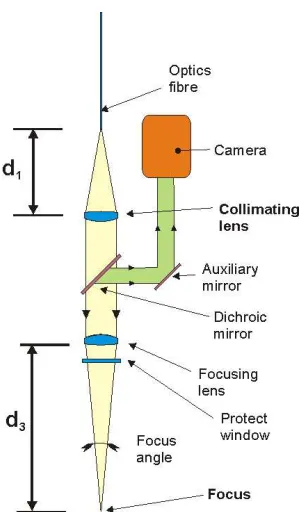
Another welding machine we employ for experiments is based on the solid-state laser (SSL) source. Due to the dif-ferent working wavelength the laser beam is delivered to the focusing optics through an optical fibre and, therefore, the design of the welding head significantly differs from the welding head employed with CO2 welding machine. The main difference is apparent from Figure 3 – there is a collimating and a focusing lens but no adaptive mirror. Therefore we need another approach in order to achieve the possibility of changing the laser beam geometry.
The design of adaptive optics for SSL is based on pos-sibility of changing the distance between the end of optical fibre and the collimating lens d1. This allows to change the divergence of the beam incident on the focusing lens and, consequently, to change the geometrical parameters of the focus located at a distance d3from the focusing lens.
Fig. 3.Optical system of the solid-state laser welding machine
3 Physical model of keyhole creation
It follows from the results of previous section that the opti-cal system parameters strongly affect the geometry of laser beam incident on the work piece. In order to study the consequences for keyhole properties a physical model of keyhole creation has been evolved. This section deals with general characteristics of this model and physical phenom-ena that are involved.
The physical model of the keyhole creation is based on the following simplified notion: The laser beam with defined intensity profile and spatial shape moves with con-stant welding speed v along the work piece. The energy ra-diation of the beam hits the surface of the work piece where it is partially absorbed. Some of the absorbed intensity is dissipated into the material due to the heat conduction while the rest causes a warming-up of the material. When a small volume of the material reaches the maximum tem-perature corresponding to the boiling point, it is removed from the system. An increasing total volume of removed material leads to the creation of the keyhole body. Within the emerging keyhole the laser beam undergoes multiple reflections on its walls which in turn increases the total amount of the absorbed intensity. On the other hand, the intensity of the beam becomes attenuated due to absorption in plasma that fills the keyhole and forms a plasma plume above it. As the laser beam moves along the work piece the molten material flows horizontally from the keyhole front wall to the rear wall.
Of course, this concept of keyhole creation process is very simplified. The idea of removing the material reach-ing the boilreach-ing point was accepted as a simplest way to replace the effects of phenomena which actually makes the keyhole creation possible. Among them the flow of the molten material caused by pressure gradient or evaporation of the material are the most important. However, as indi-cated further even such a simple model can provide rele-vant information about dependence of keyhole properties
70 75 80
90 95 100 105 110
d1 [mm]
d3
[mm]
70 75 80
0.02 0.021 0.022 0.023
d1 [mm]
w0f
[mm]
Fig. 4.Dependence of final waist radiusw0fand its distance from the focusing lens d3on distance between the end of optical fiber and the collimating lens d1
on the shape of laser beam incident on the work piece. In the following text we will give a brief mathematical de-scription of particular phenomena involved in the model.
The laser beam incident on the work piece will be as-sumed to have a Gaussian intensity profile given by
I(r,z)=I0
w0f
w(z)
!2
exp − 2r
2
w2(z)
!
. (4)
The value I0 = 2P/πw20f, where P is total power of the beam andw0f is a waist radius calculated in the previous section. The functionw(z) that describes the beam radius along its axis of propagation is given by
w(z)=w0f
s
1+ z−z0 zr
!2
, (5)
where z0is now a waist position with respect to the surface of welded material.
The absorptivity of the welded material can be calcu-lated as 1−R, where R is reflectivity of the molten material described by the Fresnel angle dependent model [14]
R=1 2
1+(1−εcosθ)2 1+(1+εcosθ)2 +
ε2−2εcosθ+2 cos2θ
ε2+2εcosθ+2 cos2θ !
.
(6) Hereθis an angle between incident ray and surface normal, the quantityεdepends on laser type and material proper-ties. We will accept a value 0.08 widely used for combina-tion of CO2laser and steel work piece [14].
The absorbed intensity represents a heat source term Q(r,t) in time-dependent heat equation
ρc∂T (r,t)
∂t =Λ∇
2T (r,t)+Q(r,t) (7)
that determines the distribution of temperature T (r,t) in the material. Here all the parameters, i.e. densityρ, heat capacity c and heat conductivityΛare assumed to be con-stant.
The multiple reflections of laser beam inside the key-hole will be considered within the frame of geometrical optics – the beam is represented by a finite set of rays. The reflection of a ray incident at the keyhole wall of surface normal vectornis given by the relation
k=i+2(−i·n)n, (8)
Attenuation of laser beam intensity in plasma due to the inverse Bremsstrahlung is driven by Beer-Lambert’s law
I(z)=I(0) exp(−αiBz), (9) where I(0) is incident intensity, I(z) is intensity transmitted after propagation along the distance z andαiBis a plasma absorption coefficient.
One of the important keyhole characteristic, we are also interested in, is the surface temperature Ts of the keyhole walls. This temperature depends especially on the amount of absorbed intensity Iabs and heat of evaporation of the welded material Lv. It can be calculated from the follow-ing two equations [15] bindfollow-ing the surface temperature and speed of evaporation frontvs
Iabs=vsρ(Lv+cTs), (10)
vs=v0exp −
MLv kBTs !
, (11)
wherev0is a constant corresponding to the speed of sound in the welded material, M is its atomic mass and kBis the Boltzmann constant.
4 Numeric simulation
The aim of the numeric simulation is to estimate the ge-ometry of the keyhole and the surface temperature and ab-sorbed intensity distribution on its walls on the basis of known (or estimated) parameters of the incident laser beam (geometry of beam waist and its position to material sur-face), the work piece material and the physical phenomena that take part in the process of the keyhole creation.
The simulation is limited to two dimensions and deals with a longitudinal cross-section of the welded material, i.e. the plane given by the axis of the incident laser beam and the axis of the beam movement over the work piece surface. The material cross-section plane is modelled as a discrete mesh, i.e. a 2D matrix representing discrete in-finitesimal areas of the material. The laser beam is consid-ered to have ideal Gaussian distribution of intensity. The plasma that fills the keyhole and that creates the plume above it is described by a plasma absorption coefficient which is assumed to be constant. Regarding the temporal scale discrete time steps are used to evaluate the course of events within the material.
The simulation starts with intact work piece heated up to the ambient temperature and it is run until the keyhole depth is stabilized at a constant value. Then the results of simulation performed for different parameters are easily cross-comparable.
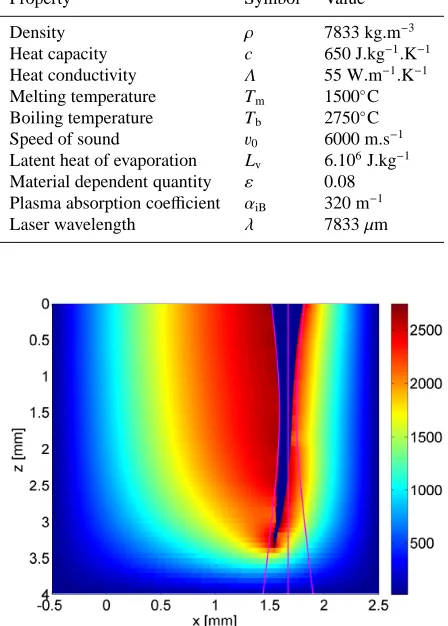
The simulations were performed for mild carbon steel, beam power 2 kW, welding speed 1 m/min and the focus-ing optics of the CO2laser welding machine. The common set of material parameters used for calculations is given in Table 1. A typical output of the numeric simulation is shown in Figure 5 – the longitudinal cross-section of the welded material with a keyhole body created and temper-ature distribution. The picture indicates that the layer of molten material surrounding the front wall of the keyhole is very thin. The relative motion of laser beam with respect to the work piece causes a difference between shape of the rear and the front wall of the keyhole.
Table 1.Physical properties of mild steel, plasma vapours and laser beam used in numeric simulation.
Property Symbol Value
Density ρ 7833 kg.m−3
Heat capacity c 650 J.kg−1.K−1
Heat conductivity Λ 55 W.m−1.K−1
Melting temperature Tm 1500◦C
Boiling temperature Tb 2750◦C
Speed of sound v0 6000 m.s−1
Latent heat of evaporation Lv 6.106J.kg−1
Material dependent quantity ε 0.08
Plasma absorption coefficient αiB 320 m−1
Laser wavelength λ 7833µm
Fig. 5.Result of simulation – shape of key hole with tempera-ture distribution (◦C) within the material around the keyhole. The
laser beam indicated by its edges and axis moves to the right
The first set of results reveals a dependence of key-hole depth on waist position of the beam for different focal length of the converging lens (while the curvature of adap-tive mirror is constant). The relaadap-tive position of the beam waist and work piece surface was changed by vertical ad-justment of the lens position. The range of waist position was from 5 millimeters below the surface up to 2 millime-ters above it. For the focal length of the lens the values of 5.0” and 7.5” were chosen. The results of performed sim-ulations are shown in Figure 6a). We see that the choice of waist position strongly affects the depth of the keyhole. For given focal length of the lens the dependence has a single maximum around which it is not symmetrical. The difference between the curves corresponding to different focal lengths lies in their maximum value and slope. The smaller focal length causes the greater maximum depth of penetration but the decrease from the maximum value is much faster.
−2 −1 0 1 2 3 4 5 1
1.5 2 2.5 3 3.5 4
Focus position z 0 [mm]
Keyhole depth d [mm]
f = 5.0" f = 7.5" a)
−2 −1 0 1 2 3 4 5
1.8 2 2.2 2.4 2.6 2.8 3 3.2 3.4 3.6
Focus position z 0 [mm]
Keyhole depth d [mm]
Variable vertical position of the focusing lens Variable curvature of the adaptive mirror b)
Fig. 6.a) Calculated keyhole depth d depending on focus position z0 for different focal lengths f and constant curvature of adaptive mirror. b) Comparison of the keyhole depth achieved for variable vertical position of the converging lens and variable curvature of the adaptive mirror
0 0.5 1 1.5 2 2.5 3 3.5 4 4.5 5
0 0.07 0.14
1/ρ
m
[m
−1
]
0 0.5 1 1.5 2 2.5 3 3.5 4 4.5 5
0 1
Signal [a.u.]
z [mm]
0 0.5 1 1.5 2 2.5 3 3.5 4 4.5 5
0
5
10
Time [s]
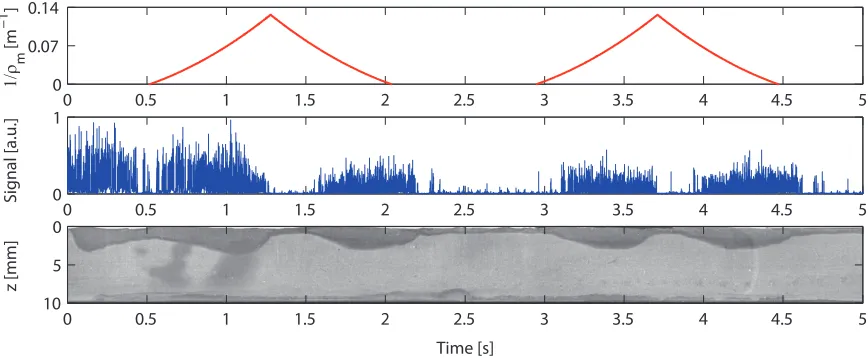
Fig. 7.Welding experiment with variable curvature of the adaptive mirror 1/ρm
5 Experimental verification
To verify the results discussed above we have performed an extensive set of experiments with CO2 laser welding ma-chine. As an example, we show on Figure 7 the evaluation of testing weld performed for the same material and weld-ing parameters which were used in the numeric simulation, i.e. mild carbon steel, laser beam power 2 kW and welding speed 1 m/min, the focal length of the converging lens was
f =7.5”.
The curvature of the adaptive mirror was changed along the welded distance in the range from minimum to maxi-mum possible value (these can be found in Figure 2). Si-multaneously, the welding process was monitored by photo detector sensitive on radiation emitted by plasma plume.
It is obvious from Figure 7 that the value of mirror cur-vature has significant impact on the weld depth. In parts of minimal weld depth the keyhole was not even created because the energy density incident on the surface of work piece was too low. These parts of shallow penetration cor-respond to dramatic fall in the course of signal coming from the photo detector. The evaluation of the relation be-tween the keyhole depth and focusing parameters allowed
us to conclude, that the theoretical and experimental results are in good agreement. This means that the adaptive optics is well applicable for the control of laser welding process.
6 Conclusion
Acknowledgements
This work was supported by the Ministry of Industry and Trade of the Czech Republic, project number 2A-3TP1/113 and was partially supported by European Commission and Ministry of Education, Youth, and Sports of the Czech Re-public (project No. CZ.1.05/2.1.00/01.0017).
References
1. C.Y. Ho, M.Y. Wen, J. Mater. Process. Tech.145, 303-310 (2003)
2. X. Jin, L. Li, Y. Zhang, J. Phys. D Appl. Phys.35, 2304-2310 (2002)
3. X. Jin, P. Berger, T. Graf, J. Phys. D Appl. Phys.39, 4703-4712 (2006)
4. X. Jin, P. Berger, T. Graf, J. Phys. D Appl. Phys.30, 3216-3222, (1997)
5. J. Dowden, P. Kapadia, J. Phys. D Appl. Phys.28, 2252-2261 (1995)
6. M.R. Frewin, D.A. Scott, Weld. J.,78, 15-22 (1999) 7. A. Kaplan, J. Phys. D Appl. Phys.27, 1805-1814 (1994) 8. J.H. Cho, S.J. Na, J. Phys. D Appl. Phys.39, 5372-5378
(2006)
9. H. Ki, P.S. Mohanty, J. Mazumder, J. Phys. D Appl. Phys.34, 364-372 (2001)
10. H. Ki, P.S. Mohanty, J. Mazumder, Metall. Mater. Trans. A33A, 1817-1830 (2002)
11. H. Ki, P.S. Mohanty, J. Mazumder, Metall. Mater. Trans. A33A, 1831-1842 (2002)
12. A. Otto, Phys. Proc.12, 11-22 (2011)
13. O. Svelto (2009) Principles of Lasers, (Springer, 2009).
14. W. Schulz, G. Simon, H.M. Urbassek, I. Decker, J. Phys. D Appl. Phys.20, 481-488 (1987)