IJEDR1802056
International Journal of Engineering Development and Research (
www.ijedr.org
)
314
Improving Problem Solving Skills of Third Year
Mathematics Students Taking The Course
Numerical Analysis II (Math3152); in Case of
Adigrat University
1Haftom Gebremariam Mhretu, 2Meresa Kebede Weldesemaet Lecturer and Researcher
1Department of Mathematics, College of Natural and Computational Science, Adigrat University, Adigrat, Ethiopia
____________________________________________________________________________________________
Abstract - This study wanted to investigate the poor performance of solving problem skills and to establish the strategies that can be adopted to improve performance in solving problems in Mathematics by third year Mathematics students in case of Adigrat University, Ethiopia. The data were analyzed using quantitative content analysis for target population was 37 respondents which comprised of 3 male and 34 female third year mathematics students. The data for the research was collected by use of questionnaires, interviews and observation. Hence, factors contributing to poor performance in solving problem skills include inadequate learning materials, lack of motivation and poor attitudes by both teachers and students. The findings of this study will give mathematics curriculum developers new insights into emerging issues on performance and influence the Ministry of Education on policy formulation. However, students are also expected to benefit from the findings; because improved mathematics performance will give them opportunities to pursue science related courses in higher institutions of learning. Three major challenges limited the use of problem solving and investigations: curriculum, student-related, and teacher-related issues. The strategies suggested by the students on how to improve achievement in mathematics were grouped into five areas, which comprised of staffing, teaching and learning materials, curriculum, motivation and attitudes, and fees and levies.
Keywords - Problem Solving Skills, Numerical Analysis II, Investigations, Mathematics, Curriculum
____________________________________________________________________________________________
I.INTRODUCTION
Background of the Study
There is a complex relationship between teaching, learning and curriculum. Specifically, the students’ learning is affected by the teaching of curriculum. Hence the curriculum plays a major contribution in the teaching methods and direction. The teaching methods and direction are under teachers’ control. Nevertheless, the question is “how can a teacher encourage the students” potential in relation to solving mathematical problems? Dealing with the encouragement, interactions between teachers and students are the concerns. The classroom interaction is not only between the teacher and the students, but also between the students and learning contents. Moreover, in the nature of learning which involves reflection of human actions, the human interaction could involve some purposive activities. The activity could generate some logical arguments [1].
Mathematical thinking will support science, technology, economic life and development in an economy. Increasingly, governments are recognizing that economic well-being in a country is underpinned by strong levels of what has come to be called ‘mathematical literacy’ according to a report by Program for international student assessment(PISA) in the population [2].
The contributions of mathematics to modern life extend beyond its partnerships with the other sciences and engineering. Over the last several decades it has become clear that a mathematically-educated population is a key to economic development [3]. Effectively solving a mathematical word problem is assumed to depend not only on students’ ability to perform the required mathematical operations, but also on the extent to which they are able to accurately understand the text of the word problem [4-7].
Being able to use mathematical thinking in solving problems is one of the most fundamental goals of teaching mathematics, but it is also one of its most elusive (difficult to find, describe) goals. It is an ultimate goal of teaching that students will be able to conduct mathematical investigations by themselves, and that they will be able to identify where the mathematics they have learned is applicable in real world situations. A report by Paul Halmos reveals that problem solving is “the heart of mathematics”. However, even as teachers around the world have considerable successes with achieving this goal, especially with more able students, there is always a great need for improvement, so that more students get a deeper appreciation of what it means to think mathematically and to use mathematics to help in their daily and working lives [8].
IJEDR1802056
International Journal of Engineering Development and Research (
www.ijedr.org
)
315
the solution have been provided. An important aspect of problem solving is recording the steps towards devising a solution strategy [9, 10].Another report reveals that a four step process for Problem solving in Mathematics involves getting a problem, understanding it by identifying which quantity the problem is asking one to find or solve; then devising a plan by identifying which skills and techniques one has that can be applied to solve the problem; then carry out the plan; and after getting a solution, looking back to see if the answer one gave, seems reasonable [11].
A research by Burns says “A problem-solving curriculum, however, requires a different role from the teacher. Rather than directing a lesson, the teacher needs to provide time for students to grapple with problems, search for strategies and solutions on their own, and learn to evaluate their own results. Although the teacher needs to be very much present, the primary focus in the class needs to be on the students’ thinking processes [12].
In Ethiopia, many studies revealed that only few students choose to join Department of Mathematics in all Governmental universities compared to other Departments. For example, at Adigrat University students’ enrolment figures showed a low students’ interest to join to the Department of Mathematics because most students believe that mathematics is the most difficult field of study. This can also well confirmed by the long years’ experience and observation of the researchers in teaching Numerical analysis II at Samara and Adigrat Universities. Due to this an action research were conducted on third year Mathematics students to assess their interest, attitude and skill in solving problems in Numerical Analysis II Classes and to enhance their low level of interest, attitude and problem solving skills in the course; in the case of third year Mathematics students at Adigrat University.
II.OBJECTIVESOFTHESTUDY
General objective of the study
The main objective of this study was to improve problem solving skills of third year mathematics students in Numerical Analysis II by finding out and minimizing the existing factors that affect the students’ low level of problem solving skills; in case of Adigrat University.
Specific objectives the study
The specific objectives of this study were:
‒ To assess students problem solving skills in Numerical Analysis II
‒ To examine students’ participation in solving Numerical Analysis problems
‒ To investigate the factors that affect participation of students in solving Numerical Analysis II problem classes ‒ To improve students problem solving skills in the course Numerical Analysis II
III.LIMITATIONOFTHESTUDY
For more relevant and reliable results, it would have been better if it had included representatives of all students at Adigrat University enrolled in Department of Mathematics, but due to shortage of time, budget, over burdens of the researchers in other regular teaching activities and limited resources the study was limited to third year mathematics students.
IV.SIGNIFICANCEOFTHESTUDY
Under taking such kind of research has a great importance and contribution for the University community, and also other responsible body. The result of the study could help Mathematics instructors to identify the challenges of problem solving skills of their students capacity and may initiate them to give due attention to design new methods that help students observe, examine and improve their problem solving skills in Numerical Analysis II. Moreover, it is hoped that it can initiate others to do more and detailed research on this area.
V.RESEARCHMETHODOLOGY
Population of the Study
The target population of this study was third year Mathematics students in case of Adigrat University, Ethiopia. Totally 37 respondents were involved in the final analysis. The respondents were totally taken from the Department of mathematics for it is near to the researchers and due to the prevalence of the problem.
Data collection instruments
As the purpose of the study was to improve problem solving skills in Numerical Analysis II classes of the third year mathematics students at Adigrat University and to take an immediate corrective action, primary data was collected by the researchers using data collection instruments such as questionnaires, interview and observation.
Data Analysis and presentation Data Analysis
In the present study, the study data collected through interviews, questionnaires and observation was analyzed using descriptive statistics such as frequency distribution and percentages. In this analysis descriptive statistics frequency was calculated and tabulated.
Data Presentation
IJEDR1802056
International Journal of Engineering Development and Research (
www.ijedr.org
)
316
VI.RESULTANDDISCUSSIONS
This section of the study deals with the analysis and interpretation of the data gathered from study targeted population using interview, questionnaires and observation in the selected third year mathematics classes at Adigrat University. In this part, the most important findings from the study were discussed.
According to table 1, out of the total students, 34 (91.89%) of the respondents were female students and 3 (8.11%) of them were males.
Table 1: Student’s gender
Item description Response № of respondents Percentage
Sex Male 3 16.22
Female 31 83.78
Total 37 100
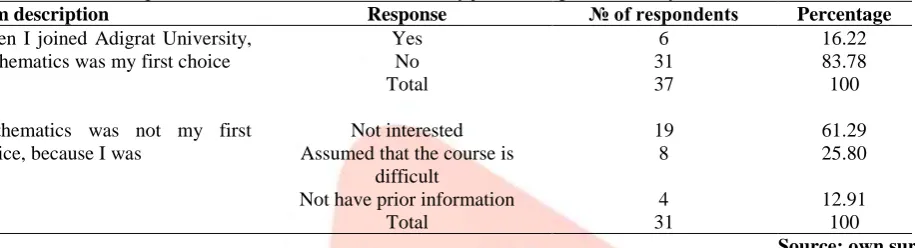
Source: own survey 2018 From Table 2, it can be seen that mathematics was not their first choice when most (83.78%) of the students joined to the department at Adigrat University. This is because majority of them (61.29%) were not interested and 25.80% were assumed that mathematics is the most difficult field of study. And about 12.91% of the students answered that, they had no information about mathematics before they join to the Department of Mathematics.
Table 2: students’ response on mathematics choice when they joined Adigrat University
Item description Response № of respondents Percentage
When I joined Adigrat University, mathematics was my first choice
Yes 6 16.22
No 31 83.78
Total 37 100
Mathematics was not my first choice, because I was
Not interested 19 61.29
Assumed that the course is difficult
8 25.80
Not have prior information 4 12.91
Total 31 100
Source: own survey 2018 As shown in Table3 below, most (86.49%) of the students believe that they were not actively participating in Numerical Analysis II Classes. Moreover, 89.19% of the students do not believe that learners have positive attitude towards Numerical analysis II classes.
Table 3: students’ interest and participation towards Numerical analysis II
Item description Response № of respondents Percentage
Do you believe that you have positive attitude towards Numerical analysis II classes?
Yes 5 13.51
No 32 86.49
Total 37 100
In Numerical analysis II classes, all students are actively participating
Agree 0 0
Not Sure 4 10.81
Disagree 33 89.19
Total
Source: own survey 2018 As indicated in Table 4 only 18.91% of the respondents answered that the time allocated for each Numerical Analysis II syllabus is proportional, where as 27.03% responded that they do not have information about syllabus but majority of the students strongly disagree the proportionality.
Table 4: Numerical Analysis II versus time allocation
Item description Choice № of respondents Percentage
The time allocated with the content covered in Numerical Analysis II syllabus is proportional
Agree 7 18.91
Not Sure 10 27.03
Disagree 20 54.06
Total 37 100
Source: own survey 2018
Table 5 shows that the level of problem solving skills in Numerical analysis II was almost low (81%) except the rest of respondent (18.92) have a medium skills in solving problems in Numerical analysis II classes.
IJEDR1802056
International Journal of Engineering Development and Research (
www.ijedr.org
)
317
Item Choice № of respondents Percentage
How is your extent of problem solving skill in Numerical analysis II?
High 0 0
Medium 7 18.92
Low 30 81.08
Total 37 100
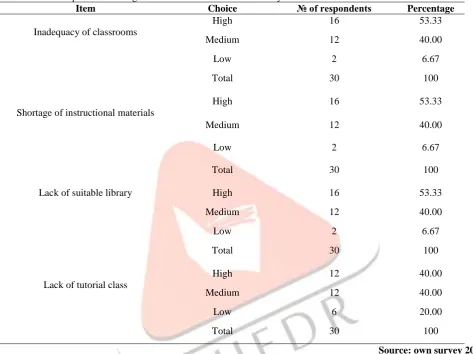
Source: own survey 2018 From table 6, among the different factors which may contribute for the low problem solving skill of students, the primary ones are inadequacy of classrooms (53.33%), shortage of instructional materials (53.33%), and lack of suitable library (53.33%). Moreover, lack of reference books and lack of regularly arranged tutorial classes have their own effect.
Table 6: Factors to low problem solving skill of students in Numerical analysis II
Item Choice № of respondents Percentage
Inadequacy of classrooms
High 16 53.33
Medium 12 40.00
Low 2 6.67
Total 30 100
Shortage of instructional materials
High 16 53.33
Medium 12 40.00
Low 2 6.67
Total 30 100
Lack of suitable library High 16 53.33
Medium 12 40.00
Low 2 6.67
Total 30 100
Lack of tutorial class
High 12 40.00
Medium 12 40.00
Low 6 20.00
Total 30 100
Source: own survey 2018 By table 7, all the selected students responded the instructor has key impacts on learners’ teaching learning process
Table 7: How much your Numerical analysis II teacher affect the teaching-learning process
Item Response № of respondents Percentage
Do you think that your Numerical analysis II teacher have an actual impact in the teaching-learning process?
Yes 37 100
No 0 0
Total 37 100
Source: own survey 2018 As shown in table 8, out of the selected students 64.86% of the students responded that the influence of Numerical analysis II teacher at Adigrat University to develop problem solving skills were low.
Table8: Influence of Numerical analysis II teacher to develop problem solving skills
Item Response № of respondents Percentage
How effective is your teacher in influencing you to develop problem solving skills?
High 3 8.11
Medium 10 27.03
Low 24 64.86
Total 37 100
IJEDR1802056
International Journal of Engineering Development and Research (
www.ijedr.org
)
318
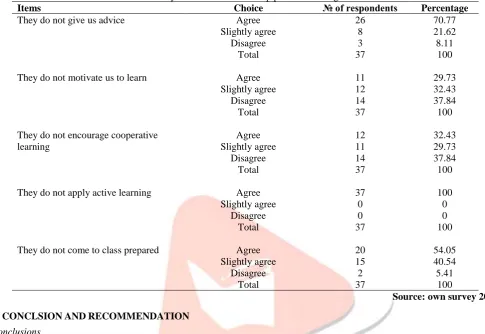
Table 9: Low contribution of Numerical analysis II teacher to develop problem solving skillsItems Choice № of respondents Percentage
They do not give us advice Agree 26 70.77
Slightly agree 8 21.62
Disagree 3 8.11
Total 37 100
They do not motivate us to learn Agree 11 29.73
Slightly agree 12 32.43
Disagree 14 37.84
Total 37 100
They do not encourage cooperative learning
Agree 12 32.43
Slightly agree 11 29.73
Disagree 14 37.84
Total 37 100
They do not apply active learning Agree 37 100
Slightly agree 0 0
Disagree 0 0
Total 37 100
They do not come to class prepared Agree 20 54.05
Slightly agree 15 40.54
Disagree 2 5.41
Total 37 100
Source: own survey 2018
VII.CONCLSIONANDRECOMMENDATION
Conclusions
This action taken has the opportunity to engage in mathematical problem solving and to develop problem solving skills techniques through reflecting on a set of heuristics (the study of how people use their experience to find answers to questions or to improve performance). We will work both individually and in groups on mathematical problems, drawing out the strategies we used and applying them to the next
Generally, we conclude that problem-solving should focus on problems that stimulate students’ imaginations that appeal to their interest, that accord with their knowledge and skills. As well as exercising careful judgment in the selection of problems, the teacher’s most important role is to offer just the right amount of support and encouragement, ensuring that a solution is within a student’s grasp but not too easily discovered.
Finally, we say that please record your steps and ideas even if they do not lead you to a successful solution, since this might serve as a venue to trace, modify, and possibly reformulate them.
RECOMMENDATION
‒ Mathematics Instructors should motivate and support their students how to develop problems solving skills. ‒ Tutorial classes should be arranged in order to increase participation of female students.
‒ Mathematics curriculum developers should review mathematics syllabus and the time allocation. ‒ Encourage students to do and present their work in class, giving enough time to exercise all students.
VIII.ACKNOWLEDGMENT
The authors are thankful to Year III Mathematics students of Adigrat University for their willingness on carrying out this study.
IX.REFERENCE
[1] Lucas, G. R. (1983). The genesis of modern process thought: A historical outline with bibliography. Metuchen, NJ: The Scarecrow Press, Inc. and the American Theological Library` Association.
[2] PISA (Programme for International, Student Assessment) (2006) Assessing Scientific, Reading and Mathematical Literacy. A framework for PISA 2006. Paris: OECD Robert Solow, p. 65 – 94, 1956.
[3] Robert, M Solow. A contribution to the theory of Economic Growth, Quarterly Journal of Economics (MIT Press), 70(1): pp. 65-94, 1956.
IJEDR1802056
International Journal of Engineering Development and Research (
www.ijedr.org
)
319
[5] Hegarty M., Mayer R. E., Monk C. A. (1995). Comprehension of arithmetic word problems: a comparison of successfuland unsuccessful problem solvers. J. Educ. Psychol. 87 18–32. 10.1037/0022-0663.87.1.18.
[6] Van der Schoot M., Bakker Arkema A. H., Horsley T. M., Van Lieshout E. D. C. M. (2009). The consistency effect depends on markedness in less successful but not successful problem solvers: an eye movement study in primary school children. Contemp. Educ. Psychol. 34 58–66. 10.1016/j.cedpsych.2008.07.002.
[7] Jitendra A. H., Star J. R. (2012). An exploratory study contrasting high– and low achieving students’ percent word problem solving. Learn. Individ. Differ. 22 151–158. 10.1016/j.lindif.2011.11.003
[8] Halmos, P. R. (1980). The heart of mathematics. American Mathematical Monthly, 87(7), 519-524.
[9] Szetela, W., &Nicol, C. (1992). Evaluating problem solving in mathematics. Educational Leadership, 49(8), 42-45. [10] Schoenfeld, A. H. (1989). Explorations of Students’ Mathematical Beliefs and Behavior. Journal for Research in
Mathematics Education, 20(4), 338-355
[11] Polya, G. (1988) How to solve it: a new aspect of mathematical method (2nd Ed.). Princeton, New Jersey: Princeton University Press.
IJEDR1802056
International Journal of Engineering Development and Research (
www.ijedr.org
)
320
Adigrat University
College of Computational and Natural Sciences Department of Mathematics
A questionnaire to be filled by third Year Mathematics Students
Title: Improving problem solving skills of Year III mathematics students taking the course Numerical Analysis II
The purpose of this questionnaire is to collect information about the current status of the problem solving skills of Year III mathematics students taking the course numerical analysis II, in case of Adigrat University. The information gathered through this questionnaire will be used only for Action research purpose and it is assured that your response will be held in strict confidentiality. Therefore, you are kindly requested to fill in the questionnaire frankly and responsibly for it is the chief determinant to the success of the study. The researchers express their thanks to you in eagerness that you would spend extra time and energy to complete this questionnaire.
For each of the statements (questions) below, indicate your response from the given alternatives for each item by putting tick [√] or encircling the appropriate answer and for open-ended questions write your answer on the space provided.
I) Student’s gender
Sex : A. Male B. Female
II) Students’ interest and attitude towards mathematics
1. When you joined to Adigrat University, was mathematics your first choice?
A. Yes B. No
2. If your response to question №.1 is “B”, why?
A. Not interested in mathematics B. No prior information about mathematics
C. The course is difficult D. Others
3. In Numerical Analysis II class all students are actively participating: A. Agree B. Not Sure C. Disagree
4. Do you believe that you have positive attitude towards Numerical Analysis II classes?
A. Yes B. No
5. The time allocated with the content covered in Numerical Analysis II syllabus is proportional A. Agree B. Not Sure C. Disagree
6. How is your extent of problem solving skill in Numerical Analysis II?
A. High B. Medium C. Low
7. If your response to question №. 6 is “C”, judge the extent to which the following factors contribute to it.
Response High Medium Low
Inadequacy of classrooms ________ _______ ______
Shortage of instructional materials ________ _______ ______
Lack of suitable library ________ _______ ______
Lack of tutorial class ________ _______ ______
If there are other factors, please list them out:
_____________________________________________________________________________________________________ _______________________________________________________
III) Teacher factors on students low participation in solving problems Numerical Analysis II
8. Do you think that your teacher of Numerical Analysis II has an actual impact in teaching-learning process?
A. Yes B. No
9. If your response in question №. 8 is “A”, please list down the detailed reasons:
_____________________________________________________________________________________________________ _______________________________________________________
10. How effective is your teacher in influencing you to develop problem solving skills?
A. High B. Medium C. Low
11. If your response to question 10 is “C”, rate the contribution of the following cases:
Response Agree Slightly Agree Disagree
They do not give us counseling _______ _______ _______
They do not motivate us to learn _______ _______ _______
They do not encourage cooperative learning _______ _______ _______
They do not apply active learning _______ _______ _______
If any, specify:
_____________________________________________________________________________________________________ _______________________________________________________