http://www.sciencepublishinggroup.com/j/ajme doi: 10.11648/j.XXXX.2017XXXX.XX
ISSN: 2575-3908 (Print); ISSN: 2575-3797 (Online)
Experimental Determination of Effect of Total Solid (TS)
and Volatile Solid (VS) on Biogas Yield
Ejiroghene Kelly Orhorhoro
*, Patrick Okechukwu Ebunilo, Godwin Ejuvwedia Sadjere
Department of Mechanical Engineering, University of Benin, Benin City, Nigeria
Email address:
[email protected] (E. K. Orhorhoro), [email protected] (E. K. Orhorhoro), [email protected] (P. O. Ebunilo), [email protected] (G. E. Sadjere)
*Corresponding author
To cite this article:
Ejiroghene Kelly Orhorhoro, Patrick Okechukwu Ebunilo, Godwin Ejuvwedia Sadjere. Experimental Determination of Effect of Total Solid (TS) and Volatile Solid (VS) on Biogas Yield. American Journal of Modern Energy. Vol. 3, No. 6, 2017, pp. 131-135.
doi: 10.11648/j.ajme.20170306.13
Received: October 16, 2017; Accepted: November 3, 2017; Published: November 25, 2017
Abstract:
In this research work, eight different samples of substrates with varying percentage total solid (TS) and volatile solid (VS) were used. The samples which comprises mainly of water hyacinth, waste water (i.e., from ice fish cold room, septic tanks, and abattoir), pig dung, cow dung, corn cobs, potato peels, pineapple peels, rice left over, yam peels, cassava peels, orange peels, sweet potato peels, garri left over, plantain peels, beans waste, banana peels and vegetables, etc., were co-digested. In each of the samples, 10kg of substrates were used and the experiment was conducted within mesophilic temperature range of 36°C-37°C, pH range of 6.9-7.4 and hydraulic retention time (HRT) of thirty-three (33) days. It was observed that the quantity of biogas yield from these substrates increase with increasing percentage volatile solid and decrease with decreasing percentage volatile solid concentration below and above the optimum value of 91.1% (2.88kg) volatile solids which gave the maximum amount of biogas yield for the samples of substrates to be 1.01kg (23.6%), 2.01kg (60.75%), 2.55kg (84.72%), 2.41kg (68.0%), 2.35kg (67.67%), 1.85kg (59.23%), 1.45kg (25.39%). Furthermore, the results obtained reveal that bio-digesters should be run at 10.16% total solids, since optimum cumulative biogas generation is achieved at this %TS concentration.Keywords:
Total Solid (TS), Volatile Solid (VS), Substrates, Mesophilic Temperature, pH Range, Cumulative Biogas Yield1. Introduction
Anaerobic digestion (AD) process also referred to as the biogas process has been widely utilized by the modern society for stabilizing sludge in municipal wastewater treatment plants [1, 2]. The AD process is applied as an alternative method for the treatment of animal manure, organic waste from households, urban areas and industries, often associated with energy recovery and the recycling of the nutrients from digested biomass to the agricultural sector [3, 4, 5]. The process is indigenous to natural anaerobic ecosystems and represents the microbiological conversion of organic matter to methane in the absence of oxygen. The digested organic matter resulting from the anaerobic digestion process is usually called digestate [6, 7].
The rate of biogas yield and efficiency of the anaerobic digestion process is controlled by the type of substrates being digested, total solid (TS) and volatile solid concentration (VS), temperature (T), the presence of toxic materials, pH, hydraulic retention time (HRT), solids retention time (SRT), etc. [17, 18]. Water content is a vital parameter that affects AD of solid wastes and this is as a result of;
i. Water make possible the movement and growth of bacteria facilitating the dissolution and transport of nutrient and
ii. Water reduces the restriction of mass transfer of particulate substrate.
Total solids (TS) and volatile solids (VS) concentrations of the require substrates provide useful information about biogas yield that can be expected and as well as the process efficiency. Furthermore, mechanical components of AD plant such as pumps and stirrers can only safely process charged substrates with a certain TS concentration. TS is use to describes dry matters of a substrate and it is expressed as the percentage of the total weight in grams per kilogram [19, 20]. To know the TS of organic matters, the amount of substrate is weighed and dried at 105°C until its water content is zero. The weight after drying is divided by the original weight. Paramagurua, et al. [21] reported a drop in biogas production with a continuous increase of TS values, with an optimum biogas production at a TS value of 10%. Other researchers such as Tsunatu, et al. [22] and Budiyono, et al. [23] pointed in same direction. They reported TS of 9% and 9.2% for optimum biogas yield respectively. Tsunatu, et al. [22], concluded that increased in TS value brings about drop in water volume which consequently reduce the level of microbial activity, thus, drop in biogas yield.
Volatile solid (VS) concentration is defined as the organic fraction of TS and is commonly measured as a percentage of TS in grams per kilogram. To isolate the inorganic from the organic fraction of the TS, the already dried substrate is burned in a muffle furnace at 600°C. The residue after incineration is the inorganic fraction. The weight of the dried substrate minus the weight of the inorganic fraction is then divided by the weight of the dried substrate in order to get the VS concentration [20]. VS concentration can be used to assess AD system efficiency. Not only can the biogas potential of a substrate be estimated based on it VS content, but also the degree of degradation can be achieved [22].
2. Materials and Method
2.1. Materials Used
In this research work, eight different samples of substrates with varying percentage total solid (TS) and volatile solid (VS) were used. The samples which comprises mainly of water hyacinth, waste water (i.e., from ice fish cold room, septic tanks, and abattoir), pig dung, cow dung, corn cobs, potato peels, pineapple peels, rice left over, yam peels, cassava peels, orange peels, sweet potato peels, garri left
over, plantain peels, beans waste, and banana peels, vegetables, etc., were co-digested separately. In each of the samples, 10kg of substrates were used and the experiment was conducted within mesophilic temperature range of 36°C-37°C, pH range of 6.9-7.4 and hydraulic retention time of thirty-three (33) days. Other materials used in this research work include:
i. Crucible
ii. Laboratory oven iii. Desiccator
iv. Electronic precision balance v. Dish tongs
vi. Magnetic stirrer vii. Wash bottles vii. Muffle furnace
2.2. Determination of Total Solid (TS)
The amount of total solid was determined at Energy Research Centre, University of Benin, Nigeria (Figure 1). It is the amount of solid present in the sample after the loss of water molecules present in it. In other words, is refers to the quantity of the material residue left in the crucible after evaporation of the sample and its subsequent drying in a laboratory oven at 105°C for a period of one hour.
These were the procedures followed;
i. A crucible weighing 0.2380kg kg was properly washed and dried in the laboratory oven at a temperature of 105°C for one hour. The crucible was stored and cooled in a desiccator until needed.
ii. The crucible was re-weighed before use (0.2371kg) iii. The laboratory oven was switch on and allowed to reach a temperature of 105°C. This temperature was maintained throughout the experiment
iii. 0.550kg of the collected co-digested substrate sample was added to the crucible and diligently placed in the laboratory oven at a temperature of 105°C. The substrate sample was dried to a constant mass for a period of 1 to 2 hours.
iv. The crucible plus substrate residue were allowed to cool in a desiccator to balance temperature. Desiccators are designed to provide an environment of standard dryness. The desiccator was properly lubricated with grease and this was to prevent moisture from entering the desiccator as the test glassware cools.
v. The crucible plus substrate (material) residue was weighed using electronic precision balance.
Equation (1) was used to calculate the percentage total solids.
%TS = × 100 (1)
where,
%TS = Percentage total solid
W1 = Weight of dried crucible + dried residue
W2 = Weight of crucible
W3 = Weight of wet sample (substrate) + crucible
Figure 1. Experimental setup for determination of percentage total solid.
2.3. Determination of Volatile Solid (VS)
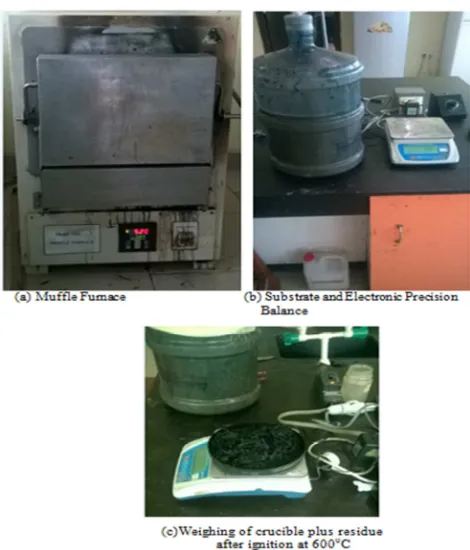
The volatile solid is the solid remaining after evaporation or filtration are dried, weighed, and ignited at 600°C. The following procedures were followed in determination of the volatile solid of the substrates used.
i. The residue obtained from total solids determination was ignited at 600°C for a duration of 30 minutes using a muffle furnace.
ii. The crucible and black mass of carbon were allowed to cool partially in air before it was transferred to the desiccator for complete cooling.
iii. The sample was weighed once temperature balance is reached.
The percentage volatile solid was calculated using Equation (2).
%VS 100 (2)
where,
%VS= Percentage Volatile solid
W4 = Weight of crucible + weight of residue after ignition
Figure 2 shows the experimental setup for determination of percentage total solid.
Figure 2. Experimental setup for determination of percentage volatile solid.
3. Results and Discussion
Moreover, it was as a result of decrease in amount of water, which on the other hand reduce the level of microbial activity.
Figure 3. Graph of cumulative biogas yield against percentage total solid.
Also, it was observed from the results obtain with the effect of volatile solid that, the quantity of biogas yield from these substrates increase with increasing percentage volatile
solid and decrease with decreasing percentage volatile solid concentration below and above the optimum value of 91.1% (2.88kg) volatile solids which gave the maximum amount of biogas yield for the samples of substrates to be 1.01kg (23.6%), 2.01kg (60.75%), 2.55kg (84.72%), 2.41kg (68.0%), 2.35kg (67.67%), 1.85kg (59.23%), 1.45kg (25.39%). Figure 4 shows the graph of percentage volatile solid against cumulative biogas yield.
Figure 4. Graph of percentage volatile solid against cumulative biogas yield.
Table 1. Effect of Total Solid (TS) on Biogas Yield.
Substrates Before Drying After drying at 105°C TS (kg) %TS CBY (kg) W2 (kg) W3(kg) W3-W2(kg) W1(kg) W1-W2 (kg)
Sample 1 0.2371 0.550 0.3129 0.2460 0.0089 0.0284 2.840 1.01
Sample 2 0.2371 0.550 0.3129 0.2585 0.0214 0.0684 6.840 2.01
Sample 3 0.2371 0.550 0.3129 0.2659 0.0288 0.0920 9.204 2.55
Sample 4 0.2371 0.550 0.3129 0.2689 0.0318 0.1016 10.16 2.88
Sample 5 0.2371 0.550 0.3129 0.2801 0.0430 0.1374 13.74 2.35
Sample 6 0.2371 0.550 0.3129 0.2716 0.045 0.1103 11.03 2.41
Sample 7 0.2371 0.550 0.3129 0.2913 0.0542 0.1732 17.32 1.85
Sample 8 0.2371 0.550 0.3129 0.3013 0.0642 0.2052 20.52 1.45
*W1-Weight of dried crucible and dried residue; *W3-Weight of Crucible and wet sample; *W2-Weight of Crucible, *BY-Cumulative biogas yield
Table 2. Effect of Volatile Solid (VS) on Biogas Yield.
Substrates W1(kg) W2(kg) W1-W2 (kg) W4(kg) W1-W4 (kg) VS VS (%) CBY
Sample 1 0.2460 0.2371 0.0089 0.2439 0.0021 0.2360 23.60 1.01
Sample 2 0.2585 0.2371 0.0214 0.2455 0.0130 0.6075 60.75 2.01
Sample 3 0.2659 0.2371 0.0288 0.2415 0.0244 0.8472 84.72 2.55
Sample 4 0.2689 0.2371 0.0318 0.2399 0.0290 0.9119 91.10 2.88
Sample 5 0.2716 0.2371 0.0450 0.2410 0.0306 0.6800 68.00 2.41
Sample 6 0.2801 0.2371 0.0430 0.2510 0.0291 0.6767 67.67 2.35
Sample 7 0.2913 0.2371 0.0542 0.2592 0.0321 0.5923 59.23 1.85
Sample 8 0.3013 0.2371 0.0642 0.2850 0.0163 0.2539 25.39 1.45
*W4-Weight of crucible + Weight of residue after ignition at 600°C, *VS-Volatile solid, *%VS-Percentage volatile solid, *BY-Cumulative biogas yield
4. Summary and Conclusion
The total solid (TS) and volatile solid (VS) content of substrates affects the performances of anaerobic digestion process. Change in total solids content will lead to change in microbial morphology of AD systems. Thus, in order to increase the efficiency of anaerobic digestion process, it is paramount for one to understand the role of both total solid
decrease in percentage total solid below the optimum value (10.16%). Moreover, biogas production was reduced due to increase in percentage total solid above 10.16. Also, increase in percentage volatile solid resulted to higher quantities of cumulative biogas generated. Therefore, for optimum biogas yield, percentage total solid of 10.16% is recommended.
References
[1] E. K. Orhorhoro, P. O. Ebunilo, R. I. Tamuno, I. A. Essienubong. “The Study of Anaerobic Co-Digestion of Non-Uniform Multiple Feed Stock Availability and Composition in Nigeria”, European Journal of Engineering Research and Science, Vol. 1, issue 1, 39-42, 2016.
[2] J. I. Nwankwo. “Production of Biogas from Paper Waste Blended with Cow Dung”, Journal of Environmental Science, Toxicology and Food Technology (IOSR-JESTFT) Volume 8, issue 10, 58-68, 2014.
[3] A. M. Muzaffar, H. Athar, V. Chanchal. “Design considerations and operational performance of anaerobic digester: A review”, Cogent Engineering, 3: 118169, 1-20, 2016.
[4] J. C.Motte, R. Escudié, N. Bernet, J. P. Delgenes, J. P. Steyer, C. Dumas. “Dynamic effect of total solid content, low substrate/inoculum ratio and particle size on solid-state anaerobic digestion”. Bioresour. Technol., 144, 141-148, 2013.
[5] E. K. Orhorhoro, P. O. Ebunilo, E. G. Sadjere. “Design of Bio-Waste Grinding Machine for Anaerobic Digestion (AD) System”, European Journal of Advances in Engineering and Technology, 4 (7): 560-568, 2017.
[6] O. O. Osita, U. G. Lawan, “The Optimum Mesophilic Temperature of Batch Process Biogas Production from Animal-based Wastes”, Research Journal of Applied Sciences, Engineering and Technology, 8(16),. 1772-1776, 2014. [7] E. K. Orhorhoro, O. W. Orhorhoro, P. O. Ebunilo. “Analysis
of the effect of carbon/nitrogen (C/N) ratio on the performance of biogas yields for non-uniform multiple feed stock availability and composition in Nigeria”, International Journal of Innovative Science, Engineering and Technology, Vol. 3, issue 5, 119-126, 2016.
[8] M. K. Peter, M. I. Alfa, G. Datau, K. C. Aluwong, K. C. Hadi. “Design, Development and Performance Evaluation of an Anaerobic Plant”, American Journal of Engineering Research (AJER), Vol. 6, issue 4,2320-0936, 2017.
[9] O. P. Karthikeyan, C. Visvanathan. “Bio-energy recovery from high-solid organic substrates by dry anaerobic bio-conversion processes: a review”. Rev. Env. Sci. Biotechnol., 12, 257-284, 2012.
[10] E. K. Orhorhoro, P. O. Ebunilo, A. E. Ikpe. “Effect of pH on Anaerobic Digestion (AD) of Organic Municipal Solid Waste in Benin City, Nigeria”, Journal of the Nigerian Association of Mathematical Physics. Volume 36, No.1, 369-374, 2016.
[11] W. Mussoline, G. Esposito, P. Lens, G. Garuti, A. Giordano. “Design considerations for a farm-scale biogas plant based on pilot-scale anaerobic digesters loaded with rice straw and piggery wastewater”, Biomass. Bioenerg., 46, 469-478, 2012 [12] P. O. Ebunilo, E. K. Orhorhoro, O. A. Adegbayi.
“Investigation of the purification of biogas from domestic wastes using local materials in Nigeria”, International Journal of Scientific & Engineering Research, Volume 7, Issue 2, 505-515, 2016.
[13] S. Desal, V. Palled, R. Mathad. “Performance Evaluation of Fixed Dome Type biogas plant for solid state digestion of cattle dung”. Karnataka Journal of Agricultural Science, Vol. 26, No. 1, 103-106, 2013
[14] C. M. Chima, N. O. Jude, C. O. Justina, S. A. Ekpewerechi, “Biogas potential of organic waste in Nigeria”. Journal of Urban and Environmental Engineering, Vol. 7, No. 1, 110-116, 2013.
[15] R. Chandra, H. Takeuch. “Methane production from lignocellulosic agricultural crop wastes: A review in context to second generation of biofuel production”. Renewable and Sustainable Energy Reviews, 16(3), 1462-147, 2012.
[16] P. O. Ebunilo, S. A. Aliu, E. K. Orhorhoro, “Performance Study of a Biogas Pilot Plant using Domestic Wastes from Benin Metropolis”. International Journal of Thermal & Environmental Engineering volume 10, No 2, 135-141, 2015. [17] P. O. Ebunilo, S. A. Aliu, E. K. Orhorhoro, “Comparative
Analysis of Biogas Yield from Different Composition of Domestic Wastes from Benin City, Nigeria”. Journal of Advanced &Applied Science (JAAS) Volume 04, Issue 05, 169-177, 2015.
[18] A. Alli, L. Rundong, F. Shah, R. B. Mahar, M. S. WajidIjaz, M. Muhammad. “Predictive Modeling of Biogas Production from Anaerobic Digestion of Mixed Kitchen Waste at Mesophilic Temperature”. International Journal of Waste Resources, Volume 6, Issue 3, 2-4, 2016.
[19] I. Budiyono, S. S. Syaichurrozi, “Effect of Total Solid Content to Biogas Production Rate from Vinasse”, International Journal of Engineering, Vol. 27, No. 2, 177-184, 2014. [20] N. H. S. Ray, M. K. Mohanty, R. C. Mohanty, “Anaerobic
digestion of kitchen waste: Biogas production and pretreatment waste, a review”. International Journal of Scientific and Research Publication, 3, 11-18, 2013.
[21] B. B. Sajeena, P. P. Jose, G. Madhu, “Effect of Total Solid Concentration on Anaerobic Digestion of the Organic Fraction of Municipal Solid Waste”. International Journal of Scientific and Research Publications, 3(8), 1–5, 2013.
[22] D. Y. Tsunatu, I. C. Azuaga, J. Agabison. “Evaluation of the Effect of Total Solids Concentration on Biogas Yields of Agricultural Wastes”. International Research Journal of Environment Sciences, Vol. 3(2), 70-75, 2014.