Extending insight to the Analytics of Mobile
Business Intelligence
Disha Milan Gupta
L.B.H.S.S. Trust Institute of Computer Applications (Affiliated to the University of Mumbai, India)
E-mail : [email protected]
Abstract—This paper is proposed to define the role of Business Intelligence (BI) in an organization that drives profitable business action.Consecutively, it investigates the need of Mobile business intelligence that extends desktop business intelligence (BI) appli-cations so they can be used on mobile devices.Recently, Mobile business intelligence has been a fast growing, challenging and interesting area for enterprises as it enables data that’s captured by the mobile device to be integrated on-the-fly for real time decision making.
Keywords—Business Intelligence (BI),Decision support systems (DSS),Mobile BI, Information Technology,ROI,Business analytics, Knowledge management,OLAP.
I. INTRODUCTION
In the modern corporate world,information has become the most important resource for a business enterprise.Corporations spend a substantial amount of capital to maintain enterprise systems that record, process and present data from all aspects of the organization.The integration of processes, technologies and tools needed to turn data into information and information into knowledge that enables a company or organization to gain insight into its critical operations through reporting applica-tions and analysis tools is known as Business Intelligence (BI). BI encompasses data warehousing, business analytics and knowledge management [1].The evaluation of BI is mainly monitored by Management and IT Consultants.
On the other hand, Mobile Business Intelligence applications optimizes traditional BI reports so they can be viewed easily on a mobile screen.
Mobile BI is a system comprising both technical and or-ganizational elements that present historical and/or real-time information to its users for analysis on mobile devices such as smart phones and tablets (not laptops), to enable effective decision-making and management support, for the overall purpose of increasing firm performance[2].
II. LITERATUREREVIEW OFBUSINESSINTELLIGENCE
Business intelligence as it is understood today is said to have evolved from the decision support systems (DSS) that began in the 1960s and developed throughout the mid-1980s.It allows us to use data strategically in responses to challenges and drive profitable business actions. Organizations in the 21st century use business intelligence (BI) solutions to gain a clearer picture of their internal operations, customers, supply chain, and financial performance. They also derive significant ROI by using BI to devise better tactics and plans, respond
more effectively to emergencies, and capitalize more quickly on new opportunities [1].
Business intelligence combines a broad set of data analysis applications, including ad hoc analysis and querying, enterprise reporting, online analytical processing (OLAP), mobile BI, real-time BI, operational BI, cloud and software as a service BI, open source BI, collaborative BI and location intelligence.
A. Operational Challenges faced by Business Intelligence
One of the biggest problems with traditional business intelligence tools is that they are so complicated to use that only a few key individuals within the company know how to handle them. Bottlenecks can quickly from around these key individuals, and this can slow down the whole reporting process [6].
The second biggest Business Intelligence challenge was found to be unlocking data buried in systems that means even if you have the data already in place and you know where it is this does not necessarily mean that it is easily accessible. Getting at the information you need, when you need it, can be an extremely painful process when the data is buried in complex systems and software.
III. A CHANGINGENVIRONMENT-MOBILEBUSINESS INTELLIGENCE
Analytics on the go-Mobile BI is one of the hottest and quickly evolving spaces in the software industry. The concept of Mobile Business Intelligence dates back to the early 1990s, during the initial days of mobile revolution access the globe. It helps in displaying key performance indicators (KPIs) and alerts on small screens with simple charts, graphs and spark lines.
Necessity of Mobile BI:
1) Mobility of Executives. 2) Access to Real time data.
3) Need for increased efficiency in the decision-making process.
4) Need for improved communication between multidis-ciplinary groups.
applications is typically accomplished in two ways.
1) Using a mobile-browser to access the application on the web
2) Using a native application that is designed for a specific mobile OS (such as iOS or Android).
Some of the various advantages of using Mobile BI include:
1) Make business intelligence as seamless.
2) View, and analyze on all business content using a smart phone.
3) Instantly access various business contents from any location.
A. Empirical study on newfangled Mobile BI
Mobile BI is gaining worldwide importance, the reason behind this is simple: in the rapid-fire business world of the 21st century businesses and teams rely on real-time, on-demand access to business critical information
Fig. 1: Global Mobile BI Market, By Service (Managed Ser-vices, Professional Services), By Business Function Forecast 2022
Researcher estimates the global mobile Business Intelli-gence (BI) market to grow from USD 4.08 billion in 2017 to USD 11.13 billion by 2021, at a Compound Annual Growth Rate (CAGR) of 22.2
IV. IMPLEMENTATION
A. Using a Web based mobile-browser to access BI applica-tion
The mobile browser on a smart phone is a hand held computer integrated with a mobile phone,provide a means to read simple tables of data.Web browser based access means that a normal browser is used to connect to a portal specifically set up for Mobile BI. The biggest advantage of using a web browser based approach is the portability between devices.
IBM Cognos Mobileis a Business Intelligence solution for executives and mobile workers who require wireless access to
requiring timely, personalized and secure information beyond their traditional office. Users can access and interact with reports and dashboards on their mobile device while they are offline or online. It supports standard reports, Active Reports as well as Cognos Workspace content [9]. Consumer can access the Mobile IBM Cognos portal via Web Browser using URL address like http://¡Cognos Server url¿/c10.1.1/m/
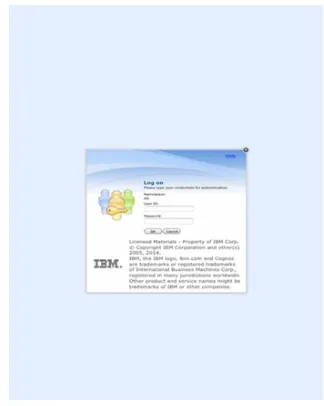
There are two user interfaces provided by Web based access which are shown below (Figure 2).
Fig. 2: IBM Cognos Portal
1) Desktop version-:It allows data to be viewed just as it would be over a browser from a personal computer (Figure 3).
tabs:
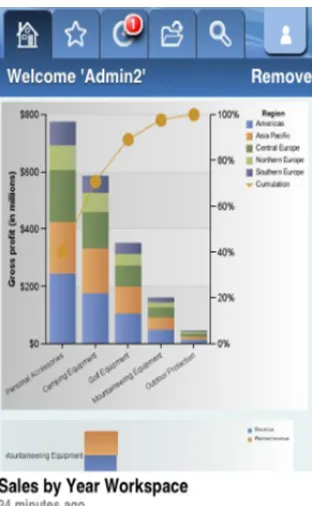
a) Welcome: in this tab, a user can add his favorite report (Figure 5).
b) Favorites: provides shortcuts to favorite re-ports
c) Recently run reports: shows a list of recently run reports
d) Get more: this will open the content store as you would see it in the normal BI environ-ment
e) Search tab: enables searching through the Content Store [8].
Fig. 4: Log on to Mobile version
B. Using Mobile Client Application
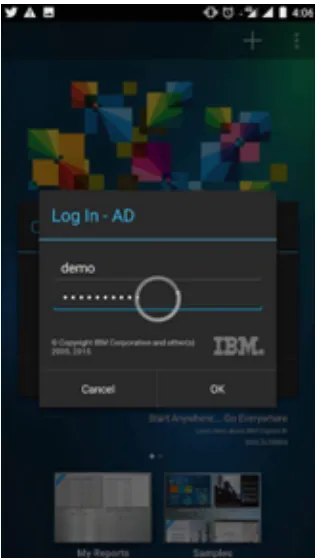
All the Reports that can be consumed in standard web browsers can also be accessed on your iOS and Android devices (Figure 6). After entering a server URL, user ID and password a connection is established.The App provides extra functionality compared to the web based browser access. The largest difference is the support for Active Reports. These reports can be stored locally on the device, for offline viewing and offer great interactivity with the user. By using tab pages, sliders and list of values, a real interactive dashboard can be used.You can run Active Reports from the BI server or import them manually into the App as MHT files. The Active Report file size grows as the volume of data and number of charts increases[8].
Figure 7,8,9 and 10 shows the interface at different in-stances.
Fig. 5: The welcome screen showing a favourite report
Fig. 7: Create a connection to your BI server using your Gateway URL
Fig. 8: Logging in to Account
Fig. 9: Sample Reports and User Reports
V. FUTUREENHANCEMENTS INMOBILEBI
1) Notification or alerts for changes in key figures. 2) Adaptive design for any device.
3) Full Mobile authoring system. 4) Secure sharing and collaboration. 5) Agile and Interactive
6) Seamless analytics across Cloud and on-premises [3].
VI. CONCLUSION
If BI is about making better decisions using the right data, Mobile BI is about making sure that everyone especially remote workers has access to that data anytime, anywhere [4].The major drawback of using smart phones for BI was that the limited screen size prevented smart phones from delivering functionality such as full-featured dashboards or interactive reports. But despite these limitations, smart phone-accessed BI gave road warriors a taste of BI on the go and they liked it.
With various innovative Mobile BI applications available today such as IBM Cognos Analytics, SAS Crystal Reports, Microsoft SharePoint, Style Intelligence that allows real time analysis capabilities on the mobile device and transforming it fully dynamic, organizations are having a better opportunity to explore this new arena without trouble. Moreover, employees use mobile applications more frequently than the old age desktop based applications.
In additions,it is one of the critical aspects to line up mobile strategy with BI strategy for a flawless user experience across all touch points.
REFERENCES
[1] Vince Leat, ASEAN SW Group (2007)Introduction to Business Intelligence from IBM Corporation.
[2] Peters et al. (2016)Mobile Business Intelligence from Wikipedia.
[3] Powerful Visual Analytics for the Entire Organization Oracle Business Intelligence 12c (2016) from Oracle Data Sheet.
[4] What is Mobile Business Intelligence from www.klipfolio.com
[5] CIO Review(2017) Adopting Mobile Business Intelligence from www.cioreview.com
[6] Insights (2017)The 5 biggest Business Intelligence challenges facing organizations today from www.matillion.com
[7] Sambit Kumar(June 2017)Global Mobile BI Market 2021 Research Report from www.military-technologies.net
[8] Maarten Vanleenhove (2012)Mobile BI going mainstream: the case of Cognos BI 10 Mobile from www.element61.be
[9] IBM (2015)IBM Cognos Mobile from www-01.ibm.com