An Empirical Model of Data Deduplication
Technique over Cloud
1
K.Srilakshmi, N.V.AshokKumar
2C.P.V.N.J Mohan Rao
31Final MTechScholar, 2Associate Professor,3Principal,
1,2,3 Dept of CSE, Avanthi Institute of Engineering and Technology, Visakhapatnam, A.P
Abstract
We are proposing an empirical model of data deduplication technique over cloud data. Even though various traditional approaches proposed by various authors from years of research, every approach has its own pros and cons. Cloud acts as resource area for data owners and End users. In this model we reduce the duplication of the data components without violating privacy and privileges or access permissions of the while sharing between multiple data owner. Our proposed model improves the performance and maintains data confidentiality than the traditional approaches.
I. INTRODUCTION
Cloud computing has been visualize the next generation architecture of IT endeavour due to its large list of advantages in the IT history: on demand service, location independent, resource pooling and rapid resource elasticity. From users side in clouding both individuals storing data distant into the cloud in easier on demand manner brings requesting benefits: relief of the burden of storage management global data access with dependent geo-graphical locations and reducing of large disbursement on hardware / software and personnel maintenances etc.
Present days cloud service is a frequently increasing technology due to its efficient features as a resource area and data storage area. It can be used as an application, an os or virtual machine and many advantages with cloud service technology. Cloud service provider follows pay and use relationship with clients and the data owner. They do not know where the real data is stored but he/she can surf the cloud when it required by verifying themselves with their authentication credentials.
Data Owner: Data Owner or User is a person stores more amount of data on server which is maintained by the service provider or the individual who is storing data or data component to the service provider. User has a privilege to upload their data on cloud without bothering about storage and
maintenance. A service provider will provide services and privileges to the user. The major goal of cloud data storage is to achieve the exactness and probity of data stored in cloud.
Third Party Auditor: Third party auditors acts as verifier, verifies on users request for storage exactness and probity of data. This Auditor Communicates with Cloud Service Provider and monitors data components which are uploaded by the data owner.
The proposed work describe that user can browse the data stored in cloud as if the local one without bothering about the probity of the data. Therefore TPA is used to verify the probity of data. It maintains the privacy protecting public auditing. It verifies the probity of the data and the storage exactness. It also maintains data dynamics & batch auditing. The main benefits of storing data on a cloud is ease of burden in storage maintenance, global data access with location independent, reducing of large expenditure on hardware / software and self-maintenance.
Batch Auditing: It also maintains batch verifying through which efficiency is increasing. It allows TPA to process different thread parallel which reduces communication and calculation cost. Using this method we can find the invalid response. It uses BiLinear Signature BLS which is proposed by Boneh, Lynn and Shacham to achieve batch verifying.
Cloud Service Provider allows the Data Owner to upload the data items and allows Third Party Auditor to verify whether he/she is authenticated.
In traditional approach of cloud services data components can be uploaded without verification of duplication of data components ,this redundancy makes wastage of disk space over cloud,to the main drawback with traditional approach is authentication can be verified at cloud service ,so it is additional overhead to the cloud service to authenticate every time. Traditional approach does not suitable to multi data owners.
Additional overhead to public cloud if it verifies the authentication
Redundant uploading of data components is maximum
More wastage of space and time complexity
II. RELATED WORK
In the previous architectures data components can be uploaded by the data owners and the same data component can be forwarded to auditor to monitoring the data which is uploaded to the server. But it leads to privacy issue when data owner transfer entire data component to the auditor. So in this protocol we are prosing an efficient auditing protocol by forwarding entire data component to the third party auditor.
In cloud service data storage, users store their data in the cloud database and no longer possess the data locally. Therefore the exactness and availability of the data files stored on the cloud servers must be approved. One of the main issues is to detect any unauthorized data alteration and corruption and possibly due to server compromise and random Byzantine failures. In the decentralized case when such deviations are successfully recognize to find which server data error lies in and also of great implication and since it can always be the initial step to fast reveal the storage errors and finding possible threats of external attacks.
The simple Proof of retrievability method can be made using a keyed hash function as hk(F). In this method the verifier before achieving the data file F in the cloud storage and pre-computes the hash of F using hk(F) and stores hash result as well as the secret key as K. To verify the probity of the file F is lost the verifier publish the secret key K to the cloud achieve and query it to calculate and return value of hk(F). By storing various hash values for various keys the verifier verify for the probity of the file F for several times, each one being an independent proof.
A public auditing method consists of four algorithms such as Key_Generation, Sig_Generation, Gen_Proof, Verify_Proof.
Key_Generatiom is a key create method that is process by the user to setup the method.
Sig_Generation is processed by the user to create verification meta-data which consists of MAC, signatures and related information that will be used for verifying.
Gen_Proof is process by the cloud server to generate a proof of data storage.
Verify_Proof is process by the trust auditor to verify the proof from the cloud server.
Running a public verifying system consists of two steps such as Setup and Audit.
Setup: The user selects the public and secret tokens of the system by processing Key_Generation and pre-processes of the data file F by using Sig_Generation to trigger the verification meta data at the cloud server and removes its regional copy. As part of pre-processing the user may modify the data file F by enlarging it or consisting additional metadata to be stored at server.
Audit: The TPA sends a verification message to the cloud service provider to make sure that the server has maintained the data file F correctly at the time of the verification. The cloud server will derivate a result message by processing Gen_Proof using F and its verification process of metadata as inputs. The TPA then verifies the results through Verify_Proof[14].
III. PROPOSED WORK
We are proposing an empirical model of data deduplication technique over cloud for elimination redundant components and private cloud takes care of authentication mechanism ,it obliviously reduces the additional overhead on cloud. Usually data components over cloud are encrypted and applies signatures over encoded blocks, so while uploading new components it needs to compare with same format. This proposed model reduces the redundancy of data over cloud and reduces additional overhead while authentication of users.
Eliminates the redundant blocks of the data components
Separate service can be maintained for authentication
Signature mechanism and cryptographic implementation maintains the authentication and data confidentiality
In our method data owner apply signature generation method on each blocks of the data and creates the hash code and encrypts the content with Triple DES algorithm and uploads in to the server. Data Components sre divided into m1,m2….mn & generates random tag key set(t1,t2…..tn) . Every individual block can be encrypted with tag keys and then it forward the file meta data details and key to
the third party auditor (verifier). There the auditor process same signature generation method and generates signature on the blocks and then verifies the both signatures if any block code is not matched that sends alert message to the data owner, then the administrator can forward only the revised information instead of total content then the user can browse the information which is given by the cloud service provider.
KeyGen (t1,t2…..tn), RA, RB H XOR(RA,RB)
Owner Data component M (m1,m2,m3) Initialisation (segmentation/tag gen) process
Minfo RA,T (t1,t2 …. Tn)
M,RBT,H
Minfo, RA(challenge, Auditing Request)
Conformation Monitor details
Auditing
Minfo, RA( Auditing Response)
Verify (Minfo, RA, RB, H) 0/1
Results (0/1) Update Corrected block if any
Dynamic
Updation
Update status
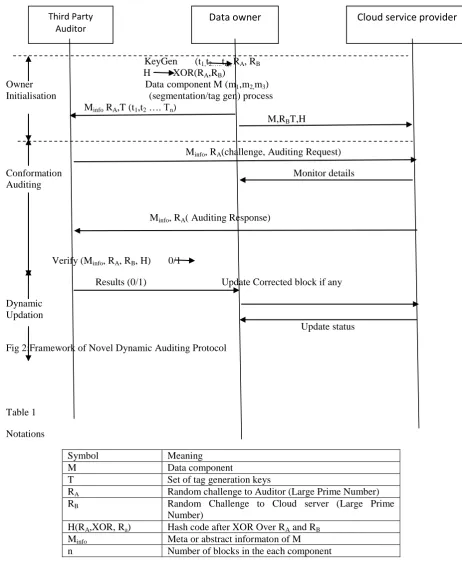
Fig 2:Framework of Novel Dynamic Auditing Protocol
Table 1
Notations
Symbol Meaning
M Data component
T Set of tag generation keys
RA Random challenge to Auditor (Large Prime Number) RB Random Challenge to Cloud server (Large Prime
Number)
H(RA,XOR, Ra) Hash code after XOR Over RA and RB Minfo Meta or abstract informaton of M n Number of blocks in the each component
Data owner
Cloud service provider
The above Figure shows entire architecture of the protocol, initially data owner segments the data component or file into number of blocks separated by a delimiter as space and generates a random tag key set which is required for encryption of individual blocks respectively. Data owner generates two random challenges for authentication of third party auditor at cloud service provider (CSP) while monitoring the data components of particular data owner. Data owner after encryption of data component uploads to the cloud storage area along with Tag key set and verification parameters and forwards initiation parameters to the auditor for monitoring of data component.
Step by Step Process for protocol Implementation:
Step1: Data owner fragments Data component D into n blocks (m1,m2….mn).
Step2: Generates a random tag key set T (t1,t2…..tn) to encrypt the block with triple DES algorithm and finds signatures on encrypted blocks for authentication
Step3 : Generates random challenges RA,RB and computes hash value of xor between RA and RB.
x := hash ( RA XOR RB )
Step4 : Forward Data component, Tag key set and RB to service provider and meta data and authentication parameters (Minfo RA,T (t1,t2 …. Tn)
) to Auditor
Step5 : data owner Checks authentication by recomputing hash code with auditor RA.
Step6 : Auditor again divides D in ti number of blocks at server end, encrypts and applies same signature and compares signatures of corresponding blocks
Step7 : Monitoring Status can be forwarded t Data owner through smtp implementation
Step8: Auditor updates Data component status to the Data owner and updates the block if corrupted
Auditor receives the initiation parameters and meta data for monitoring of data component and authenticate himself at cloud service provider by forwarding the random challenge (RA).Cloud service provider validates the auditor by generating the hash code of XOR (RA,RB),if authentication is success, csp allows the auditor to monitor the data component and instantly forward a mail response to the data owner. Data owner receives monitoring status from auditor, if uploaded data is same as monitored data then no issue otherwise data owner
updates corrupted block which is informed by the auditor report.
Before upload of data components to the server, service compares the data components blocks with existing data blocks and if found then maintains a reference id and updates the reference and no need to maintain the one more copy of the data component again over cloud disk. It eliminates the redundancy and saves the cloud disk space
Signature Implementation:
Authentication Based signature:
Algorithm: Generate file with integrated
Signatures
Input: User File in ASCII (Fo)
Output: File with Signature appended at end of
(Fn)
Method: For apply hash function on each n byte
block of file which is corrupted? If we consider it
with the file we perform the following steps to
make (m mod n)= 0 of Fo
M Calculate Length of (F0)
n Length of Block (any one of128/ 256
/512/ 1024 /204/4096/ 8192) bytes
res reserved 16 bytes
P m mod n
Q n- (P + res)
if(Q > 0)
FAppend Q zeros at the end of F0
Else if(Q < 0)
R n+ Q
F1 Append R zeros at the end of F0
F1 Append res at the end of F0
In order to generate Signatures of Fl, perform the
following steps
I Calculate_ Length of (Fl)
count l/n
For j1 to count
S reverse[∑ nA=1((A XOR B) v (A ∩ B))]
Where B <- to_Integer (to_Char (A))
Sig Sig+ to-Binary (S)
Fn F1 + Sig
Cryptographic implementation:
Triple DES is the common name for the Triple Data Encryption Algorithm (TDEA) block cipher. It is so named because it applies the Data Encryption Standard (DES) cipher algorithm three times to
The standards define three keying options: Keying option 1: All three keys are independent.
Keying option 2: K1 and K2 are independent, and K3 = K1.
Keying option 3: All three keys are identical, i.e. K1 = K2 = K3.
Keying option 1 is the strongest, with 3 x 56 = 168 independent key bits.
Keying option 2 provides less security, with 2 x 56 = 112 key bits. This option is stronger than simply DES encrypting twice, e.g. with K1 and K2, because it protects against meet-in-the-middle attacks.
Keying option 3 is no better than DES, with only 56 key bits. This option provides backward compatibility with DES, because the first and second DES operations simply cancel out. It is no longer recommended by the National Institute of Standards and Technology (NIST) and not supported by ISO/IEC 18033-3.
IV. CONCLUSION
We conclude that our work with an efficient auditing protocol without losing its data probity, In this approach, the user need not to forward the data components to the auditor directly , but auditing can be done efficiently. We can enhance our approach by increasing the authentication approach rather than simple random challenges. From the traditional approaches we are not entirely depend on the third party verifiers, therefore the protocol authorize the auditor to monitors data items of meta information only that provides the extracted information of data component. Data owner can receive the general monitoring details.
REFERENCES
[1] S. Marium, Q. Nazir, A. Ahmed, S. Ahthasham and Aamir M. Mirza, “Implementation of EAP with RSA for Enhancing The Security of Cloud Computig”,International Journal of Basic and Applied Science,vol 1, no. 3, pp. 177-183,2012.
[2] Q. Wang, C. Wang,K.Ren, W. Lou and Jin Li “Enabling Public Audatability and Data Dynamics for Storage Security in Cloud Computing”, IEEE Transaction on
Parallel and Distributed System, vol. 22, no. 5, pp. 847 859,2011.
[3] B. Dhiyanesh “A Novel Third Party Auditability and Dynamic Based Security in Cloud Computing” , International Journal of Advanced Research in Technology, vol. 1,no. 1, pp. 29 -33, ISSN: 6602 3127, 2011
[4] P. Mell and T. Grance, “The NIST definition of cloud computing,”National Institute of Standards and Technology, Tech. Rep., 2009.
[5] M. Armbrust, A. Fox, R. Griffith, A. D. Joseph, R. H. [6] T. Velte, A. Velte, and R. Elsenpeter, Cloud Computing: A Practical Approach, 1st ed. New York, NY, USA: McGraw-Hill, Inc., 2010, ch. 7. Stoica, and M. Zaharia, “A view of cloud computing,” Commun. ACM,
[7] L. N. Bairavasundaram, G. R. Goodson, S. Pasupathy, and J. Schindler, “An analysis of latent sector errors in disk drives,” in SIGMETRICS, L. Golubchik, M. H. Ammar, and M. Harchol-Balter, Eds. ACM, 2007, pp. 289–300.
[8] B. Schroeder and G. A. Gibson, “Disk failures in the real world: What does an mttf of 1, 000, 000 hours mean to you?” in FAST. USENIX, 2007, pp. 1–16.
[7] M. Lillibridge, S. Elnikety, A. Birrell, M. Burrows, and M. Isard, “A cooperative internet backup scheme,” in USENIX Annual Technical Conference, General Track.USENIX, 2003, pp. 29–41.
[9] Y. Deswarte, J. Quisquater, and A. Saidane, “Remote probity checking,” in The Sixth Working Conference on Probity and Internal Control in Information Systems(IICIS). Springer Netherlands,
November 2004.
[10] M. Naor and G. N. Rothblum, “The complexity of online memory checking,” J. ACM, vol. 56, no. 1, 2009. [11] A. Juels and B. S. K. Jr., “Pors: proofs of retrievability for large files,” in ACM Conference on Computer and Communications Security, P. Ning, S. D. C. di Vimercati, and P. F. Syverson, Eds. ACM, 2007, pp. 584–597.
[12] T. J. E. Schwarz and E. L. Miller, “Store, forget, and check: Using algebraic signatures to check remotely administered storage,” in ICDCS. IEEE Computer Society, 2006, p. 12. [13] D. L. G. Filho and P. S. L. M. Barreto,
“Demonstrating data possession and uncheatable data
transfer,” IACR Cryptology ePrint Archive, vol. 2006, p.150, 2006.
[14] F. Seb´e, J. Domingo-Ferrer, A. Mart´ınez-Ballest´e, Y. Deswarte, and J.-J. Quisquater, “Efficient remote data possession checking incritical information .
[15] Cong Wang, Sherman S.M, Qian Wang, Kui Ren, Wenjing Lou “Privacy-Preserving Public Auditing for Secure Cloud Storage”.
BIOGRAPHIES
N.V.AshokKumar.M.Tech (CSE) He received the B.Tech degree in Computer Science and Engineering from JNT University, Kukatpalli, Hyderabad and received the M.Tech degree in Computer Science and Technology from JNT University, Kakinada. Presently he is working as Associate Professor in Computer Science and Engineering in Avanthi Institute of Engineering and Technology,Vizag, A.P.His research interests include Network Security, Data Warehousing and Data Mining and RDBMS .He has Published more than 10 papers in various national and international journals..