Review Article
International Journal of Medical Reviews, Volume 1, Issue 2, Spring 2014; 63-69
Relationship between Intelligence and Reaction Time; A Review Study
Mojtaba Khodadadi *1, Khodabakhsh Ahmadi 1, Hedayat Sahraei 2,Esfandiar Azadmarzabadi 1, Sara Yadollahi 3
Abstract
Introduction
About 120 years ago, Francis Galton, the father of psychometric, pointed out this theoretical or intuitive concept that there is relationship between the reaction time (RT) and Intelligence quotient (IQ). From then, based on relevant theories related to intelligence or reaction time, a lot of different or sometimes conflicting interpretations have been discussed in this area. These interpretations are mainly based on behavioral or cognitive interpretations of the subject areas. Reviewing these results, we are going to reveal different aspects of the relationship between intelligence and reaction time, so we can obtain a relatively clear answer for this relationship. Reaction time in psychology -also called latent time - is the time interval between the stimulus and the response of the organism to its presentation or the time required to start a pre- programmed response to a specific stimulus. Reaction time indicates the speed of decision making and performance. Furthermore, the definition of RT can be a representative of individual’s cognitive processing speed. This structure is used to study sensory and intellectual processes, and in fact, it is considered as an important tool for understanding how information processing happens (stimulus identification, response selection, and response programming) that occurs in the human nervous system [1].
Types of reaction time
Generally, there are two types of RT:simple and complex reaction times. Simple reaction time refers to the time
when the individual only reacts to a specific stimulus, such as when subjects must press a button hearing a voice or seeing a visual stimulus. Complex reaction time is of several types that are as follow: first, selective reaction time refers to the time when subject should have different responses facing various stimuli for example different buttons should be pressed in response to different stimuli; second, recognition reaction time, which the subjects are asked not only to press a button in the presence of a stimulus, but to press it in its absence; third, discrimination reaction time. In the assignments of this reaction time, the subjects are asked to choose one stimulus between two stimuli which is in accordance with predetermined features. For example, between two or more colored visual stimuli, a blue stimulus should be selected and this selection should be shown by pressing a button. Dondre showed simple reaction time is shorter (faster) and selective reaction sare longer (slower) than other types of complex reaction times. Laming et al. had reported that the mean simple reaction time is equal to 220ms and the mean discrimination time is equal to 384ms[2]. It was accepted for 120 years that the mean simple reaction time to visual stimuli for students (colored lights) is 190ms and for auditory stimuli (sounds of different frequency) is 160ms. However Eckner, Kutcher and Richardson reported the reaction time for footballers is 200ms, when they were measured with a simple assessment tool, and was 260when they were measured with computer.[1,3].Miller and Low believe that the reaction time differences in different parts Introduction: Although the relationship between reaction time and Intelligence quotient (IQ)
scores involves an important part of theoretical information processing approaches towards individual differences, data obtained in this area are sparse or even non- congruent. Those who do not believe the relationship between reaction time and intelligence, often argue that the reaction time is too simple, banal and non-intelligent and thus, it cannot reflect a variable with the same sophistication, elegance and ambiguity of intelligence. In contrast, some believe that the reaction time is indicative of fluid intelligence has a growing trend until youth time (crescendo) and then steadily decreases (decrescendo). New researchers also believe that to judge the relationship between intelligence and reaction time, the difference between processing time and reaction time should be considered.
Method & Results: The present study, comparing recorded results of present studies and reviewing stated theories, seeks to answer this question "what is the relationship between reaction time and intelligence and whether reaction time can predict the differences in the intelligent structure?" Conclusion: The relationship between reaction time and IQ is too complicated and revealing a significant correlation depends on various variables (e.g. methodology, data analysis, instrument etc.).
Key words: Intelligence, Reaction Time, Information Processing
1. Behavioral Sciences Research Center, Baqiyatallah University of Medical Sciences, Tehran, Iran. 2. Neurosciences Research Center, Baqiyatallah University of Medical Sciences, Tehran, Iran
3. Allameh Tabatabaei University, Tehran, Iran
* Corresponding Author
Mojtaba Khodadadi, Behavioral Sciences Research Center, Baqiyatallah University of Medical Sciences , Sheikh Bahaei Street, Mollasadra Street, Vanak Square, Tehran, Iran
E-mail: [email protected]
are due to different kinds of processing time. In one study, they separated the duration of data processing time from practical performance duration and since the practical performance (response) is done during different parts of reaction time, they concluded that reaction time difference is related to data processing time. In other words,in simple reaction time, the amount of time spent responding to perceive the stimulus and decision making for response is shorter; but in complex ones, this time is longer[4]. Reaction time correlations
Different factors may influence individual differences in reaction time. Age, gender, trial and error, personality traits, learning disorders, distraction and drug consumption are among these factors.
Age: researches have shown that simple reaction time is the shortest in individuals less than 20 years of age. Then it gradually increased until the ages of 50s to 60s and further decreases from 70swith accelerated process. McDonald et al. also reported that reaction time variability or variance in older adults is often associated with a longer reaction time, and concluded that this variability may be a useful criterion for the assessment of neurological damages[5].
Gender:studies on the gender-related differences have revealed that in most age groups, men have demonstrated faster reaction time than women and the reaction time of women has not been improved, even with exercise. However Silverman believes that this has been changed because men’s pre-dominance in visual reaction time has decreased compared with women, since women have dealt with activities like driving and sports, which need instant reaction [6].Barral and Debu also reported that although men are faster in achieving goals, women have more accurate and precise performance. Also, studies of Zyai and Amiri show that men’s reaction time is shorter in women [7].
Trial and Error: Sanders has stated individuals who experience reaction time tests for the first time have slower reaction time than those who have continuous and adequate training [8]. Moreover, when subjects commit errors in reaction time tasks, they are slower in processing subsequent stimulus [9].Philip et al. also found that fatigue from 24 hours lack of sleeping in young people aged 20 to 25 years old prolonged their reaction time,but did not affect52 to 63 years old adults[10].
Personality traits: personality characteristics also seem to affect the reaction time. Studies have shown that introverted and anxious people have faster reaction time[2].They also never felt time pressure in verbal tasks that require insight and intuition as well as in long tasks which for example last an hour and have better performance. In contrast, extroverts in practical tasks with Wechsler Intelligence Scale that require focus on the tight time limit (e.g. two to three minutes) and are short term perform better and have faster reaction time[11].
Learning Disorders: Miller and Poll investigated the effect of learning disorders on reaction time. They found that students with a history of verbal disorders or dyslexia had slower reaction time and better language skills correlated with faster reaction time[12].
Distraction: distraction is another factor that many researchers have studied its effect on reaction time. Trimmel and Poelzl found out that the presence of a sound field will increase the reaction time through inhibition of the cerebral cortex. Also, studies have shown that despite using hands-free microphone while driving, it is possible to face difficulty for functions that are related to the rapid reaction time. Hsieh also reported that considerable variation between different types of tasks increases the reaction time[13].
Drugs:significant statistical differences were reported related to simple and selective reaction time of (visual, auditory, and general) those who had opium and heroin addicts and normal subjects. Also, complex reaction time (discriminative and selective)of heroin users was significantly longer than that of opium users and both of them had longer discriminative and selective reaction time than their non-addicted counterparts [14]. Narimani, Soleimani and Kurdasghari also reported a reaction time (simple and selective reaction time to auditory stimuli) of individuals addicted to opium and Crystalis longer than their normal counterparts[15].
The historical trend of increasing reaction time
Woodley, Te Nijenhuis and Murphy have noted that IQ tests are biased under the influence of education, social norms, cultural factors and some low related psychological issues with cognitive abilities. While they propose to examine the historical process of IQ changes, reaction time should be used as a measure of genuine intelligence i.e. the intelligence, which is not influenced by level of education, cultural factors,etc.Meta-analysis results of these researchers indicated that RT rate during the period from 1884 to 2004 increases slowly. This time has decreased from 183 to 253ms in men and from 188 to 261ms in women. However, Dodonova and Dodonovhave criticized these results. They remanufactured and doubted the suitability of the device (pendulum) that Galton used to measure RT [16]. The other criticism of these researchers was mainly attributed to Meta-analysis methodology i.e. comparing or integrating researches with many different characteristics is the same as comparing or integrating orange and apple and does not lead to reliable results [17]. These researchers argued that studied researches in the study of interest have clearly distinct characteristics that almost make their comparability impossible. Thus, changing in the reaction time in a period of time may be due to lots of differences in measurement tools and methodologies and meta-analysis[18].
Intelligence and reaction time
a distinct chapter that should be separated from data processing time.
Those who do not believe in the relationship between RT and IQ, often argue that the RT is a too simple, banal and non-intelligence structure and thus it cannot reflect a variable with complexity, subtlety and ambiguity of intelligence. They also noted that people with high IQ seem slow but instead they have deep thinking style. It is publically believed that the top speed of mental function implies superficiality and calmness and slowness indicates depth[19]. In contrast, some believe that the reaction time is indicative of fluid intelligence and as intelligence increases to youth, the reaction time also grows and then steadily slows down. New researchers also believe that to judge the relationship between intelligence and reaction time, perception time and information processing should be separated from reaction time duration.
Classical and modern studies
The researchers have interested in the relationship between intelligence and reaction time since Galton’s era. Initial and classical studies in examining these two variables have mainly reported conflicting results. In justifying this contradiction, it is possible to point out weak methodologies, which lead to disordered results in the mentioned studies (this justification has been dealt with in the overview part on the reaction time measurement tools).Among initial investigations, Ruth’s research can be pointed out. He found a significant relationship between IQ and RT. He also achieved correlation between general intelligence factor (G-factor) and the slope of the RT. Ruth achieved a weak correlation between RT and the information processing rate i.e. the slope of the regression line which shows the relationship between RT and information processing[20].In the information processing speed model, it is assumed that subjects with higher IQ should also show faster rate of information processing. Since RT is a linear function of information processing speed, it is expected that the rate of information processing reflects more in the shape of flatter slope or flat RT for subjects with high IQ[21].
Jensen and Munroin a research acquired negative and moderate correlation between reaction time (RT) and movement time (MT) with the results obtained from Raven’s progressive tests (increasing intelligence was associated with reducing reaction time or rapidness). This result was repeated in 1982 by Carlson and Jensen. According to their research, a negative correlation from moderate to high was seen between RT scores and MT with Raven IQ, , thus, the results from the previous study were confirmed[22].However, Jensen’s researches have been criticized both theoretically and methodologically (non-representative sample, manipulation and statistical interpretations and irregular presentation of the results). Jensen's theory in explaining individual differences in selective reaction time which is based on present fluctuations is located in the stimulating of internal nodes (the same synapses or synaptic nodes) through which nerve impulses are transmitted. Each node is increased when the internal and external stimulation exceeds a certain threshold. Individual differences in fluctuation rate
lead to differences in data transfer rates and thus in selective reaction time. Slowness inneural transmission leads to restrictions in information processing and limiting the recovery of short and long term memory and subsequently leads to an increasing cognitive impairment. Jensen's theory predicts a negative relationship between RT and also the slope of RT with g .Jensen notes there is a correlation between IQ with simple RT, selected RT, movement time MT, the Hick gradient, RT variability and inspection time(IT). All the tests have not achieved the expected results (Irwin, 1984; Barret and Lucking 1985, Carlson, Jensen and Wideman, 1983) quoted by Ferrson and Eyzenck[20].As mentioned above, Jensen's theory predicts that there is a relationship between time and IQ review. Paradigm of inspection time (mentioned above) is one of the ways to measure RT. This structure is representative of information processing speed that correlates with different mental abilities and a significant correlation between inspection time and IQ has been reported. Kranzler and Jensen (1989) in a meta-analysisas quoted by Neisser et al (1996) have reported that, after unstable correction, the correlation between IQ scores and IT was a range between -0/30 to -0/50. That means increasing IQ is associated with reducing time[23]. Eysenck[20] has studied the literature review of the physiological, psychological intelligence researches and tried to provide a stronger biological basis. His theory is similar to Jensen's theory, but also differs in some way. The used tools by Fererson and Eysenck have been adapted from Jensen’sparadigm which is known as "odd man out".In this procedure, in every effort, three lights of eight lamps are turned onin which two of them are relatively close to each other, while there is a distance between the third lamp and them. Subject has to press a button corresponding to a lamp, which is distant or considered as a stimulus. The resulting correlations between measured reaction time by this structure with IQ are stronger and higher than reported correlation using Jensen paradigm. Possible explanation is that these tools require sophisticated forms of spatial analysis[23].
respectively[24]. The exact relationship between intelligence and reaction time has also been studied by Diri, Dir and Ford [26]. They have reported that severe
mental retardation leads to slower reaction time (longer) and higher dispersion. Among individuals with normal intelligence, smarter people have shown faster reaction
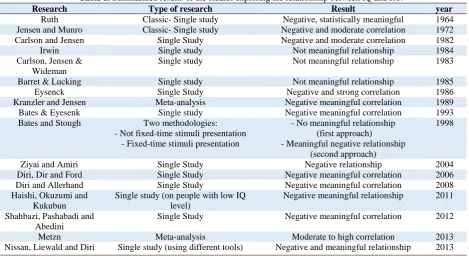
Table 1. Summarized results of the studies exploring the relationship between IQ and RT.
Research Type of research Result year
Ruth Classic- Single study Negative, statistically meaningful 1964
Jensen and Munro Classic- Single study Negative and moderate correlation 1972
Carlson and Jensen Single Study Negative and moderate correlation 1982
Irwin Single study Not meaningful relationship 1984
Carlson, Jensen & Wideman
Single study Not meaningful relationship 1983
Barret & Lucking Single study Not meaningful relationship 1985
Eysenck Single Study Negative and strong correlation 1986
Kranzler and Jensen Meta-analysis Negative meaningful correlation 1989
Bates & Eyesenk Single study Negative meaningful correlation 1993
Bates and Stough Two methodologies:
- Not fixed-time stimuli presentation - Fixed-time stimuli presentation
- No meaningful relationship (first approach)
- Meaningful negative relationship (second approach)
1998
Ziyai and Amiri Single Study Negative relationship 2004
Diri, Dir and Ford Single Study Negative meaningful correlation 2006
Diri and Allerhand Single Study Negative meaningful correlation 2008
Haishi, Okuzumi and Kukubun
Single study (on people with low IQ level)
Negative meaningful relationship 2011
Shahbazi, Pashabadi and Abedini
Single Study Negative meaningful correlation 2012
Metzn Meta-analysis Moderate to high correlation 2013
Nissan, Liewald and Diri Single study (using different tools) Negative and meaningful relationship 2013
time (shorter) but the difference was not significant, however individuals with normal intelligence have more variability or variance of reaction time than more intelligent people .Also, In Iran, Ziyai and Amiri have reported a negative relationship between intelligence and reaction time after studying 36 women and 29 men[7]. Shahbazi, Pashabadi and Abedini also attained a significant negative correlation between intelligence and selective reaction time[3]. The results of the aforementioned studies as well as other research are summarized in table 1.
The roles of tools and RT methodologies and its effect on intelligence
The main tools that are commonly used to measure RT measure speed screen of letter symbols or numbers in short-term memory, recovery speed of verbal information from long term memory or efficiency of storing and processing verbal or numerical information simultaneously in short-term memory .In the simpler cases, subject responses to simple stimuli which may be different colored lights or sounds with various pitches. Bates and Stough have examined the relationship between RT and IQ using two different experiments. In the first experiment, successive burst stimuli were used to measure RT and each response was the starting point of the next stimulus. This method did not show a significant correlation with IQ. In the second study with developing and adapting Jensen and Munro’s classic methodology, still stimuli were presented to decrease uncertainty or doubt about the start point of the stimulus. In this experiment, decision duration
intelligence and executive functions in people with intellectual disability have led to similar conclusions .Haishi, Okuzumi and Kukubun examining subjects with IQ of 20 to 70concluded that subjects with tougher executive functions have more variability or variance in their reaction time. The researchers concluded that IQ and executive functions (especially in controlling executive function) affect relatively independent on RT[28].In such studies, smarter subjects are mostly faster than the absolute reaction time. Generally, those research are able to reflect the relationship between reaction time and intelligence that their measurement tools do not need high level cognitive processing and use simple stimuli. We also expect that the slope of the regression line in individuals with high and low IQ is smooth and similar, but research results show the relationship between the reaction time and intelligence in the subjects that responds slower is stronger. Some of the contradictory results in this area can be attributed to the lack of stability and reproducibility of the results, which is due to a defect in the measurement method. In addition, in evaluating the reproducibility of the results, the nature of the measured variable should be taken into account. Stable reproducibility is stated about variables which have relative stability over time, such as personality variables. However, as mentioned earlier, the reaction time is a variable that changes if it is influenced by situational variables such as anxiety and distraction changes.
Investigation of the genetic roles
With relative high assurance, it can be said that cognitive abilitie sare genetic and this is one of the confirmed scientific findings. General intelligence or g factor have at least 0.50 of genetic values. For example, Jongeneel-Grimen(2007) studied meta-analysis sample size of2590peopleandachieved highly significant correlation between g and genetic coefficients. On the other side, the research results show that cognitive abilities have a strong correlation with the information processing speed. Since RT has relative high correlation with cognitive abilities, and cognitive abilities are also highly correlated with genetic, it is expected that general intelligence has(which is presented in reaction time tools)positive moderate to high correlation with genetic coefficients .RT genetic coefficient can be estimated by comparing RT coefficient of identical and non-identical twins. Metzn in studying genetic coefficient and general intelligence achieved 0.51 using meta-analysis method and concluded that reaction time like many acquired measures from cognitive processing scales are relatively genetic and is correlated with general intelligence factor or g factor. In other words, general intelligence is also reflected in the reaction time has largely genetic aspect[29].
Cross-cultural comparisons
Metzn considering that the reaction time has moderate to high correlation with the final score of the Raven test (one of the best predictors of general intelligence or g), meta analyzed studies in which group differences in reaction time scales with g and a collection of IQ tests were studied. Metzn first goal
was to examine whether the differences between whites reaction time with low IQ groups(blacks) as well as the difference between reaction time of Whites with groups of higher IQ (Northeast Asians) is correlated with general intelligence. The results of this meta-analysis, which was of 2191 subjects, show that the correlation difference among Asians and Whites equals to 0.48, which is considered as a moderate coefficient. This supports the theory of the existence of positive and significant correlation of RT between Whites and groups of lower IQ and g size. So in the difference between the cultures there is a correlation between reaction time and intelligence[29].
Discussion
Studies in the decade of 60 and 70 led to contradictory results about intelligence and reaction time. This contradiction can be explained by considering different instruments for measuring IQ and RT, especially RT on one hand and the theoretical and operational definitions of the different kinds of reaction time on the other. At the same time, some studies have found negative, but significant correlation, between intelligence and decision making[21]. But this was not alinear and rising trend. In other words, despite a significant correlation between processing speed and decision making, processing speed did not show significant predictive power for predicting intelligence, regarding to the low reliability of measurement instruments. Repeatingthissurveyin1982 by Carlsonand Jensen, a significant negative correlation between reaction time and intelligence as well as movement time and intelligence was reported [22]. However, other researchers such as Irwin(1984) have not reported any significant correlation between these two variables. Meta-analysis shows that there is a significant negative correlation between inspection time (which is considered as a time-related structure) and IQ[23].Eysenck with a slightly different approach with Jensen achieved stronger and higher correlations between these two variables and in explaining the findings, he pointed out the nature of the measurement tools and stated that a stronger relationship between intelligence and reaction time will be achieved, when reaction time measuring method needs special judgments[20]. Modern researches disagree with this explanation and suggest the stimulus used to measure reaction time is simpler and the stronger relationship between intelligence and reaction time will be obtained[23]. In more recent researches, there is also a significant negative relationship between simple and selective reaction time with intelligence[24]. In studying the causal relationship between high levels of mental abilities(intelligence and creativity), processing speed and academic performance also refers to direct effect of reaction time on intelligence[25].
reaction time than those with low intelligence [26]. Researches on those with low-power mental ability have achieved a significant negative correlation between reaction time and intelligence. This relationship is stronger when the reaction time is slower. This will be proved using the weakest performance e.g. the correlation between IQ and reaction time in people who have a slower reaction time is stronger (Coyle, 2003).Since general intelligence (g-factor) is a genetic characteristic, and most of studies have confirmed the relationship between intelligence and reaction time, Te Nijenhuis, Jongeneel-Grimen and Metzn‘s researches on reaction time showed the effect of genetics [29]. Researches done on identical and non-identical twins have confirmed the effect of genetic factors in selective reaction time. The cross-cultural comparisons also show that there is a significant relationship between differences in RT in white subjects and in groups with lower IQ and the size of g[30].Totally, despite the limited results from reports, the existence of a significant relationship between intelligence and reaction time has been specified. The relationship has been reported less than -0.20 to more than -.50. Since in the more recent studies this amount has a rising trend, it seems that the role of methodology in measuring reaction time and theoretical intelligence concepts and the role of reaction time in clarifying this fact were outstanding; especially in measuring reaction time, which the observer should pay more attention to separate the time duration spent on information processing in brain from the amount of time spent doing practical answer. According to the dispersion of existent results, it seems that to discuss the predictive power of intelligence based on time reaction results, more reflection and stronger empirical evidences should be obtained.
Reference
1. Heidari, H.; Kasaeyan, A.; Kyanzadeh, A., Tayebi sani, S. M., Fahimi Nejad, A. (1389). Comparison of simple and
selective reaction time in male and female
athletes.Journal of SabzevarUniversity of Medical
Sciences: Vol 7, No.4,294-300.
2. Kosinski, R J (2010). A Literature Reviewon Reaction
Time. ClemsonUniversity: available
at:http://biae.clemson.edu/bpc/bp/Lab/110/reaction.htm#Ki nds
3. Shahbazi, M.; Pashabadi, A., Abedini Parizi, H. (1391). Reaction time and intelligence-trait anxiety and state associated with elite athletes, and non-athletes. Journal of growth andLearning and Movement - Sport. 3 (8).65-80. 4.Miller, J. O. and K. Low(2001). Motor processes in simple, go/no-go, and choice reaction time tasks: a psychophysiological analysis. Journal of Experimental Psychology: Human Perception and Performance .27: 266. 5. MacDonald, S. W. S., L. Nyberg, J. Sandblom, H. Fischer, and L. Backman. (2008). Increased response-time variability is associated with reduced inferior parietal activation during episodic recognition in aging. Journal of Cognitive Neuroscience.20(5): 779-787.
6. Silverman. I. W. (2013). Testing the hypothesized effect of dysgenic fertility on intelligence with existing reaction time data: A comment on Woodley, te Nijenhuis, and
7. Zyai, M. Amiri, sh. (1385). The relationship between reaction time and intelligence andlevel of anxiety. Developmental Psychology (Iranian Psychologists). 9. 53-62.
8. Sanders, A. F. (1998). Elements of Human Performance: Reaction Processes and Attention in Human Skill. Lawrence Erlbaum Associates Publishers.Mahwah :New Jersey.
9. Koehn, J. D., J. Dickenson, and D. Goodman. (2008). Cognitive demands of error processing. Psychological Reports 102(2): 532-539.
10. Philip, P., J. Taillard, P. Sagaspe, C. Valtat, M. Sanchez-Ortuno, N. Moore, A. Charles, and B. Bioulac. (2004). Age, performance, and sleep deprivation. Journal of Sleep Research 13(2): 105-110
11. Sakolofske, D. H., Zeidner, M. (1995). International Handbook of Personality and Intelligence, 12, 87-154. New York: Plenum Press.
12. Miller, C. A. and G. H. Poll. (2009). Response time in adults with a history of language difficulties. Journal of Communication Disorders.42(5): 365-379.
13. Trimmel, M., and G. Poelzl.(2006). Impact of background noise on reaction time and brain DC potential changes of VDT-based spatial attention. Ergonomics.49(2): 202-209.
14. Asghari, MJ; Dojkam, M, Azadfallah, P. (1387). Comparison of reaction of nerve- psychological (reaction time) in addicts and normal subjects. Training and Psychology studies in FerdowsiUniversity. 10 (1). 47-61. 15. Narimani, M., Soleimani, E. Kordasghri, F. (1391). Comparison of drug-dependent and non-dependent reaction time. Addiction research. 6 (23).
16. Woodley. M., Nijenhuis. J. T., Murphy. (2013). Were the Victorians cleverer than us, intelligence. 41 (6): 843-850
17. Delavar, A. (1391). Theoretical and practical research in the humanities and social sciences. Tehran: growth. 18. Dodonova. Y. A., Dodonov. Y. S. (2013). Is there any evidence of historical slowing of reaction time. Intelligence. 41 (5): 674-687.
19. Jensen. A. R., (1982). Reaction time and psychometric g. In H. J. Eysenck (ed.), A Model for Intelligence. New York: Springer-Verlag.
20. Frearson. W., Eysenck. H.j. (1986).Intelligence, reaction time (R-T) and a new ‘odd man out’ RT paradigm Personal individual differences. 7 (6), 807-817.
21. Bates. T., Stough. C. (1998). Improved reaction time method, information processing speed and intelligence. Intelligence. 26(l): 53-62.
22. Carlson. J. S., Jensen. C. M. (1982). Reaction time, movement time and intelligence: a replication and extension. Intelligence. 6, 256-274.
23. Neisser. U., Boodoo. G., Bouchard. Th. J., Boykin. A. W., Brody. N., Ceci. S. J., Halpern. D. F., Loehlin. J. C., Perloff. R., Sternberg. R. J., Urbia. S. (1996). Intelligence: knowns and unknowns. American Psychologist. 51(2). 27-101.
24. Deary. I. J., Allerhand. M. (2008). Reaction time and intelligence difference frome age 56 to 69. Ageing and psychology. 25 (3).
25. Rindermann. H., Neubauer. A. C. (2004). Processing speed, Intelligence, creativity and school performance: testing of causal hypotheses using structural equation models. Intelligence. 32: 573-589.
26. Der, G., and I. J. Deary. (2006). Age and sex differences in reaction time in adulthood: Results from the United Kingdom health and lifestyle survey. Psychology and Aging 21(1): 62-73.
28. Haishi. K., Oluzumi. H., Kokubun. M. (2011). Effects of age, intelligence and executive control function on saccadic reaction time in persons with intellectual disabilities. Research in developmental disabilities. 32(6): 2644-2650.
29. Metzen. D. (2012). The Causes of Group Differences in Intelligence Studied Using the Method of Correlated Vectors and Psychometric Meta-Analysis. Available at: https://www.google.com/url