www.atmos-meas-tech.net/2/495/2009/
© Author(s) 2009. This work is distributed under the Creative Commons Attribution 3.0 License.
Atmospheric
Measurement
Techniques
Determination of aerosol properties from MAX-DOAS observations
of the Ring effect
T. Wagner1, T. Deutschmann2, and U. Platt2 1Max-Planck-Institute for Chemistry, Mainz, Germany
2Institute for Environmental Physics, University of Heidelberg, Germany
Received: 9 February 2009 – Published in Atmos. Meas. Tech. Discuss.: 9 March 2009 Revised: 11 June 2009 – Accepted: 23 August 2009 – Published: 4 September 2009
Abstract. The first quantitative comparison of MAX-DOAS observations of the Ring effect with model simulations is pre-sented. It is performed for a large variety of viewing ge-ometries (solar zenith angles: 45◦ to 90◦, elevation angles:
3◦, 6◦, 10◦, 18◦, 90◦; three different azimuth angles), which
allows a comprehensive test of our capabilities to measure and simulate the Ring effect. In addition to the Ring effect, also the observed O4absorptions (optical densities) and radi-ances are compared with model simulations. In general good agreement is found for all measured quantities. From sev-eral sensitivity studies it is found that for most measurement situations, the aerosol optical depth has usually the strongest influence on the observed quantities, but also other aerosol properties like e.g. the vertical distribution have a significant effect. In some aspects, the qualitative dependence of the Ring effect on aerosol properties is similar to that of the O4 absorption. This can be understood, since both quantities depend strongly on the light path length in the lower atmo-sphere. However, since the Ring effect depends also on the properties of the scattering processes, in specific cases ob-servation of the Ring effect can provide complementary in-formation to that retrieved from the O4 observations. This is e.g. possible for measurements at small relative azimuth angles, from which information on the aerosol phase func-tion can be derived. Observafunc-tions at large solar zenith an-gle might allow the retrieval of stratospheric aerosol prop-erties, even in cases with very low aerosol optical depths. In addition, Ring effect observations in zenith direction are rather sensitive to the aerosol optical depth (in contrast to O4 observations), which might allow to retrieve information on aerosol properties from existing zenith UV data sets prior to the MAX-DOAS era.
Correspondence to: T. Wagner
1 Introduction
496 T. Wagner et al.: Determination of aerosol properties from MAX-DOAS observations of the Ring effect
Figures
4:00 8:00 12:00 16:00
Time
4:00 8:00 12:00 16:00
Time SZA
rel. azimuth angle
0 100
-300 -200 -100 0 100
[degree]
South West North
4:00 8:00 12:00 16:00
Time
60 160 260
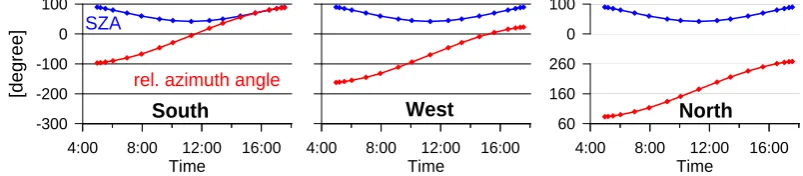
Fig. 1 Diurnal variation of the solar zenith angle (blue) and relative azimuth angle (red) for the three telescopes.
25
Fig. 1. Diurnal variation of the solar zenith angle (blue) and relative azimuth angle (red) for the three telescopes.
this study we focus on the potential to retrieve aerosol infor-mation from observations of the Ring effect using a ground based Multi-Axis-DOAS (DOAS) instrument. MAX-DOAS instruments observe scattered sun light under a va-riety of elevation angles (H¨onninger and Platt, 2002; Leser et al., 2003; Bobrowski et al., 2003; van Roozendael et al., 2003; Wittrock et al., 2004; H¨onninger et al., 2004; Heckel et al., 2005; Wagner et al., 2004, 2007b; Frieß et al., 2006; Fietkau et al., 2007; Theys et al., 2007). The MAX-DOAS observations used in this study make simultaneous measure-ments in three different azimuth directions.
Recent studies have qualitatively and semi-quantitatively described the aerosol effect on ground based observations of scattered light (Wagner et al., 2004; Langford et al., 2007). Here we present the first comprehensive quantitative com-parison of the observed and modelled Ring effect for MAX-DOAS measurements on two cloud free days with very dif-ferent aerosol loads. Our comparison includes a large variety of viewing conditions: the SZA ranges from about 45◦ to 90◦, the elevation angles include 3◦, 6◦, 10◦, 18◦ and 90◦ (zenith) and are made simultaneously at three different az-imuth angles (North, West, South). The respective combina-tions of SZA and relative azimuth angles are shown in Fig. 1. In addition to the Ring effect, also the observed radiances and O4absorptions are compared with model simulations, giv-ing additional confidence both in the observations and model simulations.
Our paper is structured as follows: in Sect. 2, the in-strument, data analysis, and observed quantities used in this study are introduced. In Sect. 3, the radiative transfer sim-ulations are described. Section 4 shows the comparison of model simulations and measurements and in Sect. 5, the sen-sitivity of the Ring effect towards various atmospheric and surface parameters is investigated in detail.
2 Measurements
We investigate MAX-DOAS observations performed in September 2003 in Milan (Italy) during the FORMAT-II campaign (Formaldehyde as a tracer for oxidation in the troposphere (FORMAT) is a European research project, see www.nilu.no/format/). These observations were already dis-cussed in a previous paper (Wagner et al., 2004) which
fo-cussed on the aerosol effects on the O4 absorptions mea-sured by MAX-DOAS. In this study, we focus on the aerosol influence on MAX-DOAS observations of the Ring effect. As a consistency check, we perform a simultaneous quan-titative comparison also for the observed O4absorptions as well as for the measured radiances. Our comparisons include two selected days (14 and 17 September 2003) with different aerosol load, which are mostly cloud free.
Since the MAX-DOAS observations are already described in detail in Wagner et al. (2004), here only a brief overview is given. The MAX-DOAS instrument observes light from three steerable telescopes, which are connected via glass fi-bre bundles to a spectrograph with a two-dimensional CCD-detector. The telescopes are directed at three different az-imuth angles (5◦, 185◦, 250◦) with respect to north. For
sim-plicity we refer to these directions as north, south, and west, respectively. Each telescope sequentially scans 5 different elevation angles: 3◦, 6◦, 10◦, 18◦and 90◦(zenith); a single measurement is taken about every 90 s (a full sequence thus taking about 10 min). The measurements cover the wave-length range 320–457 nm and the spectral resolution is about 0.75 nm (FWHM).
Table 1. Relationship between the Raman scattering probability (RSP), which is used in this study to quantify the strength of the Ring effect, and other definitions used in other studies.
Study Instrument & spectral resolution Wavelength Definition of filling-in Relationship to RSP Joiner et al. (1995) SBUV∼1.1 nm 393.37 nm Filling-in factor =RSP*0.74 Joiner et al. (2004) GOME∼0.17 nm 393.37 nm Filling-in factor =RSP*2.92 Joiner et al. (2006) OMI∼0.50 nm 393.37 nm Filling-in factor =RSP*1.79 de Beek et al. (2001) GOME∼0.17 nm 393.37 nm Ring DOD =RSP*3.02 Langford et al. (2007) Ground based∼0.33 nm 344.1 nm Fractional filling-in =RSP*1.01
The retrieved fit coefficient for the O4cross section (for 296 K) (Greenblatt et al., 1990) yields the slant column den-sity (SCD, the trace gas concentration along the absorption path). In the case of O4, the SCD cannot be directly referred to O4, because the equilibrium constant between O4 and (O2)2is not known. Therefore usually the O4SCD is referred to the integrated quadratic O2concentration (see also Green-blatt et al., 1990). The O4SCD then includes the equilibrium constant and it has the unit [molec2/cm5]. From the compar-ison between measurements and model results, it was found that the retrieved O4 SCDs were systematically too high to match the model simulations: On the day with low aerosol load (14 September 2003), the measured values were found to be even larger than the simulations for a pure Rayleigh at-mosphere. One reason for this discrepancy is probably the temperature dependence of the O4absorption at 360 nm (see e.g. Wagner et al., 2002). The atmospheric temperature at the measurement site weighted with the O4profile was about 267 K compared to 296 K for the laboratory measurement of the O4cross section.
The value of the O4 cross section used in this study (5.27×1046cm5/molec2)was determined from the detailed comparison between measurement and model results (see Sect. 4). This determination could be performed with an ac-curacy of about 10%. The influence of other possible effects like e.g. spectrograph straylight or errors in the determina-tion of the elevadetermina-tion angles could be largely ruled out, be-cause they would have affected observations at different ele-vation and azimuth angles (see Sect. 4) in a different way. The value of the O4 cross section at 360 nm found from this comparison is close to the values found by Volkamer (1996) (5.42×1046cm5/molec2)and Perner and Platt (1980) (5.4×1046cm5/molec2).
Finally, the O4SCDs are converted into O4air mass fac-tors (AMF) to allow a direct comparison with the results from the radiative transfer simulations. AMF is defined as the ratio of the SCD and VCD (e.g. Solomon et al., 1987):
AMF=SCD/VCD (1)
VCD denotes the vertically integrated O4column density. The O4 VCD for both selected days were calculated from the atmospheric profiles of temperature and
pres-Aerosol Optical Thickness 350nm AERONET ISPRA, Italy
0 0.2 0.4 0.6 0.8 1
04:00 06:00 08:00 10:00 12:00 14:00 16:00 18:00
Time
Optical Thickness
AOT_350 AOT_350 17.09.2003 14.09.2003
Fig. 2 Aerosol extinction at 350nm measured by the AERONET station at Ispra (Principal Investigator: Giuseppe Zibordi). The distance between Ispra and the location of the MAX-DOAS measurements (Milan) is about 60 km.
26 Fig. 2. Aerosol extinction at 350 nm measured by the AERONET station at Ispra (Principal Investigator: Giuseppe Zibordi). The dis-tance between Ispra and the location of the MAX-DOAS measure-ments (Milan) is about 60 km.
sure obtained from surface observations and model results (taken from the Air Research Laboratory, see http://www. ready.noaa.gov/ready.html) taking into account the elevation (130 m above sea level) of the measurement site. The O4 VCD changed only little for these days (±1%) and a value of 1.3×1043molec2/cm5is used for the conversion of O4SCD into O4AMF. Note that this value is about 10% higher than in Wagner et al. (2004). The difference is caused by the use of the precise altitude profiles of pressure and temperature for both selected days in this study, whereas in Wagner et al. (2004) the altitude profiles were estimated from the sur-face values of temperature and pressure.
498 T. Wagner et al.: Determination of aerosol properties from MAX-DOAS observations of the Ring effect
Ring effect, western telescope
4:00 8:00 12:00 16:00 4:00 8:00 12:00 16:00
Ring eff e ct (R SP
) Meas., 14.09.2003 Meas., 17.09.2003
4:00 8:00 12:00 16:00 0.01 0.03 0.05 0.07 0.09 0.11
Ring effect (RSP)
4:00 8:00 12:00 16:00
Model, OD: 0.1 Model, OD: 1.0
0.01 0.03 0.05 0.07 0.09 0.11
O4 absorption, western telescope
4:00 8:00 12:00 16:00 4:00 8:00 12:00 16:00
O4
AM
F
14.09.2003 17.09.2003
4:00 8:00 12:00 16:00 1 2 3 4 5 6 7 O4 AMF
4:00 8:00 12:00 16:00
OD: 0.1 OD: 1.0
1 2 3 4 5 6 7 27
Radiance, western telescope
4:00 8:00 12:00 16:00 0E+0 1E+5 2E+5 3E+5 4E+5 5E+5 Radiance [counts/ s ]
4:00 8:00 12:00 16:00
Meas., 14.09.2003 Meas., 17.09.2003
4:00 8:00 12:00 16:00 0.00 0.05 0.10 0.15 Normalised Ra d iance
4:00 8:00 12:00 16:00
Model, OD: 0.1 Model, OD: 1.0
Radiance ratio, western telescope
4:00 8:00 12:00 16:00 0 1 2 3 4 Radiance ratio
4:00 8:00 12:00 16:00
Meas., 14.09.2003 Meas., 17.09.2003
4:00 8:00 12:00 16:00 0 1 2 3 4 Ra dian ce ratio
4:00 8:00 12:00 16:00
Model, OD: 0.1 Model, OD: 1.0
Fig. 3 Comparison of measurements and model results for the western telescope on two selected days (14 and 17 September 2003). Besides the Ring effect, also the O4 AMF and the measured radiance and radiance ratio are displayed. In each sub-plot the upper graphs show the measurement results for the 14 September 2003 (left) and 17 September 2003 (right); the lower graphs show model results for aerosol OD of 0.1 (left) and 1.0 (right). Further aerosol properties are: constant extinction between 0 and 1 km, single scattering albedo of 0.9, asymmetry parameter of 0.68.
28
Ring effect, western telescope
4:00 8:00 12:00 16:00 4:00 8:00 12:00 16:00
Ring eff e ct (R SP
) Meas., 14.09.2003 Meas., 17.09.2003
4:00 8:00 12:00 16:00 0.01 0.03 0.05 0.07 0.09 0.11
Ring effect (RSP)
4:00 8:00 12:00 16:00
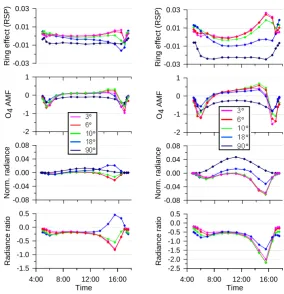
Model, OD: 0.1 Model, OD: 1.0
0.01 0.03 0.05 0.07 0.09 0.11
O4 absorption, western telescope
4:00 8:00 12:00 16:00 4:00 8:00 12:00 16:00
O4
AM
F
14.09.2003 17.09.2003
4:00 8:00 12:00 16:00 1 2 3 4 5 6 7 O4 AMF
4:00 8:00 12:00 16:00
OD: 0.1 OD: 1.0
1 2 3 4 5 6 7 27
Radiance, western telescope
4:00 8:00 12:00 16:00 0E+0 1E+5 2E+5 3E+5 4E+5 5E+5 Radiance [counts/ s ]
4:00 8:00 12:00 16:00
Meas., 14.09.2003 Meas., 17.09.2003
4:00 8:00 12:00 16:00 0.00 0.05 0.10 0.15 Normalised Ra d iance
4:00 8:00 12:00 16:00
Model, OD: 0.1 Model, OD: 1.0
Radiance ratio, western telescope
4:00 8:00 12:00 16:00 0 1 2 3 4 Radiance ratio
4:00 8:00 12:00 16:00
Meas., 14.09.2003 Meas., 17.09.2003
4:00 8:00 12:00 16:00 0 1 2 3 4 Ra dian ce ratio
4:00 8:00 12:00 16:00
Model, OD: 0.1 Model, OD: 1.0
Fig. 3 Comparison of measurements and model results for the western telescope on two selected days (14 and 17 September 2003). Besides the Ring effect, also the O4 AMF and the measured radiance and radiance ratio are displayed. In each sub-plot the upper graphs show the measurement results for the 14 September 2003 (left) and 17 September 2003 (right); the lower graphs show model results for aerosol OD of 0.1 (left) and 1.0 (right). Further aerosol properties are: constant extinction between 0 and 1 km, single scattering albedo of 0.9, asymmetry parameter of 0.68.
28
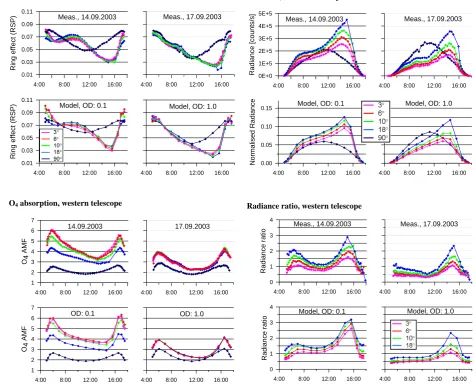
Fig. 3. Comparison of measurements and model results for the western telescope on two selected days (14 and 17 September 2003). Besides the Ring effect, also the O4AMF and the measured radiance and radiance ratio are displayed. In each sub-plot the upper graphs show the measurement results for the 14 September 2003 (left) and 17 September 2003 (right); the lower graphs show model results for aerosol OD of 0.1 (left) and 1.0 (right). Further aerosol properties are: constant extinction between 0 and 1 km, single scattering albedo of 0.9, asymmetry parameter of 0.68.
respectively. For the comparison between model results and measurements (Figs. 3, 4, 9, 10, and Appendix) these val-ues for the O4AMF and the RSP of the Fraunhofer reference spectrum were added to the measurements.
Besides the O4absorption and the Ring effect, also the ob-served radiance (at 350 nm±1 nm) is compared to the model simulations. Since the instrument is not radiometrically cali-brated, the radiance is only used in relative units and no strin-gent comparison to model results is possible. Thus, in addi-tion to the radiance itself, we also calculated radiance ratios with respect to the radiance of the measurement in zenith di-rection (of the same elevation sequence). This radiance ratio is independent of the radiometric calibration and can be
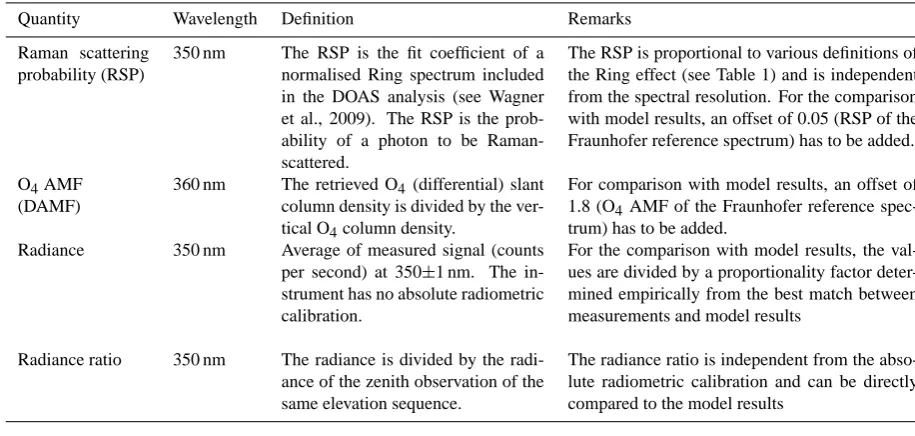
di-rectly compared to the respective ratios from the model sim-ulations. An overview of the measured quantities used in this study is given in Table 2.
3 Radiative transfer modelling
Table 2. Overview of the quantities derived from the MAX-DOAS measurements and used in this study.
Quantity Wavelength Definition Remarks
Raman scattering probability (RSP)
350 nm The RSP is the fit coefficient of a normalised Ring spectrum included in the DOAS analysis (see Wagner et al., 2009). The RSP is the prob-ability of a photon to be Raman-scattered.
The RSP is proportional to various definitions of the Ring effect (see Table 1) and is independent from the spectral resolution. For the comparison with model results, an offset of 0.05 (RSP of the Fraunhofer reference spectrum) has to be added. O4AMF
(DAMF)
360 nm The retrieved O4(differential) slant column density is divided by the ver-tical O4column density.
For comparison with model results, an offset of 1.8 (O4AMF of the Fraunhofer reference spec-trum) has to be added.
Radiance 350 nm Average of measured signal (counts per second) at 350±1 nm. The in-strument has no absolute radiometric calibration.
For the comparison with model results, the val-ues are divided by a proportionality factor deter-mined empirically from the best match between measurements and model results
Radiance ratio 350 nm The radiance is divided by the radi-ance of the zenith observation of the same elevation sequence.
The radiance ratio is independent from the abso-lute radiometric calibration and can be directly compared to the model results
atmospheric situation. From these trajectories the average frequency of the modelled photons for certain interactions with atmospheric constituents or with the Earth’s surface are determined. The scattering events are modelled individu-ally, according to their respective scattering cross sections and phase functions. Interaction with the Earth’s surface is treated as a Lambertian reflection. In addition to elastic pro-cesses (the reflection at the surface, Rayleigh scattering at molecules, scattering on aerosol and cloud particles), also rotational Raman scattering events are modelled (for more details, see Wagner et al., 2009). From the output of the Monte Carlo simulations we determine the fraction of all ob-served photons, which have undergone a rotational Raman scattering event, by counting the numbers of RRS-scattered and total photons). This fraction represents the Raman scat-tering probability (RSP) as defined in Wagner et al. (2009) and can be directly compared to the results from the spectral analysis (see Sect. 2). In this study, the vertical discretisation was chosen to 50 m below 200 m, 200 m below 12 km, 1 km below 25 km and 2.5 km below 50 km.
4 Comparison of measurement and modelling results
In this section measurement data for the two selected days (14 and 17 September 2003) are compared to the radiative transfer simulations. This comparison covers various as-pects: first, it should confirm the applied concept as well as both radiative transfer simulations and measurements. Sec-ond, it should provide an overview of the general range of variability of the different quantities, especially depending on the aerosol optical depth. Third, it should show how the
results depend on the viewing geometry (especially the ele-vation angles and relative azimuth angles).
The aerosol load on both selected days is systematically different. From AERONET observations at Ispra it is found that on 14 September 2003 the aerosol optical depth was low (0.1–0.2), and on 17 September 2003 rather high (0.6–0.9), see Fig. 2. For both days, also substantial variations over the course of the day are found. For comparison with the MAX-DOAS observations (see below) it should be taken into ac-count that the distance between Ispra and the Milan is rather large (about 60 km), and also the local conditions are quite different: Ispra is already located within the Alps, while Mi-lan is located in the Po valley. Thus the aerosol optical depth at Ispra can be only used for a rough comparison with the MAX-DOAS observations.
From the comparison of the MAX-DOAS observations with the radiative transfer simulations (for details see below), it is found, that the values for the aerosol optical depth of about 0.1 and 1.0 lead to best agreement for the two selected days (see Figs. 3 and 4). This finding matches well with the AERONET observations.
500 T. Wagner et al.: Determination of aerosol properties from MAX-DOAS observations of the Ring effect
(a) a)
0.00 0.03 0.06 0.09 0.12
0.00 0.03 0.06 0.09 0.12
0.00 0.03 0.06 0.09 0.12
Ring effect (R
SP)
0.00 0.03 0.06 0.09 0.12
4:00 8:00 12:00 16:00
Time
0.00 0.03 0.06 0.09 0.12
3°
6°
10°
18°
90°
1.0 Model results for different OD:
0 0.025 0.05
0.1 0.2 0.5
1.0 Model results for different OD:
0 0.025 0.05
0.1 0.2 0.5
29
(b) b)
1 3 5 7
1 3 5 7
1 3 5 7
O4
AM
F
1 3 5 7
4:00 8:00 12:00 16:00
Time
1 3 5 7
3°
6°
10°
18°
90° 1.0 Model results for different OD:
0 0.025 0.05
0.1 0.2 0.5
1.0 Model results for different OD:
0 0.025 0.05
0.1 0.2 0.5
30 Fig. 4. Comparison between measurements of the western telescope (red: 14. September; blue: 17 September) and model results for various optical depths. The comparison is performed for individual elevation angles (top: 3◦to bottom 90◦or 18◦). Besides the Ring effect (a) also the O4AMF (b), the radiance (c), and the radiance ratio (d) are shown.
Figure 3 shows the comparison of the 4 measured quanti-ties (RSP, O4AMF, radiance and radiance ratio) for the two selected days with the modelled quantities for the western telescope; the thin lines show the model results for differ-ent optical depth (for the measured O4 AMF and the RSP the respective values of the Fraunhofer reference spectrum are added, see Sect. 2). The measured radiance was scaled by a multiplicative factor until the best overall match was achieved. Thus this comparison should be treated with cau-tion.
In general, rather good agreement is found between mea-surements and model results. For most results, not only the diurnal variation shows the same qualitative behaviour, but also the absolute values agree. It is interesting to note that for both the measured and modelled radiances the dependence on the elevation angle changes in a similar way between 14 and 17 September 2003.
Discrepancies between measurements and model results are mainly found for the RSP (especially at large SZA) and for the radiance and radiance ratio. The differences for the latter two quantities are most probably caused by the suspected presence of very thin clouds (see Sect. 5.2) and spatial and temporal variations of the aerosol load. From AERONET data at Ispra it is found that the aerosol optical depth varied significantly during the two selected days (see Fig. 2). Also differences of the assumed single scattering albedo and asymmetry parameter might be responsible for part of the discrepancies. The deviations of the Raman scat-tering probability at large SZA are probably related to the presence of stratospheric aerosols (see Sect. 5.2).
(c)
c)
0.00 0.05 0.10 0.15
0.00 0.05 0.10 0.15
0.00 0.05 0.10 0.15
Modelled normalised radiance
0.00 0.05 0.10 0.15
4:00 8:00 12:00 16:00
Time
0.00 0.05 0.10 0.15
0E+0 1E+5 2E+5 3E+5 4E+5 5E+5
0E+0 1E+5 2E+5 3E+5 4E+5 5E+5
0E+0 1E+5 2E+5 3E+5 4E+5 5E+5
Me
asu
rem
ent
r
adiance
[cou
n
ts
/s
]
0E+0 1E+5 2E+5 3E+5 4E+5 5E+5
0E+0 1E+5 2E+5 3E+5 4E+5 5E+5
3°
6°
10°
18°
90°
1.0 Model results for different OD:
0 0.025 0.05
0.1 0.2 0.5
1.0 Model results for different OD:
0 0.025 0.05
0.1 0.2 0.5
31 (d)
d)
0 1 2 3 4
0 1 2 3 4
0 1 2 3 4
Radiance ratio
0 1 2 3 4
4:00 8:00 12:00 16:00
Time 3°
6°
10°
18°
1.0 Model results for different OD:
0 0.025 0.05
0.1 0.2 0.5
1.0 Model results for different OD:
0 0.025 0.05
0.1 0.2 0.5
Fig. 4 Comparison between measurements of the western telescope (red: 14. September; blue: 17 September) and model results for various optical depths. The comparison is performed for individual elevation angles (top: 3° to bottom 90° or 18°). Besides the Ring effect (a) also the
O4 AMF (b), the radiance (c), and the radiance ratio (d) are shown.
32 Fig. 4. Continued.
probability depends much more strongly on the relative az-imuth angle.
For the radiance, increasing aerosol load can either in-crease or dein-crease the values for different elevation angles. In general, the radiance tends to increase for zenith view, but tends to decrease for lower elevation angles (see also dis-cussion in Wagner et al., 2004). The radiance depends also on the relative azimuth angle. A strong increase of the ra-diance is found around 15:00, when the relative azimuth an-gle approaches zero. This indicates the strong probability of aerosol scattering in the forward direction.
The radiance ratio is in general decreased for increasing aerosol load. This is caused by the combined effects of de-creased radiances for low elevation angles and inde-creased ra-diance for zenith view. The increased rara-diance for zenith view is caused by the additional photons scattered by the aerosol particles. For low elevation angles, the situation is more complex: even in the absence of aerosols the optical depth along the line of sight is typically much larger than unity. Thus, additional aerosols do basically not enhance the overall probability for solar photons to be scattered into the instrument. The decrease of the observed radiance is in-stead mainly caused by the increased probability for multiple
scattering including multiple reflections at the low surface albedo.
Note that for the other two azimuth angles very similar results were found, but the effect of the relative azimuth angle is smaller (see Appendix).
A more detailed comparison between measurements and model results for the individual elevation angles is presented in Fig. 4. Again the observations of the western telescope are selected, because it shows the strongest effects of the relative azimuth angle. The other viewing directions show similar results.
502 T. Wagner et al.: Determination of aerosol properties from MAX-DOAS observations of the Ring effect
(a)
a)
4:00 8:00 12:00 16:00
Time 0.00 0.02 0.04 0.06 0.08 0.10
Ring effect (RSP)
-0.03 -0.01 0.01 Diff erence -0.03 -0.01 0.01 Dif ference
4:00 8:00 12:00 16:00 Time -0.03 -0.01 0.01 Dif fer ence OD: 0.2 OD: 0.5 OD: 1.0 -300 -200 -100 0 100 [degr ee] OD: 0.1 SZA
rel. azimuth angle
West
33 (b)
b)
4:00 8:00 12:00 16:00
Time 0 2 4 6 8 O4 AMF -3 -2 -1 0 1 Diffe rence -3 -2 -1 0 1 Difference
4:00 8:00 12:00 16:00 Time -3 -2 -1 0 1 Difference OD: 0.2 OD: 0.5 OD: 1.0 -300 -200 -100 0 100 [degree] OD: 0.1 SZA
rel. azimuth angle West
34
(c)
c)
4:00 8:00 12:00 16:00
Time 0.00 0.05 0.10 0.15 N o rm . ra dian ce -0.06 -0.03 0.00 0.03 0.06 Diffe rence -0.06 -0.03 0.00 0.03 0.06 Difference
4:00 8:00 12:00 16:00 Time -0.06 -0.03 0.00 0.03 0.06 Difference OD: 0.2 OD: 0.5 OD: 1.0 -300 -200 -100 0 100 [degree] OD: 0.1 SZA
rel. azimuth angle West
35 (d)
d)
4:00 8:00 12:00 16:00
Time 0 1 2 3 4 Radiance ratio -2.0 -1.0 0.0 1.0 Diffe rence -2.0 -1.0 0.0 1.0 Difference
4:00 8:00 12:00 16:00 Time -2.0 -1.0 0.0 1.0 Difference OD: 0.2 OD: 0.5 OD: 1.0 -300 -200 -100 0 100 [degree] OD: 0.1 SZA
rel. azimuth angle West
Fig. 5 Modelled dependencies of the diurnal profiles of the following quantities: Ring effect (a), O4 AMF (b), radiance (c) and radiance ratio (d) on the optical depth of the aerosol (constant extinction 0-1 km, single scattering albedo: 1.0, AP: 0.68). In the left two diagrams of each set (a-d) the SZA and relative azimuth angle (top) and the simulations for an aerosol OD of 0.1 (bottom) are shown. In the right column the differences of the above quantities for different aerosol ODs (0.2, 0.5, 1.0) compared to those for OD= 0.1 are shown. Results for the western telescope.
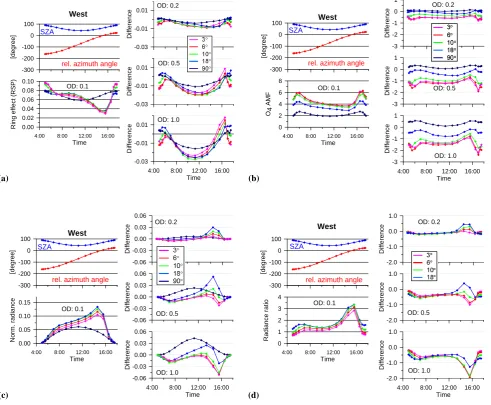
36 Fig. 5. Modelled dependencies of the diurnal profiles of the following quantities: Ring effect (a), O4AMF (b), radiance (c) and radiance ratio (d) on the optical depth of the aerosol (constant extinction 0-1 km, single scattering albedo: 1.0, AP: 0.68). In the left two diagrams of each set (a–d) the SZA and relative azimuth angle (top) and the simulations for an aerosol OD of 0.1 (bottom) are shown. In the right column the differences of the above quantities for different aerosol ODs (0.2, 0.5, 1.0) compared to those for OD=0.1 are shown. Results for the western telescope.
5 Sensitivity studies
5.1 Dependence of the observed quantities on aerosol properties and surface albedo
In this section, the dependencies of the 4 selected quantities on various aerosol properties are investigated. One specific aim is to identify situations, for which the observation of the Ring effect can provide additional information to those re-trieved from observations of O4and the radiance. In addition to the effects of aerosols, also the effects of surface albedo, high clouds and stratospheric aerosols are considered. Again, to minimise the number of graphs, the results are restricted to
one viewing direction. Because of the strong influence of the relative azimuth angle, the western telescope was selected.
(a)
(a) Ring effect (RSP)
-0.01 0.00 0.01 0.02
Difference
-0.01 0.00 0.01 0.02
Difference
-0.01 0.00 0.01 0.02
Dif
fer
ence
4:00 8:00 12:00 16:00 Time -0.01
0.00 0.01 0.02
Difference
4:00 8:00 12:00 16:00 Time SCA: 0.9
AP: 0.6
0-3km
albedo: 3%
SCA: 0.9
AP: 0.6
0-3km
albedo: 3%
37 (b)
(b) O4 AMF
-0.5 0.0 0.5 1.0
Difference
-0.5 0.0 0.5 1.0
Difference
-0.5 0.0 0.5 1.0
Dif
fer
ence
4:00 8:00 12:00 16:00
Time -0.5
0.0 0.5 1.0
Difference
4:00 8:00 12:00 16:00
Time SCA: 0.9
AP: 0.6
0-3km
albedo: 3%
SCA: 0.9
AP: 0.6
0-3km
albedo: 3%
38
Fig. 6. Influence of various aerosol properties and the surface albedo. The different panels show (a) the strength of the Ring effect, (b) O4 AMF, (c) radiance, (d) radiance ratio (left: OD: 0.1; right: OD: 1.0). The results are expressed as differences compared to the case with constant extinction between 0–1 km, single scattering albedo: 1.0, AP: 0.68, and surface albedo: 5%. Only one parameter is changed (as indicated in the figures). Results for the western telescope.
For both O4 AMF and RSP, a strong dependence on the aerosol optical depth is found, especially for observations at low elevation angle. For the radiance and radiance ratio, de-pending on the viewing angles and solar zenith angle, an in-crease or dein-crease is found.
In Fig. 6, the influence of several other aerosol properties on the selected quantities is shown. Here, only the differ-ences with respect to the standard scenarios (constant extinc-tion 0–1 km, single scattering albedo: 1.0, AP: 0.68) for an optical depth of 0.1 (left hand side) or 1.0 (right hand side) are presented. In addition to the aerosol properties, also the effects of changes of the surface albedo are included.
For the RSP, the strongest effects are found for changes of the layer height. Especially for low optical depth, the RSP increases with increasing layer height. This is most proba-bly caused by the fact that the absorption path along the line of sight is increased if the aerosol load is distributed over a larger height interval. Accordingly, the probability of molec-ular scattering increases. Also the asymmetry parameter can have a strong effect on the RSP, but only for conditions with rather small relative azimuth angle. Under such conditions, a decrease of the asymmetry parameter leads to an increase of the Raman scattering probability, because more photons are
scattered from the side into the line of sight. Such photons have a larger probability to be scattered by molecules.
For the O4AMF also the height of the aerosol layer has a substantial effect. With increasing height of the aerosol layer the absorption paths along the line of sight become longer and accordingly the O4absorption is increased. In contrast to the RSP, for the O4AMF the influence of the asymmetry parameter is rather small indicating the fact that the absorp-tion path for photons which were scattered from the side into the line of sight are rather similar to those scattered in the forward direction. For the radiance and the radiance ratio, the influence of the single scattering albedo (especially for large optical depth) becomes important. Also the other pa-rameters (except the surface albedo) can have a considerable effect, but only for relative azimuth angles close to zero. 5.2 Dependence of the observed quantities on the
pres-ence of high cirrus and stratospheric aerosols
504 T. Wagner et al.: Determination of aerosol properties from MAX-DOAS observations of the Ring effect
(c)
(c) Radiance
-0.04 -0.02 0.00
Difference
-0.04 -0.02 0.00
Difference
-0.04 -0.02 0.00
Dif
fer
ence
4:00 8:00 12:00 16:00 Time -0.04
-0.02 0.00
Difference
4:00 8:00 12:00 16:00 Time SCA: 0.9
AP: 0.6
0-3km
albedo: 3%
SCA: 0.9
AP: 0.6
0-3km
albedo: 3%
39
(d)
(d) Radiance ratio
-0.6 -0.4 -0.2 0.0 0.2
Difference
-0.6 -0.4 -0.2 0.0 0.2
Difference
-0.6 -0.4 -0.2 0.0 0.2
Dif
fer
ence
4:00 8:00 12:00 16:00
Time -0.6
-0.4 -0.2 0.0 0.2
Difference
4:00 8:00 12:00 16:00
Time SCA: 0.9
AP: 0.6
0-3km
albedo: 3%
SCA: 0.9
AP: 0.6
0-3km
albedo: 3%
Fig. 6 Influence of various aerosol properties and the surface albedo. The different panels show (a) the strength of the Ring effect, (b) O4 AMF, (c), radiance, (d) radiance ratio (left:
OD: 0.1; right: OD: 1.0). The results are expressed as differences compared to the case with constant extinction between 0-1 km, single scattering albedo: 1.0, AP: 0.68, and surface albedo: 5%. Only one parameter is changed (as indicated in the figures). Results for the western telescope.
40
Fig. 6. Continued.
enhanced atmospheric absorption paths (Erle et al., 1995; Wagner et al., 1998; Pfeilsticker et al., 1998; Wagner et al., 2004). In the presence of extended and optically thick clouds, the determination of aerosol properties using MAX-DOAS observations might become impossible or is at least strongly limited.
The presence of clouds can be usually detected by the ob-served quantities themselves, in particular by strong devia-tions of the observed radiance, O4AMF and RSP from the respective values for clear sky. Often also the rapid tempo-ral variation of the observed quantities (caused by changes in the cloud properties) are a clear indication for the cloud presence.
However, in some cases, the presence of thin (possibly sub-visible) clouds might not be obvious from the observed quantities. Such cases are investigated in this section. In Fig. 7 the effects of a thin homogenous cirrus clouds (opti-cal depth either 0.2 or 1.0) between 9 and 10 km are shown, expressed as differences compared to the standard aerosol scenario with optical depth 0.1, constant extinction 0–1 km, single scattering albedo: 1.0, and AP: 0.68. The results in-dicate that for clouds with an optical depth of about unity or larger, it should be possible to discriminate the effects from those of aerosols close to the surface (by inspecting the
par-ticular diurnal variations of the observed quantities). How-ever, for cirrus clouds with very small optical depths, this will be a very challenging task, in particular if the aerosol or cloud properties also change during the day. In general, the possible presence of thin cirrus clouds constitutes a fun-damental error source for the retrieval of aerosol properties from MAX-DOAS observations (also for other observations like sun photometers). In particular, observations of the Ring effect (and the O4absorption) in zenith direction can be off-set by the presence of thin cirrus clouds. One promising way to discriminate the effects of thin clouds from those of aerosols could be to study the wavelength dependence: while the wavelength dependence of scattering by cloud particles is weak (i.e., clouds are white), that of aerosol scattering shows a strong wavelength dependence. Thus the relation of the strength of the Ring effect at different wavelengths should be different for clouds and aerosols.
In addition, also stratospheric aerosols can affect the ob-served quantities. Especially during sunset and sunrise, the first scattering events of the incoming sun light usually take place at high altitudes, where stratospheric aerosols could al-ter the atmospheric scatal-tering properties.
-2 -1 0 1
O4
AMF
-0.03 -0.01 0.01 0.03
Ring effect
(RSP
)
-0.08 -0.04 0.00 0.04 0.08
No
rm.
ra
d
ianc
e
-1.5 -1.0 -0.5 0.0 0.5
Ra
dianc
e
ra
tio
4:00 8:00 12:00 16:00 Time
-2 -1 0 1
O4
AMF
-0.03 -0.01 0.01 0.03
Rin
g
effe
ct
(RSP
)
-0.08 -0.04 0.00 0.04 0.08
N
o
rm
. ra
d
ian
ce
-2.5 -2.0 -1.5 -1.0 -0.5 0.0 0.5
Radiance
ratio
4:00 8:00 12:00 16:00 Time
Fig. 7 Influence of high cirrus clouds on the measured quantities. The aerosol properties are constant extinction 0-1 km, OD: 0.1, single scattering albedo: 1.0, AP: 0.68. The cirrus clouds have optical depths of 0.2 (left) and 1.0 (right) and are located between 9 and 10 km (AP: 0.68, single scattering albedo: 1).
41
Fig. 7. Influence of high cirrus clouds on the measured quantities. The aerosol properties are constant extinction 0–1 km, OD: 0.1, single scattering albedo: 1.0, AP: 0.68. The cirrus clouds have optical depths of 0.2 (left) and 1.0 (right) and are located between 9 and 10 km (AP: 0.68, single scattering albedo: 1).
small, since for a long time no strong volcanic eruption had taken place (see e.g. http://data.giss.nasa.gov/modelforce/ strataer/). From the SAGE-II satellite instrument, the to-tal stratospheric aerosol optical depth at 1020 nm was found to be below 0.002 (see e.g. http://data.giss.nasa.gov/sageii/). However, because the stratospheric aerosol particles are small, the optical depth at 360 nm is expected to be sub-stantially larger. In Fig. 8 the influence of two assumed stratospheric aerosol profiles on the observed 4 quantities is shown. Both assumed stratospheric profiles extend from 15–25 km with constant extinction with a total optical depth of either 0.01 or 0.02. The single scattering albedo and the asymmetry parameter are assumed to be 1.0 and 0.68, re-spectively. Again, the results are expressed as differences to the standard aerosol scenario for an optical depth of 0.1 (constant extinction 0–1 km, single scattering albedo: 1.0, AP: 0.68). The assumed stratospheric aerosol optical depth is rather small compared to those used near the surface. Nev-ertheless, for large SZA, systematic differences compared to the standard scenario are found (except for the radiance). Es-pecially for the RSP, the presence of stratospheric aerosols can then lead to a systematic decrease. This effect is proba-bly the main reason for the deviation between measurement results and model simulations as seen in Fig. 4. Other rea-sons might include the effects of polarisation and refraction,
which are both not included in the current version of our model.
506 T. Wagner et al.: Determination of aerosol properties from MAX-DOAS observations of the Ring effect
-2 -1 0 1
O4
AM
F
-0.03 -0.01 0.01 0.03
Ring effect (RSP)
-0.08 -0.04 0.00 0.04 0.08
No
rm
. ra
d
ian
c
e
-2.5 -2.0 -1.5 -1.0 -0.5 0.0 0.5
R
a
d
ian
ce r
a
tio
4:00 8:00 12:00 16:00 Time
-2 -1 0 1
O4
AM
F
-0.03 -0.01 0.01 0.03
Ring effect (RSP)
-0.08 -0.04 0.00 0.04 0.08
No
rm
. ra
d
ian
c
e
-2.5 -2.0 -1.5 -1.0 -0.5 0.0 0.5
R
a
d
ian
ce r
a
tio
4:00 8:00 12:00 16:00 Time
Fig. 8 Influence of two different stratospheric aerosols properties on the measured quantities. The aerosol properties are constant extinction 0-1 km, OD: 0.1, single scattering albedo: 1.0, AP: 0.68.The stratospheric aerosol has optical depths of 0.01 (left) and 0.02 (right) with constant extinction between 15 and 25 km (AP: 0.68, single scattering albedo: 1).
42
Fig. 8. Influence of two different stratospheric aerosols properties on the measured quantities. The aerosol properties are constant extinction 0–1 km, OD: 0.1, single scattering albedo: 1.0, AP: 0.68. The stratospheric aerosol has optical depths of 0.01 (left) and 0.02 (right) with constant extinction between 15 and 25 km (AP: 0.68, single scattering albedo: 1).
5.3 Special cases with strong potential of Ring effect ob-servations for the retrieval of aerosol properties
In many situations, the influence of aerosols on the RSP and the O4 AMF shows a very similar qualitative dependence. This can be understood from the fact that an increase (de-crease) of the atmospheric light path will in general lead to an increased (decreased) O4 absorption as well as to an increased (decreased) probability for molecular scattering. Nevertheless, there are also interesting differences in the de-tailed dependencies, some of them will be discussed in this section.
Figure 9 shows the diurnal variation of the measured and modelled RSP and the O4AMF for the 18 degree elevation of the western telescope (same data as shown in Fig. 4). For dif-ferent times of the day the modelled Raman scattering prob-abilities for different aerosol optical depth indicate a quite different sensitivity either to small or large aerosol optical depths. Around 11:00, the curves for low aerosol optical depth show only little differences, while those for aerosol optical depths>0.2 show large differences, indicating a high sensitivity for optical depths>0.2. In contrast, around 15:00 the modelled curves for small aerosol optical depths (<0.2) show large differences, while those for larger optical depths
show only small differences, indicating a high sensitivity for optical depths<0.2. A similar behaviour is also found for the O4 AMFs (Fig. 9b), but with rather small absolute dif-ferences. Thus observations of the Ring effect might be es-pecially well suited for an optimisation of the sensitivity for situations with different aerosol optical depths.
Another interesting application for Ring effect observa-tions is found for observaobserva-tions in zenith viewing direction. In Fig. 10 the diurnal variation of the measured and mod-elled RSP and O4 AMF for the 90 degree elevation (same data as shown in Fig. 4). Except for large SZA, the RSP depends strongly on the aerosol optical depth. In contrast, the O4AMF shows only a weak dependence. Here it is also interesting to note that the aerosol profile has only a small effect on the RSP measured in zenith direction: at low so-lar zenith angles, the influence of a change of the profile height from 1 km to 3 km is about 10% of the change of the aerosol optical depth from 0 to 1 (see also Fig. 6a). This ef-fect decreases further towards larger wavelengths (e.g.<5% at 500 nm), because of the decreasing probability for scatter-ing by molecules.
(a)
4:00 8:00 12:00 16:00
Time
RSP
Ring effect (RSP) 18°
0.00 0.03 0.06 0.09 0.12
(b)
1 3 5 7
O4
AM
F
4:00 8:00 12:00 16:00
Time
O4 AMF 18°
1.0 Model results for different OD:
0 0.025 0.05
0.1 0.2 0.5
1.0 Model results for different OD:
0 0.025 0.05
0.1 0.2 0.5
Fig. 9 Diurnal variation of the measured and modelled values of the Raman scattering probability (a) and the O4 AMF (b) for the western telescope at 18° elevation (same data as in
Fig. 4). Depending on the viewing geometry the Ring effect observations are especially sensitive for low OD (green rectangle) or high OD (blue rectangle).
43
Fig. 9. Diurnal variation of the measured and modelled values of the Raman scattering probability (a) and the O4AMF (b) for the western telescope at 18◦elevation (same data as in Fig. 4). De-pending on the viewing geometry the Ring effect observations are especially sensitive for low OD (green rectangle) or high OD (blue rectangle).
properties. From the analysis of the Ring effect, informa-tion on aerosol properties could thus be derived from many UV instruments prior to the MAX-DOAS era.
Finally, as shown in the previous sub-section, observations of the Ring effect at large SZA might provide information on stratospheric aerosol properties, even for very small optical depths (<0.01).
All three examples indicate potential areas in which the analysis of the Ring effect might provide valuable informa-tion in addiinforma-tion to the analysis of the O4absorption. Addi-tional possibilities might be discovered from further sensitiv-ity studies, especially including other wavelengths.
6 Conclusions
In this study the first quantitative comparison of MAX-DOAS observations of the Ring effect with model simula-tions is presented. The comparison is performed for two cloud-free days with different atmospheric aerosol loads. It also includes a large variety of viewing geometries: SZA between about 45◦ to 90◦, elevation angles at 3◦, 6◦, 10◦,
18◦and 90◦(zenith), as well as three azimuth angles (North,
West, South). The variety of atmospheric conditions and viewing geometries allowed a comprehensive test of our ca-pabilities to measure and model the Ring effect. In addition to the Ring effect, also the observed O4absorptions and ra-diances are compared to the model simulations. In general good agreement was found. Discrepancies occurred mainly for the radiance and the Ring effect at large SZA. The
differ-(a)
4:00 8:00 12:00 16:00
Time
RSP
Ring effect (RSP) 90°
0.00 0.03 0.06 0.09 0.12
1.0 Model results for different OD:
0 0.025 0.05
0.1 0.2 0.5
1.0 Model results for different OD:
0 0.025 0.05
0.1 0.2 0.5
(b)
4:00 8:00 12:00 16:00
Time 1
3 5 7
O4
AMF
O4 AMF 90°
Fig. 10 Diurnal variation of the measured and modelled values of the Raman scattering
probability (a) and the O4 AMF (b) for the telescopes at 90° elevation (same data as in Fig. 4).
For Zenith observations the analysis of the Ring effect can provide more information on
aerosol properties than the O4 absorption, especially during noon.
44 Fig. 10. Diurnal variation of the measured and modelled values of the Raman scattering probability (a) and the O4AMF (b) for the telescopes at 90◦ elevation (same data as in Fig. 4). For Zenith observations the analysis of the Ring effect can provide more in-formation on aerosol properties than the O4absorption, especially during noon.
ences in the radiance are most probably caused by the sim-plified assumptions of the aerosol scenarios (especially with respect to the values of the asymmetry parameter and the sin-gle scattering albedo). Also thin cirrus clouds and horizon-tal gradients of the aerosol properties might explain part of the differences. The differences of modelled and measured Ring effect at large SZA might be related to several reasons: first, for such viewing geometries, the effects of polarisation and refraction might become important. Both effects are cur-rently not included in our radiative transfer model. In addi-tion, it was found that at large SZA, even very small strato-spheric aerosol loads can have a relatively strong effect on the Ring effect.
508 T. Wagner et al.: Determination of aerosol properties from MAX-DOAS observations of the Ring effect azimuth angles, Ring effect observations are thus sensitive to
the aerosol phase function. The observed radiance is most sensitive to properties of the scattering processes, but is al-most independent of the atmospheric light path distribution. In contrast to observations of the O4absorption and the Ring effect, the radiance depends strongly on the aerosol absorb-ing properties (see also Frieß et al., 2006).
Observations of the Ring effect might become especially interesting for two specific applications: Ring effect obser-vations at large SZA could allow to retrieve stratospheric aerosol properties, even in cases with very low stratospheric aerosol optical depths. While this might become an inter-esting tool to monitor the temporal evolution of stratospheric aerosols, more research is needed to explore the full potential of Ring observations.
In addition, for conventional zenith scattered light obser-vations, the analysis of the Ring effect provides a unique op-portunity to retrieve aerosol properties, since in contrast to the O4 absorption the Ring effect depends strongly on the aerosol optical depth. It should be also noted here, that such retrievals are rather straightforward, because no dependence on the relative azimuth angle has to be considered. Also the (relative) aerosol profile has a rather small effect on the observation of zenith scattered light. The analysis of the Ring effect might thus allow to create long term data sets of aerosol properties from existing zenith UV observations prior the MAX-DOAS era.
Future studies should investigate the aerosol influence on the Ring effect at additional wavelengths. This might be-come a very important aspect, because in contrast to O4 absorptions, the Ring effect can be retrieved almost con-tinuously over large wavelength intervals. Also radiative transfer simulations should be improved by including the ef-fects of polarisation and refraction. Finally, inversion tech-niques based on least squares algorithms or optimal estima-tion should be developed taking into account the observed radiances, the Ring effect and O4absorptions.
Appendix A
Comparison of measurements and model
simulations for the northern and southern telescope
Appendix: comparison of measurements and model simulations for the northern and southern telescope
Ring effect, northern telescope
4:00 8:00 12:00 16:00 4:00 8:00 12:00 16:00
Ring
eff
e
ct
(R
SP
) Meas., 14.09.2003 Meas., 17.09.2003
4:00 8:00 12:00 16:00 0.01
0.03 0.05 0.07 0.09 0.11
Ring effect (RSP
)
4:00 8:00 12:00 16:00 Model, OD: 0.1 Model, OD: 1.0 0.01
0.03 0.05 0.07 0.09 0.11
O4 absorption, northern telescope
4:00 8:00 12:00 16:00 4:00 8:00 12:00 16:00 O4
AM
F
14.09.2003 17.09.2003
4:00 8:00 12:00 16:00 1
2 3 4 5 6 7
O4
AMF
4:00 8:00 12:00 16:00
OD: 0.1 OD: 1.0
1 2 3 4 5 6 7
45
Fig. A1. Same as Fig. 3, but for the northern and southern tele-scopes: Comparison of measurements and model results for the western telescope on two selected days (14 and 17 September 2003). Besides the Ring effect, also the O4 AMF and the mea-sured radiance and radiance ratio are displayed. In each sub-plot the upper graphs show the measurement results for the 14 Septem-ber (left) and 17 SeptemSeptem-ber (right); the lower graphs show model results for aerosol OD of 0.1 (left) and 1.0 (right). Further aerosol properties are: constant extinction between 0 and 1 km, single scat-tering albedo of 0.9, asymmetry parameter of 0.68.
Radiance, northern telescope
4:00 8:00 12:00 16:00 0E+0
1E+5 2E+5 3E+5 4E+5 5E+5
Ra
diance
[co
u
nts/s]
4:00 8:00 12:00 16:00 Meas., 14.09.2003 Meas., 17.09.2003
4:00 8:00 12:00 16:00 0.00
0.05 0.10 0.15
No
rm
a
lis
ed
R
a
d
ian
c
e
4:00 8:00 12:00 16:00 Model, OD: 0.1 Model, OD: 1.0
Radiance ratio, northern telescope
4:00 8:00 12:00 16:00 0
1 2 3 4
Radiance ratio
4:00 8:00 12:00 16:00
Meas., 14.09.2003 Meas., 17.09.2003
4:00 8:00 12:00 16:00 0
1 2 3 4
Ra
dian
ce ratio
4:00 8:00 12:00 16:00
Model, OD: 0.1 Model, OD: 1.0
46
510 T. Wagner et al.: Determination of aerosol properties from MAX-DOAS observations of the Ring effect
Ring effect, southern telescope
4:00 8:00 12:00 16:00 4:00 8:00 12:00 16:00
Ring eff e ct (R SP)
Meas., 14.09.2003 Meas., 17.09.2003
4:00 8:00 12:00 16:00 0.01 0.03 0.05 0.07 0.09 0.11
Ring effect (RSP
)
4:00 8:00 12:00 16:00
Model., OD: 0.1 Model., OD: 1.0
0.01 0.03 0.05 0.07 0.09 0.11
O4 absorption, southern telescope
4:00 8:00 12:00 16:00 4:00 8:00 12:00 16:00
O4
AM
F
14.09.2003 17.09.2003
4:00 8:00 12:00 16:00 1 2 3 4 5 6 7 O4 AMF
4:00 8:00 12:00 16:00
OD: 0.1 OD: 1.0
1 2 3 4 5 6 7 47 Ring effect, southern telescope
4:00 8:00 12:00 16:00 4:00 8:00 12:00 16:00
Ring eff e ct (R SP)
Meas., 14.09.2003 Meas., 17.09.2003
4:00 8:00 12:00 16:00 0.01 0.03 0.05 0.07 0.09 0.11
Ring effect (RSP
)
4:00 8:00 12:00 16:00
Model., OD: 0.1 Model., OD: 1.0
0.01 0.03 0.05 0.07 0.09 0.11
O4 absorption, southern telescope
4:00 8:00 12:00 16:00 4:00 8:00 12:00 16:00
O4
AM
F
14.09.2003 17.09.2003
4:00 8:00 12:00 16:00 1 2 3 4 5 6 7 O4 AMF
4:00 8:00 12:00 16:00
OD: 0.1 OD: 1.0
1 2 3 4 5 6 7 47
Fig. A1. Continued.
Acknowledgements. The authors would like to thank the staff of
the Italian Red Cross section at the airport in Bresso (Milan), where the measurements were carried out for their great hospitality. Many thanks to Barbara Dix, Udo Frieß and Irene Pundt for their help in constructing and operating the MAX-DOAS instrument. Financial support from the EU is highly appreciated (project FORMAT, http://www.nilu.no/format/, grant EVK2-CT-2001-00120). Aerosol data from the AERONET station at Ispra (Italy) are used for com-parison with our results. Many thanks to the Principal Investigator, Giuseppe Zibordi for his effort in establishing and maintaining the AERONET station at Ispra.
The service charges for this open access publication have been covered by the Max Planck Society. Edited by: C. von Savigny
Radiance, southern telescope
4:00 8:00 12:00 16:00 0E+0 1E+5 2E+5 3E+5 4E+5 5E+5 Radi ance [cou nt s/s]
4:00 8:00 12:00 16:00
Meas., 14.09.2003 Meas., 17.09.2003
4:00 8:00 12:00 16:00 0.00 0.05 0.10 0.15 Norm alis ed Radiance
4:00 8:00 12:00 16:00
Model, OD: 0.1 Model, OD: 1.0
Radiance ratio, southern telescope
4:00 8:00 12:00 16:00 0 1 2 3 4 Radiance ratio
4:00 8:00 12:00 16:00
Meas. 14.09.2003 Meas. 17.09.2003
4:00 8:00 12:00 16:00 0 1 2 3 4 Ra dian ce ratio
4:00 8:00 12:00 16:00
Model, OD: 0.1 Model, OD: 1.0
Fig. A1 Same as Fig. 3, but for the northern and southern telescopes: Comparison of measurements and model results for the western telescope on two selected days (14 and 17 September 2003). Besides the Ring effect, also the O4 AMF and the measured radiance and radiance ratio are displayed. In each sub-plot the upper graphs show the measurement results for the 14 September (left) and 17 September (right); the lower graphs show model results for aerosol OD of 0.1 (left) and 1.0 (right). Further aerosol properties are: constant extinction between 0 and 1 km, single scattering albedo of 0.9, asymmetry parameter of 0.68.
48 Radiance, southern telescope
4:00 8:00 12:00 16:00 0E+0 1E+5 2E+5 3E+5 4E+5 5E+5 Radi ance [cou nt s/s]
4:00 8:00 12:00 16:00
Meas., 14.09.2003 Meas., 17.09.2003
4:00 8:00 12:00 16:00 0.00 0.05 0.10 0.15 Norm alis ed Radiance
4:00 8:00 12:00 16:00
Model, OD: 0.1 Model, OD: 1.0
Radiance ratio, southern telescope
4:00 8:00 12:00 16:00 0 1 2 3 4 Radiance ratio
4:00 8:00 12:00 16:00
Meas. 14.09.2003 Meas. 17.09.2003
4:00 8:00 12:00 16:00 0 1 2 3 4 Ra dian ce ratio
4:00 8:00 12:00 16:00
Model, OD: 0.1 Model, OD: 1.0
Fig. A1 Same as Fig. 3, but for the northern and southern telescopes: Comparison of measurements and model results for the western telescope on two selected days (14 and 17 September 2003). Besides the Ring effect, also the O4 AMF and the measured radiance and
radiance ratio are displayed. In each sub-plot the upper graphs show the measurement results for the 14 September (left) and 17 September (right); the lower graphs show model results for aerosol OD of 0.1 (left) and 1.0 (right). Further aerosol properties are: constant extinction between 0 and 1 km, single scattering albedo of 0.9, asymmetry parameter of 0.68.
48
Fig. A1. Continued.
References
Aben, I., Stam, D. M., and Helderman, F.: The Ring effect in skylight polarization, Geophys. Res. Lett., 28(3), 519–522, doi:10.1029/2000GL011901, 2001.
Bobrowski, N., H¨onninger, G., Galle, B., and Platt, U.: Detection of bromine monoxide in a volcanic plume, Nature, 423, 273–276, 2003.
Brinkmann, R. T.: Rotational Raman scattering in planetary atmo-spheres, Astrophys. J., 154, 1087–1093, 1968.
Burrows, J., Vountas, M., Haug, H., Chance, K., Marquard, L., Muirhead, K., Platt, U., Richter, A., and Rozanov, V.: Study of the Ring effect, Final Report for ESA Contract 109996/94/NL/CN, 1995.
Chance, K. V. and Spurr, R. J. D.: Ring effect studies: Rayleigh scattering, including molecular parameters for rotational Raman scattering, and the Fraunhofer spectrum, Appl. Optics, 36, 5224– 5230, 1997.
Deutschmann, T.: Atmospheric radiative transfer modelling using Monte Carlo methods, Diploma thesis, University of Heidelberg, 2008.
Deutschmann, T. and Wagner, T.: TRACY-II Users manual, http: //joseba.mpch-mainz.mpg.de/Strahlungstransport.htm, 2008. de Beek, R., Vountas, M., Rozanov, V. V., Richter, A., and Burrows,
J. P.: The Ring effect in the cloudy atmosphere, Geophys. Res. Lett., 28, 721–724, 2001.
Erle, F., Pfeilsticker, K., and Platt, U.: On the influence of tropo-spheric clouds on zenith-scattered-light measurements of strato-spheric species, Geophys. Res. Lett., 22, 2725–2728, 1995. Fietkau, S., Medeke, T., Richter, A., Sheode, N., Sinnhuber, B.-M.,
Wittrock, F., Theys, N., van Roozendael, M., and Burrows, J. P.: Ground-based measurements of tropospheric and stratospheric bromine monoxide above Nairobi (1◦S, 36◦E), Atmos. Chem. Phys. Discuss., 7, 6527–6555, 2007,
http://www.atmos-chem-phys-discuss.net/7/6527/2007/. Fish, D. J. and Jones, R. L.: Rotational Raman scattering and the
ring effect in zenith-sky spectra, Geophys. Res. Lett., 22, 811– 814, 1995.
Frieß, F., Monks, P. S., Remedios, J. J., Rozanov, A., Sinre-ich, R., Wagner, T., and Platt, U.: MAX-DOAS O4 measure-ments: A new technique to derive information on atmospheric aerosols. (II) Modelling studies, J. Geophys. Res., 111, D14203, doi:10.1029/2005JD00661, 2006.
Grainger, J. F. and Ring, J.: Anomalous Fraunhofer line profiles, Nature, 193, 762, 1962.
Greenblatt, G. D., Orlando, J. J., Burkholder, J. B., and Ravis-hankara, A. R.: Absorption measurements of oxygen between 330 and 1140 nm, J. Geophys. Res., 95, 18577–18582, 1990. Heckel, A., Richter, A., Tarsu, T., Wittrock, F., Hak, C., Pundt, I.,
Junkermann, W., and Burrows, J. P.: MAX-DOAS measurements of formaldehyde in the Po-Valley, Atmos. Chem. Phys., 5, 909– 918, 2005, http://www.atmos-chem-phys.net/5/909/2005/. H¨onninger, G. and Platt, U.: The Role of BrO and its Vertical
Dis-tribution during Surface Ozone Depletion at Alert, Atmos. Envi-ron., 36, 2481–2489, 2002.
H¨onninger, G., von Friedeburg, C., and Platt, U.: Multi axis dif-ferential optical absorption spectroscopy (MAX-DOAS), Atmos. Chem. Phys., 4, 231–254, 2004,
http://www.atmos-chem-phys.net/4/231/2004/.
Joiner, J., Bhartia, P. K., Cebula, R. P., Hilsenrath, E., McPeters, R. D., and Park, H.: Rotational Raman scattering – Ring effect in satellite backscatter ultraviolet measurements, Appl. Optics, 34, 4513–4525, 1995.
Joiner, J. and Bhartia, P. K.: The determination of cloud pressures from rotational Raman scattering in satellite backscatter ultravi-olet measurements, J. Geophys. Res., 100, 23019–23026, 1995. Joiner, J., Vasilkov, A., Flittner, D., Buscela, E., and
Glea-son, J.: Retrieval of Cloud Pressure from Rotational Ra-man Scattering, in: OMI Algorithm Theoretical Basis Doc-ument Volume III: Clouds, Aerosols, and Surface UV Ir-radiance, edited by: Stammes, P., ATBD-OMI-03, Ver-sion 2.0, August 2002 (http://www.knmi.nl/omi/documents/data/ OMI ATBD Volume 3 V2.pdf), 31–46, 2002.
Joiner, J., Vasilkov, A. P., Flittner, D. E., Gleason, J. F., and Bhar-tia, P. K.: Retrieval of cloud pressure and oceanic chlorophyll content using Raman scattering in GOME UV measurements., J. Geophys. Res., 109, D01109, doi:10.1029/2003JD003698, 2004. Joiner, J. and Vasilkov, A. P.: First results from the OMI rotational Raman scattering cloud pressure algorithm, Geoscience and Re-mote Sensing, IEEE Transactions, 44(5), 1272–1282, 2006. Kattawar, G. W., Young, A. T., and Humphreys, T. J.:
Inelastic-Scattering in Planetary-Atmospheres. 1. The Ring Effect, with-out Aerosols, Astrophys. J., 243(3), 1049–1057, 1981.
Langford, A. O., Schofield, R., Daniel, J. S., Portmann, R. W., Melamed, M. L., Miller, H. L., Dutton, E. G., and Solomon, S.: On the variability of the Ring effect in the near ultraviolet: un-derstanding the role of aerosols and multiple scattering, Atmos. Chem. Phys., 7, 575–586, 2007,
http://www.atmos-chem-phys.net/7/575/2007/.
Leser, H., H¨onninger, G., and Platt, U.: MAX-DOAS measure-ments of BrO and NO2 in the marine boundary layer, Geophys. Res. Lett., 30, 10, doi:10.1029/2002GL015811, 2003.
Noxon, J. F., Whipple Jr., E. C., and Hyde, R. S.: Stratospheric NO2, Observational method and behavior at mid-latitude, J. Geo-phys. Res., 84, 5047–5076, 1979.
Park, H., Heath, D. F., and Mateer, C. L.: Possible application of the Fraunhofer line filling in effect to cloud height measure-ments, Meteorological Optics, OSA Technical Digest Series, 70– 81, Opt. Soc. Am., Washington, D.C., 1986.
Perner, D. and Platt, U.: Absorption of light in the atmosphere by collision induced pairs of oxygen, (O2)2, Geophys. Res. Lett., 7, 1053–1056, 1980.
Platt, U., Marquard, L., Wagner, T., and Perner, D.: Corrections for zenith scattered light DOAS, Geophys. Res. Lett., 24, 1759– 1762, 1997.
Platt, U. and Stutz, J.: Differential Optical Absorption Spec-troscopy, Principles and Applications, Springer, Berlin, 2008. Pfeilsticker, K., Erle, F., Funk, O., Veitel, H., and Platt, U.: First
geometrical pathlengths probability density function derivation of the skylight from spectroscopically highly resolving oxygen A-band observations: 1. Measurement technique, atmospheric observations, and model calculations, J. Geophys.Res., 103, 11483–11504, 1998.
Shefov, N. N.: Spectroscopic, photoelectric, and radar investiga-tions of the aurora and the nightglow, Izd. Akad. Nauk., 1, 25–28, 1959.
Sioris, C. E. and Evans, W. F. J.: Impact of rotational Raman scat-tering in the O2A band, Geophys. Res. Lett., 27, 4085–4088, 2000.
Solomon, S., Schmeltekopf, A. L., and Sanders, R. W.: On the in-terpretation of zenith sky absorption measurements, J. Geophys. Res., 92, 8311–8319, 1987.
Theys, N., Van Roozendael, M., Hendrick, F., Fayt, C., Hermans, C., Baray, J.-L., Goutail, F., Pommereau, J.-P., and De Mazire, M.: Retrieval of stratospheric and tropospheric BrO columns from multi-axis DOAS measurements at Reunion Island (21◦S, 56◦E), Atmos. Chem. Phys., 7, 4733–4749, 2007,
http://www.atmos-chem-phys.net/7/4733/2007/.
512 T. Wagner et al.: Determination of aerosol properties from MAX-DOAS observations of the Ring effect
doi:10.1029/2007JD009129, 2008.
Van Roozendael, M., Fayt, C., Post, P., Hermans, C., and Lambert, J.-C.: Retrieval of BrO and NO2from UV-Visible Observations, in: Sounding the troposphere from space: a new era for atmo-spheric chemistry, Springer-Verlag, ISBN 3-540-40873-8, edited by: Borrell, P., Borrell, P. M., Burrows, J. P., and Platt, U., 2003. Volkamer, R.: Absorption von Sauerstoff im Herzberg I system, und Anwendungen auf die Aromatenmessungen am EUropean PHoto REactor, (EUPHORE), Diploma thesis, University of Hei-delberg, Germany, 1996.
Vountas, M.: Die Modellierung und Parametrisierung des Ring Effektes: Einfluß auf die Bestimmung von stratosph¨arischen Spurengasen, PhD-thesis, University of Bremen, http://www.iup. physik.uni-bremen.de/diss/Vountas/ring diss/master.html, 1998. Vountas, M., Rozanov, V. V., and Burrows, J. P.: Ring effect: Impact of rotational Raman scattering on radiative transfer in earth’s at-mosphere, J. Quant. Spectrosc. Radiat. Trans., 60(6), 943–961, 1998.
Wagner, T., Erle, F., Marquard, L., Otten, C., Pfeilsticker, K., Senne, T., Stutz, J., and Platt, U.: Cloudy sky optical paths as derived from differential optical absorption spectroscopy observations, J. Geophys. Res., 103, 25307–25321, 1998.
Wagner, T., von Friedeburg, C., Wenig, M., Otten, C., and Platt, U.: UV/vis observations of atmospheric O4 absorptions using direct moon light and zenith scattered sunlight under clear and cloudy sky conditions, J. Geophys. Res., 107, 4424, doi:10.1029/2001JD001026, 2002.
Wagner, T., Dix, B., v. Friedeburg, C., Frieß, U., Sanghavi, S., Sinreich, R., and Platt, U.: MAX-DOAS O4 measurements – a new technique to derive information on atmospheric aerosols. (I) Principles and information content, J. Geophys. Res., 109, D22205, doi:10.1029/2004JD004904, 2004.
Wagner, T., Burrows, J. P., Deutschmann, T., Dix, B., von Friede-burg, C., Frieß, U., Hendrick, F., Heue, K.-P., Irie, H., Iwabuchi, H., Kanaya, Y., Keller, J., McLinden, C. A., Oetjen, H., Palazzi, E., Petritoli, A., Platt, U., Postylyakov, O., Pukite, J., Richter, A., van Roozendael, M., Rozanov, A., Rozanov, V., Sinreich, R., Sanghavi, S., and Wittrock, F.: Comparison of box-air-mass-factors and radiances for Multiple-Axis Differential Opti-cal Absorption Spectroscopy (MAX-DOAS) geometries Opti- calcu-lated from different UV/visible radiative transfer models, Atmos. Chem. Phys., 7, 1809–1833, 2007a,
http://www.atmos-chem-phys.net/7/1809/2007/.
Wagner, T., Ibrahim, O., Sinreich, R., Frie, U., von Glasow, R., and Platt, U.: Enhanced tropospheric BrO over Antarctic sea ice in mid winter observed by MAX-DOAS on board the research vessel Polarstern, Atmos. Chem. Phys., 7, 3129–3142, 2007b, http://www.atmos-chem-phys.net/7/3129/2007/.
Wagner, T., Beirle, S., and Deutschmann, T.: Three-dimensional simulation of the Ring effect in observations of scattered sun light using Monte Carlo radiative transfer models, Atmos. Meas. Tech., 2, 113–124, 2009,
http://www.atmos-meas-tech.net/2/113/2009/.