R E S E A R C H P A P E R
Inter-ethnic differences in genetic variants
within the transmembrane protease, serine 6 (TMPRSS6) gene
associated with iron status indicators: a systematic review
with meta-analyses
Wanjiku N. Gichohi-Wainaina•G. Wayne Towers•
Dorine W. Swinkels•Michael B. Zimmermann •
Edith J. Feskens•Alida Melse-Boonstra
Received: 26 June 2014 / Accepted: 11 November 2014 / Published online: 22 November 2014 ÓSpringer-Verlag Berlin Heidelberg 2014
Abstract Transmembrane protease, serine 6 (TMPRSS6),
is likely to be involved in iron metabolism through its pleiotropic effect on hepcidin concentrations. Recently, genome-wide association studies have identified common variants in the TMPRSS6 gene to be linked to anaemia and low iron status. To get a more precise evaluation of iden-tifiedTMPRSS6 single nucleotide polymorphism associa-tions with iron status in cohorts of differing continental ancestry, we conducted a systematic review with meta-analyses. We searched the literature using HuGE Naviga-tor, Pubmed and Scopus databases for primarily genome-wide association studies using TMPRSS6 as a free term. Fixed-effects meta-analysis was used to obtain summary estimates of associations. Eleven studies comprised Cau-casian populations, four included an Asian population and
one study included an African-American population. Dif-ferences in minor allele frequencies of 8TMPRSS6 SNPs (rs855791, rs4820268, rs2111833, rs1421312, rs228921, rs228918, rs228919 and rs575620) across ethnic groups were observed, with the MAF of rs855791 significantly higher in Asian populations than in Caucasians (0.55 vs 0.42, P\0.0001). In the meta-analysis, the A allele of rs855791 was associated with lower Hb and ferritin con-centrations in all populations. This allele was also associ-ated with increased serum transferrin receptor and transferrin concentrations. We observed similar associa-tions for the G allele in rs4820268. Clear disparities in associations were found for the African-American popu-lation, although not statistically significant. Associations between TMPRSS6 SNPs and anaemia are consistent across Caucasian and Asian populations. This study high-lights the need to conduct studies in African populations where iron deficiency is of utmost public health significance.
Keywords Systematic reviewMeta-analyses
TMPRSS6Iron status
Introduction
Iron deficiency has previously been hypothesized to orig-inate entirely from dietary and/or other environmental factors. However, several discoveries regarding disorders of iron metabolism have indicated that there is a genetic contribution to the development of iron deficiency (Leb-oeuf et al. 1995; Morse et al. 1999; Finberg 2009). In particular, polymorphisms in the Trans Membrane Protease Serine 6 (TMPRSS6) gene have been implicated as influ-encing iron metabolism in both animal and human studies. W. N. Gichohi-WainainaE. J. Feskens
A. Melse-Boonstra (&)
Division of Human Nutrition, Wageningen University, P.O. Box 8129, 6700 EV Wageningen, The Netherlands e-mail: [email protected]
G. W. Towers
Centre of Excellence for Nutrition, North–West University (Potchefstroom Campus), Potchefstroom, South Africa
D. W. Swinkels
The Laboratory of Genetic, Endocrine and Metabolic Diseases, Department of Laboratory Medicine, Radboud University Medical Centre, Nijmegen, The Netherlands
M. B. Zimmermann
Laboratory of Human Nutrition, Institute of Food Nutrition and Health, Department of Health Sciences and Technology, Swiss Federal Institute of Technology, Zurich, Switzerland
A. Melse-Boonstra
In the mask mutant mouse, loss of the catalytic domain of matriptase-2 (protein produced due to TMPRSS6 expres-sion) results in an increase in hepcidin expression in the liver, lowered dietary iron absorption and severe micro-cytic anaemia (Du et al.2008). Similar findings have been observed in TMPRSS6 knockout mice (Tmprss6 2/2; Fol-gueras et al.2008) and in zebrafish overexpressing mutant matriptase-2 (Silvestri et al.2008). Contrariwise, overex-pression of wild-type matriptase-2 in human hepatoblas-toma (HepG2) cells has been observed to result in suppression of hepcidin gene promoter activation (Du et al. 2008). Mutations in the TMPRSS6 gene have also been implicated in iron deficiency anaemia refractory to oral iron therapy within Caucasian populations (Finberg et al. 2008; Guillem et al. 2008; Melis et al. 2008). Further evidence of the association of TMPRSS6 polymorphisms with iron status in persons not affected by overt genetic disorders of iron metabolism have been observed in several GWAS though not all findings are consistent across studies (Benyamin et al.2009; Chambers et al.2009; Ganesh et al. 2009; Tanaka et al. 2010).
At the population level, various studies have observed a geographic disparity in iron status leading to the hypothesis that dissimilarities in genetic alterations across ethnicities may indeed contribute to differences in iron status (Gor-deuk et al.1992; Barton et al.1995; Wurapa et al. 1996; Moyo et al. 1998). Specifically, studies have shown that Asia and Africa have the highest proportion of individuals affected by anaemia according to the WHO regional prevalence estimates (WHO2008). Furthermore, in studies conducted in the US, African-Americans appear to have lower haemoglobin concentrations and serum transferrin saturation (TS) as compared to Caucasians (Williams1981; Jackson et al.1983; Perry et al.1992; McLaren et al.2001; Beutler et al. 2003). Disparities in iron status have also been observed between Mexican-American and non-His-panic white women of childbearing age (Looker et al. 1997). It is not known, however, if these differences con-tain a genetic component.
In order to shed light on the contradictory findings from GWAS and to evaluate the role of ethnicity as an explan-atory factor, we performed a systematic review with meta-analysis on TMPRSS6 loci identified in cohorts of differing continental ancestry.
Methods
Search strategy
An electronic literature search was conducted using HuGE Navigator which is a database of published population-based epidemiological studies of human genes extracted
and curated from PubMed since 2001. The search term ‘tmprss69[Text MesH]’ was used. The latest search was conducted on 31st August 2013. In addition, the PubMed and Scopus databases were searched to include any articles that may have been published on the topic prior to 2001. Searches in both databases were conducted withTMPRSS6 as a free term. Manual searching of reference lists of ori-ginal articles was also conducted.
Eligibility criteria
The first step in the study selection was exclusion of dupli-cates followed by examination of titles and abstracts obtained. Articles were included when they were: original research articles; conducted in humans; and when testing for TMPRSS6 SNP associations with iron status measures i.e. haemoglobin (Hb), serum or plasma ferritin (SF/PF) and/or serum transferrin receptor (sTfR), was undertaken. In addition, we included studies on associations of dichoto-mous outcomes (anaemia, iron deficiency, or iron deficiency anaemia) with TMPRSS6 SNPs. Animal, single patient studies and studies on disorders of iron metabolism [iron-refractory iron deficiency anaemia (IRIDA), hemojuvelin, hereditary hemochromatosis] were excluded. The full text of each remaining study was reviewed to establish eligibility, and all relevant information and data were extracted. Data extraction
Data extraction was conducted by one author (WGW) and repeated by two other authors (AMB and EJF) for 30 % of the papers that met the inclusion criteria. The latter was done for quality control purposes. For each article, infor-mation on authors, publication year, sample size, ethnicity, health status of the population (e.g. type 2 diabetes type patients), study design, mean age, gender distribution, minor allele frequencies, genotyping platform, call rate, beta values, standard errors, confidence intervals, reported measure of variance, agreement with Hardy–Weinberg equilibrium and model adjustments were extracted. In the case of GWA studies, information on the main and repli-cation study was reported separately. Additionally, where several cohorts were included in a study, information on each cohort was reported separately. In the case that information provided was missing, insufficient or unclear, authors were contacted for further information. Any recalculation of values required prior to meta-analyses was performed by one author (WGW).
Statistical methods
results ordered by ethnicity. Results were presented at the sub-group and overall levels. The sub-groups were desig-nated as Caucasian, Asian and Mixed, with Mixed imply-ing that the study results presented were from more than one ethnicity.
All data for specific iron status measures i.e. Hb, SF/PF and sTfR were transformed into identical units before meta-analyses. In the case where all extracted values had different transformations, values were back transformed to comparable units to enable comparison. New standard error values were obtained by calculating the ratio between the untransformed beta values and their standard errors and applying this ratio to the recalculated beta value.
Our goal in conducting the meta-analyses was to com-pute the common effect size for the identified populations, and not to generalize the findings to other populations. Additionally, the studies with complete information were few. For these reasons, we used the fixed-effects model to assign study weights as well as combine summary statis-tics. We also conducted a random-effect analyses to check for heterogeneity between studies.
An estimate of potential publication bias was carried out by generating funnel plots. The symmetry of the funnel plot was assessed both visually and formally by using
Egger’s test (Egger et al. 1997). The Chi square test was conducted to test for heterogeneity and I2values reported. We conducted an independent samplesTtest on summary estimates per SNP for each outcome measure to determine whether differences observed between ethnicities were statistically significant.
The R program for statistical computing version 2.15.2 (R Core Team 2013) was used to perform all analyses.
Results
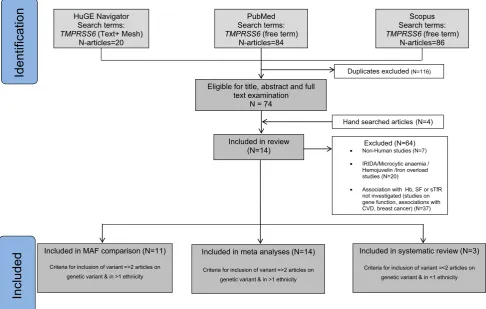
We found 20 articles through HuGE Navigator, 84 articles through PubMed and 86 articles through Scopus and four articles through manual search of the references.1In total we obtained 14 articles that contained information from various cohorts (Fig.1; Table1). Articles identified as eligible for meta-analyses (n=14) contained complete
Included
Included in MAF comparison (N=11)
Criteria for inclusion of variant =>2 articles on genetic variant & in >1 ethnicity
Excluded (N=64) • Non-Human studies (N=7)
• IRIDA/Microcytic anaemia / Hemojuvelin /Iron overload studies (N=20)
• Association with Hb, SF or sTfR not investigated (studies on gene function, associations with CVD, breast cancer) (N=37) Included in review
(N=14)
Identification
Hand searched articles (N=4) Duplicates excluded(N=116) HuGE Navigator
Search terms:
TMPRSS6(Text+ Mesh) N-articles=20
PubMed Search terms:
TMPRSS6(free term) N-articles=84
Scopus Search terms:
TMPRSS6(free term) N-articles=86
Eligible for title, abstract and full text examination
N = 74
Included in meta analyses (N=14)
Criteria for inclusion of variant =>2 articles on genetic variant & in >1 ethnicity
Included in systematic review (N=3)
Criteria for inclusion of variant =<2 articles on genetic variant & in <1 ethnicity
Fig. 1 Study selection process
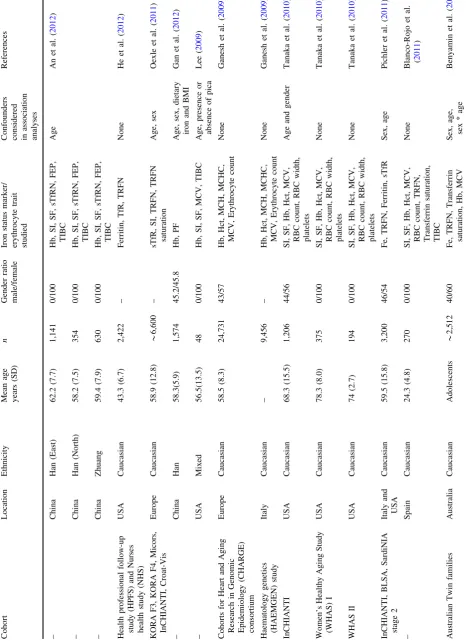
Table 1 Characteristics of cohorts included in the review Cohort Location Ethnicity Mean age years (SD) n Gender ratio male/female Iron status marker/ erythrocyte trait studied
Confounders considered in
Table 1 continued Cohort Location Ethnicity Mean age years (SD) n Gender ratio male/female Iron status marker/ erythrocyte trait studied
Confounders considered in
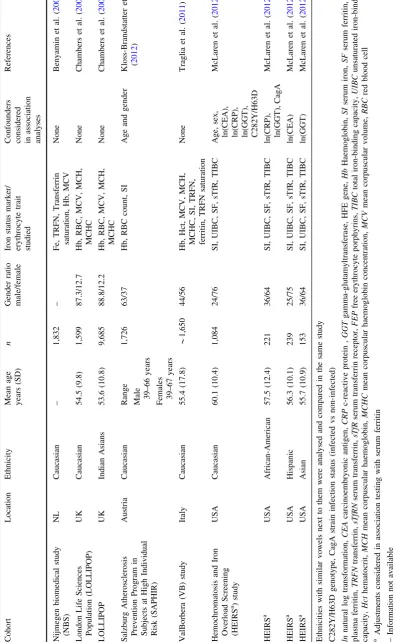
association analyses References Nijmegen biomedical study (NBS) NL Caucasian – 1,832 – Fe, TRFN, Transferrin saturation, Hb, MCV None Benyamin et al. ( 2009 ) London Life Sciences Population (LOLLIPOP) UK Caucasian 54.5 (9.8) 1,599 87.3/12.7 Hb, RBC, MCV, MCH, MCHC None Chambers et al. ( 2009 ) LOLLIPOP UK Indian Asians 53.6 (10.8) 9,685 88.8/12.2 Hb, RBC, MCV, MCH, MCHC None Chambers et al. ( 2009 ) Salzburg Atherosclerosis Prevention Program in Subjects at High Individual Risk (SAPHIR) Austria Caucasian
Range Male 39–66
years Females 39–67 years 1,726 63/37 Hb, RBC count, SI Age and gender Kloss-Brandstatter et al. ( 2012 ) ValBorbera (VB) study Italy Caucasian 55.4 (17.8) * 1,650 44/56 Hb, Hct, MCV, MCH, MCHC, SI, TRFN, ferritin, TRFN saturation None Traglia et al. ( 2011 ) Hemochromatosis and Iron Overload Screening (HEIRS a) study USA Caucasian 60.1 (10.4) 1,084 24/76 SI, UIBC, SF, sTfR, TIBC Age, sex,
ln(CEA), ln(CRP), ln(GGT), C282Y/H63D
information on two TMPRSS6 variants. In addition, 11 articles on MAF comparisons and 3 articles on 4TMPRSS6 variants were included in the systematic review (Fig.1). Only one study corrected for iron intake in association
analyses. Additional data on covariates considered in association analyses in the various studies can be found in Table1. The majority of the articles were based on studies conducted entirely in subjects of Caucasian ethnicity
Table 2 Minor allele frequencies ofTMPRSS6SNPs in various populations
SNP Cohort Ethnicity MAF References
rs855791 (A) – Han (East) 0.53 An et al. (2012)
– Han (North) 0.55 An et al. (2012)
– Zhuang 0.63 An et al. (2012)
– Han 0.53 Gan et al. (2012)
CHARGE?HAEMGEN Caucasian 0.39 Ganesh et al. (2009)
InCHIANTI?BLSA?WHAS I?WHAS II Caucasian 0.41 Tanaka et al. (2010)
Australian Twin families Caucasian 0.42 Benyamin et al. (2009)
LOLLIPOP Caucasian 0.34 Chambers et al. (2009)
LOLLIPOP Indian Asians 0.53 Chambers et al. (2009)
SAPPHIR Caucasian 0.43 Kloss-Brandstatter et al. (2012)
NBS Caucasian 0.46 Kloss-Brandstatter et al. (2012)
– Mixed 0.37 Lee (2009)
ValBorbera study Caucasian 0.45 Traglia et al. (2011)
NBS Caucasian 0.46 Galesloot et al. (2013)
rs4820268 (G) – Han (East) 0.51 An et al. (2012)
Han (North) 0.53 An et al. (2012)
Zhuang 0.61 An et al. (2012)
– Han 0.50 Gan et al. (2012)
InCHIANTI?BLSA?WHAS I?WHAS II Caucasian 0.46 Tanaka et al. (2010)
Caucasian 0.47 Benyamin et al. (2009)
LOLLIPOP Caucasian 0.43 Chambers et al. (2009)
LOLLIPOP Indian Asians 0.55 Chambers et al. (2009)
SAPPHIR Caucasian 0.45 Kloss-Brandstatter et al. (2012)
NBS Caucasian 0.47 Kloss-Brandstatter et al. (2012)
rs2111833 (T) HEIRS Caucasian 0.34 McLaren et al. (2012)
HEIRS African-American 0.39 McLaren et al. (2012)
HEIRS Hispanic 0.20 McLaren et al. (2012)
HEIRS Asian 0.31 McLaren et al. (2012)
rs1421312 (G) HEIRS Caucasian 0.40 McLaren et al. (2012)
HEIRS African-American 0.61 McLaren et al. (2012)
HEIRS Hispanic 0.34 McLaren et al. (2012)
HEIRS Asian 0.31 McLaren et al. (2012)
InCHIANTI?BLSA?WHAS I?WHAS II Caucasian 0.39 Tanaka et al. (2010)
LOLLIPOP Caucasian 0.46 Chambers et al. (2009)
LOLLIPOP Indian Asians 0.54 Chambers et al. (2009)
rs228921 (G) LOLLIPOP Caucasian 0.41 Chambers et al. (2009)
LOLLIPOP Indian Asians 0.48 Chambers et al. (2009)
rs228918 (C) LOLLIPOP Caucasian 0.47 Chambers et al. (2009)
LOLLIPOP Indian Asians 0.48 Chambers et al. (2009)
rs228919 (T) LOLLIPOP Caucasian 0.40 Chambers et al. (2009)
LOLLIPOP Indian Asians 0.48 Chambers et al. (2009)
rs5756520 (A) LOLLIPOP Caucasian 0.41 Chambers et al. (2009)
(n=11; 73 %). Three studies had multiple ethnicities as part of the cohorts investigated (Chambers et al.2009; Lee 2009; McLaren et al. 2012). We did not find any studies conducted among individuals from the African population (Tables1 and 2). No publication bias was present in the meta-analyses performed except for the association between rs855791 and transferrin in the Caucasian population.
In rs855791, MAF was higher in the Asian than in Caucasian populations (0.55 vs 0.42, P\0.0001). The MAF of the rs2111833 SNP ranged from 0.20 in the His-panic population to 0.47 in the Caucasian population, while the MAF of rs1421312 was 0.31 in the Asian population and 0.47 in the Caucasian population. MAF for rs228921, rs228918, rs228919 and rs575620 were comparable in Caucasian and Indian Asians (Table1).
Associations of rs855791 with Hb and iron status
The rs855791 (c.2207T[C) SNP causes the matriptase-2 valine to alanine amino acid substitution (p.Val736Ala; Nai et al.2011). In our association analyses we considered the
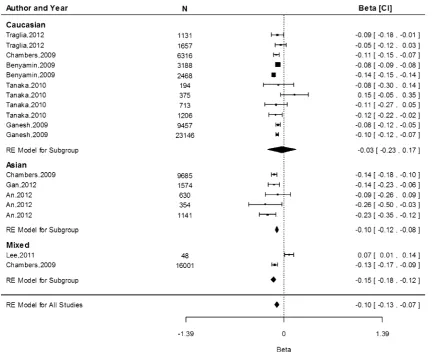
A allele which is the minor allele on the reverse strand (similar to the T allele on the forward strand). The meta-analysis of the association of rs855791 with Hb indicates that each A allele (encoding for Valine [Val]) was asso-ciated with 0.11 g/dL (95 % CI -0.11, -0.10) lower Hb concentrations overall, with values of -0.08 (95 % CI -0.11, -0.04),-0.15 (95 % CI -0.18,-0.12) and-0.11 (95 % CI-0.11,-0.10) g/dL in the Caucasian, Asian and mixed populations, respectively (Fig. 2). The difference in the effect estimates between Caucasian and Asian popu-lations, based on 11 and 5 separate study popupopu-lations, respectively, was not significant (P=0.85). Heterogeneity was high among the studies within the Caucasian popula-tion (I2=96.2 %,P=\0.0001,n=11) and in the mixed populations (I2=96.3 %, P\0.0001, n =2), but was absent for the Asian cohorts (I2=0.00 %, P=0.47, n =5).
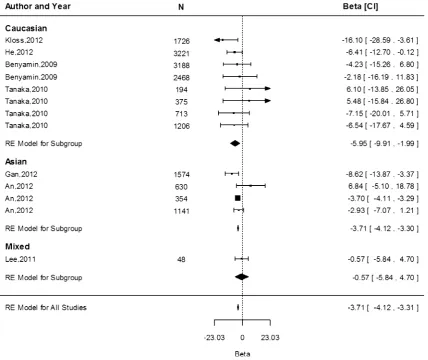
Data from 13 study populations were available to study the associations of the A allele and serum ferritin con-centration. Overall, a reduction of 3.71 lg/L (95 % CI -4.12,-3.31) was observed, without significant differences between ethnicities (P[0.05; Fig.3). As for Hb,
heterogeneity was high in the Caucasian population (I2=65.2 %,P =0.02) but not in the Asian populations (I2=0.00 %).
Associations of rs855791 with serum transferrin recep-tor concentration were only conducted within the Cauca-sian population. Based on three study populations, the estimate shows that the A allele was associated with an increase of 0.02 mg/dL (95 % CI 0.01, 0.02) in serum transferrin receptor concentration (Fig.4). Heterogeneity between the studies was low (I2=0.00 %, P=0.93).
In determining the association with transferrin, overall meta-analysis of five study populations indicated that the A allele had no effect 0.00 mg/dL (95 % CI -0.05, 0.06; Fig.5). Heterogeneity between the studies was high (I2=99.7 %,P=0.01). Publication bias was detected in the meta-analyses performed (P=0.01).
Associations of rs4820268 with Hb and iron status The minor allele at the rs4820268 (c.1563C[T) leads to a synonymous change at nucleotide position 521
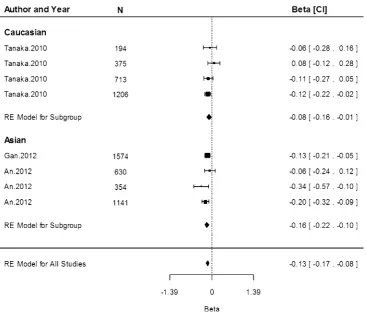
(p.Asp521Asp). In our association analyses, we considered the G allele which is the minor allele on the forward strand (similar to the C allele on the reverse strand). The meta-analysis of the association of rs4820268 with Hb and fer-ritin within the Caucasian and Asian ethnicities indicated that the G allele results in lower concentrations of Hb by 0.12 g/dL (95 % CI -0.16, -0.01) and 0.16 g/dL (95 % CI-0.22,-0.10), respectively (Fig.6). The difference in the effect estimates between four Caucasian and Asian populations was not significant (P[0.05). We observed a non-significant amount of heterogeneity within studies in both the Caucasian (I2=6.20 %, P=0.34) and Asian population (I2=0.61 %,P=0.23).
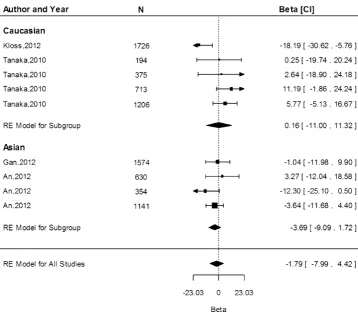
We obtained data from 13 study populations on the associations of the G allele and serum ferritin concentra-tion. The G allele resulted in an increased ferritin con-centration of 0.12lg/L (95 % CI -6.16, 6.39) in the Caucasian population and a decrease of 3.69lg/L (95 % CI-9.09, 1.72) in the Asian population (Fig. 7). There was no significant difference in the effect estimates between Caucasian and Asian populations (P[0.05). We observed
a significant amount of heterogeneity in the studies within the Caucasian population (I2=65.15 %, P=0.02), but not in the Asian studies (I2=0.00 %, P=0.43).
Associations of rs4820268 with sTfR concentration were only conducted in three studies within the Caucasian population. The G allele was associated with a reduction by 0.08 mg/dL (95 % CI -0.10, -0.06) in the Caucasian population (Fig.8). There was a significant amount of heterogeneity detected (I2=65.15 %,P=0.02).
TMPRRS6variants not eligible for meta-analysis
Since the associations of rs2111833 (c.1083G[A) and rs1421312 (c.659-1988T[C) with iron status among Cau-casians, Asians, Hispanics and African-Americans was described in only one study by McLaren and McLachlan (McLaren et al.2012), these variants were not eligible for the meta-analysis. In this study, MAF across the
populations for rs211833 indicated that the T allele has the lowest frequency among the Hispanic population (20 %) while the Caucasian, Asian and African-American popu-lations had a MAF of approximately 30 % (Table2). When investigating the association of rs2111833 with serum ferritin, the T allele was associated with an increase in serum ferritin concentrations across all ethnicities. For rs2111833 and sTfR, the estimates in each ethnicity indi-cated an association of the T allele with a decrease in concentrations (McLaren et al. 2012). However, none of the observations were significant (P[0.05).
The SNP rs1421312 was also studied in four ethnicities. The MAF of this SNP in the African-American population was 0.61, higher than that in the Caucasian population 0.40, Asian population 0.41, and Hispanic population, 0.34. Overall, the G allele of rs1421312 was associated with a non-significant decrease in serum ferritin concentration. However, each additional G allele resulted in a
non-Fig. 4 Fixed-effects meta-analysis of observational studies evaluating association of rs855791 with serum transferrin receptor (mg/dL)
significant decrease of 30.75lg/L (95 % CI -159.62, 98.12) in SF concentrations within the African-American population, but in increase in the other ethnic populations. For sTfR, this SNP was associated with non-significant negative associations in Caucasians (-0.23 (95 % CI -0.45,-0.01) and Asians (-0.25 (95 % CI -0.78, 0.28) and a positive association in African-Americans (0.88 (95 % CI -0.04, 1.80) and Hispanics [0.19 (95 % CI -0.48, 0.86; McLaren et al.2012].
We also identified studies in the Chinese population that have observed rs855791 and rs4820268 polymorphisms as genetic risk factors for developing anaemia, iron deficiency and iron deficiency anaemia (An et al. 2012; Gan et al. 2012). We additionally identified another study conducted among Danish blood donors that has observed that the T and G alleles of rs855791 and rs4820268, respectively, are not associated with low serum ferritin (Sorensen et al. 2012).
Discussion
To our knowledge, this is the first review to focus on the association ofTMPRSS6 genetic variants with iron-related parameters in different ethnic groups. Sample sizes
included in the meta-analyses were sufficient to investigate the research question. We observed that the A allele of rs855791 is associated with lower concentrations of Hb and ferritin across all populations. Additionally, this allele is associated with increased sTfR and transferrin concentra-tions. Based on our meta-analyses, the overall effect esti-mate of the Asian studies indicates that for each A and G allele of rs855791 and rs4820268, respectively, an addi-tional decrease in Hb values of 0.07 and 0.12 g/dL is observed, as compared to the Caucasian population. Sim-ilarly, ferritin concentration is lowered by an additional 2.24 and 3.85lg/L, respectively, in the Asian populations. The directions and magnitudes of associations were iden-tical in both fixed-effects and random-effects model.
Although the observed differences in iron status may not be impressive from a clinical point of view, it may be of significance on the population level especially in popula-tions that already have marginal iron status due to low dietary iron intake.
The exact mechanism through which TMPRSS6 action is exerted is still under investigation. It had generally been thought that TMPRSS6 polymorphisms affect hepcidin transcription, thereby altering hepcidin concentrations in response to systemic iron concentrations (Du et al. 2008; Finberg et al. 2008; De Falco et al. 2013). However, two
recent studies (Traglia et al.2011; Galesloot et al. 2013) did not confirm an intermediate role for hepcidin in the SNP–iron status parameters associations. These studies instead indicate pleiotropic SNP effects on hepcidin and iron status parameters. Currently, it is proposed that ma-triptase-2 could regulate hepcidin expression by cleaving
HJV to decrease BMP–SMAD signalling (Meynard et al. 2014). Further studies are required to elucidate the role of hepcidin in TMPRSS6–iron status parameter associations. We have observed similar directions of the effect esti-mates between rs855791 and rs4820268 in associations with iron status parameters. This is probably because these
Fig. 7 Fixed-effects meta-analysis of observational studies evaluating association of rs4820268 with ferritin (lg/L)
two SNPs are in linkage disequilibrium (Nai et al.2011). However, we also observed differences in the direction of association of the risk allele in rs1421312 with body iron, serum ferritin and serum iron in African-Americans. Sim-ilar alleles in different ethnic groups could result in vari-ations in the expression of genes (Spielman et al. 2007). This further strengthens the need to conduct ethnicity-specific studies when considering the role of genetics in disease outcome.
We observed that the risk allele frequencies of rs855791 and rs4820268 were as high as 63 % in the Asian popula-tions, while in the Caucasian populapopula-tions, it was generally less than 45 %. This difference in MAF across ethnicities has also been observed in the SNPs rs211833 and rs1421312. Indeed, allele frequencies for SNPs can vary greatly across ethnic groups (Ioannidis et al.2004), and this may impact the prevalence and incidence of disease across ethnic groups in case of associations (Lan et al.2007; Myles et al.2008). The high frequency of the risk alleles of the rs855791 and rs4820268 SNPs in Asian populations and the stronger negative associations with Hb and ferritin predis-pose this population to iron deficiency. Environmental factors such as a diets low in bioavailable iron and high inflammation burden further aggravate this predisposition. In this regard, it would have been interesting to include in this review studies conducted within the African population as well. However, at the time the search was completed, there were no studies conducted within the African popu-lation other than the one performed in the African-Ameri-can population. However, this is an admixed population (Parra et al. 1998), and therefore, observations are not readily transferrable to the African population. Besides this, it may be that the phenotypic expression for the same alleles investigated are different within the genetically diverse African population (Tishkoff et al. 1996; Tishkoff and Williams 2002; Tishkoff and Verrelli 2003; Tishkoff and Kidd 2004; Frazer et al. 2007; Garrigan et al. 2007; Ja-kobsson et al.2008; Li et al.2008; Tishkoff et al.2009).
Several limitations of our study need mentioning. We focussed on SNP–iron status measure associations that were investigated in at least two studies and in more than one ethnicity. Consequently, significant SNP–iron status measure associations that have only been researched in one ethnicity were not described. Additionally, since we only included SNPs described in greater than two cohorts and more than one ethnicity, we were only able to include two genetic variants from the selected SNPs in the meta-anal-yses. For this reason, there may be ethnic differences in other genetic variations that have not been included in this review.
Secondly, high heterogeneity was observed among the Caucasian studies. We attribute this to the variation in population characteristics and study designs. Most studies
that were conducted within the Caucasian populations have previously been designed to study other outcomes, whereas the studies within the Asian population were specifically designed to study genetic influences of iron metabolism and are fewer in number.
Thirdly, in conducting association analyses, only one study (Gan et al.2012) included dietary iron as a predictor of iron status within the model. This investigation on the interactions between SNPs and the environment is crucial in order to quantify the contribution of genetic alterations to the development of iron deficiency. Further to this, only two studies considered inflammation as a potential con-founder in association analyses. These studies either excluded subjects with CRP levels above a pre-defined cut-off (Traglia et al.2011; An et al.2012; Gan et al.2012) or corrected for inflammation (McLaren et al. 2012). Cor-rection for inflammation or exclusion of values of inflamed subjects would ensure that what is observed is a true association. Ferritin and Hb are influenced by inflammation and sTfR concentrations might also be influenced nega-tively by inflammatory cytokines (Seiser et al.1993).
In conclusion, we observe that the risk alleles A and G in rs855791 and rs4820268 are associated with a reduction in Hb and serum ferritin concentrations and an increase in transferrin and serum transferrin receptor concentrations in most populations investigated. Our study highlights key information gaps in several areas regarding the associations of SNPs in TMPRSS6 and iron status. First of all, more information on the (factors involved in) regulation of TMPRSS6 is required as well as how exactly TMPRSS6 exerts its effects on body iron. Moreover, our study also highlights the need to conduct further studies in ethnicities or populations where iron deficiency is of public health significance. The question is whether populations with high prevalence of risk alleles may require higher recommen-dations for iron intake in order to maintain normal eryth-ropoiesis. This is especially relevant in combination with unfavourable environmental conditions such as diets with low bioavailable iron and high inflammation burden. Knowledge of genetic factors influencing iron status could improve care and advice given to populations at risk for iron deficiency.
Acknowledgments We thank Toshiko Tanaka, National Institute on Aging, National Institutes of Health, USA, for in-depth advice. The authors’ responsibilities were as follows—WNGW: literature search, design of study, data extraction, statistical analyses, interpretation of data, and writing of the manuscript; AMB and EJF: design of study, data extraction, statistical analyses, interpretation of data; MBZ, GWT and DS: interpretation of data and provision of advice; and all authors: contributed to subsequent drafts of the manuscript and approved the submitted version of the manuscript.
Feskens and Alida Melse-Boonstra declare that they have no conflict of interest.
References
An P, Wu Q, Wang H, Guan Y, Mu M, Liao Y, Zhou D, Song P, Wang C, Meng L, Man Q, Li L, Zhang J, Wang F (2012) TMPRSS6, but not TF, TFR2 or BMP2 variants are associated with increased risk of iron-deficiency anemia. Hum Mol Genet 21:2124–2131
Barton JC, Edwards CQ, Bertoli LF, Shroyer TW, Hudson SL (1995) Iron overload in African Americans. Am J Med 99:616–623 Benyamin B, Ferreira MA, Willemsen G, Gordon S, Middelberg RP,
McEvoy BP, Hottenga JJ, Henders AK, Campbell MJ, Wallace L, Frazer IH, Heath AC, de Geus EJ, Nyholt DR, Visscher PM, Penninx BW, Boomsma DI, Martin NG, Montgomery GW, Whitfield JB (2009) Common variants in TMPRSS6 are associated with iron status and erythrocyte volume. Nat Genet 41:1173–1175
Beutler E, Barton JC, Felitti VJ, Gelbart T, West C, Lee PL, Waalen J, Vulpe C (2003) Ferroportin 1 (SCL40A1) variant associated with iron overload in African-Americans. Blood Cells Mol Dis 31:305–309
Blanco-Rojo R, Baeza-Richer C, Lopez-Parra AM, Perez-Granados AM, Brichs A, Bertoncini S, Buil A, Arroyo-Pardo E, Soria JM, Vaquero MP (2011) Four variants in transferrin and HFE genes as potential markers of iron deficiency anaemia risk: an association study in menstruating women. Nutr Metab (Lond) 8:69
Chambers JC, Zhang W, Li Y, Sehmi J, Wass MN, Zabaneh D, Hoggart C, Bayele H, McCarthy MI, Peltonen L, Freimer NB, Srai SK, Maxwell PH, Sternberg MJ, Ruokonen A, Abecasis G, Jarvelin MR, Scott J, Elliott P, Kooner JS (2009) Genome-wide association study identifies variants in TMPRSS6 associated with hemoglobin levels. Nat Genet 41:1170–1172
De Falco L, Sanchez M, Silvestri L, Kannengiesser C, Muckenthaler MU, Iolascon A, Gouya L, Camaschella C, Beaumont C (2013) Iron refractory iron deficiency anemia. Haematologica 98:845– 853
Du X, She E, Gelbart T, Truksa J, Lee P, Xia Y, Khovananth K, Mudd S, Mann N, Moresco EM, Beutler E, Beutler B (2008) The serine protease TMPRSS6 is required to sense iron deficiency. Science 320:1088–1092
Egger M, Davey Smith G, Schneider M, Minder C (1997) Bias in meta-analysis detected by a simple, graphical test. BMJ 315: 629–634
Finberg KE (2009) Iron-refractory iron deficiency anemia. Semin Hematol 46:378–386
Finberg KE, Heeney MM, Campagna DR, Aydinok Y, Pearson HA, Hartman KR, Mayo MM, Samuel SM, Strouse JJ, Markianos K, Andrews NC, Fleming MD (2008) Mutations in TMPRSS6 cause iron-refractory iron deficiency anemia (IRIDA). Nat Genet 40:569–571
Folgueras AR, de Lara FM, Pendas AM, Garabaya C, Rodriguez F, Astudillo A, Bernal T, Cabanillas R, Lopez-Otin C, Velasco G (2008) Membrane-bound serine protease matriptase-2 (Tmprss6) is an essential regulator of iron homeostasis. Blood 112:2539–2545
Frazer KA, Ballinger DG, Cox DR, Hinds DA, Stuve LL, Gibbs RA, Belmont JW, Boudreau A, Hardenbol P, Leal SM, Pasternak S, Wheeler DA, Willis TD, Yu F, Yang H, Zeng C, Gao Y, Hu H, Hu W, Li C, Lin W, Liu S, Pan H, Tang X, Wang J, Wang W, Yu J, Zhang B, Zhang Q, Zhao H, Zhou J, Gabriel SB, Barry R, Blumenstiel B, Camargo A, Defelice M, Faggart M, Goyette M,
Gupta S, Moore J, Nguyen H, Onofrio RC, Parkin M, Roy J, Stahl E, Winchester E, Ziaugra L, Altshuler D, Shen Y, Yao Z, Huang W, Chu X, He Y, Jin L, Liu Y, Sun W, Wang H, Wang Y, Xiong X, Xu L, Waye MM, Tsui SK, Xue H, Wong JT, Galver LM, Fan JB, Gunderson K, Murray SS, Oliphant AR, Chee MS, Montpetit A, Chagnon F, Ferretti V, Leboeuf M, Olivier JF, Phillips MS, Roumy S, Sallee C, Verner A, Hudson TJ, Kwok PY, Cai D, Koboldt DC, Miller RD, Pawlikowska L, Taillon-Miller P, Xiao M, Tsui LC, Mak W, Song YQ, Tam PK, Nakamura Y, Kawaguchi T, Kitamoto T, Morizono T, Nagashi-ma A, Ohnishi Y, Sekine A, Tanaka T, Tsunoda T et al (2007) A second generation human haplotype map of over 3.1 million SNPs. Nature 449:851–861
Galesloot TE, Geurts-Moespot AJ, den Heijer M, Sweep FC, Fleming RE, Kiemeney LA, Vermeulen SH, Swinkels DW (2013) Associations of common variants in HFE and TMPRSS6 with iron parameters are independent of serum hepcidin in a general population: a replication study. J Med Genet 50:593–598 Gan W, Guan Y, Wu Q, An P, Zhu J, Lu L, Jing L, Yu Y, Ruan S, Xie
D, Makrides M, Gibson RA, Anderson GJ, Li H, Lin X, Wang F (2012) Association of TMPRSS6 polymorphisms with ferritin, hemoglobin, and type 2 diabetes risk in a Chinese Han population. Am J Clin Nutr 95:626–632
Ganesh SK, Zakai NA, van Rooij FJ, Soranzo N, Smith AV, Nalls MA, Chen MH, Kottgen A, Glazer NL, Dehghan A, Kuhnel B, Aspelund T, Yang Q, Tanaka T, Jaffe A, Bis JC, Verwoert GC, Teumer A, Fox CS, Guralnik JM, Ehret GB, Rice K, Felix JF, Rendon A, Eiriksdottir G, Levy D, Patel KV, Boerwinkle E, Rotter JI, Hofman A, Sambrook JG, Hernandez DG, Zheng G, Bandinelli S, Singleton AB, Coresh J, Lumley T, Uitterlinden AG, Vangils JM, Launer LJ, Cupples LA, Oostra BA, Zwaginga JJ, Ouwehand WH, Thein SL, Meisinger C, Deloukas P, Nauck M, Spector TD, Gieger C, Gudnason V, van Duijn CM, Psaty BM, Ferrucci L, Chakravarti A, Greinacher A, O’Donnell CJ, Witteman JC, Furth S, Cushman M, Harris TB, Lin JP (2009) Multiple loci influence erythrocyte phenotypes in the CHARGE Consortium. Nat Genet 41:1191–1198
Garrigan D, Kingan SB, Pilkington MM, Wilder JA, Cox MP, Soodyall H, Strassmann B, Destro-Bisol G, de Knijff P, Novelletto A, Friedlaender J, Hammer MF (2007) Inferring human population sizes, divergence times and rates of gene flow from mitochondrial, X and Y chromosome resequencing data. Genetics 177:2195–2207
Gordeuk V, Mukiibi J, Hasstedt SJ, Samowitz W, Edwards CQ, West G, Ndambire S, Emmanual J, Nkanza N, Chapanduka Z et al (1992) Iron overload in Africa. Interaction between a gene and dietary iron content. N Engl J Med 326:95–100
Guillem F, Lawson S, Kannengiesser C, Westerman M, Beaumont C, Grandchamp B (2008) Two nonsense mutations in the TMPRSS6 gene in a patient with microcytic anemia and iron deficiency. Blood 112:2089–2091
He M, Workalemahu T, Manson JE, Hu FB, Qi L (2012) Genetic determinants for body iron store and type 2 diabetes risk in US men and women. PLoS ONE 7:e40919
Ioannidis JP, Ntzani EE, Trikalinos TA (2004) ‘Racial’ differences in genetic effects for complex diseases. Nat Genet 36:1312–1318 Jackson RT, Sauberlich HE, Skala JH, Kretsch MJ, Nelson RA (1983)
Comparison of hemoglobin values in black and white male U.S. military personnel. J Nutr 113:165–171
Kloss-Brandstatter A, Erhart G, Lamina C, Meister B, Haun M, Coassin S, Seifert M, Klein-Franke A, Paulweber B, Kedenko L, Kollerits B, Swinkels DW, Vermeulen SH, Galesloot TE, Kronenberg F, Weiss G (2012) Candidate gene sequencing of SLC11A2 and TMPRSS6 in a family with severe anaemia: common SNPs, rare haplotypes, no causative mutation. PLoS ONE 7:e35015
Lan Q, Shen M, Garcia-Rossi D, Chanock S, Zheng T, Berndt SI, Puri V, Li G, He X, Welch R, Zahm SH, Zhang L, Zhang Y, Smith M, Wang SS, Chiu BC, Linet M, Hayes R, Rothman N, Yeager M (2007) Genotype frequency and F ST analysis of polymor-phisms in immunoregulatory genes in Chinese and Caucasian populations. Immunogenetics 59:839–852
Leboeuf RC, Tolson D, Heinecke JW (1995) Dissociation between tissue iron concentrations and transferrin saturation among inbred mouse strains. J Lab Clin Med 126:128–136
Lee P (2009) Role of matriptase-2 (TMPRSS6) in iron metabolism. Acta Haematol 122:87–96
Li JZ, Absher DM, Tang H, Southwick AM, Casto AM, Ramachan-dran S, Cann HM, Barsh GS, Feldman M, Cavalli-Sforza LL, Myers RM (2008) Worldwide human relationships inferred from genome-wide patterns of variation. Science 319:1100–1104 Looker AC, Dallman PR, Carroll MD, Gunter EW, Johnson CL
(1997) Prevalence of iron deficiency in the United States. JAMA 277:973–976
McLaren CE, Li KT, Gordeuk VR, Hasselblad V, McLaren GD (2001) Relationship between transferrin saturation and iron stores in the African American and US Caucasian populations: analysis of data from the third National Health and Nutrition Examination Survey. Blood 98:2345–2351
McLaren CE, McLachlan S, Garner CP, Vulpe CD, Gordeuk VR, Eckfeldt JH, Adams PC, Acton RT, Murray JA, Leiendecker-Foster C, Snively BM, Barcellos LF, Cook JD, McLaren GD (2012) Associations between single nucleotide polymorphisms in iron-related genes and iron status in multiethnic populations. PLoS ONE 7:e38339
Melis MA, Cau M, Congiu R, Sole G, Barella S, Cao A, Westerman M, Cazzola M, Galanello R (2008) A mutation in the TMPRSS6 gene, encoding a transmembrane serine protease that suppresses hepcidin production, in familial iron deficiency anemia refrac-tory to oral iron. Haematologica 93:1473–1479
Meynard D, Babitt JL, Lin HY (2014) The liver: conductor of systemic iron balance. Blood 123:168–176
Morse AC, Beard JL, Jones BC (1999) A genetic developmental model of iron deficiency: biological aspects. Proc Soc Exp Biol Med 220:147–152
Moyo VM, Mandishona E, Hasstedt SJ, Gangaidzo IT, Gomo ZA, Khumalo H, Saungweme T, Kiire CF, Paterson AC, Bloom P, MacPhail AP, Rouault T, Gordeuk VR (1998) Evidence of genetic transmission in African iron overload. Blood 91:1076–1082 Myles S, Davison D, Barrett J, Stoneking M, Timpson N (2008)
Worldwide population differentiation at disease-associated SNPs. BMC Med Genomics 1:22
Nai A, Pagani A, Silvestri L, Campostrini N, Corbella M, Girelli D, Traglia M, Toniolo D, Camaschella C (2011) TMPRSS6 rs855791 modulates hepcidin transcription in vitro and serum hepcidin levels in normal individuals. Blood 118:4459–4462 Oexle K, Ried JS, Hicks AA, Tanaka T, Hayward C, Bruegel M,
Gogele M, Lichtner P, Muller-Myhsok B, Doring A, Illig T, Schwienbacher C, Minelli C, Pichler I, Fiedler GM, Thiery J, Rudan I, Wright AF, Campbell H, Ferrucci L, Bandinelli S, Pramstaller PP, Wichmann HE, Gieger C, Winkelmann J, Meitinger T (2011) Novel association to the proprotein conver-tase PCSK7 gene locus revealed by analysing soluble transferrin receptor (sTfR) levels. Hum Mol Genet 20:1042–1047
Parra EJ, Marcini A, Akey J, Martinson J, Batzer MA, Cooper R, Forrester T, Allison DB, Deka R, Ferrell RE, Shriver MD (1998) Estimating African American admixture proportions by use of population-specific alleles. Am J Hum Genet 63:1839– 1851
Perry GS, Byers T, Yip R, Margen S (1992) Iron nutrition does not account for the hemoglobin differences between blacks and whites. J Nutr 122:1417–1424
Pichler I, Minelli C, Sanna S, Tanaka T, Schwienbacher C, Naitza S, Porcu E, Pattaro C, Busonero F, Zanon A, Maschio A, Melville SA, Grazia Piras M, Longo DL, Guralnik J, Hernandez D, Bandinelli S, Aigner E, Murphy AT, Wroblewski V, Marroni F, Theurl I, Gnewuch C, Schadt E, Mitterer M, Schlessinger D, Ferrucci L, Witcher DR, Hicks AA, Weiss G, Uda M, Pramstaller PP (2011) Identification of a common variant in the TFR2 gene implicated in the physiological regulation of serum iron levels. Hum Mol Genet 20:1232–1240
R Core Team (2013) A language and environment for statistical computing. R Foundation for Statistical Computing, Vienna Seiser C, Teixeira S, Kuhn LC (1993) Interleukin-2-dependent
transcriptional and post-transcriptional regulation of transferrin receptor mRNA. J Biol Chem 268:13074–13080
Silvestri L, Pagani A, Nai A, De Domenico I, Kaplan J, Camaschella C (2008) The serine protease matriptase-2 (TMPRSS6) inhibits hepcidin activation by cleaving membrane hemojuvelin. Cell Metab 8:502–511
Sorensen E, Grau K, Berg T, Simonsen AC, Magnussen K, Erikstrup C, Hansen MB, Ullum H (2012) A genetic risk factor for low serum ferritin levels in Danish blood donors. Transfusion 52:2585–2589
Spielman RS, Bastone LA, Burdick JT, Morley M, Ewens WJ, Cheung VG (2007) Common genetic variants account for differences in gene expression among ethnic groups. Nat Genet 39:226–231
Tanaka T, Roy CN, Yao W, Matteini A, Semba RD, Arking D, Walston JD, Fried LP, Singleton A, Guralnik J, Abecasis GR, Bandinelli S, Longo DL, Ferrucci L (2010) A genome-wide association analysis of serum iron concentrations. Blood 115:94–96
Tishkoff SA, Kidd KK (2004) Implications of biogeography of human populations for ‘race’ and medicine. Nat Genet 36:S21–S27 Tishkoff SA, Verrelli BC (2003) Patterns of human genetic diversity:
implications for human evolutionary history and disease. Annu Rev Genomics Hum Genet 4:293–340
Tishkoff SA, Williams SM (2002) Genetic analysis of African populations: human evolution and complex disease. Nat Rev Genet 3:611–621
Tishkoff SA, Dietzsch E, Speed W, Pakstis AJ, Kidd JR, Cheung K, Bonne-Tamir B, Santachiara-Benerecetti AS, Moral P, Krings M (1996) Global patterns of linkage disequilibrium at the CD4 locus and modern human origins. Science 271:1380–1387 Tishkoff SA, Reed FA, Friedlaender FR, Ehret C, Ranciaro A,
Froment A, Hirbo JB, Awomoyi AA, Bodo JM, Doumbo O, Ibrahim M, Juma AT, Kotze MJ, Lema G, Moore JH, Mortensen H, Nyambo TB, Omar SA, Powell K, Pretorius GS, Smith MW, Thera MA, Wambebe C, Weber JL, Williams SM (2009) The genetic structure and history of Africans and African Americans. Science 324:1035–1044
Traglia M, Girelli D, Biino G, Campostrini N, Corbella M, Sala C, Masciullo C, Vigano F, Buetti I, Pistis G, Cocca M, Camaschella C, Toniolo D (2011) Association of HFE and TMPRSS6 genetic variants with iron and erythrocyte parameters is only in part dependent on serum hepcidin concentrations. J Med Genet 48:629–634
Williams DM (1981) Racial differences of hemoglobin concentration: measurements of iron, copper, and zinc. Am J Clin Nutr 34:1694–1700