354 | P a g e
Novel Heterobimetallic Tetranuclear Water-Soluble
Ni
2
(II)/Cu
2
(II)–Ge
2
(IV) macrocyclic Complexes: Spectral
Characterization and Antimicrobial Activity
Shahab A. A. Nami
1, Abdul Kareem
21
Department of Kulliyat, Faculty of Unani Medicine, Aligarh Muslim University, Aligarh, (India)
2
Material Research lab, Department of Chemistry, Jamia Millia Islamia, New Delhi, (India)
ABSTRACT
The newly synthesized heterobimetallic tetranuclear water-soluble Ni2(II)/Cu2(II)–Ge2(IV) macrocyclic complexes
bearing 1,10-phenanthroline as auxiliary ligand were synthesized by template method and characterized by various
spectroscopic techniques viz, molar conductance, FT-IR, UV–VIS, magnetic susceptibility X-ray diffraction (XRD)
and TGA/DTA. The molar conductance values suggest non electrolytic nature for all the complexes.
Thermogravimatric analysis shows that all the complexes are stable up to 600 C. The studies confirm the formation
of macrocyclic complexes containing octahedral Ge(IV) and square planar Cu(II) and Ni(II) ions in the synthesized
metal complexes respectively. The synthesized complexes were also tested for their antimicrobial activity and the
results reveals that the copper complex is more active as compare to Ni(II) complex on few microbial strain.
However, on some bacterial strain Ni(II) complex is more active comparatively which clearly confirms that both the
complex have an effective importance.
Keyword: water soluble; XRD; Ge(IV), antimicrobial activity.
*Corresponding author: Shahab A. A. Nami.
I. INTRODUCTION
The biomedical inorganic chemistry has been a fascinating research area due to the broad application of inorganic
pharmaceuticals in various clinical therapies and diagnostics [1–3]. Extensive research work has been carried out on
platinum-based chemotherapeutic compounds [4, 5]. Despite of their remarkable success with high efficiency
against human testicular, ovarian, bladder, head and neck carcinomas, several side effects such as limited water
solubility and the dose-dependent toxicities, mainly nephrotoxicity, cytotoxicity and emetogenesis are the major
drawbacks associated with these drugs [5-7]. It is a general assumption that cancers are derived from numerous
tissues with multiple etiologies and endless combination of genetic and epigenetic alterations. Therefore, therapies
for cancers must be as diverse as the disease itself. Studies at the molecular basis hold promise for developing more
355 | P a g e
medicinal inorganic chemistry due to significant achievements both in cancer diagnostics and therapeutics. The mostconsiderable challenge in front of effective cancer therapy is to develop systemic toxicity of chemotherapeutic
drugs, resistance, their lack of tumor localization and an even distribution throughout the body including tumor
tissues. A large number of same or different, bimetallic macrocyclic complexes [8-10] have been synthesized and
characterized. The synthesis of tetra nuclear bimetallic complexes has become a point of increasing interest due to
their mimicry in term of physical and chemical properties with metal centre in enzymes [11]. The germanium (IV)
centers exhibit a number of distinct coordination numbers and environments namely four (often tetrahedral), five
(square pyramidal or trigonalbipyramidal) and six (often octahedral) a very important feature in order to attain
topological diversity for the framework. Germanium centre also exhibit two distinct oxidation state i.e. +2 and +4,
with the latter being the most stable at ambient conditions and commonly appearing in inorganic compounds and
germinate framework.
II. EXPERIMENTAL
2.1 Materials
The starting materials used for the synthesis of newly designed complexes were commercially available and used as
such. Diethylenetetraamine (DETA) and hydrated N i(II) and Cu(II) metal salts were obtained from E. Merck. All
the solvents were received from s.d.fine-Chem Ltd. GeCl4.5H2O was purchased from Lancaster.
2.2 Physical measurements:
The elemental analyses of both complexes (CHN) were performed using a Carlo Erba Analyzer Model 1106. Molar
conductances of the solutions (10−3M) were measured at room temperature (25 C) on a Digisun Electronic
Conductivity Bridge calibrated at room temperature. The infrared spectra of synthesized complexes were obtained
on an Interspec2020 FT-IR spectrometer using nujol mull. Electronic spectra were recorded on a Systronics119
spectrophotometer (ESP-300) and kinetics experiments were performed on a (USB 2000) Ocean Optics
spectrometer. Solid-state EPR spectra of the copper complexes were recorded on a Varian E112 X–band
spectrometer at liquid nitrogen temperature. The NMR spectra were obtained on a Brucker DRX–300 spectrometer
in CD2Cl2 and CDCl3.
III. RESULTS AND DISCUSSION
3.1. Synthesis and characterization
The biologically important heterobimetallic complexes were synthesized by reacting [Cu2(deta)2]Cl4/[Ni2(deta)2]Cl4
with1,10-phenanthroline, and GeCl4.5H2O in 1:2:2 stoichiometry (Scheme 1). The formulation of these chemical
entities were ascertained by elemental analysis, molar conductance values, IR, (in case of 2 and 4) and EPR (in case
of 1 and 3) which revealed square planar coordination geometry for the central metal ions Cu(II)/Ni(II) and
357 | P a g e
3.1 Infrared spectroscopy
The infrared spectrum of the both the complexes shows characteristic bands at ca.1640 and 1650 cm−1 attributed to
azomethine υ(C=N) groups. All other stretching and bending vibration frequency are in accordance with the
synthesized complexes that confirm the formation of Ni and Cu complexes bearing Ge(IV) as core nuclei.
3.2 Electronic spectra
The absorption spectrum of tetra nuclear complex bearing Cu metal shows a broad band at18,650 cm−1
corresponding to 2B1g→ 2
A1g transition [12], which is within the range of 18,050-20,100 cm −1
generally expected for
square planar and rhombic Cu(II) complexes and the obtained transition confirm that both the Cu(II) in the
synthesized complex have square planar structure. It is clear from literature data that the square planar and rhombic
geometries mainly exhibit d-d absorption bands in similar region, so it is difficult to distinguish these absorption
bands [13]. The Ni(II) bearing complex has diamagnetic behavior and their electronic absorption spectrum shows a
band at 20,500 cm−1 which can attributed to 1A1g →1B1g transition that supports the square planar geometry around
both the Ni(II) ion in the second complex [14].
3.3. X-ray Diffraction analysis
The synthesized complexes were characterized by X-ray diffraction. The X-ray powder diffraction (XRD) was used
to determine the type of structure ordering of 18-membered octa azamacrocyclic complex. The XRD pattern of the
complex recorded from crystalline powdered sample exhibited some sharp peaks in the spectrum correlated to the
crystalline behavior of the Cu(II) complex. Thus on the basis of above evidences the structures for Cu(II) complex
can be assigned as shown in Scheme 1.
3.4. Thermal analysis
Thermal stabilities of all the metal complexes were studied by thermogravimetric analyses (TGA and DTA) in N2
atmosphere at a heating rate of 20 °C min−1 in the temperature range 20–700 °C. The thermal analyses show that
these compounds undergo three steps of weight loss. There are two strong endothermic peaks in the DTA curve of
these complexes, the first is the melting point of the complexes and the second corresponds to decomposition of the
complexes. The TG studies of tetranuclearGe(IV) with Cu(II) and Ni(II) complexes showed no weight loss upto 160
C indicating the absence of coordinated water molecules in all these macrocyclic complexes.
4. Antimicrobial Activity 4.1. Antibacterial Studies
The synthesized complexes were screened for their antibacterial activity against Escherichia coli (ATCC-25922),
Staphylococcus aureus, Pseudomonas aeruginosa (ATCC-27853), Streptococcus pyogenes and Klebsiella
pneumoniae (Clinicalisolates) bacterial strains by disc diffusion method [15, 16]. The standard inoculums (1-2 X 10⁷
c.f.u. /ml 0.5 McFarland standards) was spread onto the surface of sterile agarplates. The discs measuring 6 mm in
diameter were prepared using Whatman no. 1 filter paper and were sterilized by dry heat at 140 °C for 1 h. The
sterile discs previously soaked in a known concentration of the test compounds were placed in the nutrient agar
358 | P a g e
control. The plates were inverted and incubated for 24 h at 37 °C. The susceptibility was assessed on the basis of thediameter of the zone of inhibition against Gram-positive and Gram-negative strains of bacteria. Inhibition zones
were measured and compared with the controls (Table 1). Minimum inhibitory concentrations (MICs) were
determined by the broth microdilution method. The nutrient broth, which contained logarithmic serially two
folddiluted amount of test compound and controls were inoculated with approximately 5X10⁵ c.f.u. / ml of actively
dividing bacteria cells. The cultures of the bacterial strains were incubated for 24 hours at 37 °C and the growth was
monitored visually and spectrophotometrically. The lowest concentration (highest dilution) required to arrest the
growth of bacteria was regarded as minimum inhibitory concentration (MIC). To obtain the minimum bacterial
concentration (MBC), 0.1 ml volume was taken from each tube and spread on agar plates. The number of c.f.u. was
counted after 18-24 h of incubation at 35 °C. MBC was defined as the lowest drug concentration at which 99.9% of
the inoculums were killed. The minimum inhibitory concentration and minimum bactericidal concentration are
given in Table 2. The investigation of antibacterial screening data revealed that all tested compounds showed
moderate to good antibacterial activity. The complex of Cu(II) showed good inhibition against S. pyogenes, S.
aureus and E. coli species. In general, all the complexes were more effective against Gram positive bacteria as
compared to Gram negative bacteria. MIC and MBC are given in Table. 2.
Table 1.Antibacterial activity of the complexes.
Diameter of zone of inhibition (mm)
Complexes
Gram positive bacteria
Gram negative bacteria
S. pyogenes
S. aureus
P. aeruginosa
K.pneumoniae
E. coli
1
18.4±0.2
18.5±0.4
29.1±0.2
18.1±0.6
25.1±0.4
2
22.5±0.5
18.8±0.3
30.4±0.3
18.6±0.6
26.5±0.6
Standard
23.0±0.6
22.0±0.7
32.0±0.5
19.0±0.6
27.0±0.9
Table 2.MIC and MBC results of complexes with positive control ciprofloxacin.
Complexes
Gram positive bacteria
Gram negative bacteria
S. pyogenes
S. aureus
P.
aeruginosa
K.pneumonia
e
E. coli
MIC
MBC
MIC
MB
C
MIC
MB
C
MIC
MBC
MIC
MBC
1
25
50
50
>
100
25
50
100
>
100
50
100
2
12.5
25
25
50
25
>100
50
>100
12.5
100
359 | P a g e
MIC (μg/ml) = minimum inhibitory concentration, i.e. the lowest concentration of
the in house synthesized complexes to inhibit the growth of bacteria completely;
MBC (μg/ml) = minimum bacterial concentration, i.e., the lowest concentration of
the complexes for killing the bacteria completely.
4.2. Antifungal Assay
The stock solution of complexes was prepared in DMSO at a concentration of 200mg/ml. Agar dilution assay and
micro dilution method were used to establish the minimum inhibitory concentration (MIC) as well as minimum
fungicidal concentration (MFC) of complexes [22, 23]. The complexes were diluted in solid and broth media to
obtain a final concentration from 0.0312 to 256 mg/ml, usingPDA and RPMI 1640 media. The inocula of the yeasts
were prepared from 2-7 days mature colonies grown. Fluconazole and Itraconazole or Griseofulvin, were used as
standard drugs depending on the kind of fungus used as positive control and the solvents of the complexes were used
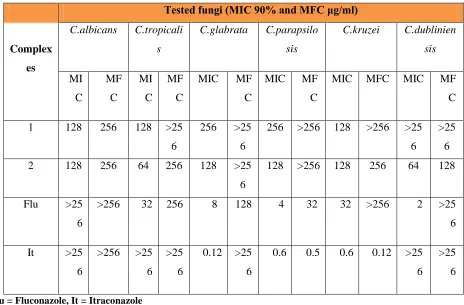
as negative blanks. As shown in Table 3 the complexes exhibit good antifungal effects against tested clinical species
of Candida albicans.
Table 3.In-vitro antifungal activity of synthesized Complexes against standard species of Candida.
Tested fungi (MIC 90% and MFC μg/ml)
Complex
es
C.albicans
C.tropicali
s
C.glabrata
C.parapsilo
sis
C.kruzei
C.dublinien
sis
MI
C
MF
C
MI
C
MF
C
MIC
MF
C
MIC
MF
C
MIC
MFC
MIC
MF
C
1
128
256
128
>25
6
256
>25
6
256
>256
128
>256
>25
6
>25
6
2
128
256
64
256
128
>25
6
128
>256
128
256
64
128
Flu
>25
6
>256
32
256
8
128
4
32
32
>256
2
>25
6
It
>25
6
>256
>25
6
>25
6
0.12
>25
6
0.6
0.5
0.6
0.12
>25
6
>25
6
360 | P a g e
Table 4.In-vitro antifungal activity of in house synthesized complexes against clinical species of Candida.
Tested fungi (MIC 90% and MFC μg/ml)
Complexes
C.albicans
C.tropicalis
C.parapsilos
is
C.
albicans*
C.tropicalis
*
MIC
MF
C
MIC
MFC
MIC
MF
C
MIC
MF
C
MIC
MF
C
1
128
256
128
>256
256
>256
256
>25
6
128
>25
6
2
128
256
128
256
64
>256
128
>25
6
128
256
Flu
8
>256
16
256
0.5
1
R
R
R
R
It
0.12
>256
1
>256
0.25
0.5
R
R
R
R
Flu = Fluconazole,
It = Itraconazole
* = resistant to fluconozole and itraconazole,
R =resistant
V. CONCLUSIONS
The newly synthesized tetraazamacrocyclic Schiff base complexes were obtained in a good yield. The report of the
study confirms traditional usage of these compounds as antimicrobial agents. However, large data must be generated
through the paharmacognostic studies before going for commercialization. These complexes were evaluated against
yeast. Among the synthesized complexes, 1 and 2 showed antimicrobial activity against all tested microorganisms
which is almost equivalent to the standard drugs ciprofloxacin and fluconazole. Some complexes also exhibited
good antifungal activity against tested clinical species of Candida albicans which were resistant to fluconazole as
well as itraconazole. Thestudies presented here provide a new structural type for the development of novel
antifungal agents.
VI. REFERENCES
[1] L. Ronconi, P.J. Sadler, Coord. Chem. Rev. 251, 1633–1648 (2007).
361 | P a g e
[3] Z. Guo, P.J. Sadler, Angew. Chem. Int. Ed. 38, 1512–1531 (1999).[4] A.G. Quiroga, F.J. Ramos-Lima, A. Alvarez-Valdés, M. Font-Bardía, A. Bergamo, G. Sava and C.
Navarro-Ranninger, Polyhedron 30, 1646–1650 (2011).
[5] D.G. Mccollum, L. Hall, C. White, R. Ostrander, A.L. Rheingold, J. Whelan, B. Bosnich, Inorg. Chem. 33,
924-933 (1994).
[6] M. Shakir, S.P. Varkey, O.S.M. Nasman, Polyhedron 14, 1283-1288 (1995). [7] S.M. Peng, V.L. Goedken, J. Chem. Soc, Chem. Comm. 3, 62-63 (1973).
[8] U. Abram, K. Ortner, R. Gust, K. Sommer, J. Chem. Soc., Dalton Trans. 735–744 (2000).
[9] U. Abram, K. Ortner, R. Gust, K. Sommer, J. Chem. Soc., Dalton Trans. 735–744 (2000).
[10] J.S. Casas, M.S. Garcia-Tasende, J. Sordo, Coord. Chem. Rev. 209, 197–261 (2000).
[11] Y. Singh,R.N. Patel, Y. P. Singh, A. K. Patel, N. Patel,Rita Singh,R. J. Butcher,J. P. Jasinski,E. Colacio, M. A.
Palacios, Dalton Trans. 46, 11860-11874 (2017)
[12] S.K. Mandal, K. Nag, J. Chem.Soc. Dalton Trans. 2839–2841 (1984).
[13] R.N. Prasad, M. Agarwal, S. Sharma, Indian. J. Chem. 43A, 337–340 (2004).
[14] Y. Dong, G.A. Lawrance, L.F. Lindoy, P. Turner, J. Chem. Soc. DaltonTrans. 1567–1576 (2003).
[15] S.A.A. Nami, IrfanUllah, M. Alam, Dong-Ung Lee, N. Sarikavakli, J. Photochem. Photobiol. B: Biology 160,
392–399 (2016).
[16] C. O'Connor, J.D. Gilbert, G. Wilkinson, J. Chem. Soc. (A) 84–87 (1969).