NEUROBIOLOGY OF SENSORY DEVIANCE: USING EEG TO MEASURE VISUAL AND AUDITORY MISMATCH NEGATIVITY IN CHILDREN WITH AUTISM
Katherine McLaurin Cleary
A dissertation submitted to the faculty of the University of North Carolina at Chapel Hill in partial fulfillment of the requirements for the degree of Doctor of Philosophy in the
Curriculum of Neurobiology
Chapel Hill 2013
ii ABSTRACT
KATHERINE MCLAURIN CLEARY: Neurobiology of Sensory Deviance: Using EEG to Measure Visual and Auditory Mismatch Negativity in Children with Autism
(Under the direction of Aysenil Belger)
iii
iv DEDICATION
v
ACKNOWLEDGEMENTS
I would like to express my gratitude to my advisor, Dr. Aysenil Belger, for her mentorship throughout my graduate training. I would also like to thank Drs. Grace Baranek, Franc Donkers, Geraldine Dawson, Karen Grewen and Aldo Rustioni for their participation on my dissertation committee and for their helpful comments during the development of this
research. Funding for these projects was partially provided by the Howard Hughes Medical Institute Program in Translational Medicine. I also must thank the Sensory Experiences Project funded by NICHD (R01-HD42168) and their associated staff for their help in conception, recruitment and analysis of preliminary data. I also thank the
members of the Belger Lab for their support, in particular Ms. Anna Evans for her assistance with acquiring laboratory techniques, as well as the participants and their
families who took part in this research.
I could not have completed this work without the friends who supported me throughout this journey, especially Lora Maroney who helped immensely with editing of this manuscript, Maarten Buitendijk, Stacy Ramsey, Dr. Stephanie Rendino, Kendall Spillman, Stephanie Latta and Eve Peters-Campbell. Finally, I thank my partner Seth
vi
Table of Contents
CHAPTER ONE: GENERAL INTRODUCTION ... 1
1.1 Brief introduction to autism... 2
1.2 ERP as a measurement of sensory processing: Mismatch Negativity ... 12
1.3 Visual mismatch negativity ... 17
1.4 Brief Goals of Current Projects ... 20
CHAPTER TWO: SENSORY PROCESSING IN AUTISM INVESTIGATED USING AUDITORY MISMATCH NEGATIVITY………22
2.1 Auditory MMN in typical development………...22
2.2 MMN as a measure of sensory features in autism ... 26
2.3 Clinical applications of Auditory MMN studies in autism ... 30
2.4 Auditory MMN in autism and its relationship to sensory features ... 34
2.5. Future directions of sensory processing investigation in MMN ... 40
2.6 Summary and specific aims ... 42
CHAPTER THREE: PRELIMINARY DATA ... 44
3.1 Introduction ... 45
3.2 Method ... 47
3.3 Results ... 52
3.4 Discussion ... 55
CHAPTER FOUR: VISUAL MISMATCH NEGATIVITY: TYPICAL DEVELOPMENT AND CLINICAL APPLICATIONS ... 67
4.1 Functional relevance of vMMN ... 68
4.2 Typical development of ERPs to visual stimuli ... 72
4.3 Development of vMMM and presence of multiple negativities in the visual difference wave ... 75
vii
4.5 vMMN as a clinical investigative tool ... 86
4.6 Unanswered questions and future directions of vMMN ... 88
CHAPTER FIVE: METHOD ... 91
5.1 Study One ... 92
5.1.1 Introduction ... 92
5.1.2 Method ... 97
5.1.3 Results ... 101
5.1.5 Discussion ... 105
5.2 Study Two ... 112
5.2.1 Introduction ... 112
5.2.2 Method ... 116
5.2.3 Results ... 118
5.2.4 Discussion ... 121
CHAPTER SIX: DISCUSSION AND CONCLUSIONS ... 130
6.1 Novelty of current studies and significance to literature ... 131
6.2 Limitations of current studies and potnetial solutions for future work ... 135
6.3 Potential clinical impact of current and previous studies ... 139
6.4 Future directions in light of current studies ... 144
viii
Table of Figures
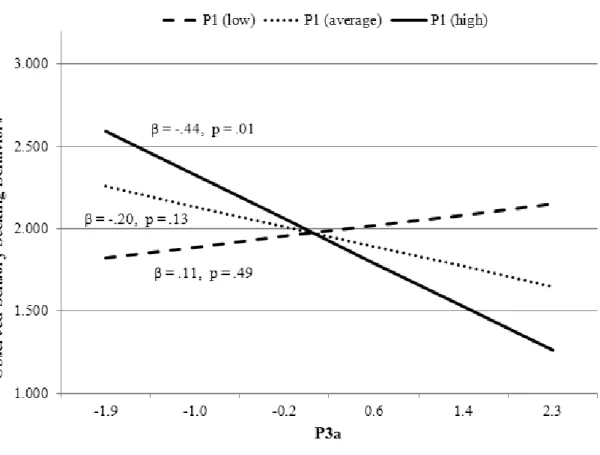
Figure 1: Group averaged ERPs to standard stimuli. ... 62 Figure 2: Group averaged ERPs to novel stimuli. ... 63 Figure 3: ERP composite values across groups. ... 64 Figure 4: Interactions between P1 and N2 in the prediction of
observed sensory seeking behaviors. ... 65 Figure 5: Interactions between P1 and P3a in the prediction of
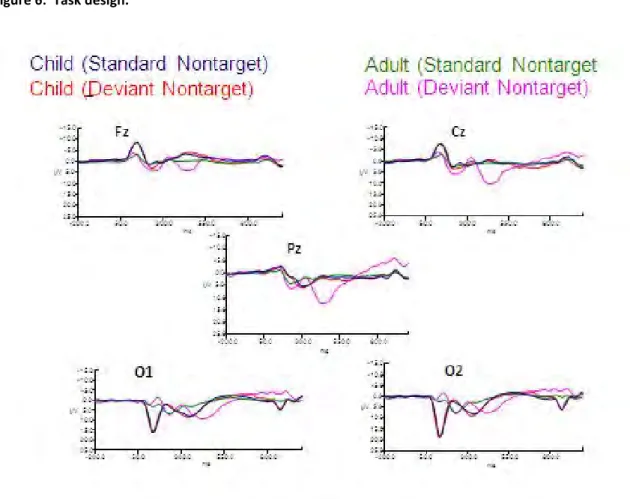
observed sensory seeking behavior... 66 Figure 6: Task design. ... 109 Figure 7: ERPs for both deviant nontarget and deviant target
stimulus conditions in children (N=21) and adults (N=20)
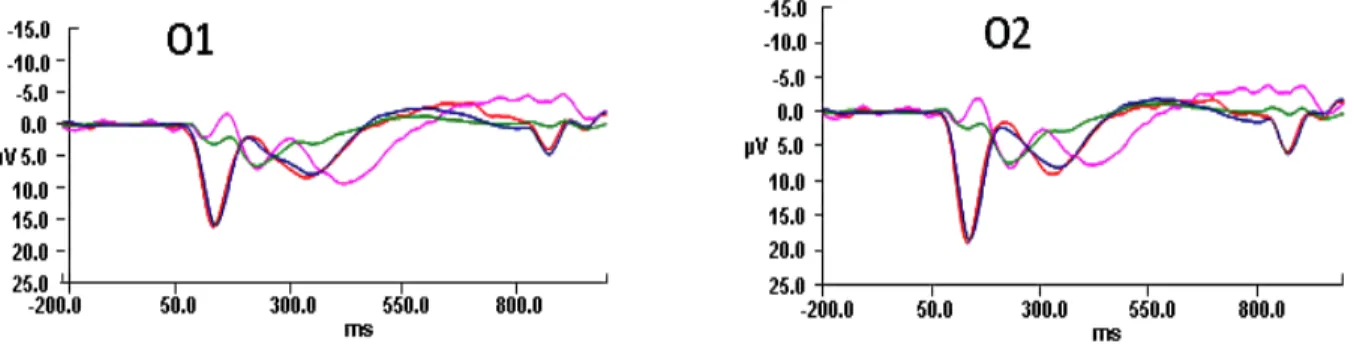
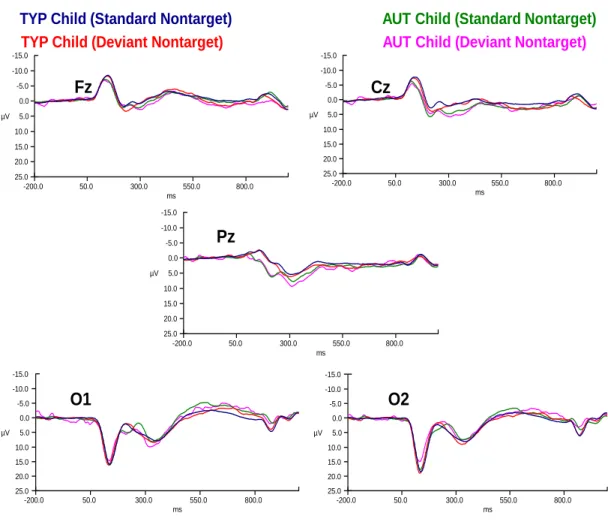
at electrodes Fz, Cz, Pz, O1 and O2. ... 109 Figure 8: ERPS for both deviant nontarget and deviant target stimulus
conditions in children and adults at electrodes O1 and O2 only. ... 110 Figure 9: Difference wave (vMMN) computed by subtracting
standard nontarget from standard target ERPs for both
children and adults at electrodes O1 and O2. ... 110 Figure 10: ERPs for both deviant nontarget and deviant target
stimulus conditions in typically-developing children (N=21) and children with autism (N=13) at electrodes Fz, Cz, Pz,
O1 and O2. ... 125 Figure 11: ERPs for both deviant nontarget and deviant target
stimulus conditions in typically-developing children and
children with autism at electrodes O1 and O2 only. ... 126 Figure 12: Difference wave (vMMN) computed by subtracting
standard nontarget from standard target ERPs for typically-developing children and children with autism
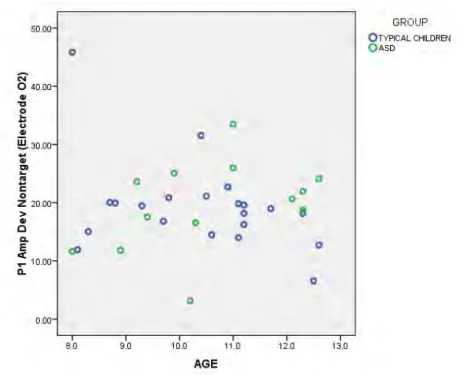
at electrodes O1 and O2. ... 126 Figure 13: Scatterplot of decreasing P1 amplitude in deviant nontarget
condition with increasing age in the typically-developing
ix
Figure 14: Scatterplot of decreasing N1 latency in the deviant
nontarget condition with increasing age in the typically-developing
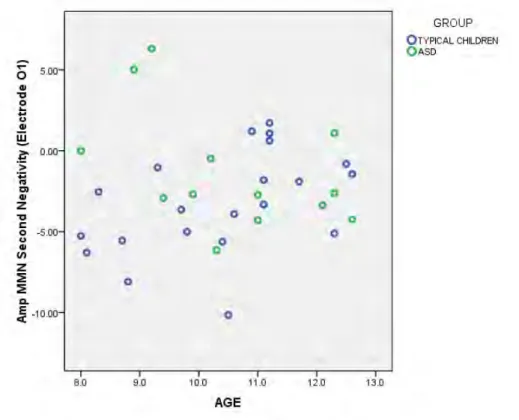
children at electrode O2. ... 127 Figure 15: Scatterplot of decreasing amplitude of the second
negativity in the difference wave with increasing age
x Table of Tables
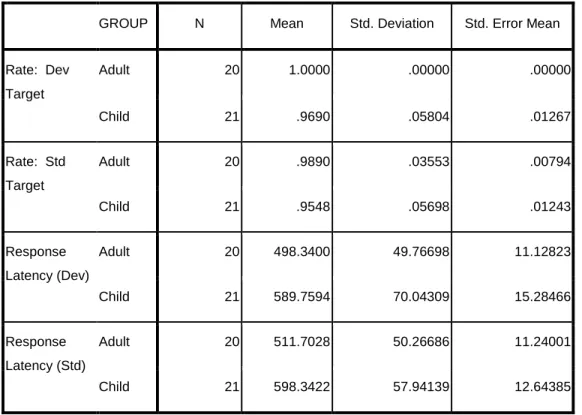
Table 1: Behavioral data for target stimuli in adult and child groups. Indicates percentage of correct targets (rate) and reaction time (latency) for both standard (std) and
deviant (dev) target conditions. ... 111 Table 2: Mean vMMN latency and amplitude at occipital electrodes
O1 and O2 for both negativities observed in the children and
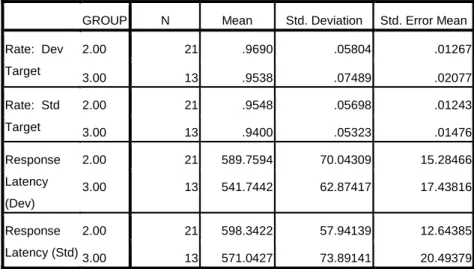
the single negativity observed in the adults... 111 Table 3: Behavioral data for target stimuli in typically-developing
CHAPTER ONE: GENERAL INTRODUCTION
Every moment, we constantly encounter sensory experiences in our
environments, from the feeling of a cotton shirt against our skin, to the change of a traffic light from red to green, to the trilling of a telephone. These stimuli are in unceasing motion, ever changing as we unconsciously adapt to the thousands of sensory changes that occur in our environment within a single second. For some individuals, this process occurs seamlessly and unconsciously, as we constantly make tiny adjustments to our perception of the environment: deciding which stimuli are important and planning our reactions accordingly; allocating ever-changing degrees of resources to particular stimuli depending on their relevance; and maximizing our ability to engage efficiently with our environments. However, for others, this sensory processing can be a relentless struggle if their ability to process changes in sensory information is disrupted. These deficits may impair the ability to learn language, which is dependent on many tiny distinctions of auditory stimuli, the ability to associate that language with printed letters and words, the subsequent ability to use those words to interact with others, or even impact other sensory modalities such as touch and taste. In addition, these deficits could interfere with broader processes of perception, emotion processing, and socialization and as such have a profound impact on those who suffer from them.
The ability to accurately detect sensory changes and adjust responses
2
autism, particularly children, has lead researchers to investigate ways to better understand sensory processing in both typical and disordered development. This knowledge will help orchestrate more effective clinical interventions for children affected by deficits in sensory processing. Behavioral research through observational and
self/parent reports has contributed to the knowledge of sensory processing deficits, but a biological approach to investigate response to sensory changes is necessary to provide a more complete understanding of these concepts. Through event related potential (ERP) research, we possess the ability to measure both conscious and unconscious responses to changes in sensory stimuli at the level of milliseconds, and this technique has already lead to answers for many underlying questions of how the brain processes stimulus deviance. Using a phenomenon known as the mismatch negativity (MMN), research has painted a detailed picture of stimulus deviance through many
developmental phases, clinical states and stimulus modalities, but more questions remain. Through investigation of stimulus deviance in the visual modality in childhood and relationships to specific sensory features found in autism in the auditory modality, the current studies seek to build a broader knowledge base of how children relate to their sensory environment in both typical development and in autism.
1.1 Brief introduction to autism: features, symptoms, deficit domains, and
avenues for research into sensory features
3
retrospective video analysis of home movies recorded in infancy (Osterling and Dawson 1994; Baranek 1999) and prospective studies of high risk siblings (e.g. Zwaigenbaum et al. 2009). These infants may engage less in social behaviors, including responding to their name being called or looking and smiling at other individuals, and initiate or sustain less eye contact than their typically developing peers (Baranek 1999; Volkmar et al 2005). Later in development, preschoolers with autism may exhibit difficulties with turn-taking and socially approaching others, and have poorer understanding of social norms and others’ emotions (Sigman et al 2004). Later in life, many of these individuals find it difficult to make and maintain friends, and social development deficits represent a strong negative impact on their lives (Burgess and Gutstein 2007).
Deficits in communication, especially with regard to language acquisition and production, are also prevalent in autism. Language deficits observed in individuals with autism differ widely, with some high functioning individuals displaying little to no
language-related symptoms and some lower-functioning individuals being completely nonverbal (Lord et al. 2000). As seen in social interaction deficits described above, communication deficits may begin in infancy with decreased or delayed onset of
babbling and unusual gestures, as well as lack of verbal cues taken from the caregiver; these deficits can further in the preschool years with increased reliance on nonverbal communication and the onset of echolalia, or the repetition of others’ words (Landa 2007). These children may also have difficulties with joint attention, or the focus on two individuals or objects (Volkmar et al. 2005); for example, many are unable to follow the gaze of an individual who is pointing out an object, and look at the pointing hand instead. Although higher functioning adolescents and adults with autism may have basic
4
is limited (Williams et al 2006). These deficits make it difficult to function in a reality driven by verbal communication, and as many as one half of children with autism do not develop sufficient language skills to communicate independently (Noens et al. 2006). Restricted and repetitive behaviors or interests are common in autism and can occur in many forms, as measured by the Repetitive Behaviors Scale-Revised (RBS-R; Bodfish, Symons and Lewis 1999). Individuals with autism may exhibit movement stereotypy such as hand-flapping; compulsive or ritualistic behaviors associated with inability to cope with change in routine or arranging objects; limited interests such as a particular video game or topic; and a preference for sameness in their environments and a poor tolerance of change (Lam and Arman 2007). These behaviors in particular suggest difficulties with stimulus change in the sensory environments of individuals with autism and may be partially explained by atypical sensory processing in these individuals. Indeed, profound sensory deficits and unusual sensory features have been observed in individuals with autism, particularly children, as discussed below, and these and other symptoms have a profound impact.
5
sensory input) and sensory seeking (craving certain types of sensory input) are three classifications of behavior common in children with autism (Boyd et al. 2010). These unusual sensory features cause significant negative consequences to both the individuals affected by them and their families (Boyd et al. 2010).
Because autism is highly heterogeneous in nature, the severity and manifestation of symptoms vary widely, both between individuals with autism and across development. Some individuals have severe behavioral deficits and remain completely nonverbal throughout their lifespan, while others have milder impairments in speech patterns, eye gaze, and stereotyped behaviors. These large variations in symptoms have significant predictive and diagnostic relevance (Luyster, Qui, Lopez and Lord 2007), but have thus far remained unresolved. As a result, many children are not correctly diagnosed with autism until 2 to 3 years after symptoms appear (Filipek et al. 1999; Bryson, Rogers and Fombonne, 2003). Recent research has shown that examining the biology and behavior behind deficits in sensory processing may hold the key to these diagnostic and research challenges. Cognitive science has attempted to explain sensory deficits in autism in several different ways, and three main theories underlying these deficits will be discussed below.
6
turn empathizing with others (Rajendran and Mitchell 2007). This hypothesis focuses on the social and communication deficits seen in autism. Theory of Mind, or the ability to recognize that others outside of oneself have a point-of-view, was originally postulated by Premack and Woodruff (1978) and, in this hypothesis, is impaired in individuals with autism. This hypothesis is supported by atypical responses of children with autism to tests for unexpected transfer of false belief pioneered by Wimmer and Perner (1983), in which a story is told to a child whereby a puppet has a belief about an object’s location that is incongruous with its true location. This requires the child to make inferences about the puppet’s mental state, and in this widely-replicated finding, a majority of children with autism were unable to do this. A weakness of this theory is that many studies have found that individuals with autism have more difficulty with complex emotional states of others, rather than simple opposing viewpoints (Hamilton 2009). In addition, responses of children with autism to the classic Theory of Mind test (Wimmer and Perner 1983) vary, and indeed some children with autism are capable of taking the puppet’s perspective. This is probably related to the strong heterogeneity of autism and suggests that while the Theory of Mind may explain some aspects of autism for some individuals, it is not a complete hypothesis (Rajendran and Mitchell 2007).
7
typically-developing individuals, and that even when their performance is on par with that of typical individuals, they often recruit different neural networks in order to perform the task. Poor performance on executive function tasks is also predictive of repetitive behaviors, especially stereotypies and mental inflexibility, although not all children with autism perform poorly on executive function tasks, and performance on some tasks, such as the Stroop task, tend to be unimpaired in children with autism (Hill 2004). However, Kenworthy et al. (2008) also note that this hypothesis may be incomplete; in some cases when the human examiner is replaced by a computer, individuals with autism improve their performance of executive function tasks, indicating that cognitive hypotheses of social interaction deficits and executive function deficits may interact.
The third cognitive hypothesis is the Weak Central Coherence Theory (Frith 1989), which helps to merge the non-social and social theories and is applicable across multiple domains. This theory states that while typically-developing individuals tend to derive overall meaning from information they come across in their environments,
individuals with autism tend to focus on smaller details of this information rather than the “big picture,” or global coherence (Rajendran and Mitchell 2007). This theory is related to the idea that individuals with autism exhibit enhanced perceptual functioning,
especially when concerned with detail-focused stimuli and local (versus global) stimulus processing (Mottron et al 2006). This theory fits in well with the idea of
8
(Rajendran and Mitchell 2007). Rajendran and Mitchell (2007) also emphasize that while individuals with autism may be biased to detail processing over global processing, they may be able to process global information with increased effort or strategies that differ from typically-developing individuals.
9
bias toward local processing and poor connectivity with other neural systems could have a negative impact on the way individuals with autism experience the world, and could partially explain the sensory features often found in autism, discussed below.
The three core symptom domains of autism may be further explained in the context of unusual sensory features. Sensory features occur often in autism, especially in children, exist on a continuum of severity and often persist into adulthood (Marco 2011). There is a wide variety of expression of sensory features, and individuals may experience them in some but not all sensory modalities, or even respond quite differently to stimuli in the same sensory modality. For example, children with autism may exhibit a profoundly diminished response to touch, crave certain textures or foods, or react very strongly to loud noises in ways that their typically-developing peers do not. These
unusual sensory features appear to be behavioral expressions that aggregate into three distinct categories or sensory response patterns: (a) sensory hyporesponsiveness (i.e., failure to behaviorally react with sufficient magnitude or attention to a sensory stimulus; for example, no response to name being called), (b) sensory hyperresponsiveness (i.e., exaggerated behavioral reaction, aversion, or avoidance to a sensory stimulus; for example, extreme aversion to telephone ringing), and (c) sensory seeking behavior (i.e., cravings for sensory stimuli). A number of studies have examined sensory features in autism using play-based behavioral assessments and parent reports (Boyd et al 2010). High levels of hyporesponsive behaviors are associated with both increased social-communicated symptom severity and decreased language and social adaptive skill among children with autism (Watson et al 2010). In addition, high levels of
10
types of sensory features are more likely to occur in this disorder relative to other developmental disorders (Rogers and Ozonoff 2005). In a review of the empirical evidence of sensory features in autism, Rogers and Ozonoff (2005) found more
evidence for hyporesponsive behaviors in children with autism as compared to children with other developmental disorders, but the authors also highlighted the lack of
replicated findings and lack of group differences in many studies. These authors
recommend more stringent diagnostic criteria and careful matching across study groups, as well as the inclusion of multiple sensory modalities and consistent biological
measures to better interpret future research’s findings.
These unusual sensory features, discussed in more detail in Chapter Two, may be related to each of the core deficits of autism. When a stimulus is introduced that deviates from the expected norms in an individual with autism’s environment, these individuals may respond in ways that deviate significantly from individuals with typical development. Deficits in processing auditory stimuli, (e.g., hypo- or
hyperresponsiveness) could lead to difficulty with the learning and subsequent
production of language. Inability to process changes in an individual’s environment and respond appropriately, especially those of a social nature such as facial expressions or touch, could lead to both deficits in social interaction and subsequent avoidance of such interactions. Finally, difficulties with responding to stimulus change could result in a desire for sameness, and result in the repetitive behaviors and interests often seen in autism. Studying sensory processing deficits in children with autism may help
deconstruct the immense symptom variability found in autism and better parse the heterogeneity of this disorder.
11
(Baranek 2006; Boyd et al. 2010), these measures currently lack biological correlates. Very few studies (e.g. Gomot et al. 2011) have researched sensory features using imaging methods, but this field has the potential to result in earlier diagnoses and intervention methods by uncovering markers for certain types of sensory deficits,
described above. Taken together, this suggests that researching the biological bases of stimulus deviance is an excellent avenue to understand sensory processing in autism, as well as how deficits in that processing could influence the expression of the core symptom domains. Since most sensory stimuli are introduced quite quickly, a method with excellent temporal resolution is necessary to examine sensory deficits in autism. Event Related Potentials (ERPs), a type of electroencephalography (EEG) research, provides the necessary tools to study these questions. In addition, ERPs allow for the study of stimulus deviance per se in addition to basic sensory processing deficits. Such research can be efficiently conducted using a phenomenon observed in neural evoked potentials called mismatch negativity.
1.2 ERP as a measurement of sensory processing: Mismatch Negativity
Electroencephalography (EEG) is a method of measuring tiny electrical impulses from ionic current flow of neurons and the associated electrical activity of voltage
fluctuations produced in the brain (Niedermeyer and da Silva 2004). Using this method, the aggregate of electric voltage fields from millions of neurons and associated
12
the scalp. EEG is very useful in clinical and research settings due to its excellent temporal resolution, its noninvasiveness, its ability to directly measure brain activity and its relatively low cost. Clinical uses for EEG include seizure and sleep disorder
diagnosis, monitoring states of consciousness, and diagnosing coma, encephalopathies or brain death.
Clinical uses for EEG normally focus on the collection of continuous data, but EEG can also be used to study evoked related potentials (ERPs) or averages of EEG activity time-locked to the presentation of an event and its associated processing. This allows for the measure of complex electrophysiological responses to a sensory,
13
can be used even populations who cannot follow directions, such as coma patients, infants, or individuals with profound cognitive deficits or developmental delays. Either used separately or together with behavioral research, ERP provides specific information about the timing of stimulus processing at the level of milliseconds, even when there is not necessarily a behavioral change in response to a stimulus. This makes it a
particularly interesting tool to study neural responses that may occur very rapidly, and allows for timing measurements of information processing in different areas of the brain. These factors make ERP research useful for studying sensory processing in many modalities.
Two unique aspects of ERP research that make it particularly appealing for the study of stimulus change are both that it is possible to obtain ERPs even when a subject is not consciously attending to a stimulus, and to measure the brain’s ability to detect a change in a stimulus when compared to a series of standard stimuli. The mismatch negativity (MMN) is a component of the ERP that occurs in response to a small, rare change in a series of frequently-occurring standard stimuli. MMN can be measured in any modality, although it is most commonly studied in the auditory and, more recently, the visual modality. In addition, many types of stimulus changes can elicit MMN, including pitch/frequency, duration, and intensity. It is usually computed by subtracting the ERP waveform elicited by a standard event from that of the deviant event, resulting in a difference wave that reflects the processing of change between the two stimulus events. This difference wave generally shows a negativity presenting over fronto-temporal electrode locations that peaks around 100 to 200ms post-stimulus
presentation, although exact parameters depend on the nature of the deviance, the task paradigm, stimuli used, and the population studied (Naatanen 1995).
14
associated cognitive processes. Generators for the MMN were first proposed bilaterally in the auditory cortex and in prefrontal areas (Naatanen and Michie 1979), and today the auditory MMN is thought to mainly originate from primary and secondary auditory
cortices. Animal studies have revealed that other brain areas may contribute to MMN, including the thalamus (Kraus et al. 1995) and the hippocampus (Csepe et al. 1989). Different types of auditory deviants (e.g., frequency, duration) as well as deviants of varying complexities (e.g. phonemes versus simple tones) have been shown to have different generators within the auditory cortex (Alho 1995). Activation of prefrontal areas, such as the dorsolateral prefrontal cortex, might also occur due to the involuntary shifting of attention towards stimulus change (Giard et al. 1991; Escera et al. 2003), or connectivity input from frontal to auditory cortices (Alho et al. 1994). In this “memory-adjustment” theory, deviations in a particular established standard auditory sequence generate a response in a temporo-prefrontal network that compares the deviation with the previously-experienced memory trace of standard stimuli (Garrido et al 2009). This idea has been challenged by studies such as Jaaskelainen et al (2004) that found robust MMNs in the presence of a single standard stimulus, despite the idea that repeated standard stimuli are necessary to elicit an MMN. The authors hypothesized that the MMN is actually a result of auditory “adaptation” in the auditory cortex that causes attenuation and delay of the N1 response. The N1, or N100, is a large, negative-going peak occurring approximately 100ms post-stimulus presentation elicited by an
unpredictable stimulus independent of task demands. However, the scalp distribution of the N1 is different from the MMN (Giard et al. 1990), and studies of patients with
15
Garrido et al. 2009) has suggested that while the N1, and thereby the primary auditory cortex, has an effect on the MMN, it cannot explain the MMN entirely. It is likely that both the adaptation and memory-adjustment hypothesis contribute to the MMN. Garrido et al. (2009) proposed a model of predictive-coding that reconciles these two hypotheses and associated brain areas. In this view, integration of both sensory information from the environment and predictions formed based on what caused this sensory information work together to form perceptions. Interactions among auditory cortical hierarchies help to control prediction error, but when this does occur, as is the case with MMN, this model must be automatically and rapidly adjusted. Interestingly, a similar model has been proposed in the visual system whereby top-down processes make predictions based on input from bottom-up processes, which are then continuously modified to reflect actual sensory input (Yuille and Kersten 2006). Viewed this way, MMN is an important
construct of perceptual learning and is reflective of changing connection strengths over repeated presentations of the same stimulus to more accurately reflect perceptual reality and reduce prediction error. This process requires input from both primary (i.e. auditory cortices) and higher-order (i.e. prefrontal areas) areas and allows for the reconciliation of the adaptation and the memory-adjustment hypotheses (Garrido et al. 2009).
16
disorders associated with deficits in language acquisition and production (e.g. Naatanen 1995; Roberts et al. 2011) or sensory processing deficits (e.g. Gomot et al. 2011; Donkers et al., in review). Both of these deficits are often observed in autism, making MMN a useful avenue to better understand how individuals with autism relate to their sensory environment in the auditory modality and beyond.
1.3: Visual mismatch negativity: A new modality for investigation of stimulus
change
The presence of a visual mismatch negativity (vMMN) has been the subject of some debate, but recent research (reviewed by Pazo-Alvarez, Cadaveira and Amenedo, 2003; Czigler, 2007) has provided convincing evidence that the brain can unconsciously detect small changes in visual stimuli. Czigler, Balazs and Winkler (2002) first
demonstrably demonstrated the existence of a visual mismatch negativity (MMN) in healthy participants who viewed different color gratings unrelated to the task at hand. This visual MMN was manifested in a posterior negativity and anterior positivity between 120-160ms post-stimulus presentation. However, the authors note that large deviances were necessary to elicit a visual MMN, as the small deviant condition did not produce a significant negativity. Since then, vMMN has been investigated and elicited in many different visual stimulus deviance paradigms, including color (Horimoto et al. 2002; Czigler, Weisz and Winkler 2006; Berti 2009), spatial frequency (Heslenfeld 2003; Fu et al. 2003), line orientation (Kimura et al. 2009; Czigler and Sulykos 2010), position (Muller et a. 2012; Berti 2009) and even complex stimuli such as facial emotions (Stefanics et al. 2011, Gayle et al. 2012). General commonalities of the studies mentioned above
17
post-stimulus, this negativity’s independence of stimulus properties, standard stimuli being present for comparison against the deviant stimuli, and conscious attention being unnecessary to elicit this negativity. This research has led to the conclusion that a visual homologue of the auditory MMN exists and may be a useful tool in clinical and cognitive neuroscience (Kimura et al. 2011).
Factors that affect visual MMN in previous studies include presentation of standards and unconscious change, task relevance, and the type of visual stimulus presented. Small changes in a frequently-occurring visual stimulus can be processed unconsciously, as demonstrated by Fu, Fan and Chen (2003). Visual gratings that had a different orientation to the previously-presented grating elicited P84 and N192
18
deviants presented in the lower visual field did not. This indicates that obtaining a reliable visual MMN depends on both location and nature of the stimulus. Type of stimulus may be particularly important to visual MMN due to the topography of the human visual system and its organization into two distinct-but-interacting processing streams, i.e. dorsal and ventral. This idea will be discussed in detail in Chapter Four.
19
and second negativities sometimes observed in vMMN and their potential functional applications, see Chapter Four.
Perhaps because visual MMN is a relatively new field of investigation, studies have primarily examined this difference wave in populations of typically-developing adults. A small number of studies have investigated vMMN in children (Horimoto et al. 2002; Tomio et al 2012; Clery et al 2012, 2013), both typically-developing and children with developmental disorders such as mental retardation (Horimoto et al. 2002) and autism (Clery et al. 2013). These studies will be described in more detail in Chapter Four and raise many questions about the development of vMMN in both typically-developing children and children with autism. In particular, the results of some of these studies have been inconsistent in typically-developing children (see Clery et al. 2012, 2013), leading to questions about their accuracy when used as a comparison group to children with autism. Comparatively little is known about vMMN in children with autism in relation to auditory MMN in this group, and there has been sparse speculation about the relationship between vMMN differences in these children. Looking to the relatively well-characterized auditory modality may help to answer these questions, as well as considering previous behavioral research into sensory features and the broader cognitive deficit domains of autism.
1.4 Brief Goals of Current Projects
20
change in typical development; a better understanding of typical stimulus change
processing is critical to understanding how and why this process is different in autism, as well as what interventions might be effective to improve it. ERP research has provided much knowledge in terms of how individuals process changes in their sensory
environments, particularly through the mismatch negativity, a unique measure of unconscious stimulus deviance processing. The current projects will investigate visual mismatch negativity in typical development and in children with autism, as well as further the already-robust body of research on auditory mismatch negativity in children with autism by correlating MMN with sensory features evident in these children. To this end, the current projects will work to answer the following questions:
Visual MMN has advanced greatly as a field in the last two decades, but there is still sparse research on how MMN in the visual modality manifests in children. In addition, very few studies have investigated MMN in children with autism. The current project will therefore investigate the development of vMMN in a sample of typically-developing children and children with autism. The goal of this project both to
characterize vMMN at a particular stage of development (in this case, eight- to twelve-year-old children) and to open the door for future studies relating vMMN to sensory features found in children with autism and other developmental disorders.
Although there is a rich field of research concerning auditory MMN in children with autism, how differences in aMMN in this population relate to specific sensory features common in these children is poorly understood. The current project will therefore investigate these relationships through a multi-measure study using
21
understand how sensory features observed in the clinic relate to biological measures of neural activity, in this case ERP components. For a detailed description of specific aims and research methods, see Chapter Two and Chapter Four respectively.
CHAPTER TWO: SENSORY PROCESSING IN AUTISM INVESTIGATED USING AUDITORY MISMATCH NEGATIVITY
2.1: Auditory MMN in typical development
Mismatch negativity in the auditory modality (aMMN) has been well-studied in both typical development and in autism, and is defined as the brain’s response to a rare change in a series of frequently occurring standard stimuli (Naatanen and Escera 2000). This deviance can be detected in one or more features of the stimulus such as
pitch/frequency, duration, or intensity. The adult auditory MMN was first described by Naatanen, Gaillard and Mantysalo (1978) as a negativity in response to auditory stimuli varying slightly in either intensity and frequency. It manifests as a fronto-central
negativity associated with primary and secondary auditory cortices, and occurs
23
There are several reasons that make aMMN a useful research tool to study sensory deviance processing in both clinical and typically-developing populations. aMMN can be studied even in very young or very impaired populations who cannot follow instructions. In addition, aMMN is particularly suited to the investigation of many aspects of symptoms commonly seen in developmental disorders. aMMN is thought to be related to language development, as there are many finely tuned discriminations between sounds that must occur when learning to produce language, and as such it is a popular tool to investigate disorders associated with language delay. Finally, aMMN occurs very quickly and can be easily measured with EEG’s high temporal resolution, allowing for the precise study of sensory responses that occur on the order of
milliseconds. These factors make aMMN an important tool in cognitive neuroscience for the investigation of developmental disorders, as well as the study of sensory processing in typically development.
Although research has noted some discrepancies, the aMMN in typical
development is relatively well understood. Infants as young as two months may express aMMN-like negativities around 200ms (Ceponiene 2002), however, there is also
24
and can therefore fire at faster rates. The emergence of MMN-like responses is likely a reflection of the maturation of deeper cortical layers (Trainor et al 2003).
In terms of peak topography, the aMMN is very similar to adults by childhood (around age seven), but many studies suggest that it is not yet fully mature; specifically, it seems to be larger in amplitude and longer in latency in children versus adults and older adolescents. Oades et al. (1997) found that aMMNs were larger in ten to fourteen year old children than in seventeen to twenty-one year old young adults. In addition, there may be a right frontal bias in younger children that is not evident in the older age group. In a sample of four to ten year old typically-developing children and adults, Shafer et al. (2000) found that the aMMN was expressed as a frontal negativity occurring around 200ms post-stimulus in children. This peak decreased in latency by 11ms/year of age across the span of child participants, and the overall amplitude of the aMMN was significantly larger in children versus adults. Kraus et al. (1997) also found larger aMMN amplitudes in school-age children versus adults, although these authors did not find any significant differences in latency. This could be due to the stimuli used in this particular study, which were restricted to perceptively different speech phonemes. There could be a perceptual benefit to further language-related auditory stimuli in typically-developing children. Indeed, Korpilahti et al. (2001) found stronger aMMNs to deviations in
25
and adults displayed aMMNs to small frequency deviances at temporal and frontal electrode sites, the amplitude of aMMN was greater at temporal electrode sites only in the children. The authors concluded that aMMN may be mediated by two distinct neural systems that may be temporally connected, with the system associated with the auditory cortex also associated with pre-attentive mechanisms and maturing later than that of frontal areas. This multi-component, successive view of aMMN has also been postulated in the visual modality as discussed in previous chapters. Generally, however, the aMMN seems to decrease in both latency and amplitude with age, which indicates both faster and more efficient processing of auditory deviance with increasing age and biological maturation.
2.2: MMN as a measure of sensory features in autism
The studies described in previous chapters have investigated stimulus deviance processing in the visual modality using populations of children with autism as well as typically-developing adults and children. Impaired processing of rare stimulus deviance may affect individuals with autism in many ways, including adaptation to a changing environment and stimulus filtering. Individuals with autism often have difficulty
26
tool to measure stimulus deviance processing due to its non-invasive, unconscious nature, and it has been posited that MMN holds clinical applications in the areas of language deficits, overall cognitive functioning, sensory memory, and states of
consciousness (see Naatanen 2003 for a review). Many of these potential applications are relevant to the core features of autism. Evidence presented in previous chapters indicates that not only do individuals with autism have difficulty with these broader, top-down processes; they may also have deficits at more fundamental levels of stimulus discrimination and deviant recognition, which may go on to explain the more commonly-observed symptom domains in autism spectrum disorders. For example, an individual who has a reduced response to task-irrelevant, small differences in spatial frequency at components of the ERP associated with early primary visual areas may have difficulty recognizing at an unconscious level when a portion of their environment has changed. Or, deficits in later ERP components may point to greater processing resources
allocated, or resources allocated in inappropriate distributions, leading to excess strain in experiencing one’s sensory environment. These problems may lead to difficulties in adjusting behavior appropriately in everyday functioning, as sensory experiences impact these individuals more. Consequently, such individuals may begin to avoid situations, e.g. social interaction, in which these experiences may arise. Clearly visual sensory deficits, even at the very basic level of primary auditory cortex, can have a strong impact on individuals with autism. However, this research question has many detailed facets that necessitate further exploration.
27
modalities and their relationship is complicated. As a result, recent research has characterized sensory features as part of a continuum and organized them into distinct sensory response patterns including hyporesponsiveness, hyperresponsiveness and sensory seeking behaviors. Many unusual sensory behaviors can be related to over- or underreactivity to stimulus deviance, such as a child who prefers repetitive conditions and becomes profoundly upset when this repetition is violated, or changes in auditory or visual stimuli (such as a blinking light or a blender being turned on) that elicit far more or less of a response than would be otherwise appropriate. Craving of sensory input, or sensory seeking behaviors, can also occur. More than ninety-six percent of children with autism exhibit some form of sensory hyper- or hyporesponsivity, and these deficits exist on a continuum of severity and often persist into adulthood (Marco 2011). MMN’s nature as the response to a rare change in a series of frequently occurring standard stimuli makes it an ideal avenue to investigate atypical sensory features. Currently, categories of sensory features such as hyporesponsiveness, hyperresponsiveness, and sensory seeking behavior are primarily assessed using observed behavioral measures and parent reports such as the Sensory Processing Assessment for Young Children (SPA; Baranek 1999, unpublished manuscript), the Sensory Experiences Questionnaire (SEQ; Baranek 1999, unpublished manuscript; Baranek et al. 2006) and the Sensory Profile (SP; Dunn 1999). These categories of sensory features have been associated with core deficits of autism. In particular, Boyd et al. (2010) found that high levels of
28
seeking behaviors. However, each category is not necessarily related to one another, i.e. sensory seeking and hyperresponsiveness were not correlated in Boyd et al. (2010)’s analysis. Sensory seeking appears to be related to ritualistic/sameness behavior dimensions of repetitive behaviors (Boyd et al. 2010), while previous studies (Gay et al. 2008) have found that social communication deficits may be associated with high levels of both sensory seeking and hyporesponsive behaviors. While it is important to note that these general associations were often seen in children with other
developmental delays in addition to children with autism, children with autism were more likely to have higher scores on both measures of sensory features and on the RBS-R. This indicates that there could be different systems of neurobiological deficits underlying each sensory feature category, and further that these categories could better explain the three core deficits of autism. Furthermore, although the interactions between sensory features and, for example, repetitive behaviors may be similar in children with autism and other developmental delays, it is likely that these deficits are more severe in children with autism and much more likely to occur (Marco 2011; Dawson and Watling 2000).
29
stimulus deviance research. These correlations could help explain the heterogeneity of autism and provide for more targeted interventions that would address the individual child’s specific sensory difficulties.
2.3: Clinical applications of Auditory MMN studies in autism
There have been a wide variety of interventions to address sensory features in children with autism, including Sensory Integration (i.e. exposure to a wide variety of sensory experiences), Auditory Integration Training (i.e. electronically modulated or filtered music provided through earphones), and Sensory Stimulation (i.e. providing organized sensory stimulation of one type and modality, e.g. pressure) approaches (Baranek 2002). These sensory-focused interventions are not substitutes for core educational curricula and are likely most useful as supplementary portions of an overall intervention program. Baranek (2002) recommends a conservative approach for applying these interventions, as there is limited scientific basis for the efficacy of these therapies. Most evidence comes from case studies and small intervention studies and these findings are mixed, with any observed improvements often disappearing following cessation of treatment; large-scale experimental studies on the efficacy of sensory-based interventions are lacking (Baranek 2002). In addition, some interventions such as AIT have been criticized for potential adverse effects including lack of safeguards
against hearing loss.
30
outcomes. Baranek (2002) recommends longitudinal and cross-sectional studies documenting the efficacy of these interventions using replicated, methodologically rigorous designs with randomized controlled trials. Baranek (2002) also emphasizes the importance of identification of specific behavioral and physiological patterns that
differentiate those who respond well to these treatments from those who do not. This pattern identification can be addressed through studying individual sensory features, both behaviorally through observational and parent report methods, and
neurobiologically through ERP investigations such as aMMN studies. Research on sensory features shows that individual children with autism can have vastly different sensory processing profiles (e.g. Boyd et al. 2010), and there is unlikely to be any “one-size-fits-all” intervention treatment for deficits in sensory processing. However, studies of aMMN may be useful as a clinical assessment tool in differentiating which children might be most responsive to certain types of sensory-based interventions. These potential benefits, when combined with large experimental intervention studies, could help tailor treatment plans to individual children’s needs. A major avenue for pursuing aMMN research with the goal of improved, individualized sensory-based interventions is the correlation of aMMN and other subtypes of auditory ERP responses to measures of autism severity and auditory processing. Several recent studies, discussed below, have begun to address these questions.
31
adolescents who reached the same performance threshold. This effect was not observed in intensity of duration discrimination of auditory stimuli, but frequency discrimination ability did not correlate with auditory sensory behaviors as measured by the Adult/Adolescent Sensory Profile (AASP; Brown and Dunn 2002). Further,
individuals with autism who were more proficient at auditory duration discrimination self-reported more auditory sensory behaviors on the AASP. However, individuals with autism who performed poorly on auditory intensity discrimination were more likely to report sensory behaviors related to coping with loudness levels. This study, while not collecting ERP data, indicates that a subset of adolescents with autism exhibit superior auditory frequency discrimination, and the authors hypothesize that they may represent a specific phenotype. However, this superior frequency discrimination group was not associated with sensory features. This paper is indicative of the complicated
relationship between auditory deviance types, associated sensory features, and performance among individuals with autism. The authors note that items on the AASP rarely deal with frequency discrimination and are more focused on loud noises and lack of response to auditory stimuli; it is possible that frequency-specific auditory sensory features may be present in this group. Future work should determine what is ‘special’ about frequency discrimination in autism, as well as any associated neurological differences that depend on sensory processing profile; this could be approached using ERP, as other studies described below have begun to investigate.
32
Barthelemy et al. 1997), a questionnaire for evaluating symptoms of autism such as deficits in social interaction as well as verbal and non-verbal communication, abnormal eye contact and responses to auditory stimuli, and ritual uses of objects. The authors selected items that were relevant to their hypotheses, including unusual responses to auditory stimuli and disproportionate frustration or anger when activities are interrupted, objects forbidden, or expectations unsatisfied. Gomot et al. (2011) found shorter MMN latencies in children with autism compared to typically-developing controls at frontal and central electrode sites, and no significant group difference in MMN amplitude.
Additionally, while no differences were noted in P3a latency, its amplitude was larger in children with autism at both frontal and central electrode sites. Overall, children with autism seem hypersensitive to novel auditory frequencies, a finding replicated in many other MMN studies (see Gomot et al. 2002; Ferri et al. 2003; Jones et al. 2009). Perhaps more importantly, however, children with autism who scored higher on
33
occurring in abnormalities observed in MMN, particularly in the subset of individuals with autism scoring high on preference for sameness, and distress when routines are
disrupted.
2.4: Auditory MMN in Autism and its relationship to sensory features
The body of literature concerning aMMN in autism is inconsistent (e.g. Bomba and Pang 2004; Jeste and Nelson 2009; see Marco et al. 2011 for a review), and many different findings have been reported. This is likely due to several factors, including the heterogeneity of autism spectrum disorders, and consequently the subject populations chosen for each study, and the different paradigms used to investigate aMMN. Although this topic has been well-researched previously and resolving the remaining
discrepancies is beyond the scope of this work, a brief review of aMMN findings in autism will be presented here, as well as remaining questions as they relate to sensory features’ role in stimulus deviance processing.
Previous studies have found decreased MMN amplitudes and latencies in AU children when presented with important components of language such as vowel
perception (Oram et al. 2005) and small changes in pitch (Gomot et al. 2002). However, some types of stimuli, such as pitch-deviant tones, elicit larger MMNs (Ferri et al. 2003) in children with AU, and some studies report autism MMNs on par with
34
retardation, and the authors hypothesize that their results may have been influenced by low functioning cognitive impairment. This both highlights aMMN’s usefulness as a tool to investigate brain functioning even in individuals who cannot cooperate or follow instructions, since this ERP component occurs unconsciously and makes it very easy to deliver auditory stimuli in a passive paradigm, and yet also indicates potential
differences between low and high functioning individuals with autism. It is worth noting, however, that another study (Gomot et al., 2002) found decreased aMMNs in children with autism that were unaffected by the level of mental retardation of the children in their sample. The potential distribution using scalp current density (SCD) mapping was altered both in autism versus control children, and in the autism group subdivided into more and less severe levels of mental retardation. In other words, children with autism exhibited an abnormal bilateral distribution over central electrodes as compared to frontal electrodes in typically-developing children, and this effect was most profound in the children within the autism group with high levels of mental retardation. Gomot et al. (2002) also used SCD to observe different aMMN generators in children with autism, with earlier left temporal activation preceded by an abnormal early left frontal
component, versus typically-developing children. The authors hypothesize possible left frontal cortex dysfunction underlying their observed reduced aMMNs, potentially
involving parallel nonprimary thalamo-cortical projections that could be overactivated in children with autism. Gomot et al. (2002) also noted the presence of a P3a-like
component in children with autism following the aMMN. The P3a is a later component of an ERP reflecting more conscious attention to a stimulus and especially stimulus
35
changes would normally not pass into conscious awareness in control children. This hypothesis is especially important in hyperresponsive children and may explain their overreaction to environmental stimuli.
Age is also an important factor in characterizing aMMN in autism, and it may interact with severity of deficit to paint a more complete picture of how deviance processing is altered in autism. In a sample of adults diagnosed with Asperger’s disorder, Kujala et al. (2007) found increased amplitude of the aMMN in fronto-central electrodes in duration-deviant stimuli compared to typically-developing adults, and also shorter latencies of aMMN and P3a in frequency deviant stimuli. The authors argue for enhanced speed of cortical processing and hypersensitivity to stimulus deviants in individuals with Asperger’s disorder, which may relate to these individuals’ increased detail-oriented perception rather than holistic perception in a dynamic environment. The authors also note that another study (Lepisto et al. 2006) using the exact same paradigm and stimuli found the opposite effect in children with Asperger’s disorder and autism (2005), in that these children had attenuated aMMN amplitudes to duration deviant auditory stimuli. There are possible developmental effects at work here that point to studying adolescents with autism in order to determine where the ERP shift occurs. However, Lepisto et al. (2006) also noted that the children in their study had larger aMMN amplitudes in response to frequency deviant stimuli, indicating that while at first glance the exact opposite effect occurred in a different age group, stimulus deviance type also plays a role. These studies are significant because the same results were found when Lepisto et al. applied the paradigm to children with autism as well as Asperger’s disorder, indicating similar auditory deviance processing despite large
36
children with autism as compared to typically-developing children in response to frequency-deviant tones. Potential explanations could be the different stimuli used, stimulus duration, and the particular sample of children with autism. Dunn et al. only used a 1000Hz and 1200Hz tone, while Lepisto et al. (2005, 2006) used standard tones of 500, 1000 and 1500Hz, and these deviants also occurred more often (24% vs 10%). Perhaps children with Asperger’s disorder and autism are more sensitive to increased variety of stimulus deviance. Interestingly, when Dunn et al. (2008) instructed the children to attend to the auditory stimuli, the smaller amplitude of aMMN in children with autism vanished. This indicates that consciousness may play a larger role in auditory deviance processing in children with autism, and with increased cognitive resources devoted to a stimulus they may be able to overcome differences from their typically-developing peers. Covariance for language development did not explain differences in aMMN in Dunn et al. (2008)’s sample, and the children with autism were able to
37
ones used in “training.” Furthermore, changes in aMMN dysfunction might be
extrapolated to stimulus deviance in other modalities, and therefore future studies should investigate conscious attention’s effect on vMMN in children with autism.
Taken together, there appear to be many different factors at work in
characterizing differences in the aMMN between children with autism and typically-developing controls. However, recent research is beginning to piece together
discrepancies found in previous studies. It appears that children with autism generally have hypersensitivities to auditory deviance, as evidenced by increased aMMN
38
delayed magnetic mismatch field latency (in a magnetoencephalography study) and concomitant language impairment. Children with autism who also had language impairments tended to have longer latencies of auditory deviance processing of tones and vowels than children with autism who lacked language impairments. However, Naatanen and Kajula (2011) note that this effect may be due to sub-optimal language processing in general, rather than language impairments in autism specifically. These authors note that aMMN amplitude in response to speech sounds has been found to decrease in children with general learning disabilities, premature infants, and children with dyslexia. They further state that overall cognitive impairment may be a factor in aMMN differences seen in autism. Indeed, Naatanen et al. (2011) recently argued that attenuated or delayed MMNs reflect overall cognitive and functional decline in patients with schizophrenia and many other disorders, including Down syndrome and Alzheimer’s disease, and suggested that research on aMMN should go beyond auditory cortex deficits and consider global effects of, for example, neurotransmitter dysfunctions. Overall, although there are still questions to consider related to overall brain dysfunction, it appears that language processing deficits might strongly relate to aMMN
39
2.5: Future directions of sensory processing investigation in MMN and rationale for current studies
Currently, there is a vast body of research investigating sensory processing in terms of MMN as a measure of neurobiological response to stimulus deviance, behavioral observation and parental report studies of sensory features, and the
relationship of these two research concepts to autism and other disorders with a strong relationship to sensory processing deficits.
Going forward, an integrative approach may help to answer outstanding questions regarding process of stimulus deviance in typical and disordered
development. Many studies (see Jones et al. 2009; Perry et al. 2007; Gomot et al. 2011) have begun to correlate behavioral measures of sensory processing deficits with auditory discrimination ability, basic sensory responses, and ERP patterns, respectively. This work has helped identify potential sensory subcategories of autism and sensory processing deviance, building on work such as Boyd et al. (2008) and Baranek et al. (2006), dedicated to distinguishing sensory processing deficits based on subcategories of sensory features. Future studies should consider relationships built between
subcategories of sensory features, such as hyporesponsiveness, hyperresponsiveness, and sensory seeking behaviors, in context of behavioral and biological measures such as PPI, auditory discrimination ability, and in particular the MMN as investigated using ERP research. Such distinctions will allow for more individualized sensory processing profiles, as well as supplement the results reported in questionnaires and observational measures with biological and sensory findings.
40
41
modality would be particularly useful for investigation in children with autism, who frequently have difficulties with stimulus input in this modality (e.g. brushing hair, touch, clothing against skin). The possibility of multi-sensory MMN studies opens the door to further understanding sensory feature categories investigated by Baranek (2006). In the future, such work may serve as preamble to biomarkers for vulnerability to
hyperresponsiveness, hyporesponsiveness, or sensory seeking behaviors, which would have profound implications for clinical interventions.
To this end, it is critical to continue investigating MMN in multiple modalities, both building on the thus-far modest research on development of the visual MMN, and
investigating relationships between sensory features and the comparatively well-researched field of auditory MMN. The current series of research studies will build on the aforementioned knowledge base for both auditory and visual MMN by further defining development of visual MMN, and integrating our current understanding of auditory MMN with relationships between sensory features. In the future, this work should both add to the knowledge of MMN in typical development and pave the way for more complete associations built between autism core deficits and abnormalities in the stimulus deviance processing.
2.6: Summary and Specific Aims
42
others. Mismatch negativity (MMN), or the brain’s response to rare changes in its sensory environment, is well documented in the auditory domain, and recent evidence suggests that a visual homologue also exists. Auditory MMN is often altered in
individuals with autism, though these findings are inconsistent and may be further explained by the presence of unusual sensory features in autism. Few studies have examined the development of visual MMN in children, and how this phenomenon differs in children with autism is poorly understood.
In addition to the core deficits of autism, abnormal sensory processing features are commonly observed in individuals with autism throughout the lifespan with regard to visual, auditory, gustatory and tactile stimulation. Hyporesponsiveness (behavioral under-reactivity to sensory input), hyperesponsiveness (behavioral over-reactivity to sensory input) and sensory seeking behaviors (craving of sensory input) are common in children with autism (Boyd et al. 2010). Our preliminary data (see Chapter Three) investigated the relationship between sensory features in autism and auditory MMN. We used a novel ERP visual task to investigate visual MMN in typically-developing (TYP) children and children with autism.
Preliminary Data: Together with the Sensory Experiences Project (SEP), we examined
43
Aim 1: Characterize the nature of the visual MMN in typically-developing children. Fifteen typically-developing (TYP) children ranging from eight to twelve years old will complete a visual oddball task while viewing vertical, black-and-white gratings of high and low visual frequency. Target stimuli will be presented in the center of the screen while irrelevant visual stimuli are presented simultaneously in the periphery. We expect a visual MMN manifested as a posterior negativity and anterior positivity between 120-160ms post-stimulus presentation
Aim 2: Test whether autism and TYP children differ in visual MMN as measured by relevant components of the ERP.
CHAPTER THREE: PRELIMINARY DATA IN AUDITORY EVENT-RELATED POTENTIALS AND THEIR RELATIONSHIPS WITH SENSORY PROECCESING IN CHILDREN WITH AUTISM1
3.1. Introduction:
Sensory features in autism have been reported in infancy (Ben-Sasson et al. 2008), childhood (Leekam et al. 2007; Liss et al. 2006) and adulthood (Crane et al. 2009; Harrison and Hare 2004), with reported prevalence rates ranging from 42% to as much as 100% (Baranek et al. 2006; Dawson and Watling 2000) and varying levels of severity. For a detailed explanation of sensory hyporesponsiveness,
hyperresponsiveness and sensory seeking behaviors, see Chapters One and Two. See Chapter One for a detailed description of ERP research and peak topography of
averaged ERP waveforms.
In typically-developing children, the presentation of repeated tones in a sequence elicits a series of midlatency peaks identified as P1 and N1/N2; conversely, P1, N1 and P2 peaks can be discerned in adults. The N1 and P2 peaks are typically not seen in
1
These Preliminary Data were collected as part of the Sensory Experiences Project (SEP) funded by NICHD (R01-HD42168) and are currently under review as Donkers et al. (2013, in review). The SEP team conceived this study, conducted the behavioral assessments, led statistical analyses and contributed to the writing of the published manuscript. The author of this
45
children under approximately nine years of age, although the likelihood of observing these components increases with longer inter-stimulus intervals. The lack of these peaks results in the early ERP responses in children being dominated by the N2 peak, which appears to decrease in size from 5-10 years of age and become expressed primarily as an N1 in adults (Ceponiene et al. 1998; Sussman et al. 2008). The N2 peak occurs between 220 and 280ms, and is thought to have biliateral sources in the
supratemporal auditory cortex (Bruneau and Gomot 1998) and a non-specific subcortical neural generator (Bishop et al. 2007). These evoked potentials are elicited in the
absence of an overt task and are pre-attentive, reflecting the physical properties of a stimulus (Ceponiene et al. 2002; Lepisto et al. 2005) as well as detection, classification, auditory inhibition and orientation (Key et al. 2005). Interspersing an occasional
infrequent deviant sound in a series of frequent standard stimuli can also allow for the measure of sound discrimination, determined by subtracting the standard ERP from the deviant ERP (mismatch negativity, or MMN). While the MMN is pre-attentive and reflects involuntary capture of attention (see Nataanen et al. 1978), salient deviance will cause an individual’s attention to shift toward the stimulus and result in a later positive deflection known as the P3a. This peak is elicited roughly 300ms post-stimulus and is attention dependent, reflecting higher cognitive processing of stimuli (Comerchero and Polich 1998).
46
hyporesponsiveness and sensory seeking behavior). The same children participated in an auditory oddball ERP paradigm for which we focused on analysis of the P1, N1/N2 and P3a components. Given developmental maturation effects and potential fusing of the N1 and N2 components during our age window, henceforth we will refer to this component as the N2 for simplification. In this study, we aimed to characterize and compare brain responses to different types of auditory stimuli in children with autism, and to examine the association between auditory brain responses and clinical sensory response patterns within children with autism, as measured through both observational and parental report assessments.
3.2. Method:
Participants:
47
with hallucinations or delusions, and none were taking antipsychotic medications. Clinical/Behavioral Measures:
The purposes of the laboratory assessments were to validate diagnoses (if applicable), measure cognitive level/IQ, measure child adaptive and maladaptive
behaviors and family functioning, and to measure the level of sensory features present in children. All children completed a battery of sensory assessments consisting of two parent report questionnaires and two observational measures. These included: The Sensory Experiences Questionnaire (SEQ), Sensory Profile (SP), Sensory Processing Assessment for Young Children (SPA), and Tactile Defensiveness and Discrimination Test-Revised (TDDT-R); they are described in detail in previous papers (Watson et al 2010, Boyd et al 2010). The sensory battery is designed to assess sensory features across modalities and includes measures of auditory discrimination, hearing and visual acuity, frequency of child’s unusual sensory reactions, play-based measures of sensory response patterns, and tactile processing. Scores for each of the three sensory
constructs of interest (hyperresponsiveness, hyporesponsiveness, and sensory seeking) were derived separately for the two parent report (SEQ & SP), and the two observational (SPA & TDDT-R) measures, yielding six aggregate scores for analyses purposes. Higher scores indicated greater levels of severity across these variables.
ERP Paradigm and Analysis: