A NEW RATE CONTROL ALGORITHM FOR VIDEO
CODING BASED ON JUST NOTICEABLE DISTORTION
1
YI LIAO, 1,2MEI YU, 1XIAODONG WANG, 1,2GANGYI JIANG, 1WEIYUE LIU
1
Faculty of Information Science and Engineering, Ningbo University, Ningbo, China 2
National Key Lab of Software New Technology, Nanjing University, Nanjing, China
E-mail: [email protected] , [email protected]
ABSTRACT
To improve the performance of rate control algorithm for H.264/AVC and keep a good quality for video, a new rate control algorithm is proposed based on the just noticeable distortion (JND). Firstly, the motion characteristics of inter-frames were used to measure the frame complexity as to allocate the target bits rationally in frame level. Secondly, just noticeable distortion for measuring visual sensitivity of macro-block was introduced, and the bits allocation of macro-macro-block is based on the JND value. The experimental results show that the proposed algorithm can control the bit-rate more accurately and improve the subjective quality of the visual sensitive areas without any rate-distortion performance decline compared with JVT-G012 algorithm.
Keywords: Video coding, Rate Control (RC), Just Noticeable Distortion (JND), Frame complexity
1. INTRODUCTION
Rate control (RC) plays an essential role in video communication which can adjust the video quality to satisfy the channel bandwidth constraint and the buffer constraint. So far, several rate control algorithms have been proposed, such as TM5 for MPEG-2, TMN8 for H.263, VM8 for MPEG-4 and JVT-G012 [1] for H.264/AVC. JVT-G012 is the most classical rate control algorithm in which the leaky bucket model is proposed to keep the bit stream stable, the linear prediction model is used to predict the complexity of each frame and each basic unit (BU) and the quadratic rate-distortion model is used to compute the quantization parameter (QP).
However, the algorithm of JVT-G012 still exist some shortcomings. Firstly, in the frame level, it takes the mean absolute difference (MAD) as the complexity which will leads poor visual quality in scene of vigorous movement for video. Secondly, the complexity of BU is used to guide bit allocation in macro-block level which is not consistent with the visual perception. To solve the former problem, Yan et.al [2] established a linear relationship between the frame complexity and the generated bite rate at the referential base QP, and controlled I-frame and P-I-frame jointly to allocate bit rate. Jiang et.al [3] analyzed the relationship between the video scene complexity and the gradient value, and then set a RCQ model to estimate the scene
complexity. To solve the latter one, Hu et.al [4] used the gray projection method to extract the moving region and divided a frame into multiple regions based on the human visual system. Wang et.al [5] optimized the rate distortion model by the structural similarity index in place of mean squared error which can be integrated with human perception.
In this paper, we propose a rate control algorithm based on the just noticeable distortion (JND). In the frame level, the total number of motion macro-blocks and the summation of motion vector (MV) of motion macro-blocks are used to measure the motion complexity of each frame. In the macro-block level, JND values for macro-macro-blocks are calculated to allocate bitrates according to human visual characteristic. The experimental results show that the proposed rate control method can accurately control the bitrates and provide a good visual quality for video.
2. RELATED WORKS
JND simulates luminance contrast and spatial-temporal masking in human visual system (HVS), the human eyes cannot sense any changes below the JND threshold around a pixel. JND was always used to improve the perceptual quality and encoding efficiency [6, 7]. In [8], a perceptual video encoder architecture based on JND model under energy resource constraint was bailed, the JND was extended to temporal domain so as to determine perceptual cue in unit of MB and provided the guideline of resource allocation in MBs. In [9], a foveate JND (FJND) model which incorporated both spatial and temporal masking and foveation characteristics was first established, and the proposed FJND model was then used for macro-block (MB) quantization adjustment in video coding. In [10], a stereoscopic JND model was established for block-adaptive residue pre-processing which can improve the stereoscopic video coding efficiency.
Obviously, it is imperative for us to establish an appropriate JND model according to the human perceptual, then we can allocate more bits for the regions of small JND thresholds where are sensitive to any distortion for human visual.
3. JUST NOTICEABLE DISTORTION
We first establish the spatial JND model and the temporal JND model on pixel domain, and then combined them into a spatio-temporal JND model.
3.1 Spatial JND
Chou et.al [11] simulated the impact on JND by luminance contrast and spatial masking, and then obtained a spatial JND
))} , ( ( )), , ( ), , ( ( max{ ) , ( 2 1 y x bg f y x mg y x bg f y x SJND = (1)
where bg(x,y) and mg(x,y) denote the average background luminance and the maximum weighted average of luminance differences around the pixel (x,y), respectively. f1(bg(x,y),mg(x,y)) denotes the spatial masking and f2(bg(x,y)) denotes the luminance contrast. f1(bg(x,y),mg(x,y)) is computed by )) , ( ( )) , ( ( ) , ( )) , ( ), , ( ( 1 y x bg y x bg y x mg y x mg y x bg f β α + × = (2)
where mg(x, y) is calculated as
} ) , ( { max ) , ( 4 , 3 , 2 ,
1 grad x y y
x
mg =k= k (3-a)
) , ( ) 3 , 3 ( 16 1 ) , ( 5 1 5 1 j i g j y i x p y x grad k i j
k = ∑ ∑ − + − + ×
= = (3-b)
where gk(i,j) denotes the operators for calculating the weighted average of luminance changes in four directions.
The α(bg(x,y)) and β(bg(x,y)) in formula (2) are both determined by background luminance
115 . 0 0001 . 0 ) , ( )) , (
(bg x y =bg x y × +
α (4)
01 . 0 ) , ( )) , (
(bg x y =µ−bg x y ×
β (5)
The f2(bg(x,y)) in formula (1) is calculated as
> + − ≤ + − = 127 ) , ( , 3 ) 127 ) , ( ( 128 3 127 ) , ( , 3 ) 127 ) , ( 1 ( 17 )) , ( ( 2 y x bg y x bg y x bg y x bg y x bg
f (6)
3.2 Temporal JND
The temporal masking is determined by the frame difference of two adjacent frames and the background luminance [12]. Let TJND(x,y,j) be the temporal JND > ∆ + ∆ − − ⋅ ≤ ∆ + + ∆ − ⋅ = 0 ) , , ( ), ))) , , ( 255 ( 2 15 . 0 exp( 6 . 1 , max( 0 ) , , ( ), )) 255 ) , , ( ( 2 15 . 0 exp( 4 , max( ) , , ( j y x j y x j y x j y x j y x TJND τ π τ τ π τ (7)
where τ is a constant and its value is 0.8, and Δ(x,y,j) is calculated by
2 ) 1 ( ) ( ) 1 , , ( ) , , ( ) , , ( = − − + − −
∆xy j I xy j I xy j I j I j (8)
where I(x,y,j) denotes the luminance value of pixel at (x,y) in the j-th frame, I(j)denotes the average
luminance value in the j-th frame.
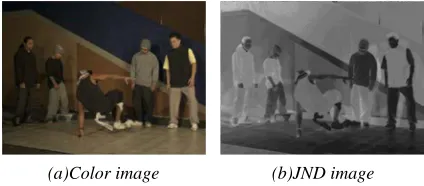
[image:2.612.316.528.538.631.2](a)Color image (b)JND image
Figure 1. Color image and its corresponding JND image for Breakdancers
3.3 Spatio-temporal JND model
After the above discussion about spatial JND model and temporal JND model, we define the spatio-temporal JND model as
) , , ( ) , ( ) , ,
(x y j SJND x y TJNDx y j
The JND map is shown in Figure 1. It can be seen from Figure 1(b) that the value of JND is smaller when the area is darker and human eyes are more sensitive to the distortion that happens on this area.
4. THE PROPOSED RATE CONTROL
ALGORITHM
By introducing motion complexity into frame level and spatio-temporal JND model described in section 3, we proposed a rate control algorithm which is consistent with visual perception. The algorithm is performed on three levels, namely group of picture (GOP) level, frame level, macro-block level. In the GOP level, the initial quantization parameter and the target bits are calculated for each GOP. In the frame level, bits allocation is decided by the predicted complexity of the frame. In the macro-block level, the JND value is taken as a sensitive factor to guide the bits allocation.
4.1 GOP Level Rate Allocation
In the GOP level, the total number of bits for each GOP and the QP of the key frame are calculated. Before encoding the i-th GOP, the bits allocated for the GOP are computed by
)) , 1 ( 8 ( * ) 1 , ( ) 0 ,
( c gop
s gop r
r B i N
B N F i u i
T = − − − (10)
where u(i,1) denotes the bandwidth, Fr denotes the frame rate of the video, Ngop denotes the total number of frames in each GOP, Bs is the capacity of the buffer and Bc(i-1,Ngop) is the buffer fullness after coding the (i-1)-th GOP. The buffer occupancy should be kept at Bs/8 after coding each GOP as to ensure that all GOPs accordance with each other. In the case of constant bandwidth, Tr (i,j) is updated frame by frame as
) 1 , ( ) 1 , ( ) ,
(i j =T i j− −Ai j−
Tr r (11)
where A(i,j) denotes the actual bits of the (j-1)-th frame.
4.2 Frame Level Rate Allocation
The rate control algorithm of JVT-G012 allocates the bits for a frame based on the buffer constraints, complexity of each frame and the remained bits, but the scene of vigorous movement is not considered which may lead poor visual quality. Therefore, the total number of motion macro-blocks and the summation of MV of motion macro-blocks are used to measure the motion complexity of each frame in this paper.
The absolute value of motion vector for a macro-block is computed by
2 2
v
h MV
MV
MV= + (12)
where MVh and MVv denote the motion vector value in the horizontal and vertical direction, respectively. When the value of MV of a macro-block is larger than 5, it is defined as a motion macro-block.
The relative motion complexity is calculated by three steps as follows.
Firstly, the total number of motion macro-blocks in the j-th frame is calculated and expressed by C(j) which denotes the size of motion region. Let Area(j) be the size of motion region in j-th frame relative to encoded frames ) 1 ( ) ( ) ( − = j C j C j Area avg (13)
where Cavg(j-1) denotes the total number of motion macro-blocks of the encoded frames, and C(j) is predicted by the previous frame.
Secondly, the summation of the MVs of all the macro-blocks in the j-th frame is calculated and expressed by S(j) which denotes the motion intensity of the current frame. Let Amp(j) be the motion intensity in j-th frame relative to encoded frames ) 1 ( ) ( ) ( − = j S j S j Amp avg (14)
where Savg(j-1) denotes the summation of the MVs of the motion macro-blocks of the encoded frames, and S(j) is predicted by the previous frame.
Lastly, let M(j) be the motion complexity of the j-th frame relative to encoded frames
) ( ) 1 ( ) ( )
(j Area j Amp j
M =λ× + −λ × (15)
where λ is a constant and its value is 0.5. The larger M(j) is, the more bits should be allocated to the j-th frame.
In order to be rationally used for bits allocation, the M(j) is nonlinear quantified by
> ≤ < ≤ < ≤ = 5 . 1 ) ( 7 . 1 5 . 1 ) ( 1 ) ( 1 . 1 1 ) ( 7 . 0 ) ( 8 . 0 7 . 0 ) ( 5 . 0 ) ( j M j M j M j M j M j M j
H (16)
) 1 ( ) 1 (
) , ( )
( ) , (
− +
− ×
=
j N W j N W
j i T W j
H j i f
br b pr
p
r
p (17)
where Wp and Wb are the complexity weight of P- and B-frames, respectively, and Npr(j-1) and Nbr(j-1) are the numbers of the remaining P-frames and B-frames in the i-th GOP, respectively[1].
4.3 Macro-block Level Rate Allocation
In the video coding, we should improve the subjective quality for the region where human is sensitive to the distortion. Consequently, the smaller JND value of a macro-block is, the more bits should be allocated.
The macro-block JND is calculated by
∑ ∑ =
= =
15
0 (,) 15
0
) , ( 256
1 ) , (
x jn
y
y x JND n
j
JND (18)
where JND(j,n)(x,y) denotes the JND value at pixel (x,y) in the n-th macro-block in the j-th frame.
The visual sensitive coefficient of the n-th macro-block in the j-th frame is expressed by W(j,n)
) , (
) , ( 1
) , (
1
0 n j JND
k j JND N n j W
N
k
∑ =
−
=
(19)
where N denotes the total number of macro-blocks in a frame.
The target bits for the n-th macro-block in the j -th frame is calculated by
∑ × ×
=
= N
n t r
t j MAD
n j MAD n
j W j T n j T
) , (
) , ( )
, ( ) ( ) , (
2 2
(20)
where Tr(j) denotes the remaining bits in the j-th frame, MAD(j,n) denotes the mean absolute difference of the n-th macro-block in the j-th frame [1].
5. EXPERIMENTAL RESULTS
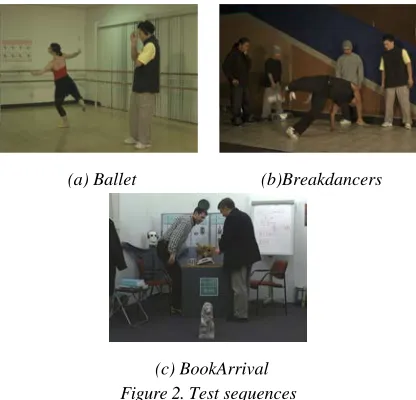
To evaluate the performances of the proposed method, JVT-G012 is used as a benchmark for comparison and the test platform is JM18.2 [13]. Several experiments were performed with video sequences of “Ballet”, “Breakdancers” and “BookArrival” with the size of 1024×768. The three test sequences are shown in Figure 2.
Some important test conditions are listed in Table 1.
Table 1. Experiment conditions
RD optimization used
Frame rate 30f/s
Entropy coding
method CABAC Sequence type IPPP…
GOP length 8
Frames to be encoded 81
The rate control error is used to measure the accuracy of the bitrates controlling and calculated by
% 100
arg arg ×
− =
et t
et t acture
R R R
E (21)
where Racture is the bitrates generated by the test sequence, and Rtarget is the target bitrates which is generated by coding the test sequences with fixed QP, and the fixed QP is set to 22, 27, 32 and 37, respectively.
(a) Ballet (b)Breakdancers
[image:4.612.317.525.301.501.2](c) BookArrival
Figure 2.Test sequences
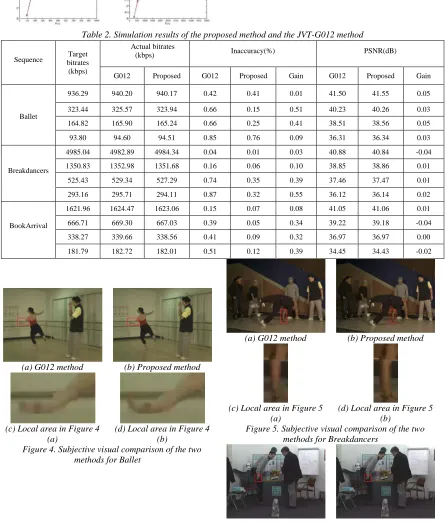
Table 2 summarizes the control accuracy and the average PSNR. It can be seem from the table that the accuracy of the G012 is with 0.04% to 0.87% while that of the proposed method is with 0.11% to 0.76%. The proposed method can achieve good control accuracy because the complexity prediction is adopted into the frame level and the frames of vigorous movement are allocated for more bits.
The rate-distortion (RD) performance comparison results between the proposed method and the G012 method are shown in Figure 3. The two methods are of the similarly RD performance.
more clearly in the proposed method. Figure 6 shows that the proposed method can achieve better texture of the fingers of the man compared with the G012. Therefore, the proposed algorithm can provide more comfortable visual image quality for visual sensitive areas.
(a) Ballet (b) Breakdancers
(c) BookArrival
Figure 3. The RD performance comparisons between the two methods
Table 2. Simulation results of the proposed method and the JVT-G012 method
Sequence bitrates Target
(kbps)
Actual bitrates
(kbps) Inaccuracy(%) PSNR(dB)
G012 Proposed G012 Proposed Gain G012 Proposed Gain
Ballet
936.29 940.20 940.17 0.42 0.41 0.01 41.50 41.55 0.05
323.44 325.57 323.94 0.66 0.15 0.51 40.23 40.26 0.03
164.82 165.90 165.24 0.66 0.25 0.41 38.51 38.56 0.05
93.80 94.60 94.51 0.85 0.76 0.09 36.31 36.34 0.03
Breakdancers
4985.04 4982.89 4984.34 0.04 0.01 0.03 40.88 40.84 -0.04
1350.83 1352.98 1351.68 0.16 0.06 0.10 38.85 38.86 0.01
525.43 529.34 527.29 0.74 0.35 0.39 37.46 37.47 0.01
293.16 295.71 294.11 0.87 0.32 0.55 36.12 36.14 0.02
BookArrival
1621.96 1624.47 1623.06 0.15 0.07 0.08 41.05 41.06 0.01
666.71 669.30 667.03 0.39 0.05 0.34 39.22 39.18 -0.04
338.27 339.66 338.56 0.41 0.09 0.32 36.97 36.97 0.00
181.79 182.72 182.01 0.51 0.12 0.39 34.45 34.43 -0.02
(a) G012 method (b) Proposed method
(c) Local area in Figure 4 (a)
(d) Local area in Figure 4 (b)
Figure 4. Subjective visual comparison of the two methods for Ballet
(a) G012 method (b) Proposed method
(c) Local area in Figure 5 (a)
[image:5.612.87.534.217.741.2](d) Local area in Figure 5 (b)
(a) G012 method (b) Proposed method
(c) Local area in Figure 6 (a)
(d) Local area in Figure 6 (b)
Figure 6. Subjective visual comparison of the two methods for BookArrival
6. CONCLUSIONS
In this paper, a rate control algorithm for video coding based on the just noticeable distortion is proposed. The proposed algorithm is performed on three levels, namely GOP level, frame level and macro-block level. In the GOP level, the initial quantization parameter and the target bits are calculated for each GOP. In the frame level, bits allocation is decided by the predicted complexity of the frame. In the macro-block level, the JND value is taken as a sensitive factor to guide the bits allocation. Experimental results show that the proposed rate control method can accurately control the bitrates and provide a good visual effect. In future probe, more efforts will be focused on consideration of PSNR fluctuation to improve the fluency of the video.
ACKNOWLEDGEMENTS
This work is supported by Natural Science Foundation of China (61271270, 61271021, 61111140392), Natural Science Foundation of Zhejiang Province (Y1101240), and The projects of Ningbo Government (2011A610197, 2011B81002).
REFRENCES:
[1] ISO/IEC JTC1/SC29/WG11 and ITU-T SG16/Q.6, “Adaptive Basic Unit Layer Rate Control for JVT”, Doc. JVT-G012r1, Pattaya, Thailand, March 7-15, 2003, pp.23-27.
[2] B. Yan and K. Sun, “Joint Complexity Estimation of I-frame and P-frame for H.264/AVC Rate Control”, IEEE Transactions on Circuits and Systems for Video Technology, Vol.22, No.5, May 2012, pp.790-798.
[3] Z. Jiang, Q. Dai and Y. Ai, “A Scene Complexity Adaptive Intra-Frame Rate Control for Video Coding”, 2010 International Conference on Multimedia Communications, Leshan, China, August 7-8, 2010, pp.108-111.
[4] H. Hu, B. Li, W. Lin, W. Li and M. Sun, “Region-Based Rate Control for H.264/AVC for Low Bit-Rate Applications”, IEEE Transactions on Circuits and Systems for Video Technology, Vol.22, No.11, November 2012, pp.1564-1576.
[5] S. Wang, Z. Wang, S. Ma and W. Gao, “SSIM-Motivated Rate-Distortion Optimization for Video Coding”, IEEE Transactions on Circuits and Systems for Video Technology, Vol.22, No.4, April 2012, pp.516-529.
[6] Z. Peng and Z. Chen, “Perceptual Quality Measure Using JND Model of The Human Visual System”, 2011 International Conference on Electric Information and Control Engineering (ICEICE), April 15-17, 2011, pp.2454-2457.
[7] M. Naccari and F. Pereira, “Advanced H.264/AVC-Based Perceptual Video Coding: Architecture, Tools, and Assessment”, IEEE Transactions on Circuits and Systems for Video Technology, Vol.21, No.6, June 2011, pp.766-782.
[8] W. Ji, M. Chen, X. Ge, P. Li and Y. Chen, “A Perceptual Macro-block Layer Power Control for Energy Scalable Video Encoder Based on Just Noticeable Distortion Principle”, Journal of Network and Computer Applications, Vol.34, No.5, September 2011, pp.1489-1497.
[9] Z. Chen and C. Guillemot, “Perceptually-Friendly H.264/AVC Video Coding Based on Foveated Just-Noticeable-Distortion Model”, IEEE Transactions on Circuits and Systems for Video Technology, Vol.20, No.6, June 2010, pp. 806-819.
[10] L. Zhang, Q. Peng, Q. Wang and X. Wu, “Stereoscopic Perceptual Video Coding Based on Just-Noticeable-Distortion Profile”, IEEE Transactions on Broadcasting, Vol.57, No.2, June 2011, pp. 572-581.
[11] C. Chou and Y. Li, “A Perceptually Tuned Subband Image Coder Based on The Measure of Just-Noticeable-Distortion Profile”, IEEE Transactions on Circuits and Systems for Video Technology, Vol.5, No.6, December 1995, pp. 467-476.
[12] Z. Wei and K. Ngan, “A Temporal Just-Noticeble Distortion Profile for Video in DCT Domain”, 15th IEEE International Conference on Image Processing (ICIP), Hong Kong, October 12-15, 2008, pp.1336-1339.