THE MORPHOSYNTAX-LEXICON INTERFACE BREAKDOWN: AN ASPECTUAL ACCOUNT OF THE L2 ACQUISITION OF SER AND ESTAR BY L1 ENGLISH SPEAKERS
Inmaculada Gómez-Soler
A thesis submitted to the faculty of the University of North Carolina at Chapel Hill in partial fulfillment of the requirements for the degree of Master of Arts in the Department of Linguistics
Chapel Hill 2009
ii ©2009
iii
ABSTRACT
GÓMEZ-SOLER INMACULADA: The Morphosyntax-Lexicon Interface Breakdown: An Aspectual Account of the L2 Acquisition of ser and estar by L1 English speakers
(Under the direction of Misha Becker)
This thesis analyzes the L2 acquisition of ser and estar by L1 English speakers. My results showed the following patterns: overgeneralization of ser, omission of estar, difficulty
with semantic constraints and with locations of events and better performance in the written task. These facts can be explained by means of the Missing Surface Inflection Hypothesis (Prévost and White 2000). I claim that the problems with ser and estar stem from processing difficulties and an impossibility to retrieve estar from the lexicon due to the difficulty that L1
English learners of Spanish have identifying its aspectual properties. Interestingly, L1 learners show the opposite pattern: they overgeneralize estar. This fact can be explained
through the Aspect First Hypothesis, which proposes that children use inflectional morphology to mark aspect. So, the aspectual element seems to be the key to understanding
iv
ACKNOWLEDGMENTS
First and foremost, I would like to thank my director Misha Becker because her effort and endless patience have made this project possible. I would also like to thank her for being an inspiration of hard work and dedication. Also, I would like to thank the members of my committee Randall Hendrick, Larry King and Julia Mack for their availability and their wise comments. I would like to give a special thanks to Julia Mack for her generous commitment to my project and for helping me find my way back when I was lost.
Secondly, I would like to thank Carmen Pérez, Pablo Maurette, Rosario Colchero, Vinodh Venkatesh and Encarnación Cruz for providing subjects for my research.
v
vi
TABLE OF CONTENTS
LIST OF TABLES ... vii
Chapter I. INTRODUCTION ...1
II. LITERATURE REVIEW ...4
2.1 History of the copula ...4
2.2 The ser/estar contrast in Spanish ...5
2.3 The acquisition of ser and estar ...15
III.EXPERIMENTS ...24
3.1 Introduction ...24
3.2 Experiment 1: (Guided) Picture Description Task ...27
3.3 Experiment 2: Grammaticality Judgment Task ...36
IV. THE L2 ACQUISITION OF SER AND ESTAR AND THE MISSING SURFACE INFLECTION HYPOTHESIS ...44
vii
4.2 The Missing Surface Inflection Hypothesis ...46
4.3 The Missing Surface Inflection Hypothesis and the L2 Acquisition of ser and estar...48
V. FIRST LANGUAGE ACQUISITION OF SER AND ESTAR ...63
4.1 Introduction ...63
4.2 Background ...63
4.3 First Language Acquisition of ser and estar and the Missing Surface Inflection Hypothesis ...71
4.4 First Language Acquisition of ser and estar and the Aspect First Hypothesis ...72
4.5 Similarities between the L1 and L2 Acquisition of ser and estar ...73
VI. CONCLUSION ...77
APPENDIX ...82
viii
LIST OF TABLES Table
2.1 Several authors’ views on the ser and estar contrast ...7
3.1 Percentage of frequency values of ser and estar ...32
3.2 Percentage of frequency values of ser and estar by level ...33
3.3 Percentage of error rate in correct responses for ser and estar ...33
3.4 Percentage of error rate in correct responses for ser and estar ...33
3.5 Percentage of error rate by type ...34
3.6 Percentage of error rate in students’ use of syntactic, pragmatic and semantic constraints ...34
3.7 Percentage of error rate in students’ performance with subtypes ...35
3.8 Percentage of copula omission...36
3. 9 Percentage of frequency values of ser and estar ...39
3.10 Percentage of frequency values of ser and estar by level ...40
3.11 Percentage of error rate in correct responses for ser and estar ...40
3.12 Percentage of error rate in correct responses for ser and estar ...41
ix
3.14 Percentages of error rate in students’ use of syntactic, pragmatic
and semantic constraints ...42
3.15 Percentages of error rate in students’ performance with subtypes ...42
3.16 Percentage of copula omission...43
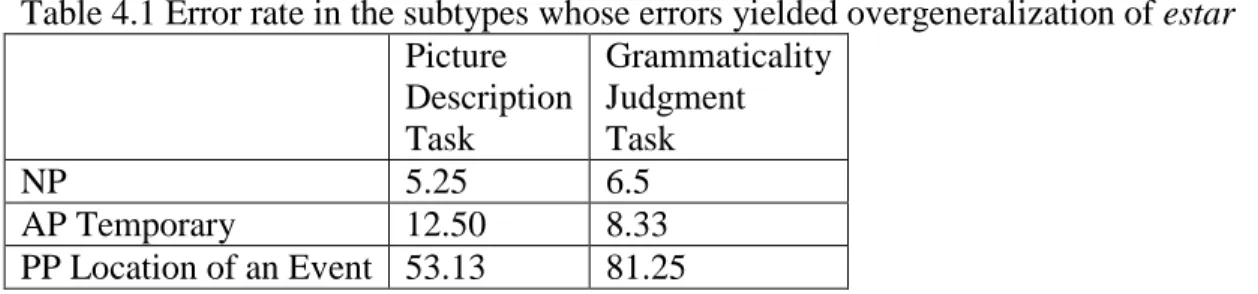
4.1 Error rate in the subtypes whose errors yielded overgeneralization of estar ...59
4.2 Total error rate in the picture description task and in the grammaticality judgment task ...60
4.3 Error rate by type in the picture description task and in the grammaticality judgment ...60
5.1 Percentages of estar by age...64
CHAPTER 1 INTRODUCTION
Mirrors and the copula are abominable because
they multiply the number of people
J. L. Borges
I am one of those ‘multiplied people’ who has been fascinated by the copula and has decided to focus her research on this topic. In particular, this thesis centers on the second language acquisition of ser and estar by L1 English speakers. The first and main goal of this thesis is to find a theoretical rationale able to explain the facts found in my research, most of which are widely confirmed by the L2 literature. The second goal of this thesis consists in finding the points of similarity and dissidence between the L1 and the L2 acquisition of ser and estar. So far, this explicit comparison has not been made in the literature.
2
Chapter three is a report on my two experiments which consist of a picture description task and a grammaticality judgment task. The goals of the experiments will be presented, the participants described, the procedure and methodology followed to complete the experiments will be disseminated in detail and finally a statistical analysis of the results will be provided. The main results found in this section are the overgeneralization of ser in the oral task, the omission of estar, the difficulty with the integration of lexical constraints in the copula task, the problematic case of ser used with locations of events and the different performance of the students in the oral vs. the written task.
Chapter four presents the Missing Surface Inflection Hypothesis as the logical theoretical explanation of the results found in chapter three. The problematic nature of ser and estar for native-English speakers seems to lie in processing difficulties and not in problems at the level of syntactic representation. Even if the right syntactic structure is present and the lexical items ser and estar are inserted in the lexicon, there is a breakdown between the morphosyntax-lexicon interfaces that causes problems with lexical retrieval. I will attribute the source of these problems to students’ inability to recognize the aspectual nature of estar, a characteristic that is morphologically covert in its English counterpart ‘to be’.
3
Missing Surface Inflection Hypothesis since this hypothesis is unable to account for the
overgeneralization of estar. On the other hand, the Aspect First Hypothesis (Wagner, 2001), that is, the belief that children start using verbal morphology to mark aspect, seems to be the theoretical justification of the L1 facts. On the other hand, the L1 and the L2 processes also have some points in common: both children and L2 learners find syntactic constraints to be the best cue for correct copula choice. Also, L1 and L2 learners encounter difficulty using ser with locations of events.
Next, I will draw conclusions from the current work.
CHAPTER 2 LITERATURE REVIEW
2.1 History of the copula
Studies on the copula date back to Aristotle. Since then, multiple theories have tried to provide theoretical definitions of the term. Moro (1997) presents an overview of the different theories that have tried to account for the syntactic and semantic nature of the copula. There are three main traditional approaches: in the Aristotelian approach the copula is considered an inflectional element which provides tense marking in declarative sentences. For Abelard and later on for the Port Royal School, the copula is the element that allows predicational linking. Conversely, Russel considers the copula a predicate which in particular carries the meaning of identity. Another way in which the copula is considered a predicate is when it is assumed to indicate existence. The latter concept started with Abelard.
5
endeavored to this undertaking over the centuries. The question of what the copula is and what it represents still remains open nowadays (Moro 1997: 249-261).
2.2 The ser/estar contrast in Spanish
I would like to open our discussion of the ser/estar contrast in Spanish by quoting their respective entries in the Diccionario de uso del español by Maria Moliner1 (1998):
• Estar (del lat. <<stare>>)1 atrib. Su función es la de atribuir al sujeto una manera
circumnstancial de existir, bien con un adverbio de modo o un gerundio, bien con un
atributo. ‘1 atrib. Its function is attributing a circumstantial way of existing to the
subject, either with a modal adverb or a gerund, or with an attribute’ (volume 1, p.1219).
• Ser (el infinitivo, así como el futuro de indicativo, el potencial, el presente de
subjuntivo, el imperativo y las formas impersonales proceden del ant. <<seer>>, del
lat. <<sedēre>>; las formas restantes proceden del lat. <<esse>>). 4 atrib. Sirve
para atribuir a un sujeto una cualidad o circumstancia. ‘(the infinitive as well as the
conditional, the present subjunctive, the imperative and the impersonal forms come from ant. (ancient) <<seer>>, from lat. << sedēre >>; the rest of the forms come from lat. <<esse>>). 4 atrib. Serves to attribute a quality or circumstance to a subject’ (volume 2, p. 1064).
1 These are the abbreviations used in the Diccionario de usodel español by María Moliner:
Atrib.=Attributive verb Ant. =Ancient
6
Simply by looking at these definitions we can realize that the division between ser and estar is far from being transparent. In fact, the meaning and distribution of the copulative verbs ser and estar has been (and still is) one of the most debated topics in Spanish grammar. In this section I will present an overview of some of the theories that have tried to account for the different behavior of these two copulas.
Navas Ruiz presents the difference between attribution and predication in the following way:
La predicación indica un proceso y la atribución un estado o cualidad. Pero estos son conceptos
insuficientes.’ [...]. ‘En la predicación el significado de proceso, acción o estado permanece externo al
sujeto, independiente de su manera de ser, de su esencia. En la atribución el significado de proceso,
acción o estado afecta a la naturaleza íntima del sujeto, modificando sus notas características. En yo
duermo dormir es un accidente de mi ser; en yo soy bueno , la bondad es la esencia de mi
ser.‘Predication indicates a process and attribution indicates a state or quality. But these concepts are
insufficient. […] ‘In predication the meaning of process, action or state remains outside the subject,
independent from its way of being, its essence. In the attribution the meaning of the process, action or
state affects the intimate nature of the subject, modifying its characteristic notes. In I sleep sleeping is
an accident of my being; in I am good, goodness is the essence of my being’ (1977: 20).
These concepts also seem to be too vague to help us understand the complexities of the attributive system.
Fernando Lázaro Carreter’s definition of the copulative verb does not seem to shed light into these complexities either: “El que sirve de nexo entre el sujeto y el atributo sin que
7
subject and the attribute without adding anything to the meaning of the sentence’ (1968: 117).
However, the mere fact that we have several copulative verbs is an indication that these verbs do entail different connotations and actually add different nuances to the sentences in which they are included. Next, we will look at how other authors have explained the different connotations between copulative verbs, in particular, ser and estar which is the focus of this study.
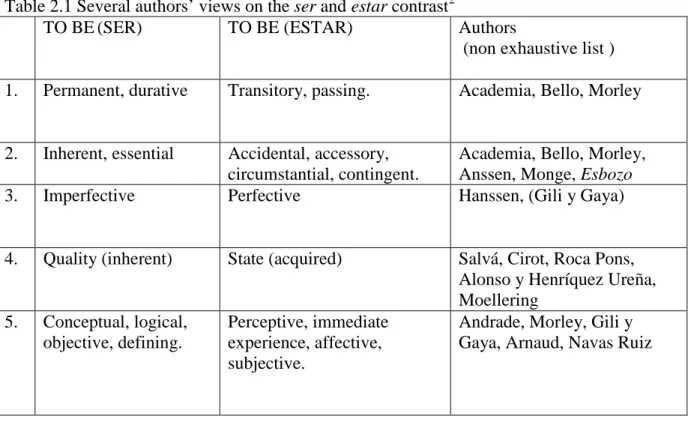
Falk (1979) presents an outline of the different views that previous researchers have held in regard to the distinction between these two copulas. This will help us understand what has been the traditional division between the two verbs.
Table 2.1 Several authors’ views on the ser and estar contrast2
TO BE (SER) TO BE (ESTAR) Authors
(non exhaustive list ) 1. Permanent, durative Transitory, passing. Academia, Bello, Morley
2. Inherent, essential Accidental, accessory, circumstantial, contingent.
Academia, Bello, Morley, Anssen, Monge, Esbozo
3. Imperfective Perfective Hanssen, (Gili y Gaya)
4. Quality (inherent) State (acquired) Salvá, Cirot, Roca Pons, Alonso y Henríquez Ureña, Moellering
5. Conceptual, logical, objective, defining.
Perceptive, immediate experience, affective, subjective.
Andrade, Morley, Gili y Gaya, Arnaud, Navas Ruiz
2
8
6. Normal Non-normal (change) Bull, Bolinger, Alonso y
Henríquez Ureña.
7. Not susceptible to change
Susceptible to change Gili y Gaya, Navas Ruiz, Esbozo…
8. Timeless (mere attributive relationship)
Inserted in duration (permanence)
Navas Ruiz
9. Not dependent on circumstance.
Dependent on circumstance. Pottier, Esbozo
10. Interior form of language Navas Ruiz, Esbozo
(Falk 1979:60) As we can see in the preceding table, many of the traditional explanations for the
ser/estar dichotomy have centered around concepts such as permanency vs. temporariness or
inherency vs. accidentality. Other researchers in the field considered that new explanations were necessary to account for the different behavior of the Spanish copulas at hand. These researchers consider that these differences arise from the complex interaction of diverse linguistic factors. Trying to find more convincing explanations for this issue, researchers have made new proposals in this field.
ser-9
relation could be seen as a classificatory one” (Falk 1979: 152). This classification is reminiscent of the traditional accounts previously described.
However, he also adds a new dimension to the study of the ser/estar contrast by taking into account a factor ignored in previous studies: the speaker’s intention. The speaker can see the subject as presented within a class frame of reference (ser) or presented within an individual frame of reference (estar). That is, ser will be used when we observe a deviation from the norm that the speaker sees as common for a class of objects or individuals. If on the contrary, we encounter a deviation from the individual norm, that is, an individual changes with respect to itself at a previous stage; then estar would be the appropriate copula.
This can be illustrated with the following example in which Falk explains the difference between the sentences La carretera es ancha ‘The road is-SER wide’ and La
carretera está ancha ‘The road is-ESTAR wide’. “De este modo se analizaría La carretera
es ancha como una comparación implícita con respecto a lo que yo (el hablante) considero
como normal para carreteras en general Esta carretera a que me refiero sobrepasa la
norma.” ‘In this way we would analyze The road is-SER wide as an implicit comparison with
respect to what I (the speaker) consider normal for roads in general. This road to which I am referring exceeds the norm’.
Conversely, he explains the sentence La carretera está ancha ‘The road is-ESTAR ancha’ in the following way: “Hay razón para creer que la norma de la que está ancho es
una desviación está conceptualizada a nivel individual. El punto de referencia del adjetivo
está en el objeto específico que se aparta de lo que yo-hablante-tengo entendido como
10
deviation is conceptualized at an individual level. The reference point of the adjective is in the specific object that separates from what I-speaker-understand as normal for it’ (Falk 1979: 73). In this second example the speaker is comparing the road to that same road at a previous stage, that is, we are comparing the road to itself at a different point in time. Maybe the road is-ESTAR wide because there has been construction to widen the road. I can say then ‘The road is-ESTAR wide’ if it is the first time I am driving through that road after the construction. So, the road is wide compared to itself before the construction work. This is what Falk called the individual frame of reference However, the road can still be-SER narrow compared to other roads (class frame of reference).
11
Some authors decided to look for the difference between ser and estar in the aspectual properties of either the copulas themselves or the predicates that occur with them. Next, I will present the views of Luján (1981), Schmitt (1992), Lema (1992), whose studies focus on aspectual analysis of the copulas.
Luján (1981) rejected the view that ser and estar “are in perfect complementary distribution” (Stockwell et al. 1960:170). On the contrary, she presented an aspectual account of ser and estar that was able to explain both the distinct distribution of the two copulas and the cases where these could be considered as partial synonyms such as ser elegante and estar
elegante ‘to be elegant’:
(1) Ser eleganteestar elegante Estar elegante ser elegante
The fact that you are-SER always elegant might imply that you are-ESTAR elegant. However, the fact that you are-ESTAR elegant at a specific moment does not imply that you are-SER always elegant.
12
difference between ser obeso ‘to be-SER obese’ and estar obeso ‘to be-ESTAR obese’ can be explained through the predicate’s lexical features in (2).
(2) ser – obeso estar – obeso
.
+Adjective . +Adjective .
. .
. .
. .
+STATIVE +STATIVE
-PERFECTIVE +PERFECTIVE
(Luján 1981: 174)
Cristina Schmitt (1992), unconvinced by traditional accounts proposed an aspectual explanation for the ser/estar contrast. Schmitt, as well as Luján proposed an aspectual account of ser and estar. However, whereas Luján claims that both ser and estar have aspectual features, but they are different from each other; Schmitt claims that ser possesses no aspectual features. In particular, Schmitt ascribes the distinct behavior of ser and estar to a major aspectual difference between the two copulas: whereas estar has aspectual properties, ser is devoid of those. This means that estar is always temporally anchored; on the other hand, ser needs the support of aspectual operators in order to have a temporal interpretation. (Schmitt 1992: 421). Also, ‘estar contributes to the VP with a subevent of the type state’ (Schmitt 2007:1913) ‘ser has no subevent property’ (Schmitt 2007:1914).
For all the above reasons, estar can be used only in situations where properties are only true at that specific moment, that is, they are temporary properties. On the other hand,
13
indicate temporariness if it is supported by adverbials. For instance, the sentence El gato es
gordo ‘The cat is-SER fat’ indicates that being fat is a permanent characteristic of the cat. On
the other hand, in both El gato está gordo ‘The cat is-ESTAR fat’ and El gato es gordo
ahora ‘The cat is-SER fat NOW’ being fat can be regarded as a temporary characteristic.
Thus, according to Schmitt, we can find a plausible explanation for the divergent behavior of
ser and estar if we have a closer look at their different aspectual nature.
Lema (1992) also described the differences between Spanish ser and estar in terms of aspect. He considered that while ser is a copula, estar is, actually, an aspectual auxiliary. Ser is semantically empty and it is only specified for tense but not aspect. On the other hand,
estar has aspectual content and contributes to the sentence both tense and aspectual content.
Lema provided several tests as evidence for the aspectual nature of estar. First of all,
estar can appear in predicate constructions but not in equative constructions. For instance
*Tu tía está la Señora Martínez ‘Your aunt is-ESTAR Mrs. Martínez’ is ungrammatical whereas Tu tía está contenta. ‘Your aunt is-ESTAR happy’ (1992: 260) is perfectly grammatical. Conversely, ser can appear in both kinds of constructions: Tu tía es la Señora
Martínez ‘Your aunt is-SER Mrs. Martínez’ Tu tía es mayor que la mía ‘Your aunt is-SER
14
(3) *…y [estado atentos] habrían [] los niños de ser interesante ‘…and been attentive would have the boys had it been interesting’ (Lema 1992:264).
(4) …y [siendo atentos] estaban [] los meseros después del regaño ‘...and being corteous were the waiters after the reprimand.’ (Lema 1992:264).
The reason for this is that Aspect cannot take scope over Tense *[Asp…[T]] (1992:261). That is, taking into account that estar projects an AspP, we assume that it cannot be preposed because that would imply that Asp will take scope over T. Again, this hints at the aspectual nature of estar.
Thirdly, estar has a distribution similar to other aspectual verbs which are not considered copulas such as habitual andar ‘to be in the process of’ and seguir ‘to go on’. Fourthly, estar cannot function as the complement of a perception verb since these verbs already add aspectual properties to the construction:
(5) Su hermana vió a Oscar (*estar) trabajando en la fábrica ‘Her sister saw Oscar *be working in the factory’ (Lema 1992: 270)
Finally, Lema concluded that the permanent or temporary property of the adjectives accompanying ser and estar respectively comes from the interpretation of the tense and aspect elements imbued in the copulas themselves. The tense feature of ser allows a generic reading of the adjective while the aspectual properties of estar allow a temporary reading of the adjective. Thus the different uses, meanings and distributions of ser and estar can be explained if we look at the aspectual properties of the two verbs: whereas estar is aspectual,
15
In the next section I will focus on how this intrinsically difficult problem is handled in the acquisition literature.
2.3 The acquisition of ser and estar
An extensive body of research has focused on the acquisition of ser and estar in Second Language Acquisition3 (VanPatten, 1985 and 1987; Ryan & Lafford, 1992; Gunterman, 1992; Briscoe, 1995; Ramírez-Gelpi, 1995; Geeslin 2002 and 2003; Woolsey, 2006; Francis, 2007). On the other hand, much less attention has been paid to the acquisition of the copula by monolingual Spanish children. As far as I know, only few authors have conducted research on this area (Sera, 1992; Schmitt, Holtheuer and Miller, 2004; Schmitt & Miller, 2007). The FLA literature will be reviewed in detail in chapter 5.
2.3.1 Second Language Acquisition of ser and estar
VanPatten was the first researcher who established a series of transitional stages for the acquisition of ser and estar for English native learners of Spanish as a Second Language. These stages were claimed to be universal and independent from factors such as L1 or type of instruction. Next, I will present the mentioned stages:
I. Absence of copula in learner speech.
II. Selection of ser to perform most copula functions.
III. Appearance of estar with progressive.
16 IV. Appearance of estar with locatives.
V. Appearance of estar with adjectives of condition.
(VanPatten 1987, 64)
These stages were established through the analysis of data coming from three different sources in which different students were tested: a longitudinal study of six-college students, a grammaticality judgment task and classroom observations.
Next, I would like to provide a summary of his theoretical rationale. The development of the copula following the stages proposed above is not accidental. According to VanPatten these stages are the result of the complex interaction of several factors and processes that are important in the course of Second Language Acquisition.
17
404). The reason why students from an English-L1 background seem to linger at that stage is due to the interaction of a different factor: L1 transfer. VanPatten used Andersen’s “Transfer to Somewhere Principle”:
Andersen’s principle claims that transfer operates only where there are similarities between the L1 and
the developing interlanguage […] Furthermore, the interaction between the L1 and the interlanguage
cannot violate the natural processes of acquisition that are in progress […]. Andersen also claims that
when transfer is triggered in this manner, the resultant structure in the learner’s interlanguage will be
more resistant to change (1987: 69).
He claims that the reason why learners lingeron stage II (selection of ser to perform most copula functions) is that the L1 and L2 are overlapping at that point (the existence of just one copula) and thus transfer is operating at that specific stage (VanPatten 1987:69).
Finally, the learner abandons that stage and starts using estar for different functions. The order in which the learner starts using the different functions of estar is governed by how frequent that particular structure is in the input he receives (VanPatten 1987:70).
VanPatten’s research has been followed by a series of studies which have tried to confirm/reject and elaborate on the claims proposed by this author. Some of these studies include those by Ryan & Lafford, 1992; Gunterman, 1992; Briscoe, 1995; Ramírez-Gelpi, 1995; Francis, 2007.
18
even if the latter studies were conducted in a classroom setting. Theses are the stages described by Ryan and Lafford:
1. Absence of the copula
2. Overuse of ser in estar Locative and Conditional Contexts 3. Absence of the copula in estar Conditional contexts 4. Estar in Progressive constructions
5. Replacement of zero copula errors by errors with estar when ser is required 6. Estar replaces zero copula in Conditional contexts
7. Estar in Conditional contexts
8. Estar replaces ser in Locative contexts
(Ryan and Lafford 1992: 718)
There are three main differences between VanPatten’s and Ryan and Lafford’s results. First of all, the omission stage is extended to contexts where estar appears with adjectives of condition. Secondly, there is a stage in which it is actually the estar copula which is overused appearing in ser-required contexts. Thirdly, the order of acquisition of the conditional and the locative structures was reversed. However, these differences do not prevent us from drawing the conclusion that the general pattern of acquisition of the copula for L2 learners of Spanish is mainly the same regardless of the context in which the language is acquired.
19
260 to 300 hours of in-service training and a second time, at least, nine and a half months later. Her stages closely resemble those found in previous studies:
1. Omission of the copula 2. Overgeneralization of ser
3. Absence of the copula in conditional contexts (as described by Ryan and Lafford) : this stage was not found
4. Estar with progressives
5. Replacement of zero copula errors by errors with estar when ser is required (as described by Ryan and Lafford) was only found in small numbers.
6. Estar replaces zero copula in conditional contexts (as described by Ryan and Lafford)
was not found
7. Estar in conditional contexts
8. Estar in locative contexts
(Gunterman 1992: 1299-1300)
20
Briscoe’s work (1995) also confirmed VanPatten’s transitional stages. This study presented a more detailed picture of the copula functions. These functions correlate to the functions of ser and estar presented in most Spanish L2 textbooks. This research was able to shed light especially on the second stage proposed by VanPatten: overgeneralization of ser. Briscoe proposed that not all functions of ser are acquired at the same time and that some of them are acquired even after some functions of estar. Next I provide the stages proposed by Briscoe:
1. ser/telling time
ser/profession
ser/copula
[ser+de/origin] until mid-2nd year
[ser+de/possession]
[ser+de/composition]
Ser/impersonal expressions
Ser/characteristic
2. estar/progressive from mid-second year until 4th year 3. estar/location begins in 4th year
21 5. ser/events (time)
ser/events (location) after 4th year
ser/passive
(Geeslin 2003:712)
Ramírez-Gelpi examined L2 learners’ use of ser and estar in written compositions. Interestingly, she found a similar pattern of acquisition to those presented by other researchers:
1. Ser performs most copula functions
2. Ser with Predicate nominatives and estar with Progressive constructions
3. Estar with Prepositional phrases
4. Estar with Adverbial phrases
5. Estar with Predicate adjectives
(Ramírez-Gelpi 1995: 206)
22 1. Omission of the copulas
2. Use of ser for most communicative functions requiring a copula 3. Discriminate use of ser to tell time
4. Correctly replacing ser with estar for locating entities 5. Correctly replacing ser with estar for forming progressive
6. Discriminate use of ser for describing a referent’s natural or inherent qualities 7. Discriminate use of ser for stating origin
8. Discriminate use of ser for identifying a subject or describing a referent’s affiliation 9. Discriminate use of ser for describing a referent’s physical make-up
10. Use of estar for conditions and resultant states 11. Use of estar for describing a change from the norm
(Francis 2007: 164)
All these studies confirm VanPatten’s claim that there are a series of transitional stages which are independent of environment, L1 background or method of instruction. Even if there are some differences in the results of the experiments this might be due to the fact that the researchers were using different methodologies to categorize the data. The important conclusion to be drawn from these studies is that although some differences were found among them, the overall development of the copula is remarkably similar.
23
participants had been exposed to Spanish in both naturalistic contexts and classroom settings and had been learning the language for various periods of times. They found out that none of these factors were relevant for the acquisition of the copula. This corroborates the hypothesis that L2 learners go through similar stages of acquisition which are naturally driven and unaffected by external factors.
CHAPTER 3 EXPERIMENTS
3.1 Introduction
In this chapter I will present a description of the studies that I conducted on the L2 acquisition of ser and estar. The goals, participants, procedures and statistical analysis will be analyzed in detail. I would like to start this chapter with some introductory comments about the three levels tested and why the experiments were conducted at a specific point during the semester.
Three levels of Spanish instruction were considered for these experiments. Next I present a brief description of each of these courses:
• Spanish 105 (Spanish for High Beginners): This course is usually considered a review course. It goes over the material covered in Spanish 101 (1) and Spanish 102 (2) (Introductory Courses) in just one semester. So, the pace of this course is more accelerated than other courses. Due to the nature of this course, the students taking Spanish 105 have diverse language backgrounds. Typically they are students who have some previous basic knowledge of Spanish. They have usually taken Spanish 1 or Spanish 2 in high school.
25
already been exposed to all of the major grammar topics and they try to develop their listening and speaking skills during this semester.
• Spanish 255 (Conversation): This is a conversation course which focuses on the development of the students’ speaking abilities. Students take Spanish 255 after Spanish 204, that is, there is one course in between Spanish 203 and Spanish 255. This is not a required course for the students, so those taking it are usually majoring or minoring in Spanish and have a special interest in learning the foreign language.
Regarding ser and estar, in Spanish 105 this topic is taught explicitly at the beginning of the year. In Spanish 203 ser and estar is the main grammar topic introduced in the first chapter but it is presented as review since students are already supposed to be familiar with the topic. In Spanish 255 it is also introduced at the beginning of the course. However, it is not presented as a grammar explanation but integrated in a natural way in the speech of the class. From this point onwards I will refer to Spanish 105, 203 and 255 as beginner, intermediate and advanced respectively. This seems a more general and intuitive way of referring to the specific courses which might be easier to grasp for the reader unaware of the UNC numeric course system.
26
the same material, complete the same assignments, take the same tests and are in contact with the same teacher. The experiments were conducted three months into the semester. At this time the students should all have been at a similar level of language learning. There is indeed a great deal of individual variation among students but conducting the experiment at the end of the semester minimized these differences. This allowed me to make strong general claims about the patterns of acquisition observed at each level of instruction.
The second reason why the experiments were conducted at the end of the semester is that I was trying to study an acquisition process and not a learning process. Krashen defined these two terms in the following way: “Language acquisition is a subconscious process; language acquirers are usually not aware of the fact that they are acquiring language, but are only aware of the fact that they are using the language for communication.” On the other hand, learning “refer[s] to conscious knowledge of a second language, knowing the rules, being aware of them and being able to talk about them” (Krashen 1992: 10).
27
the acquired system. This can happen before we speak or write, or after (self-correction)” (Krashen 1992: 15). Three factors are needed in order for the learner to be able to access the Monitor: time, focus on form and knowing the rule (Krashen 1992: 16). The learner needs to have enough time to access the rules and this is especially true of writing. Also, the task should focus on correctness and not on meaning. Finally, the learner needs to know the rule in question. The perfect context for the use of the Monitor would be an untimed writing assignment. However, the Monitor can also act in oral tasks.
Specifically, VanPatten presented an example of the interference of the Monitor with the process of acquisition when the students started overusing estar in a couple of taping sessions. This goes against the general behavior which is overgeneralizing ser. VanPatten explained these deviations from the norm in the following way: “[…] it was possible that somehow the learners were ‘acutely’ aware of estar, perhaps due to a review lesson that week. This awareness may have caused the Monitor to ‘put in’ more estar in the learners’ speech than would have occurred naturally” (1985: 401). Since ser and estar were introduced at the beginning of the semester in the three courses tested in my experiments, I was able to study the real acquisition process and to avoid the skewing effects of the monitor.
3.2 Experiment 1: (Guided) Picture Description Task
3.2.1 Goal
28
wanted to find out which of these types of information was more helpful for students when they are faced with the task of deciding which copula is the correct one in a specific context.
Another goal of this experiment was to get (semi-)spontaneous speech samples from the students. I considered that this was the most reliable way of trying to discover if there is indeed an omission stage. This belief was based on VanPatten’s claim “copula omission seems to surface more often in oral language than in written language” (VanPatten 1987:64). However, instead of having a task where spontaneous speech was recorded, I decided to have a guided task so that the specific structures being tested could be elicited in the minimal amount of time.
In order to reach these goals, this and the following experiment were designed following Schmitt et. al. (2004) and Schmitt and Miller (2007)’s methodology. Their experiments will be discussed in sections 5.2.2 and 5.2.3 respectively. Following their procedures closely allowed me to draw clearer comparisons between this study and the findings in the FLA literature, which is one of the main purposes of this thesis.
3.2.2 Participants
29 3.2.3 Procedure
First of all the students were shown a Power Point slide with instructions. They were asked to answer the questions in Spanish and to use complete sentences when doing so. They were given a couple of examples to make sure that they understood the task. Secondly, the participants were shown 3 Power Point slides which contained one or more pictures accompanied by a series of questions about the pictures, formulated in English, that the students had to answer. The questions were given in English so that no clues were provided to the learner about copula use. The translation of some words into Spanish was given to the students so that they could easily form their answer in spite of possible vocabulary deficits. One of the slides contained one picture and four questions, another contained 4 pictures and two questions and another one contained 3 pictures and 4 questions. The experiment was designed so that, regardless of the number of questions in the slide, the questions always elicited the same number of uses of ser and estar from students in each slide. Four responses were obtained from each slide. Out of those four responses, there were two whose correct response was ser and two whose correct response was estar; that way, the number of tokens of each item, that is, ser and estar, was controlled. The order of the slides was randomized to make sure this would not skew the results. (The Power Point slides are provided in the Appendix).
30
studied the learners’ accessibility to pragmatic information. The students were not aware of this division since I did not provide them with that information before carrying out the experiment.
More specifically, the sentences trying to obtain information about syntactic constraints were constructed in such a way that learners should be able to distinguish between the two copulas only by looking at the syntactic structure of the sentences. For instance, sentences with NP attributes are only possible with ser and sentences with progressive are only possible with estar. Thus, when a learner encounters this type of sentence, the syntactic frame should be enough information to ascertain which copula is correct in that specific context. Following this criterion, in the slide representing syntactic constraints, I tried to elicit from students two sentences with NP attributes and two sentences with the progressive construction. In (1), I provide the stimuli in the syntactic slide:
(1) a. Is Bart a girl or a boy?
b. What is Bart doing? (jump=saltar) c. Is Lisa a student?
d. What is Homer doing? (drink=beber)
31
temporary property of the subject (his face painted blue when he dressed up as a smurf for Halloween) and the other one depicted a permanent property of the same subject (his normal (white) face). The other two pictures were photographs of two children: one with his tongue green (temporary property) and other with his tongue red (permanent property). In this example the students needed to rely on pragmatic clues to ascertain the correct copula, that is, they needed to look at the context of the sentence and determine if it is a kind of context that favors ser or a type of context that favors estar. These were the sentences in the pragmatic slide:
(2) a. What color is his face in each picture?
b. What color is his tongue (lengua) in each picture?
32 (3) a. Where are the books?
b. Where is the picture of the lemons? c. Where is the game against NC State? d. Where is the concert?
3.2.4 Analysis
The contrasts were done within a logistic regression model adjusting for multiple observations within subjects except for a few cases in which multiple observations could not be taken into account (this will be indicated when necessary).
First of all, I compared the frequency of overall production of ser vs. estar. Taking into account that there were equal numbers of target contexts for ser and estar, correct production would have resulted in 50% of responses being ser and 50% being estar. However the frequency values I found are significantly different from each other (χ2=15.27, p<.0001, df=1). This means that students seem to be using ser more frequently than estar.
Table 3.1 Percentage of frequency values of ser and estar
Ser 61.43 (344/560)
Estar 38.57 (216/560)
If we look at the different levels we do not find a significant difference in the way students performed (Overall Effect χ2=3.85, p=0.15, df=2) (Beginner vs. Intermediate
33
Table 3.2 Percentage of frequency values of ser and estar by level
Beginner Intermediate Advanced
Ser 64.35 (148/230) 55.56 (130/234) 68.75 (66/96)
Estar 35.65 (82/230) 44.44 (104/234) 31.25 (30/96)
Secondly, I was interested in discovering if the students performed better in the ser-condition, that is, when the appropriate response should have been ser; or in the estar-condition, that is, when the appropriate response should have been estar. The error rate in
estar-contexts was significantly higher than the error rate in the ser-contexts (χ2=14.69, p=0.0001, df=1).
Table 3.3 Percentage of error rate in correct responses for ser and estar
Ser 22.81 (65/285)
Estar 45.09 (124/275)
The students across different levels showed a similar pattern of behavior. The p-values of advanced students are high because of the fact that I had a very reduced sample of advanced students. This gives me very little power in this calculation (Overall Effect
χ2=15.12, p=0.0098, df=5). The effect in the individual comparisons is not significant because all of the groups behaved in a very similar way (Beginner vs. Intermediate χ2=2.05, p=0.15, df=1; Beginner vs. Advanced χ2=0.6, p=0.44 df=1; Intermediate vs. Advanced
χ2=2.56, p=0.11, df=1).
Table 3.4 Percentage of error rate in correct responses for ser and estar
Beginner Intermediate Advanced
Ser 22.03 (26/118) 28.57 (34/119) 10.42 (5/48)
Estar 50.00 (56/112) 39.13 (45/115) 47.92 (23/48)
34
the syntactic frame in which they were embedded. If we examine the students’ responses we can see that there is a significant difference in how students used syntactic constraints when compared to either pragmatic or semantic constraints (Overall Effect χ2=38.06, p<.0001, df=2) (Syntactic vs. Pragmatic χ2=37.93, p<.0001, df=1; Syntactic vs. Semantic χ2=22.06, p<.0001, df=1). On the other hand, the difference in the way learners made use of the semantic and the pragmatic information in the sentences was only marginally significant (pragmatic vs. semantic χ2=3.63, p=0.057, df=1).
Table 3.5 Percentage of error rate by type
Syntactic 16.16 (32/192)
Pragmatic 48.96 (94/192)
Semantic 41.15 (79/192)
If we look at the results broken down by levels it is interesting to notice that we find a stable pattern of behavior across the three different levels (Overall Effect χ2=43.77, p<.0001, df=8) (Beginner vs. Intermediate χ2=3.27, p=0.19, df=2; Beginner vs. Advanced χ2=1.98, p=0.37, df=2; Intermediate vs. Advanced χ2=0.78, p=0.68, df=2).
Table 3.6 Percentage of error rate in students’ use of syntactic, pragmatic and semantic constraints
Beginner Intermediate Advanced
Syntactic 25.00 (20/80) 11.25 (9/80) 9.38 (3/32)
Pragmatic 47.50 (38/80) 51.25 (41/80) 46.88 (15/32)
Semantic 42.50 (34/80) 43.75 (35/80) 31.25 (10/32)
In the fourth place, I looked the effects of subtype4 across levels. The variable subtype stands for the different structures that were tested in each of the categories: syntactic,
4
This is the meaning of the abbreviations used in the subtype variable :
• NP=Noun Phrase attribute.
• Progressive= Progressive construction (estar+gerund).
• AP permanent=Adjective Phrase attribute which denotes a permanent characteristic of a subject.
35
semantic and pragmatic, respectively. It was found that the effect of subtype was consistent across level (Overall Effect χ2=132.15, p>.0001, df=17). In this specific case, the logistic regression model did not take into account the repeated measures due to a lack of power. The subtypes AP temporary and PP location of an event seem to have a particularly high error rate in the three levels. There is a significant difference in the performance of beginner students and intermediate students (Beginner vs. Intermediate χ2=22.92, p=0.0004, df=5). Also, beginner students performed poorly with the progressive and advanced students performed surprisingly badly with the location of objects. I marked in boldface the highest percentages of error rate for each level of instruction.
Table 3.7 Percentage of error rate in students’ performance with subtypes
Beginner Intermediate Advanced
Syntactic NP 2.50 (1/40) 7.50 (3/40) 6.25 (1/16)
Progressive 47.50 (19/40) 15.00 (6/40) 12.50 (2/16) Pragmatic AP Permanent 20 (8/40) 10.00 (4/40) 0.00 (0/16)
AP Temporary 75 (30/40) 92.50 (37/40) 93.75 (15/16) Semantic PP Location of
an event
47.50 (19/40) 70.00 (28/40) 25.00 (4/16) PP Location of
an object
37.50 (15/40) 17.50 (7/40) 37.50 (6/16)
Finally, I analyzed the cases where the copula was omitted. There were not many cases of omission (the sample size was 12 omissions out of 576 sentences) (Overall Effect
χ2=3, p=0.08, df=1). However an interesting pattern arises from these omissions: 75% of the omissions involved an omission of estar. On the other hand, only 25% of the omissions involved an omission of ser. The relevance of this fact will be explained in chapter 4.
• PP location of an event=Prepositional Phrase which denotes the location of an event.
36 Table 3.8 Percentage of copula omission
Ser 25 (3/12)
Estar 75 (9/12)
In the following section I will report on a very similar experiment but this time the experiment consists of a written task. This will allow us to see if any differences arise in the students’ performance when we switch from the oral code to the written code.
3.3 Experiment 2: Grammaticality Judgment Task
3.3.1 Goal
The goals of this experiment are the same as the goals of the previous experiment: to confirm the claims about copula omission and overgeneralization of ser and ascertain which kinds of constraints (syntactic, semantic or pragmatic) play a role in L2 learners’ acquisition of the Spanish copulas ser and estar.
The difference between this experiment and the previous one is that this is a written task instead of a spoken one. The relevance of the different types of tasks will be discussed in Chapter 4.
3.3.2 Participants
The same participants who took part in Experiment 1 took part in Experiment 2.
3.3.3 Procedure
(article-37
noun-adjective agreement and subject-verb agreement). (Fillers are presented in the appendix along with the full set of test items). Each question had 3 options a)-c). The three options offered in the test sentences were the following ones: in one of them the sentence was presented with ser, in another one with estar, and in another one no copula was used. This last option was included so that it would be possible to study the omission of the copula in a written task. The order of the 3 options was randomized. The translation of all of the sentences was provided in English in order to make sure that the students were not misinterpreting the sentences.
The test sentences were classified into 3 categories as we explained in experiment 2: syntactic, semantic and pragmatic. In the syntactic category there were two sentences which contained NP attributes and two sentences which contained the progressive construction.
(4)
1) José is a doctor
a. José médico b. José es médico c. José está médico
2) Javier is walking
a. Javier andando b. Javier es andando c. Javier está andando
3) Beatriz is a model
a. Beatriz modelo b. Beatriz es modelo c. Beatriz está modelo
4) The girl is eating
38
In the pragmatic category, there were two sentences with an adjectival attribute which indicated a permanent property and two others that indicated a temporary property. In (5) I provide the test sentences in this category:
(5)
1) My Spanish teacher is a really nice person
a) Mi profesor de español está muy simpático b) Mi profesor de español muy simpático c) Mi profesor de español es muy simpático
2) My biology teacher is always really unfriendly but today he is being friendly
a) Mi profesor de Biología siempre es muy antipático, pero hoy está simpatico b) Mi profesor de Biología siempre es muy antipático, pero hoy simpatico c) Mi profesor de Biología siempre es muy antipático, pero hoy es simpatico
3) Cristina is very pretty. She has won the Miss Spain contest
a) Cristina es muy guapa. Ha ganado el concurso de Miss España b) Cristina está muy guapa. Ha ganado el concurso de Miss España c) Cristina muy guapa. Ha ganado el concurso de Miss España
4) Clara is very pretty with that red dress
a) Clara está muy guapa con ese vestido rojo b) Clara es muy guapa con ese vestido rojo c) Clara muy guapa con ese vestido rojo
In the semantic category there was one sentence which presented the location of an event, one which presented the location of an object, and two which dealt with the semantic ambiguity of the word listo (estar listo=‘be ready’ and ser listo=‘be smart’). These were the stimulus sentences:
(6)
1) María is very smart. She always gets good grades
39
c) María está muy lista. Siempre saca muy buenas notas
2) The party is at my house
a) La fiesta es en mi casa b) La fiesta está en mi casa c) La fiesta en mi casa
3 )The pencil is on the table
a) El lápiz es en la mesa b) El lápiz está en la mesa c) El lápiz en la mesa
4) Ana is ready to go to the party. She has already gotten dressed and put her make-up on
a) Ana es lista para ir a la fiesta. Ya se ha vestido y se ha maquillado. b) Ana lista para ir a la fiesta. Ya se ha vestido y se ha maquillado c) Ana está lista para ir a la fiesta. Ya se ha vestido y se ha maquillado
3.3.4 Analysis
As in Experiment 1, the contrasts were done within a logistic regression model adjusting for multiple observations within subjects. There were a few cases in which multiple observations could not be taken into account. This will be indicated explicitly in the part of the analysis corresponding to those items.
In the first place, I analyzed how frequent ser and estar were respectively in the students’ written answers. If we examine the responses of the three groups of students together, the difference between the number of times they used ser vs. the number of times they used estar was not significant (χ2=0.85, p=0.36, df=1).
Table 3. 9 Percentage of frequency values of ser and estar
Ser 48.32 (273/565)
40
However, if we look at the responses of the students broken down by level, there seems to be a significantly different pattern of behavior (Overall Effect χ2=14.43, p=0.0007, df=2). Beginner students use ser more frequently than estar; on the other hand, intermediate and advanced students use estar more often than ser. Thus, the responses of beginner students are significantly different from those of intermediate and advanced students (Beginner vs. Intermediate χ2=13.70, p=0.0002, df=1; Beginner vs. Advanced χ2=9.52, p=0.0020, df=1). On the contrary, intermediate and advanced students performed similarly; hence their behavior is not significantly different (Intermediate vs. Advanced χ2=0.75, p=0.39, df=1).
Table 3.10 Percentage of frequency values of ser and estar by level
Beginner Intermediate Advanced
Ser 56.03 (130/232) 42.19 (100/237) 44.79 (43/96)
Estar 43.97 (102/232) 57.81 (137/237) 55.21 (53/96)
Secondly, I looked at the percentage of correct responses in the ser-condition and in the estar-condition (χ2=9.9, p=0.0016, df=1). Overall, we can see that the error rate in this task is lower than the error rate in the spoken task.
Table 3.11 Percentage of error rate in correct responses for ser and estar
Ser 19.79 (57/288)
Estar 15.16 (42/277)
41
χ2=10.47, p=0.0012, df=1; Beginner vs. Advanced χ2=7.22, p=0.0072, df=1; Intermediate vs. Advanced χ2=0.40, p=0.53, df=1).
Table 3.12 Percentage of error rate in correct responses for ser and estar
Beginner Intermediate Advanced
Ser 19.83 (24/121) 21.01 (25/119) 16.67 (8/48)
Estar 29.73 (33/111) 5.08 (6/118) 6.25 (3//48)
Thirdly, I examined students’ use of syntactic, pragmatic and semantic information at the time of copula choice in the written task (Overall Effect χ2=33.83, p=.0001, df=2). The students performed significantly worse when they needed to use semantic information to decide between the two copulas (syntactic vs. semantic χ2=15.02, p=0.0001, df=1; pragmatic vs. semantic χ2=23.45, p<.0001, df=1). Their use of syntactic and pragmatic constraints seemed not to be significantly different (syntactic vs. pragmatic χ2=0.07, p=0.79, df=1).
Table 3.13 Percentages of error rate by type
Syntactic 13.54 (26/192)
Pragmatic 12.50 (24/192)
Semantic 31.25 (60/192)
42
χ2=2.85, p=0.24, df=2; Intermediate vs. Advanced χ2=1.30, p=0.52, df=2). Notwithstanding, the important conclusion to be drawn from this is that the three groups performed significantly better with the syntactic and pragmatic constraints than with the semantic ones.
Table 3.14 Percentages of error rate in students’ use of syntactic, pragmatic and semantic constraints
Beginner Intermediate Advanced
Syntactic 23.75 (19/80) 7.50 (6/80) 3.13 (1/80)
Pragmatic 22.50 (18/80) 5.00 (4/80) 6.25 (2/80)
Semantic 35.00 (28/80) 30.00 (24/80) 25.00 (8/80)
Fourthly, I will examine students’ performance with respect to the different sentence subtypes (Overall Effect χ2=91.62, p.0001, df=23). PP Location of an event was the subtype which produced the highest error rate consistently in the three levels. Beginner students also have difficulty with the progressive construction, AP Temporary and Listo (ready). The subcategories which were especially difficult for students have been marked in boldface.
Table 3.15 Percentages of error rate in students’ performance with subtypes
Beginner Intermediate Advanced
Syntactic NP 7.50 (3/40) 5.00 (2/40) 6.25 (1/16)
Progressive 40.00 (16/40) 10.00 (4/40) 0.00 (0/16) Pragmatic AP Permanent 10.00 (4/40) 10.00 (4/40) 0.00 (0/16) AP Temporary 35.00 (14/40) 0.00 (0/40) 12.50 (2/16) Semantic PP Location of
an event
75.00 (15/20) 85.00 (17/20) 87.50 (7/8) PP Location of
an object
20.00 (4/20) 10.00 (2/20) 0.00 (0/8) Listo (Smart) 10.00 (2/20) 15.00 (3/20) 0.00 (0/8) Listo (Ready) 35.00 (7/20) 10.00 (2/20) 12.50 (1/8)
In the last place, I looked at omissions of the copulas. There are only 11 sentence choices (out of a total of 576) that did not present an overt copula. However, I found an interesting result which confirms the findings of the previous experiment (Overall Effect
43
sentences where the correct response was estar but not in sentences where the correct response was ser.
Table 3.16 Percentage of copula omission
Ser 0 (0/11)
Estar 100 (11/11)
CHAPTER 4
THE L2 ACQUISITION OF SER AND ESTAR AND THE MISSING SURFACE
INFLECTION HYPOTHESIS
4.1 Introduction
In the previous chapter it was found that the L2 acquisition of ser and estar by L1 English speakers is mainly characterized by the following facts: ser is overgeneralized over
estar, the use of pragmatic and especially, semantic constraints seems to be specially
problematic when determining copula choice, the subtype PP Location of an event, that is, the use of ser with locations of events, yielded the highest error rate, there was a clear pattern of copula omission where estar was omitted most of the times and, finally, the general better performance of the students in the written task when compared to the oral task. In this chapter I will argue that the behavior exhibited by the L2 learners with respect to the Spanish copulas ser and estar can be best accounted for by means of the Missing Surface Inflection
Hypothesis (MSIH). This hypothesis, first named Missing Inflection, was proposed by
45
I decided to use a morphological theory for explaining the acquisition of ser and estar based on the idea that ser and estar can be considered as different morphological inflections of the copula in Spanish. This theory is able to explain the main facts in this specific process of acquisition: 1) why the copula is sometimes missing, 2) why ser is overgeneralized, 3) why we see a difference in the students’ performance in the oral vs. the written task and 4) why the semantic constraints were the most difficult to integrate as linguistic cues for copula choice.
This chapter is organized as follows. In 4.2 I will provide a summary of the theoretical rationale used in this thesis for the study of the acquisition of ser and estar, that is, the MSIH. In 4.3 I will analyze how the data presented in chapter 3 can be examined under the MSIH framework. This subsection is divided in the further subsections: in 4.3.1 I will explain how the omissions of the copula, mainly of estar, can be explained by means of the
MSIH. In 4.3.2. I will study the overgeneralization of ser and how it is considered a default
46 4.2 The Missing Surface Inflection Hypothesis
In this section I will provide a summary of the theory. The Missing Surface Inflection
Hypothesis considers that “even in the absence of consistent or appropriate inflectional
morphology, functional categories and features are fully specified in the grammar, with certain ‘visible’ syntactic consequences” (White 2003: 194). Notwithstanding, there is disagreement in regards to the source of those functional representations and features. Some advocates of this theory consider that the abstract functional structure and features come from UG. These are supporters of the Full Access without Transfer Hypothesis (Epstein et al., 1996). On the other hand, some advocates of the MSIH consider that this abstract structure is transferred from the L1. These are supporters of the Full Transfer/Full Acccess
Hypothesis (Haznedar and Schwartz, 1997).
The MSIH finds the reason for absent (or substituted, as we will see later) morphology in mapping problems, that is, there is a communication failure between the syntax and the lexicon:
the divergence between surface morphology and abstract morphosyntactic features reflects a problem
in mapping from abstract categories and features to their particular surface morphological
manifestations […] even when learners have acquired the surface morphological manifestations of
more abstract features, such that these forms are entered in the mental lexicon, they might not be able
to retrieve the appropriate form for lexical insertion into a syntactic representation (White 2003: 196).
47
form. Default forms are underspecified lexical items. The MSIH predicts that the distribution of the forms is not random but there is a specific pattern that emerges: the underspecified form is used instead of the fully specified form but the reverse only takes place in exceptional cases.
The theoretical frame for this theory comes from Distributed Morphology (DM) and its mechanism for lexical insertion. According to DM both the nodes in the syntactic tree and the lexical items have features. Lexical insertion takes place when the features of the lexical item match the features of the terminal node. However, that is not the only case when a lexical item can be inserted into the syntactic representation. Lexical items can be underspecified, that is, you can insert a lexical item in a terminal node even if the features of the lexical item are only a subset of the features in the tree. This is the process that takes place with defaults. The only case when lexical insertion fails is when there is a feature mismatch. In DM there is a competition for lexical insertion. The item which is fully specified and matches all of the features of the terminal node will be the winner of the competition. This is true in native grammars. All these ideas are expressed in the Subset Principle:
The phonological exponent of a vocabulary item is inserted into a morpheme…if the item matches all
or a subset of the grammatical features specified in the terminal morpheme. Insertion does not take
place if the Vocabulary Item contains features not present in the morpheme. When several Vocabulary
Items meet the conditions for insertion, the item matching the greatest number of features specified in
the terminal node must be chosen (Halle, 1997).
48
the acquisition process. So, how can this fact be explained? The reason why sometimes the underspecified element is the winner in the competition for lexical insertion in L2 grammars is that the access to the more detailed item is blocked for some reason. In those cases, learners will resort to default forms or they will omit the inflection.
4.3 The Missing Surface Inflection Hypothesis and the L2 Acquisition of ser and estar
I think that the MSIH is the perfect theoretical explanation for the acquisition of ser and estar by L1 English speakers for the four reasons mentioned in the Introduction section. This theory is able to account for the omission of the copula in certain circumstances, the frequent replacement of estar by ser in the L2 grammar, the lower performance of students in the spontaneous-speech task when compared to the written task and the fact that students have special difficulty integrating lexical constraints in the copula task.
49
syntactic structures for ser and estar in the sentences Yo soy inteligente ‘I am intelligent vs.
Yo estoy enfermo ‘I am sick.’
(1) IP
NP I’
N’ I AspP
N -pst Asp’ VP
Yo Asp5 V’
V AP
soy A’
A
inteligente
5
50 (2) IP
NP I’
N’ I AspP
N -pst Asp’ VP
Yo Asp V’
V AP
estoy A’ [+aspect]
A
enfermo
51 (3) IP
NP I’
N’ I AspP
N -pst Asp’ VP
I Asp V’
V AP
am A’
A
52
(4) IP
NP I’
N’ I AspP
N -pst Asp’ VP
I Asp V’
V AP
am A’ [+aspect]
A
sick