THE EFFECTS OF TRAINING LOAD ON LANDING MECHANICS, HIP RANGE OF MOTION, AND DELAYED ONSET MUSCLE SORENESS IN DIVISION I FEMALE
ATHLETES.
Joshua E. Barnhill
A thesis submitted to the faculty of the University of North Carolina at Chapel Hill in partial fulfillment of the requirements for the degree of Master of Arts in the Department
of Exercise and Sport Science (Athletic Training).
Chapel Hill 2020
© 2020
ABSTRACT
Joshua E. Barnhill: The effects of training load on landing mechanics, hip range of motion, and delayed onset muscle soreness in Division I female athletes.
(Under the Direction of Troy Blackburn)
Excessive workload during training for athletic competition may increase injury risk. The purpose of this study was to determine the effect of an increase in the acute-to-chronic work ratio (ACWR) on hip range of motion, muscle soreness, and landing biomechanics in female collegiate athletes. Hip rotation range of motion, muscle
soreness, and the Landing Error Scoring System (LESS) were compared between athletes in whom the ACWR exceeded 1.4 and those who did not (controls). The control group demonstrated a decrease in hip external rotation range of motion of 4.73° that was greater than the change in the ACWR group (p = 0.015). Greater LESS scores (i.e. poorer
TABLE OF CONTENTS
LIST OF TABLES ... vi
LIST OF FIGURES ... vii
CHAPTER 1: INTRODUCTION ... 1
Overview ... 1
Research Questions and Hypotheses ... 4
Clinical Significance ... 5
CHAPTER 2: REVIEW OF THE LITERATURE ... 6
Overview ... 6
The Role and Evolution of Monitoring Training Load ... 6
Acute to Chronic Workload Ratio and Injury Risk ... 8
Landing Mechanics and Injury Risk ... 11
LESS Test Validation ... 14
The Role of Hip Range of Motion ... 15
Rationale ... 16
CHAPTER 3: METHODOLOGY ... 17
Research Design ... 17
Participants ... 17
Measures ... 18
Acute to Chronic Workload Ratio ... 18
Landing Error Scoring System ... 19
Delayed Onset Muscle Soreness ... 20
Range of Motion Assessment ... 20
Data Analysis ... 21
CHAPTER 4: RESULTS ... 22
Results ... 22
CHAPTER 5: DISCUSSION ... 25
Overview ... 25
Limitations of the Study ... 29
Conclusions ... 30
LIST OF TABLES
LIST OF FIGURES
CHAPTER 1: INTRODUCTION
Overview
Anterior Cruciate Ligament (ACL) rupture is a common injury in competitive sports. Approximately 250,000 Americans injure their ACLs each year.1–3 This injury
involves a long-term recovery process and frequently produces lasting effects on the knee.1,4,5 The impact that this injury has on quality of life and performance draws
attention to its prevention and care. With this in mind it is important to identify what makes an individual more susceptible to ACL injury and to use that information to create prevention strategies in order to decrease that individual’s susceptibility. ACL injuries are most common among females.6–13 Sports with the highest incidence include but are not
limited to soccer, volleyball, and field hockey.10,12,13 This study evaluated the interactions
between workload, a known influence on musculoskeletal injury risk; landing mechanics, an established predictor of musculoskeletal injury risk generally and ACL injury risk specifically; and hip range of motion, another predictor of ACL injury risk14–22 in
women’s soccer and field hockey athletes. This interaction would point to what may cause musculoskeletal injury during high workloads as well as a potential relationship between high workloads and ACL injury.
different methods have been developed for assessing workload. The most effective approach is to measure the acute:chronic workload ratio (ACWR), meaning an average workload of 1 week compared to an average workload of 4 weeks.15,16,18,19 Previous
studies have measured the absolute training load approach which does not take into consideration the fitness level of the athlete.18 The ACWR approach is effective because
it considers the training load that the athlete has performed compared to the training load that the athlete has prepared for, and this provides an index of athlete preparedness.18
Along with ACWR, another common tool used to predict injury is the Landing Error Scoring System (LESS). The LESS has primarily been used to identify risky movement patterns involved in both musculoskeletal injury as well as ACL injury, and it is an important tool used to screen the lower extremity’s overall biomechanical
function.20,24–26 More recently, the LESS has been explored as a predictor of ACL
injury.20 Literature has shown specific landing patterns that place the ACL in the greatest
danger.20,24,25,27 Those patterns particularly include trunk flexion displacement, hip
flexion displacement, joint displacement, knee flexion displacement, trunk flexion at initial contact, and foot external rotation at initial contact. The LESS identifies those patterns and provides an opportunity to modify them as a preventative approach. Landing mechanics have been shown to be altered by fatigue.28–30 An ACWR of 1.5 or greater
places an athlete at greater risk of injury, but little is known regarding what biomechanical factors contribute to this increase in risk.16 If there is a change in
of biomechanical changes produced by higher ACWR could also place athletes at a greater risk of ACL injury.
Thirdly, hip range of motion has been utilized as a predictor of ACL injury probability. While the majority of analyses have claimed knee joint movement as a cause of ACL injury, hip movements may contribute indirectly to the causative knee joint movement.21,22,31 Limited hip internal and external rotation in particular have been
associated with ACL injury.21,22,31,32 While a link can be made between hip range of
motion and injury, the relationship between hip range of motion and fatigue is unclear. The factor that may bridge the gap between fatigue and range of motion is delayed onset muscle soreness (DOMS). Clemente et. al.33 found increased DOMS in elite level soccer
players who performed in 2 matches per week compared to elite level soccer players who performed in only one patch per week. DOMS has been shown to decrease range of motion in the affected muscle.34–36 If DOMS bridges the gap between fatigue and range
of motion, the association would be clinically significant in that a high fatigue to fitness ratio (ACWR) would decrease hip range of motion and therefore increase ACL injury probability via poor hip internal and external rotation.
While extensive research has been done on LESS, hip range of motion, DOMS, and ACWR, little has been done to examine associations among them. Also limited in the literature is the association between ACWR and ACL injury risk. Workload studies have defined injury as any injury that leads to 24 hours of missed participation, but they have not differentiated extensively between injured structures.14–19 Therefore, it would be
injury and hip range of motion’s association with ACL injury, an association among ACWR, landing mechanics, and hip range of motion would present the opportunity to adjust factors that lead to musculoskeletal or even ACL injury during periods of excessive ACWR.
The purpose of this study was to determine the effect of ACWR on hip rotation range of motion and landing biomechanics linked to ACL injury risk in women’s soccer and field hockey athletes as well as to explore relationships between DOMS, LESS, and hip rotation range of motion in the ACWR spike group. Changes in LESS scores and hip range of motion were compared between individuals who reached an ACWR value of 1.4 (ACWR spike group) and a matched control group with an ACWR of less than 1.4 (ACWR control group). Women’s sports were chosen due to the high incidence of ACL injury in women.6–9,37 Soccer and field hockey were chosen because of their high
incidence of ACL injury as well as being non-contact in nature. Research Questions and Hypotheses
1. What is the effect of acute:chronic workload ratio on landing biomechanics and hip rotation range of motion in Division 1 female soccer and field hockey athletes?
a. Hypothesis 1: Both LESS Test scores and hip rotation range of motion will be poorer in the ACWR spike group than in the ACWR control group. 2. What are the associations among LESS, DOMS, and hip rotation range of motion
in the ACWR spike group?
will be associated with reduced hip rotation range of motion in the ACWR spike group.
Clinical Significance
Given the greater injury risk associated with elevated ACWR, it is important to identify different factors that contribute to this greater risk. If this study finds that landing biomechanics, range of motion, and delayed onset muscle soreness are altered by ACWR, it will potentially identify targets for injury prevention programs and the timing of
CHAPTER 2: REVIEW OF THE LITERATURE
Overview
Competitive team sports give rise to an environment on a constant quest to be more prepared and better trained than the opponent. The most efficient way to become better is through training.17,38,39 Several studies have shown that training intensity,
volume, and frequency can improve athletic performance, and it is therefore understood that performance improves with an increased training load.17,38,39 However, while
improving performance is a desired outcome, increased training load can also produce undesired results. In collision sports, the harder athletes train the more susceptible they are to injury.14,16,17,23 About 60% of collision sport injuries occur through tackles and
collisions and are, therefore, deemed directly avoidable. However, the other 40% of injuries are non-contact in nature and may be preventable. It is unclear as to whether an increase in training load influences the risk of non-contact injuries. One purpose of this study is to examine the influence of workload on the Landing Error Scoring System (LESS Test), which is a clinically relevant test linked to the risks of various non-contact injuries.20,24–26 This study will also examine the associations between training load,
delayed onset muscle soreness, and hip range of motion. The Role and Evolution of Monitoring Training Load
performance but has more recently shifted towards identifying points throughout the season at which the athlete is at maximal or minimal injury risk. Gabbett and Domrow14
measured both rate of perceived exertion (RPE) and an arbitrary unit that is the product of training session intensity and duration in order to quantify training load in sub-elite rugby players, and reported a 1.5 to 2.85 increase in odds of sustaining an injury for each arbitrary training load unit. They also established that RPE, which uses the subjective ratings 2, 5, and 9 to quantify easy, hard, and very, very hard, is an acceptable way to measure training load.
These findings coincide with others to suggest that a higher training load to improve athletic performance may lead to higher injury risk.14,17,19,23 However,
appropriate training can also lead to adaptations that decrease injury risk, such as muscle strength and endurance.14,16 Gabbett17 compared planned training load developed by
strength and conditioning coaches (calculated by multiplying session intensity and duration) and perceived training load (measured by Rate of Perceived Exertion, heart rate, and blood lactate and also multiplied by session duration) in professional rugby players, and found that a Cohen’s effect size (ES) of 0.5 between planned and perceived training load represented a threshold, or “spike”, in training load. More importantly, athletes were 70 times more likely to sustain a non-contact soft tissue injury when this threshold was exceeded.17 Other studies have utilized the Acute:Chronic Workload Ratio
(ACWR) to evaluate workload, which is calculated by dividing the acute workload (average of a period of time) by the chronic workload (average of a longer period of time).15,16,18 This study will utilize the LESS test, hip range of motion, and delayed onset
ACWR so that injury resulting from training load increases can be better understood and therefore prevented.
Acute to Chronic Workload Ratio and Injury Risk
Higher training loads lead to higher injury risk.14,17,19,23 This causes a predicament
in high level competitive sports as there is a need to train harder in order to perform better.17,38,39 Another contradiction is that high aerobic capacity, ability to sustain high
intensity running, and greater body mass index are all attributes of increased workload, and they all decrease injury risk.16 Why then is a higher training load associated with
higher injury risk?
A common theme among workload-injury studies is to measure an absolute workload (high or low training load). However, workload-performance investigations have taken a step to examine a difference in chronic workload (a rolling, 4-week average workload) and acute workload (a 1-week average workload). This difference is referred to as acute:chronic workload ratio.15,16,18,23 Hulin et al.16 found that a low chronic
workload has the greatest potential for injury risk. These authors evaluated professional rugby players over the course of 2 seasons, and reported that a high chronic workload combined with moderate and moderate-high workload had lower injury risk than low chronic workload with several other acute:chronic workload ratios. Players with a high chronic workload were more resistant to moderate acute:chronic workload ratios, but less resistant to very-high acute:chronic workload ratios. The threshold at which high chronic workload athletes are less resistant is about 1.5 (different statistic from the Cohen’s Effect Size used in Gabbett’s17 study).16 At this ratio, Hulin et. al. found a 28.6% injury
or training load was previously shown by the literature to be a predictor of injury, it is important to consider that a high-level athlete (rugby in this case) will be required to produce high workload during any given athletic event. An athlete working at a lower chronic workload will be underprepared for the high physical demands inherent to the athletic event.16
Athletes who are accustomed to a high training load appear to incur fewer injuries than those who are accustomed to a lower training load.18 Gabbett defines acute workload
as “fatigue” and chronic workload as “fitness”. If the acute load, or “fatigue”, is higher than the chronic load, or “fitness”, there is an acute:chronic workload ratio that exceeds 1.0. A collection of data taken from rugby, cricket, and Australian football suggest that an acute:chronic ratio of 0.8-1.3 is the “sweet spot”, but an acute:chronic workload
measuring 1.5 or more is classified as the “danger zone”.16,18 While most of the literature
is centered around professional rugby, a more recent study by Malone et. al.15 studied
workload and injury risk in professional soccer players over the course of one season. Workload was measured using the modified Borg CR-10 RPE scale. Also unique to this study was that fitness levels were obtained by strength and conditioning staff using the Yo-Yo Intermittent recovery test. Training load data that was collected included cumulative two, three, and four weekly loads, change in load from week prior, and acute:chronic workload ratio. One significant finding was that at a similar weekly workload, players with an acute:chronic workload ratio of >1 to <1.25 were at a reduced injury risk compared with players who exerted an acute:chronic workload ratio of .85 or less.15 Also a significant finding was that players with higher fitness levels measured by
than players with lower fitness levels. The data in this study recommend an acute:chronic workload ratio between 1 and 1.25.15 This study shows the importance of a consistent
high-intensity training regimen despite previous data suggesting that higher training load increases injury risk.
One limitation to research involving workload is the subjective nature of workload and injury. In many of the studies, workload is measured using rate of
perceived exertion (RPE), which is a subjective test.14–19,23 While it has been shown to be
an acceptable measure of workload, it is still subject to the athlete’s perception and honesty. For example, if an athlete knows that a consequence of a certain acute:chronic workload ratio is restricted participation in sport, that may give the athlete incentive to lie about his/her RPE in order to prevent or facilitate restricted participation. Another
limitation of the current research is that the definition of injury is fairly vague. Most of the current workload studies define injury as an injury leading to a 24-hour time-loss.14– 19,23,27,40 Missed time due to injury is normally up to the discretion of the clinician
working with that athlete, who reports subjective symptoms to that clinician. Within that interaction is potential for fabrication from the patient, as well as over or under-cautious decisions made by the clinician. Injury reporting also encompasses a wide range of tissue damage with little detail regarding what structure was damaged and to what severity that structure was damaged. However, Krutsch, et. al.40 compared ACL and PCL injury rates
compared to only 1.9% in the amateur league (all ACL injuries).40 While these data
provide a preliminary link between an increase in workload associated with level of play and injury risk, a causal link cannot be evaluated due to the cross-sectional cohort design. Specifically, training level was not evaluated prospectively, as league of play was used as a proxy for training workload. The results of this study cannot, therefore, be used to infer that increased training load leads to cruciate ligament injury.
In addition to current literature’s broad, nonspecific scope of tissue injuries incurred by increasing workload, research so far has not addressed specific physical or psychological changes that occur during these different acute:chronic workload ratios that may be increasing or decreasing susceptibility to injury. Now that there is quantifiable injury risk associated with changes in training load, it is important to consider what alterations are imposed on that athlete physically or mentally that increase injury risk. Despite the evidence, athletes will continue to be pushed physically beyond what is considered safe, so it is the healthcare provider’s duty to know what actions to take while a particular athlete may be in the “danger zone”. In order to know what actions to take, it is essential to know what changes in high level athletes that make them more susceptible to injury. At that point, preventative action can be taken to reduce the risk of injury when athletes cross into more injury-prone stages of training. This study will use the LESS test to identify biomechanical changes happening during periods of high ACWR that place the athlete in a susceptible position so that preventative action can be taken.
Landing Mechanics and Injury Risk
mechanics associated with lower extremity soft tissue injury, and how they are altered by ACWR. A valid, reliable, and clinically feasible way to assess landing mechanics is using the Landing Error Scoring System (LESS).20,24,25 During the LESS, the subject jumps
from a 30 cm box placed half the body height away from the landing surface, attempts to land with both feet simultaneously, and then performs a maximal vertical leap
immediately after landing. Movement patterns are evaluated from initial ground contact to toe-off. The purpose of the LESS test is to provide an inexpensive, efficient, and easy-to-use assessment tool for identifying high risk movement patterns during a jump-landing maneuver.20,24,25Everard26 discovered that there is an association between injury and a
LESS Test score greater than 5 in male entry-level military recruits. In the 34 subjects with poor LESS Test scores (>5), 10 sustained knee injuries, 3 sustained ankle injuries, and 4 sustained lower limb injuries. Little detail can be retracted from this study
regarding relationship between LESS Test scores and injury location or severity. The significance in Everard’s study is that the LESS test is a sensitive (73%) and specific (87%) predictor of injury.26 Faults in the LESS Test are modifiable and can be corrected
to reduce the risk of musculoskeletal injury, therefore it is important to use the LESS Test to identify those modifiable faults. If ACWR and poor LESS Test scores can be linked, it may improve prevention strategies during spikes in ACWR.
One musculoskeletal injury that the LESS Test is particularly close with is
Anterior Cruciate Ligament (ACL) injury.20,25 A LESS Test total score greater than 5 has
been linked to ACL injury risk in youth soccer players.20 Padua et. al.20 utilized the LESS
scores of less than 5 was 10.7. While this ratio is significant, the use of LESS test as a screening tool has a low specificity (64%) giving it a low positive predictive value. This is likely due to the low numbers of ACL injury in the sample population. These results, while limited to youth athletes, show a positive relationship between improper landing mechanics (higher LESS scores) and ACL injury, but they do not add any insight as to which aspects of improper landing are more important or less important to preventing injury. There are known biomechanical factors that contribute to ACL loading. Ruptures occur most commonly during rapid deceleration movements such as cutting or landing.27
What this review will focus on is those factors that can be evaluated via landing mechanics. The ACL is susceptible to loading in all three planes of motion- frontal, transverse, and sagittal.24,25,27 These motions include increased knee valgus, increased
knee internal rotation, and decreased knee flexion (secondary to anterior shear forced produced by quad contraction) respectively.27 Laughlin et al.27 modeled ACL loading
during landing in healthy females. Subjects performed two types of landing: “stiff” and “soft”. In the soft landing technique, knee flexion angle increased providing a more efficient moment arm and stronger force from the hamstring muscles, which in turn added posterior tibiofemoral shear, reduced anterior tibiofemoral shear, and therefore reduced peak ACL force.27 Another major finding from this study is that even though
peak ACL force was altered by different landing mechanics, the time at which it occurred remained the same.27 This finding suggests that the subject’s body position at initial
peak ACL load and that it should be an important determinate when evaluating a female patient for potential risk factors that may lead to ACL injury.
Literature has not yet shown a link between ACWR and ACL injury. Because of the relationship between LESS Test scores and ACL injury, evaluating LESS Test scores during spikes in ACWR may provide insight into whether or not a spike in ACWR can be linked to ACL injury; however, the purpose of this study is to evaluate landing mechanics during periods of high ACWR and not to find a link between workload and ACL injury. LESS Test Validation
The most obvious advantages to the LESS test are affordability, simplicity, and efficiency.20,24,25 In addition, the LESS test has proven itself as a valid test for landing
mechanics.24,25 Padua et. al.25 studied the validity and reliability of the LESS test by
comparing 2 “off the shelf” video cameras against 3-dimensional motion analysis, which is the gold standard. Two raters graded the LESS test twice for randomly selected
subjects and were blinded to each other’s results as well as their own data between 2 rounds of scoring. The LESS demonstrated good interrater reliability and excellent intrarater reliability. Significant differences in sagittal, frontal, and transverse plane biomechanics between those with poor and excellent scores demonstrate that the LESS test successfully distinguishes jump-landing biomechanics related to ACL injury, making it a valid test.25 Limitations of the LESS test include that it is mostly vertical motion,
while advantageous in cost, ease, and efficiency. It is an appropriate tool to assess improper motions in athletes who may be at risk for ACL injury.
The Role of Hip Range of Motion
Hip function is understood to be an indirect contributor to knee biomechanics.41–43
One relationship studied in depth is hip function and ACL injury. Two common
categories studied are hip range of motion and hip strength. This study will focus on the association between hip range of motion and ACL injury, and how hip range of motion is affected by an increased workload. Hip range of motion has been discovered as a
potential factor contributing to ACL injury by a few studies.21,22,31 Tainaka et. al.22
compared hip range of motion in healthy individuals to hip range of motion in individuals with a history of ACL injury. In the non-contact ACL injured group (n=44), internal rotation averaged 35 degrees (SD=9.1) compared to 50.2 degrees (SD=7.2) in the control group (n=123). External rotation measured 45.7 degrees (SD=6.1) in the injured group compared to 56.3 degrees (SD=6.8) in the non-injured group. The study found that ACL injury risk increases as hip rotation narrows. While an association between hip range of motion and ACL injury has been established, literature is lacking in factors associated with poor hip range of motion. However, there is literature to support the effects of overtraining on overall flexibility. Kibler et. al.34 recognized that muscle placed under
repetitive tensile loads becomes tight thus limiting joint range of motion. In addition, a bridge between training load and range of motion has been previously discovered using the presence of delayed onset muscle soreness (DOMS). DOMS has been shown to temporarily decrease muscle flexibility. Howell, et. al.44 and Saxton et. al.36 show a
these two studies is that the subjects experienced a much higher level of muscle activity than one would experience with every day activity. However, that is essentially the concept of acute to chronic workload ratio. If the ratio is high, the individual experiences a heavier workload than normal. Clemente et. al.33 found that elite level soccer players
experienced an increase in DOMS when competing in two matches per week when compared to competing in one match per week. If an athlete who experiences higher than normal workload (high ACWR) is susceptible to DOMS, that athlete is more likely to experience range of motion deficits. As previously stated, hip range of motion has been associated with ACL injury. This study will examine the effect of ACWR on delayed onset muscle soreness and hip range of motion in an attempt to identify biomechanical factors associated with injury in order to explain why high ACWR causes injury and ultimately to explore modifying those factors.
Rationale
Workload studies have demonstrated that an acute:chronic workload ratio (ACWR) of 1.5 or more puts an athlete at a significantly increased risk for non-contact injury.15,16,18,19 What research has not yet provided is what happens to the individual
CHAPTER 3: METHODOLOGY
Research Design
A cohort study design with a convenience sample and control was used. All participants completed 2 testing sessions (pretest and posttest) involving identical procedures for assessing jump-landing biomechanics and transverse plane hip range of motion. Muscle soreness was recorded only as a posttest measure. The pretest session was completed prior to the subject’s athletic season as part of pre-screening medical procedures, and the post-test session was completed within 72 hours after the athlete exceeded the critical ACWR value.
Participants
We recruited a convenience sample of females between 18 and 25 years of age from Division 1 women’s soccer (n=31) and field hockey (n=30) teams. We excluded individuals with a history of injury or illness who were not cleared for full participation in sport. Participants were stratified into groups that did (ACWR) or did not (Control) experience a training load spike as defined below. The university’s Institutional Review Board approved all methods, and all participants provided written informed consent prior to participation.
Procedures
academic class were recorded at each posttest session. DOMS was subjectively scored on the day of posttest using the FitFor90 soreness scale. Participants also completed a series of passive range of motion measurements via a digital inclinometer. Participants next completed a landing biomechanics assessment from which the LESS score was determined using the Physimax motion capture system. Once a participant had been tested as a control or ACWR subject, that participant was not available to be re-tested. If a participant experienced a spike during the season and was not tested as a spike subject, that participant was given a 2-week washout period before he/she could be tested as a control subject.
Measures
Acute to Chronic Workload Ratio
Workload data was collected via self-report using the modified Borg CR-10 rating of perceived exertion (RPE) scale, with ratings obtained from each participant
immediately after each event or training session via each team’s respective load
monitoring platform (soccer- Fit for 90; field hockey- Fusionetics). Session duration in minutes was also input into each platform by the staff ATC following each training session. RPE and session duration were then multiplied to represent a workload value (Session RPE [sRPE]). The information was then downloaded as a csv file and converted to a Microsoft Excel document. Acute to Chronic workload ratio (ACWR) was calculated using an uncoupled ratio of moving averages- an acute three-day average sRPE to a chronic seven-day average sRPE. The acute period (numerator) was calculated as the average sRPE over the previous 3 days, and the chronic period (denominator) was
day of interest). ACWR values that exceeded 1.4 were considered “spikes” in training load, and these subjects were assigned to the ACRW group.
Landing Error Scoring System
Landing mechanics were assessed in all subjects during preseason screenings. For the ACRW group, landing mechanics were assessed again within 72 hours of the ACWR spike. using the PhysiMax 3D motion capture system. Control subjects were tested with spike subjects, and were not tested within 2 weeks of an ACWR spike.. Scoring was quantified by the use of the Landing Error Scoring System (LESS), which is a valid and reliable assessment of landing quality.20 Participants jumped from a 12-inch height placed
36 inches horizontally from a targeted landing surface, and then performed a maximal vertical jump immediately after landing. A successful jump was defined as (1) jumping off both feet from the box; (2) jumping forward in order to reach the targeted surface; (3) landing with each foot entirely positioned on the targeted surface; and (4) completing the task in one fluid motion. The participants were not given any feedback unless they incorrectly performed the task. In that case, the participant was given corrective instruction and as many practice trials as needed to perform 3 successful trials.
The LESS score consists of a count of 22 landing technique errors. A higher score indicates poorer mechanics and a lower score indicates better mechanics. The first set of items (1-9) addresses lower extremity and trunk motion at the time of initial contact. A second set of items (10-13) assesses foot positioning errors. Items 10 and 11 are scored as the entire foot comes into contact with the ground, and items 12 and 13 are scored
flexion, or maximum knee valgus angle (18). Items 1-19 were scored by the PhysiMax system, which uses the Xbox connect system to objectively score the subjects’ landing mechanics. The final set of items (20-22) includes the assessor’s overall opinion of the participant’s movement. These items (20-22) were scored manually through video recording after the tests were completed. Without these items, the markerless motion capture system shares a similar reliability with consensus expert scores.45 Each landing
assessment trial was then visually inspected to ensure proper tracking and scoring. Delayed Onset Muscle Soreness
Delayed onset muscle soreness was obtained by a trained research assistant during each posttest session using the soreness score within the Fit for 90 platform. This scale involves a subjective rating of soreness from -3 to 3 where -3 indicates “very sore”, -2 indicates “sore”, -1 indicates “fairly sore”, 0 indicates “neutral”, 1 indicates “fairly good”, 2 indicates “good”, and 3 indicates “very good”. The subject also indicates the location of soreness. Any soreness reported that did not involve the lower extremity was not included in the analysis.
Range of Motion Assessment
position with the test-side knee flexed to 90 degrees. The digital inclinometer was the placed parallel to the long axis of the tibia. The clinician stabilized the subject’s ipsilateral PSIS/iliac crest, then passively internally rotated the hip to end feel, and the inclinometer reading was recorded. Each measurement was recorded 3 times and averaged for each limb.
Data Analysis
CHAPTER 4: RESULTS
Results
Of the original sample of 61 participants, 38 completed the post-test assessment (13 control, and 25 ACWR spike). Average height, weight, and age of each group are listed in Table 1.
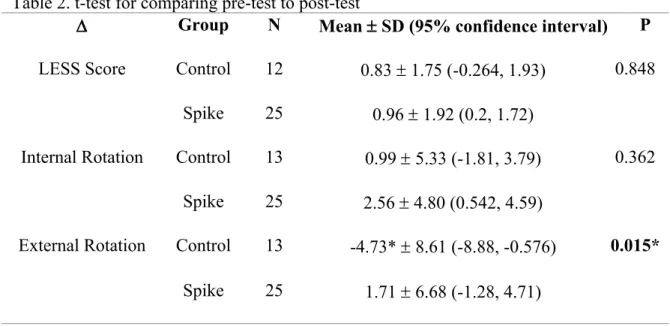
Independent samples t-tests revealed a decrease in hip external rotation range of motion of 4.73° in the Control group (p = 0.015) (Table 2.). No differences were found between groups for LESS scores or hip internal rotation range of motion.
Group Height in cm Mass in kg Age in years
ACWR Spike 167.6 ± 5.7 63.2 ± 5.8 19.8 ± 1.5
Control 166.64± 5.3 64.4 ± 5.9 20.2 ± 1.5
Table 2. t-test for comparing pre-test to post-test
D Group N Mean ± SD (95% confidence interval) P
LESS Score Control 12 0.83 ± 1.75 (-0.264, 1.93) 0.848 Spike 25 0.96 ± 1.92 (0.2, 1.72)
Internal Rotation Control 13 0.99 ± 5.33 (-1.81, 3.79) 0.362 Spike 25 2.56 ± 4.80 (0.542, 4.59)
External Rotation Control 13 -4.73* ± 8.61 (-8.88, -0.576) 0.015* Spike 25 1.71 ± 6.68 (-1.28, 4.71)
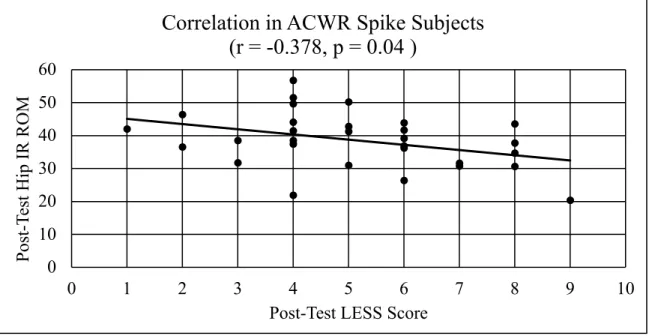
Pearson correlation in the ACRW group revealed that greater LESS scores at post-test were associated with lesser hip internal rotation range of motion (r = -0.378, p = 0.04; Figure 1). The correlations between LESS scores and soreness (r = 0.068, p = 0.684) and hip external rotation range of motion (r = 0.266, p = 0.156) were not significant.
0
10 20 30 40 50 60
0 1 2 3 4 5 6 7 8 9 10
P
os
t-Te
st
H
ip I
R
R
O
M
Post-Test LESS Score
Correlation in ACWR Spike Subjects
(r = -0.378, p = 0.04 )
CHAPTER 5: DISCUSSION
Overview
Contrary to our primary hypothesis, a spike in the ACWR did not alter factors related to ACL injury risk including landing biomechanics and hip internal or internal rotation range of motion. Similarly, changes in landing biomechanics, hip rotation range of motion, and soreness were not associated with the ACWR value. Current literature has studied the association between ACWR and injury risk in elite men’s soccer, elite men’s rugby, and elite men’s Australian league football.14,15,46 However, no previous studies
have evaluated these associations in female athletes or field hockey athletes. As such, differences in aerobic capacity required between sports and across sex may explain why our results differ from those of previous investigations. Aerobic capacity is an important factor, because the chronic component of the ACWR calculation is representative of fitness, and lower fitness paired with an increase in workload is predictive of injury risk.14,15,18,46 Sex is potentially a differentiating factor between this study and previous
literature as females have a higher predisposition to ACL injury than males.6–9,32 Beutler
et al5 also suggests that female military cadets score higher on the LESS than male
influence ACL injury risk to exist between the ACWR and Control groups that can only be identified via traditional 3-dimensional laboratory assessments.
The existing literature interprets an ACWR of 1.5 or higher as a spike in workload1,4–19,46 whereas we defined a spike as an ACWR of 1.4 or greater. Our
reasoning for choosing a lower threshold was to create more sensitivity to change in neuromuscular patterns that may be the root of increased injury rates experienced at higher ACWR levels.14–19,46,47 However, further analyses revealed that ACWR was not a
significant predictor of the change in LESS score (r = 0.138, p = 0.476).
Additionally, we calculated ACWR using a 3:7 calculation while others have utilized as 7:21 calculation.14–19,46,47 We retrospectively calculated ACWR using a 7:21
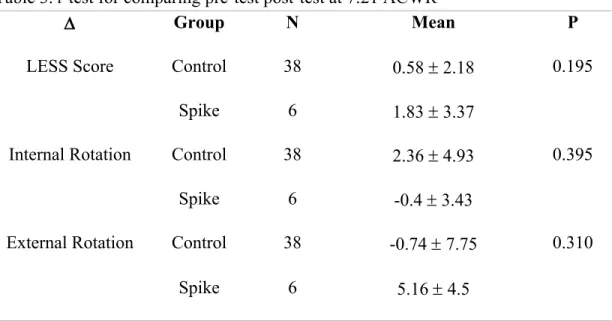
formula. However, there was no correlation between ACWR calculated with a 3:7-day ratio compared to a 7:21-day ratio in the ACWR spike subjects on the day of their spikes (r = -0.098, p = 0.674). This suggests that the two calculations may reflect different phenomena and are not interchangeable. Further analyses indicated that recategorizing subjects using the 7:21 ACWR revealed no statistically significant differences in hip internal or external rotation range of motion, or LESS between the control (n=32) and spike (n=6) groups (see Table 3). It is possible based on these post hoc analyses that it would have been more appropriate to utilize both a larger sample size as well as a 7:21 day ACWR calculation first because the 7:21 day ratio has demonstrated injury
prediction capability in men’s Australian rules football, men’s professional rugby, and men’s professional soccer;14–19,46,47 there was no correlation between the validated 7:21
Table 3. t-test for comparing pre-test post-test at 7:21 ACWR
Hip external rotation range of motion decreased in the control group whereas the group that experienced a spike in ACWR displayed no changes in range of motion. This finding contradicts our hypothesis that the ACWR spike group would experience a decrease in hip rotation range of motion compared to baseline measurements. The causes of the decrease in range of motion experienced in the control group are unclear but may be explained by the choice of ACWR threshold and the ACWR calculation method, as well as the minimal detectable change for range of motion measures.
While the reliability of using a digital inclinometer for hip rotation range of motion is well-studied and well-established,48,49 data detailing the minimal detectable
change (MDC) and validity of hip external rotation measurements using a digital inclinometer are limited. The MDC for shoulder rotation is 8°50 and the hip internal
rotation MDC is reported to be 8.6°.51 The decrease in hip external rotation detected in
D Group N Mean P
LESS Score Control 38 0.58 ± 2.18 0.195
Spike 6 1.83 ± 3.37
Internal Rotation Control 38 2.36 ± 4.93 0.395
Spike 6 -0.4 ± 3.43
External Rotation Control 38 -0.74 ± 7.75 0.310
the control group in this study was 4.73°, thus it is likely based on the studies of the hip and shoulder that this change in hip external rotation is within the MDC of the digital inclinometer’s measurements capability. Therefore, this small change in range of motion is most likely due to the inclinometer’s margin of error and not a clinically meaningful difference. In addition, the upper limit for the 95% confidence interval for the control group’s change in external rotation range of motion comes very close to zero, meaning that it comes very close to being statistically insignificant.
Lesser hip internal rotation range of motion was moderately associated with poorer LESS scores in the ACWR spike group. Because there were no changes in soreness, range of motion, or LESS scores as a result of spike in ACWR, the correlation between hip internal rotation range of motion and higher LESS scores cannot be
explained using these factors. Instead, it is possible that the assumed increase in fatigue (RPE) that is self-reported in the ACWR spike group played a role in the correlation between lesser hip internal rotation range of motion and higher LESS scores. This finding may reflect a general reduction in range of motion and an increase in landing stiffness in the ACWR spike group. This notion of generally reduced range of motion is further supported by post-hoc analyses demonstrating a correlation between reduced post-test weight-bearing lunge test (dorsiflexion range of motion) and higher post-test LESS scores (r = -0.543, p = 0.005). It is well established in the literature that fatigue alters jump-landing mechanics.29,52–58 Smeets et al54 reported a correlation between a higher
RPE and decreased knee flexion angle at maximum displacement post-activity during a double leg jump landing task. Similarly, Noh et al53 reported a decrease in hip and knee
Decreased knee flexion angles lead to greater LESS scores, and this outcome is a valuable component to predicting lower extremity injury, including ACL
injury.20,24,25,45,59 While we are not aware of any literature evaluating the effects of fatigue
on passive hip range of motion, the increase in LESS-related variables observed with fatigue28–30,43,56,57 could represent a general increase in lower extremity muscle stiffness
and passive resistance to internal rotation. This would potentially explain the correlation observed in this study between lesser hip internal rotation range of motion and greater LESS scores in the ACWR spike group.
The purpose of the current study was to globally evaluate jump landing
biomechanics after a change in ACWR. To expand upon these findings, further analyses of individual criteria within the LESS may help explain the relationship between hip internal rotation range of motion and LESS scores. The clinical significance of this finding is that lesser hip rotation range of motion22,31 may be associated with greater ACL
injury risk as is a LESS score of 5 or more.20,25 Therefore, the relationship between lesser
hip internal rotation range of motion and poorer LESS scores in individuals who display an ACWR spike supports a need for more research on fatigue-related biomechanical changes that may be seen with abrupt changes in workload that potentially increase the risk of ACL injury.
Limitations of the Study
test scores, more research is necessary to determine if there is a threshold at which changes in hip rotation range of motion, LESS scores, and soreness become detectable, similar to the observed increase in injuries in male soccer, Australian rules football, and rugby athletes past the 1.5 threshold. Second, this study used an acute period of 3 days to an uncoupled chronic period of 10 days. It could be that this calculation provides a higher sensitivity but lower specificity in detecting changes in workload that have been linked to greater injury risk.14–16 Essentially, the shorter term 3:7 ACWR calculation might detect
smaller changes in load than the longer term 7:21 ratio that detects a more chronic state of fatigue. The possible increased sensitivity and decreased specificity in this method may have provided a false positive in determining an ACWR spike. This may explain why no differences were seen between the ACWR spike and control groups, as our calculation method potentially detected a spike when there was no true spike present. Further research is necessary to discern if clinical changes can be detected in those determined to have a spike in ACWR. Additionally, we tested all subjects within 72 hours of their spike in workload. However, it is possible that the effects of an initial spike in ACWR do not persist over this interval and were muted at the time of post-test. More research needs to be done on injury risk post-spike and the time frame at which those injuries occur.
Conclusions
range of motion may be a factor of interest to a fatigued individual. Hip internal rotation range of motion may play a biomechanical role in distinguishing innocuous fatigue and fatigue that leads to injury. Second, more research is needed to determine if specific ACWR values at which an athlete’s injury risk changes vary across sport, as the aerobic capacity required in each sport is different.15,16,23 Finally, it is important to establish a
REFERENCES
1. Luc B, Gribble PA, Pietrosimone BG. Osteoarthritis prevalence following anterior cruciate ligament reconstruction: a systematic review and numbers-needed-to-treat analysis. J Athl Train. 2014;49(6):806-819. doi:10.4085/1062-6050-49.3.35 2. Flynn RK, Pedersen CL, Birmingham TB, Kirkley A, Jackowski D, Fowler PJ.
The familial predisposition toward tearing the anterior cruciate ligament: A case control study. Am J Sports Med. 2005. doi:10.1177/0363546504265678
3. Griffin LY, Albohm MJ, Arendt EA, et al. Understanding and Preventing Noncontact Anterior Cruciate Ligament Injuries. Am J Sports Med. 2006;34(9):1512-1532. doi:10.1177/0363546506286866
4. Bennell KL, van Ginckel A, Kean CO, et al. Patient Knowledge and Beliefs About Knee Osteoarthritis After Anterior Cruciate Ligament Injury and Reconstruction. Arthritis Care Res (Hoboken). 2016;68(8):1180-1185. doi:10.1002/acr.22794 5. Beutler AI, De La Motte SJ, Marshall SW, Padua DA, Boden BP. Muscle Strength
and Qualitative Jump-Landing Differences in Male and Female Military Cadets: The Jump-ACL Study. Vol 8.; 2009. http://www.jssm.org. Accessed November 8, 2018.
6. Rozzi SL, Lephart SM, Gear WS, Fu FH. Knee Joint Laxity and Neuromuscular Characteristics of Male and Female Soccer and Basketball Players*.; 1999.
https://journals-sagepub-com.libproxy.lib.unc.edu/doi/pdf/10.1177/03635465990270030801. Accessed November 27, 2018.
7. Shultz SJ, Sander TC, Kirk SE, Perrin DH. Sex Differences in Knee Joint Laxity Change across the Female Menstrual Cycle. Vol 45.; 2005.
https://www.ncbi.nlm.nih.gov/pmc/articles/PMC1890029/pdf/nihms21193.pdf. Accessed November 27, 2018.
8. Adachi N, Nawata K, Maeta M, Kurozawa Y. Relationship of the menstrual cycle phase to anterior cruciate ligament injuries in teenaged female athletes. Arthrosc Sport Med. 2008;128:473-478. doi:10.1007/s00402-007-0461-1
https://journals-sagepub-November 27, 2018.
10. Agel J, Rockwood T, Klossner D. ). Vol 26.; 2016. http://links.lww.com/JSM/A92,.
11. Braun HJ, Shultz R, Malone M, Leatherwood WE, Silder A, Dragoo JL.
Differences in ACL biomechanical risk factors between field hockey and lacrosse female athletes. doi:10.1007/s00167-014-2873-0
12. Kaeding CC, Léger-St-Jean B, Magnussen RA. Epidemiology and Diagnosis of Anterior Cruciate Ligament Injuries. doi:10.1016/j.csm.2016.08.001
13. Gornitzky AL, Lott A, Yellin JL, Fabricant PD, Todd Lawrence J, Ganley TJ. Sport-Specific Yearly Risk and Incidence of Anterior Cruciate Ligament Tears in High School Athletes A Systematic Review and Meta-analysis.
doi:10.1177/0363546515617742
14. Gabbett TJ, Domrow N. Relationships between training load, injury, and fitness in sub-elite collision sport athletes. J Sports Sci. 2007.
doi:10.1080/02640410701215066
15. Malone S, Owen A, Newton M, Mendes B, Collins KD, Gabbett TJ. The
acute:chonic workload ratio in relation to injury risk in professional soccer. J Sci Med Sport. 2017. doi:10.1016/j.jsams.2016.10.014
16. Hulin BT, Gabbett TJ, Lawson DW, Caputi P, Sampson JA. The acute: Chronic workload ratio predicts injury: High chronic workload may decrease injury risk in elite rugby league players. Br J Sports Med. 2016. doi:10.1136/bjsports-2015-094817
17. Gabbett TJ. THE DEVELOPMENT AND APPLICATION OF AN INJURY PREDICTION MODEL FOR. Vol 24.; 2010.
18. Gabbett TJ. The training-injury prevention paradox: Should athletes be training smarter and harder? Br J Sports Med. 2016. doi:10.1136/bjsports-2015-095788 19. Gabbett TJ, Nassis GP, Oetter E, et al. The athlete monitoring cycle: A practical
guide to interpreting and applying training monitoring data. Br J Sports Med. 2017. doi:10.1136/bjsports-2016-097298
20. Padua DA, DiStefano LJ, Beutler AI, de la Motte SJ, DiStefano MJ, Marshall SW. The Landing Error Scoring System as a Screening Tool for an Anterior Cruciate Ligament Injury-Prevention Program in Elite-Youth Soccer Athletes. J Athl Train. 2015;50(6):589-595. doi:10.4085/1062-6050-50.1.10
https://ac-els-cdn-
main.pdf?_tid=ec321a24-55ef-4181-a591-863c87a8b0bd&acdnat=1543368505_8deec01f8c47123183399ec1b927de59. Accessed November 27, 2018.
22. Tainaka K, Takizawa T, Kobayashi H, Umimura M. Limited hip rotation and non-contact anterior cruciate ligament injury: A case-control study. 2014.
doi:10.1016/j.knee.2013.07.006
23. Drew MK, Finch CF. The Relationship Between Training Load and Injury, Illness and Soreness: A Systematic and Literature Review. Sport Med. 2016.
doi:10.1007/s40279-015-0459-8
24. Padua DA, Boling MC, Distefano LJ, Onate JA, Beutler AI, Marshall SW.
Reliability of the Landing Error Scoring System-Real Time, a Clinical Assessment Tool of Jump-Landing Biomechanics. Vol 20.; 2011.
http://content.ebscohost.com/ContentServer.asp?T=P&P=AN&K=59990649&S=R &D=s3h&EbscoContent=dGJyMNLr40Seprc4zdnyOLCmr1CeqK9SsKq4SreWx WXS&ContentCustomer=dGJyMPGrtkqxpq5IuePfgeyx44Dt6fIA. Accessed October 9, 2018.
25. Padua DA, Marshall SW, Boling MC, Thigpen CA, Garrett Jr WE, Beutler AI. The Landing Error Scoring System (LESS) Is a Valid and Reliable Clinical Assessment Tool of Jump-Landing Biomechanics The JUMP-ACL Study
Department of Exercise and Sport Science and the. Am J Sports Med. 2009;37(10). doi:10.1177/0363546509343200
26. Everard E, Lyons M, Harrison AJ. Examining the association of injury with the Functional Movement Screen and Landing Error Scoring System in military recruits undergoing 16 weeks of introductory fitness training. J Sci Med Sport. 2018;21:569-573. doi:10.1016/j.jsams.2017.05.013
27. Laughlin WA, Weinhandl JT, Kernozek TW, Cobb SC, Keenan KG, O’connor KM. The effects of single-leg landing technique on ACL loading. 2011.
doi:10.1016/j.jbiomech.2011.04.010
28. Gokeler A.1, Eppinga P.2, Dijkstra P.U.3, et al. EFFECT OF FATIGUE ON LANDING PERFORMANCE ASSESSED WITH THE LANDING ERROR
SCORING SYSTEM LESS IN PATIENTS AFTER ACL RECONSTRUCTION. A PILOT STUDY. http://www.sta. Accessed November 27, 2018.
29. Zhang X, Xia R, Dai B, Sun X, Fu W. Of Exercise-Induced Fatigue on Lower Extremity Joint Mechanics, Stiffness, and Energy Absorption during Landings. Vol 17.; 2018. http://www.jssm.org. Accessed November 27, 2018.
31. Gomes JLE, de Castro JV, Becker R. Decreased Hip Range of Motion and
Noncontact Injuries of the Anterior Cruciate Ligament. Arthrosc - J Arthrosc Relat Surg. 2008. doi:10.1016/j.arthro.2008.05.012
32. Mclean SG, Huang X, Van Den Bogert AJ. Investigating isolated neuromuscular control contributions to non-contact anterior cruciate ligament injury risk via computer simulation methods. doi:10.1016/j.clinbiomech.2008.03.072
33. Clemente FM, Mendes B, Nikolaidis PT, Calvete F, Carriço S, Owen AL. Internal training load and its longitudinal relationship with seasonal player wellness in elite professional soccer. Physiol Behav. 2017. doi:10.1016/j.physbeh.2017.06.021 34. Kibler WB, Chandler TJ, Stracener ES. Musculoskeletal Adaptations and Injuries
Due to Overtraining.
35. Howell JN, David LAS, Gates T. An electromyographic study of elbow motion during postexercise muscle soreness. 2019.
36. Saxton J, Donnelly A. Light Concentric Exercise During Recovery from Exercise-Induced Muscle Damage. Int J Sports Med. 1995;16(06):347-351. doi:10.1055/s-2007-973018
37. Uhorchak JM, Scoville CR, Williams GN, Arciero RA, St Pierre P, Taylor DC. Risk Factors Associated with Noncontact Injury of the Anterior Cruciate Ligament A Prospective Four-Year Evaluation of 859 West Point Cadets*.; 2003.
38. Jaspers A, Brink MS, Probst SGM, Frencken WGP, Helsen WF. Relationships Between Training Load Indicators and Training Outcomes in Professional Soccer. Sport Med. 2017;47(3):533-544. doi:10.1007/s40279-016-0591-0
39. Borresen J, Lambert MI. The Quantification of Training Load, the Training Response and the Effect on Performance.
https://link-springer- com.libproxy.lib.unc.edu/content/pdf/10.2165%2F11317780-000000000-00000.pdf. Accessed November 5, 2018.
40. Krutsch W, Zeman F, Zellner J, Pfeifer C, Nerlich M, Angele P. Increase in ACL and PCL injuries after implementation of a new professional football league. Knee Surgery, Sport Traumatol Arthrosc. 2016. doi:10.1007/s00167-014-3357-y
41. Prins MR, van der Wurff P. Females with Patellofemoral Pain Syndrome Have Weak Hip Muscles: A Systematic Review. Vol 55.; 2009. doi:10.1016/S0004-9514(09)70055-8
43. Patrek MF, Kernozek TW, Willson JD, Wright GA, Doberstein ST. Hip-Abductor Fatigue and Single-Leg Landing Mechanics in Women Athletes. www.nata.org/jat. Accessed December 2, 2018.
44. Howell JN, Chila AG, Ford G, David D, Gates T. An Electromyographic Study of Elbow Motion during Postexercise Muscle Soreness.
www.physiology.org/journal/jappl.
45. Mauntel TC, Padua DA, Stanley LE, et al. Automated Quantification of the Landing Error Scoring System With a Markerless Motion-Capture System. J Athl Train. 2017;52(11):1002-1009. doi:10.4085/1062-6050-52.10.12
46. Hughes B, Doran DA, Malone S, Gabbett TJ, Collins K. Can the workload–injury relationship be moderated by improved strength, speed and repeated-sprint
qualities? J Sci Med Sport. 2018;22(1):29-34. doi:10.1016/j.jsams.2018.01.010 47. Murray NB, Gabbett TJ, Townshend AD, Blanch P. Calculating acute:chronic
workload ratios using exponentially weighted moving averages provides a more sensitive indicator of injury likelihood than rolling averages. doi:10.1136/bjsports-2016-097152
48. Charlton PC, Mentiplay BF, Pua Y-H, Clark RA. Reliability and concurrent validity of a Smartphone, bubble inclinometer and motion analysis system for measurement of hip joint range of motion. J Sci Med Sport. 2015;18:262-267. 49. Bierma-Zeinstra SMA, Bohnen AM, Ramlal R, Ridderikhoff J, Verhaar JAN,
Prins A. Comparison between two devices for measuring hip joint motions. Clin Rehabil. 1998;12(6):497-505. doi:10.1191/026921598677459668
50. Kolber MJ, Vega F, Widmayer K, Cheng MSS. The reliability and minimal detectable change of shoulder mobility measurements using a digital inclinometer. Physiother Theory Pract. 2011;27(2):176-184.
doi:10.3109/09593985.2010.481011
51. Krause DA, Hollman JH, Krych AJ, Kalisvaart MM, Levy BA. Reliability of hip internal rotation range of motion measurement using a digital inclinometer. Knee Surgery, Sport Traumatol Arthrosc. 2015;23(9):2562-2567. doi:10.1007/s00167-014-3096-0
52. Chang E, Johnson ST, Pollard CD, Hoffman MA, Norcross MF. Anterior cruciate ligament reconstructed females who pass or fail a functional test battery do not exhibit differences in knee joint landing biomechanics asymmetry before and after exercise. Knee Surgery, Sport Traumatol Arthrosc. 2019;(0123456789).
doi:10.1007/s00167-019-05707-9
2020;6(1):1-54. Smeets A, Vanrenterghem JOS, Staes F, Verschueren S. Match Play-induced Changes in Landing Biomechanics with Special Focus on Fatigability. Med Sci Sports Exerc. 2019;51(9):1884-1894. doi:10.1249/MSS.0000000000001998 55. Lessi GC, Serrão FV. Effects of fatigue on lower limb, pelvis and trunk kinematics
and lower limb muscle activity during single-leg landing after anterior cruciate ligament reconstruction. Knee Surgery, Sport Traumatol Arthrosc.
2017;25(8):2550-2558. doi:10.1007/s00167-015-3762-x
56. Hollman JH, Hohl JM, Kraft JL, Strauss JD, Traver KJ. Effects of hip extensor fatigue on lower extremity kinematics during a jump-landing task in women: A controlled laboratory study. Clin Biomech. 2012;27(9):903-909.
doi:10.1016/j.clinbiomech.2012.07.004
57. Descarreaux M, Lafond D, Cantin V. Changes in the Flexion-Relaxation Response Induced by Hip Extensor and Erector Spinae Muscle Fatigue. Vol 11.; 2010. doi:10.1186/1471-2474-11-112
58. Krause DA, Hollman JH, Krych AJ, Kalisvaart MM, Levy BA. Reliability of hip internal rotation range of motion measurement using a digital inclinometer. Knee Surgery, Sport Traumatol Arthrosc. 2015;23(9):2562-2567. doi:10.1007/s00167-014-3096-0
59. Everard E, Lyons M, Harrison AJ. Examining the association of injury with the Functional Movement Screen and Landing Error Scoring System in military recruits undergoing 16 weeks of introductory fitness training. J Sci Med Sport. 2018;21(6):569-573. doi:10.1016/J.JSAMS.2017.05.013