ADOLESCENT ETHNOLINGUISTIC STABILITY AND CHANGE: A LONGITUDINAL STUDY
Mary Elizabeth Kohn
“A dissertation submitted to the faculty of the University of North Carolina at Chapel Hill in partial fulfillment of the requirements for the degree of Doctor of Philosophy in the
Department of Linguistics.”
Chapel Hill 2013
ii © 2013
iii
ABSTRACT
MARY ELIZABETH KOHN: Adolescent Ethnolinguistic Stability and Change: A Longitudinal Study
(Under the direction of Elliott Moreton and Erik Thomas)
Most sociolinguistic studies rely on apparent time, cross-sectional methods to analyze language change. On the basis of apparent time data, sociolinguists have hypothesized that cultural processes of lifespan change create predictable cycles of linguistic behavior in which adolescents lead in the use of vernacular variants and advance sound change (Eckert 1997). While adolescence is hypothesized to be central to vernacular optimization and language change processes, only longitudinal studies reveal whether individuals change their linguistic behavior in predictable ways across
adolescence. Furthermore, longitudinal data about individual trajectories of change allow linguists to confirm or disconfirm apparent time data.
As a longitudinal study of over 67 African Americans from infancy to post-high school, the Frank Porter Graham (FPG) study presents a unique opportunity to document language variation across the lifespan. This analysis is the first longitudinal acoustic analysis of vocalic variation from childhood to early adulthood. Because African
iv
comparisons across linguistic subsystems reveal the extents and limits to which life-stage patterns predict linguistic cycles of behavior.
This study focuses on a subset of 20 individuals at approximately ages 9, 12, 15, and 20. Although all participants are from the Piedmont region of NC, individuals come from two communities with different demographics. Hierarchical regressions show that, while participation in AAE vowels strongly correlate with community and school demographics, stable vocalic variables do not undergo aggregate-level peaking patterns consistent with age-grading. Instead, stable aggregate patterns camouflage idiosyncratic individual trajectories. A lack of group patterns for vowel variation across adolescence suggests that life-stage variation does not affect all linguistic systems equally; age-grading is a minority pattern perhaps associated with stereotyped features and/or
v
ACKNOWLEDGEMENTS
The Piedmont region of North Carolina is home to a unique community of linguists with an unparalleled dedication to collaboration and mentorship. This
community has been a constant source of support and inspiration to me as I’ve gone on my academic journey. I count myself lucky to have had the direct supervision of such generous, talented, and insightful individuals as I’ve had on my dissertation committee. My co-chairs, Elliott Moreton and Erik Thomas, were not only exceedingly generous with their time, but also provided complementary perspectives that greatly strengthened the project. They are model scholars, and I hope to live up to their examples of
innovation, thoroughness, and commitment to the field. Bruno Estigarribia’s keen insight kept me on my toes and forced me to think beyond the scope of my discipline, and Mike Terry’s enthusiasm and encouragement kept my motivation up. I also join a line of linguists who are both indebted to and inspired by Walt Wolfram, whose kindness and humanity serve as an example of the power of inclusive leadership. Walt’s strength-based approach to mentorship allows all of us in the North Carolina Language and Life Project (NCLLP) consortium to develop our own voices and paths, and I can only hope to try to carry on that tradition with my future students.
vi
who excelled in her role as Primary Investigator both in her ability to retain participants and in her careful handling of the massive amount of information collected during the course of the project. Janneke Van Hofwegen and Jenn Renn have both been amazing collaborators, freely opening up their research to me and answering the multitude of questions I’ve had along the way.
Charlie Farrington deserves a special acknowledgement as he has so frequently worked side-by-side with me throughout this project. Neither the depth nor the breadth of this project would have been possible without his strong work ethic and dedication. I hope to have many more cross-time-zone g-chats about our research in the future! David Ethier and Anna Powers also both generously contributed to data collection, and Megan Risdal’s research on vowel trajectory information proved extremely helpful for this project.
While I could not have asked for a more supportive committee, I have also been amazed by the generosity of both mentors and peers who have had no formal obligation to support me in this process. Robin Dodsworth has stood by me in almost every aspect of this project, from technical advice, to critical insights, to emotional support, warm meals, and friendship. Robin, I can’t tell you how grateful I am for all the e-mails, phone conversations, afternoons at your house, evenings at restaurants, and so much more.
Jennifer Smith and the P-side reading group at the University of North Carolina at Chapel Hill have provided insightful feedback at every stage of this process, from
vii
advice and feedback provided by all these individuals, and, of course, all remaining errors are my own.
In 2006 I had the fortune to begin NCSU’s master’s program in sociolinguistics with an amazingly special group of women. I feel so lucky to have gone through this experience with Erin Callahan-Price, Stephany Dunstan, and Danica Cullinan. Y’all have been a source of both support and inspiration. From data collection in the Durham Public School System through our individual paths around the triangle, it’s been an amazing journey, and I couldn’t have asked for better travelling companions.
My family and friends has been a constant source of strength and sympathy throughout this process. Carrie Bishop, my mom, has certainly been a role-model of endurance, sympathy, and resiliency. Nicole Foster listened to me talk about every aspect of this project, a true testament to friendship. Finally, but certainly not least important, without the support of my husband and best friend, Chris Nelson, none of this would have been possible. Chris’s endless emotional support, patience, and willingness to listen to Robin and me talk about “fricatives” are testament to his generous and giving
viii
TABLE OF CONTENTS
LIST OF TABLES ... xii
LIST OF FIGURES ... xiv
1. THE QUESTION ... 1
1.1. Life-stage variation: how does linguistic behavior change as children mature into adults? ... 4
1.2. Implications for apparent-time research: what is the relationship between individual trajectories and community patterns of variation and change? ... 7
1.3. AAE and life-stage variation: how do ethnolects interact with Predominant Regional Varieties over the lifespan? ... 14
1.4. The corpus ... 17
1.5. Chapter outline ... 18
2. LINGUISTIC LIFE-STAGES AND CHANGE ACROSS THE LIFESPAN ... 21
2.1. Evidence for life-stages ... 24
2.1.1. Age-grading: Evidence from generational and panel studies ... 26
2.1.2. Linguistic change: Evidence from generational studies ... 31
2.2. Sociolinguistic analysis of linguistic development across childhood and adolescence ... 34
2.2.1. Sociolinguistic analyses of children ... 35
2.2.2. Adolescents ... 39
2.2.3. Emerging adults ... 42
2.3. Constraints on lifespan change ... 45
ix
2.3.2. Longitudinal studies ... 51
2.4. What we don’t know about life-stage change ... 54
3. CONTEXTUALIZING AFRICAN AMERICAN ENGLISH VOWELS ... 55
3.1. Description of the AAE vowel system ... 56
3.1.1. Similarities and distinctions between the AAVS and the European American SVS ... 57
3.1.2. AAVS as part of AAE: Evidence from perception studies and regional distribution ... 62
3.2. Social evaluation of African American English Vowels ... 63
3.2.1. Is the AAVS likely to undergo age-grading? ... 64
3.3. AAE vowels and sound change ... 71
3.3.1. A brief history on the study of AAE participation in regional sound changes ... 73
3.3.2. Evidence for mutual influence between AAE and PRV vowel systems .... 76
3.3.3. Factors that potentially influence AAE and PRV interaction ... 80
3.4. The linguistic ecology of FPG ... 85
3.4.1. Rural Eastern and Piedmont North Carolina ... 86
3.4.2. Urban Piedmont North Carolina ... 89
3.5. Chapter summary ... 106
4. THE DATABASE AND THE ANALYSIS ... 107
4.1. Frank Porter Graham Project ... 107
4.1.1. Participants ... 109
4.1.2. Field sites ... 111
4.2. Sound file selection ... 117
4.2.1. Data extraction ... 120
x
4.2.3. Details of normalization procedure chosen for the current analysis ... 128
4.3. Independent variables considered in the analysis ... 129
5. HOW DO CHILDREN CHANGE THEIR VOWEL PRONUNCIATIONS AS THEY AGE? ... 133
5.1. Statistical analysis for group change across time ... 135
5.2. Analysis of school demographic data ... 139
5.3. Group results for four time points ... 146
5.3.1. Phonetic environment ... 147
5.3.2. Formality ... 149
5.3.3. Sex differences ... 150
5.3.4. Group change across time ... 151
5.3.5. Participation in the AAVS by field site ... 152
5.3.6. Exploration of vowel change by field site ... 154
5.3.7. Discussion of group results ... 165
5.4. Individual change ... 169
5.5. Conclusions ... 174
6. STABLE SYSTEMS AND LIFE TIME CHANGE: A COMPARISON ACROSS LINGUISTIC SUBSYSTEMS ... 176
6.1. Group level comparisons for trajectories of morphosyntactic, consonantal, and vocalic change ... 178
6.1.1. The morphosyntactic and consonantal variables ... 178
6.1.2. Relationships among vocalic, consonantal, and morphosyntactic variables ... 182
6.2. Case studies ... 188
6.2.1. Adolescent peaking patterns for BAT and copula absence ... 188
xi
6.2.3. Stability or erratic patterns in vowels with no
correspondence in morphosyntax ... 194
6.3. Factors that contribute to differential patterns of linguistic change across the lifespan ... 198
6.4. Conclusions ... 202
7. THE NATURE OF VARIATION AND LIFE-STAGE CHANGE ... 203
7.1. The many paths through adolescence: Implications for apparent-time analyses of sound change ... 204
7.2. Ethnolectal vowel variation in context ... 208
7.3. The complexity of stability ... 210
7.4. Conclusions and further directions ... 211
Appendix 1 ... 213
Appendix 2 ... 216
Appendix 3 ... 236
xii
LIST OF TABLES
Table
1.1: Possible relationships between individual and
community variation as illustrated in Labov (1994), expanded
in Sankoff (2005: 1004), and discussed in Wagner (2012b) ... 8
3.1: Similarities and differences between SEAE and AAE ... 57
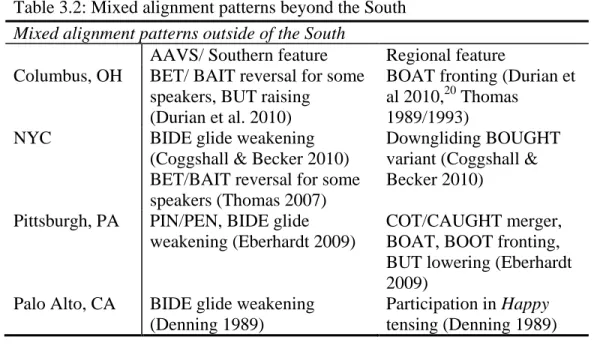
3.2: Mixed alignment patterns beyond the South ... 79
4.1: Average DDM across 6 time points by speaker ... 110
4.2: Post-high school occupations. Individuals who have moved out of county are noted. ... 111
4.3: Participants... 116
4.4: School demographics by gender ... 116
4.5: LOBANOV normalization algorithm ... 128
5.1: Variables considered in the analysis. ... 137
5.2: Model selection ... 147
5.3: Coefficients for duration ... 148
5.4: Coefficients for phonetic environment (coronal as comparison) ... 149
5.5: Coefficients for formality (Informal as treatment code) ... 150
5.6: Coefficients for sex differences (women as default treatment code) ... 151
5.7: Coefficients for grade ... 152
5.8: Coefficients for field site (Durham and Other relative to Chapel Hill) ... 153
5.9: Individual regression results for lax vowel midpoints ... 170
xiii
xiv
LIST OF FIGURES
Figure
1.1: Age-grading ... 9
1.2: Generational change ... 9
1.3: Lifespan change ... 10
1.4: Community stability may correspond to non-cyclical individual trajectories of variation. ... 11
1.5: Vernacular Reorganization in Real Time. Each curve represents lifespan change for one generation. ... 13
1.6: Two vowel charts with AAE vowel variables from middle class African American participants born 74 years apart (Raleigh, North Carolina). ... 15
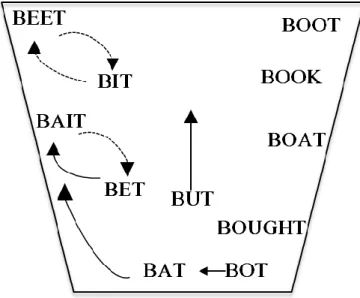
3.1: The Southern Vowel Shift (Labov 1991, 1994; Labov et al. 2006; Thomas 2001). Dotted lines for BEET and BIT indicate that shifting is not as prevalent as BAIT/BET reversals. The dashed line for BAT indicates the variable nature of raising in the South. ... 58
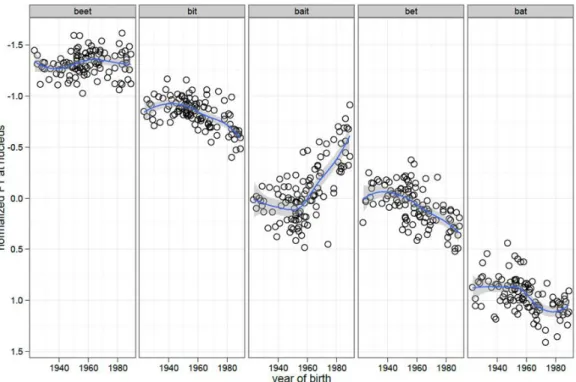
3.2: Trajectories for front lax vowels. ... 60
3.3: Features of the AAVS as identified in previous descriptions of AAE vowels. Interactions with PRV systems and regional innovations frequently lead to partial participation in this system. Dotted lines represent less common features ... 62
3.4: Vowel space from African American mayor (Kendall & Wolfram 2009:312) ... 70
3.5: African American speakers from Robeson County ... 86
3.6: Robeson County European American speakers ... 87
3.7: Warren County African American speakers ... 88
3.8: Warren County European American speaker ... 88
xv
3.10: Normalized F2 values for European Americans in
Raleigh, NC, in apparent time ... 91
3.11: BAT scatter plots and box plots for Raleigh African Americans. ... 94
3.12: BET scatter plots and box plots for Raleigh African Americans. ... 96
3.13: BAIT scatter plots and box plots for Raleigh African Americans. ... 98
3.14: BIT scatter plots and box plots for Raleigh African Americans. ... 99
3.15: BUT scatter plots and box plots for Raleigh African Americans. ... 100
3.16: BOAT scatter plots and box plots for Raleigh African Americans. ... 102
3.17: BOOK scatter plots for Raleigh African Americans. ... 103
3.18: BOOT scatter plots for Raleigh African Americans. ... 104
3.19: FPG speakers with PRV systems. ... 105
3.20: FPG Speakers with AAVS features. ... 106
4.1: Field site locations ... 112
4.2: School demographics 1999-2000 4th grade ... 113
4.3: School demographics 2003-2004 8th grade ... 113
4.4: School demographics 2006-2007 10th grade ... 113
4.5: Vowel extraction ... 121
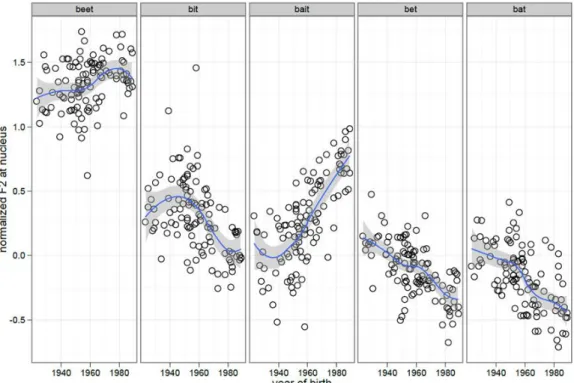
4.6: Comparisons of unnormalized (above) and Lobanov normalized (below) vowel spaces for the same participant (speaker 1057) at four ages. Plotting symbols represent means for vowel classes. ... 127
5.1: Correlation between school demographics and participation in front lax vowel raising. ... 140
5.2: Changes in school demographics by speaker ... 143
5.3: Changes for vowel height faceted by changes in demographics during childhood and adolescence. ... 143
xvi
5.5: BAT F2 by field site. ... 156
5.6: BET F1 by field site. ... 157
5.7: BET F2 by field site. ... 157
5.8: BIT F1 by field site... 158
5.9: BIT F2 by field site... 158
5.10: BUT F1 by field site. ... 159
5.11: BAIT F1 by field site. ... 160
5.12: BAIT F2 by field site. ... 160
5.13: Post-Coronal BOOT F1 by field site. ... 162
5.14: Post-Coronal BOOT F2 by field site. ... 162
5.15: BOOK F1 by field site. ... 163
5.16: BOOK F2 by field site. ... 163
5.17: BOAT F1 by field site. ... 164
5.18: BOAT F2 by field site. ... 164
6.1: Trajectories of copula absence by field site. Each line represents a trajectory of change for one individual ... 180
6.2: Trajectories of (ING) by field site. Each line represents a trajectory of change for one individual ... 181
6.3: Front lax vowels in informal contexts across time. ... 183
6.4: Correlations between copula absence and front lax vowel raising. ... 186
6.5: Correlations between (ING) and front lax vowel raising. ... 187
xvii
6.7: Comparison of morphosyntactic and consonantal change to vowel change in informal environments for speakers who show
accommodation to or participation in PRV sound changes. ... 193
6.8: Comparison of morphosyntactic and consonantal change to vowel change in informal environments for speakers who have stable vowels. ... 195
6.9: Comparison of morphosyntactic and consonantal change to vowel change in informal environments for dynamic speakers. ... 197
Appendix 1.1: dissimilarity indices for cities where AAE vowels have been studied ... 213
Appendix 1.2: Isolation indices for cities where AAE vowels have been studied ... 214
Appendix 1.3: Exposure indices for cities where AAE vowels have been studied ... 215
Appendix 2.1: Speaker 256 ... 216
Appendix 2.2 Speaker 268 ... 217
Appendix 2.3: Speaker 269 ... 218
Appendix 2.4: Speaker 274 ... 219
Appendix 2.5: Speaker 275 ... 220
Appendix 2.6: Speaker 280 ... 221
Appendix 2.7: Speaker 1001 ... 222
Appendix 2.8: Speaker 1003 ... 223
Appendix 2.9: Speaker 1015 ... 224
Appendix 2.10: Speaker 1025 ... 225
Appendix 2.11: Speaker 1035 ... 226
Appendix 2.12: Speaker 1057 ... 227
Appendix 2.13: Speaker 1058 ... 228
xviii
Appendix 2.15: Speaker 1062 ... 230
Appendix 2.16: Speaker 1070 ... 231
Appendix 2.17: Speaker 1072 ... 232
Appendix 2.18: Speaker 1075 ... 233
Appendix 2.19: Speaker 1078 ... 234
Appendix 2.20: Speaker 1085 ... 235
Appendix 3.1: Normalized BAT F1 trajectories ... 237
Appendix 3.2: Normalized BAT F2 trajectories ... 238
Appendix 3.3: Normalized BET F1 trajectories ... 239
Appendix 3.4: Normalized BET F2 trajectories ... 240
Appendix 3.5: Normalized BAIT F1 trajectories ... 241
Appendix 3.6: Normalized BAIT F2 trajectories ... 242
Appendix 3.7: Normalized BIT F1 trajectories ... 243
Appendix 3.8: Normalized BIT F2 trajectories ... 244
Appendix 3.9: Normalized BUT F1 trajectories ... 245
Appendix 3.10: Normalized BUT F2 trajectories ... 246
Appendix 3.11: Normalized BOOT F1 trajectories... 247
Appendix 3.12: Normalized BOOT F2 trajectories ... 248
Appendix 3.13: Normalized BOOK F1 trajectories ... 249
Appendix 3.14: Normalized BOOK F2 trajectories ... 250
Appendix 3.15: Normalized BOOK F2 trajectories ... 251
Appendix 3.16: Normalized BOAT F1 trajectories... 252
xix
Appendix 3.18: Normalized BOUGHT F1 trajectories ... 254
xx
LIST OF ABBREVIATIONS
AAE African American English AAVS African American Vowel System
AE Appalachian English
CDS Child-Directed Speech EAE European American English FPG Frank Porter Graham
NCS Northern Cities Shift NYC New York City
PRV Predominant Regional Variety SAAE Standard African American English SDA Second Dialect Acquisition
SEAE Southern European American English SLA Second Language Acquisition
SVS Southern Vowel Shift
“Linguists frequently study linguistic change, but an equally interesting phenomenon is linguistic stability or resistance to change” Macauley (1977: 2)
CHAPTER 1
THE QUESTION
Transitions between life stages, particularly from childhood to adolescence and adulthood, have a profound impact on an individual’s identity formation and social networks as well as involvement with and orientation towards social institutions. These cultural transitions potentially influence trajectories of linguistic change across the lifespan. While language acquisition studies incorporate longitudinal methods to document individual linguistic progression, similar studies beyond early acquisition are rare so that post-early acquisition trajectories of language variation remain under-documented (Sankoff 2005). Though sociolinguists hypothesize that life-stage changes create predictable cycles of linguistic behavior, particularly that individuals are
2
Although longitudinal studies of adolescent and adult linguistic variation and change are uncommon, recent longitudinal research on African American English (AAE) morphosyntactic and consonantal variation suggests that many iconic AAE features undergo age-grading, in which adolescents decrease their use of vernacular variants as they enter adulthood (Rickford & Price 2013; Van Hofwegen & Wolfram 2010; Wolfram & Van Hofwegen 2012). It remains to be seen whether age-grading is a pervasive pattern that affects variables across linguistic subsystems or if it is restricted to stereotyped and/or morphosyntactic features. Without empirical longitudinal evidence, a number of questions remain:
Do individuals change their linguistic behavior in predictable ways across adolescence? And, are adolescent trajectories of change isomorphic across linguistic subsystems?
How do individual trajectories relate to synchronic community patterns in terms of vowel variation over late adolescence and early adulthood?
How do trajectories of variation for AAE across adolescence correlate with and reflect societal structures?
What does variation and stability during late adolescence and early adulthood reveal about the nature of language change over the lifespan?
The Frank Porter Graham (FPG) database provides the first opportunity to empirically explore these questions longitudinally. While previous adolescent
3
project has followed 67 African Americans from infancy to adulthood (Burchinal, Roberts, Hooper & Zeisel 2000), representing the largest and most comprehensive longitudinal study of AAE ever undertaken.
Using the FPG database, which now spans the first 20 years of life (Burchinal, Roberts, Hooper & Zeisel 2000), I identify the stability and change of acoustic variants in the vowel space during adolescence, and compare these trajectories with other linguistic subsystems, in particular, the morphosyntactic and consonantal changes observed by Van Hofwegen and Wolfram (2010; Wolfram & Van Hofwegen 2012). The inclusion of four time points, starting in childhood and ranging to early adulthood, allows for a true longitudinal analysis of trajectories across adolescence. As the first longitudinal acoustic analysis of vocalic variation across the adolescent and early adult lifespan, this study enriches insight into how the cultural context of growing up predicts engagement in variable linguistic systems.
4
life-stage change (Eckert 1997). Because the AAVS is a stable system, life-stage variation can be assessed without the complicating factors of a change in progress.
This study illustrates that, while the AAVS highly correlates with school and community demographics, group adolescent trajectories for these variables are not consistent with age-grading. These results contrast with patterns observed in
contemporary analyses of consonantal and morphosyntactic vernacular AAE variables in the corpus in which participants as a group use more vernacular features during
adolescence than during childhood or adulthood (Van Hofwegen & Wolfram 2010; Wolfram & Van Hofwegen 2012). While sociolinguists hypothesize that age-grading is a common component of lifespan change across adolescence (Chambers 2003; Eckert 1997), these findings suggest that community-level patterns of age-grading may be restricted to a select suite of highly salient variables.
As more longitudinal studies of adolescent and adult speech emerge, evidence about post-acquisition stability and change complement apparent-time/cross-sectional studies by establishing models of individual linguistic lifecycles. Increased
documentation of life-stage trajectories for a variety of linguistic variables not only elucidates the nature of individual variation across the lifespan, but improves
interpretation of apparent-time/cross-sectional data. Because age-grading does not appear to be a majority-pattern for non-stereotyped vowel variation, it should not be assumed that adolescent peaks in apparent-time vowel data reflect processes of age-grading.
1.1. Life-stage variation: how does linguistic behavior change as children mature into adults?
5
change. This pattern, known as the adolescent peak, has been repeatedly observed in apparent time (see Section 2.1). Eckert hypothesizes that adolescents use more vernacular and more innovative variants as they establish independent identities from their families, which, in turn, advances sound change:
Adolescence is the focus of the development of the social use of the vernacular, and in general is seen as the time when linguistic change from below is advanced. Adolescents lead the entire age spectrum in sound change and in the general use of vernacular variables, and this lead is attributed to adolescents’ engagement in constructing identities in opposition to – or at least independently of – their elders (1997: 163).
Under this hypothesis adolescence is a special life stage in linguistic development. The language of adolescents is set apart by two processes. First, adolescents push sound change forward and increase their use of vernacular forms as part of the socio-cultural transition from childhood to adolescence. Second, some young adults shift away from local or stigmatized variants during the transition between adolescence and early
adulthood as they gain adult marketplace responsibilities or come into contact with other linguistic varieties in social institutions such as university systems or the military
6
Despite the attention given to life-stage variation, without longitudinal analyses, linguists are left with only a snapshot of linguistic behavior and a set of assumptions about change over the lifespan. While previous research on adolescent speech illustrates the connection between linguistic variability and social structure, only longitudinal studies can provide empirical evidence that adolescent linguistic behavior shifts and changes with the inevitable changes in social structures that individuals experience as they grow and develop into adults. Specifically, longitudinal analyses that track linguistic behavior from childhood through early adulthood are necessary to identify in what ways adolescents differ from their childhood and adult selves and how individuals
linguistically transition through the life stages of childhood, adolescence, and adulthood. This study illustrates the extent and limits to which adolescent speech stands out from adjacent life stages through the incorporation of four time points starting at
approximately age 9 and ending at approximately age 20. Within Chapter 5 I provide evidence that aggregate-level trajectories for stable vocalic variation are inconsistent with patterns of adolescent peaking. As a group, the adolescent time points do not significantly differ from childhood time points for the majority of the variables analyzed. However, while aggregate-level results largely show group stability, individuals display
idiosyncratic trajectories of vowel variation across adolescence. These results suggest that aggregate patterns of age-grading for stable vowel variables may be a minority pattern for life-stage variation, as adolescents do not pull from all linguistic resources in identical ways when they construct their adolescent linguistic identities.
These results contrast with patterns observed in contemporary analyses of
7
& Wolfram 2010; Wolfram & Van Hofwegen 2012). Trajectories of change for stereotyped morphosyntactic and consonantal variables at the aggregate level are consistent with age-grading, unlike patterns observed for vocalic variables. Life-stage variation does not appear to affect all linguistic subsystems in predictable ways because trajectories of change are mostly variant-specific (Chapter 6). While age-grading has been identified as a common component of lifespan change across adolescence, these findings suggest that community-level patterns of age-grading may be restricted to a select suite of highly salient variables. Evidence from this study shows that adolescent peaks at the aggregate level do not occur across all types of linguistic variables.
1.2. Implications for apparent-time research: what is the relationship between individual trajectories and community patterns of variation and change?
Due to constraints on data collection and resources, the majority of sociolinguistic analysis relies on the apparent-time construct (Bailey, Wikle, Tillery & Sand 1991; Labov 1963[1972]; Tillery & Bailey 2003). The apparent-time construct tracks sound change by comparing community speech norms across generations of speakers in a cross-sectional design. Under this model differences between the speech of older and younger generations are interpreted as a reflection of language change within the community. However, linguistic instability at the individual level can confound the interpretation of apparent-time data.
Longitudinal studies increasingly suggest that individuals can continue to modify their language throughout the lifespan both in the direction of community change
8
comparisons may overestimate linguistic change. Building on Labov (1994), Sankoff identifies five potential relationships between synchronic patterns of community variation observed in apparent time and individual trajectories of change (Table 1.1, see also Figure 1.1-Figure1.4).
Table 1.1: Possible relationships between individual and community variation as
illustrated in Labov (1994), expanded in Sankoff (2005: 1004), and discussed in Wagner (2012b)
Individual Community Synchronic Pattern 1. Stability Stable Stable Flat (no apparent change) 2. Age-Grading Unstable Stable Monotonic slope with age 3. Generational Change Stable Unstable Monotonic slope with age 4. Community Change Unstable Unstable Flat(no apparent change) 5. Lifespan change Unstable Unstable Monotonic slope with age
Interest in the relationship between individual trajectories of change and community variation emerges from the observation that aggregate, synchronic patterns can mask multiple patterns of longitudinal behavior. Authors such as Labov (1994) and Sankoff (2005) observe that monotonic slopes for age in synchronic data can correspond to age-grading in which linguistic variation remains stable at the community level even as individuals undergo life-stage change (Figure 1.1), generational change in which
9
generation will stand out from other generations for the linguistic feature in question (Figure 1.1).
Figure 1.1: Age-grading
Figure 1.2: Generational change
10 Figure 1.3: Lifespan change
Lifespan change is a process in which individuals change in the direction of community change in real-time. When lifespan change occurs apparent-time analyses can underestimate linguistic change as older age groups will have advanced their use of the linguistic variable in question alongside the community under analysis (Figure 1.3).
11
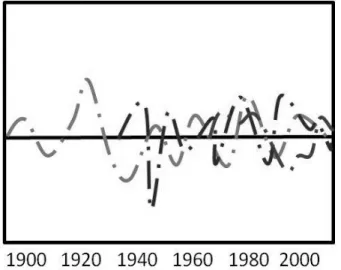
Figure 1.4: Community stability may correspond to non-cyclical individual trajectories of variation.
These observations highlight an inherent limitation of apparent-time studies: individual trajectories of change across the lifespan complicate interpretation of cross-sectional data. Longitudinal studies serve as an important complement and challenge to apparent-time data as they document the extents and limits to which individuals change across the lifespan. It is particularly crucial to identify the extent to which group patterns of age-grading are an expected component of the linguistic lifecycle as age-grading can confound the interpretation of apparent-time data. The more that is known about which types of variables undergo age-grading and when in the lifespan age-grading is likely to occur, the more judiciously linguists can interpret apparent-time data.
12
exclusive, as is probably the case for features like invariant be in AAE or quotative be like.
Labov (2001) suggests that adolescent peaks observed in apparent time provide an important clue to how sound change occurs within a community. Under his hypothesis, children first acquire the linguistic system of their primary care-giver. However, at some point “children must learn to talk differently from their mothers,” a process Labov labels vernacular reorganization (2001:415). To Labov, the existence of the adolescent peak for
changes in progress demonstrates that children advance sound change by altering their speech until they reach a period of grammatical stabilization (see Figure 1.5).
Specifically, he hypothesizes that girls1 will use their mother’s system until about age four. From age four until age 172 these girls push the sound change forward year by year. As such, younger girls are expected to have less advanced sound changes than their older siblings because they have not had the same amount of time to push the sound change forward. Because sound changes appear to advance as logistic functions, incrementation will occur as a logistic function, leading to the s-curve observed for language change (Labov 1994). This model predicts an adolescent peak for girls during the middle stages of the sound change when the sound change advances more rapidly, but not in the later stages or earliest stages when the change advances in slower increments.
1
Labov does not suggest that boys undergo the same kind of vernacular reorganization; but, rather, have similar levels of participation in sound changes as their mothers. The gender divide for vernacular reorganization provides a possible model for the female lead in most sound changes.
2
13
Figure 1.5: Vernacular Reorganization in Real Time. Each curve represents lifespan change for one generation.
14
suggests that adolescent peaks for vocalic variants are not a default pattern related to age-grading, bolstering the position that adolescent peaks for variables undergoing a change in progress correspond to incrementation through vernacular reorganization.
1.3. AAE and life-stage variation: how do ethnolects interact with Predominant Regional Varieties over the lifespan?
Due to an overwhelming focus on the processes underlying language change, research into the linguistic behavior of stable variation is rare in sociolinguistics; accordingly, the relationship between individual trajectories of life-stage variation and stable sociolinguistic variables remains an underexplored topic (Wagner 2012a). Only a handful of stable variables in English, such as multiple negation, copula absence, velar nasal fronting, and interdental fricative stopping,3 receive attention within the field of sociolinguistics. Yet, as illustrated by the quote introducing this chapter, an
understanding of the patterning of stable variation, or resistance to change, is equally important in providing insight into the ordered heterogeneity of the speech community. This is particularly true when one explores the relationship between ethnolects and PRVs, in which patterns of resistance to sound change have been observed (Bernstein 1993; Gordon 2000; Henderson 1986; Labov & Harris 1986; Thomas 1989). In the Piedmont region of North Carolina an AAE vowel system has been present for almost a century (Figure1.6 and Section 3.4.2 illustrate the time-depth of AAE vowels in the region). Because AAE vowels are stable in the region and longitudinal trajectories of AAE morphosyntactic/consonantal variables are documented, this analysis can explore the
3Multiple negation is defined as “[t]he marking of negation at more than one point in a sentence (e.g. They didn’t do nothing about nobody)” (Wolfram & Schilling-Estes 2006: 400). Copula absence is defined as the absence of the copula, as in she smart. Velar nasal fronting is a process in which the velar nasal [ŋ] is
realized as an alveolar nasal [n], as in swimmin’ for swimming. Interdental fricative stopping occurs when the voiced or voiceless interdental fricatives [ð] and [θ] are realized as alveolar stops [d] or [t] as in dey for
15
extent to which life-stage variation influences linguistic subsystems without the confound of a change in progress. The longitudinal study of AAE vowels offers the opportunity to identify the extent to which stable vowel system show life-stage variation, as well as how ethnolects interact with PRV systems across the lifespan.
Figure 1.6: Two vowel charts with AAE vowel variables from middle class African American participants born 74 years apart (Raleigh, North Carolina).
16
AAE variables during middle school and high school, perhaps indicating that the
adolescent peak is a significant trait of life-stage variation in AAE. These real-time data provide evidence that individual relationships with ethnolectal variation across the lifespan are subject to age-grading.
These previous studies, however, focus on canonical morphosyntactic variables and selected consonantal variables of AAE (e.g. Rickord 1999; Green 2002). In general, the study of sound changes within AAE has taken a back seat to the study of well-known morphosyntactic and consonantal variables. Although the last fifteen years have
witnessed the emergence of research regarding AAE vowels, the subject remains vastly understudied when compared to regional European American vowel variation and AAE morphosyntactic variation. Further, the studies addressing AAE vowel variation tend to be divorced from other AAE features. Even as researchers urge the field to consider AAE as a systematic whole, a split in the focus of analysis across linguistic subsystems may conceal how such systems work in concert to index ethnic identity. So, while longitudinal studies of AAE illustrate shifting trajectories of development on the morphosyntactic level, little is known about how the sounds of AAE develop alongside these discrete variables. Do children who demonstrate significant changes in morphosyntactic
vernacularity from childhood to their teen years also demonstrate parallel changes in the vowel system? If not, what might this indicate about the relationship between vocalic variation and morphosyntactic variation in AAE and ethnolects in general? A comparison of trajectories of change for morphosyntactic and vocalic AAE variables in Chapter 6 shows that while participation in the AAVS corresponds to community-level
17
intandem across adolescence. Age-grading for the AAVS, unlike vernacular AAE variables, is idiosyncratic and constrained.
1.4. The corpus
The FPG project provides a unique opportunity to test the adolescent peak hypothesis with empirical data, as well as explore the connection between
morphosyntactic variability and variable vowel production in AAE. The FPG study is a longitudinal database that began with 88 African American children in 1990 and followed participants from infancy through post high school, collecting a battery of academic, social, and demographic data across dispersed time points (Burchinal, Roberts, Hooper & Zeisel 2000). The linguistic development of each child has been recorded and preserved alongside their demographic, social, and educational history. Such data provide a narrative of linguistic development rather than a simple snapshot. Because the study includes longitudinal measures of childhood, adolescent, and early adult speech the question of whether adolescence stands out from other life stages can be tested
empirically. Additionally, because analyses of morphosyntactic and consonantal variation have been completed, trajectories of change across linguistic subsystems can be
18
1.5. Chapter outline
Over the course of this dissertation I present an analysis of linguistic variation across the lifespan in order to illuminate the relationship between life stages and linguistic variation. I consider the relationship of individual trajectories of change to patterns of stability and change in terms of the surrounding speech community, and what this evidence suggests about individual negotiations between ethnolectal variation and PRV systems.
In Chapter 2, I discuss previous research on the linguistic flexibility of the
individual across the lifespan, as well as relevant longitudinal studies and studies of child vowel variation. Because life-stage change is potentially limited by a loss of plasticity over the lifespan, I further review relevant research from adult longitudinal studies and studies of Second Dialect Acquisition (SDA). The third chapter provides the linguistic context of the study by including a review of AAE vowel research and a description of the FPG linguistic ecology. While several rapid and on-going changes have been identified in the vowel system of the region’s PRV speech variety (Dodsworth & Kohn 2012), less is known about the vowel system of the local AAE variety. I present evidence from the Southeast Raleigh Project illustrating the longevity and stability of the AAVS in the region. Additionally, I discuss AAE vowel studies to contextualize the longitudinal analyses in the chapters which follow. Chapter 4 describes the field sites and the participants in the current study and addresses some of the challenges of working with child data, particularly relating to the normalization of vowels.
19
directly address the adolescent peak hypothesis through a longitudinal analysis of the vowel space at the 4th grade, 8th grade, 10th grade, and post-high school time points. Do the children show vocalic change across these time points? Or do the vowel spaces remain stable? If change occurs between the 4th and 8th grade time points, do children continue to advance this change across high school? Or does the rate of change decrease with age? The contribution of this chapter is two-fold. First, it provides empirical
evidence for intense individual variation for stable variants across the lifespan. Second, it presents evidence for a correlation between participation in the AAVS and school
demographics.
Chapter 6 compares trajectories of change for vocalic features with trajectories of change for morphosyntactic and consonantal features. Previous analyses of the FPG recordings indicate dramatic differences in linguistic behavior for morphosyntactic and consonantal variants across these time points (Renn 2009; Van Hofwegen & Wolfram 2010; Wolfram & Van Hofwegen 2012). In line with the adolescent peak, participants in the 8th grade use more vernacular variants. Because correlations between vernacular speech and certain vowel patterns have been identified (Kohn & Farrington 2011), I additionally ask whether the 8th grade participants use more extreme variants of these vowel patterns. Should vowels be expected to change in tandem with other segmental and morphosyntactic features? If they don’t, what might this reveal about the connection between subsystems in the grammar?
20
complex sociolinguistic world is key to illuminating whether life-stage patterns predict linguistic cycles of behavior. Because of the importance of life-stage variation for AAE variation, this may be particularly true for African American youth. Observations
CHAPTER 2
LINGUISTIC LIFE-STAGES AND CHANGE ACROSS THE LIFESPAN
The interaction of language with social structures is not constant over the lifespan. Institutions such as school, work, and family structures produce environments in which gender, age, and social segregation correlate with various life stages. Many linguists have noted that it would be surprising if an individual’s relationship with these structures did not impact language use, resulting in predictable patterns of linguistic variation over the course of the lifespan (Chambers 1995, 2003; Cheshire 1987; Eckert 1997; Foulkes & Docherty 2006; Hockett 1950; Kerswill & Williams 2000; Labov 1964, 1972a, 2001; Wagner 2012a; Woolard 2011). Although theorization about psychosocial development in linguistic behavior has circulated for some time, the study of life stages in language variation represents a relatively new and important development within the field of sociolinguistics; one that first developed with the recognition that adolescent culture does not exist as an imperfect imitation of adult systems, but rather, emerges within the social and developmental contexts of this life-stage (Eckert 1989).1 These studies consider the social process of development and aging and its potential impact on linguistic behavior (Cameron 2005, 2010; Coupland 1991, 1997; Eckert 1996, 1997, 2000, 2011; Foulkes & Docherty 2006; Kerswill 1995; Kerswill & Williams 2000, 2005; Roberts 2002; Romaine 1984; Woolard 2011).
1
While Habick (1980) and later Eckert (1989) were the first to incorporate this approach to data collection and analysis, Hockett (1950) proposed the importance of recognizing adolescent culture as distinct from adult culture almost three decades before Habick’s (1980) and Eckert’s (1989) groundbreaking
22
An understanding of the interaction between age and linguistic behavior is intimately related to the cultural processes of development and aging in the broadest sense of these words, which is why panel studies emerge as a crucial test case for such theories. Panel studies consist of multiple interviews of the same individuals over a span of time, thus providing information on trajectories of change (Sankoff 2005). The majority of what is known about linguistic change across middle childhood and
adolescence comes from apparent time or from case studies over a limited time period. While these studies provide information on the interaction between development, aging, and linguistic behavior across the lifespan, there is no substitute for the insight that can be gained by following groups of individuals through the developmental and social
experiences of growing up (Sankoff 2004; Wagner 2012a). Only panel studies can empirically establish that individuals show linguistic stability or change across the lifespan and whether change correlates with progression through life stages.
How do individuals linguistically transition between life stages? Do real-time data provide evidence to indicate that the linguistic life stage of adolescence stands apart from other life stages? If so, are such behaviors restricted to certain linguistic structures? Are there limits to language change across the lifespan? Answering these questions is a necessary step in understanding ordered heterogeneity within the speech community.
23
adolescence for stable vocalic variation for twenty speakers from approximately age 9 to approximately age 20. This contributes to the growing body of knowledge on linguistic life stages by examining a dimension of potential variability in the system that has yet to be explored longitudinally for children and adolescents. Are trajectories of change for stable vocalic variation isomorphic to those observed for stable morphosyntactic variation within this community? If not, why would a difference emerge and what does this reveal about typical patterns of variation across the lifespan? Additionally, analyzing stable vocalic variation across adolescence provides context for apparent-time studies of sound change as it can serve as a crucial base model comparison of community variation in stable contexts. Finally, I investigate the relationship between institutional structures and lifetime change by exploring the relationship between school demographics and
participation in regional sound changes.
24
1977; Wolfram 1969). To date, no studies have examined stable vocalic variation from a life-stage perspective.
Evidence from ethnographic studies of adolescent speech suggests that teens may follow different linguistic trajectories for stable morphosyntactic variables depending on their engagement with adolescent social structures (Eisikovits 1998; Moore 2004). Speakers who vary on a morphosyntactic feature may easily alter speech through simple shifts in frequency even in adulthood (Nahkola & Saanilahti 2004). Yet, there may be limits on the extent to which older adolescents can modify vocalic variables due to a loss of linguistic plasticity (Evans & Iverson 2007). Although longitudinal case studies indicate that adults can modify vocalic systems in the direction of community change (Harrington et al. 2000), group change for variables below the level of consciousness is idiosyncratic (MacKenzie & Sankoff 2010). Because of a lack of research on stable vocalic variation, it remains to be seen how stable vocalic variation patterns across adolescence. Ultimately, there is no substitution for longitudinal studies covering multiple life stages that can show how transitions through the cultural constructs of age impact language use.
2.1. Evidence for life-stages
25
home in on specific life-stages (see Section 2.2). Research from apparent-time studies indicates that individuals in different life stages use stable vernacular morphosyntactic features and incoming changes to different degrees. Starting with a developmental stage where the child acquires linguistic variants closely aligned with parental models (Foulkes & Docherty 2006; Roberts 1994, 1997, 2002; Smith, Durham & Fortune 2007), apparent-time evidence and short term real-apparent-time evidence suggests that children begin to diverge from parental models as they gain exposure to peer models in elementary school (Kerswill & Williams 2000, 2005). Several scholars suggest that this process of
divergence continues incrementally across childhood, peaking in the adolescent years as teens seek to establish autonomous identities from both adults and children (Cheshire 1987, 2005; Eckert 1997, 2000, 2011; Labov 1964, 1972a, 2001).2 As teens transition towards adulthood, they are described as attenuating their use of vernacular variables, moving towards adult norms (Labov 2001). Attenuation of variables undergoing a change in progress may occur, but to a lesser extent (Cedergren 1987). Often, young adults’ orientations towards marketplace pressures are cited as instigating this shift, and sometimes a similar shift back to more vernacular behavior has been predicted for retirees who no longer experience the pressure of conforming to linguistic marketplace pressures (Chambers 1995, 2003; Eckert 1997).
2
26
2.1.1. Age-grading: Evidence from generational and panel studies
Adolescent peaks in vernacularity for stable variants have been cited as evidence of the importance of life stages in linguistic development (Chambers 1995, 2003; Eckert 1997; Labov 2001). Such generational differences cannot be attributed to language change, and as such, represent an important insight into the influence of the cultural construct of age on language variation. Even as adolescent peaking for non-standard stable variables is sometimes touted as a truism in the field of sociolinguistics, evidence discussed below suggests that different communities and class backgrounds exhibit different patterns of age-grading in apparent time. This pattern is consistent with the hypothesis that age-grading reflects the culture context of aging in a community. If adolescent peaks for stable variants are based on identity work as suggested by Eckert (1997), then social indexing of the variable in question, as well as social expectations for adolescent identities, will play a role in the age distribution of the variant. Evidence from Van Hofwegen and Wolfram (2010) presented in this section provides the linguistic context for this study by illustrating that vernacular AAE morphosyntactic features for this population display an adolescent peak. With this in mind, I can ask whether peaking patterns extend to stable vocalic features as well.
27
this evidence, he claimed that the use of stable vernacular sociolinguistic variables is a function of class for adults, but that speakers may show elevated use of such features in late adolescence (2001: 119). Yet the age of an apparent-time peak for stable variation does not always appear in adolescence and frequently interacts with class. For example, Biondi (1975) identified a peak in theta-stopping, among other features, for 4th graders when compared to 1st graders and 8th graders among Italian-American bilingual and monolingual Bostonians. Macauley’s (1977) analysis of Glaswegian English identified that the stigmatized use of glottal variants for /t/ was highest among children, but declined across adolescence to lower levels in adulthood among professional and white collar classes in his data. Variability in patterns of age-grading can be contrasted with more consistent patterns of adolescent peaking identified for changes in progress, suggesting that age-grading may be subject to more locally defined cultural practices related to age (Section 2.1.2)
Both apparent-time and longitudinal studies of AAE have demonstrated that vernacular AAE morphosyntactic and segmental features undergo age-grading between childhood and adulthood (Baugh 1996; Cukor-Avila 2002; Cukor-Avila & Bailey 2011; Rickford & McNair-Knox 1994; Van Hofwegen & Wolfram 2010; Wolfram 1969). These studies suggest that social factors such as school structure, interlocutor effects, and class background likely influence trajectories of life-stage change within each
community.
28
age group used higher rates of non-standard variants than teens or adults. However, an interaction between class and age was apparent for some of these variables in which working class teens patterned closer to the children’s rate of usage and the middle class teens patterned closer to adult levels of usage. This pattern is apparent not only for phonological features such as labialization of interdental fricatives, but also for morphosyntactic variants such as invariant be.
Baugh (1996) confirmed this age-graded pattern in real time through a case study of four men interviewed as teens and again as adults. Although each of the participants had taken different career paths, every individual used fewer vernacular AAE
morphosyntactic features, including copula absence and non-standard negation, in the adult interview. This is particularly striking considering that one of the adult participants was interviewed during his incarceration, during which linguistic marketplace forces likely differ from typical young adult settings.
29
vocalic variables. However, the earliest time point included in this study was age 13. Given evidence that suggests linguistic plasticity declines across adolescence, this time point may have been too late to capture peaking patterns for vocalic variation.
The importance of school as a locus for diffusion resulting in life-stage change is evident within Cukor-Avila and Bailey’s (2011) panel study in rural Texas. Speakers born between World War II and 1970 adopted urban AAE morphosyntactic features only after attending a high school outside of the community as social networks extended beyond the community. In contrast, after the community gained a high school in the 1990s, the youngest generation appeared to have adopted innovative quotative forms through “infusion,” primarily from European Americans who came from outside the community to attend the local school. In both cases school system structures provided the social contact necessary to trigger life-stage change.
30
The majority of participants demonstrated a “roller coaster” trajectory for the composite measure in which scores are high at 48 months, dip in 1st grade (approximately age 6) and 4th grade (approximately age 9), and rise in 6th(approximately age 11) and 8th grade (approximately age 13) (Van Hofwegen & Wolfram 2010). Inclusion of the post-high school time point indicated that DDM scores tended to drop for the majority of speakers between 10th grade (approximately age 15) and post-high school (approximately age 20) (Wolfram & Van Hofwegen 2012). This pattern aligns with the adolescent peak model of vernacularity in which teens use vernacular features more frequently than younger children or adults.
The variationist analysis of –ing, third person singular –s absence, habitual be, and copula deletion also demonstrated adolescent peaking patterns with lower
frequencies of vernacular features in 1st and 4th grade and higher frequencies in the middle school and high school years (Van Hofwegen & Wolfram 2010). All morphosyntactic features analyzed using traditional variationist methods rose in frequency between 4th grade and subsequent middle school and high school grades and declined in frequency between 10th grade and post-high school, once again illustrating that these stable vernacular features have an adolescent peak for the community in question (Wolfram & Van Hofwegen 2012).
31
copula absence, third person singular -s, and non-standard negation were observed in the earliest sociolinguistic studies of AAE (Labov 1966), we can assume that these features are generationally stable to some extent. With this in mind, having comparison data for morphosyntactic and consonantal variation for the participants in this study is particularly valuable as Van Hofwegen and Wolfram 2010 and Wolfram and Van Hofwegen 2012 illustrated that stable vernacular morphosyntactic and consonantal variants have adolescent peaks for this population.
To date, no longitudinal study tracks trajectories of change for vocalic features across childhood and adolescence outside of second dialect acquisition studies to be discussed in Section 2.3. Stable vocalic variation rarely receives attention from
sociolinguists unless it is highly stigmatized. Yet, understanding life-stage trajectories of change for stable vocalic variation provides a necessary complement to similar studies of segmental variation by illustrating the extent to which individuals modify their speech as they age.
2.1.2. Linguistic change: Evidence from generational studies
32
In a large-scale study of sound change in North America, Labov (2001: 458) found a peak in apparent-time for nine incoming sound changes in Philadelphia. Trudgill’s (1974) study of Norwich English also found incoming variants were more common among the youngest participants in his study.3 Ash (1982) identified similar peaks for /l/ vocalization, a change in progress in Philadelphia. Tagliamonte and D’Arcy (2009) offered strong evidence that morphosyntactic changes also display adolescent peaks. The age range of the 152 Canadian English speakers in the sample population allowed for the comparison of teenagers to both children (between the age of 9 and 12) and adults (ranging from 29 to 32). Of the six variables explored (quotative be like, discourse marker like, stative possessive have, modal have to, future temporal going to, and intensifier so), teens had higher rates for the incoming form than pre-adolescents or adults for five of the variables. Peaks were largest for rapid changes, as seen in the case of be like. Incipient changes, such as intensifier so, and changes that were approaching completion and completed changes, such as future temporal going to or modal have to, showed little to no peak. The authors attributed these patterns to logistic incrementation. They hypothesized that pre-adolescents participate in vernacular reorganization,
advancing linguistic change, until around age 17 when their grammars stabilize. Cedergren’s (1973) study of ch lenition in Panama also contained a peak,4
which she interpreted as indicating a change in progress. In order to confirm this hypothesis, Cedergren resampled the population over a decade later between 1982 and 1984
3
Nevertheless, because Trudgill (1974) groups speakers by decade it is impossible to determine distinctions between preadolescent and adolescent speech.
4
33
(Cedergren 1987). The peak remained, even as the sound change had advanced by 10 to 15% per age group. She interpreted these finding as indicative of a pattern of both community change and individual change across the lifespan.
In a rare comparison of stable variation and language change across generations, Cameron (2005) contrasted a morphosyntactic change in progress (quotative strategies) with two stable phonological variables (final –s deletion and intervocalic spirantization of d) in Puerto Rican Spanish for speakers age 5 to 84. Only the first feature showed an
adolescent peak, but it is unclear whether this difference reflects a
morphosyntactic/phonetic split or a change in progress/stable variant split. However, given Cedergren’s (1987) findings, it seems likely that the distinction relates to change rather than linguistic status.
Apparent-time generational studies provide suggestive evidence that features undergoing change demonstrate adolescent peaks consistent with logistic incrementation regardless of whether these features are morphosyntactic, consonantal, or vocalic. In contrast, adolescent peaking in apparent and real time for variation that is stable at the community level is inconsistent, suggesting that age-grading may be constrained by additional factors. Potential factors that may influence age-graded patterns include whether or not the feature is above or below the level of consciousness, as well as social indexing of variants. Without research into typical lifespan trajectories for vocalic
34
apparent-time peaks). As such, a lack of research into age-graded patterns poses a hurdle for apparent-time interpretations of research into vocalic change.
2.2. Sociolinguistic analysis of linguistic development across childhood and adolescence
35
2.2.1. Sociolinguistic analyses of children
Interest in how and when children acquire variable speech patterns has led to the growth of early childhood research from a sociolinguistic perspective.5 Data from Child-Directed Speech (CDS) indicate that children are exposed to socially meaningful
variation at the earliest stages of acquisition, and analysis of child speech for these earliest time periods indicates close alignment with parental models for socially salient variables (Foulkes, Docherty & Watt 2005; Kerswill & Williams 2000; Roberts 2002; Smith et al. 2007). Longitudinal (Callahan-Price 2011) and apparent-time analyses of language acquisition indicate that developmental constraints on variation cede to linguistic constraints found in the larger adult population during the preschool years, (Foulkes et al. 1999; Guy & Boyd 1990; Roberts 1996, 1997).6 Research into middle childhood illustrates a shift towards peer models, with schools serving as an important location for social contact (Kerswill & Williams 2000).
Some evidence suggests that local vocalic systems are acquired by about age 4 at which time variation closely aligns with adult models. Smith et al. (2007) studied a lexically conditioned stable phonological variant in Scots English, the HOOSE (for HOUSE) variable, among caregivers and children ages 2.6 and 4 years old. Although the youngest children frequently had only the standard variable, the oldest children in this
5
Some of the major theoretical questions driving sociolinguistic child acquisition studies include whether children acquire social variation alongside linguistic variation, or if children start with one representation and introduce social variation at a later stage, and how to model acquisition of sociolinguistic constraints in phonological theory (Foulkes & Docherty 2006). These issues fall outside the scope of this dissertation as the children under analysis are beyond the early acquisition stage of development.
6
36
study were found to match CDS frequencies and stylistic constraints for the local
variable. Roberts and Labov (1995) analyzed the Philadelphia split –a system, a variable undergoing change at that time, for 3 and 4 year olds enrolled in preschool. Lexically-conditioned tensing for the children aligned with parental models. Phonetic constraints for the 4 year olds more closely matched adult norms than those of the three year olds, illustrating that the adult system was acquired around age 3-4. Additionally, 4 year olds showed evidence of increasing tensing in environments undergoing a change in progress. The acquisition of adult norms was occurring alongside the progression of sound
changes.
Beyond the acquisition of variation in early childhood, analysis of middle childhood speech provides evidence that the transition between infancy at home to childhood and towards adolescence at school correlates with reorganization of variation based on peer models (Kerswill & Williams 2000). While middle childhood is clearly an important time in the linguistic lifecycle for moving away from parental models and learning sociolinguistically meaningful variation in the context of the peer group, the emphasis in sociolinguistic analysis has been placed on early acquisition, adolescent variation, or the presumably stable adult system. Because middle childhood language, between the years of 7 and 11, represents a relatively intact structural system with
developing social components,7 this particular time period deserves greater attention from linguists interested in how the linguistic individual progresses through the lifespan.
7
37
Sociolinguistic studies of vowel variation for middle childhood are rare (Habib 2011; Kerswill & Williams 2000; Romaine 1984: 100-102),8 and acoustic studies for this age group are almost non-existent (Eckert 2011; Jacewicz, Fox & Salmons 2011; Thomas 1996).9 While there are few apparent-time studies addressing the transition from
childhood to adolescence, Eckert notes that this stage is likely a crucial one in the development of the linguistic individual: “. . . it is in this early social order that kids’ sociolinguistic competence expands to engage with the wider social world” (Eckert 2011: 86). Eckert’s initial investigations of preadolescent speech suggests that innovative vowel variation, including advanced variants of Californian vowels undergoing a change in progress, is one tool that preadolescents draw upon to establish their social orders.
In their study of 4, 8, and 12 year olds at Milton Keynes, Kerswill and Williams (2000) focused on children as the promoters of koineization, a process of rapid dialect change that occurs in dialect contact environments, but their results speak to the
importance of life-stage variation as well. Six of the 10 features analyzed in their study of a New Town koine were vowel variables. For all of the variables the children avoided salient regional markers and were more homogenous than the adults, who hailed from various dialect regions. Kerswill and Williams (2000) compared school-aged children to
morphosyntactic and segmental variants emerged as socially significant by the sixth grade. Again, because this current study focuses on a subsample of the data analyzed in Renn (2010), this finding is of particular interest. In a comparison of 6-7 year olds to 10-11 year olds for /R/ deletion in France, Chevrot, et al. (2000) found a similar pattern. These authors additionally note that the process of learning to read likely affects phonemic awareness.
8
Acoustic studies of child vowel variation from a developmental perspective are discussed in Chapter 4. These studies do not consider social backgrounds of the participants but, rather, focus on acoustic correlates of the physical development of vocal tract morphology. See Vorperian and Kent (2007) for a review of the literature.
9
Seeking to fill the gap, Jacewitz et al. (2011) compared child and adult speech from a Southern
38
children not yet enrolled in school for two vocalic variables: the BOAT and BOOT classes. For both vowel classes the youngest participants aligned more closely with parental models and the 12 year olds led in the use of innovative forms, consistent with Labov’s (2001) model of sound change through incrementation. A case study of one male speaker demonstrated a shift away from parental models over an 18 month stretch from age 4 to age 6. The child’s vowel system went from reflecting the Scots dialect of his parents to the Southern English variants of his peers during this time.
Linguistic and social saliency likely affects whether or not children adjust the use of a feature when entering school. In a study of Arabic variation Habib (2011) explored two variables among children and adolescents ages 6-18 in a rural Syrian village. Habib compared a rural raised and fronted [e] variant to the low back vowel [a] urban variant, and a more urban glottal stop variant was compared with its rural uvular stop variant. Urban variants are spreading to the rural community under analysis. Mothers in this community typically come from outside the rural town, bringing in urban variants. The uvular stop appears to be a socially salient feature, receiving metalinguistic commentary from participants in the study. Apparent-time age effects were much stronger for the consonantal variant than the vocalic variant, possibly because the saliency of the consonantal variant made this feature the subject of age-grading for boys.
While childhood has been identified as a crucial transitional stage for linguistic development there remains a lack of evidence regarding vocalic variants from children. Only a handful of studies have analyzed child vowels from a sociolinguistic perspective (Habib 2011; Kerswill 1996; Labov 2001;10 Roberts & Labov 1995; Thomas 1996).
10