Big Data Sensors of Organic Advocacy: The
Case of Leonardo DiCaprio and Climate
Change
Eric C. Leas1☯, Benjamin M. Althouse2,3,4,5, Mark Dredze6,7, Nick Obradovich8,9, James
H. Fowler1,9, Seth M. Noar10,11, Jon-Patrick Allem12, John W. Ayers13☯*
1University of California San Diego School of Medicine, San Diego, CA, United States of America, 2Institute for Disease Modeling, Bellevue, WA, United States of America,3University of Washington, Seattle, WA, United States of America,4Santa Fe Institute, Santa Fe, NM, United States of America,5New Mexico State University, Las Cruces, NM, United States of America,6Human Language Technology Center of Excellence, Johns Hopkins University, Baltimore, MD, United States of America,7Bloomberg LP, New York, New York, United States of America,8Scripps Institution of Oceanography, University of California San Diego, San Diego, CA, United States of America,9Department of Political Science, University of California San Diego, San Diego, CA, United States of America,10School of Media and Journalism, University of North Carolina, Chapel Hill, NC, United States of America,11 Lineberger Comprehensive Cancer Center, University of North Carolina, Chapel Hill, NC, United States of America,12Keck School of Medicine, University of Southern California, Los Angeles, CA, United States of America,13 Graduate School of Public Health, San Diego State University, San Diego, CA, United States of America
☯These authors contributed equally to this work. *[email protected]
Abstract
The strategies that experts have used to share information about social causes have histori-cally been top-down, meaning the most influential messages are believed to come from planned events and campaigns. However, more people are independently engaging with social causes today than ever before, in part because online platforms allow them to instan-taneously seek, create, and share information. In some cases this“organic advocacy”may rival or even eclipse top-down strategies. Big data analytics make it possible to rapidly detect public engagement with social causes by analyzing the same platforms from which organic advocacy spreads. To demonstrate this claim we evaluated how Leonardo DiCa-prio’s 2016 Oscar acceptance speech citing climate change motivated global English lan-guage news (Bloomberg Terminal news archives), social media (Twitter postings) and information seeking (Google searches) about climate change. Despite an insignificant increase in traditional news coverage (54%; 95%CI: -144 to 247), tweets including the terms“climate change”or“global warming”reached record highs, increasing 636% (95%CI: 573–699) with more than 250,000 tweets the day DiCaprio spoke. In practical terms the “DiCaprio effect”surpassed the daily average effect of the 2015 Conference of the Parties (COP) and the Earth Day effect by a factor of 3.2 and 5.3, respectively. At the same time, Google searches for“climate change”or“global warming”increased 261% (95%CI, 186– 335) and 210% (95%CI 149–272) the day DiCaprio spoke and remained higher for 4 more days, representing 104,190 and 216,490 searches. This increase was 3.8 and 4.3 times larger than the increases observed during COP’s daily average or on Earth Day. Searches
a11111
OPEN ACCESS
Citation:Leas EC, Althouse BM, Dredze M, Obradovich N, Fowler JH, Noar SM, et al. (2016) Big Data Sensors of Organic Advocacy: The Case of Leonardo DiCaprio and Climate Change. PLoS ONE 11(8): e0159885. doi:10.1371/journal.pone.0159885
Editor:Donald R. Olson, New York City Department of Health and Mental Hygiene, UNITED STATES
Received:May 5, 2016
Accepted:July 6, 2016
Published:August 2, 2016
Copyright:© 2016 Leas et al. This is an open access article distributed under the terms of the
Creative Commons Attribution License, which permits unrestricted use, distribution, and reproduction in any medium, provided the original author and source are credited.
Data Availability Statement:All data are publicly available. News coverage data can be accessed using the Bloomberg Terminal {NT GO} function (bloomberg.com/professional), Twitter postings can be accessed using the public API (dev.twitter.com/ streaming/overview), and Google searches can be downloaded from Google Trends (google.com/ trends). Please contact the corresponding author if further assistance is required.
were closely linked to content from Dicaprio’s speech (e.g.,“hottest year”), as unmentioned content did not have search increases (e.g.,“electric car”). Because these data are freely available in real time our analytical strategy provides substantial lead time for experts to detect and participate in organic advocacy while an issue is salient. Our study demonstrates new opportunities to detect and aid agents of change and advances our understanding of communication in the 21st century media landscape.
Introduction
On February 28th, 2016 Leonardo DiCaprio used his Oscar acceptance speech to advocate for action on climate change to 34.5 million live viewers(Box 1)[1]. DiCaprio is not alone in championing social causes, especially climate change advocacy [2,3]. Recent trends suggest that a large number of non-celebrities are also conscious of social and environmental causes, with 81% of global consumers claiming they would be willing to purchase/consume fewer products to preserve natural resources [4]. Moreover, the Web 2.0 era has democratized advocacy. Unlike ever before, the public can seek, create, and share information instantaneously online [5]. We call this phenomenon“organic advocacy”since it is often led by the public and occurs outside the context of expert-led events or campaigns.
Population-level engagement with a campaign or organized event is typically assessed using surveys, but surveys are ill equipped to study discrete occurrences of organic advocacy, such as DiCaprio’s speech. Surveys are costly and typically do not have sampling frames that allow for the necessary baseline measures to demonstrate deviations from historical trends. These barri-ers alone may explain why organic advocacy has not been well-studied or integrated into expert communication strategies. Significant breakthroughs in big data are eliminating some of these barriers. Online footprints continuously shadow how the public engages with and seeks infor-mation [6,7], including with environmental issues and climate change [8,9]. By harnessing these novel data streams, we can directly observe how the public engaged with DiCaprio’s call-to-action. And because these data are available in real time, our strategy can be taken to the field to inform how experts respond to advocacy as it is happening. Specifically, we explored how DiCaprio’s message resonated on (a) traditional news and social media, and (b) how the
Box 1
“And lastly, I just want to say this, making The Revenant was about man's relationship to the natural world—the world that we collectively felt in 2015 [w]as the hottest year in recorded history. Our production had to move to the southernmost tip of this planet just to be able to find snow. Climate change is real, it is happening right now, it is the most urgent threat facing our entire species, and we need to work collectively together and stop procrastinating. We need to support leaders around the world who do not speak for the big polluters or the big corporations, but who speak for all of humanity, for the indig-enous peoples of the world, for the billions and billions of underprivileged people who will be most affected by this, for our children's children, and for those people out there whose voices have been drowned out by the politics of greed.”~Transcript from Leo-nardo Dicaprio’s Oscar Acceptance Speech
analysis, decision to publish, or preparation of the manuscript.
public concurrently sought information on how to respond online. We also compared DiCa-prio’s speech to other organized climate change events, such as Earth Day, to contrast the potential impacts of organic advocacy to planned advocacy.
Materials and Methods
Evaluating changes in traditional news and social media relied on daily trends for global news articles from the Bloomberg Terminal using the {NT GO} function (bloomberg.com/
professional) and postings on Twitter (dev.twitter.com/streaming/overview) that included the phrases“climate change”or“global warming”from January 1, 2011 through March 9, 2016. News was plotted on a relative scale (the proportion of all news including the key terms) and Twitter on an absolute scale (all English language tweets including the key terms) since it was only available in this format.
To evaluate how the public sought information we monitored all English language Google searches (google.com/trends), taking into account the specific topics the public sought infor-mation on, by hour for February 25, 2016 through March 9, 2016. Google searches were divided between those primarily investigating the claims made by DiCaprio, including the exact terms“climate change”,“global warming,” “hottest year,”and“indigenous,”versus those investigating topics that are related to climate change, but were not mentioned by DiCaprio, including the exact terms“solar power,” “electric car,” “sea level rise,”and“carbon tax.” Searches were plotted on a relative search volume (the proportion of searches including the key terms relative to all searches scaled to a 0 to 100 scale where 100 is the highest search propor-tion) and absolute volumes were estimated using Google Adwords (google.com/adwords).
Our study design was quasi-experimental, deriving a single estimate of the“DiCaprio effect” by comparing observed news, Twitter, and search volumes around DiCaprio’s speech to a counterfactual estimate representing expected news, Twitter, and search volumes had DiCaprio not advocated for climate change during the Oscars [10]. The observed volumes were derived from the time series. The counterfactual volumes were derived from an autoregressive inte-grated moving average (ARIMA) model, with components estimated using the algorithm developed by Hyndman and Khandakar [11]. This model used historical data to estimate expected volumes for the time period after DiCaprio’s speech. These models are robust to the most well-known biases, including recurring periodicities and trending in the data, such as how the daily volume of tweets may be growing as Twitter’s user base grows. The ratio of observed and counterfactual volumes were calculated so as to represent the“effect”as a percent increase with confidence bounds (alpha = 0.05) estimated by using 10,000 random draws from the multivariate normal sampling distribution with mean equal to the maximum-likelihood point estimates, and variance equal to the variance-covariance matrix [12]. We fitted additional models to describe the durability of the“DiCaprio effect”and describe variations by hour or day.
effect and Earth Day effect was then compared to the DiCaprio effect (e.g., Dicaprio effect divided by the summary COP effect) with statistical tests estimated by using 10,000 random draws from the multivariate normal sampling distribution with mean equal to the maximum-likelihood point estimates, and variance equal to the variance-covariance matrix [12].
All analyses relied on anonymized data and adhere to the terms and conditions, terms of use, and privacy policies of Bloomberg LP, Google, and Twitter. All analyses were computed using R Ver. 3.2.1
Results
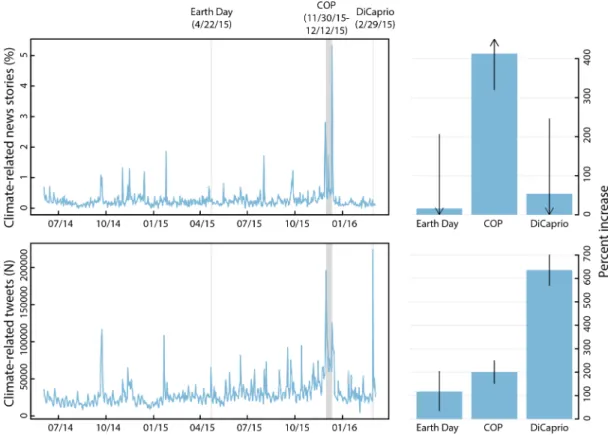
Social media engagement on climate change spiked after DiCaprio’s speech even though news coverage of climate change did not statistically significantly increase (54%; 95%CI: -144 to 247). Tweets mentioning climate change or global warming were 636% (95%CI: 573–699) higher than expected the day DiCaprio spoke(Fig 1).
To put these trends in perspective, the response to DiCaprio’s speech on Twitter was 5.3 times larger (p = 0.003) than Earth Day (Earth Day = 117%; 95%CI: 35–202) and 3.2 times larger (p<0.0001) than the daily average during the most recent COP (COP = 200%; 95%CI: 149–251). Moreover, the number of tweets including the phrases“climate change”or“global warming”on the day of DiCaprio’s speech were at the highest recorded value in our database with more than 250,000 tweets on that day.
Fig 1. News articles and Twitter postings for“climate change”or“global warming”Time trends show daily trends for news articles and Twitter postings that included the terms“climate change”or“global warming.” Bar plots show estimated increases in daily volumes for news articles and Twitter postings the day of DiCaprio’s Oscar speech, the daily average during the 2015 Conference of the Parties meeting, and 2015 Earth Day, comparing the observed volume to an empirical expectation of the counterfactual volume derived from forecasts using historical trends. Arrows indicate that the confidence interval bound continues off the plotted image.
Increased engagement on social media co-occurred with increased information seeking for content from DiCaprio’s speech (Fig 2). Google searches for“climate change”increased immediately the hour DiCaprio spoke, rising 261% (95%CI: 186–335) the day of, 78% (95%CI: 51–105) the day after, and remained significantly higher 4 days later (39%; 95%CI: 17–61); accounting for 104,190 total searches.“Global warming”searches were 210% (95%CI: 149– 272) higher the day of and still 42% (95%CI: 19–65) higher 4 days later, representing 216,490 total searches. In relative terms, the day DiCaprio spoke these searches were 3.8 (p = 0.004) and 4.3 (p = 0.005) times higher than the daily average during the most recent COP and Earth Day, respectively. At their peak these searches reached the third-highest point ever recorded for climate change or global warming on Google trends.
Fig 2. Hourly Google searches around DiCaprio’s Oscar speech.Time trends show Google search volumes for the referenced focal terms, clustered according to those included (versus not included) in DiCaprio’s speech. Bar plots show estimated increases in each focal term, with estimates showing the day of DiCaprio’s speech (0) and subsequent days labeled as 1 through 5. Estimates were derived by comparing the observed volume to an empirical expectation of the counterfactual volume derived from forecasts using historical trends.
In addition, DiCaprio claimed that 2015 was the hottest year on record and indigenous popula-tions will be disproportionately affected by climate change. Google queries including the terms “hottest year”or“indigenous”spiked immediately yielding 342% (95%CI: 248–433) and 81% (95% CI: 53–109) more searches than expected the first day following the speech, and remained elevated for 2 and 3 more days, respectively. During the same period, queries for climate change topics not mentioned by DiCaprio, such as“electric cars,”did not deviate from their historical trends.
Discussion
DiCaprio’s speech was a major moment for climate change advocacy, inspiring record levels of social media engagement and near record levels of online information seeking for climate change, apart from any similar increase in traditional news coverage.
Alongside DiCaprio there are several newly discovered cases showing that organic advocacy —emanating from celebrities and ordinary citizens—have a reach that is greater than virtually any planned media campaign. The most significant smoking-cessation-promoting event in Brazil was when Brazilian President Lula disclosed his laryngeal cancer diagnosis which he attributed to smoking [13]. Angelina Jolie’s editorial inThe New York Timesdisclosing her pro-phylactic double mastectomy corresponded with record levels of news and Google searches for breast cancer, increases that presaged amplified breast cancer screening and prevention [14,15]. Catherine Zeta-Jones disclosed she was treated for bipolar disorder and public engage-ment with and help-seeking for the condition spiked near record levels [16]. When Charlie Sheen first disclosed his HIV-positive status he personally did not promote HIV prevention, but the public engaged with HIV prevention in record numbers [17]. Ordinary citizen Tawny Willoughby’s Facebook pictures of her skin cancer lesions, attributable to indoor tanning, were shared more than 50,000 times and widely covered by news media [18]. These instances beg the question of how experts might embrace organic advocacy to further their social causes.
Traditional top-down communication strategies—i.e., experts and organizations communi-cating with the public through planned events and campaigns—have predominated as the method for disseminating scientific evidence and promoting behavior change [19]. These top-down frameworks typically expect that messages are more impactful when shared in the con-text of a planned campaign [20] and, in some cases, it is almost accepted that scientific evidence is only available and reliably disseminated“from the top.”For instance, many notable reviews, including for climate change communication strategies, do not consider the possibility of infor-mation retrieval and sharing outside of the context of a planned campaign [21–23]. However, the example of DiCaprio and others demonstrates that dissemination can occur completely outside the context of a campaign and can even generate more public engagement than planned events. Moreover, in some cases, the scientific community is beginning to find that retaliatory messages from bottom-up communication channels (e.g., on Twitter) can eclipse, dilute, or reduce the efficacy of planned messages [24]. Top-down frameworks are useful but communication strategies should be adapted to include a greater emphasis on bottom-up approaches where experts dedicate more resources to listening, dialoguing, and empowering the public who themselves can become advocates for change.
intelligence with colleagues. It is time the scientific community invest in similar resources. All of the results described herein can be available in real time, including additional forms of passive surveillance and crowdsourced data to understand discrete media events and climate change gen-erally [29–33]. In the case of DiCaprio there was minimal engagement from the scientific com-munity based on our review or related media, likely because experts were not aware of the magnitude of his speech or did not know how to build upon his call for action on climate change.
With awareness of events that can facilitate organic advocacy, the scientific community can engage the public by promoting existing resources and designing new messages targeting pub-lic discourse when pubpub-lic engagement and information seeking are high [34]. Given that searches were closely linked to the content of DiCaprio’s speech, the importance of this task is underscored as experts could have filled content gaps and highlighted how the public can miti-gate climate change. Reactions could be shared across a diverse array of bottom-up communi-cation channels, such as Facebook, Instagram, Reddit, and Twitter at a very low cost and mirroring how the public is engaged.
By amending our communication frameworks, building infrastructure for monitoring, and reacting to organic advocacy in near real time, we open novel possibilities for communication advocacy and research. For instance, does traditional top-down media advocacy interact with or generate public engagement to discrete organic events? How does organic advocacy about misinformation resonate, such as climate change denial [35] or anti-vaccination [36]? Can events like DiCaprio’s speech drive more than engagement by changing opinions and inspiring action in ways that are complementary to top-down communication approaches [37,38]?
Climate change is a serious crisis with critical implications for public health [39,40]. Climate change advocacy relies on imploring citizens to acknowledge the reality of a warming planet, accept humanity’s role in the fate of the planet, and help to forge a consensus on concrete solutions to the problem [41,42]. DiCaprio issued a wake up call to the public that ignoring climate change poses great peril. At the same time, we believe that ignoring organic advocacy and bottom-up communi-cation approaches imperils the effectiveness of media advocacy and, ultimately, environmental and public health. The scientific community must adapt to the 21st century dynamic communication landscape and ready itself for the next opportunity to harness the agents of change.
Acknowledgments
We appreciate feedback from the Epidemiology Doctoral Seminar and the Human Nature Group at San Diego State University and University of California San Diego. All errors or omissions are our own.
Author Contributions
Conceived and designed the experiments:ECL JWA.
Analyzed the data:ECL BMA JWA.
Contributed reagents/materials/analysis tools:ECL BMA MD NO JHF SMN JPA JWA.
Wrote the paper:ECL BMA MD NO JHF SMN JPA JWA.
References
2. Anderson A. Sources, media, and modes of climate change communication: the role of celebrities. Wiley interdisciplinary reviews: climate change. Wiley Online Library; 2011; 2(4):535–546.
3. Thrall AT, Lollio-Fakhreddine J, Berent J, Donnelly L, Herrin W, Paquette Z, et al. Star power: celebrity advocacy and the evolution of the public sphere. The international journal of press/politics. 2008; 13 (4):362–385.
4. Cone Communications LLC. Cone Communications/Ebiquity Global CSR Study. 2015; 4: 15. Available:
http://www.conecomm.com/research-blog/2015-cone-communications-ebiquity-global-csr-study#download-research
5. Watts DJ. A twenty-first century science. Nature. 2007; 445(7127):489. PMID:17268455
6. Lazer D, Pentland A, Adamic L, Aral S, Barabasi AL, Brewer D, et al. Computational social science. Sci-ence. 2009; 323(5915):721–3. doi:10.1126/science.1167742PMID:19197046
7. Ayers JW, Althouse BM, and Dredze M. Could Behavioral Medicine Lead the Web Data Revolution? JAMA. 2014; 311(14):1399–400. doi:10.1001/jama.2014.1505PMID:24577162
8. Newman TP. Tracking the release of IPCC AR5 on Twitter: Users, comments, and sources following the release of the Working Group I Summary for Policymakers. Public Understanding of Science. SAGE Publications; 2016;0963662516628477.
9. Mccallum ML, and Bury GW. Google search patterns suggest declining interest in the environment. Bio-diversity and Conservation. 2013; 22(6–7):1355–1367.
10. Shadish WR, and Cook TD. The renaissance of field experimentation in evaluating interventions. Annu Rev Psychol. 2009; 60:607–29. doi:10.1146/annurev.psych.60.110707.163544PMID:18616391
11. Hyndman RJ, and Khandakar Y. Automatic time series forecasting: the forecast package for R 7, 2008. Available:http://www.jstatsoft.org/v27/i03. 2007.
12. King G, Tomz M, and Wittenberg J. Making the most of statistical analyses: Improving interpretation and presentation. Am J Poli Sci. 2000; 44(2):341–55.
13. Ayers JW, Althouse BM, Noar SM, and Cohen JE. Do celebrity cancer diagnoses promote primary can-cer prevention? Prev Med. 2014; 58:81–84. doi:10.1016/j.ypmed.2013.11.007PMID:24252489
14. Noar SM, Althouse BM, Ayers JW, Francis DB, and Ribisl KM. Cancer information seeking in the digital age: effects of Angelina Jolie's prophylactic mastectomy announcement. Med Decis Making. 2015; 35 (1):16–21. doi:10.1177/0272989X14556130PMID:25349187
15. Evans DG, Wisely J, Clancy T, Lalloo F, Wilson M, Johnson R, et al. Longer term effects of the Angelina Jolie effect: increased risk-reducing mastectomy rates in BRCA carriers and other high-risk women. Breast cancer research: BCR. BioMed Central; 2015; 17.
16. Fond G, Gaman A, Brunel L, Haffen E, and Llorca PM. Google Trends: Ready for real time suicide pre-vention or just a Zeta-Jones effect? An exploratory study. Psychiatry Res. 2015; 228(3):913–7. doi:10. 1016/j.psychres.2015.04.022PMID:26003510
17. Ayers JW, Althouse BM, Dredze M, Leas EC, and Noar SM. News and Internet Searches About Human Immunodeficiency Virus After Charlie Sheens Disclosure. JAMA internal medicine. 2016; 176 (4):552–554. doi:10.1001/jamainternmed.2016.0003PMID:26902971
18. Stapleton, AC. Frequent tanner shares grisly skin-cancer selfie. 2015;5: 15. Available:http://www.cnn. com/2015/05/12/living/skin-cancer-selfie-feat/
19. Rice RE, and Atkin CK. Public communication campaigns. Sage; 2012.
20. Wakefield MA, Loken B, and Hornik RC. Use of mass media campaigns to change health behaviour. Lancet. 2010; 376(9748):1261–71. doi:10.1016/S0140-6736(10)60809-4PMID:20933263
21. Maibach EW, Roser-Renouf C, and Leiserowitz A. Communication and marketing as climate change— intervention assets: A public health perspective. Am J Prev Med. 2008; 35(5):488–500. doi:10.1016/j. amepre.2008.08.016PMID:18929975
22. Nisbet MC. Communicating climate change: Why frames matter for public engagement. Environment: Science and Policy for Sustainable Development. Taylor & Francis; 2009; 51(2):12–23.
23. Moser SC. Communicating climate change: history, challenges, process and future directions. Wiley Interdisciplinary Reviews: Climate Change. 2010; 1(1):31–53.
24. Allem J-P, Escobedo P, Chu K-H, Soto DW, Cruz TB, and Unger JB. Campaigns and counter cam-paigns: reactions on Twitter to e-cigarette education. Tobacco Control. 2016;:tobaccocontrol-2015. 25. Kryvasheyeu Y, Chen H, Obradovich N, Moro E, Van Hentenryck P, Fowler J, et al. Rapid assessment
of disaster damage using social media activity. Science Advances. 2016; 2(3):e1500779. doi:10.1126/ sciadv.1500779PMID:27034978
27. Santillana M, Zhang DW, Althouse BM, and Ayers JW. What Can Digital Disease Detection Learn from (an External Revision to) Google Flu Trends? Am J Prev Med. 2014; 47(3):341–7. doi:10.1016/j. amepre.2014.05.020PMID:24997572
28. Ayers JW, Althouse BM, Johnson M, and Cohen JE. Circaseptan (weekly) rhythms in smoking cessa-tion consideracessa-tions. JAMA Intern Med. 2014; 174(1):146–8. doi:10.1001/jamainternmed.2013.11933
PMID:24166181
29. Ayers JW, Westmaas JL, Leas EC, Benton A, Chen Y, Dredze M, et al. Leveraging Big Data to Improve Health Awareness Campaigns: A Novel Evaluation of the Great American Smokeout. JMIR Public Health and Surveillance. 2016; 2(1):e16. doi:10.2196/publichealth.5304PMID:27227151
30. Noar SM, Ribisl KM, Althouse BM, Willoughby JF, and Ayers JW. Using digital surveillance to examine the impact of public figure pancreatic cancer announcements on media and search query outcomes. J Natl Cancer Inst Monogr. 2013; 47:188–94.
31. Pearce W, Holmberg K, Hellsten I, and Nerlich B. Climate change on Twitter: Topics, communities and conversations about the 2013 IPCC Working Group 1 report. PloS One. 2014; 9(4):e94785. doi:10. 1371/journal.pone.0094785PMID:24718388
32. Lineman M, Do Y, Kim JY, and Joo G-J. Talking about Climate Change and Global Warming. PloS One. 2015; 10(9):e0138996. doi:10.1371/journal.pone.0138996PMID:26418127
33. Cody EM, Reagan AJ, Mitchell L, Dodds PS, and Danforth CM. Climate change sentiment on Twitter: An unsolicited public opinion poll. PloS One. 2015; 10(8):e0136092. doi:10.1371/journal.pone. 0136092PMID:26291877
34. Hart PS, Leiserowitz AA. Finding the teachable moment: An analysis of information-seeking behavior on global warming related websites during the release of The Day After Tomorrow. Environmental Communication. 2009 Nov 1; 3(3):355–66.
35. Hmielowski JD, Feldman L, Myers TA, Leiserowitz A, and Maibach E. An attack on science? Media use, trust in scientists, and perceptions of global warming. Public Understanding of Science. 2013;:0963662513480091.
36. Dredze M, Broniatowski DA, Smith MC, and Hilyard KM. Understanding Vaccine Refusal: Why We Need Social Media Now. Am J Prev Med. 2016; 50(4):550–2. doi:10.1016/j.amepre.2015.10.002
PMID:26655067
37. Deryugina T, and Shurchkov O. The Effect of Information Provision on Public Consensus about Climate Change. PloS One. 2016; 11(4):e0151469. doi:10.1371/journal.pone.0151469PMID:27064486
38. Hart PS, and Feldman L. The Impact of Climate Change—Related Imagery and Text on Public Opinion and Behavior Change. Science Communication; 2016; 38(4):415–441.
39. Frumkin H, and McMichael AJ. Climate change and public health. Am J Prev Med. 2008; 35(5):403– 410. doi:10.1016/j.amepre.2008.08.019PMID:18929964
40. Patz JA, Frumkin H, Holloway T, Vimont DJ, and Haines A. Climate change: challenges and opportuni-ties for global health. JAMA. 2014; 312(15):1565–80. doi:10.1001/jama.2014.13186PMID:25244362
41. Hamilton LC, Hartter J, Lemcke-Stampone M, Moore DW, and Safford TG. Tracking Public Beliefs About Anthropogenic Climate Change. PloS One. 2015; 10(9):e0138208. doi:10.1371/journal.pone. 0138208PMID:26422694