A MULTIPLE CASE STUDY OF EARLY LANGUAGE AND LITERACY PRACTICES IN BLACK MIDDLE CLASS FAMILIES IN THE SOUTHEASTERN UNITED STATES:
IMPLICATIONS OF RACE AND CLASS
Naa Dede Awula Addy
A dissertation submitted to the faculty of the University of North Carolina at Chapel Hill in partial fulfillment of the requirements for the degree of Doctor of Philosophy in the School of
Education.
Chapel Hill 2018
Approved by:
Jocelyn Glazier
Dana Griffin
George Noblit
Karolyn Tyson
ii © 2018
iii ABSTRACT
Naa Dede Awula Addy: A Multiple Case Study of Early Language and Literacy Practices in Black MiddleClass Families in the Southeastern United States: Implications of Race and
Class
(Under the direction of Jocelyn Glazier)
Early literacy experiences, prior to formal school entry, impact children’s academic
success (Bradley, Corwyn, McAddo, & García Coll, 2001; Snow, Burns, & Griffin, 1998).
However, much of this early literacy research has been based on the experiences of white,
middle class families. Current understandings of early literacy practices in black families are
based primarily on research limited to working-class and poor communities. This project
highlights literacy practices in the black middle class families that have been largely overlooked
in the literature.
Using a sociocultural definition of literacy based on New Literacy Studies (Gee, 1999;
Street, 1995) and an ethnographic multiple case study design, this project examines the language
and literacy practices of black middle class parents and their four-year-old children who live in
the southeastern United States. Findings of this qualitative study demonstrate that these families
are engaged in a number of oral, print, and digitally-based literacy practices that are highly
similar to the practices reported in white middle class families. However, these black middle
class families also engage in oral literacy traditions that potentially differentiate them from their
white middle class counterparts. Furthermore, the financial resources and social capital
associated with middle class status provide these families with a wealth of material objects and
iv
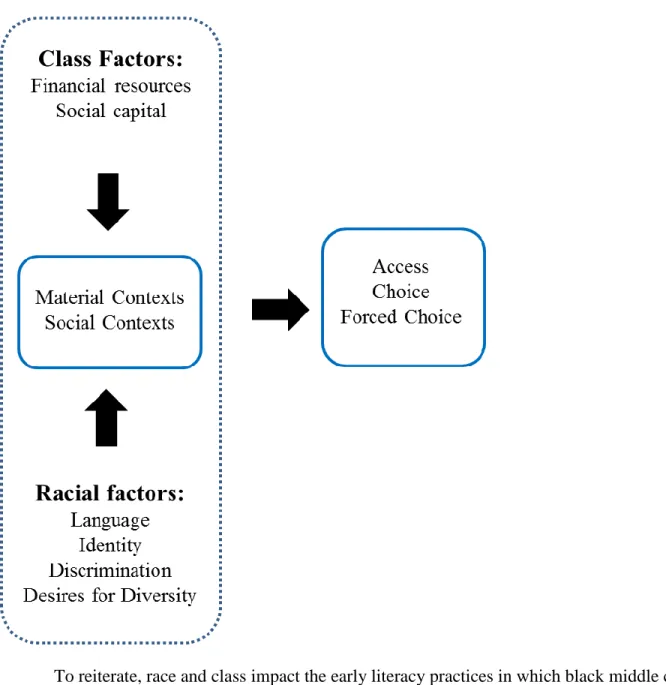
force these families to negotiate both black and white language and literate traditions. In short,
class-based factors provide increased access and choice for these families when it comes to
literacy and language practices, while racial factors also impose particular choices upon these
black middle class families. These findings serve as a reminder that educational professionals
and scholars must address intersecting variables of race and class in both theoretical models and
instructional settings. Perspectives shaped by race or class alone will necessarily fall short of
explaining the full range of practices in which these families engage. Furthermore, there must be
an appreciation for the role that immediate social and material contexts play in shaping literacy
v
TABLE OF CONTENTS
ABSTRACT... iii
LIST OF FIGURES ... vii
LIST OF ABBREVIATIONS ... viii
CHAPTER 1: INTRODUCTION ... 1
Introducing the Study ... 9
CHAPTER 2: FOUNDATIONAL LITERACY AND THEORY ... 13
Defining Concepts ... 14
Theoretical Frameworks ... 21
Review of Existing Literature ... 24
CHAPTER 3: METHODS ... 44
Research Design ... 44
Participants ... 46
Data Collection ... 50
Data Analysis ... 53
Researcher positionality ... 61
CHAPTER 4: INDIVIDUAL CASE STUDY ANALYSES ... 63
Chapter 4a: The Washington Family ... 64
Chapter 4b: The Mason Family ... 83
Chapter 4c: The Ambrose Family ... 100
Chapter 4d: The Peters Family ... 118
CHAPTER 5: CROSS-CASE ANALYSES AND FINDINGS ... 140
vi
Research Question Two ... 156
Research Question Three ... 165
CHAPTER 6: EXPANSION OF THEMES AND DISCUSSION ... 192
Methodological Considerations and Limitations ... 195
Implications and Recommendations ... 199
Future Directions ... 207
APPENDIX A: PARENTAL QUESTIONNAIRE ... 211
APPENDIX B: INITIAL INTERVIEW GUIDE ... 215
APPENDIX C: CLOSING INTERVIEW GUIDE ... 218
APPENDIX D: TABLE OF IN VIVO WORD FREQUENCIES ... 219
APPENDIX E: INITIAL CODES FROM OPEN CODING ... 221
APPENDIX F: SECOND PASS CODING ... 222
APPENDIX G: CODE FAMILIES AND ASSOCIATED INDIVIDUAL CODES ... 223
APPENDIX H: INDIVIDUAL FAMILY DESCRIPTORS ... 232
vii
LIST OF FIGURES
Figure 1: A limited model of social influences on literacy practices
viii
LIST OF ABBREVIATIONS
AAE African American English
1
CHAPTER 1: INTRODUCTION Early Language and Literacy
Literacy skills are foundational in formal U.S. education. Much of academic success is dependent on a student’s ability to learn through literacy. In fact, a young child’s early literacy
skills are predictive of that child’s academic success not only in elementary school, but also
through middle and high school (Diamond, Gerde, & Powell, 2008; Poe, Burchinal, & Roberts,
2004; Snow, Burns, & Griffin, 1998). For this reason, many kindergarten and even preschool
classrooms have shifted from a focus on play-based learning to a more explicit focus on early literacy skills (Diamond et al., 2008, Graue, 2010). Graue (2010) notes that many of today’s
kindergarten classrooms appear similar to first grade classrooms of past decades. Children are
now expected to possess increasingly advanced literacy skills at progressively younger ages.
Given this academic climate, educational scholars and practitioners have directed
increased attention towards children’s literacy experiences at home prior to formal school entry.
Research indicates that the frequency and types of educational activities in which young children
participate, or do not participate, prior to school entry influence their literacy performance in
school (Bradley, Corwyn, McAddo, & García Coll, 2001; Bus, van Ijzendoorn, & Pellegrini,
1995; Sénéchal & LeFevre, 2002). For instance, early experiences with storybooks in the home
are associated with increased language and educational outcomes later in school (Snow, Burns,
& Griffin, 1998). Exposure to large amounts of rare and complex words in the home has also
2
Based on this abundance of research, educational scholars and practitioners
overwhelmingly agree on the need for students to develop strong literacy skills even prior to
school entry. The term literacy itself, however, has been contested. Traditionally, literacy has
referred to the cognitive ability to decode, represent, and understand orthographic symbols, or
more simply put, to the ability to read and write. More recently, however, sociocultural approaches to learning define literacy as a wider range of skills than an individual’s ability to
decode orthographic symbols and connect them to the sounds of language (Bloome, Champion,
Katz, Morton, & Muldrow, 2001; Gee, 1989; Qualls, 2001). Instead, sociocultural accounts of
literacy define it more comprehensively as a dynamic cultural practice of using language within a
community, in oral and written forms. This view of literacy highlights the culturally-based
nature of literacy and its use among members of a particular community, rather than as an
isolated cognitive ability possessed by an individual. As a social and cultural practice, literacy is
dynamic and takes on various forms and meanings in the social contexts in which it is used,
based on the needs and expectations of the communities in which it is used. Finally, sociocultural
perspectives also highlight the interconnectedness of oral language and print literacy. In other
words, both the written and spoken word are conceptualized as part of a larger shared system of
communication. Although there are differences in how language is written and spoken, this
framework of literacy assumes that the two inform one another. For all these reasons, I
conceptualize early literacy practices in this project as encompassing aspects of both language
and literacy, encompassing elements of both traditional and sociocultural notions of literacy.
Therefore, I will often use the term literacy practices as an umbrella term that includes both
3
While there are some literacy activities in early childhood that are fairly common in the
majority of U.S. households, such as reading storybooks together and practicing how to write the
letters of the alphabet, there are also patterns that emerge along racial and class lines (Heath,
1983; Purcell-Gates, 1996; Vernon-Feagans, 1996). For instance, Purcell-Gates reports
differences in the timing of the literacy activities explicitly aimed at increasing reading and
writing skills, such as practice writing the alphabet. In her study of low-income urban families,
their explicit literacy instruction practices quadrupled once children began formal schooling.
This timing differs from higher-income families, in which explicit reading and writing
instruction occurs regularly and at quite a young age, without a sharp increase at school entry
(Purcell-Gates, 1996). In addition, the rate of reading books to and with young children differs
across class lines. Though reading books to and with children is a common practice in most
families in the United States (about 65%, Raikes et al., 2006), it more frequently occurs in
middle class and white families than among low-income families or families of color (Bradley et
al., 2001; Heath, 1983; Raikes et al., 2006).
On the other hand, scholars suggest that incorporating the practice of oral storytelling is
more common in black families than in white families, in which storytelling is overwhelmingly
print-based (Heath, 1983; Rickford & Rickford, 2000; Smitherman, 2000; Ward, 1971). In their
discussion of language traditions in black communities, Rickford and Rickford (2000) along with
Smitherman (2000) refer to a variety of oral traditions, including the practice of sharing stories
orally. Relying on empirical data, both Heath (1983) and Vernon-Feagans (1996) conducted
ethnographies with low-income black and white families in the rural South (specifically in the
Carolinas). Although these two studies were conducted nearly twenty years apart (Heath in the
4
storytelling practices mirrored one another and echo the accounts of Rickford and Rickford
(2000) and Smitherman (2000). Both observed that the rural black families regularly told stories
to one another. Children told stories to other children, parents told stories to other parents, and
children and adults told stories to one another. Moreover, children who were particularly good at
creating and elaborating on stories and creatively using language were praised, further
encouraging the development of verbal and narrative skills. Instead of engaging in this kind of
oral storytelling, the rural white families with preschool-aged children were more often observed
to read storybooks to and with their children.
Various explanations for these racial and class-based differences have been proposed,
ranging from the availability of financial resources to devote to child literacy materials in the
home, to the use of various dialects of English at home, to differences in culturally defined views
of literacy. For instance, when it comes to stories, Heath’s (1983) research suggests that within
black communities, stories are conceptualized more as oral accounts that are jointly created
rather than as narratives written within books. She argues that stories are also meant to be
fictionalized and elaborated, rather than necessarily representing a literal representation of
reality. This approach to narrative contrasts with how narratives are typically framed in white
communities, in which more emphasis is placed on accuracy and factuality. Furthermore, greater
emphasis is placed on narrative in print, such as in children’s storybooks (Heath, 1983). It is
possible, then, that observed differences in the nature of early literacy practices are due to
cultural variations in how literacy is defined. In other words, differences in literacy practices
between these communities may be related to different expectations regarding the role of literacy
and differing beliefs about how literacy learning does and should occur (Hammer & Weiss,
5
Whatever the underlying expectations for literacy may be, evidence suggests that the
early experiences of white, middle class children position them well to succeed in the classroom.
Those classrooms, in fact, are largely based on norms of white middle class families and
therefore mirror many of the practices that occur in those homes (Heath, 1983; Gee, 2008). For
instance, middle class parents routinely incorporate book-like or academic talk into everyday
conversation, encouraging their children to develop expertise on a particular topic (Gee, 2004,
2008). Similarly, these parents often encourage explicit reporting of events or information in
dinnertime conversations with their children. These kinds of language and literacy practices facilitate children’s early school success by developing skills in what has been referred to as
academic language (Gee, 2008; Cazden, 2001).
However, not all families participate in these types of literacy practices with their
children. Again, children from low-income homes typically have less experience prior to school
in developing islands of expertise or explicitly reporting events than those from middle class
homes. Although they may come to school with strong language skills, these skills may not be
understood by teachers or seen as strengths in the classroom. Michaels (1981) notes that the
white teacher of a racially-mixed first grade class had much more trouble understanding and
supporting the episodic or thematically-organized narrative styles typical of the black students in
her class compared to the chronological or topic-centered styles typical of her white students.
Cazden (2001) and Gee (1989b, 1989c) delineate a number of strengths in the storytelling styles
of young black children, although those strengths are often misinterpreted by teachers as a lack
of structure or comprehension skills. Black children, and boys in particular, display strengths in
narrative skill and verbal play (Vernon-Feagans, 1996). However these abilities do not often
6
and Manlove, 2001). In fact, they are negatively related to school-based literacy performance, in
measures such as comprehension, production, rephrasing, spontaneity, fluency, and listening
(Vernon-Feagans, 1996). Several decades ago, scholars like Kochman (1969) and Labov (1970,
1972), noted the high verbal ability of black students in their home communities, using their
native dialects of English, but noted that these children were either silent or inarticulate at
school, where academic or standardized English was used.
These studies demonstrate some of the ways in which early literacy practices differ along
racial lines. Children who have fewer experiences with the kinds of literacy practices valued in
school are at a disadvantage compared to students who have had more experience with
school-based forms of literacy at home. This appears to be the case for many black children.
Educational scholars have long noted thatblack children lag behind their peers in standardized
measures of reading and in overall academic performance (Jencks & Phillips, 1998; NAEP,
2012). Even as early as preschool entry, black children score below their peers on standardized
vocabulary measures (Washington, 2001; Washington & Craig, 1999). Certainly, there are a
number of theories as to why this might be the case, including dialectal differences between
home and school, culturally biased assessments at school that are based primarily on white,
middle class norms, and persistent racial disparities in socioeconomic status and access to
resources (Dickinson & McCabe, 2001; Washington, 2001). Nevertheless, because experiences
in the home are tied to performance in school, it is important to continue to examine early
literacy practices and their possible associations with later outcomes.
While a body of research indicates patterns of literacy practices that are less common in
black families compared to white families, other research demonstrates the variety of rich
7
(Addy, Vernon-Feagans, and the Family Life Key Investigators, 2013; Purcell-Gates, 1996). As
indicated earlier, particular literacy practices like storybook reading, which has gained the most
attention in early literacy studies, may not be as common in black families as in white families.
However, its relative infrequence does not equate to a lack or absence of literacy in these homes.
Some of the literacy activities that frequently occur include helping children to learn the
alphabet, using print literacy as part of daily routines like shopping, and singing nursery rhymes.
Once more, further research is needed to more closely examine how literacy is practiced and
understood in the homes of black families, beyond storybook reading.
Three primary gaps remain among the existing literature on literacy practices in black
families. First, the majority of research with black families has been limited to low-income
families. Because race and class have often been confounded in this country, it is unclear
whether the observed literacy patterns extend across black families regardless of class status or
not. Very little research has focused on middle class black families specifically. Among
existing research on this population, the findings have been contradictory or otherwise
inconclusive.
Some research with small numbers of black middle class families suggests that their
literacy practices are fairly common to white middle class families. For example, sociologist
Annette Lareau, (2003, 2013), in her study of families with elementary-aged children, suggests
that black and white middle class parents both attempt to carefully shape the early learning
environments of their children by enrolling them in as many activities as possible, including
those geared towards language and literacy. This similarity in parenting styles, she contends,
unites families according to shared class, rather than shared race. In other words, she contends
8
Other research indicates that when it comes to literacy, race is a more significant variable
to examine similarities. Multiple studies suggest that many black families, regardless of class
background, do indeed engage in similar language and literacy practices. For instance,
linguistic, anthropological, and educational research all indicate that the majority of black
families in the US communicate with one another using a dialect, or variety, of English called
African American English (AAE; Horton-Ikard & Miller, 2004; Lacy, 2007; Patillo, 2013).
Other oral traditions, such as call and response, word play, and oral storytelling appear to also
cross class lines in black communities (Lee, 2006; Rickford & Rickford, 2000; Smitherman,
2000). Clearly, additional work is needed to tease apart these conflicting accounts regarding the
role of race and class in the literacy practices of black middle class families.
In terms of literacy performance, middle class blacks form a sort of intermediate group,
generally showing greater academic success than their low-income black counterparts, but not
attaining levels reached by their middle class white counterparts (Washington, 2001). It is
unclear whether the literacy practices of middle class blacks follow a similar pattern, positioning
them as different from both other middle class and other black families. This study aims to shed
some light on this possibility.
In addition to conflating race and class, few of these studies have directly examined how
literacy is actually conceptualized in black families based on how those families actually engage
in language and literacy in the communities in which they live. Clearly, the ways in which black
parents and caregivers understand literacy will shape the nature of the home environment and the
kinds of literacy activities in which they engage with their children (Hammer & Weiss, 2000;
Lareau, 2003; Purcell-Gates, 1996). However, descriptions of literacy practices are often framed
9
school-based literacy. In a related fashion, literacy practices in black families are often discussed
vis-à-vis their comparison to practices in white middle class families. Without attention to
literacy practices as they exist in black families in their own right, their forms and functions
become overshadowed by how literacy is defined in other, most often white, communities.
Furthermore, the way literacy is practiced becomes distorted, often described in terms of
deficiency, rather than understanding how literacy serves the purposes of the communities in
which it is used. To reiterate, approaching this issue with a sociocultural lens allows a more
accurate view of how literacy is actually understood and practiced by its own users, in this case
by black, middle class families.
Finally, a third, and no less critical, gap remains. That is the lack of updated or current
research on literacy practices in black families. Much of the seminal research in the field is
based on studies that were conducted several decades and multiple generations ago. It is unclear
if the same patterns persist between black and white families today. Similarly, partially because
of the relatively small size of the black middle class relative to black working-class and poor
families several decades ago, current understandings of literacy in black families are still
primarily based on the larger population of working-class and poor black families. It is then
possible that current educational models and instruction are based on outdated, and consequently,
erroneous data.
Introducing the Study
The current research contributes to the literature by focusing attention on black middle
class families and their literacy practices. The objective is to gain a better understanding of the
10
and to examine how race and class may contribute to how literacy is practiced in these families.
More specifically, the research questions guiding this study are:
1. What types of early language and literacy practices do middle class black families
engage in with their four-year-old children prior to school entry? In a related fashion,
what purposes do those practices serve?
2. How are the material and social contexts in which black middle class families live
related to the language and literacy practices in which they engage with their
four-year-old children?
3. How do class and race impact the language and literacy practices and purposes in
which these families engage?
To reiterate, this project contributes to the existing body of research in the following
ways: 1) by helping to create a more comprehensive account of black literacy practices by
including oft-overlooked middle class families, 2) by examining literacy practices and their
purposes from the perspectives of families themselves, in the context in which they are used, and
3) providing an updated account of literacy practices in black families (although findings cannot
be directly compared with prior research due to the different class background of these families).
This qualitative case study research is based on my short-term immersion in the lives of
four black-middle class families throughout the southeastern United States. Through the current
project, I attempt to center the practices of these black families. In the overwhelming majority of
literacy research, white middle class literacy practices serve as the norm. Researchers have
positioned language and literacy practices in black families, who are disproportionately low
income, as deficient in comparison to these white middle class families. The proposed project
11
Instead the aim is to understand and value the practices of black middle class families from their
own perspectives, based on the contexts in which they live. Furthermore, rather than focusing on
literacy outcomes or academic performance, or how literacy practices directly relate to academic
performance, I take a step back to simply examine the practices themselves and why parents may
engage in those practices. Because research on literacy practices in black middle class families
is still in its nascent phase, this study is primarily exploratory and descriptive in nature. In sum,
the particular perspective of this project, along with the gaps which it serves to fill, positions this
project as an important and groundbreaking contribution to the field.
Implications
As will be described in the following chapters, this study contributes to educational
scholarship and practice regarding black children’s early educational experiences, specifically
those related to literacy. More specifically, the findings are intended to help scholars of early
education to better understand the specific ways that race, class, and specific social contexts
shape the early educational environments that children experience before they enter formal
classrooms. By focusing on the factors that contribute to how parents and children engage in
early literacy, it is then possible to discuss why parents engage in some practices and not others.
This approach allows for examination of the processes linking race and class to literacy
practices.
In the following chapters, I situate my study and findings among prior theory and
research regarding literacy practices. In Chapter Two, I examine the relevant literature on this
topic. In Chapter Three, I discuss my methods of data collection and analysis. Next I provide
12
findings outlined in Chapter Five. In Chapter Six, I share the implications of this study for
13
CHAPTER 2: FOUNDATIONAL LITERACY AND THEORY
As discussed in the previous chapter, early language and literacy practices are related to
literacy performance and overall academic success in school. Therefore, early childhood
educators stress the importance of laying a firm foundation for learning in the years from birth to
school entry, in order to provide children with optimal chances for later educational success. A
substantial body of research is dedicated to understanding the specific types of language and
literacy practices that are associated with increased literacy outcomes in school. In other words,
these studies are invested in tracking children’s literacy skills and development. Teasing apart
that literature, however, is not the aim of the current research. Instead, this project functions as
an exploratory investigation into the literacy practices in which families engage prior to their children’s entry into formal schooling, regardless of whether those practices are tied to increases
in their children’s academic performance.
This exploration also involves an attempt to better understand the purposes or goals that
parents consciously or unconsciously attempt to achieve through these practices. And finally, I
examine the role of racial and class factors in shaping these literacy practices and purposes. This
type of inquiry is unique and groundbreaking, given that black middle class families are often
overlooked in the literature on early language and literacy.
I begin this chapter with brief definitions of language and literacy practices, race, and
class as I conceptualize them in the current project. I also present the theoretical frameworks
that shape this project. Next, I review existing research on language and literacy practices that
14
research has yielded. In reviewing the literature on literacy practices I focus primarily, though
not entirely, on research in families with preschool-aged children under the age of five. I include
studies that examine a broad range of literacy practices, although a large portion of this research
is limited to book-reading practices in families with young children (see Fletcher & Reese, 2005
for a review). Finally, I offer suggestions regarding additional areas of inquiry that remain
unanswered or unexplored.
Defining Concepts Language Practices
I use the term language practices to refer to the ways that families use words to express
themselves and communicate orally. In other words, I examine the practice of language in social
settings, in which the social context is highly relevant. These practices may include having
conversations, telling stories, reciting nursery rhymes or prayers and verses from religious texts,
telling jokes, and even singing. At times I use the term oral language practices, with both terms
referring to the oral use of language. I do, however, make a distinction between language
practices and the term language itself. Language refers to the system of communication used
within communities based on agreed upon conventions that connect sounds (or signs) with
meaning. Again, I am interested in the practice of language, rather than the system itself.
Furthermore, this project is not an investigation into the language skills or abilities of preschool-aged children. A wealth of research on early literacy is dedicated to studying children’s various
language skills, such as phonological awareness, vocabulary size, syntactic complexity.
Although I mention some of these aspects of language skill as they relate to language practices,
they are not the focus of this research.
15
The same distinction I make with language practices versus language itself applies to the
use of literacy practices versus literacy. Traditionally, literacy has referred to the ability to
decode, represent, and understand orthographic symbols, or even more narrowly, the ability to
read and write. Therefore, many studies of early literacy have involved investigations of an individual’s knowledge of the alphabet, letter-sound relationships, ability to recount stories, and
so on. More recently, sociocultural approaches have influenced definitions of literacy to encompass a wider range of skills than an individual’s ability to decode orthographic symbols
and connect them to the sounds of language (Bloome, Champion, Katz, Morton, & Muldrow,
2001; Gee, 1989; 2008; Qualls, 2001; Street, 1995). This view of literacy highlights the
sociocultural nature of literacy and its use within a community, rather than as an isolated
cognitive ability housed in the individual (Mui & Anderson, 2008; Street, 1995).
In other words, literacy is more comprehensively defined as a dynamic cultural practice
of using language within a community, both in oral and print forms. As a social and cultural
practice, literacy is also dynamic and takes on various forms and meanings in the social contexts
in which it is used and based on the needs and expectations of the communities in which it is
used. This emphasis on the use of a system within a community or as practical mastery can be
seen in the application of the term literacy to refer to mastery in various areas, such as financial
literacy, cultural literacy, and digital literacy. Once again, this study serves as an examination of
literacy practices, or the social uses of language, both orally and in print, rather than the isolated
cognitive skills that are more appropriately defined as literacy skills.
While literacy practices still predominantly refer to language use in print, the term is also
used to refer to oral language practices as well, with an understanding that oral language and
16
interconnectedness of language and literacy. Cognitive or developmental studies of literacy also
note the connections between oral language and literacy development (Gee, 1999; National
Reading Panel, 2000; Snow, Burns, & Griffin, 1998 all taken from Gee, 2001). For instance,
reading scholars connect awareness about the sounds of language, oral vocabulary, and abilities
to comprehend and produce oral narratives with reading skills.For these reasons, I conceptualize
early literacy practices as encompassing aspects of both oral language and print literacy
practices. Therefore, I primarily use the term literacy practices to refer to both aspects of
literacy, without specific references to language and literacy practices.
I also include in this study uses of literacy in digital or electronic forms. Although
literacy in digital forms represents another form of print literacy, I have included it as a separate
category due to the fact that it is not one that has been included in many of the prior studies I use
as comparative cases, simply due to changes in technology since those studies were conducted.
There may also be some particularities of digital forms of literacy that make it distinct from
literacy on paper, either because methods of writing do not involve paper and pens or pencil but
often involve the direct use of digits (texting, swiping on cell phones and tablets, etc.) and
reading does not involve the physical turning of pages as in books, magazines, or newspapers.
While these particularities may not necessarily lead to a qualitatively or substantially different
experience with literacy, these small distinctions may be important to young children who are
still learning about the forms and meanings of literacy and who may or may not encounter
literacy in the same ways once they enter formal schooling. In recent years, literacy scholars
have begun to examine links between electronic resources and traditional conceptualizations of
literacy (e.g., Korat & Shamir, 2006). So far, findings concerning potential differences in
17
Golinkoff, 2017). It is clear, nevertheless, that the use of electronic devices, including
computers, smartphones, and electronic devices, has increased substantially in the past decade.
Finally, I do not include a review of literature that attempts to quantify home literacy
practices along any kind of scale using the framework of the home literacy environment (HLE,
Burgess, Hecht, & Lonigan, 2002). This line of research, typically used in quantitative studies, is employed as a means of categorizing the quality of literacy practices in children’s homes and
its relation to their subsequent literacy and overall academic achievement. However, I find these
definitions to be rather narrow. Although they may take into account the unique sociocultural
environments that exist in families, they implicitly define literacy according to its relationship to
school-based literacy and often privilege shared book-reading practices to the exclusion of a
myriad of other oral and print-based language and literacy practices. For similar reasons, I also
avoid using the term emergent literacy (Clay, 1966; Rohde, 2015; Scarborough & Dobrich,
1994). Although the term expands literacy development beyond reading and writing skills to
include surrounding contexts and includes precursors to formal literacy such as an awareness of
the sounds of languages, an understanding of the mechanics and functions of books, and
narrative structures, it again emphasizes a skills-oriented definition of literacy. Again, these
definitions implicitly assume that school-based forms of literacy, based on white-middle class
norms, are the standard, which necessarily frames other practices as deficient.
The current study is not intended to categorize practices according to their comparative
value among groups. Instead, the goal is to examine the practices in their own right, the purposes
that they serve within their communities, and offer insight about how those practices may be
related to early educational experiences, not just limited to skills, but broadly speaking and not
18 Literacy Purposes
Prior research has at times conflated what I separately refer to as practices and purposes.
Some of the purposes that appear across studies include literacy for recreational or entertainment
purposes, instrumental literacy or literacy to support daily life, literacy for interpersonal
communication, literacy for spiritual growth, literacy for educational purposes (Heath, 1983;
Johnson, 2010; Purcell-Gates, 1996). In my own project, not all of these four purposes are
necessarily evident in each family, or some may be foregrounded, pushing others into the
background. Although I use these groupings as a starting point, I primarily list the literacy
purposes according to how they actually appear in each particular family, relying loosely on
these groupings when relevant.
Separating practices according to these categories serves an analytic purpose, but it also
overlooks the ways in which practices may serve multiple purposes simultaneously. For
instance, families may engage in the academic tasks of learning to read and write in ways that
also serve as entertainment or leisure activities for children who enjoy such activities. So while
dividing literacy practices in this way serves an analytical purposes, the separation is a bit
artificial, given that literacy practices often serve multiple purposes simultaneously, which has
been noted by other scholars as well (Heath, 1983; Purcell-Gates, 1996).
Sometimes conflated with literacy purposes are also literacy beliefs. These beliefs may
include beliefs about the purposes of literacy, such as believing that literacy is meant to be an
academic activity. Beliefs may also incorporate ideas about how literacy skills are best learned,
whether through observation or explicit instruction, whether at home, or at school. Many of
19
independently. In the current study, I deal primarily with the practices and purposes, with
secondary examination of the beliefs that underlie them.
Race
Social scientists have long argued that the concept of race is a social construct with no
biological basis (Omi & Winant, 1994) and therefore, one that is unstable and changes in
definition according to the dominant social groups and the historical, political, and social
contexts in which it has been employed. More specifically, it has been used to the advantage of
those who identify as white, with all other racialized groups deemed inferior. Whereas different
racial categories were once generally assumed to be biologically based, scholars currently
acknowledge that the concept of race is more superficially tied to phenotypical features such as
skin color, hair texture, and facial features, but is also used to define different cultural groups
that are more accurately defined by ethnicity rather than race (Bonilla-Silva, 2004). Some
scholars suggest that in studying race, researchers are more accurately studying systems of racial
stratification or the effects of racism and discrimination (Bonilla-Silva, 2004).
That being said, I examine black families in this project, with the understanding that there
is a level of heterogeneity among them, but also that they move through a society in which they
are assumed to share a number of characteristics and life experiences, and by their reports, do
indeed experience similar forms of discrimination based on their phenotypical features. In
studying black families, I recognize the implicit assumption that these families are connected by
the supposedly unifying factor of shared race and similarly, shared culture. I operate with the
understanding that participants who self-identify as black are likely to share cultural heritage,
20
identical. Simply because all these families self-identify using the racialized label of black or
African American does not necessarily mean that they share identical experiences, lifestyles,
behaviors, or values. There is still a certain level of heterogeneity within and amongst black
families, as there is within any cultural group. Differences exist along a number of dimensions,
such as of religion, region, socioeconomic or class status, and residential patterns (i.e., rural,
urban, suburban).
Keeping this heterogeneity in mind, I examine black families as a single racialized group,
which is defined by patterns of historical segregation in the US that do indeed maintain some
level of distinct cultural traditions that are reinforced by physical isolation. Finally, I use the
term black to refer to these families because this is the more common term that the families use
to refer to themselves, rather than the term African American that is more commonly used in
academic circles or by people who do not identify as members of this racialized group.
Class
Defining social class has been notoriously contentious and problematic across various
disciplines in social science research (Bennett, Lutz, & Jayaram, 2012). As a social construct, the
concept of class is fluid and abstract rather than fixed and concrete. However, differences in
income and social standing indeed contribute to disparate material conditions in which groups
and individuals live (Wright, 2008). The most common components used to define social class
are income or wealth, educational attainment, and occupational prestige (Jackson, 2010; Patillo
2013). Consequently, the proposed study will investigate the influence of social class, as the
combination of these primary demographic variables and as the experience of particular material
conditions, and their potential role in shaping language and literacy beliefs and practices in black
21
Theoretical Frameworks Literacy Redefined: New Literacy Studies
The proposed project is guided by the theoretical contributions of New Literacy Studies (NLS; Gee, 1999, 2008; Scollon & Scollon, 1981; Street, 1997, 2005). NLS offers a “culturally
sensitive account of literacy that rejects static and homogeneous views of the literacy practices of cultural communities” (Gutiérrez, Morales, & Martinez, 2009, p. 213). Literacy is also
conceptualized in terms of its plurality. Literacy, or literacies, are multiply constructed. Using a
sociocultural lens, literacies are understood to be social and cultural practices that take multiple
forms and meanings depending on the contexts in which they are used (Street, 1997, 2005). In
other words, they are a part of larger discourses and discourse patterns that reflect the particular
worldviews of different cultural groups. In order to fully understand the literacy practices of any
particular group, it is necessary to also understand the broader social contexts in which they
occur.
Furthermore, in an NLS framework, literacy is inextricable from language, in both oral and written forms. Reading and writing take different forms that are necessarily tied to “oral
language, social activities, material settings, and distinctively cultural forms of thinking,
knowing, valuing, and believing” (Gee, 1999, p. 356). According to this model, literacy is more
broadly about communicating. Rather than using the term literacies, I used the term literacy
practices, also used in NLS theory (Street, 2005), to refer to the social acts to which literacies are
tied.
Class-Based Theories: Concerted Cultivation
This study is also influenced by the work of Lareau (2011) and other scholarship in the
field of sociology. Although Lareau does not focus on language and literacy practices
22
literacy with their children. Her work is particularly relevant to my own, given that she attempts
to tease apart the relative contributions of racial and class-based factors in shaping the parenting
practices of black and white families of working-class and middle class families. If her theory holds, it should also explain black middle class families’ literacy practices, under the larger
umbrella of parenting practices.
Lareau conducted an in-depth ethnographic study of parents of nine- and ten-year-olds,
having a sample comprised of middle- and working-class black families, as well as middle-and
working-class white families. Although Lareau observed racial segregation in the families she
observed as well as differences in encounters with racial discrimination, she concluded that
parents of similar class standing had much more in common with one another than did parents of
similar racial backgrounds. In other words, the black and white middle class families operated
under highly similar parenting logics, while the black and white lower-income families also
shared many similarities in parenting practices. These class-based similarities far surpassed any
similarities found within racial groups. To reiterate, Lareau argues that class distinctions, rather
than racial ones, explain differences in parenting practices regardless of race. A critical
component of Lareau’s work lies in her attempt to explain not only observed behaviors but the
systems of logic underlying those behaviors.
In regards to the specific differences that Lareau observes between middle class and
working-class parents, Lareau argues that parents of different class backgrounds differ in the amount of parental structuring in their children’s lives as well as the sense of authority that
parents wield regarding what is best for their children. In terms of literacy practices, this may
translate into parents providing numerous opportunities to support their children’s skills, giving
23
regardless of what other educational “experts” may advise. Working-class parents, on the other
hand, promote obedience both in their children, but also in themselves, in terms of acquiescing to
the knowledge and expertise of educators and other professionals.
Lareau’s theory of parenting practices, however, does not exist without substantial
critique. Bennet, Lutz, and Jayaram (2012) for instance, argue that it is not the parenting logics
that differentiate parents of different class backgrounds, but the access with which parents can
provide educational opportunities. In other words, nearly all parents share the same parenting
logics, but only middle- to upper-class parents have the resources to provide the highest levels of
opportunities for their children.
Taking another approach, Lewis-McCoy (2014) argues that Lareau erroneously
downplays the continuing role that the intersections between race and class continue to impact
the lives of black families in the US. Through his examination of black families in a suburb who
send their children to a private school with a reputation for providing high-quality education, he
finds that racial discrimination and class differences affect the experiences of black families
within that school. Furthermore, parents’ varying degrees of social capital, impact their
relationships with other families and school staff, leading to differential effects on their children’s educational experiences. This social capital may appear in the form of social
behaviors sanctioned by elites and social networks that provide material gain. Through an
interactional analysis, Lewis-McCoy argues that middle class parents in effect engage in “opportunity hoarding” that reduces the amount of opportunities left for working-class parents.
So what does all this mean in terms of the literacy practices of black middle class
families? In short, it appears that Lareau’s account, while compelling, offers an answer that is but
24
with new data, in an attempt to find perhaps more accurate or more precise answers to the role of
race and class in shaping literacy and overall parenting practices.
Review of Existing Literature The role of race: Literacy practices and purposes in black families
Once again, the majority of research examining black families has relied on samples that
are working class and poor. Therefore, in reviewing the literature, it is unclear whether many of
the findings are generalizable across black families or whether they are primarily a result of
class-based differences.
In regards to literacy practices specifically, the foundational literature is primarily
ethnographic or observational in nature. One of the most influential and widely cited was
conducted by Shirley Brice Heath (1983) in the 1970s Piedmont Carolina region. She examined
the ways in which children in two working-class, rural communities learned to use language to
communicate. Her observations of the white community she refers to as Roadville and the black
community she calls Trackton were among the first in the educational literature to demonstrate how children’s home-based practices align with the needs and expectations of their communities.
However, these practices do not always align well with the middle class-based norms expected at
school. More specifically, she found black families at the time interacted with print literacy
through print that existed in the environment around them (e.g., on product labels and
instructions), as part of everyday living (e.g., searching in newspapers for local activities) and in
order to communicate with school teachers and distant family and friends (e.g., in letters).
However, she also found that these families rarely read storybooks with their preschool children,
25
community engaged with literacy, but with less emphasis on print literacy than in the nearby
white community.
Many of Heath’s findings are mirrored by Lynne Vernon-Feagans in her observational
study of rural communities in the Carolina Piedmont region during the late 1970s and early 80s
and Martha Ward in her study of a low-income all-black community in New Orleans in the late
1960s. Vernon-Feagans (1996), like Heath, studied a group of low-income black children and a
group of low-income white children also adding a group of mainstream or middle class white
children who lived in the nearby university town. Ward (1971), Heath (1983), and
Vernon-Feagans (1996) all note that children and their parents frequently engaged in oral storytelling and
story-sharing practices in the communities they studied. Heath suggests that stories in black
communities are more often conceptualized as oral accounts that are jointly created rather than as
narratives written in books. Stories are meant to be fictionalized and elaborated, rather than
necessarily representing a literal representation of reality. Vernon-Feagans also notes that
stories for children were not necessarily conceptualized as written accounts recorded in books.
Instead, they were viewed as oral accounts there were meant to be jointly created. In line with
this conceptualization, children and their parents in both communities were observed to
frequently engage in oral storytelling and story-sharing activities. Based on their work with
working class families in the rural South, they conclude oral language and literacy practices,
based on participant interaction, were particularly important in the black community.
Ward (1971) also observed that the printed word took a back seat to oral communication
among the seven families who participated in her ethnographic study. Prior to Heath and
Vernon-Feagans, she noted that storytelling skills and linguistic creativity were highly valued in
26
preschool and elementary-aged children, nor did they make frequent trips to public libraries.
Ward also finds few printed literacy materials such as books and magazines, but argues the
purchase of such materials is easily explained by the lack of financial resources. Similarly,
rather than literally raising their children “by the book” by relying on the latest research reports
and popular magazine articles (e.g., Dr. Spock), parents relied on shared beliefs and tradition
passed orally among those within the community.
Indeed, the oral tradition has historically been, and continues to be, particularly strong in
black communities in the United States. The passing of knowledge and cultural traditions has
often occurred through oral means. A number of historical accounts and essays written by
scholars of black language and culture point to the central role of orality (Boutte & Johnson,
2010; Rickford & Rickord, 2000; Smitherman, 2000). Smitherman (2000) specifically asserts that “black culture is an oral culture” (p. 127). Even among young children, oral language skills,
including narrative abilities are highly valued, and young black children display strengths in
creating elaborate, fictionalized, imaginative, and jointly-created narratives (Vernon-Feagans,
1996).
Furthermore, the structure of stories reportedly differs between white and black
communities. In research reported in various outlets, Michaels (1981) and Cazden (2001)
examined the oral stories told by students during sharing time in an urban-first grade classroom.
They observed that white children typically told stories in a topic-centered style that were
chronologically ordered around a single event. Black children however told stories that were
topic-associating in nature, which connected thematically-related episodes that did not
necessarily occur in chronological order. These findings were corroborated by Gee (1989), who
27
and a working class white girl (Sandy), two 11-year-olds who participated in the original project
by Michaels and Cazden. Gee argues that Leona’s story incorporates a technique of spatializing
that connects elements through relationships that are not linear in nature. Gee also found
evidence of a thematic ordering in her storytelling, which contrasts with Sandy’s organization of
a story around a single setting that more closely mirrors the teacher’s expectations.
Books and book-reading practices. Black-white comparisons have not only been made in regard to oral literacy practices. Scholars have also examined storybook-reading practices in great depth and found both similarities and differences between black and white families. In the
early 1990s, Anderson-Yockel and Haynes (1994) found that both black and white working class
families regularly read storybooks with their 18- to 30-month old children. Families of both races owned many children’s books, read to their children several times per week, and believed
that reading books to their children was an important part of their development. In fact,
researchers did not find differences in the length of book-reading sessions or in the number of
books that families owned. However, findings indicate that the black families read books less
often than the white families (one to five times per week as opposed to six to ten times per
week). Furthermore, black parents questioned their children about the content of those books
less often than white parents. So although the literacy practices were similar and frequent
overall, they differed in relative frequency and style.
Using data from the 1995 US National Household Education Survey, Yarosz and Barnett
(2001) examined the frequency of book reading based on interviews conducted with the families
of 7,566 children under the age of six who had not yet started kindergarten. Data indicate that
approximately 50% of the black mothers with at least college degrees read to their infants daily
28
daily reading frequency between black and white mothers applies to less educated mothers as
well. Again, while many of these families read to their children frequently, if not daily, the data
suggest that black parents engage in shared book-reading practices less often than their white
counterparts.
Sawyer and colleagues (2017) interviewed 10 black and 10 Puerto Rican mothers whose
children were an average of four and a half years old and enrolled in Head Start. All
participating families were low-income and lived in an urban area of the northeastern U.S. The
research team noted patterns among the participating mothers, with little difference between the
two racial/ethnic groups. These patterns included the provision of educational materials, such as
books, engaging in shared storybook reading at least several times a week with various family
members, focusing on explicit teaching and learning of the writing skills and other pre-academic
skills, and engaging in language together, sometimes with the explicit intention of increasing
language development, and daily television-watching in most families, with some being
educational in nature. Although there was variation in how best to achieve it, mothers expressed
a commitment to their children’s academic and life success.
Literacy Expanded: Beyond Books. Although decades of research suggest that black families engage in literacy less often than white families, more recent research indicates that this
is not necessarily true. An altered portrait of early literacy in black families emerges particularly
when these studies rely on expanded definitions of literacy that not only focus on reading and
writing skills, nor on exclusive examination of book reading practices. In 2013, Tamis-LeMonda
and her colleagues conducted a study of block-playing styles with 230 mothers and their
four-year-olds in a block-playing study. Of those pairs, 51 identified as native-born black and the rest
29
controlled, black mothers displayed the highest frequencies of teaching advanced literacy
concepts in literacy during block play among all the groups. These findings align with the
observational accounts finding that black mothers place great emphasis on literacy and academic
success as an essential part of preparing their children for future success (Davis, 2013;
Tamis-LeMonda et al., 2005).
Multiple studies find that black families frequently and routinely engage in a variety of
literacy practices, when expanded definitions of literacy are employed. Using observational and
interview methods, both Davis (2013) and Johnson (2010) note multiple forms of literacy in
homes with young children, such as recreational, educational, interactional, and spiritual uses of
literacy. In other words, literacy served as a form of entertainment, to acquire knowledge and
teach children with a focus on school success, to communicate and maintain relationships, and to foster spiritual growth, particularly through reading and reciting of Bible verses. Davis’s (2013)
findings are derived from her study of five families with preschool-aged children, while Johnson
(2010) examined practices in a single black family with a three-year-old child. With similar
participants, these studies yield highly similar findings regarding the variety of literacy practices
and purposes in black families with preschool-aged children.
Harris and Schroeder (2012) also found a range of in-home literacy practices among
mothers and their four-year-old children, although these families were specifically of middle
class standing. Questionnaire data from their study of 40 families (58% black, 42% white),
indicate that both black and white children are exposed to a variety of school readiness and
narrative activities prior to formal school entry. The findings also indicate that many of the
traditional school readiness activities such as learning ABCs, color names, and the location of
30
engage in a variety of oral narrative activities with their mothers, such as conversations, reading
stories, making up stories, and reciting rhymes.
Decades earlier, Taylor and Dorsey-Gaines (1988) found similar patterns of school-based
literacy practices in the homes of black families. In their ethnographic study of elementary-aged
children in four black families living in urban poverty in the northeastern United States, they
found that the families mirrored school-based literacy practices at home. For instance, they
frequently practiced writing their own names. It was also common for them to draw, read, and
write, engaging in inter-related activities that supported their preparation for school-based
literacy.
Oral Language. There are a number of language and literacy practices that are commonly associated with black communities in the United States. Most notably,African
American English (AAE) is a language variety used in many black communities that cuts across
class boundaries and unifies black families. According to linguistic scholarship, the majority of
black people in the US use some form of African American English (AAE; Rickford & Rickford,
2000; Smitherman, 2000). Also referred to as African American Language, African American
Vernacular English, and Black English among other names, this language variety or dialect, has
several features that differentiate it from other varieties of American English (Boutte & Johnson,
2013; Green, 2002; Labov, 1972; Smitherman, 2000; Wolfram, 1969).
Certainly, speaking of AAE as a single, unified language variety belies the regional,
age-based, and context-based complexity in AAE that undergoes changes in form and feature over
time (Wolfram, 2007). However detailed discussion of its linguistic complexity is beyond the
scope of the current project. Although the use of AAE in the national consciousness, and in
31
reality is that features of AAE can be found among blacks of all class backgrounds (Patillo,
2013; Wolfram, 2007). In their study of black children ranging from age six to eleven
Horton-Ikard and Miller (2004) identified the use of several distinctive features of AAE among middle
and upper class black children in four elementary schools. Language samples obtained through
informal interviews revealed the use of AAE both in conversation and in a narrative task in
which children were instructed to retell at least two stories they knew. Moreover, data revealed a
pattern of dialect density comparable to rates of AAE use in other studies based in poorer black
communities. Although features and patterns of AAE use may differ between middle and
working class black communities, black communities of all classes are generally marked by its
usage in some form, as Horton-Ikard’s research reflects.
Part of its widespread use is attributed to connections between AAE and black identity.
Indeed, reading, writing, and speaking in any language or language variety are necessarily linked
with identity (Gee, 1999; 2008). Whereas Horton-Ikard notes the use of AAE among middle and
upper class children, scholars suggest that middle class black adults also use AAE to signal
solidarity and membership in the black community (Jackson, 2010; Lee, 2006; Morgan, 2001).
It is used even used as a marker of identity among members of the black middle class who were
not primarily raised with it as their native variety (Morgan, 2001).
In fact, multiple studies of the black middle class cite the use of AAE among adults. In
ethnographic studies based in Washington, D.C., Harlem, and Chicago, Lacy (2007), Jackson
(2010) and Patillo (2013), respectively, cite the use of AAE among middle class black adults.
Lacy and Jackson, in particular, make connections between language practices and the
construction of identity, noting that the nature and frequency of AAE use is variable, depending
32
language practice, may thereby function as a distinctive feature in black communities. As a
result, the black children in these families are acquiring literacy, with its accompanying
traditions and styles, in both African American English and the dominant language variety of
standardized whitestream English (SWE). Having numerous labels, this dominant variety of
English is often referred to as mainstream American English or standardized American English. I prefer to use the label of standardized whitestream English. Drawing on Urrieta’s (2009) label of
whitestream schools, the term SWE explicitly demonstrates that this language variety is in fact
associated with whiteness in the United States. Similarly, SWE provides a label that is more
equivalent to that of African American English, identified by the racial group to which it is most
closely associated.
In addition to language variety, communication styles in black families have long been a
topic of inquiry. Much of the existing literature on early language practices touches on the ways
in which black parents communicate with their young children and how these forms of
communication often do not align with communication styles used in preschool and early
elementary classrooms. Heath (1983) notes that parents in black families do not substantially
alter language directed towards young children using infant-directed speech. Commonly known
as a sing-song version of speaking to infants and toddlers, infant-directed speech often has a
higher pitch, greater range of intonation, simplified grammatical structure (e.g., single words)
and more repetition than speech directed to older children and adults (Broesch & Bryant, 2015).
Rather than using infant-directed speech, which is theorized to help young children learn language, black parents do not regard themselves as explicit “teachers” of language (Ward,
33
through observation and indirect learning, without explicit attempts to structure the environment to fit the child’s level of development (Hammer and Weiss, 2000; Heath, 1983, Ward, 1971).
Ward (1971) also notes parents’ expectations of children in her work. The parents of
young children, as opposed to the children themselves, have the right and the authority to select
the topic of conversation and determine its direction. More specifically, these mothers don’t read ladies’ journals, Dr. Spock or rely on the latest developments in the field of psychology in order
to raise their children. They do not see themselves as “language and literacy teachers” for their
children. Instead, children are incorporated into everyday life and are expected to learn language
through observation and indirect learning, without explicit attempts to structure the environment to fit the child’s level of development (Hammer and Weiss, 2000; Ward, 1971).
Clearly, orientations towards early language and literacy, therefore, relate to beliefs
regarding child development, the role of children, and even the time and place for explicit
instruction (whether home or school). Again, Purcell-Gates’ (1996) work suggests that parents
who are low-income and black may believe that shaping the child’s learning environment is most
appropriate after schooling has begun rather than before. This may reflect a belief that
preschool-aged children should be free to play and explore, that they are not yet “students” in a
formal sense, and that explicit teaching and learning should be relegated to school or at least
occur in the home only after formal schooling has begun. On the other hand, research suggests
that middle class parents tend to view parenting as involving an obligation to explicitly structure young children’s environments to encourage learning and development (Hammer & Weiss,
2000; Rogoff et al., 1993; vanKleeck, 2006). In this way, means of engagement in language and
34
explicitly teaching children academic content or school-readiness skills and who are the most appropriate “teachers” for their children.
One of the few studies of language and literacy beliefs that also examined the role of
class in Black families was conducted by Hammer and Weiss (2000; see also Hammer, 2001).
They examined a group of middle- and low-income Black mothers and infants in the urban
South, finding some commonalities and some differences within both social class groups. Their
data suggests that low-income mothers, particularly those with less education, were more likely
to believe language learning was a natural process, whereas middle class and more highly
educated mothers felt language learning occurred explicitly. Middle-income mothers therefore,
felt compelled to engage in more explicit forms of language instruction than low-income
mothers. For instance, they would label objects for their children or make a conscious effort to use language in response to their infant’s early vocalizations. The authors attributed this practice
to parents’ belief that they are instrumental in “teaching” language to their children.
As already mentioned, most of the studies on language and literacy in black families have
privileged race and given little attention to social class. Many of these studies assume
homogeneity across black families of various class backgrounds. Certainly, the majority of
black communities in the US have been historically working class and poor, one of the legacies
of the slave trade and legal racial discrimination. However, with a growing black middle class,
recent scholarship has included mixed class samples of black families in order to examine
potential similarities and differences. Race alone cannot explain observed differences in literacy
practices. This is not only because race and class are often confounded, but because intersections
between race and class lead to results that cannot be explained purely by racial differences or by