A Framework for Understanding the Role of Self-Interest in Attitude Formation
Jennifer Kirstin Benz
A thesis submitted to the faculty of the University of North Carolina at Chapel Hill in partial fulfillment of the requirements for the degree of Master of Arts in the Department of Political Science.
Chapel Hill 2008
Approved by:
Thomas Carsey
Virginia Gray
ii ©2008
iii
Abstract
Jennifer Kirstin Benz: A Framework for Understanding the Role of Self-Interest in Attitude Formation
(Under the direction of Thomas Carsey)
In this paper I present a framework based on the Elaboration Likelihood Model of
persuasion to explain the interplay of self-interest with symbolic beliefs and sociotropic
perceptions in determining policy preferences. In developing the self-interest framework,
I generate three testable hypotheses. I address two of these hypotheses in this paper using
individual level survey data on preferences for a system of universal health insurance.
The results of these tests provide preliminary support for the self-interest framework and
suggest that a new conception of the effect of self-interest on policy preferences is in
iv
Table of Contents
List of Tables... v
List of Figures... vi
Introduction... 1
Background... 3
A Framework for Understanding the Role of Self-Interest... 8
Data and Methods... 13
Results... 17
Discussion... 24
Conclusion... 27
Appendix A: Question Wordings... 28
v
List of Tables
Table
1. Symbolic Politics and Self-Interest Framework
vi
List of Figures
Figure
1. Expected Interaction of Self-Interest and Symbolic Beliefs ...………..12
2. Predicted Probability of Support for Universal
Coverage Given Insurance Status ...………..20
3. Predicted Probability of Support for Universal
Coverage Given Insurance Status & Party ...……….22
4. Predicted Probability of Support for Universal
Introduction
The function of self-interest in political behavior is regularly debated in both the
normative and empirical literatures. One important puzzle is the discrepancy between the
significant role of self-interest in the economic, public policy and normative political
literatures and its insubstantial role in the political public opinion literature. The public
opinion literature has generated two widely cited theories in which symbolic beliefs or
perceptions of the larger national situation are more predictive than self-interest in
determining policy and electoral preferences. Individual empirical tests generate support
for both of these theories, but the accumulated body of evidence demonstrates that the
theories are conditional upon individual and contextual factors. The result is an unclear
understanding of the basic structure of public policy attitudes. In this paper, I present a
framework for understanding the determinants of public policy preferences that
highlights the interplay of self-interest with symbolic beliefs and perceptions of the
national situation for important public policy issues. Tests of the theory show when and
how self-interest becomes a significant predictor of public policy attitudes.
Despite the theoretical disagreement about the determinants of public policy
preferences, aggregate public opinion is a proven influence on the policy process in the
United States. A considerable body of evidence finds that the public’s preferences have
important effects on electoral and public policy outcomes (Page and Shapiro 1992;
2
Furthermore, public policy scholars and practitioners observe in real time the
determinants of public opinion and their consequences on important public policy issues.
The debate over health care reform provides a clear example. Experts on health care
reform policy observe that individual self-interest has a large effect on the public’s
preferences for large-scale change (Oberlander 2003; Blendon 2006). Oberlander writes,
“The insured are generally satisfied with their own medical care, even if they think
poorly of the system as a whole. Consequently, the well-insured are not a reliable
constituency for change. Indeed, any reform that threatens to alter their medical care
arrangements is likely to provoke public opposition” (2003).
Observations like this challenge conventional thinking in political science about
the determinants of policy attitudes, and most especially, the role of self-interest. The
framework I present in this paper provides a way to reconcile the discrepancy between
the observed effects of self-interest in the policy environment and the inability to find an
effect of self-interest in the political science literature. I begin with a brief review of the
literatures on symbolic beliefs and voting based on perceptions of the national economic
situation, highlighting the role that self-interest plays in those theories. I then present the
self-interest framework and discuss the expectations of the framework for understanding
attitudes toward public policy issues. In the next section, I utilize individual level
opinion data on preferences for a system of national health insurance to test aspects of the
framework. I conclude with a discussion of the results and their implications for the role
Background
Early theories of public opinion emphasized the role of self-interest as a major
determinant of individual preferences. Campbell et al. (1960) articulate a notion of
public policy preferences as mere expressions of “primitive self-interest” (Campbell et al
1960). Popkin et al. (1976) assert that the influence of economic conditions on electoral
outcomes results from individuals basing their electoral decisions upon the tangible
economic situations they face in their daily lives. The self-interested motivations of these
“pocketbook voters” served as a central theme in the work on the political economy of
individuals for several years.
Kinder and Kiewiet conducted the first critical investigation of the pocketbook
voter assumption (1981). In doing so, they defined the sociotropic voter as an individual
“influenced most of all by the nation’s economic condition” and not the condition of their
own pocketbook (Kinder and Kiewiet 1981). They argued that individuals develop rough
evaluations of the nation’s economic condition and place credit or blame on the
incumbent government accordingly. Furthermore, they showed that sociotropic
perceptions are not simply expressions of ideological or partisan loyalties. They and
others showed that sociotropic perceptions are more predictive of vote choice than
pocketbook considerations (Fiorina 1981; Kinder and Kiewiet 1981; Kinder 1981;
4
Kinder and Kiewiet (1981) expressed an agnostic belief about the motivation
driving sociotropic effects. They were clear that sociotropic politics did not necessarily
imply a politics of altruism. Sociotropic politics, they believed, could very well be a
politics of indirect self-interest, but they were unable to adequately test for this
possibility. Several scholars have since taken up this issue and the evidence that has
accumulated suggests that sociotropic politics are not indirect expressions of self-interest.
Evaluations of group fairness, social value commitments, and beliefs in economic
individualism seem to moderate the role of self-interest and bolster the effect of
sociotropic perceptions (Mutz and Mondak1997; Funk 2000; Funk and Garcia-Monet
1997; Feldman 1982).
At about the same time that the sociotropic politics literature was questioning the
role of self-interest, work by Sears and his colleagues explored the relative contribution
of self-interested motivations compared to symbolic beliefs about race1, political parties,
and ideology in predicting policy preferences and political behaviors (Kinder and Sears
1981; Lau et al. 1978; Sears et al. 1980). Their studies found little or no effect of
self-interest on policy preferences across a number of domains. Even when self-self-interest
effects were present, their explanatory power compared to symbolic beliefs was quite
small. A recent replication and update of the original work confirms the dominant role of
symbolic beliefs (Lau 2007).
1
5
Overall then, the bulk of the evidence from the sociotropic perceptions and
symbolic beliefs literatures reduces self-interest to a negligible determinant of policy
preferences. However, several studies do find a role for self-interest when examining
preferences for policies that offer clear benefits or costs (Sears and Citrin 1985; Dixon et
al. 1991; Wolpert and Gimpel 1998). Furthermore, survey and laboratory based
experiments demonstrate that priming self-interest can induce significant self-interest
effects in policy preferences (Sears and Lau 1983; Chong et al. 2001). Taken together,
these results suggest that theories of political attitude determinants should not be so quick
to dismiss the role of self-interest. The empirical data imply that the role of self-interest
is conditional and the evidence to date implies that self-interest is most likely to have an
impact on attitudes when an individual is aware of his or her self-interest and when the
implications of the policy options for the individual are clear. However the literature
lacks any theoretical justification for these findings.
The conditional nature of self-interest can potentially be explained using models
of attitude formation available in the social psychology literature. The Elaboration
Likelihood Model (ELM) of persuasion is of particular relevance to understanding the
roles of self-interest, sociotropic perceptions, and symbolic beliefs. The ELM begins
with the premise that individuals want to hold correct attitudes2 (Festinger 1950).
Attitudes are defined in the ELM as “general evaluations people hold in regard to
themselves, other people, objects, and issues” (Petty and Cacioppo 1986). The attitudes
can be based on behavioral, affective, and/or cognitive experiences, and have the
2
Individuals are motivated to hold attitudes that are adaptive and lead to positive behavioral, affective, and cognitive consequences. Festinger’s Social Comparison process (1954) explains how individuals
6
potential to influence behavioral, affective and cognitive processes in the future (Petty
and Cacioppo 1986).
The Elaboration Likelihood Model puts forth two routes that individuals might
take when forming an attitude (Petty and Cacioppo 1981). Individuals who are both
motivated and able to cognitively process information relevant to the attitude are likely to
take the central route to forming attitudes, which involves more cognitive processing and
leads to relatively accessible and stable attitudes (Petty et al. 1995). These individuals
are said to have high elaboration likelihood. High elaboration indicates a process in
which individuals carefully attend to issue messages, access relevant information from
memory, elaborate upon the message using the information from memory, and form an
attitude based on this analysis (Petty and Cacioppo 1986). Individuals lacking the
motivation or ability to process information are likely to take the peripheral route to
forming an attitude, such that they rely on simple cues and heuristics rather than
cognitive processing. These individuals are said to have low elaboration likelihood as
they do not attend carefully to the message or undergo a process of accessing relevant
information from memory3.
One feature of the Elaboration Likelihood Model that will help inform the
self-interest framework I present in the next section is that pieces of information and cues can
serve multiple roles for individuals4. A common example used in the literature is an ad
3
7
that shows a picturesque view of a sandy beach. In an advertisement for a hotel in
Hawaii, this picture serves as relevant information for cognitive processing in the central
route because it supplies information on the benefits of the hotel. The same scene
appearing in an advertisement for a car serves only as a peripheral cue because it does not
provide any relevant information about the qualities of the car (Staats and Staats 1957).
In other words, a piece of information can serve as a cognitive argument or as a
peripheral cue depending on the context. As the self-interest framework is presented, it
will be important to remember that cues in the political environment can influence both
central route and peripheral route processors.
4
A Framework for Understanding the Role of Self-Interest
In this section, I build on the existing literature to present a framework for
understanding when and how self-interest becomes an important determinant of policy
preferences in the political environment. The political environment provides individuals
with a large amount of information they can use to form policy preferences. Each of
these pieces of information can be considered as either an argument or a peripheral cue
depending on the degree to which individuals rely on cognitive processing to form their
preferences. Included among the different types of information available are:
• Descriptions of the current national condition that serve to frame the policy problem (sociotropic considerations).
• Arguments about the merits and consequences of policy options for different groups of individuals (self-interested considerations).
• Endorsements of policy options by politicians and political parties (symbolic considerations).
• Policy frames that connect the policy to broader ideological values (symbolic considerations).
Recall that individuals are likely to engage in central route processing when they
are able and motivated to think about the issue (Petty and Cacioppo 1986). Research on
the ELM finds that personal relevance, which occurs when an issue has significant
consequences for the individual, motivates individuals to engage in central route
processing (Petty and Cacioppo 1979). In the realm of political decision making, I
propose that self-interest serves as a source of motivation5. Self-interest suggests that the
5
9
issue carries significant consequences for the individual. As self-interest increases,
people will become more motivated to cognitively process the issue information available
in the political environment. The intrinsic consequences of the issue motivate
self-interested individuals to form a correct attitude because the costs of holding an incorrect
attitude are large. Individuals with a clear stake in a policy outcome are therefore more
likely to engage in central route processing as they form their attitudes. This is the first
role of self-interest as a determinant of public policy preferences.
Once they are cognitively engaged, individuals with a self-interested stake in the
policy outcome will be more likely to consider the sociotropic and symbolic
considerations available in the political environment as informational arguments6.
Compare this to individuals lacking a self-interested motive in the policy outcome who
are likely to rely on the sociotropic and symbolic considerations as simple cues to form
their preferences. The second role of self-interest, therefore, is to moderate the influence
of sociotropic and symbolic considerations. Under this framework the influence of
self-interest on sociotropic perceptions and symbolic beliefs to determine policy preferences
will differ depending on the importance of the policy issue for the individual.
engaging in effortful and analytic thinking (Cacioppo and Petty 1982). Need for cognition is an individual difference variable that is rarely measured in political surveys. Although not a direct proxy for NFC (Cacioppo et al. 1996), an individual’s education is controlled for in all analyses presented here.
6
Petty and Cacioppo find that central route processors are better able to distinguish between strong and weak arguments compared to peripheral route processors (1986). Party identifiers are likely to consider arguments from their own party as strong and to disregard information from the other party (Druckman 2004). Party identifiers engaged in central route processing should therefore view party messages as strong arguments. Party identifiers engaged in peripheral processing should not make a distinction about
10
The framework generates three hypotheses about the role of self-interest as a
determinant of policy preferences. First, I expect individuals with a narrow self-interest
in a policy outcome to engage in behaviors consistent with attitude formation under the
central processing route of the Elaboration Likelihood Model. Self-interested individuals
should be more likely to engage in the types of information processing behaviors
consistent with central route processing. These behaviors include, but are not limited to,
the ability to distinguish between strong and weak arguments in the face of peripheral
cues such as source expertise and varying the number of arguments. The attitudes
formed by self-interested individuals, like all central route processors, should
demonstrate the characteristics of strong attitudes indicative of preferences formed using
the central route such as greater persistence and increased ability for the attitude to
predict behavior (Petty and Cacioppo 1986). This hypothesis is not tested in this paper.
Second, I expect the effects of self-interest to be significant whenever the policy
outcomes and consequences are clear because self-interested individuals will be
motivated to form the correct attitude given the appreciable costs of forming an incorrect
attitude. Phrased in the negative, self-interest is unlikely to have a significant effect for
policies that lack tangible benefits or costs. A significant effect of self-interest should
remain even when controlling for symbolic beliefs and sociotropic perceptions.
Third, self-interest should moderate the effects of sociotropic perceptions and
symbolic beliefs. Individuals with an interest in a policy will be more likely to elaborate
on the information about the policy available in the political environment. Self-interested
individuals will therefore relate the information about the policy from the political parties
11
of forming an attitude against one’s own interests are greater than forming an attitude
against one’s symbolic beliefs or sociotropic perceptions, the self-interest framework
expects no significant differences among individuals with a tangible interest in a policy
regardless of their symbolic beliefs or sociotropic perceptions7. Individuals without a
tangible interest in a policy will not be motivated to elaborate on the information
available in the political environment and will therefore rely on symbolic beliefs and
sociotropic perceptions as cues to form their attitudes. As a result, the self-interest
framework expects significant differences based upon symbolic beliefs and sociotropic
perceptions to exist among individuals without a tangible interest in the policy.
Figure 1 depicts the relationship between self-interest and a symbolic belief, party
identification, for a hypothetical policy8. The second hypothesis of the self-interest
framework predicts that, overall, self-interested individuals will support the policy more
than individuals without an interest. Furthermore, the situation pictured is one in which
self-interested individuals and Democrats tend to support the policy. In this situation, the
third hypothesis of the self-interest framework predicts no significant difference among
self-interested Democrats and Republicans and a significant difference between
Democrats and Republicans without an interest in the policy. Additionally, the nearly
flat slope of the Democrats’ line predicted by the third hypothesis of the framework
7
Cacioppo and Petty find the potential for an individual’s self-interest to reach such a high level that it biases the processing of information (1979). It is therefore conceivable that an individual’s interest in a policy can increase to a point at which the individual is so motivated to advance his interest, he will no longer behave as a central route processor attending to all information in the environment, and will instead reject any information that does not support his interest.
8
12
means that no significant differences exist among Democrats regardless of self-interest,
but self-interested Republicans should differ from Republicans without an interest in the
policy.
Figure 1: Expected Interaction of Self-Interest and Symbolic Beliefs Self-interested individuals and Democrats are for the policy.
Republicans Democrats Support
Against
Data and Methods
In this paper, I test the expectations that self-interest will have an effect for
policies with tangible individual outcomes, and that self-interest will moderate the effects
of sociotropic perceptions and symbolic beliefs using multivariate regression techniques
with national survey data. I use the health care reform case, specifically preferences for a
system of universal health insurance, as an example of a policy with tangible policy
consequences.
The use of survey data requires the researcher to make a decision about the
self-interest of an individual respondent or category of people. My selection of the universal
health insurance policy is intended to minimize the error associated with that judgment.
Being uninsured in this country creates a number of tangible effects including fragmented
health care, delayed treatments, failed detection of preventable diseases, and increased
financial instability9. Policies that guarantee health care coverage provide tangible
benefits for the medically uninsured.
At the same time, the provision of universal health care coverage invokes
sociotropic and symbolic considerations as well. When questioned about the status of the
U.S. health care system, individuals’ opinions are generally fairly negative to begin
9
14
with10, and much of the debate over a system of universal coverage revolves around the
chance that the reform could further lessen the overall effectiveness and efficiency of the
system. Symbolic beliefs about a system of universal coverage are embodied in the
rhetoric of socialism and big government that is consistently present in the elite debate
over the policy. As such, preferences for a system of universal health insurance provide a
reasonable test of the self-interest framework.
To operationalize these concepts for testing the self-interest framework theory, I
utilize data from a September 2006 ABC News/Kaiser/USA Today national survey of
adults about health care issues archived at the Roper Center11. The dependent variable in
this analysis is a dichotomous choice between a preference for the current health
insurance system or a universal insurance program (exact question wordings are included
in Appendix A). Fifty eight percent of the sample stated a preference for a system of
universal health insurance. Self-interest, the key independent variable, is operationalized
as having some form of health insurance or health care coverage. Only nine percent of
the sample reports lacking any form of health coverage. According to the Current
Population Survey in 2005, nearly sixteen percent of the U.S. population lacks any form
of health care coverage. Underreporting in the survey is likely due to the correlation
10
In a 2006 ABC News/Kaiser/USA Today poll, 82 percent of respondents were somewhat or very dissatisfied with the total cost of health care in the U.S., 54 percent were dissatisfied with the quality of health care in the U.S., and 90 percent perceived the number of Americans with no health insurance to be a serious or critical problem for the country.
11
15
between the uninsured population and populations difficult to contact in telephone
surveys12.
Symbolic beliefs include self-identification as a Democrat, Republican, or
Independent and identification as a liberal, conservative, or moderate. Thirty nine
percent of the population reports affiliation with the Democrats, thirty one percent with
the Republicans, and thirty percent with Independents. Sociotropic perceptions are
operationalized using a question that asks respondents to classify the number of
Americans without any form of health insurance as a critical problem (55%), a serious
problem (35%), a problem that is not serious (7%), or not a problem (4%).
To test the hypothesis that self-interest moderates symbolic beliefs, I form
interaction terms between health insurance status and the pair of party affiliation
variables representing Democrats and Republicans. The omitted baseline category is for
independents. Party identification is selected as the symbolic belief because the parties
have public stances on the issue of universal health care insurance. Because the universal
coverage issue has not been debated in terms of ideology or race as frequently as the
partisan debate, interactions with these symbolic beliefs are not considered here. The
self-interest framework predicts that self-interest moderates sociotropic perceptions as
well. However, due to small sample sizes among the uninsured who perceive the number
of Americans without health insurance to be a non-problem or a minor problem, I was
unable to include the interaction term. The main effect for sociotropic perceptions
remains in the model. To reduce the risk of omitted variable bias, I include controls for
12
16
education, gender, race, and income. These variables are not discussed in the analysis,
but it should be noted that the only demographic variable that is consistently significant is
income which demonstrates an expected negative relationship with support for universal
Results
To test the self-interest framework hypotheses, I estimate a logit model with a
preference for a system of universal health insurance as the dependent variable. I present
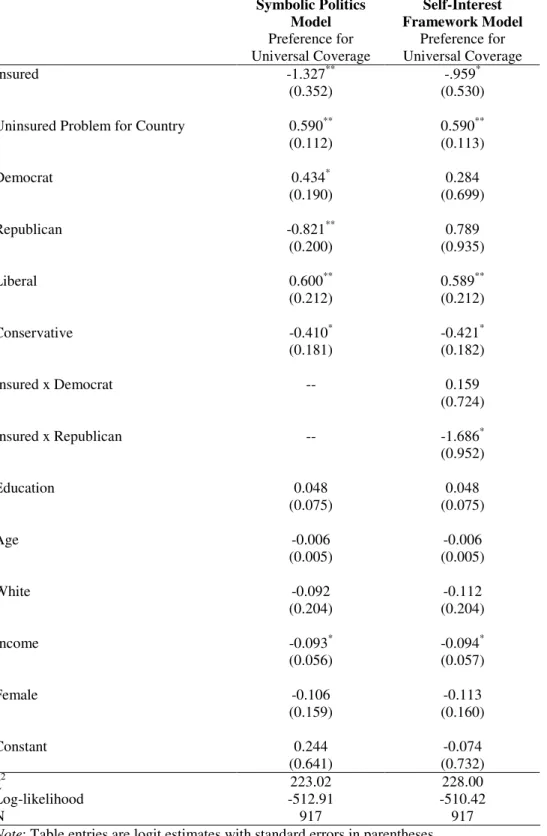
the results of the self-interest framework model in the right hand column of Table 1.
Also included in the left column of Table 1, for comparison purposes, are the estimates
predicted using a traditional symbolic politics model. The symbolic politics model
behaves as expected with significant and positive coefficients on the Democrat and
liberal terms and negative and significant coefficients on the Republican and conservative
terms. Joint Wald hypothesis tests confirm that Democrats and Republicans are
significantly different from one another, as are liberals and conservatives13. Of note is
the highly significant and negative sign on the insured term meaning that insured
individuals are significantly less likely to prefer a system of universal health insurance
even after controlling for symbolic beliefs and sociotropic perceptions. Most models in
the symbolic politics literature find that self-interest variables contribute very little
compared to models including only symbolic belief variables (Lau 2007).
The significant effect of self-interest in the symbolic politics model is likely due
to the characteristics of the dependent variable. First, it provides a tangible policy
outcome for the uninsured. Second, it provides a clear contrast to the current system
which is not meeting the needs of the uninsured and is therefore likely to activate
13
The relevant Wald test statistics are: Democrats=Republicans (χ21df = 37.35, p<.01)and
18
interest. The self-interest framework specifies that these types of characteristics, which
exemplify the idea of tangible policy consequences, are necessary to activate self-interest.
These features are often lacking in the dependent variable of traditional models of
symbolic politics.
The self-interest framework model provides a further improvement in explaining
preferences for a system of universal health insurance14 and provides support for the
expectations derived from the self-interest framework. The first expectation of the
framework is that self-interest will have an effect on policy preferences when the policy
has tangible consequences. To assess the overall effects of self-interest among
individuals with a party affiliation, it is necessary to assess the coefficient on the insured
variable together with the coefficients on the relevant interaction terms. I use a joint Wald
test to evaluate the null hypothesis that self-interest has no effect (βinsured + βinsured x Democrat +
βinsured x Republican = 0). The test allows me to reject this hypothesis at P<.05.
14
19
Table 1: Symbolic Politics and Self-Interest Framework Models of Preference for Universal Coverage Symbolic Politics Model Self-Interest Framework Model Preference for Universal Coverage Preference for Universal Coverage
Insured -1.327** -.959*
(0.352) (0.530)
Uninsured Problem for Country 0.590** 0.590**
(0.112) (0.113)
Democrat 0.434* 0.284
(0.190) (0.699)
Republican -0.821** 0.789
(0.200) (0.935)
Liberal 0.600** 0.589**
(0.212) (0.212)
Conservative -0.410* -0.421*
(0.181) (0.182)
Insured x Democrat -- 0.159
(0.724)
Insured x Republican -- -1.686*
(0.952)
Education 0.048 0.048
(0.075) (0.075)
Age -0.006 -0.006
(0.005) (0.005)
White -0.092 -0.112
(0.204) (0.204)
Income -0.093* -0.094*
(0.056) (0.057)
Female -0.106 -0.113
(0.159) (0.160)
Constant 0.244 -0.074
(0.641) (0.732)
χ2 223.02 228.00
Log-likelihood -512.91 -510.42
N 917 917
Note: Table entries are logit estimates with standard errors in parentheses.
*p
20
The coefficients show a significant, negative relationship of being insured to
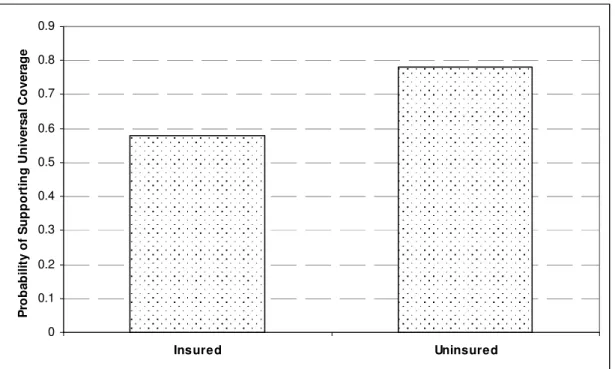
preferring a system of universal health insurance over the current system. Figure 2
demonstrates the effects of insurance status on preferences for universal coverage in the
Self-interest Framework. The predicted probability of supporting universal coverage for
insured individuals is .58 (95% CI: .49-.66) and .79 (95% CI: 0.60-0.95) for uninsured
individuals15. This represents a 21 percentage point decrease in support as individuals
move from being uninsured to having insurance. These results provide support for the
self-interest framework’s expectation that self-interest will have an effect on policy
attitudes when the policy has tangible consequences.
Figure 2: Predicted Probability of Support for Universal Coverage Given Insurance Status 0 0.1 0.2 0.3 0.4 0.5 0.6 0.7 0.8 0.9 Insured Uninsured P ro b a b il it y o f S u p p o rt in g U n iv e rs a l C o v e ra g e
Of central interest in evaluating the self-interest framework is whether or not the
effects of symbolic beliefs are moderated by interest. The expectation of the
15
21
interest framework, as depicted in Figure 1, is that Democrats will have similar
preferences for universal coverage regardless of insurance status, while insured
Republicans should express less support for universal coverage compared to uninsured
Republicans and all Democrats. These expectations are borne out in the non-significant
coefficient on the interaction term for insurance status and Democrats as well as the
negative and significant coefficient on the insurance status and Republican term.
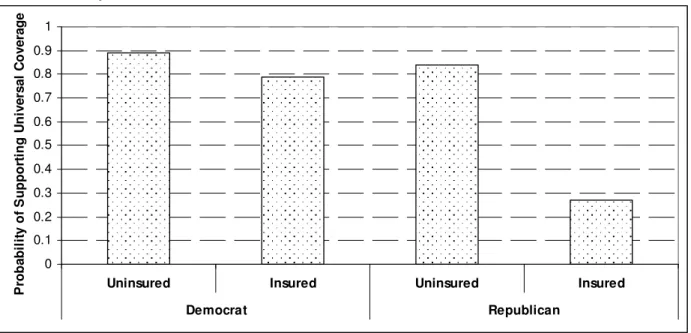
Again, to help with interpretation, the predicted probabilities for the interaction
are presented in Figure 3. There are two important features to notice. First, there are no
significant differences in preferences by party for self-interested individuals with a
tangible stake in the policy outcome. The probability of preferring universal coverage to
the current system for uninsured Democrats is .89 (95% CI: .797-.992) and .84 (95% CI:
.625-1.00) for uninsured Republicans16. Second, insured Republicans, whose probability
of supporting universal coverage is .27 (95% CI: .197-.337), are significantly different
from uninsured Republicans and all Democrats. These results provide initial support for
the idea that self-interest serves to motivate individuals to carefully process information
in the political environment such as party messages and potentially discount these
messages when they conflict with self-interest.
16
22
Figure 3: Predicted Probability of Support for Universal Coverage Given Insurance Status & Party Affiliation
0 0.1 0.2 0.3 0.4 0.5 0.6 0.7 0.8 0.9 1
Uninsured Insured Uninsured Insured
Democrat Republican P ro b a b il it y o f S u p p o rt in g U n iv e rs a l C o v e ra g e
Although the data could not support the inclusion of an interaction between
insurance status and sociotropic perceptions, it is still important to consider the
consequences of including a main effect of sociotropic perceptions in models of
self-interest and symbolic beliefs. As seen in Table 1, there is a significant and positive
relationship between perceptions of the number of uninsured as a problem and
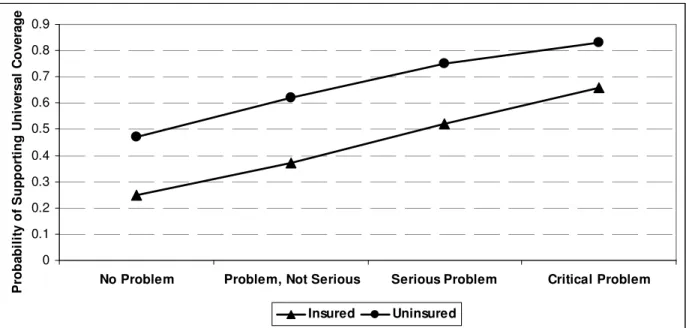
preferences for universal health insurance. Holding all other variables at their mean or
modal value, moving from a perception that the number of uninsured is not a problem at
all to the perception that it is a critical problem increases the probability of supporting
universal coverage from .46-.83 for the uninsured and from .25-.66 for the insured.
Because the interaction term could not be included in the model, Figure 4 shows the
additive effect of being uninsured. The uninsured tend to be about 20 percentage points
23
Figure 4: Predicted Probability of Support for Universal Coverage Given Insurance Status & Sociotropic Perceptions
0 0.1 0.2 0.3 0.4 0.5 0.6 0.7 0.8 0.9
No Problem Problem, Not Serious Serious Problem Critical Problem
Discussion
The results presented in the case of universal health insurance provide support for
the self-interest framework. The framework generates three predictions. First, the effects
of self-interest will be significant whenever the policy outcomes and consequences are
clear. The results support the hypothesis. The provision of universal health insurance
provides a tangible benefit to those individuals without health insurance. Individuals
currently lacking health insurance, those with a tangible interest in the policy, were
significantly more likely to support the policy. This effect persisted even when symbolic
beliefs, such as party affiliation and ideology, and sociotropic perceptions of the
uninsured problem were controlled for in the model. The significant effect of
self-interest found in this analysis differs from the results found in much of the symbolic
politics literature. According to the self-interest framework, this discrepancy is explained
by differences in the dependent variable. In the present study, the dependent variable
provides a policy choice between the status quo and a new system of health care in which
all individuals have some form of health insurance. This policy choice poses tangible
benefits for the uninsured. The dependent variable in the symbolic politics literature
rarely has the same characteristics. Under those conditions, when tangible policy effects
are not clear to respondents, the self-interest framework would not predict significant
25
Second, the self-interest framework predicts that self-interest will moderate the
effects of sociotropic perceptions and symbolic beliefs. The results presented in the case
of universal health insurance preferences demonstrate significant differences between
individuals without an interest in the policy based on party affiliation, and no such
differences between those individuals with an interest in the policy. As expected, the
uninsured were equally as likely to support universal coverage regardless of party
affiliation. The self-interest framework posits that the uninsured are motivated to
centrally process information in the political environment. The data presented above
provide evidence for the idea that Republicans without insurance were motivated to
overcome the party message to support a system of universal health insurance over the
current system. Furthermore, the insured, those without a tangible interest in the policy,
showed significant differences in support for universal coverage by party affiliation. This
suggests that party messages were processed peripherally as cues rather than elaborated
upon centrally as arguments. Although correlational in nature, these results provide
support for the self-interest framework’s prediction that self-interest motivates
individuals to centrally process symbolic political information, while those without an
interest are likely to accept the symbolic political information as a peripheral cue.
Finally, public policy attitudes formed by self-interested individuals should
demonstrate the attributes of all attitudes formed using central route processing such as
persistence and certainty. The data utilized for testing the first two hypotheses are not
capable of evaluating this expectation of the framework. Future experimental work will
be needed to evaluate the characteristics of attitudes resulting from both individuals
26
survey data employed in this study were unable to accommodate testing the expectation
that self-interest should moderate the effects of sociotropic perceptions. Testing this
expectation using survey data can potentially occur for policy areas where there is more
variation among the self-interested on sociotropic conditions or through experimental
Conclusion
The interest framework provides a new way of conceiving the role of
self-interest in politics. Self-self-interest serves to motivate individuals to carefully process the
information they receive from the political environment to form policy attitudes rather
than simply relying on symbolic cues or perceptions of the national situation. The
framework provides insights into understanding the determinants of public policy
attitudes. In the aggregate, these attitudes function as inputs in the public policy process
and serve as predictors of policy outcomes (Erikson et al. 2002).
Additionally, the self-interest framework may have implications for political
behavior. The attitudes formed by self-interested individuals are predicted to be strong
and therefore more predictive of behavior. Scholars have begun to explore the idea that
self-interest may have more of a political impact in terms of behavior than attitudes
(William and Ratner 1998; and Green and Cowden 1992). The self-interest framework
would provide a theoretical rationale for these predictions. Testing the behavioral impact
of the framework would provide an even greater understanding of the subtle, but
28
Appendix A: Question Wordings
* Kaiser Family Foundation and USA Today. ABC News/Kaiser/USA Today Poll # 2006-1021: Health Care Costs and Issues [computer file]. 1st Roper Center for Public Opinion Research version. Storrs, CT: The Roper Center, University of Connecticut [distributor], 2006.
Dependent Variable
Which would you prefer – (the current health insurance system in the United States, in which most people get their health insurance from private employers, but some people have no insurance) or (a universal health insurance program, in which everyone is covered under a program like Medicare that’s run by the government and financed by taxpayers)?
Self-Interest
Do you have some form of health insurance or health care coverage, or not?
Symbolic Beliefs
Generally speaking, do you usually think of yourself as: (A Democrat, A Republican, An Independent, Or What)?
Would you say your views on most political matters are liberal, moderate, or conservative?
Sociotropic Perceptions
29
Works Cited
Bartels L. 2002. Beyond the Running Tally: Partisan Bias in Political Perceptions.
Political Behavior 24: 117-50.
Blendon R, M Brodie, J Benson, D Altman, T Buhr. 2006. Americans’ Views of Health Care Costs, Access, and Quality. The Milbank Quarterly 84: 623-657.
Cacioppo J, R Petty. 1982. The Need for Cognition. Journal of Personality and Social Psychology 42: 116-31.
Cacioppo J, R Petty, J Feinstein, B Jarvis. (1996). Individual Differences in Cognitive Motivation: The Life and Times of People Varying in Need for Cognition. Psychological Bulletin 119: 197-253.
Campbell A, P Converse, W Miller, D Stokes. 1960. The American Voter. Chicago: The University of Chicago Press.
Chong D, J Citrin, P Conley. 2001. When Self-Interest Matters. Political Psychology
22: 541-570.
Dixon R, R Lowery, D Levy, K Ferraro. 1991. Self-Interest and Public Opinion Toward Smoking Policies. Public Opinion Quarterly 55: 241-254.
Druckman J. 2004. Political Preference Formation: Competition, Deliberation, and the (Ir)relevance of Framing Effects. American Political Science Review 98: 671-686.
Erikson E, M MacKuen, J Stimson. 2002. The Macro Polity. New York: Cambridge University Press.
Feldman S. 1982. Economic Self-Interest and Political Behavior. American Journal of Political Science 26: 446-466.
Festinger L. 1950. Informal Social Communication. Psychological Review 57: 271-82.
Festinger L. 1954. A Theory of Social Comparison Processes. Human Relations 7: 117-40.
Funk C. 2000. The Dual Influences of Self-Interest and Societal Interest in Public Opinion. Political Research Quarterly 53: 37-62.
30
Fiorino M. 1981. Retrospective Voting in American National Elections. New Haven: Yale University Press.
Green D, J Cowden. 1992. Who Protests: Self-interest and Public Opinion toward Smoking Restrictions and Cigarette Taxes. Public Opinion Quarterly 53: 1-16.
Kelly N. 2005. Political Choice, Public Policy, and Distributional Outcomes. American Journal of Political Science 49: 865-880.
Kinder D. 1981. Presidents, Prosperity, and Public Opinion. Public Opinion Quarterly
45: 1-21.
Kinder D and D Kiewiet. 1981. Sociotropic Politics: The American Case. The British Journal of Political Science 11: 129-161.
Kinder D, D Sears. 1981. Prejudice and Politics: Symbolic Racism versus Racial Threats to the Good Life. Journal of Personality and Social Psychology 40: 414-431.
Koch J. 1998. Political Rhetoric and Political Persuasion. Public Opinion Quarterly 62: 209-229.
Lewis-Beck M. 1988. Economics and Elections: The Major Western Democracies. Ann Arbor: University of Michigan Press.
Lau R. 2007 Self-Interest, Symbolic Attitudes, and Support for Public Policy: A New Look. Paper presented to the International Society of Political Psychology Annual Meeting. July 4 – 7 in Portland, OR.
Lau R, T Brown, D Sears. 1978. Self-Interest and Civilians' Attitudes Toward the Vietnam War. Public Opinion Quarterly: 42. 464-483.
Lodge, M. and C. Taber. 2000. Three Steps Toward a Theory of Motivated
Reasoning. In A. Lupia, M. McCubbins, and S. Popkin [Eds.] Elements of Political Reason: Understanding and Expanding the Limits of Rationality. Cambridge: Cambridge University
Press.
MacKuen M, R Erikson, J Stimson. 1992. Peasants or Bankers? The American
Electorate and the U.S. Economy. The American Political Science Review 86: 597-611.
Miller D, R Ratner. 1998. The Disparity between the Actual and Assumed Power of Self-interest. Journal of Personality and Social Psychology 74: 53-62.
Mutz D, J Mondak. 1997. Dimensions of Sociotropic Behavior: Group-Based
31
Oberlander J. 2003. The Politics of Health Reform: Why Do Bad Things Happen to Good Plans? Health Affairs W3: 391-404.
Page B, R Shapiro. 1992. The Rational Public: Fifty Years of Trends in Americans’ Policy Preferences. Chicago: University of Chicago Press.
Petty R, J Cacioppo, J. 1979. Issue Involvement Can Increase or Decrease Persuasion by Enhancing Message-relevant Cognitive Responses. Journal of Personality and Social Psychology 37: 1915-26.
Petty R, J Cacioppo. 1981. Attitudes and Persuasion: Classic and Contemporary Approaches. Iowa: William C Brown Press.
Petty R, J Cacioppo. 1986. The Elaboration Likelihood Model of Persuasion. In L. Berkowitz (Ed.), Advances in Experimental Social Psychology (Vol. 19, pp. 123-205). New York: Academic Press.
Petty R, C Haugtvedt S Smith. 1995. Elaboration as a Determinant of Attitude Strength: Creating Attitudes that are Persistent, Resistant, and Predictive of Behavior. In R Petty and J Krosnick (eds) Attitude Strength: Antecedents and Consequences. NJ: Lawrence Erlbaum Press.
Popkin S, J Gorman, C Phillips, J Smith. 1976. What Have You Done for Me Lately? Toward an Investment Theory of Voting. The American Political Science Review 70: 779-805.
Sears D, J Citrin. 1985. Tax Revolt: Something for Nothing in California. Cambridge: Harvard University Press.
Sears D, R Lau. 1983. Inducing Apparently Self-Interested Political Preferences.
American Journal of Political Science 27: 223-252.
Sears D, R Lau, T Tyler, H Allen. 1980. Self-Interest vs. Symbolic Politics in Policy Attitudes and Presidential Voting. The American Political Science Review: 74, 670-684.
Sniderman P, P Tetlock. 1986. Symbolic Racism: Problems of Motive Attribution in Political Analysis. Journal of Social Issues 42: 129-50.
Staats C, A Staats. 1957. Meaning Established by Classical Conditioning. Journal of Experimental Psychology 54: 74-80.
Stimson J. 1999. Public Opinion in America, 2nd ed. Colorado: Westview Press.
Wleizen C. 1995. The Public as Thermostat: Dynamics of Preferences for Spending.
32
Wolpert R, J Gimpel. 1998. Self-Interest, Symbolic Politics, and Public Attitudes toward Gun Control. Political Behavior 20: 241-262.