SPATIOTEMPORAL GEOSTATISTICAL METHODS FOR EXPOSURE AND EPIDEMIOLOGICAL ANALYSES OF GROUNDWATER NITRATE AND RADON
Kyle Philip Messier
A dissertation submitted to the faculty of the University of North Carolina at Chapel Hill in partial fulfillment of the requirements for the degree of Doctor of Philosophy in the Department
of Environmental Sciences and Engineering of the Gillings School of Global Public Health.
Chapel Hill 2015
Approved by: Marc L. Serre Rebecca C. Fry
Jacqueline A. MacDonald Gibson Lawrence E. Band
iii
ABSTRACT
Kyle P Messier: Spatiotemporal Geostatistical Methods for Exposure and Epidemiological Analyses of Groundwater Nitrate and Radon
(Under the Direction of Marc L. Serre)
Exposure assessment and dose-response characterization are critical steps in the risk assessment of an environmental contaminant with potential human health effects. There are many established methods to conduct exposure assessments and to characterize the dose-response relationship between a contaminant of concern and a health outcome; however, many require extensive time and monetary resources that are becoming increasingly limited.
Geostatistical methods are attractive approaches due to their cost-effective implementation and clear physical interpretations. Land use regression (LUR) is a type of geostatistical method that uses spatially-based explanatory variables to model outcomes using classical regression methods. Bayesian Maximum Entropy (BME) is a geostatistical framework for incorporating
measurements as well as various knowledge bases in a logical and theoretically sound manner to produce estimates for variables of interest at unmonitored locations. This work advances these spatiotemporal geostatistical methods in the following three studies: 1) An exposure assessment of groundwater nitrate (𝑁𝑂3−), a biological nutrient with natural and anthropogenic sources that in excess has deleterious effects on human and ecological health; 2) An exposure assessment of groundwater radon (222𝑅𝑛), a naturally occurring gas with radioactively discharged alpha particles that are known human carcinogens; and 3) An epidemiological analysis of the association between groundwater 222𝑅𝑛exposure and lung and stomach cancer incidence.
First, we develop a nonlinear LUR model and then integrate the model into the BME framework to produce the first space/time exposure estimates of groundwater 𝑁𝑂3−
uranium-iv
based explanatory variables resulting in a cross-validation 𝑟2of 0.46. Lastly, we utilize the LUR-BME exposure model for 222𝑅𝑛to investigate associations with lung and stomach cancer at multiple spatial scales. It is the first epidemiological analysis of the association between groundwater 222𝑅𝑛 exposure and lung cancer, moreover with a significant and positive
v
For my late mother
Janice Irwin Messier
vi
ACKNOWLEDGEMENTS
I would first like to thank my advisor, Dr. Marc L. Serre, for bringing me into his lab and providing excellent mentorship through both a Master’s and PhD. We had many a fruitful discussions ranging from technical statistics to abstract philosophy and international soccer matches. I am grateful to call Marc a mentor, a colleague, and a friend.
I would also like to thank my committee members, Dr. Rebecca C. Fry, for valuable research advice and for providing PhD funding for two years; Dr. Jacqueline A. MacDonald Gibson, for valuable input and research advice; Dr. Lawrence E. Band, for research advice and his excellent course covering the excitable research area of nitrogen; and Dr. Gregory W. Characklis, for reviewing and editing many papers and abstracts. I would also like to thank Dr. Leena Nylander-French for providing funding for two years during my PhD.
I would like to thank my friends in the department for making my time as a graduate student not only a valuable time professionally, but also socially. It was great to have many friends in the window-less, tornado bunker better known as the Rosenau basement. And of course I cannot forget our amazingly mediocre intramural basketball team. I still feel sorry for the referees.
vii
TABLE OF CONTENTS
LIST OF TABLES ... xi
LIST OF FIGURES ... xiii
INTRODUCTION ... 1
NITRATE BACKGROUND ... 1
RADON BACKGROUND ... 2
LAND USE REGRESSION ... 4
BAYESIAN MAXIMUM ENTROPY ... 5
PROJECT THEMES ... 8
DISSERTATION ORGANIZATION ... 8
REFERENCES ... 10
CHAPTER 1 ... 13
ABSTRACT ... 14
INTRODUCTION ... 15
METHODS ... 17
Nitrate Data ... 17
Spatial and Temporal Observation Scales ... 18
Maximum Likelihood Estimation of Nitrate Distributions ... 18
Spatial Explanatory Variables ... 19
Nonlinear Regression Model Selection ... 19
BME Estimation Framework for Space/Time Mapping Analysis... 21
viii
RESULTS ... 23
Nitrate Concentrations ... 23
Spatially-smoothed/Time-averaged Nitrate ... 23
Time-averaged Nitrate ... 25
Point-Level Nitrate ... 26
DISCUSSION ... 29
Groundwater Nitrate Maps ... 29
LUR Variable Interpretations ... 30
Recommendations and Limitations ... 32
ACKNOWLEDGEMENTS ... 34
ASSOCIATED CONTENT ... 34
REFERENCES ... 35
SUPPORTING INFORMATION FOR CHAPTER 1 ... 39
Spatial Explanatory Variables ... 40
Model Coefficient Interpretations ... 43
Tables... 46
Figures ... 53
Movies ... 60
REFERENCES ... 61
CHAPTER 2 ... 62
ABSTRACT ... 63
INTRODUCTION ... 64
METHODS ... 66
Radon Data Sources... 66
ix
Land Use Regression and Model Selection ... 70
BME Estimation Framework for Space/Time Mapping Analysis... 71
Validation Statistics ... 73
Kruskal-Wallis Hypothesis Tests for LUR model results ... 73
RESULTS ... 74
Land Use Regression ... 74
Spatial Covariance Analysis ... 75
Land Use Regression – Bayesian Maximum Entropy ... 76
Kruskal-Wallis ANOVA ... 78
DISCUSSION ... 78
Groundwater Radon Maps ... 78
LUR Model Interpretations ... 79
Hypothesized Controls of Radon Anomalies ... 80
Recommendations and Limitations ... 80
CONCLUSIONS ... 81
REFERENCES ... 82
SUPPORTING INFORMATION FOR CHAPTER 2 ... 86
Maps of Hibbard Geology Data by Geological Scale ... 87
Land Use Regression (LUR) Maps ... 91
Bayesian Maximum Entropy (BME) covariance by physiographic region ... 92
BME rose diagrams ... 94
LUR-BME covariance by physiographic region ... 96
LUR-BME rose diagrams ... 99
CHAPTER 3 ... 100
x
INTRODUCTION ... 103
METHODS ... 104
Study Population... 104
Exposure Data... 105
Statistical Analyses at Multiple Spatial Scales ... 106
RESULTS ... 108
Lung Cancer ... 108
Stomach Cancer ... 110
DISCUSSION ... 112
REFERENCES ... 116
SUPPORTING INFORMATION FOR CHAPTER 3 ... 120
Confounding independent variables ... 121
Logistic Regression Model ... 122
Model Coefficient Interpretations ... 122
Figures ... 126
Tables... 129
REFERENCES ... 135
APPENDIX: CONCLUSIONS, PUBLIC HEALTH RELEVANCE, AND FUTURE RESEARCH ... 136
PUBLIC HEALTH RELEVANCE ... 139
xi
LIST OF TABLES
Table 1.1. Leave-one-out cross-validation statistics comparing nitrate models. ...24
Table 1.2. Nonlinear regression model variables selected via CFN-RHO and parameter estimates for time-averaged nitrate monitoring and private well models. ...25
Table S1.1. Groundwater Nitrate Data Source Basic Information. ...46
Table S1.2. Spatial explanatory variable model categories. ...46
Table S1.3. Nonlinear regression model variables selected via CFN-RHO ...47
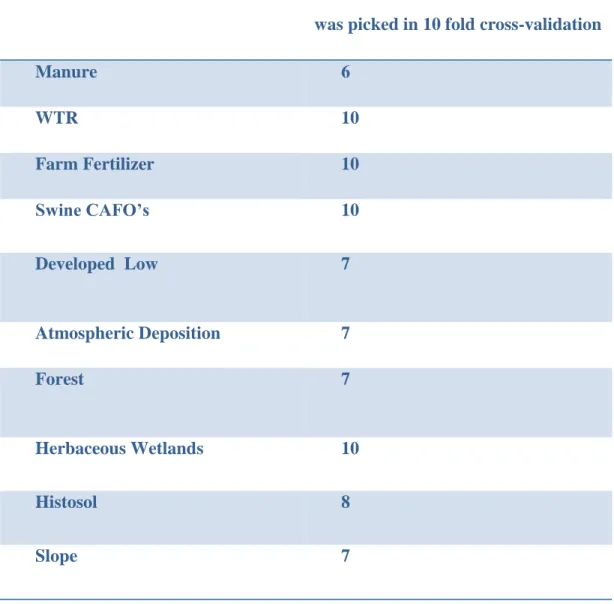
Table S1.4. The number of times each variable in the full spatially-smoothed/time-averaged LUR model for monitoring wells was selected in the ten-fold cross-validation runs. ...48
Table S1.5. The number of times each variable in the full spatially-smoothed/time-averaged LUR model for private wells was selected in the ten-fold cross-validation runs. ...49
Table S1.6. The number of times each variable in the full time-averaged LUR model for monitoring wells was selected in the ten-fold cross-validation runs. ...50
Table S1.7. The number of times each variable in the full time-averaged LUR model for private wells was selected in the ten-fold cross-validation runs. ...50
Table S1.8. Comparison of area within study area predicted by monitoring and private well LUR-BME model concentrations above a threshold ...51
Table S1.9. Comparison of area within study area predicted by Nolan and Hitt 2006 GWAVA monitoring and drinking-water model concentrations above a threshold ...52
Table 2.1. Land Use Regression model selected through A Distance Decay Regression Selection Strategy. ...74
Table 2.2. Leave-One-Out Cross-Validation statistics for the radon LUR, BME, and LUR-BME methods...76
xii
Table 3.2. Lung Cancer Negative Binomial regression results for
groundwater radon concentration for multiple models. ...109 Table 3.3. Lung cancer logistic GLM results representing the odds
a case is within the lung cancer cluster. ...110 Table 3.4. Stomach cancer logistic GLM and GEE results representing
the odds that a stomach cancer case falls within a local
stomach cancer cluster. ...111 Table S3.1. Lung cancer negative binomial regression models for
groundwater radon and all confounding variables.. ...129 Table S3.2. Lung cancer logistic GLM results representing the odds a
case is within the lung cancer cluster ...131 Table S3.3. Stomach cancer negative binomial regression models for
groundwater radon and all confounding variables ...132 Table S3.4. Stomach cancer logistic GLM and GEE results representing
the odds that a stomach cancer case falls within a local
xiii
LIST OF FIGURES
Figure 0.1. The nitrogen cycle. ...2
Figure 0.2. Uranium-238 decay series with Radon...3
Figure 0.3. An illustration of BME methodology. ...7
Figure 1.1. Comparison of LUR-BME results between the monitoring well model and private well model nitrate concentrations. ...28
Figure 1.2. Elasticity curves for monitoring well sources. ...32
Figure S1.1. North Carolina study area with private well and monitoring well nitrate databases ...53
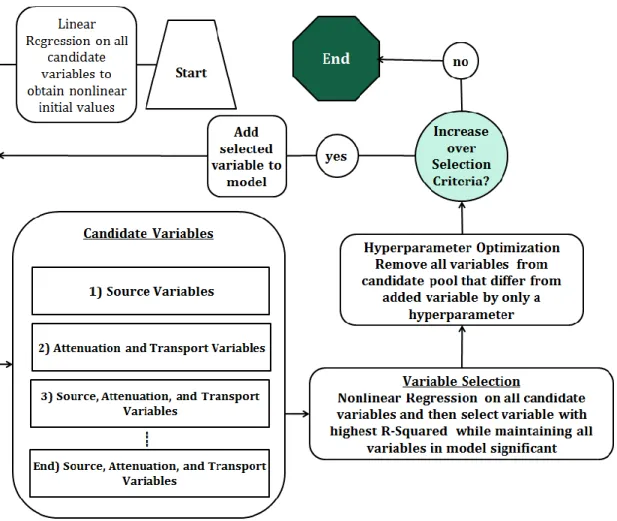
Figure S1.2. Flow diagram of the constrained forward nonlinear and hyperparameter optimization model selection procedure. ...54
Figure S1.3. Histogram of monitoring well data only observed above the detection limit ...55
Figure S1.4. Land Use Regression results from the Constrained Forward Nonlinear Regression and Hyperparameter Optimization procedure for the monitoring and private well models. ...56
Figure S1.5. Monitoring well nitrate LUR residual experimental and modeled spatial and temporal covariance.. ...57
Figure S1.6. Private well nitrate LUR residual experimental and modeled covariance. ...57
Figure S1.7. Level III Ecoregions in North Carolina defined by the US Environmental Protection Agency. ...58
Figure S1.8. Observed monitoring well nitrate from this study overlaid with the GWAVA-SW model results. ...59
Figure S1.9. Observed private well nitrate from this study overlaid with the GWAVA-DW model results. ...60
Figure 2.1. Radon data source spatial distribution detailed by its source. ...67
Figure 2.2. Visualization of elliptical geology based variables. ...70
Figure 2.3. LUR-BME radon predicted median and variance across North Carolina. ...77
xiv
Figure S2.2. Hibbard 2006 Lithotectonic elements geological descriptions. ...88
Figure S2.3A. Hibbard 2006 Units geological descriptions. ...89
Figure S2.10. Radon LUR residual experimental anisotropic covariance for the Blue Ridge physiographic region.. ...96
Figure S2.13. A rose diagram for radon LUR residual within the Blue Ridge physiographic region. ...99
Figure S3.1. USEPA Indoor Air Radon risk zones by county ...126
Figure S3.2. Pearson residual covariance plots ...127
1
INTRODUCTION
In order to protect the public from harmful contaminants in the environment, public health scientists conduct risk assessments, which have four basic steps: 1) risk identification, 2) exposure assessment, 3) dose-response characterization, and 4) health-risk characterization. There are many established methods to conduct exposure assessments and to characterize the dose-response relationship between a contaminant of concern and a health outcome; however, many require extensive time and monetary resources that are becoming increasingly limited. Developing geostatistical methods that utilize publicly available data to conduct risk assessment steps not only further develop our understanding of the contaminant of concern and protect public health, but also increase the returns on public resources spent on environmental and public health monitoring.
Understanding the risk of groundwater nitrate (𝑁𝑂3−) and radon (222𝑅𝑛) exposure is important because they are potential and known human carcinogens, respectively. The three studies in this work address the need for exposure assessment for groundwater 𝑁𝑂3− and 222𝑅𝑛 and the dose-response characterization for 222𝑅𝑛. The goals of this work are to further develop the spatiotemporal geostatistical methods that can utilize publicly available environmental and human health data, and to apply them to the novel assessment of groundwater 𝑁𝑂3− and 222𝑅𝑛in North Carolina.
Nitrate Background
2
cultivated crops, human and animal waste, combustion of fossil fuels including stationary and mobile sources, and other industrial processes.
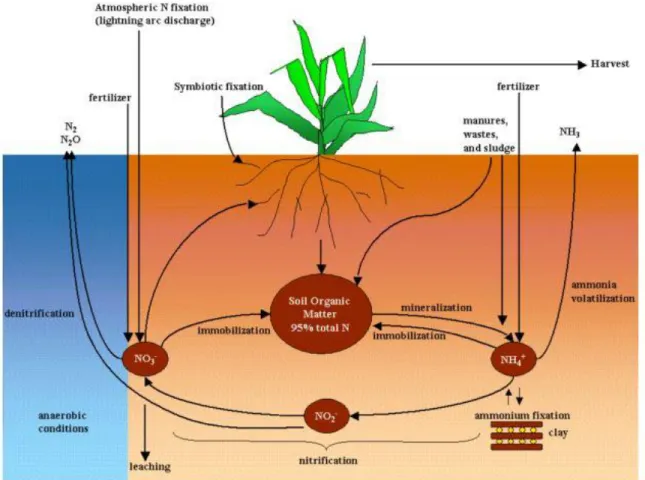
Figure 0.1. The nitrogen cycle. Figure verbatim from the Soil Water and Assessment Tool theoretical documentation, Neitsch et al. 2009 3.
Exposure to 𝑁𝑂3− can cause many deleterious health effects in humans. For instance, infants exposed to NO3- can develop methemoglobinemia, or blue baby syndrome4. This adverse endpoint is the basis of the 10 mg/L maximum contaminant level (MCL) in drinking water5. More recent studies have found associations between 𝑁𝑂3− exposures at levels lower than the current MCL and cancers including colon6, bladder7, and Non-Hodgkin’s Lymphoma8. Ecological effects resulting from excess 𝑁𝑂3− in the environment include eutrophication of waterways, harmful algal blooms, and fish kills among others 9–11.
Radon Background
3
Figure 0.2. Uranium-238 decay series with Radon, the radionuclide of interest, highlighted in blue. The top row of each box is the element symbol and isotope number. The second row is the half-life time. Figure modified from Hall et al., 1985. Alpha decay is the release of 2 protons and two neutrons (a helium atom). Beta decay is the release of an electron and a proton changing to a neutron. y refers to years, d to days, m to minutes, and s to second.
222𝑅𝑛
4
groundwater used for showering, dishwashing, and clothes washing resulting in exposures in direct vicinity to the breathing zone 19,20.
Land Use Regression
Land use regression (LUR) is a common statistical approach used for exposure
assessments, which was introduced in the EU-funded SAVIAH (Small Area Variations in Air quality and Health) project in 199721. Since LUR was introduced, over a hundred studies implemented LUR to assess exposure of air quality22–24 and water quality contaminants25–28. LUR uses spatially based explanatory variables to model outcomes using classical regression methods. Examples of LUR explanatory variables include land use/land cover (LULC), altitude, river networks, road networks, and point source locations to name just a few. The major benefits of LUR include: 1) Simplicity as a regression-based approach; 2) The plethora of explanatory data sources with the increase of geographic information systems (GIS) and satellite databases; and 3) Physical interpretations of explanatory variables.
A LUR follows a standard regression format as follows:
𝑌𝑖 = 𝛽0+ ∑ 𝛽𝑙𝑋𝑖𝑙 𝐿
𝑙=1
+ 𝜀𝑖 (0.1)
where 𝑌𝑖 is the outcome or dependent variable of interest at data point 𝑖, 𝑋𝑖𝑙 is explanatory or independent variable 𝑙 at point 𝑖, 𝛽𝑙 is the regression coefficient for variable 𝑋𝑙, 𝛽0 is the regression equation constant, 𝜀𝑖 is the error term for point 𝑖, and the summation represents the ability to include multiple explanatory variables. The LUR implementation of the regression equation is aided by including a spatial and/or time parameter dependency as follows:
𝑌𝑖(𝒔, 𝑡) = 𝛽0+ ∑ 𝛽𝑙𝑋𝑖𝑙(𝒔, 𝑡) 𝐿
𝑙=1
+ 𝜀𝑖 (0.2)
where 𝑌𝑖(𝒔, 𝑡) is the dependent variable for point 𝑖 at spatial location 𝒔 and temporal location 𝑡, and 𝑋𝑖𝑙(𝒔, 𝑡) is explanatory variable 𝑙 at point 𝑖 at the same spatial location 𝒔 and temporal location 𝑡. Model coefficients are determined with same techniques available for ordinary linear regression such as ordinary least squares (OLS) and generalized least squares (GLS). In
5
or with techniques developed specifically for LUR such A Distance Decay Regression Selection Strategy22.
Bayesian Maximum Entropy
Bayesian Maximum Entropy (BME) is a modern spatiotemporal geostatistical framework for incorporating measurements as well as various knowledge bases in a logical and theoretically sound manner to produce estimates of variables of interest at unmonitored locations29. BME therefore is an extremely valuable tool that can be used to produce information of chemical levels and disease rates through space and time by making efficient use of available monitoring resources. BME consists of three epistemological stages known as the prior, meta-prior, and
posterior stages.
It is important to first define the notation and some basic concepts for discussing these BME stages: The notation for a single random variable Z in capital letter, its realization, z, in lower case; and vectors and matrices in bold faces, e.g. 𝒁 = [𝑍1, … , 𝑍𝑛]𝑇 and 𝒛 = [𝑧1, … , 𝑧𝑛]𝑇. Let 𝜒(𝒑) be the space/time random field (S/TRF) describing the distribution of a variable of interestacross space and time, where 𝒑 = (𝒔, 𝑡), 𝒔 is the space coordinate and 𝑡 is time. The prior stage (Figure I3, Panel A) consists of gathering information or knowledge about the space/time distribution of the variable of interest and compiling it into the general knowledge base,𝐺 − 𝐾𝐵. In the prior stage the 𝐺 − 𝐾𝐵 is mathematically a set of integral equations, which represent constraints on the space/time distribution of 𝝌𝑚𝑎𝑝:
𝐸[ℊ𝛼] = ∫ 𝑓𝜒(𝝌𝑚𝑎𝑝)𝓰𝜶( 𝝌𝑚𝑎𝑝 )𝑑𝝌𝑚𝑎𝑝 (0.3) where 𝛼 = 0,1, … , 𝑁𝑐 is the number of suitable constraint functions, 𝑓𝜒(𝝌𝑚𝑎𝑝) is the probability distribution function (PDF) of 𝝌𝑚𝑎𝑝 = [𝑥1, … , 𝑥𝑚𝑥𝑘]𝑇, ℊ𝛼(𝝌𝑚𝑎𝑝) are known functions of 𝝌, and 𝐸[. ] is the expected value operator. Functions that describe the space/time distribution include the mean trend, covariance, higher-order moments such as the trivariance, regression equations, and stochastically represented mechanistic equations (i.e. physical laws). The prior PDF describing the space/time distribution of 𝝌𝑚𝑎𝑝 is given by:
𝑓𝜒(𝝌𝑚𝑎𝑝) = exp ( 𝜇0+ ∑ 𝜇𝛼ℊ𝛼(𝜒𝑚𝑎𝑝) 𝑁𝑐
𝛼=1
6
where 𝜇𝛼, (𝛼 = 0,1, … , 𝑁𝑐) are Lagrange coefficients that are solved for via the system of
𝑁𝑐+ 1 equations, with the first equation, ∫ 𝑓𝜒(𝝌𝑚𝑎𝑝) 𝑑𝝌𝑚𝑎𝑝 = 1, as the normalization constraint.
In the meta-prior stage one gathers and organizes all of the information that can be explicitly incorporated into BME in the site-specific knowledge base, 𝑆 − 𝐾𝐵. This entails identifying hard data, 𝑆: 𝝌ℎ𝑎𝑟𝑑, or data without measurement error (Figure 0.3, Panel B); soft data, 𝑆: 𝝌𝑠𝑜𝑓𝑡 , or data with measurement error that is expressed mathematically as a distribution function. Soft data can be data that has inherent error quantified in its measurements (Figure 0.3, Panel C) or data that is the result of a model prediction with confidence bounds (Figure 0.3, Panel D). An important part of BME is that the soft data can be represented with any distributional form, or is not limited to linear, normal/Gaussian distributions. For example, possible soft data distributions in addition to Gaussian are interval, truncated-Gaussian, or cumulative distribution function. This flexibility in distributions allow for more accurate modeling of environmental contaminants. In practice, the information in the meta-prior stage is often used in the prior stage to empirically derive the functions for the general knowledge base such as the mean trend and covariance.
The posterior stage (Figure 0.3, Panel E) updates the prior PDF, 𝑓𝜒(𝝌𝑚𝑎𝑝) , with site-specific knowledge from the meta-prior stage using Bayesian conditionalization, which is essentially the marginal PDF of 𝑓𝜒(𝝌𝑚𝑎𝑝) with respect to 𝝌𝑠𝑜𝑓𝑡 or 𝝌ℎ𝑎𝑟𝑑, depending on the scenario. Given the scenario of hard data and probabilistic soft data, the BME posterior PDF for a given estimation point 𝑥𝑘 is given by:
𝑓𝑘(𝝌𝒌) = 𝐴−1∫ 𝑓
𝜒(𝒙𝒉𝒂𝒓𝒅, 𝒙𝒔𝒐𝒇𝒕, 𝑥𝑘)𝑓𝜒(𝒙𝒔𝒐𝒇𝒕)𝑑𝝌𝑠𝑜𝑓𝑡
𝐷 (0.5)
where
𝐴 = ∫ 𝑑𝜒𝑘 𝐷
∫ 𝑓𝐺(𝒙𝒔𝒐𝒇𝒕, 𝒙𝒉𝒂𝒓𝒅, 𝑥𝑘)𝑑𝝌𝑠𝑜𝑓𝑡
𝐷 (0.6)
is the normalization constraint, and ∫ (. )𝐷 is the integral over the domain of the soft data.
When the general knowledge base consists of the mean trend and covariance only and the site-specific data contains only hard data or soft data with a Gaussian measurement error, then BME reduces to the Kriging estimator. As BME currently stands in its numerical
7
through the mean trend as opposed to additional ℊ𝛼 functions in the general knowledge base at the prior stage.
8 Project Themes
The goal of this work is to advance the spatiotemporal geostatistical methods that are utilized in exposure assessments and epidemiological studies; and to demonstrate methodological improvements in the modeling of groundwater 𝑁𝑂3− and 222𝑅𝑛in North Carolina.
Methodological themes that are present in this work include: 1) Land Use Regression model development for groundwater contaminants; 2) Implementation of space/time BME estimation for groundwater contaminants; 3) Integration of Land Use Regression models into the Bayesian Maximum Entropy framework; 4) Model selection procedures in large variable space problems; 5) Quantitative comparisons of model results arising from differences in spatial scales of
independent and dependent variables; and 6) Quantitative comparisons between the current state of science in exposure estimates and dose-response characterization and the novel developments from this work.
Accurate and precise exposure assessments are important for both nitrate and radon due to their significant human and ecological health risks. Not only is a detailed mapping of
groundwater nitrate important from a biogeochemical perspective31, but it also poses known and potential human health effects, including cancers6,7, that need quality exposure assessments for further study. Similarly, radon has known and potential human carcinogenetic effects. This dissertation addresses that need by providing a framework for more accurate exposure
assessment, which is shown with two case studies of nitrate and radon. Additionally, it will be shown that the exposure assessments can then be utilized in an epidemiological analysis to help elucidate the association between exposures and a response, which in this case is radon and cancers of the stomach and lung. In short, this work comprises two exposure assessments and one dose-response characterization through an epidemiological analysis.
Dissertation Organization
This dissertation is organized into three chapters, with each chapter formatted as a
9
information pertinent to radon including lithological and uranium data. This manuscript has been submitted to the journal Water. Third, the exposure assessment of groundwater radon is used in the dose-response characterization of groundwater radon to the health outcomes of stomach and lung cancer via an epidemiological analysis at the ecological and the address-level scales. We plan on submitting this manuscript to the journal International Journal of Epidemiology in the near future.
10
REFERENCES
(1) US Environmental Protection Agency. Basic Information About Nitrate in Drinking Water http://water.epa.gov/drink/contaminants/basicinformation/nitrate.cfm (accessed Nov 1, 2012).
(2) Doering, O. C. I.; Galloway, J. N.; Theis, T. L.; Aneja, V.; Boyer, E.; Cassman, K. G.; Cowling, E. B.; Dickerson, R. R.; Herz, W.; Hey, D. L.; et al. Reactive Nitrogen in the United States: An Analysis of Inputs, Flows, Consequences, and Management Options. EPA-SAB-11-013; Washington D.C., 2011.
(3) Neitsch, S. L.; Arnold, J. G.; Kiniry, J. R.; Williams, J. R. Soil & Water Assessment Tool Theoretical Documentation. 2009.
(4) Comly, H. H. Cyanosis in infants caused by nitrates in well water. J. Am. Med. Assoc.
1945, 129, 112–116.
(5) Spalding, R. F.; Exner, M. E. Occurrence of Nitrate in Groundwater—A Review. J. Environ. Qual. 1993, 22, 392–402.
(6) De Roos, A. J.; Ward, M. H.; Lynch, C. F.; Cantor, K. P. Nitrate in Public Water Supplies and the Risk of Colon and Rectum Cancers. Epidemiology 2003, 14, 640–649.
(7) Weyer, P. J.; Cerhan, J. R.; Kross, B. C.; Hallberg, G. R.; Kantamneni, J.; Breuer, G.; Jones, M. P.; Zheng, W.; Lynch, C. F. Municipal Drinking Water Nitrate Level and Cancer Risk in Older Women : The Iowa Women’s Health Study. Epidemiology 2001, 12, 327–338.
(8) Ward, M. H.; Mark, S. D.; Cantor, K. P.; Weisenburger, D. D.; Correa-Villasenor, A.; Zahm, S. H. Drinking Water Nitrate and the Risk of Non-Hodgkin ’ s Lymphoma.
Epidemiology 1996, 7, 465–471.
(9) Paerl, H. W. Coastal eutrophication and harmful algal blooms : Importance of atmospheric deposition and groundwater as “ new ” nitrogen and other nutrient sources. Limnol.
Oceanogr. 1997, 42, 1154–1165.
(10) Zhou, M.; Shen, Z.; Yu, R. Responses of a coastal phytoplankton community to increased nutrient input from the Changjiang (Yangtze) River. Cont. Shelf Res. 2008, 28, 1483– 1489.
(11) Smith, V. H.; Tilman, G. D.; Nekola, J. C. Eutrophication: impacts of excess nutrient inputs on freshwater, marine, and terrestrial ecosystems. Environ. Pollut. 1999, 100, 179– 196.
11
(13) Krewski, D.; Lubin, J. H.; Zielinski, J. M.; Alavanja, M.; Catalan, V. S.; Field, R. W.; Klotz, J. B.; Letourneau, E. G.; Lynch, C. F.; Lyon, J. I.; et al. Residential Radon and Risk of Lung Cancer. Epidemiology 2005, 16, 137–145.
(14) Lubin, J. H.; Boice, J. D. Lung cancer risk from residential radon: meta-analysis of eight epidemiologic studies. J. Natl. Cancer Inst. 1997, 89, 49–57.
(15) Field, R. W.; Smith, B.; Steck, D.; Lynch, C. F. Residential radon exposure and lung cancer: variation in risk estimates using alternative exposure scenarios. J. Expo. Anal. Environ. Epidemiol. 2002, 12, 197–203.
(16) Kendall, G. M.; Smith, T. J. Doses to organs and tissues from radon and its decay products. J. Radiol. Prot. 2002, 22, 389–406.
(17) Campbell, T.; Mort, S.; Fong, F.; Crawford-Brown, D.; Vengosh, A.; Cornell, E.; Field, W. R. North Carolina Radon-in-Water Advisory Committee Report; Raleigh, North Carolina, 2011.
(18) National Research Council. Risk Assessment of Radon in Drinking Water; Washington D.C., 1999.
(19) Vinson, D. S.; Campbell, T. R.; Vengosh, A. Radon transfer from groundwater used in showers to indoor air. Appl. Geochemistry 2008, 23, 2676–2685.
(20) Fitzgerald, B.; Hopke, P. K. Experimental Assessment of the Short- and Long-Term Effects of Rn from Domestic Shower Water on the Dose Burden Incurred in Normally Occupied Homes. 1997, 31, 1822–1829.
(21) Briggs, D. J.; Collins, S.; Elliott, P.; Fischer, P.; Kingham, S.; Lebret, E.; Pryl, K.; Van Reeuwijk, H.; Smallbone, K.; Van Der Veen, A. Mapping urban air pollution using GIS: a regression-based approach. Int. J. Geogr. Inf. Sci. 1997, 11, 699–718.
(22) Su, J. G.; Jerrett, M.; Beckerman, B. A distance-decay variable selection strategy for land use regression modeling of ambient air pollution exposures. Sci. Total Environ. 2009, 407, 3890–3898.
(23) Raaschou-Nielsen, O.; Andersen, Z. J.; Beelen, R.; Samoli, E.; Stafoggia, M.; Weinmayr, G.; Hoffmann, B.; Fischer, P.; Nieuwenhuijsen, M. J.; Brunekreef, B.; et al. Air pollution and lung cancer incidence in 17 European cohorts: prospective analyses from the
European Study of Cohorts for Air Pollution Effects (ESCAPE). Lancet. Oncol. 2013, 14, 813–822.
12
(25) Hoos, A. B.; Mcmahon, G. Spatial analysis of instream nitrogen loads and factors controlling nitrogen delivery to streams in the southeastern United States using spatially referenced regression on watershed attributes ( SPARROW ) and regional classification frameworks. Hydrol. Process. 2009, 23, 2275–2294.
(26) McLay, C. D.; Dragten, R.; Sparling, G.; Selvarajah, N. Predicting groundwater nitrate concentrations in a region of mixed agricultural land use: a comparison of three
approaches. Environ. Pollut. 2001, 115, 191–204.
(27) Aelion, C. M.; Conte, B. C. Susceptibility of residential wells to VOC and nitrate contamination. Environ. Sci. Technol. 2004, 38, 1648–1653.
(28) Messier, K. P.; Akita, Y.; Serre, M. L. Integrating address geocoding, land use regression, and spatiotemporal geostatistical estimation for groundwater tetrachloroethylene. Environ. Sci. Technol. 2012, 46, 2772–2780.
(29) Christakos, G.; Li, X. Bayesian Maximum Entropy Analysis and Mapping : A Farewell to Kriging Estimators ? Math. Geol. 1998, 30, 435–462.
(30) LoBuglio, J. N.; Characklis, G. W.; Serre, M. L. Cost-effective water quality assessment through the integration of monitoring data and modeling results. Water Resour. Res. 2007,
43, 1–16.
(31) Rivett, M. O.; Buss, S. R.; Morgan, P.; Smith, J. W. N.; Bemment, C. D. Nitrate
attenuation in groundwater: a review of biogeochemical controlling processes. Water Res.
13
CHAPTER 1
Nitrate Variability in Groundwater of North Carolina using Monitoring and Private Well Data Models
Kyle P. Messier†, Evan Kane‡, Rick Bolich‡, Marc L. Serre†*
Authors’ Affiliation:
† Department of Environmental Science and Engineering, Gillings School of Global Public
Health, University of North Carolina, Chapel Hill, NC
‡ North Carolina Department of Environment and Natural Resources, Division of Water Resources
*Corresponding Author: Marc L. Serre
Department of Environmental Sciences and Engineering, Gillings School of Global Public Health, University of North Carolina, 1303 Michael Hooker Research Center, Chapel Hill, NC 27599
14 Abstract
15 Introduction
Nitrate (𝑁𝑂3−) is a widespread contaminant of groundwater and surface water across the United States that has deleterious effects to human and ecological health1,2. The maximum contaminant level of 10 mg/L established by the U.S. Environmental Protection Agency was based on the prevention of methemoglobinemia in infants3; moreover, there is concern of many cancer types 4–6 and from lower concentration exposures7. Excessive 𝑁𝑂3−inputs into the
environment can result in adverse changes to ecosystems such as eutrophication and harmful algal blooms8–10.
Protection of drinking water sources is mandated by the Safe Drinking Water Act; however, private well drinking water is unregulated in contrast to regulated public water systems11. In North Carolina where more than ¼ of the population relies on private wells for drinking water12, quantifying potential exposures is important to protect public health. Monitoring programs such as the US Geological Survey’s (USGS) National Water Quality Assessment (NAWQA) Program13 and the NC Division of Water Resources (NC DWR) ambient monitoring program14 are effective because they use consistent sampling and analytical methods, yet this water quality monitoring data is spatially and temporally sparse.
Land use regression15–21(LUR) is a proven method that complements monitoring
programs and provides effective means for water quality exposure assessments. Previous studies have related land use characteristics to 𝑁𝑂3−contamination in surface waters 22–25 and
groundwater. Additionally, regression-based methods have been implemented for estimating loading to surface waters21,23,24. In North Carolina, groundwater discharge to streams (baseflow) accounts for roughly two-thirds of annual streamflow in the Coastal Plains region of North Carolina26 and may be contributing excess nutrient loads in streams27; however, current surface water models do not directly account for this large source of 𝑁𝑂3−from baseflow.
16
regression, methods for model selection based on a large candidate variable space include stepwise logistic regression30,31 and regression tree analysis which approximates nonlinear relationships 32,33; still for continuous variable outcomes with nonlinear models, less rigorous methods for model selection have been developed. The number of candidate variables is generally consolidated to a tractable number through expert knowledge or single variable regression, and then various combinations of models are tested until one finds the best model in terms of a validation statistic like 𝑅2 or Akaike Information Criterion (𝐴𝐼𝐶)15,21,24.
The advanced geostatistical method of Bayesian Maximum Entropy (BME) has also been shown to successfully estimate groundwater quality contaminants19,34. An advantage of BME is its ability to quantify spatial and temporal variability which is then used in the estimation process at unmonitored locations. BME, like all geostatistical methods, is data driven and can only provide reliable estimates within the vicinity of measured values. However, BME utilizes Bayesian epistemic knowledge blending to combine multiple sources of data, which has been successfully demonstrated with incorporation of deterministic mean trend functions into BME for groundwater19.
Local spatial and temporal variability have lead previous studies to reduce
𝑁𝑂3−variability with a combination of spatial smoothing and temporal averaging15,35,36 . For instance, Nolan and Hitt spatially smoothed 𝑁𝑂3−by taking watershed averages over their study time period, based on watersheds with an average size of approximately 2000 square-kilometers. They not only helped elucidate trends and potential explanatory variables, but they were able to explain a large percentage in the variability of spatially-smoothed 𝑁𝑂3−with a 𝑟2of 0.80 for shallow aquifer 𝑁𝑂3−and 0.77 for deep aquifer 𝑁𝑂3−. However, this advantage of reducing groundwater 𝑁𝑂3−variance is also a limitation because factors affecting spatially-smoothed and temporally averaged 𝑁𝑂3−might not affect point-level 𝑁𝑂3−, and vice-versa. Furthermore, since groundwater 𝑁𝑂3−contains significant local variability, the need to provide local estimates of its variability naturally follows. Models developed for predicting spatially-smoothed and temporally averaged 𝑁𝑂3−will likely not be successful in predicting observed, point-level 𝑁𝑂3−.
The objectives of this study are to: 1) Develop a novel nonlinear regression model for spatial point-level and time-averaged groundwater 𝑁𝑂3−concentrations in monitoring and private wells of North Carolina, 2) Produce the first space/time estimates of groundwater 𝑁𝑂3−
17
and 3) Compare space/time 𝑁𝑂3− concentration models to the current standard of spatially averaged 𝑁𝑂3− concentration models Two nonlinear models, whose form is adopted from Nolan and Hitt15 with components that represent 𝑁𝑂3−sources, attenuation, and transport, are created and selected with a new model selection framework for nonlinear regression models with
correlated explanatory variables. We then integrate the LUR models into the BME framework to model space/time point-level 𝑁𝑂3−. Results are of interest to agencies that regulate drinking water sources or that monitor health outcomes from ingestion of drinking water. Additionally, the results can provide guidance on factors affecting the point-level variability of groundwater
𝑁𝑂3−and new resources for more accurate management of 𝑁𝑂
3− loads. Methods
Nitrate Data
𝑁𝑂3−data across North Carolina are obtained from three data sources (Figure S1.1), which are detailed as follows:
North Carolina Division of Water Resources (NC-DWR) collects data near select permitted, dedicated Wastewater Treatment Residual (WTR) application fields via monitoring wells. The second source is USGS data obtained through the National Water Information System (NWIS). Well depth information is not linked directly to each monitoring well, although a subset of well depth information is available. Based on the subset with depth information, they have a mean depth of 33 feet with a standard deviation of 32 feet. Together, the NCDWR and USGS data represent shallow aquifer monitoring wells (n= 12,322), which hereafter will be referred to as “Monitoring Well data.”
The last dataset of groundwater 𝑁𝑂3−comes from private well data collected by the North Carolina Department of Health and Human Services (NC-DHHS). Groundwater 𝑁𝑂3−was obtained and address geocoded using the same process outlined in Messier et al.19. Well depth information is not linked to water quality measurements, but a separate database on private well construction contains well depths. The mean depth is 95 feet with a standard deviation of 109 ft. This data will hereafter be referred to as “Private Well data” and this data is assumed to represent a deeper aquifer model of groundwater 𝑁𝑂3− (n=22,067).
18
percent observed above the detection limit is 79.7, 61.4, and 30.6 respectively. Additional basic statistics for the dataset are available in the supporting information (Table S1.1).
Spatial and Temporal Observation Scales
In this work we develop models for 𝑁𝑂3−at three observation scales. The finer scale corresponds to the space/time point-level𝑁𝑂3−data, i.e. 𝑁𝑂3−data as it is sampled. An
intermediate observation scale corresponds to the time-averaged data, whereby 𝑁𝑂3−at each well is averaged. The time-averaged data provides point-level spatial resolution, but no time
variability. Finally, the coarser resolution observation scale corresponds to the
spatially-smoothed/time-averaged data, which was obtained by spatially smoothing the time-averaged data using a 25 km exponential kernel function. We choose 25 km as it is approximately the average size of watersheds in many NAWQA groundwater studies15,37. While previous works over large study domains have developed models for spatially-smoothed/time average 𝑁𝑂3−data, very few models, if any, have been developed for point-level 𝑁𝑂3−data over large study domains. Our work therefore fills that knowledge gap.
Maximum Likelihood Estimation of Nitrate Distributions
Our notation for variables denotes a single random variable Z in capital letter, its realization, z, in lower case; and vectors and matrices in bold faces, e.g. 𝒁 = [𝑍1, … , 𝑍𝑛]𝑇 and 𝒛 = [𝑧1, … , 𝑧𝑛]𝑇.
Due to the high percentage of nondetect (left-censored) data in both the monitoring well and private well databases, a maximum likelihood estimation (MLE) is used for the estimation of monitoring well and private well distribution parameters38, which is assumed to follow a
lognormal distribution. MLE can directly account for the nondetect values by modifying the likelihood equation, with the censored observations given by the cumulative distribution function (CDF) evaluated at the detection limit. The MLE equation then becomes38:
ℒ(𝒛|𝜇, 𝜎) = { ∏ 𝑓𝜇,𝜎(𝑧𝑖) 𝑧𝑖|𝑧𝑖≥𝑡𝑖
} ∗ { ∏ 𝐹𝜇,𝜎(𝑡𝑖) 𝑧𝑖|𝑧𝑖≤𝑡𝑖
} (1.7)
19
wells and to handle nondetect data. For the regression analysis, the log- 𝑁𝑂3−concentration of a measurement below detection limit 𝑡𝑖 is assigned a value equal to the mean of the normal distribution N(𝜇,𝜎) truncated above log(𝑡𝑖), whereas the geostatistical analysis can handle the full truncated normal distribution19.
Spatial Explanatory Variables
Spatial explanatory variables representing possible groundwater 𝑁𝑂3−sources, attenuation, and transport factors were constructed prior to model development. Potential variables are summarized below with details available in the supporting information (Table S1.2).
All of the explanatory variables have an inherent spatial distance parameter such as circular buffer radius or exponential decay range, which hereinafter is referred to as the
hyperparameter. Each variable is calculated with multiple hyperparameter values since optimal distance is unknown a priori. In the final model selection process, a maximum of one
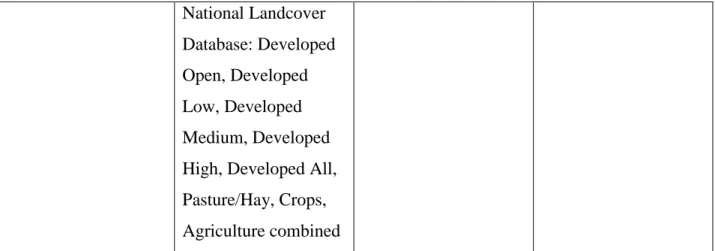
hyperparameter value is allowed to be selected from each variable to avoid multicollinearity and effectively optimize the hyperparameter. The following variables adopted from Nolan and Hitt15 are 𝑁𝑂3−sources calculated as Kg − NO3−/yr/ha within a circular buffer: Sources include farm fertilizer, non-farm fertilizer, manure, and 𝑁𝑂3−atmospheric deposition. Each National
Landcover Database (NLCD) category is calculated as a percent within a circular buffer. On-site wastewater treatment plant variables, septic density and average nitrate loading, are created following the methods of Pradhan et al.39 The following point sources are calculated as the sum of exponentially decaying contribution19: Wastewater treatment residual field application sites (WTR), swine confined animal feeding operations (CAFOs), poultry CAFOs, cattle farms, and wastewater treatment plants (WWTP). Mean slope in degrees and topographic wetness index40 (TWI) are calculated within circular buffers. Water withdrawals in cubic meters per second are calculated using USGS water use estimates12. Lastly, population density is calculated within circular buffers from US Census block data assuming an even distribution of population per census block.
Nonlinear Regression Model Selection
20
(SPARROW) 21,23,24. We partition explanatory variables into source, attenuation, and transport terms. Following Nolan and Hitt15, the nonlinear multivariable model is constructed as follows:
zi = 𝛽0+ {∑ 𝛽𝑘𝑌𝑖(𝑘)(𝜆𝑘) 𝐾
𝑘=1
} exp {∑ −𝛾𝑙𝑌𝑖(𝑙)(𝜆𝑙) 𝐿
𝑙=1
} exp { ∑ 𝛿𝑚𝑌𝑖(𝑚)(𝜆𝑚) 𝑀
𝑚=1
}
+ 𝜀𝑖
(1.8)
where zi is the log–transform of 𝑁𝑂3−concentration at point i, 𝛽0 is the intercept, 𝑌𝑖(𝑘)(𝜆𝑘) is the
k-th source predictor variable at point i with hyperparameter value k, 𝛽𝑘 is its source regression coefficient, 𝑌𝑖(𝑙)(𝜆𝑙) is the l-th attenuation predictor variable at point i with hyperparameter value 𝜆𝑙, 𝛾𝑙is its attenuation regression coefficient, 𝑌𝑖(𝑚)(𝜆𝑚)is the m-th transport predictor variable with hyperparameter value 𝜆𝑚, 𝛿𝑚 is its transport regression coefficient, and i is an error term. The model contains an additive, linear submodel for sources, and multiplicative exponential terms for the attenuation and transport variables that act directly on the source terms 15. For example 𝑌𝑖(𝑘)(𝜆𝑘) may be equal to a land cover variable or a point source variable. The
attenuation variables,𝑌𝑖(𝑙), physically represent areas that are associated with removing 𝑁𝑂3−from groundwater such as wetlands and histosol soil. The transport variables, 𝑌𝑖(𝑚)(𝜆𝑚), may be equal to any variable that effects the movement of 𝑁𝑂3−in the groundwater such as the soil
permeability and average slope. The attenuation variable coefficients,𝛾𝑙, are constrained to be negative allowing them to only decrease 𝑁𝑂3− concentrations, while the transport variable coefficients,𝛿𝑚, are unconstrained allowing variables to increase or decrease
𝑁𝑂3−concentrations.
We developed a nonlinear model regression model selection technique that
accommodates variables that differ only by a hyperparameter and can be adapted for various nonlinear model forms. Our model selection procedure is essentially a nonlinear extension of A Distance Decay REgression Selection Strategy (ADDRESS)16, since to the authors’ knowledge there is not a regression selection strategy for nonlinear LUR. We implement Constrained Forward Nonlinear Regression with Hyperparameter Optimization (CFN-RHO) whose simple algorithm is as follows (Figure S1.2):
21
2) Candidate Variables: In the first iteration, the candidate variables consist of the source variables only. In the second iteration, candidate variables consist of attenuation and transport variables only. This is done so as to obtain an initial model with at least one source and one attenuation or transport variable. In every iteration afterwards the candidate variables can be any variable.
3) Nonlinear Regression: Nonlinear regression is performed by adding each candidate variable to the current model one at a time. Note that candidate variables are added according to their
predetermined place in the nonlinear model (i.e. Source variables are in a linear submodel; Attenuation and transport in the exponential submodel.).
4) Variable Selection: The variable that results in the highest R-Squared (lowest AIC is also an option) while constrained to maintaining all variables in the model statistically significant (p-value < 0.05), is selected and added to the model. R-Squared ties beyond the thousandth decimal place are settled by the lowest p-value.
5) Hyperparameter Optimization: The rest of the candidate variables that differ from the selected variable by only a hyperparameter are removed from the candidate variable pool, effectively optimizing the hyperparameter value.
6) Selection Criteria: The new model must increase R-Squared over user-defined selection criteria such as a one percent increase. If the model passes the selection criteria, then the iterative process continues to step 2. If it does not, then the algorithm ends with the final model being the i-th minus one model since the last variable did not pass the selection criteria.
BME Estimation Framework for Space/Time Mapping Analysis
22
Let 𝑍(𝒑)be the space/time random field (S/TRF) describing the distribution of
groundwater log- 𝑁𝑂3−across space and time, where 𝒑 = (𝒔, 𝑡), 𝒔 is the space coordinate and 𝑡 is time. The knowledge available is organized in the general knowledge base (G-KB) about the space/time trend and variability (e.g. mean, covariance) of 𝑁𝑂3−across the study domain, and the site-specific knowledge base (S-KB) corresponding to the hard and soft data 𝒛𝒅 available at a set of specific space/time points 𝒑𝑑.
First, we define the transformation of log- 𝑁𝑂3−data 𝒛𝒅at locations 𝒑𝒅 as
𝒙𝒉 = 𝒛𝒉− 𝑜𝑍(𝒑𝒉) (1.9)
where 𝑜𝑍(𝒑𝒉) may be any deterministic offset that can be mathematically calculated at any space/time coordinate 𝒑. We then define 𝑋(𝒑) as a homogeneous/stationary S/TRF representing the variability and uncertainty with the transformed data 𝒙𝒅, i.e. such that 𝒙𝒅 is a realization of
𝑋(𝒑). Finally we let 𝑍(𝒑) = 𝑋(𝒑) + 𝑜𝑧(𝒑) be the S/TRF representing groundwater log- 𝑁𝑂3−. In this study, we consider two choices for 𝑜𝑧(𝒑): (1) a constant value determined by the MLE mean resulting in a purely BME model, and (2) the LUR estimate 𝑳𝒛(𝒑𝒉) from CFN-RHO resulting in a LUR-BME model.
The G-KB for the S/TRF 𝑋(𝒑) describes its local space/time trends and dependencies. In this work, the general knowledge consists of the space/time mean trend function 𝑚𝑥(𝒑) = 𝐸[𝑋(𝒑)], and the covariance function 𝐶𝑋(𝒑, 𝒑′)=𝐸[[𝑋(𝒑) − 𝑚𝑥(𝒑)][X(𝐩′) − 𝑚𝒙(𝒑′)]] of the S/TRF 𝑋(𝒑). The S-KB consists of hard data and soft data; with hard data, 𝒙𝒉= 𝒛𝒉− 𝑳𝒛(𝒑𝒉), for data points where 𝒛𝒉 is observed over the detection limit and soft data, 𝑿𝒔, is at locations 𝒑𝒔where 𝑁𝑂3−is observed below the detection limit. Following Messier et al 19, the BME soft data for log- 𝑁𝑂3−is modeled as a Gaussian distribution truncated above the log of the detection limit.
The overall knowledge bases considered consist of 𝐺 = {𝑚𝑥(𝒑), 𝐶𝑋(𝒑, 𝒑′)}, and 𝑆 = {𝑓𝑠(. ), 𝑿𝒉}. In this case the BME set of equations reduces to
𝑓𝐾(𝑥𝑘) = 𝐴−1∫ 𝑑𝒙𝒔𝑓𝐺(𝒙𝒉, 𝒙𝒔, 𝑥𝑘)𝑓𝑆(𝒙𝒔) (1.10 ) where 𝑓𝐾(𝑥𝑘) is the BME posterior PDF for the offset-removed log 𝑁𝑂3−(𝑥𝑘) at some
23
Gaussian PDF of 𝑿𝒔, and 𝐴−1is a normalization constant. After the BME analysis is conducted,
𝑜𝑍(𝒑) is added back to obtain log- 𝑁𝑂3−concentrations. Validation Statistics
The robustness of CFN-RHO is tested with a fold cross-validation procedure. In 10-fold cross-validation data is randomly partitioned into 10 equal size subsamples. A single subsample is retained as the validation data for testing the model, and the remaining 9
subsamples are used as training data. Each of the 10 subsamples is used exactly once as the validation data. Similar variable selections (which may differ only by hyperparameter) for subsamples demonstrate model selection robustness.
Models are compared with a leave one-out cross-validation (LOOCV) mean squared error (MSE) and R-Squared. Spatially-smoothed/time-averaged 𝑁𝑂3− and time-averaged 𝑁𝑂3− models are also tested on how well they predict at the smaller observation scales. In LOOCV, each
𝑁𝑂3−value 𝑍
𝑗 is removed one at a time, and re-estimated using the given model based only on the remaining data. Let 𝑍∗(𝑘)be the re- estimate for method k, then 𝑀𝑆𝐸(𝑘)=𝑛1∑𝑛𝑗=1(𝑍𝑗∗(𝑘)−
𝑍𝑗) 2
and the cross-validation R-Squared is 𝑅2(𝒁, 𝒁∗(𝑘)). Results
Nitrate Concentrations
The MLE of the statewide monitoring concentrations resulted in a geometric mean and standard deviation of the lognormal distribution of 0.62 and 14 mg/L, respectively (Figure S1.3). MLE for private wells resulted in a geometric mean and standard deviation of 0.45 and 5.1 mg/L (Figure S1.3).
Spatially-smoothed/Time-averaged Nitrate
24
10-fold cross-validation of spatially-smoothed/time-averaged 𝑁𝑂3− LUR models was done to demonstrate the stability of CFN-RHO (Table S1.4, S1.5). All variables were selected 7 and 10 out of 10 iterations for the monitoring and private well models, respectively.
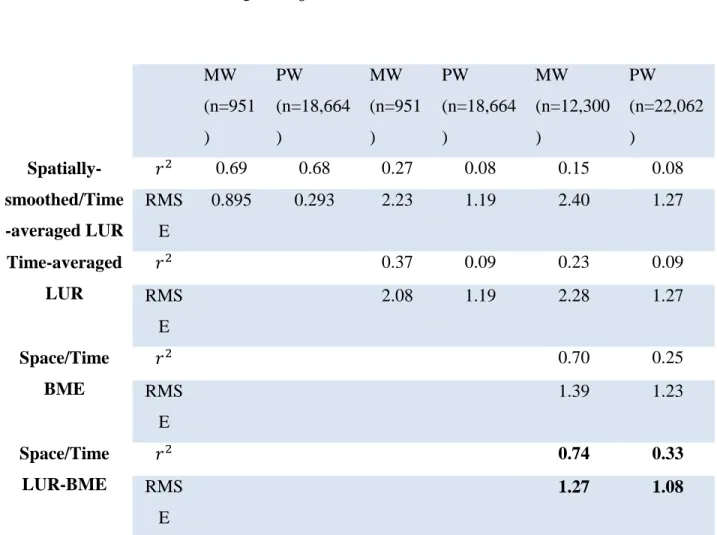
Table 1.1. Leave-one-out cross-validation statistics comparing for four estimation methods that predict spatial/temporally averaged 𝑵𝑶𝟑−concentrations, temporal averaged 𝑵𝑶𝟑−concentrations, and point-level observed 𝑵𝑶𝟑−concentrations. Note that methods were used to predict at scales more refined or equal to its calibration scale. MW = Monitoring Well model. PW= Private Well model. n = number of observations at that scale. Time averaging results in fewer observations. RMSE = Root Mean Squared Error. Units of 𝑵𝑶𝟑− concentration = mg/L.
Predicted Value
Method
Spatially- smoothed/Time-averaged 𝑁𝑂3−
Time-averaged
𝑁𝑂3−
Point-Level 𝑁𝑂3−
MW (n=951 ) PW (n=18,664 ) MW (n=951 ) PW (n=18,664 ) MW (n=12,300 ) PW (n=22,062 ) Spatially-smoothed/Time -averaged LUR
𝑟2 0.69 0.68 0.27 0.08 0.15 0.08
RMS E
0.895 0.293 2.23 1.19 2.40 1.27
Time-averaged LUR
𝑟2 0.37 0.09 0.23 0.09
RMS E
2.08 1.19 2.28 1.27
Space/Time BME
𝑟2 0.70 0.25
RMS E
1.39 1.23
Space/Time LUR-BME
𝑟2 0.74 0.33
RMS E
25 Time-averaged Nitrate
The LUR variables selected through CFN-RHO for time-averaged 𝑁𝑂3−observed at monitoring wells and private wells are shown in Table 1.2. The LUR calibrated to predict time-averaged 𝑁𝑂3−obtains a 𝑟2 of 0.37 and 0.09 for monitoring wells and private wells, respectively (Table 1.1, second row). Moreover, the LUR model predicts point-level 𝑁𝑂3−with a 𝑟2 of 0.23 and 0.09 for monitoring and private well respectively. LUR maps are available in supporting information (Figure S1.4).
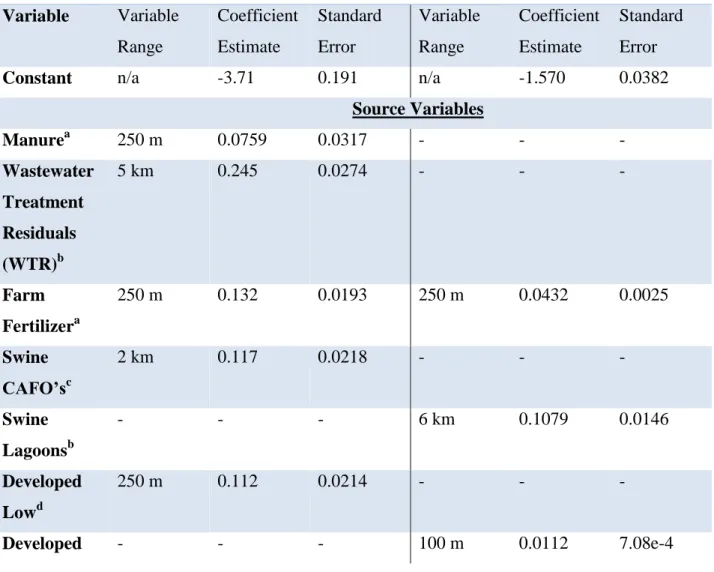
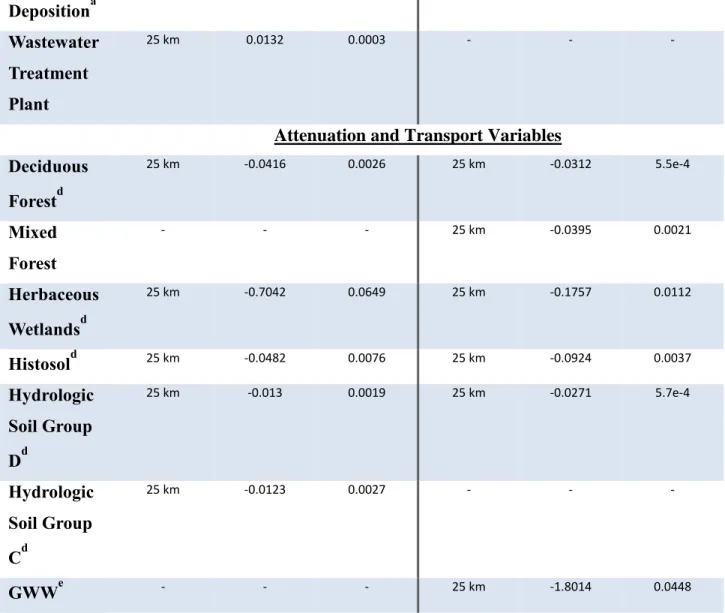
Table 1.2. Nonlinear regression model variables selected via CFN-RHO and parameter estimates for time-averaged 𝑵𝑶𝟑− monitoring (left) and private well (right) models. All variables are significant with p-value < 0.025. Variables units: a- Kg- 𝑵𝑶𝟑−/yr/ha, b- Dimensionless, c- 100 pigs, d- percent, e- degrees (-) Not a variable in the model.
Monitoring Well Private Well
Variable Variable Range Coefficient Estimate Standard Error Variable Range Coefficient Estimate Standard Error
Constant n/a -3.71 0.191 n/a -1.570 0.0382
Source Variables
Manurea 250 m 0.0759 0.0317 - - -
Wastewater Treatment Residuals (WTR)b
5 km 0.245 0.0274 - - -
Farm Fertilizera
250 m 0.132 0.0193 250 m 0.0432 0.0025
Swine CAFO’sc
2 km 0.117 0.0218 - - -
Swine Lagoonsb
- - - 6 km 0.1079 0.0146
Developed Lowd
250 m 0.112 0.0214 - - -
26 (All
combined)d Atmospheric Depositiona
250 m 0.477 0.129 25 km 2.94e-11 2.53e-10
Attenuation and Transport Variables Forest (All
combined)d
2 km -0.0064 0.00281 - - -
Deciduous Forestd
- - - 4 km -0.0151 0.00127
Herbaceous Wetlandsd
5 km -0.531 0.079 - - -
Histosold 25 km -0.0427 0.0111 25 km -0.106 0.0126
Hydrologic Soil Group Dd
- - - 500 m -0.012 0.0010
Slopee 25 km -0.074 0.0261 - - -
10-fold cross-validation of time-averaged 𝑁𝑂3− LUR models was conducted (Table S1.6, S1.7). All variables selected from the monitoring well model are selected in at least 6 iterations of the ten-fold cross-validation runs. The majority of variables in the private well model were also stable; however swine lagoons and deciduous forest were only selected 2 and 0 out of 10 times. In both models, when a variable is not selected in the 10-fold cross validation it is likely due to other variables that capture similar source, attenuation, or transport processes (i.e. Forest instead of Deciduous, Swine CAFO’s instead of Swine Lagoons).
Point-Level Nitrate
We modeled the space/time covariance of the LUR offset removed log- 𝑁𝑂3− S/TRF,
𝑋(𝒑), using a two-component, space/time non-separable, exponential covariance model following Messier et al19:
𝐶𝑋(𝑟, 𝜏) = 𝑐1exp (−3𝑟
𝑎𝑟1) exp (− 3𝜏
𝑎𝜏1) + 𝑐2exp (− 3𝑟
𝑎𝑟2) exp (− 3𝜏 𝑎𝜏2)
27
where 𝑐1 = 0.67 (𝑙𝑜𝑔 − 𝑚𝑔/𝐿)2 , 𝑎𝑟1 = 93 𝑚 ,𝑎𝜏1 = 15 𝑑𝑎𝑦𝑠, 𝑐2 = 3.6 (𝑚𝑔/𝐿)2, 𝑎𝑟2 =
1750 𝑚, 𝑎𝜏2 = 15840 𝑑𝑎𝑦𝑠 for monitoring wells (Figure S1.5) and a one-component, space/time exponential covariance model for private well where 𝑐1= 0.76 (𝑙𝑜𝑔 − 𝑚𝑔/𝐿)2 , 𝑎𝑟1 = 1181 𝑚 ,𝑎𝜏1 = 8640 𝑑𝑎𝑦𝑠 (Figure S1.6).
28
29 Discussion
Groundwater Nitrate Maps
This study presents a LUR model for point-level 𝑁𝑂3−in North Carolina that elucidates processes affecting its local variability, and then utilizes the strengths of BME to create the first LUR-BME model of groundwater nitrate’s spatial/temporal distribution including prediction uncertainty. The first major finding is the LUR-BME model for monitoring wells, assumed to represent surficial aquifers, (Figure 1.1, Movie S1) shows groundwater 𝑁𝑂3−that is highly variable with many areas predicted above the current standard of 10 mg/L.
Contrarily, the private well results (Figure 1.1) depict widespread, low-level 𝑁𝑂3−
concentrations, which is consistent with the current physical understanding in which sources tend to pollute the surficial aquifer, but then transport over time to the deeper drinking-water supply aquifers where concentrations are lower. This finding is significant because of the studies demonstrating potential significant health effects at concentrations as low as 2.5 mg/L4–7. Additionally, concentrations of 𝑁𝑂3−could impact ecological function since there are potential large reserves in deeper aquifers that can discharge to surface waters.27. The standard deviation maps (Figure 1.1) demonstrate the importance of NC-DWR and USGS monitoring wells and private well testing because areas within the spatial covariance range are well characterized, whereas those outside are less reliable.
The second major finding is the LUR-BME maps (Figure 1.1) show that groundwater
𝑁𝑂3−in monitoring wells is elevated in the southeastern plains of North Carolina (Figure S1.7) due to the larger amount of 𝑁𝑂3−sources and the lack of subsurface attenuation factors (Movie S2) that are present in the coastal plain region. This corroborates the findings of Nolan and Hitt15, which also show spatially-smoothed/time-averaged 𝑁𝑂3−to be the highest in the
southeastern plains of North Carolina. This expands that finding with point-level results showing significant point-level variability within regional trends. Additional concerns arise since
groundwater flow of the southeastern plains contributes significantly to surface water flow27. Our LUR-BME model can be used with surface water models to quantify the effect of groundwater
𝑁𝑂3−contributing to surface water contamination.
30
significantly less training data and averaging 𝑁𝑂3−over watersheds. Our LUR-BME models benefit from the large amount of monitoring (n=12,322) and private well (n=22,067) data, whereas they used 2,306 and 2,490 across the US for their shallow and drinking water models, respectively.
LUR-BME benefits from the exactitude property of BME, thus our model results are in 100% agreement at monitoring locations. Contrarily, when our observed data is compared with Nolan and Hitt15 by grouping results according to the bins of figure 1.1, Nolan and Hitt15 over-predicts 48% and 59% of the time for monitoring and private wells, respectively (Figure S1.8,S1.9). As a result of the finer resolution of our maps and their improved ability to predict low level 𝑁𝑂3−, our results lead to a significant new finding about the extent of areas with low level contamination. Our results show private well concentrations are greater than 0.25 mg/L while monitoring well concentrations are less than 0.25 mg/L in 30.6 percent of North Carolina’s area, compared to 2.6 percent for Nolan and Hitt15 (Table S1.8,S1.9). Likewise, our results show monitoring and private wells are both above or below 0.25 mg/L at the same location in 68 percent of North Carolina, compared to 91 percent for Nolan and Hitt15. Hence whereas Nolan and Hitt15 results suggest the geographical extent of the low level contamination of drinking water aquifer is limited to that of the shallow aquifer, which is consistent with downward transport of 𝑁𝑂3−contamination, our LUR-BME models shows that in fact the geographical extent of the contamination of the drinking water extends over a much larger area than that of the shallow aquifer. This major new finding provides new evidence indicating that in addition to downward transport, there is also a significant outward transport of groundwater 𝑁𝑂3−in the drinking water aquifer to areas outside the range of sources. This is especially significant because it indicates that the deeper aquifers are acting as a reservoir that is not only deeper, but also wider than the reservoir formed by the shallow aquifers.
LUR Variable Interpretations
31
geometric mean of 𝑁𝑂3−in mg/L for every 1 kg/yr/ha of farm fertilizer is exp(0. 132 ∗ 0.456) =
1.06 = 5% where 0.456 is the exponential of the mean attenuation and transport variables multiplied by their coefficients. For the private well model, the percent increase in the geometric mean of 𝑁𝑂3−for every 1 kg/yr/ha of farm fertilizer is exp(0.0432 ∗ 0.4636) = 1.02 = 2%. Every other source coefficient interpretation for time-averaged 𝑁𝑂3−is provided in the supporting information.
Comparing variables selected between the spatially-smoothed/time-averaged 𝑁𝑂3−LUR and the time-averaged 𝑁𝑂3− LUR help elucidate effects the spatial scale has on groundwater
𝑁𝑂3− concentrations. The variable hyperparameters selected by CFN-RHO help elucidate potential scales at which the variables affect groundwater 𝑁𝑂3−concentrations. For example, the short buffer range of developed low likely captures the small size of single-family housing yards and their associated fertilizer applications. The monitoring well model WTR has an exponential decay range of 5 km. A possible explanation of this medium range is due to the volatization of
𝑁𝑂3−into the air, which can then be transported over longer distances than subsurface transport mechanisms alone. Long buffer ranges for attenuation and transport variables such as percent histosol soil and mean slope represent variables with larger, regional scale effects.
32
Figure 1.5. Elasticity curves for monitoring well sources. Y-axis is the percent decrease in a source and the X-axis is the percent decrease in geometric mean, for (A) State-Wide, (B) Within 1-km of Wastewater Treatment Residuals, and (C) Within 1-km of swine CAFO’s.
Recommendations and Limitations
This work represents the first step in the development of modeling observed 𝑁𝑂3−over large domains without averaging. In previous studies, spatial averaging is utilized because it provides results at the domain (State, Regional, or National) desired for policy making decisions and sheds light on processes influencing groundwater 𝑁𝑂3−. We demonstrated that a LUR at the point-level in space is currently limited in terms of model predictive capability but when
33
covariance range similar to LUR models for spatially-smoothed/time-averaged groundwater
𝑁𝑂3−concentrations. Potential explanatory variables that can explain the remaining variability in the point-level LUR will need primary data collection. For instance, we found WTR to be a significant variable even though we just used location of fields. If records of timing and amounts of WTR applications were improved, then the temporal variability in monitoring wells near WTR application fields could be improved44. Similarly, a parcel-level query of farm fertilizer application practices could distinguish farms that use 𝑁𝑂3−fertilizers efficiently versus farms that apply excessively or with poor timing. For private wells, the short spatial auto-correlation range may be due to differences in effectiveness of on-site wastewater treatment systems or residential fertilizer use. Additionally, we note that candidate variables not selected via CFN-RHO does not necessarily indicate they have no effect on groundwater 𝑁𝑂3−concentrations in surficial or confined drinking-water aquifers of North Carolina. Many factors both statistically and physically can affect the selection such as correlation between candidate variables and local hydrogeology conditions being overwhelmed by larger scale trends. This study lacked well depth for the majority of monitoring and private wells. The monitoring and private well models clearly demonstrate a difference in concentrations based on depth, so well depth could quantify this more explicitly as opposed to categorically as done by this study. Furthermore, pumping rate information was not available for the private well data set thus the effect of local pumping could not be quantified. The USGS water use report12 has information on domestic-use water
34
In conclusion, a LUR model with a novel model selection procedure can elucidate important predictors of point-level groundwater 𝑁𝑂3−in North Carolina monitoring and private wells. The methods are translatable to other study areas in the United States. LUR-BME models can be used to predict spatial/temporal varying groundwater 𝑁𝑂3−and provide uncertainty assessments. Further research should integrate groundwater 𝑁𝑂3−results into surface water models to determine the extent of groundwater’s contribution to surface water contamination. Lastly, results will be useful in identifying localities of elevated 𝑁𝑂3− for increased monitoring. Acknowledgements
This research was supported in part by funds from the NIH T32ES007018,
NIOSH 2T42OH008673, and North Carolina Water Resources Research Institute (WRRI) project number 11-05-W.
Associated Content