P H Y S I C A L S C I E N C E S 2016 © The Authors, some rights reserved; exclusive licensee American Association for the Advancement of Science. Distributed under a Creative Commons Attribution NonCommercial License 4.0 (CC BY-NC).
Molecular structure of bottlebrush polymers in melts
Jarosław Paturej,1,2,3 Sergei S. Sheiko,2Sergey Panyukov,4 Michael Rubinstein2*
Bottlebrushes are fascinating macromolecules that display an intriguing combination of molecular and partic-ulate features having vital implications in both living and synthetic systems, such as cartilage and ultrasoft elastomers. However, the progress in practical applications is impeded by the lack of knowledge about the hierarchic organization of both individual bottlebrushes and their assemblies. We delineate fundamental cor-relations between molecular architecture, mesoscopic conformation, and macroscopic properties of polymer melts. Numerical simulations corroborate theoretical predictions for the effect of grafting density and side-chain length on the dimensions and rigidity of bottlebrushes, which effectively behave as a melt of flexible filaments. These findings provide quantitative guidelines for the design of novel materials that allow architec-tural tuning of their properties in a broad range without changing chemical composition.
INTRODUCTION
Significant progress in polymerization techniques allows synthesis of hyperbranched molecules with precisely controlled architectures (1–9). Dense branching results in distinct shape of individual molecules and reduces overlap of neighboring molecules in dense systems (concen-trated solutions and melts). These unique features inspire the design of new materials with physical properties that are different from proper-ties of conventional linear polymers. Branched macromolecules were ex-plored as molecular pressure sensors (10), pH-sensitive probes (11), supersoft elastomers (12,13), and drug delivery agents (14–16). They have also been used as components for the construction of mesoscopic systems (6) and controlling conformations of polymer chains (17).
One of the most distinct examples of highly branched macromol-ecules are molecular bottlebrushes composed of many polymer side chains densely grafted to a linear chain (backbone) (Fig. 1). The high grafting density results in strong steric repulsion between the side chains, causing extension of the backbone (18–21) and, in some cases, even scission of its covalent bonds (21,22). Because of this steric re-pulsion, bottlebrushes adapt a wormlike conformation controlled by side-chain length and grafting density (23). In bulk melts, this conforma-tion promotes reducconforma-tion of entanglement density of the wormlike mol-ecules (24), resulting in unusual rheological properties (25,26) with an ultralow plateau modulus of 102to 103Pa (13,25,27), which is much lower than the 105to 106Pa typically observed in melts of linear poly-mers. Note that these fundamental changes in physical properties are achieved only through architectural control without changing the chemical composition. Varying length and grafting density of side chains allows for systematic control of conformation of individual mol-ecules as well as overlap and entanglements with neighboring mole-cules in dense systems.
Given their unique physical properties, molecular bottlebrushes have been an active field for many theoretical (18,28–32), experimen-tal (13,27,33–40), and numerical investigations (20,22,34,36,41–51). Most of these studies focused on basic structural properties of bottle-brushes in solutions and in the adsorbed state. Particular attention was paid to the bending rigidity of bottlebrush macromolecules, which is
characterized by the persistence lengthℓpand remains a matter of
de-bate in the scientific literature. The major difficulty is the interplay between many length scales in the bottlebrush structure and their impact on ℓp. Several theoretical approaches have been proposed to
address this problem using scaling analysis (28, 29,31,52) and the self-consistent field method (49). For bottlebrushes in dilute solutions, under good solvent conditions, the persistence length was predicted to scale asℓpºNsca, withaas low as
3 4
= (28) or as high as 1.11 (49) and15=8
(29). The exponentafor bottlebrushes in aqsolvent was predicted to be2=3(28) or 1.01 (49). Significantly less attention has been paid to
solvent-free systems (53). Here, we address the problem of architecture-induced increase of bottlebrush persistence length as the key feature underlying physical properties of bottlebrush melts and elastomers.
In this work, we present the results of systematic coarse-grained molecular dynamics simulations and scaling analysis of the equilibrium
1Leibniz Institute of Polymer Research Dresden, 01069 Dresden, Germany.2
De-partment of Chemistry, University of North Carolina, Chapel Hill, NC 27599– 3290, USA.3Institute of Physics, University of Szczecin, 70451 Szczecin, Poland.
4P.N. Lebedev Physics Institute, Russian Academy of Sciences, Moscow 117924,
Russia.
*Corresponding author. Email: [email protected]
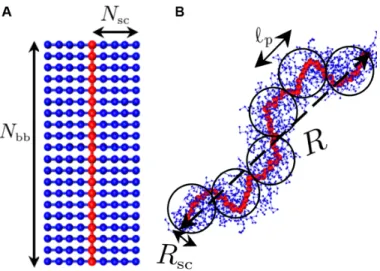
Fig. 1. Molecular architecture and conformation of a bottlebrush polymer. (A) Architecture of a bottlebrush molecule consisting of a backbone withNbb
mono-mers (red beads) andzside chains (blue beads) per backbone monomer. Each side chain is made ofNscmonomers. The total number of monomers of bottlebrush
mac-romolecule isN=Nbb(1 +zNsc). All beads in the simulation are considered to be
identical and interact via bonded and nonbonded potential (see Materials and Methods for details). Here,Nbb= 20,Nsc= 4, andz= 2. (B) The bottlebrush molecule
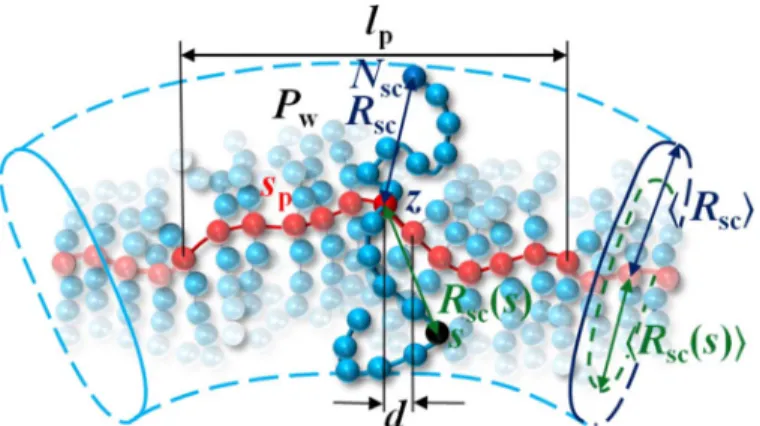
in a melt state can be represented as a chain of effective persistence segments of lengthℓpand thicknessRsc.Rdenotes end-to-end distance of bottlebrush backbone.
structure of bottlebrush polymer melts for a range of degrees of polym-erization of the backboneNbb, side chainsNsc, and backbone spacer between the neighboring side chains. The latter is inversely propor-tional to the grafting densityz, which is the number of side chains per backbone monomer. We show that the persistence lengthℓp for z= 1 andz= 2 bottlebrushes is on the order of the size of side chains 〈R2
sc〉1=2and scales asℓpº〈R2sc〉1=2ºN 1=2
sc . This finding suggests that
the entanglement plateau modulus of bottlebrush melts decreases as (27) Geº1=Vperv≈1=〈R2
sc〉3=2ºN 3=2
sc , where Vpervis the volume
of the effective bottlebrush Kuhn segment proportional to the per-vaded volume of a side chainVperv≈〈R2sc〉3=2. The pervaded volume
Vpervof a side chain is the volume of a sphere that encompasses this
side chain. Our results also indicate that the backbones of bottlebrushes forz= 1 andz= 2 in a melt state obey Gaussian statistics with their size
R(root mean square radius of gyration and end-to-end distance) scaling as〈R2〉1=2ºN1=2
bb N 1=4
sc forNbb≫Nsc. Furthermore, our molecular
modeling provided vital insights into the internal organization of bottle-brush melts, including limited interpenetration of side chains of neighboring molecules, radial distribution function of backbone mono-mers, and the form factor of individual bottlebrushes inside melt. We con-clude that bottlebrush melts behave as melts of thick and flexible filaments, with a persistence length proportional to the size of the side chains.
RESULTS
Scaling theory of combs and bottlebrush molecules Conformations of combs and bottlebrushes depend on the degree of polymerization of the side chainsNscand their grafting densityz. Although
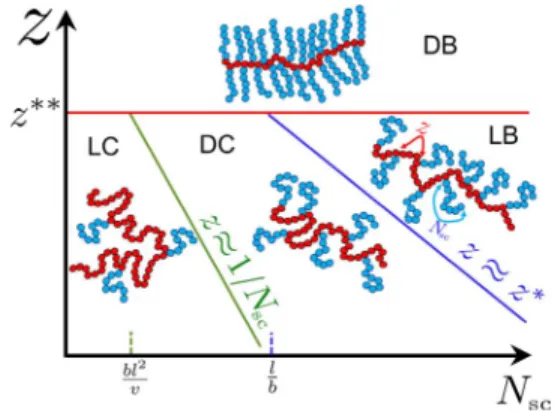
most of the paper concentrates on bottlebrushes withz≥1, in the present section, we consider a broader set of parameters, including loosely grafted bottlebrushes (LBs) and loosely grafted combs (LCs) withz< 1. Depend-ing on graftDepend-ing density, we identify four conformational regimes of comb and bottlebrush melts (27), depicted in Fig. 2. At lower grafting density, we distinguish two comblike regimes characterized by Gaussian conforma-tions of both backbone and side chains: (i) loosely grafted combs (LCs) with long backbone spacers between side chainsz< 1/Nscand with strongly interpenetrating neighboring molecules and (ii) densely grafted combs (DCs) for 1/Nsc<z<z*with weak interpenetration between molecules, wherez*is defined in Eq. 1 below. There are also two regimes at higher grafting density: (iii) loosely grafted bottle-brushes (LBs) with extended backbones and Gaussian side chains for intermediate grafting densityz*<z<z**and (iv) densely grafted bottlebrushes (DBs) with extended backbones and side chains for high grafting density of side chainsz>z**, wherez**is defined in Eq. 3 below. The boundary between the comb and bottlebrush regimes can be found from the space-filling condition ofzNscside chains with physical
volumevNsc, each within their pervaded volume (blNsc)3/2, resulting in
reduced interpenetration of side chains from neighboring molecules
z*≈ ðblÞ 3=2
v N
1=2
sc ð1Þ
wherebis the Kuhn length,lis the monomer length, andvis the mono-mer volume. The present paper focuses on the melts of densely grafted bottlebrushes, whereas below we briefly review conformations of other types of molecules.
The low grafting density regime withz<z*(combs) includes two subregimes: LC and DC. Loosely grafted combs (LC part of Fig. 2), with spacers between side chains longer than the side chains (z< 1/Nsc)
and a high volume fraction of backbones (> 50%), fully interpenetrate each other in melts. Densely grafted combs (DC part of Fig. 2), with spacers shorter than the side chains 1/Nsc<z<z*, allow only partial
inter-penetration of the side chains because there is not enough space to accom-modate side chains of neighboring molecules near the backbone of a host molecule. Both the side chains and backbones in melts of combs (LC and DC regimes) are in almost unperturbed Gaussian conformations. Macromolecules with z>z*correspond to the so-called bottle-brush regime, which onsets because of a lack of space for side chains emanating from the unperturbed Gaussian backbone. Interpenetration of these side chains without their significant deformation is only possible upon extension of the backbone. We can estimatez*(Eq. 1) by considering a side chain with an unperturbed Gaussian size 〈R2
sc;0〉1=2≈ðblNscÞ1=2and with pervaded volumeVperv ≈〈R2sc;0〉3=2≈
ðblNscÞ3=2. This pervaded volume can only fitVperv=Vsc≈ðblÞ3=2Nsc1=2=v
side chains, each with a physical volume Vsc≈vNsc. A section of
the backbone of size〈R2
sc;0〉1=2passing through this pervaded volume
containsNscmonomers if it is in its unperturbed Gaussian
conforma-tion (assuming the same conformaconforma-tional statistics of backbone and side chains). Therefore, if grafting density is too high (z>z*), theNsczside chains grafted to the undeformed section of the backbone with com-bined physical volumevNsc2z>Vpervcan no longer fit in the pervaded
volumeVperv, forcing the backbone to extend.
The backbone extension on the length scale〈R2
sc;0〉1=2 assures a
fixed number of grafting points along the backbone section of this size 〈R2
sc;0〉1=2 equal to the number of overlapping side chains
〈R2
sc;0〉3=2=ðvNscÞ≈ðblÞ3=2Nsc1=2=v. On the small length scales, up to
the size of the tension blob (54), the backbone remains unperturbed. The size of the tension blobx ≈(blg)1/2consisting ofgmonomers is estimated from the condition thatgzside chains emanated from this section of the backbone densely fill its pervaded volumex3[there are
x3/(vg)≈gzsuch overlapping chain sections]. Therefore, the ten-sion blob size isx≈(lb)2/(vz). There is no crowding issue on length scalesrsmaller than the tension blob (r<x), and bottlebrush back-bones maintain the unperturbed Gaussian conformations with bare Kuhn lengthb. On the intermediate length scales (x<r<〈R2sc;0〉1=2),
Fig. 2. Diagram of states of combs and bottlebrush molecules.Molecular con-formations are determined by the degree of polymerizationNscof side chains (blue
circles) and the numberzof side chains per backbone monomer (red circles). Four conformational regimes are distinguished: loosely grafted comb-like polymer (LC) withz< 1/Nsc, densely grafted comb (DC) with 1/Nsc<z<z*, loosely grafted
bottlebrush (LB) withz* <z<z**, and densely grafted bottlebrush (DB) withz> z** (see Eqs. 1 and 3 for the definitions ofz* andz**). The solid lines indicate cross-overs between regimes [green, LC-DC boundary atz≈1/Nsc; blue, DC-LB crossover
a backbone can be visualized as an extended array of tension blobs with a constant average distance between grafting pointsv/(bl). On larger length scales (r>〈R2
sc;0〉1=2), backbones of bottlebrushes in a melt are represented
as random walks of these extended arrays of tension blobs. The loosely grafted bottlebrush (LB part of Fig. 2) is described as a thick filament with contour lengthL≈Nbbvz/(bl), thickness equal to the end-to-end distance of its side chains〈R2
sc;0〉1=2, and persistence length on the same
order of magnitude (see detailed derivation in the subsection“Persistence length of a bottlebrush in a melt”). Thus, bottlebrush macromolecules are considered as chains ofL=〈R2
sc;0〉1=2effective monomers of size〈R2sc;0〉1=2.
The mean square end-to-end distance of the backbone of an LB
〈R2〉≈L〈Rsc2;0〉1=2≈ vz
ðblÞ1=2NbbN
1=2
sc z*<z<z** ð2Þ
increases with increasing degree of polymerizationNsc and grafting densityzof side chains. Considering bottlebrush as a dense “ sausage-like”random walk, we can estimate its mean square size from its phys-ical volumeVchain≈vzNbbNscas〈R2〉≈Vchain=〈R2sc;0〉1=2.
Side chains begin to extend at the crossover between loosely grafted and densely grafted bottlebrush regimes (red line in Fig. 2 atz≈z**). The crossover value of the grafting density is given by
z**¼l 2b
v min
b2l
v ;1
ð3Þ
This crossover occurs either if the backbone spacer between neigh-boring grafting points begins to extend (forv>b2l) or if the backbone approached the fully extended state (forv<b2l). In the former case at
z≈z**≈(bl)3/v2, the scale associated with the tension blob of the backbonex≈(lb)2/(vz) becomes comparable to the unperturbed spacer size (bl/z)1/2. At high grafting density (z**<z<l3/2/v1/2), the balance of side chain and backbone spacer stretching leads to the equilib-rium size of extended side chains〈R2
sc〉1=2≈N 1=2
scv1=3z1=6, with the corre-sponding average spacer length (v/z)1/3and the contour length of the bottlebrushLbb≈v1/3z2/3Nbb. The mean square size of the bottlebrush in this regime is
〈R2〉≈〈R2sc〉1=2Lbb≈
Vchain
〈R2 sc〉1=2
≈v2=3z5=6Nsc1=2Nbb
f or v>b2l and ðblÞ 3
v2 <z<
l3=2
v1=2 ð4Þ
The backbone is almost fully stretched in the case of lower monomer volumev<b2lifz>z**≈(l2b)/vor, for higher grafting density,z>
l3/2/v1/2in the case of higher monomer volumev>b2l. In this case, the dense packing of side chains forces them to extend to the mean square size
〈R2 sc〉≈
vz
l Nsc f or z> l2b
v if v<b
2l or
f or z>l
3=2
v1=2 if v>b
2l ð5Þ
The filament-like bottlebrush with both thickness and persistence length on the order of 〈R2
sc〉1=2 and bottlebrush contour length on the order of the contour of the backbonelNbbhas mean square size
〈R2〉≈ðvlzNscÞ1=2Nbb f or z>
l2b
v if v<b
2l or
f or z>l
3=2
v1=2 if v>b
2l ð6Þ
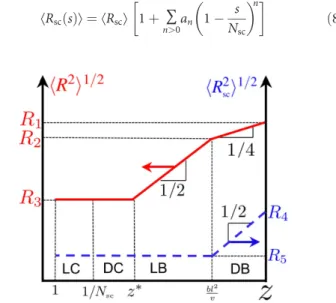
The dependence of backbone and side-chain size of combs and bottlebrushes onzis summarized in Fig. 3.
The size of side chains of densely grafted bottlebrushes with almost fully stretched backbones
The size of side chains increases with degree of polymerizationNsc(see
fig. S1 and table S1). Their size also increases with grafting densityz
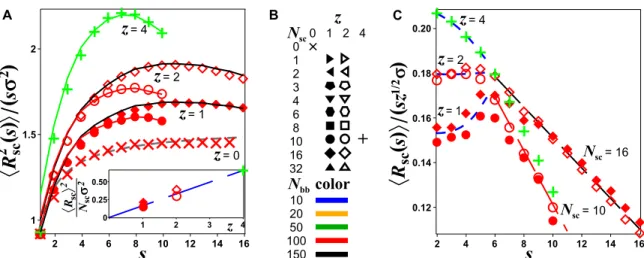
along the backbone. This effect is illustrated in Fig. 4A, which exhibits the variation of the ratio of the mean square distance〈R2
scðsÞ〉of side-chain
monomersfrom the grafting point and the corresponding Gaussian size
ss2as a function of the bond indexsfor different grafting densitiesz. Different colors and symbols correspond to bottlebrushes with different values of Nbb, NSC, andz, as shown in Fig. 4B and table S2. To understand
the bond indexsdependence of the mean square distance〈R2 scðsÞ〉, we
consider the average of the square of the sizeRsc(s) =〈Rsc(s)〉+dRsc(s) of
these side-chain segments containingsmonomers
〈R2
scðsÞ〉¼〈RscðsÞ〉2þ〈dR2scðsÞ〉 ð7Þ
We assume that the nontrivialsdependence of〈R2scðsÞ〉observed in Fig. 4A is due to chain extension〈Rsc(s)〉, whereas the fluctuations
〈dR2
scðsÞ〉of the size of theses-segments can be described by the mean square size of chain sections containingsmonomers of a free linear 16-mer (z= 0, red crosses).
For monomers near the free ends of side chains, the mean distance 〈Rsc(s)〉can be expanded in the Taylor series of the variable 1−s/Nsc:
〈RscðsÞ〉¼〈Rsc〉 1þ
∑
n>0an 1
s Nsc
n
ð8Þ
Fig. 3. Size of combs and bottlebrushes in different regimes.With increasing grafting density, the dimensions of both backbone〈R2〉1/2(red solid line) and side chain 〈R2
sc〉1=2(blue dashed line) undergo characteristic variations in the comb (LC and DC)
and bottlebrush (LB and DB) regimes. This figure corresponds to the case of lower monomer volumev<b2l. Abbreviations are the same as in Fig. 2. In addition,R
1≡ðvlzNscÞ1=4N1=2bb,
where〈Rsc〉=〈Rsc(Nsc)〉is the average size of a side chain. The first coefficient isa1= 0 due to the boundary conditiondRsc/ds= 0 at the free ends=Nsc. The condition〈Rsc(s)〉≪〈Rsc〉for small s≪ Nsc leads to the constraint for the sum of all coefficients∑nan=−1. Note that the asymptotic expressions for the higher-order coefficientsanin Eq. 8 can be found by expanding the dependence〈Rsc(s)〉º(s/Nsc)1/2= [1−(1−s/Nsc)]1/2(see Eq. 14 below) in the power series of (1−s/Nsc). Comparing this expansion with expansion in Eq. 8 term by term, we estimatea3 ≈ −1/16 and coefficients andecay withnasn−3/2. The small values of these coefficients justify omission of the higher-order terms in the expansion in Eq. 8. Thus, we take allan>2= 0 anda2=−1 and obtain
〈RscðsÞ〉≃
s Nsc
2 s
Nsc
〈Rsc〉 f or gNsc≲s≤Nsc ð9Þ
The parameterg~ 0.3 to 0.5 defines the lower boundary of the interval of validity of the above approximation. The mean square size of linear chain segments containingsmonomers〈dR2
scðsÞ〉obtained from molecular dynamics simulations is presented by the lowest set of points denoted by × symbols in Fig. 4A. This dependence can be ap-proximated by〈dR2
scðsÞ〉≃ss2C∞lin=ð1þ~s=sÞ, whereClin∞ ¼1:55 and
s
˜¼0:61, as shown by the dashed line (see Eq. 22 below for the similar approximation for bottlebrush backbones). In Fig. 4A, we compare our prediction from Eqs. 7 and 9
〈R2 scðsÞ〉
ss2 ¼
s Nsc
2 s
Nsc
2〈
Rsc〉2
Nscs2þ
Clin ∞ 1þ~s=s
f or gNsc≲s≤Nsc ð10Þ
with the data obtained from simulations of bottlebrushes with grafting densityz= 1, 2, and 4 using single fitting parameter〈Rsc〉and the value of Clin
∞ ¼1:55 ands˜¼0:61 from the fit to linear chain data (z= 0). This simple estimate (Eq. 10) demonstrates excellent agree-ment with the simulation data.
The average side-chain size〈Rsc〉can be estimated from the mono-mer dense packing condition. The transverse slice of a bottlebrush can be approximated by a disc of volumed〈Rsc〉2and thicknessd≈sof the backbone bond projection onto the contour of the molecule. Assuming that there is no (or limited) overlap between the side chains of neighboring bottlebrushes, the disc volume is occupied by zside chains of volumevNsceach, wherev≈s3is the volume of one monomer.
Therefore, the square of the average size of side chains can be estimated as
〈Rsc〉2≃
vNscz
d ¼CscNsczs
2 ð11Þ
whereCscis the numerical coefficient accounting for the scaling form of this expression. The inset in Fig. 4A shows good agreement with Eq. 11, with the value of the fitting parameterCsc= 0.17.
Combining Eqs. 9 and 11, we can write
〈RscðsÞ〉≃C1sc=2 2
s Nsc
ssz1=2
Nsc1=2
f or gNsc≲s≤Nsc ð12Þ
In Fig. 4C, we test this prediction by plotting thesdependence of the ratio of the average distance 〈RscðsÞ〉¼ ½〈R2scðsÞ〉〈dR
2 scðsÞ〉
1=2
andssz1/2
using the simulation data presented in Fig. 4A. For larger values ofsfor
gNsc≲s≤Nsc, this rescaled function isz-independent and exhibits linear dependence ons,〈RscðsÞ〉=ðssz1=2Þ≃Csc1=2ð2s=NscÞ=Nsc1=2, with
Nsc-dependent negative slope predicted by Eq. 12. The red and black dashed lines in Fig. 4C (fors> 6) have slopes of−0.012 and−0.0064 for
Nsc= 10 andNsc= 16, respectively, which are consistent with the pre-dicted negative slopesCsc1=2=Nsc3=2¼ 0:013 and−0.0063 from Eq. 12.
z
= 0z
= 1z
= 2z
= 4A B C
1/2
z
= 4z
= 1z
= 2z
0 1 2 4 0
1 2 3 4 6 8 10 16 32
10 20 50 100 150
N
scsc sc
N
bbcolor
+
+
N
sc= 10N
sc= 16Fig. 4. Size of side chains of bottlebrushes in a melt.(A) Dependence of the rescaled values of the mean square distance of a side-chain monomersfrom the grafting point〈R2
scðsÞ〉=ðss2Þfor side chains withNsc= 10 andNsc= 16 monomers as a function of the bond indexscounting from the grafting point for molecules with different
numberzof grafted side chains per backbone monomer. The mean square fluctuations of the size of ans-segment〈dR2
scðsÞ〉are assumed to be equal to their value for linear
16-mer in a melt (z= 0, crosses). The dashed line is the fit to thesez= 0 points byClin
∞=ð1+~s=sÞwith two adjustable parametersC∞lin=1:55and̃s=0:61. Curves forz≥1 show
theoretical predictions of Eq. 10 with fitting parameter〈Rsc〉. (Inset) Dependence of〈Rsc〉2/(Nscs2) on parameterzfor〈Rsc〉obtained from the separate fit to Eq. 10 for each curve.
Dashed line represents the theoretical prediction of Eq. 11 with scaling parameterCsc= 0.17. (B) Convention of symbols used in all figures to denote a particular bottlebrush
melt. Color and shape of symbols denote the values ofNbbandNsc, respectively. Crosses represent the data for linear chains (z= 0), solid symbols correspond to bottlebrushes
withz= 1, open symbols are for bottlebrushes withz= 2, and plus symbols denote the data for bottlebrushes withz= 4 (see table S2 for more details). (C) Dependence of the rescaled values〈Rsc(s)〉/(sz1/2s) of the corresponding mean distance〈RscðsÞ〉 ½〈R2scðsÞ〉 〈dR2scðsÞ〉
1=2
The mean square fluctuations of the size of chain segments con-taining large numbers≫1 of monomers are Gaussian. Therefore, the normalized mean square size of side-chain segments (Eq. 10) can be approximated for largesby
〈R2 scðsÞ〉
ss2 ¼ Csc
zs Nsc
2 s
Nsc
2
þ C∞lin 1þ~s=s
≃Csc
zs Nsc
2 s
Nsc
2
þC∞lin f orgNsc≲s≤Nsc ð13Þ
This equation predicts a maximum atsmax= 2Nsc/3. This predic-tion is in good agreement with the simulapredic-tions (see Fig. 4A). Note that the position of the maximum (for both points and lines) has a slightly higher value ofsthan 2Nsc/3 because of the residualsdependence of the ratio〈dR2
scðsÞ〉=ðss2Þfor short side chains. The physical explana-tion of this peak is that not all of the chains extend all the way to〈Rsc〉. There is a wide distribution of the positions of side-chain ends around their average value〈Rsc〉. Because fewer side chains extend to larger radial distances from the backbone, they provide an additional contri-bution to the ratio〈R2scðsÞ〉=ðss2Þin Eq. 13 forgNsc<s<smaxand a relatively smaller contribution for larger values ofs>smax. As a result of side chains that do not extend to large radial distances from the backbone, the crowding of remaining side chains at these large radial distances decreases. This decrease in crowding weakens the stretching of the remote side-chain sections, resulting in a relatively smaller av-erage extension of chain sections withs> 2Nsc/3. The stretching decreases withsand vanishes at the free side-chain ends in the over-lapping zone of neighboring bottlebrushes.
Conformations of side-chain segments withs≲gNscnear the graft-ing point are determined by the monomer packgraft-ing condition due to the limited penetration of monomers with indexs′>sinto this zone near the backbone, similar to packing restrictions for the entire side chain (see Eq. 11)
〈RscðsÞ〉2 ≃
zvs
d ≃zss
2 f or s≲gN
sc ð14Þ
Therefore, the ratio〈Rsc(s)〉/(ssz1/2) should be independent ofNsc for smalls≲gNsc, as observed in Fig. 4C. However, note that thes dependence of〈Rsc(s)〉fors≲6 differs from our prediction (Eq. 14) because of strong crowding of side-chains near the backbone and the non-Gaussian behavior of these short chain segments. Thes depen-dence of〈dR2
scðsÞ〉=ðss2Þsignificantly deviates from a constant fors≲6 (see red crosses in Fig. 4A), as described by the crossover expression
Clin∞=ð1þ~s=sÞ.
Persistence length of a bottlebrush in a melt
The rigidity of bottlebrush is only due to the mutual repulsion of the crowded side chains. The excluded volume interactions in a melt state are highly screened. In the unrealistic case of complete screening of steric interactions, the resulting persistence length of a bottlebrush is on the order of its monomer size≈s. To estimate the persistence length of“real” bottlebrushes, we have to account for partially screened excluded volume interactions between side chains. The physical volume ofspzside chains grafted to a persistent bottlebrush section isvspzNsc, whereas the radius of
this section is〈R2
sc〉1=2. Therefore, the length of this cylindrical-like section is vspzNsc=〈R2
sc〉 and its pervaded volume is ≈ðvspzNsc=〈R2sc〉Þ 3
. The pervaded volume of a persistent bottlebrush section is the volume
of a sphere that encompasses this cylindrical-like persistent segment. The excluded volume interactions between polymer sections in the melt are reduced by the degree of polymerizationPw=spzNscof these
sections (54) (see Fig. 5). Thus, the free energy of the excluded volume interactions between these persistent bottlebrush sections within their pervaded volume is
Esc¼kBT
v Pw
ðspzNscÞ2 ðvspzNsc=〈R2sc〉Þ
3 ð15Þ
The persistent segmentspis determined by the condition that the excluded volume interaction energy Escis on the order of thermal energykBT, resulting in
sp≈ 〈
R2 sc〉3=2
vzNsc ≈
ðzvNscÞ1=2
d3=2 ð16Þ
where Eq. 11〈R2
sc〉1=2≈ðzvNsc=dÞ1=2was used. In this case, the size of the persistence segmentℓp is
ℓp ≈spd≈
zvNsc
d
1=2
≈〈R2sc〉1=2 ð17Þ
The conformations of bottlebrush backbones at small length scales are similar to those of flexible polyelectrolytes that are almost un-deformed on scales up to electrostatic blob size but extended into a linear array of electrostatic blobs on larger length scales with persist-ence length determined by the screening length (55). By analogy with the polyelectrolytes, bottlebrushes are flexible on small length scales and have large persistence length, induced by side-chain repulsion, on intermediate length scales.
Our simulations confirm the scaling prediction that the persistence length of bottlebrush backbones in a melt state is comparable to the size of side chains. To determine the length of persistence segmentssp,
Fig. 5. Geometry of a bottlebrush polymer.A bottlebrush is composed ofzside chains withNscmonomers each grafted to every backbone monomer (z= 2 in this
figure).Rsc≡Rsc(Nsc) andRsc(s) denote instantaneous values of size of side chains
(bottlebrush thickness) and distance of a side-chain monomersfrom the grafting point, respectively. The number of monomers per persistence segment issp, and
persistence length isℓp.Pw≈spzNscis the total degree of polymerization of cylindrical-like
section composed ofspbackbone monomers andspzNscside-chain monomers.dis
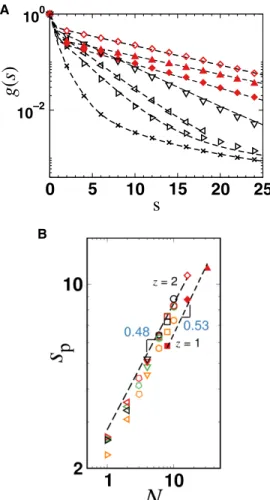
we calculated the decay rate of the correlations between bond orienta-tionsgðsÞ≡〈cosq〉ºes=sp (see simulation data in Fig. 6A and fig.
S2). The cosine of the angle is cosq= (ri/|ri|)⋅(ri+s/|ri+s|), whereri=
Ri+1−Riis the bond vectoribetween monomersiandi+ 1, andri+s=
Ri+s+1−Ri+sis the bond vectori+sbetween monomersi+sandi+s+
1. The data obtained from simulations (symbols) have been fitted to the function (dashed lines) of the following form
gðsÞ ¼ ð1AÞes=sf þAes=spþzs3=2tanh½ðs=3Þ3 ð18Þ
whereA,sf,sp, andzare fitting parameters (see table S3) and denote the following: (1−A) andAare the magnitudes of short- and long-range correlations, respectively, between bond vectors of the backbone;
sf is the characteristic number of beads in the backbone, which undergo“local”bond vector correlations;spis the number of beads per persistence segment; andzis the magnitude of long-range
inter-actions induced by the connectivity of backbone bonds (see the section on persistence length in the Supplementary Materials for details). The power-law decayºs−3/2ats≫1 was reported for polymers melts (56) and forq solutions (57). The origin of these interactions is ex-plained either by effective compression of polymer coils due to the correlation hole effect (56) or by the shift of the monomeric Mayer
f-function due to the finite interaction range and chain connectivity (57). The function tanh[(s/3)3] presented in Eq. 18 describes a cutoff at minimal loop sizes= 3.
In Fig. 6B, the number of monomers along the bottlebrush backbone in the persistent segment spis presented as a function of the degree of polymerization of side chainsNscfor grafting densities z = 1 and 2 and various backbone degrees of polymerizationNbb. These data demonstrate the effect of backbone straightening with the increasingNscandz. The exponents of the observed power laws
sp¼1:91Nsc0:53±0:04 f or z¼1 ð19Þ
sp¼2:75Nsc0:48±0:03 f or z¼2 ð20Þ
agree with the exponent1 2
= predicted from the scaling arguments, as presented in the beginning of this subsection (see Eq. 16), and indicate that the number of monomers spin the persistence segments of the bottlebrush backbones withz= 1 or 2 side chain per backbone mono-mer andNbb≳50 is proportional to the brush radius (side-chain size
〈R2
sc〉1=2) (see fig. S3).
Size of a bottlebrush in a melt
The size of a bottlebrush in a melt state can be estimated from a simple physical picture of nonoverlapping flexible filaments with ℓpº〈R2sc〉1=2. Consider a bottlebrush backbone that is much longer than
persistence segmentNbb≫sp(see Fig. 1B). The bottlebrush confor-mation can be represented as a chain of effective monomers consisting ofspbackbone monomers andspzside chains of size〈R2sc〉1=2. The mean square end-to-end distance of the backbone can be estimated as the number of these effective monomersNbb/sptimes the square of their size, which is proportional to the mean square size of side chains〈R2
sc〉,
resulting in〈R2〉≈〈R2
sc〉Nbb=sp. Because the number of monomers in
a persistence segmentspis proportional to the size of a side chain
〈R2
sc〉1=2≈sN 1=2
sc (see Eqs. 17, 19, and 20), we predict that the mean
square size of the backbone is also proportional to the size of a side chain 〈R2〉≈s〈R2
sc〉1=2Nbb¼s2NbbN 1=2
sc . Our simulation results
corrobo-rate this prediction (cf. Eq. 6), as discussed below.
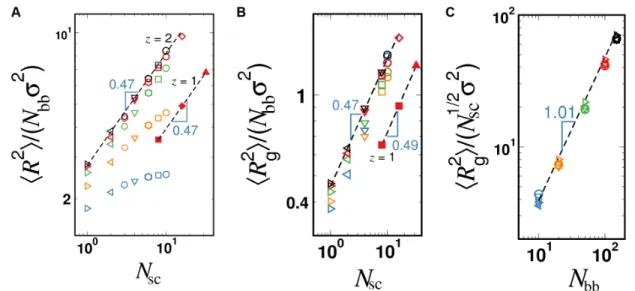
The mean square end-to-end distance of the backbone〈R2〉and the mean square radius of gyration 〈R2
g〉 of the whole bottlebrush are
plotted as functions of the degree of polymerization of side chains
Nsc and backbone Nbbin Fig. 7 and fig. S4 (for the definition of
symbols, see Fig. 4B and the corresponding caption as well as table S2). The mean square size increases with Nbband Nsc and obeys
the power law
〈R2〉=Nbb¼1:33Nsc0:47±0:01s2 f or z¼1
〈R2〉=Nbb¼2:76Nsc0:47±0:01s
2 f or z¼2 ð21Þ
a n d 〈R2
g〉=Nbb¼0:23Nsc0:49±0:01s2 f o r z = 1 a n d 〈R2g〉=Nbb¼ 0:46Nsc0:47±0:01s2 for z= 2. Similar to linear chains in melts, the
0
5
10
15
20
25
s
10–2
100
A
B
g
(
s
)
Fig. 6. Persistence segment of a bottlebrush in a melt.(A) Decay of backbone bond orientational correlationsg(s) as a function of the number of monomerss be-tween two bonds for bottlebrushes with various degrees of polymerizationNscof
side chains and numberzof side chains grafted per backbone monomer (see Fig. 4B and the corresponding caption for the definition of symbols). Dashed lines represent best fits to the expression forg(s) given by Eq. 18. (B) Persistence segments obtained from the decay of bond orientational correlations plotted as a function of the side-chain polymerization degreeNscfor various backbonesNbband grafting densitieszof
conformations of bottlebrushes with long backbones are well described by the ideal chain statistics, that is,〈R2〉=〈R2
g〉≈6, as verified by the distributions of the end-to-end distancesRand the radii of gyration
Rg(cf. fig. S5). From Fig. 7A, one can observe that the mean square end-to-end distance of molecules with backbonesNbb= 10 and 20 becomes insensitive to further increase inNsc. This is attributed to the crossover from the crew-cut bottlebrushes to the starlike configurations.
The mean square internal distances〈R2(s)〉between backbone monomers are plotted in Fig. 8 as a function of the number of bonds
sin a backbone section for molecules with various side-chain degrees of polymerizationNscand different numberzof side chains grafted
per backbone monomer (the definition of symbols is displayed in Fig. 4B and described in the corresponding caption). The simulation data for allzvalues were fitted to the crossover expression
〈R2ðsÞ〉¼ss2 C
bb ∞
1þ~s=s ð22Þ
with fitting parametersC∞bb and~splotted in Fig. 8B and reported in table S4. The overall good agreement between the crossover expression and simulation data is observed by the overlap between points (simulation data) and lines (Eq. 22) in Fig. 8A. The backbone stretching (characterized by both parametersCbb
∞ and~s) increases sig-nificantly with the grafting density of side chainszand with the degree of polymerization of side chainsNscbecause of steric repulsion between densely grafted side chains. The Flory characteristic ratio Cbb∞ and parameter~sincrease proportionally to the power of the degree of po-lymerization of side chainsC∞bb¼1:3Nsc0:52±0:01and~s¼2:1Nsc0:51±0:1for
z= 1 andCbb
∞ ¼2:8Nsc0:53±0:01and~s¼3:4Nsc0:55±0:01forz= 2 (see Fig. 8B and table S4). The scaling exponents are close to1
2
=, indicating thats
dependence of distances between backbone bonds separated bys mono-mers fors>~sis consistent with the backbone size scaling (Eq. 21). We observe that~sis 60% and 25% larger than correspondingC∞bbvalues (see
Fig. 7. Size of bottlebrushes in a melt.Mean square end-to-end distance〈R2〉(A) and mean square radius of gyration〈R2
g〉(including side chains) (B) of bottlebrushes in a
melt normalized by the ideal mean square size of backbonesNbbs2as functions of the degree of polymerization of side chainsNsc. (C) Mean square radius of gyration〈R2g〉of
bottlebrushes normalized bystimes the ideal root mean square size of side chainsN1=2sc s2as a function of the degree of polymerization of backbonesNbb. See Fig. 4B and the
corresponding caption for the definition of symbols. In (A) and (B), the number of side chains grafted per backbone monomer isz= 1 and 2. (C) displays data forz= 2. Dashed lines represent fitted scaling laws: (A) 1:33N0:47±0:01sc forz= 1 andNbb= 100 and 2:76N0:47±0:01sc forz= 2 andNbb= 100, (B) 0:23N0:49±0:01sc forz= 1 andNbb= 100 and
0:46N0:47±0:01sc forz= 2 andNbb= 100, and (C) 0:39N1:01±0:04bb forz= 2 andNsc= 10. The error bars for all data points are smaller than the size of symbols.
0 10 20 30 40 50 60 70
s
0 5 10
R
2
(
s
)
/
(
s
σ
2
)
A
B
Fig. 8. Extension of a bottlebrush in a melt.(A) Dependence of the mean square internal distances〈R2(s)〉between bottlebrush backbone monomers normalized by
their ideal mean square sizess2on the number of monomerssin the backbone
sections plotted for various side-chain polymerization degreesNscand grafting
den-sitiesz(see Fig. 4B and its caption for the definition of symbols). Solid lines represent best fits to the crossover expression〈R2ðsÞ〉=ðss2Þ ¼ C∞bb
1þ~s=s, with fitting parameters Cbb
∞ and~slisted in table S4. (B) Fitting parametersCbb∞ and~splotted as a function of
side-chain polymerization degreeNscforz= 1 (full symbols) andz= 2 (open
symbols). Dashed lines represent fitted scaling laws:Cbb
∞ ¼1:3N0:52±0:01sc and~s¼
Fig. 8B and table S4) forz= 1 and 2, respectively, pointing out the wiggling of the backbone〈R2(s)〉1/2≈s1/2son length scales smaller than the tension blob. The bottlebrushes undergo a conformational transform-ation from a random coil to a rod as the grafting densityzincreases from 1 to 4, which is evidenced by the increase of both the Flory characteristic ratioCbb∞ and the crossover value~sby more than an order of magnitude. Because the backbone degree of polymerizationNbb≪~s, the simulated bottlebrush with side-chain grafting densityz= 4 is effectively rodlike. Note that it is hardly possible to determine persistence segmentspfrom correlations of bond orientations (see Eq. 18) for simulated bottlebrushes with short backbonesNbb≲50 andz= 4 because the correspondingg(s) functions do not decay sufficiently.
Interpenetration of neighboring bottlebrushes in a melt As discussed below, reduced interpenetration of side chains from neighboring macromolecules is a distinct feature that distinguishes segregated filaments (bottlebrushes) from overlapped molecules (linear chains and combs). This interpenetration is crucial for the understanding of the friction between these molecules and for the ex-planation of the complex rheological response of bottlebrush-based materials observed in recent experiments (12,26,27,58,59). We have analyzed the number of intramolecular hs and intermolecular gs
contacts between side-chain monomers. Contacts were defined be-tween pairs of monomers within distancershell= 1.5sfrom each other.
This separation corresponds to the position of the minimum in the interbead correlation functiong(r), as discussed below. We denote by〈hs〉the average number of intramolecular nonbonded contacts
betweensth monomer of a side chain and monomers within the same host molecule, whereas〈gs〉stands for the average number of
inter-molecular contacts between theith monomer of a side chain of a given molecule with monomers belonging to all other molecules. Both quantities were calculated as functions of monomer indexsalong a side chain and normalized by the average number of nonbonded neighbors persth monomerZs=〈hs〉+〈gs〉. The average value ofZs
is independent of the monomer indexs,Zs≈〈Z〉≈4.7, except for
terminal monomersZ1≈5.0 andZNsc ≈5:3. The results of this
anal-ysis are presented in Fig. 9A (for the definition of symbols, see Fig. 4B and the corresponding caption as well as table S2). The average frac-tion of intermolecular contacts for the first side-chain monomers (s= 1) is low and decreases with increasing grafting densityz:〈g1〉/〈Z1〉≈0.2 for z= 1,〈g1〉/〈Z1〉≈0.1 forz= 2, and〈g1〉/〈Z1〉< 0.01 forz= 4. The limited
interpenetration is ascribed to dense crowding of the side-chain monomers belonging to the same bottlebrush in the vicinity of its backbone, which hinders penetration of guest monomers to the central region of the host bottlebrush. The probability of encountering guest mono-mers〈gs〉/〈Zs〉increases withsand reaches the maximum value for
terminal monomers of the side chains. This maximum value was found to be〈gNsc〉=〈ZNsc〉≈1=2 independent of grafting density z
and degree of polymerization of side chainsNsc. The terminal
mono-mers are in the interpenetration zone between two neighboring bot-tlebrushes. This zone contains 50:50 composition of monomers from both molecules. The low interpenetration of bottlebrushes in a melt state is demonstrated by the“territorial map”(60–62) of the simulation box snapshot in Fig. 9B.
For a reference system, we have calculated the number of contacts between monomers of neighboring linear chains in a melt (cf. the inset of Fig. 9A). The interchain contacts for linear polymers are almost uniformly distributed along the backbone except for the chain ends. The estimated fraction of guest monomers for linear chains was found
to be〈gs〉/〈Zs〉≈0.65 (independent of the degree of polymerization)
and is higher than the maximum fraction of 0.5 (encountered by end monomers of bottlebrush side chains). The increase in the fraction of intermolecular contacts of up to≈0.78 is observed at the ends of linear chains. The intrachain nonbonded contacts in linear chains are due to the formation of self-loops. For inner monomers of a linear chain, one can have self-loops at both sides, whereas for end mono-mers, self-loops can only be formed from one side. This explains the higher number of interchain contacts for end monomers of linear chains in a melt. The main conclusion of this analysis is that the overlap of bottlebrush molecules in the melt is qualitatively different on a monomer level from that of linear chains. Below, we show that melts of bottlebrushes become qualitatively similar to those of linear chains if we describe bottlebrushes as thick flexible filaments, which are chains of“effective monomers”of size〈R2sc〉1=2.
0 0.2 0.4 0.6 0.8 1
s
0 0.2 0.4 0.6 0.8 1
0 25 50 75 100 125 150
Monomer index s
0.6 0.7 0.8
A
B
/
N
scFig. 9. Interpenetration of bottlebrushes in a melt.(A) Average number of contacts〈gs〉between bottlebrush side-chain monomersand monomers of other
molecules. The value of〈gs〉is normalized by the average number of nonbonded
neighbors〈Zs〉and plotted as a function of monomer indexi(counting from the
backbone) normalized by the degree of polymerization of side chainsNsc. Data for
Nsc= 10 andNsc= 16, with grafting densityz= 1, 2, and 4 of side chains per
backbone monomer (see Fig. 4B and the corresponding caption for the definition of symbols). The inset displays the average number of contacts〈gs〉betweensth
monomer of a linear chain and monomers of surrounding linear chains in a melt normalized by the average number of nonbonded neighbors. (B) The“map of territories”for an equilibrated melt of bottlebrushes withNbb= 100,Nsc= 10,
Local structure
The internal structure of melts composed of linear chains or bottle-brushes is illustrated in Fig. 10 by the pair correlation functionsg(r) of backbone monomers. The intrabackbone pair correlation function
gintra(r) has several peaks, as shown in Fig. 10A, for both linear chains and bottlebrush melts with different side-chain grafting densitiesz. There are two peaks in melts of bottlebrushes with short side chains: one atr≈0.96sthat corresponds to bonded (nearest) neighbors and the peak atr≈1.87sthat corresponds to second-nearest neighbors. As the degree of polymerization of side chainsNscincreases, one ob-serves that, for the grafting density ofz= 2 side chains per backbone monomer (solid lines), new peaks appear atr≈2.6sand 3.4s, which
are due to stretching of the backbone. As the number of side chains attached to a backbone monomer increases toz= 4 (dashed line), the backbone stiffens and more peaks appear, indicating stronger intra-molecular correlations. In this case, a series of clearly distinguishable subsequent and equidistant maxima is observed: 1.92s, 2.79s, 3.63s, 4.48s, 5.32s,…The existence of local structure for bottlebrush melts is due to long-range interactions between backbone monomers in-duced by side chains. The strength of the intramolecular interaction increases with grafting densityzand with length of side chains. The longer the side chains are, the stronger the interaction is between backbone monomers and the longer the range of these interactions is. The interaction range along the backbone is comparable to the size of the persistence segment, which scales with the size of side chains as 〈R2
sc〉1=2.
The information about bottlebrush packing in the melt is contained in the interbackbone correlation functionginter(r) presented in Fig. 10B.
In the case of linear chain melts, ginter(r) reveals the structure at very
small length scales.ginter(r) is zero for distancesrbelow first peak be-cause of Lennard-Jones (LJ) core repulsion between monomers. The sharp peak atr≈1.1scorresponds to the first“solvation shell,”which is the optimal distance between pairs of nearest-neighbor monomers. The second peak atr≈1.9sdisplays the influence from the shell of the second-nearest neighbors. In contrast to melts of linear chains, the large-scale structure is observed in bottlebrush melts. Bottlebrush back-bones are shielded by densely grafted side chains and do not approach each other. This fact is clearly demonstrated in the case of bottlebrushes with the long side chains, that is,Nsc= 10 (solid red line forz= 2 and dashed red line forz= 4). At distances comparable to bottlebrush thick-ness, equal to the average side-chain size〈R2sc〉1=2≈4:18sforz= 2 and at〈R2
sc〉1=2 ≈4:58sforz= 4, the corresponding values ofginter(r) are
lowginter(r)/rbb≈0.1 because the“coat”of side chains around a given
backbone prevents neighboring backbones from approaching it. Note that the highest probability to find monomers of neighboring backbones does not exactly match the brush diameter 2〈R2
sc〉1=2but is rather at a
shorter distance because of partial interpenetration of side chains. The first maxima are observed atrmax≈7.25sforz= 2 and≈8.35sforz= 4, respectively. The smaller value ofrmax=ð2〈Rsc2〉1=2Þforz= 2 (≈0.87)
with respect toz= 4 (≈0.91) implies a stronger overlap of grafted side chains in bottlebrush melts with lowerz(see Fig. 9). The inset of Fig. 10B shows the correlation functionsginter(r), with the abscissa rescaled by the
position of the first maximum rmax. The positions of the peaks for
bottlebrush systems correlate very well with the peaks observed for linear chain, indicating a similar“liquid-like”origin of melt structure (63,64) but with stronger correlations at correspondingly larger distances. This result justifies representing bottlebrushes in melts by chains of“effective” mono-mers of sizeº〈R2
sc〉1=2, which are thick flexible filamentous objects.
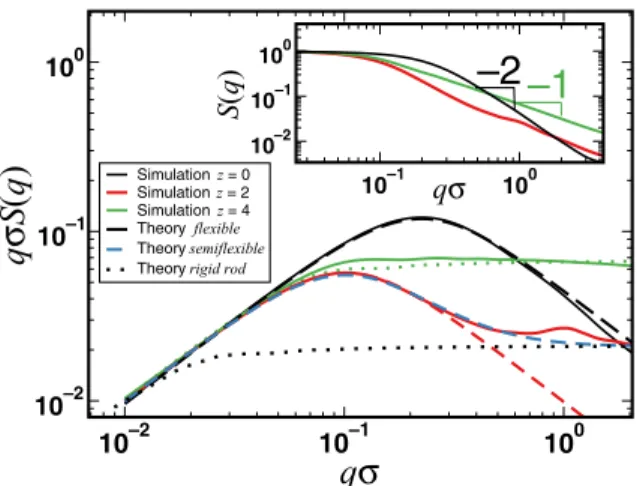
The form factor of a bottlebrush backbone in a melt The form factorS(q) of the backbones of bottlebrushes with different grafting densitieszof side chains is presented as the Holtzer plot in Fig. 11. The form factor of linear chains (z= 0) in a melt state (solid black line) is well represented by the Debye function (black dashed line) and scales asS(q)ºq−2for large wave vectorsq. The backbone form factors of bottlebrushes exhibit different behavior because of the backbone extension induced by side chains. For bottlebrushes withz= 2 (solid red line), the backbone S(q) at intermediate values of wave vectorq< 0. 5s−1is similar to the form factor of a semiflexible chain. The simulation data forz= 2 (solid red line) were fitted to the theo-retical prediction of the structure factor of a semiflexible chain (blue
0 1 2 3 4 5 6
r
10–3 10–2 10–1 100
g
(
r
)/
ρ
A
N
sc=0
N =1
scN
sc=2
N
sc=4
N
sc=10
intra
sc
N
=16
0 2 4 6 8 10 12 14 16 18 20 22 24
r
0.0 0.5 1.0 1.5 2.0 2.5 3.0 3.5
g
(
r
)/
ρ
0 1 2 3 4
r
/
r
0.0 0.5 1.0 1.5 2.0
g
(
r
)/
ρ
inter
B
bb
bb
max
inter
Fig. 10. Radial distribution function of bottlebrushes in a melt.Pair correla-tion funccorrela-tions between (A) intrabackbone monomersgintra(r) and (B)
interback-bone monomersginter(r) normalized by melt densityrand density of backbone
monomers in a meltrbb, respectively. Correlation functions were plotted for
var-ious degrees of polymerization of side chainsNsc. As indicated in the legend,
var-ious colors are used to distinguish between the lines with different values ofNsc.
Solid gray lines denote results for linear melts, that is, with grafting densityz= 0 (Nsc= 0), whereas other solid lines correspond toz= 2. Dashed lines represent
dashed line) (65). Note that the form factor of a semiflexible chain (blue dashed line) interpolates between the Debye function (red dashed line) at large length scales (smallqvalues) and rigid rod form factor (dotted black line) at small length scales (highqvalues). The overall very good agreement between simulation data and theoretical predic-tion (65) is observed. The only difference is the presence of a hump located betweenq≈0.65s−1and 1.96s−1. The nonmonotonicity of Holtzer plotqS(q) for highqvalues is attributed to the local flexibility of bottlebrushes at small length scales. Flexibility of bottlebrushes at length scales below tension blob sizexis also confirmed by the exis-tence of the fast initial decay of backbone bond correlations (see Fig. 6A and Eq. 18). The case of bottlebrushes withz= 4 (solid green line) cannot be fitted by the theoretical structure factor of a semiflexible chain. Larger crowding of side-chain monomers around the backbone gives rise to its increased extension for bottlebrushes withz= 4. The persistence length in this case is much larger than bottlebrush thick-ness, and structure factor is well approximated by the rigid rod–like scattering (dotted green line).
DISCUSSION
The conformations of bottlebrush macromolecules in melts depend on the side-chain grafting densityzand the degree of polymerization of side chainsNsc. We demonstrated that the increase ofzandNsc
leads to the extension of the bottlebrush backbone at intermediate length scales and enhancement of long-range interactions between backbone monomers, causing stronger intra- and intermolecular cor-relations similar to semidilute polyelectrolyte solutions. These interac-tions also result in significant reduction of the overlap between side chains of neighboring molecules. For moderate grafting densities with
z≤2, the conformation of bottlebrush is similar to a filament com-posed of“effective monomers”of size comparable with bottlebrush thickness (size of side chains). The bottlebrush size follows ideal (Gaussian) chain statistics forz≤2, and the mean square size of
a bottlebrush is proportional to the product of the backbone de-gree of polymerizationNbband the persistence length of the mol-eculeºNsc1=2, that is,〈R2〉ºNbbNsc1=2. For high grafting densities z > 3, bottlebrushes with short backbones Nbb≲50 adopt rodlike conformations.
MATERIALS AND METHODS
Simulations of bottlebrush melts were performed using three-dimensional coarse-grained bead-spring model (63). An individual bottlebrush molecule is composed ofNbbbackbone monomers (beads) connected by bonds and z side chains of Nscmonomers grafted to every
backbone monomer (see Fig. 1A). Thus, the total number of beads in a bottlebrush isN=Nbb+zNbbNsc, wherezis the grafting density.
The case ofNsc= 0 (orz= 0) corresponds to a linear chain.
The nonbonded interactions between monomers separated by dis-tancerwere modeled by the truncated and shifted LJ potential
VLJð Þ ¼r 4D½ðs=rÞ
12 ð
s=rÞ6þ ðs=rcÞ6 ðs=rcÞ12 r≤rc
0 r>rc
ð23Þ
where the interaction strengthDis measured in units of thermal en-ergykBT,sis the monomer diameter, andrcis the cutoff. In the NVT ensemble, we have used D¼kBT andrc= 21/6s. This choice of LJ potential results in purely repulsive interactions between monomers. The bonded interactions in a molecule were described by the Kremer-Grest potential (63),VKG(r) =VFENE(r) +VLJ(r), with the“finitely ex-tensible nonlinear elastic”(FENE) potential
VFENE¼ 1
2kr 2 0ln 1
r r0
2 " #
ð24Þ
where the bond stiffnessk¼30D=s2and the maximum bond length
r0= 1.5s(63). All simulations were performed in a cubic box with periodic boundary conditions imposed in all spatial dimensions. In the NVT ensemble, the simulations were carried out at the overall mono-mer densityr= 0.85s−3corresponding to the intermolecular pressure
〈P〉≈4.75D/s3. In a separate set of simulations, we have also inves-tigated melts of bottlebrushes with attractive LJ potential with the in-teraction strengthD¼0:84kBT and the cutoffrc= 2.5susing NPT ensemble withP= 0, ensuring that the average density〈r〉≈0.85s−3
is the same as in the NVT runs. The static properties obtained from both NVT and NPT simulations, for example, the average bottle-brush size, demonstrate good agreement with each other within the error bars after rescaling by the corresponding average bond lengthl (bonds in NPT simulations are 1% shorter than those in NVT simulations).
The molecular dynamics simulations were performed by solving the Langevin equation of motion for the positionri= [xi,yi,zi] of each
bead (66)
m€ri¼FLJi þFFENEi zr :
iþFRi; i¼1;…;N ð25Þ
which describes the motion of a set of interacting monomers. Forces FLJ
i andFFENEi in Eq. 25 above are obtained from the LJ (Eq. 23) and FENE
10–2 10–1 100
qσ
10–2
10–1
100
q
σ
S
(
q
)
Simulation z = 0 Simulation z = 2 Simulation z = 4 Theory flexibleTheory semiflexible
Theory rigid rod
10–1 qσ 100
10–2
10–1
100
S
(
q
)
–2
–1
(Eq. 24) interaction potentials between the ith monomer and surrounding monomers. The third and fourth terms on the right-hand side of Eq. 25 are a slowly evolving viscous forceżri and a rapidly fluctuating stochastic forceFRi, respectively. This random forceFRi is related to the friction coefficient z by the fluctuation-dissipation theorem〈FRiðtÞFRjðt0Þ〉¼kBTzdijdðtt0Þ. The friction coefficient used in simulations wasz= 0.5mt−1, wheremis the monomer mass and
t¼pffiffiffiffiffiffiffiffiffiffiffiffims2=Dis the LJ time. The velocity Verlet scheme (67) was used for numerical integration of equations of motion in Eq. 25. The inte-gration step was taken to beDt= 0.01t. A Langevin thermostat was used to keep the temperature constant. All simulations were carried out using Large-scale Atomic/Molecular Massively Parallel Simulator (LAMMPS) (68). Simulation snapshots were rendered using Visual Molecular Dynamics (VMD) (69). Initially, molecules were grown using a self-avoiding random walk technique and placed randomly in the simulation cell. The initial density of all systems was small (≈0.03s−3). Overlapping monomers in the initial configuration were pushed off using soft potential with slowly ramped interaction strength. To obtain the desired melt density (r = 0.85s−3), the simulation box was gradually decreased in size (see fig. S6) at constant velocity 10−3s/t. Equivalently, a short (≈104t) NPT simulation was performed at pressureP¼0:01D=s3. We have verified that the results do not depend on the sample preparation method. Once the target density was reached, simulations were continued for up to at least three relaxation times of the corresponding system. During the equi-libration stage, the molecules diffused, on average, at least the root mean square end-to-end distance of their backbones.
Simulations of bottlebrush and linear chain melts were carried out for the following number of backbone monomersNbb= 10, 16, 20, 50, 100, and 150. The number of side-chain monomersNscwas varied
between 0 and 32 for bottlebrushes withz= 1 and between 0 and 16 for bottlebrushes withz= 2 side chains attached to each backbone monomer. We assign unique symbols to denote data for each particular system. The convention of symbols used throughout the article is displayed in Fig. 4B. The complete list of symbols can be found in table S2. In addition, for molecules withNbb= 50, the number of side chains per backbone monomer was varied (z= 0, 1, 2 and 4). To avoid the finite size effects, the number of moleculesMin a simulation box was changed; thus, the box size awas at least ≈2.5 times larger than the root mean square end-to-end distance〈R2〉1/2of bottlebrush backbones. Table S2 summarizes all parameters used in our computer simulations.
SUPPLEMENTARY MATERIALS
Supplementary material for this article is available at http://advances.sciencemag.org/cgi/ content/full/2/11/e1601478/DC1
The size of a bottlebrush side chains in a melt Persistence length of a bottlebrush in a melt The size of a bottlebrush in a melt Bottlebrush melt preparation
table S1. Summary of the adjustable parametersCsc
∞andÑscdescribing the mean square size of side chains.
table S2. Summary of system parameters for simulations of bottlebrush melts and linear chain melts.
table S3. Summary of the adjustable parametersA,sf,sp, andzfor the bond angle correlation function.
table S4. ParametersCbb
∞ and~sdescribing the sizes of backbone sections.
fig. S1. The size of side chains of a bottlebrush in a melt. fig. S2. The bond angle correlation functionsg(s). fig. S3. Persistent segments of bottlebrushes in a melt. fig. S4. The size of backbones for bottlebrushes in a melt.
fig. S5. Distribution of sizes of bottlebrushes in a melt.
fig. S6. A scheme demonstrating sample preparation of a bottlebrush melt. fig. S7. Snapshots displaying conformations of bottlebrush molecules in a melt state.
REFERENCES AND NOTES
1. K. L. Beers, S. G. Gaynor, K. Matyjaszewski, S. S. Sheiko, M. Möller, The synthesis of densely grafted copolymers by atom transfer radical polymerization.Macromolecules31, 9413–9415 (1998).
2. Z. Li, K. Zhang, J. Ma, C. Cheng, K. L. Wooley, Facile syntheses of cylindrical molecular brushes by a sequential RAFT and ROMP“grafting-through”methodology.J. Polym. Sci. A
Polym. Chem.47, 5557–5563 (2009).
3. S. Jha, S. Dutta, N. B. Bowden, Synthesis of ultralarge molecular weight bottlebrush polymers using Grubbs’catalysts.Macromolecules37, 4365–4374 (2004).
4. Y. Xia, B. D. Olsen, J. A. Kornfield, R. H. Grubbs, Efficient synthesis of narrowly dispersed brush copolymers and study of their assemblies: The importance of side chain arrangement.J. Am. Chem. Soc.131, 18525–18532 (2009).
5. M. Zhang, A. H. E. Müller, Cylindrical polymer brushes.J. Polym. Sci. A Polym. Chem.43, 3461–3481 (2005).
6. A. D. Schlüter, J. P. Rabe, Dendronized polymers: Synthesis, characterization, assembly at interfaces, and manipulation.Angew. Chem. Int. Ed.39, 864–883 (2000).
7. L. Shu, A. Schäfer, A. D. Schlüter, Dendronized polymers: Increasing of dendron generation by the attach-to approach.Macromolecules33, 4321–4328 (2000). 8. F. Vögtle, S. Gestermann, R. Hesse, H. Schwierz, B. Windisch, Functional dendrimers.
Prog. Polym. Sci.25, 987–1041 (2000).
9. N. Hadjichristidis, M. Pitsikalis, S. Pispas, H. Iatrou, Polymers with complex architecture by living anionic polymerization.Chem. Rev.101, 3747–3792 (2001).
10. H. Xu, F. C. Sun, D. G. Shirvanyants, M. Rubinstein, D. Shabratov, K. L. Beers, K. Matyjaszewski, S. S. Sheiko, Molecular pressure sensors.Adv. Mater.19, 2930–2934 (2007).
11. A. Nese, N. V. Lebedeva, G. Sherwood, S. Averick, Y. Li, H. Gao, L. Peteanu, S. S. Sheiko, K. Matyjaszewski, pH-responsive fluorescent molecular bottlebrushes prepared by Atom Transfer Radical polymerization.Macromolecules44, 5905–5910 (2011).
12. T. Pakuła, Y. Zhang, K. Matyjaszewski, H.-i. Lee, H. Boerner, S. Qin, G. C. Berry, Molecular brushes as super-soft elastomers.Polymer47, 7198–7206 (2006).
13. L.-H. Cai, T. E. Kodger, R. E. Guerra, A. F. Pegoraro, M. Rubinstein, D. A. Weitz, Soft poly (dimethylsiloxane) elastomers from architecture-driven entanglement free design.
Adv. Mater.27, 5132–5140 (2015).
14. A. Kano, T. Yamano, S. W. Choi, A. Maruyama, Polymer brush-stabilized Polyplex for a siRNA carrier with long blood circulatory half-life.Adv. Mater. Res.47–50, 762–764 (2008).
15. J. A. Johnson, Y. Y. Lu, A. O. Burts, Y.-H. Lim, M. G. Finn, J. T. Koberstein, N. J. Turro, D. A. Tirrell, R. H. Grubbs, Core-clickable PEG-branch-azide bivalent-bottle-brush polymers by ROMP: Grafting-through and clicking-to.J. Am. Chem. Soc.133, 559–566 (2011). 16. Y. Q. Yang, X. D. Guo, W. J. Lin, L. J. Zhang, C. Y. Zhang, Y. Qian, Amphiphilic copolymer
brush with random pH-sensitive/hydrophobic structure: Synthesis and self-assembled micelles for sustained drug delivery.Soft Matter8, 454–464 (2012).
17. Y. Kamikawa, T. Kato, H. Onouchi, D. Kashiwagi, K. Maeda, E. Yashima, Helicity induction on a poly(phenylacetylene) bearing a phosphonate residue by chiral dendrons.J. Polym.
Sci. A Polym. Chem.42, 4580–4586 (2004).
18. S. Panyukov, E. B. Zhulina, S. S. Sheiko, G. C. Randall, J. Brock, M. Rubinstein, Tension amplification in molecular brushes in solutions and on substrates.J. Phys. Chem. B113, 3750–3768 (2009).
19. S. V. Panyukov, S. S. Sheiko, M. Rubinstein, Amplification of tension in branched macromolecules.Phys. Rev. Lett.102, 148301 (2009).
20. J. Paturej, L. Kuban, A. Milchev, T. A. Vilgis, Tension enhancement in branched macromolecules upon adhesion on a solid substrate.Europhys. Lett.97, 58003 (2012). 21. S. S. Sheiko, F. C. Sun, A. Randall, D. Shirvanyants, M. Rubinstein, H.-i. Lee,
K. Matyjaszewski, Adsorption-induced scission of carbon–carbon bonds.Nature440, 191–194 (2006).
22. A. Milchev, J. Paturej, V. G. Rostiashvili, T. A. Vilgis, Thermal degradation of adsorbed bottle-brush macromolecules: A molecular dynamics simulation.Macromolecules44, 3981–3987 (2011).
23. M. Wintermantel, M. Schmidt, Y. Tsukahara, K. Kajiwara, S. Kohjiya, Rodlike combs.
Macromol. Rapid Commun.15, 279–284 (1994).
24. S. Namba, Y. Tsukahara, K. Kaeriyama, K. Okamoto, M. Takahashi, Bulk properties of multibranched polystyrenes from polystyrene macromonomers: Rheological behavior I.
Polymer41, 5165–5171 (2000).
26. M. Hu, Y. Xia, G. B. McKenna, J. A. Kornfield, R. H. Grubbs, Linear rheological response of a series of densely branched brush polymers.Macromolecules44, 6935–6943 (2011).
27. W. F. M. Daniel, J. Burdyńska, M. Vatankhah-Varnoosfaderani, K. Matyjaszewski, J. Paturej, M. Rubinstein, A. V. Dobrynin, S. S. Sheiko, Solvent-free, supersoft and superelastic bottlebrush melts and networks.Nat. Mater.15, 183–189 (2016).
28. T. M. Birshtein, O. V. Borisov, Y. B. Zhulina, A. R. Khokhlov, T. A. Yurasova, Conformations of comb-like macromolecules.Polym. Sci. U.S.S.R.29, 1293–1300 (1987).
29. G. H. Fredrickson, Surfactant-induced lyotropic behavior of flexible polymer solutions.
Macromolecules26, 2825–2831 (1993).
30. N. A. Denesyuk, Conformational properties of bottle-brush polymers.Phys. Rev. E67, 051803 (2003).
31. O. V. Borisov, E. B. Zhulina, T. M. Birshtein, Persistence length of dendritic molecular brushes.ACS Macro Lett.1, 1166–1169 (2012).
32. I. I. Potemkin, Persistence length of comblike polymers strongly adsorbed on a flat surface.Macromolecules39, 7178–7180 (2006).
33. S. Lecommandoux, F. Chécot, R. Borsali, M. Schappacher, A. Deffieux, A. Brûlet, J. P. Cotton, Effect of dense grafting on the backbone conformation of bottlebrush polymers: Determination of the persistence length in solution.Macromolecules35, 8878–8881 (2002).
34. S. Rathgeber, T. Pakuła, A. Wilk, K. Matyjaszewski, K. L. Beers, On the shape of bottle-brush macromolecules: Systematic variation of architectural parameters.J. Chem. Phys.122, 124904 (2005).
35. D. Vlassopoulos, G. Fytas, B. Loppinet, F. Isel, P. Lutz, H. Benoit, Polymacromonomers: Structure and dynamics in nondilute solutions, melts, and mixtures.Macromolecules33, 5960–5969 (2000).
36. H.-P. Hsu, W. Paul, S. Rathgeber, K. Binder, Characteristic length scales and radial monomer density profiles of molecular bottle-brushes: Simulation and experiment.
Macromolecules43, 1592–1601 (2010).
37. J. Bolton, J. Rzayev, Tandem RAFT-ATRP synthesis of polystyrene–poly(methyl methacrylate) bottlebrush block copolymers and their self-assembly into cylindrical nanostructures.ACS Macro Lett.1, 15–18 (2012).
38. S. S. Sheiko, B. S. Sumerlin, K. Matyjaszewski, Cylindrical molecular brushes: Synthesis, characterization, and properties.Prog. Polym. Sci.33, 759–785 (2008).
39. L. Feuz, P. Strunz, T. Geue, M. Textor, O. Borisov, Conformation of poly(L-lysine)-graft-poly (ethylene glycol) molecular brushes in aqueous solution studied by small-angle neutron scattering.Eur. Phys. J. E23, 237–245 (2007).
40. S. L. Pesek, X. Li, B. Hammouda, K. Hong, R. Verduzco, Small-angle neutron scattering analysis of bottlebrush polymers prepared via grafting-through polymerization.
Macromolecules46, 6998–7005 (2013).
41. M. Saariaho, O. Ikkala, I. Szleifer, I. Erukhimovich, G. ten Brinke, On lyotropic behavior of molecular bottle-brushes: A Monte Carlo computer simulation study.J. Chem. Phys.107, 3267–3276 (1997).
42. M. Saariaho, I. Szleifer, O. Ikkala, G. ten Brinke, Extended conformations of isolated molecular bottle-brushes: Influence of side-chain topology.Macromol. Theor. Simul.7, 211–216 (1998).
43. A. Subbotin, M. Saariaho, O. Ikkala, G. ten Brinke, Elasticity of comb copolymer cylindrical brushes.Macromolecules33, 3447–3452 (2000).
44. H.-P. Hsu, W. Paul, K. Binder, Structure of bottle-brush polymers in solution: A Monte Carlo test of models for the scattering function.J. Chem. Phys.129, 204904 (2008). 45. H.-P. Hsu, W. Paul, K. Binder, Conformational studies of bottle-brush polymers absorbed
on a flat solid surface.J. Chem. Phys.133, 134902 (2010).
46. H.-P. Hsu, W. Paul, K. Binder, Standard definitions of persistence length do not describe the local“intrinsic”stiffness of real polymer chains.Macromolecules43, 3094–3102 (2010).
47. H.-P. Hsu, W. Paul, K. Binder, Estimation of persistence lengths of semiflexible polymers: Insight from simulations.Polym. Sci. Ser. C55, 39–59 (2013).
48. S. Elli, F. Ganazzoli, E. G. Timoshenko, Y. A. Kuznetsov, R. Connolly, Size and persistence length of molecular bottle-brushes by Monte Carlo simulations.J. Chem. Phys.120, 6257–6267 (2004).
49. L. Feuz, F. A. M. Leermakers, M. Textor, O. Borisov, Bending rigidity and induced persistence length of molecular bottle brushes: A self-consistent-field theory.
Macromolecules38, 8891–8901 (2005).
50. P. E. Theodorakis, H.-P. Hsu, W. Paul, K. Binder, Computer simulation of bottle-brush polymers with flexible backbone: Good solvent versus theta solvent conditions.
J. Chem. Phys.135, 164903 (2011).
51. G. M. Leuty, M. Tsige, G. S. Grest, M. Rubinstein, Tension amplification in tethered layers of bottle-brush polymers.Macromolecules49, 1950–1960 (2016).
52. Y. Rouault, O. V. Borisov, Comb-branched polymers: Monte Carlo simulation and scaling.
Macromolecules29, 2605–2611 (1996).
53. N. G. Fytas, P. E. Theodorakis, Molecular dynamics simulations of single-component bottle-brush polymers with flexible backbones under poor solvent conditions.J. Phys.
Condens. Matter25, 285105 (2013).
54. M. Rubinstein, R. H. Colby,Polymer Physics(Oxford Univ. Press, 2003).
55. A. V. Dobrynin, M. Rubinstein, Theory of polyelectrolytes in solutions and at surfaces.
Prog. Polym. Sci.30, 1049–1118 (2005).
56. J. P. Wittmer, H. Meyer, J. Baschnagel, A. Johner, S. Obukhov, L. Mattioni, M. Müller, A. N. Semenov, Long range bond-bond correlations in dense polymer solutions.
Phys. Rev. Lett.93, 147801 (2004).
57. D. Shirvanyants, S. Panyukov, Q. Liao, M. Rubinstein, Long-range correlations in a polymer chain due to its connectivity.Macromolecules41, 1475–1485 (2008).
58. C. R. López-Barrón, P. Brant, A. P. R. Eberle, D. J. Crowther, Linear rheology and structure of molecular bottlebrushes with short side chains.J. Rheol.59, 865–883 (2015). 59. S. J. Dalsin, M. A. Hillmyer, F. S. Bates, Linear rheology of polyolefin-based bottlebrush
polymers.Macromolecules48, 4680–4691 (2015).
60. K. J. Meaburn, T. Misteli, Cell biology: Chromosome territories.Nature445, 379–381 (2007). 61. T. Cremer, M. Cremer, Chromosome territories.Cold Spring Harbor Perspect. Biol.2,
a003889 (2010).
62. J. R. Dixon, S. Selvaraj, F. Yue, A. Kim, Y. Li, Y. Shen, M. Hu, J. S. Liu, B. Ren, Topological domains in mammalian genomes identified by analysis of chromatin interactions.
Nature485, 376–380 (2012).
63. K. Kremer, G. S. Grest, Dynamics of entangled linear polymer melts: A molecular dynamics simulation.J. Chem. Phys.92, 5057–5086 (1990).
64. K. G. Honnell, J. G. Curro, K. S. Schweizer, Local structure of semiflexible polymer melts.
Macromolecules23, 3496–3505 (1990).
65. A. L. Kholodenko, Analytical calculation of the scattering function for polymers of arbitrary flexibility using the Dirac propagator.Macromolecules26, 4179–4183 (1993). 66. M. P. Allen, D. J. Tildesley,Computer Simulations of Liquids(Oxford Univ. Press, 1989). 67. L. Verlet, Computer“experiments”on classical fluids. I. Thermodynamical properties of
Lennard-Jones molecules.Phys. Rev.159, 98–103 (1967).
68. S. Plimpton, Fast parallel algorithms for short-range molecular dynamics.J. Comput. Phys. 117, 1–19 (1995).
69. W. Humphrey, A. Dalke, K. Schulten, VMD: Visual molecular dynamics.J. Mol. Graph.14, 33–38 (1996).
Acknowledgments:J.P. would like to thank J. Brock, A. Erbas, A. Galuschko, M. Koch, T. Kreer, P. Lorchat, M. Mateyisi, O. Sariyer, and J.-U. Sommer for many stimulating discussions. Funding:J.P. acknowledged the support from the Polish Ministry of Science and Higher Education (Iuventus Plus: IP2012 005072 and IP2015 059074) and the computational time at PL-Grid. M.R. would like to acknowledge financial support from the NSF (under grants DMR-1122483, DMR-1309892, DMR-1436201, and DMR-1121107), the NIH (under grants P01-HL108808 and 1UH2HL123645), and the Cystic Fibrosis Foundation. S.S. acknowledged the support by NSF under grant DMR-1407645.Author contributions:All authors designed
and conceived the research. All authors wrote the manuscript.Competing interests:The authors declare that they have no competing interests.Data and materials availability:All data needed to evaluate the conclusions in the paper are present in the paper and/or the Supplementary Materials. Additional data and materials related to this paper
may be requested from the authors and are available online.
Submitted 29 June 2016 Accepted 12 October 2016 Published 11 November 2016 10.1126/sciadv.1601478