LABOR DIVIDED
UNION STRUCTURE AND THE DEVELOPMENT OF THE POSTWAR
WELFARE STATE IN THE NETHERLANDS AND THE UNITED
KINGDOM
Proefschrift
ter verkrijging van
de graad van Doctor aan de Universiteit Leiden,
op gezag van Rector Magnificus prof. mr. P.F. van der Heijden,
volgens besluit van het College voor Promoties
te verdedigen op dinsdag 3 november 2009
klokke 15.00
door
Dennie Oude Nijhuis
Promotiecommissie
Promotoren
Prof. dr. R.T. Griffiths
Co-promotor
Dr. L.J. Touwen
Overige leden
Prof. dr. K. van Kersbergen (Vrije Universiteit Amsterdam)
Prof. dr. J. Visser (Universiteit van Amsterdam)
Prof. dr. R. Koole
Dr. K. Anderson (Radboud Universiteit Nijmegen)
The printing of this dissertation was financially supported by: J.E. Jurriaanse Stichting
ACKNOWLEDGEMENTS
This dissertation benefited from the invaluable support of many people. I would first like to thank my colleagues from the Economic and Social History section of the Department of History at Leiden University. Regrettably I cannot thank them all, but I do want to mention a few of them. During my first year as a PhD student, Jurien de Jong’s company and advice proved to be invaluable to me. I also want to thank Cátia Antunes, whose help and advice extended far beyond the academic sphere. I want to thank Martijn van der Burg, who joined the department only two years ago, for his company and for helping me in making this book presentable. The joint work with Peter Tammes on public opinion towards European integration was a welcome sidestep from my thesis writing obligations.
Leiden University customs do not allow me to give extensive thanks to Richard Griffiths, but I trust that he realizes how grateful I am to him.
I am particularly grateful to Jeroen Touwen. Jeroen not only drew my attention to a PhD position at the Department of History, but proved to be a great source of support and friendly advice in subsequent years. Sharing an interest in economics and labor-related matters, our many discussions broadened my horizon. It was a pleasure to have him as a co-advisor.
The Posthumus Institute provided me with the first opportunity to present my research. I profited greatly from group discussions with fellow PhD students (Daan, Ton, Bart, Michael) and the comments of staff members. My special thanks to go Ben Gales, Peer Vries, Peter Scholliers, and Lex Heerma van Voss for their insightful criticisms on various stages of my work. Although not related to the Posthumus Institute, I also benefited from the remarks of Jacques van Gerwen.
I was fortunate to meet many helpful colleagues, librarians and archivists during my research trips in the Netherlands and abroad. Many of them offered invaluable assistance in gathering necessary sources and literature. My special thanks go out to Matthieu Leimgruber, for providing me with archival material and for his helpful advice in PhD matters. I also want to thank Doreen Arnoldus for her advice and for accompa-nying me on a research trip to Friesland.
Writing a PhD thesis is a personal enterprise. I was therefore fortunate to be able to share experiences with friends who embarked on a PhD trajectory at roughly the same time. In this respect, I am particularly grateful to Ismail, Vera and Tom. Outside the direct working environment, I could always rely on good friends for drinks, laughs, and distraction. Most notably, I want to thank Chris, Bartel, Fatima and Luuk for listening to my complaints about the hardships of life as a PhD student.
well for the both us. Finally, towards the end of my PhD period I was fortunate to gain another warm and loving family.
CONTENTS
LIST OF TABLES AND FIGURES LIST OF ABBREVIATIONS
1. LABOR AND THE DEVELOPMENT OF THE POSTWAR
WELFARE STATE 5
Revisiting the Role of Labor in Welfare State Development 6 The Importance of Union Structure for Welfare State Development 10
The Organization of the Book 14
A Note on Sources 15
2. LABOR DIVIDED 19
Revisiting British Voluntarism 26
Shaping Solidarity: Union Structure and the Representation of
Workers’ Interests 41
Unions, Employers, and the Notion of the Social Wage 47
Looking Ahead 56
3. THE DEVELOPMENT OF OLD AGE PENSIONS IN THE
NETHERLANDS AND THE UNITED KINGDOM 59
Solidarity versus Egalitarianism: Comparing Pension Reform in the
Netherlands and the United Kingdom 61
Labor Unions and the Rejection of a Redistributive Contributory
Pension Scheme in the United Kingdom 68
Unions, Employers and the Move Towards Full Subsistence
Pensions in the Netherlands 81
A Final Note on Employers 90
4. THE DEVELOPMENT OF UNEMPLOYMENT INSURANCE IN
THE NETHERLANDS AND THE UNITED KINGDOM 93
Toward Superannuation for the Unemployed in the United Kingdom 95 The Economic Benefits of Unemployment Compensation 98 The Introduction of the Earnings-Related Supplementary Scheme 108 From Bismarck to the Social Insurance in the Netherlands 114 From Grant to Right: The Introduction of the Unemployment 123
5. THE DEVELOPMENT OF DISABILITY INSURANCE IN THE
NETHERLANDS AND THE UNITED KINGDOM 127
The TUC and the Industrial Preference 130
The Evolution of Public Protection From Non-Work-Related
Disabilities in the United Kingdom 137
Toward a Single Disability Insurance for All Disabled in the
Netherlands 144
The General Disability Act and the Inclusion of the Self-Employed 156 6. UNION SOLIDARITY AND THE USE OF SOCIAL SECURITY
FOR EARLY RETIREMENT PURPOSES IN THE NETHERLANDS 159
Explaining the Extraordinary Exit of Elderly Workers from the
Dutch labor market 160
The Dutch Disability Insurance and Exit from the Labor Market 167
Early Exit Through the Dutch Unemployment System 177
The Introduction of Industry-Wide Early Retirement Schemes 182
7. CONCLUSIONS AND IMPLICATIONS 187
Occupational Unionism and the Emergence of Divided Welfare States 192 The Importance of Union Structure for National Differences in Labor 198
Market Development
Mapping Social Solidarity 202
REFERENCES 205
SUMMARY 221
SAMENVATTING 228
LIST OF TABLES AND FIGURES
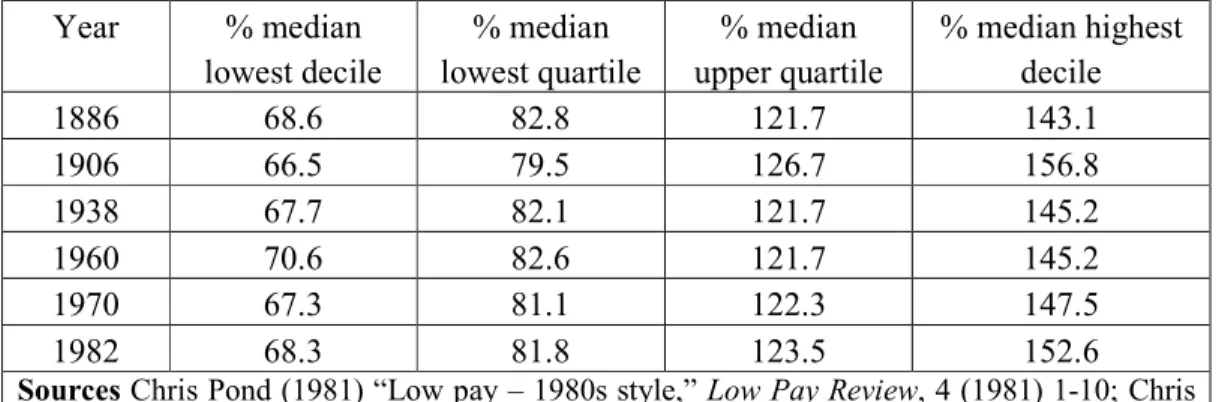
Table 2.1 Dispersion of weekly earnings of full-time manual men,
1886-1980 38
Table 4.1 The unemployment benefit as a percentage of weekly earnings
under the National Insurance Scheme in 1965 111
Table 4.2 The unemployment benefit as a percentage of weekly earnings under the National Insurance Scheme and the earnings-related
supplementary scheme 112
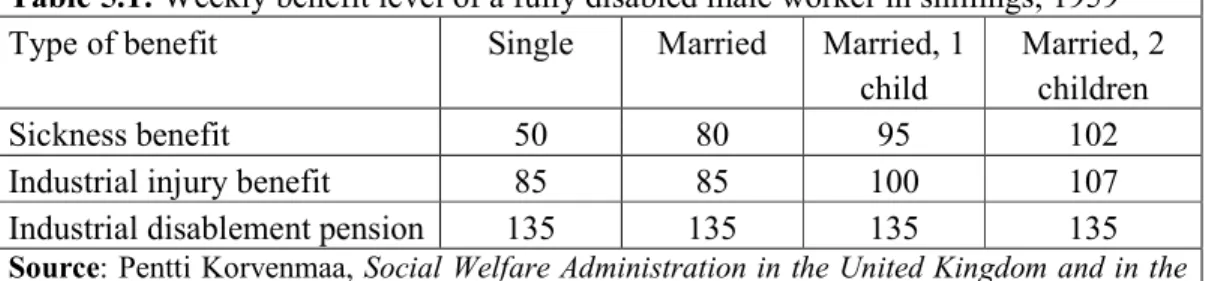
Table 5.1 Weekly benefit level of a fully disabled male worker in shillings,
1959 133
Table 5.2 Benefit as a percentage of previous earnings under Labour’s sick pay proposal and the existing National Insurance Scheme during
the first 4 weeks of sickness or disability` 140
Table 5.3 Benefit as a percentage of previous earnings under Labour’s sick pay proposal and the industrial injury benefit during the first 4
weeks of sickness or disability 142
Table 5.4 Disability insurance in the Netherlands in the early postwar period 146
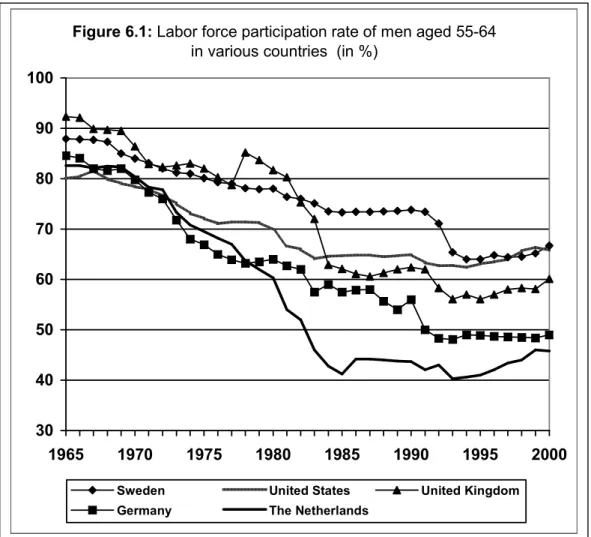
Figure 6.1 Labor force participation rate of men aged 55-64 in various
countries (in %) 161
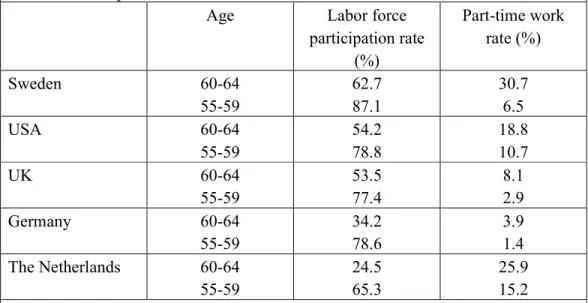
Table 6.1 Composition of the labor force of older men in various countries,
1989 162
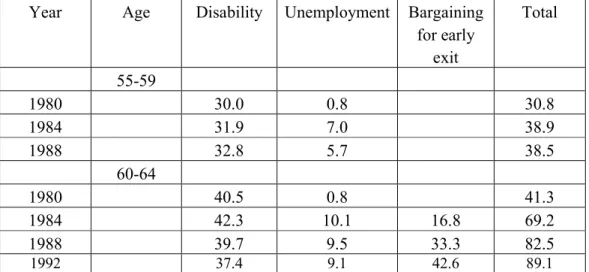
Table 6.2 The use of different early retirement pathways among male workers in the Netherlands, 1980-1992, by number of participants as a
percentage of the age groups 55-59 and 60-64 166
Figure 6.2 Disability benefit recipients per 1000 active labor market
LIST OF ABBREVIATIONS
The United Kingdom
AEEU Amalgated Engineering and Electrical Union BEC British Employers’ Confederation
CAWU Clerical and Administrative Workers Unions CBI Confederation of British Industry
CSPA Civil Service Pensioner Alliance
EETPU Electrical, Electronic, Telecommunications and Plumbing Union FBI Federation of British Industries
GMWU General and Municipal Workers Union ISTC Iron and Steel Trades Confederation LOA Lifes Offices’ Association
NALGO National Association of Local Government Officers NFPW National Federation of Professional Workers NEDC National Economic Development Council NEDO National Economic Development Office NJAC National Joint Advisory Council
NUM National Union of Mineworkers NUPE National Union of Public Employees NUR National Union of Railwaymen NUS National Union of Seamen
NUVB National Union of Vehicle Builders
RMT National Union of Rail, Maritime and Transport Workers SERPS State Earnings Related Pension Scheme
STOP Save the Occupational Pension
TGWU Transport and General Workers’ Union TSSA Transport Salaried Staffs’ Association TUC Trades Union Congress
The Netherlands
AAW Algemene Arbeidsongeschiktheidswet (General Disability Act) AKWV Algemene Katholieke Werkgeversvereniging (General Catholic
Employers’ Federation)
AOW Algemene Ouderdomswet (General Old Age Act)
CNV Christelijk Nationaal Vakverbond (Christian Union Federation) CSWV Centraal Sociaal Werkgevers Verbond (Central Social Employers’
Federation)
GMD Gemeenschappelijke Medische Dienst (Common Medical Service) KAB Katholieke Arbeidersbeweging (Catholic Workers Movement) KVP Katholieke Volkspartij (Catholic People’s Party)
KVW Katholiek Verbond van Werkgeversvakverenigingen (Catholic Federation of Employers’ Unions)
MHP Vakcentrale voor Middelbaar en Hoger Personeel (Federation for Middle and Higher Level Personnel)
NCW Nederlands Christelijk Werkgeversverbond (Christian Employers’ Federation)
NKV Nederlands Katholiek Vakverbond (Netherlands Catholic Trade Union Federation)
NVV Nederlands Verbond van Vakverenigingen (Dutch Association of Trade Unions)
PvdA Partij van de Arbeid (Dutch Labor Party)
RKWV Rooms-Katholiek Werkliedenverbond (Roman Catholic Workers’ Federation)
RvBA Raad van Bestuur in Arbeidszaken (Council of Directors in Labor Affairs) RVV Raad van Vakcentralen (Council of Trade Union Federations)
RvBA Raad van Bestuur in Arbeidszaken (Council of Directors in Labor Affairs) SER Sociaal-Economische Raad (Social-Economic Council)
SVR Sociale Verzekeringsraad (Social Insurance Council)
VNO Verbond van Nederlandse Ondernemingen (Federation of Dutch Industries)
VPCW Verbond van Protestantsch-Christelijke Werkgevers in Nederland (Federation of Protestant-Christian Employers)
VUT Vervroegde Uittreding (Early Retirement)
WAO Wet op Arbeidsongeschiktheidsverzekering (Act on Disability Insurance) WW Werkloosheidswet (Unemployment Act)
WWV Wet Werkloosheidsvoorziening (Unemployment Provision Act)
The United States
AFL American Federation of Labor CIO Congress of Industrial Organizations
Sweden
1
LABOR AND THE DEVELOPMENT OF
THE POSTWAR WELFARE STATE
The first decades of the postwar period undoubtedly represent a crucial epoch in the development of the modern welfare state. Within a time span of only two to three decades, all nations of the advanced industrial world created intricate systems of social protection that raised entire groups of the feeble out of poverty, significantly reduced market-generated income disparities, and greatly diminished the financial consequences of labor market risks like unemployment, sickness, disability, and old age. In the immediate postwar period, the bulk of the population living in the advanced industrial world relied on grossly inadequate levels of protection against hardships resulting from labor market risks. By the 1970s, most of them could count on very generous protection against such hardships. During this decade, more people were entitled to more generous levels of protection against labor market risks than ever before – and arguably ever since.
Compared to previous time periods, the welfare achievements of the first half of the postwar period were truly remarkable. Yet they were by no means equally remarkable in all nations of the advanced industrial world. While all advanced industrial nations experienced sharp increases in both public and private social expenditure during the first half of the postwar period, they differed markedly both in the overall level of this increase and, perhaps more importantly, in the division within what is popularly known as the ‘public and private mix’.1 As a result, societies came to differ greatly in their ability to protect their members against the risks of economic misfortune and dependency. Most importantly, they came to differ greatly in their ability to provide adequate levels of social protection for all their members. This study is concerned with understanding this difference, which is deeply rooted in the ability of societies to foster social solidarity.
Despite the existence of a vast literature on the development of the postwar welfare state, scholars still struggle to account for differences in the ability of societies to offer adequate social protection to all their members. In this study, I argue that our understanding of welfare state variation cannot be improved without a fundamental reappraisal of the role of organized labor in welfare state development. I argue in particular against the convention of seeing welfare state development as part of the emancipation struggle of the worker movement. This view has resulted in a strong tendency to view labor unions as natural proponents of the welfare state and to see the success of welfare state development as dependent on labor’s relative power resources against capital. In this study, I argue against this view by emphasizing that welfare state
1
6
development is mainly about redistribution of income and risk among different categories of employers, the self-employed, and most of all, different categories of workers.
This study emphasizes the importance of the organizational blueprint of labor unions for the development of welfare states. Its main objectives are to show how the involvement of labor unions in welfare state development – and through this, the involvement of other interest groups like employer associations – are shaped by the way workers’ interests are structured, and how these involvements themselves shape welfare outcomes. To demonstrate the importance of union structure, I compare the involvement of labor unions in the development of the British and Dutch welfare states from roughly the early 1940s through the late 1970s. Throughout this period, the British and Dutch labor union movements were key players in the creation and expansion of public provision for the elderly, unemployed, sick, and disabled. Yet because of differences in their organizational blueprints, their stances toward and consequently their involvement in the development of these programs differed in important ways. In this study I analyze these differences, and show how they led to very different welfare outcomes in the two nations.
So far, the comparative literature on welfare state development has paid scant attention to the importance of the organizational structure of labor unions to their involvement in welfare state development. In the first section of this introduction, I show why this has been the case. In the rest of this introduction, I present my argument about how the organizational structure of national labor union movements matters to the ability of societies to achieve adequate levels of social protection for all their members.
REVISITING THE ROLE OF LABOR IN WELFARE STATE DEVELOPMENT In the comparative literature on welfare state development, labor associations have always played a prominent role. As the main purpose of the welfare state has always been to protect workers from labor market risks, the importance attached to organized labor’s involvement in the development of welfare states is unsurprising. What is quite surprising, however, is that all this attention has not resulted in a strong awareness of the very diverse and often conflicting nature of different groups of workers’ demands for security against labor market risks. In much of the literature on welfare state development, workers are treated as a homogenous group with united interests in the introduction and expansion of public welfare programs. This has resulted in a rather one-sided treatment of the involvement of organized labor in welfare state development. Labor union support for this development is often assumed, but rarely tested.2 Welfare state development itself is often seen as a political victory of labor over capital, and
2
7 seldom as an outcome of the willingness of labor associations to redistribute income and risks within the labor category.3 And finally, cross-national differences in welfare state programs are generally explained by looking at the degree to which workers organize into labor unions, as opposed to the manner in which they do so.4
This view of the involvement of organized labor in welfare state development has been put forward most forcefully, although by no means exclusively, by the adherents of the so-called “power resources” perspective of welfare state development. This perspective rose to prominence in the welfare state literature in the 1970s, and remains so today. As a derivative of class analysis, the power resources perspective views welfare state development as primarily involving distributive conflict between workers and employers. One consequence of this emphasis on class as an explanatory concept for welfare state development is a strong tendency to view workers, but also employers and the self-employed, as homogeneous groups in which group members share similar risks and resources, and thus similar interests.5 Another consequence is a strong tendency to define labor as a “subordinated” or “disadvantaged” group that needs to be “compensated” or “emancipated” by the welfare state.6 In this perspective, the outcome of welfare state development depends principally on labor’s relative “power resources” compared to those of the “bourgeois” or “capitalist” forces.7
Over the years, the power resources perspective has been criticized for many sins of omission. Often, these criticisms began with the observation that labor’s relative power resources alone – whether defined in terms of union density levels, social democratic parties’ electoral strength or their participation in government, or the weakness of
3
See, for example, Esping-Andersen, The Three Worlds, 22; Michael Shalev, “The Social Democratic Model and Beyond: Two Generations of Comparative Research on the Welfare State, Comparative Social Research 6 (1983) 320.
4
For some prominent studies that emphasize the importance of union strength, see Gøsta Esping-Andersen and Kees Van Kersbergen, “Contemporary Research on Social Democracy,” Annual Review of Sociology 23 (1992) 191; Rothstein, Just Institutions Matter, 151; Evelyne Huber and John D. Stephens, Development and Crisis of the Welfare State. Parties and Policies in Global Markets (Chicago: The University of Chicago Press, 2001) 1; and Duane Swank, Global Capital, Political Institutions and Policy Change in Developed Welfare States (Cambridge: Cambridge University Press, 2002) 42-43.
5
According to Walter Korpi, for example, “at the most general level we can distinguish three socio-economic classes: employers, employees, and the self-employed. Although internally quite heterogene-ous, these broad categories define similarities in actors’ opportunities and constraints, resources, and risks.” Walter Korpi, “Power Resources and Employer-Centered Approaches in Explanations of Welfare States and Varieties of Capitalism,” World Politics 58 (2006) 174. According to Gøsta Esping-Andersen and Roger Friedland, in Sweden “more than in any other European nation...the working class has been capable of initiating and imposing its policy preferences.” Gøsta Esping-Andersen and Roger Friedland, “Class Coalitions in the Making of Western European Economics.” In Esping-Andersen and Friedland, Political Power and Social Theory. Volume III (Greenwich: Jai Press, 1982) 18-19.
6
According to Walter Korpi, the main aim of the welfare state is to “compensate labor for its disadvantaged position on the labor market.” According to Gøsta Esping-Andersen, it is to “emancipate workers from market-dependence.” Walter Korpi, The Democratic Class Struggle (London: Routledge and Kegan Paul, 1983) 83; Esping-Andersen, The Three Worlds, 22.
7
8
bourgeois or capitalist forces – cannot explain welfare state outcomes in many nations.8 Some scholars have used this shortcoming to argue for the importance of Christian democracy as an active force in shaping welfare state outcomes.9 Others have used it to criticize the power resources perspective for focusing only on workers’ interests in welfare state development. To fully understand cross-national variation in welfare patterns, these scholars have argued, it is necessary to look to the welfare demands of other societal groups like farmers and the (otherwise) self-employed as well.10 More recently, a group of scholars has even come to challenge the assumption of employer hostility to welfare state development.11
In this work, I criticize the power resources perspective in a different and, arguably, more fundamental way. This criticism starts with the belief that workers, like employers and the self-employed, do not constitute a homogenous group with similar interests. Perhaps more than any other societal group, workers as a group hold multiple and partly contradictory interests when it comes to welfare state development. Different occupational categories of workers differ greatly in terms of income and the degree to which they are exposed to labor market risks. As a result, they also differ greatly in their welfare demands. There are many workers who do indeed have a “disadvantaged” position on the labor market; but there are also many workers whose position on the labor market is by contrast quite comfortable. Whereas the former clearly have an interest in welfare state development, the latter often do not. This makes it questionable whether the concept of class is the most useful lens with which to examine welfare state development. It certainly means that the conventional preoccupation of scholars with labor’s organizational strength is unwarranted.
This study proceeds with the recognition that the main purpose of the welfare state is neither to “compensate labor for its disadvantaged position on the labor market,” nor to “emancipate workers from market-dependence.”12 Instead, it is to redistribute risks and resources among society’s more and less privileged members. In this regard, a crucial distinction has to be made between private and public solutions for provision against labor market risks. Even the purest form of social security differs from private insurance
8
For these definitions of labor’s relative power resources, see, among others, John D. Stephens, The Transition from Capitalism to Socialism (London: Macmillan, 1979); Francis Castles, “The Impact of Parties on Public Expenditures.” In Frances Castles, The Impact of Parties: Politics and Policies in Democratic Capitalist States (Beverly Hills: Sage, 1982); Huber and Stephens; Development and Crisis; and Hicks, Social Democracy.
9
Ever since Kees Van Kersbergen’s (1995) seminal study on the impact of Christian democracy on welfare state development, power resources scholars have argued that the presence of a large confessional party might produce a generous welfare state when this party is in competition with leftist political parties. See Kees van Kersbergen, Social Capitalism: a Study of Christian Democracy and the Welfare State (London: Routledge, 1995).
10
See, for example, Peter Baldwin, The Politics of Social Solidarity. Class Bases of the European Welfare State 1975-1975 (Cambridge: Cambridge University Press, 1990).
11 See, for example, Peter Swenson, Capitalists against Market: The Making of Labor Markets and Welfare States in the United States and Sweden (Oxford: Oxford University, 2002); Colin Gordon, New Deals: Business, Labor and Politics in America, 1920-1935 (Cambridge: Cambridge University Press, 1994); Idem, Dead on Arrival: the Politics of Health Care in Twentieth-Century America (Princeton: Princeton University Press, 2003); Isabela Mares, The Politics of Social Risk: Business and Welfare State Development (Cambridge: Cambridge University Press, 2003).
12
9 in an important way: public pooling of risks allows society’s more risk-prone members to receive the same level of protection as its less risk-prone members. The redistributive feature of this lies in the reapportioning of risks; after all, when all members share in the common risk pool on equal terms, ‘good’ risks effectively subsidize ‘bad’ risks. Most of the time, the redistributive nature of social security programs does not end here, as all members seldom share in the common risk pool on completely equal terms. The systems of contributions and benefits of most social insurance programs work to the advantage of their poorer members – who tend to be society’s more risk-prone members as well.
As a result of their tendency to focus on class divisions, scholars often fail to examine how these redistributive consequences affect the distribution of income and risk in society. Rarely do they mention that redistributive welfare state development mainly affects the distribution of income and risk among different categories of workers. This is nevertheless evidently the case for two reasons. First, in modern capitalist societies, nearly all breadwinners are workers and most of the national income is divided among workers. This means that workers also pay the brunt of welfare state expenditure, either as contributors, as taxpayers, or, when employers contribute to social security as well, as consumers. Second, and as mentioned before, workers differ to a vast degree in income and exposure to economic risk. Skilled manual workers typically enjoy higher wages and greater job security than do semi- or unskilled manual workers. Some categories of white-collar workers enjoy even higher wages than skilled manual workers, and are even less exposed to labor market risks. Finally, other categories of white-collar workers earn wages and have a degree of job security that more closely reflect those of skilled manual workers or even of semi- and unskilled manual workers. When these different categories or groups of workers join the same risk pool, or come to belong to a pension scheme with a system of contributions and benefits that works to the advantage of its poorer members, the result is a massive redistribution among them.
Based on the above, I put forward a view of the involvement of organized labor in welfare state development that differs markedly from conventional views – especially from those put forward by power resources theorists. This view starts with the claim that labor union support for redistributive welfare state development cannot be taken for granted. Whether labor unions support redistributive welfare state development, I argue, depends on the kind of workers they organize. Do they mainly organize skilled workers with a strong position on the labor market? Or do they also organize many workers who can only achieve adequate security against risk through risk redistribution and a redistributive contributory system? Depending on the risk and income profile of their members, unions will value public welfare solutions, and especially their redistributive consequences, in quite different ways. It is for this reason that I argue against the “consensus in the literature that the policy efficacy of left parties depends on the extent to which they can count on strong trade unionism.”13 More important than the organizational strength of labor unions is whether they are united in their support for
13
10
redistributive welfare state development. This, I argue here, depends on the way in which they are organized.
THE IMPORTANCE OF UNION STRUCTURE FOR WELFARE STATE DEVELOPMENT
There are two ways to understand the impact of labor unions on welfare state development. The first is by emphasizing the importance of the extent to which labor unions organize workers. As a result of their tendency to focus on labor unity and strength against capital, this is how most scholars approach the involvement of labor unions in welfare state development. A second approach to the impact of labor unions on welfare state development centers on the ways in which unions organize and represent workers. In this work, I argue that the way in which workers organize into unions matters more to the ability of societies to achieve adequate levels of social protection for all their members than the extent to which they do so. In other words, I argue for the importance of the organizational structure of labor unions over that of their organizational strength.
There are several ways to look at the organizational structure of national labor union movements. National labor union movements differ from each other mainly in the degree to which they are fragmented along regional, religious, sectoral, and occupa-tional lines. In this study, I focus mainly on this last source of fragmentation. This is not to say that other divisions do not affect the stance of labor unions towards welfare state development. On the contrary, religious divisions, in particular, can be quite important to labor union’ attitudes vis-à-vis the welfare state. Subsequent chapters of this study will show, for instance, that protestant, catholic and ‘socialist’ union federations in the Netherlands have on occasion held markedly different attitudes towards government intervention. Yet I argue that regional and religious divisions impact the stance of labor unions on welfare state development much less than do occupational divisions. This is because no type of union organization lays the competing interests of different categories of workers with regards to redistributive welfare state development so clearly bare as does the organization of workers along occupational lines.
The distinctive feature of occupational unionism is that it organizes workers accord-ing to skill or occupation. This type of union organization neatly divides the labor movement into unions that represent workers who do and those that represent workers who do not depend on redistributive, and thus public, welfare solutions to achieve adequate insurance against labor market risks. After all, the risk and income profile of workers, and thus their ability to achieve adequate security against risk without a redistributive effort from other workers, depend greatly on their skill or occupational profile. Skilled manual workers, for example, are generally quite able to obtain adequate security against risk through private bargaining – or at least, through a combination of public and private provision that involves no redistribution of risks or introduction of a redistributive contributory system.14 Semi- and unskilled manual workers, on the other
14
11 hand, usually cannot obtain adequate security in the same way. Likewise, different occupational categories of white-collar workers differ greatly in their ability to do so.15 When all these different occupational categories organize into separate unions, the union movement naturally becomes divided in its welfare preferences. Unions representing privileged occupational categories may support public welfare develop-ment solutions for a variety of reasons; for example, their members may appreciate the ability of public welfare schemes to provide pay-as-you-go financing.16 Yet they will have little reason to support any initiative that redistributes risks and resources, as this goes against the interests of their entire membership. In this, they will differ strongly from unions that organize large numbers of lower-skilled, and thus lower-paid and more risk-prone workers.
Crucially, no other type of union organization leads to such a clear division between more and less privileged workers. Even where regional, religious, or sectoral divisions are strong – and the latter is typically the case in nations where occupational unionism is weak – the union movement will be characterized by unions with quite diverse membership profiles in terms of income and risk. A central argument of this study is that such unions differ markedly in their stance on redistributive welfare state development from occupationally-organized unions that limit their membership to privileged workers. The crucial distinctive feature here is that unions that seek to organize workers regardless of skill and occupation emphasize broad worker solidarity as opposed to occupational identity. When seeking to improve the protection of their members against labor market risks, such unions will be far more likely to consider redistributive welfare solutions. This means that in nations in which the union movement is organized along ‘vertical’ as opposed to ‘horizontal’ lines, it will be far easier to achieve adequate levels of social protection for all workers.
Despite their tendency to focus on labor’s struggle with capital, some scholars have recognized the importance of the distinction between union organization along occupational and union organization along sectoral lines. In fact, the importance of union structure seems to have been recognized most fully in the early works of some power resources scholars. In The Democratic Class Struggle, for example, Walter Korpi mentioned that “it is of significance whether workers are organized on the basis of craft or industry.”17 In The Transition from Capitalism to Socialism, John D. Stephens noted that “the character of labor organization once it develops in a country…also has an Hugh Clegg, The Changing System of Industrial Relations in Britain (Oxford: Blackwell, 1979) 436-37; Alan Campbell, Nina Fishman and John McIlroy, “The Post-War Compromise: Mapping Industrial Politics, 1945-64.” In Campbell, Fishman, and McIlroy, British Trade Unions and Industrial Politics. Volume One: the Post-war Compromise, 1945-1964. (Aldershot: Ashgate, 1999) 77-78; Gary Marks, “Variations in Union Political Activity in the United States, Britain and Germany from the Nineteenth Century,” Comparative Politics 22:1 (1989) 84.
15 On the diversity of the white-collar category, see, for example, Michael P. Kelly, White-collar Proletariat. The Industrial Behaviour of British Civil Servants (London: Routledge and Kegan, 1980). 16
Private pension plans often cannot offer pay-as-you-go financing and are generally based on funded contributions. The appeal of pay-as-you-go financing for privileged workers is that it does not require saving, since current benefits are paid for by current contributions. For poorer workers, the added appeal is that it can also easily be used to redistribute among different categories of workers.
17
12
important effect on class formation and class consciousness.”18 Finally, in Politics Against Markets, Gøsta Esping-Andersen emphasized the importance of “vertically organized and nationally centralized trade unionism” for the social democratic road to victory in Norway and Sweden, since “class unity is more difficult to achieve under conditions of competition between craft workers, unskilled industrial laborers, and the rural proletariat.”19
Yet in the view of these power resources scholars, the importance of union structure lay foremost in the degree to which it extended labor’s organizational power against capital.20 As a result, they either ranked it secondary in importance to union strength in their attempts to explain cross-national variation in welfare outcomes, or neglected it completely. Esping-Andersen, it must be acknowledged, did cite the relative importance of craft unionism in Denmark and the lack thereof in Norway and Sweden to show that the industrial proletariat in the latter two nations was “better situated to invoke broad class solidarity.”21 Yet Korpi, in his chapter on social policy, examined only union density and the governmental inclusion of left parties in his attempts to account for welfare variation among nations. Stephens, in turn, explained the absence of a generous welfare state in the United States only through the “very low level of labor organization and the absence of a major reformist labor party.” And despite the fact that the division of labor’s share of the national income clearly involves a conflict of interests among different categories of workers, he directly linked cross-national differences in wage equality to cross-national differences in union strength.22
More recent attempts to explain cross-national patterns of welfare state development have arguably paid even less attention to union structure. Often, welfare state scholars do not even mention the nature of union organization in the country or countries that they investigate. So have recent writings on the involvement of employer interest groups in welfare state development paid scant attention to the possibility that the nature of this involvement may be shaped by the attitudes of labor unions towards the redistributive consequences of attempts to create adequate provision for all workers – as will be shown at length in chapter 2. This is surprising, as one variant of this scholarship seems well aware of the fragmented nature of worker interests regarding redistributive welfare development.23 Likewise, in his otherwise seminal work on the involvement of the “middle classes” in the development of several European welfare states, Peter Baldwin has not mentioned the importance of differences in union structure between
18
Stephens, The Transition, 45. 19
Gøsta Esping-Andersen, Politics Against Markets: the Social-Democratic Road to Power (Princeton: Princeton University Press, 1985) 88.
20
According to Korpi, for example, “Working-class power resources can be expected to be greatest where the labour movement is well integrated and has strong support from wage-earners.” Korpi, The Democratic, 39.
21
Esping-Andersen, Politics Against Markets, 88. 22
Stephens, The Transition, 149. 23
13 these nations – even though these matter immensely to the way in which the interests of the largest middle class group, namely privileged workers, are represented.24
This neglect of the importance of union structure to welfare state development has led to an inadequate understanding of cross-national differences in welfare state development. So are the generous nature of public welfare provision in the Netherlands and the opposite in the United Kingdom seldom linked to the dominance of vertically organized unionism in the former and the dominance of horizontally organized unionism in the latter. As a result, scholars have often wondered how the Netherlands, where labor’s relative “power resources” have always been so weak, could develop such a generous and redistributive welfare state. They have also struggled to reconcile the British welfare state’s continual inability to provide adequate public benefits with labor’s relatively strong “power resources” there.25 Of course, scholars also widely assume labor union support for the introduction and expansion of public welfare programs in the United Kingdom.26
The neglect of the importance of union structure by welfare state scholars has been most detrimental to our understanding of welfare state development in nations – like the United Kingdom – in which the labor union movement is largely organized along occupational lines. In such nations, labor union support for welfare state development cannot be taken for granted. Yet welfare state scholars nevertheless tend to do so. When confronted with cases in which labor unions displayed little interest in welfare state development, or even outright opposed welfare initiatives, scholars have focused on several explanations that all fail to take into account the redistributive consequences of such initiatives. The most popular way to explain such instances is by referring to an ideological commitment of labor unions to “voluntarism” – the idea that the state has to abstain from direct intervention in the labor market. This commitment is then in turn explained as the outcome of union anxiety over the consequences of allowing a potentially hostile “bourgeois” state to undermine union functions.27
24
On the contrary, in his account of the reaction of the British Trades Union Congress to several Labour government attempts to introduce superannuation, he states: “It has been argued that, by covering white- and blue-collar wage earners, the TUC was unable to represent the interests of the latter as effectively as the LO [the main Swedish labor union federation] was able to do. The evidence in this case suggests the opposite.” Peter Baldwin, ThePolitics, 243, fn. 137. Baldwin refers to several works of Richard Scase, who is one of the few scholars who has emphasized the importance of union structure in his works. See, for example, Richard Scase, Social Democracy in Capitalist Society: Working-Class Politics in Britain and Sweden (London: Croom Helm, 1977).
25
On the mismatch between British and Dutch welfare state outcomes and the claims of power resources theorists, see, for example, Göran Therborn, “‘Pillarization’ and ‘Popular Movements’. Two Variants of Welfare Capitalism: the Netherlands and Sweden.” In Francis Castles, Comparative History of Public Policy (Cambridge: Polity, 1989) 208; and Michael Hill, Social Policy: A Comparative Analysis (London: Prentice Hall, 1996) 42.
26
See, for example, Robert Taylor, The Fifth Estate: British Unions in the 1970s (London: Routledge, 1978) 172; Michael Hill, The Welfare State in Britain. A Political History Since 1945 (Brookfield: Edward Elgar, 1993) 50; Helen Fawcett, “Jack Jones, the Social Contract and Social Policy 1970-4.” In Helen Fawcett and Rob Lowe, Welfare Policy in Britain. The Road from 1945 (London: Macmillan, 1999) 158; Isabela Mares, Taxation, 178-9.
27
14
In this work, I take a different view on such cases of union disinterest in or opposition to welfare state development. This view begins with the recognition that unions that display little interest in welfare state initiatives often represent skilled and thus privileged workers who strongly oppose any initiative that results in a redistribu-tion of risk or income among different categories of workers. Most welfare initiatives, and many other instances of government intervention in the labor market, do exactly this. This means that the voluntarist inclinations of unions are often rooted as much in union anxiety over the consequences of government intervention on wage differentials among different categories of workers as in worries about allowing a potentially hostile state to undermine union functions. In the following chapter of this work, I will explain this at length.
THE ORGANIZATION OF THE BOOK
Although the aim of this work is to develop an argument on the importance of union structure that is broadly applicable, for reasons of expediency the main comparison in this work is between the Netherlands and the United Kingdom. The choice of these two countries can be easily defended. Differences in both the organizational strength and structure of their labor union movements make them ideally suited to illustrate the importance of the latter. In terms of pure organizational strength, the British labor union movement has outperformed its Dutch counterpart throughout the entire postwar period.28 I noted above how difficult it has been for scholars to reconcile this with the continual inability of the British welfare state to provide adequate protection against labor market risk to all workers, and the very generous and redistributive nature of the Dutch welfare state. Had they realized the importance of the strength of occupationally-organized unionism in the United Kingdom and its almost complete absence in the Netherlands, then they would surely have found this to be less difficult. In the United Kingdom, nearly all skilled manual and white-collar workers are organized into their own craft and occupationally-organized white-collar unions. Barred from membership in these unions, semi- and unskilled workers, who often lack a strong occupational profile, have mostly come to rally in separate general unions. In the Netherlands, by contrast, such divisions hardly exist. Here, nearly all workers rally in industrial unions – a union type that is virtually absent in the United Kingdom.29
Institution, 1979) 113; Victoria Hattam, Labor Visions and State power: The Origins of Business Unionism in the United States (Princeton: Princeton University Press, 1993) 5; Michael K. Brown, “Bargaining For Social Rights: Unions and the Re-Emergence of Welfare Capitalism, 1945-1952,” Political Science Quarterly 112: 4 (1997-98) 663; Marie Gottschalk, The Shadow Welfare State. Labor, Business, and the Politics of Health Care in the United States (Ithaca: Cornell University Press, 2000) 43; Stephens, The Transition, 89; and Gordon, Dead on Arrival, 275. I will return to the American case in the final chapter.
28
In the early postwar period, some 40 percent of Dutch workers were organized in labor unions. From the late 1970s on, this percentage fell steadily, to under 25 percent today. In the United Kingdom, union membership stood just over 40 percent in the immediate postwar period. Thirty years later, it had increased to over 50 percent, after which it decreased to about 30 percent today. See Jelle Visser, European Trade Unions in Figures (Deventer: Kluwer, 1989) 151-2 and 240-1; Idem, “Union Membership Statistics in 24 Countries,” Monthly Labour Review (January 2006) 45.
29
15 In this book I aim to show how differences in union structure mattered to welfare outcomes in the two nations. The book is organized into seven chapters, of which this introduction is the first. Chapter 2 begins with an analysis of the organizational differences between the British and Dutch labor union movements, and puts these differences in historical perspective. It then explores how these differences lead to the development of very different labor market features in the two countries. One of the main purposes of this section is to show how the stance of unions towards redistribution of income among workers shaped their attitude toward state intervention in the labor market – which often has a redistributive aim, and nearly always has redistributive consequences. The chapter ends with a survey of recent writings on the involvement of employer interest groups in welfare state development, and shows how union structure affected this involvement.
Chapters 3 through 6 analyze the introduction and expansion of the major postwar social security programs in the Netherlands and the United Kingdom. These chapters form the empirical ‘core’ of this book. Chapters 3, 4 and 5 show how the organizational structure of the British and Dutch labor union movement affected the development of public welfare programs for, respectively, the elderly, the unemployed, and the sick and disabled in these countries. These chapters cover a period ranging from roughly the early 1940s to the late 1960s. Chapter 6 explores how some of these programs came to be used for early retirement purposes during the 1970s. As this development took place to a much greater degree in the Netherlands than in the United Kingdom, this chapter focuses mainly on the Dutch case.
Chapter 7 summarizes the findings of this work and looks at their most important implications. The chapter first summarizes my findings on the importance of union structure for welfare state outcomes in the Netherlands and the United Kingdom. In so doing, the chapter also summarizes the implications of this importance for the involvement of employer interest groups in welfare state development. Building on this, it then explores the implications of my findings for our understanding of welfare state development in other countries – whereby special attention will be paid to the situation in the United States. Finally, it examines the implications of my findings for our understanding of the causes of national variation in labor market institutions and the related subject of wage equality.
A NOTE ON SOURCES
16
Association of Trade Unions30 (Nederlands Verbond van Vakverenigingen, henceforth NVV); the Catholic Workers Movement (Katholieke Arbeidersbeweging, henceforth KAB); its successor, the Netherlands Catholic Trade Union Federation (Nederlands Katholiek Vakverbond, henceforth NKV); and the protestant Christian Union Federation (Christelijk Nationaal Vakverbond, henceforth CNV). When important decisions in the field of welfare were to be made, the social security experts and leadership of these federations often met in the Council of Trade Union Federations (Raad van Vakcentralen, henceforth RVV).
Both because one of the purposes of this work is to show how union structure matters to the involvement of employer interest groups in welfare state development, and because the records of such groups also provided valuable information on the actions of unions, this work also draws heavily on the minutes of various committee and board meetings of important employer federations. In the United Kingdom, these federations were: the Federation of British Industries (FBI); the British Employers’ Confederation (BEC); and their predecessor, the Confederation of British Industry (CBI). In the Netherlands, there were so many employer federations that it would take too much space here to list them exhaustively. Of most importance for this research were the minutes of the liberal Central Social Employers’ Federation (Centraal Sociaal Werkgevers Verbond, henceforth CSWV) and those of its successor, the Federation of Dutch Industries (Verbond van Nederlandse Ondernemingen, henceforth VNO). Of slightly less importance were the minutes of the Catholic Federation of Employers’ Unions (Katholiek Verbond van Werkgeversvakverenigingen, henceforth KVW) and the General Catholic Employers’ Federation (Algemene Katholieke Werkgevers-vereniging, henceforth AKWV); the Federation of Protestant-Christian Employers in the Netherlands (Verbond van Protestantsch-Christelijke Werkgevers in Nederland, henceforth VPCW); and the general-confessional Federation of Catholic and Protestant-Christian Employers’ Unions (Federatie van Katholieke en Protestants-Christelijke Werkgeversverbonden, henceforth FCWV) and Christian Employers’ Federation (Nederlands Christelijk Werkgeversverbond, henceforth NCW). As was the case with their union counterparts, the social security experts and leadership of these various employer federations often held meetings in a common platform, called the Council of Directors in Labor Affairs (Raad van Bestuur in Arbeidszaken, or RvBA).
30
2
LABOR DIVIDED
In 1951, in an article on the growing importance of white-collar unionism in the United Kingdom, the British economist Guy Routh published a survey of the “distribution of the gainfully occupied population of Great Britain.”1 In this survey, ninety-five percent of all economically active persons were characterized as “workers.” These were divided into nine occupational categories. First on Routh’s list were unskilled manual workers who, according to the survey, represented twelve percent of the economically active population. Second on the list stood the largest occupational group, semi-skilled manual workers, who represented some twenty-eight percent of the gainfully occupied population. These were followed by skilled manual workers, who represented an additional twenty-five percent of the economically active. All other worker-occupations mentioned in the survey belonged to the white-collar category. Although representing only about thirty percent of the economically active at the time, this category was by then already so diverse that the survey subdivided it into six different occupational groups, ranging from shop assistants, to foremen, to clerical workers, to managers, to higher professionals, and to lower professionals. In the years after Routh presented his survey results, the white-collar category would grow rapidly. In 1951, it accounted for roughly thirty-two percent of all workers. By 1971, this had increased to forty-three percent.2
Routh’s survey is mentioned here because it so neatly demonstrates the relative size and diversity of the British worker category at around the time of Britain’s first postwar social security reforms.3 Among those ninety-five percent of all economically active persons classified as “workers” were unskilled and semi-skilled manual workers, who held, respectively, very weak and fairly weak positions in the labor market. But the broad category of “workers” also included skilled manual workers, whose qualifications enabled them to earn much higher wages and made them much less prone to labor market risks such as unemployment. Other workers belonged to the “high-end” white-collar category of “higher professionals,” who earned an even higher income. Finally, many others belonged to the growing “low-end” white-collar legion of nurses, typists, waiters, telephone operators, and messengers, whose income and risk profiles were more comparable to those of semi-skilled or perhaps even unskilled manual workers than to those of their more privileged white-collar counterparts.4 The interests of these
1
For the survey, see Guy Routh, “White-collar Unions in the United Kingdom.” In Adolf Sturmthal, White-collar Trade Unions: Contemporary Developments in Industrialized Societies (Illinois: University of Illinois Press, 1996) 166.
2 See Robert Price and George Sayers Bain, “Union Growth Revisited: 1948-1974 in Perspective,” British Journal of Industrial Relations 4 (1966) 339-55.
3
The 1946 National Insurance Act had become effective in 1948, three years before the survey was undertaken.
4
20
different occupational categories regarding redistributive welfare state development were by no means similar. So, for example, were most unskilled and semi-skilled manual workers, and many low-end white-collar groups of workers, only able to achieve adequate levels of unemployment insurance through risk redistribution with other occupational categories. In this, they differed from skilled manual workers and other white-collar categories who, as we will see in chapter 4, were generally quite capable of achieving adequate provision through collective bargaining. Finally, some white-collar workers occupied such secure occupations that even the need to pursue occupational provision against unemployment may have seemed redundant for them.
In the literature on welfare state development and industrial relations, the divergence in interests among these different categories of workers is seldom fully acknowledged. Scholars often fail to examine this divergence even when explicitly focusing on occupational differences among workers. A good example of this is an investigation of the growth of white-collar unionism in the United Kingdom undertaken by the industrial relations expert George Sayers Bain during the mid-1960s. Following the convention of placing the distinction between labor and capital at the center of the analysis, Bain argued that the British labor union movement had to develop its membership among white-collar workers in order to avoid becoming “the increasingly outdated representa-tives of a declining industrial minority.” If the labor union movement failed to do so, Bain continued, “its ability even to advance the interests of its manual membership will be seriously impaired.”5 In coming years, the labor union movement did indeed absorb more and more white-collar workers. Especially from the mid-1960s on, an increasing proportion of white-collar workers unionized. Because white-collar employment numbers were also increasing rapidly, by the mid-1970s, two out of every five unionists belonged to the white-collar category, as compared to one out of every five only three decades earlier.6
One might, however, wonder how this was to increase the interests of the “manual membership” of the British labor union movement exactly. Of those white-collar workers who organized, nearly all did so within their own white-collar unions, of which membership was generally limited to certain privileged occupations. (Higher-educated white-collar workers were far more likely to be unionized than their lower-educated counterparts).7 These unions bargained separately from other unions, guarded wage described above, however, which is why I use the broader definition of the term. For a long, but probably still not exhaustive, list of workers who qualify as white-collar workers, see Bernhard Ebbinghaus and Jeremy Waddington, “United Kingdom/Great Britain.” In Ebbinghaus and Visser, The Societies of Europe, 722.
5
George Sayers Bain, “The Growth of White-Collar Unionism in Great Britain,” British Journal of Industrial Relations 4 (1966) 304 and 331.
6
See Arthur Marsh and Victoria Ryan, History Directory of Trade Unions. Volume I: Non-Manual Unions (Westmead: Gower, 1980) xi.
21 differentials as jealously as did craft unions representing skilled manual workers, and, mainly because of these differentials, took a stance towards government interference that was quite different from unions that also represented many lower skilled workers. In fact, and as we will see below and in the following chapters, in their resistance towards redistributive government intervention, they often sided with employer interest groups. In short, there is good reason to argue against the view that in the United Kingdom strong union organization among one occupational group of workers helps to advance the interests of other groups of workers as well.
Bain’s belief that unionization of white-collar workers would help to advance the interests of their manual worker counterparts can be attributed to one of two mistakes that are still often made by industrial relations and welfare state scholars: he was either not aware of the vast differences in interests among different occupational categories of workers, or he assumed that worker movements by necessity display some degree of worker solidarity. Yet different categories of workers have many competing interests and worker solidarity cannot be assumed – at least not in nations in which occupational divisions within the union movement lay these competing interests so clearly bare. Such occupational divisions matter a great deal here. Had Britain’s white-collar workers organized themselves predominantly in unions that catered to multiple occupational groups, then Bain’s argument would have been valid. Yet, because of a series of coincidental circumstances grounded in Britain’s industrialization process, they did not. A crucial feature of the British labor union movement is that it almost completely lacks unions that cater to a wide range of different occupational groups or skills. There are only a few unions in the United Kingdom that could qualify as industrial unions, and even these organize fewer grades of workers than do their counterparts in northwest continental Europe. The most complete industrial union in the United Kingdom is the National Union of Mineworkers (NUM). Even in this industry, however, ‘privileged’ white-collar professions like managers and under-managers, foremen, overmen, deputies, shotfirers and colliery clerks all organize in separate organizations.8 The same holds for the only other unions that could qualify as industrial unions in the United Kingdom, the National Union of Rail, Maritime and Transport Workers (RMT) and its most prominent predecessors, the National Union of Railwaymen (NUR) and National Union of Seamen (NUS). In other industries, skilled manual workers also rally in their own unions, leaving unskilled and semi-skilled manual workers to organize in separate general unions. While most of these unions are members of the TUC, this union confederation has done little to diminish the occupational divisions that exist within the British labor union movement. In fact, and as we will also see below and in the following chapters, it is mainly because of these occupational divisions that the TUC’s throughout the postwar period. In fact, it is for this reason that economists and labor market scholars initially often held that the effect of unionization was to increase wage inequality. See, for example, Milton Friedman, “Some Comments on the Significance for Labor Unions on Economic Policy.” In David Wright, The Impact of the Union (New York: Kelley and Millman, 1956) 124; and Albert Rees, The Economics of Trade Unions (Chicago: University of Chicago Press, 1962); John S. Pettingill, Labor Unions and the Inequality of Earned Income (Amsterdam: North-Holland Publishing Company, 1980) 3. 8
22
authority over its members is notoriously weak, and that its function is mostly limited to lobbying government.9
In the sharp differentiation of its unions along occupational lines, the United King-dom closely resembles those countries that were once part of its economic and political sphere of influence, like the United States, Canada, Australia, New Zealand, and Ireland – all countries that through no coincidence are known for their ‘liberal’ labor market and welfare features.10 At the same time, it differs starkly in this from its continental European counterparts. To be sure, occupational unionism also exists among the countries of continental Europe – and to a greater extent in some of these countries than in others. Yet crucially, its importance is nowhere as great on the European continent as in the Anglo-Saxon world. In most continental European countries a certain proportion of organized white-collar workers rally in separate white-collar unions. Yet contrary to in the United Kingdom, many of these white-collar unions are organized predominantly along ‘vertical’ lines.11 Perhaps even more important, in only three European countries did a strong craft tradition remain in existence during the postwar period. These countries are the United Kingdom, Ireland and Denmark – with craft unionism being much weaker in the latter than in the former two.12 Finally, all continental European countries have strong industrial unions that aim to organize workers regardless of skill or profession.
It could be argued that of all continental European countries, the Netherlands has historically differed most from the United Kingdom in terms of the
9
For craft opposition to the creation of a more powerful union federation, see James Fulcher, “On the Explanation of Industrial Relations Diversity: Labour Movements, Employers and the State in Britain and Sweden,” British Journal of Industrial Relations 26:2 (1988) 246-74. For a more general discussion of this, see also Richard Scase, Social Democracy, 37.
10
In Hall and Soskice’s typology of “liberal” and “coordinated” market economies, all countries mentioned here belong to the liberal market model. Similarly, all northwest continental European countries, with their industrially organized labor union movements, belong to the “coordinated” categories. These differences between the “liberal” Anglo-Saxon world and “Social Europe” have been noted in the welfare state literature as well. Yet because of the tendency of scholars to focus on class divisions, they have seldom been linked to differences in union structure. For Hall and Soskice’s typology, see Peter A. Hall and David Soskice, Varieties of Capitalism: The Institutional Foundations of Comparative Advantage (Oxford: Oxford University Press, 2001) 20. Note also the strong ‘liberal’ features of most Anglo-Saxon welfare states in for example Esping-Andersen, The Three Worlds, 74. 11
In Sweden, for example, most white-collar workers organize in separate white-collar unions that are represented by their own white-collar federations. A majority of the members of the largest white-collar federation, named Tjänstemännens Centralorganisation (TCO), however, are organized along sectoral lines. In Belgium, many white-collar workers also organize in separate white-collar unions. Most of these unions are in turn represented by the same union federations as are blue-collar unions – but this is not the point here. What is the point here is that these white-collar unions, like their Swedish counterparts, are predominantly organized along sectoral or ‘vertical’ lines. In most other continental countries, white-collar unionism follows either the Belgian or Swedish model. See, for example, Sturmthal, White-collar Trade Unions; Jelle Visser, In Search of Inclusive Unionism. A Comparative Analysis (Deventer: Kluwer, 1990); Ebbinghaus and Visser, The Societies of Europe; Van Ruysseveldt and Visser, Industrial Relations.
12