THE POLITICS OF LOSING THE “AAA” RATING:
A CRITICAL PERSPECTIVE ON THE SOVEREIGN DOWNGRADES OF THE UNITED STATES, FRANCE, AND AUSTRIA
Zachary Dunnam
A thesis submitted to the faculty of the University of North Carolina at Chapel Hill in partial fulfillment of the requirements for the degree of Master of Arts in the Department of Political Science, Concentration European Governance.
Chapel Hill 2013
Approved by:
Erica Edwards
Donald Searing
ii
ABSTRACT
ZACHARY DUNNAM: The Politics of Losing the “AAA” Rating: A Critical Perspective on the Sovereign Downgrades of the United States, France, and Austria
(Under the direction of Erica Edwards)
This article promotes the utility of critical theory to examine instances of private authority in
international affairs with a particular focus on the political consequences of a sovereign credit rating
downgrade. After historicizing the American roots of credit rating agencies and linking their global
expansion to the growth of transnational finance in the neo-liberal era, this article argues that credit
rating agencies’ authority is socially constructed and inextricably tied to the United States’ hegemonic
position in the current world order. This argument is qualified through case analyses of the politics
surrounding the sovereign downgrades of the US, France, and Austria. The results of these case
studies shows that following the global financial crisis of 2008 credit rating agencies’ judgments on
sovereign debt are much more political than technical, their power to affect the cost of capital is
diminished, and their authority is increasingly challenged by bondholders, political leaders, and
iii
ACKNOWLEDGEMENTS
The work I put into researching and writing this thesis required a great deal of support from many
people. I would personally like to thank Dr. Erica Edwards for her insightful feedback and guidance.
I am also grateful to the close friends who took time out of their busy schedules to provide an
outsider’s perspective on this academic work. I am especially indebted to the Political Science
department at Vrije University Amsterdam, who opened my eyes to theories and perspectives I might
otherwise would have overlooked. Finally, I would like to acknowledge the continued love and
iv
TABLE OF CONTENTS
LIST OF FIGURES……….v
Section I. Introduction………..1
II. Critical Theory and Private Authority in International Relations………2
III. Credit Rating Agencies and Global Governance……….4
Credit Rating Agencies in the Neo-liberal Era………..5
Neo-liberal Hegemony – The Structural Power of Capital and Epistemic Authority...8
IV. Methodology………..12
V. The Downgrade of US Sovereign Debt by Standard & Poor’s……….14
VI. Case Analysis: France and Austria………...16
The French Case………..20
The Austrian Case………...23
VII. Discussion………..27
v
LIST OF FIGURES
Figure
1. Trends in financial assets of institutional investors (US)………...7
2. Yields on U.S. 10-yr government bonds (4/2011 – 1/2012)………14
3. U.S. Stock Market – Dow Jones (4/2011 – 1/2012)……….15
4. France Stock Market – CAC 40 (5/2011 – 9/2011)……….17
5. Austria Stock Market – WBI (5/2011 – 9/2011)………..18
6. Yields on France 10-yr government bond (5/2011 – 9/2011)………..18
7. Yields on Austria 10-yr government bonds (5/2011 – 9/2011)………19
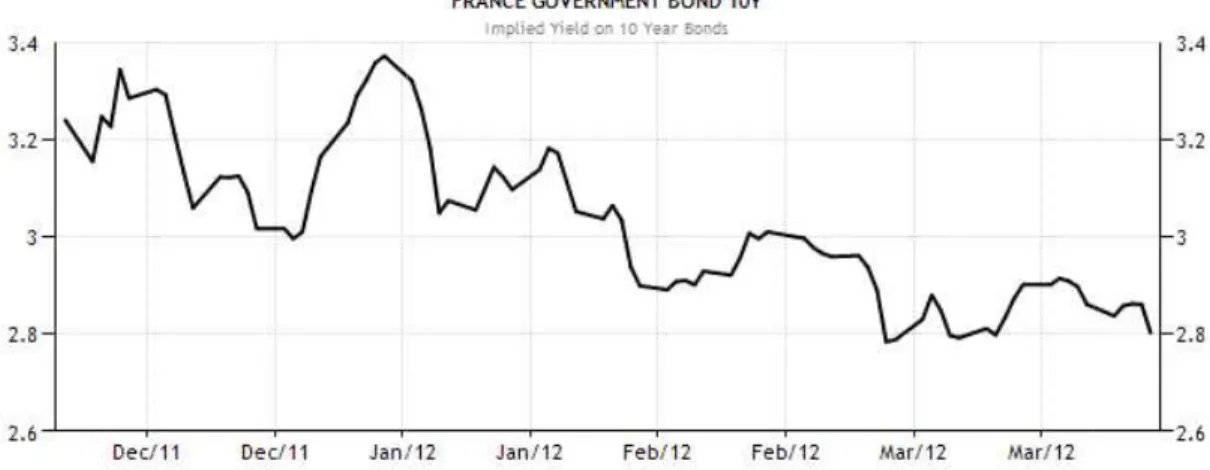
8. Yields on France 10-yr government bonds (12/2011 – 3/2012)………...21
9. France Stock Market – CAC 40 (12/2011 – 3/2012)………...21
10. Yields on Austria 10-yr government bonds (12/2011 – 3/2012)……….25
Introduction
The global financial crisis of 2008 resulted from numerous failures among state and non-state
actors to effectively govern the ever-increasing demands of expanding capital in the global economy.
Prior to the crisis, governments and other state regulatory institutions increasingly came to rely upon
non-state actors to monitor and manage the flow of capital as the speed of financial innovation
continued to outstrip the capacity of traditional state apparatuses to effectively govern the global
financial system. One of the most important non-state actors with public regulatory responsibility has
been the international credit rating agencies (CRAs), whose “relatively standardized, harmonized,
easy to understand, independent (third party) assessments of credit quality” (Basel Committee 2009)
became an essential element within the global financial governance mechanism (Sinclair 2001).
However, the outbreak of the subprime mortgage crisis revealed the CRAs contribution to the US real
estate bubble by “over-rating senior tranches in specialty purpose vehicles” (Lanoo 2008).
Additionally, their continued role in the assessment of sovereign debt throughout the euro-crisis has
helped precipitate the implementation of fiscal austerity and structural reforms in the fledgling
economies of the European periphery. With a downgrade by a rating agency having such immediate
and powerful consequences for a sovereign state, it is important that their role within the global
financial governance mechanism be critically assessed.
While an extensive study of CRAs influence on governments since the 2008 global financial
crisis would be highly enlightening, such an endeavor for this article is unfeasible, as changes in the
rating of sovereign debt occurred too frequently to permit the appropriate handling of data of this
magnitude. However, much insight can be gained by focusing our analysis on the unprecedented
event of the downgrade of the United States’ sovereign debt rating by Standard & Poor’s on August
5, 2011. It was the first time in history that the US lost its “AAA” credit rating and the subsequent
2
France and Austria would lose their “AAA” rating five months later, making all three the only
countries to lose their “AAA” status since the onset of the 2008 global financial crisis.1 The loss of a “AAA” sovereign rating is a rare incident, with only Japan, Australia, Sweden, and Canada having
previously experienced the event. But the downgrade of the world’s most important economy
provides a unique opportunity in which to critically examine the political and economic consequences
of such an occurrence and contribute to a broader investigation into the evolving role of CRAs as
private actors with considerable influence over sovereign states in the global economy. By
historicizing the American roots of CRAs and their eventual global expansion following important
changes in the global economy in the 1970s, this article will show that sovereign ratings are not
merely “expert” or technical opinions on the likelihood of a sovereign default, but are a global
governance mechanism that privilege the neo-liberal organization of production and are a
representation of the United States’ hegemonic position in the current world order. This assertion
will then be qualified by an in-depth case study of the political and economic events surrounding the
sovereign downgrade of both France and Austria on January 13, 2012. These cases will show that
while the sovereign ratings made by CRAs seem to have lost considerable influence among
bondholders since the 2008 global financial crisis, especially in countries high up the ratings scale,
the manner in which their opinions are politicized can generate disproportionate consequences on a
government’s fiscal policies and political dynamics.
Critical Theory and Private Authority in International Relations
As previously discussed, CRAs are an example of private actors wielding authority over
sovereign states in the international system and the relationships that exist between states and
non-state actors should be given proper theoretical consideration. But examining the development of
private authority in international affairs is often a difficult challenge for the traditional,
1
3
solving theories of international relations (IR). By viewing the state as the most important unit of
analysis, neo-realism and neo-liberal institutionalism not only overlook the relevance of non-state
actors in the international system, but they also fail to account for the existence of different kinds of
states with a diversity of goals and modes of interaction beyond the concerns of war and peace.
While of important practical use for the precise examination of a particular problem area involving a
limited number of variables (Cox 1981: 88), problem-solving theories assume the basic features of the
international system to be constant and are thus, unable to conceptualize structural change beyond
these features (Bieler and Morton 2003). However, critical theory “does not take institutions and
social power relations for granted but calls them into question by concerning itself with their origins
and how and whether they might be in the process of changing” (Cox 1981: 89). The main purpose
of this article is to analyze how the authority of CRAs emerged in the existing world order, how that
authority is exercised in the current crisis, and how and whether the nature of that authority is
changing. Thus, this article will apply a neo-Gramscian perspective in international political
economy (IPE) to the global growth of CRAs. I will then briefly examine Standard & Poor’s
downgrade of the United States to set up the political and fiscal responses that surrounded the
downgrade of my case studies, France and Austria.
The neo-Gramscian approach rests on a unique conception of hegemony. While neo-realism
conceives of hegemony as the military and economic dominance of a powerful state over all other
states (Gilpin 1981), the neo-Gramscian perspective broadens the concept’s domain to one “based on
a coherent conjunction or fit between a configuration of material power, the prevalent collective
image of world order (including certain norms) and a set of institutions which administer the order
with a certain semblance of universality” (Cox 1981: 103). Hegemony is thus conceived to extend
beyond the coercive actions of a powerful state to include the more consensual aspect of dominance
and subordination so that “dominance by a powerful state may be a necessary but not a sufficient
4
three spheres of activity: social relations of production, forms of state, and world orders (Bieler and
Morton 2003). These three spheres are interrelated:
Changes in the organization of production generate new social forces which, in turn, bring about changes in the structure of states; and the generalization of changes in the structure of states alters the problematic for world order. For instance, as E.H. Carr argued, the incorporation of the industrial workers (a new social force) as participants within western states from the late nineteenth century accentuated the movement of these states toward economic nationalism and imperialism (a new form of state), which brought about a fragmentation of the world economy and a more conflictual phase of international relations (the new structure of the world order) (Cox 1981: 100).
Using the neo-Gramscian concept of hegemony within a method of historical structure, we can
historicize the growth in authority of CRAs by examining the significant economic changes that
occurred during the 1970s, which first transformed the structure of the US state, and ultimately gave
way to a new world order organized around the interests of transnational capital in a globalized world
economy. This historical examination will show that the growth in authority of CRAs is one
expression of US neo-liberal hegemony in the current world order. Following this examination, an
analysis of the political and fiscal responses to a sovereign downgrade in France and Austria will be
conducted to determine whether the authority of CRAs’ judgments are being internalized or resisted,
and thus provide some insight into whether the world order is in a process of change.
Credit Rating Agencies and Global Governance
Before an in-depth analysis of the various governmental responses to a sovereign debt downgrade
can be made, a critical examination of the history of CRAs and their role in global governance is
required. The concept of global governance is itself highly contested but much can be gained from a
brief discussion of the subject despite the diversity of perspectives that exist. Additionally, such a
discussion will provide this article an opportunity to establish the utility of a neo-Gramscian concept
of hegemony in assessing the influence and authority of private entities in international affairs as
opposed to the limited contributions of traditional theories of international relations (IR) to the
5
The concept of global governance emerged in the 1970s as decisions over the collective problems
confronting states grew in importance. Drastic changes in the global economy after the collapse of
the Bretton Woods system, the liberation of capital from national borders, access to new labor in the
developing world, growing competition over finite natural resources proceeding the Arab oil
embargo, and the emergence of climate change, were among the many new global issues weakening
the ability of nation-states to manage independently. Simultaneously, the US-led system of postwar
coordination through the concept of international organization, represented most visibly in the
growing prestige of the United Nations, began to disintegrate as the assertive emergence of new states
in Africa and Asia following the end of colonialism shifted the balance of international concerns
towards rectifying the inordinate disparities between the global North and South (Sinclair 2012:
15-17). Following this relative decline in US leadership and Western dominance over the prevailing
world order, the broadening scope of global issues throughout the 1970s and 1980s fostered the
growth of private, non-state actors’ technical and managerial influence in the creation and
enforcement of global governance, particularly over the challenges created by the reemergence of
global finance and increased economic interdependence (2012: 20). Even while the profiles of
intergovernmental organizations such as the European Union, International Monetary Fund, World
Trade Organization, and the World Bank grew, the influence of NGOs, Multinational Corporations
(MNCs), social movements, and other private institutions in shaping government policy and
regulatory oversight increased dramatically (Cutler, Haufler, and Porter 1999). One such private
institution with the authority to “regulate both states and much of transnational economic and social
life” is the credit rating agency (Murphy 2000: 793). Therefore, their authority and influence must
first be examined by historicizing the character of the economic and political transformations
responsible for creating the environment instrumental for their proliferation.
Credit Rating Agencies in the Neo-liberal Era
6
During the seventeenth and eighteenth centuries, colonial importers customarily extended up to a year of credit to their retail customers, shopkeepers, and general stores. Payments were often late, and it was difficult for sellers to gather credible information about the reputation of buyers: letters of reference were faked or forged, detailed financial data were not available, and the process was tediously slow. As markets and trade evolved during the nineteenth century, it became clear that there were economies of scale associated with gathering and disseminating credit information in a
systematic, organized way.
The railroad boom of the late 19th century provoked the need for greater market surveillance, ultimately fostering the establishment and success of Moody’s, Poor’s Publishing Co., Standard’s
Statistical Company2, and Fitch Publishing Company in the early 20th century (McVea 2010: 707-708; Partnoy 1999). These CRAs initially focused on railroads, industrial corporations and financial
institutions in the US until an important transformation of the global economy in the 1970s and 1980s
instituted their global reach (Sinclair 2005: 26).
The last major economic crisis in the 1970s marked the end of the Keynesian, state-led
management of national economies and unleashed a new era of “globalized financialization”
(Hoogevelt 2010: 52). The economic and political challenges of the 1970s gave rise to the theory of
neo-liberalism, which promoted an institutional framework designed to support strong private
property rights, free markets, and free trade. The state would be responsible for the creation and
preservation of this framework but would keep interventions to a minimum (Harvey 2005: 2). This
new era is personified by Ronald Reagan and Margaret Thatcher in the United States and Britain,
respectively, but their domestic political achievements were only part of the broader ideological and
practical transformation of capitalism instigated by the effects of technological advancements in
global logistics and communication, the liberation of capital from national borders, and access to new
labour in the developing world. Perhaps the most relevant development to our research agenda in this
era was the deregulation of finance and currency markets after the collapse of the Bretton Woods
system and subsequent proliferation of short-term speculative capital transfers (Burchill 2009: 74).
2
Timothy Sinclair notes that the level of reliance on CRAs directly coincides with changes in
financial markets. Banks are traditionally defined as financial intermediaries that borrow money
through the funds of depositors and then lend that money to borrowers at their own risk
liberal era helped usher in a new change in banks and borrowers’ behaviour, as depositors discovered
new opportunities for their funds (government and private bonds, stocks) while borrowers found new
sources for funds (capital markets) other
Figure 1
By 1994, the percent of American households owning a mutual fund increased to 28 percent, up
from 6 percent in 1980. Consequently, the proportion of household assets held in US bank deposits
declined from 1980-1990, from 46 to 38 percent (Sinclair 2005: 55). On the borrowing side,
commercial lending by American banks declined from 65 percent of total borrowing needs in 1970 to
36 percent by 1992, making up the balance through securities (Economist 199
0 1000000 2000000 3000000 4000000 5000000 6000000 7000000 1 9 8 0 1 9 8 1 1 9 8 2 1 9 8 3 1 9 8 4 1 9 8 5
Millions of national currency, current prices
7
that the level of reliance on CRAs directly coincides with changes in
financial markets. Banks are traditionally defined as financial intermediaries that borrow money
through the funds of depositors and then lend that money to borrowers at their own risk
liberal era helped usher in a new change in banks and borrowers’ behaviour, as depositors discovered
new opportunities for their funds (government and private bonds, stocks) while borrowers found new
sources for funds (capital markets) other than banks (1999: 154).
Figure 1. Trends in financial assets of institutional investors
OECD (2011), OECD Institutional Investors Statistics
doi: 10.1787/data-00498-en (Accessed on 27 February 2013)
By 1994, the percent of American households owning a mutual fund increased to 28 percent, up
from 6 percent in 1980. Consequently, the proportion of household assets held in US bank deposits
1990, from 46 to 38 percent (Sinclair 2005: 55). On the borrowing side,
commercial lending by American banks declined from 65 percent of total borrowing needs in 1970 to
36 percent by 1992, making up the balance through securities (Economist 1994: 11). At the global
1 9 8 5 1 9 8 6 1 9 8 7 1 9 8 8 1 9 8 9 1 9 9 0 1 9 9 1 1 9 9 2 1 9 9 3 1 9 9 4 1 9 9 5 1 9 9 6 1 9 9 7 1 9 9 8 1 9 9 9 2 0 0 0 Annual
Millions of national currency, current prices
Investment funds, consolidated
United States
Other, not elsewhere classified
Shares and other equity
Loans
Securities other than shares, except financial derivatives
that the level of reliance on CRAs directly coincides with changes in
financial markets. Banks are traditionally defined as financial intermediaries that borrow money
through the funds of depositors and then lend that money to borrowers at their own risk. But the
neo-liberal era helped usher in a new change in banks and borrowers’ behaviour, as depositors discovered
new opportunities for their funds (government and private bonds, stocks) while borrowers found new
. Trends in financial assets of institutional investors
OECD Institutional Investors Statistics, (database). (Accessed on 27 February 2013).
By 1994, the percent of American households owning a mutual fund increased to 28 percent, up
from 6 percent in 1980. Consequently, the proportion of household assets held in US bank deposits
1990, from 46 to 38 percent (Sinclair 2005: 55). On the borrowing side,
commercial lending by American banks declined from 65 percent of total borrowing needs in 1970 to
4: 11). At the global Other, not elsewhere
Shares and other equity
8
level, bank lending declined from 37 percent of total capital movements in 1977-81 to 14 percent in
1982-86. Portfolio investment, instead of direct investment in physical capital, grew from 36 percent
in 1972-76 to 65 percent of total investment in 1982-86 (Sinclair 2005: 55).
The process of disintermediation made it more difficult for a lender to effectively judge the
likelihood that a borrower would be able to repay his debt, therefore requiring independent
institutions capable of gathering the information needed to make such a judgment. CRAs fulfil this
role by making judgments on the “future ability and willingness of an issuer to make timely payments
of principal and interest on a security over the life of an instrument.” They provide this service for all
issuers of debt, including sovereign governments, through a rating scale from least to most
“creditworthy” (Sinclair 1999: 155). It is no surprise that the global growth in disintermediation since
the 1970s coincided with the expanding reach of CRAs. By 2007, S&P alone rated approximately US
$34 trillion in debt globally in 100 countries (McVea 2010: 708).
Neo-liberalism emphasizes “contractual relations in the marketplace”, which requires the pursuit
of information technologies that can “accumulate, store, transfer, analyse, and use massive databases
to guide decisions in the marketplace” and maximize the “reach and frequency of market
transactions” (Harvey 2005: 3). Given the important changes in global financial markets during the
neo-liberal era, especially evident through the referenced trends in disintermediation, we can more
clearly understand why the utility of CRAs in coordinating market activities increased as a result of
this historical juncture in the global capitalist system. Still necessary for our examination is a
discussion over how that increase in utility relates to the existence of power and authority in global
governance and it is to this discussion that we now turn.
Neo-liberal Hegemony – The Structural Power of Capital and Epistemic Authority
The neo-Gramscian concept of hegemony can be readily applied to the neo-liberal era and its
proliferation of market ideology, norms, and standards of behaviour - through which CRAs are just
9
mechanisms of hegemony of the dominant class”. This idea is what led Gramsci to extend his view
of hegemony beyond the actions of state institutions but also further into all the political structures of
civil society that contribute to the social order (Cox and Sinclair 1996: 126). No doubt this includes
the numerous forms of private authority and self-regulation in global governance discussed in detail
in Cutler, Haufler, and Porter (1999). In the second strand of the concept of hegemony, Gramsci
connects it to the concept of power, which can then be applied to “relations of dominance and
subordination” and particularly “relations of world order” (Cox and Sinclair 1996: 127). It is from
the concept of hegemony applied to international relations or “world order” that we can more clearly
see CRAs as a part of the broader structural changes in capitalism. Cox insists that the end of the
Bretton Woods system marked a shift in economic world order from the “Keynesian demand
management along with varieties of corporatism” prevalent in the postwar era towards the
“subordination of domestic economies to the perceived exigencies of a global economy” in the new
neo-liberal era. This shift was characterized by the emergence of several new structures, including
the structural power of capital and the role of debt (Cox and Sinclair 1996: 297-298).
Power itself is a controversial concept and enjoys broad usage. In the international relations (IR)
field, power is almost exclusively focused on the power of states (Baldwin 2002; Schimmelfennig
1998), and while Comparative and American Politics often discusses the relationship between power
and legitimate rule within the state, the lack of a sovereign authority beyond the state in the
international arena frequently underestimates the relevance of questions concerning legitimate power
and authority (Fuchs and Lederer 2007). In order to analyze the power of non-state actors in global
governance a broader conception of power must be employed. Susan Strange defines structural
power as “the power to shape and determine the structures of the global political economy within
which other states, their political institutions, their economic enterprises, and (not least) their
scientists and other professional people, have to operate” (1988: 24f). In this conceptualization, “the
ability to define the norms and terms for the satisfaction of needs in the international system” is an
10
Lederer 2007). We can then apply this concept of structural power to capital, which defined as a
social relation, provides an important insight into the complimentary yet often competitive pursuit of
authority between state and non-state actors (Gill and Law 1989). Capital as a social relation
perceives a distinction between those with privileged ownership and access to capital and the
remainder of society. Thus, “capital as a social relation depends on the power of the state to define,
shape, and participate in a regime of accumulation.” Due to the demands of capital and financial
innovation spurred by advances in technology and communication during the neo-liberal era, the
structural power of transnational capital increased over that of the state (Gill and Law 1989:
479-480). While the state still retains the sole legal authority to determine the extent of free enterprise, its
political will and capacity to do so is what is at question in the current environment. Even closer to
the issue of this article is the manner in which the structural power of capital is manifested in the
authority of CRAs.
Although CRAs provide their services for all issuers of debt, from corporations to municipalities,
it is the rating of sovereign debt that yields the highest potential for affecting the actions of sovereign
governments and represents an instance of the structural power of capital over that of the state. Until
the 1980s, sovereign rating represented a very small fraction of the rating agencies’ work, with only
US $14 billion in foreign sovereign bonds sold in New York between 1945 and 1963. This was
largely due to the fact that sovereign debt was once unavailable for sale outside the country (Sinclair
2005: 138). But due to the financial globalization of the 1970s and onwards, local currencies became
a more attractive purchase for investors and by the end of 2011 over US $31 trillion worth of
government bonds were in issue (Economist, February 11, 2012). Cox observes that governments are
increasingly relying on debt financing, particularly foreign debt, instead of equity investments or
taxation in the neo-liberal era. As states use a higher and higher proportion of their revenue to service
debt, their accountability to bond markets takes precedent over their own public (Cox and Sinclair
1996: 299). Because the interest rate to be paid on a bond is in effect determined by a state’s
11
undermine market confidence in a state’s ability to service its debt, driving up interest rates even
more and increasing the amount of state revenue directed towards debt servicing. Nowhere is this
scenario more visible than in the peripheral countries of the euro area (Greece, Portugal, and Ireland)
as a result of the European sovereign debt crisis. The downgrading of these countries’ sovereign debt
to “junk status” led to a jump in interest rates on bonds to an unsustainable level that inevitably
required a bailout from the troika of international lenders – International Monetary Fund, European
Central Bank, and the European Commission – who provided the necessary liquidity in exchange for
the implementation of specific structural reforms comprised of tax hikes and spending cuts to
government services that much of the public relies upon. While CRAs themselves do not directly
dictate fiscal policy to the sovereign states whose debt they rate, their ratings publications have an
enormous effect on investor decisions and market price (Sinclair 1999: 156), thus creating a potential
for calamitous ramifications when rating sovereign debt.
While CRAs, as well as other non-state actors, do not possess the legal authority often associated
with government, their authority is instead “based upon and operative through claims to specialized
knowledge. Epistemic authority supplies advice, expertise, and the like to executive authority, while
the latter retains financial decision-making power” (Lincoln 1994: 168; Sinclair 1999: 159). CRAs
have epistemic authority, rather than influence, because their judgments determine a corporation,
municipality, or state’s level of access to capital markets (Sinclair 1999: 159). Although the work of
CRAs is often viewed as depoliticized and technical, the epistemic authority of their judgments
should not be disentangled from the world order from which it arose. The American rating agencies,
Moody’s and Standard & Poor’s, dominate the global credit issuer market with the much smaller
French-owned Fitch Ratings in a very distant third (Sinclair 2005: 1). Whether credit rating is viewed
as a specifically American process or a transnational phenomenon, either scenario creates pressure for
policy convergence that “privilege a system of values and knowledge tied to particular social forces”
12
model3, and the incorporation of ratings into the regulations and investment mandates of the Basel I capital requirements, has cemented the institution as a “quasi-regulatory” mechanism of global
governance (McVea 2010: 708) and an expression of US neo-liberal hegemony in the current world
order. Whether this current order is in a process of change will now be determined through the
careful consideration of the methodology employed and the results of our subsequent case analysis.
Methodology
As indicated earlier, this article will employ a case-oriented analysis of the political and fiscal
policy effects of the sovereign downgrades in France and Austria. I am using a case-oriented design
instead of a positivist or variable-oriented design because I am attempting to explore the interactions
between a constellation of variables within a variety of state-society complexes and their subsequent
effect on the current world order, instead of trying to establish generalized relationships between
variables. Using this strategy will allow me to account for and make effective use of the observation
that our unit of analysis is not a static object but a fluid entity continually pressured by “forces from
above (world order) and from below (civil-society)” (Cox and Sinclair 1996: 3). I selected my cases
because at the time of this research they were the first and only “AAA” rated countries to be
downgraded following the US downgrade in August 2011. These cases also happen to be members of
the European Union, and perhaps more importantly, utilize the common euro currency. This is an
especially important consideration as the political prerogatives associated with the European Union,
as well as the political and monetary constraints of the common currency, situates France and
Austria’s response to the downgrade within a unique global governance power structure that cannot
be ignored. Of all the countries previously downgraded from “AAA” (Australia, Canada, Japan,
Sweden, US), only France and Austria faced the sovereign limitations of a supranational free trade
regime bound by a common currency. Therefore, their respective responses to the downgrade must
3
13
be placed within the context of the euro area and its current crisis when conducting an in-depth
empirical investigation of the several variables I will now present.
The first variable to take into consideration is the issue of time. The global financial crisis and
the S&P downgrade of the US in August 2011 will act as an instance of what Sewell (1996) calls
eventful temporality, or those particular events that are defined as a “relatively rare subclass of
happenings that significantly transform structure” (della Porta 2008: 220). Therefore, the analyses of
our cases cannot be removed from the narrative of the era of globalization and European integration
that preceded their downgrade. More importantly, due to the transnational character of the global
economy and the United States economy’s large role in it, the timing of its downgrade must be a
consideration when analyzing the simultaneous downgrade of France and Austria five months later.
A second variable will be to examine changes in fiscal policies before and after the rating downgrade
in each country as well as a comparison between any fiscal changes with the recommendations
provided in the rating statement. This will involve some quantifiable measurements of fiscal austerity
or stimulus but also a qualitative assessment of how fiscal policy decisions are directly affected by the
downgrade, if at all. Another quantifiable variable will be the market reaction to the downgrade,
namely the fluctuations in borrowing costs (we will use 10-year bond yields) and stock markets. An
additional variable will be an in-depth examination of the rhetorical framing of the country’s credit
rating, before and after the downgrade, from governments and their political leaders (executives,
finance ministers, central bank presidents, etc.). A final variable will involve an examination of
proposals introduced within sovereign government institutions, as well as those in
international/supranational organizations or other institutions of global governance to reform the
credit rating industry.
Exploring all of these variables in our respective cases will allow us to observe the emergence of
important changes, if any, within the “limited totality” of credit rating agencies as an historical
structure. In this sense, we should be able to observe any change in the ideas and judgments central
14
relationship with the effect of a credit downgrade on the cost of capital, and a change in the position
of credit rating agencies as an institution among many, competing for authority over the allocation of
capital (Cox and Sinclair 1996: 10-11), following the global financial crisis. An informed discussion
on the extent of private authority as it relates to credit rating agencies in the world order can then
conclude our analysis.
The Downgrade of US Sovereign Debt by Standard & Poor’s
When Standard & Poor’s downgraded the United States from “AAA” to “AA+” on August 5,
2011, it cited three main reasons for the rating adjustment: (1) the rising public debt burden, (2) the
inadequacy of the fiscal consolidation plan to stabilize the country’s medium-term debt dynamics that
the Congress and Administration agreed to, and (3) the likely continuation of the policy uncertainty
and political brinkmanship exhibited in the debt ceiling controversy (S&P 2011). Briefly examining
the market response and political rhetoric following the S&P downgrade will help provide some
important insight into the role and position of CRAs’ private authority during the global financial
crisis.
Figure 2. Yields on U.S. 10-yr government bonds (4/2011 – 1/2012)
15
announcement of the downgrade in early August, in which a sharp decline from 3 percent down to 2
percent occurred. The downgrade in no way negatively affected the US government’s ability to
borrow and actually reduced borrowing costs by a significant amount.
Figure 3. U.S. Stock Market – Dow Jones (4/2011 – 1/2012)
The US Stock Market (Dow Jones) on the other hand, registered an approximate 2,000-point drop
after the announcement of the downgrade. But this decline is likely an indication of a panicked
sell-off among short-term investors following the unprecedented event of a US sovereign downgrade.
The significant decline in Treasury yields gives a much greater weight to the view that investors still
perceive US debt to be extremely safe. The political response was unsurprising, however, with the
Obama Administration and Congressional Democrats placing the blame on the Republican opposition
and vice versa (Goldfarb 2011). Furthermore, the downgrade seemed to have almost no effect on
fiscal policy. S&P said the $2.5 trillion deal reached to raise the debt ceiling “fell short” of the $4
trillion reduction to the deficit in the next ten years that was needed (S&P 2011). $1.5 trillion of the
original deal was supposed to be determined by a “supercommittee” of twelve lawmakers but the
downgrade did not appear to create much impetus for further deficit reduction as the
“supercommittee” dissolved only months later with no agreement. More significant was the response
16
of S&P’s report, indicating that their methodology was “flawed” (Goldfarb 2011). Treasury
Secretary Timothy Geithner is quoted as saying, “I think S&P has shown really terrible judgment and
they've handled themselves very poorly. They've shown a stunning lack of knowledge about basic
US fiscal budget math. And I think that they drew exactly the wrong conclusion from this budget
agreement'' (Cox 2011). Taken together, the various market and political responses provides an
important insight into the political and economic dynamics surrounding sovereign ratings in the
current environment.
As evidenced by sales and yields in the US bond market, the downgrade actually increased
demand in the same government bonds that S&P’s rating implied were now riskier. Since
bondholders seemed to overwhelmingly ignore the implied judgment of S&P, the logical deduction
not only suggests a significant decline in the company’s credibility but also confirms our
characterization of the US as the proverbial Gramscian hegemon relatively free from the exigencies
typically placed on a state further down the hierarchy of the world order following such an event.
Furthermore, the paradoxical outcome of the downgrade suggests that S&P’s opinion was not solely
an “expert” or “technical” judgment of the likelihood of a default on US government debt, but
ultimately a political intervention by a private entity into sovereign governmental affairs. But while
the downgrade in the United States may have proved relatively inconsequential, both economically
and politically, the effects of the event would find their way across the Atlantic into the dynamics of
the European economic crisis.
Case Analysis: France and Austria
On January 13, 2012 Standard & Poor’s downgraded nine euro area countries, including the
“AAA” rated economies of France and Austria. In its rating statements, S&P said that insufficient
resources and lack of operational flexibility provided by EU policy-makers to address the political,
financial, and monetary challenges of the euro area of which France and Austria is closely integrated,
17
external imbalances and divergences in competitiveness, was one of the reasons for the downgrade
(S&P 2012). Although S&P published rating statements with country specific reasons for each
respective downgrade, one common judgment in all of them refers to the current state of European
governance in the ongoing crisis. Therefore, it is important that France and Austria’s situation is
placed in the European context when proceeding with the detailed case analyses.
In order to concretely examine the political and fiscal effect of the downgrade in France and
Austria, we must first consider the existing economic policies surrounding the euro area and the
political dynamics of the ongoing economic crisis. Euro area members are already required to adhere
to the Maastricht convergence criteria, which calls for a 3 percent limit on budget deficits and a 60
percent ceiling on total overall debt (European Commission n.d.). The effects of the euro-crisis in
2010 caused many members to exceed both of these limits, especially in the periphery, where
international bailouts were provided in exchange for structural adjustment policies that would bring
these countries’ fiscal situations back in line with the Maastricht criteria. Although neither France
nor Austria were ever under a bailout-imposed fiscal adjustment, their fiscal policy still operates
under existing EU and domestic constraints, meaning the goal is to determine whether the downgrade
altered or intensified the previous fiscal trajectory.
It is also important to consider the tumultuous month of July 2011, in which concerns about a
Greek exit from the euro led EU leaders to agree to a second bailout for the country and yields on
government bonds from Spain and Italy rose sharply. Below are some indicators of the market
reaction in France and Austria in the summer of 2011:
18
Figure 5. Austria Stock Market – WBI (5/2011 – 9/2011)
The stock market in each respective country experienced a very sharp decline in July 2011 as
concerns about the future of the euro currency grew. We will return to an examination of the stock
market in France and Austria again following their downgrade. The graphs below are yields on
ten-year government bonds in France and Austria during the summer of 2011:
19
Figure 7. Yields on Austria 10-yr government bonds (5/2011 – 9/2011)
Even with the euro area locked in market turmoil, yields in France and Austria actually began
steadily declining in July 2011, signaling the safe-haven status provided by a “AAA” rating.
Maintaining that status would become an increasing concern for France and Austria in the following
months as any further downgrades of euro area members would affect the European Financial
Stability Facility (EFSF), Europe’s previous bailout fund, which had just been granted the power to
purchase bonds on the secondary market and recapitalize banks in an emergency (Economist, August
28, 2011). European sovereign ratings would have a direct effect on the cost of purchasing such
bonds and maintaining the EFSF’s own “AAA” rating, creating an extra pressure on European
20 The French Case
The events surrounding the downgrade of France by S&P on January 13, 2012 are particularly
unique given the dramatic narrative of the presidential election that framed them. Then president,
Nicolas Sarkozy, had been experiencing consistently low levels of support since the onset of the
euro-crisis and was searching for a way to craft a political legacy that would prove to voters his resolve in
leading France through the crisis. Soon after the US lost its “AAA” rating on August 5, attention was
then diverted to the economies of the euro area, where European leaders were returning from their
summer holiday to negotiate a second international bailout for Greece. On August 10, Nicolas
Sarkozy announced that his government would unveil new austerity measures to slash the country’s
public debt and preserve its “AAA” credit rating (Phillips 2011). The statement came after shop
drops in the shares of France’s largest banks – Societe Generale, BNP Paribas, and Credit Agricole –
began the circulation of rumors that France’s “AAA” rating was at risk (Gill 2011). On August 24, a
EUR 11 billion austerity budget was announced, consisting solely of various tax increases on high
incomes, capital gains, and property investments, as well as taxes on cigarettes and alcohol. The
measures also limited tax breaks given to companies incurring losses and a reduction in benefits for
companies of tax-free overtime (Hollinger and Boxell 2011). It is also important to note that the
austerity package was also designed to help bring France’s budget deficit back to the 3 percent limit
required by the Maastricht Criteria. But by late October the worsening crisis in the euro area forced
the French government to lower its growth forecast for 2012 from 1.75 percent to 1 percent and
Moody’s put France on “negative” watch (Clark 2011). In a televised statement Sarkozy said that the
anticipated decline in tax revenues would need to be compensated with another program of budget
cuts between EUR 8.5 – 11.3 billion: “It’s because of this debt crisis that we find ourselves in a
position of having to defend France’s triple-A” credit rating, and added that a downgrade would only
increase the interest burden on France’s debt (Clark 2011). Thus, on November 7 the government
three-fourths comprised of various tax increases, in addition to limited short
retirement age to 62 in 2017 (Economist
private, “if we lose the triple-A, I’m dead” (
On January 13, 2012 S&P published its downgrade of France from “AAA” to “AA+”.
Interestingly, the overall market response w
Figure 8. Yields on Fr
As indicated by the graph above, a brief spike in yields occurred in early January upon
expectation of the downgrade but this was followed by a steady decline in rates over
months. The downgrade actually proved relatively inconsequential in negatively impacting France’s
debt servicing ability and like the US, France’s borrowing capabilities actually improved after the
downgrade.
Figure 9.
21
fourths comprised of various tax increases, in addition to limited short-term cuts and a rise in the
Economist, November 12, 2011). Sarkozy was reported saying in
A, I’m dead” (Chrisafis 2011).
On January 13, 2012 S&P published its downgrade of France from “AAA” to “AA+”.
Interestingly, the overall market response was minimal:
. Yields on France 10-yr government bonds (12/2011 – 3/2012)
As indicated by the graph above, a brief spike in yields occurred in early January upon
expectation of the downgrade but this was followed by a steady decline in rates over
months. The downgrade actually proved relatively inconsequential in negatively impacting France’s
debt servicing ability and like the US, France’s borrowing capabilities actually improved after the
. France Stock Market – CAC 40 (12/2011 – 3/2012)
term cuts and a rise in the
2011). Sarkozy was reported saying in
On January 13, 2012 S&P published its downgrade of France from “AAA” to “AA+”.
3/2012)
As indicated by the graph above, a brief spike in yields occurred in early January upon
expectation of the downgrade but this was followed by a steady decline in rates over the next two
months. The downgrade actually proved relatively inconsequential in negatively impacting France’s
debt servicing ability and like the US, France’s borrowing capabilities actually improved after the
The French Stock Market (CAC 40) also performed relatively well in the months following the
downgrade, although a relatively sharp decline did occur in early January upon expectation of the
downgrade. Much like the situation in the US, though, the market reaction remained small, indicating
that bondholders continued to overwhelmingly ignore the implied judgments of S&P. Given these
indicators, the downgrade did not produce any short
a need for significant or substantive fiscal measures.
Following the downgrade on January 13, 2012, Sarkozy gave his first public comments on the
downgrade by stating, “in the final analysis, this doesn’t change anything” (
minister Francois Baroin declared that the event was “not a catastrophe” and urged for calm
(Alderman 2012). While Sarkozy and members of his UMP government downplayed the significance
of the downgrade, opposition leaders took full advanta
Socialist Party secretary Martine Aubry declared Sarkozy to be the “president of
France” (Alderman 2012). Socialist presidential candidate Francois Hollande remarked that Sarkozy
had made the preservation of France’s top rating “an obligation for his
Sarkozy’s policies, not France, that was downgraded (
his reelection bid to Francois Hollande in June 2012.
Reform of the credit rating industry continues to be an important legislative issue within EU
22
The French Stock Market (CAC 40) also performed relatively well in the months following the
downgrade, although a relatively sharp decline did occur in early January upon expectation of the
h like the situation in the US, though, the market reaction remained small, indicating
that bondholders continued to overwhelmingly ignore the implied judgments of S&P. Given these
indicators, the downgrade did not produce any short-term external market pressures that would create
a need for significant or substantive fiscal measures.
Following the downgrade on January 13, 2012, Sarkozy gave his first public comments on the
downgrade by stating, “in the final analysis, this doesn’t change anything” (Jolly 2012). Finance
minister Francois Baroin declared that the event was “not a catastrophe” and urged for calm
2012). While Sarkozy and members of his UMP government downplayed the significance
of the downgrade, opposition leaders took full advantage of the event to place the blame on Sarkozy.
Socialist Party secretary Martine Aubry declared Sarkozy to be the “president of the degradation of
2012). Socialist presidential candidate Francois Hollande remarked that Sarkozy
the preservation of France’s top rating “an obligation for his government”
Sarkozy’s policies, not France, that was downgraded (Erlanger 2012). Sarkozy would eventually lose
his reelection bid to Francois Hollande in June 2012.
he credit rating industry continues to be an important legislative issue within EU The French Stock Market (CAC 40) also performed relatively well in the months following the
downgrade, although a relatively sharp decline did occur in early January upon expectation of the
h like the situation in the US, though, the market reaction remained small, indicating
that bondholders continued to overwhelmingly ignore the implied judgments of S&P. Given these
ressures that would create
Following the downgrade on January 13, 2012, Sarkozy gave his first public comments on the
2012). Finance
minister Francois Baroin declared that the event was “not a catastrophe” and urged for calm
2012). While Sarkozy and members of his UMP government downplayed the significance
ge of the event to place the blame on Sarkozy.
the degradation of
2012). Socialist presidential candidate Francois Hollande remarked that Sarkozy
government” and that it was
2012). Sarkozy would eventually lose
23
institutions, especially since the global financial crisis of 2008, and France is an avid supporter for
reform. The French EU Commissioner for Internal Market and Services, Michel Barnier, has been at
the head of much of the reform efforts concerning credit rating agencies. He introduced the proposal
that eventually created the European Securities and Markets Authority (ESMA) in 2011, with one of
its major tasks to institute new rules for credit rating agencies in Europe (BBC, June 2, 2010). One of
the major initiatives he proposed to curb the power of CRAs is a proposal to force issuers to regularly
change the agencies that rate their bonds. One of the main criticisms of CRAs has been that because
issuers pay an agency to rate their debt, this creates a conflict of interest between the issuer and the
rating agency (McVea 2010). France was only one of three or four EU member states supporting the
idea to require the rotation of agencies every three to six years, with the perception that such a
measure would diminish the reliance on Moody’s, Standard and Poor’s, and Fitch. However, the
measure faced heavy opposition from several interest groups, many in Germany, the United
Kingdom, in France itself, as well the European Securities and Markets Authority, which was created
to supervise CRAs. Additionally, almost every initial reform to constrain the power of CRAs
introduced in 2009 has been significantly watered down (Barker 2012). The most recent legislation
passed in late November of 2012 included new rules that will require agencies to set up a calendar
indicating when they will rate EU member states and that ratings can only be published after the close
of business and before the stock market reopens in order to avoid sudden market disruptions.
Furthermore, rating agencies will have to provide greater transparency of their underlying facts and
assumptions to investors and EU countries when rating sovereign states. However, several experts
and EU officials admitted that while the legislation provides better supervision of credit rating
agencies, the reform does little to alter their behavior. Furthermore, a draft report concerning the
creation of a European credit rating agency has been pushed back to 2016 (O’Donnell 2012).
The Austrian Case
24
warnings of an Austrian downgrade also occurred following the S&P downgrade of the US in August
2011. In the fall of 2011, a fiscal austerity package as well as a proposed constitutional limit on
future borrowing (commonly referred to as a “debt brake”) were already under consideration before
the news of the downgrade and supported by the grand coalition between the social democrats (SPO)
and conservatives (OVP). Germany passed its constitutional debt brake in 2009 and in December
2011, German chancellor Angela Merkel and French president Nicolas Sarkozy announced their
support for adding the debt brake into the constitutions of the 17 euro area countries (Economist,
December 10, 2011).
In November 2011, the SPO-OVP coalition government introduced its proposal to create a debt
brake that would constitutionally limit future borrowing and bring the overall debt level back to 60
percent by 2020. While the two coalition parties disagreed over the exact measures to achieve that
goal, Austria’s chancellor and member of the SPO, Werner Faymann, said that “we want a top credit
rating, the lowest unemployment rate – and we do not want to spend money on interest rates of the
public debt” (Austrian Times, November 16, 2011). Head of the State Debt Commission, Bernhard
Felderer, also expressed his support for the debt brake while warning that Austria’s credit rating could
be lowered from “AAA” if the economic situation in Italy, an important import and export market for
Austria, significantly deteriorated (Austrian Times, December 30, 2011). Although Moody’s affirmed
its “AAA” rating of Austria in December 2011, it cited concerns over the country’s health care sector
and debts and also warned its rating was at risk should the economic climate in Eastern Europe
worsen in the future, prompting vice chancellor and OVP member Michael Spindelegger to state that
the government “will not sit back and relax” because of Moody’s confirmation (Austrian Times,
December 30, 2011). Even in the month before the downgrade by S&P we can clearly see that top
government leaders were using Austria’s “AAA” rating as a justification for the pursuit of their
specific fiscal agenda.
On January 13, 2012, S&P published its downgrade from Austria from “AAA” to “AA+” and
25
Figure 10. Yields on Austria 10-yr government bonds (12/2011 – 3/2012)
Although a brief spike in yields occurred in early January upon expectation of the downgrade,
their consistent decline in the month following the downgrade reaffirms a muted market reaction, as
well as signifies limited pressure on the governments’ ability to borrow. In fact, the decline in the
10-year interest rate made the cost of debt servicing lower than it was prior to the downgrade.
Figure 11. Austria Stock Market – WBI (12/2011 – 3/2012)
Again, we see that the downgrade had limited effect on the Austria Stock Market (WBI) and
actually began returning to levels seen before the tumultuous summer of 2011. While market
26
fiscal policy, the news of the downgrade would be highly politicized and create conditions conducive
for fiscal adjustment, and it is to this examination that we now turn.
Following the news of the downgrade, Werner Faymann declared the move from S&P to be
“wrong and incomprehensible”. Faymann cited the country’s reasonable level of overall debt (74
percent of GDP), lowest unemployment rate in the EU (4 percent), and low budget deficit (estimated
to be 3.2-3.4 percent at the time) as reasons for why the downgrade was unwarranted (Scally 2012).
Furthermore, Faymann made sure to mention Austria’s “AAA” rating from Moody’s and Fitch, as
well as the current debt reduction bill still being negotiated in parliament. The social democratic
Central Bank governor, Ewald Nowotny, also described the rating downgrade as “politically
motivated” (Lister 2012) and called the decision “an aggressive political action by Standard & Poor’s
to downgrade quasi all of Europe in one blow” (Scally 2012). However, reactions varied along party
lines with conservative members of the coalition (OVP) avoiding any downplay of the downgrade.
Finance Minister and OVP member, Maria Fektar, said the downgrade was a “wake up call” to take
notice of the country’s “Damocles sword of debt”, most visible in Austria’s bank exposures to Central
and Eastern Europe (Scally 2012). Austrian banks’ total international exposure in the first quarter of
2011 was EUR 380 billion, or 134 percent of GDP, with two thirds of that concentrated in Central
and Eastern Europe (Stratfor, January 17, 2012). Austria’s biggest bank, Erste Bank, had already
announced its plans to reduce the workforce level of its Hungarian affiliate by 400-450, as well as
start a “restructuring and re-dimensioning procedure” at Erste Bank Hungary (Austrian Times,
January 19, 2012). Fektar made sure to reiterate that the downgrade is “a matter of debt and deficits,
not primarily of the economy”, a marked distinction from her colleagues on the opposite side of the
coalition and a sign of enthusiasm for her party’s support of debt reduction and a proposed
constitutional limit on future borrowing (Scally 2012). Opposition leader Heinz-Christian Strache of
the right-wing populist FPO claimed the downgrade was a vote of no confidence in the government
and stated “if nothing better occurs to them than ‘incomprehensible’, it’s high time to send these
27
Trade Union (OGB), Erich Foglar, focused his response to the downgrade on the S&P statements
regarding austerity across the EU. He warned of the negative effects on the European economy if all
member states did nothing but make cuts at the same time and expressed his support for the inclusion
of balanced tax hikes or new taxation measures that would not significantly “affect the masses” nor
negatively affect the economy or unemployment rates. The conservative OVP party claimed that the
budget deficit could be restored without tax hikes or new taxation measures (Austrian Times, January
19, 2012).
In February 2012, the governing coalition introduced a five-year EUR 26.7 billion-austerity
package to help bring Austria back within the fiscal limits imposed by the Maastricht criteria.
However, after passing the “debt brake” law in December, the governing coalition was unable to
obtain the two-thirds majority needed to make the law a constitutional measure, lacking support from
the FPO and Green party. After further negotiations within the governing coalition, the austerity
package was increased to EUR 27.9 billion and included EUR 17.3 billion in cuts to the pension
system, civil service, and state-run companies like Austrian Rail (OeBB) and sector subsidies, as well
as EUR 9.2 billion in increased tax revenues. Additional reforms to the social service system would
bring EUR 1.4 billion in savings as well (Times of Malta, March 6, 2012). One month later in April,
Fitch maintained Austria’s “AAA” rating, prompting Finance Minister Maria Fektar to claim Fitch
might have downgrade Austria had the austerity measures not passed last month. She further stated
that she was “certain that when the next evaluation comes from Standard and Poor’s, they will
recognize that we have triple-A status” (AFP, April 18, 2012).
Discussion
The events following the S&P downgrade of the United States from “AAA” allow this article to
observe the emergence of several important changes in the role of credit rating agencies as a “limited
totality”, in addition to discussing general observations concerning the nature of private authority in
28
crisis are well known, with the struggling peripheral euro area members and their subsequent bailouts
and austerity programs providing the most recent examples in daily newspaper headlines around the
world. The structural power and authority of CRAs reaches its pinnacle in those countries resting
further down the rating scale but my analysis of a downgrade in “AAA” countries allows for a more
complete picture on the extent of that authority, particularly following the rare event of a global
financial crisis in which CRAs helped precipitate.
The downgrade of the US is especially revealing due to the paradoxical response exhibited by
bondholders. After stock markets fluctuated wildly over questions concerning the economic and
political uncertainties that such an event might create, bondholders quickly and emphatically provided
an answer: nothing. At least, this was the case in the United States. The fact that bondholders
overwhelming ignored S&Ps implied judgment on the likelihood of a US sovereign default suggests
that S&P provided little more than well-established commentary on the political partisanship
exhibited in Congressional negotiations over the debt ceiling. It also lends support to the utility of a
critical perspective in analyzing the evolution of an instance of private authority. S&P’s downgrade
proves that a technical view of credit ratings is incomplete and that those who accept their opinions
socially construct their authority. In the case of the US, the extent of that authority seems very much
in doubt.
A similar conclusion can be reached in the cases of France and Austria. Once again, bondholders
seemed to ignore S&P’s assessment on the risk of default in these countries and the reduction of
S&P’s judgment to political commentary on the euro-crisis is reestablished. But the politicization of
the “AAA” rating that occurred, both before and after the downgrade, allowed S&P’s judgments the
opportunity to generate a much more visible effect on the eventual political and fiscal outcomes,
especially in France. When comparing the French and Austrian narrative with that of the United
States, a neo-Gramscian conception of hegemony proves useful in interpreting the disparity.
In all cases, all the appropriate conclusions can be reached on CRAs as a “limited totality” within
29
to be significantly more political than technical; their material capabilities in affecting the cost of
capital is diminished; and their highly held position as an institution among many competing for
authority over the allocation of capital is increasingly questioned by the ongoing reform efforts in
both the United States and Europe. Despite these important changes, the utility of credit ratings will
likely remain a vital part in coordinating the activities of the global capitalist economy and their role
30 REFERENCES
“A call to arms,” Economist, http://www.economist.com/blogs/freeexchange/2011/08/world-economy
(accessed February 25, 2013).
Alderman, L. “In France, downgrade is especially painful; Standard & Poor’s rating shifts weight of financial crisis to Paris shoulders,” International Herald Tribune, 16 January, 2012.
"Austria Government Bond 10Y." Austria Government Bond 10Y. Trading Economics, n.d. Web.
http://www.tradingeconomics.com/austria/government-bond-yield (accessed March 3, 2013).
"Austria Stock Market (WBI)." Austria Stock Market (WBI). Trading Economics, n.d. Web.
http://www.tradingeconomics.com/austria/stock-market (accessed March 3, 2013).
“Austrian AAA rating retained,” Associated Foreign Press, http://dawn.com/2012/04/18/austria-aaa-rating-retained/ (accessed February 28, 2013).
“Austrian Banks to Limit Exposure to Central, Eastern Europe,” Stratfor Global Intelligence,
http://www.stratfor.com/analysis/austrian-banks-limit-exposure-central-eastern-europe (accessed February 28, 2013).
“Austrian government agrees EUR 28-billion austerity package,” Times of Malta,
http://www.timesofmalta.com/articles/view/20120306/world/austrian-government-agrees-28-billion-austerity-package.409958 (accessed February 21, 2013).
Baldwin (2002). “Power and International Relations,” in Carlsnaes, W., T. Risse, and B. Simmons, (eds.) Handbook of International Relations. London: Sage.
Barker, A. (2012). “Move to curb rating agencies prompt backlash,” Financial Times, 30 March, 2012.
Bieler, A. and Morton, A. (2003). “Theoretical and Methodological Challenges of neo-Gramscian Perspectives in International Political Economy,” International Gramsci Society Online Article, January 2003.
Burchill, S. (2009). “Liberalism,” in Burchill S. et al., eds., Theories of International Relations. New York: Palgrave Macmillan.
Chrisafis, A. “France fears credit rating cut despite bid to ease eurozone crisis,” The Guardian,
http://www.guardian.co.uk/business/2011/dec/11/france-fears-credit-rating-cut (accessed February 25, 2013).
Clark, N. “Sarkozy Warns France of New Economic Reality,” New York Times,
http://www.nytimes.com/2011/10/29/world/europe/euro-rescue-plan-means-more-austerity-sarkozy-tells-france.html?_r=0 (accessed February 20, 2013).
Clark, N. “Government of France Proposes Austerity Cuts,” New York Times,