ISSN: 2451-8875
E-mail alerts: To be notified by e-mail when a new article is published, write “subscribe” [email protected].
Twitter: Subscribe to the Journal on Twitter for updates: @AENJournal. Terms of usage:This work is licensed under a Creative Commons Attribution-NoDerivatives 4.0 International License. To view a copy of this license visit
http://creativecommons.org/licenses/by-nd/4.0/. © the author.
A Publication of the Leiden Center for the Study of Ancient Arabia
Inscriptions & its Classification
Fokelien Kootstra
Leiden University
Arabian Epigraphic Notes 2 (2016): 67‒140.
Published online: 15 August 2016.
The Language of the Taymanitic Inscriptions
& its Classification
Fokelien Kootstra (Leiden University)
*Abstract
This work comprises a linguistic survey of the Ancient North Arabian (ANA) epigraphic material from Taymāʾ, conventionally known as Taymanitic (Macdonald 2000: 28-9). A grammatical sketch, based on the linguistic features in the Taymanitic corpus is presented, followed by a discussion of the linguistic features of Taymanitic that are relevant to its linguistic classification. After that, follows a compilation of all previously published inscriptions with grammatical content. Finally, an appendix with a glos-sary follows.
Keywords:Ancient North Arabian, Taymanitic, Classification
1 Introduction
Taymanitic1 is the name given to an Ancient North Arabian (ANA) script
em-ployed in and around the northwestern Arabian oasis of Taymāʾ.2 ANA is
an umbrella term for all of the non-Ancient South Arabian manifestations of the South Semitic alphabet. It has been hypothesized that these form one group, descending parallel to Ancient South Arabian from a putative proto-South Semitic script. Nevertheless, a paleographic connection between all of the ANA scripts has yet to be demonstrated (Al-Jallad 2015: 10).
When the Taymanitic inscriptions were first discovered they were called Thamudic, together with several other, now separately distinguished, script types.3 In the 1930s Winnett (1937) divided the Thamudic inscriptions into
*I owe thanks to Jérôme Norris, Dr. Marijn van Putten, and Prof. dr. Hani Hayajneh for their
ex-tensive comments and corrections on an earlier version of this paper. I thank Dr. Ahmad Al-Jallad for his thorough comments and corrections on this paper and for advising the Master's Thesis upon which this is based. I owe a special thanks to Michael Macdonald for not only commenting on and correcting an earlier version of this paper, but for also kindly giving me access to his photographs and his personal database of the inscriptions of the Tayma survey prior to their publication for my MA thesis. Without his generosity, this project would have been impossible. I reference his notes and translations from the database with (db). All errors are my own.
1Michael Macdonald has kindly given me access to his photographs and his personal database
of the inscriptions of the Tayma survey prior to their publication for my MA thesis, of which this is a reworked version. I would like to thank him very much for his generosity. Whenever translations or notes put forward in the database are used, these will be referenced as (db).
2The oasis was an important stopping point for the caravans travelling along the frankincense
route. See Hausleiter (2010: 219-261) for a more detailed discussion of the ancient history of Taymāʾ.
3In this period, the term Thamudic encompassed Hismaic as well. The collection of Thamudic
5 subgroups based on script and content: Thamudic A, B, C, D and E. Since the features distinguishing Thamudic A consistently occur in the inscriptions found in the Taymāʾ region, Winnett coined the name Taymanite for this script type (Winnett & Reed 1970: 90 and Winnett 1980: 133). The name Taymanitic was later established by Macdonald in an effort to systemize the wide array of names that had been created by different scholars for the various corpora of ANA inscriptions4(Macdonald 2000: 33).
Even though it is impossible to dertermine when Taymanitic first started to be written, there are some historical references in the Taymanitic inscriptions that provide us with a clear time frame for at least part of the corpus. A few inscriptions found around Taymāʾ mentionnbnd mlk bbl(Esk 169 and Esk 177) “Nabonidus king of Babylon”ormlk bbl(Esk 0255) “king of Babylon”,6placing
the writing of these inscriptions sometime in the middle of the first millennium BCE, when Nabonidus occupied Taymāʾ for ten years of his rule (552-543 BC) (Beaulieu 1989: 150).7
The corpus of ANA inscriptions has generally been considered a relatively homogeneous group of linguistic varieties (e.g. Macdonald 2000: 31). This is primarily based on the scripts used, and not on linguistic features.8 Even
though some scholars have emphasized the difference between Arabic and ANA (e.g. Müller 1982, Macdonald 2008: 179), ANA as a whole is often considered to be either very closely related to, or even the direct predecessor of Arabic (e.g. Knauf 2010; Lipiński 1997; Müller 19829). Until recently, the main
lin-guistic feature used to distinguish ANA from Arabic was the definite article, which was identified ash(n)- for ANA as opposed toʾl- for Arabic varieties.
some of the Thamudic inscriptions they found on the Arabian Peninsula (e.g. Wellsted 1838; Wallin 1850). Also larger collections of Ancient North Arabian inscriptions and graffiti found in the same area started to be published around that time (Doughty 1884; Huber 1884 and Huber 1891, Euting 1914; Jaussen & Savignac 1909-1922).
4Macdonald proposes to use –ic for languages and scripts, -ite for peoples and cultures;
consistent with the way in which these morphemes are generally used in the English language (Macdonald 2000: 33).
5Esk 169 is certainly written in Taymanitic script, although thefin line three has a Safaitic
shape. Esk 025 contains two non-Taymanitic letter shapes, but seems to have been written in the Taymanitic script otherwise. Theʾin the personal name has a Safaitic shape, while theṭinnṭrt
looks like two # signs glued together, closely resembling theṭsign proposed for “dispersed ONA” or in fact Taymaniticḍ(Macdonald 2000: 34). For Esk 177 it is hard to determine exactly in which script it was written partly due to the angle at which the photograph was taken (Macdonald in comments, db).
6Several inscriptions mentioning Nabonidus in other scripts have also been found at the oasis:
one fragmentary cuneiform inscription on stone with the name of Nabonidus was found during the Saudi-German excavations of Taymāʾ (Hausleiter 2010: 253, no. 101) and an Imperial Aramaic graffito the author of which said that he had accompanied Nabonidus king of Babylon has been found at al-Muqayil south of Taymāʾ (I would like to thank Michael Macdonald for pointing this out to me).
7The reason for Nabonidus’ presence at Taymāʾ has been a matter of debate; among the
sug-gested reasons have been economic considerations, sickness, and political/religious tensions. The fact that he stayed at Taymāʾ during this period, however, has been accepted as an historical fact. Therefore, at least part of the Taymanitic corpus can safely be dated to the second half of the 6th century BCE. For more detailed discussions of the topic see e.g. Beaulieu 1989; D'Agostino 1994: 97-108 and Lambert 1972.
8This is largely due to the relative paucity of the material; since the short, formulaic
inscrip-tions make it hard to get a clear grasp of the full grammar of any of these varieties.
9Müller does recognize that the use of Arabic for the interpretation of ANA texts might be one
Since the definite article is not a shared morphological innovation10 for
Ara-bic or for ANA,11this cannot be used as a feature to determine their linguistic
affiliation.12
If we take an approach which focusses on morphological innovations to de-termine linguistic relationship (e.g. Hetzron 1976; Huehnergard & Rubin 2011) it can be established that Hismaic and Safaitic form a dialect continuum with Old Arabic (Al-Jallad 2015: 12). Based on our current knowledge it is impos-sible to establish what the affiliation of Dadanitic and the languages expressed in the Thamudic scripts would be. Even though several striking features of the Dadanitic grammar are known (e.g. bothʾ-andh-causatives are attested, and it uses independent 3rd person pronouns as anaphora (Al-Jallad, forthcoming)) our knowledge is too fragmented to be able to classify it at the moment.13 This
study will set out to establish the linguistic affiliation of the language of the Taymanitic inscriptions in relation to the Old Arabic dialect continuum and its surrounding Semitic languages.
When looking at possible cultural ties between ANA corpora, Taymanitic seems to have had its own script tradition. First of all, the content of the Taymanitic inscriptions is very different from, for example, Safaitic. This it partly due to the obvious fact that the Taymanitic inscriptions were written by a sedentary community, so there are no inscriptions mentioning nomadic activities such as pasturing like in Safaitic. However, other, more general top-ics, such as grieving or longing for a loved one, or funerary texts which are also common themes in Safaitic (Al-Jallad 2015: 22) are similarly unattested. Moreover, even when compared to inscriptions from other sedentary commu-nities such as Dedan, Taymanitic remains clearly distinguishable. There are for example, no attestations of texts relating a specific religious ceremony called theẓllceremony forḏġbt which features in many of the Dadanitic inscriptions (Sima 1999: 90-95); the only deity that is mentioned in the Taymanitic in-scriptions isṢalm;14there is no mention ofḏġbt,rḍw/yorlt who appear often
in other ANA corpora. Instead, Taymanitic mainly seems to discuss military activities: a few writers list their military ranks (e.g. Esk 031) and one of the common formulae isnṣr l-ṣlm‘he gave aid on behalf of ṣlm (the main deity of the oasis)’ seems to refer to military service (for a complete discussion see 4.6 fornṣr l-Ṣlminscriptions). Other inscriptions are purely religious in nature and are also dedicated toṣlm(e.g. HE 24).
Even though the formula used in the Taymanitic inscriptions generally follow the basic structure also used in other ANA varieties: ‘introductory particle -genealogy – statement’; there seems to be little overlap with other corpora
oth-10Cf. Hetzron 1976; Huehnergard & Rubin 2011
11The usage and relevance of the definite article for the classification of ANA is extensively
discussed in Al-Jallad (2014: 5-6 and 2015: 11-12).
12When examining the evidence, it becomes clear that the situation is more complex than this:
while Al-Jallad classifies the language varieties found in the Safaitic inscriptions as forms ofOld Arabic” (Al-Jallad 2015: 11), a variety of different forms of the article is attested in the Safaitic inscriptions. The most frequently attested form of the article ish-, buthn-andʾ(l)-articles have also been attested (Al-Jallad 2015: 11). This illustrates how the form of the article cannot be used to indicate how closely related any linguistic variety is to Arabic or any another Semitic language.
13In recent years, two extensive monographs have been published on Dadanitic: Sima’s MA
the-sis, which was published in 1999 and Farès-Drappeau’s (2005) study. However, Sima’s work does not cover the complete corpus and Farès-Drappeau’s study does not offer a reliable comparative approach.
erwise: there are no attestations of curse formula for example (e.g. in Safaitic KRS 1551 (part): …h lh rwḥ w mḥltn l-ḏ yʿwr h-s¹ fr‘… O Lh, grant relief and dearth of pasture to him who would scratch out this inscription’).15 The fact
that different scripts come with different composition formulae suggests that they were produced within independent writing traditions and cultural con-texts. Therefore, the Taymanitic inscriptions will be considered as an indepen-dent corpus both culturally and linguistically and it will only be compared to other ANA corpora when relevant, since the semantics and grammar of other corpora can often not be used as a starting point for interpreting the Taymanitic inscriptions.
This paper will focus on the language represented in the Taymanitic in-scriptions. It presents a grammatical sketch, based on the linguistic features in the Taymanitic corpus, followed by a discussion of the linguistic features of Taymanitic that are relevant to its linguistic classification. Two Appendices follow: a compilation of all previously published inscriptions with grammatical content, including a discussion of any new interpretations; and a glossary.
2 Grammatical sketch
In order to establish the relationship between Taymanitic and the other ANA variaties or Arabic, a better understanding of the Taymanitic grammar itself is required. Below, a grammatical sketch of Taymanitic will be offered, dis-cussing the linguistic features that are most significant to answering the ques-tion ‘what kind of Semitic language do the Taymanitic inscripques-tions express?’ This means that some of the features it has in common with most Semitic lan-guages, or for which we simply do not have evidence in the epigaphic material from Taymāʾ, will not be discussed specifically.
2.1 Orthography
2.1.1 Vowels and Dipthongs
Taymanitic is a consonantal script. Diphthongs were occasionally represented graphically, e.g.ʾtw-t/ʾatawt(u)/ ‘I came’ (Esk 169).
There are however, several examples of diphthongs going unrepresented, e.g. Taymāʾ written astmʾ(Kim CIMG 0759 Tay. (unpublished)) and possibly: tmnyt */taymāniyyat/ ‘Taymanite’ (Liv. Tay1) (but cf. Macdonald 1992: 31). In the same inscription as in which the formtmʾis attested however, we also find the formbʿlywhich was probably pronounced /baʿalay/ ‘owners of’ (Kim CIMG 0759 Tay.). This differentiation in spelling of diphthongs could be due to uncertainty on the part of the writers as to the interpretation of these sounds.16
In the examples cited above it could also represent a difference in the ortho-graphic representation of internal as opposed to word final diphthongs similar to that in Safaitic (Al-Jallad 2015: 38), the spelling ofʾtwt, however seems to contradict this. When comparing the spelling of tmʾ /taymāʾ/ to that ofʾtwt
15Translation following Al-Jallad (2015: 260).
16Most Dutch speakers would for example consider diphthongsee[ej] andoo[ow] as single
/ʾatáwtu/ one might suggest that only stressed diphthongs are represented or-thographically. The presence of the–yinbʿly(Kim CIMG 0759 Tay.) however, demonstrates that this is not the case, since bʿly is in construct position and therefore unstressed. At the moment there are too few certain attestations of diphthongs to distinguish a pattern in their distribution with any certainty.
2.1.2 Word Dividers
Word dividers are used in many of the Taymanitic inscriptions,17 but their
usage seems to have been inconsistent. In some inscriptions they are used to separate every word, while in others the placement of word boundaries seems more phrase or stress-based; and finally there are inscriptions that do not use any word dividers at all. Two of the inscriptions that use word dividers to separate every word seem to have been more formal inscriptions, engraved deeply into a smooth and possibly prepared, surface.
TA 09302:
ḥ{s³}y / fʿl / ḥmd / l-ḥdh / b-ym / blbd
‘Ḥs³yattained glory by guarding the border in the battle ofblbd’
TA 09303:
----{l}y / fʿl / r[ʾ]s¹ / ḥm{d} ‘…(?) attained foremost glory’
There are also inscriptions that seem pegged or pounded on rocks in the desert that separate every word of an inscription.
Esk 026:
l bʾm / b n{ʾ}dr / fʿl / nk
‘byBʾmson ofNʾdrengaged in battle’
Other inscriptions that use word dividers seem to use them to separate phrases or stress units, like construct phrases, from each other. This would explain, for example, whyb‘son of’ is never separated from the following per-sonal name in genealogies.
Esk 023:
yfʿ / b b{s²}mt / {f}ʿl {n}k
‘Yfʿ son ofBs²mtengaged in battle’
Esk 064:
ṣmdʿ / b s²mt / ʾl trḍlt
‘Ṣmdʿ son ofS²mtof the tribe ofTrḍlt’
17Other ANA scripts that use word dividers are Dadanitic, Dumaitic (of which only three
Esk 013:
<l> l bʾrl / rḍw ṣlm18
‘byBʾrl, mayṢalmbe pleased’
Esk 083 (part): ʾl / b-zy ṣlm
‘Strength is with those ofṢalm’
WTay 3:
nṣr / bʿgl / hlk / znk rfty /h- rkb
‘nṣrson ofʿgldied, that isRftythe riding camel’
HE 41:
lm {y}ʿzrl / b lrm / mn s¹mʿ / l- ṣlm l twy
‘byYʾzrlson ofLrm, whoever obeysṢalmwill not perish’
Some authors seem to have used word dividers mainly to separate their name from the rest of the inscription.
WTay 2:
lm / hbʾl b ʿgl / mn s¹mʿ l- ṣlm l tw[y]
‘byHbʾlson ofʿql, whoever obeysṢalmwill not perish’
There are two inscriptions in which a clear construct chain is separated by a word divider.
WTay 11 :
fḥk b ḥgg nṣr l- {ṣ}lm // b-ḍr / nbyt
‘Fḥkson ofḤggkept watch on behalf ofṢalmin the war ofNbyt’
Esk 169 (line 1):
ʾn / mrdn / {ḫ}lm / nbnd /mlk / bbl
‘I amMrdn, servant of Nabonidus king of Babel’
A similar break within a probable construct chain can be found in the fol-lowing inscriptions.
Kim CIMG 0759. Tay (unpublished) (part): ʾs¹ bʿly / tmʾ
‘The chief of the inhabitants of Taymāʾ’
Al-Anṣāry 35:
lm wdd / b lḥm / ḥll/ b-zy s²nʾ /ʿm ṣlm
‘byWddson ofLḥmhe acted as a soldier against those of enmity of/against the people ofṢalm’
Finally, the majority (about 250 out of the 375) of Taymanitic inscriptions does not employ word dividers at all; these also include more elaborate inscrip-tions containing verbal phrases.
Esk 059: bmrt ḥl b {ʿ}ft
‘Bmrt was a soldier atʿft19’
WTay 20:
bhs²rkt nṣr b- ḍr ddn yr{ḫ} l- ṣlm
‘Bhs²rktkept watch during the war of Dadan for a month on behalf ofṢalm’
2.2 Phonology
2.2.1 Consonant system overview
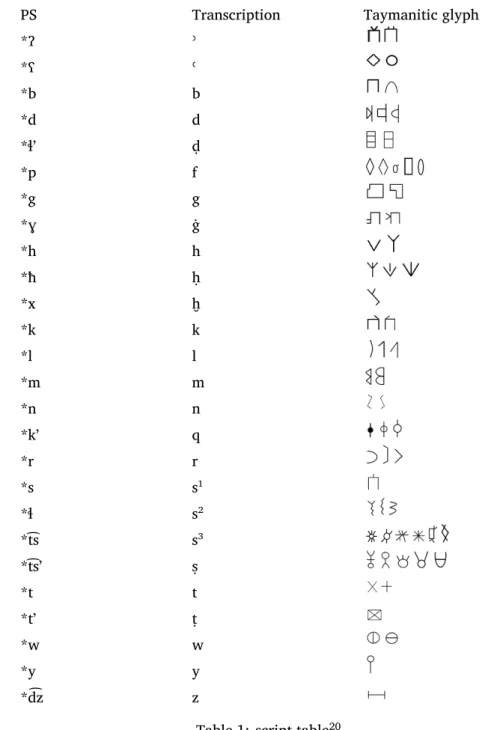
Scholars have argued that Taymanitic employed at least 26 different letter shapes, which means it probably had at least 26 distinct phonemes. PS *ḏ and*zhave merged and are respresented asz; Taymanitic does not distinguish a phoneme*ẓ, which seems to have merged with*ṣ. There are several features in the inscriptions that could point to a merger of*s³ and*ṯ. As there are no bilingual inscriptions, loan-names and the interpretation of the inscriptions are key to our understanding of Taymanitic phonology. Below, only the phonemes of which the pronunciation is open to debate will be discussed.
PS Transcription Taymanitic glyph
*ʔ ʾ
*ʕ ʿ
*b b
*d d
*ɬʼ ḍ
*p f
*g g
*ɣ ġ
*h h
*ħ ḥ
*x ḫ
*k k
*l l
*m m
*n n
*kʼ q
*r r
*s s¹
*ɬ s²
*t͡s s³
*t͡sʼ ṣ
*t t
*tʼ ṭ
*w w
*y y
*d͡z z
Table 1: script table20
2.2.2 *p
The reflex of*pis traditionally transcribed asf. However, this is a transcrip-tion based on a sound change in Arabic. There is no reason to assume that Taymanitic had undergone the same sound change. Following convention how-ever, this phoneme will be transcribed asf.
2.2.3 The interdental fricatives
In Taymanitic the interdental fricatives seem to have systematically merged with their sibilant (or affricate) counterparts.
*ḏ, *z >z *ṯ, *s³ >s³ *ṯ̣,21*ṣ >ṣ
After a discussion of the evidence pointing to a merger of these phonemes, several misspellings and loanwords or renderings of foreign words into Tay-manitic script will be discussed to gain some insight into their possible phonetic realization. As the evidence is fragmentary and open to several interpretations the exact realization of the sibilants will remain uncertain however.
ḏ and z The interdental fricativeḏ[ð] merged withz.22 They share the same
sign, which is used to representz in Hismaic, several varieties of Thamudic and Dadanitic as well; we find forms like the distal demonstrativeznk<*ḏnk (WTay 3); and the personal namezʾb<*ḏʾb(e.g. WTay 1.2) andzʾbt<*ḏʾbt (e.g. Esk 018) in Taymanitic for example.
ṯ and s³ = PS *[t͡s] The existence of a 27thletter, a separate sign fors³, is
gen-erally included in the Taymanitic script tables (e.g. Winnett & Reed 1970: 205) but it is often mentioned with some cautionary notes (e.g. Macdonald 1991: 25). Sholars have identified six glyphs, all occurring in personal names that could qualify as a separate letter signifying the independent reflex ofs³. This glyph has a circular center as opposed to the star-like shape which was interpreted as ṯ. The etymology of most of these names is problematic, but they seem point to a merging of the two phonemes. Knauf (2011) already proposed thatṯ ands³ had merged in Taymanitic, and thatṯwas either realized as [t͡θ] (which would suggest a merger ofṯ ands³ toṯ), or [t͡s] (which would suggest a merger ofṯ ands³tos³) (Knauf 2011).23
Based on the etymologies of the personal names; variation in attested letter shapes that have been interpreted asṯ ands³; several lexical items; and the
21This glyph is generally transcribed asẓ, the transcriptionṯ̣is used here to show its etymological
relation to the interdental and sibilant series.
22This merger in Taymanitic has already been widely recognized. See for example, Winnett &
Reed (1970: 94) and (Macdonald 2008: 191).
23In the same paragraph he argues that thes³andṯmerged in a similar fashion in Dadanitic.
Based on the spelling of roots with etymologicals³in Dadanitic however, it is clear that in Dadanitic
s³merged withs¹, as it did in the other well understood ANA varieties (Safaitic and Hismaic) and Arabic as well (Compare for example Dadanitics¹fr(e.g. AH 123; AH 220) ‘inscription’ to Heb.
general structure of the Taymanitic phoneme inventory, it will be argued that ṯ ands³seem to have merged tos³in Taymanitic.
ʿbds³r (HU 501)
s³rṣ (WTay 4)
s³gʿdhd on the Vienna seal (RES 2688) bys³ʿhls³24 (Esk 123)
ys³m (TM.T. 035)
ṣms³mk (TM.T. 001B)
Table 2: The attested personal names previously read withs³and their sigla
Macdonald considers ʿbds³r (HU 501) to reflect *ʿabd Osiris (Macdonald 1991: 17). He compares the name to other Osiris names in Phoenician in-scriptions (ʿbdʾsr) and the the namePṭsrywith the theophoric element Osiris in Aramaic on the Louvre Stela in (Macdonald 1991: 17). Macdonald mentions that “the phoneme represented bys³ in South Semitic alphabets is cognate to Aramaic /s/” (ibid.) but since the name Osiris was an Egyptian goddess, the et-ymological correspondence is of less relevance than their pronunciation at the time the name was borrowed. Sinces¹seems to have represented [s] in Tay-manitic, which is based on a more certain borrowing (see paragraph 1.2.2.1 s¹ or*s), it seems unlikely that Osiris would end up being represented with an s³ instead. Another issue is the loss of the glottal stop at the beginning of the theophoric element. This would only be possible if the name entered Taymanitic from another language which dropped the glottal stops in this po-sition.25 The nameʿbds³r(HU 501) may better be interpreted as a transcription
of the nameʿabd ḏūśarayinstead; a theophoric name based on the Nabataean deityḏūśaray.26 The assimilation of the*ḏto the preceding*din this name is
also attested in Safaitic (e.g. Mu 836) and Greek (e.g. IGLS XIII 9266) in Tay-manitic, the name was probably taken from a language in which this happened as well since Taymaniticdandz(<*ḏ) would probably not assimilate in the same way; we know that inḏū śaraythe lateral was preserved, because Safatic used its laterals², rather than its plain sibilants¹to transcribe it (Macdonald 2000: 48). If the interpretation of the verbbḥs²(Kim CIMG0759 Tay (unpub-lished)) is correct, Taymanitic did not preserve a lateral pronunciation of s² (see 2.2.4). Transcribing a lateral with aṯ is not unlikely however as the two are phonetically very similar (Ball et al. 2001: 5).27 This approximation may
have a precedent in two cuneiform abecedaries in thehlḥmorder discovered at
24Based on a very uncertain reading, unfortunately there is only a copy available of this
inscrip-tion by Jaussen and Savignac, the photograph of the inscripinscrip-tion in Eskoubi (1999) only shows the first three letters of the inscription. The copy by Jaussen and Savignac, shows the third letter, traditionally transcribed asṯ, as a star-shaped sign while the last letter, transcribed ass³looks like a circle with four lines coming out of it .
25There are many examples of personal names that entered Taymanitic without a glottal stop,
e.g. Esk 290:s¹mrl(cf. 2.2.5)
26If we are indeed dealing with a theophoric name mentioningḏūśaraythis would either be a
very early mention of the deity, or an indication that Taymanitic was written well after the sixth century BCE.
27Other approximations that were recorded were fricatives, including velar fricatives; and
Ras-Šamra (RS 88.2215)28and Bēt Šemeš (KTU 5.24),29where the glyph forṯ
occupies the position of the laterals²[ɬ] which may indicate a similar phonetic confusion between the two (Al-Jallad & al Manaser 2015: 9-10).
Another name Macdonald discusses in his 1991 article is s³rṣ, which he compares to Aramaicsrṣn, generally assumed to come from*(w)sīr ṣawn‘Osiris is protection’ (Macdonald 1991: 19). In this case it is more problematic to argue for the loss of the glottal stop as it is difficult to imagine why an initial vowel wouldnotbe represented as such in Taymanitic. Moreover, one would have to explain why the finalndisappeared and we are still confronted with [s] being represented withs³rather than withs¹. Asṯrṣandsrṣdo not yield any plausible roots for a personal name it may be compared to CAr.ṣurṣūr‘cricket or roach’, after dissimilation of the first consonant, since the non-emphatic equivalent of ṣwould have beens³. This of course leaves us again with a final consonant to get rid of, and a name that is not very common.30
After the discussion of the Osiris names Macdonald briefly discusses the names³gʿdhd(on the Vienna seal, RES 2688), but he concludes that there are so many uncertainties surrounding the interpretation of the text in which it occurs that it is unwise to base any conclusions on this name (Macdonald 1991: 21). The final three names can be interpreted with a little more certainty. Even though the reading of second part of the namebys³ʿ{h}l{s³}(Esk 123) is unsure, based on the first half of the name it seems to represent a theophoric name with the deityyṯʿ.31 In this cases³ would represent*ṯ. It is difficult to be certain
what the origin of the nameys³mis. It may be compared to CAr. wasīm, ‘to be beautiful’ from*√ws³m(compare Akk.(w)asāmu(m)‘to be suitable’or Ugaritic ysm‘pleasant’ (Cohen 1976: 569)), with*w- > y-which seems to have been active in Taymanitic (cf. paragraph*w- > y-under sound changes).
In one of the inscriptions currently in the Tayma museum, the theophoric nameṣms³mkappears (TM.T. 001B). Macdonald (Macdonald & Al-Najem forth-coming) interprets the name as ‘Ṣalm supports’ and connectss³mkto Hebrew sāmak. In this case the Taymanitic form reflects the etymological s³. So, if the interpretations put forward are correct, the glyph under discussion repre-sents etymological*s³ in some personal names (ys³m,ṣms³mk) but*ṯin others (ʿbds³r,32bys³ʿ{h}l{s³}).
Even though the letter shapes seem clearly distinguishable in the ANA script charts (e.g. as published in Macdonald 2008: 187) their shapes seem to have merged in (at least some of) the actual inscriptions. The visual confusion be-tween the two signs may be an indication that the two phonemes had merged or that there was some confusion as to the distinction of the two.
s³ ṯas in the script charts ṯ as attested in several inscriptions
33 34
Table 3: contrasting the attested letter-forms with the reported forms.
28Cf. Bordreuil & Pardee 1995; Hayajneh & Tropper 1997; Sass 2005.
29For the most recent discussions of these inscriptions see Bordreuil & Pardee 1995; Hayajneh
& Tropper 1997; Sass 2005.
Figure 1: tracing ofs³in Wtay 004 Figure 2: tracing ofs³in HU 50135
Figure 3: tracing ofṯ in JSTham 50836 Figure 4: Tracing ofṯ in Esk 020.1
The merger of s³ and ṯ is found in other Arabian languages as well, e.g. Ḥadramitic and the Amīritic dialect of Sabaic; in Ḥadramitic interdentals and affricates/sibilants seem to have merged, suggesting the sound change [θ] > [t͡s] or [s]. In Amīritics³ ands¹merged tosafter which*ṯ was written with thes³ glyph; this either indicates a sound changeṯ > [t͡s] or a reassignment of thes³ sign toṯ while it kept its phonetic value. The fact that in a newly discovered Thamudic B abecedary in the South Semitichlḥmorder the glyph for ṯwas written in the place ofs³may indicate that the latter explanation is what happened in Amīritic, especially since the abecedary was probably written after recitation of the values of the letters rather than being a transcription of the written form of the other alphabet (Al-Jallad & al Manaser 2015: 11-2).
There are no unambiguous attestations of etymological ṯ in lexical items. The sign fors³/ṯappears in two other inscriptions, Esk 272 and TA 09302. In Esk 272,ʾs³r(written with the sign ) (Esk 272) could possibly be read as*ʾs³r, ‘captivity’ (Esk 272), although*ʾṯr‘place or trace’ is also possible, whiles³ġ‘to be accessible’, which is attested in the same inscription with a similar sign (Esk 272) should probably be read with a*s³(√s³wġ).
Another example of the rayed disk letter shape is the wordḥs³yin TA 09302. The inscription is very clear and deeply inscribed on a prepared surface, giving it a much more formal appearance than most other Taymanitic inscriptions.
TA 09302:
ḥs³y / fʿl / ḥmd / lḥdh / b ym / blbd
‘Ḥs³yattained glory by guarding the border during the battle ofblbd’
Macdonald (forthcoming) has tentatively suggested the translation ‘hon-ored be the deed of Ḥmd (done) by him alone in the day of the son ofLbd’, interpretingḥmdas a tribal name andḥs³yas ‘to show much honor’ from the Arabic root√ḥfy. Based on an irregular sound changef > ṯ.37 This
substitu-33Esk 272, Esk 020.1, JSTham 508 34Esk 272
35For the complete tracing of the photograph of the inscription see Macdonald (1991: 13). 36The trace was made based on a photograph taken during the Tayma survey; Michael
Mac-donald has kindly granted me permission to use these photographs.
37There are examples of such substitutions, Macdonald gives Classical Arabicdafaʾiyyand ANA
tion would require*pto have becomef in Taymanitic, but so far it is unclear whether this sound change has taken place. If the new interpretation offered above is correct (TA 09302),ḥs³yshould probably be interpreted as a personal name. Unfortunately it is unclear what the etymology of ḥs³ywould be as a personal name.
Finally there is a structural argument for the merger of ṯ and s³ since z and the voiced fricative interdentalḏ have clearly merged in Taymanitic, it would naturally follow that the loss of the interdentals would have affected the voiceless series as well.
ṯ̣ = PS *[θʼ] and ṣ = PS *[t͡sʼ] As demonstrated in the previous discus-sion the voiced and unvoiced interdental fricatives in Taymanitic seem to have merged with their sibilant (or affricate) counterparts. It therefore stands to reason that the same process would have affected the emphatic series as well, resulting in a phonological system very similar to Canaanite.
The only lexical items in whichṣappears in the Taymanitic corpus areṣlm, the main deity of the oasis (e.g. Esk 013; JSTham 352; WTay 1.2) and the verb nṣr(e.g. WTay 9.1; WTay 11; WTay 14). Otherwise it only occurs in personal names (e.g.ṣby(e.g. Esk 012),ṣḥm(Esk 024) andṣwq(JSTham 541)).
The verb nṣroccurs in the formulanṣr l-ṣlm b-ḍr Ddn38 (WTay 20; HE 32;
WTay 33.1; WTay 11) which has generally been translated as ‘he gave assis-tance to Ṣalm in the war against Dadan’ (Winnett & Reed 1970: 99) and taken to be related to for example CAr. naṣara ‘to aid or assist’ (Lane: 2802c) or Sabaicnṣr‘to provide support’ (Beeston et al. 1982: 100).39
If we consider the merging ofẓ(*ṯ̣) andṣhowever,nṣrcould represent*nẓr ‘to watch, to guard’ (cf. CAr.naẓara‘to look at’ (Lane: 2810c); Old Aramaic nṣr‘watch, protect’; Off. Aramaic, Nab. nṭr‘to watch, to protect’ (Hoftijzer & Jongeling 1995: 754-5); Heb.nṣr(HALOT: 718)). We find reflexes of this verb in several other ANA corpora (e.g. Safaitic (e.g. C49; BHT 228) and Dadanitic (e.g. AH 312; JSLih 007; JaL 158)).
There is one Taymanitic inscription in which the formnṭrt‘I kept watch’ is attested.
Esk 025:
{ʾ}n ʾ{n/r}ds¹ / s¹{ s¹}n / mlk / bbl / n{ṭ}rt
‘I amʾnds¹official of the king of Babylon, I kept watch40’
This could be taken as an argument against readingnṣr as ‘to guard’. Ha-yajneh (2001: 89) interpretednṭras an Aramaicized form, but also noted that the absence of a glyph forẓin Taymanitic might point to the fact that bothṭ andẓwere represented by the same glyph in Taymanitic orthography.41 Given
38Variations withb-ḍr Msʾorb-ḍr Nbytare also attested: WTay 16 and WTay 11; WTay 13;
WTay 15 repectively.
39IfṢalmwas indeed the deification of Nabonidus at the oasis (Winnett & Reed 1970: 92-3), this
could be compared to ASA inscriptions in which chieftains recorded that they aided their lords in wars as suggested by Beeston in Winnett & Reed (1970: 99). However, Dalley (1986: 86) argued convincingly against this interpretation.
40Hayajneh (2001: 89) reads the word following the personal name ass¹dn, which he translates
as ‘overseer, guardian’.
the fact that the author of this inscription identifies himself as being close to the king of Babylon, influence from Aramaic would not be surprising. In addition to that, the unusual formula used in this inscription is very similar to another inscription in which the author also identifies himself as affiliated with the court of Nabonidus (Esk 169). A merger ofẓandṭ in Taymanitic seems unlikely however, since no Semitic languages merge the plain interdentals to the sibilant, while merging the emphatic one to the stop.
Esk 169 (line 1 and 2):
ʾn / mrdn / {ḫ}lm / nbnd / mlk / bbl // ʾtwt / mʿ / rbs¹rs¹ / kyt
‘I amMrdnservant of Nabonidus king of Babylon, I came with chiefKyt’
Since Aramaic and Neo-Babylonian were most likely the main languages that were in use at the court of Nabonidus, it is likely that nṭris a loan from Aramaic in which *ṯ̣(the origin of CAr. ẓ) and ṭ merged toṭ. The form nṭr possibly came to indicate a specific kind of guard or guarding in this neo-Babylonian setting as opposed to guarding in general for which the local nṣr was still in use.
the phonetic realization ofṣands³ Below, alternative spellings ofnṣrand s¹mʿ will be discussed in light of their relevance to our understanding of the pronunciation ofṣ. A hypothesis about the realization ofṣwill also impact our assumptions about the values of the other sibilants; therefore the realization ofs³andṣwill be discussed together. Since the examples are open to several explanations it remains unclear what the exact phonetic realization ofṣands³ was.
There is one instance in which ṣseems to be confused with s³ (Wtay 17). This may indicate thatṣstill represented an affricate [t͡sʼ] or [t͡sˁ] in Taymanitic.
WTay 17:
ʿlʾl b ʾs¹gt ns³r b-ḍr
----k----‘ʿlʾlson ofʾs¹gtkept watch during the war ---?---’
The verbns³rwas translated ‘he fell in battle…’ by Winnett, from the root *nṯr (Winnett & Reed 1970: 102). Based on the frequency of the formula nṣr b-ḍrit seems more likely however, that this is a misspelling of some sort. The confusion ofs³forṣcould indicate that the reflex ofs³was in some way similar to that ofṣ.
Ifṣwas indeed still realized as an affricate, it may suggest thats³still rep-resented an affricate as well, in which case only the feature of emphasis would have been misinterpreted in the inscription.42 As we will discuss below
how-ever there is some evidence that seems to rule out an affricated realization of ṣands³.
It should be noted however, that only a copy is available for this inscrip-tion. Winnett indicates in his commentary that he might have miscopied the
(Müller & Al-Said 2001: 113). Given the clear reference to the king of Babylon in the inscription however, assuming Aramaic influence seems preferable.
42This could also be interpreted to indicate thatṣwas still realized as an affricate [t͡sʼ] or [t͡sˁ]
in Taymanitic, which was confused with the fricative [θ]. The merger ofs³andṯto an interdental
inscription (Winnett & Reed 1970: 102). Adding one line at the bottom of the letter could make it into aṣ( > ). He might have doubted his copy because he was expecting to find aṣinstead of as³.
In another inscription, ṣseems to have been confused withs¹. In this in-scription the formṣmʿappears (Facey unpublished 00856). It is unclear what the verb ṣmʿ means in this inscription. In Lane, ṣmʿ is recorded to mean ‘to be small, compact, slender’. It is also used to mean courageous “because the courageous is described as compact in heart” (Lane: 1728). Another option is that the author confuseds¹andṣ. This may be preferable, as it would turn this unique and difficult to interpret inscription into one of the regular Tay-manitic formulae. A confusion betweens¹andṣcould indicate a de-affrication of emphaticṣ, as the author would only need to misinterpret one phonological feature (pharyngialization or glottalization, depending on how the emphatics were realized) to get froms¹toṣ. Readingṣass¹would give us the very com-mon verb in the Taymanitic corpuss¹mʿ‘he listened’.
It is difficult to combine the attestation of the confusion between s³ and ṣ(WTay 17) and that of ṣand s¹ (Facey unpublished 00856, 00806); while the first could point to an affricated realization of ṣ, the confusion of ṣ and s¹seems to point to the loss of affrication in the realization of ṣ. Moreover, assuming that the sibilants and fricatives had been de-affricated would point to a realization of [s] forṯ ands³. This would seem to indicate thats³ands¹ had merged, which begs the question why they were still distinguished in the orthography, especially since there is no evidence for any confusion between s¹ands³in Taymanitic. Therefore, if affrication was not the distinguishing fea-ture, it seems they differed in some other way (for example dental as opposed to alveolar sibilants). Ifṣands³were indeed no longer affricates, the formns³r should probably be considered a writing, or copying error. It is not entirely clear what the spelling of the personal nameʿbds³rtells us about the realization ofs³. It seems to indicate thats²was no longer realized as a lateral fricative, but borrowing a lateral fricative with [s] does not seem the most obvious choice either. Possibly the name was adopted into the Taymanitic onomasticon before ṯands³merged. Based on the data available at the moment it is impossible to determine the exact values for the complete sibilant and fricative series.
2.2.4 Realization of the plain sibilants
s¹ = PS *[s] The pronunciation ofs¹was probably close to a plain sibilant [s]. In the inscription Esk 169, s¹occurs in the word rbs¹rs¹.43 This is
iden-tified as a compound ofrab ša rəšiby Hayajneh (2001) and Müller & Al-Said (2001) which was borrowed from Neo-Assyrian into Aramaic assrs(Hayajneh 2001: 83).44 Aramaic likely formed the source of the form in the Taymanitic
text (Hayajneh 2001: 83). This indicates thats¹was the closest equivalent to the plain sibilant [s] available to the writer of this inscription.45
43Regardless of whether this word is an actual borrowing into Taymanitic or not, the fact that
the author of the text rendered a foreign word in the Taymanitic script can tell us something about the realization of the glyphs.
44In borrowings into Aramaic, the Neo-Assyrian glyphšwould be written withsimkat,
indicat-ing that is was pronounced as [s].
45There is one personal name which looks like a phrasal name, which could shed more light
s² = PS *[ɬ] The interpretation of the phonetic realization ofs²is dependent on the interpretation of the etymology of the verb bḥs² (Kim CIMG0759 Tay (unpublished)). Sincebḥs²does not seem to be a productive root in Semitic, the Taymanitic form probably comes from the root*√bḥṯ‘to search’. This verb is attested asbḥšin Aramaic (Cohen 1976: 57).46 If this were a native Taymanitic
verb one would expect it to appear withs³(cf. 2.2.3, pg. 75) but not with s². Thes²can be explained if one assumes thatbḥs²is a borrowing from Aramaic or Canaanite, and s² was the closest equivalent to Aramaic š, pointing to a possible realization ofs²as a palato-alveolar fricative in Taymanitic.47
2.2.5 Glottal stop
Outside of the onomasticon, the glottal stop was preserved in all positions in Taymanitic. In some ʾĒl-based theophoric names, the glottal stop has been elided e.g. Esk 290: s¹mrl. This seems to suggest that at least the theophoric part of the name was drawn form a language in which the initial glottal stop was dropped, like Akkadianilumfor example. There are several names attested in which the /ʾ/ in the name of the deityʾlis gone, but it is preserved in the first part of the name: bʾrl(Esk 013),yʾws¹l(e.g. Esk 076),yʾrs²l(e.g. Esk 068 + 069) indicating that the loss of the glottal stop was probably conditioned in the source language. There are also theophoric names with ʾĒl as a compound attested that do preserve theʾfor example: kfrʾl(e.g. Esk 001; JSTham 521), ydʿʾl(Esk 079 and Esk 237) andwddʾl(Esk 087).
Since the theophoric ʾĒl names without the glottal stop must be considered loans, they may be helpful in determining the phonetic values of, for example, the sibilants in these names. So far 5 different ‘non-native’ theophoric names with ʾĒl containing a sibilant have been attested in Taymanitic.
yʾws¹l48 (Esk 076; Esk 081; Esk 178)
ys¹mʿl (Esk 183) s¹mrl (Esk 290)
yʾrs²l (Esk 068+069; Esk 072; JSTham 431; JSTham 530)
nṣbl (JSTham 411)
An accurate understanding of the phonology of these names in their source language is required before they can contribute to our reconstruction of Tay-manitic phonology. Unfortunately it is difficult to determine which language this was, given the small set of forms available to us. Since both theʾand theʿ are still represented in the first part of the names (e.g.yʾws¹landys¹mʿl), they could not have come from Akkadian names. The nameyʾrs²lprobably comes from a C-stem of the root*wrṯ‘to inherit’ (compare CAr.wariṯa‘he inherited’ (Lane: 2934a) or Hebr.yrš(Hoftijzer & Jongeling 1995: 471)). This could not have been the source of a form such asys¹mʿlhowever, which one would expect
46Since Aramaic merged its interdentals with its stops, the expected reflect of*bḥṯwould be
*bḥt, therefore the formbḥšin Aramaic is likely a loan from Hebrew or another Canaanite language.
47If the personal nameʿbds³r indeed represents ʿabduśaray it seems that the lateral [ɬ] in
Nabataeandūśaraywas borrowed into Taymanitic withs³, in which case a lateral pronunciation ofs²in Taymanitic can probably be ruled out (cf.ṯands³= PS *[t͡s] above).
48The nameYʾws¹ʾl, with the gottal stop in the ʾĒl element, occurs in Minaic in and several
to have been borrowed with the same sibilant asyʾrs²l, given the merging of*s¹ and*ṯtošin Hebrew, in addition to that, Hebrew does not have a ʾ-causative. Another option could be to consider a language in which theṯ obtained as the source ofyʾrs²l: *yʾrṯl. Sinceṯseems to have merged withs³in Taymanitic, s² may have been perceived as the closest equivalent to an interdental ṯ. It has to be kept in mind however, that we do not have written evidence of all linguistic varieties that were spoken in the area, and these names might have come from a language unknown to us. It is also a possibility of course that not all names containing an ʾĒl element and lacking the glottal stop in the theophoric part, come from the same source.
2.2.6 Sound changes
N-assimilation One of the characteristic features of Taymanitic is the writing of the word ‘son’ asbinstead of more commonbn. This orthographic feature seems to be an example of n-assimilaton, a conditioned phonological sound change common in other ANA corpora and NWS. However, there is one clear example in which this does not happen: ntnt/natantu/ ‘I gave’ (JSTham 352) in which the /n/ is clearly directly followed by the stop /t/.49
If this inscription is representative of the language of the rest of the corpus, this seems to indicate that /n/ does not assimilate to a following consonant in all environments, but only in proclitic position in which it is per definition unstressed. This hypothesis could also explain the difference betweenm‘from’ andmn‘who’; sincemnever occurs without an object it may have been treated as a proclitic similar to the prepositionsb-andl-.
WTay 9.2: m- s¹mw ‘fromS¹mw’
TA 02669.1: m-lmq ‘fromLmq’
Mn‘who’, is not proclitic and is always written with then. WTay 2; WTay 1.2; HE 31:
mn s¹mʿ l-ṣlm
‘whoever obeysṢalm’
While the examples are limited it seems safe to suggest that /n/ assimi-lates to any directly following consonant when it is the coda of an unstressed syllable.
49If Winnett’s reading ofṢlm ʾnkd(JSTham 546) as ‘(Oh) Ṣalm (grant) offspring’ (unpublished,
L-assimilation The assimilation of lin theophoric names with the element Ṣlm suggests a similar pattern of assimilation to that of n: when it is used in proclitic position the lassimilates to the followingm. For example in the names: ṣmnʿm (Esk 058), ṣmntn (Esk 004), ṣmrʿ (Esk 050). There are other names with a Ṣlm element in which the l does not assimilate, but thereṢlm is the second part of the name e.g.: ʾmrṣlm(TM.T. 024) andlṣlm (WTay 30). All other occurrences of ṣlm refer to the deity, in which case it is usually a prepositional object and has its own stress:b ṣlm ntnt‘by Ṣalm I gave’ (JSTham 352; BIT p.336),nṣr l-ṣlm ‘he he kept watch on behalf ofṢalm’ (WTay 32).50
Winnett (1937: 23) already suggested that the elementṣm-in the Taymanitic personal names came from the theophoric nameṢalm, but he does not connect the assimilation of thelin these names to the assimilation oflandnin the rest of the inscriptions.
The assimilation of the l in Ṣalm additionally indicates that CvCC nouns probably did not undergo epenthesis, as thelofṣlmcould only have assimilated if the consonant cluster remained.
*w-> y- Taymanitic seems to have undergone the Northwest Semitic sound change*w->y-. There are several lexical items in the Taymanitic inscriptions with initialy-which come from forms with an initialw-originally: yrḫ‘month’ (WTay 20);ydʿ‘he knew’ (Kim CIMG 0759. Tay, unpublished) and the verbyrr ‘he guarded’ (compare CAr. warwara‘to guard, to watch and modern Arabic wry‘to show, to let s.o. see’ (Kurpershoek 2005: 349) (Esk 052)).
Words with initialw- are attested in the corpus, but they are all personal names, e.g.: ʾl wnʿ‘the tribe ofWnʿ’ (Esk 272),wdd(e.g. JSTham 552), andwtr (Esk 233). Since personal names are often borrowed along with their phonol-ogy (cf. 2.2.5), or reflect archaic pronunciations, this cannot be used as proof against a sound change*w- > y-.
Reduction of final triphthongs In Taymanitic final triphthongs had proba-bly not collapsed completely. There is one attestation of a final weak verb in –wwhich preserves its final weak root consonant in the suffixing conjugation: rḍw‘may he please’ (Esk 013). Since Taymanitic did not make use of matres lectiones, this form suggests a pronunciation /raḍiwa/. The formrḍw addition-ally shows that the sequence–iwadid not shift to–iyaas it did in Arabic. Since vowels are not represented in Taymanitic, the final triphthong could have col-lapsed to a diphthong in Taymanitic. There are no clear attestations of other triphthong sequences in Taymanitic.
*-at > -ah Two possible femininenisbahforms ending in-t seem to indicate that Taymanitic did not undergo the sound change of final–atto–ah(cf. section 2.3.3 for the gentilic suffix (pg. 88 and the morpheme-t(pg. 87). It should be noted however, that both these forms occur in genealogies.51 Therefore they
50CvCC nouns probably did not undergo epenthesis, because thelofṣlmcould only have
assim-ilated if the cluster remained. However, it cannot be ruled out that epenthesis emerged following the assimilation rule (ṣalm>ṣamm). Ṣammwould not be affected anymore in this case, as the l-assimilation rule was no longer active, andṣammwas realized with a geminate.
51The beginning of WTay 37 is broken, therefore it is not entirely sure thath-mṣrytis part of a
may not have been perceived as actual nisbah forms, but simply as personal names, possibly representing an archaic form.
WTay 37: h-mṣr-y-t
‘the Egyptian woman52’
HE 17 and HE 40: h-ḥḍr-y-t
‘the settled woman/the woman fromḤḍr’
2.3 Nominal Morphology
2.3.1 NumberPlural There are no attestations of an unbound plural suffix in Taymanitic. There is one possible attestation of a bound plural suffix –y, which will be discussed in more detail below in the paragraph 2.3.2. There is one possible attestation of a broken plural, but it can be explained equally in many other ways (on which see section 2.4.4):
WTay 22: ----lm b-ḍrrddn
‘…lmin thewarsof Dadan/ bywaging waragainst Dadan’
The phraseb-ḍr ddn(e.g. WTay 20, and WTay 33.1) ‘in the war of Dadan’ oc-curs in four other inscriptions (Wtay 20; WTay 21; WTay 33.1 and WTay 33.2), so this single occurrence might be better explained as a writing error. More-over, the present form could still reflect an external plural in the construct state /ḍararē Dadān/ ‘the wars of Dadan’ (compare for example Heb.malkē ‘kings of’ (Gzella 2011: 440)) (cf. section 2.3.2). This reading would additionally sug-gest a process of /a/ insertion, typical in the plural formation of CvCC nouns in NWS (e.g. Hebrewkeleb<*kalb‘dog’; pl.kəlābîm<*kalab-īma(Huehnergard 1995: 2129)), to explain the fact that bothr’s are represented. Another pos-sibility is to interpret it as an infinitive or participle denoting a simultaneous action. Given the formulaic nature of most of the inscriptions mentioningḍr Ddn, the most likely scenario seems to be that it is a dittography.
2.3.2 State
Definite article A prefixed definite articleh-marks definiteness in substan-tives.
lettersbh-it seems to be a similar type of inscription.
52Slaves were often named after the place they came from, in PPII (17.66) we find, for example
Philby 279 ay: kfrʾl b tʾn h-rmh-ġlm
‘Kfrʾlson ofTʾn, the lancer,the junior’
Esk 031:
h-ḍ{b}ʾ/ {h/ḥ}{r}{ʿ}{y} ‘the soldier, the chief’
It is used substantivize verbal forms. WTay 3:
Znk rftyh-rkb
‘that isRftythe riding camel’
If the following examples are indeednisbahforms referring to the mothers of the authors of the texts, they illustrate the use of the article to substantivize adjectives. It could be the case however; that theh-has become a part of the personal name and its usage here does not reflect the grammatical usage of the article.
WTay 37:
----bdwd bh-mṣryt
‘{PN} son ofthe Egyptian woman’
HE 17: Ns²w b h-ḥḍryt
‘Ns²wson ofthe sedentary woman/the woman fromḥḍr’
HE 40:
ḥkrn b ns²w bh-ḥḍryt
‘Ḥkrnson ofNs²wson ofthe sedentary woman/the woman fromḥḍṛ’
Construct chains In Taymanitic construct chains consisting of as many as three nouns have been attested. There are no attestations of analytical genitive constructions.
Al-Anṣāry 35 [part] ḥll
be.a.soldier.SC.3MS/WDb-zyagainst-REL.MPs²nʾenmity.CNST/WDʿmpeople.CNSTṣlmṢalm ‘he was a soldier against those of enmity of/against the people ofṢalm’ Esk 169 [line 1]53
ʾn
There is one attestation of a construct chain that suggests that in Taymanitic bound masculine plural nouns could be marked by a suffix-y, like in Aramaic and Hebrew (Gzella 2011: 440) or like Sabaic masculine nouns in the oblique case with a plural suffix (Stein 2003: 82).
Kim CIMG 0759. Tay (unpublished): ʾ[s¹] // bʿlytmʾ
‘chief of the of landowners/residents of Taymāʾ’
There is damage above the first letter of the second line which makes it impossible to tell for sure whether there were any lines coming out on top of it, causing the uncertainty in reading aʾ, bors¹. Reading ʾʿlyas a broken plural form of the root√ʿlw‘the nobles’ (suggested by Macdonald in comments, db) is tempting; however, this is an Arabic form in which*-iwa>-iya. Since rḍwdoes not becomerḍyin Taymanitic the expected reflex of ʾʿlwwould not be ʾʿly. Therefore bʿly ‘the inhabitants or landowners’, forms a more likely reading. A similar phrase with the construction ‘bʿly+ place name’ occurs in the Aramaic part of the trilingual Lycian, Greek, Aramaic inscription found at Xanthos (dated 358 B.C.) (Hoftijzer & Jongeling 1995: 183-4). There it can be translated as ‘landowners’ (Teixidor 1978: 182). The same formula occurs half a century earlier (408 B.C.) in a petition to the governor of Judaea (Cowley 1923: No.3022) in which the phrasebʿly ybcan be translated similarly, as ‘the
inhabitants of Yeb’ (Ibid. 114).54
As was already mentioned in the section on the assimilation of landn, it seems that all bound forms were marked by a change in stress pattern. It is unclear what impact this might have had on possible vowel reduction.
2.3.3 Nominal derivation
Morpheme -t It is not certain whether the following forms respresent fem-inine personal names or femfem-ininenisbah forms. Either way, they are clearly derived fromnisbah forms with a feminine -t (see the section on the gentilic suffix below, pg. 88).
WTay 37: h-mṣr-y-t
‘the Egyptian woman’
HE17 and HE40: h-ḥḍr-y-t
‘the settled woman/the woman fromḤḍr’
53See also Hayajneh (2001) for a discussion on this inscription.
54The formbʿly, followed by a toponym also occurs in Sabaic inscriptions butbʿlyis always a
Aside from the feminine marker-t, the suffix can also be found on masculine names. This means that the gender of the bearer of a particular name can only be determined by features such as the patronyms (b‘son’ orbt‘daughter’) and verbal agreement. Taymanitic masculine names with-tendings include:
JSTham 426: mṣrt b
‘Mṣrtson of’’
IMA 2: zʾbt b ‘Zʾbtson of’
TM.T. 042: ḥnkt b ‘Ḥnktson of’
WTay 33.1: mntt nṣr
‘Mnttkept watch’
Gentilic suffix-y The use of the gentilic suffix-yis attested in two personal names probably indicating the mother of the author of the text. The women who are mentioned seem to have been named after the place from which they came. Since there are only three examples of such names in the corpus, these forms might have been personal names, not directly referencing a place of origin anymore.
WTay 037:
----bdbwd bh-mṣr-y-t/ha-miṣriyyat/ ‘{PN} son of the Egyptian woman’
HE 17; 40: PN bh-ḥḍr-y-t
‘son of the settled woman/fromḥdr’
qattāl pattern In Esk 031 the nounrʿy‘leader/shepherd’ seems to reflect the agentiveqattālpattern, /ra‘‘āy/.
Esk 031:
ʾs¹ b dmg / l ʾṣ{r/n} / hḍ{b}ʾ /{h/ḥ}{r}{ʿ}{y}
‘ʾs¹son ofDmg to/forʾṣr the soldierthe chief’
Hypocoristic names All examples of diminutive forms in Taymanitic are only attested in personal names, this makes it uncertain what the active lin-guistic devices to construct diminutives were in Taymanitic.
Suffix-n The suffix -n is commonly attested on personal names and could have functioned as a diminutive.55
rttn(Esk 049) <*rtt
s¹lmn(e.g. Esk 271) <*s¹lm
ġnmn(Esk 017.2) <*ġnm
s²btn(Esk 006 and Esk 067) <*s²bt rʾs¹n(e.g. Esk 081) <*rʾs¹
s³rbn(e.g. Esk 166.1) <*s³rbor*ṯrb
Suffix-y There is one attestation of a suffix-yon the name of an animal:rfty (WTay 3).
This name is not attested elsewhere, butrftis (Harding 1971). The formrfty is probably a hypocoristic name. Compare for example other personal names with a hypocoristic -y: Phoen. klby, šlmy (Benz 1972: 235) Ug. pdry, rḥmy, ʾarṣy56(Tropper 2000: 283).
There may be one example of the diminutivefuʿaylpattern. Esk 049:
kfrʾl / b ʾrs² /bnyhṣy / b rb{.} // b rttn
‘kfrʾlson ofʾrs²little son of(?) Hṣyson ofrb. son ofRttn’
The formbnymight be a diminutive, but this reading is very uncertain. It looks like part of the genealogy, however, there are no names attested with the roothṣy(Harding 1971). Even if such names were attested we would still be looking at an aberrant form bn for son in Taymanitic in the middle of a genealogy in which the usualbforms are also used. Its position in the middle of the genealogy also seems to rule out a possible reading as a tribal name, banī, or a verb /banaya/ ‘to build’. Therefore the most plausible interpretation ofbnyseems to be a diminutive form ofb‘son’, which could have been used to indicate ‘little’ or ‘youngest’ son. This interpretation also faces some issues; even though formerly unattested names are encountered every now and again, a diminutive form of ‘son’ to indicate ‘youngest son of’ would be unique in the widely attested phraseology of genealogies, to my knowledge.
55Enclitic-n’s are also commonly found on personal names in the Aramaic inscriptions from
the Taymāʾ area. For the use of-nas a diminutive in other Semitic languages see Brockelmann (1908-1913: 394). Hayajneh (1998: 21) mentions several other possible functions of-non per-sonal names: the creation of concrete nouns out of abstract ones; the markation of singulatives as opposed to collective; and ascribing the quality of an adjective to a specific individual, following Goetze (1946: 130).
56Even though Tropper considers it likely that these are hypocoristic feminine names, he
2.4 Verbs
2.4.1 Form of the Suffix Conjugation
The Taymanitic corpus is relatively small and the inscriptions are generally short, therefore no full verbal paradigm is attested in the inscriptions. Most inscriptions are written in the third person masculine singular. There are four attestations of the first person singular with a suffix-t(Esk 169; JSTham 352); Esk 052 and JSTham 403.
Esk 05257
lm
LmAhkdlHkdl/WDbson.CSTs³rbnS³rbn/WDbson.CSTlbLb/WDbson.CSTʿrt{m}ʾʿrt{m}ʾ /WD
{y}rrt
guard.SC-1CS
‘byhkdlson ofS³rbnson oflbson ofʿfyʾ,I guarded.’ Esk 169 [part]
ʾn
IPRO.1CS/WDmrdnMrdn/WD{ḫ}lmservant.CNST/WDnbndNabonidus/WDmlkking.CNST/WD bbl
Babel//LBʾtw-tcome-SC.1CS/WDwithmʿ /WDrbs¹rs¹rbs¹rs¹ /WDKytKyt
‘I am Mrdn servant of Nabonidus king of Babylon,I camewith chief Kyt’
JSTham 352 b-ṣlm
by-ṣlmntn-tgive-SC.1CS
‘on behalf/by means ofṣlm,I have made an offering’
IIw/y In R²-weak verbs, the middle triphthong is not represented. Therefore it seems that it collapsed to a long vowel: s³ġ‘he opened’ (Esk 272) from the root√s³wġ;ḥl(e.g. Esk 055) from the root√ḥwl(cf. section 2.5.1, pg. 94).
There is one attestation of a first person singular form of the G-stem form ofḥl.
JSTham 403: Mr{ʾ}l{ṣ} //ḥlt
‘Mrʾlṣ,I was a soldier’
IIIw/y In R³-weak verbs, the final glide is preserved in the G-stem (cf. para-graph 2.2.6 on final triphthongs): rḍw‘he was pleased’ (Esk 013).
57For a discussion of the verbyrr‘to guard, to watch’ see paragraph*w- > y-under Sound
R² = R³ It is unclear whether forms likeḍrr(HE 39) andyrr-t(Esk 052) reflect the G-stem or the D-stem of these verbs, making it impossible to tell whether Taymanitic treated its verbs from geminate roots as regular verbs from strong roots, or whether the final syllable was metathesized to create forms like for example in CAr. (C¹vC²C²v).
2.4.2 Function of the Suffix Conjugation
There are a few instances in Taymanitic in which the perfective is used with an optative mood (For the ending-winrḍwsee section 2.2.6).
Esk 013:
rḍwṣlm58
‘MayṢalmbe pleased’
2.4.3 Prefix conjugation
There is only one attestation of a verb in the prefix conjugation. JSTham 549:
fys²hd
‘so that it/he will bear witness(?)’
The formys²hdoccurs in a very short inscription, consisting of only a per-sonal name and the phrasef ys²hd(the third line of JSTham 545+546+549), providing no context to help determine the function or exact TAM features of the verb.
All other attestations of forms that could formally be interpreted as prefix-conjugated verbs are personal names. Examples includeyfrʿ(e.g. JSTham 426) yʾrnl(Esk 014) andykfrl(e.g. Esk 044.2).
2.4.4 Infinitive
There seem to be only three possible attestations of an infinitive in Taymanitic, one of which is attested in an uncertain context.
Form Most of the attested forms of the infinitive are not distinguishable from the third masculine singular perfective form in the consonantal script of Tay-manitic. In these cases, the infinitive has to be deduced from its syntactic context.
It seems that the infinitive could be used to denote a simultaneous action, but the reading of the following text is open to several other interpretations (cf. section 2.3.1).
58Rḍwmight also be interpreted as a nominal form (I would like to thank one of the anonymous
WTay 22 ----lm b-ḍrr
in-war.INFddnDdn
‘…lmin the wars of Dadan/by waging war against Dadan’
Cognate infinitive construction In the following example the cognate in-finitive is used for assertion.
WTay 32 b----ʿ
b----ʿ nṣrkeep.watch.SC.3MSl-ṣ[l]for-Ṣalm<//><LB> {m} nṣrkeep.watch.INFhzbstrong.ADJ ‘b…ʿkept watch vigilantly on behalf ofṢalm’
While it may be tempting to interprate ʾḫr ʾḫrt in TA 02669.2 as a cog-nate infinitive construction as well, the interpretation of such a construction is problematic.
TA 02669.1 + 02669.2 {----}
--- ḥmdglory.INF/WDʾ{ḫ}rend.CSTʾ{ḫ}//rtposterity.<LB>{ḥ}{l}{l}be.a.soldier.SC.3MS?/WD b-hm
against-CPRO.3MPm-lmqfrom-lmq
‘{----}glory until the end of posterity {having performed his duties as a soldier} against them fromLmq(?)’
The interpretation ofʾḫr ʾḫrtas a cognate infinitive construction would ren-der an interpretation of the verb ‘to retreat, go back’ with an etymological object ‘he retreated quickly’, but writing about defeat does not seem to fit an in-scription beginning with the word ‘glory’. Instead it may be read as ‘the end of posterity’ indicating that all of the descendants of the person being praised will share in his glory. Compareʾḫrfor example to Arabicʾāḫir‘the last’ (Lane: 32a) andʾḫrt to Dadaniticʾḫrt‘offspring’ (e.g. U6) or Nab.ʾḥr‘posterity’ (Hoftijzer & Jongeling 1995: 38).
fʿl + infinitive In the following examples the infinitive is indicated by the use of the verbfʿl.
Esk 023, 026 fʿl
do.SC.3MSnksmite.INF