PHYSICIANS‟ PERCEPTIONS OF
THE HONG KONG CERVICAL SCREENING PROGRAMME: IMPLICATIONS FOR IMPROVING CERVICAL HEALTH
Cecilia Stover Fabrizio, MPH, MBA
A dissertation submitted to the faculty of the University of North Carolina at Chapel Hill in partial fulfillment of the requirements for the degree of Doctor of Public Health in the Gillings School of Global Health.
Chapel Hill 2011
ii @2011
iii ABSTRACT
CECILIA FABRIZIO: Physicians‟ Perceptions of the Hong Kong Cervical Screening Programme: Implications for Improving Cervical Health
(Under the direction of Christopher Shea, PhD)
Background: The incidence and mortality rates of cervical cancer are disproportionately higher in Hong Kong than in developed countries with similar resources. In 2004 the Hong Kong government introduced the Cervical Screening Program (CSP) to increase the
population screening coverage rates, and to reduce the incidence and mortality of cervical cancer. Seven years after the launch of the program, proximal outcomes are disappointing; registration among both physicians and women is below twenty percent of those eligible, and there have been negligible changes in rates of screening.
Objective: The purpose of this study was to inform policy considerations by exploring the under-participation of practitioners in the CSP.
Methods: Using both snowball and purposeful sampling, sixteen physician key informants were interviewed to explore the factors that might influence their decisions to participate in the program. Rogers‟ Diffusion of Innovations, and its focus on the individual‟s adoption-decision process, served as a theoretical framework for analysis. Data were coded, and then analyzed in matrix displays for themes and higher-level analysis. This analysis was
iv
Results: Several themes emerged to suggest the benefits and barriers that might influence CSP participation, including a lack of benefits that were meaningful to the physicians; administrative cost and complexity; and polices that were incompatible with physicians‟ usual care practices.
Recommendations: The data from this study indicate that the CSP‟s characteristics are limiting physicians‟ participation in the program. Importantly, the CSP does not influence rates of overscreening among those physicians who currently conduct cervical screening, nor does the CSP overcome the obstacles to screening among physicians who do not do much screening. A Plan for Change is presented that uses the study findings and the lack of program outcomes to inform and influence cervical screening policy makers. Strategic recommendations suggest refocusing cervical screening policies and strengthening efforts to increase the uptake among underscreened women. The plan recommends the use of specific advocacy leadership skills to build support and influence, while working toward an
v
ACKNOWLEDGEMENTS
I would like to acknowledge my friends and extended family for their support. My gratitude is strongest for my girls, Jessy and Emily, who suffered my academic preoccupation the most tangibly, and my husband, Ron, who still pretends that he will be able to retire on my new public health degree. I could not have persisted through this journey without my mother, who is my constant inspiration and unflagging support. I would also like to thank my committee members, William Carpenter, Susan Havela Hobbs, Sheila Twinn and Bryan Weiner, as each contributed indispensable expertise and succor. I am eternally grateful to my chair, Chris Shea, whose willingness to accommodate my "other-side-of-world" time
vi
TABLE OF CONTENTS
LIST OF TABLES ...vi
LIST OF FIGURES...vii
Chapter 1. INTRODUCTION ...1
Statement of the issue….….…….…………... 1
Study aims…….………...3
Cervical cancer background ...3
Hong Kong background………...………...4
2: REVIEW OF THE LITERATURE ...16
Search methodology ...16
Search results…...18
Discussion………...…….….…....………….…..………..30
Theoretical model...31
Implications for research….……...…..………..……….34
3: METHODS ...35
Study design ...35
Participant selection………….………..……….37
Data analysis ...43
vii
4: RESULTS...49
Finding 1: CSP benefits were rarely salient ...50
Finding 2: CSP administration was costly and complex...54
Finding 3: CSP was incompatible with women‟s KAPs and typical care practice……….57
Finding 4: Communication channels...66
Finding 5: Physicians have a rapid adoption-decision process……...68
Conclusion. ...71
5: THE PLAN FOR CHANGE…..…...75
Introduction..………..………..…………75
Policy alternatives…….………...……….……….79
Advocacy plan…….………....……….………88
Conclusion………..……….………..……..…..108
6: DISCUSSION ...110
Implications for future study…..……...………..……….…….114
Final word….……….….………..……….114
APPENDIX A: Key Definitions….……….………...….………116
APPENDIX B: Physician Discussion Guide ...119
APPENDIX C: Cervical Cancer Program Description…...….122
APPENDIX D: Coding Guide...….………..…… 123
APPENDIX E: Summary of Key Findings, by Registered versus Non-Registered Physicians……….126
viii
LIST OF TABLES
Table
1. Protective effect of screening after a negative smear, ages 35-64……….……...22
2. Key informant characteristics…….…...….………..……….……….42
3. Research key findings summary….………....……….………….……..50
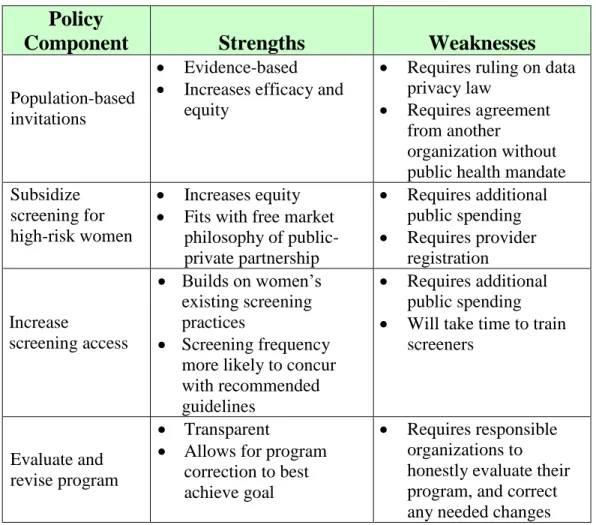
4. Implications of key findings………...………..….……….…78
ix
LIST OF FIGURES
Figure
Figure 1: Age-standardized incidence rates……..……….….….………2
Figure 2: Age-standardized mortality rates………...………..……..2
Figure 3: Hong Kong incidence, mortality rates, 1989-2009………....….……...…..6
Figure 4: Average age-specific incidence and mortality rates of malignant neoplasm of cervix uteri in Hong Kong, 2004-2009……… …...…7
Figure 5: Hong Kong, age-specific incidence of HPV infection………....………….8
Figure 6: Hong Kong, age-specific incidence of cervical neoplasia.…...…………..8
Figure 7: Hong Kong: age-specific incidence of invasive cervical cancer...…9
Figure 8: Power Map Step 1: Identification of roles…..……….….…...……..94
Figure 9: Power Map Step 2: Choosing targets………..………...…….…...…….96
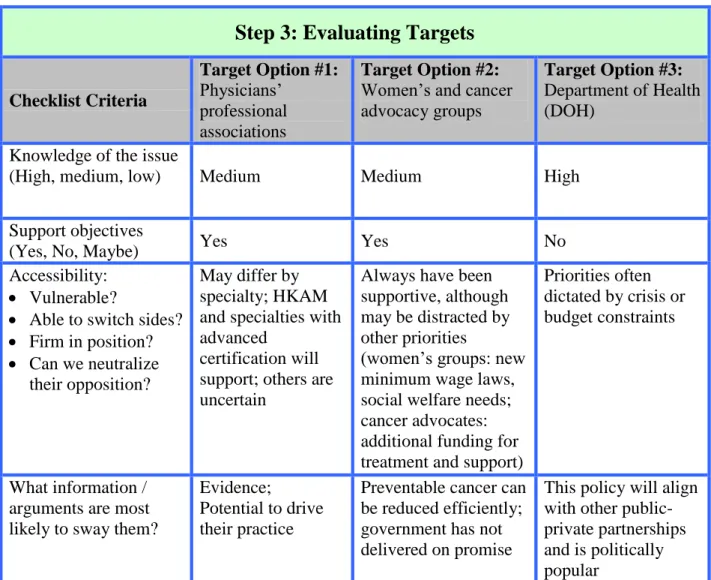
Figure 10: Power Map Step 3: Evaluating targets………...……….………97
CHAPTER 1 INTRODUCTION
I. Statement of the Issue
Cervical cancer is the second most common female cancer worldwide after breast cancer, with estimates of over 500,000 new cases and more than 288,000 deaths per year (International Agency for Research on Cancer, 2005). Cervical cancer is unique among cancers in that its cause is known, it can be identified early and it can be treated effectively at a pre-cancerous stage. The most common screening test, the Papanicolaou smear (Pap test) is relatively inexpensive, widely available, and reasonably acceptable to women. As a result of the Pap test, government-organized screening programs in many developed countries, and
opportunistic screening in many other countries, the global burden of cervical cancer has fallen in the last forty years.
2
Figure 1: Age-standardized Cervical Cancer Figure 2: Age-standardized Cervical Cancer Incidence Rates Mortality Rates
(Hong Kong Department of Health, 2009)
3 II. Study Aims
Given Hong Kong women‟s disproportionate rates of cervical cancer and low participation in the CSP, this research aimed to understand the CSP‟s role in
impacting cervical screening rates. Cervical screening rates can be influenced either directly, by attempting to change the behavior of the women, or indirectly, by
working with physicians to recommend screening to their patients. The determinants of cervical cancer screening have been studied in Hong Kong, however not much is known about factors that impact physician‟s recommendations for cervical screening. Therefore, this study focused on the efforts of the CSP to motivate physicians to increase screening among their patients.
The purpose of this study was to explore the under-participation of private practitioners in the Hong Kong Cervical Cancer Screening Program by studying which factors influenced their adoption of the program. The results of the study will inform policy considerations for potential policy improvements to the national CSP.
III. Cervical Cancer Background Screening methods and diagnosis
4
60‟s and 70‟s (Papanicolaou, 1928; Papanicolaou & Traut, 1941, as reported in International Agency for Research on Cancer, 2005).
When Pap cytology is used as part of a broad-based screening program for cervical cancer, results are compelling. Early descriptive studies comparing the incidence of cervical cancer in Finland and Sweden before and after the introduction of opportunistic screening, reported declines in incidence of 50% and 34%,
respectively (Laara, Day, & Hakama, 1987). Subsequent successful studies were designed as case-control or cohort follow-up studies (Clarke & Anderson, 1979; Hakama, Chamberlain, Day, Miller & Prorok, 1985). Today, although results have never been established through rigorous scientific trials, scientific agreement on the Pap test‟s effectiveness from these quasi-experimental studies has made it virtually impossible to conduct a randomized controlled trial, as it would be considered unethical to withhold screening from women in the control group (International Agency for Research on Cancer, 2005).
IV. Hong Kong Background
Hong Kong burden of cervical cancer
5
6
Figure 3: Hong Kong Incidence and mortality rates of cervical cancer, 1989-2009
(Hong Kong Hospital Authority, 2010)
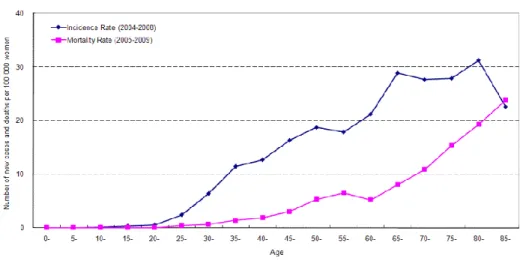
Similar to global data, the burden of cervical cancer in Hong Kong generally grows with increasing age, due to the long pre-invasive stage, post HPV infection (Figure 4). Incidence and mortality are quite low before 25 years of age, and then rise sharply. There is a peak in incidence for women in their 40s and 50s; however the highest incidence peak is among women aged 70–75 years.
While Hong Kong‟s incidence profile for women through their 50‟s is
7
Figure 4: Average age-specific incidence (2004-2008) and mortality (2005-2009) rates of malignant neoplasm of cervix uteri in Hong Kong,
(Hong Kong Hospital Authority, 2010)
An analysis of HPV infection prevalence compared to age-specific cervical cancer incidence helps explain this troubling trend. Similar to global data,
age-specific HPV prevalence in Hong Kong shows two peaks, at 26-30 years and at 46-50 years, similar to bimodal trends in many countries (Figure 5). The first peak is
8
Figure 5: Hong Kong age-specific incidence of HPV infection
(Chan, et al., 2010)
Figure 6: Hong Kong age-specific incidence of cervical intraepithelial neoplasia
9
Figure 7: Hong Kong age-specific incidence of invasive cervical cancer
(Chan, et al., 2010)
Hong Kong Primary Care Services Background
Hong Kong has a public-private health care system. Per a 2007 report by the Bauhinia Foundation, the majority of outpatient primary care visits (about 85%) were attributed to private medical or alternative medical practitioners, of which there are about 12,000. The government provides the remaining 15% of outpatient
10 Cervical screening in Hong Kong
Prior to the introduction of the CSP in 2004, cervical screening was done opportunistically or as part of general or well-women health checks offered by primary care providers. Galbraith (2005) estimated that about 60% of screening was conducted through non-governmental organizations, such as the Family Planning Association, and governmental agencies, including the Department of Health‟s Maternal and Child Health Centres, Women Health Centres, and Elderly Health Clinics, as well as the government hospital system. The remaining 40% was conducted in the private sector, which included single or group-based practitioners, and Well Women Clinics of private hospitals. In the private sector relatively few physicians may be responsible for the majority of private screening as it was estimated that only 40% of male generalists offered cervical screening to their
patients, although data were limited and somewhat dated (Dickinson & Chan, 2001). All but the most low-income women pay for their screens, even in the public sector, although the lower screening fees in the government clinics are an indirect subsidy (HK$100 in government clinics versus HK$200-$500 in the private sector, or about US$13 versus US$25-$65).
In 1998, Adab, et al., (2004) estimated that the effectiveness of the territory‟s opportunistic screens in 1998 was equivalent to an organized program with about 50% coverage and 10-year screening intervals. However this screening was
11
al. (1999), described Hong Kong‟s system as one that is “inequitable, wastes resources, and results in avoidable cases of cervical cancer.”
The Hong Kong government tracks cervical screening with an annual telephone-based study, the Behavioral Risk Factor Survey (BRFS). This study is weighted by gender and age to make it more representative of the population. The BRFS reported a rate of 63.9% ever-screened women in the summer of 2004, the year the Cervical Screening Program began (Hong Kong Department of Health, 2010).
The Cervical Screening Program
The Cervical Screening Program (CSP) was introduced with the objective of:
Increasing the population coverage rates of cervical screening among women
Reducing the incidence of cervical cancer
Reducing the mortality of cervical cancer
The program was positioned as benefiting overall screening coverage, equitable and efficient screening, better support and collaboration between the public and private sector, and better quality management in the screening service itself, from smear-taking to cytological examination, and with referrals and management of follow-up (Hong Kong Department of Health Topical Health #4: Prevention and Screening of Cervical Cancer, 2003).
CSP Policy Components
12
rate of 60% within three years after the program‟s launch, growing to 80-85% coverage over a longer period. Based on Hong Kong epidemiology, local practice guidelines, and experience from overseas, the CSP recommended two initial
consecutive screens, and if there were no abnormal results, follow-up screens every three years. The CSP worked with the local medical societies in developing these guidelines and encouraged the societies to issue them to their medical constituencies.
Cervical Screening Information System (CSIS)
The CSIS was established by the Department of Health (DOH) for the following purposes:
As a central recall registry
To maintain information on screening history and results
To track utilization of screening service and follow-up results
To facilitate record linkage across service providers
To link cervical smear data to biopsy results for correlation of cytology and biopsy
13
Protection, 2004). The program also offered a recall system for their patients, and access to their screening history through a secure online system.
Women were invited to register with the program, either through their doctor, online, or by mailing in a form. They were required to consent to transfer their personal data and test results to the CSIS. Registered providers could also submit the registered women‟s details into the database. Women were required to use a
password to access their screening history. The database then issued an automatic recall for the patient at the appropriate interval. The CSIS also promised to archive test results, email providers with details of patients recalled, and alert them of abnormal smears.
CSP Quality Management
14 CSP Recruitment and education
The program sought to collaborate with physicians and other service providers to encourage screening by providing data on screening, sending their patients reminder letters, setting up an enquiry system for cervical smear and biopsy results, and developing an informational website. For women, a recruitment and education strategy was formulated to recruit the target population into the program.
Communication aimed to ensure that women understand the reasons for cervical screening, the test and procedures involved, the results, and the treatment options. Mass media levels were significant at the program‟s launch, followed by low, maintenance levels of promotion.
The CSP was not able to utilize national population listings for a “record and recall” system, due to local privacy constraints. Therefore,the program has no capability of targeting high-risk women if they do not register. Once a woman registers with the program and submits her Pap test results, the CSIS acts as a prospective recall system and sends her a reminder at the appropriate interval.
The program was conceived as a public-private partnership, meaning that the government would determine the program guidelines but the private sector would provide the service. The government consulted with stakeholders in the private sector in developing the framework of the program, and did not impose many regulations in its execution.
15
tested at their choice of a public or private health care provider, on a fee-for-service basis. Screening frequency is not monitored.
CHAPTER 2
REVIEW OF THE LITERATURE
Hong Kong‟s CSP was intended to be a comprehensive program to increase the rates of cervical screening and decrease the incidence and mortality from cervical cancer. Therefore, a literature review was conducted to summarize the evidence for, and critical components of, cervical screening programs. This included both the evidence for
screening programs in general and for cervical cancer screening programs in particular. In addition, the literature was searched for evidence on the determinants of screening and for interventions targeted to either women or physicians that increase women‟s
participation in cervical screening.
I. Search Methodology
The computerized platform EBSCO was used to search the following individual online search engines, using their available cutoff publication dates as noted: Academic Search Premier (1975), PsychInfo (1975), Communication and Mass Media Complete (1915) and Health Source (1990). PubMed was searched separately.
17
results were then narrowed down by searching for a combination of these words, as noted below:
Policy:
For “policy,” “program,” and “regulation” were also used, but “policy” was the most fruitful search term.
Program Evaluation:
For “program evaluation,” “implementation,” “analysis,” and “evidence-based” were also used.
Organized screening programs:
“Organized screening programs” and “cancer screening” were searched separately, as well as “cervical cancer” and “Hong Kong.”
Determinants of screening
Psychosocial information was searched with the terms “psychosocial,” “determinants,” “barriers,” and “acceptability.”
18
Kong DOH report on cervical screening (2003) offered comprehensive literature reviews for further research. Only studies published in English were included.
Articles excluded were studies or papers that only focused on primary prevention, such as the HPV vaccine, and those not relevant to cancer screening policy and practices in Hong Kong, such as alternate screening methods in low resource countries.
II. Search Results
The evidence on cervical cancer screening is grouped into three main
discussion areas: 1) evidence for the effectiveness, efficiency and equity of organized screening programs; 2) determinants of cervical cancer screening and; 3)
interventions for women or physicians to increase participation in cervical screening. Where there is Hong Kong-specific evidence it is discussed in the appropriate section.
Evidence for the effectiveness, efficiency and equity of organized screening programs
Components of an organized screening program
In 1993 the International Union against Cancer (UICC) summarized the components that successful programs shared in common, emphasizing the systematic roles of policy, active recruitment, quality assurance, evaluation, and monitoring:
The larger target population is identifiable
19
Evidence-based recruitment methods are utilized to “guarantee” high coverage and attendance
Programs have adequate facilities for collecting and analysis of the screened materials
Programs have an organized quality control program for both screening and analysis of the screened materials
After screening there are adequate facilities and capacity to diagnose and treat the person with the confirmed disease
A referral system links the person screened, the laboratory, and the clinical provider for diagnosis and management of abnormal test results and for information about normal test results
At the population level, evaluation and monitoring distinguishes between those screened and those not screened (Hakama, 1993)
Comparison of organized programs versus opportunistic programs
20
mechanisms for follow-up and quality assurance. When an organized program followed up on abnormal results, such as highlighted in the UICC description, it had the potential to increase the rates of diagnosis and treatment, and thereby reduce the rates of incidence and mortality (Miles, et al., 2004). Conversely, opportunistic screening could be characterized by over-screening of some women, often performed by more expensive providers such as gynecologists, with low coverage of women of older age and/or low socioeconomic background. In addition, test and reporting quality might not be consistent since it was not monitored systematically (Arbyn, et al, 2009).
Although there was no evidence that either an organized or opportunistic screening model entirely eliminated disparities, organized programs helped promote equality of access (Miles, et al., 2004). Importantly, access did not necessarily translate to equitable coverage, as this coverage was a function of the quality of the lists used to invite participants, the performance of the system issuing the invitation, and the relative participation levels of the target population. Opportunistic screening might miss those at highest risk because it does not reach out to all women in the target population and address barriers to access. Any particular woman‟s likelihood of being screened was influenced mainly by individual-level factors such as her physician, or her own knowledge, behavior, and access to care (Miles et al., 2004).
21
the maximum impact in life-years gained came from reducing the over-screening of low-risk women and increasing the under-screening of high-risk women
(Koopmanschap, 1990). For example, in 1995 Norway established a national centralized system with obligatory registration of all cervical screening tests. Three-year coverage in the target group rose 7%, with increased participation of older and high-risk women; the number of smears fell 7%; and incidence declined 22% (Koopmanschap, van Oortmarssen, van Agt, van Ballegooijen, Habbema & Lubbe, 2006).
While opportunistic screening had few restrictions on quality, type and breadth of screening, for an individual woman it might offer a higher level of protection than an organized program because she might have more frequent screens, over a longer period of time, than that recommended in an organized program. However this opportunistic benefit had to be balanced with the greater potential for harm, as the disadvantages of cervical cancer screening were both physical and psychosocial. Physical outcomes included complications, potentially unnecessary medical
interventions, overtreatment, treatment costs, or delayed diagnosis from false negative test results; psychosocial outcomes include stigmatization, anxiety over false
positives, and overtreatment for non-progressive abnormalities (International Agency for Research on Cancer, 2005).
On the other hand, organized screening aimed for a population-level benefit that balanced benefits and harms, although in order to be cost-effective on a
22
2004). As shown in the chart below, epidemiological studies of effectiveness have enabled estimations of the impact of different screening intervals. After the first screen, a second screen was usually recommended one year later to offset a potential false negative result. After these two screens, reducing subsequent screens from one to three years only reduced the cumulative incidence of invasive cancer from 93% to 91%. This risk reduction might be acceptable on a population basis, but might not be ideal for a particular individual (Hakama, 1993; Goldie et al., 2005).
Table 1: Protective effect of screening after a negative smear, ages 35-64
Protective Effect of Screening After a Negative Smear Interval between
screening (years)
Reduction in cumulative Incidence of invasive cervical cancer (%)
1 93.5
2 92.5
3 90.8
5 83.6
10 64.1
Organized cervical screening programs have been shown to be effective and have been recommended by the World Health Organization (World Health
Organization, 2010).
Summary – Evidence for the effectiveness, efficiency and equity of organized
screening programs
23
limit opportunistic screening and thereby reduce overscreening. Screening programs were typically classified as either organized, with a centralized invitation system at the population level, or opportunistic with screening initiated at the individual level.
Organized cervical screening programs were the most likely to outperform opportunistic programs for equity, participation and cost effectiveness, while
opportunistic programs were more likely to over-screen younger, affluent, lower-risk women and under-screen older, less affluent and higher-risk women. Both types of programs could decrease incidence and mortality at the population level, while opportunistic programs might offer the most effective level of protection to the individual. However, due to cytology‟s weaknesses as a screening tool, which could induce both physical harm from overtreatment, complications or delayed diagnosis, and psychosocial problems, such as anxiety and stigma, organized programs offered the most benefit and least harm at the population level.
Determinants of cervical screening Global evidence
In a 2005 IARC review of quantitative studies, most evidence of determinants of screening uptake was at the individual level. There were numerous studies of the barriers to screening that were relatively consistent among women in different
24
Paskett et al., 2009). In particular, women aged 65 or older were more likely to report that their doctor did not order or recommend the screen, or that they did not know they needed a screen (Hewitt, Devesa & Breen, 2004; Waller, Bartoszek, Marlow & Wardle, 2009). Studies also identified such psychosocial barriers as the women‟s perception of vulnerability, anxiety and fear of the cancer, her beliefs about the relevance of the test to her, and the priority she gave to screening (International Agency for Research on Cancer, 2005).
Hong Kong evidence
Several studies of Hong Kong women indicated that a similar range of factors contributed to the relatively high cervical cancer burden in Hong Kong. In addition to similar demographic and socioeconomic factors, many women did not perceive the need for screening, did not know that the Pap test can prevent cervical cancer, and felt that the absence of symptoms negated the need for a check-up (Adab, 1999; Adab, McGhee, Yanova, Chin, Wong & Hedley, 2000; Chang & Hazlett, 2002; Twinn, Holroyd, Fabrizio, Moore & Dickinson, 2005; Leung, 2010)
25
the idea” of remaining at risk for cervical cancer. One third of women between 50– 59 years of age had no intention of returning for further screening (Twinn, et al., 2007).
Physicians as facilitators to screening
Physicians could facilitate women‟s decision to begin screening simply by recommending it opportunistically (Twinn, et al., 2007). However, even after women decided to be screened, female practitioners could eliminate additional cultural
concerns about male screeners. Importantly, Twinn and Cheng (2000) found that women expressed little preference for a female nurse over male doctors, as long as the practitioner had experience and skills. These necessary skills were defined as teaching, minimizing pain and discomfort during the test, and being considerate (Twinn & Cheng, 2000).
Summary - Determinants of cervical screening
26
Facilitators included recommendations from physicians, encouragement from family and friends, marriage, and the degree of other health-seeking behavior.
Interventions to increase participation in screening Global evidence for interventions targeting physicians
Consistent with the evidence that women cite a lack of a physician
recommendation as a key facilitator to initiating cervical screening, interventions that targeted physicians have been shown to be effective in increasing uptake of cervical screening (Lomas, 1991; Grilli & Lomas, 1994; Snell & Buck, 1996). While there is little evidence that passive dissemination of screening guidelines can influence physician behavior, evidence does indicate the effectiveness of guidelines that were easier to try, took account of local circumstances, were disseminated by active educational interventions and were implemented with patient-specific reminders (Lomas, 1991; Grilli & Lomas, 1994; Stone, et al., 2002). Snell and Buck (1996) studied provider “activation” methods both during and outside of the patient visit. During-visit interventions, such as reminders and flowcharts, helped to remedy physician forgetfulness in suggesting screening, while outside-visit interventions, such as education and audit with feedback, helped to update the physician‟s knowledge and correct overestimations of their actual performance in suggesting screening.
Physician incentives were shown to be effective in increasing women‟s participation in screening. England provided a compelling example of this
27
effective organized program in the 1990‟s, coverage rose from 42% to 85% from 1990 to 1998, with over 90% of physicians reaching a target of over 80% of their patients screened (Patnick, 2000).
Stone, et al. (2002) also found that targeting the physician at the environmental level was effective in increasing levels of preventive screening services. In their meta-analysis they found that several organizational changes were effective:
establishing a separate clinic devoted to screening and prevention activities, planning a visit specifically for preventive activities; using quality control or continuous quality-improvement techniques, and designating preventive responsibilities to a non-physician staff. In addition, health care provider reminders and educational outreach helped change provider behavior while less active interventions, such as attending conferences, reading medical journals or mailing clinical practice guidelines were not effective.
Global evidence for interventions targeting women
28
emphasize the preventive role of Pap tests. Letters could also educate women about screening, including the benefits and risks of the tests, and where to access the test. Personal invitations might also overcome barriers to women‟s perceived lack of risk to themselves (Byles & Sanson-Fisher, 1996). Evidence also demonstrated that response rates rose when invitations were “sponsored” by a trusted or valued
organization (Marcus & Crane, 1998). Other evidence-based interventions included mass media campaigns, and outreach. Mass media campaigns were successful, however they were expensive so typically media was only used for a short duration. However mass media was found to be most effective when used in combination with other outreach efforts, such as mailings or opportunistic screenings (Byles & Sanson-Fisher, 1996). Outreach campaigns had some success when they aimed to make the message personal, such as using outreach workers, mobile vans, or personal appeals to family and friends (Marcus & Crane, 1998).
Hong Kong evidence
29
Summary - Interventions to increase participation in cancer screening
Screening programs were directed at populations, yet they required individuals to accept the invitation. These programs had the difficult task of encouraging women to present for a screen, and then to return for follow-up care if results are abnormal. Effective interventions to encourage screening addressed key barriers for the women, such as educational and psychosocial barriers, or addressed physicians as the
gatekeeper and influential motivator. No evidence indicated whether it was more effective to target physicians or women.
III. Discussion
Strength and weakness of studies
The literature review is strengthened by the depth and breadth of the peer-reviewed research done on cervical cancer screening, both in Western countries and in Hong Kong. The evidence for organized screening programs and for determinants of screening was strong, and the Hong Kong evidence was similar to the Western literature. However, aside from the evidence contributing to the elements of
30 Implications for Hong Kong
The evidence for an organized screening program‟s ability to reduce the incidence and mortality of cervical cancer is compelling and addresses the potential for Hong Kong to reduce outcomes in line with its level of economic development. Hong Kong women should benefit from the elements of organized screening that were included in the CSP, such as the recommended age and interval targets, the quality assurance, the capacity for follow-up and treatment, and the registry for surveillance and analysis. However the CSP lacked key evidence-based program elements, such as interventions to increase provider screening recommendations; a comprehensive call-recall system; targeted interventions towards those most at risk; efforts to reduce inappropriate over-screening; and a referral system for abnormal tests. Without specific, evidence-based efforts to overcome the barriers to screening, Hong Kong might find it difficult to realize its objective of the 80% participation necessary to achieve the desired population reductions in incidence and mortality for cervical cancer.
IV. Theoretical model of adoption
Just as theories or models enhanced the effectiveness of interventions for cancer screening by guiding the complex practices of behavioral change at the individual level, theories could guide the adoption of an intervention at the
organizational or settings level (Glasgow, Marcus, Bull & Wilson, 2004). Everett Rogers‟ Diffusion of Innovations model (DOI) has been used to support the
31
Rutten, Nelson, Meissner, 2003; Prochaska, Fromont, Suchanek, Hudmon & Cataldo, 2009). Rogers‟ defined dissemination as the “planned process of creating awareness of the program or interventions among the targeted population, informing
stakeholders about the innovation and persuading them to try it” (Rogers, 2003). Rogers defined four main elements involved in the Diffusion of Innovation, where diffusion was the “process by which: a) an innovation; b) was communicated through certain channels; c) over time; d) among the members of a social system” (Rogers, 2003).
All innovations are not equivalent, and their characteristics influenced their rates of adoption. Relative advantage was the degree to which an innovation is perceived to be better than the previous idea. Perception of advantage, which can be influenced by economics, social prestige, convenience, or satisfaction, was more important than objective metrics. Compatibility was the degree to which the innovation was perceived to be consistent with the potential adopters‟ past
experiences, current values and future needs. Trialability was the degree to which an innovation might be experimented with, without permanent commitment, so that it was less risky. Observability was the degree to which the result of an innovation could be seen by others, thereby stimulating peer discussion and allowing others to observe the experience. Finally, complexity was the degree to which an innovation was perceived as difficult to understand and difficult to use. Higher levels of relative advantage, compatibility, trialability and observability, and lower levels of
32
Innovations depended upon the communication channels to be spread;
Rogers‟ defined a communication channel as “the means by which messages get from one individual to another” (Rogers, 2003). Communication channels could range along a continuum from mass media, which was an efficient way to increase awareness and knowledge of an innovation, to interpersonal channels for direct communication. Among the types of interpersonal communication, people were most likely to accept an innovation from someone most like herself.
This decision process involved knowledge, the step of becoming aware of and learning about the innovation; persuasion, the formation of a favorable or unfavorable attitude about the innovation; the actual decision, the choice the person made about the innovation; implementation, putting the innovation into use; and confirmation, seeking reinforcement about the adoption decision with the potential to reverse the first decision. At the end of this decision process the person might decide either to adopt or to reject the innovation.
The last element of the diffusion adoption model was the social system, defined as “a set of interrelated units that are engaged in joint problem-solving to accomplish a common goal” (Rogers, 2003). Certain types of individuals influenced diffusion into the system more than others: opinion leaders, who derived their status
33 V. Implications for research
This literature review identified the opportunity for an organized screening program to effectively, efficiently and equitably reduce the incidence and mortality of cervical cancer. The literature also identified the key determinants of cancer
CHAPTER 3 METHODS
The literature identified the crucial role of physicians in encouraging the uptake of screening, which led to this study‟s focus on enrolling physicians in the CSP. This chapter delineates the methods used to study the factors influencing the physicians‟ participation in the CSP. The chapter presents the major components of the
discussion guide, and discusses the changes made following pilot testing. Next, it reviews the sampling strategy and analyzes the resulting study sample. The chapter also discusses the data analysis, including the coding and the qualitative analysis procedures. The chapter concludes with a discussion of efforts to increase study validity and reliability, as well as the limitations of the study.
I. Study Design
35
process. Physicians, whether familiar with the CSP or not, were given a description of the program to read before the discussion (CSP Description is found in Appendix C).
Discussion guide pilot testing
The Discussion Guide was pilot tested with two physicians; one was a member of the original Cervical Screening Task Force, and one was in private practice. They were a convenience sample chosen either for their knowledge of the program or for their experience as a private practitioner, respectively. Both
physicians had difficulty answering theoretical questions about their adoption-decision process so it became necessary to develop and include questions about actual innovations that were familiar to them. After some trial and discussion, two innovations were identified that would provide appropriate insights into the
physicians‟ decision process: a government flu vaccine voucher program, or more commonly known in Hong Kong as a scheme, and the HPV vaccine.
The government‟s flu vaccination scheme, introduced in 2009, offered people over 65 years of age a HK$50 voucher (about US$8) to offset the cost of a flu shot at a private physician‟s office. Most private physicians who were General Practitioners (GPs) and Family Practitioners (FPs) joined the scheme. The program required physicians to register with the government, and to perform certain
36
government program; it applied to a large percentage of the population; it was computer-based; it required the patient and the physician both to register; and it was introduced to the target populations in a similar manner. However, unlike the CSP, the flu vaccine offered a financial subsidy to the patient that they could apply toward the provider of their choice.
The second alternative innovation was the HPV vaccine. OB/GYNs did not provide general patient care, so the HPV vaccine was more appropriate for these specialists. The key similarity with the CSP was that the vaccine was also associated with cervical cancer, and therefore was likely to have similar cultural associations with promiscuity and premarital sexual activity. The differences between the HPV vaccine and the CSP related to their source and their method of introduction: the HPV vaccine was offered by private pharmaceutical companies, and the companies‟ promotional efforts were well-funded, highly-visible, and memorable (See Appendix B for the Discussion Guide for Key Informants).
II. Participant Selection Sampling frame
37 Sampling strategy
The sampling strategy utilized both snowball sampling, after the initial referrals from the physicians‟ association leaders and HKU School of Public Health (SPH) professors; and purposeful sampling, to include a representative mix of genders, specialties, districts and CSP-registered physicians. This sampling was more difficult than anticipated, as only about half of the physicians interviewed were willing or able to recommend a colleague to interview. In an effort to recruit additional physicians in different districts, particularly more men, two physicians were recruited by “cold calling” physicians on an insurance directory listing. Additionally, three physician leaders were interviewed to explore their perceptions of their association members, as well as their own experiences with the CSP.
It was originally proposed that interviews be limited to private physicians, however as the data emerged it became necessary to understand the perspective of those who had adopted and used the CSP. In this sample, too few private
practitioners knew enough about the program, due to limited registration with the program. Therefore, the sample was broadened to include three physicians who were in a government or NGO multi-center clinic setting (“clinic-based”
physicians), that were registered with the program as a matter of organizational policy.
38
office; that interview was conducted in a public restaurant. Consistent with the IRB approval, written consent was obtained prior to the interview.
Description of key informant sample
Twenty-nine physicians were approached for an interview, either via email or phone, and sixteen physicians accepted, for a response rate of 55%. This response rate was relatively low, given that most physicians contacted were personal referrals. Twelve respondents (69%) were female and four (31%) were male. For perspective, over 70% of physicians in Hong Kong are estimated to be male (Medical Council of Hong Kong, Li, 2003).
39
physicians randomly contacted agreed to join the study, while the only female contacted also accepted.
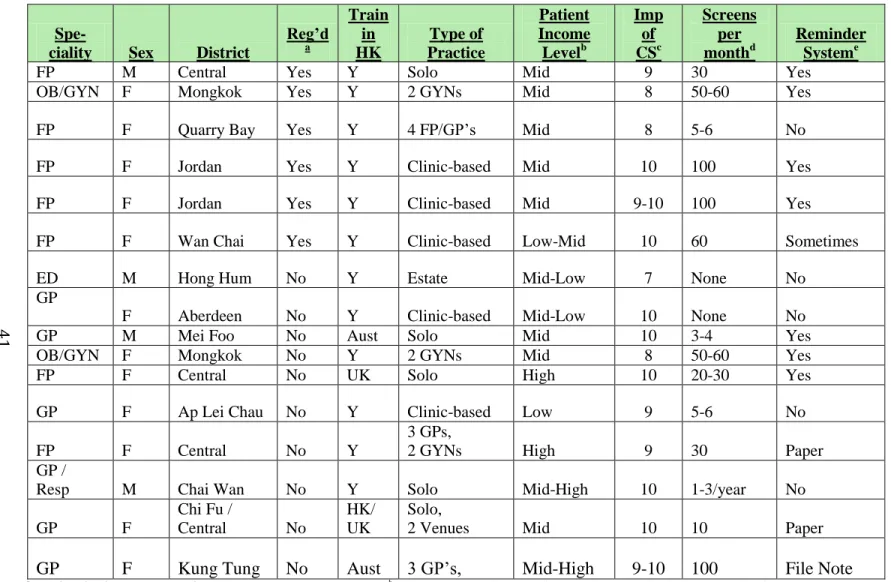
Among the key informants, there was a mix of specialties, type and size of practice, and districts (Table 2: Key Informant Characteristics). Seven (44%) of the physicians were in Family Practice (FP), six (38%) were in General Practice (GP), two (13%) were OB/GYNs (GYN) and one (6%) was an Estate Doctor (ED). In terms of size of their practices, about six were in solo practice (38%); five practiced in small groups of six or less (31%); while the remaining five (31%) worked for government or large multi-site practices. The key informants had a range of experience, with the newest physician having only six years experience, about half with 10–20 years experience, and a few with over 25 years of experience. The sample was geographically heterogeneous, as the sixteen physicians worked in twelve different districts in Hong Kong. The districts reflected the economic distribution of Hong Kong‟s population, with the majority of the physicians working in middle income districts, a few in low-income districts and a few in the business district of Hong Kong, which had the wealthiest patient base. The majority of physicians had trained in Hong Kong, although two had trained in the U.K. and one in Australia. Most of the GP and FP physicians estimated that a majority of their patients were women, with percentage estimates ranging from 60– 75%. The OB/GYNs and physicians practicing in “Well Women” clinics had female patients exclusively.
40
Table 2: Key Informant Characteristics
Spe-ciality Sex District
Reg’d a Train in HK Type of Practice Patient Income Levelb Imp of CSc Screens per monthd Reminder Systeme
FP M Central Yes Y Solo Mid 9 30 Yes
OB/GYN F Mongkok Yes Y 2 GYNs Mid 8 50-60 Yes
FP F Quarry Bay Yes Y 4 FP/GP‟s Mid 8 5-6 No
FP F Jordan Yes Y Clinic-based Mid 10 100 Yes
FP F Jordan Yes Y Clinic-based Mid 9-10 100 Yes
FP F Wan Chai Yes Y Clinic-based Low-Mid 10 60 Sometimes
ED M Hong Hum No Y Estate Mid-Low 7 None No
GP
F Aberdeen No Y Clinic-based Mid-Low 10 None No
GP M Mei Foo No Aust Solo Mid 10 3-4 Yes
OB/GYN F Mongkok No Y 2 GYNs Mid 8 50-60 Yes
FP F Central No UK Solo High 10 20-30 Yes
GP F Ap Lei Chau No Y Clinic-based Low 9 5-6 No
FP F Central No Y
3 GPs,
2 GYNs High 9 30 Paper
GP /
Resp M Chai Wan No Y Solo Mid-High 10 1-3/year No
GP F
Chi Fu /
Central No
HK/ UK
Solo,
2 Venues Mid 10 10 Paper
GP F Kung Tung No Aust 3 GP‟s, Mid-High 9-10 100 File Note
a Reg‟d: Is the physician registered with the CSP? (Responses: Yes or No). bPatient Income Level: What is the general economic level of patients in the physicians‟ practice (Responses: High, Medium or Low). cImportance of CS: Physicians were asked: “On a scale of 1 to 10, with 1 „not at all important,‟ and 10 „most important,‟ how important is cervical screening to you as a preventive practice? ” dScreens per month: How many cervical screens did a physician conduct per month, regardless of their participation in the CSP. eReminder system: Did the physicians have a reminder system, and if so, was it electronic or another type?
42 III. Data Analysis:
Coding
Coding and analysis was conducted with Dedoose, a Macintosh-compatible, web-based application, that could be used for qualitative and mixed methods research (Lieber & Weisner, 2010). The transcripts were imported into the software, where the interviews were coded. The software was used for data retrieval, sorting, analysis, and output for data matrices.
43 Data Management
Each physician was assigned a unique numerical code, in order to maintain the confidentiality of the data. This numerical code was used on the physician‟s tape recordings, data analysis and data summaries. The interviews were double-taped and verbatim transcripts were made. The tapes were kept in a locked safe and files were password protected on a home computer. When the transcripts were received, random key sections of the tapes were listened to again and crosschecked in order to increase reliability.
Analysis
Within one day of each interview, field notes that included overall
impressions were written, including but not limited to key information according to each element of the theoretical framework, reflections on potential themes, and suggestions for future interviews.
44
practice versus those who were in government or large NGO clinic settings. The most relevant matrices were organized into findings, then supported and illustrated by citations from the underlying transcripts. These quotes were then used in the Results chapter. Given that many of the physicians were non-native English speakers, some quotes were edited (noted in brackets) to correct the grammar and convey the content of the quote, although efforts were made to preserve the key informants‟ voice.
Also in the dissertation, quotes were identified with key physician descriptors where pertinent, such as registration status, specialty, size of practice, gender, etc. However, the descriptive data were omitted when such data would potentially identify the speaker, typically for gender or specialty descriptors. Each quote was also labeled with its numerical physician code, which helped illustrate the
frequency of any individual physician‟s quotes. In order to verify the analytic conclusions, the following processes were used:
Validity: Various methods were employed to improve validity (Mays & Pope, 2000). First, summaries of the physicians‟ perceptions of the CSP characteristics were examined for discrepant viewpoints. Then results were triangulated between different data sources to explore them further.
Discrepancies were most frequently explored between physicians with different registration status (registered versus non-registered), different specialties, and finally different genders. The triangulation assisted in
45
reflexivity was considered, using quotes to help clarify any existing biases. Attention was paid to negative cases and considerable effort was spent illuminating the issues.
Reliability: In order to increase study reliability, all of the interviews were double-taped, the transcripts were re-checked against the audio tape and post-interview contact summary notes as they were coded, and further attention to potential code “drift” was paid. Early in the coding process the code
definitions were re-evaluated and subsequently five of the initial interviews were re-coded. Finally, a log of the data management and analytic methods was developed so as to document research activity.
IV. Limitations:
A) The sampling frame was adapted to accommodate the scarcity of private physicians who were both registered and active in the program, as documented above. Only three private physicians had registered with the program and therefore had personal knowledge of the program‟s actual benefits and barriers, which might limit the generalizability of this research to other private
physicians. However, the three physicians‟ data were consistent with the data from the private physicians who knew of the program yet had not registered, and with the clinic-based physicians who had registered with the program. B) The relatively high participation of physicians with higher professional
46
results between those private physicians with advanced qualifications and those without were generally similar.
C) The relatively low response rate, 55%, might also limit the generalizability of the results. Other than under-participation by male physicians (30% of key informants versus 72% of Hong Kong practitioners) the background and attitudes of the non-responders were not known. These non-responders might have different viewpoints about cervical screening, and about the CSP. Two indications of this potential bias were that most physicians responded
genuinely positively to the question on the importance of screening as a preventive care measure, and that most of the physicians interviewed stated that they often suggested screening to their patients. These responses are not consistent with screening rates in Hong Kong. However, given that these attitudes were almost universal among the key informants interviewed, the finding might be indicative of attitudes, and not practices, among the larger physician population.
CHAPTER 4 RESULTS
This chapter reports results of key informant interviews that examined factors
influencing private physicians‟ under-participation in the CSP, using the methods defined in the previous chapter. The factors that were studied draw upon Rogers‟ theoretical framework of the Diffusion of Innovations. These findings report physicians‟ perceptions of the
characteristics of the CSP; what communication channels might influence adoption; and what the physician‟s adoption-decision process was for their practice. However, as discussed in the Methods section, few physicians knew about the CSP and physicians had a difficult time responding to hypothetical questions about adopting a new program into their practice; therefore physicians were also asked to consider adoption issues in the context of the government-sponsored flu vaccine voucher, or the HPV vaccine.
During the analysis, three physician perspectives on innovation decisions emerged: (1) a business perspective; (2) a patient perspective; and (3) a public health perspective. The business perspective was most common, as physicians reported a need to ensure the financial success of their practices. As discussed in more detail in the following findings, this business framework was evidenced primarily in physicians‟ discussions of the “cost” of doing
48
49 Table 3: Research Key Findings Summary
Research Key Findings Summary
Finding #1
Physicians perceived that the CSP‟s benefits were rarely meaningful to their practice (Relative advantage)
Finding #2
Many physicians perceived the CSP as time-consuming and administratively problematic (Complexity)
Finding #3
Many physicians found the CSP to be inconsistent with their perception of the women‟s cervical screening Knowledge, Attitudes and Practices (KAP) and their typical patient care practices (Compatibility)
Finding #4
Most physicians typically learned about potentially applicable innovations through relatively passive communication channels
Finding #5
Physicians tended to make rapid decisions about new programs, without much time for consideration, trial or consultation with others
Key Finding #1: Physicians perceived that the CSP’s benefits were rarely meaningful to their practice (relative advantage)
After reading the description of the CSP that highlighted the program benefits, a few physicians could not identify any pertinent benefit. Most physicians identified the recall system and the online screening history as the most important benefits; however, these benefits were not substantially better than the status quo of their current
practices.
Perceived lack of benefits
50
“I don‟t think that there is a need for it here; it wouldn‟t add any value to the way we practice now (110322, Non-registered, GP, small group).”
Registry recall and reminder system:
Most physicians identified the program‟s recall system as the most pertinent benefit of the program, although most physicians that performed even a minimal number of Pap tests (over 10 screens a month) found this benefit to be redundant to their own practice system. Physicians‟ recall systems ranged from sophisticated computer programs that sent automatic patient reminders, to penciled notations in a patient‟s file that the doctor would check during a patient visit. Most physicians concurred that a patient recall system should be an essential component of any general practice that conducts cervical screening, as shown in this quote:
If the physicians don‟t recall the women, the women won‟t come back. The physicians will lose the business, right? That is why in that sense the Registry is of limited help to one‟s practice. You either determine to do this kind of screening and you would have your own system to make sure this follow-up happens, or basically this is not something that is a high priority in your practice (110104, Registered, FP).
Some physicians optimistically perceived that the recall system might increase their business, although this perception was only expressed by non-registered
physicians. This physician, quoted talking about potential demand from the program, did not conduct many cervical screens:
51 Online access to patient data
Physicians differed in their assessment of whether the online screening history was a benefit to them. Naturally physicians preferred to have access to their patient‟s past screening results, as it would help improve patient care:
Access to the client‟s smear results online, I think, is good. Actually we can know the result distributed online and we can….have a thorough understanding of the condition. I think that is good (110113, Non-registered, GP).
However, many physicians perceived the online results to be unnecessary, as physicians kept their regular patients‟ past records in their files and new patients generally knew a sufficient amount about their past screening results for the physician to determine their clinical history. This quote illustrates the physician‟s determination of a patient‟s past screening results:
Pap smear results are simple. The patient will know if her past result is normal negative, or if there is something abnormal that [requires] some follow-up afterward….So the information is already adequate (110301-02, Non-registered, GYN).
Five of the six registered physicians interviewed did not perceive any benefits from the CSP. When asked about the benefits of the program, these physicians reported the same reactions as the non-registered physicians: the recall system and online access were redundant.
52
of the physicians that joined the flu scheme because their patients requested their participation:
Why did I participate? I have lots of patients enrolled. So I think that it‟s providing an extra service to my patients…a lot of patients…a lot more than from the cervical screening [program] (110309, Registered, GP).
This physician reported how the flu scheme increased her patient revenue:
Why did I join the flu scheme instead of [the] CSP? Because I get revenue from it (110330-01, Not-registered, FP, private).
Summary
53
Key Finding #2: Many physicians perceived the CSP as time-consuming and administratively problematic (complexity)
Most physicians perceived the program‟s administrative process to be complex and time-consuming. Often the program‟s complexities impacted physicians‟ practice costs or revenues. Some physicians also characterized the administrative demands as a distraction from patient care. However, some physicians, including a few private and all the clinic-based physicians, found the program‟s complexity to be manageable, and therefore not a barrier to adoption.
Administrative demands
Many physicians were concerned about the perceived time and effort required to use the system. Some physicians performed the administrative work themselves, and they reported this time as a barrier to enrollment:
Doctors may skip the stuff that requires time since there is a time constraint in consultation (110315, Non-registered, GP).
54 Cost concerns
Discussions of the flu scheme helped illuminate the business costs of the administration. Physicians talked about the time that program required to train their staff, and they complained that the program was too complicated to administer on an on-going basis:
Having said that, it is actually costing me time, from the difficult workload and so on and so forth, to actually make it work in a private practice like this (110323, Non-registered, GP).
In addition, sometimes the paperwork was incorrect so the physicians did not receive payment:
Well, it [administration]is complicated. Trying to explain to the patients what to sign; filling in all the forms; sending them in. If you are late you don‟t get paid. If the patient signs the wrong thing, you don‟t get paid. And you end up losing money. The patient never comes back to pay (110225, Non-registered, GP).
When questioned about the perceived administrative demands of the CSP versus the flu scheme, one registered FP (110225) said succinctly: “Similar. Just as bad.”
Among the registered physicians, the private physicians were less tolerant of the complexities of the program. In this representative quote, a private physician expressed exasperation at the time and effort required to administer the program:
I am registered. But then I have so many problems getting onto it, really! The first few times I couldn‟t get on the computer. The website is really not well done. I mean, honestly, the website is a deterrent for practitioners to join (110104, Registered, FP, private).
In contrast, a few of the private physicians and all the clinic-based physicians
55
the shift in the burden: “For me it‟s simple, because most of the things are done by the clinic assistant” (110309, Registered, FP, clinic-based).
Summary
The CSP was perceived to be problematically complex. Physicians placed differing levels of importance on the CSP‟s complexity as a barrier to enrollment depending on the degree to which their administrative staff could manage the work. For those few physicians that had the administrative capability, this complexity was not much of a problem, however most physicians had minimal staff capability, or limited time and interest to do the work themselves. In the US, the perceived complexities of the CSP and flu vaccine might be similar to physicians‟ experience with insurance paperwork and approvals. However in Hong Kong most primary care patients are self-pay, so consequently physicians are unused to these types of
administrative demands.
Key Finding #3: Many physicians foundthe CSP to be inconsistent with their perception of the women’s cervical screening Knowledge, Attitudes and Practices (KAP) and their typical patient care practices (compatibility)
56 KAP: knowledge of cervical screening
Many physicians felt the CSP was not compatible with their practice because their patient population was not knowledgeable about cervical screening. Physicians were reluctant to spend time educating and motivating their patients. This knowledge gap was particularly significant for physicians with patients of lower socioeconomic background or those in general practice:
We have a lot more women with whom you would have to reach out to initiate screening, because they don‟t have very much knowledge about it. With the local population, if they don‟t feel that they have anything wrong with them, then they don‟t feel the need to do screening. They really don‟t. The whole concept of this kind of preventive screening is not very well established in the local Chinese population. They are very inactive rather than proactive (110322, Non-registered, GP, when working previously in low income practice area).
Conversely, this same physician who moved to a relatively high socioeconomic district, subsequently perceived that her new patients had a sufficient knowledge of cervical screening:
The knowledge of screening here is extremely high and we really don‟t have to reach out to people to encourage them to have screens. They initiate a lot of it. It‟s seldom that we have to encourage someone to do it who hasn‟t done it before (110322, Non-registered, GP, when working in high income practice area).
In addition, some physicians had experienced a gradual increase in their
57
I came back straight from the UK…I was wondering why on earth these people do not want to have Pap smears done. I thought it was Chinese culture. At first it was an uphill climb for me to explain. I‟ve even made up leaflets. I have been giving them out like anything…But after ten years now I hardly need to give any one of these leaflets to any patients; I mean I will if they are very ignorant, but I found they are asking for it rather than me having to ask them for it. I think the knowledge base has grown. People have heard about it. I think this has become the norm (110307, Non-registered, FP, relatively high income practice area).
Physicians also perceived that age was a barrier to cervical screening; physicians observed that women over 55 years were not as aware of the need for cervical screening as younger women:
With older Chinese women, their lack of knowledge is a little bit of a barrier to doing this kind of screening (110322, Non-registered, GP).
Also age-related physical problems made screening uncomfortable:
Getting to post-menopausal women is very difficult because physically it‟s a very uncomfortable examination to have post-menopause and it really is hard getting them to do that. I mean it‟s not a comfortable procedure and so you really need to sort of reassure them that this is necessary. And that‟s really hard because they feel fine and they don‟t see the need for it (110322,
Non-registered, GP).
Importantly, the HPV vaccine provided some insights for the CSP. Physicians reported that most of their patients were not aware of, or knowledgeable about, the HPV vaccine, analogous to their lack of knowledge of the Pap test. Yet the physicians were gradually able to motivate their patient to have the vaccine. In the following quote, a GYN shared her experience introducing patients to the HPV vaccine:
58
them out. So there won‟t be any inconvenience (110301-02, Non-registered, GYN).
KAP: Screening link with promiscuous behavior
A few physicians expressed the concern that women were reluctant to undergo cervical screening because they associated it with promiscuous behavior. This quote
demonstrates the perception of this cultural barrier to screening:
I think the whole cultural thing in Hong Kong is a big thing. Basically women don‟t really understand why they are having the test; what does it mean when they have the test; what does the result mean? A lot of people think that by admitting they have had a cervical screen, they admit that they are promiscuous. That kind of thinking is still really prevalent so there are lots of barriers to overcome (110315, Female, Non-registered, GP).
KAP: Preference for a female physician
Most physicians attempted to increase screening among their patients. However many of the male physicians were unsuccessful because their patients preferred to be screened by female practitioners. One physician shared his experience:
The female patients told me that usually they will find female doctors to perform this kind of screening. Very rarely they will find a male doctor (110315, Male, Non-registered, GP).
Another physician had restricted himself to reminding women to be screened, rather than suggest that he perform the screen himself: