Programs
Aggelos Kiayias1,2, Nikos Leonardos1, Helger Lipmaa3, Kateryna Pavlyk4, and Qiang Tang1,2 1
Department of Informatics and Telecommunications, University of Athens 2 Department of Computer Science and Engineering, University of Connecticut
3
Institute of Computer Science, University of Tartu 4
Institute of Mathematics, University of Tartu
Abstract. We initiate the study of good rate homomorphic encryption schemes. Based on previous work on securely evaluating (binary I/O) branching programs, we propose a leveled homomorphic encryption scheme forlarge-outputpolynomial-size branching programs (which we callLBP) that possesses near optimal-rate. The rate analysis of the new scheme is intricate: the best rate is achieved if a certain parametersis set equal to the only positive root of a degree-mpolynomial, wheremis the length of the branching program. We employ the Newton-Puiseux algorithm to find a Puiseux series for this parameter, and based on this, propose aΘ(logm)-time algorithm to find an integer approximation tos.
We also describe a rate-optimal 1-out-of-nCPIR based on rate-optimal homomorphic encryption. In concrete terms, when applied to say, a movie database withn= 216 elements of`= 3.8·109 -bits, the client can privately download a movie with a communication rate of almost 0.99, hence sacrificing only about 1% of bandwidth for privacy.
We also analyze the optimality of the rate efficiency of our scheme in a novel model that may be of independent interest. Our 1-out-of-n CPIR has rate 1−1.72pk/`·log2n+O`(`−1), while we show that no black-box construction surpasses 1−p
k/`(logn/log logn) +O`(`−1) in terms of rate, where`is the length of the database elements andk the security parameter.
Keywords: branching programs, CPIR, homomorphic encryption, lower bounds, Puiseux series
1 Introduction
Therateof regular public-key encryption scheme|x|/|Enc(x)|as a function of`=|x|is typically of no great concern in cryptography. This is because given any sub-optimal public-key encryption scheme Enc it is possible to transform it to a near optimal one via hybrid encryption. The construction amounts encrypting a key K by using Enc, and then encrypting the plaintext x
using a rate-optimal symmetric encryption scheme SE(·) (which are easy to construct); this results in a near optimal ciphertexthEnc(K),SEK(x)i.
While the above construction preserves security (assuming a suitableSE(·)), it does not pre-serve any homomorphic property thatEnc(·) may have. This poses the fundamental question we are concerned with in this work: is it possible to construct a (near) optimal-rate homomorphic public-key encryption? In fact, fully homomorphic encryption schemes (introduced in [Gen09b]) have very low and typically subconstant rate, see [CLO+13] for a recent analysis of the param-eters5. For rates that are arbitrarily close to 1, the current only documented scheme is due to Damg˚ard and Jurik [DJ01] that allows only an additive homomorphic property, i.e., an evalua-tion of arithmetic circuits with only an addievalua-tion gate.6
5Furthermore, performing hybrid encryption using fully homomorphic encryptionhFHE(K),SE
K(x)iand then homomorphically evaluating AES [GHS12]) does not give any advantage over straight FHE since given f it will merely enable the computation of another FHE ciphertext containingFHE(SEK(f(x))) while our objective in this case is to obtain a ciphertext of the formhFHE(K),SEK(f(x))i.
6 There were occasional claims of a ring-LWE based optimal rate scheme for PIR (e.g., e-print draft [Lip11] that
Our Contributions. We initiate the study of good rate homomorphic encryption schemes by proposing the first optimal-rate (leveled) homomorphic encryption scheme for a non-trivial family of languages. The new construction is a variation of older constructions; however, the performance analysis needed to optimize various parameters is complicated and seems to be novel in cryptographic research. We show how our construction can be used to optimize the communication of cryptographic tasks such as private information retrieval (PIR) assuming large enough data are to be transferred. We mention several open questions such as achieving optimal rate for larger classes of functions (e.g., via optimizing fully homomorphic encryption) and optimizing the computation of these protocols. We hope that our work gives an impetus to the design of efficient rate public-key cryptographic primitives.
Let C be a class of programs. A C-homomorphic PKE scheme is an encryption scheme where given an encryption ψx = Enc(x) and a program Pf ∈ C that implements a function
f, it is possible to produce a value ψf(x) =Eval(Pf,Enc(x)) that can be decrypted tof(x). It
is also required that the output of Eval is succinct and program-private (i.e., it will reveal no information aboutPf, [Gen09b]). Such scheme isleveled(cf. [Gen09b]) ifEnc(x) should restrict to a subclass of C for which Eval can be applied (e.g., the restriction is typically of the form “programs up to certain length”). Designing homomorphic PKE’s for wide classes of programs C is one of the major endeavors in cryptography research, and it has resulted in XOR-circuits stemming from [GM82], addition over ZN in [Pai99],NC1-homomorphic encryption [SYY99],
(L/poly)-homomorphic encryption [IP07] and finallyP-homomorphic encryption[Gen09b]. The rate of a C-homomorphic PKE scheme is the ratio (|x|+|f(x)|)/(|ψx|+|ψf(x)|). Here,
we include the length of the input x, since x also has to be transported during the protocols, and in many applications|x|is at least as large as|f(x)|. The focus on therateof homomorphic PKE’s is a novel characteristic of our work.
Let LBPbe the class of all branching programs with large output7, that are polynomial-size in terms of their input variables and number of sinks (see Sect. 2 for a precise definition). We construct a leveledLBP-homomorphic encryption scheme with optimal rate — i.e., a rate-(1−1/r(`)), for a rapidly increasing functionr. While the existence of such scheme is considered folklore (e.g., it is alluded in [Lip09] but also mentioned informally earlier) no previous work presented a construction or an analysis of its rate. It turns out the design (the choice of optimal parameters) and analysis are both very intricate. In fact, we consider the analysis (that uses powerful techniques from mathematical analysis) of this construction to be one of the main contributions of this work.
The construction is a culmination of a long line of previous schemes that employ additive homomorphic public-key encryption (i.e., G+-homomorphic encryption where G+ is the class of all arithmetic circuits over addition gates) and they employ recursion in order to enhance the class of programs that are computable; the technique was introduced by Kushilevitz and Ostrovsky [KO97] and followed (implicitly or explicitly) by a number of works including [Ste98] and [Lip05,IP07,Lip09]. The latter three papers use the high-rate PKE from [DJ01]; nevertheless, none of the previous works provided a way to utilize it in such a way that optimal rate is achieved in the evaluated program. More specifically, we present the following:
Construction.We construct anLBP-homomorphic PKE scheme that evaluates efficiently any (leveled) branching program Pf for a function f :{0,1}χ → {0,1}` where we assume that Pf
has length (= the maximum number of levels)m. Our construction has rate 1−2p(w−1)χmk·
`−1/2+O`(`−1), wherewis the arity of the branching program and kis the security parameter.
7
It follows the general paradigm of [KO97] as applied in [IP07] to branching program evaluation, with an array of crucial optimizations that are tailored to our goal of achieving optimal rate.
In [Lip05,IP07,Lip09], one recursively applies the cryptosystem of [DJ01]. Every recursion levelidefines a length parametersi; in the aforementioned constructions the valuessiare strictly increasing. We show that the optimal rate is only achieved if the parameters s1, . . . , sm are
suitably selected. We use techniques from multivariate analysis to show that these parameters must be all equal to some values. After that, we show that the optimal communication results from choosing s as the unique positive root of the degree-(m + 1) polynomial fm(X, σ) :=
σXm+1−(X+ 1)m−1, where σ = (w−1)kχ/(`m) for some w (in the case of usual branching programs,w= 2). Finding the root is impossible analytically whenm >3. Instead, we use the Newton-Puiseux algorithm [Cas00] to compute the Puiseux seriesP∞i=0ciσ(i−1)/2 of the optimal
s. We then construct a simple algorithm that, given the first two partial sums of the Puiseux series, computes an integer approximation to the optimals in log2msteps.
The homomorphic encryption scheme of [IP07] is often dismissed because of its bad communication-efficiency, caused by the fact that the output length of its evaluation algo-rithm depends on the length of the branching program. Therefore, it is rather surprising that a simple modification like ours allows to achieve optimal rate. The latter becomes clear only after extensive analysis of the parameters as explained above.
Another important aspect of LHE schemes is the server’s computation. While this is not a focus of the current work, we remark that the new LHE scheme fares better than [IP07,Lip09] also in this aspect. The reason behind this is that instead of encrypting at least`-bit strings, we encrypt in suitably small segments. Since encryption takes superquadratic time, we therefore save significantly in computation.
Applications.In a CPIR protocol [KO97] a client receives one`-bit block out ofnpossibilities that form a database maintained by a server. As the first application, we use our results to optimize the communication rate of (n,1)-CPIR. Based on our new leveledLBP-homomorphic encryption scheme, we show how to construct an (n,1)-CPIR protocol with communication
`+1.72√k`log2n+O(1) and optimal rate 1−1.72 log2n·p
k/`+O(`−1).8Using our lower bound argument (see below) we also establish that any efficient PIR (i.e., one with polylogarithmic communication complexity inn) that is in the black-box additive PKE model and satisfies that the client sends Ω(logn/log logn) ciphertexts overall (true for all protocols that fit the model [KO97,Lip05,Lip09]) has communication at least `+c·Ω(logn/log logn)·√k`. We note that CPIR protocols using the φ-hiding assumption [CMS99,GR05] are highly unlikely to achieve rate close to 1, see [CMS99, Sect. 2.3] for a discussion. Thus, with standard number theoretic assumptions (our scheme is based on RSA) the results we present are the best possible for the total communication of CPIR up to log log-factors.
We also present concrete parameter choices for the new CPIR protocol, demonstrating that in a practical relevant case (say in an application where a client wants to privately retrieve a 3.8 Gigabyte movie from the server’s database of 216 movies) one can get rate 0.99. We emphasize
that in practice, the resulting rate 0.99 is obviously of greater value than a theoretical estimate of type 1−o(1); it shows the great practical value of the newLBP-homomorphic PKE scheme. Charpentier et al [CFFC11] observed that oblivious transfer could be used as a building block for asymmetric fingerprinting [Pfi96] directly, in which a client downloads a file (usually with large size, e.g., a movie, thus communication rate is a key factor of efficiency) from a server so
8
that it isfingerprinted in a private fashion. In this way, the server obtains undeniable proof of the implication of a client in a piracy incident. All previous works, e.g.,[Pfi96,PS96,PW97] treated the file transfer generically as an instance of secure two party computation. Unfortunately, even with “communication efficient” secure two-party computation [NN01,DFH12,DZ13,IKM+13] the complexity of the resulting protocol is prohibitively high.
As the CPIR application can be easily adapted to OT, our rate optimal homomorphic encryption opens the door to practical asymmetric fingerprinting schemes, and in principle it could be applied to construct an asymmetric fingerprinting scheme with rate close to 1.
Lower Bounds. We prove a lower bound for the communication length of all leveled LBP -homomorphic PKE schemes that perform the program evaluation via the utilization of an underlying additively homomorphic PKE scheme in a black-box way. Our communication lower bound for the case of LBP-homomorphic PKE gives us a ceiling for the best possible rate that can be achieved in the context of private-information-retrieval which is 1−Ω(log loglognn)·
p
k/`+Θ(`−1). This demonstrates the optimality of our construction within logarithmic factors. We achieve this result by introducing a model for arguing about lower bounds in the context of secure two-party computation that we call the black-box additive PKE model and may be of independent interest. All previous related constructions [KO97,Lip05,IP07,Lip09] can be described within our model. We show two lower bounds that are complementary: the first one establishes the importance of the term pk/` in the ceiling of the rate while the second demonstrates the lower bound dependency of the bound in the number of levels m. The first bound is shown directly with an information theoretic argument that takes into account the need to encode the correct output stream. The second bound is more involved and relies on an intermediate lower bound that examines the communication complexity in a hybrid model where the two parties communicate via a multivariate polynomial evaluation oracle. Using this intermediate result we determine a lower bound that relates the selection parameter domain sizenand the total number of levels.
Paper Organization. In section 2 we present preliminaries including notations and the def-inition of branching programs. In section 3 we present our main construction for the LBP -homomorphic encryption scheme. It is described in a black-box fashion over an additively homo-morphic PKE with suitable efficiency and length flexibility properties. The scheme is described leaving a number of parameters free which we in turn optimize in section 4; the final theorem about the efficiency of our construction is given in this section together with some concrete parameters from our implementation. In section 5, as an application of the new encryption scheme, we present a near optimal rate CPIR protocol. Finally, in section 6 we describe our lower bound results.
Due to the lack of space, many technical details are given in the appendix.
2 Preliminaries
Notation. We use aggressively the Landau notation likeΘ(·). Since we are often interested in the growth of a function in several variables, we write the relevant variable as a subscript, like ino`(`logn). Letkbe the polynomial security parameter, i.e., we assume that adversaries work
in probabilistic polynomial-time w.r.t. k. The current recommendation is to take k≥ 3072. If not specified, all logarithms take basis 2; we denote the natural logarithm of x by lnx. For a predicate P(x), let [P(x)] = 1 if P(x) is true, and = 0, otherwise. We occasionally use the notation [n] for the integer set {1, . . . , n}.
X4
X3
X2
X1
f0 f1
X1
f2 f3
X2
X1
f4 f5
X1
f6 f7
X3
X2
X1
f8 f9
X1
f10 f11
X2
X1
f12 f13
X1
f14 f15
X4
1 X3
X2
1 X1
1 0
0
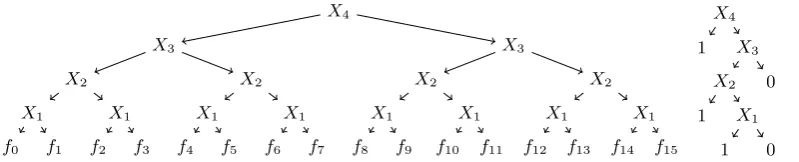
Fig. 1.The complete binary decision tree that returnsfx(left), and a branching program that returns 1 iffx≤10 (right). In both cases,len(P) = 4
graph (V, E), where the non-terminal (that is, non-sink) nodes are labeled by variables from some variable set{X1, . . . , Xχ}, the sinks are labeled by`-bit strings and thew outgoing edges
of every internal node are labeled by values from 0 to w−1. Usually, it is assumed that a branching program has 1-bit sink labels, then it can be assumed to have two terminal nodes. A branching program with longer sink labels is thus sometimes calledmulti-terminal. See Fig. 1.
A branching program with 1 source computes a function f :{0,1}χ→ {0,1}`. Every
assign-ment of the variables selects one path from the source to a sink as follows. The path starts from the source. If the current path does not end at a sink, test the variable at the endpoint of the path. Select one of the outgoing edges depending on the value of this variable, and append this edge and its endpoint to the path. (For the sake of concreteness, we assume that the leftmost edge is chosen iff the variable is 0.) If the path ends at a sink, return the label of this sink as the value of the source. The branching program’s value is then equal to the source value.
For a branching programP, letlen(P) be its length (that is, the length of its longest path), size(P) be its size (that is, the number of non-terminal nodes). LetBP(f) be the minimal size of any branching program computing f. It is known that any Boolean function f :{0,1}χ →
{0,1} hasBP(f)≤(1 +o(1))2χ/χ [BHR95, Thm. 1]. A Boolean functionf has a polynomial-size branching program iff f belongs to L/poly [Cob66]. If f has non-Boolean output, f :
{0, . . . , w−1}χ → {0,1}`, then it can be computed in parallel by ` branching programs that
compute its individual bits.P is a decision tree if the underlying graph is a tree.P isleveled if its set of nodes can be divided into disjoint setsVd such that every edge from a node in setVd
ends in a node in set Vd−1. We assume that the source is the only member of the set Vm. Let
size(P, d) be the number of nodesP has on level d, thussize(P, m) = 1.
Definition 1. The class LBP contains all functions f : {0, . . . , w−1}χ → {0,1}` for which
we have a large-output branching program with size that is polynomial on both parameters χ, n
with n=|f({0, . . . , w−1}χ)|.
Throughout the paper, Pf is a fixed leveled w-ary branching program that implements f :{0,1}χ → {0,1}`. For any node v, let len(v) be itslength, i.e., len(v) =len(P
f)−d¯, where ¯d
is the distance from the source to v. Thus v∈Vlen(v), and the source has lengthlen(Pf). (E.g.,
on Fig. 1 (left), all sinks have length 0 and the source has length 4.) If v is a non-sink node, let child(v, i) for i∈[0, w−1] be its ith leftmost child, and Xind(v) be the label of v. Note that
len(child(v, i)) =len(v)−1. Assume that the nodes ofPf are ordered from 1 tosize(Pf) so that
if there exists an edgeu→vthenv < u. We assume thatPf hasnsinks. Thus, nodesv≤nare
the sinks and v = size(Pf) is the source of Pf. Recall that the description of Pf also contains the values fv of the sinks ofPf.
polynomial-time encryption algorithm c ← Encpk(x;r), and a deterministic polynomial-time decryption algorithm x ← Decsk(c). It is required that if (pk,sk) ←r Gen(1k), then for any x
and r from corresponding domains, Decsk(Encpk(x;r)) = x. The rate of a cryptosystem is the length`of a plaintext divided by the length of its ciphertext. The rate can be a function of`. A cryptosystem isCPA-secure if for anyx0 andx1(possibly chosen by the adversary) of the same
length, given an encryptionEncsN(xβ;r) for randomly chosen β∈ {0,1}and r, no probabilistic polynomial-time adversary can guessβ with probability 1/2 +ε, whereεis non-negligible ink.
Damg˚ard-Jurik Cryptosystem. Assume ` is the length of the plaintexts in bits. The Damg˚ard-Jurik cryptosystem [DJ01] allows to encrypt plaintexts for arbitrary ` ≥ 1, so that the ciphertext length is not more than `+ 2k. The cryptosystem is defined as follows. To gen-erate the public and secret keys, one lets N =pqto be ak-bit RSA modulus for two randomly generated largek/2-bit primesp andq. The valueN is the public keypk, and the factorization (p, q) of N is a part (together with some additional information that makes decrypting more efficient) of the secret key sk. To encrypt an `-bit string x, one chooses a length parameter s
such that ` = sk (or s = d`/ke if k - `), chooses a randomizer r ←r Z∗N, and then outputs c← (1 +N)xrNs mod Ns+1. Thus the plaintext belongs to ZNs while the ciphertext belongs to ZNs+1, i.e., has the bitlength ≤ dlog2Ns+1e ≤ (s+ 1)k bits. Due to the choice of s, the bitlength of the plaintext is at least (s−1)k. Decryption can be done efficiently, see [DJ01].
The rate of Damg˚ard-Jurik is |x|/|c| ≥ (s−1)/(s+ 1). If ` → ∞, then ` =|x| ≈ sk, and the rate is approximately 1−1/s. Since EncsN(x0;r0)·EncNs (x1;r1) =EncsN(x0+x1;r0r1), the Damg˚ard-Jurik cryptosystem is additively homomorphic. If c is a publicly known value, then EncsN(x;r)c=EncsN(cx;rc). Recall that arithmetic in the first (resp., second) parameter ofEnc is done moduloNs (resp.,N).
The CPA-security of the Damg˚ard-Jurik cryptosystem is based on the Decisional Composite Residuosity (DCR) assumption of Paillier [Pai99].
Computationally-Private Information Retrieval (CPIR). In an (w,1)-CPIR protocol for `-bit strings, the server has a database of w elements, f = (f0, . . . , fw−1), each fi being `
bits long, and the client has an input x ∈ {0, . . . , w−1}. The client needs to obtain fx, while no efficient (i.e., probabilistic polynomial-time) server should obtain any information about
x. In a two-message CPIR protocol, the client generates a secret/public key pair (sk,pk) ←
KGCPIR(1k), and sends to the server pk and a query c=Quepk(w, `, x;r) that depends on the security parameterk, the size of the databasew, the length of the database elements`, the input
x, and some random coins r. The server replies with ˆc ← Reppk(f, c; ˆr) that depends on the input f, the query c, and another randomizer ˆr. The client can recover fx by using algorithm Anssk(w, `,cˆ), given access to ˆc,w,`, and the secret keysk.
The rate rate(Γ) of a (two-message) CPIR protocol Γ is the number of “useful bits” (that is,`, the database element length) divided by the total communication |Que()|+|Rep()|of the protocol. We do not include pk to the communication, since the samepk can — and will — be used in many CPIR protocols.
The formal (CPA-)security notion is similar to the one of cryptosystems, see, e.g., [Lip05].
Lipmaa’s Basic (w,1)-CPIR.In Lipmaa’s (w,1)-CPIR protocol [Lip05,Lip09], the client first generates secret and public key (sk,pk), withpk=N, for the Damg˚ard-Jurik cryptosystem. She then sendspk together with a vector ofw−1 ciphertexts
c= (c1, . . . , cw−1) =Quepk(w, `, x;r)←(EncsN([i=x];ri))w−1i=1
to the server, where [i = x] ∈ {0,1} is equal to 1 iff i = x, s = d`/ke, ri ←r Z∗N, and
be the server’s database. The server answers, for random ˆr ←rZ∗ N, with
ˆ
c←Reppk(f,c; ˆr) :=
w−1 Y
i=1 cfi−f0
i ·Enc s
N(f0; ˆr) =EncsN(fx; w−1
Y
i=1 rfi−f0
i ·rˆ) .
Since ˆr is random, then ˆc is a random encryption offx.
The client obtains fx by decrypting ˆc, fx ←Anssk(w, `,ˆc) :=Decssk(ˆc). Clearly, the server’s answer is a random encryption offx. Since the server only sees encrypted messages, the CPA-security of (w,1)-Lipmaa’s CPIR protocol immediately follows from the CPA-security of the Damg˚ard-Jurik cryptosystem, and thus, from the DCR assumption.
Here, |Que()|= (w−1)(s+ 1)k and |Rep()|= (s+ 1)k, wheres=d`/ke, and thus the rate israte(Γ) = (sk)/((w−1)(s+ 1)k) =s/((w−1)(s+ 1)) = 1/(w−1)−k/((w−1)`) +O`(`−2),
sinces≈`/k.
Due to the construction of the Damg˚ard-Jurik cryptosystem,x and fx must be encrypted by using the same length parameters: if xwas encrypted by using a parameterz < s, then the server’s answer would encryptfx modNzand thus the server would not recover the whole value fx. More discussion on this issue is provided in [Lip09]. There it was also demonstrated that (i) There exists a function Compress that takes Encs+1N (x;r) as an input and outputs EncsN(x
mod Ns;r∗), where s ≥ 1, and r∗ is a randomizer that depends on N, r and s. (ii) On the
other hand, if there exists a function Expand that takes EncsN(x;r∗) as an input and outputs Encs+1N (x;r), then the Lipmaa’s (2,1)-CPIR protocol has rate 1−o(1). Namely, in this case the client’s message is justEnc1N(x) (2kbits) independently of the value of`. However, the existence of this function was deemed to be extremely unlikely in [Lip09].
3 Optimal-Rate Leveled LBP-Homomorphic Encryption
We introduce leveled homomorphic encryption for LBP, following the terminology of Gen-try [Gen09a]. However, the definition will be somewhat different. According to [Gen09a, Def. 2.1.5], a family of homomorphic encryption schemes {Π(m) : m ∈
Z+} is leveled fully
homomorphic if, for all m ∈ Z+, they all use the same decryption circuit, Π(m) compactly
evaluates all circuits of depth at most m(that use some specified set of gates), and the compu-tational complexity ofΠ(m)’s algorithms is polynomial ink,m, and (in the case of the evaluation algorithm) the size of the circuit. In practice, this means that each Π(m) can have a different private/public key pair (sk(m),pk(m)). This is since the public moduli, used when encrypting, (and thus also the public key) depend on m.
The new (slightly stronger) definition only requires the creation of a single key pair (sk,pk) usable for anym. Instead, it is Alice who picks the valuemwhile encrypting the messages. The concrete value m gives an upper bound on the length of the large-output branching program that Bob can evaluate on these ciphertexts. Optimal rate is achieved ifmis equal to the actual length of the evaluated large-output branching program. For this reason, in the definition we will concentrate on the case of level m branching programs. Since the rate in our case will be defined as the total length of Alice’s and Bob’s messages, it is is natural that Alice — who sends her message first — has to choose the parameterm, based on her knowledge of Bob’s input, to optimize the rate. Similar problem exists in leveled FHE.
Definition 2. A (single-key) leveled LBP-homomorphic encryption (LHE) scheme is a four-tuple of efficient algorithms (KG,Enc,Eval,Dec), such that (i) the randomized key generation algorithm KG(1k) creates a single secret key and public key pair (sk,pk), (ii) given a message
Encmpk(x;r)returns a ciphertextc, (iii) given a leveled branching programPf of lengthm, a fresh
ciphertext c (equal to Encmpk(x;r) for some plaintext x and randomizer r) and a randomizer rˆ, the randomized evaluation algorithmEvalpk(Pf, c; ˆr)returns an evaluated ciphertextcˆofPf(x), (iv) given an evaluated ciphertext cˆ and the branching program length m, the deterministic decryption algorithmDecmsk(ˆc) returns a plaintext x.
It is required that for any valid key pair (sk,pk), message x, randomizers r and ˆr, and a polynomial-size branching program Pf of length m, Decmsk(Evalpk(Pf,Encmpk(x;r); ˆr)) = x. Fi-nally, it must be the case that the computational complexity of these four algorithms is poly-nomial in k,m, and (in the case ofEval) the size of the branching program. We often omit the randomizerr(or ˆr) in the descrption of algorithms; in this case it is understood that it is chosen uniformly at random.
A leveled LHE scheme must satisfy two security requirements,CPA-security andbranching program privacy (similar to circuit-privacy, [Gen09b,Gen09a]). The first one is defined similarly to the case of arbitrary public-key cryptosystems, though one has to take into account the presence ofEval, see [Gen09b,Gen09a] for a formal definition. However, to achieve optimal rate we allow the outputs ofEncmandEvalcan come from different distributions; we just require that the output ofEval does not reveal any unnecessary information about the evaluated branching program except its length. That is,(perfect) branching program privacy guarantees that for any (sk,pk), any m, any valid ciphertextc produced byEncmpk, and any two equal-length branching programs P0 and P1 such that P0(Decmsk(c)) = P1(Decmsk(c)), it holds that Evalpk(P0, c) and Evalpk(P1, c) have the same distribution.
We require that the LHE schemeΠ be communication-efficient in the sense that itsrate
rate(Π) := |x|+|Pf(x)|
|Encmpk(x;r)|+|Evalpk(Pf,Encmpk(x;r); ˆr)|
is as large as possible. Informally, Π is optimal-rate, if the rate is 1−o`(1) as a function of `.
The rate takes into account the value |Enc|, since it is possible to choose parameters so that
|Eval| is very small while |Enc| is very large. It is also a natural measurement of the rate in many applications like (n,1)-CPIR. Similarly, the communication complexity of a leveled LHE scheme is equal to |Enc|+|Eval|.
Construction. Next, we propose a leveled LHE scheme that enables one to securely compute the value of any function f : {0, . . . , w−1}χ → {0,1}`, f ∈ LBP, with the communication
complexity that is approximately `+ 2p(w−1)χmk` (+ smaller terms), and the rate that is 1−2p(w−1)χmk/`(+ smaller terms). Here,mis the length of a polynomial-sizew-ary leveled branching program Pf that implements f. Since in the intended applications, ` χmk, the
rate will quickly approach 1 when `increases.
We utilize a two-message (w,1)-CPIR protocol (see Sect. 2) with short reply|Rep()|. More precisely, we chose Lipmaa’s (w,1)-CPIRΓ = (KGCPIR,Que,Rep,Ans) (see Sect. 2).9 We recall that in the case of this CPIR,|Que()|= (w−1)(s+ 1)kand|Rep()|= (s+ 1)k, wheres=d`/ke. Furthermore, it is possible to deriveQuepk(w, `0, x;·) fromQuepk(w, `, x;r) for any`0≤`without knowing the secret key [Lip09] (see Sect. 2).
We assume that all parties knowm=len(Pf). For every leveld∈[m], letsdbe a level-specific
length parameter. Optimal parameterssd, ford∈[m], will be fixed in Sect. 4. Every nodevhas
a labelLv of bitlength|Lv|=tlen(v)slen(v)kfor some valuestidefined later. Letsmaxi := max{sd:
some leveldnode is labeled byXi}Sometimes, but not always, it is reasonable to assume that the encrypter knows the values smaxi . If he does not, we can assume thatsmaxi := max{sd}. In
the optimal case, see Sect. 4, all valuessdare equal to each other, so it does not matter whether
the encrypter knows the values smaxi . However, we first have to establish the optimality. On input x, the encrypter writesx =P
xiwi
Lchild (v , w -1), 1 Lchild (v , w -1), 2
… Lchild
(v , w -1), t[ d] Lchild (v , 0 ), 1 Lch ild (v , 0 ), 2
… Lchild
(v , 0 ), t[d ] R
ep Rep
… Rep
Lv, 1 Lv, 2 … Lv,
t[ d ] Lchild (v*,0), 1 Lch ild (v*,1), 2 Lchild (v*,2), 3
… Lchild
(v*,w
-1),
t[d
+1
]
|Lchild(v,i)|=tdsdk |Lv| = td (sd+1)k = td+1sd+1k
…
cind
(v ) Compu ta ti on of Lv Comp. oL Lp ar ent (v)
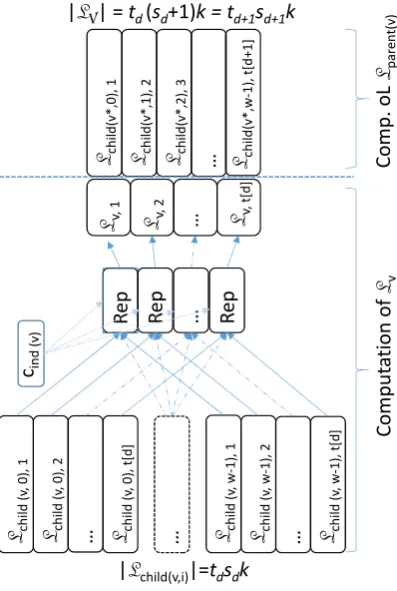
Fig. 2.Local computation ofLv
with xi < w, and then for each xi provides ci ←
Quepk(w, smaxi ·k, xi;·) by using a new randomness.
The vector of those queries is the LHE encryption of x. Note that xi corresponds to an assignment to the formal variableXi.
Evalpk(Pf, c; ˆr) inputs aw-ary leveled branch-ing programPf and the queries ci corresponding
to assignments to allXi. Recall that the choice of Pf fixes Lv for all sinks v ≤ n. Eval then
recur-sively computes Lv for all non-sink nodes whose
children already have assigned labels Lchild(v,i). Eval returns the valueLsize(Pf) of the source.
Up to now, the construction does not differ-ent from those in [IP07,Lip09]. The crux of the new construction is in how exactly Lv is
evalu-ated. Namely, at every non-sink nodev,Evaldoes the following. (See Fig. 2.) Let d = len(v); since
v is a non-sink node, {1, . . . , m}. Recall that Lv
has bit-length tdsdk and Lchild(v,i) has bit-length
td−1(sd−1+ 1)k. For the evaluation to succeed, we
set recursively
t0s0k=` , and tdsdk=td−1(sd−1+ 1)k ford∈[1, m] . (1)
Eval writes Lchild(v,i) = (Lchild(v,i),1, . . . ,Lchild(v,i),td) and Lv = (Lv,1, . . . ,Lv,td), where
|Lchild(v,i),z| = sd and due to the properties of the underlying (w,1)-CPIR protocol |Lv,z| =
|Reppk()|=sd+ 1. (Later, when v will play the role of a child of some other node v∗,Lv will
be divided into td+1 parts, see Fig. 2.) For each z, Eval then computes Lv,z by applying the
Reppk(·) algorithm on (Lchild(v,i),z)i=0w−1 and cind(v), see Fig. 3. After that,Lv is set equal to the
concatenation of the replies oftdparallel CPIR protocols, where thezth (w,1)-CPIR protocol is
applied to client’s inputxind(v) and the database (Lchild(v,i),z)w−1i=0 . Intuitively,Lv is a “garbled”
version ofLchild(v,x
ind(v)).
This means that at the end of the protocol, Lsize(Pf) is equal to the m-times recursive (and parallel) application ofReptofx. From this, the decrypter can obtainfxfromLsize(Pf)by recursively applyingAnsskto it. In our case,Lsize(Pf)(and the intermediate values) is interpreted
Key generationKG(1k): generate a key pair (sk,pk) viaKGCPIR(1k).
EncryptionEncmpk(x;·): Fori←1 toχ, letci←Quepk(w, smaxi ·k, xi;ri) for randomri. Returnc←(c1, . . . ,cχ).
EvaluationEvalpk(Pf, c; ˆr)for w-ary branching program Pf wheref:{0, . . . , w−1}χ→ {0,1}`:
forv←n+ 1tosize(Pf)do
d←len(v);
Parsecind(v)ascind(v)=Quepk(w, si·k, xi;·); forz←1totddo
Lv,z←Reppk(Lchild(v,0),z, . . . ,Lchild(v,w−1),z;cind(v); ˆrv,z) for random ˆrv,z;
end
Lv←(Lv,1, . . . ,Lv,td); end
return ˆc←Lsize(Pf);
DecryptionDecmsk(cˆ):
Parseˆc←(ˆc1, . . . ,ˆctd);
forz←1totddo letxz←Anssk(w, sm·k,ˆcz) ; Writex= (x1, . . . , xtd);
if d= 0then returnx; else returnDecmsk−1(x) ;
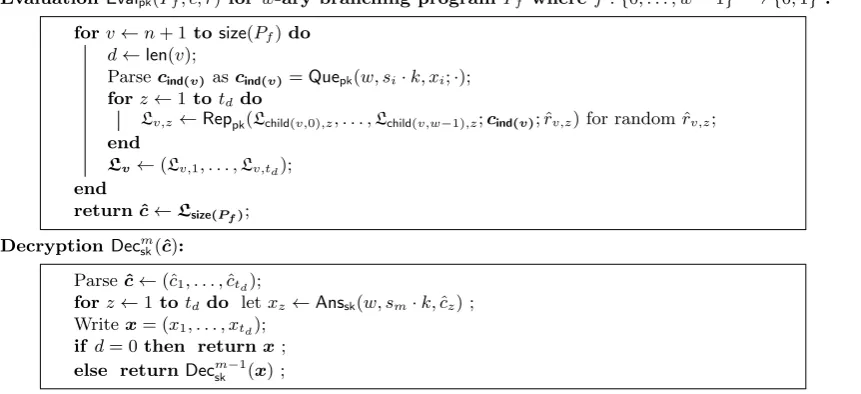
Fig. 3.The new leveled LHE scheme based on a (w,1)-CPIR protocol (KGCPIR,Que,Rep,Ans).
algorithms KG(1k), Encmpk(x;r), Evalpk(Pf, c; ˆr), and Decmsk(ˆc) are formally described by Fig. 3. The required constraints are satisfied by Lipmaa’s (w,1)-CPIR, see Sect. 2.
Theorem 1. Let Γ = (KG,Que,Rep,Ans) be a (w,1)-CPIR protocol that has the Compress function, with plaintext size ` =sk, |Que(w, `, . . .)|= (w−1)(s+ 1)k and |Rep()|= (s+ 1)k, wherekis the security parameter. Letf :{0, . . . , w−1}χ→ {0,1}` be a function inLBP. LetP
f
be a polynomial-size leveled w-ary branching program that implements f, and let m=len(Pf).
Write s= (s1, . . . , sm).
Let Π = (KG,Enc,Eval,Dec) be the leveled LHE scheme from Fig. 3 parameterized by w ∈
N>0.Π is perfectly branching program private. IfΓ is CPA-secure, thenΠ is CPA-secure. The
computation ofEvalpk is dominated byPmd=1td·size(Pf, d)·TRep(sd, w), whereTRep(sd, w) is the computational complexity ofReppk with given parameters. The communication |Enc|+|Eval| of
Π is equal to
com(χ, w, m,s, k, `) = (w−1)k χ X
i=1
smaxi +χ !
+`·
m−1 Y
d=0
1 + 1
sd
. (2)
Proof. Correctness and Security. The correctness of the construction is obvious. The
branching program privacy is clear, since the decrypter only sees an a number of (m−1)-times application of Rep to an output of Que, and it is guaranteed by the definition of privacy that the input to the query does not depend on the branching program.
Next, if an adversary is able to break the CPA-security of the leveled LHE scheme, then via a standard hybrid argument she is also able to break the CPA-security of the underlying CPIR protocol.
Complexity.The computational complexity is obvious. For the communication complexity,
clearly,|Encmpk(x;r)|=Pχi=1(w−1)(smaxi + 1)k= (w−1)(Pχi=1smaxi +χ)k bits. For d >0,
td=
sd−1+ 1 sd td−1 =
d−1 Y
i=0 si+ 1
si+1 ·t0 = d−1 Y
i=0
(si+ 1)· d Y
i=1
1
si · ` s0k =
`
(sd+ 1)k· d Y
i=0
1 + 1
si
Thus,|Evalpk(Pf, c; ˆr)|=tmsmk=`/((sm+ 1)k)·Qmi=0(1 + 1/si)·smk =`·Qm−1i=0 (1 + 1/si).
This gives the claimed communication complexity. ut
To guarantee branching program privacy in the case of a malicious encrypter, the encrypter must accompany his ciphertexts with standard zero knowledge proofs that they individually encrypt a Boolean value, and that their sum encrypts 1. This is out of the scope of the current paper. We remark that one can implement every language fromNC1 by using a width-5 branch-ing program [Bar86]. Since then one only has to keep a small constant number of branchbranch-ing program nodes in memory, by using the new leveled LHE scheme, one can implement languages from NC1 space-efficiently. We omit further discussion.
4 Finding Rate-Optimal Parameters
Next, we find the optimal parameters that result in the best possible rate for the leveled LHE scheme from Sect. 3. More precisely, our goal is to find optimal length parameters sd, as a function of `. As we will see, this optimization problem has quite an unexpected solution, we now briefly summarize our strategy. First, we show by using standard methods of multivariate analysis that the communication is minimized when the length parameters sd used at every level are all equal, s1 =· · ·=sm=:s. Second, we show that optimalsis defined as the unique
positive root of a certain degree-(m+ 1) polynomial. Third, since there is no general algebraic solution to this polynomial (except form <4), we find a Puiseux series for the unique positive root s (and also for the communication and rate, given optimal s). Fourth, we describe an efficient logm-time algorithm to find an integer approximation for the optimal value s. As we will show, this results in rate that is very close to 1 in practically relevant scenarios.
Rewording the Optimization Problem. In App. A, we show that ∂com/∂s1 = · · · =
∂com/∂sm = 0. Since all si are positive, then the global minimum is reached if s1 = . . . = sm=:sforsome s. (See App. A for a precise proof.) In particular, this means that the optimal communication complexity does not depend on the fact whether the encrypter knows the values
smaxi . Since all sd-s are equal, we denote
com(χ, w, m, s, k, `) :=com(χ, w, m, s, . . . , s, k, `) = (w−1)χ(s+ 1)k+
1 +1
s m
·` . (3)
Now, ∂com/∂s= (w−1)χk−m(s+ 1)m−1/sm+1·`. Denoting
σ:= (w−1)χk
m` , (4)
the requirement∂com/∂s= 0 is equivalent to the requirement that (s, σ) is a root of
fm(x, y) :=yxm+1−(x+ 1)m−1 . (5)
According to the Descartes’ rule of signs,fm has exactly one positive real root for each m >0. Thus, this unique positive real root salso minimizes the functioncom.
Computing Puiseux Series of s. Since by the Abel-Ruffini theorem there is no general algebraic solution to polynomial equations of degree five or higher, for m >3 it is impossible to give explicit algebraic formula of the root of (5). We tackle this problem as follows.
Recall that the Puiseux series [Cas00] of a function g(x) is of type g(x) = P∞i=0aixi/γ, whereγ is an integer. We use the Newton-Puiseux algorithm [Cas00] to find the Puiseux series for the unique positive root s of fm. By the previous discussion, this will also be the Puiseux
First, it is known [Cas00] that the Puiseux series exists, i.e., s = P∞i=0aiσi/n for some
coefficients ai and integer n. We find this series by assuming that s = c0σγ0 +c1σγ0+γ1 + c2σγ0+γ1+γ2+. . ., and then findingciandγi one by one. The exponentsγi are defined as certain slopes of the Newton polygon [Cas00] forfm(s, σ) = 0. After a while we form a hypothesis about
the general formula for ci and prove it. See Appendix B for a more detailed description of the
Newton-Puiseux algorithm and for the proofs of the following theorems.
Theorem 2. Let σ be as in Eq.(4). The Puiseux series of the unique positive root s of fm is
s=
∞ X
i=0
ciσ(i−1)/2 =σ−1/2+m−1
2 −
1 8(m
2−1)√σ+O(σ) , (6)
where ci = (−1)i+1 (m−1)2ii!
((i−1)(m+1))!! ((i−1)(m−1))!!.
Denote by s(i) := Pi−1i=0ciσ
(i−1)/2 the sum of the first i elements of this Puiseux series. In
practice, it suffices to know the valuess(1) =σ−1/2 ands(2)=σ−1/2+ (m−1)/2 (see Sect. 4.1).
Knowing the Puiseux series ofswe may substitute it into the communication functioncomof Eq. (3), deriving thus the Puiseux series for the communication. The following theorem follows.
Theorem 3. Letf :{0, . . . , w−1}χ → {0,1}`be computable by a polynomial-sizew-ary
branch-ing program Pf of length m. The leveled LHE scheme of Sect. 3 for f has communication
`+ 2p(w−1)χmk`+w−1
2 χ(m+ 1)k+O(`
−1/2
)
and rate
1−2
r
(w−1)χmk ` +
w−1
2 ·
χ(7m−1)k ` +O(`
−3/2) .
See App. D for a more detailed statement (with a more precise series expression) and a proof.
4.1 Efficient Algorithm for Finding Integer Approximation of Root
Next, we propose a simple binary search algorithm that finds the best integer approximation to the unique positive root s of Eq. (5) in ≈ log2m steps. Clearly, in our application, an integer approximation is sufficient. Letσ be as defined in Eq. (4). We first show that for s(1) =σ−1/2
and s(2) = σ−1/2+ (m−1)/2 as defined in Thm. 2, fm(s(1), σ) is negative and fm(s(2), σ) is
positive. (This result is quite technical, and its proof is given in App. C.) Since 0< s(1)< s(2),
we know that the only positive rootsoffm(x, σ) is in the interval (s(1), s(2)) of length (m−1)/2.
We can compute the integer approximation to s (that is sufficient for our purposes) by using binary search in this interval, see Alg. 1. The proof of the following lemma is given in App. C.
Lemma 1. fm(s(1), σ) <0 and fm(s(2), σ) ≥0. Moreover, f1(s(2), σ) = 0 and fm(s(2), σ) >0
for m >1.
Theorem 4. Alg. 1 finds the best integer approximation of s in ≈ log2((m−1)/2) ≈ log2m
sL← bs(1)c;sH ← ds(2)e;
while sH > sL+ 1do sM ← b(sL+sH)/2c;
if fm(sM, σ)>0 then sH ←sM ;
else sL←sM ;
end
if com(χ, w, m, sL, k, `)<com(χ, w, m, sH, k, `) then return s←sL ;
else return s←sH ;
Algorithm 1:Finding integer approximation to rootsby using binary search
Proof. The algorithm finds the unique unit interval [s∗, s∗ + 1] in the original interval that contains the root. It does so by using binary search. The number of the steps is clearly (approx-imately) logarithmic in the length of the interval, (m−1)/2. ut
5 Near Optimal Rate (n,1)-CPIR
Given our homomorphic encryption the of a near optimal rate (n,1)-CPIR is straightforward. Following [Lip09], in an (n,1)-CPIR protocol, we let the client first generate a new Damg˚ ard-Jurik public and secret key pair, and then send to the server the public key together with encryptions of every individual bit of the index x. The server represents her database f as a compact branching program Pf that computes the function f where f(x) := fx, and then
evaluates securely the client’s query on top of it. The client obtains the encrypted source value, and then decrypts it. When using the new leveled LHE scheme, the computational and com-munication complexity is as per Thm. 1. Thus, the resulting CPIR protocol has both optimal rate (when using the parameters derived in Sect. 4), and (given the database is sufficiently redundant) sublinear-in-ncomputational complexity. On the other hand, if the database is not redundant, then the server just represents it as an w-ary tree of lengthm.
In most of the applications, w = 2, which is also often (but not always) the optimal case. The following corollary exemplifies this.
Corollary 1. Assume that the DCR assumption [Pai99] is true. There exists a CPA-secure (n,1)-CPIR protocol with communication `+ 1.72·log2n·√k`+ 2(log25n+ log5n)k+O(`−1/2) and rate 1−1.72·log2n·p
k/`+ 2(7 log25n−log5n)·k ` +O(`
−3/2).
Proof. Follows from preceeding discussion and Thm. 3 by settingm=χ= logwn, and consider-ing the full w-ary decision tree. Thus, the (n,1)-CPIR protocol has communication complexity
`+ 2
√ w−1
log2w log2n·
√
k`+O(1). Since w is an integer, the second coefficient in this series is
minimized when w= 5. ut
We provide an example with concrete parameters below. Consider the setting of (n, 1)-CPIR, where each database element is a movie, and a paying client wishes to obtain one movie without the server knowing which movie she wants to see. Assume that k = 3072, ` = 106k
6 Communication complexity lower bounds in restricted models
In order to study the optimality of our constructions, we introduce two abstract models that capture the power of leveled homomorphic schemes that are constructed in a black-box fashion from an additive homomorphic public-key encryption (PKE). We provide lower-bounds on the communication complexity of private-information-retrieval in these models. We note that PIR be seen as an instance of large-output branching program evaluation and our results can be generalized to yield lower bounds for homomorphically evaluating branching programs.
We first derive a useful lemma in a restricted model where two-party protocols are imple-mented non-interactively via only access to a multivariate polynomial evaluation functionality. An important corollary of this is that when we use multivariate polynomial evaluation over degree 1 polynomials the best communication complexity we can obtain is Ω(√n) where n is the cardinality of the client input domain.
The usefulness of the result will come by a further observation (see below) that additive homomorphic encryption that operates without “layering” i.e., encoding ciphertexts within plaintexts and rencrypting, can achieve at best a degree 1 multivariate polynomial evaluation.
In particular, the client and the receiver are communicating via a multivariate polynomial evaluation oracleMP(v, Q1, . . . , Qt), operating over a finite fieldF, wherev∈Fr is some
encod-ing of the user’s input x ∈ {0,1}`·n and Qd ∈F[y1, . . . , yr] and returns to the user a vector in Ft whose d-th coordinate equals ud =Qd(v). If the maximum degree of eachQd ism then we
write the oracle asMPm(·).
The length of the oracle communication for a protocolBin this model is measured in terms of the size of the input provided by the client to the MP(·) oracle and the size of the response of the oracle to the client. In the appendix E.2 we prove a slightly more general version of the following lemma.
Lemma 2. Let m ∈ N. Consider a two-round protocol B in the MPm(·) model over a field F
that realizes (n,1)-CPIR protocol for `-bit strings. Assume the communication complexity ofB
is such that the client transmits r values to MP(·) and receives t values from it. It holds that
r+m m
·t≥`·n/log|F|.
If we count also the field size in the above description we have that the total communication of the protocol is (t+r) encodings of values in F. In the case that m= 1 the communication
will be minimized provided that we choose t, r ≈ p
`n/log|F|. In the general case, if m r
we have (r+ 1)m·t≥`n/log|F|, the communication to the oracle will be minimized when we
choose r= (mn`/log|F|)
1
m+1 −1 resulting in a total communication of Ω((mn`) 1 m+1).
We recall that our LHE scheme is built on top of a (w,1)-CPIR protocol implemented over an additive homomorphic public-key encryption (PKE).
We next introduce the black-box PKE model for an additive homomorphic PKE scheme. In this model, we consider two-party two-round protocols B that realize a functionality F(·,·) as follows. If the client has inputx and the server input (f,s) the user receivesF(x,(f,s)) =sf(x). Specifically, in an (n,1)-CPIR protocol, X = [n] and F(x,hs1, . . . , sni) =sx, with f being the identity function. In our model, the protocol is parameterized bymlevels. Each level dutilizes a corresponding additive-homomorphic PKE oracle that encrypts in an associated group Gd.
The encrypted messages may be homomorphically added via oracle queries and then passed to the next leveld+ 1 to be processed further. Finally, the client receives an element from Gm.
Specifically, a black-box 2-round protocolBis comprised of three algorithmsΠ = (C1, S, C2)
with the following characteristics.10 Bis parameterized by m that corresponds to the “levels” 10
of the encryptions that it utilizes. With each level we associate an additive group. The d-th group (Gd,+) requires bdbits for the representation of its elements and the underlying PKE is
suitable for encrypting elements of the groupsGdin a way that addition can be homomorphically achieved between encrypted elements. The exact choice of G1, . . . , Gm is independent of our
arguments and we make no further assumption about these groups beyond the fact that the basic operation can be efficiently implemented. Note that the groups are not necessarily distinct. The first algorithm of Bdenoted byC1 has inputx and access to a set of oraclesEncd(·) for d= 1, . . . , m that operate as follows: Encd(·) receives as input a plaintext m0 so that m∈Gd;
it returns a ciphertextψ encryptingm0. We say that ψ is ad-th level encryption of m0.
C1 using oracle access to{Encd(·)}dproduces a sequence of ciphertextsψ1, . . . , ψt(that may
belong to different levels). The algorithmS takes as inputsas well as a sequence of ciphertexts
hψ1, . . . , ψti (presumably the output of C1). S has access to the oracle Encd(·) and an oracle Addd(·) that takes as input a pair of ciphertexts (ψ1, ψ2) and provided that ψ1, ψ2 are d-level encodings encrypting the elements m1, m2 ∈ Gd, it returns a ciphertext ψ that encrypts the
element m1 +m2 ∈ Gd. S terminates with a sequence of ciphertexts ψ1, . . . , ψt0. Finally, C2 operates on input x, ψ01, . . . , ψt00 and returns an output z. Algorithm C2 has oracle access to Encd(·),Decd(·). The oracle Decd(·) receives as input ψ and if ψ is a valid encryption of some
m0 ∈Gd it returns m0.
Note that we assume perfect correctness from the underlying encryption, i.e., whenever ψ
is an oracle answer to a query m0 by Encd(·), submittingψ toDec(·) will return the value m0.
Definition 3. A protocolBrealizes the functionalityF(·,·)in the black-box additive PKE model if it holds that for all x,s the output z of the C2 algorithm in the interaction as defined above
satisfiesz=F(x,s) for all correct instantiations of the Encd(·),Decd(·),Addd(·) oracles.
An important feature of our approach is that the protocol Bin the black-box PKE is com-pletely agnostic in the implementation of the underlying PKE scheme. Thus by manipulating the PKE oracle one may deconstruct protocol B to simpler subprotocols for which we can an-alyze their communication complexity using the multivariate polynomial argument that was presented above. Specifically, for canonical protocols that satisfy certain simple requirements (see the appendixE for a full description) we prove the following.
Theorem 5. Let Bf be any canonical two-party protocol in the black-box additive PKE model
that realizes F with F(x,(f,s)) = sf(x) for f : X → [n] and s ∈ ({0,1}`)n. Suppose that the
total communication complexity of Bf with respect ton is On(logλn), for some positive integer
λ; then its total communication complexity is at least
`+Ω
logn
log logn
·√`k+Ω
logn
log logn
·k .
Based on this we easily obtain the ceiling on the best possible communication rate for CPIR in the black-box additive PKE model which equals 1−Ω(logn/log logn)·p
k/`+Θ`(`−1).
References
Bar86. David A. Mix Barrington. Bounded-Width Polynomial-Size Branching Programs Recognize Exactly Those Languages in NC1. In Proceedings of the Eighteenth Annual ACM Symposium on Theory of Computing, pages 1–5, Berkeley, California, USA, 28–30 May 1986. 3
BHR95. Yuri Breitbart, Harry B. Hunt III, and Daniel J. Rosenkrantz. On The Size of Binary Decision Diagrams Representing Boolean Functions. Theoretical Computer Science, 145(1&2):45–69, 1995. 2 Cas00. Eduardo Casas-Alvero. Singularities of Plane Curves, volume 276 of London Mathematical Society
CFFC11. Ana Charpentier, Caroline Fontaine, Teddy Furon, and Ingemar Cox. An asymmetric fingerprinting scheme based on tardos codes. In Proceedings of the 13th international conference on Information hiding, IH’11, pages 43–58, Berlin, Heidelberg, 2011. Springer-Verlag. 1
CLO+13. Ashish Choudhury, Jake Loftus, Emmanuela Orsini, Arpita Patra, and Nigel P. Smart. Between a Rock and a Hard Place: Interpolating between MPC and FHE. In Kazue Sako and Palash Sarkar, editors,ASIACRYPT 2013, volume 8270 ofLNCS, pages 221–240, Bangalore, India, December 1–5, 2013. Springer, Heidelberg. 1
CMS99. Christian Cachin, Silvio Micali, and Markus Stadler. Computational Private Information Retrieval with Polylogarithmic Communication. In Stern [Ste99], pages 402–414. 1
Cob66. Alan Cobham. The Recognition Problem for the Set of Perfect Squares. InFOCS 1966, pages 78–87, Berkeley, California, October 23–25, 1966. IEEE Computer Society. 2
DFH12. Ivan Damg˚ard, Sebastian Faust, and Carmit Hazay. Secure two-party computation with low commu-nication. InTCC, pages 54–74, 2012. 1
DJ01. Ivan Damg˚ard and Mads Jurik. A Generalisation, a Simplification and Some Applications of Paillier’s Probabilistic Public-Key System. In Kwangjo Kim, editor,PKC 2001, volume 1992 ofLNCS, pages 119–136, Cheju Island, Korea, February 13–15, 2001. Springer, Heidelberg. 1, 2
DZ13. Ivan Damg˚ard and Sarah Zakarias. Constant-overhead secure computation of boolean circuits using preprocessing. InTCC, pages 621–641, 2013. 1
Gen09a. Craig Gentry. A Fully Homomorphic Encryption Scheme. PhD thesis, Stanford, September 2009. 3, 3 Gen09b. Craig Gentry. Fully Homomorphic Encryption Using Ideal Lattices. In Michael Mitzenmacher, editor,
STOC 2009, pages 169–178, Bethesda, Maryland, USA, May 31 — June 2, 2009. ACM Press. 1, 3 GHS12. Craig Gentry, Shai Halevi, and Nigel P. Smart. Homomorphic evaluation of the AES circuit. In
Advances in Cryptology - CRYPTO 2012 - 32nd Annual Cryptology Conference, Santa Barbara, CA, USA, August 19-23, 2012. Proceedings, pages 850–867, 2012. 5
Gil91. George T. Gilbert. Positive Definite Matrices and Sylvester’s Criterion. The American Mathematical Monthly, 98(1):44–46, 1991. A
GM82. Shafi Goldwasser and Silvio Micali. Probabilistic Encryption and How to Play Mental Poker Keeping Secret All Partial Information. InProceedings of the Fourteenth Annual ACM Symposium on Theory of Computing, pages 365–377, San Francisco, California, USA, May 5–7, 1982. ACM. 1
GR05. Craig Gentry and Zulfikar Ramzan. Single-Database Private Information Retrieval with Constant Communication Rate. In Luis Caires, Guiseppe F. Italiano, Luis Monteiro, Catuscia Palamidessi, and Moti Yung, editors, ICALP 2005, volume 3580 ofLNCS, pages 803–815, Lisboa, Portugal, 2005. Springer, Heidelberg. 1
IKM+13. Yuval Ishai, Eyal Kushilevitz, Sigurd Meldgaard, Claudio Orlandi, and Anat Paskin-Cherniavsky. On the power of correlated randomness in secure computation. InTCC, pages 600–620, 2013. 1
IP07. Yuval Ishai and Anat Paskin. Evaluating Branching Programs on Encrypted Data. In Salil P. Vadhan, editor,TCC 2007, volume 4392 ofLNCS, pages 575–594, Amsterdam, The Netherlands, February 21– 24, 2007. Springer, Heidelberg. 1, 3
KO97. Eyal Kushilevitz and Rafail Ostrovsky. Replication is Not Needed: Single Database, Computationally-Private Information Retrieval. InFOCS 1997, pages 364–373, Miami Beach, Florida, October 20–22, 1997. IEEE Computer Society. 1
Lip05. Helger Lipmaa. An Oblivious Transfer Protocol with Log-Squared Communication. In Jianying Zhou and Javier Lopez, editors,ISC 2005, volume 3650 ofLNCS, pages 314–328, Singapore, September 20– 23, 2005. Springer, Heidelberg. 1, 8, 2
Lip09. Helger Lipmaa. First CPIR Protocol with Data-Dependent Computation. In Donghoon Lee and Seokhie Hong, editors,ICISC 2009, volume 5984 ofLNCS, pages 193–210, Seoul, Korea, December 2– 4, 2009. Springer, Heidelberg. 1, 8, 2, ii, 3, 9, 5
Lip11. Helger Lipmaa. Efficient multi-query cpir from ring-lwe. IACR Cryptology ePrint Archive, 2011:595, 2011. 6
NN01. Moni Naor and Kobbi Nissim. Communication preserving protocols for secure function evaluation. In Jeffrey Scott Vitter, Paul G. Spirakis, and Mihalis Yannakakis, editors,STOC, pages 590–599. ACM, 2001. 1
Pai99. Pascal Paillier. Public-Key Cryptosystems Based on Composite Degree Residuosity Classes. In Stern [Ste99], pages 223–238. 1, 2, 1
Pfi96. Birgit Pfitzmann. Trials of traced traitors. In Ross J. Anderson, editor,Information Hiding, volume 1174 ofLecture Notes in Computer Science, pages 49–64. Springer, 1996. 1
PW97. Birgit Pfitzmann and Michael Waidner. Asymmetric fingerprinting for larger collusions. In Richard Graveman, Philippe A. Janson, Clifford Neumann, and Li Gong, editors,ACM Conference on Com-puter and Communications Security, pages 151–160. ACM, 1997. 1
Ste98. Julien P. Stern. A New And Efficient All Or Nothing Disclosure of Secrets Protocol. In Kazuo Ohta and Dingyi Pei, editors, ASIACRYPT ’98, volume 1514 of LNCS, pages 357–371, Beijing, China, October 18–22, 1998. Springer, Heidelberg. 1
Ste99. Jacques Stern, editor. EUROCRYPT 1999, volume 1592 ofLNCS, Prague, Czech Republic, May 2–6, 1999. Springer, Heidelberg. 6
SYY99. Tomas Sander, Adam Young, and Moti Yung. Non-Interactive CryptoComputing For NC1. InFOCS 1999, pages 554–567, New York, NY, USA, 17–18 October 1999. IEEE Computer Society. 1
Wal13. Robert J. Walker. Algebraic Curves. Springer, October 4, 2013. B
Weg00. Ingo Wegener. Branching Programs and Binary Decision Diagrams: Theory and Applications. Mono-graphs on Discrete Mathematics and Applications. Society for Industrial Mathematics, 2000. 2
A Derivation of Global Minimum
Here we give some details and explanations to Section 4.
Assuming that the rest of the parameters are fixed, the multivariate communication func-tion com of Eq. (2) is minimized (or maximized) in s = (s1, . . . , sm), when the gradient
∇com(χ, w, m,s, k, `) is 0, i.e.,∂com/∂s1 =· · ·=∂com/∂sm = 0, and the Hessian matrix
H(m,s) :=
∂2com
∂s1∂s1
∂2com
∂s1∂s2 . . .
∂2com
∂s1∂sm
∂2com
∂s2∂s1
∂2com
∂s2∂s2 . . .
∂2com
∂s2∂sm ..
. ... . .. ...
∂2com
∂sm∂s1
∂2com
∂sm∂s2 . . .
∂2com
∂sm∂sm
is positive definite. By the Sylvester’s criterion a matrix M is positive definite iff the determi-nants associated with all upper-left submatrices ofM are positive, [Gil91].
If sj is such that sj 6= smaxi for any i, then the value of sj is inconsequential for the
communication complexity, and thus we do not have to optimize it. Thus, assume that
ζj =|{i:sj =smaxi }| ≥1. Then
∂com
∂sj
=(w−1)ζjk− ` s2j ·
Qm
i=1:i6=j(si+ 1) Qm
i=1:i6=jsi
= (w−1)ζjk− `
(sj+ 1)sj
·
Qm
i=1(si+ 1) Qm
i=1si
= 0
and thus,
(w−1)ζjk ` ·
Qm i=1si Qm
i=1(si+ 1)
= 1
(sj+ 1)sj .
for every j. In particular, this means that for every i 6= j, si(si + 1) = sj(sj + 1). Thus either si = sj or si = −1−sj. But since si and sj both have to be positive, we get that
s1=· · ·=sm =:sfor somes.
In the general case
∂2com
∂s2 i
=2`
Q
κ6=i(sκ+ 1) s2
i Q
κsκ
and
∂2com
∂si∂sj
=`
Q
κ6=i,κ6=j(sκ+ 1) sisj
Q κsκ
fori6=j .
Let s? = (s?, . . . , s?) be a solution of Eq. (2). All upper-left submatrices of H(m,s) are circulant matrices with determinants of form
a b b ... b b a b ... b
· · · . ..· · ·
b b b ... a
=b(a−b)κ
1
b + κ a−b
,
whereκ∈ {0, . . . , m−1},
a= ∂
2com(χ, w, m,s?, k, `)
∂s21 =. . .=
∂2com(χ, w, m,s?, k, `)
∂s2 m
= 2`(s
?+ 1)κ−1
(s?)κ+2 >0
and
b= ∂
2com(χ, w, m,s?, k, `) ∂si∂sj
= `(s
?+ 1)κ−2
(s?)κ+2 >0 for all i, j∈ {0, . . . , κ−1},
and a−b >0. Thus, the Hessian matrices H(m,s?) are positive definite for allm >1.
Any local minimum of a convex function is also a global minimum. A continuous, twice differentiable function of several variables is convex on a convex set if and only if its Hessian matrix is positive semidefinite on the interior of the convex set. Since a positive definite matrix is also positive semidefinite,com(χ, w, m,s, k, `) is a convex function on a convex domains>0 and s?= (s?, . . . , s?) is indeed a global minimum.
B Proof of Thm. 2
Proof. First, rewrite Eq.(5) as
fm(s, σ) :=
m+1 X
i,j=0
bijsiσj = 0. (7)
The solutions(σ) of Eq. (7) will be constructed recursively as a Puiseux series inσ. Computing a power series expansion for s(σ) can be seen as solving a polynomial equation in one variable over the field of Puiseux series. Since the field of formal Puiseux series is algebraically closed (see Puiseux’s Theorem from [Wal13]), a root can always be found.
The root of function fm(s, σ) is of the form
s(σ) =c0σγ0+c1σγ0+γ1+c2σγ0+γ1+γ2+. . . , withci 6= 0,γi ∈Q,γi >0 for alli, or, otherwise, it can be written as
s(σ) =σγ0(c
0+s1) , where s1 =c1σγ1 +c2σγ1+γ2 +c3σγ1+γ2+γ3. . . . s(σ) =σγ0(c0+σγ1s2) , where s2=c1+c2σγ2 +c3σγ2+γ3. . . ,
s(σ) =σγ0(c
0+σγ1(c1+σγ2s3)) , where s3 =c2+c3σγ3 +. . . ,
and so on. According to the Newton-Puiseux algorithm [Cas00], the values of γi are defined as a certain slopes of Newton polygons of fm(i)(s, σ),ci are defined from letting terms of lowest
order in equationfm(i)(s, σ) = 0 (fm(0)(s, σ) :=fm(s, σ)) be equal to zero. Newton polygon is the
where (i, j) are the pairs of indices (i, j) of fm(s, σ) = Pbijsiσj. Those faces of the Newton
polygon, s.t. all the Pi’s lie on or above the corresponding line, have possible values for γ0 as
their negative slopes. A detailed proof of the fact, that the Newton’s Polygon Method can be performed on any polynomialf and that it actually yields Puiseux series is given in [Wal13].
Now we start from determining γ0 andc0. Since,fm(s, σ) has a non-zerobij iff
(i, j) = (i,0) fori∈[0, m−1], or (i, j) = (m+ 1,1),
the Newton polygon method gives us that the lower convex hull of the non-zero points (i, j) has one non-horizontal slope, from (m−1,0) to (m+ 1,1). This slope can be written as y =
1 2x−
m−1
2 =−γ0x+β0, whereγ0 =− 1
2 and β0 =− m−1
2 . Thus,
s(σ) =σ−1/2(c0+s1).
To find c0 we substitute σ−1/2(c0+s1) for sinfm(s, σ), getting
fm(s, σ) =fm
σ−1/2(c0+s1), σ
=σσ−1/2(c0+s1) m+1
−σ−1/2(c0+s1) + 1 m−1
=σ−(m−1)/2 m+1
X
i=0
m+ 1
i
cm+1−i0 si1−
m−1 X
i=0
m−1
i
σ−i/2 i X
j=0
i j
ci−j0 sj1
=σ−(m−1)/2
m+1
X
i=0
m+ 1
i
cm+1−i0 si1−
m−1 X
j=0
m−1
j
cm−1−j0 sj1
−
m−2 X
i=0
m−1
i
σ−i/2 i X
j=0
i j
ci−j0 sj1 .
The terms of lowest order must cancel. We equate to zero the coefficient of σ−(m−1)/2 getting
cm+10 −cm−10 = 0, orc02 = 1, orc0∈ {−1,0,1}. Since we are interested only in positive non-trivial solutions, we skipc0 ∈ {−1,0}, and obtain c0 = 1. Thus,
s(σ) =σ−1/2(1 +c1σγ1+c2σγ1+γ2 +. . .) .
Substituting c0 = 1 into fm(σ−1/2(c0 +s1), σ) and multiplying the result with σ−β0 = σ(m−1)/2, we’ll get a new polynomial
from which next γ2 and c2 will be defined. To construct Newton polygon for fm(1)(s1, σ), we
rewrite it as
fm(1)(s1, σ) := m+1 X
i=0
m+ 1
i
si1−
m−1 X
i=0
m−1
i
σ(m−1−i)/2(s1+ 1)i
:= sm+11 + (m+ 1)sm1 +
m−1 X
i=0
m+ 1
i
si1 !
−
(s1+ 1)m−1+ m−2
X
i=0
m−1
i
σ(m−1−i)/2(s1+ 1)i !
=sm+11 + (m+ 1)sm1 +
m−1 X
i=1
m+ 1
i
−
m−1
i
si1−
m−2 X
i=0
m−1
i
σ(m−1−i)/2 i X
j=0
i j
sj1 .
Thus, the polynomial fm(1)(s1, σ) = P
bijsi1σj has a non-zero coefficientbij iff
(i, j) = (x,0) forx∈[1, m+ 1], or
(i, j) =x,m−1−y2 forx∈[0, y] and y∈[0, m−2].
i j
0 1 2 3 4 5 6 7
0 0.5
1 1.5
2 2.5
Fig. 4.Newton polygon forfm, where∗ m= 6
As seen from Fig. 4, the Newton polygon offm(1)(s1, σ) consists of a single segment with only
two vertices, one on each axis. That segment has equation y = −γ1x+β1 = −12x+ 12. Such situation allows to compute the rest ci by letting lowest powers of σ cancel. By the Newton-Puiseux algorithm [Cas00], from now on the powers ofσ are going to jump by the denominator of γ1; in other words γ1 =γ2 =γ3 =· · ·= 1/2.
Now, we can calculate the rest of thecidirectly from the function obtained from substitution of s1 infm(1)(s1, σ) where
s1 =c1σ1/2+c2σ2/2+c3σ3/2+· · ·=
∞ X
i=1 ciσi/2
and equating to zero all terms which contain σ of degree n2, for all n ≥ 1. For that we will consider the equality
fm(1)(s1, σ) =σ
m−1
Now, s1 + 1 = P∞i=0ciσi/2 and s1 + 1 +σ1/2 = P∞i=0c0iσi/2, where c0i = ci for i 6= 1, and c01 =c1+ 1.
If nis a natural number and iand a0 are invertible, then
∞ X
k=0 akXk
!n
=
∞ X
k=0
bkXk, where b0=an0, andbi =
1
ia0
·
i X
k=1
(kn−i+k)akbi−k, i≥1.
Thus,
fm∗(s1, σ) = ∞ X
i=0
δi−δ0i
σi/2,
whereδ0=δ00= 1,
δi =
1
i i X
k=1
(k(m+ 1)−i+k)ckδi−k, and δi0 =
1
i i X
k=1
(k(m−1)−i+k)c0kδ0i−k , (8)
fori >0, since
(s1+ 1)m+1 =
∞ X
i=0
δiσi/2, (s1+σ1/2+ 1)m−1=
∞ X
i=0 δi0σi/2.
Collecting terms withσt/2,t≥1 infm∗(s1, σ), we get equations for calculating the rest ofct+1.
More precisely, we first collect terms that correspondt= 1, and then derive a recursive formula for the case t > 2. Via this recursive formula, we compute ci for small i, and then guess the general value ofci.
Consider first terms containing σ1/2:δ1=δ01. According to Eq. (8), δ1−δ01= (m+ 1)c1−(m−1)(c1+ 1) = 0 ,
and thus
c1= m−1
2 and δ1 = (m+ 1)c1 =
(m−1)(m+ 1)
2 .
We assume recursively that δj =δj0 for all j < i. Then, assumingi≥2,
0 =i(δi−δi0) =
i X
k=1
k(m+ 1)−i+kckδi−k−
i X
k=1
k(m−1)−i+kc0kδi−k0
= (m+ 1)−i+ 1
c1δi−1+ i X
k=2
k(m+ 1)−i+k
ckδi−k (m−1)−i+ 1c01δ0i−1−
−
i X
k=2
k(m−1)−i+kc0kδi−k0
=(m+ 2−i)c1δi−1−(m−i)(c1+ 1)δi−1+ 2
i X
k=2
kckδi−k
=2c1δi−1−(m−i)δi−1+ 2 i X
k=2
kckδi−k
=2ici+ 2
i−1 X
k=1
Thus,
ci =−1
i
(i−1)δi−1
2 + i−1 X k=2 kckδi−k ! . (9)
From Eq. (9) we can computeci, given that we have already computedcj andδj (using Eq. (8)) forj≤i.
For example, fori= 2 we get
c2 = 1 2 ·
(1−2)δ1
2 =−
δ1
4 =−
(m−1)(m+ 1) 22·2! ,
and
δ2 =
1 2
2 X
k=1
k(m+ 1)−2 +k
ckδ2−k =
(m−1)(m+ 1)(m2−2m−1)
22·2! .
Further, fori= 3,
c3 =1 3 ·
(1−3)δ2
2 −
2 X
k=2
kckδ3−k !
= (m−1)2m(2m+ 2)
23·3! ,
and
δ3 = 1 3 ·
3 X
k=1
k(m+ 1)−3 +kckδ3−k= (m−1)(m+ 1)(m
2−3m−2)(m2−3m)
23·3! ,
and so on.
The process can be continued to calculate more terms. However, the already calculated terms give us a good guess about the nature of bothci and δi.
Thus,
ci= (−1)i+1
(m−1) 2ii!
((i−1)(m+ 1))!!
((i−1)(m−1))!!, (10)
Moreover,
δi=
(m−1)(m+ 1) 2i·i! ·
i−1 Y
j=0
(m2−i(m+ 1) + 1 + 2j).
Verifying that these two equations satisfy the recursions Eq. (8) and Eq. (9) is rather tedious, and since it plays no importance in practice, we will omit it.
C Proof of Lem. 1
Proof. The case m= 1 is trivial. Now, assume that m≥2.
fm(s(1), σ) =kχ(w−1)σ−(m+1)/2−`m m−1
X
k=0
m−1
k
σ−(m−1−k)/2
= (`m)
(m+1)/2
(kχ(w−1))(m−1)/2 −`m
m−1 0
σ−(m−1−0)/2−`m m−1
X
k=1
m−1
k
σ−(m−1−k)/2
=−`m m−1
X
k=1
m−1
k