Savitribai Phule Pune University
RULES AND REGULATIONS
FOR
UG CREDIT SYSTEM PROGRAMME
UNDER FACULTY OF ENGINEERING
PREFACE:
In a bid to fine tune our technical education system to the global standards & practices, the Credit-Grade based performance and assessment system will be implemented with effect from June 2015 onwards for all the Under Graduate Programmes (UG) under the Faculty of Engineering, University of Pune, starting with First Year.
With the advent of technology and ever-changing expectations from the Industry and Society, it has become imperative to relook at the structure and subject contents of various UG courses to make it contemporary and relevant.
As per the decision by the authorities of University of Pune the faculty of Engineering has prepared the credit system and structure. The revised course is of 190 credits and 1 credit is equivalent to 15 hours. Assessments in credit system consist of A) In-semester continuous assessment and B) End-semester assessment for the Theory head and Term Work/ Practical / Oral / Presentation at the end of the semester for Practical, Oral, Seminar and Project Head.
The faculty of Engineering has shouldered the idea of incorporating latest advances in Science and technology and equip the subject/syllabus contents with latest and relevant topics and know-hows. Accordingly the new structure and syllabi are being introduced, to be implemented from the academic year 2015-16 from First Year and it will continue for subsequent years. The rules governing the programmes shall be as given below with suffix R, followed by the rule number.
• All UG programmes, under Faculty of Engineering shall be offered with credit system.
• All the B.E. programmes running under the Faculty of Engineering will be of four years duration.
• The total no. of credits required for the completion of the programme is 190 credits. • One credit is equivalent to 15 hours.
•
A student is required to earn 190 credits in a minimum period of eight semesters.
1.
UG Programme Structure:
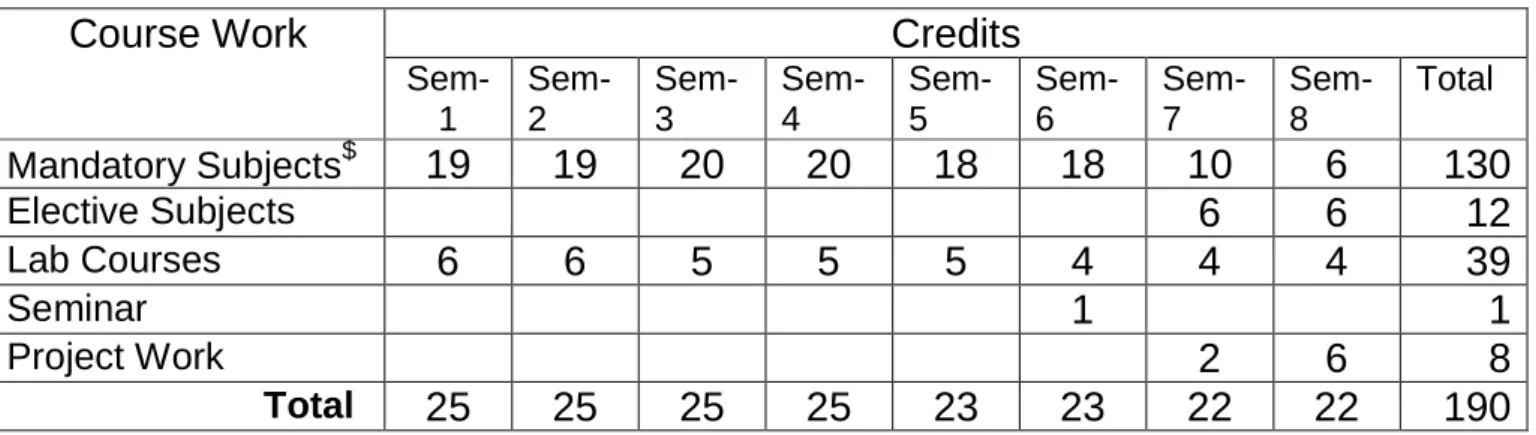
Each B.E. / B. Tech. programme is of 4 years duration. The minimum total no. of credits requirement for each programme is 190. In the structure, the credits are distributed over 8 semesters. The open elective included, gives the student a wide choice of subjects from other programmes. The Credit structure for B E programme is given below in table 1.
TABLE -1 Credit structure for B E programme
Course Work
Credits
Sem-1 Sem-2 Sem-3 Sem- 4 Sem- 5 Sem-6 Sem-7 Sem-8 Total Mandatory Subjects$
19
19
20
20
18
18
10
6
130
Elective Subjects6
6
12
Lab Courses6
6
5
5
5
4
4
4
39
Seminar1
1
Project Work2
6
8
Total25
25
25
25
23
23
22
22
190
$ : Mandatory subjects of first, second and third semester must include at least 40 credits for Engineering Physics, Engineering Chemistry, Engineering Mathematics, social science and soft skills
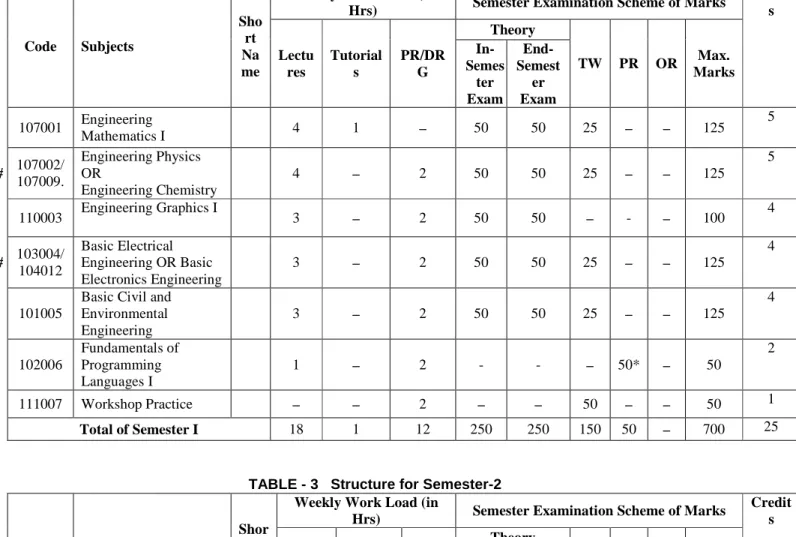
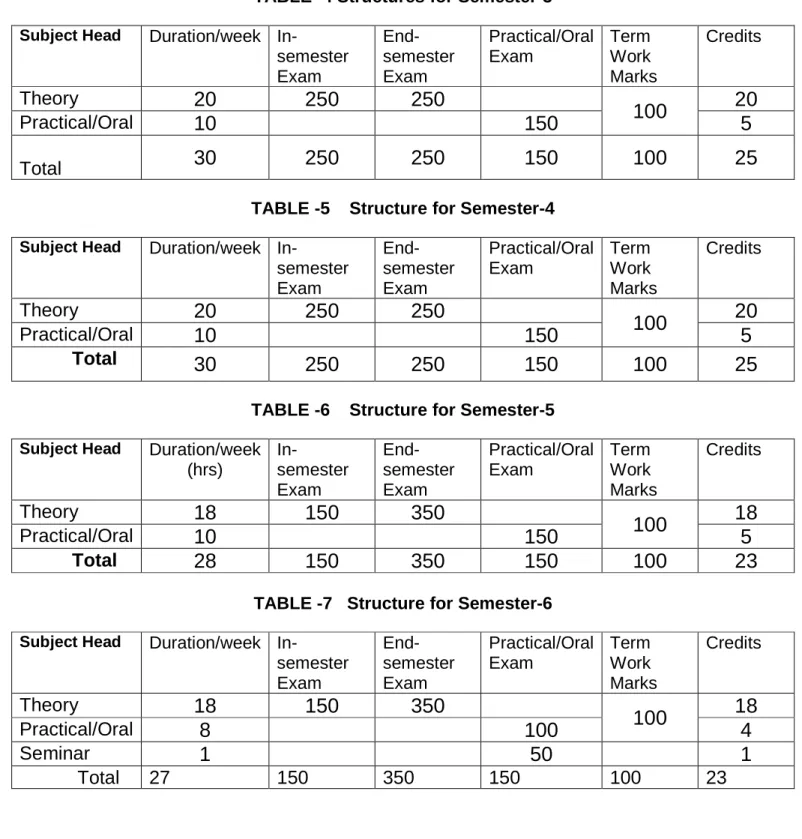
In addition to above credits, there should be audit courses in semester five, six and seven to develop the various skills. The detail structure is given in Tables
TABLE -2 Structure for Semester-1
Code Subjects
Sho rt Na me
Weekly Work Load (in
Hrs) Semester Examination Scheme of Marks
Credit s Lectu res Tutorial s PR/DR G Theory TW PR OR Max. Marks In- Semes ter Exam End- Semest er Exam 107001 Engineering Mathematics I 4 1 – 50 50 25 – – 125 5 # 107002/ 107009. Engineering Physics OR Engineering Chemistry 4 – 2 50 50 25 – – 125 5 110003 Engineering Graphics I 3 – 2 50 50 – - – 100 4 # 103004/ 104012 Basic Electrical Engineering OR Basic Electronics Engineering 3 – 2 50 50 25 – – 125 4 101005
Basic Civil and Environmental Engineering 3 – 2 50 50 25 – – 125 4 102006 Fundamentals of Programming Languages I 1 – 2 - - – 50* – 50 2 111007 Workshop Practice – – 2 – – 50 – – 50 1 Total of Semester I 18 1 12 250 250 150 50 – 700 25
TABLE - 3 Structure for Semester-2
Code Subjects
Shor t Nam
e
Weekly Work Load (in
Hrs) Semester Examination Scheme of Marks
Credit s Lectur es Tutoria ls PR/ DRG Theory TW PR OR Max. Marks In- Semes ter Exam End- Semest er Exam 107008 Engineering Mathematics II 4 – – 50 50 – – – 100 4 # 107009/ 107002 Engineering Chemistry OR Engineering Physics 4 – 2 50 50 25 – – 125 5
110010 Basic Mechanical Engineering 3 – 2 50 50 25 - – 125 4
101011 Engineering Mechanics 4 – 2 50 50 25 – – 125 5 # 104012/ 103004. Basic Electronics Engineering OR Basic Electrical Engineering 3 – 2 50 50 25 – – 125 4 102013 Fundamentals of Programming Languages II 1 – 2 - - - 50* – 50 2 102014 Engineering Graphics II – – 2 – – 50 – – 50 1 Total of Semester II 19 – 12 250 250 150 50 – 700 25
Instructions:
1. PR/Tutorial must be conducted in minimum three batches (batch size 22 maximum) per division 2. Minimum number of required Experiments/Assignments in PR/DRG/Tutorial be carried out as
mentioned in the syllabi of related subjects.
3. * for FPL-I and FPL-II: S.P. Pune University Online Practical Examination shall be conducted at the semester end.
4. # Every student should appear for Engineering Physics, Engineering Chemistry, Basic Electronics Engineering and Basic Electrical Engineering during the year.
5. # College is allowed to distribute Teaching Workload of subjects Physics, Chemistry, BEE, BXE in semester I and II by dividing number of FE divisions appropriately in two groups.
TABLE -4 Structures for Semester-3
Subject Head Duration/week
In-semester Exam End-semester Exam Practical/Oral Exam Term Work Marks Credits Theory
20
250
250
100
20
Practical/Oral10
150
5
Total30
250
250
150
100
25
TABLE -5 Structure for Semester-4
Subject Head Duration/week
In-semester Exam End-semester Exam Practical/Oral Exam Term Work Marks Credits Theory
20
250
250
100
20
Practical/Oral10
150
5
Total30
250
250
150
100
25
TABLE -6 Structure for Semester-5
Subject Head Duration/week (hrs) In-semester Exam End-semester Exam Practical/Oral Exam Term Work Marks Credits Theory
18
150
350
100
18
Practical/Oral10
150
5
Total28
150
350
150
100
23
TABLE -7 Structure for Semester-6
Subject Head Duration/week
In-semester Exam End-semester Exam Practical/Oral Exam Term Work Marks Credits Theory
18
150
350
100
18
Practical/Oral8
100
4
Seminar1
50
1
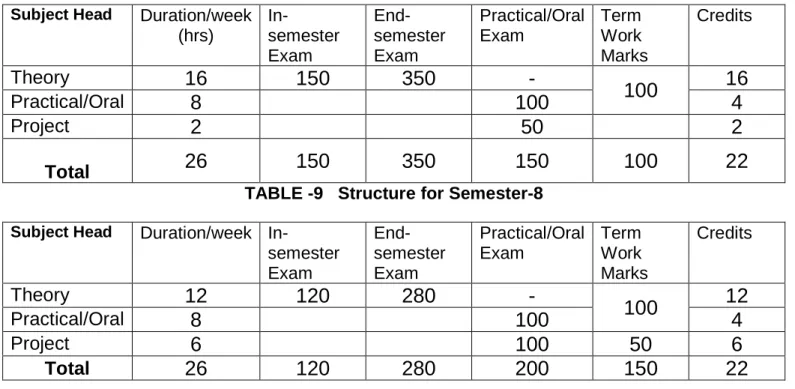
Total 27 150 350 150 100 23TABLE -8 Structure for Semester-7
Subject Head Duration/week (hrs) In-semester Exam End-semester Exam Practical/Oral Exam Term Work Marks Credits Theory
16
150
350
-
100
16
Practical/Oral8
100
4
Project2
50
2
Total26
150
350
150
100
22
TABLE -9 Structure for Semester-8
Subject Head Duration/week
In-semester Exam End-semester Exam Practical/Oral Exam Term Work Marks Credits Theory
12
120
280
-
100
12
Practical/Oral8
100
4
Project6
100
50
6
Total26
120
280
200
150
22
Note: Semester 1 and semester 2 will be part of First Year of Engineering (FE) Semester 3 and semester 4 will be part of Second Year of Engineering (SE)
Semester 5 and semester 6 will be part of Third Year of Engineering (TE) Semester 7 and semester 8 will be part of Final Year of Engineering (BE) Practicals/Lab. Work:
The laboratory work will be based on completion of assignments confined to the courses of that semester.
SEMINAR:
Shall be on state of the art topic of student’s own choice approved by an authority. The student shall submit the duly certified seminar report in standard format, for satisfactory completion of the work by the concerned Guide and head of the department/institute.
PROJECT WORK:
The project work shall be based on the knowledge acquired by the student during the graduation and preferably it should meet and contribute towards the needs of the society. The project aims to provide an opportunity of designing and building complete system or subsystems based on area where the student likes to acquire specialized skills.
Project work in the seventh semester is an integral part of the project work. In this, the student shall complete the partial work of the project which will consist of problem statement, literature review, project overview, scheme of implementation . As a part of the progress report of Project work, the candidate shall deliver a presentation on the advancement in Technology pertaining to the selected Project topic.
.
Project Work in the eighth semester, the student shall complete the remaining part of the project which will consist of the fabrication of set up required for the project, work station, conducting experiments and taking results, analysis & validation of results and conclusions.
The student shall prepare the duly certified final report of project work in standard format for satisfactory completion of the work by the concerned guide and head of the Department/Institute.
2.
Examination Scheme:
R 2.1
The theory examination shall be conducted in three phases for all the subjects of semesters 1-4 and two phases for the semesters 5-8. For first four semesters (Semester 1, 2, 3 and 4), the Phase-1 and Phase-2 exam are part of in-semester exam and Phase 3 is a part of end-semester exam.
R 2.1.1: Phases of FE and SE
Phase I Online examination of 25 marks, 30 minutes duration, containing objective- multiple choice questions (MCQ) and fill in blanks; based on unit I and unit II of the subject, shall be conducted as per the schedule of the university.
Phase II Online examination of 25 marks, 30 minutes duration, containing objective- multiple choice questions (MCQ) ) and fill in blanks; based on unit III and unit IV of the subject, shall be conducted as per the schedule of the university.
.
Phase III Written examination of 50 marks, 2 hours duration; based on all the six units, shall be conducted at the end of semester, as per the schedule of the university.
R 2.1.2: Phases of TE and BE Phase I:
Theory examination of 30 marks, 60/90 minutes duration based on unit I ,unit II and unit III of the subject, shall be conducted as per the schedule of the university.
Phase II:
Theory examination of 70 marks, 150/180 minutes duration, based on all the units of the subject, shall be conducted at the end of semester as per the schedule of the university.
R-2.2
For the subject of Engineering Graphics- I at FE, the mode of examination shall be manual for phase I and phase II. Phase I and phase II examinations shall be of one hour duration each. All these examinations shall be conducted as per the schedule of the University.
R-2.4
The practical examination of 50 marks, one hour duration for Fundamentals of Programming Languages- I and Fundamentals of Programming Languages-II, shall be conducted online at the end of respective semesters as per the schedule of the University.
R-2.5
The third semester ( first semester of SE ) Phase 1 and Phase 2 will be conducted together by considering the direct second year admissions.
3.
Structure of Question Paper :
R 3.1:For FE and SE:
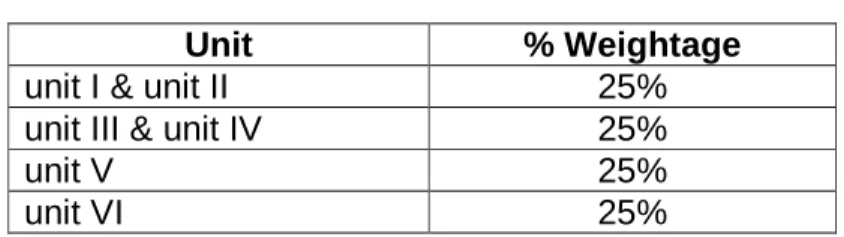
• All questions for online examinations shall be objective type with multiple choice/ fill in the blanks type questions. The weightage for each question will be of one or two marks as per the difficulty level. More or less equal weightage is to be given to every unit pertaining to the examination. • The nature of all questions in phase III written examination shall be Fundamental, Mathematical and
analytical. The weightage for the syllabus units is as in table 10 and every question will have an internal option.
Table 10 Unitwise weightage
Unit % Weightage
unit I & unit II 25%
unit III & unit IV 25%
unit V 25%
unit VI 25%
R 3.2: For TE and BE
• Three Units (Unit Nos. 1, 2 & 3 ) will be covered for 30 marks for Phase-1(In semester) Exam. Equal weightage will be given to all units (10 marks each).
• All the Six Units will be covered for 70 marks for Phase -2 ( End-semester ) Exam. 20 marks will be the weightage for first 3 units and 50 marks will be the weightage for Units 4,5 and 6. Question Paper will have only one section and five questions.
4.
Assessment
A. Theory
R 4.1:• In-Semester Examination for FE and SE:
Since in-semester exam for FE and SE is online, the assessment will be computer based.
• In-Semester Examination for TE and BE:
Assessment will be done at the CAP Centre of the College by the Expert who is appointed as an examiner for the subject as per 32/5 panel for the In-Semester exam.
R 4.2:
End-Semester Examination for FE,SE,TE and BE:
Assessment will be done at the CAP Centre by the Expert who is appointed as an examiner for the subject as per 32/5 panel for the End-Semester exam.
B. Term work:
R 4.3:Term Work assessment shall be conducted for the Lab Practice, Project, tutorials and Seminar. Term work is continuous assessment based on work done, submission of work in the form of report/journal, timely completion, attendance, and understanding. It should be assessed by
subject teacher of the institute for first to sixth semester and by the external examiner at seventh and eighth semester. At the end of the semester, the final grade for a Term Work shall be assigned based on the performance of the student and is to be submitted to the Savitribai Phule Pune University. A student who fails in the Term Work on account of unsatisfactory performance shall be given F grade and on the account of inadequate attendance shall be given FX grade.
C. Practical/Oral/Presentation :
R 4.4:Practical/Oral/presentation is to be conducted and assessed jointly by internal and external examiners. The performance in the Practical/Oral/Presentation examination shall be assessed by at least one pair of examiners appointed as examiners by the Savitribai Phule Pune University. The examiners will prepare the mark / grade sheet in the format as specified by the Savitribai Phule Pune University, authenticate and seal it.
5.
RULES OF PASSING
R-5.1
To pass the term work / Practical / Oral the student has to earn Minimum of 40% marks in each head.
R-5.2
To pass the Theory Subject head the student has to earn minimum of 40 per cent marks in End-Semester exam and 40 percent average marks (In-End-Semester marks + End-End-Semester marks). R-5.3
The failing student can repeat the End-Semester exam to pass the head in any semester and the In-Semester exam marks will be retained as it is. Or the failing student can repeat for End-Semester exam as well as in-semester exam. for the head of Even semester in the Even semester only and for the head of Odd semester in Odd semester only for the theory head.
R-5.4
To earn credits of a course (Theory/term work/practical/oral/presentation) student must pass the course with minimum passing marks/grade.
.R 5.5
Student can only apply for the revaluation/Photocopying of End-Semester exam only.
6. RULES OF A.T.K.T.:
R-6.1
A student can register for the third semester(SE), if he/she earns minimum 50% credits of the total of first and second semesters(FE).
R-6.2
A student can register for the fifth semester(TE), if he/she earns minimum 50% credits of the total of third and forth semesters(SE) and all the credits of first and second semester(FE).
R-6.3
A student can register for the seventh semester(BE), if he/she earns minimum 50% credits of the total of fifth and sixth semesters(TE) and all the credits of third and forth semester(SE).
R-6.4
A student will be awarded the bachelor’s degree if he/she earns 190 credits and clears all the audit courses specified in the syllabus.
7. Assessment and Grade Point Average: R-7.1
Marks/Grade/Grade Point
A grade is assigned to each head based on marks obtained by a student in examination of the course. The marks obtained in in-semester and end-semester examination are considered together to calculate the grade of the course. These grades, their equivalent grade points are given in Table 11.
TABLE 11 Grade and Grade Point
Grade Grade Points Percentage of Marks Obtained Remarks O 10 90-100 Outstanding A 9 80-89 Very Good B 8 70-79 Good C 7 60-69 Fair D 6 50-59 Average E 5 40-49 Below Average F 0 Below 40 Fail
AP 0 -- Passed Audit Course
FX 0 -- Detained, Repeat the Course
II 0 -- Incomplete -- Absent for Exam but continue for the course
PP -- -- Passed (Only for non credit courses) NP -- -- Not Passed (Only for non credit courses)
• Passing Grade -The grades O, A, B, C, D, E are passing grades. A candidate acquiring any one of these grades in a course shall be declared as pass. And student shall earn the credits for a course only if the student gets passing grade in that course.
• F Grade -The grade F shall be treated as a failure grade. The student with F grade will have to pass the concerned course by re-appearing for the examination. The student with F grade for any stage of the Project Work, will have to carry out additional work/ improvement as suggested by the examiners and re-appear for the examination.
• AP Grade -The student registered for auditing a course shall be awarded the grade AP and shall be included such AP grade in the Semester grade report for that course, provided student has the minimum attendance as prescribed by the Savitribai Phule Pune University and satisfactory in-semester performance and secured a passing grade in that course. No grade points are associated with this grade and performance in these courses is not accounted in the calculation of the performance indices SGPA
and CGPA.
• FX Grade-The grade FX in a course is awarded by the college, if a student does not maintain the minimum attendance in the Lecture / Tutorial class as prescribed by the Savitribai Phule Pune University and/or his performance during the semester is not satisfactory and/or he/she fails in the Term Work head of that course.
The student with FX grade in a given course is not permitted to take the end of semester examination in that course. Such a student will have to re-register for the course.
• Grade II-Grade ll shall be awarded to a candidate in a course in which he has the minimum attendance as prescribed by the University and satisfactory in-semester performance but could not
appear for the end-semester examination. Such a student will have to appear in the subsequent end-semester examination.
• PP / NP Grade -The non-credit courses, such as Practical Training, Communication Skill, Field Visit Courses etc. shall be awarded PP/NP grades. No grade points are associated with these grades and performance in these courses is not accounted in the calculation of the performance indices SGPA and CGPA. However, the award of the degree is subject to obtain a PP grade in all such compulsory courses.
• The student with F / FX / grade II in a course shall not be awarded any credits for that course.
8. PERFORMANCE INDICES:
R-8.1
The semester end grade sheet will contain grades for the courses along with titles and SGPA. Final grade sheet and transcript shall contain CGPA.
R-8.2
SGPA -The performance of a student in a semester is indicated by a number called the Semester Grade Point Average (SGPA). The SGPA is the weighted average of the grade points obtained in all the courses, seminars and projects registered by the student during the semester.
For Example: suppose in a given semester a student has registered for five courses having credits C1, C2, C3, C4, C5 and his / her grade points in those courses are G1, G2, G3, G4, G5 respectively.
Then students
C1G1 + C2G2 + C3G3 + C4G4 + C5G5 SGPA = ---
C1 + C2 + C3 + C4 + C5 SGPA is calculated up to two decimal places by rounding off.
R-8.3
CGPA- The CGPA is the weighted average of the grade points obtained in all the courses (Theory/term work/practical/oral/presentation) of first semester to eighth semester for the students admitted in the First year and third to eighth semester for the students directly admitted at Second year. It is calculated in the same manner as the SGPA.
R-8.3
ln case of a student passing a failed course or in case of improvement, the earlier grade would be replaced by the new grade in calculation of the SGPA and CGPA.
9. RESULT: Based on the performance of the student in the semester examinations, the University of Pune will declare the results and issue the Semester Grade sheets.
R-9.1
The class shall be awarded to a student on the CGPA calculated as mentioned in Rule no. R 8.3. The award of the class shall be as per Table 12.
TABLE 12 -CGPA and Class awarded
Sr.
No. CGPA Class of the Degree awarded
1. 7.75 or More than 7.75 First Class with Distinction 2. 6.75 or more but less than 7.75 First Class
3. 6.25 or more but less than 6.75 Higher Second Class 4. 5.5 or more but less than 6.25 Second Class