18102
e3
Fast Infrared Transceiver Module (4 Mbit/s), IrDA
®
Serial
Interface Compatible, 2.7 V to 5.5 V Supply Voltage Range
Description
The TFDU6108 is an infrared transceiver module compliant to the latest IrDA standard for fast infrared data communication, supporting IrDA speeds up to 4.0 Mbit/s (FIR), and carrier based remote control modes up to 2 MHz. Integrated within the transceiver module are a PIN photodiode, an infrared emitter (IRED), and a low-power CMOS control IC to provide a total front-end solution in a single package.
These FIR transceivers with an integrated serial inter-face are compliant with the IrDA "Serial Interinter-face Standard for Transceiver Control". The transceivers are capable of directly interfacing with a wide variety of I/O devices, which perform the modulation/ demodulation function. At a minimum, a VCC bypass capacitor is the only external component required implementing a complete solution. For limiting the transceiver internal power dissipation one additional resistor might be added. The transceiver can be oper-ated with logic I/O voltages as low as 1.5 V.
New Features
• The functionality of the device is similar to the TFDU6102 series. The IrDA compatible serial interface function is replacing the former program-ming method, guaranteeing a perfect IrDA stan-dardized and compliant programmability. The IRED current is programmable to different levels, no external current limiting resistor is necessary.
Features
• Compliant to the latest IrDA physical layer specification (Up to 4 Mbit/s) TV Remote Control
• Compliant to the IrDA "Serial Interface Specification for Transceivers"
• For 3.0 V and 5.0 V Applications, fully specified 2.7 V to 5.5 V Operational down to 2.6 V
• Compliant to all logic levels between 1.5 V and 5 V • Low Power Consumption
(typ. 2.0 mA Supply Current) • Power Shutdown Mode
(< 1 μA Shutdown Current) • Surface Mount Package Options
- Universal (L 9.7 mm × W 4.7 mm × H 4.0 mm) - Side and Top View
• Tri-State-Receiver Output, Weak Pull-up when in Shutdown Mode
• High Efficiency Emitter
• Baby Face (Universal) Package Capable of Surface Mount Soldering to Side and Top View Orientation
• Eye safety class 1 (IEC60825-1, ed. 2001), limited LED on-time, LED current is controlled, no single fault to be considered
• Built - In EMI Protection including GSM bands. EMI Immunity in GSM Bands > 300 V/m verified No External Shielding Necessary
• Few External Components Required
• Pin to Pin Compatible to Legacy Vishay Semicon-ductor SIR and FIR Infrared Transceivers
• Split power supply, transmitter and receiver can be operated from two power supplies with relaxed requirements saving costs, US Patent No. 6,157,476
• Compliant with IrDA EMI and Background Light Specification
• Lead (Pb)-free device
• Device in accordance to RoHS 2002/95/EC and WEEE 2002/96EC
Applications
• Notebook Computers, Desktop PCs, Palmtop Computers (Win CE, Palm PC), PDAs • Printers, Fax Machines, Photocopiers, Screen Projectors
• Telecommunication Products (Cellular Phones, Pagers)
• Internet TV Boxes, Video Conferencing Systems • External Infrared Adapters (Dongles)
Parts Table
Functional Block Diagram
Pin Description
Part Description Qty / Reel
TFDU6108-TR3 Oriented in carrier tape for side view surface mounting 1000 pcs TFDU6108-TT3 Oriented in carrier tape for top view surface mounting 1000 pcs
Comparator Amplifier AGC Logic Driver Current controlled driver VCC1 SCLK TXD GND RXD IRED Anode IRED Cathode 200 Vlogic VCC2 17086 Ω
Pin Number Function Description I/O Active
1 IRED Anode Connect IRED anode directly to VCC2. An unregulated separate power supply can be used at this pin. For VCC2 > 4 V use a serial resistor R1 to reduce the. See derating
curve.
2 IRED Cathode IRED cathode, internally connected to driver transistor 3 Txd Transmit Data Input, dynamically loaded for noise
suppression.
I HIGH
4 Rxd Received Data Output, push-pull CMOS driver output capable of driving a standard CMOS or TTL load. No external pull-up or pull-down resistor is required. When
disabled it is connected to Vlogic. by a weak pull-up (500 kΩ). Pin is current limited for protection against bus
collisions due to programming errors.
O LOW
5 SCLK Serial Clock, dynamically loaded for noise suppression. I HIGH
6 VCC Supply Voltage
7 Vlogic Supply voltage for digital part, 1.5 V to 5.5 V, defines logic swing for Txd, SCLK, and Rxd
Pinout
TFDU6108 weight 200 mg
Definitions:
In the Vishay transceiver data sheets the following nomenclature is used for defining the IrDA operating modes:
SIR: 2.4 kbit/s to 115.2 kbit/s, equivalent to the basic serial infrared standard with the physical layer version IrPhy 1.0
MIR 576 kbit/s to 1152 kbit/s FIR 4 Mbit/s
VFIR 16 Mbit/s
MIR and FIR were implemented with IrPhy 1.1, followed by IrPhy 1.2, adding the SIR Low Power Standard. IrPhy 1.3 extended the Low Power Option to MIR and FIR and VFIR was added with IrPhy 1.4. A new version of the standard in any obsoletes the former ver-sion.
Absolute Maximum Ratings
Reference point Ground (pin 8) unless otherwise noted.
Typical values are for DESIGN AID ONLY, not guaranteed nor subject to production testing.
*) Due to the internal measures the device is a "class1" device. It will not exceed the IrDA intensity limit of 500 mW/sr.
"U" Option BabyFace (Universal)
IRED Detector
1 2 3 4 5 6 7 8
17087
Parameter Test Conditions Symbol Min Typ. Max Unit
Supply voltage range, transceiver
0 V < VCC2 < 6 V VCC1 - 0.5 + 6 V
Supply voltage range, transmitter
0 V < VCC1 < 6 V VCC2 - 0.5 + 6 V
Supply voltage range, transceiver logic
0 V < VCC1 < 6 V Vlogic - 0.5 + 6 V
Input currents for all pins, except IRED anode pin
10 mA
Output sinking current 25 mA
Junction temperature TJ 125 °C
Power dissipation see derating curve, figure 4 PD 350 mW
Ambient temperature range (operating)
Tamb - 25 + 85 °C
Storage temperature range Tstg - 40 + 100 °C
Soldering temperature see recommended solder profile (see figure 3)
240 °C
Average output current IIRED (DC) 130 mA
Repetitive pulse output current < 90 μs, ton < 20 % IIRED (RP) 600 mA
IRED anode voltage VIREDA - 0.5 + 6 V
Transmitter data input voltage VTxd - 0.5 Vlogic + 0.5 V
Receiver data output voltage VRxd - 0.5 Vlogic + 0.5 V
Virtual source size Method: (1 - 1/e) encircled energy
d 2.5 2.8 mm
Maximum Intensity for Class 1 Operation of IEC825-1 or EN60825-1, edition Jan. 2001*) IrDA specified maximum limit
unidirectional operation, worst case IrDA FIR pulse pattern
Internally limited to class 1
500
Electrical Characteristics
Transceiver
Tamb = 25 °C, VCC = 2.7 V to 5.5 V unless otherwise noted.
Typical values are for DESIGN AID ONLY, not guaranteed nor subject to production testing.
1) Receive mode only. In transmit mode, add the averaged programmed current of IRED current as I CC2 2) Standard Illuminant A
3) The typical threshold level is between 0.5 x V
logic/2 (Vlogic = 3 V) and 0.4 x Vlogic (Vlogic = 5.5 V). With that the device will work with less tight levels than the specified min/ max values. However, it is recommended to use the specified min/max values to avoid increased oper-ating/standby supply currents.
Parameter Test Conditions Symbol Min Typ. Max Unit
Supply voltage VCC1 2.7 5.5 V
Vlogic 1.5 5.5 V
Dynamic supply current 1) T = - 25 °C to 85 °C active, no signal Ee = 0 klx ICC1 2.0 2.35 mA T = 25 °C 2.3 mA T = - 25 °C to 85 °C idle active, no load Ee = 0 klx Ilogic 5 μA T = - 25 °C to 85 °C Ee = 1 klx2) receive mode, EEo = 100 mW/m2 (9.6 kbit/s to 4.0 Mbit/s), RL = 10 kΩ to Vlogic = 5 V, CL = 15 pF Ilogic 160 1 μA
Shutdown supply current inactive, set to shutdown mode T = 25 °C, Ee = 0 klx
ISD 1 μA
inactive, set to shutdown mode T = 25 °C, Ee = 1 klx 2)
ISD 1.5 μA
shutdown mode, T = 85 °C, not ambient light sensitive
ISD 5 μA
Operating temperature range TA - 25 + 85 °C
Output voltage low Cload = 15 pF, Vlogic = 5 V VOL 0.5 0.8 V
Output voltage high Cload = 15 pF, Vlogic = 5 V VOH Vlogic - 0.5 V
Input voltage low (Txd, SCLK) CMOS level 3) VIL 0.15 2)
Vlogic
V
Input voltage high (Txd, SCLK) CMOS level 3) VIH 0.9 2) V
logic V
Input leakage current (Txd, SCLK)
IL - 10 + 10 μA
Input Load
The waveform "IDDadd" shows the additional operat-ing current of one input buffer (in this case Txd) vs. the logic input voltage V (TXI) for the digital supply
voltage Vdd = 3 V under typical working conditions. The current "IVIC" is the typical input current vs. the input voltage.
Optoelectronic Characteristics
Receiver
Tamb = 25 °C, VCC = 2.7 V to 5.5 V unless otherwise noted.
Typical values are for DESIGN AID ONLY, not guaranteed nor subject to production testing.
- 0.5 0.0 0.5 1.0 1.5 2.0 2.5 0 0.2 0.4 0.6 0.8 1.0 1.2 1.4 1.6 1.8 2.0 ms 3.0 3.5 10-4 IDDAD A 17088 - 1.5 - 1.0 - 0.5 0.0 0.5 1.0 10-5 IVIC A - 0.01 0.00 0.01 0.02 0.03 0.04 0.05 0.06 A IVDIODE - 1 0 1 2 3 4 5 6 7 V V (TX1)
Parameter Test Conditions Symbol Min Typ. Max Unit
Minimum detection threshold irradiance, SIR mode
9.6 kbit/s to 115.2 kbit/s
λ = 850 nm to 900 nm
Ee 25 40 mW/m2
Minimum detection threshold irradiance, MIR mode
1.152 Mbit/s
λ = 850 nm to 900 nm
Ee 65 mW/m2
Minimum detection threshold irradiance, FIR mode
4.0 Mbit/s
λ = 850 nm to 900 nm
Ee 85 90 mW/m2
Maximum detection threshold irradiance
Transmitter
Tamb = 25 °C, VCC = 2.7 V to 5.5 V unless otherwise noted.
Typical values are for DESIGN AID ONLY, not guaranteed nor subject to production testing. Logic LOW receiver input
irradiance
optical ambient noise suppression up to this level for e.g. fluorescent light tolerance equivalent to the IrDA® "Background Light and Electromagnetic Field" specification
Ee 4 mW/m2
Rise time of output signal 10 % to 90 %, @ 2.2 kΩ, 15 pF tr (Rxd) 40 ns
Fall time of output signal 90 % to 10 %, @ 2.2 kΩ, 15 pF tf (Rxd) 40 ns
Rxd pulse width of output signal, 50 % SIR mode
input pulse length 20 μs, 9.6 kbit/s
tPW 1.3 2 3 μs
input pulse length 1.41 μs, 115.2 Mbit/s
tPW 1.2 3 μs
Rxd pulse width of output signal, 50 % MIR mode
input pulse length 217 ns, 1.152 Mbit/s
tPW 110 260 ns
Jitter, leading edge, MIR mode input irradiance = 100 mW/m2, 1.152 Mbit/s
20 ns
Rxd pulse width of output signal, 50 % FIR mode
input pulse length 125 ns, 4.0 Mbit/s
tPW 100 160 ns
Jitter, leading edge, FIR mode input irradiance = 100 mW/m2, 4 Mbit/s
20 ns
Latency tL 120 μs
Parameter Test Conditions Symbol Min Typ. Max Unit
IRED operating current internally controlled,
programmable using the "serial interface" programming sequence, see Appendix
VCC1 = 3.3 V, the maximum current is limited internally. An external resistor can be used to reduce the power dissipation at higher operating voltages, see derating curve. ID 8 15 30 60 110 220 500 600 mA
Max. output radiant intensity VCC1 = 3.3 V, α = 0 °, 15 °, Txd = High, R1 = 0 Ω programmed to max. power level
Ie 0.3 mW/sr/mA
Output radiant intensity VCC1 = 3.3 V, α = 0 °, 15 °, Txd = Low, R1 = 0 Ω programmed to shutdown mode
Ie 0.04 mW/sr
Output radiant intensity, angle of half intensity
α ± 24 °
Peak - emission wavelength λp 880 900 nm
Spectral bandwidth Δλ 40 nm
Optical rise time, fall time tropt, tfopt 10 40 ns
Optical overshoot 10 %
Recommended Circuit Diagram
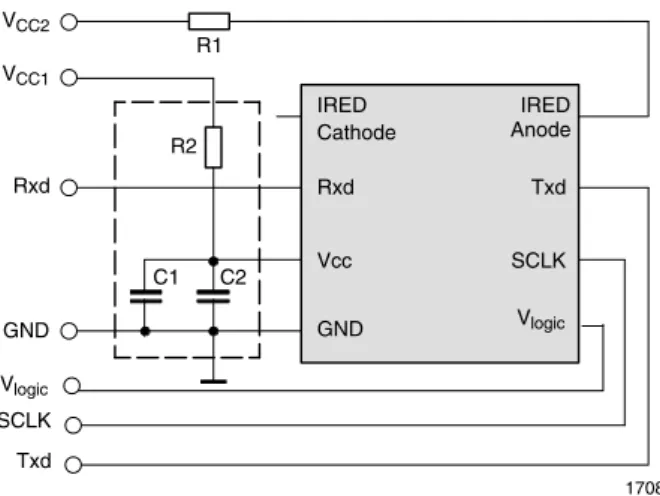
Operated with a low impedance power supply the TFDU6108 needs no external components. However, depending on the entire system design and board lay-out, additional components may be required (see fig-ure 1).
Vishay Semiconductor transceivers integrate a sensi-tive receiver and a built-in power driver. The combina-tion of both needs a careful circuit board layout. The use of thin, long, resistive and inductive wiring should be avoided. The inputs (Txd, SCLK) and the output Rxd should be directly (DC) coupled to the I/O circuit. R1 is used for controlling the maximum current through the IR emitter. This one is necessary when operating over the full range of operating temperature and VCC1 - voltages above 4 V. For increasing the max. output power of the IRED, the value of the resis-tor should be reduced. It should be dimensioned to keep the IRED anode voltage below 4 V for using the full temperature range. For device and eye protection the pulse duration and current are internally limited. R2, C1 and C2 are optional and dependent on the quality of the supply voltage VCC1 and injected noise. An unstable power supply with dropping voltage dur-ing transmission may reduce sensitivity (and trans-mission range) of the transceiver.
The placement of these parts is critical. It is strongly recommended to position C2 close to the transceiver power supply pins. An electrolytic capacitor should be used for C1 while a ceramic capacitor is used for C2.
Recommended Application Circuit
Components
I/O and Software
For operating the device from a Controller I/O a driver software must be implemented.
Mode Switching
The generic IrDA "Serial Interface programming" needs no special settings for the device. Only the cur-rent control table must be taken into account. For the description see the Appendix and the IrDA "Serial Interface specification for transceivers"
Figure 1. Recommended Application Circuit All external components (R, C) are optional
IRED Cathode IRED Anode Rxd Vcc GND Txd SCLK Vlogic C2 C1 R2 R1 VCC2 Rxd GND VCC1 SCLK Txd Vlogic 17089
Component Recommended Value
C1 4.7 μF, 16 V
C2 0.1 μF, Ceramic, 16V
R1 Recommended for VCC1≥ 4 V
Depending on current limit
Recommended Solder Profile
Solder Profile for Sn/Pb soldering
Lead-Free, Recommended Solder Profile
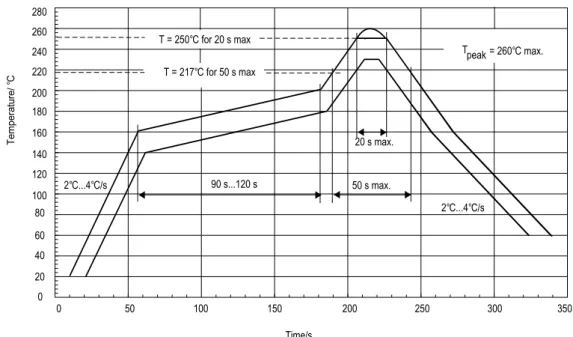
The TFDU6108 is a lead-free transceiver and quali-fied for lead-free processing. For lead-free solder paste like Sn(3.0 - 4.0)Ag(0.5 - 0.9)Cu, there are two standard reflow profiles: Ramp-Soak-Spike (RSS) and Ramp-To-Spike (RTS). The Ramp-Soak-Spike profile was developed primarily for reflow ovens heated by infrared radiation. Shown below in figure 3 is Vishay’s recommended profile for use with the TFDU6108 transceivers. For more details please refer to Application note: SMD Assembly Instruction.
Figure 2. Recommended Solder Profile Time (s) 14874 0 20 40 60 80 100 120 140 160 180 200 220 240 0 50 100 150 200 250 300 350 2 °C - 4 ° C/s 10 s max. at 230 ° C 9 0 s max 120 s - 180 s 2 ° C - 4 ° C/s Temperat u re (° C)
Figure 3. Solder Profile, RSS Recommendation T = 250°C for 20 s max 0 20 40 60 80 100 120 140 160 180 200 220 240 260 280 0 50 100 150 200 250 300 350 Time/s 20 s max. 2°C...4°C/s 2°C...4°C/s T = 217°C for 50 s max Tpeak = 260°C max. 50 s max. 90 s...120 s 19048 Temperature/ °C
Current Derating Diagram
Package Dimensions in mm
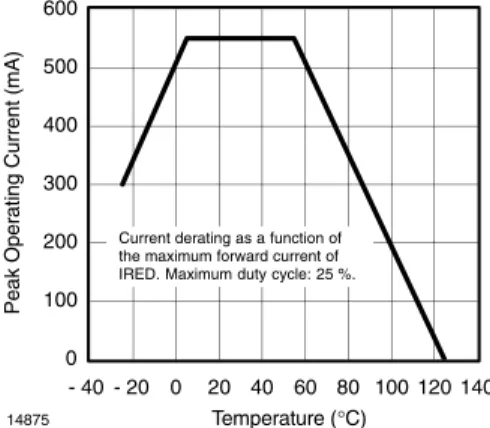
Figure 4. Current Derating Diagram 0 100 200 300 400 500 600 - 40 - 20 0 20 40 60 80 100 120 140 Peak Operating C u rrent (mA) Temperature ( °C) 14875
Current derating as a function of the maximum forward current of IRED. Maximum duty cycle: 25 %.
Appendix A
Serial Interface Implementation
Basics of the IrDA Definitions
The data lines are multiplexed with the transmitter and receiver signals and separate clocks are used since the transceivers respond to the same address.
When no infrared communication is in progress and the serial bus is idle, the IRTX line is kept low and IRRX is kept high.
Figure 5. Interface to Two Infrared Transceivers
Figure 6. Infrared Dongle with Differential Signaling VCC Optical Transceiver OFE A TX/SWDAT RX/SRDAT SCLK Optical Transceiver OFE B TX/SWDAT RX/SRDAT SCLK IRTX/SWDAT IRRX/SRDAT SCLK1 SCLK2 Infrared Controller 17092 17093 Optical Transceiver TX/SWDAT RX/SRDAT SCLK A_SL GND GND VCC Shielded Cable Connector GND VCC Infrared Controller IRTX+/SWDAT+ IRTX-/SWDAT-IRRX+/SRDAT+ IRRX-/SRDAT-SCLK+ SCLK-LVDS Transceiver
Functional description
The serial interface is designed to interconnect two or more devices. One of the devices is always in control of the serial interface and is responsible for starting every transaction. This device functions as the bus master and is always the infrared controller. The infra-red transceivers act as bus slaves and only respond to transactions initiated by the master. A bus transac-tion is made up of one or two phases. The first phase is the Command Phase and is present in every trans-action. The second phase is the Response Phase and is present only in those transactions in which data must be returned from the slave. If the operation involves a data transfer from the slave, there will be a Response Phase following the Command Phase in which the slave will output the data.
The Response Phase, if present, must begin 4 clock cycles after the last bit of the Command Phase, as shown in figures 1 - 7 and 1 - 8, otherwise it is assumed that there will be no response phase and the master can terminate the transaction.
The SCLK line is always driven by the master and is used to clock the data being written to or read from the slave.
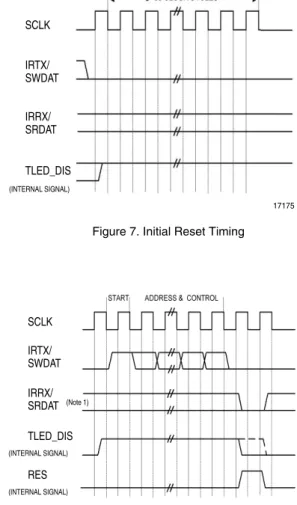
This line is driven by a totem-pole output buffer. The SCLK line is always stopped when the serial interface is idle to minimize power consumption and to avoid any interference with the analog circuitry inside the slave. There are no gaps between the bytes in either the Command or Response Phase. Data is always transferred in Little Endian order (least significant bit first). Input data is sampled on the rising edge of SCLK. IRTX/SWDAT output data from the controller is clocked by SCLK falling edge. IRRX/SRDAT output data from the slave is clocked by SCLK rising edge. Each byte of data in both Command and Response Phases is preceded by one start bit. The data to be written to the slave is carried on the IRTX/SWDAT line. When the control interface is idle, this line carries the infrared data signal used to drive the transmitter LED. When the first low-to-high transition on SCLK is detected at the beginning of the command sequence, the slave will disable the transmitter LED. The infrared controller then outputs the command string on the IRTX/SWDAT line. On the last SCLK cycle of the command sequence the slave re-enables the trans-mitter LED and normal infrared transmission can resume. No transition on SCLK must occur until the next command sequence otherwise the slave will dis-able the transmitter LED again. Read data is carried on the IRRX/SRDAT line. The slave disables the internal signal from the receiver photo diode during
the response phase of a read transaction. The addressed slave will output the read data on the IRRX/SRDAT line regardless of the setting of the Receiver Output Enable bit in the Mode Selection reg-ister 0. Non addressed slaves will tri-state the IRRX/ SRDAT line. When the transceiver is powered up, the IRTX/SWDAT line should be kept low and SCLK should be cycled at least 30 times by the infrared con-troller before the first command is issued on the IRTX/ SWDAT line. This guarantees that the transceiver interface circuitry will properly initialize and be ready to receive commands from the controller. In case of a multiple transceiver configuration, only one trans-ceiver should have the retrans-ceiver output enabled. A series resistor (approx. 200 ohms) should be placed on the receiver output from each transceiver to pre-vent large currents in case a conflict occurs due to a programming error.
Figure 7. Initial Reset Timing
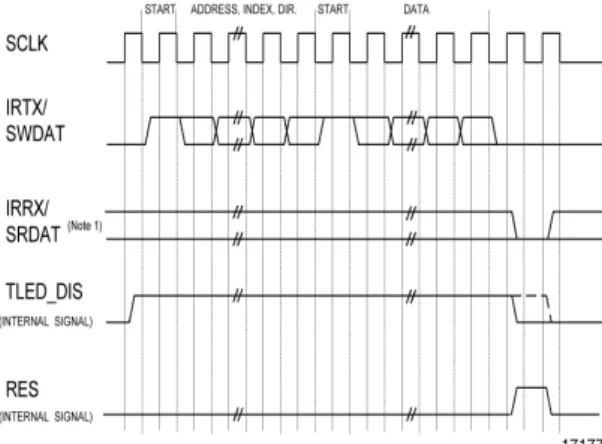
Figure 8. Special Command Waveform
SCLK IRTX/ SWDAT IRRX/ SRDAT TLED_DIS (INTERNALSIGNAL) 17175 SCLK IRTX/ SWDAT IRRX/ SRDAT TLED_DIS (INTERNALSIGNAL) RES (INTERNALSIGNAL) (Note 1) 17176
Note 1: If the APEN bit in control register 0 is set to 1, the internal signal from the receiver photo diode is discon nected and the IRRX/ SRDAT line is pulsed low for one clock cycle at the end of a write or special command.
Note 2: During a read transaction the infrared controller sets the IRTX/SWDAT line high after sending the address and index byte (or bytes). It will then set it low two clock cycles before the end of the transaction. It is strongly recommended that optical transceiv-ers monitor this line instead of counting clock cycles in order to detect the end of the read trans action. This will always guarantee correct operation in case two or more transceivers from different manufacturers are sharing the serial interface.
Figure 9. Write Data Waveform
Figure 10. Write Data Waveform with Extended Index
17177
17178
Figure 11. Read Data Waveform
Figure 12. Read Data Waveform with Extended Index
17179
Switching Characteristics
Maximum capacitive load = 20 pF1)
1) Capacitive load is different from "Serial interface - specification". For the bus protocol see "RECOMMENDED SERIAL INTERFACE
FOR TRANSCEIVER CONTROL, Draft Version 1.0a, March 29, 2000, IrDA". In Appendix B the transceiver related data are given.
Parameters Test Conditions Symbol Min. Max. Unit
SCLK Clock Period R.E., SCLK to next R.E., SCLK tCKp 250 infinity ns
SCLK Clock High Time At 2.0 V for single-ended signals tCKh 60 ns
SCLK Clock Low Time At 0.8 V for single-ended signals tCKl 80 ns
Output Data Valid (from infrared controller)
After F.E., SCLK tDOtv 40 ns
Output Data Hold (from infrared controller)
After F.E., SCLK tDOth 0 ns
Output Data Valid (from optical transceiver)
After R.E., SCLK tDOrv 40 ns
Output Data Hold (from optical transceiver)
After R.E., SCLK tDOrh 40 ns
Line Float Delay After R.E., SCLK tDOrf 60 ns
Input Data Setup Before R.E., SCLK tDIs 10 ns
Appendix B
Application Guideline
In the following some guideline is given for handling the TFDU6108 in an application ambient, especially for testing. It is also a guideline for interfacing with a controller. We recommend to use for first evaluation the Vishay IRM1802 controller. For more information see the special data sheet. Driver software is avail-able on request. Contact [email protected].
Serial Interface Capability of the Vishay
IrDA Transceivers Abstract
A serial interface allows an infrared controller to com-municate with one or more infrared transceivers. The basic specification of IrDA® specified interface is described in "Serial Interface for Transceiver Control, v 1.0a", IrDA.
This part of the document describes the capabilities of the serial interface implemented in the Vishay IrDA transceivers TFDU8108 and TFDU6108. The VFIR (16 Mbit/s) and FIR (4 Mbit/s) programmable versions are using the same interface specification (with spe-cific identification and programming).
IrDA Serial Interface Basics
The serial interface for transceiver control (SITC) is a master/slave synchronous serial bus which uses the Txd and Rxd as data lines and the SCLK as clock line with a minimum period of 250 ns. The transceiver works always as slave and jump into SITC mode on the first rising edge of the clock line remaining there until the command phase is finished. After power on it is required an initial phase for ≥ 30 clock cycles at Txd is continuous low before the transmitter can be pro-grammed. If Txd assume high during the initial phase then must start the initial phase again.
The data transfer is organized by one byte preceded by one start bit. The SITC allows the communication between infrared controller and transceiver through write and read transaction. The SITC consists of two store blocks with different functions. The store block called Extended Indexed Registers contain the vari-ous supported functionality of the device and can be read only. The other Main Control Registers allow write and read transaction and store the executable configuration of the device.
Any configuration is executed after the command phase is completed.
Power - up defaults
After power on the transceiver has to stay by definition in the following default mode shown in the table. The default mode of the TFDU6108 is different from the originally defined IrDA Serial Interface default mode. The implemented deviation from the standard was a market re-quest because only in this way a rere-quested quick function test is possible with the TFDU6108 without the need to connect to a programming device.
Addressing
The transceiver is addressable with three address bits. There are individual and common addresses with the following values.
Function TFDU6108
Power Mode active (!)
RX active
TX_LED active
APEN enabled
Infrared Mode SIR
Transmitter Power defined SIR level
Description Address value A [2:0]
Individual address Mask programmable 001
Data Acknowledgement
Data acknowledgement generated by the slave is available if the APEN bit is set to 1 in the common control register. In IrDA default state this functionality is disabled. In default state of the TFDU6108 it is enabled (see above). It is strongly recommended that this functionality is enabled to be on the safe side for correct data transmission during SITC mode.
Registers Data Depth
In general the whole data registers consist of a data depth of eight bits. But sometimes it is unnecessary to implement the full depth. In such a case the invisible bits consider like a zero.
Used Index Commands
The table shows the valid index commands, its allowable modes, and the data depth to them.
Main-ctrl-0 register values
1) APEN - Acknowledge Pulse Enable, (optional)
This bit is used to enable the acknowledge pulse. When it is set to 1 and RX OEN is 1 (receiver output enabled) the IRRX/SRDAT line will be pulsed low for one clock cycle upon successful completion of every write command or special command with individual (non broadcast) transceiver address. The internal signal from the receiver photo diode is disconnected
when this bit is set to 1.
Main-ctrl-1 register values
If any other value is tried to be written by the controller into the SIF, the transceiver will load 00h into the main_crtl_1 register and will not give an acknowledgement
Commands INDEX [3:0]
Mode Action Register Name Data
Bits
Default Value TFDU6108
0h W/R Common control main-ctrl-0 register [4.2:0] 14h
1h W/R Infrared mode main-ctrl-1 register [3:0] 00h
2h W/R Txd power level main-ctrl-2 register [7:4] 70h
Bh - 3h X Not used
Ch X Not used
Dh W Reset transceiver,
Only one byte!
R Not used
Eh X Not used
Fh W Not used
R Extended indexing
Value Function Default
bit 0 PM SL - Power Mode Select
0 ≥ low power mode (sleep mode) 1 ≥ normal operation power mode
active (!)
bit 1 RX OEN - Receiver Output Enable
0 ≥ IRRX/SRDAT line disable (tri-stated) 1 ≥ IRRX/SRDAT line enabled
active
bit 2 TLED EN - Transmitter LED Enable
0 ≥ disabled 1 ≥ enabled
active
bit 3 not used not used
bit 4 APEN1) enabled
Value Function
bit 0 SIR (default)
bit 1 MIR
bit 2 FIR
Main-ctrl-2 register values
1) default setting
Used Extended Indexed Registers
The table shows the valid extended indexed commands its allowable modes and the data depth to them. bit 7 bit 6 bit 5 bit 4 bit 3 bit 2 bit 1 bit 0 Mode Txd-IRED (mA) Remark 8xh-Fxh 1 x x x x x x x FIR > 1 m,
not for SIR!
550 (switch, ext.
R1!)
FIR standard, serial resistor is necessary
for VCC2 > 4 V
7xh1) 0 1 1 1 x x x x SIR >1 m
FIR > 0.7 m
250 SIR More Ext. FIR LP
6xh 0 1 1 0 SIR > 0.70 m
FIR > 0.45 m
125 Extended FIR Low Power
5xh 0 1 0 1 SIR > 0.50 m
FIR > 0.30 m
60 FIR Low Power
4xh 0 1 0 0 (45)
3xh 0 0 1 1 SIR > 0.35 m
FIR > 0.20 m
30 SIR Low Power
2xh 0 0 1 0 SIR > 0.25 m
FIR > 0.15 m
15 e.g. Docking station
1xh 0 0 0 1 SIR > 0.15 m
FIR > 0.10 m
8 e.g. Docking station
0xh 0 0 0 0 x x x x 0
Register Address E_INDEX [7:0]
Mode Action Data
Bits
Fixed Value
00h R Manufactured ID [7:0] 0:4h
01h R Device ID [7:0] [7:6] ≤ 11
04h R Receiver recovery time
Power on stabilization [6:4, 2:0] 24h 05h R Receiver stabilization SCKL max. frequency [6:4, 2:0] 30h 06h R Common capabilities [7:0] 03h
07h R Supported Infrared modes [7:0] 0Fh
Invalid Commands Handling
There are some commands and register addresses, which cannot be decoded by the SITC. The slave ignores such invalid data for the internal logic.
Below the different types and the slave reaction to them are shown.
No reaction means that the slave does not start the respond phase.
Reset
There is no external reset pin at Vishay IrDA trans-ceivers. In case of transition error there are two ways to set the SITC in a defined state: The first one is power off. The second one is that the transceiver monitors the IRTX/SWDAT line in any state. If this line is assumed low for ≥ 30 clock cycles then the trans-ceiver must be set to the command start state and set all registers to default implemented values.
Description Master Command Slave Reaction on IRRX/SRDAT
Invalid command in read mode Index [3:0] & C = 0 no reaction
Invalid command in write mode Index [3:0] & C = 1 No acknowledgement generating independent of the value of APEN
Valid command in invalid read mode Index [3:0] & C = 0 no reaction
Valid command in invalid write mode Index [3:0] & C = 1 No acknowledgement generating independent of the value of APEN Valid command in invalid write mode and
invalid data
Index [3:0] & C = 1 No acknowledgement generating independent of the value of APEN Broadcast (common) address in read mode A [2:0] = 111 & C = 0 no reaction
Appendix C
Serial Interface (SIF) Programming Guide
The SIF port of this module allow an IR controller to communicate with it, get module ID and capability information, implement receiver bandwidth mode switching, LED power control, shutdown and some other functions.
This interface requires three signals: a clock line (SCLK) that is used for timing, and two unidirectional lines multiplexed with the transmitter (Txd, write) and receiver (Rxd, read) infrared signal lines.
The supported programming sequence formats are listed below:
one-byte special commands two-byte write commands two-byte read commands three-byte read commands
The one-byte special command sequences are reserved for time-critical actions, while the two-byte write command is predominantly used to set basic transceiver characteristics. More information can be found in the IrDA document "Serial Interface for Transceiver Control, v 1.0a" on IrDA.org web site.
Serial Interface Timing Specifications
In general, serial interface programming sequences are similar to any clocked-data protocol:
• there is a range of acceptable clock rates, mea-sured from rising edge to rising edge
• there is a minimum data setup time before clock ris-ing edges
• there is a minimum data hold time after clock rising edges
Recommended programming timing:
(4 kHz <) fclk < 8 MHz (4 kHz is a recommended value, according to the Serial Interface Standard quasi-static programming is possible)
TCLK > 125 ns (< 250 μs, see the remark for quasi-static programming above)
Tsetup > 10 ns Thold > 10 ns
The timing diagrams below show the setup and hold time for Serial Interface programming sequences:
Protocol Specifications
The serial interface protocol is a command-based communication standard and allows for the communi-cation between controller and transceiver by way of serial programming sequences on the clock (SCLK), transmit (TX), and receive (RX) lines. The SCLK line is used as a clocking signal and the transmit/receive lines are used to write/read data information. The pro-tocol requires all transceivers to implement the write commands, but does not require the read-portion of the protocol to be implemented (though all transceiv-ers must at least follow the various commands, even if they perform no internal action as a result). This serial interface follows but does not support all read/ write commands or extended commands, supporting only the special commands and basic write/read com-mands.
Write commands to the transceiver take place on the SCLK and TX lines and may make use of the RX line for answer back purposes.
A command may be directed to a single transceiver on the SCLK, TX and RX bus by specifying a unique three-bit transceiver address, or a command may be directed to all transceivers on the bus by way of a spe-cial three-bit broadcast address code. The Vishay VFIR transceiver TFDU8108 will respond to trans-ceiver address 010 and the broadcast address 111 only, and follows but ignores all other transceiver addresses. The transceiver address of Vishay FIR module TFDU6108 is 001.
All commands have a common \"header\" or series of leading bits which take the form shown below.
SCLK TX 125 ns < Tclk s TsetThold > 10 nsup > 10 ns 18496 0 1 1/0 R0 R1 R2 R3 A0 A1 A2 ... firstbitsent to
The bits shown are placed on the TX (DATA) line and clocked into the transceiver using the rising edge of the SCLK signal. Only the data bits are shown as it is assumed that a clock is always present, and that the transceiver samples the data on the rising edge of each clock pulse.
Note: as illustrated in the diagram above, the protocol
uses "Little Endian" ordering of bits, so that the LSB is sent first, and the MSB is sent last for register addresses, transceiver addresses, and read/write data bytes. The notation that follows presents all addresses and data in LSB-to-MSB order (bits 0, 1, 2, 3, ... 7) unless otherwise stated.
One-byte Special Commands
One-byte special commands are used for time-critical transceiver commands, such as full transceiver reset. A total of six special commands are possible, although only one command is available on the TFDU8108 and TFDU6108.
Two-byte Write Commands
Two-byte write commands are used for setting the contents of transceiver registers which control trans-ceiver such as shutdown/enable, retrans-ceiver mode, LED power level, etc.
The register space requires four register address bits (R0-3), although three codes are used for controlling transceiver (see above), and the 1111 escape code is for extended commands. The 3-bit transceiver address (A0-3) is for selecting the destination, e.g. 010 to TFDU8108 and 001 to TFDU6108.
The second byte is data field (D0-7) for setting the characteristics of the transceiver module, e.g. SIR mode (00) or VFIR (05) when the register address is 0001.
The basic two-byte write command is illustrated below: 0 1 1 R0 R1 R2 R3 A0 A1 A2 Sync Bits Special Command Code Transceiver Address Write 0 0 Stop Bits 18498
Command Module Type Programming Sequence
(Binary)
Programming Sequence (Hex) RESET
(Set all registers to default value)
TFDU6108 011 1011 100 00 3B TFDU8108 011 1011 010 00 5B 0 1 1 R0 R1 R2 R3 A0 A1 A2 Sync Bits Register Address Transceiver Address Write 0 0 Stop Bits 1 D0..D7 8-Data Bits 18499
Some important serial interface programming sequences are shown below:
Command TFDU6108 Programming Sequence
(Transceiver address: 001)
TFDU8108 Programming Sequence (Transceiver address: 010)
Common Ctrl (0000) Value (hex)
Normal (Enable all) 0F 011 0000 100 1 11110000 00 011 0000 010 1 11110000 00
Shutdown 00 011 0000 100 1 00000000 00 011 0000 010 1 00000000 00
Receiver Mode (0001) Value (hex)
SIR 00 011 1000 100 1 00000000 00 011 1000 010 1 00000000 00 MIR 01 011 1000 100 1 10000000 00 011 1000 010 1 10000000 00 FIR 02 011 1000 100 1 01000000 00 011 1000 010 1 01000000 00 Apple Talk 03 011 1000 100 1 11000000 00 011 1000 010 1 11000000 00 VFIR 05 011 1000 100 1 10100000 00 011 1000 010 1 10100000 00 Sharp-IR 08 011 1000 100 1 00010000 00 011 1000 010 1 00010000 00
LED Power (0010) Value (hex)
8 mA 1X 011 0100 100 1 00001000 00 011 0100 010 1 00001000 00 15 mA 2X 011 0100 100 1 00000100 00 011 0100 010 1 00000100 00 30 mA 3X 011 0100 100 1 00001100 00 011 0100 010 1 00001100 00 60 mA 5X 011 0100 100 1 00001010 00 011 0100 010 1 00001010 00 125 mA 6X 011 0100 100 1 00000110 00 011 0100 010 1 00000110 00 250 mA 7X 011 0100 100 1 00001110 00 011 0100 010 1 00001110 00 500 mA FX 011 0100 100 1 00001111 00 011 0100 010 1 00001111 00
Reel Dimensions
14017
Drawing-No.: 9.800-5090.01-4 Issue: 1; 29.11.05
Tape Width A max. N W1 min. W2 max. W3 min. W3 max.
mm mm mm mm mm mm mm
Ozone Depleting Substances Policy Statement
It is the policy of Vishay Semiconductor GmbH to
1. Meet all present and future national and international statutory requirements.
2. Regularly and continuously improve the performance of our products, processes, distribution and operating systems with respect to their impact on the health and safety of our employees and the public, as well as their impact on the environment.
It is particular concern to control or eliminate releases of those substances into the atmosphere which are known as ozone depleting substances (ODSs).
The Montreal Protocol (1987) and its London Amendments (1990) intend to severely restrict the use of ODSs and forbid their use within the next ten years. Various national and international initiatives are pressing for an earlier ban on these substances.
Vishay Semiconductor GmbH has been able to use its policy of continuous improvements to eliminate the use of ODSs listed in the following documents.
1. Annex A, B and list of transitional substances of the Montreal Protocol and the London Amendments respectively
2. Class I and II ozone depleting substances in the Clean Air Act Amendments of 1990 by the Environmental Protection Agency (EPA) in the USA
3. Council Decision 88/540/EEC and 91/690/EEC Annex A, B and C (transitional substances) respectively. Vishay Semiconductor GmbH can certify that our semiconductors are not manufactured with ozone depleting substances and do not contain such substances.
We reserve the right to make changes to improve technical design and may do so without further notice.
Parameters can vary in different applications. All operating parameters must be validated for each customer application by the customer. Should the buyer use Vishay Semiconductors products for any
unintended or unauthorized application, the buyer shall indemnify Vishay Semiconductors against all claims, costs, damages, and expenses, arising out of, directly or indirectly, any claim of personal
damage, injury or death associated with such unintended or unauthorized use. Vishay Semiconductor GmbH, P.O.B. 3535, D-74025 Heilbronn, Germany
Disclaimer
All product specifications and data are subject to change without notice.Vishay Intertechnology, Inc., its affiliates, agents, and employees, and all persons acting on its or their behalf (collectively, “Vishay”), disclaim any and all liability for any errors, inaccuracies or incompleteness contained herein or in any other disclosure relating to any product.
Vishay disclaims any and all liability arising out of the use or application of any product described herein or of any information provided herein to the maximum extent permitted by law. The product specifications do not expand or otherwise modify Vishay’s terms and conditions of purchase, including but not limited to the warranty expressed therein, which apply to these products.
No license, express or implied, by estoppel or otherwise, to any intellectual property rights is granted by this document or by any conduct of Vishay.
The products shown herein are not designed for use in medical, life-saving, or life-sustaining applications unless otherwise expressly indicated. Customers using or selling Vishay products not expressly indicated for use in such applications do so entirely at their own risk and agree to fully indemnify Vishay for any damages arising or resulting from such use or sale. Please contact authorized Vishay personnel to obtain written terms and conditions regarding products designed for such applications.