ALLERGIC IRRITABILITY.
IlL T H E I N F L U E N C E OF CHRONIC INFECTIONS A N D OF T R Y - P A N BLIYE O N TI:I]~ F O R M A T I O N OF SPECIFIC ANTIBODIES.
BY P A U L A. LEWIS, M.D., AND D O R O T H Y LOOM-IS.
(From the Department of Animal Pathology of The Rockefeller Institute for Medical Research, Princeton, N. J.)
(Received for publication, October 17, 1925.)
The purpose of this paper is to present observations in confirma- tion and extension of our previous papers (1, 2) on this general subject, particularly the first paper. We there showed that in the tubercu- lous guinea pig the production of anti-sheep hemolytic amboceptor was exaggerated. We have now found that the production of aggtutinins for Bacillus typhosus is likewise increased by pre- existing active tuberculosis. We have studied other mild infec- tions, t h e influence of the dead tubercle bacillus, and trypan blue, finding that hemolytic amboceptor production may be in- creased by these means. We likewise have been able to increase measurably the production of hemolytic amboceptor by the rabbit through the establishment of an infection with Bacillus tuberculosis. These additional observations seem to warrant the conclusion that the phenomenon dealt with is a very general one, as to the species in which it can be made evident, the antigens whose activity may be influenced, and the means which may be effective in altering the animal's reaction capacity. These additional observa- tions and others which will appear incidentally in the body of the paper suggest a further definition of the conception of allergic irrita- bility as we have sought to develop it.
As an incident to our previous observations on increased antibody production we determined the curve of antibody production in the guinea pig and found that it departed from the usual type. The present paper contains some additional information on this point.
264 A L L E R G I C IRRITABILITY. 111
LITERATURE.
When preparing our previous paper we overlooked a paper by Clark, Zellmer, and Stone (3). These authors found that the production of agglutinins for B. typhosus was increased by the previous administration of heat-killed Gram- positive cocci. Rabbits were used. Some evidence that the rabbits were measur- ably protected against killing doses of B. typhosus was also obtained by these authors. These experiments are of importance as a possible indication of some connection between the experiments on antibody production and the classical experiments of Pfeiffer and Issaeff (4) on immunity induced by the injection of bouillon and other indifferent substances into the peritoneal cavity. I t has usually been assumed that the effect obtained by Pfeiffer and Issaeff was of short duration and purely a local manifestation. It may possibly be related in some way to a more general and lasting reaction.
K_hanolkar (5) obtained a moderate increase in the production of agglutinins for B. paratyphosus, G~irtner, by previous treatment with killed B. pyocyaneus. He failed to obtain such an effect with staphylococci and ricin.
Schroeder (6) has observed greatly increased anti-sheep amboceptor production in rabbits which developed abscesses at the site of inoculation of erythrocytes. I n control experiments she was successful in showing the similar influence of pneumococcus infection. With staphylococci and B. pyogenes she did not succeed in establishing chronic infections and was unable to show any stimulating influence. Hektoen and Corper (7) have recently reported that they failed to obtain increased antibody production in rabbits under the influence of preexisting tuberculosis infection with any degree of consistency. Their results were not entirely negative, however, even as reflected in their statement of conclusions, and we feel that they are to be interpreted as in essential harmony with our own. This matter will be taken up in greater detail in our discussion.
Gay and Clark (8) found that administration of trypan blue interfered with the production of antibodies. This is interpreted as probably signifying that those cells in the body which have a marked affinity for trypan blue are concerned in a vital way in the production of antibodies, and that this function is interfered with when they are filled with dye. The authors' context implies that the "blocking" experiments of others have sometimes given increased antibody production rather than the anticipated decrease. There is probably no fundamental contradiction between the opposing results, each tending to assign to the reticulo-endothelial cell system a definite place in antibody production.
EXPERIMENTAL.
I n a first series guinea pigs belonging to our inbred Family 13 were used. They were given at one time 5 cc. subcutaneously and 5 cc. intraperltoncaUy of a 20 per cent suspension of washed sheep red blood corpuscles. They were further treated as follows: A group of five received 5 cc. of 1 per cent trypan blue intra- peritoneally the day before the sheep blood, and 2 cc. each day thereafter until
PAIYL A. LEWIS AND DOROTHY LOOM-IS 265
the end of the experiment. A second group of five received 0.8 cc. of a 24 hour culture of a streptococcus subcutaneously 2 days before the injection of sheep cells.
Dilutlona ~ o o
~ooo
1,500I,ooo
000 cO ir I ]
9 ~ day Gi uI
~1"
i lli
9thd,~/ 0Blee_,d/r'~s ~End day EP'Od day
a b
CI~unT 1, a and b. (a) Average hemolytic amboceptor production of groups of guinea pigs treated with trypan blue, a streptococcus, and dead tubercle bacilli contrasted with a control group. Bleedings on the 9th and 22nd days after the administration of sheep erythrocytes. (b) Same for a group infected with B.
abortus contrasted with a control group.
The streptococcus was one isolated some months earlier from a swollen lymph node in a guinea pig dead of some cause unknown. A third group of five received 2 rag.
266 ALLERGIC IRRITABILITY. I l l
of culture of B. tuberculosis, Bovine xiv, intraperitoneally 2 days before the sheep cells. The culture was killed by heating to 60°C. for 1 hour. A fourth group of five was used for control, receiving no treatment other than the sheep red cells.
The animals were bled on the 9th and 22nd days following the erythrocyte injections. The sera were tested individually for the minimum hemolytic dose against 0.1 cc. of a 10 per cent suspension of sheep erythrocytes, in the presence of an excess of complement and in a total volume of 1.1 cc. The temperature of the test was 35-36°C., the time 1 hour, and the readings were made at once. For purposes of interpretation the results were averaged for each group. As a check the sera for each group were pooled in equal portions and the combined serum tested at a later time in the same way. The results were in essential accord with the averages of the individual determinations.
T h e r e s u l t s of t h i s series of t e s t s a r e s h o w n in C h a r t 1, a.
I n a second series ten animals of inbred Family 13 and ten of Family 35 were inoculated with 1 cc. of a suspension of B. abortus grown on agar and suspended in normal saline solution to a density of 2.5 on the Gates gauge. 21 days later these animals with five others of each family, selected as controls, were treated with sheep red cells. They were given at one time 5 cc. intraperitoneally aad 5 cc. subcutaneously as in the earlier series. These animals were likewise bled on the 9th and 22nd days after the blood injection and the hemolytic titer tested as before.
T h e results of this series are s h o w n in C h a r t 1, b.
T w o e x p e r i m e n t s w e r e n e x t c a r r i e d o u t t o see if i n f e c t i o n w i t h
Bacillus tuberculosis w o u l d affect t h e p r o d u c t i o n of a n t i b o d i e s o t h e r t h a n sheep cell h e m o l y s i n . I n t h e first e x p e r i m e n t t h e first t r e a t - m e n t w i t h Bacillus typhosus p r o v e d insufficient for a g g l u t i n i n p r o - d u c t i o n . A s e c o n d t r e a t m e n t w a s t h e r e f o r e given. T h e t u b e r c u - lous a n i m a l s g a v e m u c h m o r e a g g l u t i n i n t h a n t h e n o r m a l s , b u t since w e h a v e w i s h e d f o r a r e s u l t u n c o m p l i c a t e d b y r e p e a t e d i n j e c t i o n s w i t h t h e t e s t a n t i g e n , we c a r r i e d o u t a s e c o n d series as follows:
Twenty guinea pigs of inbred Family 13 were given an intraperitoneal injec- tion of 1/100 mg. of/~. tuberculosis, Bovine xiv. 2 weeks later these animals with ten others used as normal controls were given at the one time 1 cc. intraperiton- eaUy and 1 cc. subcutaneously of a suspension of B. typhosus, density with Gates gauge 1.8, which had been heated to 55°C. for 1 hour. All the animals were bled on the 7th, 9th, llth, 15th, 18th, 20th, and 22nd days after the injection of B.
typhosus. Equal parts of the serum of each animal were pooled by groups for each day, stored in the ice box, and the whole tested with the same suspension of
P A U L A. L E W I S AND DOROTHY LOOMIS 267
B. typhosus that had been used for the injection. The agglutination test was done by the macroscopic method. The tubes were incubated for ½ hour at 56°C., placed in the refrigerator overnight, and read the following morning. The last tube showing complete clearing with heavy floccull on reshaking was taken as~the end-point.
The result of the whole experiment is shown in Chart 2.
Having thus found that a stimulus to antibody production could be attained in several ways, and that the resultant increase could be
Dilution~
6,ooo
5,ooo
k
/,
2 , 0 0 0 _ .
! _7"a~ .oz,ccz ra¢:,~ ( ! ..0., l,O00qY .. . . ~- °"0-0 "°'0-, -0-°. 0 D a ~ 7 I0 15 16 !9 ~
4,000
CHART 2. B. typhosus agglutinin production in tuberculous and normal animals. The time in days is counted from the administration of B. typhosus
as described in the text.
observed with a bacterial antibody as well as with an hemolytic amboceptor, we tried to see if the effect could be obtained in an ani- mal other than the guinea pig. We chose to produce anti-sheep hemolytic amboceptor in the rabbit under the modifying influence of an infection with Bacillus tuberculosis. The experiment was planned to fulfill conditions as they had been developed in the guinea pig;
268 ALLERGIC IRRITABILITY. I I I
t h a t is, it appeared t h a t the infection m u s t be of at least 2 weeks standing if t h e effect was to be manifest. Three experiments were done.
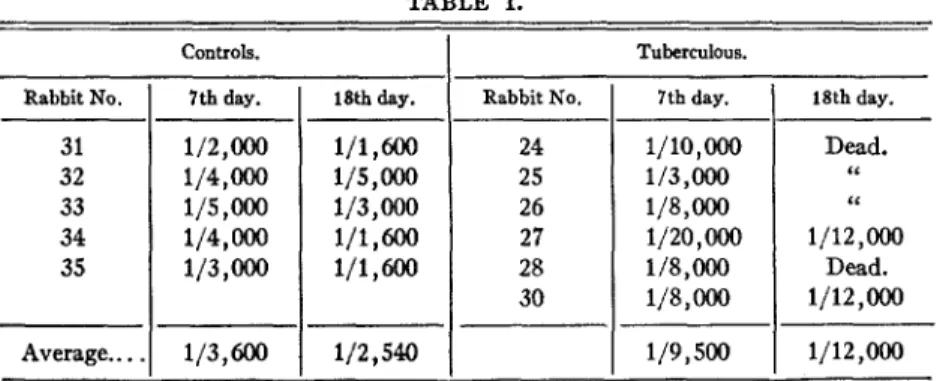
In the first of these 1/100 rag. of a bovine type culture, No. xviii, was given intraperitoneally. No significant differences in hemolysin production were made out, and when the animals were autopsied it was found that the infection had produced an insignificant amount of disease. In a second experiment 1 rag. of bovine type culture No. xiv was given intravenously. The blood cells were injected on the 16th day. On the 4th, 7th, and 9th days after the erythrocyte injection the amboceptor content of the tuberculous rabbits was lower than in the controls. Thereafter there was but one surviving tuberctflous rabbit. As the amboceptor content of the control animals remained stationary over the succeed- ing 6 days, that in the tuberculous animal increased until on the 16th day it stood at 1/16,000. The average of the controls on this day was 1/5,600 and the maxi- mum among five was 1/9,000.
TABLE I. Rabbit No. 31 32 33 34 35 Average .... Con~oh. 7th day. 1/2,000 1/4,000 1/5,000 1/4,000 1/3,000 1/3,600 18th day. 111,600 1/5,000 1/3,000 1/1,600 1/1,600 1/2,540 Rabbit No. 24 25 26 27 28 3O Tuberculous. 7th day. 1/10,000 1/3,000 1/8,ooo 1/20,000 i 1/8,000 i 1/8,ooo 1/9,500 18thday. Dead. 1/12,000 Dead. 1/12,000 1/12,000
In a third experiment the same culture was used (Bovine xiv). 1/20 rag. was injected intravenously into seven rabbits. 17 days later these together with five controls were given at one time 5 cc. of 20 per cent washed sheep red blood cor- puscles intravenously, 5 cc. intraperitoneally, and 5 cc. subcutaneously. They were all bled on the 7th and 18th days succeeding. The results are shown in Table I.
While it is plain t h a t the experiment does not proceed with the
same regularity as in the guinea pig, it is nonetheless evident t h a t in t h e rabbit, u n d e r a p p r o p r i a t e conditions, a n infection w i t h the tuber- d e bacillus does increase the p r o d u c t i o n of anti-sheep amboceptor. Conditions favorable to t h e d e m o n s t r a t i o n appear to be the t h o r o u g h establishment of an infection of considerable, b u t n o t of overwhelm- ing severity.
PALIL A. L E W I S A N D D O R O T H Y LOOMIS 269 The preceding experiments show that the stimulation of antibody production with which we are concerned is quite a general phenom- enon. I t can be brought about by a variety of chronic infections; it is exerted against at least two antigens, and is developed in at least two species of animals. Of the means adopted hone thus far tested is equal from a quantitative point of view to an active, well established infection with Bacillus tuberculosis.
I n this connection it has been interesting to compare the effect of repeated injections of red cells in normal and tuberculous animals. The experiment is limited in its scope because of the short length of life of the tuberculous. The results may be simply stated without tabulation. I n a group of ten tuberculous animals given three in- jections of red cells an average amboceptor titration of 1/58,000 was obtained on the 22nd day after the last injection. One of the animals reached 1/100,000. In normal animals the highest individual figure obtained by any mmlber of injections (following the second injec- tion in this instance) was 1/5,500, and the highest average for any group was 1/4,500. As reported in our first paper, a single injection of blood cells in tuberculous animals may give an average titration of over 1/20,000 on the 22nd day, a figure still four or five times the maximum we have been able to attain by repeated blood cell injection in uninfected animals. The stimulus of infection would appear to be more effective in increasing the quantity of antibody produced than the stimulus of several preceding injections of the specific antigen. That the figures for attainable antibody concentration afford the proper basis for comparison of the quantitative effects of the two sorts of stimuli may well be doubted. We have wished to construct complete curves of antibody production for the normal and the tuberculous after repeated blood cell injections. The technical difficulties have not so far been surmounted. It is our impression, however, that for repeated injections, as was shown for single injec- tions in our first paper, the form of the curves would be comparable but at a higher level. I t seems likely, in other words, that the factor by which each succeeding injection would increase the results of its predecessor is no greater in the case of the tuberculous animal than in the normal. From this point of view the two kinds of stimuli seem to act quite independently and to be capable of summation.
270 ALLERGIC IRRITABILITY. III
As an incident to our observations as previously reported, we de- termined the curve of antibody production in the guinea pig for anti- sheep hemolytic amboceptor. We found it characterized b y a double maximum, the first and usual peak at about the 9th day being succeeded b y a low point at about the 12th day and a later peak, higher than the first, about the 22nd day. In the course of the pres- ent work we have amplified these observations to a certain extent. As shown in Chart 2, the curve as described is followed in its charac- teristic features as a response to a single injection of
Bacillus typho-
sus (killed culture). In this case the second maximum appears somewhat earlier, at the 18th rather than the 22nd day.
Dilu[ion5
,ooo
1,soo I
1.ooo
q 500x,
x,
Day5 5 10 15 20 25 50CHAleT 3. Composite curve of hemolytic amboceptor production in guinea pigs
after the fourth of a series of treatments with sheep cells at 28 day intervals. In such work as we have done with rabbits we have kept this ques- tion constantly in mind b u t have obtained no suggestion of a second peak in them.
I n Chart 3 we present the results of observations on a group of guinea pigs for the period succeeding the fourth of a series of injec- tions of sheep red cells at 28 day intervals. I t will be noticed that the form of the curve is essentially that of Chart 2 in this paper and those previously published. The first peak of production occurs unchanged at the 9th day. The second peak is advanced to the 17th to 19th day.
PAUL A. LEWIS AND DOROTHY LOOMIS 271
As was to be expected, observations made after the last of a series of injections at 5 to 7 day intervals do not develop this form. The high point is usually about the 9th day in such cases, probably be- cause this day following the last injection is also near the second peak of some previous one.
DISCUSSION.
I n our previous papers we have defined and used the term "allergic irritability" as a "general characteristic of the animal on the basis of which it reacts to stimuli of the antigenic class, whether they be helpful, injurious, or indifferent to bodily health." The observations herein recorded serve to confirm and amplify the evidence that such a distinction between the actual response of the animal and its "capac- ity" to respond is of interest. The allergic irritability is found to be increased by a variety of means, particularly by several chronic infections. Infection with the tubercle bacillus under conditions favorable to the full development of its influence is the most effec- tive of these so far as our experience goes.
An intensive treatment with trypan blue throughout the course of the reaction period was almost as effective as infection with the tubercle bacillus. This substance was chosen for experiment because of its well known a t e , ity as a vital stain for cells of the reticulo- endothelial cell system particularly the macrophages. There is considerable evidence for the assumption that these ceils are increased in number by treatment with trypan blue and related substances. I t is likewise to be accepted that cells of this system are greatly pro- liferated in tuberculosis. Correlation of these suggestions with such evidence as is available as to the origin of antibodies in these cells, and this is also considerable, lends weight to the thought that the stimulation of antibody production which we have observed is based on an increased activity of these cells, due to either an increase in their number or a stimulation of one or more phases of their physio- logical activity.
There seems to us to be no essential conflict between this concep- tion, or the concrete experiments on which it is based, and the work of others who have succeeded in inhibiting antibody formation by "blocking" these cells with trypan blue and other colloidal substances.
272 ALLERGIC IRRITABILITY. III
I t is, in fact, a rather general rule that substances which exert physio- logical activity are stimulating in certain doses and depressing when their application is carried to an extreme.
In any event our experiments justify a more serious consideration of allergic irritability as a characteristic, subject to experimental influence in connection with the general principles and phenomena of immunity. I t is evidently possible while leaving the specific reactions to antigenic substances intact, to increase greatly their intensity by influences that affect a more general,--one is tempted to say "non-specific,"--set of reactions.
CONCLUSIONS.
1. The allergic irritability of the guinea pig (capacity of the ani- mal to react to antigenic substances) is increased by infection with Bacillus abortus and a streptococcus, by the dead tubercle bacillus, and by intensive treatment with trypan blue, respectively. The effect of these influences, while definite, is less pronounced than that previously found for infection with the tubercle bacillus. The pro- duction of anti-sheep hemolytic amboceptor was used as the test reaction in these cases.
2. The allergic irritability of the guinea pig with reference to anti- typhoid agglutinin is increased by infection with the tubercle bacillus. 3. The allergic irritability of the rabbit with reference to anti- sheep hemolytic amboceptor is increased by an infection of suitable severity with the tubercle bacillus.
4. In the guinea pig the curve of antibody production is complex. Its peculiarities are developed during the production of antityphoid agglutinins as well as that of anti-sheep hemolytic amboceptor. In the latter case injections of antigen subsequent to the first give rise to a curve of production unchanged in form but somewhat aff.ected in the time relations.
5. The effects of infection with Bacillus tuberculosis on allergic irritability with reference to anti-sheep hemolytic amboceptor are operative throughout a course of immunizing treatments. The suc- cessive increases due to the cumulative effect of repeated doses of the antigen are developed on a higher level. The end-result is that the animal with increased irritability furnishes more antibody not
PAUL A. LEWIS AND DOROTHY LOOMIS 273 only in response to the initial injection of antigen as previously de- scribed, b u t an absolute increase over the a m o u n t a t t a i n a b l e b y a comparable number of t r e a t m e n t s in series. T h a t portion of the final result contributed b y the increase in allergic irritability appears to be no less, a n d m a y even in instances be somewhat more t h a n t h a t due to the earlier doses of the specific antigen.
BIBLIOGRAPHY.
1. Lewis, P. A., and Loomis, D., J. Exp. Med., 1924, xl, 503. 2. Lewis, P. A., and Loomis, D., J. Exp. Med., 1925, xli, 327.
3. Clark, P. F., Zellmer, C. E., and Stone, H. W., J. Infect. Dis., 1922, xxxi, 215. 4. Issaeff, Z. Hyg. u. Infectionskrankh., 1894, xvi, 287. Pfeiffer, R., and Issaeff,
Z. Hyg. u. Infectionskrankh., 1894, xvii, 355. 5. Khanolkar, V. R., Y. Path. andBact., 1924, xxvii, 181. 6. Schroeder, M. L., J. Med. Research, 1923-24, xliv, 507. 7. Hektoen, L., and Corper, H. J., J. Infect. Dis., 1925, xxxvii, 82.