Dynamic and on demand data streams
MatteoDuranti1,∗,ValerioFormato1,∗∗, andValerioVagelli2,1,∗∗∗ 1INFN Sezione di Perugia, I-06100 Perugia, Italy
2Università degli Studi di Perugia, I-06100 Perugia, Italy
Abstract.Replicability and efficiency of data processing on the same data
sam-ples are a major challenge for the analysis of data produced by HEP experi-ments. High level data analyzed by end-users are typically produced as a sub-set of the whole experiment data sample to study interesting selection of data (streams). For standard applications, streams may be eventually copied from servers and analyzed on local computing centers or user machine clients. The creation of streams as copy of a subset of the original data results in redundant information stored in filesystems and may be not efficient: if the definition of
streams changes, it may force a reprocessing of the low-level files with conse-quent impact on the data analysis efficiency. We propose an approach based on
a database of lookup tables intended for dynamic and on-demand definition of data streams. This enables the end-users, as the data analysis strategy evolves, to explore different definitions of streams with minimal cost in computing
re-sources. We also present a prototype demonstration application of this database for the analysis of the AMS-02 experiment data.
One of the major challenges for the analysis of data produced by high energy physics (HEP) experiments is the efficiency of the data processing on the same data samples. The output of the process of data taking is typically a collection of values produced by the detector electronic channels, that digitizes the interesting information provided by the analog probes. Frequently, the "raw" data are processed using custom reconstruction softwares to produce the "reconstructed, or "reco" files, that contain more advanced information defined on the basis of the raw datas. Raw data are rarely processed multiple times, often only to produce the higher-level data files. Reconstructed data, instead, are typically processed many times and by a larger spectrum of users. For each set a raw data, multiple versions of "reco" data files may be produced depending on advances on the reconstruction software. Data for analysis are stored in Centralised Analysis Facilities (CAFs) for efficient access by end users. CAFs provide the hardware infrastructures and software frameworks for efficient access to files by several users. In order to identify interesting – and typically rare – features in the data it is very common to process the same data samples many times. While end-users prefer to have local access to data on their machines, they are forced to analyze filesin situdue to the large data set sizes.
To overcome this, a diffuse procedure is that ofdata preselection: if only a subset of data is found to be useful for a particular analysis, that subset is copied into a different file, or "stream". If the data size of streams is much smaller than the original file size, it becomes
∗e-mail: [email protected] ∗∗e-mail: [email protected] ∗∗∗e-mail: [email protected]
© The Authors, published by EDP Sciences. This is an open access article distributed under the terms of the Creative Commons Attribution License 4.0 (http://creativecommons.org/licenses/by/4.0/).
EPJ Web of Conferences 214, 04030 (2019) https://doi.org/10.1051/epjconf/201921404030
feasible to copy the stream on local machines of end-users. Moreover, usually a simplified version of the original data structure that contains a subset of the data information, called DST, is created by the end user to speed up the data analysis. The data process flow is shown in Figure 1.
Dynamic and on demand data streams
Matteo Duranti
(a), Valerio Formato
(a), Valerio Vagelli
(a,b)(a) Istituto Nazionale di Fisica Nucleare, Perugia (IT)
(b) Department of Physics and Geology, University of Perugia (IT)
Replicability and efficiency of data processing on the same data samples are a major challenge for the analysis of data produced by HEP experiments. High-level data analyzed by end-users are typically produced as a subset of the whole experiment data sample to study interesting selection of data (streams). For standard applications, streams may be eventually copied from servers and analyzed on local computing centers or user machine clients. The creation of streams as copy of a subset of the original data results in redundant information stored in filesystems and may be not efficient: if the definition of streams changes, it may force a reprocessing of the low-level files with consequent impact on the data analysis efficiency.
We propose an approach based on a database of lookup tables intended for dynamic and on-demand definition of data streams. This enables the end-users, as the data analysis strategy evolves, to explore different definitions of streams with minimal cost in computing resources. We also present a prototype demonstration application of this database for the analysis of the AMS-02 experiment data
1 √ X -- √
RUN 0
-Event 0
-Event 1
-Event 2
RUN 1
-Event 0
-Event 1
RUN 2
-Event 0
-Event 1
-Event 2
-Event 3
HEP data formats and data streams
Typical process for production of end-user analysis data
RAW data
- Low level instrument information, no physics objects Reconstructed data
- High level physics objects - Organized in events as part of runs Data streams
- Subset of events or runs selected for a specific analysis DST data
- Simplified data structure with a selection of variables and high level information
Production of data streams - Static approach •Process reconstructed data
•Select interesting events
•Copy subset of events to data stream
Drawbacks:
•Changes in the definition of the stream or in the selection force a new data reprocessing •Data processing can be resource demanding
•Data streams are copied to analysis centers and the information is duplicated
RUN 0
-Event 0
-Event 1
-Event 2
RUN 1
-Event 0
-Event 1
RUN 2
-Event 0
-Event 1
-Event 3
-Event 4
EVENT SELECTION
RUN 0
-Event 0
-Event 2
RUN 1
-Event 1
RUN 2
-Event 3
-Event 4
SAVE DATA STREAM
RUN 0
-Event 0
-Event 1
-Event 2
RUN 1
-Event 0
-Event 1
RUN 2
-Event 0
-Event 1
-Event 3
-Event 4
COPY DATA STREAM ( TO
ANALYSIS CENTERS)
RUN 0 -Event 0 -Event 2 RUN 1 -Event 1 RUN 2 -Event 3 -Event 4
RUN 0 -Event 0 -Event 2 RUN 1 -Event 1 RUN 2 -Event 3 -Event 4 RUN 0 -Event 0 -Event 2 RUN 1 -Event 1 RUN 2 -Event 3 -Event 4
RUN 0 -Event 0 -Event 2 RUN 1 -Event 1 RUN 2 -Event 3 -Event 4
Creation of a database for dynamic definition of data streams
•Access to reconstructed data information and test all pre-defined selection criteria •Store the information on a database indexed by run & event number
•Index the database with the data ntuples
Definition of stream
•Inspect the database for events that fulfill the selection criteria •Interesting events are automatically selected
•Non interesting events are not access from filesystem at all
RUN 0 RUN 1 RUN 2 RUN 0 RUN 1 RUN 2
Concept tested for analysis of AMS-02 data
AMS-02 data are stored in a AMSRoot ROOT TTree, events are uniquely identified by Run + Event numbers PreselectionDB implemented in the form of a ROOT TTree indexed to AMSRoot via Run & Event
Creation of the PreselectionDB
•Boolean selection criteria are tested for all events and stored as bits in a word
•Boolean selection criteria are tested for all Particle objects in each event and stored as bits in a word •The value of interesting continuous variables is discretized and stored in a dedicated word
Selection of events for data analysis
•The user defines which selections should be checked and assigns bitwise words (i.e. “masks”) •The user inputs the selection mask to the PreselctionDB
•The PreselectionDB provides the Run and Event numbers of all events fulfilling the user requirements •The user loops on the whole datasets and retrieves (locally or remotely) from file only the interesting events
Less I/O demands Less disk space
Flexible and dynamic definition of data streams The PreselectionDB approach
Use case: PreselectionDB applied to AMS-02 data analysis
All selection criteria are tested against the whole dataset only during the creation of the PreselectionDB
During the data analysis, the stream is identified dynamically: the PreselectionDB provides the user a unique identifier of the events fulfilling the selection. The user retrieves on demand from file only the selected events
RAW DATA RECO DATA
DATA STREAMS DST DATA STREAMS DATA STREAMS DST DST READ FROM DISK (LOCAL OR REMOTE)
Example of PreselectionDB entry
UInt run = 1234567890 UInt event = 123456
ULong event_word = 0x3E9 = (0011 1110 1001)2
12 selections tested for the event
vector<ULong> particle_word = <0x29, 0x71> = <(0010 1001)2, (0111 0001)2>
2 particles in the events, 8 selections tested for each particles
vector<ULong> particle_energy = <0xA1, 0x32> = <(1010 0001)2, (0011 0010)2>
2 particles in the event, energy value discretized in a 8 bin interval COMPLETE DATA FORMAT
RUN 0
-Event 0
-Event 1
-Event 2
RUN 1
-Event 0
-Event 1
RUN 2
-Event 0
-Event 1
-Event 2
-Event 3
VOLATILE ON-DEMAND DATA COMPLETE DATA FORMAT
COMPLETE DATA FORMAT
COMPLETE DATA FORMAT
√ X X √ XX X √ √ X √ √
√ X √ √ √ √ √ √
XX √ √ X X√ √ √ X X √ √ X √ √
EVENT SELECTION
(“MASK”) √ XX XX X √ √
√ X √ √
√ X √ √ √ √ √ √
XX √ √ X X√ √ √ X X √ √ X √ √
RUN 0
-Event 0
-Event 1
-Event 2
RUN 1
-Event 0
-Event 1
RUN 2
-Event 0
-Event 1
-Event 2
-Event 3
COMPLETE DATA FORMAT DATABASE COMPLETE DATA FORMAT DATABASE
Applications tested and applied successfully:
•Dynamic selection of data from the complete AMS-02 dataset as on-demand streams
•Istantaneous comparison of data selections
•Calculation of efficiencies or ratios
Event selection criteria
[0] = “Event-Reconstruction-Success” [1] = “Science-Run"
[2] = “No-HW-Failures” [3] = “Good-Livetime” [4] = “Phys-Trigger” [5] = ……
Particle selection criteria
[0] = “Particle-Reconstruction-Success” [1] = “Downgoing-Particle” [2] = “Inner-Tracker-Acceptance” [3] = “Particle-Above-GM-cutoff” [4] = “Good-Track-Reconstruction” [5] = …..
Figure 1.Typical process for production of end-user analysis data.
In a typical HEP experiment, data are collected in data acquisition sets referred from here on asruns. For each run, a set ofeventsis produced. Each event contains the information pro-duced by the experiment, in forms of booleans, indexed and un-indexed discrete values and continuous valuesxi. Data are usually analyzed many times in search for hidden correlation
between the data variables. A typical data analysis approach used in HEP experiments is the so-calledTag&Probemethod. A subset of the whole data sample that fulfills user-defined criteria is extracted and analyzed. In the simplest scenario, any single criteria used in the data selection can be mathematically expressed as:
gi(x1, ...xN)=0 (1)
The complete selection is itself a functionF, of allgi:
F(g1(x1, ...xN), ...gN(x1, ...xN))=0. (2)
Astreamis a subset of events that fulfils any requirement equivalent to Eq 2, and it can be
uniquely identified by such condition. A common approach to access to data streams is to clone the selected events and save them in a different file maintaining the same data structure.
The stream files, if small enough, can be therefore stored and analyzed locally.
The typical process for production of data streams is sketched in Figure 2. This approach,
Dynamic and on demand data streams
Matteo Duranti
(a), Valerio Formato
(a), Valerio Vagelli
(a,b)(a) Istituto Nazionale di Fisica Nucleare, Perugia (IT)
(b) Department of Physics and Geology, University of Perugia (IT)
Replicability and efficiency of data processing on the same data samples are a major challenge for the analysis of data produced by HEP experiments. High-level data analyzed by end-users are typically produced as a subset of the whole experiment data sample to study interesting selection of data (streams). For standard applications, streams may be eventually copied from servers and analyzed on local computing centers or user machine clients. The creation of streams as copy of a subset of the original data results in redundant information stored in filesystems and may be not efficient: if the definition of streams changes, it may force a reprocessing of the low-level files with consequent impact on the data analysis efficiency.
We propose an approach based on a database of lookup tables intended for dynamic and on-demand definition of data streams. This enables the end-users, as the data analysis strategy evolves, to explore different definitions of streams with minimal cost in computing resources. We also present a prototype demonstration application of this database for the analysis of the AMS-02 experiment data
1 √ X -- √
RUN 0
-Event 0
-Event 1
-Event 2
RUN 1
-Event 0
-Event 1
RUN 2
-Event 0
-Event 1
-Event 2
-Event 3
HEP data formats and data streams
Typical process for production of end-user analysis data
RAW data
- Low level instrument information, no physics objects Reconstructed data
- High level physics objects - Organized in events as part of runs Data streams
- Subset of events or runs selected for a specific analysis DST data
- Simplified data structure with a selection of variables and high level information
Production of data streams - Static approach •Process reconstructed data
•Select interesting events
•Copy subset of events to data stream
Drawbacks:
•Changes in the definition of the stream or in the selection force a new data reprocessing •Data processing can be resource demanding
•Data streams are copied to analysis centers and the information is duplicated
RUN 0
-Event 0
-Event 1
-Event 2
RUN 1
-Event 0
-Event 1
RUN 2
-Event 0
-Event 1
-Event 3
-Event 4
EVENT SELECTION
RUN 0
-Event 0
-Event 2
RUN 1
-Event 1
RUN 2
-Event 3
-Event 4
SAVE DATA STREAM
RUN 0
-Event 0
-Event 1
-Event 2
RUN 1
-Event 0
-Event 1
RUN 2
-Event 0
-Event 1
-Event 3
-Event 4
COPY DATA STREAM ( TO
ANALYSIS CENTERS)
RUN 0 -Event 0 -Event 2 RUN 1 -Event 1 RUN 2 -Event 3 -Event 4
RUN 0 -Event 0 -Event 2 RUN 1 -Event 1 RUN 2 -Event 3 -Event 4 RUN 0 -Event 0 -Event 2 RUN 1 -Event 1 RUN 2 -Event 3 -Event 4
RUN 0 -Event 0 -Event 2 RUN 1 -Event 1 RUN 2 -Event 3 -Event 4
Creation of a database for dynamic definition of data streams
•Access to reconstructed data information and test all pre-defined selection criteria •Store the information on a database indexed by run & event number
•Index the database with the data ntuples
Definition of stream
•Inspect the database for events that fulfill the selection criteria •Interesting events are automatically selected
•Non interesting events are not access from filesystem at all
RUN 0 RUN 1 RUN 2 RUN 0 RUN 1 RUN 2
Concept tested for analysis of AMS-02 data
AMS-02 data are stored in a AMSRoot ROOT TTree, events are uniquely identified by Run + Event numbers PreselectionDB implemented in the form of a ROOT TTree indexed to AMSRoot via Run & Event
Creation of the PreselectionDB
• Boolean selection criteria are tested for all events and stored as bits in a word
• Boolean selection criteria are tested for all Particle objects in each event and stored as bits in a word • The value of interesting continuous variables is discretized and stored in a dedicated word
Selection of events for data analysis
• The user defines which selections should be checked and assigns bitwise words (i.e. “masks”) • The user inputs the selection mask to the PreselctionDB
• The PreselectionDB provides the Run and Event numbers of all events fulfilling the user requirements • The user loops on the whole datasets and retrieves (locally or remotely) from file only the interesting events
Less I/O demands Less disk space
Flexible and dynamic definition of data streams
The PreselectionDB approach
Use case: PreselectionDB applied to AMS-02 data analysis
All selection criteria are tested against the whole dataset only during the creation of thePreselectionDB
During the data analysis, the stream is identified dynamically: the PreselectionDB provides the user a unique identifier of the events fulfilling the selection. The user retrieves on demand from file only the selected events
RAW DATA RECO DATA
DATA STREAMS DST DATA STREAMS DATA STREAMS DST DST READ FROM DISK (LOCAL OR REMOTE)
Example of PreselectionDB entry
UInt run = 1234567890 UInt event = 123456
ULong event_word = 0x3E9 = (0011 1110 1001)2
12 selections tested for the event
vector<ULong> particle_word = <0x29, 0x71> = <(0010 1001)2, (0111 0001)2>
2 particles in the events, 8 selections tested for each particles
vector<ULong> particle_energy = <0xA1, 0x32> = <(1010 0001)2, (0011 0010)2>
2 particles in the event, energy value discretized in a 8 bin interval
COMPLETE DATA FORMAT
RUN 0
-Event 0
-Event 1
-Event 2
RUN 1
-Event 0
-Event 1
RUN 2
-Event 0
-Event 1
-Event 2
-Event 3
VOLATILE ON-DEMAND DATA COMPLETE DATA FORMAT
COMPLETE DATA FORMAT
COMPLETE DATA FORMAT
√ X X √
XX X √ √ X √ √
√ X √ √ √ √ √ √
XX √ √
X X√ √ √ X X √ √ X √ √
EVENT SELECTION
(“MASK”) √ XX XX X √ √ √ X √ √
√ X √ √ √ √ √ √
XX √ √
X X√ √ √ X X √ √ X √ √ RUN 0
-Event 0
-Event 1
-Event 2
RUN 1
-Event 0
-Event 1
RUN 2
-Event 0
-Event 1
-Event 2
-Event 3
COMPLETE DATA FORMAT DATABASE COMPLETE DATA FORMAT DATABASE
Applications tested and applied successfully:
•Dynamic selection of data from the complete AMS-02 dataset as on-demand streams •Istantaneous comparison of data selections
•Calculation of efficiencies or ratios
Event selection criteria
[0] = “Event-Reconstruction-Success” [1] = “Science-Run"
[2] = “No-HW-Failures” [3] = “Good-Livetime” [4] = “Phys-Trigger” [5] = ……
Particle selection criteria
[0] = “Particle-Reconstruction-Success” [1] = “Downgoing-Particle”
[2] = “Inner-Tracker-Acceptance” [3] = “Particle-Above-GM-cutoff” [4] = “Good-Track-Reconstruction” [5] = …..
Figure 2.Production of data streams.
however, presents some drawbacks. The creation of streams as a copy of a subset of the
2
EPJ Web of Conferences 214, 04030 (2019) https://doi.org/10.1051/epjconf/201921404030
feasible to copy the stream on local machines of end-users. Moreover, usually a simplified version of the original data structure that contains a subset of the data information, called DST, is created by the end user to speed up the data analysis. The data process flow is shown in Figure 1.
Dynamic and on demand data streams
Matteo Duranti
(a), Valerio Formato
(a), Valerio Vagelli
(a,b)(a) Istituto Nazionale di Fisica Nucleare, Perugia (IT)
(b) Department of Physics and Geology, University of Perugia (IT)
Replicability and efficiency of data processing on the same data samples are a major challenge for the analysis of data produced by HEP experiments. High-level data analyzed by end-users are typically produced as a subset of the whole experiment data sample to study interesting selection of data (streams). For standard applications, streams may be eventually copied from servers and analyzed on local computing centers or user machine clients. The creation of streams as copy of a subset of the original data results in redundant information stored in filesystems and may be not efficient: if the definition of streams changes, it may force a reprocessing of the low-level files with consequent impact on the data analysis efficiency.
We propose an approach based on a database of lookup tables intended for dynamic and on-demand definition of data streams. This enables the end-users, as the data analysis strategy evolves, to explore different definitions of streams with minimal cost in computing resources. We also present a prototype demonstration application of this database for the analysis of the AMS-02 experiment data
1 √ X -- √
RUN 0
-Event 0
-Event 1
-Event 2
RUN 1
-Event 0
-Event 1
RUN 2
-Event 0
-Event 1
-Event 2
-Event 3
HEP data formats and data streams
Typical process for production of end-user analysis data
RAW data
- Low level instrument information, no physics objects Reconstructed data
- High level physics objects - Organized in events as part of runs Data streams
- Subset of events or runs selected for a specific analysis DST data
- Simplified data structure with a selection of variables and high level information
Production of data streams - Static approach •Process reconstructed data
•Select interesting events
•Copy subset of events to data stream
Drawbacks:
•Changes in the definition of the stream or in the selection force a new data reprocessing •Data processing can be resource demanding
•Data streams are copied to analysis centers and the information is duplicated
RUN 0
-Event 0
-Event 1
-Event 2
RUN 1
-Event 0
-Event 1
RUN 2
-Event 0
-Event 1
-Event 3
-Event 4
EVENT SELECTION
RUN 0
-Event 0
-Event 2
RUN 1
-Event 1
RUN 2
-Event 3
-Event 4
SAVE DATA STREAM
RUN 0
-Event 0
-Event 1
-Event 2
RUN 1
-Event 0
-Event 1
RUN 2
-Event 0
-Event 1
-Event 3
-Event 4
COPY DATA STREAM ( TO
ANALYSIS CENTERS)
RUN 0 -Event 0 -Event 2 RUN 1 -Event 1 RUN 2 -Event 3 -Event 4
RUN 0 -Event 0 -Event 2 RUN 1 -Event 1 RUN 2 -Event 3 -Event 4 RUN 0 -Event 0 -Event 2 RUN 1 -Event 1 RUN 2 -Event 3 -Event 4
RUN 0 -Event 0 -Event 2 RUN 1 -Event 1 RUN 2 -Event 3 -Event 4
Creation of a database for dynamic definition of data streams
•Access to reconstructed data information and test all pre-defined selection criteria •Store the information on a database indexed by run & event number
•Index the database with the data ntuples
Definition of stream
•Inspect the database for events that fulfill the selection criteria •Interesting events are automatically selected
•Non interesting events are not access from filesystem at all
RUN 0 RUN 1 RUN 2 RUN 0 RUN 1 RUN 2
Concept tested for analysis of AMS-02 data
AMS-02 data are stored in a AMSRoot ROOT TTree, events are uniquely identified by Run + Event numbers PreselectionDB implemented in the form of a ROOT TTree indexed to AMSRoot via Run & Event
Creation of the PreselectionDB
•Boolean selection criteria are tested for all events and stored as bits in a word
•Boolean selection criteria are tested for all Particle objects in each event and stored as bits in a word •The value of interesting continuous variables is discretized and stored in a dedicated word
Selection of events for data analysis
•The user defines which selections should be checked and assigns bitwise words (i.e. “masks”) •The user inputs the selection mask to the PreselctionDB
•The PreselectionDB provides the Run and Event numbers of all events fulfilling the user requirements •The user loops on the whole datasets and retrieves (locally or remotely) from file only the interesting events
Less I/O demands Less disk space
Flexible and dynamic definition of data streams The PreselectionDB approach
Use case: PreselectionDB applied to AMS-02 data analysis
All selection criteria are tested against the whole dataset only during the creation of the PreselectionDB
During the data analysis, the stream is identified dynamically: the PreselectionDB provides the user a unique identifier of the events fulfilling the selection. The user retrieves on demand from file only the selected events
RAW DATA RECO DATA
DATA STREAMS DST DATA STREAMS DATA STREAMS DST DST READ FROM DISK (LOCAL OR REMOTE)
Example of PreselectionDB entry
UInt run = 1234567890 UInt event = 123456
ULong event_word = 0x3E9 = (0011 1110 1001)2
12 selections tested for the event
vector<ULong> particle_word = <0x29, 0x71> = <(0010 1001)2, (0111 0001)2>
2 particles in the events, 8 selections tested for each particles
vector<ULong> particle_energy = <0xA1, 0x32> = <(1010 0001)2, (0011 0010)2>
2 particles in the event, energy value discretized in a 8 bin interval COMPLETE DATA FORMAT
RUN 0
-Event 0
-Event 1
-Event 2
RUN 1
-Event 0
-Event 1
RUN 2
-Event 0
-Event 1
-Event 2
-Event 3
VOLATILE ON-DEMAND DATA COMPLETE DATA FORMAT
COMPLETE DATA FORMAT
COMPLETE DATA FORMAT
√ X X √ XX X √ √ X √ √
√ X √ √ √ √ √ √
XX √ √ X X√ √ √ X X √ √ X √ √
EVENT SELECTION
(“MASK”) √ XX XX X √ √
√ X √ √
√ X √ √ √ √ √ √
XX √ √ X X√ √ √ X X √ √ X √ √
RUN 0
-Event 0
-Event 1
-Event 2
RUN 1
-Event 0
-Event 1
RUN 2
-Event 0
-Event 1
-Event 2
-Event 3
COMPLETE DATA FORMAT DATABASE COMPLETE DATA FORMAT DATABASE
Applications tested and applied successfully:
•Dynamic selection of data from the complete AMS-02 dataset as on-demand streams
•Istantaneous comparison of data selections
•Calculation of efficiencies or ratios
Event selection criteria
[0] = “Event-Reconstruction-Success” [1] = “Science-Run"
[2] = “No-HW-Failures” [3] = “Good-Livetime” [4] = “Phys-Trigger” [5] = ……
Particle selection criteria
[0] = “Particle-Reconstruction-Success” [1] = “Downgoing-Particle” [2] = “Inner-Tracker-Acceptance” [3] = “Particle-Above-GM-cutoff” [4] = “Good-Track-Reconstruction” [5] = …..
Figure 1.Typical process for production of end-user analysis data.
In a typical HEP experiment, data are collected in data acquisition sets referred from here on asruns. For each run, a set ofeventsis produced. Each event contains the information pro-duced by the experiment, in forms of booleans, indexed and un-indexed discrete values and continuous valuesxi. Data are usually analyzed many times in search for hidden correlation
between the data variables. A typical data analysis approach used in HEP experiments is the so-calledTag&Probemethod. A subset of the whole data sample that fulfills user-defined criteria is extracted and analyzed. In the simplest scenario, any single criteria used in the data selection can be mathematically expressed as:
gi(x1, ...xN)=0 (1)
The complete selection is itself a functionF, of allgi:
F(g1(x1, ...xN), ...gN(x1, ...xN))=0. (2)
Astreamis a subset of events that fulfils any requirement equivalent to Eq 2, and it can be
uniquely identified by such condition. A common approach to access to data streams is to clone the selected events and save them in a different file maintaining the same data structure.
The stream files, if small enough, can be therefore stored and analyzed locally.
The typical process for production of data streams is sketched in Figure 2. This approach,
Dynamic and on demand data streams
Matteo Duranti
(a), Valerio Formato
(a), Valerio Vagelli
(a,b)(a) Istituto Nazionale di Fisica Nucleare, Perugia (IT)
(b) Department of Physics and Geology, University of Perugia (IT)
Replicability and efficiency of data processing on the same data samples are a major challenge for the analysis of data produced by HEP experiments. High-level data analyzed by end-users are typically produced as a subset of the whole experiment data sample to study interesting selection of data (streams). For standard applications, streams may be eventually copied from servers and analyzed on local computing centers or user machine clients. The creation of streams as copy of a subset of the original data results in redundant information stored in filesystems and may be not efficient: if the definition of streams changes, it may force a reprocessing of the low-level files with consequent impact on the data analysis efficiency.
We propose an approach based on a database of lookup tables intended for dynamic and on-demand definition of data streams. This enables the end-users, as the data analysis strategy evolves, to explore different definitions of streams with minimal cost in computing resources. We also present a prototype demonstration application of this database for the analysis of the AMS-02 experiment data
1 √ X -- √
RUN 0
-Event 0
-Event 1
-Event 2
RUN 1
-Event 0
-Event 1
RUN 2
-Event 0
-Event 1
-Event 2
-Event 3
HEP data formats and data streams
Typical process for production of end-user analysis data
RAW data
- Low level instrument information, no physics objects Reconstructed data
- High level physics objects - Organized in events as part of runs Data streams
- Subset of events or runs selected for a specific analysis DST data
- Simplified data structure with a selection of variables and high level information
Production of data streams - Static approach •Process reconstructed data
•Select interesting events
•Copy subset of events to data stream
Drawbacks:
•Changes in the definition of the stream or in the selection force a new data reprocessing •Data processing can be resource demanding
•Data streams are copied to analysis centers and the information is duplicated
RUN 0
-Event 0
-Event 1
-Event 2
RUN 1
-Event 0
-Event 1
RUN 2
-Event 0
-Event 1
-Event 3
-Event 4
EVENT SELECTION
RUN 0
-Event 0
-Event 2
RUN 1
-Event 1
RUN 2
-Event 3
-Event 4
SAVE DATA STREAM
RUN 0
-Event 0
-Event 1
-Event 2
RUN 1
-Event 0
-Event 1
RUN 2
-Event 0
-Event 1
-Event 3
-Event 4
COPY DATA STREAM ( TO
ANALYSIS CENTERS)
RUN 0 -Event 0 -Event 2 RUN 1 -Event 1 RUN 2 -Event 3 -Event 4
RUN 0 -Event 0 -Event 2 RUN 1 -Event 1 RUN 2 -Event 3 -Event 4 RUN 0 -Event 0 -Event 2 RUN 1 -Event 1 RUN 2 -Event 3 -Event 4
RUN 0 -Event 0 -Event 2 RUN 1 -Event 1 RUN 2 -Event 3 -Event 4
Creation of a database for dynamic definition of data streams
•Access to reconstructed data information and test all pre-defined selection criteria •Store the information on a database indexed by run & event number
•Index the database with the data ntuples
Definition of stream
•Inspect the database for events that fulfill the selection criteria •Interesting events are automatically selected
•Non interesting events are not access from filesystem at all
RUN 0 RUN 1 RUN 2 RUN 0 RUN 1 RUN 2
Concept tested for analysis of AMS-02 data
AMS-02 data are stored in a AMSRoot ROOT TTree, events are uniquely identified by Run + Event numbers PreselectionDB implemented in the form of a ROOT TTree indexed to AMSRoot via Run & Event
Creation of the PreselectionDB
• Boolean selection criteria are tested for all events and stored as bits in a word
• Boolean selection criteria are tested for all Particle objects in each event and stored as bits in a word • The value of interesting continuous variables is discretized and stored in a dedicated word
Selection of events for data analysis
• The user defines which selections should be checked and assigns bitwise words (i.e. “masks”) • The user inputs the selection mask to the PreselctionDB
• The PreselectionDB provides the Run and Event numbers of all events fulfilling the user requirements • The user loops on the whole datasets and retrieves (locally or remotely) from file only the interesting events
Less I/O demands Less disk space
Flexible and dynamic definition of data streams
The PreselectionDB approach
Use case: PreselectionDB applied to AMS-02 data analysis
All selection criteria are tested against the whole dataset only during the creation of thePreselectionDB
During the data analysis, the stream is identified dynamically: the PreselectionDB provides the user a unique identifier of the events fulfilling the selection. The user retrieves on demand from file only the selected events
RAW DATA RECO DATA
DATA STREAMS DST DATA STREAMS DATA STREAMS DST DST READ FROM DISK (LOCAL OR REMOTE)
Example of PreselectionDB entry
UInt run = 1234567890 UInt event = 123456
ULong event_word = 0x3E9 = (0011 1110 1001)2
12 selections tested for the event
vector<ULong> particle_word = <0x29, 0x71> = <(0010 1001)2, (0111 0001)2>
2 particles in the events, 8 selections tested for each particles
vector<ULong> particle_energy = <0xA1, 0x32> = <(1010 0001)2, (0011 0010)2>
2 particles in the event, energy value discretized in a 8 bin interval
COMPLETE DATA FORMAT
RUN 0
-Event 0
-Event 1
-Event 2
RUN 1
-Event 0
-Event 1
RUN 2
-Event 0
-Event 1
-Event 2
-Event 3
VOLATILE ON-DEMAND DATA COMPLETE DATA FORMAT
COMPLETE DATA FORMAT
COMPLETE DATA FORMAT
√ X X √
XX X √ √ X √ √
√ X √ √ √ √ √ √
XX √ √
X X√ √ √ X X √ √ X √ √
EVENT SELECTION
(“MASK”) √ XX XX X √ √ √ X √ √
√ X √ √ √ √ √ √
XX √ √
X X√ √ √ X X √ √ X √ √ RUN 0
-Event 0
-Event 1
-Event 2
RUN 1
-Event 0
-Event 1
RUN 2
-Event 0
-Event 1
-Event 2
-Event 3
COMPLETE DATA FORMAT DATABASE COMPLETE DATA FORMAT DATABASE
Applications tested and applied successfully:
•Dynamic selection of data from the complete AMS-02 dataset as on-demand streams •Istantaneous comparison of data selections
•Calculation of efficiencies or ratios
Event selection criteria
[0] = “Event-Reconstruction-Success” [1] = “Science-Run"
[2] = “No-HW-Failures” [3] = “Good-Livetime” [4] = “Phys-Trigger” [5] = ……
Particle selection criteria
[0] = “Particle-Reconstruction-Success” [1] = “Downgoing-Particle”
[2] = “Inner-Tracker-Acceptance” [3] = “Particle-Above-GM-cutoff” [4] = “Good-Track-Reconstruction” [5] = …..
Figure 2.Production of data streams.
however, presents some drawbacks. The creation of streams as a copy of a subset of the
original data results in redundant information stored in the CAF filesystems. Moreover, if the definition of stream changes, it may force a reprocessing of the files, with consequent impact on the data analysis efficiency.
We propose a solution for implementation of an analysis framework intended for efficient
replicated access to data sets as solution to the drawbacks discussed earlier.
1 The PreselectionDB approach
The solution suggested here is based on the implementation of a database, here referred as PreselectionDB, to store the information used to build the file streams and to use it
dynami-callyduring the data analysis.
The easiest solution is structured in a two step procedure:
1. creation of the database, an operation to be done only once and consisting in:
• access to reconstructed data information and test all pre-defined selection criteria;
• store the information on a database indexed by run and event number;
• index the database with the data ntuples, for instance using therunandevent num-bers;
2. evaluation of the database, an operation that has to be done during each data processing
• inspect the database for events that fulfill the selection criteria;
• interesting events are selected dynamically and the database provides the user with a unique identifier of the selected event;
• the user retrieves on demand from file only the selected events. Non interesting events are not accessed from filesystem at all.
While the creation of the database requires a custom software designed to read and process the original data, the software to access the database can be more flexible and easily interfaced to most of analysis routines.
During the PreselectionDB creation, for each event jthall the criteriagi, (i=1, ...,n), in
the form of Eq.1 are evaluated. Each evaluation results in a true/false statement
(correspond-ing to the statement “the jthevent has/has not fulfilled the ithcriterion"), that is stored in the
database. Each database entry corresponds to an event and a set of true/false statements.
During the analysis phase, for each event jtha subset of criteriaF(and, therefore, a subset
of streams) in the form of Eq.2 are evaluated by simply accessing to the database and checking the true/false statements. On the basis of rules defined by the end-user, the event is then
further analyzed or skipped. The creation of the database prevents the creation of additional file streams avoiding data duplication. This approach, in fact, uses the database as an ancillary tool that is accessed during the data analysis to dynamically retrieve the events that belong to a particular stream. The concept of usage of the database in sketched in Figure 3.
The use of a database and the dynamical event selection allow to save storage space used to clone the information in the streams. If only the high-level information used to define the stream definitions (the true/false statements of Eq.1 used in Eq.2) is stored, the database
will occupy only a fraction of the filesystem size occupied by the whole data. In addition to this, the data and the database could be both resident in an external server, and the users can decide which event to access by quering the database. The structure of the events may be more complex than what described here. An event could have a nested structure, a dynamic
3
EPJ Web of Conferences 214, 04030 (2019) https://doi.org/10.1051/epjconf/201921404030
Dynamic and on demand data streams
Matteo Duranti
(a), Valerio Formato
(a), Valerio Vagelli
(a,b)(a) Istituto Nazionale di Fisica Nucleare, Perugia (IT) (b) Department of Physics and Geology, University of Perugia (IT)
Replicability and efficiency of data processing on the same data samples are a major challenge for the analysis of data produced by HEP experiments. High-level data analyzed by end-users are typically produced as a subset of the whole experiment data sample to study interesting selection of data (streams). For standard applications, streams may be eventually copied from servers and analyzed on local computing centers or user machine clients. The creation of streams as copy of a subset of the original data results in redundant information stored in filesystems and may be not efficient: if the definition of streams changes, it may force a reprocessing of the low-level files with consequent impact on the data analysis efficiency.
We propose an approach based on a database of lookup tables intended for dynamic and on-demand definition of data streams. This enables the end-users, as the data analysis strategy evolves, to explore different definitions of streams with minimal cost in computing resources. We also present a prototype demonstration application of this database for the analysis of the AMS-02 experiment data
1 √ X -- √
RUN 0
-Event 0
-Event 1
-Event 2
RUN 1
-Event 0
-Event 1
RUN 2
-Event 0
-Event 1
-Event 2
-Event 3
HEP data formats and data streams
Typical process for production of end-user analysis data
RAW data
- Low level instrument information, no physics objects Reconstructed data
- High level physics objects - Organized in events as part of runs Data streams
- Subset of events or runs selected for a specific analysis DST data
- Simplified data structure with a selection of variables and high level information
Production of data streams - Static approach
• Process reconstructed data • Select interesting events
• Copy subset of events to data stream
Drawbacks:
• Changes in the definition of the stream or in the selection force a new data reprocessing • Data processing can be resource demanding
• Data streams are copied to analysis centers and the information is duplicated
RUN 0
-Event 0
-Event 1
-Event 2
RUN 1
-Event 0
-Event 1
RUN 2
-Event 0
-Event 1
-Event 3
-Event 4
EVENT SELECTION
RUN 0
-Event 0
-Event 2
RUN 1
-Event 1
RUN 2
-Event 3
-Event 4 SAVE DATA
STREAM
RUN 0
-Event 0
-Event 1
-Event 2
RUN 1
-Event 0
-Event 1
RUN 2
-Event 0
-Event 1
-Event 3
-Event 4
COPY DATA STREAM ( TO
ANALYSIS CENTERS)
RUN 0 -Event 0 -Event 2 RUN 1 -Event 1 RUN 2 -Event 3 -Event 4
RUN 0 -Event 0 -Event 2 RUN 1 -Event 1 RUN 2 -Event 3 -Event 4 RUN 0 -Event 0 -Event 2 RUN 1 -Event 1 RUN 2 -Event 3 -Event 4
RUN 0 -Event 0 -Event 2 RUN 1 -Event 1 RUN 2 -Event 3 -Event 4
Creation of a database for dynamic definition of data streams
• Access to reconstructed data information and test all pre-defined selection criteria • Store the information on a database indexed by run & event number
• Index the database with the data ntuples
Definition of stream
• Inspect the database for events that fulfill the selection criteria
• Interesting events are automatically selected
• Non interesting events are not access from filesystem at all
RUN 0
RUN 1
RUN 2
RUN 0
RUN 1
RUN 2
Concept tested for analysis of AMS-02 data
AMS-02 data are stored in a AMSRoot ROOT TTree, events are uniquely identified by Run + Event numbers
PreselectionDB implemented in the form of a ROOT TTree indexed to AMSRoot via Run & Event
Creation of the PreselectionDB
• Boolean selection criteria are tested for all events and stored as bits in a word
• Boolean selection criteria are tested for all Particle objects in each event and stored as bits in a word • The value of interesting continuous variables is discretized and stored in a dedicated word
Selection of events for data analysis
• The user defines which selections should be checked and assigns bitwise words (i.e. “masks”) • The user inputs the selection mask to the PreselctionDB
• The PreselectionDB provides the Run and Event numbers of all events fulfilling the user requirements • The user loops on the whole datasets and retrieves (locally or remotely) from file only the interesting events
Less I/O demands Less disk space
Flexible and dynamic definition of data streams
The PreselectionDB approach
Use case: PreselectionDB applied to AMS-02 data analysis
All selection criteria are tested against the whole dataset only during the creation of the PreselectionDB
During the data analysis, the stream is identified dynamically: the PreselectionDB provides the user a unique identifier of the events fulfilling the selection. The user retrieves on demand from file only the selected events
RAW DATA RECO DATA
DATA
STREAMS DST
DATA STREAMS
DATA STREAMS
DST
DST
READ FROM DISK (LOCAL OR REMOTE)
Example of PreselectionDB entry
UInt run = 1234567890
UInt event = 123456
ULong event_word = 0x3E9 = (0011 1110 1001)2
12 selections tested for the event
vector<ULong> particle_word = <0x29, 0x71> = <(0010 1001)2, (0111 0001)2>
2 particles in the events, 8 selections tested for each particles
vector<ULong> particle_energy = <0xA1, 0x32> = <(1010 0001)2, (0011 0010)2>
2 particles in the event, energy value discretized in a 8 bin interval
COMPLETE DATA FORMAT
RUN 0
-Event 0
-Event 1
-Event 2
RUN 1
-Event 0
-Event 1
RUN 2
-Event 0
-Event 1
-Event 2
-Event 3 VOLATILE ON-DEMAND DATA COMPLETE DATA FORMAT
COMPLETE DATA FORMAT
COMPLETE DATA FORMAT
√ X X √
XX X √ √ X √ √
√ X √ √ √ √ √ √
XX √ √
X X√ √ √ X X √ √ X √ √
EVENT SELECTION
(“MASK”) √ XX XX X √ √ √ X √ √
√ X √ √ √ √ √ √
XX √ √
X X√ √ √ X X √ √ X √ √
RUN 0
-Event 0
-Event 1
-Event 2
RUN 1
-Event 0
-Event 1
RUN 2
-Event 0
-Event 1
-Event 2
-Event 3
COMPLETE DATA FORMAT DATABASE COMPLETE DATA FORMAT DATABASE
Applications tested and applied successfully:
• Dynamic selection of data from the complete AMS-02 dataset as on-demand streams
• Istantaneous comparison of data selections
• Calculation of efficiencies or ratios
Event selection criteria
[0] = “Event-Reconstruction-Success” [1] = “Science-Run"
[2] = “No-HW-Failures” [3] = “Good-Livetime” [4] = “Phys-Trigger” [5] = ……
Particle selection criteria
[0] = “Particle-Reconstruction-Success” [1] = “Downgoing-Particle”
[2] = “Inner-Tracker-Acceptance” [3] = “Particle-Above-GM-cutoff” [4] = “Good-Track-Reconstruction” [5] = …..
Figure 3.Access to data using the preselection database.
number of objects (i.e. the amount of information changes for each event1). Anyway, the
basic idea holds and can be straightforwardly extended to any data structure.
Further information can be stored in the database in form ofindexing variables. If the data can be partitioned as a disjoint union of subsets, each unambiguously identified by a (integer) indexing number, it may be useful to store such number for each event. In the case the indexing variable is a continuous variable, it could be useful to store the variable as it is. We suggest, however, a possible solution to store multiple indexing variables loosing minimum information and maximizing the optimization of the data size. Let’s assume the continuous indexing variables (χi) are single-precision floating point numbers that exist in a domain
Di=[χi(min), χ(imax)]2. A single-precision floating point number would occupy a 4-byte word
according to the IEEE 754 standard if stored plain in the database. However, the domain can be partitioned inndisjoint subsetsSisuch thatiSi =∅andiSi =Di, an operation that
in the physics analysis jargon is usually called "binning". Each subsetSirepresents a unique range that could contain the variable. The index of the subsetSicontaining the value of the variables could be stored in the database. In this procedure, the value of the variable in lost but the index of the subsetSi can be later retrieved during the analysis phase to access to the range of the variable value. The gain in terms of data storage is evident: the index of the subsetSiin a partition ofn =28 = 256 can be stored in a 1-byte word. The amounts
of single-precision floating point ranges that can be stored in a 4-byte word depends on the number of partitions, that have to be defined in a compromise between storage space saving and information loss.
The approach of the PreselectionDB provides a number of features that improve the
efficiency of the data analysis with respect to the standard production of file streams:
• routines for data selection are evaluated only once during the database creation:
• the procedure to check the quality of events reduces to the verification of true/false
vari-ables;
• the same database can be used by different users to define multiple streams;
• the database can be dynamically created and integrated with new information just by re-processing the original data to check the new requirements only and pushing the result into the database;
1This is a typical situation for the data of a HEP experiment, like the number of reconstructed tracks in a
spec-trometer.
2The notation includes the casesχ(min)
i =−∞andχ(imin)= +∞
4
EPJ Web of Conferences 214, 04030 (2019) https://doi.org/10.1051/epjconf/201921404030
Dynamic and on demand data streams
Matteo Duranti
(a), Valerio Formato
(a), Valerio Vagelli
(a,b)(a) Istituto Nazionale di Fisica Nucleare, Perugia (IT) (b) Department of Physics and Geology, University of Perugia (IT)
Replicability and efficiency of data processing on the same data samples are a major challenge for the analysis of data produced by HEP experiments. High-level data analyzed by end-users are typically produced as a subset of the whole experiment data sample to study interesting selection of data (streams). For standard applications, streams may be eventually copied from servers and analyzed on local computing centers or user machine clients. The creation of streams as copy of a subset of the original data results in redundant information stored in filesystems and may be not efficient: if the definition of streams changes, it may force a reprocessing of the low-level files with consequent impact on the data analysis efficiency.
We propose an approach based on a database of lookup tables intended for dynamic and on-demand definition of data streams. This enables the end-users, as the data analysis strategy evolves, to explore different definitions of streams with minimal cost in computing resources. We also present a prototype demonstration application of this database for the analysis of the AMS-02 experiment data
1 √ X -- √
RUN 0
-Event 0
-Event 1
-Event 2
RUN 1
-Event 0
-Event 1
RUN 2
-Event 0
-Event 1
-Event 2
-Event 3
HEP data formats and data streams
Typical process for production of end-user analysis data
RAW data
- Low level instrument information, no physics objects Reconstructed data
- High level physics objects - Organized in events as part of runs Data streams
- Subset of events or runs selected for a specific analysis DST data
- Simplified data structure with a selection of variables and high level information
Production of data streams - Static approach
• Process reconstructed data • Select interesting events
• Copy subset of events to data stream
Drawbacks:
• Changes in the definition of the stream or in the selection force a new data reprocessing • Data processing can be resource demanding
• Data streams are copied to analysis centers and the information is duplicated
RUN 0
-Event 0
-Event 1
-Event 2
RUN 1
-Event 0
-Event 1
RUN 2
-Event 0
-Event 1
-Event 3
-Event 4
EVENT SELECTION
RUN 0
-Event 0
-Event 2
RUN 1
-Event 1
RUN 2
-Event 3
-Event 4 SAVE DATA
STREAM
RUN 0
-Event 0
-Event 1
-Event 2
RUN 1
-Event 0
-Event 1
RUN 2
-Event 0
-Event 1
-Event 3
-Event 4
COPY DATA STREAM ( TO
ANALYSIS CENTERS)
RUN 0 -Event 0 -Event 2 RUN 1 -Event 1 RUN 2 -Event 3 -Event 4
RUN 0 -Event 0 -Event 2 RUN 1 -Event 1 RUN 2 -Event 3 -Event 4 RUN 0 -Event 0 -Event 2 RUN 1 -Event 1 RUN 2 -Event 3 -Event 4
RUN 0 -Event 0 -Event 2 RUN 1 -Event 1 RUN 2 -Event 3 -Event 4
Creation of a database for dynamic definition of data streams
• Access to reconstructed data information and test all pre-defined selection criteria • Store the information on a database indexed by run & event number
• Index the database with the data ntuples
Definition of stream
• Inspect the database for events that fulfill the selection criteria
• Interesting events are automatically selected
• Non interesting events are not access from filesystem at all
RUN 0
RUN 1
RUN 2
RUN 0
RUN 1
RUN 2
Concept tested for analysis of AMS-02 data
AMS-02 data are stored in a AMSRoot ROOT TTree, events are uniquely identified by Run + Event numbers
PreselectionDB implemented in the form of a ROOT TTree indexed to AMSRoot via Run & Event
Creation of the PreselectionDB
• Boolean selection criteria are tested for all events and stored as bits in a word
• Boolean selection criteria are tested for all Particle objects in each event and stored as bits in a word • The value of interesting continuous variables is discretized and stored in a dedicated word
Selection of events for data analysis
• The user defines which selections should be checked and assigns bitwise words (i.e. “masks”) • The user inputs the selection mask to the PreselctionDB
• The PreselectionDB provides the Run and Event numbers of all events fulfilling the user requirements • The user loops on the whole datasets and retrieves (locally or remotely) from file only the interesting events
Less I/O demands Less disk space
Flexible and dynamic definition of data streams
The PreselectionDB approach
Use case: PreselectionDB applied to AMS-02 data analysis
All selection criteria are tested against the whole dataset only during the creation of the PreselectionDB
During the data analysis, the stream is identified dynamically: the PreselectionDB provides the user a unique identifier of the events fulfilling the selection. The user retrieves on demand from file only the selected events
RAW DATA RECO DATA
DATA
STREAMS DST
DATA STREAMS
DATA STREAMS
DST
DST
READ FROM DISK (LOCAL OR REMOTE)
Example of PreselectionDB entry
UInt run = 1234567890
UInt event = 123456
ULong event_word = 0x3E9 = (0011 1110 1001)2
12 selections tested for the event
vector<ULong> particle_word = <0x29, 0x71> = <(0010 1001)2, (0111 0001)2>
2 particles in the events, 8 selections tested for each particles
vector<ULong> particle_energy = <0xA1, 0x32> = <(1010 0001)2, (0011 0010)2>
2 particles in the event, energy value discretized in a 8 bin interval
COMPLETE DATA FORMAT
RUN 0
-Event 0
-Event 1
-Event 2
RUN 1
-Event 0
-Event 1
RUN 2
-Event 0
-Event 1
-Event 2
-Event 3 VOLATILE ON-DEMAND DATA COMPLETE DATA FORMAT
COMPLETE DATA FORMAT
COMPLETE DATA FORMAT
√ X X √
XX X √ √ X √ √
√ X √ √ √ √ √ √
XX √ √
X X√ √ √ X X √ √ X √ √
EVENT SELECTION
(“MASK”) √ XX XX X √ √ √ X √ √
√ X √ √ √ √ √ √
XX √ √
X X√ √ √ X X √ √ X √ √
RUN 0
-Event 0
-Event 1
-Event 2
RUN 1
-Event 0
-Event 1
RUN 2
-Event 0
-Event 1
-Event 2
-Event 3
COMPLETE DATA FORMAT DATABASE COMPLETE DATA FORMAT DATABASE
Applications tested and applied successfully:
•Dynamic selection of data from the complete AMS-02 dataset as on-demand streams
•Istantaneous comparison of data selections
•Calculation of efficiencies or ratios
Event selection criteria
[0] = “Event-Reconstruction-Success” [1] = “Science-Run"
[2] = “No-HW-Failures” [3] = “Good-Livetime” [4] = “Phys-Trigger” [5] = ……
Particle selection criteria
[0] = “Particle-Reconstruction-Success” [1] = “Downgoing-Particle”
[2] = “Inner-Tracker-Acceptance” [3] = “Particle-Above-GM-cutoff” [4] = “Good-Track-Reconstruction” [5] = …..
Figure 3.Access to data using the preselection database.
number of objects (i.e. the amount of information changes for each event1). Anyway, the
basic idea holds and can be straightforwardly extended to any data structure.
Further information can be stored in the database in form ofindexing variables. If the data can be partitioned as a disjoint union of subsets, each unambiguously identified by a (integer) indexing number, it may be useful to store such number for each event. In the case the indexing variable is a continuous variable, it could be useful to store the variable as it is. We suggest, however, a possible solution to store multiple indexing variables loosing minimum information and maximizing the optimization of the data size. Let’s assume the continuous indexing variables (χi) are single-precision floating point numbers that exist in a domain
Di =[χi(min), χ(imax)]2. A single-precision floating point number would occupy a 4-byte word
according to the IEEE 754 standard if stored plain in the database. However, the domain can be partitioned inndisjoint subsetsSisuch thatiSi =∅andiSi =Di, an operation that
in the physics analysis jargon is usually called "binning". Each subsetSirepresents a unique range that could contain the variable. The index of the subsetSicontaining the value of the variables could be stored in the database. In this procedure, the value of the variable in lost but the index of the subsetSican be later retrieved during the analysis phase to access to the range of the variable value. The gain in terms of data storage is evident: the index of the subset Siin a partition ofn =28 = 256 can be stored in a 1-byte word. The amounts
of single-precision floating point ranges that can be stored in a 4-byte word depends on the number of partitions, that have to be defined in a compromise between storage space saving and information loss.
The approach of the PreselectionDB provides a number of features that improve the
efficiency of the data analysis with respect to the standard production of file streams:
• routines for data selection are evaluated only once during the database creation:
• the procedure to check the quality of events reduces to the verification of true/false
vari-ables;
• the same database can be used by different users to define multiple streams;
• the database can be dynamically created and integrated with new information just by re-processing the original data to check the new requirements only and pushing the result into the database;
1This is a typical situation for the data of a HEP experiment, like the number of reconstructed tracks in a
spec-trometer.
2The notation includes the casesχ(min)
i =−∞andχ(imin)= +∞
• the plain database structure allow the implementation with most data analysis package;
• the use of disk storage is limited by the database size and is independent on the number of streams.
In conclusion, the PreselectionDB approach allow a flexible and dynamic definition of
data streams requiring less I/O resources and disk space than standard approaches.
2 Use case: PreselectionDB applied to AMS-02 data analysis
AMS-02 is a HEP experiment operating on the International Space Station, where it detect cosmic rays (mostly fully ionized light nuclei) at an average rate of 700 Hz. The AMS-02 is composed by several subdetectors, each providing different information about the
cross-ing particle. For each cosmic ray crosscross-ing the AMS-02, the information collected by its electronic channels (∼300 000 channels in total) is processed in flight to select the channels containing interesting information to sent to ground. The data are transferred with an average rate of 9 Mbps. At ground, for each event the electronic channel information is processed using a dedicatedreconstructioncode, that identifies patterns in the data, clusters together channels providing similar information and builds high level objects that are used by the end users to investigate the properties of cosmic rays. An example of high level object is the track reconstructed in the spectrometer or the shower reconstructed in the electromagnetic calorimeter. The number of reconstructed objects is not fixed and its content changes dy-namically for each event. In the AMS reconstruction software, an additional hierarchical step is added to the data structure. After the subdetector objects are defined, they are clustered together to form aparticleobject. Such object is a collection of subdetector objects whose electronic channel information is produced by the same cosmic ray crossing the AMS-02 de-tector. Each event may contain 0 or few particle objects and a set or "orphan" objects, that are objects which do not belong to any particle.
In the first seven years of data taking, AMS-02 has collected more than 120×109events,
for a total of∼250 TB of raw data and close to 1 PB of reconstructed data stored on disk. Among such data set, scientists dig for interesting events that typically amount to less than 1% of the total data sample. The definition of “interesting" event strongly depends on the specific task of the analyses, and may change as the amount of collected data increases. Scientists therefore have to continuously process the whole data sample and check for each event whether a set of conditions in the form of Eq.2 is satisfied. PreselectionDB
2.1 The database
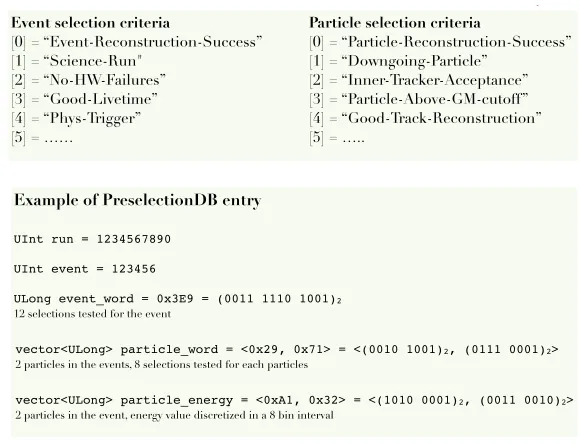
For the specific application case described here, two sets of criteria have been defined:
• Eventcriteria,g(ev)i (x1, ...xN)=0, based on the information common to the whole event
(example: time of the event acquisition, position and pointing of the experiment, etc...);
• Particlecriteria,g(pt)i (x1, ...xN)=0, based on the information proper of a particle object.
Acollection is the total set of criteria for a set. The Eventcollection groups together
32 criteria and the Particlecollection groups together 64 criteria. The maximum number of
criteria has been chosen as a compromise between a large enough variety of criteria while keeping the possibility to store the information in a 4-byte and a 8-byte word.
During the database creation all the 32 Eventcriteria,g(ev)i (x1, ...xN)=0 are evaluated
for each event. The results are stored using anegativelogic in a 4-byte word (corresponding to 32 bits) where each bit maps to an Eventcriteria. The ithbit is set to 1 if the criteria isnot
5
EPJ Web of Conferences 214, 04030 (2019) https://doi.org/10.1051/epjconf/201921404030